




The Kerala Board of Public Examinations (KBPE) successfully conducted the Class 10 Physics Exam 2026. The Kerala Board SSLC Physics Question Paper 2026 with Solution PDF is now available for download.
The Kerala Board Class 10 Physics paper covered important topics such as laws of motion, light, electricity, magnetism, energy, and modern physics. Students should focus on numerical problem-solving, derivations, diagrams, practical applications, and conceptual understanding. The exam evaluates both theoretical knowledge and analytical skills.
Kerala Board SSLC Physics Question Paper 2026 with Solution PDF
| Kerala Board Class 10 Physics Question Paper 2026 | Download PDF | Check Solution |
What does the term “Ohmic Heating” indicate?
Statement: If the stem of a tuning fork is placed on a table, the sound heard increases.
Reason: If the frequency of the forcing object and the natural frequency of the forced object are not equal, then objects are said to be in resonance. The frequency of the object undergoing resonance will increase.
When passing through water droplets while forming rainbow light rays undergo:
(i) Increase in speed.
(ii) Internal reflection.
(iii) Total internal reflection.
(iv) Refraction.
Match the following and choose the correct option:
A. Bar magnet
B. Magnetism is permanent
C. Polarity can be changed
D. Current carrying solenoid
E. Magnetic strength can be varied
F. Polarity cannot be changed
A child standing between two large buildings claps and hears the echo from the first building in 0.2 seconds and the echo from the second building in 0.3 seconds. (Speed of sound in air = \(340\ m/s\))
(a) What is the condition to produce an echo?
(b) Calculate the distance between the two buildings.
Draw a ray diagram showing the formation of a virtual image by a convex lens.
(A) The Sun appears red or yellow or orange during sunrise and sunset. But normally the sky appears blue in colour. Describe an experiment that would be helpful in explaining the cause of these phenomena.
OR
(B) In winter, path of light through the gaps of the branches of trees can be seen clearly due to scattering.
(a) By what name is the phenomenon known where the path of light becomes visible in this manner? Through what type of medium does light travel when this occurs?
(b) What does the intensity of scattering depend on?
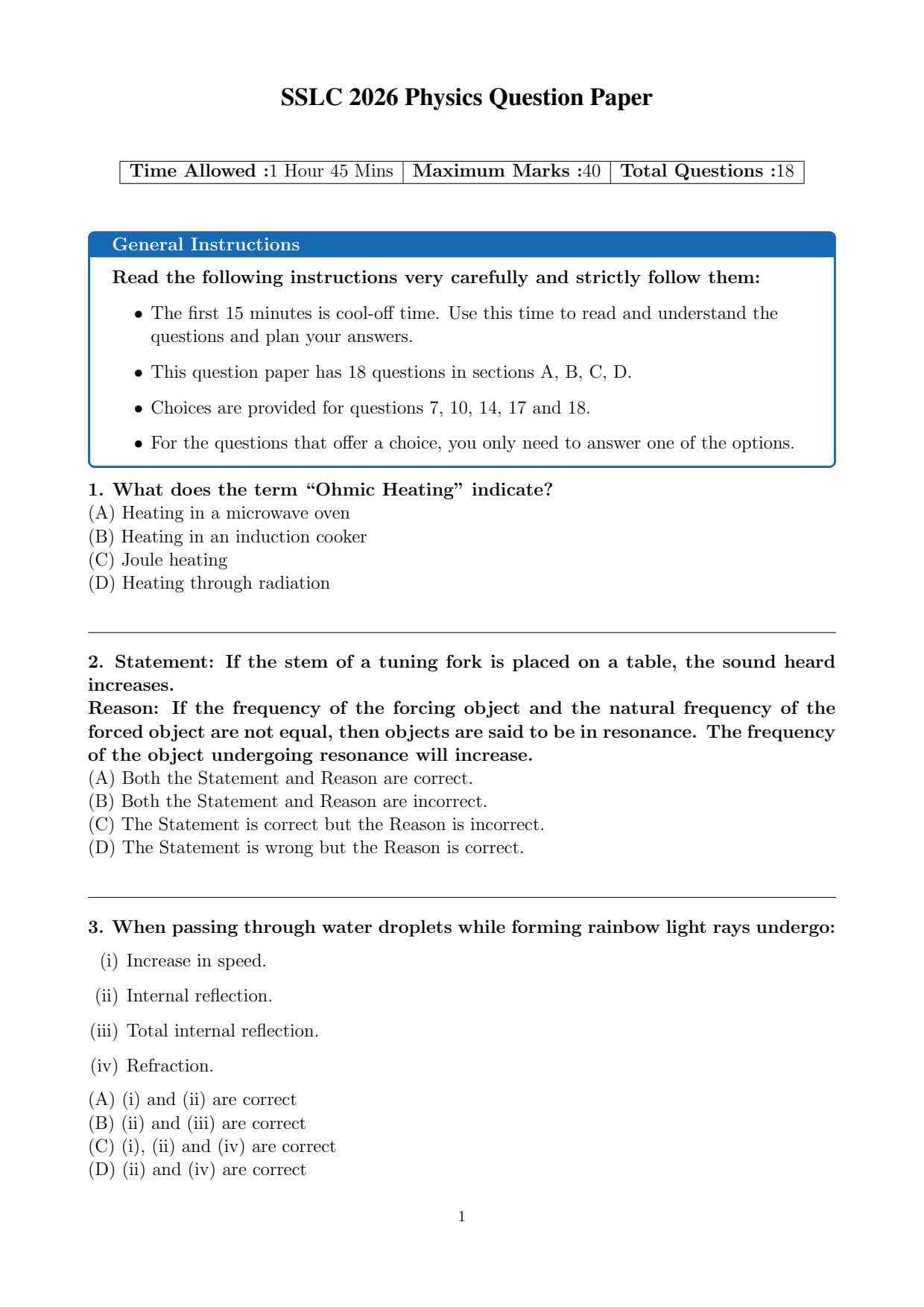
A portion of electric circuit diagram of a household wiring is given.
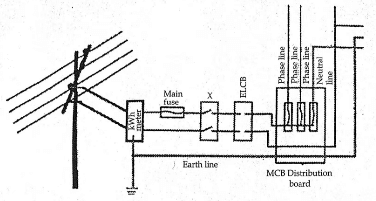
(a) What does the part marked as “X” represent in the circuit?
(b) Draw a circuit diagram of a branch circuit which includes one three pin socket with switch.
A load of \(20000\ N\) is lifted with a wheel and axle system that has a wheel of radius \(50\ cm\) and an axle of radius \(10\ cm\).
(a) Calculate the mechanical advantage of this wheel and axle.
(b) How should a wheel and axle be designed to obtain increased mechanical advantage?
(A) A heating appliance produces \(7200000\ J\) heat in 2 hours.
(a) What is the energy change in a heating appliance?
(b) Calculate the power of the appliance.
OR
(B) An electric grinder with a power of \(400\ W\) is working.
(a) What is the energy change in this equipment?
(b) Calculate the work done by this grinder in 1 minute.
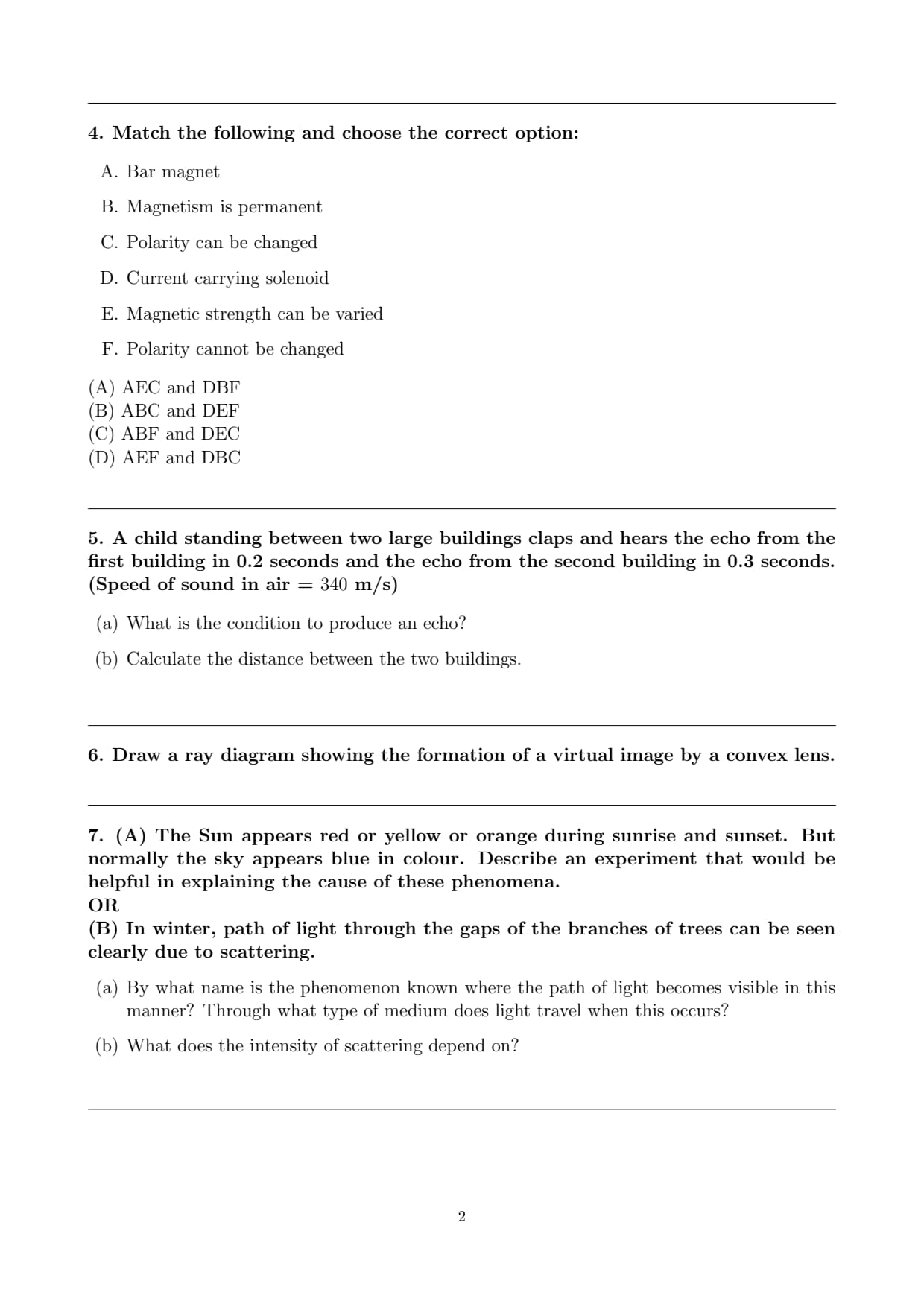
Observe the figure showing a rule related to electricity and magnetism. Which law does this figure represent? State the rule.

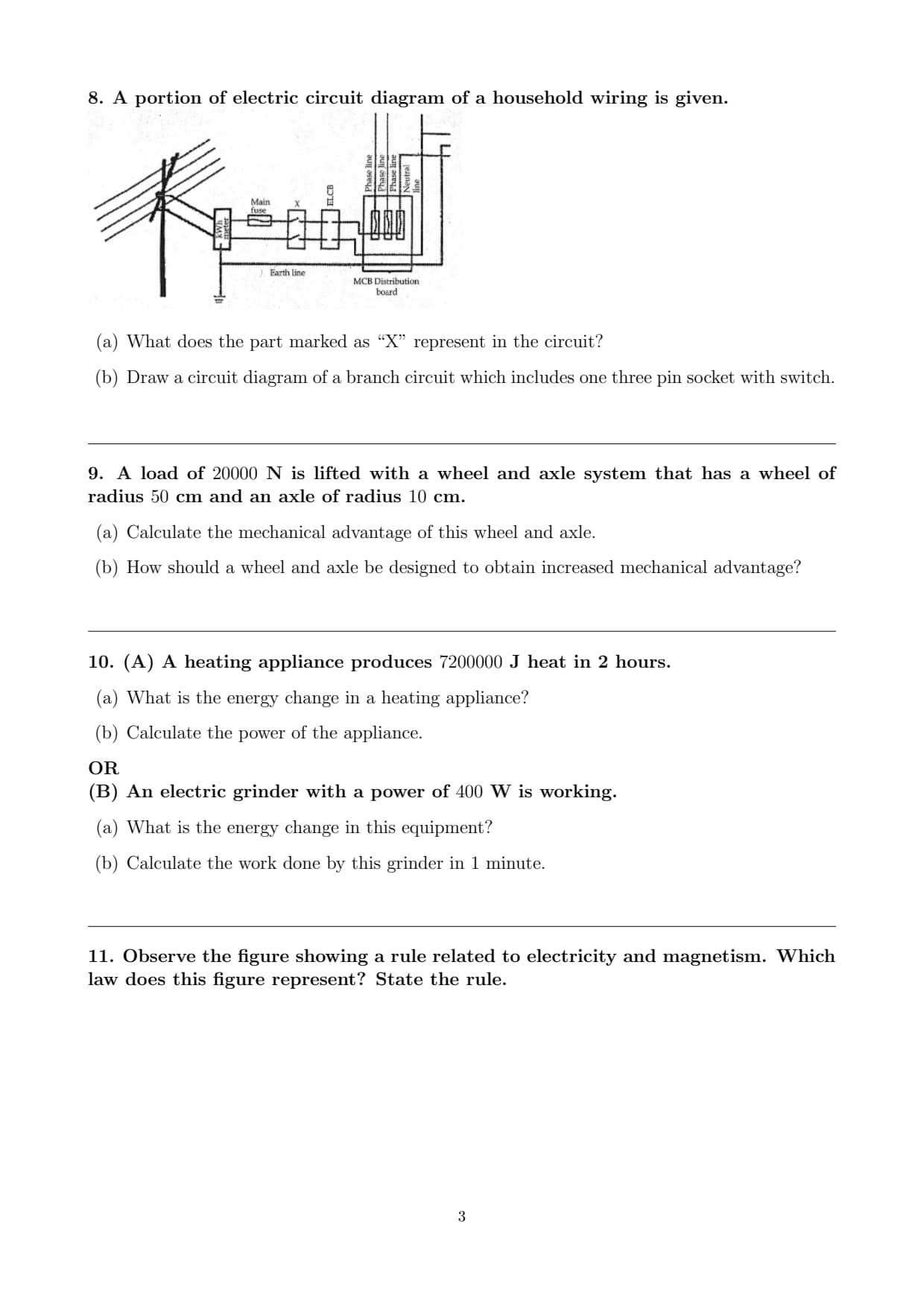
Observe the figure where three coloured lights are made to fall on a screen.
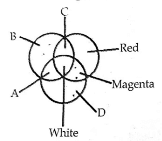
(a) Which colours are labelled as A and D?
(b) Among the colours A, B, C and D identify the primary colours and write down the colours.
(c) There is a complementary colour pair among A, B, C and D. Pick them out and write down.
The resistance of a heating coil in a heating appliance operating at \(200\ V\) is \(60\ \Omega\).
(a) Which alloy is used to make heating coil of heating appliances?
(b) Calculate the amount of heat produced if electricity flows through this appliance for 5 minutes.
(c) If another appliance with a resistance less than \(60\ \Omega\) is operated at the same voltage for 5 minutes, will the amount of heat produced increase or decrease? What is your justification?
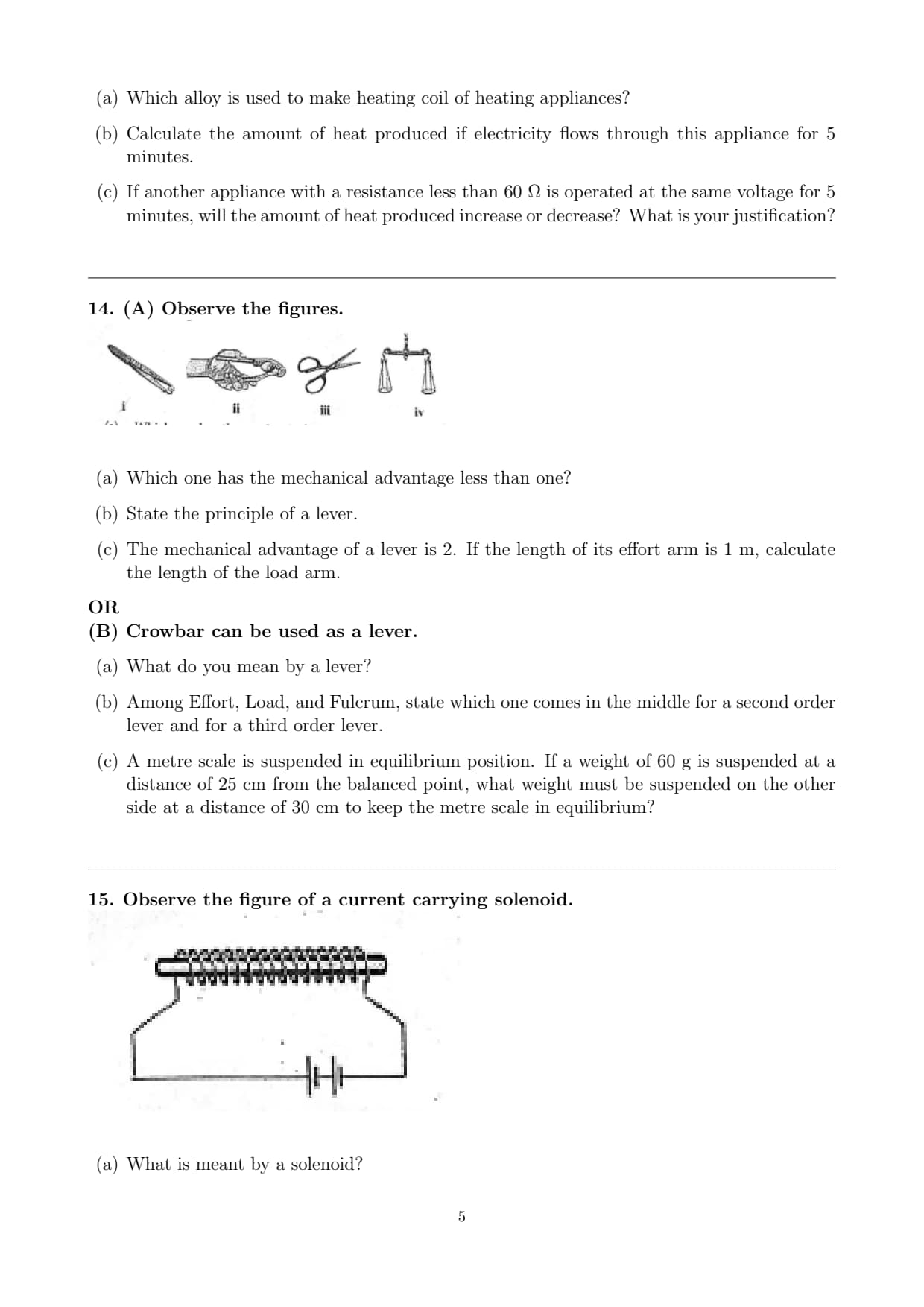
(A) Observe the figures.
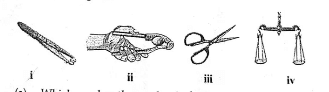
(a) Which one has the mechanical advantage less than one?
(b) State the principle of a lever.
(c) The mechanical advantage of a lever is 2. If the length of its effort arm is 1 m, calculate the length of the load arm.
OR
(B) Crowbar can be used as a lever.
(a) What do you mean by a lever?
(b) Among Effort, Load, and Fulcrum, state which one comes in the middle for a second order lever and for a third order lever.
(c) A metre scale is suspended in equilibrium position. If a weight of 60 g is suspended at a distance of 25 cm from the balanced point, what weight must be suspended on the other side at a distance of 30 cm to keep the metre scale in equilibrium?
Observe the figure of a current carrying solenoid.
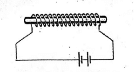
(a) What is meant by a solenoid?
(b) The end connected to the positive terminal of the cell will always be the North pole of a solenoid. Is this statement correct? Justify your answer.
(c) Write any two ways to increase the strength of the magnetic field formed around a current carrying solenoid.
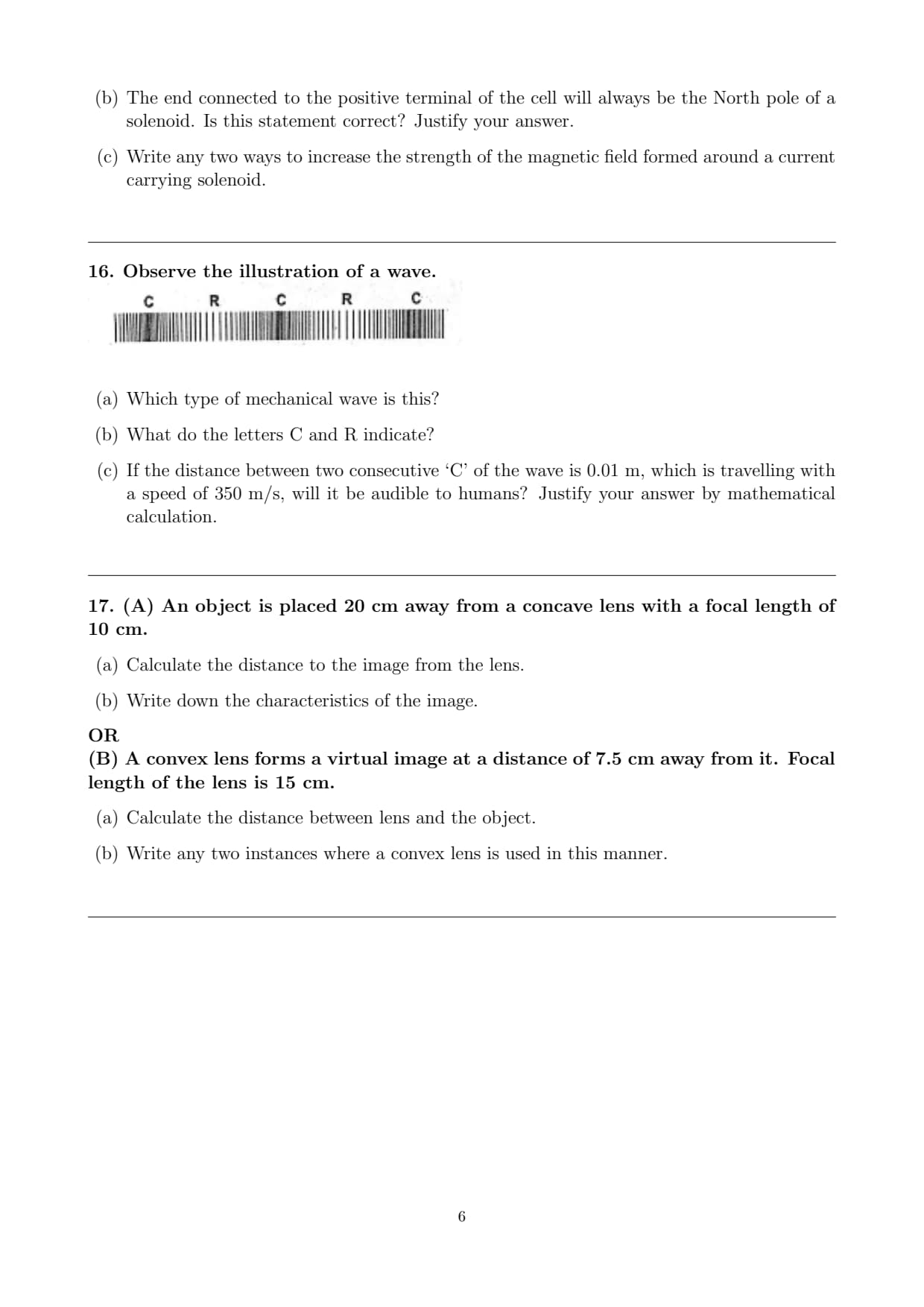
Observe the illustration of a wave.

(a) Which type of mechanical wave is this?
(b) What do the letters C and R indicate?
(c) If the distance between two consecutive ‘C’ of the wave is \(0.01\ m\), which is travelling with a speed of \(350\ m/s\), will it be audible to humans? Justify your answer by mathematical calculation.
(A) An object is placed 20 cm away from a concave lens with a focal length of 10 cm.
(a) Calculate the distance to the image from the lens.
(b) Write down the characteristics of the image.
OR
(B) A convex lens forms a virtual image at a distance of 7.5 cm away from it. Focal length of the lens is 15 cm.
(a) Calculate the distance between lens and the object.
(b) Write any two instances where a convex lens is used in this manner.



Comments