



Bihar Board is conducting the Class 10 Economics Board Exam 2026 on February 24, 2026. Class 10 Economics Question Paper with Solution PDF is available here for download.
The official question paper of Bihar Board Class 10 Economics Board Exam 2026 is provided below. Students can download the official paper in PDF format for reference.
Bihar Board Class 10, 2026 Economics Question Paper with Solution PDF - Memory Based
| Bihar Board Class 10 Economics Question Paper 2026 | Download PDF | Check Solutions |

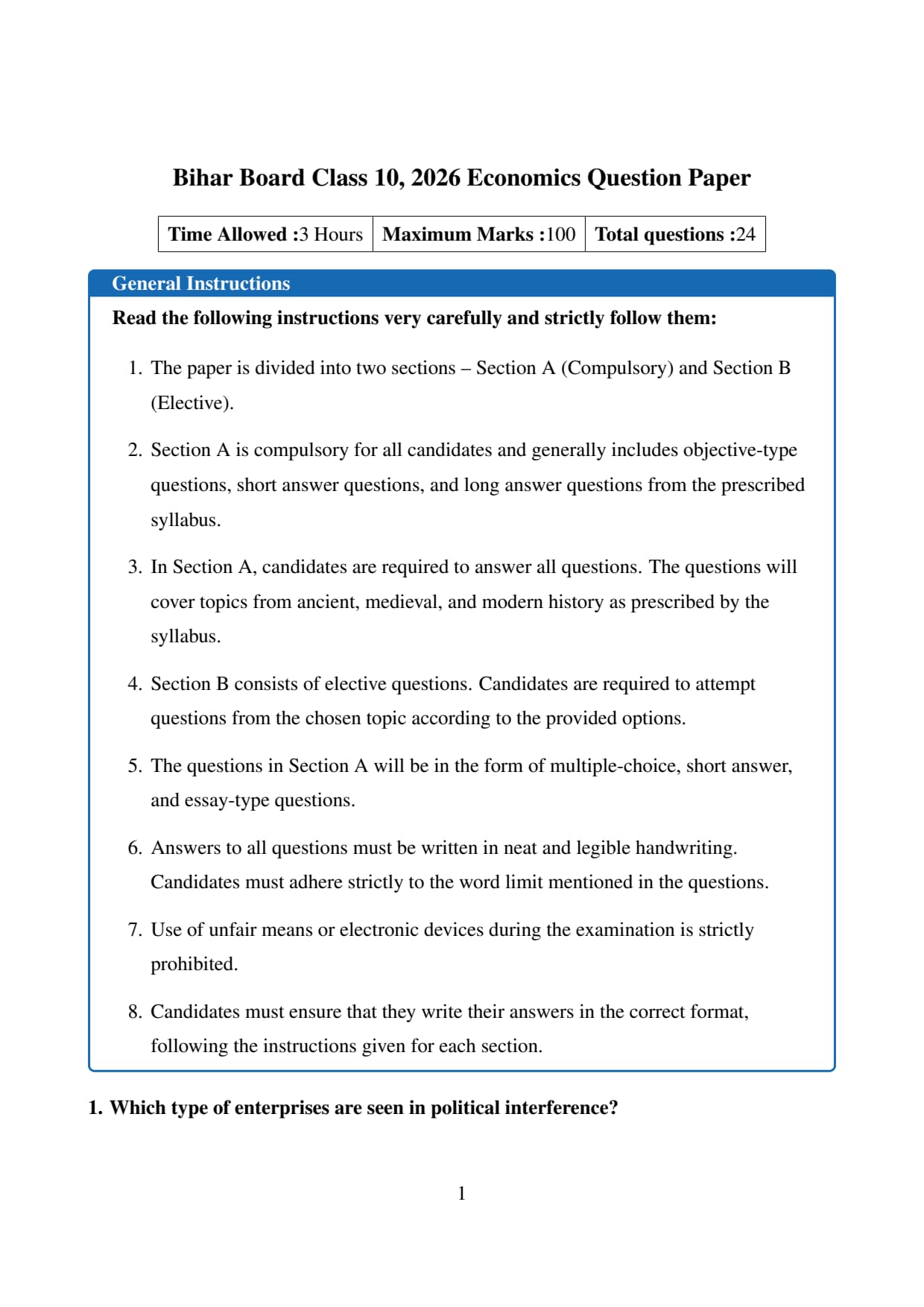
Which type of enterprises are seen in political interference?
View Solution
We are asked to identify which type of enterprises are subject to political interference.
Step 1: Understand the different types of enterprises.
Public Enterprises: Owned, controlled, and managed by the government (central or state). Examples: Indian Railways, BHEL, ONGC.
Private Enterprises: Owned, controlled, and managed by private individuals or groups. Examples: Tata, Reliance, Infosys.
Joint Enterprises: Owned and managed jointly by the government and private sector (Public-Private Partnership). Examples: Some airports, infrastructure projects.
Step 2: Analyze the susceptibility to political interference.
Public Enterprises:
Since they are government-owned, they are directly influenced by political decisions.
Appointments of directors and key officials often have political considerations.
Policies and operations may change with changing governments.
They are subject to parliamentary oversight and public accountability.
Hence, political interference is highest in public enterprises.
Private Enterprises:
These are managed by private owners with minimal government intervention.
Decisions are based on market forces and profit motives.
They are generally free from direct political interference (though they may be affected by government policies and regulations).
Joint Enterprises:
These have both government and private participation.
Some political influence may exist due to government partnership, but it is less than in purely public enterprises.
The private partner often ensures professional management to minimize interference.
Step 3: Analyze each option.
(A) Public:
✓ Correct. Public enterprises face the maximum political interference due to government ownership and control.
(B) Private:
Incorrect. Private enterprises are managed independently and face minimal political interference.
(C) Joint:
Incorrect. Joint enterprises have some government presence but are designed to be professionally managed with less political interference.
(D) All of these:
Incorrect because private and joint enterprises do not experience significant political interference like public enterprises.
Final Answer: (A) Public Quick Tip: Public enterprises = Government ownership = Maximum political interference.
Private enterprises = Private ownership = Minimum political interference.
Joint enterprises = Mixed ownership = Moderate interference but designed for autonomy.
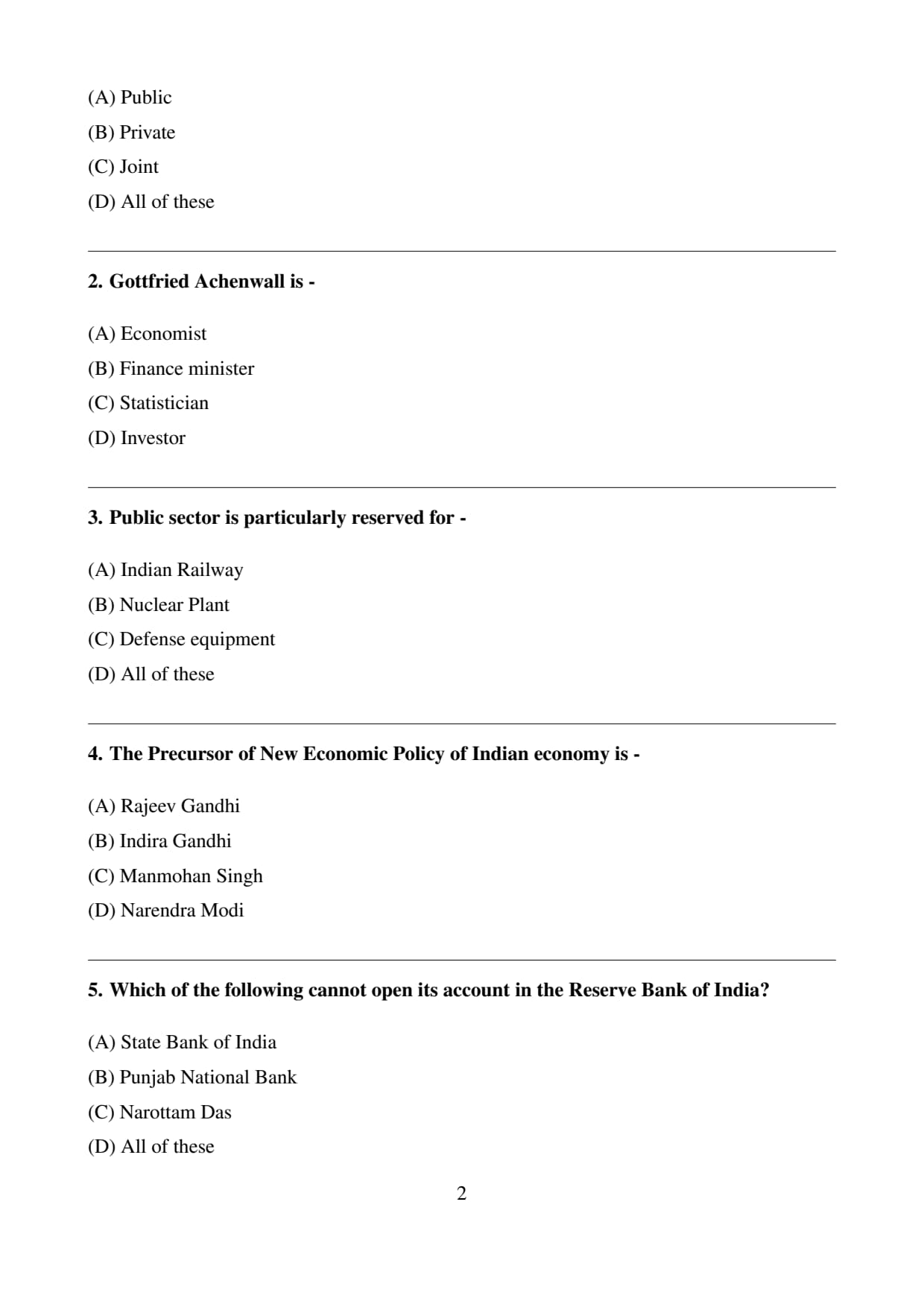
Gottfried Achenwall is -
View Solution
We are asked to identify who Gottfried Achenwall was.
Step 1: Historical background.
Gottfried Achenwall (20 October 1719 – 1 May 1772) was a German philosopher, historian, economist, jurist, and statistician. He is most famously known for his contributions to the field of statistics.
Step 2: His contribution to statistics.
Achenwall is widely regarded as one of the inventors of modern statistics. He taught at the University of Göttingen and was the first to use the term "Statistik" to describe the systematic collection and analysis of data about states. German scholars often refer to him as the "Father of Statistics," although some English writers dispute this title in favor of William Petty.
His major work, *Staatsverfassung der Europäischen Reiche im Grundrisse* (1752), provided comprehensive statistical data about the constitutions, agriculture, manufacturing, and commerce of various European countries.
Step 3: Analyze each option.
(A) Economist: While Achenwall did work in economics and belonged to the school of "moderate mercantilists," this is not his primary claim to fame. He is much better known for statistics.
(B) Finance minister: Achenwall was an academic and professor, never a finance minister. He did serve as court counsellor, but not as a finance minister.
(C) Statistician: ✓ Correct. Achenwall is most renowned as a statistician and is credited with coining the term "statistics" and establishing it as a distinct academic discipline.
(D) Investor: There is no record of Achenwall being known as an investor; he was a scholar and academician.
Final Answer: (C) Statistician Quick Tip: Gottfried Achenwall is known as the "Father of Statistics" (although disputed by some). He coined the German word "Statistik" and established statistics as a separate academic discipline at the University of Göttingen.
Public sector is particularly reserved for -
View Solution
We are asked to identify which sectors/industries are particularly reserved for the public sector.
Step 1: Understand the concept of public sector reservation.
The public sector refers to industries and enterprises owned and managed by the government. In many countries, including India, certain strategic industries are reserved exclusively for the public sector due to:
National security concerns
Strategic importance
High capital investment requirements
Essential services for the public
Natural monopoly characteristics
Step 2: Identify sectors reserved for public sector in India.
Historically, under the Industrial Policy Resolution of 1956, industries were classified into three categories. Schedule A industries were exclusively reserved for the public sector. These included:
Arms and ammunition and defense equipment
Atomic energy
Iron and steel
Heavy machinery and heavy engineering
Coal and lignite
Mineral oils
Mining of iron ore, manganese ore, etc.
Aircraft and air transportation
Railways
Shipbuilding
Generation and distribution of electricity
Step 3: Analyze each option.
(A) Indian Railway:
Railways have always been a strategic sector reserved for the public sector due to its importance in transportation and national integration.
Indian Railways is a government-owned entity.
(B) Nuclear Plant:
Atomic energy and nuclear power are exclusively reserved for the public sector due to national security and safety concerns.
Nuclear plants are operated by government agencies like NPCIL (Nuclear Power Corporation of India Limited).
(C) Defense equipment:
Manufacturing of arms, ammunition, and defense equipment is reserved for the public sector for national security reasons.
Defense Public Sector Undertakings (DPSUs) like HAL, BEL, BDL manufacture defense equipment.
Step 4: Conclusion.
All three options (Indian Railway, Nuclear Plant, and Defense equipment) are sectors that have been traditionally reserved for the public sector in India. Therefore, the correct answer is "All of these."
(Note: While economic liberalization since 1991 has opened many sectors to private participation, some strategic sectors like railways, atomic energy, and defense equipment still have predominant or exclusive government control.)
Final Answer: (D) All of these Quick Tip: Strategic sectors reserved for public sector include: Railways (Indian Railways) Atomic Energy (Nuclear plants) Defense equipment (Arms and ammunition) Others: Coal, mineral oils, electricity generation (historically) These are reserved due to national security, strategic importance, and high capital requirements.
The Precursor of New Economic Policy of Indian economy is -
View Solution
We are asked to identify the precursor (forerunner) of the New Economic Policy of the Indian economy.
Step 1: Understand the term "precursor" in this context.
A precursor is something that comes before and signals or leads to another development. In the context of Indian economic reforms, the precursor refers to the early steps and policy initiatives that laid the groundwork for the comprehensive 1991 economic reforms.
Step 2: Understand the timeline of economic reforms in India.
1980s (Precursors): During the 1980s, under Prime Ministers Indira Gandhi and especially Rajiv Gandhi, several modest economic liberalization measures were introduced. These included loosening of industrial licensing, tax reforms, and trade liberalization attempts.
1991 (The New Economic Policy): The comprehensive New Economic Policy (NEP) was launched in 1991 by Prime Minister P.V. Narasimha Rao and Finance Minister Dr. Manmohan Singh in response to a severe balance of payments crisis. This policy introduced sweeping reforms in industrial licensing, foreign investment, trade, and the public sector [citation:3].
Step 3: Analyze the role of each leader.
(A) Rajeev Gandhi:
✓ Correct. Rajiv Gandhi (Prime Minister from 1984-1989) is widely regarded as the precursor of economic reforms in India.
He initiated significant economic liberalization measures including:
Loosening of industrial licensing [citation:1]
Tax reforms including reduction of direct tax rates and introduction of Modvat (a precursor to VAT) in 1986 [citation:1][citation:9]
De-licensing of 25 industries in 1985 [citation:9]
Total decontrol of cement and aluminium sectors in 1989 [citation:9]
Promotion of computer and software industry, earning him the title "Computer Prime Minister" [citation:5]
These reforms, though modest compared to 1991, signaled the beginning of India's shift away from the license-permit raj [citation:1][citation:5].
(B) Indira Gandhi:
Indira Gandhi (Prime Minister in 1980-84) did introduce some economic adjustments, including nationalization of banks and some liberalization measures in her later years.
However, her overall economic policy was characterized by socialism and state control. The term "precursor of NEP" is more strongly associated with Rajiv Gandhi.
(C) Manmohan Singh:
Dr. Manmohan Singh, as Finance Minister in 1991, was the architect of the New Economic Policy, not its precursor [citation:3][citation:6][citation:10].
He implemented the sweeping reforms, but the groundwork was laid in the 1980s.
(D) Narendra Modi:
Narendra Modi became Prime Minister in 2014, long after the 1991 reforms. His government has continued and expanded economic reforms, but he is not the precursor to the NEP.
Step 4: Historical perspective.
According to economic historians and analysts:
"It is now fairly established the reforms actually started in the 1980s" [citation:1].
Rajiv Gandhi's government "began the process of economic liberalization" with significant measures including tax reforms and industrial de-licensing [citation:2][citation:9].
The 1991 reforms built upon and expanded these earlier initiatives, but the precursors were clearly in the 1980s under Rajiv Gandhi.
Final Answer: (A) Rajeev Gandhi Quick Tip: The precursor means the forerunner or early initiator. While Manmohan Singh was the architect of the 1991 New Economic Policy, Rajiv Gandhi's government (1984-89) laid the groundwork with early liberalization measures including tax reforms, industrial de-licensing, and promotion of technology. Remember: Precursor (1980s) → Architect (1991) → Continuation (post-1991).
Which of the following cannot open its account in the Reserve Bank of India?
View Solution
We are asked to identify which of the given options cannot open an account with the Reserve Bank of India (RBI).
Step 1: Understand the role of RBI.
The Reserve Bank of India is the central bank of India. It acts as the banker to the government and banker to other banks. It does not provide regular banking services to the general public.
Step 2: Know who can open accounts with RBI.
The RBI maintains accounts for:
Scheduled Commercial Banks: All banks (like State Bank of India, Punjab National Bank) maintain accounts with RBI for maintaining Cash Reserve Ratio (CRR), Statutory Liquidity Ratio (SLR), and for clearing house settlements.
Government: Central and State governments maintain accounts with RBI.
Select Financial Institutions: Some specified financial institutions.
Retail Direct Investors: Recently, RBI has allowed individual investors to open Retail Direct Gilt Accounts for investing in government securities [citation:7].
However, RBI does not open regular savings or current accounts for individual citizens like "Narottam Das" for their day-to-day banking needs. Individuals must open accounts with commercial banks (SBI, PNB, etc.), not with RBI.
Step 3: Analyze each option.
(A) State Bank of India:
SBI is a scheduled commercial bank.
As a bank, it is required to maintain accounts with RBI for regulatory compliance.
Hence, SBI can open an account with RBI.
(B) Punjab National Bank:
PNB is also a scheduled commercial bank.
Like all banks, it maintains accounts with RBI.
Hence, PNB can open an account with RBI.
(C) Narottam Das:
This appears to be an individual person's name.
RBI does not open regular bank accounts for individuals.
Individuals must approach commercial banks like SBI or PNB for their banking needs.
(Note: While individuals can open Retail Direct Gilt Accounts with RBI for investing in government securities, this is a specialized investment account, not a regular bank account for daily transactions [citation:7]. The question in this context clearly refers to regular banking accounts.)
Hence, "Narottam Das" cannot open a regular account with RBI.
(D) All of these:
Incorrect because SBI and PNB can open accounts with RBI.
Final Answer: (C) Narottam Das Quick Tip: RBI is the banker's bank. It maintains accounts for commercial banks (SBI, PNB, etc.) and governments, but NOT for individual citizens. Individuals must open accounts with commercial banks. Think: RBI = Bank for banks, not for people!
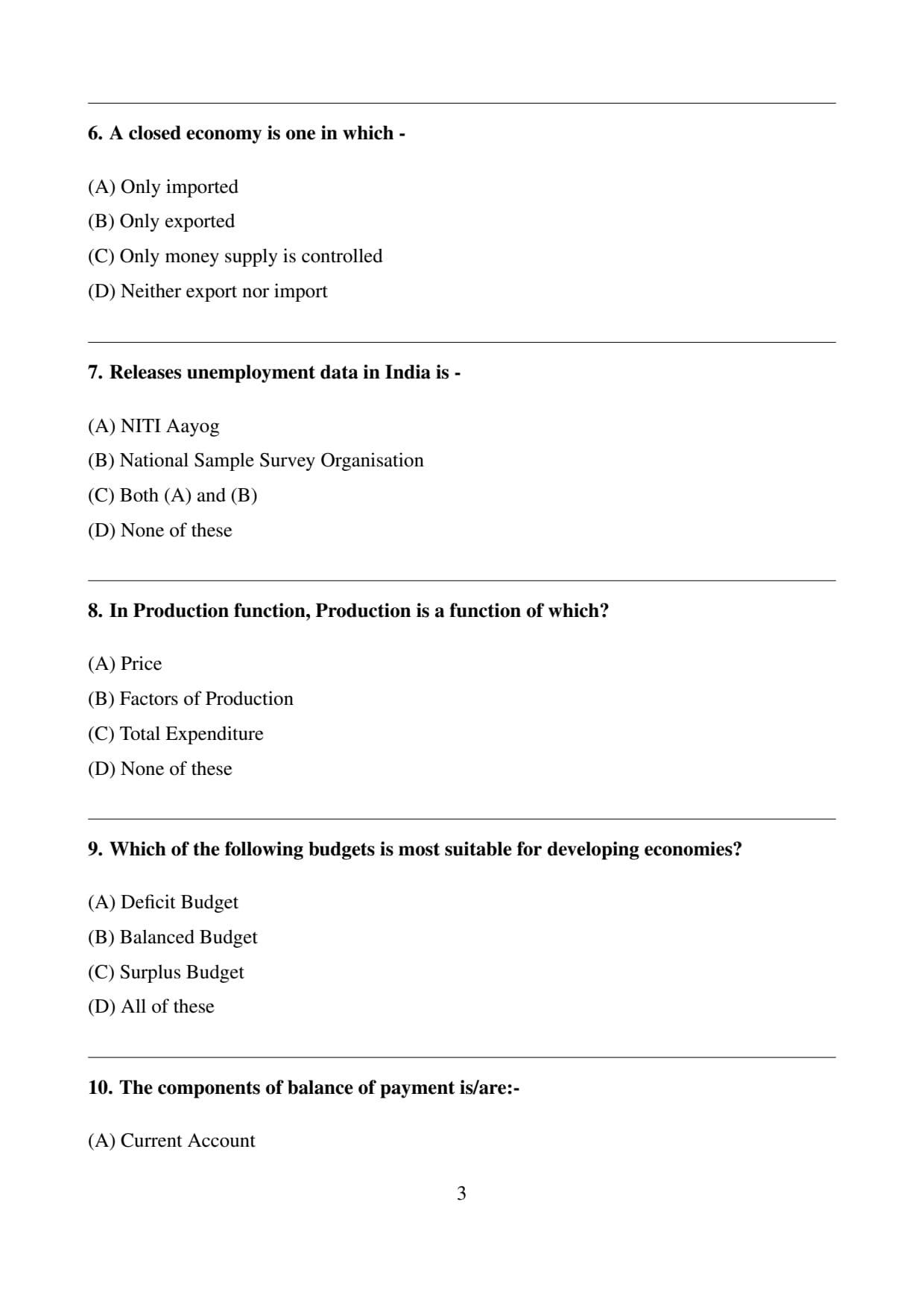
A closed economy is one in which -
View Solution
We are asked to define a closed economy.
Step 1: Understand the concept of a closed economy.
A closed economy is an economy that does not engage in international trade with other countries. It is self-sufficient and does not participate in:
Exports (selling goods and services to other countries)
Imports (buying goods and services from other countries)
In a closed economy, all goods and services are produced and consumed within the country's borders.
Step 2: Compare with an open economy.
Closed Economy: No international trade. All economic activities are confined within the country.
Open Economy: Engages in international trade (both exports and imports). Most modern economies are open economies.
Step 3: Analyze each option.
(A) Only imported:
Incorrect. An economy that only imports but does not export would still be participating in international trade (at least imports), so it cannot be called a closed economy.
Such an economy would have a huge trade deficit and is not closed.
(B) Only exported:
Incorrect. An economy that only exports but does not import is still participating in international trade (exports), so it is not a closed economy.
Such an economy is theoretically possible but still an open economy.
(C) Only money supply is controlled:
Incorrect. Controlling money supply is a function of monetary policy (done by the central bank) and is independent of whether the economy is open or closed.
Both open and closed economies can have controlled money supply.
(D) Neither export nor import:
✓ Correct. A closed economy has no international trade whatsoever—no exports and no imports.
It is completely self-reliant and does not interact with other economies through trade.
Step 4: Real-world context.
In reality, no economy is completely closed in the modern world. Even the most restrictive economies engage in some form of international trade. North Korea comes closest to being a closed economy, but even it has limited trade. The term "closed economy" is often used in economic models for theoretical analysis.
Final Answer: (D) Neither export nor import Quick Tip: Closed economy = No international trade (no exports, no imports).
Open economy = Engages in international trade (both exports and imports).
Remember: In economic models, a closed economy is used for simplifying analysis of domestic economic factors without external influences.
Releases unemployment data in India is -
View Solution
We are asked to identify which organization releases unemployment data in India.
Step 1: Understand the role of different organizations.
National Sample Survey Organisation (NSSO): Now known as National Sample Survey Office (NSS), it functions under the Ministry of Statistics and Programme Implementation (MoSPI). It is the primary agency responsible for conducting large-scale sample surveys on various socio-economic subjects, including employment and unemployment [citation:2].
Periodic Labour Force Survey (PLFS): This is the specific survey conducted by NSSO/MoSPI to generate employment and unemployment indicators. It provides official data on Labour Force Participation Rate, Worker Population Ratio, and Unemployment Rate [citation:3][citation:9].
NITI Aayog: This is a policy think tank of the Government of India. It publishes reports and analyses based on data, but it does not conduct the primary surveys or release raw unemployment data. It uses NSSO data for its reports and policy recommendations [citation:7][citation:10].
Step 2: Identify the data releasing authority.
According to official sources:
The Ministry of Statistics and Programme Implementation (MoSPI), through its National Sample Survey Office (NSSO), conducts the Periodic Labour Force Survey (PLFS) [citation:2][citation:3].
The reports of the survey results, including unemployment rates, are released on the MoSPI website [citation:2].
Monthly and quarterly bulletins containing unemployment data are published by MoSPI/NSSO [citation:6][citation:9].
Step 3: Analyze each option.
(A) NITI Aayog:
Incorrect. NITI Aayog uses data for analysis and policy formulation but does not release primary unemployment data. It publishes reports based on NSSO data [citation:7][citation:10].
(B) National Sample Survey Organisation:
✓ Correct. NSSO (under MoSPI) is the official agency that conducts the Periodic Labour Force Survey and releases unemployment data through its reports and bulletins [citation:2][citation:3][citation:6].
(C) Both (A) and (B):
Incorrect. While NITI Aayog may publish reports containing unemployment analysis, it does not "release" the primary unemployment data. The release function belongs to NSSO/MoSPI.
(D) None of these:
Incorrect because option (B) is correct.
Final Answer: (B) National Sample Survey Organisation Quick Tip: Remember: NSSO (National Sample Survey Office) under MoSPI conducts the Periodic Labour Force Survey (PLFS) and releases official unemployment data in India through monthly and quarterly bulletins. NITI Aayog is a policy think tank that uses this data for analysis and recommendations.
In Production function, Production is a function of which?
View Solution
We are asked to identify what production is a function of in the production function.
Step 1: Understand the concept of production function.
In economics, the production function expresses the technological relationship between the quantity of output (production) and the quantities of various inputs used in the production process.
It shows the maximum output that can be produced with given inputs and given technology.
Step 2: Mathematical representation.
The general form of a production function is: \[ Q = f(L, K, N, E) \]
Where:
Q = Quantity of output (Production)
f = Functional relationship
L = Labour (Factor of Production)
K = Capital (Factor of Production)
N = Land/Natural resources (Factor of Production)
E = Entrepreneurship (Factor of Production)
Step 3: Identify the factors of production.
The four main factors of production are:
Land: Natural resources (including raw materials)
Labour: Human effort (physical and mental)
Capital: Man-made resources (machinery, tools, buildings)
Entrepreneurship: Organizing and risk-taking ability
Step 4: Analyze each option.
(A) Price:
Incorrect. Price is a market outcome determined by demand and supply, not an input in the production function.
Production function deals with physical inputs and outputs, not monetary values.
(B) Factors of Production:
✓ Correct. The production function shows output as a function of the factors of production (inputs).
Example: \( Q = f(L, K) \) means output depends on labour and capital.
(C) Total Expenditure:
Incorrect. Total expenditure is the total amount spent on inputs or consumption, not a determinant of production in the production function.
Production function is technological, not financial.
(D) None of these:
Incorrect because option (B) is correct.
Final Answer: (B) Factors of Production Quick Tip: Production function = \( Q = f(Factors of Production) \)
Factors of Production = Land, Labour, Capital, Entrepreneurship
Remember: Production function shows the maximum output possible with given inputs and technology. It is a technical relationship, not a monetary one.
Which of the following budgets is most suitable for developing economies?
View Solution
We are asked to identify which type of budget is most suitable for developing economies.
Step 1: Understand the three types of budgets.
Balanced Budget: Government revenue = Government expenditure. Neither surplus nor deficit.
Surplus Budget: Government revenue > Government expenditure. Excess revenue over expenditure.
Deficit Budget: Government expenditure > Government revenue. Government spends more than it earns.
Step 2: Characteristics of developing economies.
Developing economies (like India) typically have:
High need for infrastructure development (roads, railways, power, ports)
Need for social sector spending (education, health, poverty alleviation)
Limited tax base and revenue collection
High unemployment and underemployment
Need for rapid economic growth
Step 3: Why deficit budget is suitable for developing economies.
Infrastructure Creation: Developing economies require massive investment in infrastructure. Deficit financing allows the government to borrow and spend on capital projects.
Economic Growth: Deficit spending stimulates aggregate demand and accelerates growth (following Keynesian economics).
Social Welfare: Additional funds can be directed to poverty alleviation, health, and education.
Employment Generation: Government spending creates jobs and reduces unemployment.
Developmental Expenditure: Deficit budget enables higher allocation to developmental activities even with limited current revenue.
Step 4: Why other budgets are less suitable.
Balanced Budget:
Limits government spending to current revenue.
Developing economies cannot undertake large developmental projects with such constraints.
Suitable for stable, developed economies or during normal times.
Surplus Budget:
Means government is collecting more than it spends.
This reduces money in circulation and can slow down economic growth.
Suitable for controlling inflation or during boom periods, but not for promoting growth in developing economies.
Step 5: Conclusion.
For developing economies aiming for rapid growth and development, a deficit budget (within sustainable limits) is most suitable as it allows higher government spending on infrastructure and social sectors.
Final Answer: (A) Deficit Budget Quick Tip: Developing economies → Deficit Budget (to boost growth, create infrastructure)
Developed economies → May use balanced or surplus budgets during stable times
Remember: Deficit budget helps in capital formation and employment generation in developing countries, but should be within manageable limits to avoid excessive debt and inflation.
The components of balance of payment is/are:-
View Solution
We are asked to identify the components of the Balance of Payments (BoP).
Step 1: Understand the concept of Balance of Payments.
The Balance of Payments is a systematic record of all economic transactions between residents of a country and the rest of the world during a given period. It provides a comprehensive picture of a country's international economic transactions.
Step 2: The two main components of BoP.
The Balance of Payments has two primary components:
Current Account:
Records transactions related to trade in goods (visible items) and services (invisible items).
Includes: Exports and imports of goods (Trade Balance), exports and imports of services (travel, transportation, insurance, etc.), income (investment income, compensation of employees), and current transfers (gifts, remittances, grants).
The current account shows the net income from trade and transfers.
Capital Account:
Records all transactions that involve changes in assets and liabilities between residents and non-residents.
Includes: Foreign Direct Investment (FDI), Foreign Portfolio Investment (FPI), loans and borrowings (external assistance, commercial borrowings), banking capital (NRIs deposits, foreign currency deposits), and changes in foreign exchange reserves.
The capital account shows the net change in foreign ownership of domestic assets and domestic ownership of foreign assets.
Step 3: Additional component (sometimes mentioned).
Some textbooks mention a third component: the Errors and Omissions account, which is used to balance the BoP when there are discrepancies in recording transactions. However, the fundamental and primary components are the Current Account and Capital Account.
Step 4: Analyze each option.
(A) Current Account:
This is one component, but not the only one. So this option is incomplete.
(B) Capital Account:
This is the second component, but alone it is incomplete.
(C) Both A and B:
✓ Correct. The Balance of Payments consists of both Current Account and Capital Account. These two together cover all international economic transactions.
(D) None of these:
Incorrect because option (C) is correct.
Final Answer: (C) Both A and B Quick Tip: Balance of Payments (BoP) = Current Account + Capital Account. Current Account: Records trade in goods, services, income, and transfers. Capital Account: Records investments, loans, and changes in foreign assets/liabilities. Remember: Current Account = Income/Expenditure; Capital Account = Investment/Debt. Both together determine a country's international economic position.
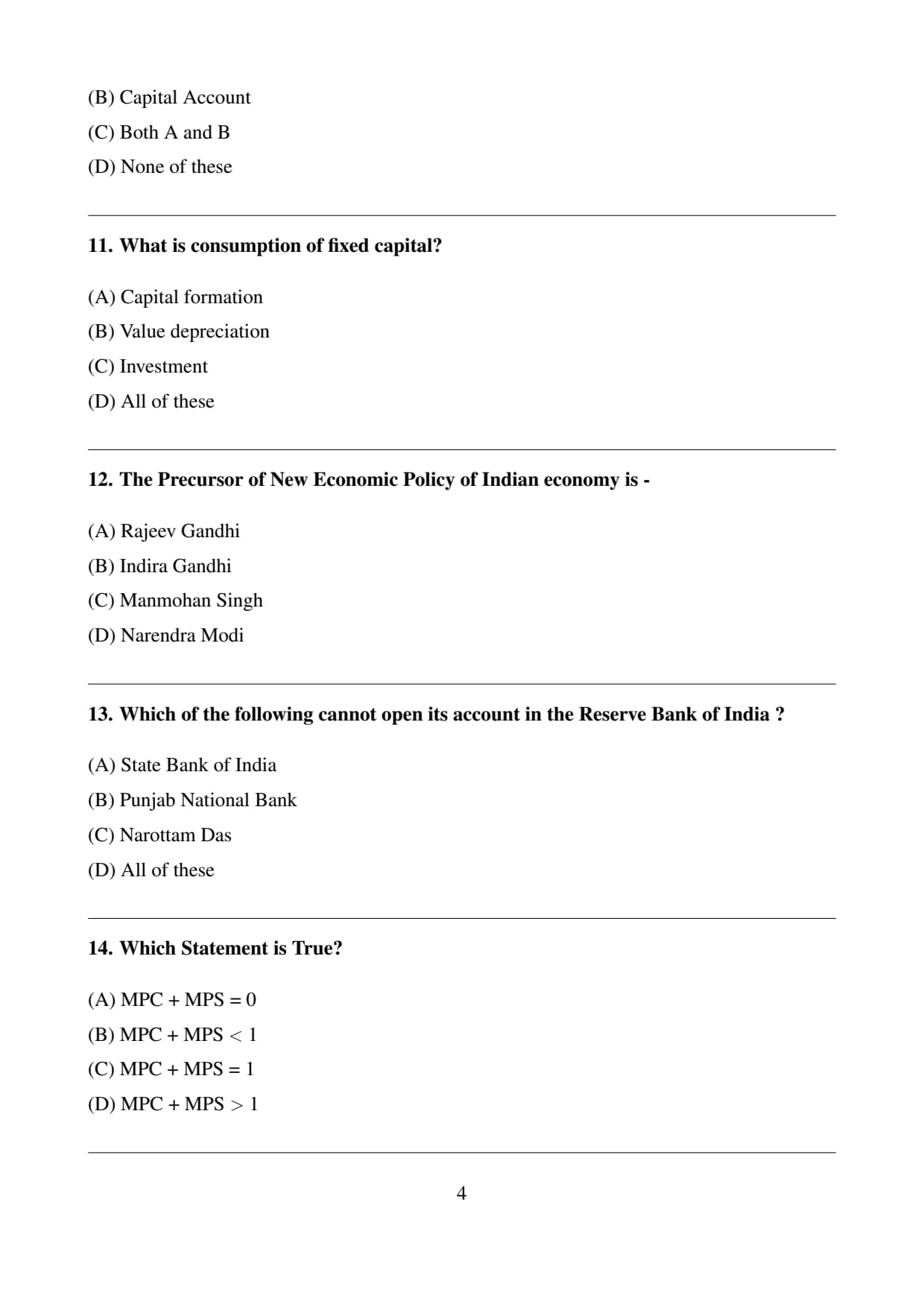
What is consumption of fixed capital?
View Solution
We are asked to define "consumption of fixed capital."
Step 1: Understand the term "consumption of fixed capital."
Consumption of fixed capital is an economic and accounting term that refers to the reduction in the value of fixed assets (like machinery, buildings, equipment) due to:
Normal wear and tear
Obsolescence (becoming outdated)
Accidental damage (normal, not catastrophic)
Passage of time (even if not used)
It is essentially the amount of fixed assets used up in the process of production during an accounting period.
Step 2: Alternative names.
Consumption of fixed capital is also commonly known as:
Depreciation
Capital consumption
Provision for depreciation
In national income accounting, it represents the value of fixed assets that need to be replaced to maintain the productive capacity of the economy.
Step 3: Distinguish from other terms.
Capital formation: This refers to the addition to the stock of capital assets (investment in new machinery, buildings, etc.). It increases the capital stock, while consumption of fixed capital reduces it.
Value depreciation: This is exactly what consumption of fixed capital means—the decrease in value of fixed assets over time.
Investment: Investment is expenditure on capital goods (new assets). Consumption of fixed capital is not investment; it's the opposite—it's the using up of existing capital.
Step 4: Analyze each option.
(A) Capital formation:
Incorrect. Capital formation increases capital stock; consumption of fixed capital decreases it.
(B) Value depreciation:
✓ Correct. Consumption of fixed capital is exactly the same as value depreciation—the decline in value of fixed assets over time.
(C) Investment:
Incorrect. Investment adds to capital; consumption of fixed capital subtracts from it.
(D) All of these:
Incorrect because only option (B) is correct.
Step 5: Relationship in national income accounting.
Gross Domestic Product (GDP) - Consumption of Fixed Capital = Net Domestic Product (NDP)
Consumption of fixed capital is the amount set aside to replace depreciated assets to maintain the productive capacity of the economy.
Final Answer: (B) Value depreciation Quick Tip: Consumption of fixed capital = Depreciation = Decrease in value of fixed assets due to wear and tear, obsolescence, or normal damage. It is NOT capital formation or investment. Remember: GDP - Depreciation = NDP.
The Precursor of New Economic Policy of Indian economy is -
View Solution
We are asked to identify the precursor (forerunner) of the New Economic Policy of the Indian economy.
Step 1: Understand the term "precursor" in this context.
A precursor is something that comes before and signals or leads to another development. In the context of Indian economic reforms, the precursor refers to the early steps and policy initiatives that laid the groundwork for the comprehensive 1991 economic reforms.
Step 2: Understand the timeline of economic reforms in India.
1980s (Precursors): During the 1980s, under Prime Ministers Indira Gandhi and especially Rajiv Gandhi, several modest economic liberalization measures were introduced. These included loosening of industrial licensing, tax reforms, and trade liberalization attempts.
1991 (The New Economic Policy): The comprehensive New Economic Policy (NEP) was launched in 1991 by Prime Minister P.V. Narasimha Rao and Finance Minister Dr. Manmohan Singh in response to a severe balance of payments crisis. This policy introduced sweeping reforms in industrial licensing, foreign investment, trade, and the public sector.
Step 3: Analyze the role of each leader.
(A) Rajeev Gandhi:
✓ Correct. Rajiv Gandhi (Prime Minister from 1984-1989) is widely regarded as the precursor of economic reforms in India.
He initiated significant economic liberalization measures including:
Loosening of industrial licensing
Tax reforms including reduction of direct tax rates and introduction of Modvat (a precursor to VAT) in 1986
De-licensing of 25 industries in 1985
Total decontrol of cement and aluminium sectors in 1989
Promotion of computer and software industry, earning him the title "Computer Prime Minister"
These reforms, though modest compared to 1991, signaled the beginning of India's shift away from the license-permit raj.
(B) Indira Gandhi:
Indira Gandhi (Prime Minister in 1980-84) did introduce some economic adjustments, including nationalization of banks and some liberalization measures in her later years.
However, her overall economic policy was characterized by socialism and state control. The term "precursor of NEP" is more strongly associated with Rajiv Gandhi.
(C) Manmohan Singh:
Dr. Manmohan Singh, as Finance Minister in 1991, was the architect of the New Economic Policy, not its precursor.
He implemented the sweeping reforms, but the groundwork was laid in the 1980s.
(D) Narendra Modi:
Narendra Modi became Prime Minister in 2014, long after the 1991 reforms. His government has continued and expanded economic reforms, but he is not the precursor to the NEP.
Step 4: Historical perspective.
According to economic historians and analysts:
"It is now fairly established the reforms actually started in the 1980s."
Rajiv Gandhi's government "began the process of economic liberalization" with significant measures including tax reforms and industrial de-licensing.
The 1991 reforms built upon and expanded these earlier initiatives, but the precursors were clearly in the 1980s under Rajiv Gandhi.
Final Answer: (A) Rajeev Gandhi Quick Tip: The precursor means the forerunner or early initiator. While Manmohan Singh was the architect of the 1991 New Economic Policy, Rajiv Gandhi's government (1984-89) laid the groundwork with early liberalization measures including tax reforms, industrial de-licensing, and promotion of technology. Remember: Precursor (1980s) → Architect (1991) → Continuation (post-1991).
Which of the following cannot open its account in the Reserve Bank of India ?
View Solution
We are asked to identify which of the given options cannot open an account with the Reserve Bank of India (RBI).
Step 1: Understand the role of RBI.
The Reserve Bank of India is the central bank of India. It acts as the banker to the government and banker to other banks. It does not provide regular banking services to the general public.
Step 2: Know who can open accounts with RBI.
The RBI maintains accounts for:
Scheduled Commercial Banks: All banks (like State Bank of India, Punjab National Bank) maintain accounts with RBI for maintaining Cash Reserve Ratio (CRR), Statutory Liquidity Ratio (SLR), and for clearing house settlements.
Government: Central and State governments maintain accounts with RBI.
Select Financial Institutions: Some specified financial institutions.
However, RBI does not open regular savings or current accounts for individual citizens like "Narottam Das" for their day-to-day banking needs. Individuals must open accounts with commercial banks (SBI, PNB, etc.), not with RBI.
Step 3: Analyze each option.
(A) State Bank of India:
SBI is a scheduled commercial bank.
As a bank, it is required to maintain accounts with RBI for regulatory compliance.
Hence, SBI can open an account with RBI.
(B) Punjab National Bank:
PNB is also a scheduled commercial bank.
Like all banks, it maintains accounts with RBI.
Hence, PNB can open an account with RBI.
(C) Narottam Das:
This appears to be an individual person's name.
RBI does not open regular bank accounts for individuals.
Individuals must approach commercial banks like SBI or PNB for their banking needs.
Hence, "Narottam Das" cannot open a regular account with RBI.
(D) All of these:
Incorrect because SBI and PNB can open accounts with RBI.
Final Answer: (C) Narottam Das Quick Tip: RBI is the banker's bank. It maintains accounts for commercial banks (SBI, PNB, etc.) and governments, but NOT for individual citizens. Individuals must open accounts with commercial banks. Think: RBI = Bank for banks, not for people!
Which Statement is True?
View Solution
We are asked to identify the correct relationship between Marginal Propensity to Consume (MPC) and Marginal Propensity to Save (MPS).
Step 1: Understand the concepts of MPC and MPS.
Marginal Propensity to Consume (MPC): The ratio of change in consumption to change in income. It represents the proportion of additional income that is spent on consumption.
\[ MPC = \frac{\Delta C}{\Delta Y} \]
Marginal Propensity to Save (MPS): The ratio of change in saving to change in income. It represents the proportion of additional income that is saved.
\[ MPS = \frac{\Delta S}{\Delta Y} \]
Step 2: Relationship between MPC and MPS.
Any additional income \((\Delta Y)\) is either consumed or saved: \[ \Delta Y = \Delta C + \Delta S \]
Dividing both sides by \(\Delta Y\): \[ \frac{\Delta Y}{\Delta Y} = \frac{\Delta C}{\Delta Y} + \frac{\Delta S}{\Delta Y} \] \[ 1 = MPC + MPS \]
Therefore, the sum of Marginal Propensity to Consume and Marginal Propensity to Save is always equal to 1.
Step 3: Implications of this relationship.
If MPC = 0.8, then MPS = 0.2 (since 0.8 + 0.2 = 1)
If MPC = 0.6, then MPS = 0.4
MPC and MPS are complementary; they always add up to 1
Step 4: Analyze each option.
(A) MPC + MPS = 0:
Incorrect. This would imply no consumption and no saving from additional income, which is impossible.
(B) MPC + MPS \(<\) 1:
Incorrect. The sum cannot be less than 1 because all additional income must be either consumed or saved.
(C) MPC + MPS = 1:
✓ Correct. This is the fundamental relationship derived from the income identity.
(D) MPC + MPS \(>\) 1:
Incorrect. The sum cannot exceed 1 because that would imply consuming and saving more than the additional income.
Final Answer: (C) MPC + MPS = 1 Quick Tip: Remember: \(\Delta Y = \Delta C + \Delta S\)
Dividing by \(\Delta Y\): \(1 = MPC + MPS\)
MPC and MPS always sum to 1. If you know one, you can find the other: \(MPS = 1 - MPC\) and \(MPC = 1 - MPS\).
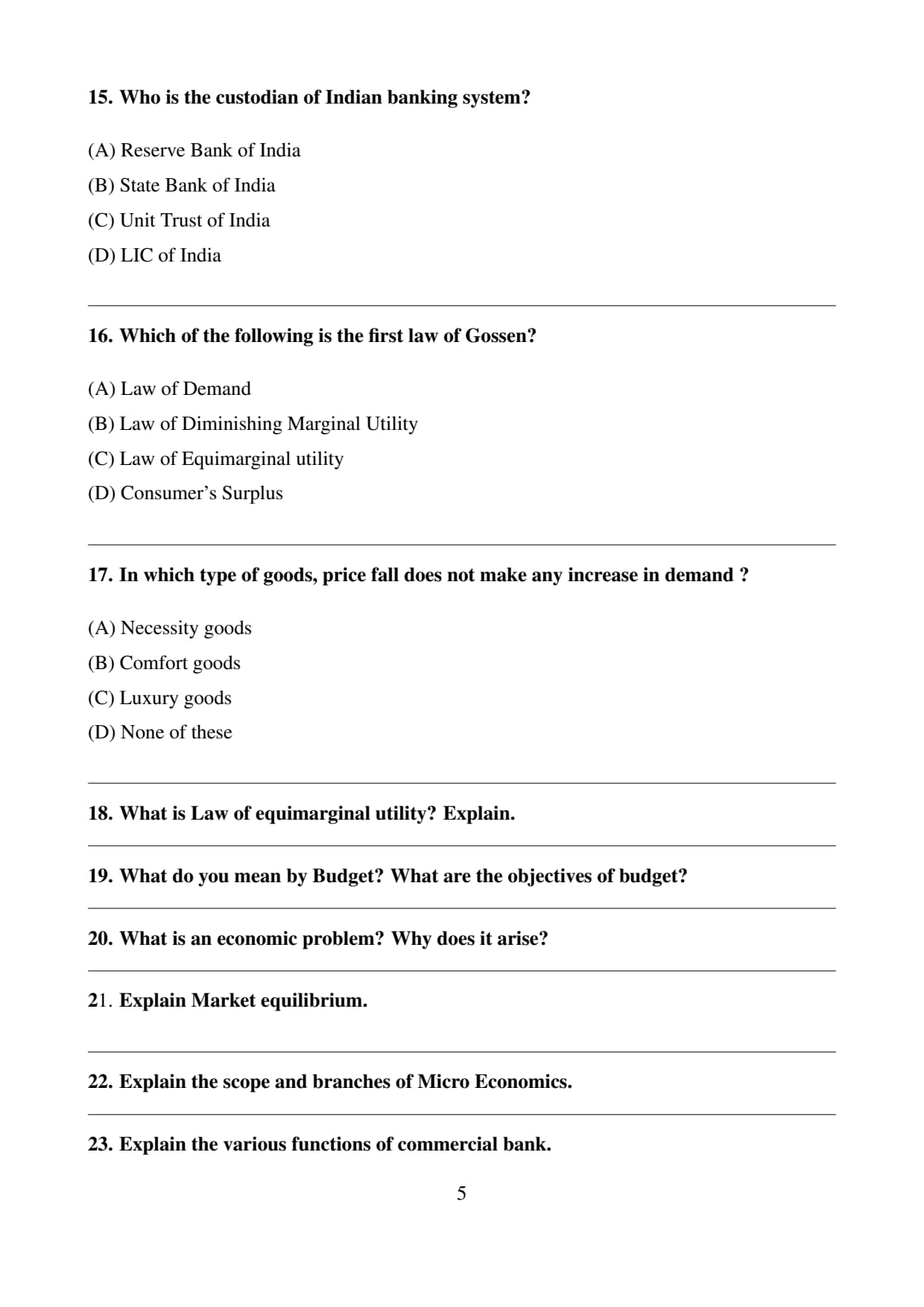
Who is the custodian of Indian banking system?
View Solution
We are asked to identify the custodian of the Indian banking system.
Step 1: Understand the meaning of "custodian" in this context.
The term "custodian" refers to the guardian, protector, or regulator. In the context of the banking system, the custodian is the central authority that regulates, supervises, and controls the entire banking system to ensure its stability and proper functioning.
Step 2: Role of Reserve Bank of India (RBI).
The Reserve Bank of India (RBI) is the central bank of India. It performs the following functions that establish it as the custodian of the banking system:
Regulator of Banks: RBI regulates and supervises all commercial banks and financial institutions under the Banking Regulation Act, 1949.
Issuer of Licenses: RBI grants licenses for opening new banks and branches.
Monetary Authority: RBI controls money supply and credit in the economy.
Lender of Last Resort: In times of crisis, banks can borrow from RBI.
Custodian of Foreign Exchange: RBI manages foreign exchange reserves under FEMA.
Banker to Banks: All scheduled banks maintain accounts with RBI.
Banker to Government: RBI manages government accounts and public debt.
Step 3: Analyze each option.
(A) Reserve Bank of India:
✓ Correct. RBI is the apex banking institution and the custodian of the Indian banking system.
It regulates, supervises, and controls all banking activities in India.
(B) State Bank of India:
Incorrect. SBI is the largest commercial bank in India, but it is regulated by RBI.
It is not the custodian; it is one of the banks under RBI's supervision.
(C) Unit Trust of India:
Incorrect. UTI was a financial institution (now UTI Asset Management Company) dealing with mutual funds and investments.
It is not related to banking system custody.
(D) LIC of India:
Incorrect. LIC is the Life Insurance Corporation of India, dealing with insurance.
It is not involved in banking regulation.
Final Answer: (A) Reserve Bank of India Quick Tip: RBI is the: Central Bank of India Regulator of banking system Issuer of currency Lender of last resort Banker to banks and government Remember: RBI is the custodian, guardian, and regulator of the entire Indian banking system.
Which of the following is the first law of Gossen?
View Solution
We are asked to identify the first law of Gossen.
Step 1: Understand who Gossen was.
Hermann Heinrich Gossen (1810-1858) was a German economist who developed fundamental principles of marginal utility theory. His work laid the foundation for the modern theory of consumer behavior. He proposed three laws, now known as Gossen's Laws.
Step 2: Recall Gossen's Three Laws.
First Law (Gossen's First Law): Law of Diminishing Marginal Utility
As a consumer consumes more and more units of a commodity, the marginal utility derived from each successive unit continuously diminishes.
This is the fundamental principle behind the downward-sloping demand curve.
Second Law (Gossen's Second Law): Law of Equimarginal Utility (or Principle of Maximum Satisfaction)
A consumer maximizes satisfaction when the marginal utility per unit of money spent is equal across all goods consumed.
Mathematically: \(\frac{MU_x}{P_x} = \frac{MU_y}{P_y} = ... = MU_m\) (marginal utility of money)
Third Law: (Less commonly mentioned) Deals with scarcity and value.
Step 3: Analyze each option.
(A) Law of Demand:
Incorrect. The Law of Demand states that price and quantity demanded are inversely related.
While derived from the Law of Diminishing Marginal Utility, it is not Gossen's First Law.
(B) Law of Diminishing Marginal Utility:
✓ Correct. This is Gossen's First Law.
It states that as consumption increases, the additional satisfaction from each extra unit decreases.
(C) Law of Equimarginal utility:
Incorrect. This is Gossen's Second Law, not the First.
(D) Consumer's Surplus:
Incorrect. Consumer's Surplus is a concept developed by Alfred Marshall, not a Gossen's Law.
It represents the difference between what consumers are willing to pay and what they actually pay.
Final Answer: (B) Law of Diminishing Marginal Utility Quick Tip: Gossen's Laws: First Law: Law of Diminishing Marginal Utility Second Law: Law of Equimarginal Utility (Maximum Satisfaction) Third Law: Deals with scarcity and value Remember: Gossen's First Law is the foundation of consumer behavior theory.
In which type of goods, price fall does not make any increase in demand ?
View Solution
We are asked to identify which type of goods do not show an increase in demand when price falls.
Step 1: Understand the relationship between price and demand.
According to the Law of Demand, there is an inverse relationship between price and quantity demanded. When price falls, demand usually increases. This holds true for almost all normal goods.
Step 2: Analyze each category of goods.
(A) Necessity goods:
Necessities are goods essential for living (food grains, basic clothing, medicines).
Demand for necessities is inelastic, meaning the change in demand is less than proportional to the change in price.
However, even for necessities, a fall in price does lead to some increase in demand (though small).
Example: If price of wheat falls, people may consume slightly more, but not dramatically.
(B) Comfort goods:
Comfort goods make life easier and more pleasant (air conditioners, refrigerators, better furniture).
Demand for comforts is more elastic than necessities.
A fall in price definitely increases demand for comfort goods.
(C) Luxury goods:
Luxury goods are high-end products (expensive cars, designer clothes, jewelry).
Demand for luxuries is highly elastic.
A fall in price significantly increases demand for luxury goods.
Step 3: Consider exceptions where price fall does not increase demand.
There are two notable exceptions where a price fall may not increase demand or may even decrease it:
Giffen Goods:
Inferior goods where price rise leads to increase in demand (and price fall leads to decrease in demand).
Example: During famine, if price of bread (staple) rises, people may consume more bread because they cannot afford meat.
These are theoretical and rare.
Veblen Goods:
Luxury goods where high price itself creates prestige value.
If price falls, demand may decrease because the snob appeal is lost.
Example: Designer handbags, luxury watches.
However, none of these exceptions are listed in the options. Necessity, comfort, and luxury goods (as normal goods) all show some increase in demand when price falls.
Step 4: Analyze the options.
(A) Necessity goods: Incorrect. Even necessities show some increase in demand when price falls.
(B) Comfort goods: Incorrect. Comfort goods show clear increase in demand with price fall.
(C) Luxury goods: Incorrect. Luxury goods show significant increase in demand with price fall.
(D) None of these: ✓ Correct. All the given categories (necessity, comfort, luxury) show an increase in demand when price falls.
Final Answer: (D) None of these Quick Tip: The Law of Demand states that price and quantity demanded are inversely related. This holds for almost all goods including necessities, comforts, and luxuries. The only exceptions are Giffen goods and Veblen goods, which are not listed here. Therefore, none of these categories show zero increase in demand when price falls.
What is Law of equimarginal utility? Explain.
View Solution
N/A
What do you mean by Budget? What are the objectives of budget?
View Solution
N/A
What is an economic problem? Why does it arise?
View Solution
N/A
Explain Market equilibrium.
View Solution
Market Equilibrium:
Market equilibrium is a situation in a market where the quantity demanded of a good equals the quantity supplied at a particular price. At this point, there is no tendency for the price to change as both buyers and sellers are satisfied.
Diagrammatic Representation:
\[ At equilibrium: Q_d = Q_s \]
where \(Q_d\) = Quantity demanded, \(Q_s\) = Quantity supplied
Explanation:
1. Equilibrium Price and Quantity:
The price at which demand equals supply is called the equilibrium price. The corresponding quantity is called the equilibrium quantity. At this price:
All consumers who want to buy at this price can buy
All producers who want to sell at this price can sell
There is no shortage or surplus in the market
2. When Price is Above Equilibrium:
If market price > equilibrium price:
Quantity supplied > Quantity demanded (Excess Supply/Surplus)
Sellers will have unsold stock
To clear stock, sellers will reduce price
Price falls until equilibrium is reached
3. When Price is Below Equilibrium:
If market price < equilibrium price:
Quantity demanded > Quantity supplied (Excess Demand/Shortage)
Consumers cannot buy as much as they want
Competition among buyers pushes price up
Price rises until equilibrium is reached
Example:
Consider the market for apples:
At ₹50 per kg, demand = 100 kg, supply = 100 kg → Equilibrium
At ₹60 per kg, demand = 80 kg, supply = 120 kg → Surplus → Price falls
At ₹40 per kg, demand = 120 kg, supply = 80 kg → Shortage → Price rises
Types of Equilibrium:
Stable Equilibrium: Market returns to equilibrium after disturbance
Unstable Equilibrium: Market moves away from equilibrium after disturbance
Factors Affecting Equilibrium:
Changes in demand (due to income, tastes, prices of related goods)
Changes in supply (due to technology, input prices, taxes)
Government policies (price controls, taxes, subsidies) Quick Tip: Market equilibrium is where demand meets supply. At this point, there is no shortage, no surplus, and no tendency for price to change. Any deviation creates forces that bring the market back to equilibrium.
Explain the scope and branches of Micro Economics.
View Solution
N/A
Explain the various functions of commercial bank.
View Solution
Commercial Bank:
A commercial bank is a financial institution that accepts deposits from the public and provides loans for the purpose of earning profits. Examples: State Bank of India, Punjab National Bank, ICICI Bank, HDFC Bank.
FUNCTIONS OF COMMERCIAL BANKS:
The functions of commercial banks are broadly classified into three categories:
Primary Functions
Secondary/Agency Functions
General Utility Functions
A. PRIMARY FUNCTIONS:
1. Accepting Deposits:
This is the most important function of commercial banks. Banks accept deposits from individuals and businesses in various types of accounts:
Savings Deposits: For small savers with limited transactions; interest rate is lower
Current Deposits: For businessmen; allows unlimited transactions; no interest paid
Fixed Deposits (Term Deposits): Deposits for a fixed period; higher interest rate; cannot be withdrawn before maturity
Recurring Deposits: Monthly installments for a fixed period; lump sum amount with interest returned at maturity
2. Advancing Loans:
Banks provide loans and advances to individuals, businesses, and governments against proper security. Types include:
Overdraft: Facility to withdraw more than the balance in current account
Cash Credit: Loans against pledged goods or documents
Term Loans: Medium and long-term loans for business expansion
Demand Loans: Loans repayable on demand
Discounting of Bills: Banks provide money by discounting bills of exchange before their maturity
3. Credit Creation:
Banks create credit out of the deposits they receive. They keep only a fraction of deposits as reserves and lend the rest, thereby creating new deposits in the economy. This is a unique function of banks.
B. SECONDARY/AGENCY FUNCTIONS:
1. Transfer of Funds:
Banks facilitate money transfer from one place to another through:
Bank Drafts
Cheques
Electronic Transfer (NEFT, RTGS, IMPS)
Demand Drafts
2. Collection and Payment of Funds:
Banks collect cheques, bills, dividends, interest, and salaries on behalf of customers. They also make payments as per instructions.
3. Purchase and Sale of Securities:
Banks buy and sell shares, debentures, and government securities on behalf of customers.
4. Collection of Taxes:
Banks collect income tax, GST, and other government dues on behalf of the government.
5. Trustee and Executor:
Banks act as trustees for wills and execute the will of their customers after their death.
6. Letter of Credit:
Banks issue letters of credit to facilitate international trade and business transactions.
C. GENERAL UTILITY FUNCTIONS:
1. Locker Facility:
Banks provide safe deposit lockers to customers for keeping valuable items like jewelry, documents, etc.
2. Foreign Exchange Services:
Banks deal in foreign exchange and provide foreign currency to customers traveling abroad.
3. Traveler's Cheques and Credit Cards:
Banks issue traveler's cheques and credit/debit cards for convenience of customers.
4. ATM and Internet Banking:
Banks provide 24/7 access to money through ATMs and online banking services.
5. Merchant Banking:
Large commercial banks provide merchant banking services like underwriting shares, project counseling, etc.
6. Gift Cheques:
Banks issue gift cheques for special occasions.
7. Standing Orders:
Banks make regular payments like insurance premiums, electricity bills, etc., as per standing instructions.
8. Demat Services:
Banks provide demat accounts for holding shares and securities in electronic form.
Role of Commercial Banks in Economic Development:
Capital formation through mobilization of savings
Promotion of trade and industry through credit
Development of agriculture and rural sector
Implementation of monetary policy
Employment generation Quick Tip: Commercial banks perform three types of functions: Primary (accept deposits, give loans, credit creation), Agency (payment/collection, fund transfer), and General Utility (locker, ATM, etc.). Credit creation is the most unique function of banks.




Comments