


The Directorate of General Education (DGE), Kerala, successfully conducted the DHSE Plus Two Political Science Exam 2026 on March 24, 2026. Kerala Board Class 12 Political Science Question Paper with Solution PDF is now available for download.
The Kerala Board Class 12 Political Science paper covered key topics from Indian politics, political theory, international relations, and governance. Students should focus on understanding political concepts, analyzing current issues, and interpreting political developments. The exam is marked out of 100, with 80 marks for the theory paper and 20 for internal assessment.
Kerala Board Class 12 2026 Political Science Question Paper with Solution PDF
| Kerala Board Class 12 Political Science Question Paper 2026 | Download PDF | Check Solution |
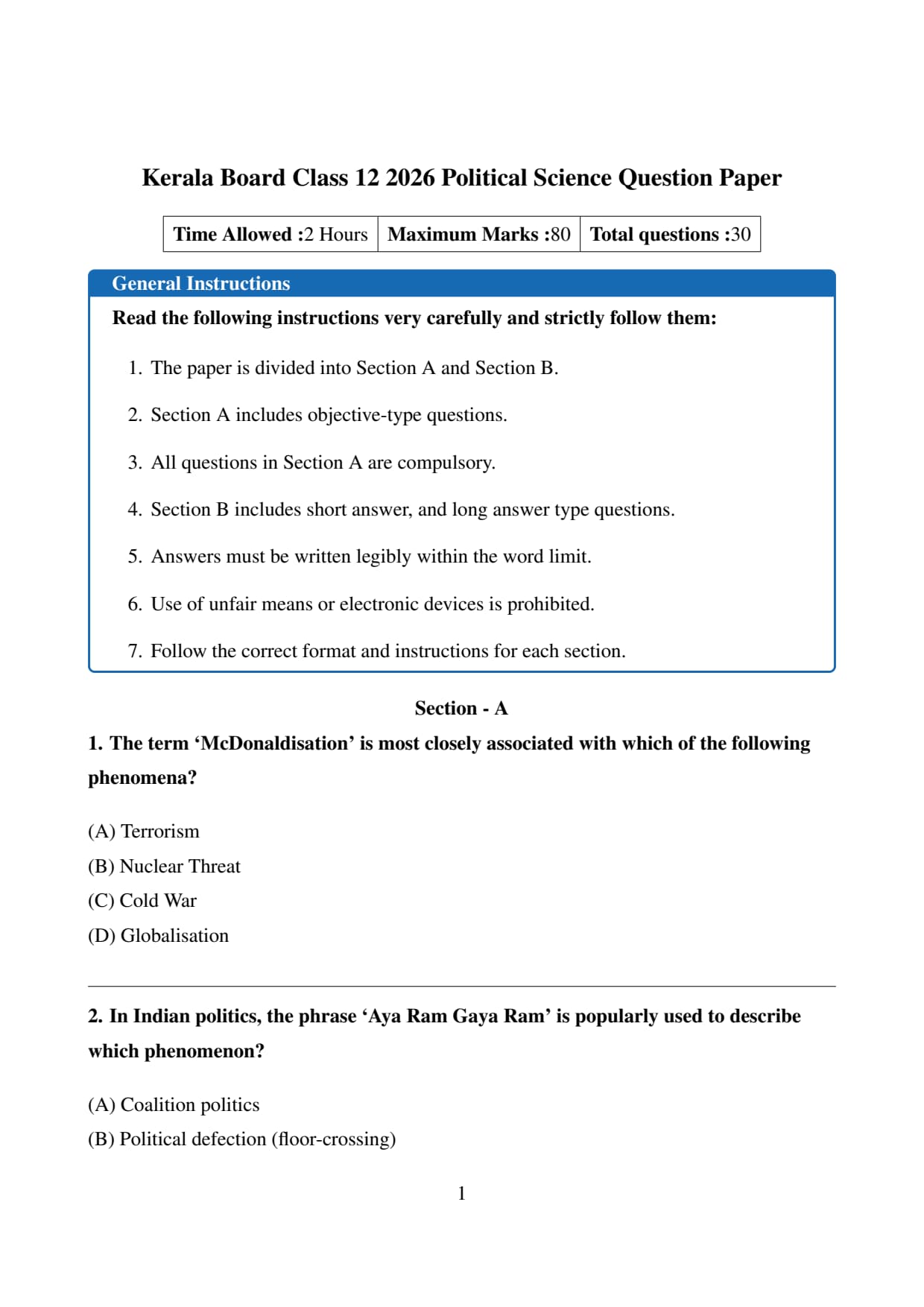
The term ‘McDonaldisation’ is most closely associated with which of the following phenomena?
View Solution
Step 1: Understanding McDonaldisation.
McDonaldisation is a concept introduced by sociologist George Ritzer, referring to the spread of fast-food principles such as efficiency, standardization, and predictability across the world.
Step 2: Linking with global processes.
These principles spread globally through multinational corporations like McDonald's, influencing cultures, economies, and societies worldwide.
Step 3: Evaluating options.
(A): Not related.
(B): Military concept.
(C): Political history.
(D): Correct. It reflects cultural and economic globalisation.
Step 4: Conclusion.
Thus, McDonaldisation is closely linked with globalisation.
Final Answer: Globalisation. Quick Tip: McDonaldisation shows how global brands spread uniform culture and practices worldwide.
In Indian politics, the phrase ‘Aya Ram Gaya Ram’ is popularly used to describe which phenomenon?
View Solution
Step 1: Understanding the phrase.
“Aya Ram Gaya Ram” refers to frequent switching of political parties by elected representatives.
Step 2: Historical context.
The phrase originated in 1967 when a Haryana MLA changed parties multiple times in a short period.
Step 3: Evaluating options.
(A): Coalition politics is different.
(B): Correct. It refers to political defection.
(C): Not related.
(D): Refers to central rule.
Step 4: Conclusion.
Thus, it describes political defection.
Final Answer: Political defection (floor-crossing). Quick Tip: “Aya Ram Gaya Ram” highlights instability caused by frequent party switching.
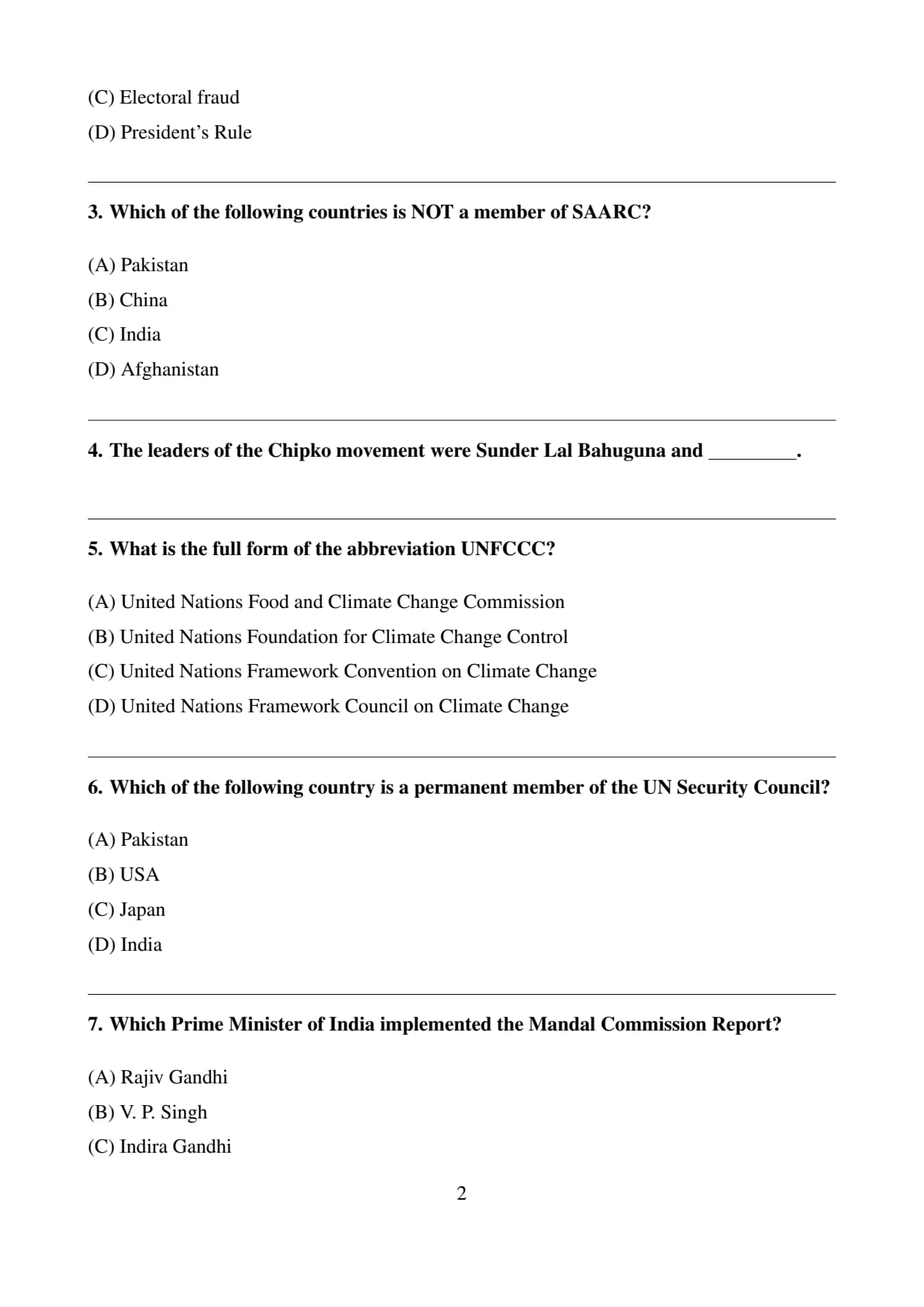
Which of the following countries is NOT a member of SAARC?
View Solution
Step 1: Understanding SAARC.
SAARC (South Asian Association for Regional Cooperation) includes countries of South Asia.
Step 2: Member countries.
Members include India, Pakistan, Bangladesh, Sri Lanka, Nepal, Bhutan, Maldives, and Afghanistan.
Step 3: Evaluating options.
(A), (C), (D): Members of SAARC.
(B): China is not a member (only an observer).
Step 4: Conclusion.
Thus, China is not a SAARC member.
Final Answer: China. Quick Tip: SAARC focuses on South Asian countries, and China participates only as an observer.
The leaders of the Chipko movement were Sunder Lal Bahuguna and \hspace{2cm}.
View Solution
Step 1: Understand the movement.
The Chipko Movement was an environmental movement started in India to protect forests by preventing tree cutting.
Step 2: Identify known leader.
Sunder Lal Bahuguna was a key leader who promoted forest conservation.
Step 3: Recall the second leader.
Another important leader associated with this movement was Chandi Prasad Bhatt.
Step 4: Role of both leaders.
They mobilized villagers, especially women, to hug trees and stop deforestation.
Step 5: Final answer.
Thus, the blank is filled with Chandi Prasad Bhatt.
Quick Tip: Chipko Movement = Hugging trees to prevent cutting; key leaders include Bahuguna and Chandi Prasad Bhatt.
What is the full form of the abbreviation UNFCCC?
View Solution
Step 1: Understanding UNFCCC.
UNFCCC ek international environmental treaty hai jo climate change ko address karne ke liye banaya gaya hai. Yeh global efforts ko coordinate karta hai greenhouse gas emissions ko reduce karne ke liye.
Step 2: Full form analysis.
UNFCCC ka correct expansion hai United Nations Framework Convention on Climate Change, jo 1992 me Rio Earth Summit ke dauran adopt kiya gaya tha.
Step 3: Analysis of options.
(A) Incorrect. Yeh official name nahi hai.
(B) Incorrect. Foundation term use nahi hota.
(C) Correct. Yeh official full form hai.
(D) Incorrect. Council word galat hai.
Step 4: Conclusion.
Isliye UNFCCC ka full form United Nations Framework Convention on Climate Change hai.
Final Answer: United Nations Framework Convention on Climate Change. Quick Tip: UNFCCC = Global climate agreement jiske under Kyoto Protocol aur Paris Agreement aate hain.
Which of the following country is a permanent member of the UN Security Council?
View Solution
Step 1: Understanding UNSC structure.
United Nations Security Council me 5 permanent members hote hain jinhe veto power bhi milti hai.
Step 2: List of permanent members.
Permanent members hain: USA, UK, Russia, China aur France.
Step 3: Analysis of options.
(A) Pakistan: Permanent member nahi hai.
(B) USA: Correct. Yeh permanent member hai.
(C) Japan: Permanent member nahi hai.
(D) India: Permanent member nahi hai (abhi tak).
Step 4: Conclusion.
Isliye USA hi given options me permanent member hai.
Final Answer: USA. Quick Tip: P5 countries: USA, UK, Russia, China, France.
Which Prime Minister of India implemented the Mandal Commission Report?
View Solution
Step 1: Understanding Mandal Commission.
Mandal Commission 1979 me establish hua tha jiska aim tha socially aur educationally backward classes ko identify karna aur unke liye reservations suggest karna.
Step 2: Implementation.
1990 me Prime Minister V. P. Singh ne Mandal Commission ki recommendations ko implement kiya, jisme OBCs ke liye reservation introduce kiya gaya.
Step 3: Analysis of options.
(A) Rajiv Gandhi: Implementation nahi kiya.
(B) V. P. Singh: Correct. Unhone implement kiya.
(C) Indira Gandhi: Commission ke time PM thi, par implement nahi kiya.
(D) Atal Bihari Vajpayee: Later PM the, implementation unhone nahi kiya.
Step 4: Conclusion.
Isliye Mandal Commission report ko V. P. Singh ne implement kiya tha.
Final Answer: V. P. Singh. Quick Tip: Mandal Commission implementation (1990) = V. P. Singh government.
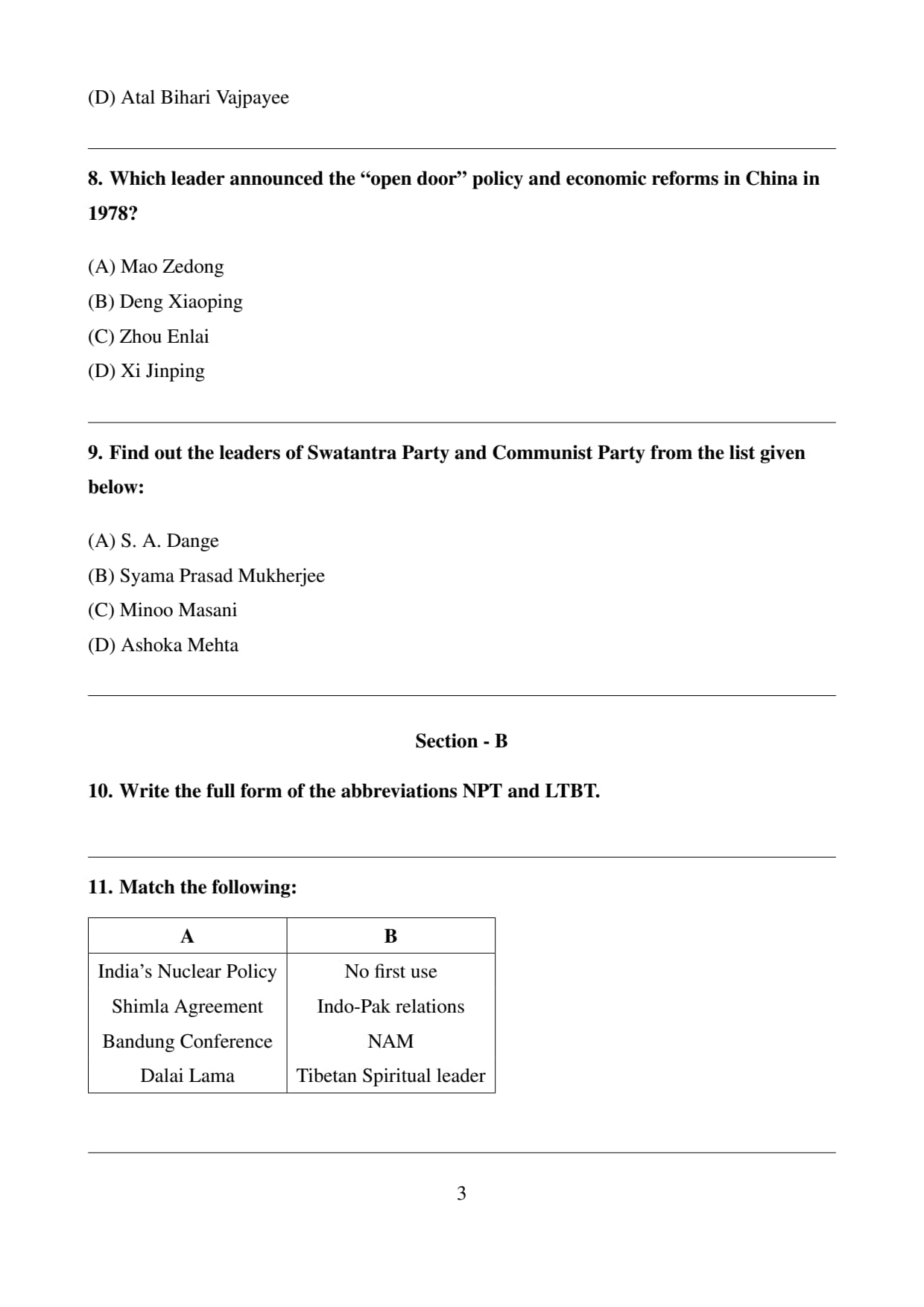
Which leader announced the “open door” policy and economic reforms in China in 1978?
View Solution
Step 1: Understanding the policy.
The “open door” policy refers to China opening its economy to foreign investment and market-oriented reforms.
Step 2: Historical context.
In 1978, Deng Xiaoping introduced major economic reforms to modernize China and integrate it into the global economy.
Step 3: Evaluating options.
(A): Mao Zedong followed a closed socialist economy.
(B): Correct. Deng Xiaoping introduced economic reforms.
(C): Zhou Enlai was a leader but not responsible for this reform.
(D): Xi Jinping is a recent leader.
Step 4: Conclusion.
Thus, Deng Xiaoping announced the open door policy.
Final Answer: Deng Xiaoping. Quick Tip: Deng Xiaoping is known as the architect of modern China's economic reforms.
Find out the leaders of Swatantra Party and Communist Party from the list given below:
View Solution
Step 1: Understanding the parties.
The question asks to identify leaders associated with Swatantra Party and Communist Party.
Step 2: Identifying leaders.
S. A. Dange: A prominent leader of the Communist Party of India.
Minoo Masani: A key leader of the Swatantra Party.
Step 3: Eliminating others.
Syama Prasad Mukherjee: Founder of Bharatiya Jana Sangh.
Ashoka Mehta: Associated with Socialist Party.
Step 4: Conclusion.
Thus, correct leaders are S. A. Dange and Minoo Masani.
Final Answer: S. A. Dange and Minoo Masani. Quick Tip: Match leaders with parties: Dange → Communist Party, Masani → Swatantra Party.
Write the full form of the abbreviations NPT and LTBT.
View Solution
Step 1: Identify NPT.
NPT stands for Nuclear Non-Proliferation Treaty.
Step 2: Understand NPT.
It is an international treaty aimed at preventing the spread of nuclear weapons and promoting peaceful uses of nuclear energy.
Step 3: Identify LTBT.
LTBT stands for Limited Test Ban Treaty.
Step 4: Understand LTBT.
It prohibits nuclear weapon tests in the atmosphere, outer space, and underwater.
Step 5: Final answer.
Thus, NPT = Nuclear Non-Proliferation Treaty and LTBT = Limited Test Ban Treaty.
Quick Tip: NPT controls nuclear weapons spread, while LTBT restricts nuclear testing.
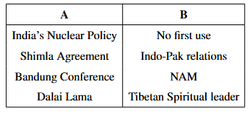
Match the following:
View Solution
Step 1: India’s Nuclear Policy.
India follows a No First Use policy regarding nuclear weapons.
Step 2: Shimla Agreement.
It was signed between India and Pakistan, so it relates to Indo-Pak relations.
Step 3: Bandung Conference.
This conference led to the formation of the Non-Aligned Movement (NAM).
Step 4: Dalai Lama.
Dalai Lama is known as the Tibetan Spiritual leader.
Step 5: Final matching.
Thus, the correct matches are:
India’s Nuclear Policy → No first use
Shimla Agreement → Indo-Pak relations
Bandung Conference → NAM
Dalai Lama → Tibetan Spiritual leader
Quick Tip: Remember key associations: Shimla = Indo-Pak, Bandung = NAM, Dalai Lama = Tibetan leader.
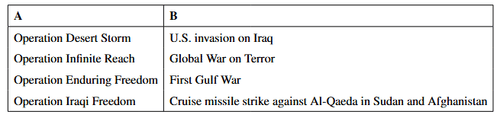
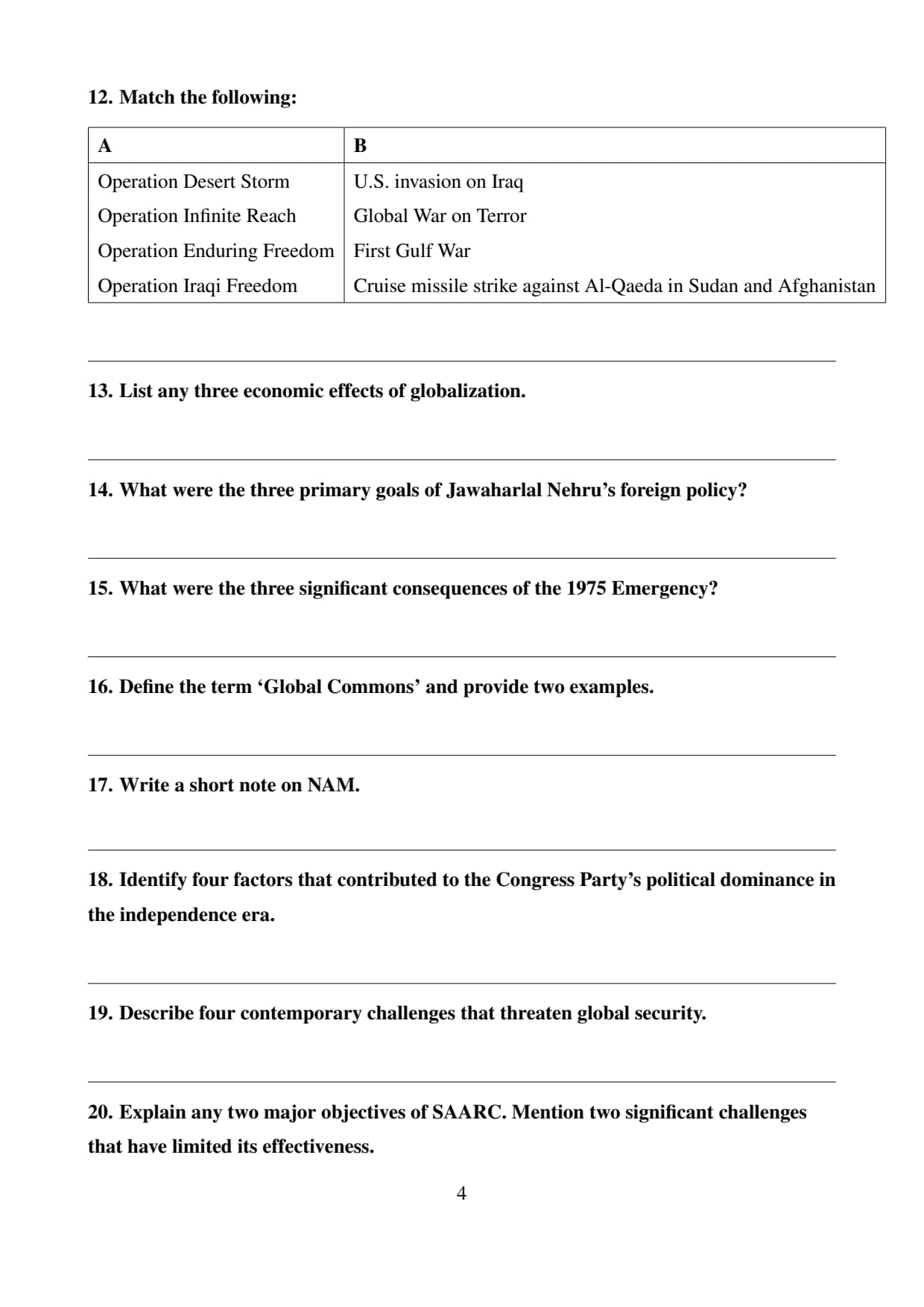
Match the following:
View Solution
Step 1: Operation Desert Storm.
This operation is related to the First Gulf War, conducted in 1991 against Iraq.
Step 2: Operation Infinite Reach.
This involved cruise missile strikes against Al-Qaeda targets in Sudan and Afghanistan in 1998.
Step 3: Operation Enduring Freedom.
This operation marked the beginning of the Global War on Terror after the 9/11 attacks.
Step 4: Operation Iraqi Freedom.
This refers to the U.S. invasion of Iraq in 2003.
Step 5: Final Matching.
Thus, the correct matching is:
Operation Desert Storm → First Gulf War
Operation Infinite Reach → Cruise missile strike
Operation Enduring Freedom → Global War on Terror
Operation Iraqi Freedom → U.S. invasion on Iraq
Quick Tip: Remember: Desert Storm = Gulf War, Enduring Freedom = War on Terror, Iraqi Freedom = Iraq invasion.
List any three economic effects of globalization.
View Solution
Step 1: Increase in trade.
Globalization has led to an increase in international trade and exchange of goods and services.
Step 2: Foreign investment.
It has encouraged foreign direct investment (FDI), leading to economic growth and development.
Step 3: Job creation.
New industries and businesses have created employment opportunities.
Step 4: Competition.
Globalization increases competition, which improves quality and reduces prices.
Step 5: Conclusion.
Thus, globalization leads to trade expansion, investment growth, and job opportunities.
Quick Tip: Globalization connects economies, boosting trade, investment, and competition.
What were the three primary goals of Jawaharlal Nehru’s foreign policy?
View Solution
Step 1: Non-alignment.
Nehru aimed to keep India independent of power blocs like the USA and USSR.
Step 2: Peaceful coexistence.
He promoted peace and cooperation among nations.
Step 3: Anti-colonialism.
He supported the freedom of colonies and opposed imperialism.
Step 4: International cooperation.
Encouraged friendly relations and cooperation with other countries.
Step 5: Conclusion.
Thus, his policy focused on non-alignment, peace, and anti-colonialism.
Quick Tip: Nehru’s policy = Non-alignment + Peace + Anti-colonialism.
What were the three significant consequences of the 1975 Emergency?
View Solution
Step 1: Suspension of rights.
Fundamental rights of citizens were suspended during the Emergency.
Step 2: Censorship of media.
Press and media were controlled and censored by the government.
Step 3: Arrest of leaders.
Opposition leaders and activists were arrested without trial.
Step 4: Centralization of power.
Power became concentrated in the hands of the central government.
Step 5: Conclusion.
Thus, the Emergency led to loss of freedom, suppression of opposition, and strict government control.
Quick Tip: 1975 Emergency = Rights suspended, media censored, opposition suppressed.
Define the term ‘Global Commons’ and provide two examples.
View Solution
Step 1: Define Global Commons.
Global Commons are those resources or regions of the world that are not owned by any one nation but are shared by all countries.
Step 2: Explain their nature.
These areas are used collectively and require international cooperation for their protection and sustainable use.
Step 3: Examples.
Two examples of Global Commons are:
1. The High Seas (Oceans beyond national jurisdiction)
2. The Atmosphere
Step 4: Conclusion.
Thus, Global Commons are shared resources that belong to all humanity and need global management.
Quick Tip: Global Commons = Shared resources like oceans, atmosphere, Antarctica, and outer space.
Write a short note on NAM.
View Solution
Step 1: Define NAM.
NAM (Non-Aligned Movement) is an international organization of countries that chose not to align with any major power bloc during the Cold War.
Step 2: Origin.
It was established in 1961 at the Belgrade Conference and was led by leaders like Jawaharlal Nehru, Tito, and Nasser.
Step 3: Objectives.
The main aim was to maintain independence in foreign policy, promote peace, and avoid involvement in power conflicts.
Step 4: Importance.
NAM gave a voice to developing nations and promoted cooperation among them.
Step 5: Conclusion.
Thus, NAM played a crucial role in maintaining neutrality and global peace during the Cold War era.
Quick Tip: NAM = No alignment with USA or USSR during Cold War.
Identify four factors that contributed to the Congress Party’s political dominance in the independence era.
View Solution
Step 1: Role in Freedom Struggle.
Congress Party led the Indian freedom movement, gaining widespread popularity and trust among people.
Step 2: Strong leadership.
Leaders like Jawaharlal Nehru and Mahatma Gandhi provided strong and visionary leadership.
Step 3: Organizational strength.
The party had a well-established network across the country, helping it connect with masses.
Step 4: Lack of strong opposition.
Other political parties were weak or fragmented, allowing Congress to dominate politically.
Step 5: Conclusion.
These factors collectively helped Congress maintain political dominance after independence.
Quick Tip: Congress dominance = Freedom struggle legacy + Strong leaders + Weak opposition.
Describe four contemporary challenges that threaten global security.
View Solution
Step 1: Terrorism.
Terrorist activities create fear, instability, and threaten peace across nations.
Step 2: Climate Change.
Environmental changes lead to disasters, resource scarcity, and conflicts.
Step 3: Cyber Threats.
Cyber attacks on governments and organizations pose serious security risks.
Step 4: Nuclear Proliferation.
The spread of nuclear weapons increases the risk of large-scale destruction.
Step 5: Conclusion.
These challenges require global cooperation to ensure peace and security.
Quick Tip: Modern threats = Terrorism + Climate change + Cyber attacks + Nuclear risks.
Explain any two major objectives of SAARC. Mention two significant challenges that have limited its effectiveness.
View Solution
Step 1: Define SAARC.
SAARC (South Asian Association for Regional Cooperation) is a regional organization formed to promote cooperation among South Asian countries.
Step 2: Objectives of SAARC.
1. To promote economic growth and development in the South Asian region.
2. To strengthen regional cooperation in areas like trade, education, health, and technology.
Step 3: Challenges faced.
1. Political conflicts, especially between India and Pakistan, have hindered cooperation.
2. Lack of mutual trust and slow decision-making process among member countries.
Step 4: Conclusion.
Thus, despite its objectives, SAARC's effectiveness is limited due to political and structural challenges.
Quick Tip: SAARC = Regional cooperation body, but political tensions reduce its effectiveness.
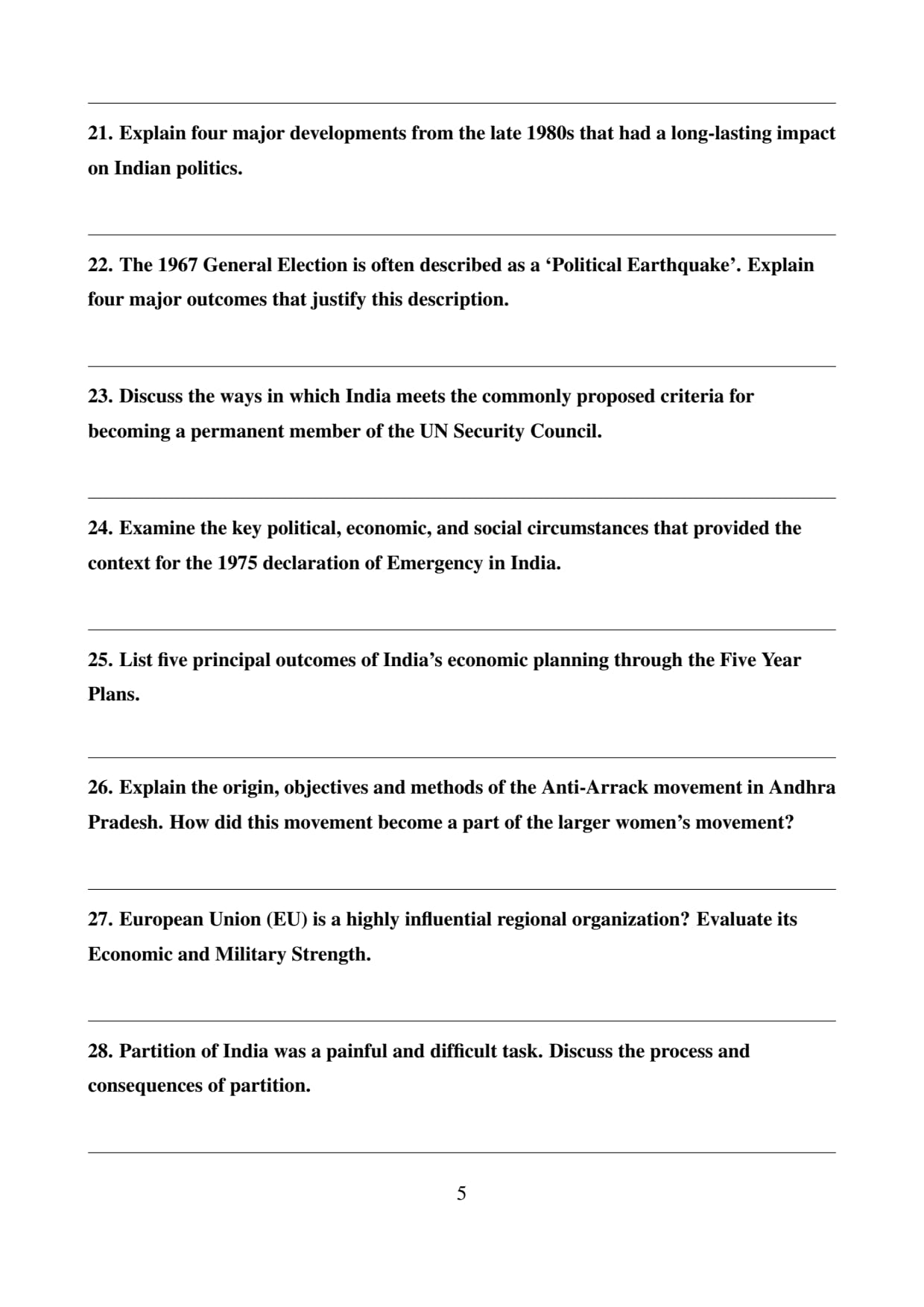
Explain four major developments from the late 1980s that had a long-lasting impact on Indian politics.
View Solution
Step 1: Rise of coalition politics.
Single-party dominance declined, and coalition governments became common at the national level.
Step 2: Mandal Commission implementation.
Reservation for OBCs led to social and political changes, strengthening backward class politics.
Step 3: Economic liberalization.
In 1991, India adopted economic reforms that changed the economic and political landscape.
Step 4: Rise of regional parties.
Regional parties gained importance and started playing a key role in national politics.
Step 5: Conclusion.
These developments transformed Indian politics into a more diverse and competitive system.
Quick Tip: Late 1980s = Coalition politics + Mandal + Liberalization + Regional parties.
The 1967 General Election is often described as a ‘Political Earthquake’. Explain four major outcomes that justify this description.
View Solution
Step 1: Decline of Congress dominance.
Congress lost its monopoly in many states, marking the end of one-party dominance.
Step 2: Emergence of coalition governments.
Non-Congress parties formed coalition governments in several states.
Step 3: Rise of opposition parties.
Opposition parties became stronger and more organized, challenging Congress effectively.
Step 4: Beginning of political instability.
Frequent government changes and defections started, leading to instability in politics.
Step 5: Conclusion.
Thus, the 1967 election brought major structural changes, justifying it as a ‘Political Earthquake’.
Quick Tip: 1967 Election = End of Congress dominance + Rise of coalition politics.
Discuss the ways in which India meets the commonly proposed criteria for becoming a permanent member of the UN Security Council.
View Solution
Step 1: Population and representation.
India has one of the largest populations in the world, representing a significant portion of humanity, which strengthens its claim for global representation.
Step 2: Economic and military strength.
India is a growing economic power and has a strong military, contributing to global stability and peacekeeping.
Step 3: Contribution to UN peacekeeping.
India has been one of the largest contributors to UN peacekeeping missions.
Step 4: Democratic credentials.
India is the world’s largest democracy, supporting democratic values globally.
Step 5: Conclusion.
Thus, India meets key criteria like population size, economic strength, peacekeeping contribution, and democratic governance.
Quick Tip: India’s claim for UNSC permanent membership is based on population, democracy, and global contributions.
Examine the key political, economic, and social circumstances that provided the context for the 1975 declaration of Emergency in India.
View Solution
Step 1: Political instability.
There was growing opposition against the government and protests led by leaders like Jayaprakash Narayan.
Step 2: Economic problems.
India faced inflation, unemployment, and economic slowdown, causing public dissatisfaction.
Step 3: Social unrest.
Strikes, protests, and movements created instability in society.
Step 4: Judicial crisis.
The Allahabad High Court declared Indira Gandhi’s election invalid, creating a political crisis.
Step 5: Conclusion.
These factors led to the declaration of Emergency in 1975.
Quick Tip: Emergency 1975 was caused by political crisis, economic issues, and social unrest.
List five principal outcomes of India’s economic planning through the Five Year Plans.
View Solution
Step 1: Industrial development.
India developed a strong industrial base through planned economic policies.
Step 2: Agricultural growth.
Green Revolution improved agricultural productivity and food security.
Step 3: Infrastructure development.
Significant progress in transport, energy, and communication sectors.
Step 4: Reduction in poverty.
Various schemes helped reduce poverty and improve living standards.
Step 5: Balanced regional development.
Efforts were made to reduce regional inequalities.
Quick Tip: Five Year Plans focused on industry, agriculture, infrastructure, and poverty reduction.
Explain the origin, objectives and methods of the Anti-Arrack movement in Andhra Pradesh. How did this movement become a part of the larger women’s movement?
View Solution
Step 1: Origin of the movement.
The Anti-Arrack movement began in Andhra Pradesh as a protest against the sale of cheap liquor (arrack), which was affecting rural families.
Step 2: Objectives.
The main aim was to ban arrack consumption and protect families from social and economic harm.
Step 3: Methods used.
Women organized protests, rallies, and campaigns to stop liquor sales in villages.
Step 4: Role of women.
Women actively participated as they were most affected by alcoholism and domestic violence.
Step 5: Link to women’s movement.
It became part of the larger women’s movement as it highlighted women’s rights, empowerment, and social justice.
Quick Tip: Anti-Arrack movement = grassroots women-led protest against alcohol abuse.
European Union (EU) is a highly influential regional organization? Evaluate its Economic and Military Strength.
View Solution
Step 1: Introduction to EU.
The European Union (EU) is a regional organization of European countries formed to promote economic cooperation, political stability, and integration among its members.
Step 2: Economic Strength of EU.
EU is one of the largest economic blocs in the world with a strong GDP and advanced industrial base. It has a single market allowing free movement of goods, services, capital, and people. The Euro is a powerful common currency used by many member nations, enhancing economic stability and trade.
Step 3: Trade and Global Influence.
The EU plays a major role in global trade and is one of the largest exporters and importers. It has strong economic partnerships worldwide, increasing its global influence.
Step 4: Military Strength of EU.
Although the EU does not have a unified army, many of its member countries (like France and Germany) have strong military capabilities. It cooperates through NATO and conducts joint security and peacekeeping operations.
Step 5: Limitations in Military Power.
The absence of a single unified military force and differences among member states limit its independent military strength.
Step 6: Conclusion.
Thus, the EU is highly influential economically but relatively weaker in military terms due to lack of complete unity in defense.
Quick Tip: EU = Strong economic power but limited military unity.
Partition of India was a painful and difficult task. Discuss the process and consequences of partition.
View Solution
Step 1: Process of partition.
In 1947, British India was divided into two independent nations—India and Pakistan—based on religious lines. The Radcliffe Commission was appointed to draw the boundary line.
Step 2: Mass migration.
Millions of people migrated across borders—Hindus and Sikhs to India, Muslims to Pakistan—resulting in one of the largest migrations in history.
Step 3: Violence and loss of life.
The partition led to widespread communal riots, causing the death of lakhs of people and massive destruction of property.
Step 4: Social and emotional impact.
Families were separated, people lost homes and livelihoods, and deep communal tensions emerged.
Step 5: Conclusion.
Thus, the partition was a painful event with long-lasting political, social, and emotional consequences.
Quick Tip: Partition 1947 = Division + Migration + Violence + Long-term tensions.
What were the key factors that led to the collapse of the Soviet Union?
View Solution
Step 1: Economic weakness.
The Soviet economy was inefficient, with slow growth, shortages, and heavy military expenditure.
Step 2: Political issues.
Lack of democracy and authoritarian rule led to public dissatisfaction.
Step 3: Reforms by Gorbachev.
Policies like Glasnost (openness) and Perestroika (restructuring) weakened central control.
Step 4: Rise of nationalism.
Different republics demanded independence, leading to disintegration.
Step 5: Conclusion.
Thus, economic failure, political instability, reforms, and nationalism caused the collapse in 1991.
Quick Tip: Soviet collapse = Economic crisis + Political failure + Reforms + Nationalism.
Discuss the diverse and complex nature of regional aspirations in North East India and explain the major political outcomes.
View Solution
Step 1: Nature of regional aspirations.
North East India has diverse ethnic groups with distinct cultures, languages, and identities, leading to varied regional demands.
Step 2: Types of demands.
These included demands for autonomy, separate states, and protection of cultural identity.
Step 3: Conflicts and movements.
Several movements and insurgencies emerged due to neglect and lack of development.
Step 4: Political responses.
The government created new states like Nagaland, Meghalaya, Mizoram, and Tripura, and provided special provisions.
Step 5: Outcomes.
These steps helped address some demands, though challenges still remain in the region.
Quick Tip: North East issues = Diversity + Identity + Autonomy demands + State formation.



Comments