




The AIBE XXI exam, which was conducted on June 7th 2026 was considered a moderate paper overall. Many students found AIBE XXI challenging compared to previous years.
- Questions from BNS, BNSS and BSA were on the challenging side, mainly due to these questions being based on procedural reforms.
- Family Law questions were unexpectedly conceptual-heavy and challenging.
- The overall paper was lengthy and more time-consuming than in previous years.
- Considering the moderate difficulty paper, 65-72 questions are considered good attempts for general candidates.
Also Read
- Check the Expected AIBE XXI 2026 Results and Direct Link
- Check AIBE XXI Expected Category-wise Cutoff and Qualifying Marks
AIBE XXI 2026 Exam Overview
AIBE XXI 2026 was conducted across multiple exam centres in India on June 7, 2026. The exam is a mandatory qualifying test for law graduates who wish to practise as advocates.
- It is an open-book examination, allowing students to carry bare acts (without annotations or handwritten notes) into the examination hall.
- Provisional Answer keys are already out for the exam, and now candidates are waiting for the results.
| Parameter | Details |
|---|---|
| Conducting Body | Bar Council of India (BCI) |
| Exam Name | All India Bar Examination XXI (AIBE XXI) |
| Exam Date | June 7, 2026 |
| Exam Mode | Offline (OMR-based) |
| Duration | 3 hours 30 minutes |
| Total Questions | 100 MCQs |
| Total Marks | 100 (1 mark per question) |
| Negative Marking | None |
| Qualifying Marks (General/OBC) | 45 out of 100 (45%) |
| Qualifying Marks (SC/ST) | 40 out of 100 (40%) |
| Type of Exam | Open Book (only bare acts are allowed) |
AIBE XXI 2026 Overall Difficulty Analysis
Based on student reviews collected after the June 7, 2026 exam, AIBE XXI 2026 was rated overall moderate in difficulty. Students who had thorough knowledge of the three new criminal law statutes: BNS (Bharatiya Nyaya Sanhita), BNSS (Bharatiya Nagarik Suraksha Sanhita), and BSA (Bharatiya Sakshya Adhiniyam) found the paper manageable.
Students who had prepared primarily from the older IPC, CrPC, and Evidence Act found certain sections more demanding due to the change in section numbers and provisions.
Key observations from student feedback after AIBE XXI 2026:
- BNS and BNSS sections were the trickiest as questions required precise knowledge of new section numbers and provisions that replaced the IPC and CrPC respectively.
- Constitutional Law and CPC were moderate and well within the scope of standard preparation.
- Professional Ethics questions were straightforward and drawn directly from BCI rules, making them the most accessible section.
- The open-book format helped significantly- students who carried complete and relevant bare acts reported being able to verify uncertain answers in real time.
- Company Law questions were the most difficult in the non-criminal law segment, testing specific provisions of the Companies Act 2013.
Ques. What was the overall difficulty level of AIBE XXI 2026?
Ans. AIBE XXI 2026 was overall moderate in difficulty based on student reviews after the June 7, 2026 exam. BNS, BNSS, and Company Law were the hardest sections, while Professional Ethics and the Indian Contract Act were the easiest.
Ques. How many questions were there in AIBE XXI 2026?
Ans. AIBE XXI 2026 had 100 MCQ questions, each carrying 1 mark, with no negative marking for incorrect answers. The total marks for the exam were 100.
AIBE XXI 2026 Section-Wise Difficulty Level
The table below shows the subject-wise question distribution, difficulty level, and good attempts for AIBE XXI 2026, based on student reviews after the June 7, 2026 exam. The question counts are based on student feedback, it's not an official exact number.
| Subject | No. of Questions (Approx.) | Difficulty Level | Good Attempts |
|---|---|---|---|
| Constitutional Law | 10 | Moderate | 7-8 |
| BNS (Bharatiya Nyaya Sanhita) | 8 | Moderate to Difficult | 5-6 |
| BNSS (Bharatiya Nagarik Suraksha Sanhita) | 8 | Moderate to Difficult | 5-6 |
| Code of Civil Procedure (CPC) | 8 | Moderate | 6-7 |
| BSA (Bharatiya Sakshya Adhiniyam) | 6 | Moderate | 4-5 |
| Indian Contract Act | 6 | Easy | 5-6 |
| Transfer of Property Act | 6 | Moderate | 4-5 |
| Family Law (Hindu and Muslim) | 6 | Easy to Moderate | 5-6 |
| Company Law | 5 | Difficult | 3-4 |
| Professional Ethics and BCI Rules | 5 | Easy | 5 |
| Labour and Industrial Laws | 5 | Moderate | 3-4 |
| Arbitration and Conciliation | 5 | Moderate | 3-4 |
| Environmental Law | 4 | Easy to Moderate | 3-4 |
| Administrative Law | 4 | Easy to Moderate | 3-4 |
| Land Acquisition Laws | 3 | Moderate | 2-3 |
| IT Act and Cyber Law | 3 | Moderate | 2-3 |
| Intellectual Property Rights (IPR) | 3 | Moderate | 2-3 |
| Consumer Protection Act | 3 | Easy | 3 |
| Public International Law | 2 | Moderate | 1-2 |
| Total | 100 | Overall: Moderate | 65-72 |
Also Read
- AIBE XXI 2026 IPC and CrPC Section Analysis: Criminal Law Marks and Difficulty
- Failed AIBE XXI 2026? Re-Attempt Rules and Temporary Enrollment Rights
Ques. Which sections were the toughest in AIBE XXI 2026?
Ans. BNS (Bharatiya Nyaya Sanhita), BNSS (Bharatiya Nagarik Suraksha Sanhita), and Company Law were reported as the most difficult sections in AIBE XXI 2026 based on student feedback. Questions in these sections required knowledge of new section numbers and detailed statutory provisions.
Good Attempts in AIBE XXI 2026
Since AIBE is an open-book exam with no negative marking, students should ideally attempt all 100 questions. A good attempt refers to the number of questions answered correctly with confidence.
- Based on the overall moderate difficulty reported for AIBE XXI 2026, 55-60 marks are considered a safe score to qualify the exam, whereas you need 65-72 marks to pass comfortably even if the cutoff increases.
- 48-52 correct attempts are likely enough for SC & ST candidates to clear the exam; however, 58-65 marks are considered good.
- Students who carried complete and unannotated bare acts for BNS, BNSS, and BSA reported higher accuracy in those sections.
- Constitutional Law, CPC, Contract Act, and Professional Ethics offered the best opportunity to secure correct answers quickly.
| Category | Qualifying Marks | Safe Score Range | Comfortable Score |
|---|---|---|---|
| General / OBC | 45 out of 100 | 55-60 | 65-72 |
| SC / ST | 40 out of 100 | 48-52 | 58-65 |

Also Read
- AIBE XXI 2026 Good Attempts: How Many to Qualify Out of 100
- AIBE XXI 2026 Expected Qualifying Cutoff for SC, ST and OBC: Category-Wise Minimum Mark
Ques. What are the good attempts in AIBE XXI 2026 for General students?
Ans. A score of 65-72 is considered a comfortable performance for General students in AIBE XXI 2026. A safe qualifying range is 55-60.
Expected Qualifying Score in AIBE XXI 2026
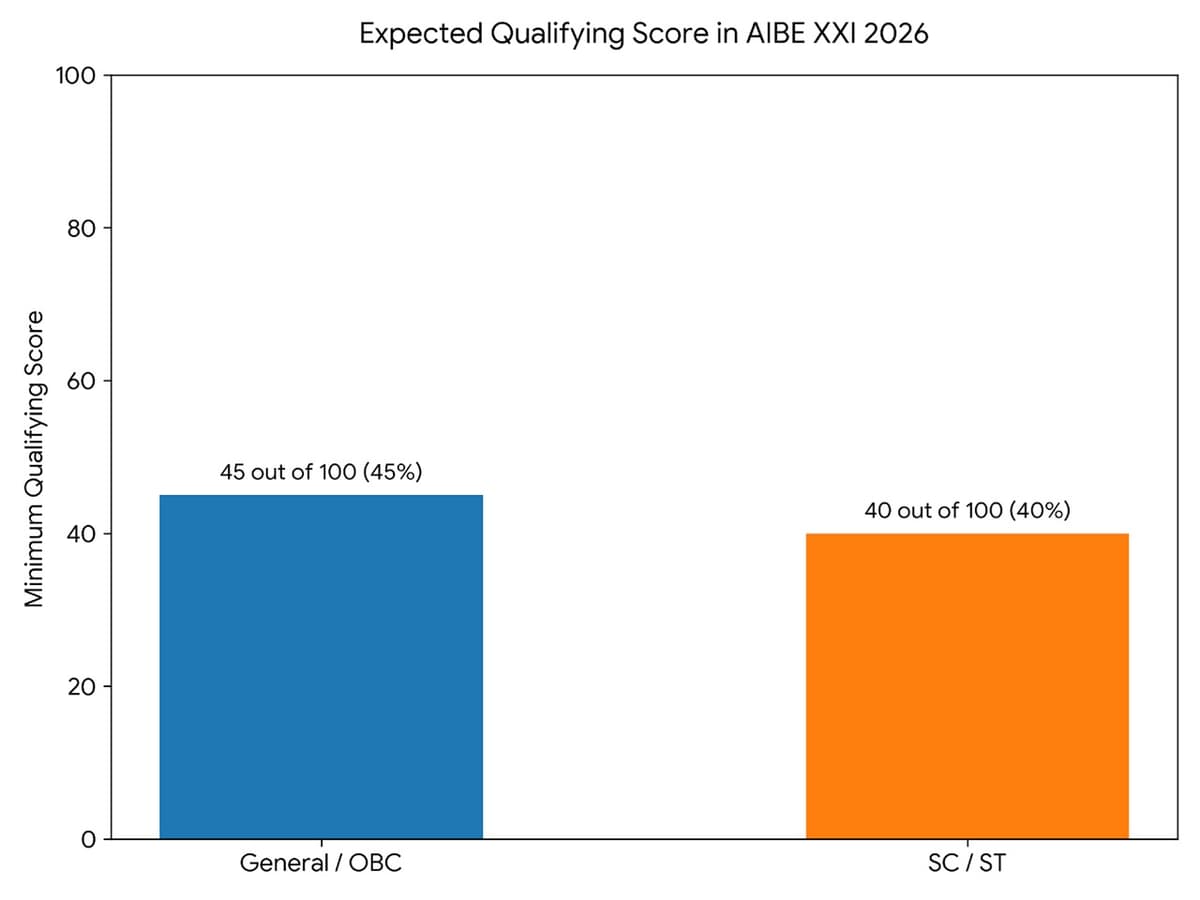
The qualifying score for AIBE XXI 2026 is fixed by the Bar Council of India at 45 out of 100 for General and OBC students, and 40 out of 100 for SC/ST students.
Given the moderate overall difficulty of AIBE XXI 2026, most well-prepared students are expected to clear the qualifying score. Students who qualify are awarded a Certificate of Practice (CoP) by the Bar Council of India, which is required to appear in courts across India.
- Students who do not qualify can reattempt AIBE in the next edition with no restriction on the number of attempts.
- Now that the AIBE provisional answer key has already been released, you can cross-check your OMR responses carefully against answer key.
- Students who do not qualify can reattempt AIBE, there is no cap on the number of attempts and no penalty for previous attempts.
| Category | Minimum Qualifying Score | Qualifying Percentage |
|---|---|---|
| General / OBC | 45 out of 100 | 45% |
| SC / ST | 40 out of 100 | 40% |
Ques. What is the qualifying score for AIBE XXI 2026?
Ans. The qualifying score for AIBE XXI 2026 is 45 out of 100 for General and OBC students, and 40 out of 100 for SC/ST students, as set by the Bar Council of India. This cutoff is fixed and does not change with exam difficulty.
AIBE XXI 2026 Paper Analysis: Reddit Discussion
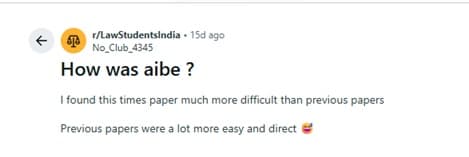
A user on the r/LawStudentsIndia subreddit found the AIBE XXI 2026 paper to be very difficult compared to previous year papers. According to the user, the previous year's paper was a lot easier and had direct questions.
Related News
- How to Calculate AIBE 21 Marks from Answer Key?
- AIBE XXI 2026: When to Get Certificate of Practice After Passing



Comments