




AIBE 21 Question Paper Set B is available for download here. Bar Council of India is conducting AIBE 21 exam on 7 June, 2026. AIBE 21 Question Paper consists of 100 questions for 100 marks.
- AIBE 21 Paper consists of questions from Constitutional law, IPC, Bharatiya Nyaya Sanhita and other law topics.
- Each question carries 1 mark and there is no negative marking for incorrect answers.
Candidates can download AIBE 21 Question Paper Set B with Answer Key and Solution PDF from the links provided below.
AIBE 21 Question Paper Set B with Solution PDF
| AIBE 21 Question Paper Set B | Download PDF | Check Solutions |
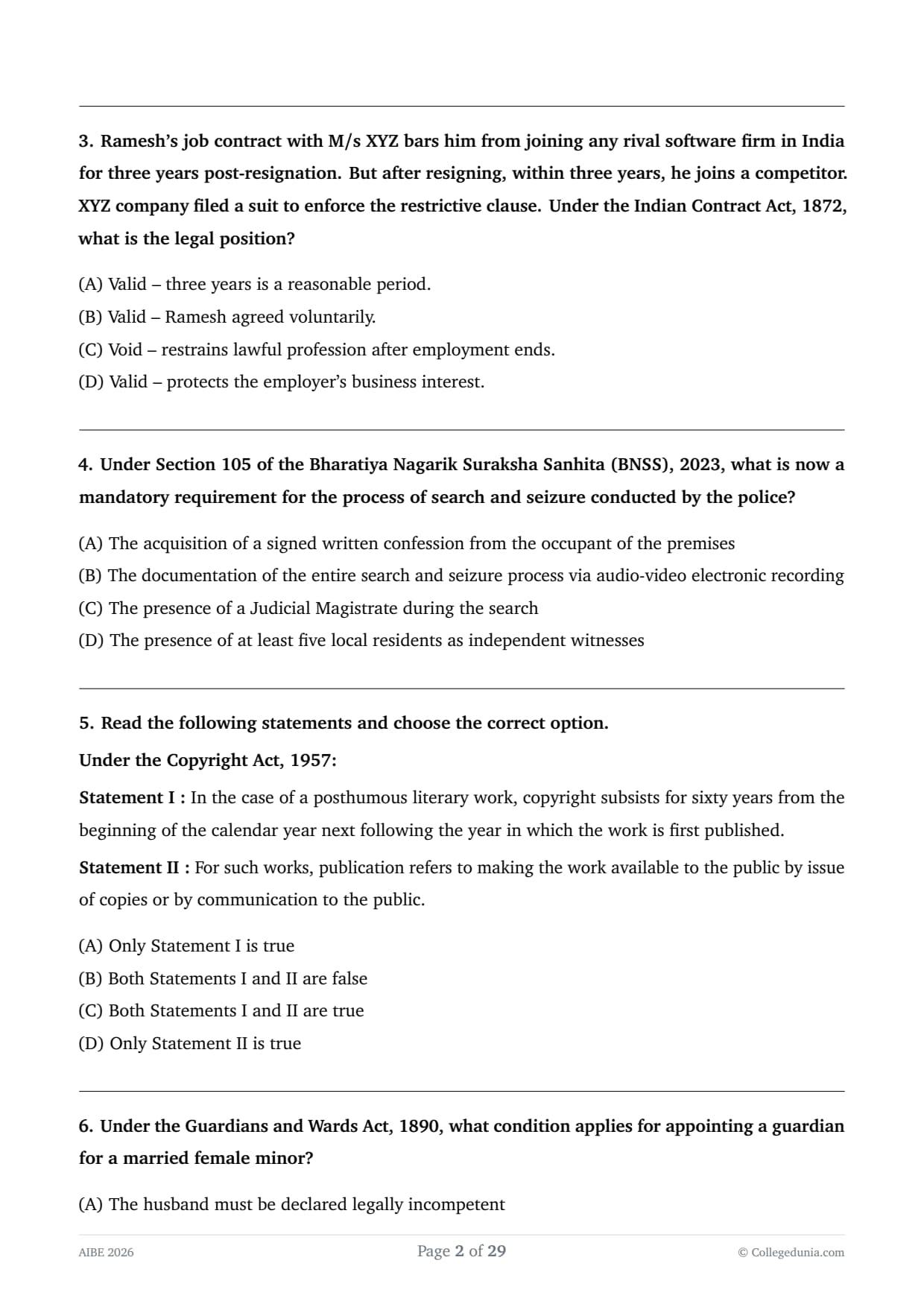
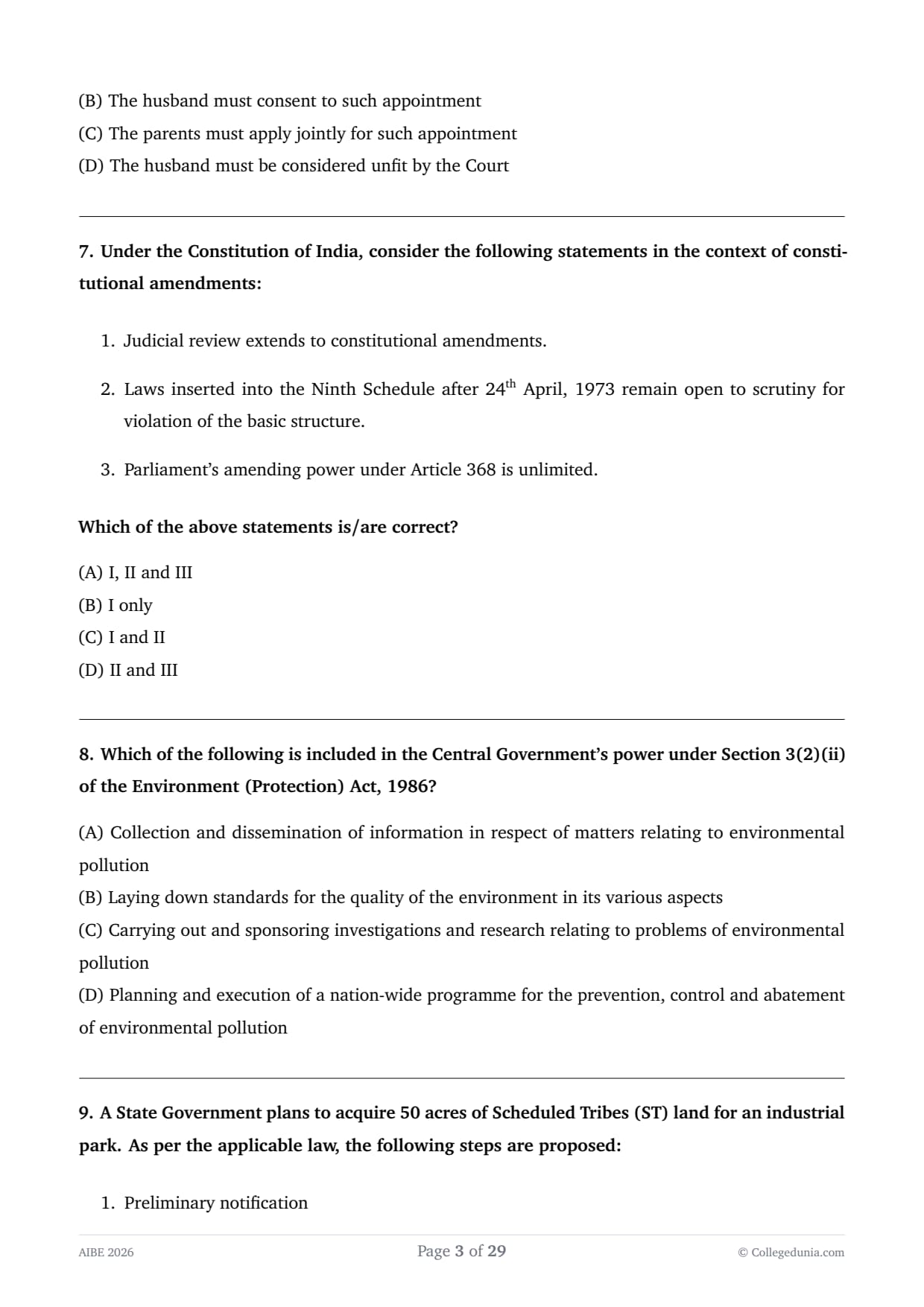
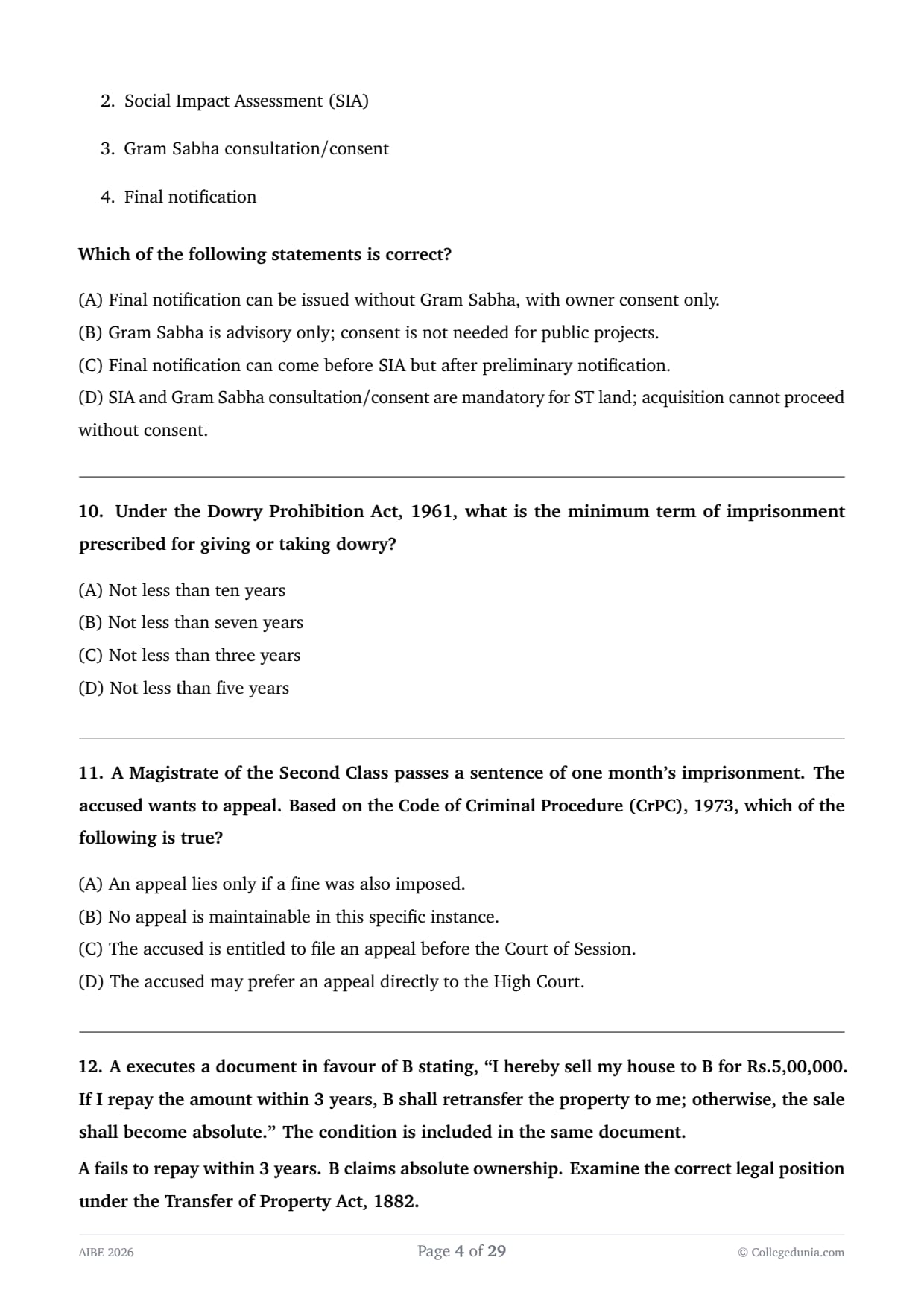
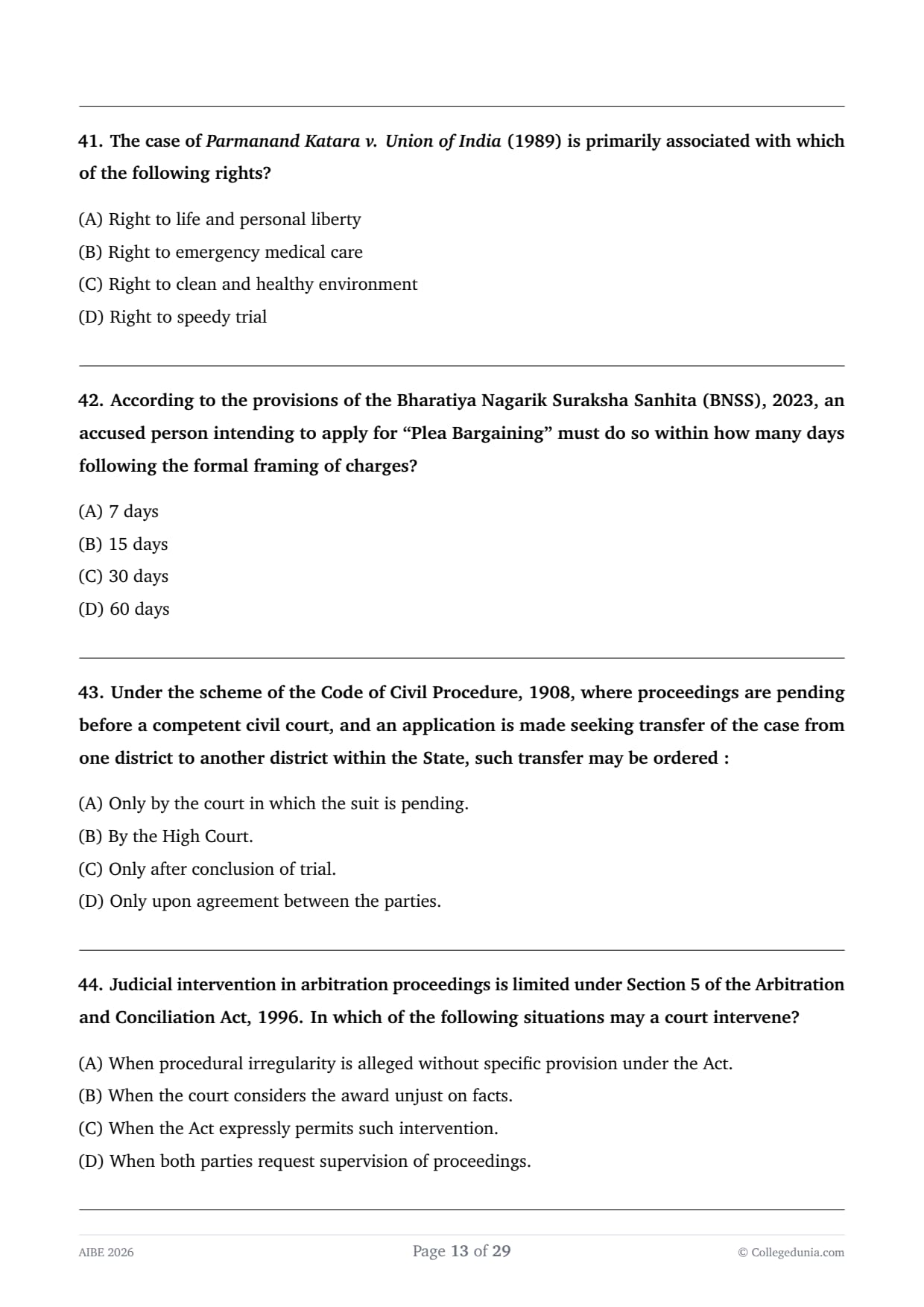
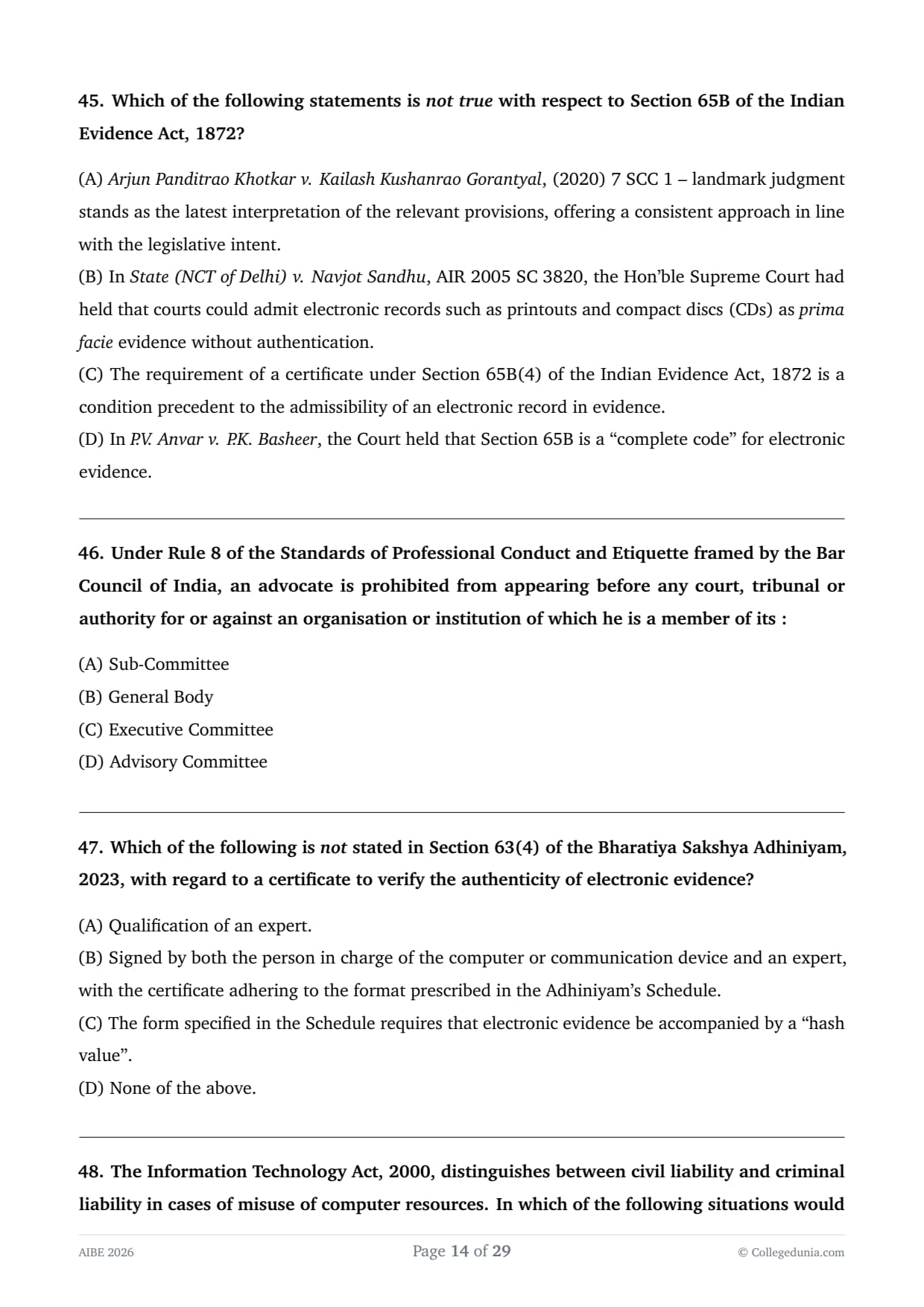
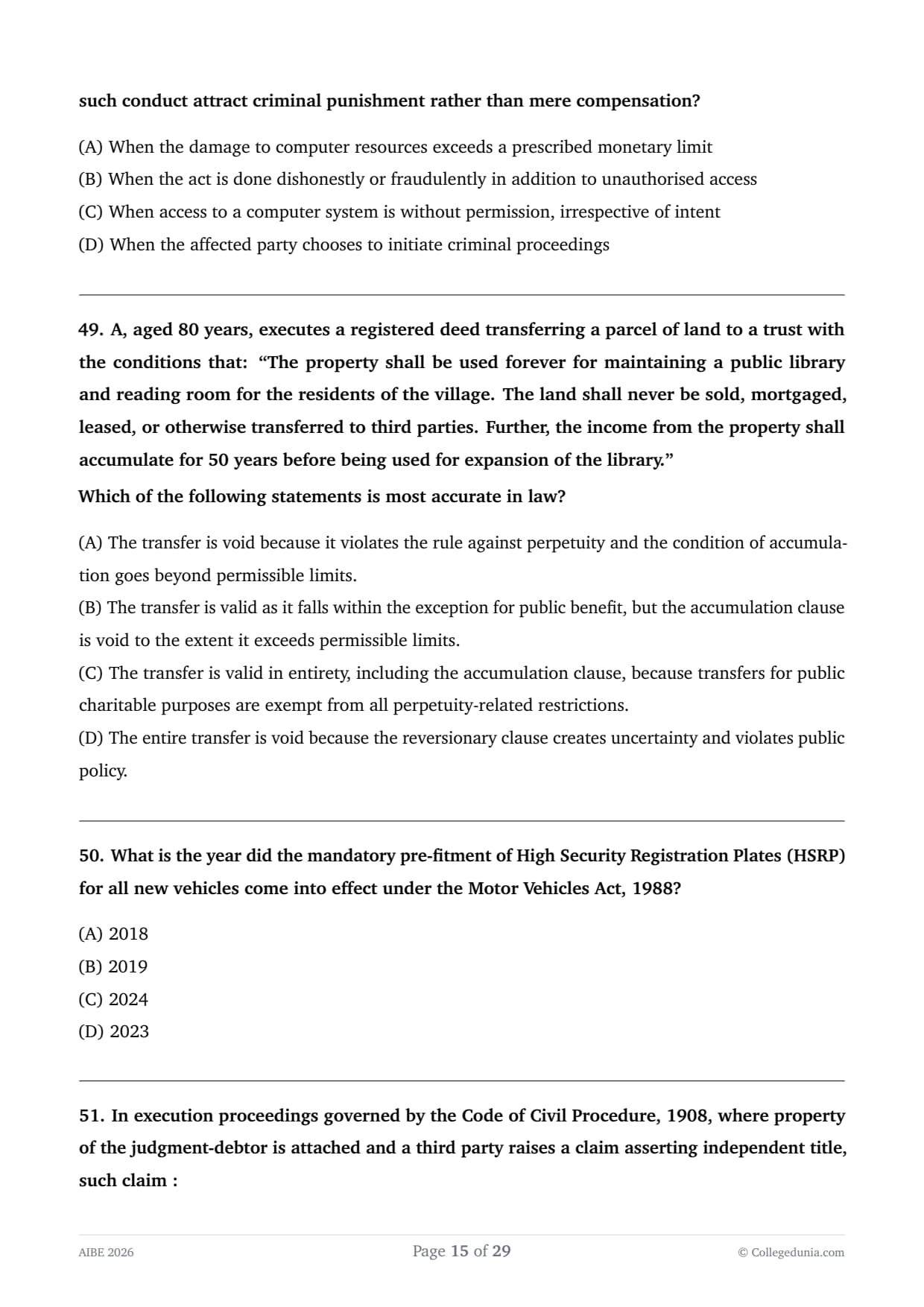
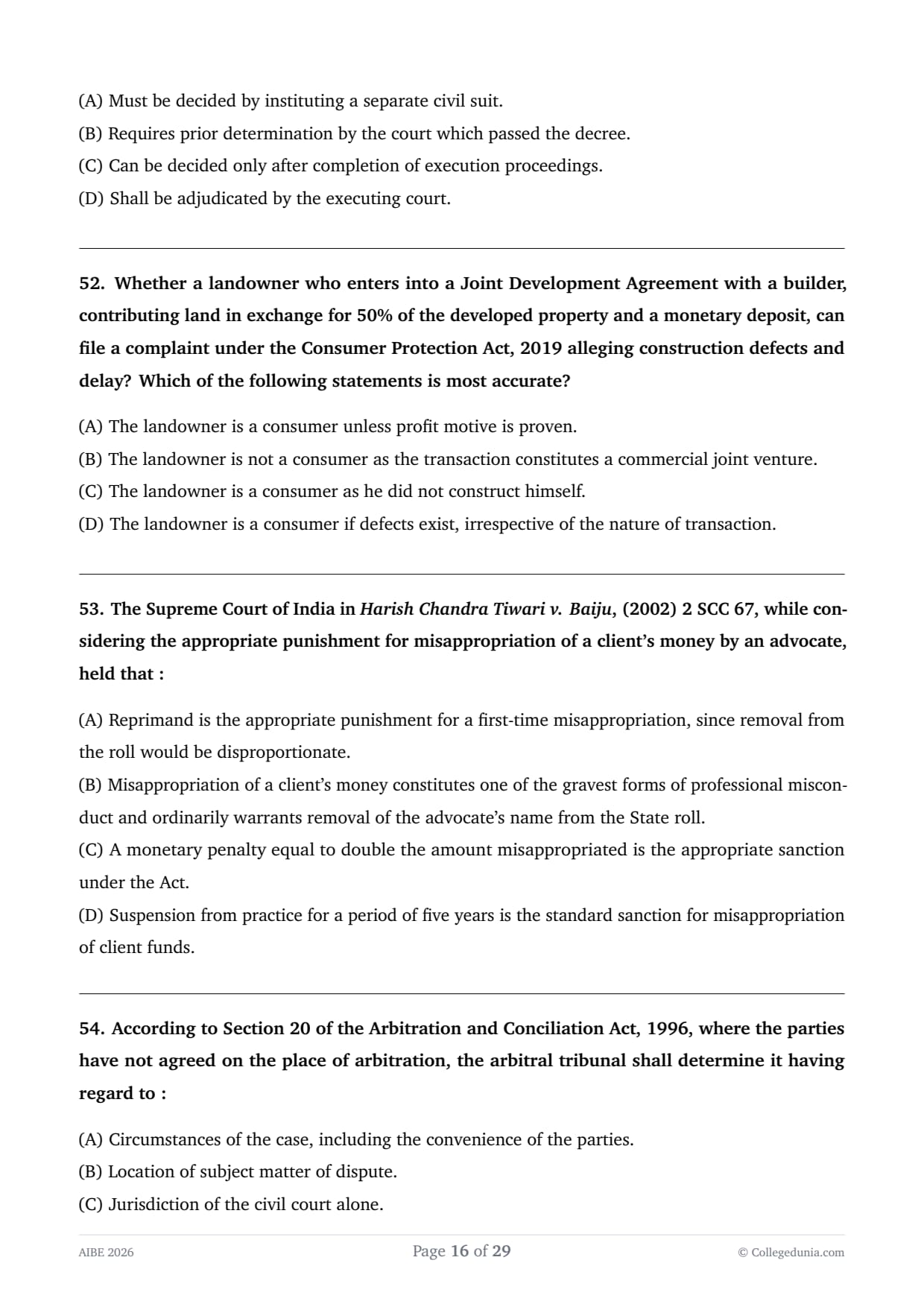
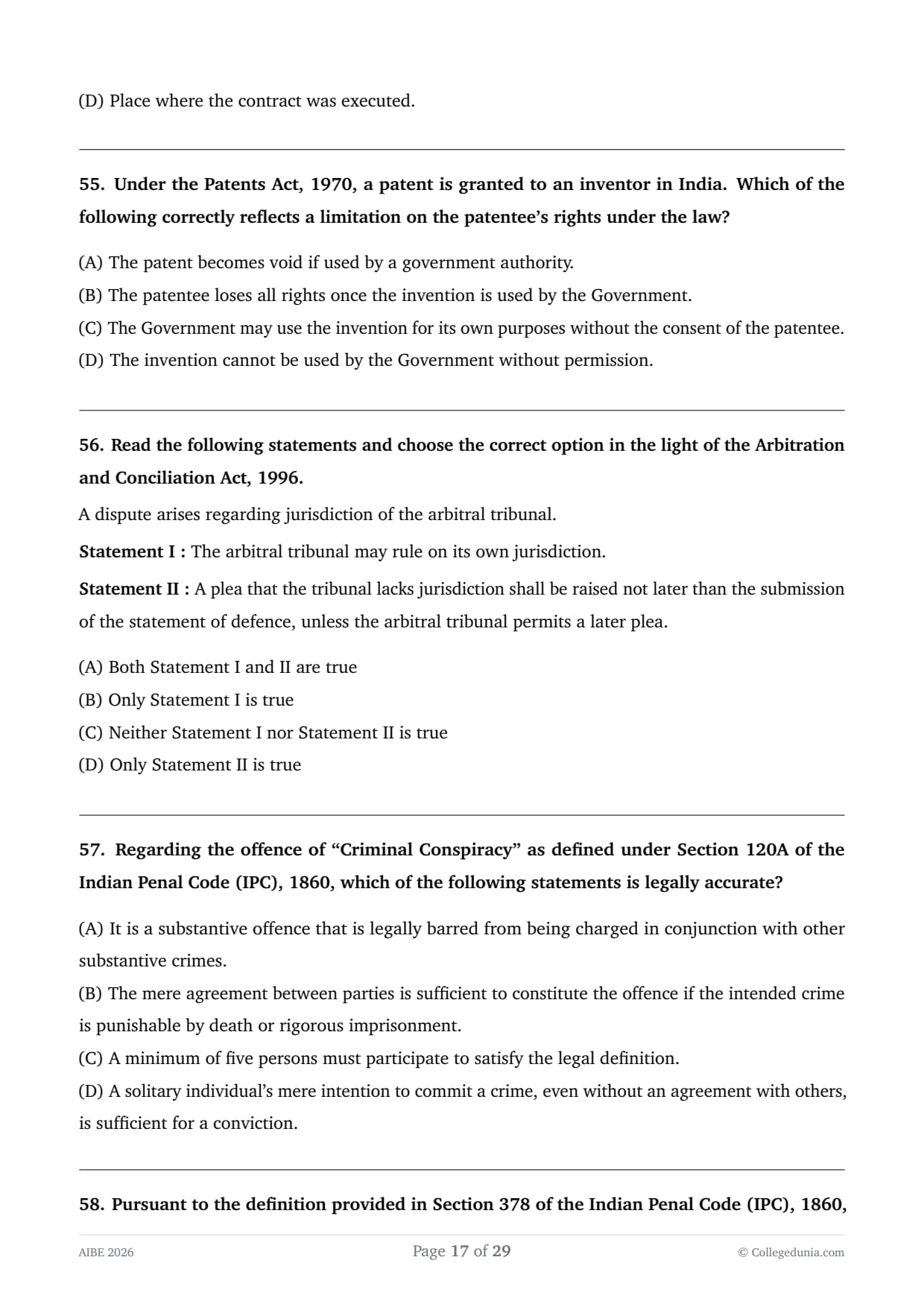
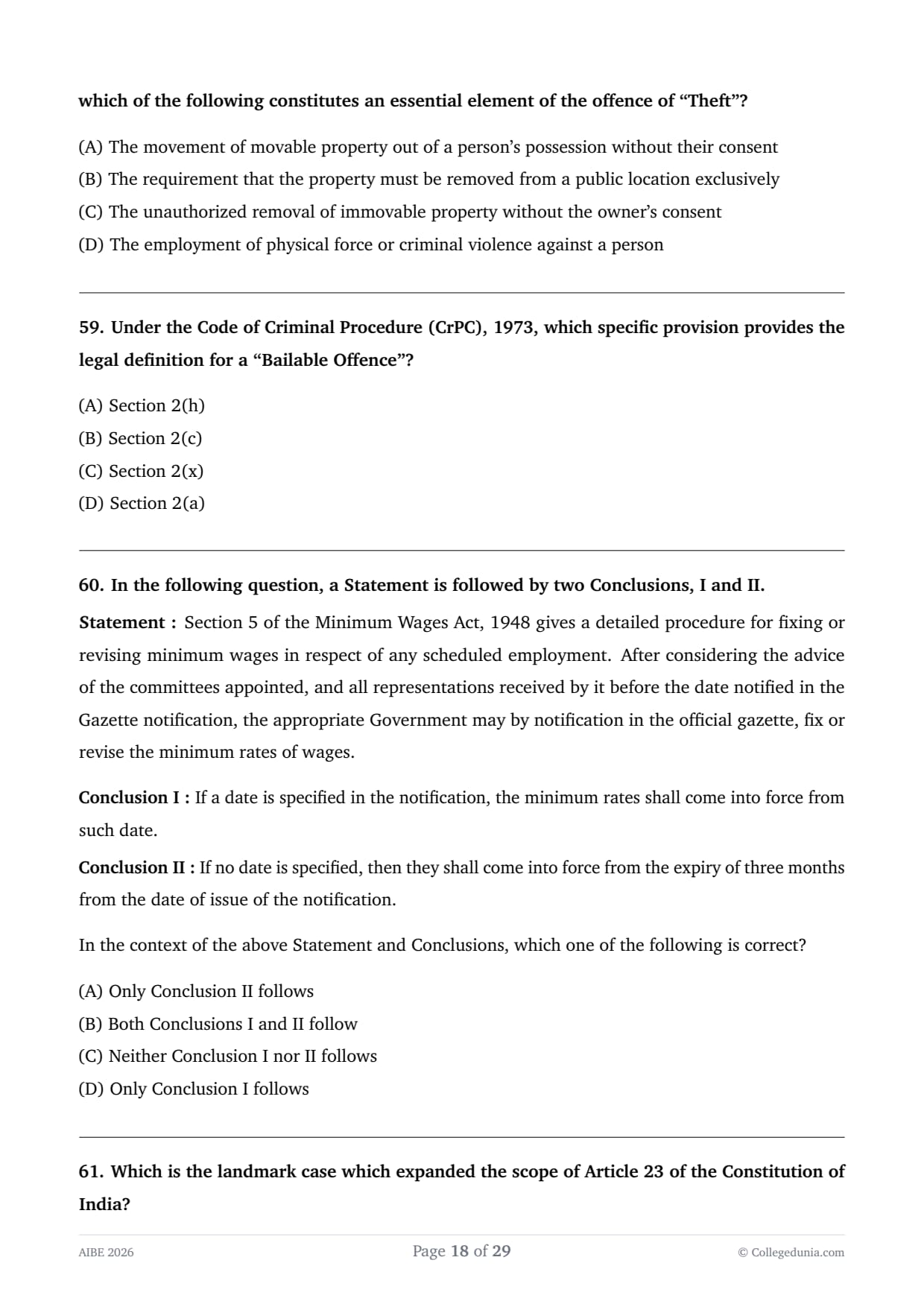
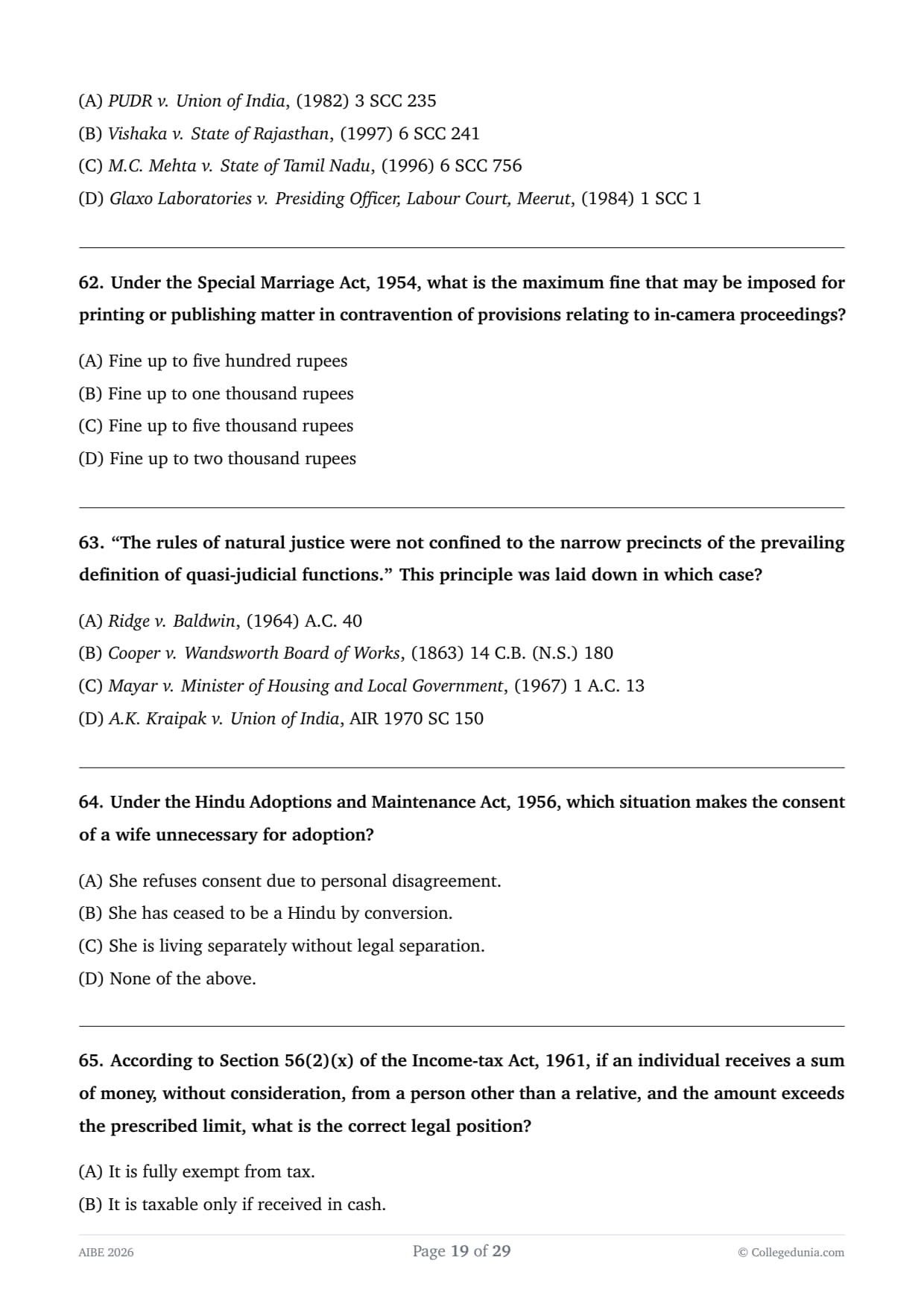
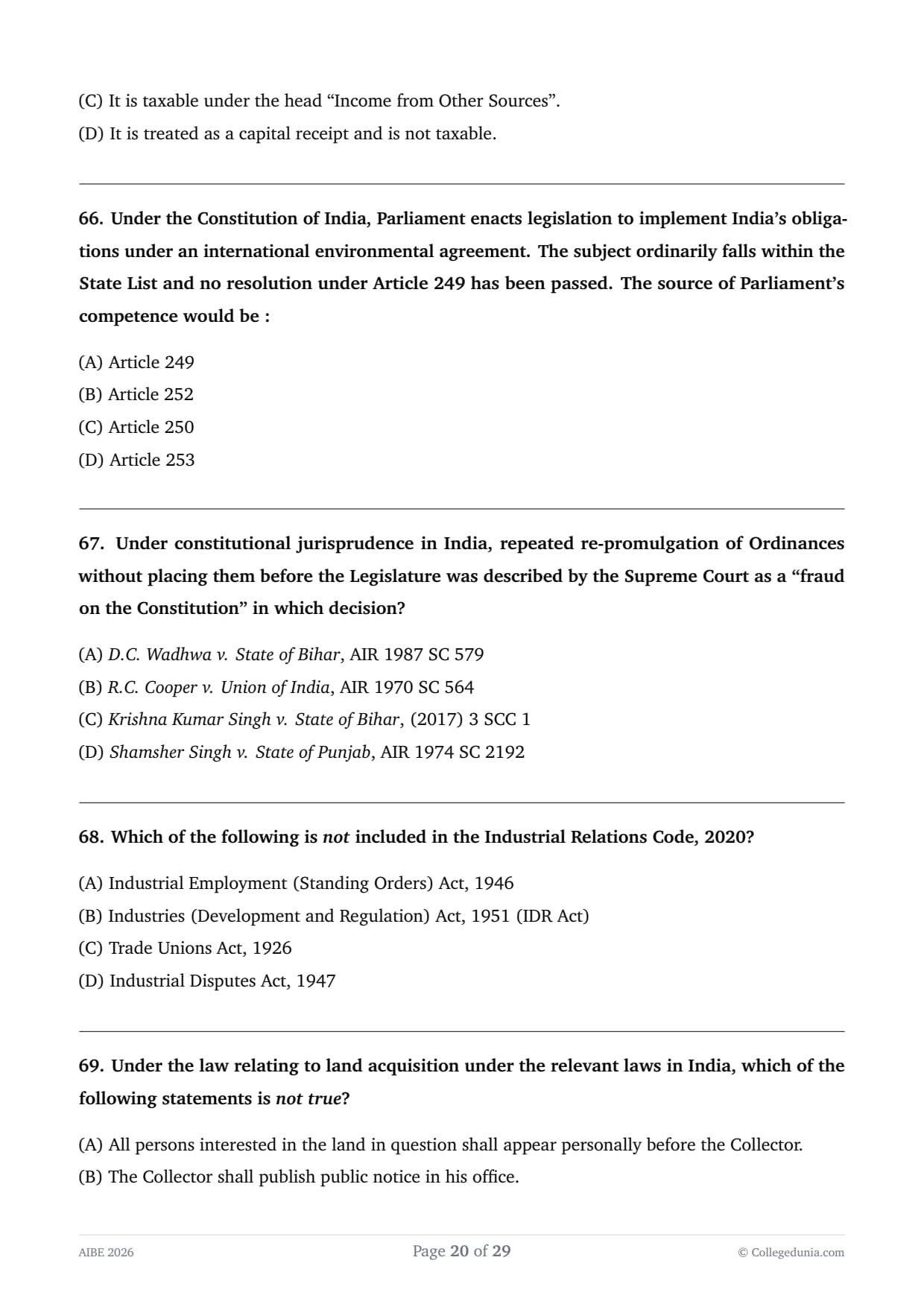
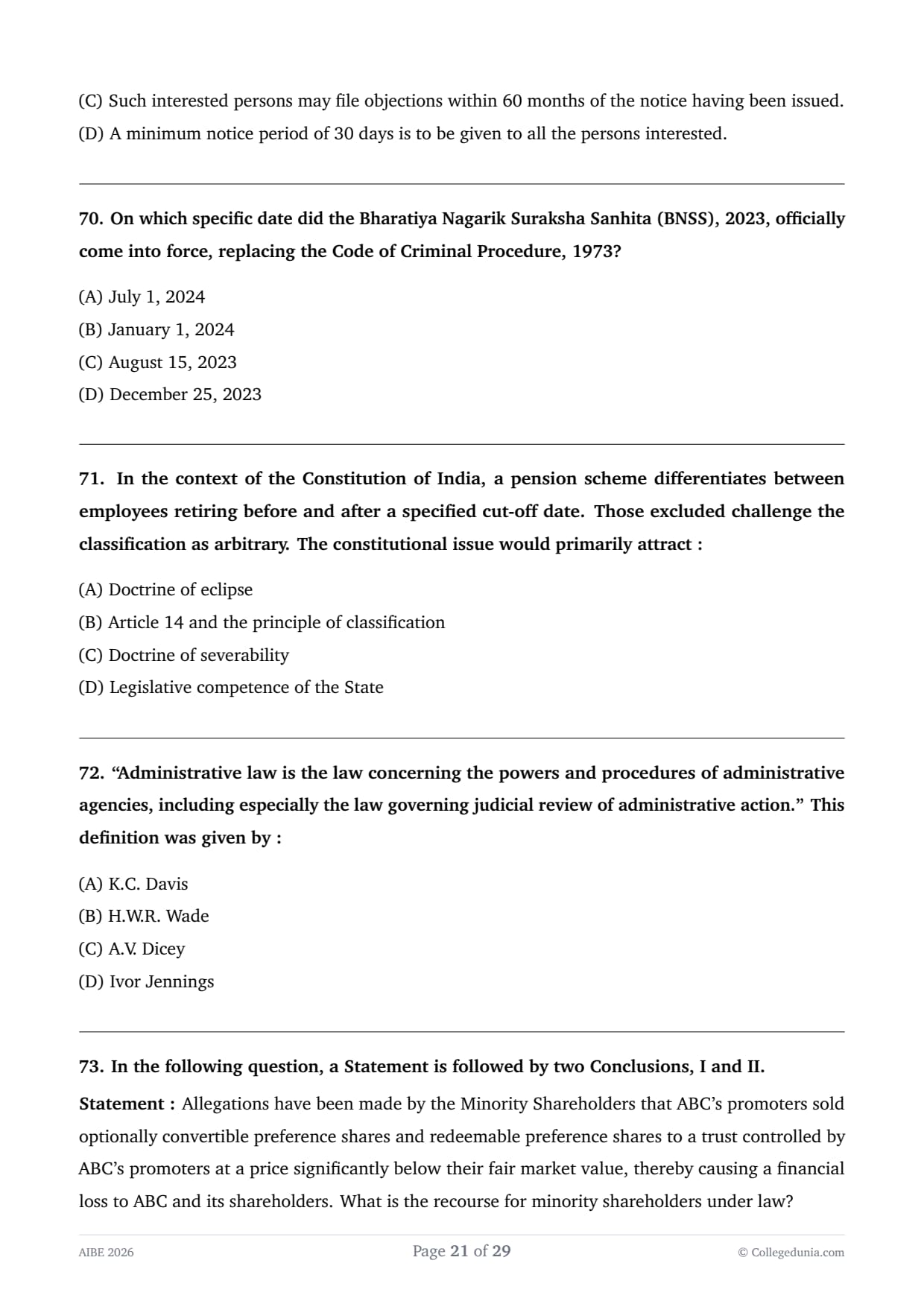
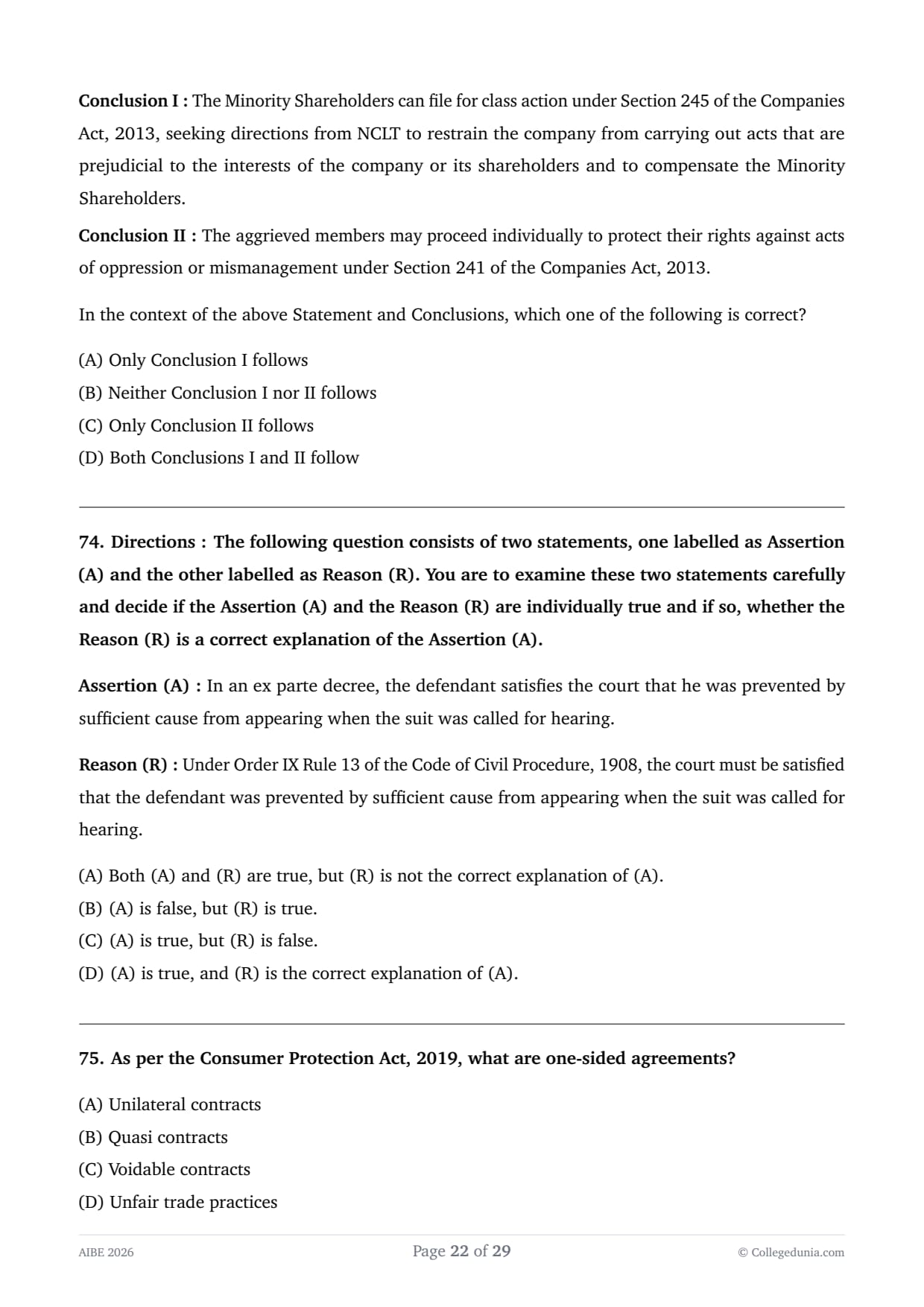
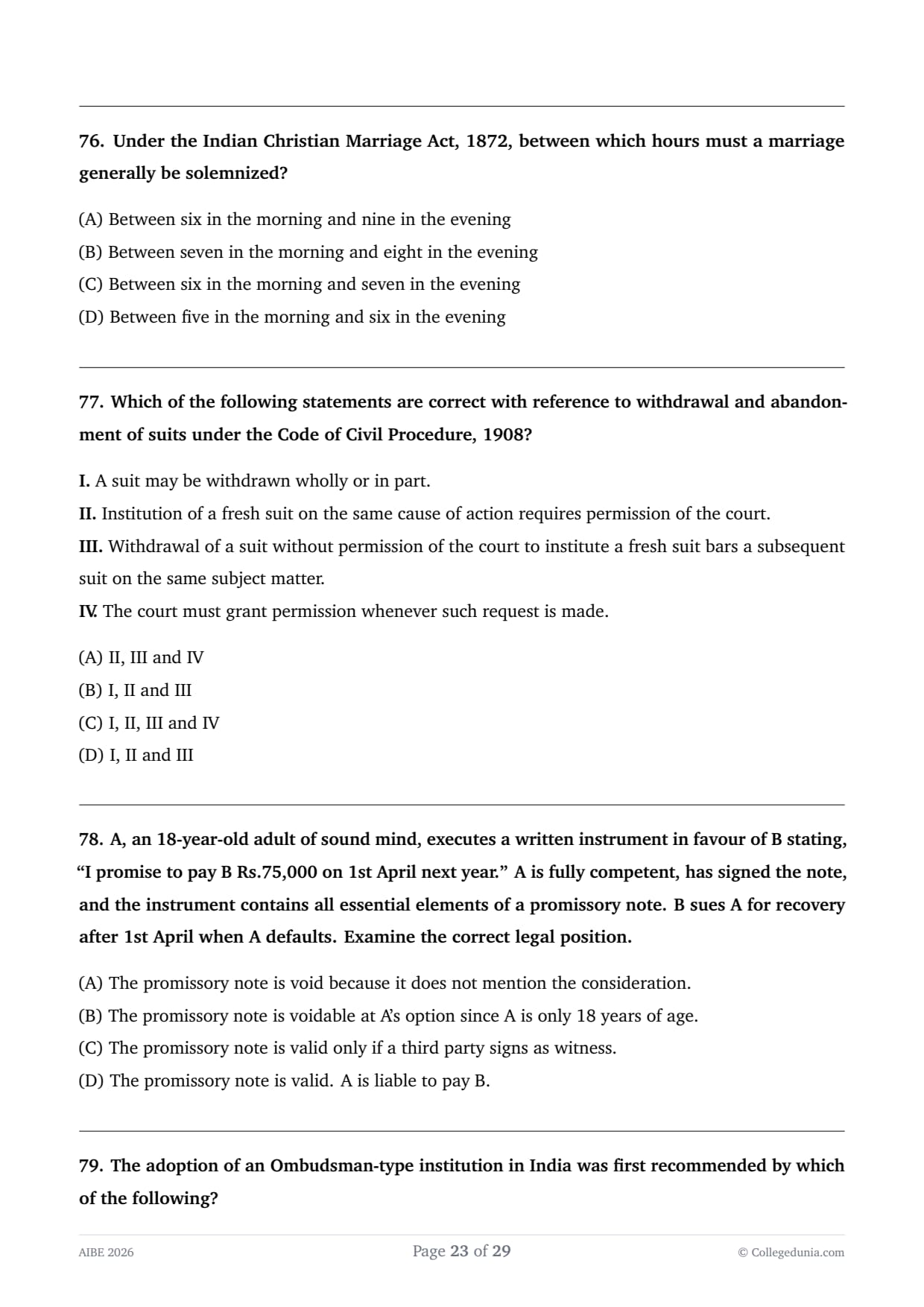
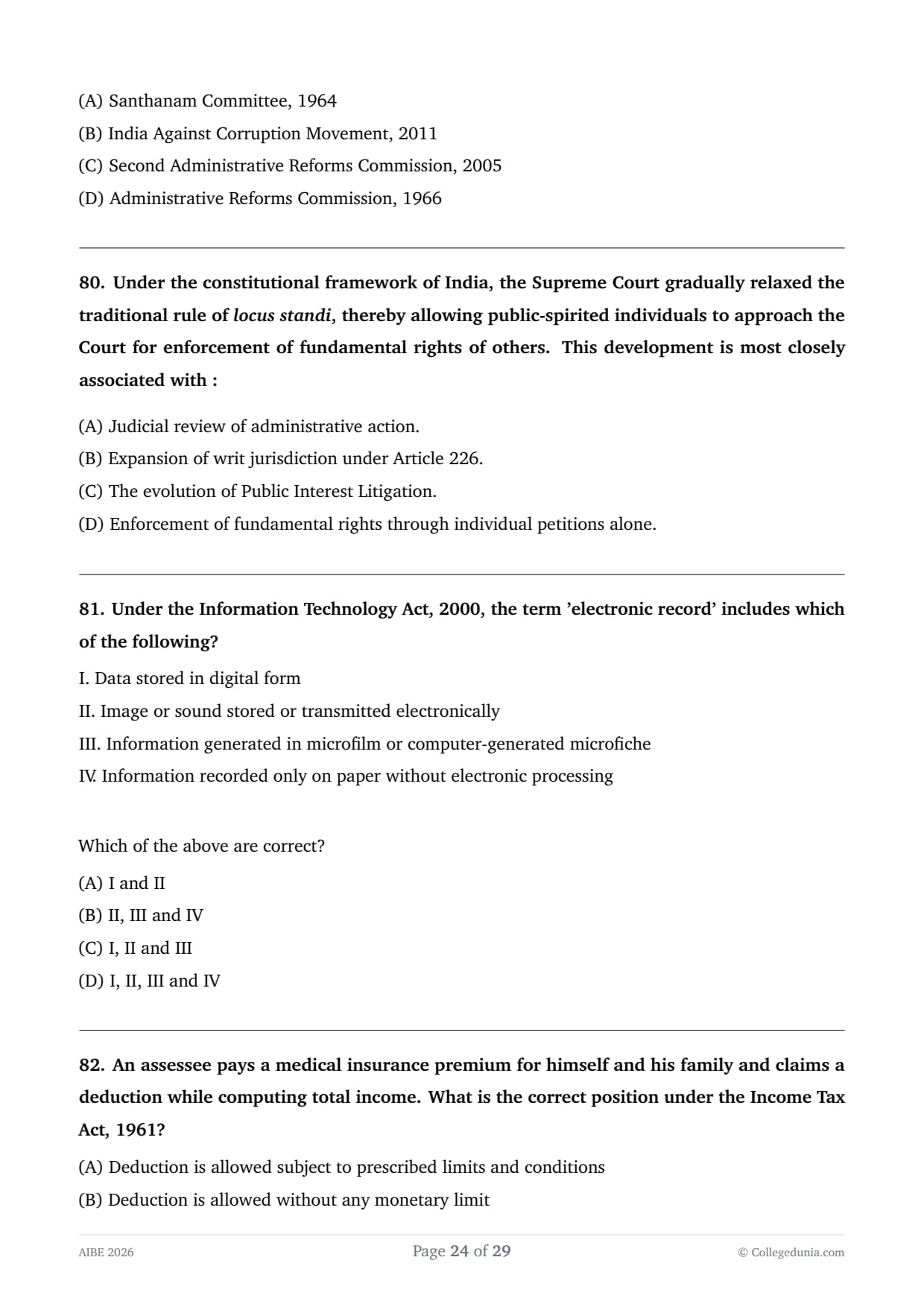
A contracts with B to construct a cold storage facility for Rs.50 lakh within 6 months. After the expiry of the time period, B fails to perform the contract. A immediately hires C to complete the construction at Rs.60 lakh and later files a suit against B claiming Rs.10 lakh as the additional cost incurred. Which of the following statements is correct under the Specific Relief Act, 1963?
View Solution
Concept:
Section 20 of the Specific Relief Act, 1963 provides for substituted performance of a contract. When a party breaches a contract, the aggrieved party may get the contract performed through a third party or by its own agency and recover the expenses incurred from the defaulting party.
However, before obtaining substituted performance, the aggrieved party must:
Give a written notice of at least 30 days to the defaulting party requiring performance of the contract.
Allow the defaulting party an opportunity to perform within the notice period.
Only after failure to comply with the notice can substituted performance be undertaken and the cost recovered.
Failure to give the mandatory notice disentitles the aggrieved party from recovering the substituted performance cost.
Step 1: Identify the breach of contract.
B failed to complete the construction within the agreed period of 6 months.
Therefore, B committed a breach of contract.
Step 2: Examine A's action after the breach.
A immediately engaged C to complete the construction at a cost of Rs.60 lakh.
Thus, A opted for substituted performance through a third party.
Step 3: Apply Section 20 of the Specific Relief Act.
Before obtaining substituted performance, A was required to give B a prior written notice of at least 30 days demanding performance.
The question states that A immediately hired C after the expiry of the contract period.
Hence, the mandatory notice requirement was not complied with.
Step 4: Determine whether A can recover the additional cost.
Since A failed to provide the statutory notice before engaging C,
Recovery of substituted performance cost is barred.
Therefore, A cannot recover the additional Rs.10 lakh incurred.
A cannot recover the cost because prior notice was not given.Quick Tip: Under Section 20 of the Specific Relief Act, substituted performance requires a prior written notice of at least 30 days to the defaulting party. Without such notice, the expenses incurred on substituted performance cannot be recovered.
Section 233 of the Companies Act, 2013, deals with ``fast track merger''. What is the time duration and the concerned authority for approval?
View Solution
Concept:
Section 233 of the Companies Act, 2013 provides a simplified procedure known as the Fast Track Merger. This mechanism is available for specified classes of companies such as:
Two or more small companies,
Holding company and its wholly-owned subsidiary,
Such other class of companies as may be prescribed.
Unlike ordinary mergers under Sections 230--232, which require approval of the National Company Law Tribunal (NCLT), a fast track merger is approved by the Regional Director (RD). The procedure is designed to reduce time and procedural complexities.
Step 1: Identify the authority responsible for approval.
Under Section 233, the scheme of merger is filed with the Central Government through the Regional Director.
Therefore,
Approving Authority = Regional Director
Step 2: Determine the prescribed timeline.
The fast track merger process is intended to be completed within approximately 60--90 days, making it significantly quicker than the normal merger process.
Hence,
Time Duration = 60--90 days
Step 3: Match with the given options.
The option that correctly states both the authority and the duration is:
60--90 Days, Regional Director
Therefore, Option (A) is the correct answer.
Option (A) Quick Tip: Remember the shortcut: Fast Track Merger (Section 233) Regional Director + 60--90 Days Normal Merger (Sections 230--232) NCLT Approval Required This distinction is frequently tested in Company Law examinations.
Ramesh's job contract with M/s XYZ bars him from joining any rival software firm in India for three years post-resignation. But after resigning, within three years, he joins a competitor. XYZ company filed a suit to enforce the restrictive clause. Under the Indian Contract Act, 1872, what is the legal position?
View Solution
Concept:
Section 27 of the Indian Contract Act, 1872 declares that:
``Every agreement by which anyone is restrained from exercising a lawful profession, trade or business of any kind is, to that extent, void.''
The general rule is that a person cannot be prevented from carrying on a lawful profession or employment after the termination of employment. Any post-employment restraint clause is generally void unless it falls within a recognized statutory exception, such as the sale of goodwill.
Step 1: Identify the nature of the restrictive clause.
The contract prohibits Ramesh from joining any rival software company in India for a period of three years after resignation.
Thus, the restriction operates after the employment relationship has ended.
Post-employment restrictive covenant
Step 2: Apply Section 27 of the Indian Contract Act, 1872.
Section 27 renders agreements in restraint of trade, profession, or business void.
Since the clause prevents Ramesh from accepting employment in his field of expertise, it restrains his lawful profession.
Restriction on lawful employment Void
Step 3: Examine whether the duration makes the clause valid.
The fact that the restriction is for three years does not make it valid.
Under Indian law, post-employment restraints are generally void irrespective of whether the period is reasonable or unreasonable.
Therefore,
Three-year duration does not save the clause.
Step 4: Determine the legal consequence.
Since the restrictive covenant restrains Ramesh from pursuing his lawful profession after leaving employment,
The clause is void and unenforceable.
Hence, XYZ cannot successfully enforce the restriction against Ramesh.
Void -- restrains lawful profession after employment ends
Therefore, Option (C) is the correct answer.
Option (C) Quick Tip: Section 27 of the Indian Contract Act, 1872} A clause restricting an employee from carrying on a lawful profession after termination of employment} is generally void. Remember: During Employment Usually Valid After Employment Generally Void Exception: Restriction connected with the sale of goodwill.
Under Section 105 of the Bharatiya Nagarik Suraksha Sanhita (BNSS), 2023, what is now a mandatory requirement for the process of search and seizure conducted by the police?
View Solution
Concept:
The Bharatiya Nagarik Suraksha Sanhita (BNSS), 2023 introduces several technology-driven reforms in criminal procedure. One of the significant changes is contained in Section 105, which mandates the use of electronic means to enhance transparency and accountability during police investigations.
Under this provision, the process of search and seizure conducted by the police must be recorded through audio-video electronic means wherever practicable, thereby reducing disputes regarding the manner in which the search was conducted and improving the evidentiary value of the proceedings.
Step 1: Identify the objective of Section 105 BNSS.
Section 105 aims to make the search and seizure process more transparent and reliable.
The legislature has incorporated technological safeguards to ensure fairness and accountability during investigations.
Step 2: Examine the statutory requirement.
The provision specifically requires the police to document the search and seizure operation through:
Audio-Video Electronic Recording
This recording serves as evidence of the manner in which the search was conducted.
Step 3: Evaluate the incorrect options.
Option (A): No provision requires obtaining a signed confession from the occupant during search and seizure.
Option (C): Presence of a Judicial Magistrate is not a mandatory requirement for every search.
Option (D): The law does not require the presence of at least five local residents as witnesses.
Hence, these options are incorrect.
Step 4: Determine the correct answer.
Since Section 105 mandates electronic recording of the search and seizure process,
Documentation through audio-video electronic recording
is the correct requirement.
Therefore,
Option (B) Quick Tip: A key reform under the BNSS, 2023 is the increased use of technology in criminal investigations. Remember: Section 105 BNSS Search and Seizure Audio-Video Recording This provision promotes transparency, accountability, and evidentiary reliability.
Read the following statements and choose the correct option.
Under the Copyright Act, 1957:
Statement I : In the case of a posthumous literary work, copyright subsists for sixty years from the beginning of the calendar year next following the year in which the work is first published.
Statement II : For such works, publication refers to making the work available to the public by issue of copies or by communication to the public.
View Solution
Concept:
The Copyright Act, 1957 grants protection to original literary, dramatic, musical and artistic works. Special provisions exist for posthumous works, i.e., works published after the death of the author.
The duration of copyright and the meaning of publication are governed by the relevant provisions of the Copyright Act, 1957.
Step 1: Examine Statement I.
For a posthumous literary, dramatic, musical or artistic work, copyright subsists for:
60 years
from the beginning of the calendar year next following the year in which the work is first published.
Thus,
Statement I is True.
Step 2: Examine Statement II.
Section 3 of the Copyright Act defines publication as making a work available to the public by:
Issue of copies to the public, or
Communication of the work to the public.
Therefore, the statement correctly describes the legal meaning of publication.
Hence,
Statement II is True.
Step 3: Determine the correct option.
Since both Statement I and Statement II correctly state the law under the Copyright Act, 1957,
Both Statements I and II are true
Therefore,
Option (C) Quick Tip: For posthumous works}, remember: Copyright Term = 60 years from the beginning of the year following the year of first publication. Also, Publication = Issue of copies + Communication to the public These provisions are frequently tested in Intellectual Property Law examinations.
Under the Guardians and Wards Act, 1890, what condition applies for appointing a guardian for a married female minor?
View Solution
Concept:
The Guardians and Wards Act, 1890 empowers the Court to appoint a guardian for the person or property of a minor whenever it is necessary for the welfare of the minor.
However, Section 19 places certain restrictions on the Court's power to appoint a guardian. In the case of a married female minor, the Court shall not appoint a guardian of her person if her husband is not, in the opinion of the Court, unfit to be the guardian.
Thus, the husband's fitness is the determining factor.
Step 1: Identify the relevant provision.
Section 19 of the Guardians and Wards Act, 1890 restricts the appointment of guardians in specific situations.
For a married female minor, special consideration is given to the position of her husband.
Step 2: Examine the role of the husband.
The law presumes that the husband may act as the guardian of the married minor female.
Therefore, the Court ordinarily will not appoint another guardian for her person.
Step 3: Determine when the Court may appoint a guardian.
The Court can appoint another guardian only if it forms the opinion that the husband is:
Unfit to be the guardian
Hence, the husband's unfitness is the essential condition.
Step 4: Evaluate the options.
Option (A): Legal incompetence is not the statutory requirement.
Option (B): Husband's consent is not the determining factor.
Option (C): No requirement exists for joint application by parents.
Option (D): Correctly states that the husband must be considered unfit by the Court.
Therefore,
The husband must be considered unfit by the Court
Hence,
Option (D) Quick Tip: Section 19, Guardians and Wards Act, 1890} For a married female minor: No guardian shall be appointed unless the husband is found unfit by the Court. Remember: Married Female Minor Husband's Fitness is the Key Test
Under the Constitution of India, consider the following statements in the context of constitutional amendments:
Judicial review extends to constitutional amendments.
Laws inserted into the Ninth Schedule after 24th April, 1973 remain open to scrutiny for violation of the basic structure.
Parliament's amending power under Article 368 is unlimited.
Which of the above statements is/are correct?
View Solution
Concept:
The doctrine of Basic Structure was evolved by the Supreme Court in the landmark case of Kesavananda Bharati v. State of Kerala (1973). The Court held that although Parliament has wide powers to amend the Constitution under Article 368, it cannot alter or destroy the basic structure of the Constitution.
Subsequent judgments such as Minerva Mills (1980) and I.R. Coelho (2007) further clarified the scope of judicial review over constitutional amendments and laws placed in the Ninth Schedule.
Step 1: Examine Statement I.
Statement I: Judicial review extends to constitutional amendments.
In Kesavananda Bharati, the Supreme Court held that constitutional amendments can be reviewed by the judiciary to determine whether they violate the basic structure of the Constitution.
Therefore,
Statement I is True.
Step 2: Examine Statement II.
Statement II: Laws inserted into the Ninth Schedule after 24th April, 1973 remain open to scrutiny for violation of the basic structure.
In I.R. Coelho v. State of Tamil Nadu (2007), the Supreme Court held that laws placed in the Ninth Schedule after 24 April 1973 (the date of the Kesavananda Bharati judgment) are subject to judicial review if they violate the basic structure.
Hence,
Statement II is True.
Step 3: Examine Statement III.
Statement III: Parliament's amending power under Article 368 is unlimited.
This statement is incorrect.
The Basic Structure Doctrine imposes limitations on Parliament's amending power. Parliament cannot amend the Constitution in a manner that destroys or damages its basic structure.
Thus,
Parliament's amending power is not unlimited.
Therefore,
Statement III is False.
Step 4: Determine the correct option.
We find that:
Statement I = True
Statement II = True
Statement III = False
Therefore,
Statements I and II are correct
Hence,
Option (C) Quick Tip: Remember the constitutional trilogy: Kesavananda Bharati (1973)} \(\) Basic Structure Doctrine. Minerva Mills (1980)} \(\) Limited amending power of Parliament. I.R. Coelho (2007)} \(\) Ninth Schedule laws inserted after 24 April 1973 are subject to basic structure review. Shortcut: Article 368 \neq Unlimited Power because Basic Structure Doctrine acts as a limitation.
Which of the following is included in the Central Government's power under Section 3(2)(ii) of the Environment (Protection) Act, 1986?
View Solution
Concept:
Section 3 of the Environment (Protection) Act, 1986 empowers the Central Government to take all such measures as it deems necessary for protecting and improving the quality of the environment and preventing, controlling, and abating environmental pollution.
Section 3(2) specifically enumerates various measures that may be undertaken by the Central Government. Clause (ii) deals with prescribing environmental quality standards.
Step 1: Examine the provision under Section 3(2)(ii).
Section 3(2)(ii) authorizes the Central Government to:
Lay down standards for the quality of the environment in its various aspects
These standards serve as benchmarks for maintaining environmental quality and regulating pollution.
Step 2: Analyze the remaining options.
Option (A): Relates to collection and dissemination of information regarding environmental pollution and falls under a different clause of Section 3(2).
Option (C): Relates to sponsoring investigations and research concerning environmental pollution, which is separately provided under another clause.
Option (D): Relates to planning and execution of nationwide programmes for prevention, control, and abatement of environmental pollution, covered under Section 3(2)(i).
Therefore, these options do not correspond to Section 3(2)(ii).
Step 3: Determine the correct option.
Since Section 3(2)(ii) specifically empowers the Central Government to prescribe environmental quality standards,
Laying down standards for the quality of the environment in its various aspects
is the correct answer.
Hence,
Option (B) Quick Tip: Important provisions under Section 3(2) of the Environment (Protection) Act, 1986: Section 3(2)(i) \(\) National programmes for prevention and control of pollution. Section 3(2)(ii) \(\) Environmental quality standards. Section 3(2)(iii) \(\) Standards for emission or discharge of pollutants. Remember: Section 3(2)(ii) Environmental Quality Standards
A State Government plans to acquire 50 acres of Scheduled Tribes (ST) land for an industrial park. As per the applicable law, the following steps are proposed:
Preliminary notification
Social Impact Assessment (SIA)
Gram Sabha consultation/consent
Final notification
Which of the following statements is correct?
View Solution
Concept:
The Right to Fair Compensation and Transparency in Land Acquisition, Rehabilitation and Resettlement Act, 2013 (RFCTLARR Act, 2013) provides special safeguards for Scheduled Castes (SCs) and Scheduled Tribes (STs).
For acquisition of land belonging to Scheduled Tribes, particularly in Scheduled Areas, the law mandates:
Conduct of a Social Impact Assessment (SIA),
Consultation with the Gram Sabha,
Prior consent/consultation requirements as prescribed under the Act and related constitutional protections,
Protection of tribal rights and rehabilitation safeguards.
These provisions ensure that tribal communities are not displaced without due process and participation.
Step 1: Examine the requirement of Social Impact Assessment (SIA).
Before acquisition proceedings are finalized, the Act requires an SIA to assess:
Impact on affected families,
Impact on livelihoods,
Social and environmental consequences,
Rehabilitation and resettlement requirements.
Therefore,
SIA is a mandatory prerequisite.
Step 2: Examine the role of the Gram Sabha.
For acquisition involving ST land, especially in Scheduled Areas, the Gram Sabha plays a crucial role.
The acquisition process requires consultation and participation of the Gram Sabha to protect tribal interests.
Thus,
Gram Sabha consultation/consent is mandatory.
Step 3: Evaluate the incorrect options.
Option (A): Incorrect. Final notification cannot bypass the Gram Sabha requirement.
Option (B): Incorrect. The Gram Sabha's role is not merely advisory in matters concerning ST land safeguards.
Option (C): Incorrect. SIA must precede the final stages of acquisition and cannot be bypassed.
Hence, all three options are legally unsustainable.
Step 4: Determine the correct answer.
Since both Social Impact Assessment and Gram Sabha consultation/consent are mandatory safeguards for acquisition of ST land,
SIA and Gram Sabha consultation/consent are mandatory
and acquisition cannot proceed without complying with these statutory requirements.
Therefore,
Option (D) Quick Tip: For acquisition of land belonging to Scheduled Tribes: SIA Mandatory Gram Sabha Consultation/Consent Mandatory Remember: ST Land = Additional Statutory Protection under the RFCTLARR Act, 2013 and related constitutional safeguards.
Under the Dowry Prohibition Act, 1961, what is the minimum term of imprisonment prescribed for giving or taking dowry?
View Solution
Concept:
The Dowry Prohibition Act, 1961 was enacted to prohibit the giving, taking, and demanding of dowry in connection with marriage.
Section 3 of the Act prescribes punishment for giving or taking dowry. The provision aims to deter the social evil of dowry by imposing stringent penalties on offenders.
Step 1: Identify the relevant provision.
Section 3 of the Dowry Prohibition Act, 1961 deals with the punishment for giving or taking dowry.
It provides that any person who gives, takes, or abets the giving or taking of dowry shall be punishable with imprisonment and fine.
Step 2: Determine the minimum term of imprisonment.
Under Section 3, the punishment prescribed is:
Imprisonment of not less than five years
along with a fine which shall not be less than:
Rs.15,000
or the amount of the value of the dowry, whichever is more.
Step 3: Evaluate the options.
Option (A): Incorrect. The Act does not prescribe a minimum of ten years.
Option (B): Incorrect. Seven years is not the minimum punishment under Section 3.
Option (C): Incorrect. Three years is lower than the statutory minimum.
Option (D): Correct. The Act prescribes imprisonment of not less than five years.
Step 4: Determine the correct answer.
Since Section 3 expressly prescribes a minimum imprisonment term of five years,
Not less than five years
Therefore,
Option (D) Quick Tip: Dowry Prohibition Act, 1961} Section 3 Giving or Taking Dowry Punishment: Imprisonment \geq 5 years and Fine \geq Rs.15,000 or the value of the dowry, whichever is higher. A common exam question is to distinguish between: Giving/Taking Dowry (Section 3) Demanding Dowry (Section 4)
A Magistrate of the Second Class passes a sentence of one month's imprisonment. The accused wants to appeal. Based on the Code of Criminal Procedure (CrPC), 1973, which of the following is true?
View Solution
Concept:
The right of appeal in criminal cases is governed by the Code of Criminal Procedure, 1973. While appeals generally lie against convictions, Section 376 CrPC provides certain cases where no appeal shall lie despite conviction.
Under Section 376, no appeal is maintainable where a Court of Session, Metropolitan Magistrate, or Magistrate of the First Class imposes imprisonment not exceeding three months or a specified fine. Further, where a Magistrate of the Second Class passes only a sentence of imprisonment for a term not exceeding one month, no appeal lies.
The provision is intended to avoid appellate proceedings in petty cases involving minor punishments.
Step 1: Identify the nature of the sentence.
The Magistrate of the Second Class has awarded:
One month's imprisonment
and no additional punishment is mentioned.
Step 2: Apply Section 376 CrPC.
Section 376 CrPC bars appeals in certain petty cases.
For a conviction by a Magistrate of the Second Class:
Imprisonment not exceeding one month
falls within the category where no appeal is ordinarily maintainable.
Step 3: Evaluate the options.
Option (A): Incorrect. The existence of a fine is not the determining factor here.
Option (B): Correct. The sentence falls within the statutory bar on appeals.
Option (C): Incorrect. The accused is not entitled to appeal before the Court of Session in this case.
Option (D): Incorrect. A direct appeal to the High Court is not available.
Step 4: Determine the correct answer.
Since the sentence is only one month's imprisonment imposed by a Magistrate of the Second Class,
No appeal is maintainable
under Section 376 CrPC.
Therefore,
Option (B) Quick Tip: Section 376 CrPC — No Appeal in Petty Cases} For a conviction by a Magistrate of the Second Class: Imprisonment \leq 1 month or prescribed minor punishments No Appeal Remember: Minor Sentence \neq Automatic Right of Appeal because Section 376 creates specific exceptions.
A executes a document in favour of B stating, ``I hereby sell my house to B for Rs.5,00,000. If I repay the amount within 3 years, B shall retransfer the property to me; otherwise, the sale shall become absolute.'' The condition is included in the same document.
A fails to repay within 3 years. B claims absolute ownership. Examine the correct legal position under the Transfer of Property Act, 1882.
View Solution
Concept:
Section 58(c) of the Transfer of Property Act, 1882 defines a Mortgage by Conditional Sale. It occurs where the mortgagor ostensibly sells the property subject to a condition that:
On default of payment of the mortgage money, the sale shall become absolute; or
On payment of the mortgage money, the buyer shall retransfer the property to the seller.
A crucial requirement is that the condition must be embodied in the same document that effects the ostensible sale. In such a case, the transaction is treated as a mortgage and not as an outright sale.
Step 1: Examine the terms of the document.
The document states:
A ``sells'' the house to B for Rs.5,00,000.
If A repays the amount within 3 years, B will retransfer the property.
If A fails to repay, the sale shall become absolute.
These are the classic conditions mentioned in Section 58(c).
Step 2: Determine whether the condition is contained in the same document.
The question specifically states that:
The condition is included in the same document.
This is a decisive factor.
Under Section 58(c),
Same Document Mortgage by Conditional Sale
Step 3: Analyze B's claim of automatic ownership.
Although A has failed to repay within 3 years, B does not automatically become the absolute owner.
In a mortgage by conditional sale, the mortgagee must enforce his rights through a decree of:
Foreclosure
obtained from a competent court.
Until foreclosure is granted, the mortgagor's right of redemption is not extinguished.
Step 4: Apply the legal principle.
Since the transaction satisfies all the requirements of Section 58(c),
The transaction is a Mortgage by Conditional Sale.
Therefore, B cannot simply assert absolute ownership without judicial foreclosure proceedings.
B must seek foreclosure through the Court.
Hence,
Option (A) Quick Tip: Section 58(c) TPA — Mortgage by Conditional Sale} Remember the golden rule: Condition in Same Document Mortgage by Conditional Sale Condition in Separate Document Generally an Outright Sale with a Repurchase Agreement Also, Default in Payment \neq Automatic Ownership The mortgagee must obtain a decree of foreclosure from the Court.
X takes a loan of Rs.10,00,000 from Bank A. Y signs a contract as surety, promising to pay the bank if X defaults. After 3 months, Bank A agrees to reduce the interest rate and extends the repayment period by 6 months without informing Y. Subsequently, X defaults on the loan. Which of the following statements correctly describes Y's liability under the Indian Contract Act, 1872?
View Solution
Concept:
A contract of guarantee is governed by Sections 126 to 147 of the Indian Contract Act, 1872. A surety's liability is generally co-extensive with that of the principal debtor under Section 128.
However, Section 133 provides that:
``Any variance made without the surety's consent in the terms of the contract between the principal debtor and the creditor discharges the surety as to transactions subsequent to the variance.''
Thus, when the creditor and principal debtor alter the terms of the contract without obtaining the surety's consent, the surety is discharged to the extent affected by such alteration.
Step 1: Identify the parties in the contract of guarantee.
Principal Debtor = X
Creditor = Bank A
Surety = Y
Y undertook liability only on the basis of the original loan agreement.
Step 2: Examine whether the original contract was altered.
Bank A and X subsequently agreed to:
Reduce the rate of interest, and
Extend the repayment period by six months.
These changes constitute a variance in the original contract.
Original Terms \neq Modified Terms
Step 3: Determine whether Y consented to the modification.
The question clearly states that the changes were made:
Without informing Y
Hence,
No consent of the surety was obtained.
Step 4: Apply Section 133 of the Indian Contract Act.
Since there was a variance in the terms of the contract between the creditor and principal debtor without the surety's consent,
Section 133 becomes applicable.
Accordingly, the surety is discharged with respect to liabilities arising after the variation.
Therefore, Y cannot be held liable exactly as under the original guarantee after the unilateral modification.
Step 5: Evaluate the options.
Option (A): Incorrect. A surety's liability is co-extensive and does not depend upon the creditor first suing the principal debtor.
Option (B): Incorrect. The surety is not automatically discharged from all liability merely because default occurred after modification.
Option (C): Incorrect. A surety is not always liable where the underlying contract has been varied without consent.
Option (D): Correct. The alteration of contractual terms without the surety's consent results in discharge to the extent affected by the variation.
Step 6: Determine the correct answer.
Since Bank A modified the terms of the loan agreement without Y's consent,
Y is discharged from liability to the extent affected by the variation.
Therefore,
Option (D) Quick Tip: Sections to Remember for Contract of Guarantee} Section 128 Surety's liability is co-extensive with the principal debtor Section 133 Variance without surety's consent discharges the surety Shortcut: Change in Loan Terms + No Consent of Surety Surety Discharged
The Bharatiya Nagarik Suraksha Sanhita (BNSS), 2023, has introduced a specific timeframe for the delivery of a judgment after the conclusion of arguments. What is that timeframe?
View Solution
Concept:
One of the important reforms introduced by the Bharatiya Nagarik Suraksha Sanhita (BNSS), 2023 is the prescription of timelines to ensure speedy disposal of criminal cases.
To reduce delays in the criminal justice system, BNSS mandates that after completion of arguments, the judgment should ordinarily be delivered within a specified period.
Step 1: Identify the objective of the provision.
The BNSS seeks to ensure:
Timely delivery of justice,
Reduction of pendency of criminal cases,
Greater accountability in judicial proceedings.
Accordingly, a statutory timeline has been introduced for pronouncement of judgments.
Step 2: Determine the prescribed timeframe.
Under BNSS, after the conclusion of arguments, the judgment is required to be pronounced:
Within 30 days
In exceptional circumstances, this period may be extended up to:
45 days
with reasons recorded.
Step 3: Evaluate the options.
Option (A): Incorrect. BNSS does not prescribe a 90-day period.
Option (B): Correct. The judgment should be delivered within 30 days, extendable to 45 days.
Option (C): Incorrect. No such 60-day period is prescribed.
Option (D): Incorrect. A strict 15-day limit is not provided under BNSS.
Step 4: Determine the correct answer.
Since BNSS prescribes delivery of judgment within 30 days, extendable to 45 days,
Within 30 days (extendable to 45 days)
Therefore,
Option (B) Quick Tip: BNSS, 2023 — Judgment Delivery Timeline} Arguments Concluded Judgment within 30 Days Exceptional Cases Extension up to 45 Days Remember: 30 Days + 15 Days Extension = 45 Days Maximum This is a frequently tested procedural reform under BNSS, 2023.
In the following question, a Statement is followed by two Conclusions, I and II.
Statement : The Bar Council of India derives its rule-making power from Section 49(1)(c) of the Advocates Act, 1961, which authorises it to frame rules governing professional conduct and etiquette to be observed by advocates. Rule 20 framed thereunder categorically bars an advocate from stipulating for, or receiving, any fee whose quantum is dependent upon the outcome of litigation, or from entering into any arrangement to share in its proceeds. An advocate who contravenes this Rule is liable to be proceeded against under Section 35 of the Act.
Conclusion I : An advocate may lawfully enter into an outcome-linked fee arrangement so long as the client's written consent is obtained prior to the engagement.
Conclusion II : An advocate who violates the prohibition on contingency-based fees may face disciplinary action under the Advocates Act, 1961.
In the context of the above Statement and Conclusions, which one of the following is correct?
View Solution
Concept:
Section 49(1)(c) of the Advocates Act, 1961 empowers the Bar Council of India (BCI) to frame rules regarding professional conduct and etiquette of advocates.
Rule 20 of the Bar Council of India Rules expressly prohibits:
Charging fees contingent upon the outcome of litigation,
Entering into arrangements to share the proceeds of litigation,
Any form of contingency fee agreement.
Violation of these professional conduct rules may amount to professional misconduct and attract disciplinary proceedings under Section 35 of the Advocates Act, 1961.
Step 1: Examine Conclusion I.
Conclusion I states that an advocate may lawfully enter into an outcome-linked fee arrangement if the client's written consent is obtained.
However, the Statement clearly provides that Rule 20:
Categorically prohibits contingency-based fees.
The prohibition is absolute and does not depend upon the client's consent.
Therefore,
Conclusion I does not follow.
Step 2: Examine Conclusion II.
The Statement specifically mentions that:
An advocate who contravenes Rule 20 is liable to be proceeded against under Section 35.
Section 35 deals with disciplinary proceedings for professional misconduct.
Hence,
Conclusion II follows directly from the Statement.
Step 3: Determine the correct option.
We find that:
Conclusion I = False
Conclusion II = True
Therefore,
Only Conclusion II follows
Hence,
Option (A) Quick Tip: Rule 20, Bar Council of India Rules} Outcome-Based Fee = Prohibited Contingency Fee = Professional Misconduct Violation Section 35 Proceedings Remember: Client consent cannot validate an arrangement that is expressly prohibited by professional conduct rules.
The Bharatiya Sakshya Adhiniyam, 2023 is not applicable in which case?
View Solution
Concept:
The Bharatiya Sakshya Adhiniyam, 2023 (which replaced the Indian Evidence Act, 1872) lays down the rules of evidence applicable to judicial proceedings before courts.
However, certain proceedings are expressly excluded from its application. In particular, arbitral proceedings are governed by the Arbitration and Conciliation Act, 1996, which provides flexibility regarding rules of evidence.
Section 1 of the Evidence law traditionally excluded arbitral proceedings, and the same principle continues under the Bharatiya Sakshya Adhiniyam, 2023.
Step 1: Identify the nature of arbitral proceedings.
Arbitration is an alternative dispute resolution mechanism in which disputes are decided by arbitrators rather than regular courts.
The Arbitration and Conciliation Act, 1996 provides that:
Arbitral Tribunals are not bound by strict rules of evidence.
Step 2: Examine the applicability of the Bharatiya Sakshya Adhiniyam.
The Bharatiya Sakshya Adhiniyam governs evidentiary rules in judicial proceedings.
However,
It does not apply to arbitral proceedings.
Arbitrators may determine the admissibility, relevance, materiality and weight of evidence without being strictly governed by the Act.
Step 3: Evaluate the options.
National Green Tribunal (NGT): Performs judicial functions and considers evidentiary material in adjudication.
Income Tax Appellate Tribunal (ITAT): Though procedural flexibility exists, it functions as a statutory adjudicatory body.
National Company Law Tribunal (NCLT): Exercises judicial and quasi-judicial powers under company law.
Arbitral Tribunal: Specifically not bound by the strict provisions of the Bharatiya Sakshya Adhiniyam.
Step 4: Determine the correct answer.
Since arbitral proceedings are exempt from the strict application of the law of evidence,
Arbitral Tribunal
is the correct answer.
Therefore,
Option (C) Quick Tip: Arbitration and Evidence Law} Court Proceedings Evidence Act / Bharatiya Sakshya Adhiniyam Applies Arbitral Proceedings Not Bound by Strict Rules of Evidence Remember: Arbitral Tribunal = Exception for questions relating to the applicability of the Bharatiya Sakshya Adhiniyam, 2023.
Under Section 167 of the Code of Criminal Procedure (CrPC), 1973, `Default Bail' (or statutory bail) is a right of the accused if the investigation is not completed:
View Solution
Concept:
Section 167(2) of the Code of Criminal Procedure, 1973 provides for Default Bail (also called Statutory Bail). It is an indefeasible right that accrues to the accused when the investigating agency fails to complete the investigation and file the charge sheet within the prescribed period.
The prescribed period depends upon the nature and gravity of the offence.
Step 1: Understand the purpose of Default Bail.
Default Bail is intended to protect the personal liberty of an accused and prevent indefinite detention during investigation.
The prosecution must complete the investigation within the statutory time limit.
Step 2: Determine the statutory periods under Section 167(2).
The law provides two different periods:
90 days
where the investigation relates to an offence punishable with:
Death, or
Imprisonment for life, or
Imprisonment for a term of not less than ten years.
For all other offences:
60 days
is the prescribed limit.
Step 3: Examine the options.
Option (A): Incorrect. There is no universal 30-day rule.
Option (B): Incorrect. Completion of 15 days' police custody does not automatically create a right to default bail.
Option (C): Incorrect. Section 167 CrPC does not prescribe a general 120-day period for offences against the State.
Option (D): Correct. The right arises after expiry of 60 days or 90 days, depending upon the maximum punishment prescribed.
Step 4: Determine the correct answer.
Since Section 167(2) CrPC grants default bail after expiry of the prescribed period of investigation,
60 days or 90 days depending upon the offence
is the correct legal position.
Therefore,
Option (D) Quick Tip: Section 167(2) CrPC -- Default Bail} Punishment \geq 10 years / Life Imprisonment / Death 90 Days Other Offences 60 Days Remember: No Charge Sheet Within Time Statutory (Default) Bail provided the accused applies for bail and is prepared to furnish bail.
In which of the following cases did Lord Wright observe that ``the incalculable value of habeas corpus is that it enables the immediate determination of the applicant's freedom''?
View Solution
Concept:
The writ of Habeas Corpus is one of the most important safeguards of personal liberty. The expression literally means:
``You may have the body.''
Its primary purpose is to secure the immediate release of a person who is unlawfully detained and to ensure judicial scrutiny of the legality of detention.
Lord Wright emphasized the extraordinary importance of this writ in the context of protection of individual freedom.
Step 1: Understand the significance of Habeas Corpus.
The writ enables a court to promptly examine whether a person's detention is lawful.
Its objective is:
Protection of Personal Liberty
and
Immediate Judicial Review of Detention.
Step 2: Identify the case associated with Lord Wright's observation.
The famous observation:
``The incalculable value of habeas corpus is that it enables the immediate determination of the applicant's freedom.''
was made by Lord Wright in:
Greene v. Secretary of State for Home Affairs (1942) AC 284
Step 3: Evaluate the remaining options.
Bugdaycay v. Secretary of State for the Home Department (1987) dealt primarily with judicial review in immigration matters.
Attorney General for Hong Kong v. Ng Yuen Shiu (1983) is known for the doctrine of legitimate expectation.
Attorney General for New South Wales v. Trethowan (1932) concerned constitutional limitations on legislative power.
None of these cases contain the quoted observation regarding habeas corpus.
Step 4: Determine the correct answer.
Since Lord Wright made the above observation in:
Greene v. Secretary of State for Home Affairs (1942) AC 284
the correct option is:
Option (B) Quick Tip: Habeas Corpus = Protection of Personal Liberty} Remember the famous quote: } ``The incalculable value of habeas corpus is that it enables the immediate determination of the applicant's freedom.'' } Lord Wright Greene v. Secretary of State for Home Affairs (1942) This case is frequently cited while discussing the importance of the writ of Habeas Corpus.
Which of the following Articles of the Constitution of India forms the primary legislative basis for the Parliament enacting the Air (Prevention and Control of Pollution) Act, 1981?
View Solution
Concept:
The Air (Prevention and Control of Pollution) Act, 1981 was enacted to provide for the prevention, control and abatement of air pollution in India.
Since ``public health'' and several environmental matters fall within the State sphere, Parliament ordinarily would not have exclusive competence to legislate on such matters for all States. Therefore, the Act was enacted on the basis of a special constitutional mechanism provided under Article 252 of the Constitution.
Article 252 empowers Parliament to legislate on a State List subject when:
Two or more State Legislatures pass resolutions requesting Parliament to legislate on the matter; and
Such law thereafter applies to those States and any other State that subsequently adopts it.
Step 1: Examine Article 252 of the Constitution.
Article 252 provides:
State Resolution Parliament may legislate on a State List matter
The Air Act, 1981 was enacted after resolutions were passed by several States requesting Parliament to legislate on air pollution control.
Step 2: Distinguish Article 252 from Article 253.
Article 253 empowers Parliament to make laws for implementing international treaties and conventions.
Although environmental legislation is often linked with international commitments, the Air Act, 1981 derives its principal legislative basis from:
Article 252
and not Article 253.
Step 3: Evaluate the remaining options.
Article 233 relates to appointment of District Judges and has no connection with environmental legislation.
Article 253 concerns implementation of international agreements but is not the primary constitutional basis of the Air Act, 1981.
None of the above is incorrect because Article 252 directly applies.
Step 4: Determine the correct answer.
Since the Air (Prevention and Control of Pollution) Act, 1981 was enacted pursuant to resolutions passed by States under Article 252,
Article 252
is the correct answer.
Therefore,
Option (A) Quick Tip: Important Environmental Laws and Constitutional Basis} Air Act, 1981 Article 252 Two or More States Pass Resolution Parliament Legislates Remember: Air Act, 1981 = Article 252 This is a frequently asked question in Environmental Law examinations.
Under the provisions of Section 362 of the Indian Penal Code (IPC), 1860, which of the following is not a mandatory legal requirement (ingredient) to constitute the offence of ``Abduction''?
View Solution
Concept:
Section 362 IPC defines Abduction as follows:
Whoever by force compels, or by any deceitful means induces, any person to go from any place, is said to abduct that person.
Unlike Kidnapping, abduction can be committed against any person, whether major or minor. Age is not an essential ingredient of the offence.
Step 1: Identify the essential ingredients of abduction.
Under Section 362 IPC, the following elements are necessary:
Use of force or deceitful means;
Compulsion or inducement;
Movement of a person from one place to another.
Thus,
Force/Deceit + Movement of Person = Abduction
Step 2: Examine Option (A).
Section 362 expressly requires:
Force \quad or \quad Deceitful Means
Therefore, Option (A) is an essential ingredient.
Step 3: Examine Option (C).
The victim must be compelled or induced to move from one place to another.
Without movement,
No Abduction
Hence, Option (C) is also an essential ingredient.
Step 4: Examine Option (D).
Abduction is often described as a continuing offence because the unlawful taking or carrying away may continue so long as the movement continues.
While this is a recognized legal characteristic, the question asks for the option that is not a mandatory ingredient. Among the given options, the clearly incorrect ingredient is the requirement of minority.
Step 5: Examine Option (B).
Section 362 uses the words:
``any person''
and does not require that the victim be a minor.
A major as well as a minor may be abducted.
Therefore,
Minority is not a mandatory requirement.
Step 6: Determine the correct answer.
Since abduction may be committed against any person regardless of age,
The person abducted need not be a minor.
Therefore,
Option (B) Quick Tip: Kidnapping vs. Abduction} Kidnapping from Lawful Guardianship Minor is Essential Abduction (Section 362 IPC) Any Person Remember: Force or Deceit + Movement = Abduction Age of the victim is not an ingredient of abduction.
The five Golden Principles with respect to Circumstantial Evidence were laid down in which Supreme Court Judgment?
View Solution
Concept:
The landmark judgment in Sharad Birdhichand Sarda v. State of Maharashtra (AIR 1984 SC 1622) is the leading authority on cases based entirely on circumstantial evidence.
In this case, the Supreme Court formulated the famous Five Golden Principles (also known as the Panchsheel of Circumstantial Evidence) which must be satisfied before an accused can be convicted solely on the basis of circumstantial evidence.
Step 1: Understand the importance of circumstantial evidence.
When there is no direct evidence of a crime, courts may rely upon circumstances proved during the trial.
However, such evidence must be scrutinized carefully because:
Suspicion, however strong, cannot replace proof.
Step 2: Identify the case that laid down the Five Golden Principles.
The Supreme Court in
Sharad Birdhichand Sarda v. State of Maharashtra
formulated the Five Golden Principles governing convictions based solely on circumstantial evidence.
Step 3: State the Five Golden Principles (Panchsheel).
The Court held that:
The circumstances from which the conclusion of guilt is to be drawn must be fully established.
The facts so established must be consistent only with the hypothesis of the guilt of the accused.
The circumstances should be of a conclusive nature and tendency.
They should exclude every possible hypothesis except the one sought to be proved.
There must be a complete chain of evidence leaving no reasonable ground for a conclusion consistent with the innocence of the accused.
Step 4: Evaluate the options.
Option (A): Important criminal law decision, but not the source of the Five Golden Principles.
Option (B): Discusses circumstantial evidence but did not formulate the original Five Golden Principles.
Option (C): Correct. This is the landmark judgment laying down the Panchsheel of circumstantial evidence.
Option (D): Important case on criminal jurisprudence, but not the origin of the Five Golden Principles.
Step 5: Determine the correct answer.
Since the Five Golden Principles of Circumstantial Evidence were laid down in:
Sharad Birdhichand Sarda v. State of Maharashtra
the correct option is:
Option (C) Quick Tip: Panchsheel of Circumstantial Evidence} Sharad Birdhichand Sarda 1984 Remember the key idea: Complete Chain of Circumstances + No Hypothesis of Innocence = Conviction Based on Circumstantial Evidence This is one of the most frequently cited criminal law judgments in India.
Ajeet Singh, a famous singer, enters into an agreement with Yash Aditya Music Company to sing exclusively for them for 2 years and not to perform for any other company during that period. After one year, Ajeet Singh refuses to perform for Yash Aditya Music Company and begins performing for BR Chopra & Company. Yash Aditya Music Company files a suit seeking an injunction restraining Ajeet Singh from performing for BR Chopra & Company. Which of the following statements is correct under the Specific Relief Act, 1963?
View Solution
Concept:
Under the Specific Relief Act, 1963, contracts involving personal skill, talent, or personal service are generally not specifically enforceable.
However, where such a contract contains a negative covenant (a promise not to do a particular act), the court may grant an injunction restraining its breach even though it cannot compel positive performance.
This principle was recognized in the celebrated case of:
Lumley v. Wagner (1852)
where an opera singer agreed to perform exclusively for one employer and not for anyone else during the contract period.
Step 1: Identify the nature of the contract.
The agreement requires Ajeet Singh:
To sing exclusively for Yash Aditya Music Company; and
Not to perform for any other company during the contractual period.
Thus, the contract contains:
A Positive Covenant
and
A Negative Covenant
Step 2: Determine whether specific performance can be granted.
Singing is a matter involving personal skill, talent and confidence.
Therefore,
Specific Performance Cannot Be Compelled
The court cannot force Ajeet Singh to sing for Yash Aditya Music Company.
Hence, Option (A) is incorrect.
Step 3: Examine the negative covenant.
Ajeet Singh expressly agreed:
Not to perform for any other company for two years.
By performing for BR Chopra & Company, he breaches this negative stipulation.
The court may restrain such conduct through an injunction.
Negative Covenant may be enforced by Injunction
Step 4: Evaluate the remaining options.
Option (C): Incorrect. Although personal service contracts cannot be specifically enforced, an injunction may still be granted to enforce a negative covenant.
Option (D): Incorrect. Relief is not confined only to damages; injunction is also available.
Step 5: Determine the correct answer.
Since the contract contains an enforceable negative covenant,
The injunction may be granted to enforce the negative covenant.
Therefore,
Option (B) Quick Tip: Personal Service Contracts} Positive Covenant No Specific Performance Negative Covenant Injunction Possible Remember the landmark case: Lumley v. Wagner (1852) Cannot compel a person to perform but Can restrain him from performing elsewhere.
Which of the following innovative penal measures has been officially incorporated into the sentencing framework under Section 4 of the Bharatiya Nyaya Sanhita (BNS), 2023?
View Solution
Concept:
The Bharatiya Nyaya Sanhita (BNS), 2023 introduced several reforms in criminal law with the objective of making punishment more reformative and community-oriented.
One of the most notable innovations under Section 4 of the BNS is the introduction of Community Service as a recognized form of punishment. This punishment aims to reform offenders while simultaneously benefiting society.
Step 1: Examine Section 4 of the BNS, 2023.
Section 4 specifies the kinds of punishments that may be imposed under the Bharatiya Nyaya Sanhita.
Among the punishments recognized is:
Community Service
which was not expressly recognized as a separate punishment under the IPC, 1860.
Step 2: Understand the significance of Community Service.
Community Service requires an offender to perform socially useful work for the benefit of the community.
Its objectives include:
Rehabilitation of offenders,
Reduction of recidivism,
Promotion of restorative justice,
Social accountability.
Step 3: Evaluate the remaining options.
Option (B): Compulsory forfeiture of ancestral property is not a punishment recognized under Section 4.
Option (C): Life imprisonment without parole is not introduced as a separate sentencing category under Section 4.
Option (D): Solitary confinement existed under the IPC framework and is not the innovative penal measure introduced by BNS.
Step 4: Determine the correct answer.
Since Section 4 of the Bharatiya Nyaya Sanhita, 2023 expressly incorporates Community Service as a form of punishment,
Community Service
is the correct answer.
Therefore,
Option (A) Quick Tip: BNS, 2023 -- Major Reform} Community Service has been formally introduced as a punishment under Section 4. Remember: IPC, 1860 No Separate Community Service Punishment BNS, 2023 Community Service Included This is one of the most frequently tested reforms under the new criminal laws.
In accordance with the provisions of the Code of Civil Procedure, 1908, where a court, while examining pleadings, finds certain averments to be unnecessary and capable of prejudicing or delaying the fair trial, the court, in such a case, may :
View Solution
Concept:
Order VI Rule 16 of the Code of Civil Procedure, 1908 empowers the Court to strike out or amend pleadings at any stage of the proceedings if the matter contained therein is:
Unnecessary,
Scandalous,
Frivolous,
Vexatious,
Likely to prejudice, embarrass or delay the fair trial of the suit,
Otherwise an abuse of the process of the Court.
The purpose of this provision is to ensure that only relevant and material pleadings remain on record so that the dispute can be adjudicated fairly and efficiently.
Step 1: Identify the relevant provision of CPC.
The question refers to pleadings that are:
Unnecessary
and capable of:
Prejudicing or Delaying the Fair Trial.
These expressions are specifically found in:
Order VI Rule 16 CPC
Step 2: Examine the power of the Court under Order VI Rule 16.
The Rule authorizes the Court to:
Strike out or amend such pleadings
and this power may be exercised:
At Any Stage of the Proceedings
Step 3: Evaluate the options.
Option (A): Correct. The Court may strike out such pleadings at any stage.
Option (B): Incorrect. The Court must pass an appropriate judicial order; it cannot merely ignore the pleadings.
Option (C): Incorrect. The power is not confined to the stage after commencement of trial.
Option (D): Incorrect. Presence of unnecessary averments does not automatically warrant rejection of the entire plaint.
Step 4: Determine the correct answer.
Since Order VI Rule 16 CPC expressly empowers the Court to remove such improper pleadings,
Strike out such pleadings at any stage of proceedings
is the correct legal position.
Therefore,
Option (A) Quick Tip: Order VI Rule 16 CPC} The Court may strike out pleadings that are: Unnecessary Scandalous Frivolous or Vexatious Likely to Prejudice or Delay Trial Remember: Order VI Rule 16 = Striking Out Pleadings and this power can be exercised at any stage of the proceedings.
During an India -- Country X war, India declares X an enemy. A (an Indian citizen) enters into a contract to supply medicines to B (a citizen of X) via a neutral intermediary and a bank. Which of the following is most accurate under the Indian Contract Act, 1872?
View Solution
Concept:
Under the Indian Contract Act, 1872, agreements whose object or consideration is unlawful are void.
Section 23 provides that an agreement is void if:
Its object or consideration is forbidden by law;
It defeats the provisions of any law;
It is fraudulent;
It involves injury to person or property;
It is opposed to public policy.
One well-recognized head of public policy is:
Trading with an Enemy During War
During wartime, commercial dealings with enemy nationals are prohibited because such transactions may directly or indirectly aid the enemy nation.
Step 1: Identify the relationship between the parties.
India is at war with Country X and has declared X an enemy.
A is an Indian citizen and B is a citizen of Country X.
Thus,
The contract involves trade with an enemy national.
Step 2: Examine whether the use of a neutral intermediary changes the position.
The contract is routed through:
A neutral intermediary, and
A bank.
However, the substance of the transaction remains:
Supply of goods to an enemy citizen.
The law looks at the real nature of the transaction and not merely the route adopted.
Step 3: Apply the doctrine of public policy.
Trading with an enemy during wartime is considered contrary to national interest and public policy.
Therefore,
Such agreements are unlawful and void.
The fact that the goods are medicines does not automatically validate the contract unless specifically authorized by law or governmental permission.
Step 4: Evaluate the options.
Option (A): Incorrect. Humanitarian nature of goods does not by itself make the contract valid.
Option (B): Correct. Trading with an enemy is prohibited and opposed to public policy.
Option (C): Incorrect. The contract is void, not merely voidable.
Option (D): Incorrect. Such contracts are not presumed valid until cancelled.
Step 5: Determine the correct answer.
Since the agreement amounts to trading with an enemy during wartime,
The contract is void as being opposed to public policy.
Therefore,
Option (B) Quick Tip: Section 23 -- Agreements Opposed to Public Policy} A classic example is: Trading with an Enemy During War Remember: War + Commercial Dealings with Enemy Void Agreement The law prioritizes national security over private contractual rights.
Under Section 35B of the Code of Civil Procedure, 1908, where a party fails to take a step required by the court on the date fixed, the court may :
View Solution
Concept:
Section 35B of the Code of Civil Procedure, 1908 deals with Costs for Causing Delay. The provision was introduced to discourage dilatory tactics and ensure that parties diligently comply with court directions.
Where a party fails to take a step which it was required by the Court to take on the date fixed, or obtains an adjournment for reasons attributable to it, the Court may impose costs.
Payment of such costs may be made a condition precedent for:
Further prosecution of the suit by the defaulting plaintiff, or
Further defence by the defaulting defendant.
Step 1: Identify the purpose of Section 35B CPC.
The object of Section 35B is:
To prevent unnecessary delay in civil proceedings.
and
To ensure compliance with court directions.
Step 2: Examine the power of the Court.
If a party fails to take a required procedural step on the date fixed,
the Court may award:
Costs for Causing Delay
against the defaulting party.
Step 3: Determine the consequence of non-payment.
Section 35B specifically authorizes the Court to make payment of costs a condition precedent for:
Further Prosecution of the Suit
or
Further Defence in the Suit.
Hence, the Court may require payment before permitting the proceedings to continue.
Step 4: Evaluate the options.
Option (A): Correct. Section 35B expressly permits imposition of costs as a condition for further prosecution or defence.
Option (B): Incorrect. No party has a right to adjournment under Section 35B.
Option (C): Incorrect. The provision specifically contemplates imposition of costs where delay is caused.
Option (D): Incorrect. Section 35B does not mandate dismissal of the suit.
Step 5: Determine the correct answer.
Since Section 35B CPC authorizes the Court to impose costs and make their payment a condition precedent for continuation of proceedings,
Impose costs as a precondition for allowing further prosecution
is the correct legal position.
Therefore,
Option (A) Quick Tip: Section 35B CPC = Costs for Causing Delay} Failure to Take Required Step or Adjournment Due to Party's Default Court May Impose Costs Payment May Be Required Before Further Prosecution/Defence Remember: Section 35B = Anti-Delay Provision
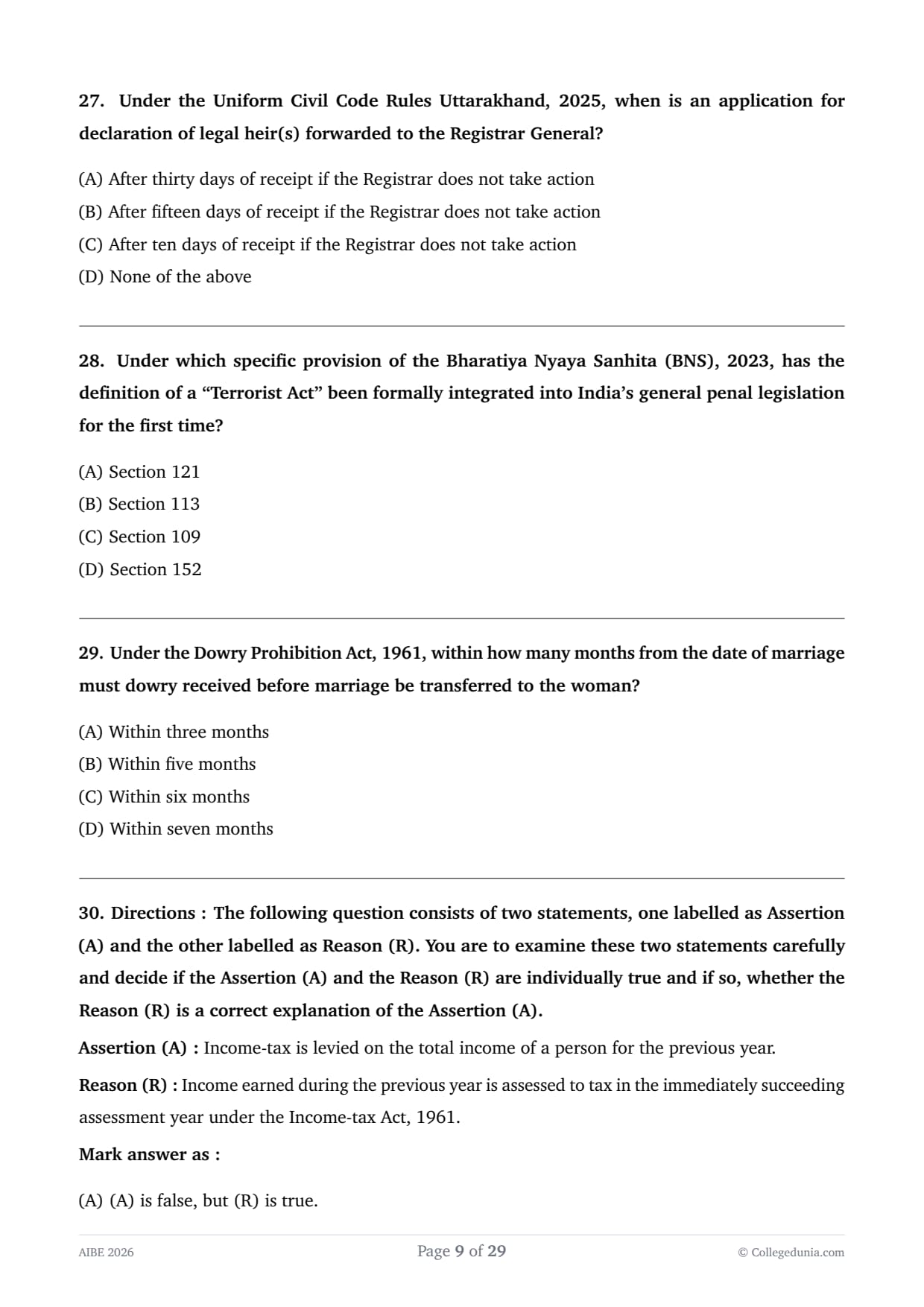
Under the Uniform Civil Code Rules Uttarakhand, 2025, when is an application for declaration of legal heir(s) forwarded to the Registrar General?
View Solution
Concept:
The Uniform Civil Code Rules, Uttarakhand, 2025 prescribe a procedural mechanism for obtaining a declaration of legal heir(s). The Rules aim to ensure expeditious processing of such applications and provide a supervisory mechanism where the concerned Registrar fails to act within the prescribed period.
To avoid unnecessary delays, the Rules provide for forwarding the application to the Registrar General if no action is taken within a specified timeframe.
Step 1: Identify the authority initially dealing with the application.
An application for declaration of legal heir(s) is first submitted before the competent Registrar.
The Registrar is expected to examine and process the application within the period prescribed under the Rules.
Step 2: Determine the prescribed period for action by the Registrar.
Under the Uniform Civil Code Rules, Uttarakhand, 2025, if the Registrar does not take action on the application within:
15 days
of its receipt, the application is forwarded to the Registrar General.
Step 3: Evaluate the options.
Option (A): Incorrect. The Rules do not prescribe a 30-day period.
Option (B): Correct. The application is forwarded after 15 days of inaction by the Registrar.
Option (C): Incorrect. The prescribed period is not 10 days.
Option (D): Incorrect because Option (B) correctly states the rule.
Step 4: Determine the correct answer.
Since the Rules provide for forwarding the application after fifteen days of inaction by the Registrar,
After fifteen days of receipt if the Registrar does not take action
is the correct answer.
Therefore,
Option (B) Quick Tip: Uniform Civil Code Rules, Uttarakhand, 2025} For declaration of legal heir(s): Registrar Inactive for 15 Days Application Forwarded to Registrar General Remember: 15 Days Registrar General This timeline is a commonly tested procedural provision under the Uttarakhand UCC framework.
Under which specific provision of the Bharatiya Nyaya Sanhita (BNS), 2023, has the definition of a ``Terrorist Act'' been formally integrated into India's general penal legislation for the first time?
View Solution
Concept:
One of the significant innovations introduced by the Bharatiya Nyaya Sanhita (BNS), 2023 is the incorporation of the offence of Terrorist Act directly into the general criminal law framework.
Previously, offences relating to terrorism were primarily governed by special legislation such as the Unlawful Activities (Prevention) Act, 1967 (UAPA). The BNS, 2023 has now incorporated the concept of a terrorist act into the general penal statute itself.
Step 1: Identify the relevant provision under BNS, 2023.
The offence of Terrorist Act is specifically defined and incorporated under:
Section 113 of the Bharatiya Nyaya Sanhita, 2023
This marks the first time that a general penal law in India expressly contains such a provision.
Step 2: Understand the significance of Section 113.
Section 113 seeks to address acts intended to:
Threaten the unity, integrity, sovereignty or security of India,
Strike terror among the people,
Cause death, injury, destruction of property or disruption of essential services.
The provision substantially draws from the framework earlier found in anti-terror legislation.
Step 3: Evaluate the options.
Section 121: Does not define ``Terrorist Act'' under BNS.
Section 113: Specifically incorporates the offence and definition of a terrorist act.
Section 109: Relates to a different category of offences.
Section 152: Concerns acts affecting sovereignty, unity and integrity but is not the provision defining ``Terrorist Act''.
Step 4: Determine the correct answer.
Since the BNS formally incorporates the definition of a terrorist act under:
Section 113
the correct option is:
Option (B) Quick Tip: Major Innovation in BNS, 2023} Section 113 = Terrorist Act Remember: Earlier Primarily UAPA Now BNS Section 113 + UAPA Framework A frequently asked reform under the new criminal laws is the inclusion of terrorism-related provisions in the general penal code.
Under the Dowry Prohibition Act, 1961, within how many months from the date of marriage must dowry received before marriage be transferred to the woman?
View Solution
Concept:
Section 6 of the Dowry Prohibition Act, 1961 provides that where any dowry is received by any person other than the woman in connection with whose marriage it is given, such person holds the dowry in trust for the benefit of the woman.
The Act prescribes specific time limits within which the dowry must be transferred to the woman.
Step 1: Identify the rule relating to dowry received before marriage.
Where dowry is received:
Before Marriage
it must be transferred to the woman:
Within Three Months from the Date of Marriage
Step 2: Understand the object of the provision.
The purpose of Section 6 is to ensure that:
Dowry does not remain under the control of relatives or other persons,
The woman receives the property intended for her benefit,
Misappropriation of dowry is prevented.
Step 3: Evaluate the options.
Option (A): Correct. The Act prescribes a period of three months from the date of marriage.
Option (B): Incorrect. No five-month period is prescribed.
Option (C): Incorrect. Six months is not the statutory period.
Option (D): Incorrect. Seven months is not recognized under the Act.
Step 4: Determine the correct answer.
Since Section 6 requires dowry received before marriage to be transferred to the woman within three months from the date of marriage,
Within Three Months
is the correct answer.
Therefore,
Option (A) Quick Tip: Section 6 -- Dowry to be for the Benefit of the Woman} Remember the timelines: Dowry Received Before Marriage Transfer Within 3 Months of Marriage Dowry Received At Marriage Transfer Within 3 Months of Receipt Dowry Received After Marriage Transfer Within 3 Months of Receipt Shortcut: Section 6 = 3 Months Rule
Directions : The following question consists of two statements, one labelled as Assertion (A) and the other labelled as Reason (R). You are to examine these two statements carefully and decide if the Assertion (A) and the Reason (R) are individually true and if so, whether the Reason (R) is a correct explanation of the Assertion (A).
Assertion (A) : Income-tax is levied on the total income of a person for the previous year.
Reason (R) : Income earned during the previous year is assessed to tax in the immediately succeeding assessment year under the Income-tax Act, 1961.
Mark answer as :
View Solution
Concept:
The Income-tax Act, 1961 follows the concept of:
Previous Year
and
Assessment Year
Income is earned during the Previous Year and is generally assessed to tax in the immediately succeeding Assessment Year.
Step 1: Examine Assertion (A).
Assertion (A) states that:
Income-tax is levied on the total income of a person for the previous year.
Under Section 4 of the Income-tax Act, 1961, income-tax is charged in respect of the total income of the previous year of every person.
Therefore,
Assertion (A) is True.
Step 2: Examine Reason (R).
Reason (R) states that:
Income earned during the previous year is assessed
in the immediately succeeding assessment year.
This correctly reflects the scheme of the Income-tax Act.
For example:
Previous Year 2024-25 Assessment Year 2025-26
Hence,
Reason (R) is True.
Step 3: Determine whether Reason (R) explains Assertion (A).
The reason explains why tax is levied on the income of the previous year.
The Income-tax Act adopts the system whereby:
Income Earned in Previous Year
is
Assessed in the Following Assessment Year.
Thus, the Reason directly explains the basis of the Assertion.
Reason (R) is the correct explanation of Assertion (A).
Step 4: Determine the correct answer.
Since both the Assertion and the Reason are true, and the Reason correctly explains the Assertion,
Both (A) and (R) are true and (R) is the correct explanation of (A).
Therefore,
Option (C) Quick Tip: Income-tax Basics} Previous Year (PY) = Year in which Income is Earned Assessment Year (AY) = Year in which Income is Assessed Example: PY 2024-25 AY 2025-26 Shortcut: Earn in PY, Tax in AY
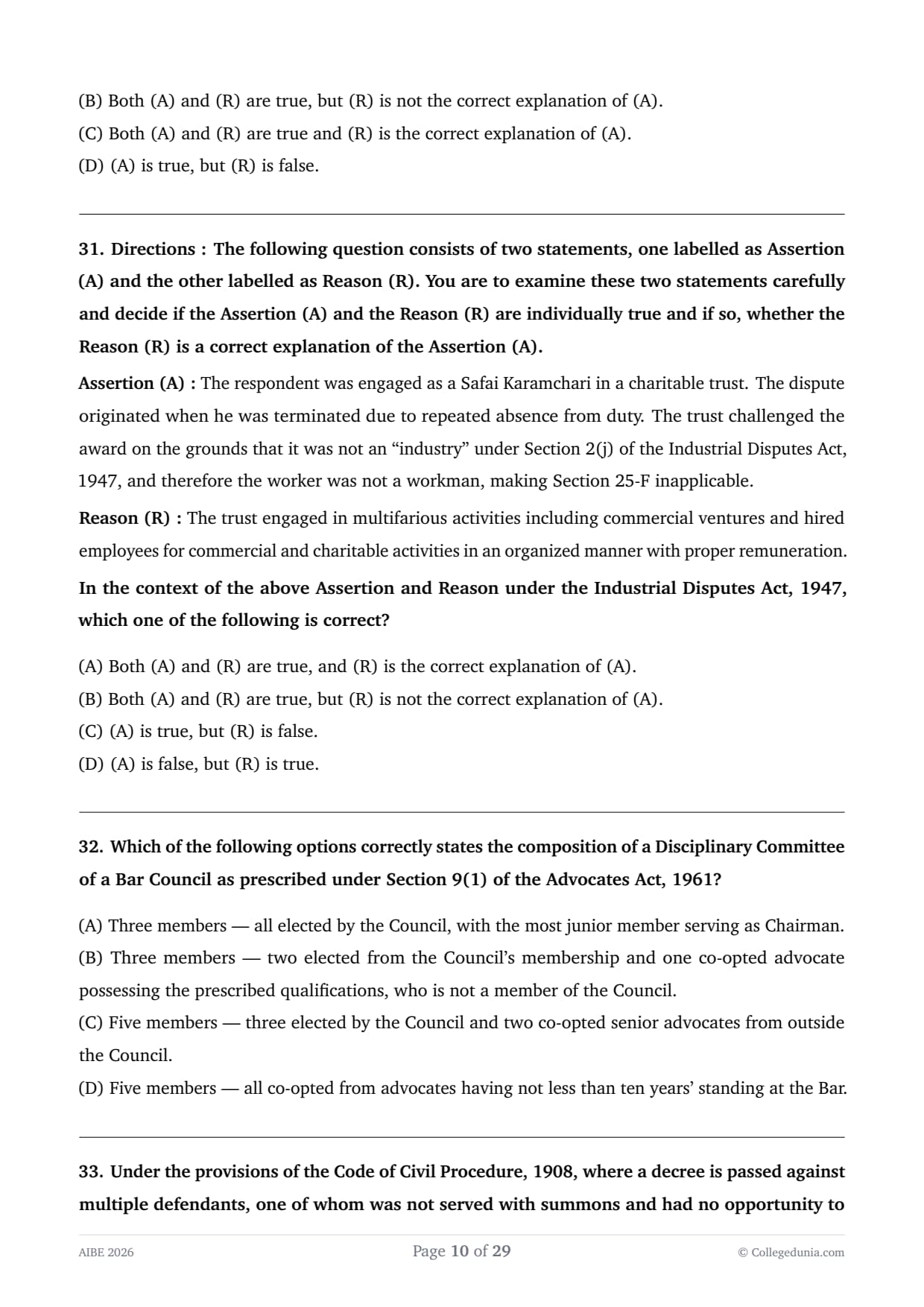
Directions : The following question consists of two statements, one labelled as Assertion (A) and the other labelled as Reason (R). You are to examine these two statements carefully and decide if the Assertion (A) and the Reason (R) are individually true and if so, whether the Reason (R) is a correct explanation of the Assertion (A).
Assertion (A) : The respondent was engaged as a Safai Karamchari in a charitable trust. The dispute originated when he was terminated due to repeated absence from duty. The trust challenged the award on the grounds that it was not an ``industry'' under Section 2(j) of the Industrial Disputes Act, 1947, and therefore the worker was not a workman, making Section 25-F inapplicable.
Reason (R) : The trust engaged in multifarious activities including commercial ventures and hired employees for commercial and charitable activities in an organized manner with proper remuneration.
In the context of the above Assertion and Reason under the Industrial Disputes Act, 1947, which one of the following is correct?
View Solution
Concept:
The expression ``Industry'' under Section 2(j) of the Industrial Disputes Act, 1947 has been interpreted broadly by the Supreme Court, particularly in the landmark judgment of:
Bangalore Water Supply and Sewerage Board v. A. Rajappa
The Court held that even charitable organizations may constitute an industry if they carry on systematic activities organized through employer--employee cooperation for the production or distribution of goods or services.
The dominant test is not profit motive but the nature of the activity and the existence of an organized workforce.
Step 1: Examine Assertion (A).
The assertion states that:
The respondent was employed as a Safai Karamchari.
His services were terminated.
The trust contended that it was not an industry under Section 2(j).
Consequently, it argued that Section 25-F was inapplicable.
These facts correctly represent the dispute raised by the trust.
Therefore,
Assertion (A) is True.
Step 2: Examine Reason (R).
The reason states that:
The trust carried on various organized activities.
It engaged employees for both charitable and commercial functions.
Employees were appointed systematically and paid remuneration.
Such characteristics satisfy the broad judicial test of an ``industry'' under Section 2(j).
Hence,
Reason (R) is True.
Step 3: Determine whether Reason (R) explains Assertion (A).
The trust's claim that it was not an industry was rejected because:
Organized Activities + Employer--Employee Relationship + Remunerated Workforce
indicate the existence of an industry.
Thus, the facts stated in the Reason directly explain why the trust could be treated as an industry and why labour law protections, including Section 25-F, would apply.
Therefore,
Reason (R) correctly explains Assertion (A).
Step 4: Determine the correct answer.
Since both statements are true and the Reason correctly explains the Assertion,
Both (A) and (R) are true, and (R) is the correct explanation of (A).
Therefore,
Option (A) Quick Tip: Section 2(j), Industrial Disputes Act, 1947} Remember the Bangalore Water Supply test: Systematic Activity + Employer--Employee Cooperation + Goods or Services = Industry Even a charitable institution may be an industry if these elements are present. Profit Motive is Not Essential
Which of the following options correctly states the composition of a Disciplinary Committee of a Bar Council as prescribed under Section 9(1) of the Advocates Act, 1961?
View Solution
Concept:
Section 9 of the Advocates Act, 1961 mandates the constitution of one or more Disciplinary Committees by every Bar Council.
The purpose of the Disciplinary Committee is to inquire into cases of professional misconduct and other disciplinary matters involving advocates.
To ensure fairness and independence, the statute prescribes a specific composition for such committees.
Step 1: Identify the statutory composition under Section 9(1).
Section 9(1) provides that a Disciplinary Committee shall consist of:
Three Members
comprising:
Two persons elected by the Bar Council from amongst its members; and
One person co-opted by the Bar Council from amongst advocates possessing the prescribed qualifications and who is not a member of the Council.
Step 2: Examine the role of the co-opted member.
The co-opted advocate:
Must possess the prescribed qualifications,
Must not be a member of the concerned Bar Council,
Participates as a full member of the Disciplinary Committee.
This ensures an element of independent participation in disciplinary proceedings.
Step 3: Evaluate the options.
Option (A): Incorrect. The Committee is not composed entirely of elected members.
Option (B): Correct. It exactly reproduces the composition prescribed under Section 9(1).
Option (C): Incorrect. The Act does not prescribe a five-member committee.
Option (D): Incorrect. The Committee is not composed entirely of co-opted advocates.
Step 4: Determine the correct answer.
Since Section 9(1) specifically provides for:
Two elected members + One co-opted advocate
the correct option is:
Option (B) Quick Tip: Section 9(1), Advocates Act, 1961} Composition of Disciplinary Committee: 2 Elected Members + 1 Co-opted Advocate Total: 3 Members Remember: Co-opted Member Not a Member of the Council This is a frequently asked provision in Professional Ethics and Advocates Act examinations.
Under the provisions of the Code of Civil Procedure, 1908, where a decree is passed against multiple defendants, one of whom was not served with summons and had no opportunity to contest, such a defendant may seek relief :
View Solution
Concept:
Order IX Rule 13 of the Code of Civil Procedure, 1908 provides a remedy against an ex-parte decree. A defendant against whom an ex-parte decree has been passed may apply to the court for setting aside the decree if:
Summons was not duly served; or
The defendant was prevented by sufficient cause from appearing when the suit was called for hearing.
The provision is based on the principle of natural justice that no person should be condemned unheard.
Step 1: Identify the nature of the decree.
The question states that:
The decree was passed against multiple defendants.
One defendant was not served with summons.
He had no opportunity to contest the case.
Thus, as regards that defendant, the decree is:
An Ex-Parte Decree
Step 2: Apply Order IX Rule 13 CPC.
Order IX Rule 13 CPC specifically provides that where summons was not duly served,
the defendant may apply to set aside the ex-parte decree.
The court, upon being satisfied that service was not duly effected, may set aside the decree upon such terms as it thinks fit.
Step 3: Evaluate the options.
Option (A): Incorrect. Appeal is not the only remedy available.
Option (B): Incorrect. A separate suit is generally not the prescribed remedy.
Option (C): Correct. Order IX Rule 13 expressly provides this remedy.
Option (D): Incorrect. Review is not the exclusive remedy in such a situation.
Step 4: Determine the correct answer.
Since the defendant was not served with summons and had no opportunity to contest the suit,
He may apply for setting aside the ex-parte decree.
Therefore,
Option (C) Quick Tip: Order IX Rule 13 CPC} Grounds for setting aside an ex-parte decree: Summons Not Duly Served or Sufficient Cause for Non-Appearance Remember: No Proper Service of Summons Application under Order IX Rule 13 This is one of the most frequently tested procedural remedies under the CPC.
Under the Indian Penal Code (IPC), 1860, in which of the following scenarios does the ``Right of Private Defence of the Body'' extend to the causing of voluntary death to the assailant?
View Solution
Concept:
Sections 96 to 106 of the Indian Penal Code, 1860 deal with the Right of Private Defence.
Under Section 100 IPC, the right of private defence of the body extends, under certain circumstances, to causing death of the assailant. The provision specifies particular situations where such extreme force is legally justified.
One of the situations expressly mentioned is:
Assault with the intention of kidnapping or abducting
Step 1: Identify the situations covered under Section 100 IPC.
The right of private defence extends to causing death when there is a reasonable apprehension of:
Death,
Grievous hurt,
Rape,
Unnatural lust,
Kidnapping or abduction,
Wrongful confinement under circumstances causing apprehension of inability to seek public authorities,
Certain acid attacks.
Step 2: Examine Option (A).
An assault committed with the intention of:
Kidnapping or Abducting a Person
is specifically covered by Section 100 IPC.
Therefore, the right of private defence may extend to causing the death of the assailant.
Option (A) satisfies Section 100 IPC.
Step 3: Examine the remaining options.
Option (B): Value of stolen property is irrelevant to the right of private defence of the body.
Option (C): Mere criminal trespass on vacant land does not justify causing death.
Option (D): A simple assault without circumstances mentioned in Section 100 does not permit causing death.
Hence, these options do not fall within the situations specified under Section 100 IPC.
Step 4: Determine the correct answer.
Since Section 100 IPC expressly includes assault with the intention of kidnapping or abduction,
The right of private defence extends to causing death in such a case.
Therefore,
Option (A) Quick Tip: Section 100 IPC -- Right of Private Defence Extending to Death} Remember the major situations: Death Grievous Hurt Rape Kidnapping or Abduction Wrongful Confinement Acid Attack Private Defence may extend to causing death A favourite exam question is: Kidnapping/Abduction Section 100 IPC
As per the Code of Civil Procedure, 1908, where the plaintiff in a civil suit fails to pay the requisite court-fee or postal charges for service of summons within the time permitted by the Court, the Court may :
View Solution
Concept:
Order IX Rule 2 of the Code of Civil Procedure, 1908 deals with the consequences of failure by the plaintiff to take necessary steps for service of summons.
Where the plaintiff fails to pay the court-fee, postal charges, or other charges required for service of summons upon the defendant within the time fixed by the Court, the Court may dismiss the suit.
The provision ensures that a plaintiff diligently prosecutes the suit and cooperates in effecting service upon the defendant.
Step 1: Identify the relevant provision.
The question concerns failure to pay:
Court-fee for service,
Postal charges,
Other charges necessary for issuing summons.
This situation is governed by:
Order IX Rule 2 CPC
Step 2: Examine the consequence of such failure.
If the plaintiff does not comply with the Court's direction regarding payment of the required charges within the prescribed time,
the Court may:
Dismiss the Suit
for failure to take steps necessary for service of summons.
Step 3: Evaluate the options.
Option (A): Incorrect. The CPC does not require merely staying the proceedings.
Option (B): Incorrect. The suit cannot ordinarily be decided on merits without proper service on the defendant.
Option (C): Correct. Order IX Rule 2 specifically empowers the Court to dismiss the suit.
Option (D): Incorrect. Return of plaint is governed by different provisions and is not the consequence contemplated here.
Step 4: Determine the correct answer.
Since Order IX Rule 2 CPC authorizes dismissal where the plaintiff fails to pay the requisite charges for service of summons,
Dismiss the Suit
is the correct legal position.
Therefore,
Option (C) Quick Tip: Order IX Rule 2 CPC} Failure to Pay Court-Fee / Postal Charges for Service of Summons {Dismissal of Suit Remember: Plaintiff Must Take Steps for Service otherwise Order IX Rule 2 Applies
Under the scheme of the Constitution of India, once a Proclamation under Article 352 is in operation, Parliament may legislate on matters in the State List by virtue of:
View Solution
Concept:
The Constitution of India ordinarily distributes legislative powers between the Union and the States through the Union List, State List and Concurrent List under the Seventh Schedule.
As a general rule:
State List Subjects State Legislature
However, during a National Emergency proclaimed under Article 352, the Constitution temporarily enlarges Parliament's legislative competence.
This power is specifically conferred by:
Article 250
Step 1: Understand Article 250.
Article 250 provides that while a Proclamation of Emergency under Article 352 is in operation,
Parliament may make laws
with respect to:
Any Matter in the State List
for the whole or any part of India.
Step 2: Distinguish Article 250 from other provisions.
Article 356 deals with President's Rule in a State.
Article 360 deals with Financial Emergency.
Article 249 permits Parliament to legislate on State List matters when the Rajya Sabha passes a resolution in the national interest.
Article 250 specifically operates during a National Emergency under Article 352.
Step 3: Evaluate the options.
Option (A): Incorrect. Article 356 concerns failure of constitutional machinery in a State.
Option (B): Incorrect. Article 360 relates to Financial Emergency.
Option (C): Incorrect. Article 249 requires a Rajya Sabha resolution and is independent of Article 352.
Option (D): Correct. Article 250 empowers Parliament to legislate on State List matters during a National Emergency.
Step 4: Determine the correct answer.
Since Parliament derives the power to legislate on State List subjects during the operation of a Proclamation under Article 352 from:
Article 250
the correct option is:
Option (D) Quick Tip: Emergency and Legislative Powers} Article 249 Rajya Sabha Resolution Article 250 National Emergency (Art. 352) Article 356 President's Rule Article 360 Financial Emergency Shortcut: Emergency under Art. 352 Article 250
The term ``Public Interest Litigation (PIL)'' was first used by :
View Solution
Concept:
Public Interest Litigation (PIL) is a judicial innovation that allows courts to entertain petitions filed not for private rights alone but for the protection of public interest, especially the rights of disadvantaged and marginalized sections of society.
Although Justices V. R. Krishna Iyer and P. N. Bhagwati played a pivotal role in developing and expanding PIL jurisprudence in India, the expression ``Public Interest Litigation'' is credited to legal scholar Prof. Upendra Baxi.
Step 1: Understand the significance of PIL.
PIL was introduced to make justice accessible to those who:
Could not approach courts themselves,
Were economically or socially disadvantaged,
Suffered violations of fundamental or legal rights affecting the public at large.
It considerably liberalized the traditional rule of locus standi.
Step 2: Identify the person who first used the term.
The expression:
Public Interest Litigation (PIL)
was first used in the Indian context by:
Prof. Upendra Baxi
a distinguished legal scholar and jurist.
Step 3: Distinguish other important contributors.
Justice V. R. Krishna Iyer greatly expanded access to justice through liberal interpretation of procedural rules.
Justice P. N. Bhagwati is often regarded as one of the principal architects of PIL jurisprudence in India.
Prof. Abram Chayes developed the concept of ``public law litigation'' in American legal scholarship but did not coin the Indian term PIL.
Step 4: Determine the correct answer.
Since the term Public Interest Litigation (PIL) was first used by:
Prof. Upendra Baxi
the correct option is:
Option (C) Quick Tip: PIL Personalities} Prof. Upendra Baxi} Term ``Public Interest Litigation'' Justice V. R. Krishna Iyer} Early Expansion of PIL Justice P. N. Bhagwati} Architect of PIL Jurisprudence Exam Shortcut: Term PIL = Upendra Baxi
Directions : The following question consists of two statements, one labelled as Assertion (A) and another labelled as Reason (R). You are to examine these two statements carefully and decide if the Assertion (A) and the Reason (R) are individually true and if so, whether the Reason (R) is a correct explanation of the Assertion (A).
Assertion (A) : The Constitution of India does not adopt a rigid separation of powers among the Legislature, Executive and Judiciary.
Reason (R) : The constitutional framework incorporates a system of checks and balances, allowing limited functional overlap among the organs of the State.
In the context of the above Assertion and Reason, which one of the following is correct?
View Solution
Concept:
The doctrine of Separation of Powers envisages division of governmental functions among the Legislature, Executive and Judiciary.
Unlike the Constitution of the United States, the Constitution of India does not establish a strict or rigid separation of powers. Instead, it adopts a system of functional separation accompanied by checks and balances to prevent concentration of power in any one organ of the State.
Step 1: Examine Assertion (A).
Assertion (A) states that:
The Constitution of India does not adopt a rigid separation of powers.
This statement is correct.
The Indian Constitution distributes powers among the three organs but also permits certain overlaps. Examples include:
The Executive is drawn from the Legislature in the parliamentary system.
The President and Governors exercise legislative functions such as promulgating ordinances.
Courts possess rule-making powers and exercise judicial review over legislative and executive actions.
Therefore,
Assertion (A) is True.
Step 2: Examine Reason (R).
Reason (R) states that:
The constitutional framework incorporates checks and balances
allowing
limited functional overlap among State organs.
This accurately reflects the constitutional scheme.
Examples include:
Judicial Review over legislative and executive action.
Legislative control over the Executive through questions, motions and no-confidence proceedings.
Executive participation in legislation through ordinances and assent.
Hence,
Reason (R) is True.
Step 3: Determine whether Reason (R) explains Assertion (A).
The reason directly explains why India does not follow a rigid separation of powers.
Since the Constitution establishes:
Checks and Balances
and
Limited Functional Overlap
the separation of powers is not absolute.
Thus,
Reason (R) is the correct explanation of Assertion (A).
Step 4: Determine the correct answer.
Since both statements are true and the Reason correctly explains the Assertion,
Both (A) and (R) are true, and (R) is the correct explanation of (A).
Therefore,
Option (C) Quick Tip: Separation of Powers in India} USA More Rigid Separation India Functional Separation + Checks and Balances Examples of overlap: Executive from Legislature Ordinance-Making Power Judicial Review Remember: India does not follow a strict separation of powers.
Under the provisions of the Bharatiya Nyaya Sanhita (BNS), 2023, what is the current range of punishment available to a court for the offence of ``Defamation''?
View Solution
Concept:
The offence of Defamation has been retained under the Bharatiya Nyaya Sanhita (BNS), 2023. The BNS continues to recognize criminal defamation while introducing community service as an additional sentencing option in certain offences.
The punishment prescribed for defamation includes imprisonment, fine, or community service.
Step 1: Identify the offence involved.
Defamation refers to making or publishing an imputation concerning any person intending to harm, or knowing or having reason to believe that such imputation will harm, that person's reputation.
Protection of reputation is regarded as an important aspect of individual dignity.
Step 2: Examine the punishment under BNS, 2023.
For the offence of defamation, the Court may impose:
Simple Imprisonment up to 2 Years
or
Fine
or
Community Service
Thus, the BNS expands the sentencing options by expressly incorporating community service.
Step 3: Evaluate the options.
Option (A): Correct. It accurately states the punishment available under the BNS.
Option (B): Incorrect. No punishment of rigorous imprisonment for five years is prescribed.
Option (C): Incorrect. Fine is not the only punishment available.
Option (D): Incorrect. An apology is not the statutory punishment prescribed.
Step 4: Determine the correct answer.
Since the BNS provides for:
Simple Imprisonment up to 2 Years
or
Fine
or
Community Service
the correct option is:
Option (A) Quick Tip: Defamation under BNS, 2023} Punishment: Simple Imprisonment up to 2 Years or Fine or Community Service Remember: BNS retains criminal defamation while introducing Community Service as an additional sentencing option.
Which provision of the Code of Criminal Procedure (CrPC), 1973, provides a summary legal remedy for the maintenance of spouses, children, and parents who are unable to support themselves?
View Solution
Concept:
Section 125 of the Code of Criminal Procedure, 1973 provides a speedy and summary remedy for maintenance to certain dependent persons who are unable to maintain themselves.
The object of the provision is:
To prevent destitution, vagrancy and starvation.
It is a measure of social justice and applies irrespective of personal laws.
Step 1: Identify the beneficiaries under Section 125 CrPC.
Section 125 enables the following persons to claim maintenance:
Wife who is unable to maintain herself,
Legitimate or illegitimate minor child,
Major child suffering from physical or mental abnormality,
Father or mother unable to maintain themselves.
Thus,
Spouses, Children and Parents
are covered under the provision.
Step 2: Understand the nature of the remedy.
The proceedings under Section 125 are:
Summary in nature,
Intended to provide quick relief,
Independent of detailed civil proceedings.
Hence,
Section 125 provides a summary maintenance remedy.
Step 3: Evaluate the options.
Section 320: Relates to compounding of offences.
Section 125: Deals with maintenance of wife, children and parents.
Section 107: Relates to security for keeping peace.
Section 144: Relates to urgent cases of nuisance or apprehended danger.
Therefore, only Section 125 corresponds to maintenance proceedings.
Step 4: Determine the correct answer.
Since Section 125 CrPC provides a summary legal remedy for maintenance of spouses, children and parents,
Section 125
is the correct answer.
Therefore,
Option (B) Quick Tip: Important CrPC Sections} Section 125} Maintenance Section 107} Keeping Peace Section 144} Urgent Preventive Orders Section 320} Compounding of Offences Shortcut: 125 = Maintenance of Wife, Children and Parents
The case of Parmanand Katara v. Union of India (1989) is primarily associated with which of the following rights?
View Solution
Concept:
Parmanand Katara v. Union of India (1989) is a landmark judgment of the Supreme Court of India concerning the obligation of doctors and hospitals to provide immediate medical assistance to injured persons.
The Court emphasized that preservation of human life is of paramount importance and that procedural formalities cannot stand in the way of emergency treatment.
The decision is regarded as the foundation of the Right to Emergency Medical Care under Article 21 of the Constitution.
Step 1: Understand the facts of the case.
The issue before the Supreme Court was whether a doctor could refuse to treat an injured person on the ground that the case should first be taken to a government hospital or that medico-legal formalities had not been completed.
The Court held that:
Every doctor has a professional obligation to provide immediate medical aid.
Step 2: Examine the principle laid down by the Court.
The Supreme Court observed that:
Preservation of Human Life
is of supreme importance.
Accordingly,
Immediate medical treatment must be provided without delay.
Neither legal formalities nor jurisdictional issues can justify refusal of emergency treatment.
Step 3: Relate the case to fundamental rights.
Although the judgment derives support from:
Article 21
it is specifically known for recognizing:
The Right to Emergency Medical Care
rather than the broader general formulation of the right to life.
Step 4: Evaluate the options.
Option (A): Article 21 is involved, but this is not the most specific answer.
Option (B): Correct. The case is primarily associated with emergency medical treatment.
Option (C): Relates to environmental jurisprudence.
Option (D): Associated with cases such as Hussainara Khatoon.
Step 5: Determine the correct answer.
Since Parmanand Katara v. Union of India established the obligation to provide immediate treatment to accident victims and injured persons,
Right to Emergency Medical Care
is the correct answer.
Therefore,
Option (B) Quick Tip: Important Article 21 Cases} Parmanand Katara (1989)} Emergency Medical Care Hussainara Khatoon} Speedy Trial M.C. Mehta} Environmental Rights Exam Shortcut: Parmanand Katara = Immediate Medical Aid
According to the provisions of the Bharatiya Nagarik Suraksha Sanhita (BNSS), 2023, an accused person intending to apply for ``Plea Bargaining'' must do so within how many days following the formal framing of charges?
View Solution
Concept:
Plea Bargaining is a mechanism that allows an accused person to voluntarily negotiate and seek a mutually acceptable disposition of the criminal case, thereby reducing prolonged litigation and promoting speedy justice.
The BNSS, 2023 continues the concept of Plea Bargaining and prescribes a specific time limit within which the accused must move an application after the framing of charges.
Step 1: Understand the purpose of Plea Bargaining.
Plea Bargaining aims to:
Reduce pendency of criminal cases,
Encourage voluntary admission of guilt,
Facilitate speedy disposal of cases,
Reduce the burden on courts.
Step 2: Identify the prescribed time limit.
Under the provisions of the BNSS, 2023, an accused desirous of availing Plea Bargaining must file the application:
Within 30 Days from the Date of Framing of Charges
This ensures that the option is exercised at an early stage of the proceedings.
Step 3: Evaluate the options.
Option (A): Incorrect. The law does not prescribe a 7-day period.
Option (B): Incorrect. Fifteen days is not the prescribed period.
Option (C): Correct. The application must be filed within 30 days after framing of charges.
Option (D): Incorrect. Sixty days is not the statutory limit.
Step 4: Determine the correct answer.
Since the BNSS prescribes a period of:
30 Days
for filing an application for Plea Bargaining after framing of charges,
the correct option is:
Option (C) Quick Tip: BNSS, 2023 -- Plea Bargaining} Charges Framed \Downarrow Apply Within 30 Days Remember: Plea Bargaining = 30-Day Rule This timeline is frequently tested in questions on criminal procedure reforms under the BNSS, 2023.
Under the scheme of the Code of Civil Procedure, 1908, where proceedings are pending before a competent civil court, and an application is made seeking transfer of the case from one district to another district within the State, such transfer may be ordered :
View Solution
Concept:
The Code of Civil Procedure, 1908 contains provisions enabling transfer of suits, appeals and other proceedings from one court to another in the interests of justice, convenience and proper administration of judicial proceedings.
Section 24 CPC empowers the High Court and the District Court to transfer cases. However, where the transfer sought is from one district to another district within the same State, the competent authority is the High Court.
Step 1: Identify the relevant provision.
The transfer of civil proceedings is governed by:
Section 24 CPC
which confers power on:
The High Court, and
The District Court.
Step 2: Determine the authority competent to transfer cases between districts.
A District Court can transfer cases only among courts subordinate to it within its territorial jurisdiction.
Where a case is sought to be transferred:
From One District Another District
within the same State, the matter falls outside the jurisdiction of a single District Court.
Therefore,
The High Court may order such transfer.
Step 3: Evaluate the options.
Option (A): Incorrect. The court where the suit is pending cannot transfer it to another district.
Option (B): Correct. The High Court possesses the requisite power under Section 24 CPC.
Option (C): Incorrect. Transfer may be ordered at any appropriate stage and need not await completion of trial.
Option (D): Incorrect. Consent of parties is not a mandatory condition for transfer.
Step 4: Determine the correct answer.
Since a transfer from one district to another district within the State may be ordered by the High Court under Section 24 CPC,
By the High Court
is the correct answer.
Therefore,
Option (B) Quick Tip: Section 24 CPC -- Transfer of Cases} Within Same District District Court Between Different Districts High Court Remember: Inter-District Transfer = High Court A common CPC examination question concerns the distinction between the transfer powers of the District Court and the High Court.
Judicial intervention in arbitration proceedings is limited under Section 5 of the Arbitration and Conciliation Act, 1996. In which of the following situations may a court intervene?
View Solution
Concept:
One of the fundamental objectives of the Arbitration and Conciliation Act, 1996 is to minimize judicial interference in arbitral proceedings and promote party autonomy.
Section 5 of the Act embodies this principle and provides:
No judicial authority shall intervene except where so provided in the Act.
Thus, courts can intervene only in situations specifically contemplated by the Act.
Step 1: Understand the scope of Section 5.
Section 5 states:
Judicial Intervention
\Downarrow
Only When Expressly Authorized by the Act
The provision seeks to ensure speedy and efficient resolution of disputes through arbitration.
Step 2: Identify situations where intervention is expressly permitted.
Examples include:
Referral of parties to arbitration (Section 8),
Appointment of arbitrators (Section 11),
Interim measures by courts (Section 9),
Setting aside an arbitral award (Section 34),
Appeals in specified cases (Section 37).
These powers exist because the Act specifically authorizes them.
Step 3: Evaluate the options.
Option (A): Incorrect. Mere allegation of procedural irregularity does not justify intervention unless the Act provides a remedy.
Option (B): Incorrect. Courts do not sit as appellate authorities to reassess facts merely because they consider an award unjust.
Option (C): Correct. Section 5 expressly limits intervention to situations specifically provided under the Act.
Option (D): Incorrect. Even consent of parties cannot enlarge judicial powers beyond those granted by the Act.
Step 4: Determine the correct answer.
Since Section 5 permits judicial intervention only where the Arbitration and Conciliation Act, 1996 expressly authorizes it,
When the Act expressly permits such intervention
is the correct answer.
Therefore,
Option (C) Quick Tip: Section 5 -- Arbitration and Conciliation Act, 1996} Minimum Judicial Intervention Golden Rule: Court Can Intervene \iff The Act Specifically Permits It Remember: Arbitration Party Autonomy Court Intervention Exception
Which of the following statements is not true} with respect to Section 65B of the Indian Evidence Act, 1872?
View Solution
Concept:
Section 65B of the Indian Evidence Act, 1872 deals with the admissibility of electronic records.
The Supreme Court has clarified through a series of landmark judgments that electronic evidence is admissible only in accordance with the statutory requirements prescribed under Section 65B.
The major cases in this area are:
State (NCT of Delhi) v. Navjot Sandhu (2005),
P.V. Anvar v. P.K. Basheer (2014),
Arjun Panditrao Khotkar v. Kailash Kushanrao Gorantyal (2020).
Step 1: Examine Option (A).
In
Arjun Panditrao Khotkar v. Kailash Kushanrao Gorantyal
the Supreme Court reaffirmed and clarified the law laid down in P.V. Anvar and treated Section 65B as the governing provision for admissibility of electronic evidence.
Therefore,
Option (A) is True.
Step 2: Examine Option (C).
The Supreme Court in:
P.V. Anvar
and later in
Arjun Panditrao
held that a certificate under Section 65B(4) is generally a condition precedent for admissibility of secondary electronic evidence.
Thus,
Option (C) is True.
Step 3: Examine Option (D).
In
P.V. Anvar v. P.K. Basheer
the Supreme Court specifically observed that:
Section 65B is a complete code for electronic evidence.
Hence,
Option (D) is True.
Step 4: Examine Option (B).
The judgment in:
State (NCT of Delhi) v. Navjot Sandhu
did permit admission of electronic evidence through provisions other than Section 65B.
However, it did not hold that electronic records could be admitted without authentication.
Electronic records still required proof and authentication.
The statement incorrectly describes the ratio of the case.
Further, the approach adopted in Navjot Sandhu was later overruled in P.V. Anvar.
Therefore,
Option (B) is Not True.
Step 5: Determine the correct answer.
Since Option (B) incorrectly states that electronic records could be admitted without authentication,
Option (B)
is the statement that is not true. Quick Tip: Electronic Evidence Timeline} Navjot Sandhu (2005) Allowed proof of electronic records through general evidence provisions. P.V. Anvar (2014) Held: Section 65B = Complete Code 65B Certificate Generally Mandatory Arjun Panditrao (2020) Reaffirmed P.V. Anvar and settled the law. Exam Shortcut: 65B Certificate Admissibility of Electronic Evidence
Under Rule 8 of the Standards of Professional Conduct and Etiquette framed by the Bar Council of India, an advocate is prohibited from appearing before any court, tribunal or authority for or against an organisation or institution of which he is a member of its :
View Solution
Concept:
The Bar Council of India Rules relating to Standards of Professional Conduct and Etiquette seek to maintain the independence, impartiality and professional integrity of advocates.
Rule 8 specifically addresses situations where an advocate holds a position in the management of an organization or institution. The Rule seeks to prevent conflicts of interest and ensure that an advocate does not use his position in a manner inconsistent with professional ethics.
Step 1: Understand the object of Rule 8.
The purpose of the Rule is:
To avoid conflict between professional duty and organizational interests,
To preserve the advocate's independence,
To prevent situations giving rise to bias or appearance of bias.
Step 2: Identify the specific restriction under Rule 8.
Rule 8 provides that:
An advocate shall not appear before a court, tribunal or authority
for or against an organization or institution
of whose Executive Committee he is a member.
The restriction is intended to maintain professional objectivity and public confidence in legal proceedings.
Step 3: Evaluate the options.
Option (A): Sub-Committee is not the expression used in Rule 8.
Option (B): Mere membership of the General Body is not covered by Rule 8.
Option (C): Correct. Rule 8 specifically refers to membership of the Executive Committee.
Option (D): Advisory Committee is not the statutory expression used in the Rule.
Step 4: Determine the correct answer.
Since Rule 8 prohibits an advocate from appearing for or against an organization of whose:
Executive Committee
he is a member,
the correct option is:
Option (C) Quick Tip: BCI Rule 8 -- Conflict of Interest} Member of Executive Committee Cannot Appear For or Against that Organization Remember: Rule 8 = Professional Independence + Avoidance of Conflict of Interest Exam Shortcut: Rule 8 Executive Committee
Which of the following is not} stated in Section 63(4) of the Bharatiya Sakshya Adhiniyam, 2023, with regard to a certificate to verify the authenticity of electronic evidence?
View Solution
Concept:
Section 63 of the Bharatiya Sakshya Adhiniyam, 2023 deals with the admissibility of electronic records and the certificate required for proving electronic evidence.
Section 63(4) modernizes the earlier framework of Section 65B of the Indian Evidence Act, 1872 and prescribes specific requirements regarding authentication of electronic records.
The provision is supplemented by the Schedule appended to the Adhiniyam, which prescribes the format of the certificate.
Step 1: Examine the requirements expressly contemplated under Section 63(4).
The certificate relating to electronic evidence must conform to the statutory requirements and prescribed format.
The provision recognizes:
Certification in the prescribed form,
Authentication relating to the electronic record,
Compliance with requirements laid down in the Schedule,
Particulars necessary to establish the integrity of the electronic record.
Step 2: Examine Option (B).
The statutory framework contemplates certification by the responsible person and incorporates the prescribed format contained in the Schedule.
Therefore,
Option (B) is stated in the statutory scheme.
Step 3: Examine Option (C).
The Schedule requires particulars including the:
Hash Value
of the electronic record for ensuring integrity and authenticity.
Hence,
Option (C) is also stated.
Step 4: Examine Option (A).
Section 63(4) does not prescribe or require a statement regarding:
Qualification of an Expert
as an essential component of the certificate.
The provision focuses on authentication of the electronic record rather than specifying expert qualifications.
Therefore,
Option (A) is not stated in Section 63(4).
Step 5: Determine the correct answer.
Since ``Qualification of an expert'' is not one of the matters stated in Section 63(4) regarding the certificate for electronic evidence,
Option (A)
is the correct answer. Quick Tip: Section 63 BSA, 2023 -- Electronic Evidence} Key points to remember: Certificate Required Prescribed Format in Schedule Hash Value Included However, Expert Qualification is Not a Requirement Exam Shortcut: BSA Electronic Evidence Certificate + Hash Value not Expert Qualification
The Information Technology Act, 2000, distinguishes between civil liability and criminal liability in cases of misuse of computer resources. In which of the following situations would such conduct attract criminal punishment rather than mere compensation?
View Solution
Concept:
The Information Technology Act, 2000 creates a distinction between:
Civil Liability
and
Criminal Liability
for unauthorized access and misuse of computer resources.
Section 43 provides for:
Compensation (Civil Liability)
for acts such as unauthorized access, downloading, introducing viruses, damaging computer systems, etc.
However, Section 66 converts certain acts into criminal offences when they are committed with the requisite guilty intention.
Step 1: Understand Section 43 of the IT Act.
Under Section 43, a person may be liable to pay compensation if he:
Accesses a computer without permission,
Downloads or copies data without authorization,
Introduces viruses,
Causes damage to computer systems.
These acts generally attract:
Civil Consequences
in the form of compensation.
Step 2: Understand Section 66 of the IT Act.
Section 66 provides that if any act referred to in Section 43 is committed:
Dishonestly
or
Fraudulently
the person becomes criminally liable.
Thus,
Section 43 + Dishonest/Fraudulent Intent = Section 66 Offence
Step 3: Evaluate the options.
Option (A): Incorrect. Criminal liability does not depend upon crossing a monetary threshold.
Option (B): Correct. Criminal punishment arises when the unauthorized act is done dishonestly or fraudulently.
Option (C): Incorrect. Mere unauthorized access may attract compensation under Section 43 but not necessarily criminal punishment.
Option (D): Incorrect. The nature of liability depends on statutory requirements, not on the victim's choice alone.
Step 4: Determine the correct answer.
Since criminal punishment under Section 66 arises when acts covered by Section 43 are committed dishonestly or fraudulently,
Option (B)
is the correct answer. Quick Tip: IT Act, 2000 -- Sections 43 and 66} Section 43} Compensation (Civil Liability) Section 66} Criminal Liability Golden Formula: Unauthorised Access + Dishonest/Fraudulent Intention = {Section 66 Offence Exam Shortcut: Dishonestly or Fraudulently Criminal Punishment
A, aged 80 years, executes a registered deed transferring a parcel of land to a trust with the conditions that: ``The property shall be used forever for maintaining a public library and reading room for the residents of the village. The land shall never be sold, mortgaged, leased, or otherwise transferred to third parties. Further, the income from the property shall accumulate for 50 years before being used for expansion of the library.''
Which of the following statements is most accurate in law?
View Solution
Concept:
The Transfer of Property Act, 1882 contains provisions relating to:
Rule against perpetuity (Section 14),
Direction for accumulation of income (Section 17),
Exceptions for transfers made for public benefit such as religion, knowledge, commerce, health, safety and other charitable purposes.
A public library and reading room constitute a charitable and public-benefit purpose.
Step 1: Examine the nature of the transfer.
The property is transferred for:
Public Library and Reading Room
which is a charitable purpose promoting:
Education and Public Knowledge
Such transfers fall within the recognized public-benefit exception to the rule against perpetuity.
Therefore, the transfer itself is not invalid merely because the property is intended to be used perpetually for a charitable object.
Charitable Purpose Exception to Perpetuity
Step 2: Examine the restriction on alienation.
The deed states that the property shall never be:
Sold, Mortgaged, Leased or Otherwise Transferred.
In charitable trusts, restrictions designed to preserve the property for the charitable object are generally viewed differently from restraints attached to ordinary private transfers.
The dominant purpose remains the maintenance of the charitable institution.
Hence, the transfer is not rendered void solely on this ground.
Step 3: Examine the accumulation clause.
The deed further provides:
Income shall accumulate for 50 years
before being used.
Section 17 TPA restricts excessive directions for accumulation.
A direction requiring accumulation beyond the permissible statutory limits cannot be fully sustained.
Therefore,
The accumulation clause is void to the extent of excess accumulation.
Step 4: Evaluate the options.
Option (A): Incorrect. The charitable transfer itself is protected by the public-benefit exception.
Option (B): Correct. The charitable transfer remains valid, but the excessive accumulation direction cannot be enforced beyond permissible limits.
Option (C): Incorrect. Charitable transfers are not exempt from every statutory restriction relating to accumulation.
Option (D): Incorrect. There is no uncertainty sufficient to invalidate the entire transfer.
Step 5: Determine the correct answer.
Since the transfer is for a public charitable purpose and therefore survives the perpetuity challenge, but the 50-year accumulation direction exceeds permissible limits,
The transfer is valid, but the excessive accumulation clause is void.
Therefore,
Option (B) Quick Tip: Transfer of Property Act, 1882} Section 14} Rule Against Perpetuity Section 17} Direction for Accumulation Important Exception: Public Benefit / Charitable Purpose Exception to Rule Against Perpetuity But remember: Charity does not automatically validate excessive accumulation clauses Exam Shortcut: Charitable Trust + Excessive Accumulation = {Transfer Valid, Excess Accumulation Void
What is the year did the mandatory pre-fitment of High Security Registration Plates (HSRP) for all new vehicles come into effect under the Motor Vehicles Act, 1988?
View Solution
Concept:
High Security Registration Plates (HSRP) are tamper-proof vehicle registration plates introduced to improve vehicle identification, prevent theft, reduce counterfeiting, and strengthen road safety enforcement.
The Central Government mandated that all new motor vehicles be fitted with HSRPs by manufacturers before registration.
Step 1: Understand what HSRP means.
An HSRP contains:
Chromium-based hologram,
Unique laser-etched identification number,
Non-removable snap locks,
Standardized specifications prescribed by law.
These features make the registration plate secure and difficult to tamper with.
Step 2: Identify the year of mandatory pre-fitment.
The Ministry of Road Transport and Highways mandated that:
All New Vehicles Manufactured On or After 1 April 2019
must be supplied with:
High Security Registration Plates (HSRP)
and colour-coded stickers where applicable.
Thus, mandatory pre-fitment came into effect in:
2019
Step 3: Evaluate the options.
Option (A): Incorrect. The nationwide mandatory pre-fitment requirement was not introduced in 2018.
Option (B): Correct. Mandatory pre-fitment for new vehicles commenced in 2019.
Option (C): Incorrect. 2024 relates to implementation drives in some States for older vehicles.
Option (D): Incorrect. The requirement had already been in force before 2023.
Step 4: Determine the correct answer.
Since mandatory pre-fitment of HSRPs for all new vehicles came into effect from:
1 April 2019
the correct option is:
Option (B) Quick Tip: HSRP Timeline} 1 April 2019 \Downarrow Mandatory HSRP for All New Vehicles Remember: HSRP = Tamper-Proof Registration Plate with Hologram + Laser Code + Snap Locks Exam Shortcut: HSRP Mandatory = 2019
In execution proceedings governed by the Code of Civil Procedure, 1908, where property of the judgment-debtor is attached and a third party raises a claim asserting independent title, such claim :
View Solution
Concept:
The Code of Civil Procedure, 1908 provides a complete mechanism for adjudication of claims and objections relating to attached property during execution proceedings.
Order XXI Rules 58 to 63 CPC deal with claims and objections raised by persons asserting an independent right, title or interest in the attached property.
The legislative intent is to avoid multiplicity of proceedings and ensure that execution-related disputes are resolved within the execution process itself.
Step 1: Identify the nature of the dispute.
The question concerns:
Attachment of property in execution,
A third party claiming independent ownership or interest,
Objection to the attachment.
Such disputes are governed by:
Order XXI Rule 58 CPC
Step 2: Understand the power of the executing court.
Order XXI Rule 58 requires the executing court to investigate and determine:
Questions relating to Right, Title or Interest
in the attached property.
The court may:
Allow the claim,
Disallow the claim,
Release the property wholly or partly from attachment.
Therefore,
The Executing Court itself adjudicates the claim.
Step 3: Effect of the CPC Amendment.
Prior to the amendment, parties were often required to file separate suits.
The amended CPC now provides that:
Questions relating to attachment shall be decided in execution itself.
This minimizes delay and multiplicity of litigation.
Step 4: Evaluate the options.
Option (A): Incorrect. A separate suit is generally not required.
Option (B): Incorrect. No prior determination by the decree-passing court is necessary.
Option (C): Incorrect. The claim is adjudicated during execution proceedings.
Option (D): Correct. The executing court is empowered to decide such claims.
Step 5: Determine the correct answer.
Since claims by third parties asserting independent title over attached property are adjudicated by the executing court under Order XXI CPC,
Option (D)
is the correct answer. Quick Tip: Order XXI Rule 58 CPC} Attachment of Property + Third Party Claim \Downarrow Executing Court Decides Remember: No Separate Suit Generally Required Exam Shortcut: Claim to Attached Property {Executing Court
Whether a landowner who enters into a Joint Development Agreement with a builder, contributing land in exchange for 50% of the developed property and a monetary deposit, can file a complaint under the Consumer Protection Act, 2019 alleging construction defects and delay? Which of the following statements is most accurate?
View Solution
Concept:
Under the Consumer Protection Act, 2019, a person who hires or avails services for consideration may qualify as a consumer.
In disputes arising from Joint Development Agreements (JDAs), courts have repeatedly examined whether the landowner is merely a participant in a commercial venture or whether he has availed the services of a builder in exchange for consideration.
The Supreme Court has held that a landowner does not automatically cease to be a consumer merely because the consideration is paid in the form of land rather than money.
Step 1: Understand the nature of a Joint Development Agreement.
In a typical JDA:
The landowner contributes land,
The developer undertakes construction,
The landowner receives a share in the developed property and/or monetary consideration.
The land contributed by the owner constitutes valuable consideration for the construction services rendered by the developer.
Step 2: Determine whether the landowner is a consumer.
The crucial test is whether the arrangement is:
A Commercial Joint Venture
or
Hiring of Construction Services
If the developer merely provides construction services in exchange for consideration, the landowner can qualify as a consumer.
Only where the arrangement is shown to be a genuine commercial venture undertaken for profit by both parties would consumer status generally be denied.
Step 3: Apply the principle to the present facts.
The question does not indicate that:
The landowner was engaged in a profit-oriented commercial enterprise,
The parties were equal business partners in a commercial joint venture,
The dominant purpose was commercial investment.
Therefore, the landowner would ordinarily be treated as a consumer unless a commercial profit motive is established.
Consumer Status Presumed Unless Commercial Venture is Proven
Step 4: Evaluate the options.
Option (A): Correct. The landowner remains a consumer unless the transaction is shown to be a commercial venture motivated by profit.
Option (B): Incorrect. A JDA is not automatically a commercial joint venture.
Option (C): Incorrect. The test is not whether he personally constructed the building.
Option (D): Incorrect. Existence of defects alone cannot determine consumer status.
Step 5: Determine the correct answer.
Since a landowner entering into a JDA may be regarded as a consumer unless the transaction is proved to be a commercial venture undertaken for profit,
Option (A)
is the most accurate statement. Quick Tip: Joint Development Agreement (JDA)} Landowner Gives Land \Downarrow Builder Provides Construction Services Key Test: Commercial Venture? If No}, Landowner = Consumer If Yes}, Consumer Protection May Not Apply Exam Shortcut: JDA + No Proven Commercial Profit Motive = {Consumer
The Supreme Court of India in Harish Chandra Tiwari v. Baiju, (2002) 2 SCC 67, while considering the appropriate punishment for misappropriation of a client's money by an advocate, held that :
View Solution
Concept:
The legal profession is regarded as a noble profession founded on trust, integrity and fiduciary responsibility.
An advocate occupies a position of confidence in relation to the client. Any misuse or misappropriation of a client's funds strikes at the very foundation of professional ethics and public confidence in the administration of justice.
Under the Advocates Act, 1961, such conduct amounts to professional misconduct and attracts disciplinary action.
Step 1: Understand the facts considered by the Supreme Court.
In
Harish Chandra Tiwari v. Baiju
the advocate had retained and misappropriated money entrusted by the client.
The Court examined the seriousness of such misconduct and the appropriate disciplinary consequence.
Step 2: Identify the principle laid down by the Court.
The Supreme Court emphasized that:
Misappropriation of Client Funds
is among the most serious forms of professional misconduct.
The Court observed that an advocate who betrays the confidence reposed by a client undermines the dignity and credibility of the legal profession.
Accordingly,
Removal from the State Roll
would ordinarily be justified in such cases.
Step 3: Evaluate the options.
Option (A): Incorrect. The Court did not treat reprimand as the normal punishment for misappropriation.
Option (B): Correct. The judgment specifically regarded misappropriation of client money as one of the gravest forms of professional misconduct warranting removal from the roll.
Option (C): Incorrect. The Advocates Act does not prescribe such a formula-based monetary penalty.
Option (D): Incorrect. No standard five-year suspension rule was laid down in the case.
Step 4: Determine the correct answer.
Since the Supreme Court held that misappropriation of a client's money is a grave professional misconduct ordinarily warranting removal of the advocate's name from the State roll,
Option (B)
is the correct answer. Quick Tip: Harish Chandra Tiwari v. Baiju (2002)} Key Principle: Client's Money = Fiduciary Trust Misappropriation \Downarrow Grave Professional Misconduct Usual Consequence: Removal from State Roll Exam Shortcut: Harish Chandra Tiwari = {Misappropriation of Client Funds
According to Section 20 of the Arbitration and Conciliation Act, 1996, where the parties have not agreed on the place of arbitration, the arbitral tribunal shall determine it having regard to :
View Solution
Concept:
Section 20 of the Arbitration and Conciliation Act, 1996 deals with the Place of Arbitration (also known as the seat of arbitration).
The provision recognizes party autonomy as the governing principle.
Parties are free to agree on the place of arbitration.
However, where the parties fail to make such an agreement, the arbitral tribunal is empowered to determine the place of arbitration.
Step 1: Understand Section 20(1) and Section 20(2).
Section 20(1) provides:
Parties may mutually agree on the place of arbitration.
If there is no such agreement, Section 20(2) states that:
The arbitral tribunal shall determine the place of arbitration.
Step 2: Identify the factors to be considered by the tribunal.
Section 20(2) expressly requires the tribunal to consider:
The Circumstances of the Case
including
The Convenience of the Parties
Thus, the tribunal is not restricted to any single factor such as the location of the dispute or the place of contract execution.
Step 3: Evaluate the options.
Option (A): Correct. This reproduces the language of Section 20(2).
Option (B): Incorrect. Location of the subject matter may be relevant but is not the statutory test.
Option (C): Incorrect. Jurisdiction of civil courts alone is not the determining criterion.
Option (D): Incorrect. The place of execution of the contract is not the sole basis under Section 20.
Step 4: Determine the correct answer.
Since Section 20(2) specifically provides that the arbitral tribunal shall determine the place of arbitration having regard to:
The Circumstances of the Case
including
The Convenience of the Parties
the correct option is:
Option (A) Quick Tip: Section 20 -- Place of Arbitration} Parties Agree Chosen Place Applies No Agreement Tribunal Decides Tribunal must consider: Circumstances of the Case and Convenience of the Parties Exam Shortcut: Section 20(2) = Convenience of Parties Test
Under the Patents Act, 1970, a patent is granted to an inventor in India. Which of the following correctly reflects a limitation on the patentee's rights under the law?
View Solution
Concept:
A patent grants exclusive rights to the patentee to make, use, sell and exploit the invention.
However, these rights are not absolute. The Patents Act, 1970 contains several statutory limitations designed to protect public interest and governmental functions.
One important limitation is the doctrine of:
Government Use of Patented Inventions
which permits the Government to use a patented invention in specified circumstances without obtaining prior consent from the patentee.
Step 1: Understand the nature of patent rights.
A patent ordinarily gives the patentee:
Exclusive right to use the invention,
Exclusive right to manufacture,
Exclusive right to sell or license the invention.
However,
Patent Rights are Subject to Statutory Exceptions.
Step 2: Examine Government use provisions under the Patents Act.
The Patents Act permits the Central Government to make use of a patented invention for governmental purposes.
This power exists even without obtaining the patentee's prior consent.
Therefore,
Government Use is a Limitation on Patent Exclusivity.
Step 3: Evaluate the options.
Option (A): Incorrect. Government use does not render the patent void.
Option (B): Incorrect. The patentee does not lose all rights merely because the Government uses the invention.
Option (C): Correct. The Government may use the invention for governmental purposes without obtaining the patentee's consent.
Option (D): Incorrect. The Act specifically recognizes circumstances where Government use may occur without such permission.
Step 4: Determine the correct answer.
Since the Patents Act recognizes Government use of patented inventions as a statutory limitation on the patentee's exclusive rights,
The Government may use the invention for its own purposes without the consent of the patentee.
Therefore,
Option (C) Quick Tip: Patents Act, 1970} Patent Rights: Make + Use + Sell + License But remember: Patent Rights are Not Absolute Government Use: Government May Use a Patented Invention for governmental purposes under the Act. Exam Shortcut: Patent \neq Absolute Monopoly Government Use is a Statutory Limitation
Read the following statements and choose the correct option in the light of the Arbitration and Conciliation Act, 1996.
A dispute arises regarding jurisdiction of the arbitral tribunal.
Statement I : The arbitral tribunal may rule on its own jurisdiction.
Statement II : A plea that the tribunal lacks jurisdiction shall be raised not later than the submission of the statement of defence, unless the arbitral tribunal permits a later plea.
View Solution
Concept:
The Arbitration and Conciliation Act, 1996 incorporates the doctrine of:
Kompetenz-Kompetenz
which means that an arbitral tribunal has the authority to determine its own jurisdiction.
This principle is embodied in Section 16 of the Act and is intended to minimize unnecessary judicial intervention during arbitral proceedings.
Step 1: Examine Statement I.
Statement I states that:
The arbitral tribunal may rule on its own jurisdiction.
Section 16(1) expressly provides that:
The arbitral tribunal may rule on its own jurisdiction
including objections regarding:
Existence of the arbitration agreement,
Validity of the arbitration agreement,
Scope of the tribunal's authority.
Therefore,
Statement I is True.
Step 2: Examine Statement II.
Statement II states that a plea challenging jurisdiction:
must be raised not later than submission of the statement of defence
unless the tribunal permits it later.
Section 16(2) specifically provides:
Jurisdictional objection must ordinarily be raised
not later than the submission of the statement of defence.
The tribunal may admit a delayed plea if it considers the delay justified.
Hence,
Statement II is True.
Step 3: Apply the statutory provisions.
The Act therefore recognizes both principles:
Tribunal Can Decide Its Own Jurisdiction
and
Jurisdictional Plea Must Normally Be Raised Before Statement of Defence
subject to the tribunal allowing a later plea.
Step 4: Determine the correct answer.
Since both Statement I and Statement II correctly reflect Section 16 of the Arbitration and Conciliation Act, 1996,
Both Statements are True
Therefore,
Option (A) Quick Tip: Section 16 -- Arbitration and Conciliation Act, 1996} Doctrine: Kompetenz-Kompetenz Meaning: Tribunal Decides Its Own Jurisdiction Time Limit for Jurisdictional Objection: Before Submission of Statement of Defence Exception: Tribunal May Permit a Later Plea Exam Shortcut: Section 16 = {Jurisdiction + Kompetenz-Kompetenz
Regarding the offence of ``Criminal Conspiracy'' as defined under Section 120A of the Indian Penal Code (IPC), 1860, which of the following statements is legally accurate?
View Solution
Concept:
Criminal Conspiracy is defined under Section 120A of the Indian Penal Code, 1860.
A criminal conspiracy exists when:
Two or More Persons Agree
to do:
An illegal act; or
A legal act by illegal means.
The essence of the offence is the agreement itself.
Step 1: Understand the ingredients of criminal conspiracy.
Section 120A IPC provides:
Agreement + Common Design = Criminal Conspiracy
Where the conspiracy is to commit an offence, the agreement itself completes the offence.
No overt act is necessary in such cases.
Step 2: Examine Option (B).
Where the object of the conspiracy is the commission of an offence,
The Agreement Itself Constitutes the Offence
and proof of any further act is not required.
Thus, the legal emphasis is on the unlawful agreement.
Hence,
Option (B) correctly reflects the law.
Step 3: Evaluate the remaining options.
Option (A): Incorrect. Criminal conspiracy is a substantive offence and may be charged along with other substantive offences.
Option (C): Incorrect. The law requires at least two persons, not five.
Option (D): Incorrect. Mere intention of a single individual is insufficient; there must be an agreement between two or more persons.
Step 4: Determine the correct answer.
Since the essence of criminal conspiracy is the agreement between two or more persons, and for conspiracy to commit an offence the agreement itself is sufficient,
Option (B)
is the legally accurate statement. Quick Tip: Section 120A IPC -- Criminal Conspiracy} Essential Requirement: Agreement Between Two or More Persons For conspiracy to commit an offence: Agreement Alone is Sufficient No overt act is required. Remember: One Person \neq Conspiracy Minimum Two Persons Required Exam Shortcut: Criminal Conspiracy = {Agreement to Commit an Illegal Act
Pursuant to the definition provided in Section 378 of the Indian Penal Code (IPC), 1860, which of the following constitutes an essential element of the offence of ``Theft''?
View Solution
Concept:
Section 378 of the Indian Penal Code, 1860 defines theft as:
Dishonestly moving movable property
out of the possession of any person
without that person's consent
with the intention of taking it.
The offence is completed when the property is moved in order to effect the taking.
Step 1: Identify the essential ingredients of theft.
The following elements must be present:
Dishonest intention,
Movable property,
Property in possession of another person,
Absence of consent,
Moving the property in order to take it.
Thus,
Movement of Movable Property Without Consent
is a core ingredient of theft.
Step 2: Examine Option (A).
Option (A) correctly reflects the statutory definition because theft requires:
Movable Property + Possession of Another + No Consent + Movement
Hence,
Option (A) is Correct.
Step 3: Examine the remaining options.
Option (B): Incorrect. Theft may occur anywhere; the property need not be removed from a public place.
Option (C): Incorrect. Theft relates to movable property, not immovable property.
Option (D): Incorrect. Use of force is an ingredient of offences such as robbery, not theft.
Step 4: Determine the correct answer.
Since Section 378 IPC requires the dishonest movement of movable property from another person's possession without consent,
Option (A)
is the correct answer. Quick Tip: Section 378 IPC -- Theft} Ingredients: Dishonest Intention + Movable Property + Possession of Another + Without Consent + Movement of Property Remember: Theft \neq Immovable Property Force Not Necessary Exam Shortcut: Move Movable Property Without Consent = Theft
Under the Code of Criminal Procedure (CrPC), 1973, which specific provision provides the legal definition for a ``Bailable Offence''?
View Solution
Concept:
The Code of Criminal Procedure, 1973 contains definitions of important legal expressions in Section 2.
A Bailable Offence is one in which bail may be claimed as a matter of right in accordance with the provisions of the Code.
The statutory definition is specifically contained in:
Section 2(a) CrPC
Step 1: Understand the definition under Section 2(a).
Section 2(a) provides that:
``Bailable Offence''
means:
An offence shown as bailable in the First Schedule to the CrPC; or
An offence made bailable by any other law for the time being in force.
Consequently,
Bail is a matter of right in such offences.
Step 2: Distinguish the other provisions.
Section 2(h) defines Investigation.
Section 2(c) defines Cognizable Offence.
Section 2(x) defines Warrant Case.
Section 2(a) defines Bailable Offence.
Step 3: Evaluate the options.
Option (A): Incorrect. Section 2(h) relates to investigation.
Option (B): Incorrect. Section 2(c) relates to cognizable offences.
Option (C): Incorrect. Section 2(x) defines warrant cases.
Option (D): Correct. Section 2(a) contains the definition of a bailable offence.
Step 4: Determine the correct answer.
Since the legal definition of a Bailable Offence is contained in:
Section 2(a) CrPC, 1973
the correct option is:
Option (D) Quick Tip: Important Definitions under Section 2 CrPC} Section 2(a)} Bailable Offence Section 2(c)} Cognizable Offence Section 2(h)} Investigation Section 2(x)} Warrant Case Exam Shortcut: Bailable Offence = Section 2(a)
In the following question, a Statement is followed by two Conclusions, I and II.
Statement : Section 5 of the Minimum Wages Act, 1948 gives a detailed procedure for fixing or revising minimum wages in respect of any scheduled employment. After considering the advice of the committees appointed, and all representations received by it before the date notified in the Gazette notification, the appropriate Government may by notification in the official gazette, fix or revise the minimum rates of wages.
Conclusion I : If a date is specified in the notification, the minimum rates shall come into force from such date.
Conclusion II : If no date is specified, then they shall come into force from the expiry of three months from the date of issue of the notification.
In the context of the above Statement and Conclusions, which one of the following is correct?
View Solution
Concept:
Section 5 of the Minimum Wages Act, 1948 prescribes the procedure for fixing and revising minimum wages for scheduled employments.
After considering:
Recommendations of committees/sub-committees, and
Representations received pursuant to the Gazette notification,
the appropriate Government may notify the revised minimum wages.
The commencement of such revised rates is governed by the provisions of the Act.
Step 1: Examine Conclusion I.
The Act provides that where the notification specifies a particular date for commencement:
The Minimum Wages Come Into Force From That Date
Therefore,
Conclusion I is Correct.
Step 2: Examine Conclusion II.
The Act further provides that where no date is specified in the notification:
The Revised Rates Come Into Force
from:
The Expiry of Three Months From the Date of Issue of the Notification
Hence,
Conclusion II is also Correct.
Step 3: Apply the statutory rule.
The commencement provision can be summarized as:
Date Specified Effective From That Date
No Date Specified Effective After Three Months
Thus, both conclusions accurately reflect the statutory position.
Step 4: Determine the correct answer.
Since both Conclusion I and Conclusion II correctly follow from the statutory provisions of the Minimum Wages Act, 1948,
Both Conclusions I and II Follow
Therefore,
Option (B) Quick Tip: Minimum Wages Act, 1948} After notification: Date Mentioned} Effective From That Date No Date Mentioned} Effective After 3 Months Exam Shortcut: Specified Date That Date No Date 3 Months Later
Which is the landmark case which expanded the scope of Article 23 of the Constitution of India?
View Solution
Concept:
Article 23 of the Constitution of India prohibits:
Traffic in Human Beings
Begar
and
Other Forms of Forced Labour
The Supreme Court significantly expanded the interpretation of Article 23 by holding that ``forced labour'' is not confined merely to physical force but includes labour extracted under economic compulsion.
Step 1: Identify the landmark judgment.
In:
People's Union for Democratic Rights (PUDR) v. Union of India
popularly known as the Asiad Workers Case,
the Supreme Court examined the conditions of workers employed in projects connected with the Asian Games.
Step 2: Understand the principle laid down.
The Court held that:
Payment of Wages Below the Statutory Minimum Wage
amounts to:
Forced Labour under Article 23
because economic necessity may compel a person to work even when he is paid less than the legally prescribed minimum wage.
The Court therefore gave Article 23 a broad and purposive interpretation.
Step 3: Why is this case important?
The judgment expanded the meaning of:
Forced Labour
from merely physical or legal coercion to include:
Economic compulsion,
Exploitative labour conditions,
Payment below minimum wages.
Thus Article 23 became a powerful tool for protecting labour rights and human dignity.
Step 4: Evaluate the options.
Option (A): Correct. PUDR v. Union of India expanded the scope of Article 23.
Option (B): Incorrect. Vishaka deals with sexual harassment at the workplace and Article 14, 15, 19 and 21.
Option (C): Incorrect. M.C. Mehta primarily concerns child labour and environmental jurisprudence.
Option (D): Incorrect. This case does not relate to the expansion of Article 23.
Step 5: Determine the correct answer.
Since the Supreme Court in:
PUDR v. Union of India (1982)
broadened the meaning of ``forced labour'' under Article 23,
Option (A)
is the correct answer. Quick Tip: Article 23 -- Forced Labour} Traffic in Human Beings + Begar + Forced Labour Landmark Case: PUDR v. Union of India (1982) Key Principle: Wages Below Minimum Wage {Forced Labour Exam Shortcut: Article 23 Expansion = PUDR Case
Under the Special Marriage Act, 1954, what is the maximum fine that may be imposed for printing or publishing matter in contravention of provisions relating to in-camera proceedings?
View Solution
Concept:
The Special Marriage Act, 1954 contains provisions to protect the privacy of parties involved in certain matrimonial proceedings.
To prevent unnecessary publicity and safeguard personal dignity, the Act permits certain proceedings to be conducted:
In Camera
and restricts publication of matters relating to such proceedings.
Violation of these restrictions attracts penal consequences.
Step 1: Understand the purpose of in-camera proceedings.
In-camera proceedings are conducted:
Away from public access,
To protect privacy of spouses,
To avoid public disclosure of sensitive matrimonial issues.
The law therefore imposes restrictions on publication of details arising from such proceedings.
Step 2: Identify the penalty prescribed under the Special Marriage Act.
The Act provides that any person who prints or publishes matter in contravention of the provisions relating to in-camera proceedings may be punished with:
Fine Which May Extend to Rs. 1,000
Step 3: Evaluate the options.
Option (A): Incorrect. The statutory maximum is higher than Rs. 500.
Option (B): Correct. The Act prescribes a fine up to Rs. 1,000.
Option (C): Incorrect. Rs. 5,000 is not the prescribed limit.
Option (D): Incorrect. Rs. 2,000 is not the statutory maximum.
Step 4: Determine the correct answer.
Since the Special Marriage Act, 1954 prescribes:
Fine up to Rs. 1,000
for publication in contravention of provisions relating to in-camera proceedings,
Option (B)
is the correct answer. Quick Tip: Special Marriage Act, 1954} In-Camera Proceedings Privacy Protection Unauthorized Publication: Fine up to Rs. 1,000 Exam Shortcut: Special Marriage Act + In-Camera Publication Violation = {Rs. 1,000 Fine
``The rules of natural justice were not confined to the narrow precincts of the prevailing definition of quasi-judicial functions.'' This principle was laid down in which case?
View Solution
Concept:
The doctrine of Natural Justice is a fundamental principle of administrative law intended to ensure fairness in decision-making.
Traditionally, rules of natural justice were applied mainly to:
Judicial and Quasi-Judicial Functions
However, modern administrative law expanded their application to administrative actions affecting rights and interests of individuals.
Step 1: Understand the significance of A.K. Kraipak.
In:
A.K. Kraipak v. Union of India
the Supreme Court observed that the distinction between:
Administrative Functions
and
Quasi-Judicial Functions
was becoming increasingly thin and blurred.
Step 2: Principle laid down by the Court.
The Court held that:
Rules of Natural Justice
are not confined merely to actions classified as quasi-judicial.
Rather, they extend to administrative decisions whenever such decisions affect the rights, interests or legitimate expectations of individuals.
The famous observation was:
Natural Justice is not confined to the narrow limits of quasi-judicial functions.
Step 3: Why is the case considered landmark?
The judgment expanded the reach of natural justice by:
Blurring the distinction between administrative and quasi-judicial functions,
Extending fairness requirements to administrative actions,
Strengthening procedural safeguards against arbitrariness.
Thus, it became one of the most important decisions in Indian Administrative Law.
Step 4: Evaluate the options.
Option (A): Incorrect. Ridge v. Baldwin is important for natural justice but not the source of the quoted principle.
Option (B): Incorrect. Cooper v. Wandsworth Board of Works established an early hearing rule but not this proposition.
Option (C): Incorrect. This case is not associated with the quoted observation.
Option (D): Correct. The quoted principle is a celebrated observation from A.K. Kraipak v. Union of India.
Step 5: Determine the correct answer.
Since the Supreme Court in:
A.K. Kraipak v. Union of India
held that the rules of natural justice are not confined to the narrow precincts of quasi-judicial functions,
Option (D)
is the correct answer. Quick Tip: A.K. Kraipak v. Union of India (1970)} Key Principle: Administrative Functions and Quasi-Judicial Functions have a thin and diminishing distinction. Therefore, Natural Justice Applies Beyond Quasi-Judicial Actions Exam Shortcut: A.K. Kraipak = {Expansion of Natural Justice
Under the Hindu Adoptions and Maintenance Act, 1956, which situation makes the consent of a wife unnecessary for adoption?
View Solution
Concept:
The Hindu Adoptions and Maintenance Act, 1956 governs adoptions by Hindus.
Section 7 provides that a male Hindu having a wife living cannot adopt a child except with the consent of his wife.
However, the Act recognizes certain exceptional situations where the wife's consent is not required.
Step 1: Understand the general rule under Section 7.
The general rule is:
Husband Cannot Adopt Without Wife's Consent
if the wife is living.
Thus, consent of the wife is ordinarily mandatory.
Step 2: Identify the statutory exceptions.
The consent of the wife is unnecessary if she has:
Completely and finally renounced the world;
Ceased to be a Hindu;
Been declared by a competent court to be of unsound mind.
Therefore,
Ceasing to be a Hindu by Conversion
is a recognized statutory exception.
Step 3: Evaluate the options.
Option (A): Incorrect. Mere refusal or disagreement does not dispense with consent.
Option (B): Correct. A wife who has ceased to be a Hindu by conversion falls within the statutory exception.
Option (C): Incorrect. Living separately does not remove the requirement of consent.
Option (D): Incorrect because Option (B) is correct.
Step 4: Determine the correct answer.
Since Section 7 specifically dispenses with the wife's consent where she has ceased to be a Hindu,
Option (B)
is the correct answer. Quick Tip: Section 7 -- Hindu Adoptions and Maintenance Act, 1956} General Rule: Wife's Consent Required Exceptions: Renounced the World Ceased to be Hindu Declared of Unsound Mind Exam Shortcut: Conversion Out of Hinduism {Consent Not Required
According to Section 56(2)(x) of the Income-tax Act, 1961, if an individual receives a sum of money, without consideration, from a person other than a relative, and the amount exceeds the prescribed limit, what is the correct legal position?
View Solution
Concept:
Section 56(2)(x) of the Income-tax Act, 1961 is an anti-abuse provision designed to tax gifts and transfers received without consideration or for inadequate consideration in specified circumstances.
The provision applies where an individual or HUF receives money or certain property from a person who is not covered by the statutory exemptions (such as a relative).
Step 1: Understand the statutory rule.
Where an individual receives:
Money Without Consideration
from a person other than a relative, and the aggregate amount exceeds the prescribed threshold,
the amount becomes taxable.
The current statutory threshold is:
Rs. 50,000
subject to the exceptions provided in the Act.
Step 2: Identify the head of income.
Section 56 specifically places such receipts under:
Income from Other Sources
Therefore, once the conditions of Section 56(2)(x) are satisfied,
The Receipt Becomes Taxable
under that head.
Step 3: Evaluate the options.
Option (A): Incorrect. Such receipts are not automatically exempt.
Option (B): Incorrect. Taxability does not depend merely on whether the money is received in cash.
Option (C): Correct. The amount is taxable under the head ``Income from Other Sources''.
Option (D): Incorrect. Section 56(2)(x) specifically taxes such receipts despite their character as gifts.
Step 4: Determine the correct answer.
Since Section 56(2)(x) taxes gifts of money received without consideration from non-relatives beyond the prescribed limit,
The Amount is Taxable Under ``Income from Other Sources''
Therefore,
Option (C)
is the correct answer. Quick Tip: Section 56(2)(x) -- Gift Taxation} If: Money Received +\; No Consideration +\; From Non-Relative +\; Amount Exceeds Rs. 50,000 then Taxable under Income from Other Sources Exam Shortcut: Gift from Non-Relative Section 56(2)(x)
Under the Constitution of India, Parliament enacts legislation to implement India's obligations under an international environmental agreement. The subject ordinarily falls within the State List and no resolution under Article 249 has been passed. The source of Parliament's competence would be :
View Solution
Concept:
Ordinarily, Parliament can legislate only on matters contained in the Union List and Concurrent List.
However, the Constitution provides certain exceptional situations where Parliament may legislate even on matters falling within the State List.
One such exception is contained in:
Article 253
which empowers Parliament to make laws for implementing international treaties, agreements, conventions and decisions made at international conferences.
Step 1: Understand Article 253.
Article 253 provides that:
Parliament may make any law
for the whole or any part of India
for implementing
International treaties,
International agreements,
International conventions,
Decisions taken at international conferences.
This power extends even to subjects falling in the State List.
Step 2: Apply the facts given in the question.
The question states that:
India has obligations under an international environmental agreement,
The subject ordinarily belongs to the State List,
No resolution under Article 249 has been passed.
Since the legislation is enacted to implement an international agreement,
Article 253 Directly Applies
Step 3: Why are the other options incorrect?
Article 249: Applies when the Rajya Sabha passes a resolution that legislation on a State List matter is necessary in the national interest.
Article 250: Applies during a Proclamation of Emergency.
Article 252: Applies when two or more States request Parliament to legislate on a State List subject.
Article 253: Applies for implementation of international treaties and agreements.
Step 4: Determine the correct answer.
Since Parliament is legislating to implement an international environmental agreement,
Article 253
is the source of legislative competence.
Therefore,
Option (D)
is the correct answer. Quick Tip: Articles Expanding Parliament's Legislative Power} Article 249} Rajya Sabha Resolution Article 250} National Emergency Article 252} Request by States Article 253} International Treaties & Agreements Exam Shortcut: International Convention/Treaty {Article 253 Example: Environment Protection Act, 1986 was enacted pursuant to international environmental commitments.
Under constitutional jurisprudence in India, repeated re-promulgation of Ordinances without placing them before the Legislature was described by the Supreme Court as a ``fraud on the Constitution'' in which decision?
View Solution
Concept:
The power to promulgate Ordinances under:
Article 123
(for the President)
and
Article 213
(for the Governor)
is an emergency legislative power intended to meet situations requiring immediate action when the Legislature is not in session.
It is not a substitute for regular legislation.
Step 1: Understand the issue before the Court.
In Bihar, a large number of Ordinances were repeatedly re-promulgated for several years without being placed before the Legislature for enactment.
This practice effectively allowed the Executive to continue laws indefinitely without legislative approval.
Step 2: Identify the landmark judgment.
In:
D.C. Wadhwa v. State of Bihar
the Supreme Court examined the constitutional validity of repeated re-promulgation of Ordinances.
The Court held that such a practice:
Subverts the Democratic Legislative Process
and amounts to:
A Fraud on the Constitution
because it bypasses the Legislature.
Step 3: Principle laid down by the Court.
The Court observed that:
Ordinance-making power is temporary in nature,
It cannot be used as a parallel source of legislation,
Re-promulgation without legislative consideration is unconstitutional.
Therefore,
Repeated Re-promulgation = Fraud on the Constitution
Step 4: Why are the other options incorrect?
Option (B): R.C. Cooper concerns bank nationalization and fundamental rights.
Option (C): Krishna Kumar Singh later reaffirmed and strengthened the principles laid down in D.C. Wadhwa, but the expression ``fraud on the Constitution'' is classically associated with D.C. Wadhwa.
Option (D): Shamsher Singh concerns constitutional powers of the President and Governors.
Step 5: Determine the correct answer.
Since the Supreme Court in:
D.C. Wadhwa v. State of Bihar
described repeated re-promulgation of Ordinances as:
``Fraud on the Constitution''
the correct option is:
Option (A) Quick Tip: Ordinance Cases} D.C. Wadhwa v. State of Bihar (1987) Key Principle: Repeated Re-promulgation Fraud on the Constitution Later Reaffirmed In: Krishna Kumar Singh v. State of Bihar (2017) Exam Shortcut: Fraud on Constitution {D.C. Wadhwa
Which of the following is not} included in the Industrial Relations Code, 2020?
View Solution
Concept:
The Industrial Relations Code, 2020 was enacted as part of India's labour law reforms and consolidates certain labour laws relating to:
Trade Unions,
Industrial Disputes,
Standing Orders.
The objective was to simplify and rationalize labour legislation by merging related enactments into a single Code.
Step 1: Identify the Acts subsumed into the Industrial Relations Code, 2020.
The Industrial Relations Code, 2020 consolidates and replaces:
Trade Unions Act, 1926
Industrial Employment (Standing Orders) Act, 1946
Industrial Disputes Act, 1947
Thus, Options (A), (C), and (D) are all included in the Code.
Step 2: Examine the Industries (Development and Regulation) Act, 1951.
The:
Industries (Development and Regulation) Act, 1951
is an industrial regulatory statute dealing with:
Development and regulation of industries,
Industrial licensing,
Central Government control over specified industries.
It is not a labour law and was not merged into the Industrial Relations Code, 2020.
Step 3: Evaluate the options.
Option (A): Included in the Industrial Relations Code.
Option (B): Not included; it remains a separate legislation.
Option (C): Included in the Industrial Relations Code.
Option (D): Included in the Industrial Relations Code.
Step 4: Determine the correct answer.
Since the Industries (Development and Regulation) Act, 1951 was not consolidated into the Industrial Relations Code, 2020,
Option (B)
is the correct answer. Quick Tip: Industrial Relations Code, 2020} Merged Labour Laws: Trade Unions Act, 1926 Industrial Employment (Standing Orders) Act, 1946 Industrial Disputes Act, 1947 Not Included: Industries (Development and Regulation) Act, 1951 Exam Shortcut: IRC, 2020 = {1926 + 1946 + 1947
Under the law relating to land acquisition under the relevant laws in India, which of the following statements is not true}?
View Solution
Concept:
Under the land acquisition framework, persons interested in the land are entitled to receive notice and an opportunity to raise objections before acquisition proceedings progress further.
The law contemplates:
Publication of public notice,
Notice to interested persons,
Opportunity to file objections within the prescribed period,
Hearing by the Collector.
The object is to ensure compliance with the principles of natural justice.
Step 1: Examine the requirement of notice.
The Collector is required to:
Publish Public Notice
and inform persons interested in the land about the proposed acquisition proceedings.
Therefore,
Option (B) is True.
Step 2: Examine the opportunity to object.
Interested persons are entitled to file objections within the statutory period prescribed by law.
The law does not provide a period of:
60 Months
for filing objections.
A period of five years would defeat the very purpose of acquisition proceedings and is not contemplated under the statutory scheme.
Therefore,
Option (C) is Incorrect.
Step 3: Examine the remaining statements.
The statutory framework contemplates:
Appearance and participation of interested persons before the Collector,
Publication of notice by the Collector,
Adequate notice period before further proceedings.
Hence, Options (A), (B) and (D) are consistent with the scheme of the law.
Step 4: Determine the correct answer.
Since the statement that objections may be filed within:
60 Months
is contrary to the statutory procedure,
Option (C)
is the statement that is not true. Quick Tip: Land Acquisition Proceedings} Basic Requirements: Notice Publication Opportunity to Object Hearing Remember: Objections Must Be Filed Within Statutorily Prescribed Short Period and certainly not after: 60 Months Exam Shortcut: Notice + Objections + Hearing = Natural Justice
On which specific date did the Bharatiya Nagarik Suraksha Sanhita (BNSS), 2023, officially come into force, replacing the Code of Criminal Procedure, 1973?
View Solution
Concept:
The Bharatiya Nagarik Suraksha Sanhita (BNSS), 2023 was enacted to replace the:
Code of Criminal Procedure, 1973 (CrPC)
It forms part of the three major criminal law reforms introduced by Parliament:
Bharatiya Nyaya Sanhita, 2023 (BNS),
Bharatiya Nagarik Suraksha Sanhita, 2023 (BNSS),
Bharatiya Sakshya Adhiniyam, 2023 (BSA).
Although enacted in 2023, the provisions were brought into force on a later date notified by the Central Government.
Step 1: Identify the commencement date.
The Central Government notified that:
BNSS, 2023 came into force on 1 July 2024
and from that date it replaced the Code of Criminal Procedure, 1973.
Step 2: Understand the significance of the date.
From:
1 July 2024
the new criminal procedure framework under BNSS became operational throughout India.
This marked one of the most significant reforms in India's criminal justice system since the enactment of the CrPC, 1973.
Step 3: Evaluate the options.
Option (A): Correct. BNSS came into force on 1 July 2024.
Option (B): Incorrect. The Act was not brought into force on 1 January 2024.
Option (C): Incorrect. 15 August 2023 was not the notified commencement date.
Option (D): Incorrect. 25 December 2023 was not the enforcement date.
Step 4: Determine the correct answer.
Since the Bharatiya Nagarik Suraksha Sanhita, 2023 officially came into force on:
1 July 2024
the correct option is:
Option (A) Quick Tip: India's New Criminal Law Regime} Effective Date: 1 July 2024 Three New Criminal Laws: BNS, 2023 BNSS, 2023 BSA, 2023 replaced: IPC, 1860 CrPC, 1973 Evidence Act, 1872 Exam Shortcut: BNSS Commencement Date = 1\ July\ 2024
In the context of the Constitution of India, a pension scheme differentiates between employees retiring before and after a specified cut-off date. Those excluded challenge the classification as arbitrary. The constitutional issue would primarily attract :
View Solution
Concept:
Article 14 of the Constitution of India guarantees:
Equality Before Law
and
Equal Protection of Laws
While Article 14 permits reasonable classification, it prohibits arbitrary, irrational or discriminatory classifications.
Whenever a law, scheme or policy treats similarly situated persons differently, the validity of such classification is tested under Article 14.
Step 1: Identify the issue raised in the question.
The pension scheme creates two classes:
Employees Retiring Before the Cut-off Date
and
Employees Retiring After the Cut-off Date
The excluded employees contend that such differentiation is arbitrary.
Thus, the dispute concerns:
Constitutional Validity of Classification
Step 2: Apply the Article 14 test.
A classification is constitutionally valid only if:
It is founded on an intelligible differentia; and
The differentia has a rational nexus with the object sought to be achieved.
This is known as the doctrine of reasonable classification.
Intelligible Differentia
+
Rational Nexus
=
Valid Classification
Step 3: Relevant judicial principle.
Questions relating to pension cut-off dates are commonly examined under Article 14.
The celebrated decision in:
D.S. Nakara v. Union of India
considered whether differential treatment of pensioners based on a cut-off date violated Article 14.
Hence, the issue primarily concerns equality and classification.
Step 4: Evaluate the options.
Option (A): Incorrect. Doctrine of eclipse concerns pre-Constitution laws inconsistent with Fundamental Rights.
Option (B): Correct. The challenge directly relates to Article 14 and reasonable classification.
Option (C): Incorrect. Doctrine of severability deals with separating valid and invalid portions of legislation.
Option (D): Incorrect. The issue is not about legislative competence.
Step 5: Determine the correct answer.
Since the challenge concerns the validity of differential treatment based on a cut-off date,
Article 14 and the Principle of Classification
are directly attracted.
Therefore,
Option (B)
is the correct answer. Quick Tip: Article 14 Test} A classification is valid only if: Intelligible Differentia and Rational Nexus both exist. Important Case: D.S. Nakara v. Union of India (1983) Pensioners classified by cut-off dates are often tested under: Article 14 Exam Shortcut: Cut-off Date Classification {Article 14
``Administrative law is the law concerning the powers and procedures of administrative agencies, including especially the law governing judicial review of administrative action.'' This definition was given by :
View Solution
Concept:
Administrative Law is the branch of public law that regulates the organization, powers, functions and procedures of administrative authorities and governmental agencies.
Various jurists have defined Administrative Law from different perspectives, emphasizing aspects such as delegated legislation, administrative discretion, tribunals and judicial review.
Step 1: Identify the quoted definition.
The statement:
``Administrative law is the law concerning the powers and procedures of administrative agencies, including especially the law governing judicial review of administrative action.''
is the well-known definition given by:
K.C. Davis
Step 2: Understand K.C. Davis's contribution.
K.C. Davis emphasized:
Administrative agencies,
Their powers and procedures,
Judicial review of administrative action.
His definition highlights the control of administrative authorities through legal mechanisms.
Step 3: Distinguish the other jurists.
H.W.R. Wade is known for his work on administrative law and judicial control of administrative action, but the quoted definition is not his.
A.V. Dicey is famous for the concepts of Rule of Law and Parliamentary Sovereignty.
Ivor Jennings contributed significantly to constitutional and administrative law but did not formulate the quoted definition.
Step 4: Evaluate the options.
Option (A): Correct. The definition is attributed to K.C. Davis.
Option (B): Incorrect.
Option (C): Incorrect.
Option (D): Incorrect.
Step 5: Determine the correct answer.
Since the quoted definition of Administrative Law was given by:
K.C. Davis
the correct option is:
Option (A) Quick Tip: Important Jurists in Administrative Law} K.C. Davis Administrative Agencies + Procedures + Judicial Review A.V. Dicey Rule of Law H.W.R. Wade Modern Administrative Law Scholar Exam Shortcut: Powers + Procedures + Judicial Review = K.C. Davis
In the following question, a Statement is followed by two Conclusions, I and II.
Statement : Allegations have been made by the Minority Shareholders that ABC's promoters sold optionally convertible preference shares and redeemable preference shares to a trust controlled by ABC's promoters at a price significantly below their fair market value, thereby causing a financial loss to ABC and its shareholders. What is the recourse for minority shareholders under law?
Conclusion I : The Minority Shareholders can file for class action under Section 245 of the Companies Act, 2013, seeking directions from NCLT to restrain the company from carrying out acts that are prejudicial to the interests of the company or its shareholders and to compensate the Minority Shareholders.
Conclusion II : The aggrieved members may proceed individually to protect their rights against acts of oppression or mismanagement under Section 241 of the Companies Act, 2013.
In the context of the above Statement and Conclusions, which one of the following is correct?
View Solution
Concept:
The Companies Act, 2013 provides remedies to minority shareholders against acts that are prejudicial to the interests of:
The company,
Its members,
Depositors,
Public interest.
Two important remedies are:
Class Action (Section 245)
and
Oppression and Mismanagement (Sections 241--244)
However, these remedies operate differently.
Step 1: Examine Conclusion I.
Section 245 of the Companies Act, 2013 enables eligible members or depositors to institute a:
Class Action
before the National Company Law Tribunal (NCLT).
The Tribunal may issue orders to:
Restrain acts that are ultra vires or prejudicial,
Prevent breach of statutory provisions,
Claim damages or compensation from directors, auditors or other responsible persons,
Protect the interests of shareholders collectively.
The allegations in the question concern a transaction allegedly undertaken at a price significantly below fair market value, causing loss to the company and shareholders.
Hence, Section 245 provides an appropriate remedy.
Therefore,
Conclusion I Follows
Step 2: Examine Conclusion II.
Proceedings under Section 241 relate to:
Oppression and Mismanagement
However, such proceedings cannot ordinarily be initiated by an individual shareholder acting alone merely because he is aggrieved.
The Act prescribes eligibility requirements under Section 244 regarding the minimum number or percentage of members who may apply.
Thus, the statement that:
Aggrieved Members May Proceed Individually
is legally inaccurate.
Accordingly,
Conclusion II Does Not Follow
Step 3: Apply the legal position.
The facts indicate a potentially prejudicial transaction affecting minority shareholders collectively.
The statutory remedy most directly available is:
Class Action under Section 245
whereas Conclusion II incorrectly suggests an unrestricted individual right to initiate oppression and mismanagement proceedings.
Step 4: Determine the correct answer.
Since:
Conclusion I Follows
but
Conclusion II Does Not Follow
the correct option is:
Option (A) Quick Tip: Minority Shareholder Remedies Section 245} Class Action NCLT may: Restrain prejudicial acts, Award compensation, Protect shareholder interests. Sections 241--244} Oppression & Mismanagement Remember: Section 241 Applications Require Eligibility Under Section 244 Exam Shortcut: Collective Injury to Shareholders Section 245 Class Action
Directions : The following question consists of two statements, one labelled as Assertion (A) and the other labelled as Reason (R). You are to examine these two statements carefully and decide if the Assertion (A) and the Reason (R) are individually true and if so, whether the Reason (R) is a correct explanation of the Assertion (A).
Assertion (A) : In an ex parte decree, the defendant satisfies the court that he was prevented by sufficient cause from appearing when the suit was called for hearing.
Reason (R) : Under Order IX Rule 13 of the Code of Civil Procedure, 1908, the court must be satisfied that the defendant was prevented by sufficient cause from appearing when the suit was called for hearing.
View Solution
Concept:
An ex parte decree is a decree passed in the absence of the defendant when the defendant fails to appear despite service of summons.
The remedy against such a decree is provided under:
Order IX Rule 13, Code of Civil Procedure, 1908
The Court may set aside the ex parte decree if the defendant establishes sufficient cause for non-appearance.
Step 1: Examine the Assertion (A).
The Assertion states that in relation to an ex parte decree, the defendant satisfies the Court that:
He was prevented by sufficient cause
from appearing when the suit was called for hearing.
This is precisely one of the grounds recognized under Order IX Rule 13 CPC.
Therefore,
Assertion (A) is True.
Step 2: Examine the Reason (R).
Order IX Rule 13 CPC provides that an ex parte decree may be set aside if:
The Defendant Was Prevented by Sufficient Cause
from appearing when the suit was called on for hearing.
Thus, the Court must be satisfied regarding the existence of such sufficient cause.
Therefore,
Reason (R) is True.
Step 3: Determine whether Reason explains Assertion.
The Reason directly states the statutory requirement contained in Order IX Rule 13 CPC.
It explains why a defendant can seek relief against an ex parte decree.
Thus,
Reason (R) is the Correct Explanation of Assertion (A).
Step 4: Determine the correct answer.
Since:
Assertion (A) is True
and
Reason (R) is True
and the Reason correctly explains the Assertion,
Option (D)
is the correct answer. Quick Tip: Order IX Rule 13 CPC Ex Parte Decree may be set aside if: Summons Not Duly Served OR Defendant Prevented by Sufficient Cause from appearing when the suit was called for hearing. Exam Shortcut: Ex Parte Decree {Order IX Rule 13 CPC Sufficient Cause Ground for Setting Aside
As per the Consumer Protection Act, 2019, what are one-sided agreements?
View Solution
Concept:
The Consumer Protection Act, 2019 introduced the concept of:
Unfair Contracts
to protect consumers from contractual terms that are excessively one-sided and operate against their interests.
Such one-sided agreements are recognized as a form of unfair conduct in consumer transactions and are addressed under the broader consumer protection framework dealing with unfair practices.
Step 1: Understand the meaning of one-sided agreements.
A one-sided agreement is a contract in which:
Terms overwhelmingly favor one party,
The consumer has little or no bargaining power,
Conditions are oppressive or unreasonable.
Examples include:
Excessive security deposits,
Disproportionate penalties,
Unreasonable restrictions imposed upon consumers.
Step 2: Apply the Consumer Protection Act, 2019.
The Act seeks to prevent unfair conduct by traders and service providers.
One-sided contractual terms are treated as unfair from the consumer protection perspective and fall within the regime aimed at curbing:
Unfair Trade Practices
and related unfair contractual arrangements.
Step 3: Evaluate the options.
Option (A): Incorrect. A unilateral contract is a contract concept and not the statutory description used here.
Option (B): Incorrect. Quasi-contracts arise by operation of law and are unrelated to one-sided consumer agreements.
Option (C): Incorrect. One-sided agreements are not automatically voidable contracts.
Option (D): Correct. Under the consumer protection framework, such agreements are addressed as unfair practices affecting consumers.
Step 4: Determine the correct answer.
Since one-sided agreements are treated as unfair conduct under the Consumer Protection Act, 2019,
Option (D)
is the correct answer. Quick Tip: Consumer Protection Act, 2019} One-Sided Consumer Terms: Excessively Favour the Seller Oppressive to Consumer Lack of Equal Bargaining Power Exam Shortcut: One-Sided Agreement Unfair Practice Remember: Consumer Protection Act, 2019 introduced protection against unfair contractual terms.
Under the Indian Christian Marriage Act, 1872, between which hours must a marriage generally be solemnized?
View Solution
Concept:
The Indian Christian Marriage Act, 1872 regulates the solemnization and registration of marriages among Christians in India.
To ensure proper supervision and compliance with legal formalities, the Act prescribes the time during which marriages are ordinarily to be solemnized.
Step 1: Identify the statutory rule.
Section 10 of the Indian Christian Marriage Act, 1872 provides that, subject to specified exceptions,
A Marriage Shall Be Solemnized
between:
6:00 A.M. and 7:00 P.M.
Step 2: Understand the purpose of the provision.
The prescribed timing was intended to ensure:
Publicity of the ceremony,
Proper observance of legal formalities,
Transparency in the solemnization process.
Although certain exceptions may exist under special authority, the general rule remains the same.
Step 3: Evaluate the options.
Option (A): Incorrect. The Act does not prescribe 9:00 P.M. as the closing time.
Option (B): Incorrect. The statutory period does not begin at 7:00 A.M.
Option (C): Correct. The Act prescribes the period from 6:00 A.M. to 7:00 P.M.
Option (D): Incorrect. These are not the statutory hours.
Step 4: Determine the correct answer.
Since the Indian Christian Marriage Act, 1872 generally requires marriages to be solemnized between:
6:00 A.M. and 7:00 P.M.
the correct answer is:
Option (C) Quick Tip: Indian Christian Marriage Act, 1872 General Rule: Marriage Timing 6:00 A.M. to 7:00 P.M. Remember: 6 A.M. \longrightarrow 7 P.M. Exam Shortcut: Christian Marriage Act = 6 A.M. to 7 P.M.
Which of the following statements are correct with reference to withdrawal and abandonment of suits under the Code of Civil Procedure, 1908?
I. A suit may be withdrawn wholly or in part.
II. Institution of a fresh suit on the same cause of action requires permission of the court.
III. Withdrawal of a suit without permission of the court to institute a fresh suit bars a subsequent suit on the same subject matter.
IV. The court must grant permission whenever such request is made.
View Solution
Concept:
Withdrawal and abandonment of suits are governed by:
Order XXIII Rule 1, CPC, 1908
The provision allows a plaintiff to withdraw a suit, either wholly or partly, and also regulates when a fresh suit on the same cause of action may be instituted.
Step 1: Examine Statement I.
Order XXIII Rule 1 permits the plaintiff to:
Abandon the Entire Suit
or
Abandon Part of the Claim
Therefore,
Statement I is Correct.
Step 2: Examine Statement II.
A plaintiff who wishes to file a fresh suit on the same cause of action must obtain:
Permission of the Court
under Order XXIII Rule 1(3).
Without such permission, the right to institute a fresh suit is lost.
Hence,
Statement II is Correct.
Step 3: Examine Statement III.
Order XXIII Rule 1(4) provides that where a plaintiff withdraws a suit without liberty to file afresh,
A Fresh Suit on the Same Subject Matter is Barred
Therefore,
Statement III is Correct.
Step 4: Examine Statement IV.
The Court does not automatically grant permission merely because it is requested.
Permission may be granted only if the Court is satisfied that:
The suit must fail due to a formal defect; or
There are other sufficient grounds for allowing withdrawal with liberty to file afresh.
Thus,
Permission is Discretionary, Not Mandatory
Therefore,
Statement IV is Incorrect.
Step 5: Determine the correct combination.
Since:
I is Correct
II is Correct
III is Correct
and
IV is Incorrect
the correct combination is:
I, II and III
Therefore,
Option (D)
is the correct answer. Quick Tip: Order XXIII Rule 1 CPC} Suit May Be Withdrawn Wholly or Partly Fresh Suit Allowed? Only With Court's Permission No Permission: Fresh Suit Barred Court's Permission: Not Automatic Granted Only on Statutory Grounds Exam Shortcut: Withdraw + No Liberty No Fresh Suit
A, an 18-year-old adult of sound mind, executes a written instrument in favour of B stating, ``I promise to pay B Rs.75,000 on 1st April next year.'' A is fully competent, has signed the note, and the instrument contains all essential elements of a promissory note. B sues A for recovery after 1st April when A defaults. Examine the correct legal position.
View Solution
Concept:
A promissory note is defined under Section 4 of the Negotiable Instruments Act, 1881 as:
An Instrument in Writing
containing:
An unconditional undertaking to pay,
A certain sum of money,
To a certain person or to the order of that person,
Signed by the maker.
If all essential requirements are fulfilled, the instrument constitutes a valid promissory note.
Step 1: Examine the capacity of A.
The facts state that:
A is 18 years old,
A is of sound mind,
A is fully competent to contract.
Therefore,
A Possesses Legal Capacity
to execute a promissory note.
Step 2: Examine whether the instrument satisfies the requirements of a promissory note.
The instrument contains:
A Written Promise
To Pay Rs.75,000
On a Certain Date
and
Signature of the Maker
The question specifically states that:
All Essential Elements of a Promissory Note Exist
Hence, the instrument is valid under the Negotiable Instruments Act.
Step 3: Evaluate the options.
Option (A): Incorrect. Consideration need not be expressly recited in the promissory note for its validity.
Option (B): Incorrect. A is a major and fully competent; therefore the instrument is not voidable on this ground.
Option (C): Incorrect. Attestation by a witness is not an essential requirement for a promissory note.
Option (D): Correct. The promissory note is valid and enforceable against A.
Step 4: Determine the legal consequence of default.
Since the promissory note is valid and payment became due on:
1st April
A's failure to pay gives B a legal right to recover the amount.
Accordingly,
A is Liable to Pay B
Step 5: Determine the correct answer.
As all statutory requirements are fulfilled and A is competent to contract,
The Promissory Note is Valid
and
A is Liable to Pay B
Therefore,
Option (D)
is the correct answer. Quick Tip: Promissory Note (Section 4, Negotiable Instruments Act)} Requirements: Written Instrument Unconditional Promise to Pay Certain Sum Certain Person Signed by Maker Not Required: Witness Signature Express Mention of Consideration Exam Shortcut: All Essentials Present Valid Promissory Note
The adoption of an Ombudsman-type institution in India was first recommended by which of the following?
View Solution
Concept:
The institution of the Ombudsman originated in Sweden and functions as an independent authority to investigate complaints against public officials and administrative agencies.
In India, the Ombudsman concept eventually took the form of:
Lokpal
at the Union level and
Lokayuktas
at the State level.
Step 1: Identify the body that first recommended the institution.
The First Administrative Reforms Commission (ARC), established in:
1966
examined measures for improving public administration and redressing citizens' grievances.
The Commission recommended:
Lokpal
for the Union Government and
Lokayuktas
for the States.
Step 2: Understand the significance of the recommendation.
The ARC viewed the institution as a mechanism to:
Investigate complaints against public authorities,
Check maladministration,
Promote accountability and integrity in governance.
Thus, the ARC is regarded as the first body to formally recommend an Ombudsman-type institution in India.
Step 3: Evaluate the options.
Option (A): Incorrect. The Santhanam Committee dealt primarily with corruption and vigilance reforms.
Option (B): Incorrect. The India Against Corruption Movement came much later and advocated enactment of a stronger Lokpal law.
Option (C): Incorrect. The Second Administrative Reforms Commission was constituted decades after the original recommendation.
Option (D): Correct. The Administrative Reforms Commission, 1966 first recommended the establishment of Lokpal and Lokayuktas.
Step 4: Determine the correct answer.
Since the first recommendation for an Ombudsman-type institution in India came from the:
Administrative Reforms Commission, 1966
the correct answer is:
Option (D) Quick Tip: Ombudsman in India} Origin: Sweden Indian Equivalent: Lokpal Lokayukta First Recommended By: Administrative Reforms Commission (1966) Exam Shortcut: Lokpal Idea ARC, 1966
Under the constitutional framework of India, the Supreme Court gradually relaxed the traditional rule of locus standi, thereby allowing public-spirited individuals to approach the Court for enforcement of fundamental rights of others. This development is most closely associated with :
View Solution
Concept:
Traditionally, the doctrine of locus standi required that only a person whose own legal or fundamental right had been violated could approach the Court.
Traditional Rule
Only Aggrieved Person Can Approach Court
However, the Supreme Court of India gradually liberalized this rule to ensure access to justice for disadvantaged and marginalized sections of society.
Step 1: Understand the relaxation of locus standi.
The Supreme Court recognized that many persons suffering violations of fundamental rights may be:
Poor,
Illiterate,
Socially disadvantaged,
Unable to approach courts themselves.
Therefore, the Court permitted:
Public-Spirited Individuals
and
Social Action Groups
to seek judicial remedies on their behalf.
Step 2: Identify the constitutional development.
This liberal approach gave rise to:
Public Interest Litigation (PIL)
where a person acting in the public interest may approach the Court for enforcement of legal or fundamental rights of others.
Important PIL judges included:
Justice P.N. Bhagwati
and
Justice V.R. Krishna Iyer
who played a significant role in expanding access to constitutional remedies.
Step 3: Evaluate the options.
Option (A): Incorrect. Judicial review of administrative action is broader and not specifically linked to relaxation of locus standi.
Option (B): Incorrect. Article 226 concerns writ jurisdiction of High Courts, but the question specifically concerns relaxation of locus standi.
Option (C): Correct. Relaxation of locus standi is the hallmark of Public Interest Litigation.
Option (D): Incorrect. PIL represents the opposite of enforcement only through individual petitions.
Step 4: Determine the correct answer.
Since the relaxation of the traditional rule of locus standi led to the recognition of:
Public Interest Litigation
the correct answer is:
Option (C) Quick Tip: Public Interest Litigation (PIL) Traditional Rule: Only Aggrieved Person Can Sue Modern Rule: Public-Spirited Person May Approach Court Key Result: Relaxation of Locus Standi Leading Judges: Justice P.N. Bhagwati Justice V.R. Krishna Iyer Exam Shortcut: Relaxed Locus Standi PIL
Under the Information Technology Act, 2000, the term 'electronic record' includes which of the following?
I. Data stored in digital form
II. Image or sound stored or transmitted electronically
III. Information generated in microfilm or computer-generated microfiche
IV. Information recorded only on paper without electronic processing
Which of the above are correct?
View Solution
Concept:
The Information Technology Act, 2000 defines "electronic record" under Section 2(1)(t) read with Section 2(1)(f). An electronic record means data, record, or information generated, sent, received, or stored in electronic form, including image, sound, microfilm, and computer-generated microfiche, but excludes plain paper records without electronic processing.
Key definitions used here:
Section 2(1)(f): "electronic form" means any information generated, sent, received, or stored in digital form.
Section 2(1)(t): "electronic record" means data, record, or information generated, sent, received, or stored in electronic form.
Explanation: Includes microfilm and computer-generated microfiche.
These provisions help determine what constitutes an electronic record under the IT Act.
Step 1: Analyzing each statement.
The four statements are examined individually:
Statement I: Data stored in digital form
From Section 2(1)(f) and 2(1)(t), data in digital form is explicitly included. Hence, Statement I is correct.
Statement II: Image or sound stored or transmitted electronically
The definition includes image and sound stored or transmitted electronically. Hence, Statement II is correct.
Statement III: Information generated in microfilm or computer-generated microfiche
The explanation to Section 2(1)(t) explicitly includes microfilm and computer-generated microfiche. Hence, Statement III is correct.
Statement IV: Information recorded only on paper without electronic processing
Paper records without electronic processing are not covered under the IT Act, 2000; they fall under the Indian Evidence Act, 1872. Hence, Statement IV is incorrect. Quick Tip: For the Information Technology Act, 2000: "Electronic record" = any data/record in electronic form. Includes: digital data, images, sound, microfilm, computer-generated microfiche. Does NOT include: plain paper records without electronic processing.
An assessee pays a medical insurance premium for himself and his family and claims a deduction while computing total income. What is the correct position under the Income Tax Act, 1961?
View Solution
Concept:
Section 80D of the Income Tax Act, 1961 provides for deductions in respect of health insurance premia. It allows an individual assessee to claim a deduction for medical insurance premiums paid for himself, his spouse, dependent children, and parents. However, this deduction is not unlimited; it is subject to specific monetary limits and conditions prescribed under the Act [citation:1].
Key provisions used here:
Section 80D(1): Deduction available to individuals and HUFs
Section 80D(2)(a): Deduction for self, spouse, and dependent children
Section 80D(2)(b): Deduction for parents
Section 80D(2B): Mode of payment restrictions (non-cash modes)
These provisions establish that the deduction is allowed but within defined boundaries.
Step 1: {Understanding the deduction limits under Section 80D.
The deduction under Section 80D is subject to the following monetary limits [citation:2][citation:5]:
For self, spouse, and dependent children (all below 60 years): Up to Rs.25,000
For parents (below 60 years): Additional up to Rs.25,000
For self/family (any member above 60 years): Up to Rs.50,000
For parents (any parent above 60 years): Additional up to Rs.50,000
Preventive health check-ups: Up to Rs.5,000 (within overall limit)
Step 2: Analyzing the conditions attached.
The deduction under Section 80D is subject to several conditions [citation:1][citation:4]:
Payment must be made by any mode other than cash (except for preventive health check-ups)
The insurance must be in accordance with a scheme approved by IRDAI or GIC
Deduction is available only under the Old Tax Regime, not under the New Tax Regime [citation:4][citation:6]
For senior citizens without insurance, medical expenditure up to Rs.50,000 can be claimed
Step 3: Evaluating the given options.
Option (A): Deduction is allowed subject to prescribed limits and conditions → This is CORRECT as explained above.
Option (B): Deduction is allowed without any monetary limit → This is INCORRECT because Section 80D explicitly specifies monetary limits (Rs.25,000/Rs.50,000).
Option (C): Deduction is not permitted in such cases → This is INCORRECT because Section 80D specifically permits this deduction.
Option (D): Deduction is allowed only for senior citizens → This is INCORRECT because the deduction is available to all individuals, though senior citizens have higher limits.
Thus, the correct answer is (A) Deduction is allowed subject to prescribed limits and conditions. Quick Tip: For Section 80D under the Income Tax Act, 1961: Deduction is allowed for health insurance premiums paid for self, family, and parents Limits vary based on age: Rs.25,000 (below 60 years) and Rs.50,000 (60 years and above) Maximum total deduction possible: Rs.1,00,000 (when both self and parents are senior citizens) Cash payments for premiums are NOT allowed Available only under the Old Tax Regime
Under the Bharatiya Nyaya Sanhita (BNS), 2023, ‘Forfeiture of Property’ is listed as a punishment. In which specific case is this most commonly applied?
View Solution
Concept:
The Bharatiya Nyaya Sanhita (BNS), 2023 introduces stringent provisions for organized crime under Section 111. This section explicitly provides for the forfeiture of property derived from or obtained through organized criminal activities. The provision targets systematic criminal operations conducted by groups or syndicates to obtain material or financial benefits. [citation:2][citation:8][citation:9]
Key provisions of Section 111 BNS, 2023 used here:
Sub-section (6): Possession of proceeds of organized crime
Sub-section (7): Possession of unaccounted property on behalf of a syndicate member
Chapter VIII of BNSS, 2023 (Sections 111-122): Procedure for attachment and forfeiture of property [citation:1]
These provisions establish that forfeiture of property is a key punitive measure specifically targeting organized crime.
Step 1: Understanding Section 111 of BNS, 2023 - Organized Crime.
Section 111(1) defines "organized crime" as any continuing unlawful activity including: [citation:2][citation:9]
Kidnapping, robbery, vehicle theft, extortion, land grabbing
Contract killing, economic offences, cyber-crimes
Trafficking of persons, drugs, weapons, or illicit goods/services
Human trafficking for prostitution or ransom
These acts must be committed by a person or group acting as part of an "organized crime syndicate" (two or more persons) using violence, threat, intimidation, or coercion to obtain direct or indirect material/financial benefit.
Step 2: Forfeiture of property provisions under organized crime.
Section 111 contains specific sub-sections dealing with property and its forfeiture: [citation:2][citation:8]
Sub-section (6): Whoever possesses any property derived or obtained from the commission of an organized crime or proceeds of any organized crime or which has been acquired through organized crime → Punishable with imprisonment of not less than 3 years (extending to life imprisonment) AND fine of not less than Rs.2 lakh
Sub-section (7): If any person on behalf of a member of an organized crime syndicate possesses movable or immovable property which he cannot satisfactorily account for → Punishable with imprisonment of not less than 3 years (extending to 10 years) AND fine of not less than Rs.1 lakh
Step 3: Evaluating the given options.
Option (A): Organized Crime (Section 111) → This is CORRECT. Section 111(6) and (7) explicitly provide for forfeiture of property derived from or acquired through organized crime, with imprisonment and fine as additional punishments.
Option (B): Offences involving simple hurt or minor physical injury → This is INCORRECT. Simple hurt falls under lighter penal provisions and does not attract property forfeiture.
Option (C): Cases of rash or negligent driving → This is INCORRECT. These are traffic-related offences punishable with imprisonment and/or fine, not forfeiture of property.
Option (D): Instances of minor or petty theft → This is INCORRECT. Petty theft is punishable with imprisonment and fine under relevant sections, not forfeiture of property. Section 112 BNS deals with "Petty Organized Crime" (snatching, shoplifting, etc.) but forfeiture is primarily for serious organized crime under Section 111. [citation:2]
Thus, the correct answer is (A) Organized Crime (Section 111).
Additionally, the Bharatiya Nagarik Suraksha Sanhita (BNSS), 2023, Chapter VIII (Sections 111-122) provides the procedural framework for attachment and forfeiture of property related to criminal activity. [citation:1][citation:4] Quick Tip: For BNS, 2023 - Forfeiture of Property: Most commonly applied in Organized Crime} cases under Section 111 BNS} Section 111(6) and (7) specifically target proceeds of crime and unaccounted property Procedural aspects covered under BNSS, 2023 Sections 111-122 Other sections like Section 243 BNS deal with fraudulent removal/concealment of property to prevent forfeiture, but the punishment of forfeiture itself is primarily associated with organized crime [citation:3][citation:6] Simple hurt, rash driving, and petty theft do NOT attract property forfeiture as a punishment
Which provision of the Code of Criminal Procedure (CrPC), 1973, stipulates that a police officer must produce a person arrested without a warrant before a Magistrate within a maximum period of 24 hours?
View Solution
Concept:
The Code of Criminal Procedure (CrPC), 1973 provides essential safeguards against arbitrary detention. One of the most fundamental protections is the requirement that a person arrested without a warrant must be produced before a Magistrate without unnecessary delay. This constitutional safeguard is embedded in Article 22(2) of the Constitution of India and implemented through Section 57 of the CrPC, 1973.
Key provisions used here:
Article 22(2) of the Constitution: "No person who is arrested shall be detained in custody without being informed, as soon as may be, of the grounds for such arrest nor shall he be denied the right to consult, and to be defended by, a legal practitioner of his choice."
Section 57, CrPC, 1973: Person arrested not to be detained more than twenty-four hours
Section 56, CrPC, 1973: Person arrested to be taken before Magistrate or officer in charge of police station
These provisions establish the 24-hour rule as a fundamental right against illegal detention.
Step 1: Understanding Section 57 of CrPC, 1973.
Section 57 of the Code of Criminal Procedure, 1973 states:
"No police officer shall detain in custody a person arrested without warrant for a longer period than under all the circumstances of the case is reasonable, and such period shall not, in the absence of a special order of a Magistrate under Section 167, exceed twenty-four hours exclusive of the time necessary for the journey from the place of arrest to the Magistrate's court."
Step 2: Key elements of Section 57.
The provision contains the following essential features:
Applicability: Applies only to arrests made without a warrant
Time limit: Maximum 24 hours from the time of arrest
Exclusion: Time necessary for journey from place of arrest to Magistrate's court is excluded
Exception: Magistrate can authorize longer detention under Section 167
Constitutional basis: Implements Article 22(2) which guarantees production within 24 hours
Step 3: Distinction from other sections.
Section 56, CrPC: Requires that a person arrested without warrant shall be taken before a Magistrate or officer in charge of a police station (complementary to Section 57)
Section 51, CrPC: Deals with search of arrested person, not production before Magistrate
Section 164, CrPC: Deals with recording of confessions and statements by Magistrate
Section 41, CrPC: Lists circumstances when police may arrest without warrant
Step 4: Evaluating the given options.
Option (A): Section 57 → This is CORRECT. It explicitly stipulates that a person arrested without warrant must be produced before a Magistrate within 24 hours (excluding journey time).
Option (B): Section 51 → This is INCORRECT. Section 51 deals with the search of an arrested person (body search, seizure of articles), not with production before a Magistrate.
Option (C): Section 164 → This is INCORRECT. Section 164 deals with the recording of confessions and statements by a Magistrate, not with production timelines.
Option (D): Section 41 → This is INCORRECT. Section 41 enumerates the circumstances in which a police officer may arrest a person without a warrant, but it does not specify the timeline for producing the arrested person before a Magistrate.
Thus, the correct answer is (A) Section 57. Quick Tip: For CrPC, 1973 - 24-Hour Production Rule: Section 57} contains the mandatory 24-hour production requirement for arrests without warrant Constitutional basis: Article 22(2) of the Constitution of India 24 hours = maximum detention period excluding journey time to Magistrate's court Magistrate can authorize longer detention under Section 167 CrPC Violation can lead to habeas corpus petition, compensation, or departmental action against police officer Section 56 complements Section 57 by requiring production before Magistrate
Which of the following is not a document as per the Bharatiya Sakshya Adhiniyam, 2023?
View Solution
Concept:
The Bharatiya Sakshya Adhiniyam (BSA), 2023 is the successor to the Indian Evidence Act, 1872. It defines a "document" broadly to include any matter expressed or described upon any substance by means of letters, figures, or marks, or by more than one of these means, intended to be used or capable of being used for recording that matter. However, certain items like caricature, despite being a form of expression, are not treated as "document" under this law for evidentiary purposes.
Key definitions used here:
Section 2(1)(d) of BSA, 2023: Definition of "document"
Section 3 of BSA, 2023: Definition of "evidence" (includes documentary and oral evidence)
Corresponding definition under Section 3 of the Indian Evidence Act, 1872 (predecessor)
These definitions establish what constitutes a document for the purpose of admissibility as evidence.
Step 1: Understanding the definition of "document" under BSA, 2023.
The Bharatiya Sakshya Adhiniyam, 2023, under Section 2(1)(d), defines a "document" as:
"Any matter expressed or described upon any substance by means of letters, figures, or marks, or by more than one of these means, intended to be used or capable of being used for recording that matter."
This includes:
Writings on paper or other materials
Printed or lithographed matter
Photographs (including photographic negatives)
Maps and plans
Inscriptions on stone, metal, or other substances
Electronic records (as defined in the Information Technology Act, 2000)
Step 2: Analysis of each option.
Option (A): Private papers
Private papers such as letters, diaries, notes, etc., are writings upon paper by means of letters or marks. They are clearly within the definition of "document". Hence, this IS a document.
Option (B): Caricature
A caricature is a distorted or exaggerated representation of a person or thing, typically in the form of a drawing or cartoon. While it is expressed upon a substance (paper, canvas, etc.), it is expressed by means of a picture or drawing, not primarily by "letters, figures, or marks" in the sense intended by the definition. Caricature is generally treated as an artistic work, not a document for evidentiary purposes, unless it contains explanatory text or annotations that qualify it as a document. Hence, this is NOT a document under the strict definition.
Option (C): Inscription
An inscription is writing carved or engraved on a hard surface such as stone, metal, or wood. It is expressed by means of letters or marks upon a substance. Hence, this IS a document.
Option (D): Map
A map is a representation of an area on a surface, using figures, marks, and symbols. It is specifically mentioned in the definition (under the old Evidence Act and continuing under BSA) as a document. Hence, this IS a document.
Step 3: Evaluating the given options.
Option (A): Private papers → This IS a document (writings on paper). Hence, not the correct answer.
Option (B): Caricature → This is NOT a document under BSA, 2023, as it is a pictorial/artistic representation without the necessary elements of letters, figures, or marks intended to record information. Hence, this is the correct answer.
Option (C): Inscription → This IS a document (letters/marks carved on a substance). Hence, not the correct answer.
Option (D): Map → This IS a document (explicitly included). Hence, not the correct answer.
Thus, the correct answer is (B) Caricature. Quick Tip: For Bharatiya Sakshya Adhiniyam, 2023 - Definition of "Document": Document = any matter expressed/described on any substance by letters, figures, or marks Includes: private papers, inscriptions, maps, photographs, electronic records Does NOT generally include: pure artistic works like caricatures, paintings, or sketches without explanatory text or marks intended to record information Caricature is treated as an artistic creation, not a document for evidentiary purposes under BSA, 2023
According to Section 10(37), of the Income-tax Act, 1961, compensation is received by an individual on compulsory acquisition of agricultural land which had been used for agricultural purposes by him prior to acquisition. What is the correct legal position?
View Solution
Concept:
Section 10(37) of the Income-tax Act, 1961 provides an exemption for compensation received on compulsory acquisition of agricultural land. This section was inserted to provide relief to individuals and Hindu Undivided Families (HUFs) whose agricultural land is acquired by the government for public purposes. The exemption is not absolute; it is subject to specific conditions prescribed under the section.
Key provisions used here:
Section 10(37) of the Income-tax Act, 1961
Section 2(14)(iii): Definition of capital asset (agricultural land in specified areas)
Section 45(5): Special provision for computation of capital gains in case of compulsory acquisition
These provisions establish that compensation for compulsory acquisition of agricultural land is exempt under certain conditions.
Step 1: Understanding Section 10(37) of the Income-tax Act, 1961.
Section 10(37) states that the following income shall not be included in total income:
"In the case of an individual or a Hindu undivided family, any amount received or receivable as consideration by way of compensation or enhanced compensation or consideration on account of compulsory acquisition of any agricultural land, being land situated in any area referred to in clause (iii) of section 2(14) which has been used for agricultural purposes in the two years immediately preceding the date of acquisition, by such individual or a parent of his or by such Hindu undivided family."
Step 2: Conditions for exemption under Section 10(37).
The exemption under Section 10(37) is subject to the following conditions:
Assessee: Only applicable to an individual or a Hindu Undivided Family (HUF)
Type of acquisition: Compulsory acquisition by the government (not voluntary sale)
Type of land: Agricultural land located in specified areas under Section 2(14)(iii)
Usage period: Land must have been used for agricultural purposes in the two years immediately preceding the date of acquisition
User of land: Agricultural use must be by the individual, his parent, or the HUF
What is exempt: Compensation, enhanced compensation, or consideration received
Step 3: Understanding Section 2(14)(iii) - Specified areas.
Agricultural land is generally excluded from the definition of "capital asset" under Section 2(14). However, agricultural land situated within certain specified urban or semi-urban areas is treated as a capital asset. Section 10(37) applies specifically to such land that falls under Section 2(14)(iii).
The specified areas generally include:
Land within jurisdiction of a municipality with population of 10,000 or more
Land within specified distance from local limits of certain municipalities (8 km, 6 km, or 2 km depending on population)
Step 4: Evaluating the given options.
Option (A): It is taxable as business income → This is INCORRECT. The compensation is not treated as business income; it is either exempt under Section 10(37) or may be subject to capital gains tax if conditions are not met.
Option (B): It is taxable only if it exceeds a prescribed limit → This is INCORRECT. Section 10(37) does not provide any monetary limit for exemption. Either the entire amount is exempt (if conditions are met) or it may be taxable (if conditions are not met).
Option (C): It is always taxable under the Act → This is INCORRECT. Section 10(37) specifically provides an exemption for such compensation, subject to conditions.
Option (D): It is exempt, subject to fulfilment of prescribed conditions → This is CORRECT. As explained above, the exemption is available only when all conditions under Section 10(37) are satisfied (individual/HUF assessee, compulsory acquisition, agricultural use for 2 years prior, land in specified area).
Thus, the correct answer is (D) It is exempt, subject to fulfilment of prescribed conditions. Quick Tip: For Section 10(37) of Income-tax Act, 1961: Exemption applies only to individuals} and HUFs} Land must be used for agricultural purposes} for 2 years} prior to acquisition Acquisition must be compulsory} (by government), not voluntary sale Land must be situated in areas specified under Section 2(14)(iii)} The exemption covers compensation, enhanced compensation, and consideration If conditions are not satisfied, capital gains tax may apply
Under the Code of Civil Procedure, 1908, where a suit is instituted against a person who is subsequently found to have been wrongly impleaded as a defendant, the court may:
View Solution
Concept:
The Code of Civil Procedure, 1908 (CPC) contains provisions to rectify mistakes in the naming of parties to a suit. Where a plaintiff has impleaded a wrong person as a defendant by mistake or due to lack of knowledge, the court has the power to allow substitution or addition of the proper defendant. This prevents multiplicity of litigation and ensures that justice is not defeated on technical grounds.
Key provisions used here:
Order I Rule 10(2) of CPC, 1908: Power of court to substitute or add parties
Order I Rule 9 of CPC, 1908: No suit shall be defeated by reason of misjoinder or nonjoinder of parties
Section 99 of CPC, 1908: No decree to be reversed or modified for misjoinder of parties
These provisions establish that misjoinder of parties is not fatal to the suit and the court can permit substitution of the proper defendant.
Step 1: Understanding Order I Rule 10(2) of CPC, 1908.
Order I Rule 10(2) of the Code of Civil Procedure, 1908 states:
"The court may at any stage of the proceedings, either upon or without the application of either party, and on such terms as may appear to the court to be just, order that the name of any party improperly joined, whether as plaintiff or defendant, be struck out, and that the name of any person who ought to have been joined, whether as plaintiff or defendant, or whose presence before the court may be necessary in order to enable the court effectually and completely to adjudicate upon and settle all the questions involved in the suit, be added."
Step 2: Key principles under Order I Rule 10(2).
The provision contains the following essential features:
Power at any stage: Court can act even at an appellate stage
Sua sponte or on application: Court can act on its own motion or on party's application
Striking out: Court can remove the name of a party improperly joined
Adding parties: Court can add a person who ought to have been joined
Terms as to costs: Court may impose terms as it deems just
Purpose: To enable complete and effective adjudication of all questions in the suit
Step 3: Distinction from other provisions.
Order I Rule 9, CPC: Provides that no suit shall be defeated by reason of misjoinder or nonjoinder of parties. This complements Rule 10.
Section 99, CPC: No decree shall be reversed or substantially varied on appeal due to misjoinder or nonjoinder of parties.
Order VII Rule 11, CPC: Deals with rejection of plaint on specific grounds (limitation, no cause of action, etc.), not misjoinder.
Order VI Rule 17, CPC: Deals with amendment of pleadings.
Step 4: Evaluating the given options.
Option (A): Direct the plaintiff to institute a fresh suit → This is INCORRECT. Order I Rule 10(2) specifically allows correction within the same suit. Directing a fresh suit would cause unnecessary delay and multiplicity of proceedings.
Option (B): Dismiss the suit as not maintainable → This is INCORRECT. Order I Rule 9 explicitly states that misjoinder or nonjoinder of parties shall not defeat the suit. Dismissal on this ground is not permitted.
Option (C): Permit substitution or addition of the proper defendant → This is CORRECT. Under Order I Rule 10(2), the court can strike out the wrongly impleaded defendant and add the proper defendant. This is the specific provision designed for this situation.
Option (D): Return the plaint on the ground of misjoinder of parties → This is INCORRECT. Return of plaint is governed by Order VII Rule 10 (lack of jurisdiction). Misjoinder of parties is not a ground for return of plaint.
Thus, the correct answer is (C) Permit substitution or addition of the proper defendant. Quick Tip: For CPC, 1908 - Wrongly impleaded defendant: Order I Rule 10(2)} empowers court to strike out wrongly joined parties and add proper parties Court can act at any stage} of proceedings (trial or appeal) No dismissal} of suit for misjoinder (see Order I Rule 9) Purpose: Avoid multiplicity of suits and do complete justice Court may impose costs or terms as condition for substitution Amendment relates back to date of filing the suit in most cases
Under the scheme of distribution of legislative powers in the Constitution of India, a subject which is not enumerated in either the State List or the Concurrent List falls within the residuary field of legislation. Such residuary power is vested in:
View Solution
Concept:
The Constitution of India provides a three-fold distribution of legislative powers between the Union and the States under Article 246. These are enumerated in:
Union List (List I) - Parliament has exclusive power
State List (List II) - State Legislatures have exclusive power
Concurrent List (List III) - Both Parliament and State Legislatures can legislate
However, if a subject is not mentioned in any of these three lists, it falls under the residuary powers. The framers of the Constitution anticipated such situations and vested residuary legislative authority in the Parliament.
Key constitutional provisions used here:
Article 246 of the Constitution: Subject matter of laws made by Parliament and State Legislatures
Article 248 of the Constitution: Residuary powers of legislation
Entry 97 of the Union List: Any matter not enumerated in List II or List III
These provisions establish that residuary legislative power belongs exclusively to the Parliament.
Step 1: Understanding Article 248 of the Constitution of India.
Article 248 of the Constitution of India states:
"(1) Parliament has exclusive power to make any law with respect to any matter not enumerated in the Concurrent List or State List.
(2) Such power shall include the power of making any law imposing a tax not mentioned in either of those Lists."
Step 2: Entry 97 of the Union List (List I).
Entry 97 of the Union List (List I) provides:
"Any other matter not enumerated in List II or List III including any tax not mentioned in either of those Lists."
This entry is the specific legislative head that gives effect to Article 248. It ensures that any subject that emerges in the future (such as cyber laws, space technology, etc.) which is not covered by existing lists automatically falls within Parliament's jurisdiction.
Step 3: Judicial interpretation of residuary powers.
The Supreme Court has interpreted residuary powers in various cases:
State of West Bengal v. Union of India (1963): Affirmed that residuary powers belong exclusively to Parliament
Union of India v. H.S. Dhillon (1971): Held that Entry 97 of Union List covers all matters not in State or Concurrent Lists; it is a general reservoir of legislative power
Prafulla Kumar Mukherjee v. Bank of Commerce (1947): (Pre-constitution) Laid down the doctrine of pith and substance to determine legislative competence; residuary powers go to the Centre
Step 4: Evaluating the given options.
Option (A): The State Legislatures → This is INCORRECT. State Legislatures can only legislate on subjects in the State List and Concurrent List. They have no residuary power under the Constitution.
Option (B): The President of India → This is INCORRECT. The President is the executive head of the state and exercises legislative powers only in certain specified situations (e.g., Ordinance under Article 123). Residuary legislative power is not vested in the President.
Option (C): The Parliament → This is CORRECT. Article 248 read with Entry 97 of Union List expressly vests residuary powers of legislation in the Parliament.
Option (D): The Supreme Court of India → This is INCORRECT. The Supreme Court exercises judicial powers, not legislative powers. While it can interpret laws and strike down unconstitutional legislation, it cannot make laws on residuary subjects.
Thus, the correct answer is (C) The Parliament. Quick Tip: For Residuary Powers under Constitution of India: Article 248} read with Entry 97 of Union List} vests residuary powers in Parliament} Residuary = subjects not enumerated in State List or Concurrent List Examples: Cyber laws, space technology, nuclear energy, environmental laws (to some extent) Doctrine of pith and substance: Courts examine true nature of law to determine if it is truly residuary or colourable legislation Parliament has exclusive power over residuary subjects — State Legislatures cannot legislate on them
Read the following statements and choose the correct option.
Statement I: Public documents like a birth certificate are given precedence over ordinary oral evidence under the law of evidence.
Statement II: Private documents always prevail over public documents in all circumstances.
View Solution
Concept:
Under the Bharatiya Sakshya Adhiniyam, 2023 (and previously under the Indian Evidence Act, 1872), public documents such as birth certificates, death certificates, marriage certificates, and court records are given greater evidentiary weight compared to ordinary oral testimony. This is because they are prepared by public officials in the discharge of their official duties. Private documents, on the other hand, do not automatically prevail over public documents.
Key provisions used here:
Section 79 of BSA, 2023: Presumption as to genuineness of public documents
Section 83 of BSA, 2023: Presumption as to maps or plans made by authority of government
Section 85 of BSA, 2023: Presumption as to powers-of-attorney
Section 104 of BSA, 2023: Burden of proof on person who asserts a fact
These provisions establish that public documents enjoy a presumption of authenticity and correctness.
Step 1: Understanding Statement I.
Statement I: "Public documents like a birth certificate are given precedence over ordinary oral evidence."
This statement is TRUE. Under Section 79 of the BSA, 2023, the court presumes that a public document is genuine and that the statements contained therein are accurate. When there is a conflict between a certified public document and oral testimony, the public document generally prevails unless strong contrary evidence is produced. A birth certificate, being a public document prepared under the Registration of Births and Deaths Act, 1969, is given precedence over mere oral claims about age or parentage.
Step 2: Understanding Statement II.
Statement II: "Private documents always prevail over public documents in all circumstances."
This statement is FALSE. Private documents (e.g., unregistered agreements, private letters, unsigned memoranda) do not automatically prevail over public documents. In fact, public documents enjoy a statutory presumption of authenticity under the BSA, 2023, while private documents must be proved in the ordinary manner. A private document can only prevail over a public document if it is proved to be more authentic, reliable, and relevant, and if the public document is shown to be erroneous or fraudulent.
Step 3: Evaluating the given options.
Option (A): Both Statements I and II are false → INCORRECT, because Statement I is true.
Option (B): Both Statements I and II are true → INCORRECT, because Statement II is false.
Option (C): Only Statement I is true → CORRECT, as explained above.
Option (D): Only Statement II is true → INCORRECT, because Statement II is false.
Thus, the correct answer is (C) Only Statement I is true. Quick Tip: For Bharatiya Sakshya Adhiniyam, 2023 - Public vs Private Documents: Public documents:} Birth/death certificates, court records, notarized documents, government maps Enjoy presumption of genuineness} (Section 79) Given precedence} over ordinary oral evidence Private documents:} No automatic presumption — must be proved by calling the author or by circumstantial evidence Private documents do not always prevail} over public documents The court weighs evidence based on authenticity, not merely public/private label
According to Section 25(b) of the Arbitration and Conciliation Act, 1996, where the respondent fails to submit his statement of defence without sufficient cause, the arbitral tribunal shall:
View Solution
Concept:
The Arbitration and Conciliation Act, 1996 (A&C Act) provides a procedural framework for arbitration proceedings. Section 25 of the Act deals with the consequences of default by a party. Unlike the Code of Civil Procedure where failure to file a written statement may lead to certain adverse consequences, Section 25(b) specifically provides that if the respondent fails to submit his statement of defence without sufficient cause, the arbitral tribunal shall continue the proceedings without treating such failure as an admission of the claimant's allegations.
Key provisions used here:
Section 25(b) of the A&C Act, 1996: Default of respondent
Section 25(a) of the A&C Act, 1996: Default of claimant (failure to submit statement of claim)
Section 23 of the A&C Act, 1996: Statement of claim and statement of defence
These provisions establish that arbitration proceedings are designed to continue without penalizing the defaulting party with automatic admission.
Step 1: Understanding Section 25 of the Arbitration and Conciliation Act, 1996.
Section 25 of the Arbitration and Conciliation Act, 1996 states:
"Unless otherwise agreed by the parties, where, without showing sufficient cause,—
(a) the claimant fails to communicate his statement of claim in accordance with sub-section (1) of section 23, the arbitral tribunal shall terminate the proceedings;
(b) the respondent fails to communicate his statement of defence in accordance with sub-section (1) of section 23, the arbitral tribunal shall continue the proceedings without treating such failure in itself as an admission of the allegations of the claimant."
Step 2: Key distinctions between claimant's default and respondent's default.
The Act treats default by claimant and default by respondent differently:
Section 25(a) - Claimant's default: If claimant fails to submit statement of claim without sufficient cause → Terminate the proceedings
Section 25(b) - Respondent's default: If respondent fails to submit statement of defence without sufficient cause → Continue the proceedings without treating such failure as admission
Step 3: Rationale behind Section 25(b).
The arbitral tribunal cannot treat the respondent's failure to file a defence as an admission of the claimant's allegations for the following reasons:
Arbitration is based on party autonomy and fair hearing
The tribunal must still examine the merits of the claimant's case
The claimant must prove his claim even in the absence of a defence
The tribunal can proceed ex parte against the respondent but cannot automatically accept the claimant's version
Step 4: Evaluating the given options.
Option (A): Continue the proceedings without treating such failure as admission → This is CORRECT. Section 25(b) explicitly provides that the arbitral tribunal shall continue the proceedings and shall not treat the failure to file defence as an admission of the claimant's allegations.
Option (B): Treat the claimant's allegations as admitted → This is INCORRECT. Section 25(b) specifically states the opposite — such failure shall not be treated as an admission.
Option (C): Proceed to decide the dispute treating the claimant's case as uncontroverted → This is INCORRECT. While "uncontroverted" may seem similar to "admitted," the language of Section 25(b) is clear: failure to file defence is not to be treated as admission. The tribunal must still examine the claimant's case on merits.
Option (D): Terminate the proceedings → This is INCORRECT. Termination of proceedings occurs under Section 25(a) when the claimant fails to file statement of claim. For respondent's default, the proceedings continue.
Thus, the correct answer is (A) Continue the proceedings without treating such failure as admission. Quick Tip: For Section 25 of Arbitration and Conciliation Act, 1996: Section 25(a) - Claimant defaults: Tribunal terminates} proceedings Section 25(b) - Respondent defaults:} Tribunal continues} proceedings Failure to file defence is NOT treated as admission} of claimant's allegations Claimant must still prove his case on merits Tribunal can proceed ex parte but must apply judicial mind Sufficient cause = illness, natural calamity, non-receipt of notice, etc.
Under the Parsi Marriage and Divorce Act, 1936, for what duration can maintenance be awarded?
View Solution
Concept:
The Parsi Marriage and Divorce Act, 1936 provides for maintenance (alimony) under Sections 39 (Alimony pendente lite - during the pendency of proceedings) and 40 (Permanent Alimony and Maintenance). Section 40 specifically governs permanent maintenance and explicitly prescribes the maximum duration for which such maintenance can be awarded. Unlike other personal laws that may have different limitations, the Parsi Act ties the duration of maintenance to the lifetime of the recipient [citation:1][citation:2].
Key provision used here:
Section 40(1) of the Parsi Marriage and Divorce Act, 1936
This provision establishes that maintenance can be awarded for a term not exceeding the life of the plaintiff.
Step 1: Understanding Section 40(1) of the Parsi Marriage and Divorce Act, 1936.
Section 40(1) of the Parsi Marriage and Divorce Act, 1936 states:
"Any Court exercising jurisdiction under this Act may at the time of passing any decree or at any time subsequent thereto, on an application made to it for the purpose by either the wife or the husband, order that the defendant shall pay to the plaintiff for her or his maintenance and support, such gross sum or such monthly or periodical sum, for a term not exceeding the life of the plaintiff as having regard to the defendant's own income and other property, if any, the income and other property of the plaintiff, the conduct of the parties and other circumstances of the case, it may seem to the Court to be just, and any such payment may be secured, if necessary by a charge on the movable or immovable property of the defendant." [citation:1][citation:2][citation:4]
Step 2: Key features of Section 40.
The provision contains the following essential features:
Who can apply: Either the wife or the husband can apply
When: At the time of passing the decree or at any time subsequent thereto
Duration: For a term not exceeding the life of the plaintiff
Factors considered: Defendant's income and property, plaintiff's income and property, conduct of the parties, and other circumstances of the case
Security: Payment may be secured by a charge on movable or immovable property of the defendant
Step 3: Other relevant provisions (Modification and Termination).
Sub-section (2): The Court, if satisfied that there is a change in the circumstances of either party at any time after it has made an order under sub-section (1), may, at the instance of either party, vary, modify or rescind any such order in such manner as the Court may deem just [citation:1][citation:2].
Sub-section (3): The Court, if satisfied that the party in whose favour an order has been made under this section has remarried or, if such party is the wife, that she has not remained chaste, or, if such party is the husband, that he had sexual intercourse with any woman outside wedlock, may, at the instance of the other party, vary, modify or rescind any such order [citation:1][citation:4].
Note: A significant distinction exists between secured and unsecured maintenance. For secured maintenance under Clause (a) of Section 40(1), the condition "while she remains chaste and unmarried" applies, whereas for unsecured/personal maintenance under Clause (b), this condition is not explicitly stated.
Step 4: Evaluating the given options.
Option (A): For a maximum of five years only → This is INCORRECT. Section 40 does not prescribe any fixed term like five years; the duration is tied to the lifetime of the plaintiff.
Option (B): For a fixed term not exceeding ten years → This is INCORRECT. No such fixed term of ten years exists under Section 40. The maximum term is the life of the plaintiff.
Option (C): For a period determined solely by the Registrar → This is INCORRECT. The power to determine the duration and amount of maintenance rests with the Court, not the Registrar.
Option (D): For a term not exceeding the life of the plaintiff → This is CORRECT. Section 40(1) explicitly states that maintenance shall be paid "for a term not exceeding the life of the plaintiff."
Thus, the correct answer is (D) For a term not exceeding the life of the plaintiff. Quick Tip: For Parsi Marriage and Divorce Act, 1936 - Section 40: Maintenance can be awarded for a term not exceeding the life of the plaintiff} Available to both husband and wife} (either spouse can apply) Can be a gross sum or monthly/periodical payments Court considers: income, property, conduct of parties, and other circumstances Order can be varied, modified, or rescinded on change of circumstances Order terminates on remarriage or unchastity (for wife) or sexual intercourse outside wedlock (for husband)
Which of the following does not} fall under the framework of presumption under Section 2 of the Bharatiya Sakshya Adhiniyam, 2023?
View Solution
Concept:
The Bharatiya Sakshya Adhiniyam (BSA), 2023, under Section 2 (Definitions), defines the framework of presumptions in evidence law. It categorizes presumptions into three distinct types: "May presume", "Shall presume", and "Conclusive proof". These terms have specific legal meanings and consequences regarding the burden of proof. "Unassailable proof" is not a term defined or used in the framework of presumptions under Section 2 of BSA, 2023.
Key provisions used here:
Section 2(1) of BSA, 2023: Definitions including presumption-related terms
Clause (e): "Conclusive proof"
Clause (f): "May presume"
Clause (g): "Shall presume"
These provisions establish the three categories of presumptions recognized under Indian evidence law.
Step 1: Understanding Section 2 definitions of presumptions under BSA, 2023.
Section 2(1) of the Bharatiya Sakshya Adhiniyam, 2023 defines:
(e) "Conclusive proof" — When one fact is declared by this Adhiniyam to be conclusive proof of another, the Court shall, on proof of the one fact, regard the other as proved, and shall not allow evidence to be given for the purpose of disproving it.
(f) "May presume" — Whenever it is provided by this Adhiniyam that the Court may presume a fact, it may either regard such fact as proved, unless and until it is disproved, or may call for proof of it.
(g) "Shall presume" — Whenever it is directed by this Adhiniyam that the Court shall presume a fact, it shall regard such fact as proved, unless and until it is disproved.
Step 2: Distinction between the three recognized presumptions.
| Type | Meaning | Effect |
|---|---|---|
| May Presume | Discretionary presumption | Court may or may not presume; can call for proof |
| Shall Presume | Compulsory presumption | Court must presume unless disproved |
| Conclusive Proof | Irrebuttable presumption | Court cannot allow evidence to disprove |
Step 3: Why "Unassailable proof" is not a presumption category.
"Unassailable proof" is a colloquial term meaning evidence that cannot be attacked or disproved. However, it is not a statutory term defined under Section 2 of BSA, 2023. The correct term for irrebuttable presumption under the Act is "Conclusive proof", not "Unassailable proof".
Black's Law Dictionary defines "unassailable" as "Not subject to attack or question," but this is not a technical presumption category under Indian evidence law .
Step 4: Evaluating the given options.
Option (A): Conclusive proof → This IS under the framework of presumption under Section 2(1)(e) of BSA, 2023. Hence, not the correct answer to "which does not fall under".
Option (B): May presume → This IS under the framework of presumption under Section 2(1)(f) of BSA, 2023. Hence, not the correct answer.
Option (C): Shall presume → This IS under the framework of presumption under Section 2(1)(g) of BSA, 2023. Hence, not the correct answer.
Option (D): Unassailable proof → This is NOT a term defined under Section 2 of BSA, 2023. The correct statutory term for irrebuttable presumption is "Conclusive proof". Hence, this is the correct answer to "which does not fall under".
Thus, the correct answer is (D) Unassailable proof. Quick Tip: For Presumptions under Bharatiya Sakshya Adhiniyam, 2023 - Section 2: Three types} of presumptions: "May presume", "Shall presume", "Conclusive proof" May presume} = Discretionary (Court may or may not presume) Shall presume} = Compulsory rebuttable presumption Conclusive proof} = Irrebuttable presumption "Unassailable proof"} is not} a term defined under Section 2 Example of conclusive proof: Birth during valid marriage as conclusive proof of legitimacy (Section 120 BSA)
According to the Code of Civil Procedure, 1908, where a suit has abated due to failure to bring legal representatives on record within the prescribed time, the court may set aside such abatement if the plaintiff shows:
View Solution
Concept:
The Code of Civil Procedure, 1908 (CPC) provides for the abatement of a suit if the legal representatives of a deceased party are not brought on record within the prescribed period. However, to prevent injustice, the CPC contains a provision allowing the court to set aside the abatement if the applicant shows "sufficient cause" for the delay. This provision is based on the principle that procedural laws should not defeat substantive justice.
Key provisions used here:
Order XXII Rule 4(3) of CPC, 1908: Procedure in case of death of one of several defendants or sole defendant
Order XXII Rule 9(2) of CPC, 1908: Setting aside abatement
Section 5 of the Limitation Act, 1963: Extension of time for sufficient cause
These provisions establish that abatement can be set aside on showing sufficient cause.
Step 1: Understanding abatement under Order XXII of CPC, 1908.
Order XXII Rule 4 of the Code of Civil Procedure, 1908 deals with the death of a defendant:
Rule 4(1): Where one of several defendants dies and the right to sue survives against the surviving defendants alone, no abatement takes place.
Rule 4(2): Where the right to sue does not survive against the surviving defendants alone, the court shall, on an application made within 90 days, cause the legal representative of the deceased defendant to be made a party.
Rule 4(3): Where within 90 days no application is made, the suit shall abate as against the deceased defendant.
Step 2: Setting aside abatement under Order XXII Rule 9(2).
Order XXII Rule 9(2) of CPC, 1908 states:
"The court may, on the application of any party, set aside abatement if it is proved that he was prevented by any sufficient cause from making the application for substitution within the prescribed period."
Step 3: Key elements for setting aside abatement.
The following conditions must be satisfied:
Application to set aside: An application must be made to the court seeking to set aside the abatement.
Sufficient cause: The applicant must prove "sufficient cause" for not making the substitution application within the prescribed time (90 days).
No separate limitation period: The application to set aside abatement is governed by Article 121 of the Limitation Act, 1963, which prescribes a period of 60 days from the date of abatement.
Court's discretion: The court has discretionary power to set aside abatement if sufficient cause is shown.
Step 4: Meaning of "Sufficient Cause".
"Sufficient cause" has been interpreted broadly by courts to mean:
Genuine and bona fide reasons for the delay
Circumstances beyond the party's control
Illness, death of near relatives, lack of knowledge of death, etc.
Negligence or inaction not considered sufficient cause
Note: "Sufficient cause" under Order XXII Rule 9(2) is the same standard as under Section 5 of the Limitation Act, 1963.
Step 5: Evaluating the given options.
Option (A): That the defendant had knowledge of death → This is INCORRECT. Knowledge of death by the defendant is not a ground for setting aside abatement. The burden is on the plaintiff to bring legal representatives on record.
Option (B): Error apparent on the face of record → This is INCORRECT. Error apparent on the face of record is a ground for review under Order XLVII Rule 1, not for setting aside abatement.
Option (C): Sufficient cause for not making the application within time → This is CORRECT. Order XXII Rule 9(2) explicitly requires proof of "sufficient cause" for setting aside abatement.
Option (D): That decree has not yet been passed → This is INCORRECT. The stage of decree is irrelevant. Even if no decree has been passed, abatement cannot be set aside without showing sufficient cause.
Thus, the correct answer is (C) Sufficient cause for not making the application within time. Quick Tip: For Setting Aside Abatement under CPC, 1908: Time to bring legal representatives on record: 90 days} from death Suit abates automatically if no application made within 90 days Order XXII Rule 9(2)} allows setting aside abatement on showing "sufficient cause"} Application to set aside abatement must be made within 60 days} from abatement (Article 121, Limitation Act) "Sufficient cause" = genuine, bona fide reasons for delay (illness, lack of knowledge, etc.) Mere negligence is not} sufficient cause
A mandatory PUC Certificate is provided under which Section and Rule?
View Solution
Concept:
The Pollution Under Control (PUC) certificate is a mandatory document for all motor vehicles in India (with limited exceptions for very old motorcycles and battery-operated vehicles). It certifies that a vehicle's emissions comply with the prescribed environmental standards. The legal mandate for the PUC certificate is derived from the Motor Vehicles Act, 1988 read with the Central Motor Vehicles Rules, 1989. The provision creates both the requirement to carry a valid PUC certificate and prescribes penalties for violation. [citation:1][citation:2]
Key provisions used here:
Section 190(2) of the Motor Vehicles Act, 1988: Penalty for violation of pollution standards
Rule 115 of the Central Motor Vehicles Rules, 1989: Standards for emission and maintenance of vehicles
Rule 116 of the Central Motor Vehicles Rules, 1989: Test for smoke emission level and carbon monoxide level
These provisions establish the requirement for PUC certification and the testing procedure.
Step 1: Understanding Section 190(2) of the Motor Vehicles Act, 1988.
Section 190(2) of the Motor Vehicles Act, 1988 states that if any person drives or causes or allows to be driven, in any public place a motor vehicle, which violates the standards prescribed in relation to road safety, control of noise and air pollution, it is a punishable offence. [citation:1][citation:2]
This section forms the statutory basis for enforcing pollution control norms. It empowers authorities to penalize vehicle owners who operate vehicles without a valid PUC certificate or whose vehicles exceed permissible emission limits.
Step 2: Understanding Rules 115 and 116 of the Central Motor Vehicles Rules, 1989.
Rule 115 prescribes the standards for emission and maintenance of motor vehicles. Sub-rule (7) specifically requires that after the expiry of one year from the date of first registration, every motor vehicle shall carry a valid PUC certificate issued by an authorized agency. The certificate is valid for six months (or twelve months for BS-IV and above compliant vehicles). [citation:1][citation:2]
Rule 116 provides the procedure for testing emission levels. It authorizes officers not below the rank of Sub-Inspector of Police or Inspector of Motor Vehicles to direct a vehicle for emission testing at authorized stations. Rule 116(6) explicitly states that failure to produce the certificate within the stipulated period makes the owner liable for penalty under Section 190(2) of the Act. [citation:3]
Step 3: Key requirements for PUC Certificate.
The PUC certificate framework includes:
Mandatory for: All motor vehicles except motorcycles with engine capacity not exceeding 70 cc manufactured before March 1, 1990, and battery-operated vehicles [citation:1][citation:9]
Timeline: Within one year of vehicle registration, first PUC must be obtained [citation:7]
Validity: Six months for older vehicles; twelve months for BS-IV and above compliant vehicles [citation:1][citation:6]
To be carried: Original PUC certificate must be kept in the vehicle at all times [citation:1][citation:8]
Penalty for violation: Fine of Rs.1,000 for first offence, Rs.2,000 for subsequent offences under Section 190(2) [citation:8]
Step 4: Evaluating the given options.
Option (A): Section 177(3) and Rules 117, 118 → This is INCORRECT. Section 177 relates to general penalties for disobedience of orders; Rules 117 and 118 do not deal with PUC certification.
Option (B): Section 160(1) and Rules 109, 110 → This is INCORRECT. Section 160 deals with production of licence and registration; Rules 109 and 110 relate to other matters, not PUC.
Option (C): Section 120(3) and Rules 122, 123 → This is INCORRECT. Section 120 relates to driving licences; these provisions are not the source of PUC mandate.
Option (D): Section 190(2) and Rules 115, 116 → This is CORRECT. Section 190(2) provides the penal framework, while Rules 115 and 116 establish the substantive requirement and testing procedure for PUC certificates. [citation:1][citation:2][citation:3]
Thus, the correct answer is (D) Section 190(2) of the Motor Vehicles Act, 1988 and Rules 115 and 116 of the Centre Motor Vehicles Rules, 1989. Quick Tip: For PUC Certificate under Motor Vehicles Act, 1988: Section 190(2)} of the Motor Vehicles Act, 1988 = Penal provision for pollution norm violation Rule 115} of CMV Rules, 1989 = Requirement to carry valid PUC certificate Rule 116} of CMV Rules, 1989 = Testing procedure and enforcement Valid for 6 months (older vehicles) / 12 months (BS-IV and above) Mandatory for insurance renewal and to avoid penalties Can be obtained from authorized PUC testing centres at petrol pumps
Under Article 143 of the Constitution of India, the President may seek the opinion of the Supreme Court on questions of law or fact of public importance. The opinion rendered by the Court in such a reference is generally regarded as:
View Solution
Concept:
Article 143 of the Constitution of India confers upon the President the power to refer to the Supreme Court any question of law or fact of public importance for its opinion. This is known as the "Advisory Jurisdiction" of the Supreme Court. Unlike appellate or original jurisdiction, the opinion rendered by the Court in such a reference is advisory in nature. The President is free to accept or reject the opinion, and such opinion does not have the force of a binding decree or precedent under Article 141 in the strict sense.
Key provisions used here:
Article 143 of the Constitution of India: Power of President to consult Supreme Court
Article 141 of the Constitution of India: Law declared by Supreme Court to be binding on all courts
Article 145(4): Procedure for exercise of advisory jurisdiction
These provisions establish the advisory nature of opinions under Article 143.
Step 1: Understanding Article 143 of the Constitution of India.
Article 143 of the Constitution of India states:
"(1) If at any time it appears to the President that a question of law or fact has arisen, or is likely to arise, which is of such a nature and of such public importance that it is expedient to obtain the opinion of the Supreme Court upon it, he may refer the question to that Court for consideration, and the Court may, after such hearing as it thinks fit, report to the President its opinion thereon.
(2) The President may, notwithstanding anything in the proviso to Article 131, refer a dispute of the kind mentioned in the said proviso to the Supreme Court for opinion, and the Supreme Court shall, after such hearing as it thinks fit, report to the President its opinion thereon."
Step 2: Key features of Advisory Jurisdiction.
The advisory jurisdiction under Article 143 has the following characteristics:
Who can refer: Only the President of India (not the Governors or any other authority)
Nature of question: Question of law or fact of public importance
Court's discretion: Under Article 143(1), the Court "may" (not "shall") report its opinion — it has discretion to refuse
Mandatory reference: Under Article 143(2) (disputes under Article 131 proviso), the Court "shall" report its opinion — no discretion
Nature of opinion: Advisory, not binding on the President
Step 3: Judicial pronouncements on Article 143 opinions.
The Supreme Court has consistently held that opinions under Article 143 are advisory in nature:
In re Delhi Laws Act (1951): The Court held that its opinion under Article 143 is not a judicial determination but only an advisory opinion.
In re Special Reference No. 1 of 1964 (Keshav Singh Case): The Court clarified that such opinions are not binding as precedents under Article 141.
In re Presidential Reference under Article 143(1) (2012): The Court reiterated the advisory nature and that the opinion does not create binding rights or obligations.
Step 4: Distinction from other jurisdictions.
| Jurisdiction | Nature | Binding Effect |
|---|---|---|
| Appellate (Article 132–136) | Judicial determination | Binding under Article 141 |
| Original (Article 131) | Judicial determination | Binding under Article 141 |
| Advisory (Article 143) | Opinion | Not binding; advisory only |
Step 5: Evaluating the given options.
Option (A): Enforceable through contempt jurisdiction → This is INCORRECT. Since the opinion is advisory, it cannot be enforced through contempt proceedings. Contempt jurisdiction applies only to binding orders and decrees.
Option (B): Equivalent to a decree of the Court → This is INCORRECT. A decree is a formal expression of an adjudication determining the rights of parties. An advisory opinion does not determine any rights and is not executable as a decree.
Option (C): A binding precedent under Article 141 → This is INCORRECT. Article 141 states that the "law declared by the Supreme Court" binds all courts. In advisory opinions, the Supreme Court declares its opinion, not "law" in the sense of a binding judicial determination. The Court itself has held that such opinions are not precedents under Article 141.
Option (D): Advisory in nature and not strictly binding → This is CORRECT. As explained above, the opinion under Article 143 is purely advisory. The President may or may not act upon it, and it does not create enforceable rights or binding precedent.
Thus, the correct answer is (D) Advisory in nature and not strictly binding. Quick Tip: For Article 143 of the Constitution of India: Article 143 confers Advisory Jurisdiction} on the Supreme Court Opinion rendered is advisory in nature}, not a judicial decree Not binding} on the President (unlike Article 141 which binds all courts) President may accept or reject the opinion Notable references: In re Kerala Education Bill (1958), In re Cauvery Water Disputes (1992), In re 2G Spectrum (2012) Under Article 143(2), reference is mandatory; under Article 143(1), Court has discretion
What do you mean by 'onus probandi'?
View Solution
Concept:
'Onus probandi' is a Latin term that translates to "burden of proof". In the law of evidence, it refers to the obligation or duty of a party to prove a fact or assertion that they have made in a legal proceeding. The fundamental principle is that the party who makes an affirmative claim bears the responsibility to substantiate it with evidence. This principle is rooted in the maxim "Ei incumbit probatio qui dicit, non qui negat" — proof lies on the one who asserts, not on the one who denies.
Key provisions and principles used here:
Section 101 of the Bharatiya Sakshya Adhiniyam, 2023 (Section 101 of Indian Evidence Act, 1872): Burden of proof
Section 102 of BSA, 2023: On whom burden of proof lies
Maxim: Actori incumbit onus probandi — The burden of proof lies on the plaintiff/claimant
These provisions establish that the burden of proving a fact rests on the party who asserts its existence.
Step 1: Understanding the meaning of 'Onus Probandi'.
'Onus probandi' literally means "burden of proving" (from Latin: onus = burden, probandi = of proving). It is a fundamental concept in evidentiary law that determines which party is required to prove a particular fact in a legal proceeding.
Step 2: Distinction between Burden of Proof and Onus of Proof.
While often used interchangeably, there is a nuanced distinction:
Burden of Proof (Legal Burden / Fixed Burden):
Remains constant throughout the trial
Lies on the party who asserts the affirmative of the issue
Determined at the beginning of the case
In criminal cases: Always on the prosecution
Onus of Proof (Evidential Burden / Shifting Burden):
May shift from one party to another during the trial
Arises when a party adduces sufficient evidence to raise a presumption
Can shift based on the evidence presented
However, the term 'onus probandi' is generally understood to mean the "burden of proof" in the primary sense — the obligation to prove an assertion.
Step 3: Statutory basis under Bharatiya Sakshya Adhiniyam, 2023.
Section 101 of BSA, 2023 (formerly Section 101 of Indian Evidence Act, 1872) states:
"Whoever desires any Court to give judgment as to any legal right or liability dependent on the existence of facts which he asserts, must prove that those facts exist."
Section 102 of BSA, 2023 states:
"The burden of proof in a suit or proceeding lies on that person who would fail if no evidence at all were given on either side."
Step 4: Illustrations of Onus Probandi.
Civil Case: Plaintiff claims breach of contract. Onus probandi lies on the plaintiff to prove the existence of the contract and its breach.
Criminal Case: Prosecution charges accused with theft. Onus probandi lies on the prosecution to prove all elements of the offence beyond reasonable doubt.
Defence: If accused takes the defence of insanity, the onus shifts to the accused to prove insanity (though standard of proof is lower — preponderance of probabilities).
Step 5: Evaluating the given options.
Option (A): Actual evidence, documents, or witnesses presented to substantiate that claim → This is INCORRECT. This describes 'evidence' (factum probans), not 'onus probandi'. Evidence is the means by which the burden of proof is discharged.
Option (B): The prosecution in a criminal case must prove beyond a reasonable doubt, not only a criminal act, but also a certain level of a guilty mind (mens rea) → This is INCORRECT. This describes the standard of proof in criminal cases and the requirement of mens rea. While related to burden of proof, it is not the definition of 'onus probandi'.
Option (C): 'Burden of proof' which places the responsibility on the party making an affirmative claim to substantiate it with evidence → This is CORRECT. This accurately defines 'onus probandi' as the burden of proof placed on the party making an affirmative assertion.
Option (D): "The fact to be proved" or the "ultimate fact" that needs to be established in a legal case → This is INCORRECT. This describes 'factum probandum' (the fact to be proved), not 'onus probandi' (the burden of proving it).
Thus, the correct answer is (C) 'Burden of proof' which places the responsibility on the party making an affirmative claim to substantiate it with evidence. Quick Tip: For 'Onus Probandi' (Burden of Proof): Latin meaning:} "Burden of proving" Basic rule:} He who asserts must prove (Ei incumbit probatio qui dicit) Section 101 of BSA, 2023:} Party asserting a fact must prove it Section 102 of BSA, 2023:} Burden lies on person who would fail if no evidence given Criminal cases:} Onus is on prosecution (presumption of innocence) Civil cases:} Onus is on plaintiff (affirmative claimant) Distinguish from 'factum probandum'} (fact to be proved) and 'factum probans' (evidentiary fact)
Directions: The following question consists of two statements, one labelled as Assertion (A) and the other labelled as Reason (R). You are to examine these two statements carefully and decide if the Assertion (A) and the Reason (R) are individually true and if so, whether the Reason (R) is a correct explanation of the Assertion (A).
Assertion (A): The right to privacy has been judicially recognised as an integral part of Article 21 of the Constitution of India.
Reason (R): Privacy is expressly enumerated as a separate Fundamental Right in Part III of the Constitution of India.
In the context of the Constitution of India and the decision in Justice K.S. Puttaswamy (Retd.) v. Union of India (2017) 10 SCC 1, which one of the following is correct?
View Solution
Concept:
The right to privacy in India has been a subject of significant judicial evolution. Prior to 2017, privacy was recognized in various contexts but not as a distinct fundamental right. The landmark judgment in Justice K.S. Puttaswamy (Retd.) v. Union of India (2017) finally declared the right to privacy as an integral part of the right to life and personal liberty under Article 21. However, privacy is not expressly enumerated as a separate Fundamental Right in Part III of the Constitution.
Key provisions and case law used here:
Article 21 of the Constitution: Protection of life and personal liberty
Article 19(1)(a) to (g): Freedom of speech, expression, movement, etc.
K.S. Puttaswamy v. Union of India (2017) 10 SCC 1: 9-Judge Bench decision
M.P. Sharma v. Satish Chandra (1954): Earlier view that privacy is not a fundamental right
Kharak Singh v. State of UP (1963): Recognized privacy but as part of personal liberty
These authorities establish that privacy is derived from Article 21, not separately enumerated.
Step 1: Analyzing Assertion (A).
Assertion (A): "The right to privacy has been judicially recognised as an integral part of Article 21 of the Constitution of India."
This Assertion is TRUE. In the landmark 9-Judge Bench decision in Justice K.S. Puttaswamy (Retd.) v. Union of India (2017), the Supreme Court overruled earlier judgments (including M.P. Sharma and parts of Kharak Singh) and unanimously held that the right to privacy is an intrinsic and integral part of the right to life and personal liberty under Article 21. Justice D.Y. Chandrachud (as he then was) famously observed that privacy is the "constitutional core of human dignity."
Step 2: Analyzing Reason (R).
Reason (R): "Privacy is expressly enumerated as a separate Fundamental Right in Part III of the Constitution of India."
This Reason is FALSE. The Constitution of India, Part III (Articles 12-35), enumerates Fundamental Rights such as:
Article 14: Right to Equality
Article 19: Right to Freedom (speech, assembly, movement, etc.)
Article 21: Right to Life and Personal Liberty
Article 22: Protection against arrest and detention
Article 23-24: Right against exploitation
Article 25-28: Right to Freedom of Religion
Article 29-30: Cultural and Educational Rights
Article 32: Right to Constitutional Remedies
There is no separate Article that explicitly enumerates "Right to Privacy" as a distinct Fundamental Right. Privacy was judicially read into Article 21 (and also, in some contexts, into Article 19). The framers of the Constitution did not expressly include privacy as a separate right.
Step 3: Relevance of Puttaswamy Judgment (2017).
The Supreme Court in Puttaswamy clarified:
Privacy is not an absolute right but can be restricted by state action if it is:
Legitimate (pursuing a public interest aim)
Proportionate (balancing individual right and state interest)
Backed by law (legislative mandate)
Privacy emanates from Articles 14, 19, and 21 read together, but is primarily rooted in Article 21.
The earlier dissenting opinion of Justice Subba Rao in Kharak Singh (1963) was finally accepted as correct law.
Step 4: Explaining why (R) is NOT the correct explanation of (A).
Since (R) is false (privacy is not expressly enumerated), it cannot be the correct explanation of (A). The true reason for (A) is that courts have interpreted the broad ambit of Article 21 to include privacy as an inherent aspect of personal liberty and human dignity.
Step 5: Evaluating the given options.
Option (A): (A) is false, but (R) is true → This is INCORRECT because (A) is true (privacy is recognized under Article 21) and (R) is false (privacy is not expressly enumerated).
Option (B): (A) is true, but (R) is false → This is CORRECT as established above.
Option (C): Both (A) and (R) are true, and (R) is the correct explanation of (A) → This is INCORRECT because (R) is false.
Option (D): Both (A) and (R) are true, but (R) is not the correct explanation of (A) → This is INCORRECT because (R) is false.
Thus, the correct answer is (B) (A) is true, but (R) is false. Quick Tip: For Right to Privacy under Constitution of India: Not a separately enumerated Fundamental Right in Part III Recognized as integral part of Article 21} in Puttaswamy (2017) by 9-Judge Bench Overruled M.P. Sharma (1954) and Kharak Singh (1963) Privacy is rooted in dignity, liberty, and autonomy Also informed by Articles 14 (equality) and 19 (freedom of expression, movement) Right is not absolute; subject to reasonable, proportionate, and lawful restrictions
In Roman jurisprudence, the concept similar to the Rule of Law was referred to as:
View Solution
Concept:
In Roman jurisprudence, the concept similar to the modern "Rule of Law" — the idea that law should govern a nation, as opposed to being governed by arbitrary decisions of individuals — is most closely associated with Jus Gentium. Jus Gentium (Law of Nations) was the body of common laws and legal principles applied to all persons (both Roman citizens and foreigners) based on natural reason and universal justice. It promoted consistency, fairness, and predictability — the core ideals of the Rule of Law.
Key concepts used here:
Jus Civile: Civil law — the law peculiar to Roman citizens only
Jus Naturale: Natural law — based on universal moral principles
Lex Regia: Royal law — the law that vested legislative power in the Roman emperor
Jus Gentium: Law of Nations — common rules and principles used in dealings with foreigners and all persons
These distinctions help identify which concept embodied legal uniformity and fairness for all.
Step 1: Understanding the Concept of Rule of Law.
The Rule of Law, as developed by A.V. Dicey in the 19th century, has three core principles:
Supremacy of law (no one is above the law)
Equality before the law (all persons subject to the same law)
Predominance of legal spirit (rights determined by courts)
In Roman jurisprudence, the idea that law should apply uniformly to all persons, rather than arbitrary power, finds its closest parallel in Jus Gentium.
Step 2: Analysis of each Roman law concept.
(A) Jus Civile (Civil Law):
Applied exclusively to Roman citizens
Based on custom, statutes, and decisions of magistrates
Excluded foreigners and non-citizens
Not similar to Rule of Law because it was not universal — it applied only to a privileged class
(B) Jus Naturale (Natural Law):
Based on universal moral principles derived from nature and reason
Influenced Jus Gentium but was more philosophical than practical
Considered the ideal law that should govern all humans
Partially similar but more abstract; not the primary source of practical legal uniformity
(C) Lex Regia (Royal Law):
The law by which the Roman people vested legislative authority in the Emperor
Associated with imperial absolutism: "Quod principi placuit, legis habet vigorem" (What pleases the prince has force of law)
Opposite of Rule of Law — it legitimized rule by will, not by law
(D) Jus Gentium (Law of Nations):
Developed by Roman praetors (peregrine praetors) from 242 BCE onward
Applied to all persons — Romans, foreigners, and non-citizens alike
Based on common legal principles found across different nations (contract, sale, tort, etc.)
Rooted in natural reason and equity
Promoted uniformity, fairness, and predictability — the essence of Rule of Law
Gradually influenced and merged with Jus Civile over time
Thus, this is the correct answer
Step 3: Historical and jurisprudential basis.
The Roman jurist Gaius (2nd century CE) distinguished Jus Gentium from Jus Civile as the law "that natural reason establishes among all human beings." The praetor peregrinus administered justice using Jus Gentium, treating foreigners and citizens with equal legal standards — a practical manifestation of equality before law.
The Digest of Justinian (Book 1, Title 1, Law 9) states: "By the law of nations, almost all contracts were introduced, such as sale, hire, partnership, deposit, and others."
This universal application and reliance on reasoned principles, rather than arbitrary authority, makes Jus Gentium the closest Roman equivalent to the Rule of Law.
Step 4: Evaluating the given options.
Option (A): Jus Civile → This is INCORRECT. It applied only to Roman citizens, not universally, and thus does not embody the Rule of Law principle of equality before law.
Option (B): Jus Naturale → This is INCORRECT. While based on reason, it remained largely philosophical and idealistic, not the practical, enforceable body of law that created uniformity for all persons.
Option (C): Lex Regia → This is INCORRECT. It justified imperial absolutism and rule by will, which is the antithesis of the Rule of Law.
Option (D): Jus Gentium → This is CORRECT. It was universally applicable, based on natural reason and equity, promoted consistency, and treated all persons (citizens and foreigners) under common legal principles — the essence of the Rule of Law.
Thus, the correct answer is (D) Jus Gentium. Quick Tip: For Roman Jurisprudence Concepts: Jus Gentium} = Law of Nations; universal, reasoned, applied to all persons Closest Roman analog to modern Rule of Law} Jus Civile} = Roman citizens only (not universal) Jus Naturale} = Philosophical/moral natural law (abstract ideal) Lex Regia} = Imperial law justifying absolute power (opposite of Rule of Law) Rule of Law = No one above law, equality before law, legal certainty
Which of the following statements is not} an example of the eggshell skull rule as per the law of torts?
View Solution
Concept:
The "eggshell skull rule" (also known as the "thin skull rule") is a principle in tort law that states a defendant is liable for the full extent of the plaintiff's injuries, even if the plaintiff had a pre-existing condition or unusual vulnerability that made the injury worse than what would be expected in a normal person. The defendant "takes the victim as they find them." The rule applies when the initial tortious act was the legal cause of the injury, and the extent of harm, though unforeseeable due to the plaintiff's special condition, is still compensable.
Key principles used here:
Thin Skull Rule: Defendant liable for full extent of damage even if plaintiff had abnormal vulnerability
Novus Actus Interveniens: A new intervening act may break the chain of causation
Reasonable Foreseeability: Only the initial injury need be foreseeable; the precise manner or full extent need not be
Remoteness of Damage: Damage must not be too remote; eggshell skull is an exception to normal remoteness principles
These principles help identify which scenario does not involve a pre-existing vulnerability being aggravated by a tortious act.
Step 1: Understanding the Eggshell Skull Rule.
The eggshell skull rule derives from the Latin principle: "A tortfeasor takes his victim as he finds him." If a defendant commits a tort against a person who has an unusually fragile skull (or other hidden vulnerability), and the injury is far more severe than it would be for an ordinary person, the defendant is still liable for the full extent of the harm — even if the severity was not foreseeable.
Example: If a defendant lightly pushes someone, who then falls and dies because of their abnormally thin skull, the defendant is liable for death, not just minor injury.
Step 2: Analysis of each option.
Option (A): Boy kicks another; victim has unknown microbial condition; kick irritates it; victim loses use of leg.
Tortious act: Kick (battery)
Pre-existing condition: Unknown microbial condition
Result: Loss of leg use
Application: This IS an example of the eggshell skull rule. The defendant (boy) takes the victim as he finds him — even the unknown vulnerability. Liability for full extent applies.
Option (B): Nervous shock cases; rule applies if shock foreseeable to an ordinarily strong-nerved person.
Tortious act: Causing nervous shock
Pre-existing condition: Abnormally sensitive psyche (the "eggshell psyche")
Result: Full extent of shock even if more severe than expected
Application: This IS an example of the eggshell skull rule extended to mental harm. If the initial shock was foreseeable to a normal person, defendant is liable for the full extent suffered by the unusually sensitive plaintiff. (See Page v. Smith [1996] AC 155)
Option (C): Patient undergoes appendectomy; needle left inside; further surgeries and suffering.
Tortious act: Negligence (res ipsa loquitur — needle left inside)
Pre-existing condition: None mentioned. Patient was normal before surgery.
Result: Additional surgeries and prolonged suffering
Application: This is NOT an example of the eggshell skull rule because:
There is no pre-existing unusual vulnerability or condition being aggravated
The harm (needle inside body) was directly caused by the negligence itself
This is simple medical negligence causing direct harm, not a case of a pre-existing "thin skull"
This is a case of direct tortious harm to a normal person, not aggravation of an abnormal vulnerability.
Option (D): Man has heart attack and dies after being bruised in chest during car accident.
Tortious act: Negligent driving (rear-end accident causing chest bruise)
Pre-existing condition: Likely undiagnosed heart condition (weak heart/thin skull equivalent)
Result: Heart attack and death
Application: This IS an example of the eggshell skull rule. A normal person would not die from a minor chest bruise. The defendant takes the victim as he finds him — with a vulnerable heart. Full liability for death applies.
Step 3: Distinguishing between Eggshell Skull and Novus Actus.
In Option (C), there is no "hidden pre-existing vulnerability" being triggered by a minor tort. The tort itself (leaving a needle inside) is directly harmful to any normal person. This is simple causation, not the special extension of liability under the eggshell skull rule.
Step 4: Evaluating the given options.
Option (A): This IS an example of the eggshell skull rule (unknown microbial condition aggravated by kick). Hence, not the answer to "which is not an example".
Option (B): This IS an example of the eggshell skull rule (nervous shock to abnormally sensitive person). Hence, not the answer.
Option (C): This is NOT an example of the eggshell skull rule — it is simple medical negligence causing direct harm to a normal person with no pre-existing condition. Hence, this is the correct answer.
Option (D): This IS an example of the eggshell skull rule (undiagnosed heart condition aggravated by minor chest bruise). Hence, not the answer.
Thus, the correct answer is (C). Quick Tip: For Eggshell Skull Rule in Tort Law: Defendant takes the victim as they find them (including hidden vulnerabilities) Applies even if the extent} of harm was not foreseeable} Requires: (i) a tortious act, (ii) a pre-existing abnormal vulnerability in the plaintiff, (iii) aggravation of that vulnerability causing greater harm Extends to physical (thin skull, haemophilia, weak heart) and mental (nervous shock, fragile psyche) vulnerabilities Does not} apply if the harm is directly caused by the tort} without any pre-existing condition Compare with Smith v. Leech Brain & Co. [1962] (burn on pre-cancerous lip → cancer → death: eggshell skull applied)
Under Section 173 of the Bharatiya Nagarik Suraksha Sanhita (BNSS), 2023, if a police officer-in-charge determines that an investigation is not warranted because the case lacks sufficient gravity, they are legally obligated to notify the informant of this decision within:
View Solution
Concept:
The Bharatiya Nagarik Suraksha Sanhita (BNSS), 2023 introduces a structured framework for preliminary enquiry, a concept that was not codified under the earlier Code of Criminal Procedure, 1973 but was read into it by judicial pronouncements (most notably Lalita Kumari v. Government of U.P., 2014). Under Section 173(3) of BNSS, for certain cognizable offences, the police officer-in-charge may conduct a preliminary enquiry to ascertain whether a prima facie case exists before proceeding with registration of FIR and investigation.
Key provisions used here:
Section 173(3) of BNSS, 2023: Preliminary enquiry for certain offences
Section 173(4) of BNSS, 2023: Remedy for informant against refusal
Section 175(3) of BNSS, 2023: Magistrate's power to direct investigation
These provisions establish the timeline and procedure for preliminary enquiry and notification of the informant.
Step 1: Understanding Section 173(3) of BNSS, 2023 - Preliminary Enquiry.
Section 173(3) of the Bharatiya Nagarik Suraksha Sanhita, 2023 states:
"Without prejudice to the provisions contained in section 175, on receipt of information relating to the commission of any cognizable offence, which is made punishable for three years or more but less than seven years, the officer in charge of the police station may with the prior permission from an officer not below the rank of Deputy Superintendent of Police, considering the nature and gravity of the offence,—
(i) proceed to conduct preliminary enquiry to ascertain whether there exists a prima facie case for proceeding in the matter within a period of fourteen days; or
(ii) proceed with investigation when there exists a prima facie case." [citation:3][citation:7]
Step 2: Notification obligation to the informant.
While Section 173(3)(i) explicitly mandates the 14-day timeline for completing the preliminary enquiry, the obligation to notify the informant when the police determine that a prima facie case does not exist (and consequently no FIR will be registered) must be understood in conjunction with other provisions:
Section 173(4): If the police refuse to record the information (i.e., register FIR), the aggrieved person (informant) may send the substance of such information to the Superintendent of Police. The SP, if satisfied that a cognizable offence is disclosed, shall investigate or direct investigation. [citation:3]
Section 175(3): Before issuing a direction to investigate, the Magistrate must consider the police's submissions explaining their refusal to register the FIR. (Om Prakash Ambadkar v. State of Maharashtra, 2025 SCC OnLine SC 238) [citation:2][citation:6]
Implicit notification requirement: For the informant to exercise their right under Section 173(4) to approach the SP or Magistrate, the police must communicate their decision (that no prima facie case exists) to the informant. This communication is considered part of the "preliminary enquiry" process which must be completed within 14 days. [citation:2]
The Supreme Court in Imran Pratapgadhi v. State of Gujarat (2025 SCC OnLine SC 678) has clarified that if the police concludes that a prima facie case does not exist, they should inform the informant, who can then pursue other remedies under the BNSS. [citation:2][citation:6]
Step 3: Scope of Section 173(3) - Which offences are covered?
The preliminary enquiry mechanism under Section 173(3) applies only to:
Cognizable offences (where police can arrest without warrant)
Punishable with imprisonment of 3 years or more but less than 7 years
The police have discretion (not mandatory) to conduct preliminary enquiry
Prior permission from an officer not below the rank of Deputy Superintendent of Police is required
The enquiry must be completed within 14 days from receipt of information [citation:3][citation:8][citation:10]
This is a significant departure from the Lalita Kumari framework, where preliminary enquiry was allowed only in limited categories (matrimonial disputes, commercial offences, medical negligence, corruption cases, and cases with abnormal delay). Under BNSS, this has been expanded to all offences in the 3-7 year imprisonment range. [citation:2][citation:10]
Step 4: Timeline analysis.
The official timelines prescribed under BNSS, as per guidelines issued by police authorities, confirm:
14 days: The period within which the preliminary enquiry must be completed. This includes the decision-making process on whether a prima facie case exists. [citation:4][citation:8]
Forthwith: The copy of FIR (if registered) must be given "forthwith" under Section 173(2). [citation:7]
24 hours: This timeline applies to the DSP's permission under Section 173(3). The DSP must accord (or refuse) permission within 24 hours of the request. [citation:1]
3 days: Applicable to signing of electronically filed FIR under Section 173(1)(ii). [citation:1][citation:3][citation:5]
Since the preliminary enquiry itself must be completed within 14 days, the police officer's determination regarding the existence or non-existence of a prima facie case (and consequently, the decision whether to register FIR and investigate or to refuse) must be made within this same 14-day period. The informant must be notified of this decision upon completion of the enquiry, i.e., within 14 days.
Step 5: Evaluating the given options.
Option (A): 24 hours → This is INCORRECT. 24 hours is the timeline for the DSP to grant or refuse permission for conducting preliminary enquiry, not the timeline for notifying the informant of the decision.
Option (B): 7 days → This is INCORRECT. No 7-day timeline is prescribed under Section 173 for preliminary enquiry completion or informant notification.
Option (C): 14 days → This is CORRECT. Section 173(3)(i) explicitly states that the preliminary enquiry must be conducted "within a period of fourteen days." The police officer's determination regarding whether a prima facie case exists (and consequently the decision on investigation) must be made within this period, and the informant must be notified accordingly.
Option (D): 30 days → This is INCORRECT. 30 days is not a timeline prescribed under Section 173 for preliminary enquiry or informant notification.
Thus, the correct answer is (C) 14 days. Quick Tip: For Preliminary Enquiry under BNSS, 2023 - Section 173(3): Applies to: Cognizable offences punishable with 3 to 7 years imprisonment Permission required:} Prior permission from DSP (must be given/refused within 24 hours) Timeline for enquiry:} 14 days} from receipt of information If prima facie case exists:} Register FIR and proceed with investigation If no prima facie case:} Notify informant within 14 days; informant can approach SP under Section 173(4) or Magistrate under Section 175(3) Significantly expands scope from Lalita Kumari (2014) categories
AIBE 21 Topic-wise weightage
| Topics | Questions |
|---|---|
| Indian Constitutional Law | 10 |
| Indian Penal Code (IPC) and Bharatiya Nyay Sanhita | 8 |
| Criminal Procedure Code (CrPC) and Bharatiya Nagrik Suraksha Sanhita | 10 |
| Code of Civil Procedure (CPC) | 10 |
| Evidence Act and Bhartiya Sakshya Adhiniyam | 8 |
| Alternative Dispute Redressal including the Arbitration Act | 4 |
| Family Law | 8 |
| Public Interest Litigation | 4 |
| Administrative Law | 3 |
| Professional Ethics & Cases of Professional Misconduct under BCI rules | 4 |
| Company Law | 2 |
| Environment Law | 2 |
| Cyber Law | 2 |
| Labor and Industrial Law | 4 |
| Law of Tort, including the Motor Vehicle Act and the Consumer Protection Law | 5 |
| Law related to Taxation | 4 |
| Law of Contract, Specific Relief, Property Laws, Negotiable Instrument Act | 8 |
| Land Acquisition Act | 2 |
| Intellectual Property Act | 2 |
| Total | 100 |



Comments