




AIBE 21 Question Paper Set A is available for download here. Bar Council of India conducted AIBE 21 exam on 7 June, 2026. AIBE 21 Question Paper consists of 100 questions for 100 marks.
- AIBE 21 Paper consists of questions from Constitutional law, IPC, Bharatiya Nyaya Sanhita and other law topics.
- Each question carries 1 mark and there is no negative marking for incorrect answers.
Candidates can download AIBE 21 Question Paper Set A with Answer Key and Solution PDF from the links provided below.
AIBE 21 Question Paper Set A with Solution PDF
| AIBE 21 Question Paper Set A | Download PDF | Check Solutions |











In the following question, a Statement is followed by two Conclusions, I and II.
Statement: Section 5 of the Minimum Wages Act, 1948 gives a detailed procedure for fixing or revising minimum wages in respect of any scheduled employment. After considering the advice of the committees appointed, and all representations received by it before the date notified in the Gazette notification, the appropriate Government may by notification in the official gazette, fix or revise the minimum rates of wages.
Conclusion I: If a date is specified in the notification, the minimum rates shall come into force from such date.
Conclusion II: If no date is specified, then they shall come into force from the expiry of three months from the date of issue of the notification.
As per the Consumer Protection Act, 2019, what are one-sided agreements?
Assertion (A): The Constitution of India does not adopt a rigid separation of powers among the Legislature, Executive and Judiciary.
Reason (R): The constitutional framework incorporates a system of checks and balances, allowing limited functional overlap among the organs of the State.
Under the Constitution of India, consider the following statements in the context of constitutional amendments:
I. Judicial review extends to constitutional amendments.
II. Laws inserted into the Ninth Schedule after 24th April, 1973 remain open to scrutiny for violation of the basic structure.
III. Parliament's amending power under Article 368 is unlimited.
Which of the above statements is/are correct?
In execution proceedings governed by the Code of Civil Procedure, 1908, where property of the judgment-debtor is attached and a third party raises a claim asserting independent title, such claim:
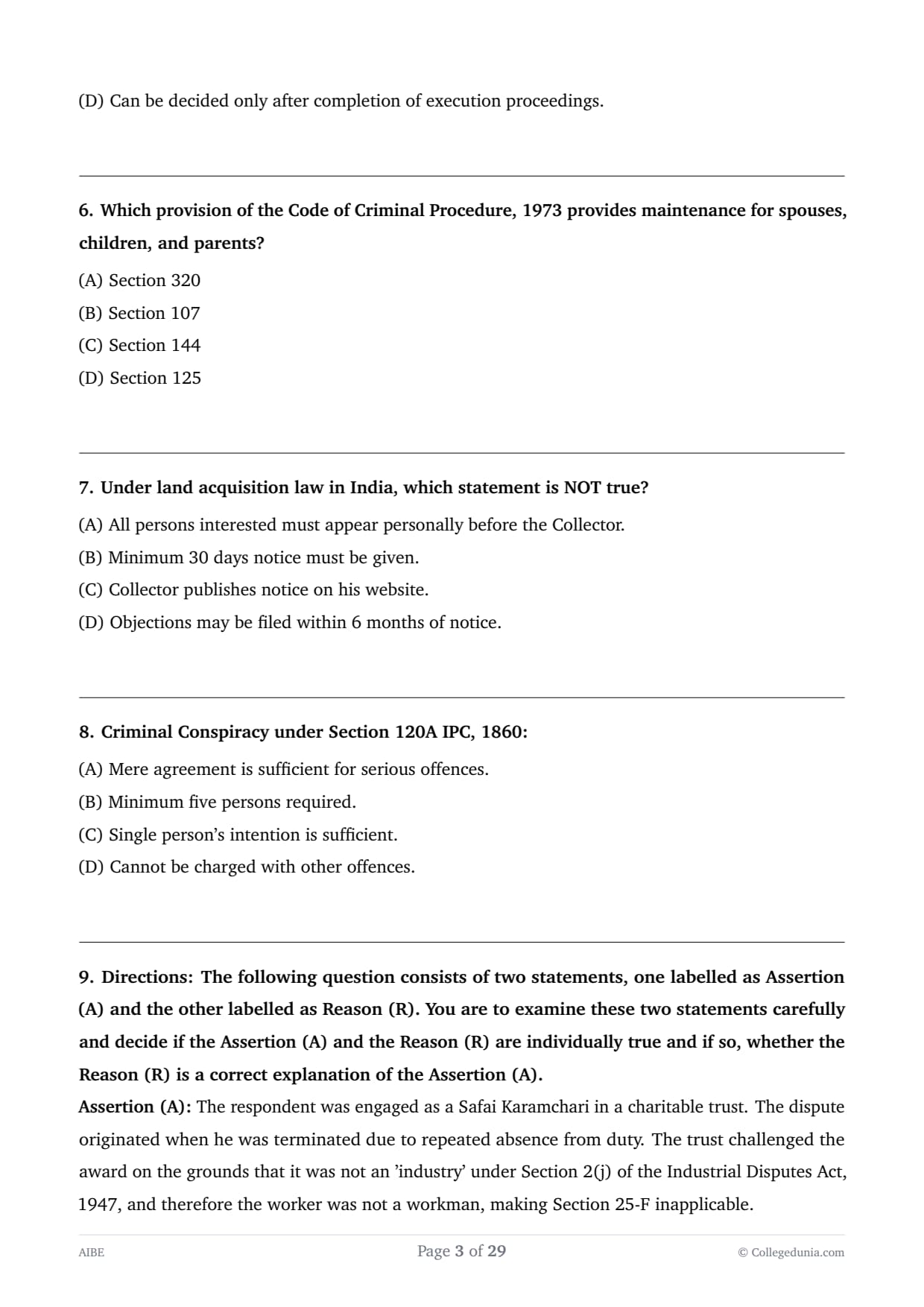
Which provision of the Code of Criminal Procedure, 1973 provides maintenance for spouses, children, and parents?
Under land acquisition law in India, which statement is NOT true?
Criminal Conspiracy under Section 120A IPC, 1860:
Directions: The following question consists of two statements, one labelled as Assertion (A) and the other labelled as Reason (R). You are to examine these two statements carefully and decide if the Assertion (A) and the Reason (R) are individually true and if so, whether the Reason (R) is a correct explanation of the Assertion (A).
Assertion (A): The respondent was engaged as a Safai Karamchari in a charitable trust. The dispute originated when he was terminated due to repeated absence from duty. The trust challenged the award on the grounds that it was not an 'industry' under Section 2(j) of the Industrial Disputes Act, 1947, and therefore the worker was not a workman, making Section 25-F inapplicable.
Reason (R): The trust engaged in multifarious activities including commercial ventures and hired employees for commercial and charitable activities in an organized manner with proper remuneration.
Environment (Protection) Act, 1986 – Section 3(2)(ii)
Under the Information Technology Act, 2000, the term 'electronic record' includes which of the following?
I. Data stored in digital form
II. Image or sound stored or transmitted electronically
III. Information generated in microfilm or computer-generated microfiche
IV. Information recorded only on paper without electronic processing
Which of the above are correct?
A pension scheme differentiates between employees retiring before and after a cut-off date. Those excluded challenge the classification as arbitrary. The constitutional issue would primarily attract:
In Harish Chandra Tiwari v. Baiju (2002), the Supreme Court held that misconduct involving misappropriation by an advocate would result in:
A State plans to acquire ST land for an industrial park. Steps include SIA, Gram Sabha consultation, and notifications. Which statement is correct?
Under the Code of Criminal Procedure, 1973, which provision defines a 'Bailable Offence'?
The Information Technology Act, 2000 distinguishes between civil and criminal liability. In which situation does conduct attract criminal punishment?
Under the Code of Civil Procedure, 1908, where pleadings are unnecessary or prejudicial, the court may:
On which date did the Bharatiya Nagarik Suraksha Sanhita (BNSS), 2023 come into force?
Which landmark case expanded the scope of Article 23 of the Constitution of India?
Parmanand Katara v. Union of India (1989) is primarily associated with which right?
In the following question, a Statement is followed by two Conclusions, I and II.
Statement: The Bar Council of India derives its rule-making power from Section 49(1)(c) of the Advocates Act, 1961, which authorises it to frame rules governing professional conduct and etiquette to be observed by advocates. Rule 20 framed thereunder categorically bars an advocate from stipulating for, or receiving, any fee whose quantum is dependent upon the outcome of litigation, or from entering into any arrangement to share in its proceeds. An advocate who contravenes this Rule is liable to be proceeded against under Section 35 of the Act.
Conclusion I: An advocate may lawfully enter into outcome-linked fee arrangement with consent.
Conclusion II: An advocate violating contingency fee prohibition may face disciplinary action.
Relaxation of locus standi allowing public-spirited individuals to approach the Supreme Court is associated with:
Where a suit is filed against a wrongly impleaded defendant, the court may:
The Bharatiya Sakshya Adhiniyam, 2023 is not applicable in which case?
Under BNS 2023, forfeiture of property is most commonly applied in:
Which of the following statements is not an example of the eggshell skull rule as per the law of torts?
Read the statements and choose correct option:
Statement I: Ossification test is the final test for age determination.
Statement II: Birth certificate is given precedence for determining juvenile age.
Repeated re-promulgation of Ordinances was called a "fraud on the Constitution" in which case?
Which is an essential element of theft under Section 378 IPC?
Can a landowner in a Joint Development Agreement file complaint under Consumer Protection Act for delay and defects?
Under Rule 8 of the Standards of Professional Conduct and Etiquette framed by the Bar Council of India, an advocate is prohibited from appearing before any court, tribunal or authority for or against an organisation or institution of which he is a member of its:
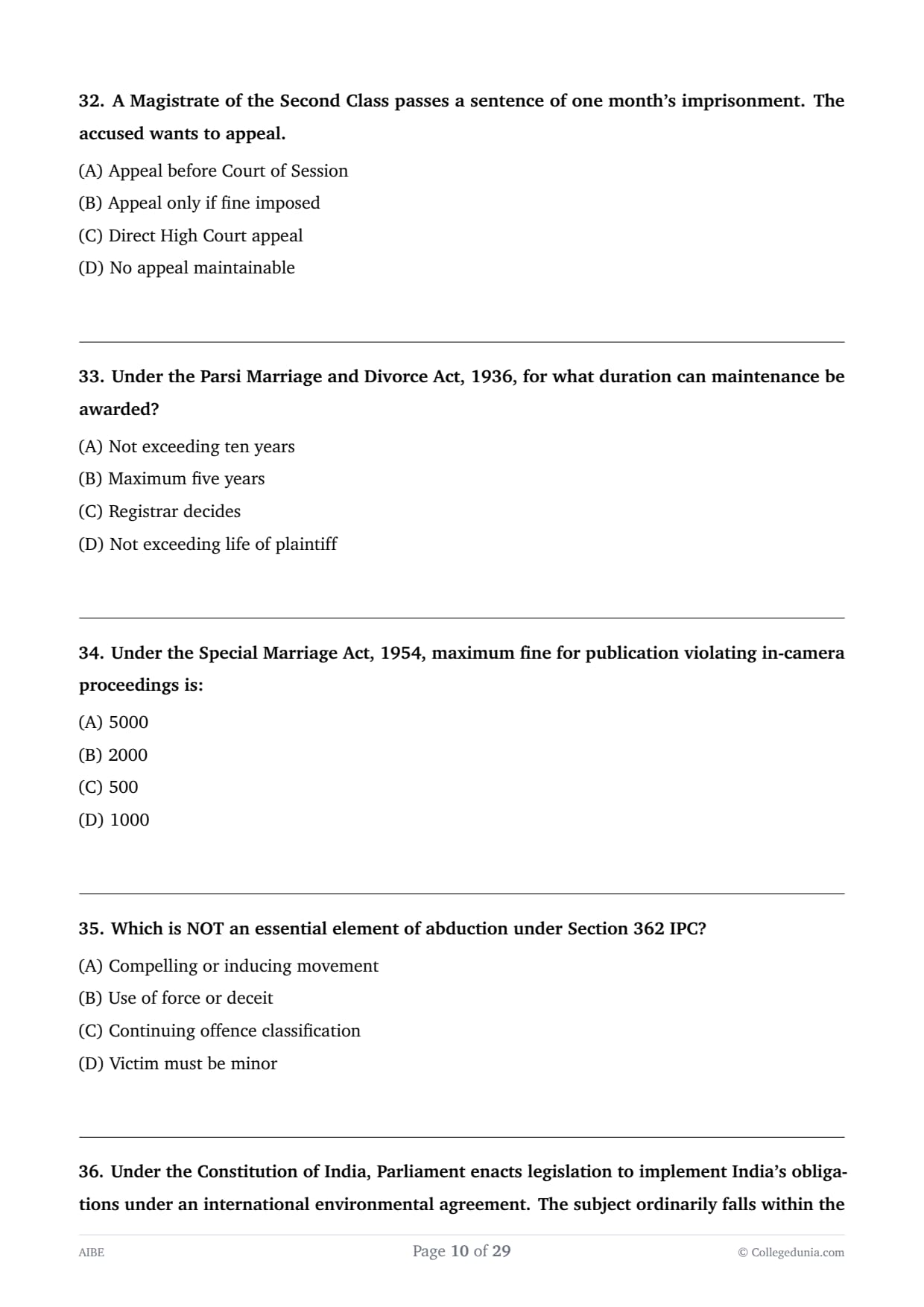
A Magistrate of the Second Class passes a sentence of one month's imprisonment. The accused wants to appeal.
Under the Parsi Marriage and Divorce Act, 1936, for what duration can maintenance be awarded?
Under the Special Marriage Act, 1954, maximum fine for publication violating in-camera proceedings is:
Which is NOT an essential element of abduction under Section 362 IPC?
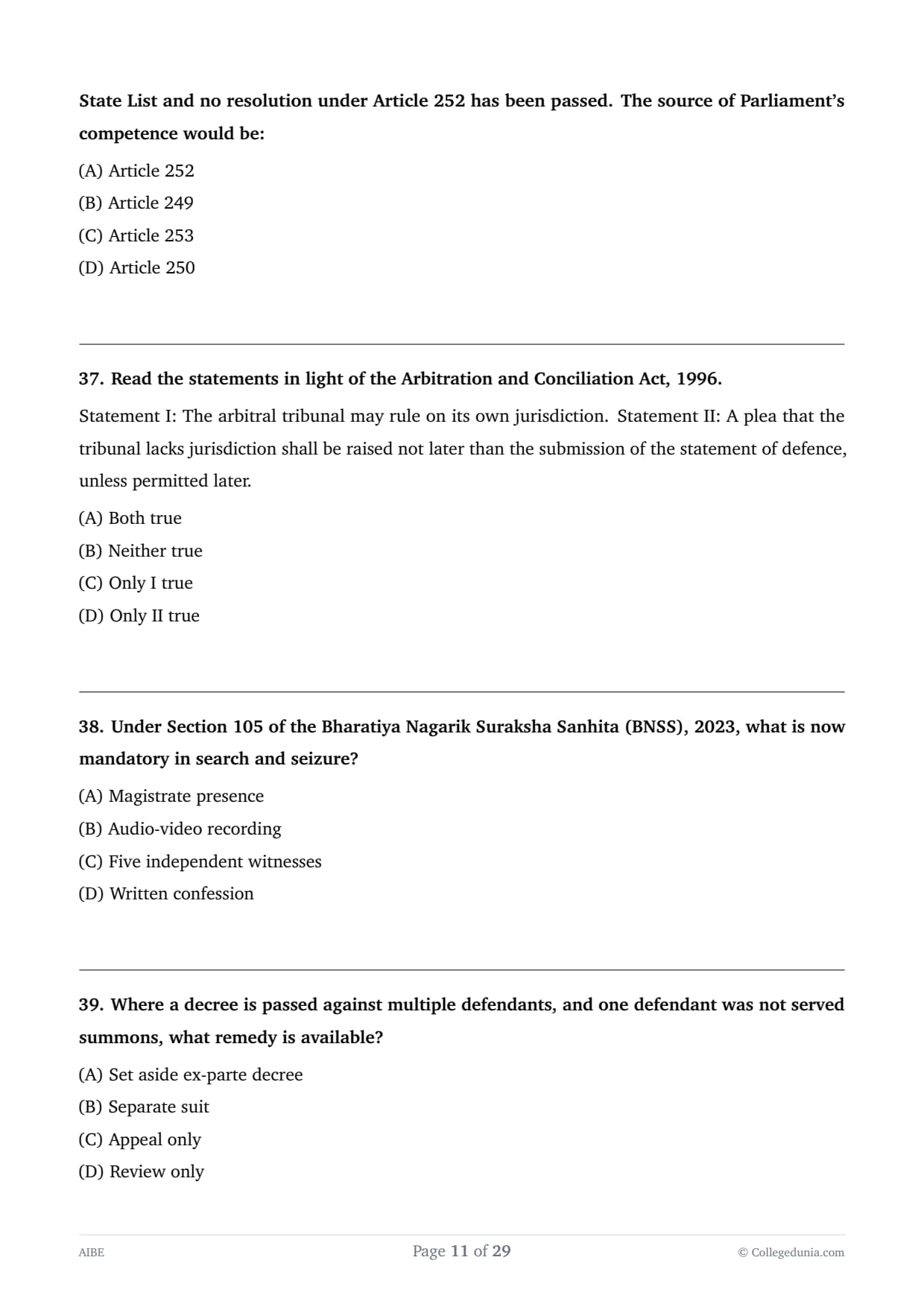
Under the Constitution of India, Parliament enacts legislation to implement India's obligations under an international environmental agreement. The subject ordinarily falls within the State List and no resolution under Article 252 has been passed. The source of Parliament's competence would be:
Read the statements in light of the Arbitration and Conciliation Act, 1996.
Statement I: The arbitral tribunal may rule on its own jurisdiction.
Statement II: A plea that the tribunal lacks jurisdiction shall be raised not later than the submission of the statement of defence, unless permitted later.
Under Section 105 of the Bharatiya Nagarik Suraksha Sanhita (BNSS), 2023, what is now mandatory in search and seizure?
Where a decree is passed against multiple defendants, and one defendant was not served summons, what remedy is available?
In Roman jurisprudence, the concept similar to the Rule of Law was referred to as:
According to Section 10(37) of the Income-tax Act, 1961, compensation received on compulsory acquisition of agricultural land used for agricultural purposes is:
Transfer of a civil suit from one district to another within the same State may be ordered by:
A contractual clause restraining an employee from joining a rival firm for three years after resignation is:
A hires C after breach by B and claims additional cost. Legal position is:
Under BNSS, 2023, judgment must be delivered within:
View Solution
Concept:
The Bharatiya Nagarik Suraksha Sanhita, 2023 introduces strict procedural timelines to ensure speedy justice delivery and reduce judicial delays. One of the key reforms is the requirement that judgments must be pronounced within a fixed time after arguments are concluded and order is reserved.
Step 1: Need for procedural timelines.
Delays in judgment delivery undermine public confidence in the justice system and defeat the constitutional mandate of speedy trial under Article 21.
Step 2: Statutory mandate under BNSS.
BNSS prescribes that judgments should ordinarily be delivered within 60 days from the date of reserving judgment.
Step 3: Purpose of the provision.
The objective is to ensure accountability of judicial process, prevent unnecessary delay, and improve efficiency in criminal adjudication.
Step 4: Exception handling.
In rare cases where delay occurs, reasons must be recorded, ensuring transparency.
Step 5: Final inference.
Thus, the correct timeframe is 60 days. Quick Tip: BNSS enforces strict timelines to ensure speedy criminal justice delivery.
The term "Public Interest Litigation (PIL)" was first used by:
The observation regarding habeas corpus being invaluable for immediate determination of liberty was made in:
View Solution
Concept:
Habeas corpus is one of the most important writs in constitutional and common law systems. It ensures judicial review of unlawful detention and immediate production of a detained person before a court. The courts have repeatedly emphasized its supreme importance as a safeguard of personal liberty.
Step 1: Meaning of habeas corpus.
Habeas corpus literally means “to have the body produced.” It is a procedural safeguard against arbitrary detention.
Step 2: Judicial importance.
It allows courts to immediately examine legality of detention, making it a cornerstone of liberty.
Step 3: Relevant case law.
In Greene v. Secretary of State for Home Affairs (1942 AC 284), Lord Wright emphasized that the value of habeas corpus lies in its ability to ensure immediate judicial scrutiny of deprivation of liberty.
Step 4: Final inference.
Thus, option (C) is correct. Quick Tip: Habeas corpus is the strongest safeguard against unlawful detention.
Under Bharatiya Nyaya Sanhita, 2023, punishment for defamation includes:
Under the Indian Christian Marriage Act, 1872, marriages must generally be solemnized between:
Which of the following statements are correct with reference to withdrawal and abandonment of suits under the Code of Civil Procedure, 1908?
I. A plaintiff may withdraw or abandon a suit subject to the provisions of law.
II. Institution of a fresh suit on the same cause of action requires permission of the court.
III. Withdrawal of a suit without permission of the court to institute a fresh suit bars a subsequent suit on the same cause of action.
IV. The court must grant permission whenever such request is made.
Which of the above statements are correct?
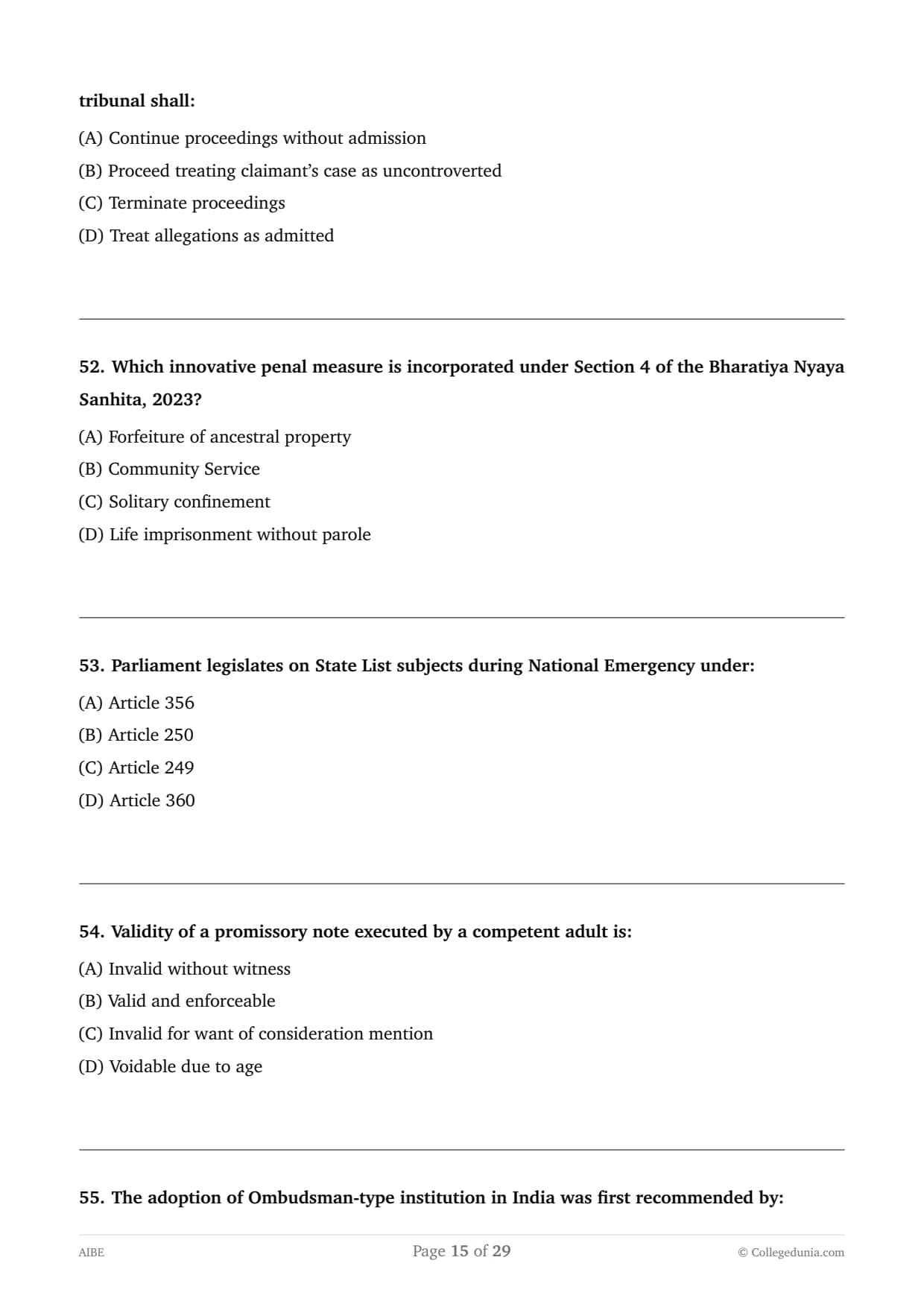
According to Section 25(b) of the Arbitration and Conciliation Act, 1996, where the respondent fails to submit his statement of defence without sufficient cause, the arbitral tribunal shall:
Which innovative penal measure is incorporated under Section 4 of the Bharatiya Nyaya Sanhita, 2023?
Parliament legislates on State List subjects during National Emergency under:
View Solution
Concept:
Article 250 of the Constitution of India empowers Parliament to legislate with respect to matters in the State List during the operation of a Proclamation of Emergency under Article 352. This provision temporarily shifts legislative competence from States to Parliament to ensure national unity and effective governance during emergencies.
Step 1: Federal structure context.
Normally, State List subjects are exclusively within State legislative competence.
Step 2: Effect of Emergency.
During Emergency, Centre assumes expanded powers to legislate on State subjects.
Step 3: Article 250 mechanism.
It allows Parliament to legislate on State List during Emergency proclamation under Article 352.
Step 4: Final inference.
Thus, Article 250 is correct. Quick Tip: Article 250 temporarily shifts State List powers to Parliament during Emergency.
Validity of a promissory note executed by a competent adult is:
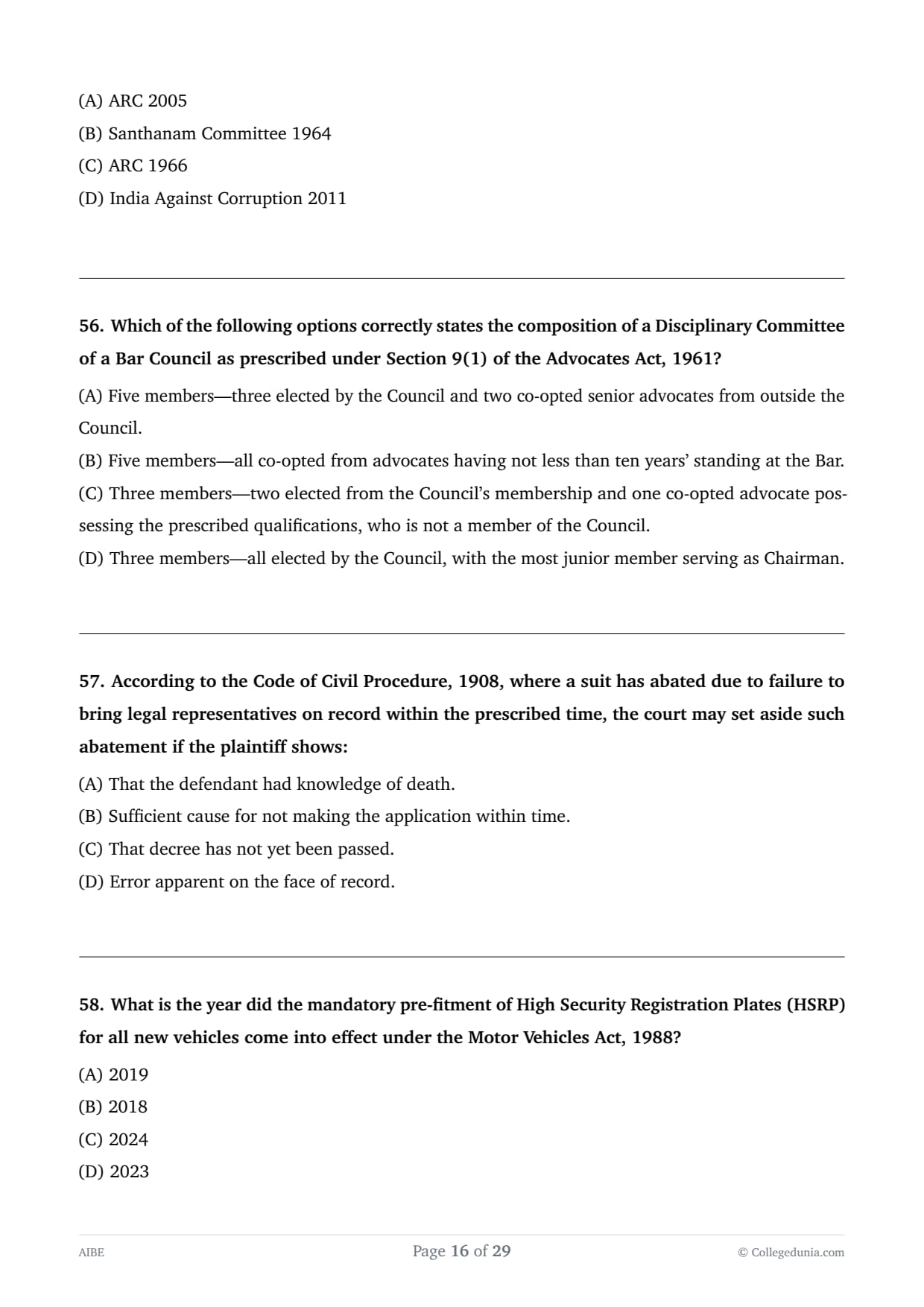
The adoption of Ombudsman-type institution in India was first recommended by:
Which of the following options correctly states the composition of a Disciplinary Committee of a Bar Council as prescribed under Section 9(1) of the Advocates Act, 1961?
According to the Code of Civil Procedure, 1908, where a suit has abated due to failure to bring legal representatives on record within the prescribed time, the court may set aside such abatement if the plaintiff shows:
What is the year did the mandatory pre-fitment of High Security Registration Plates (HSRP) for all new vehicles come into effect under the Motor Vehicles Act, 1988?
A 80-year-old person executes a registered deed transferring land to a trust with conditions that it be used forever as a public library, with reversion to heirs if use ceases, and accumulation of income for 50 years. Which of the following statements is most accurate in law?
Under the Uniform Civil Code Rules Uttarakhand, 2025, when is an application for declaration of legal heir(s) forwarded to the Registrar General?
Under Section 35B of the Code of Civil Procedure, 1908, where a party fails to take a step required by the court on the date fixed, the court may:
Which provision of the Code of Criminal Procedure (CrPC), 1973, stipulates that a police officer must produce a person arrested without a warrant before a Magistrate within a maximum period of 24 hours?
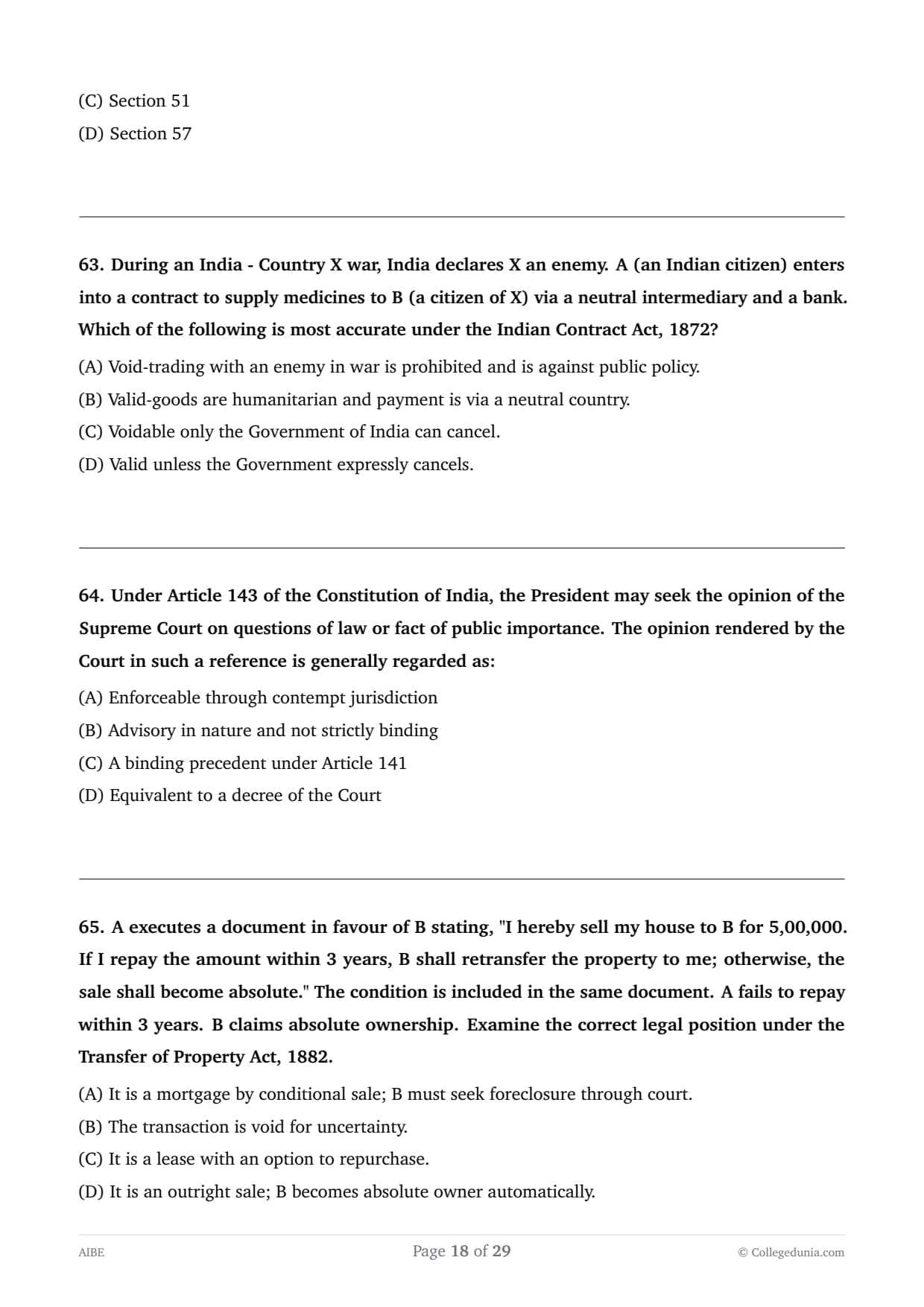
During an India - Country X war, India declares X an enemy. A (an Indian citizen) enters into a contract to supply medicines to B (a citizen of X) via a neutral intermediary and a bank. Which of the following is most accurate under the Indian Contract Act, 1872?
Under Article 143 of the Constitution of India, the President may seek the opinion of the Supreme Court on questions of law or fact of public importance. The opinion rendered by the Court in such a reference is generally regarded as:
A executes a document in favour of B stating, "I hereby sell my house to B for 5,00,000. If I repay the amount within 3 years, B shall retransfer the property to me; otherwise, the sale shall become absolute." The condition is included in the same document. A fails to repay within 3 years. B claims absolute ownership. Examine the correct legal position under the Transfer of Property Act, 1882.
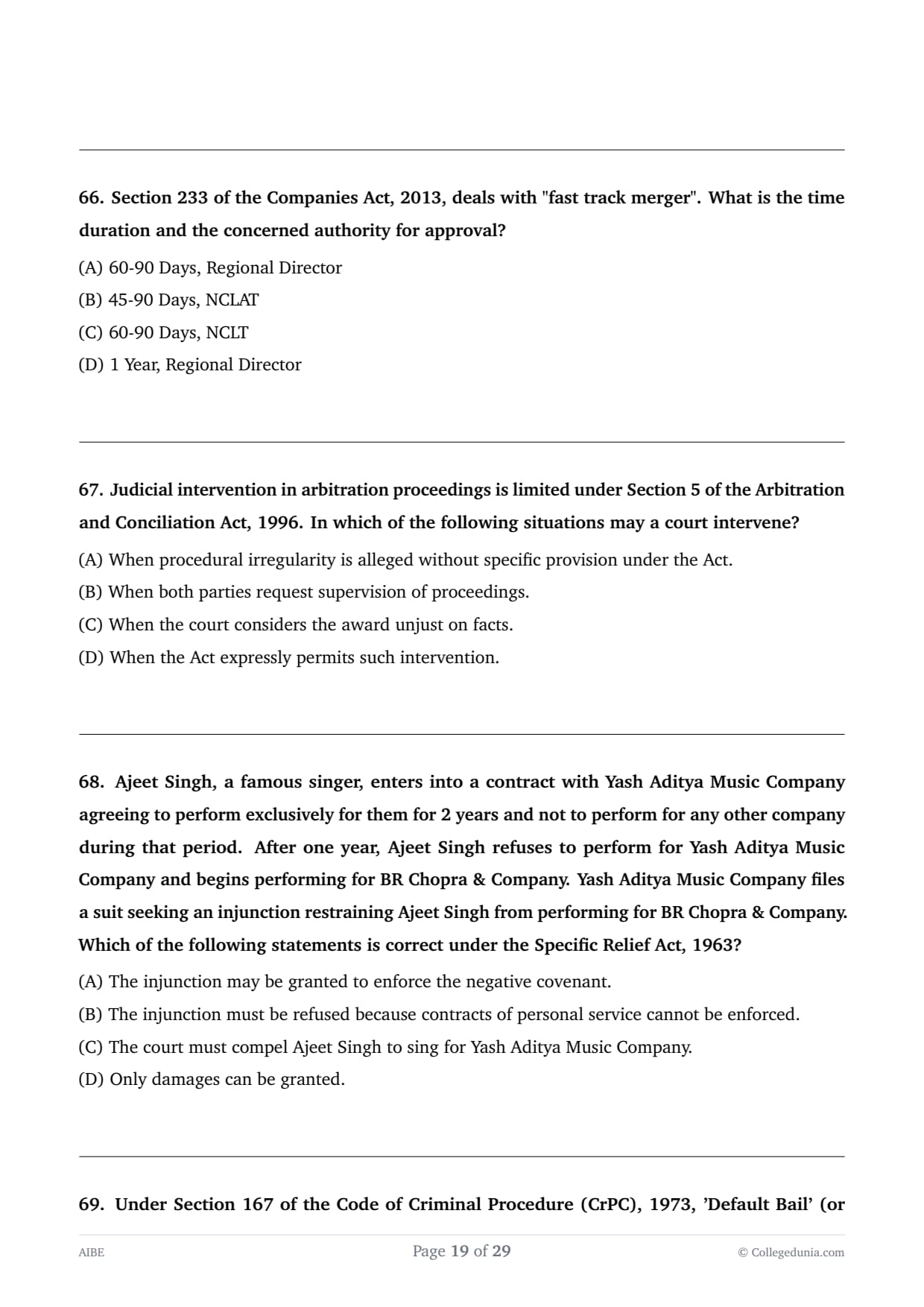
Section 233 of the Companies Act, 2013, deals with "fast track merger". What is the time duration and the concerned authority for approval?
Judicial intervention in arbitration proceedings is limited under Section 5 of the Arbitration and Conciliation Act, 1996. In which of the following situations may a court intervene?
Ajeet Singh, a famous singer, enters into a contract with Yash Aditya Music Company agreeing to perform exclusively for them for 2 years and not to perform for any other company during that period. After one year, Ajeet Singh refuses to perform for Yash Aditya Music Company and begins performing for BR Chopra \& Company. Yash Aditya Music Company files a suit seeking an injunction restraining Ajeet Singh from performing for BR Chopra \& Company. Which of the following statements is correct under the Specific Relief Act, 1963?
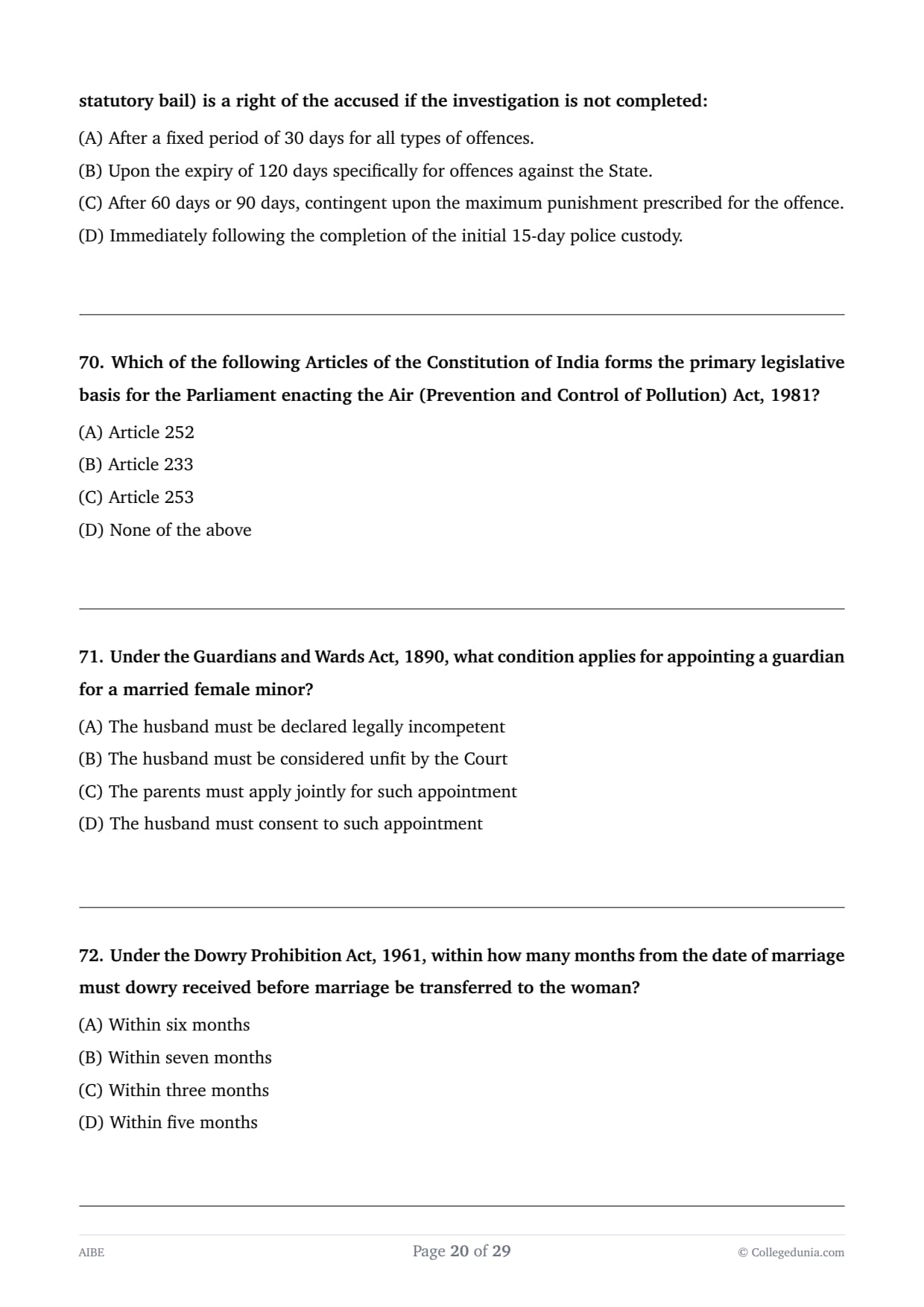
Under Section 167 of the Code of Criminal Procedure (CrPC), 1973, 'Default Bail' (or statutory bail) is a right of the accused if the investigation is not completed:
Which of the following Articles of the Constitution of India forms the primary legislative basis for the Parliament enacting the Air (Prevention and Control of Pollution) Act, 1981?
Under the Guardians and Wards Act, 1890, what condition applies for appointing a guardian for a married female minor?
Under the Dowry Prohibition Act, 1961, within how many months from the date of marriage must dowry received before marriage be transferred to the woman?
An assessee pays a medical insurance premium for himself and his family and claims a deduction while computing total income. What is the correct position under the Income Tax Act, 1961?
Under the Indian Penal Code (IPC), 1860, in which of the following scenarios does the "Right of Private Defence of the Body" extend to the extent of voluntarily causing death to the assailant?
Under Section 173 of the Bharatiya Nagarik Suraksha Sanhita (BNSS), 2023, if a police officer-in-charge determines that an investigation is not warranted because the case lacks sufficient gravity, they are legally obligated to notify the informant of this decision within:
X takes a loan of 10,00,000 from Bank A. Y signs a contract as surety, promising to pay the bank if X defaults. After 3 months, Bank A agrees to reduce the interest rate and extends the repayment period by 6 months without informing Y. Subsequently, X defaults on the loan. Which of the following statements correctly describes Y's liability under the Indian Contract Act, 1872?
Which of the following does not fall under the framework of presumption under Section 2 of the Bharatiya Sakshya Adhiniyam, 2023?
Directions: The following question consists of two statements, one labelled as Assertion (A) and the other labelled as Reason (R). You are to examine these two statements carefully and decide if the Assertion (A) and the Reason (R) are individually true and if so, whether the Reason (R) is a correct explanation of the Assertion (A).
Assertion (A): The right to privacy has been judicially recognised as an integral part of Article 21 of the Constitution of India.
Reason (R): Privacy is expressly enumerated as a separate Fundamental Right in Part III of the Constitution of India.
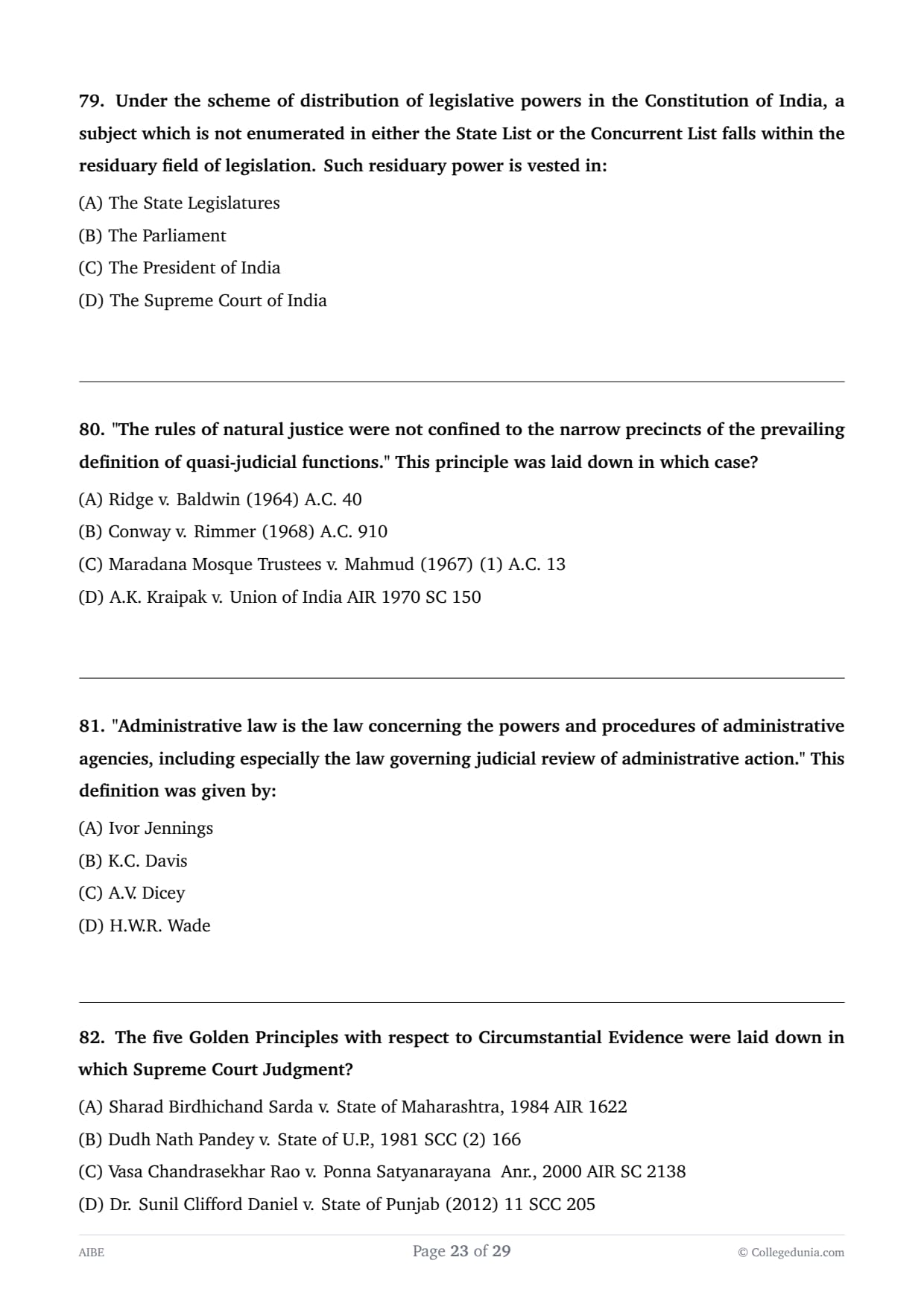
Under the scheme of distribution of legislative powers in the Constitution of India, a subject which is not enumerated in either the State List or the Concurrent List falls within the residuary field of legislation. Such residuary power is vested in:
"The rules of natural justice were not confined to the narrow precincts of the prevailing definition of quasi-judicial functions." This principle was laid down in which case?
"Administrative law is the law concerning the powers and procedures of administrative agencies, including especially the law governing judicial review of administrative action." This definition was given by:
The five Golden Principles with respect to Circumstantial Evidence were laid down in which Supreme Court Judgment?
According to Section 20 of the Arbitration and Conciliation Act, 1996, where the parties have not agreed on the place of arbitration, the arbitral tribunal shall determine it having regard to:
Under the Dowry Prohibition Act, 1961, what is the minimum term of imprisonment prescribed for giving or taking dowry?
Directions: The following question consists of two statements, one labelled as Assertion (A) and the other labelled as Reason (R). You are to examine these two statements carefully and decide if the Assertion (A) and the Reason (R) are individually true and if so, whether the Reason (R) is a correct explanation of the Assertion (A).
Assertion (A): An ex parte decree may be set aside if the defendant satisfies the court that he was prevented by sufficient cause from appearing when the suit was called for hearing.
Reason (R): Under Order IX Rule 13 of the Code of Civil Procedure, 1908, the court must be satisfied that the summons was not duly served or that the defendant was prevented by sufficient cause from appearing when the suit was called for hearing.
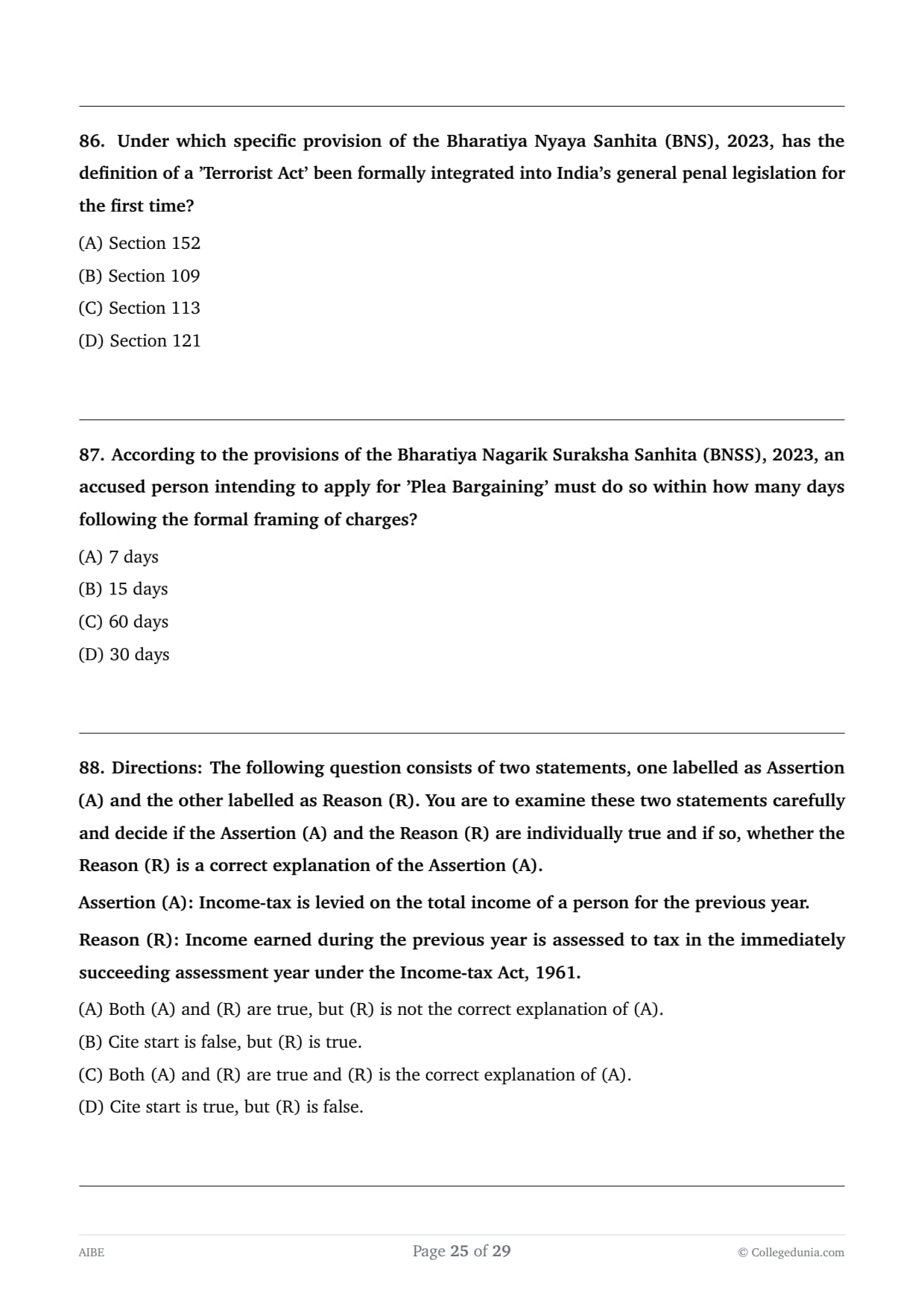
Under which specific provision of the Bharatiya Nyaya Sanhita (BNS), 2023, has the definition of a 'Terrorist Act' been formally integrated into India's general penal legislation for the first time?
According to the provisions of the Bharatiya Nagarik Suraksha Sanhita (BNSS), 2023, an accused person intending to apply for 'Plea Bargaining' must do so within how many days following the formal framing of charges?
Directions: The following question consists of two statements, one labelled as Assertion (A) and the other labelled as Reason (R). You are to examine these two statements carefully and decide if the Assertion (A) and the Reason (R) are individually true and if so, whether the Reason (R) is a correct explanation of the Assertion (A).
Assertion (A): Income-tax is levied on the total income of a person for the previous year.
Reason (R): Income earned during the previous year is assessed to tax in the immediately succeeding assessment year under the Income-tax Act, 1961.
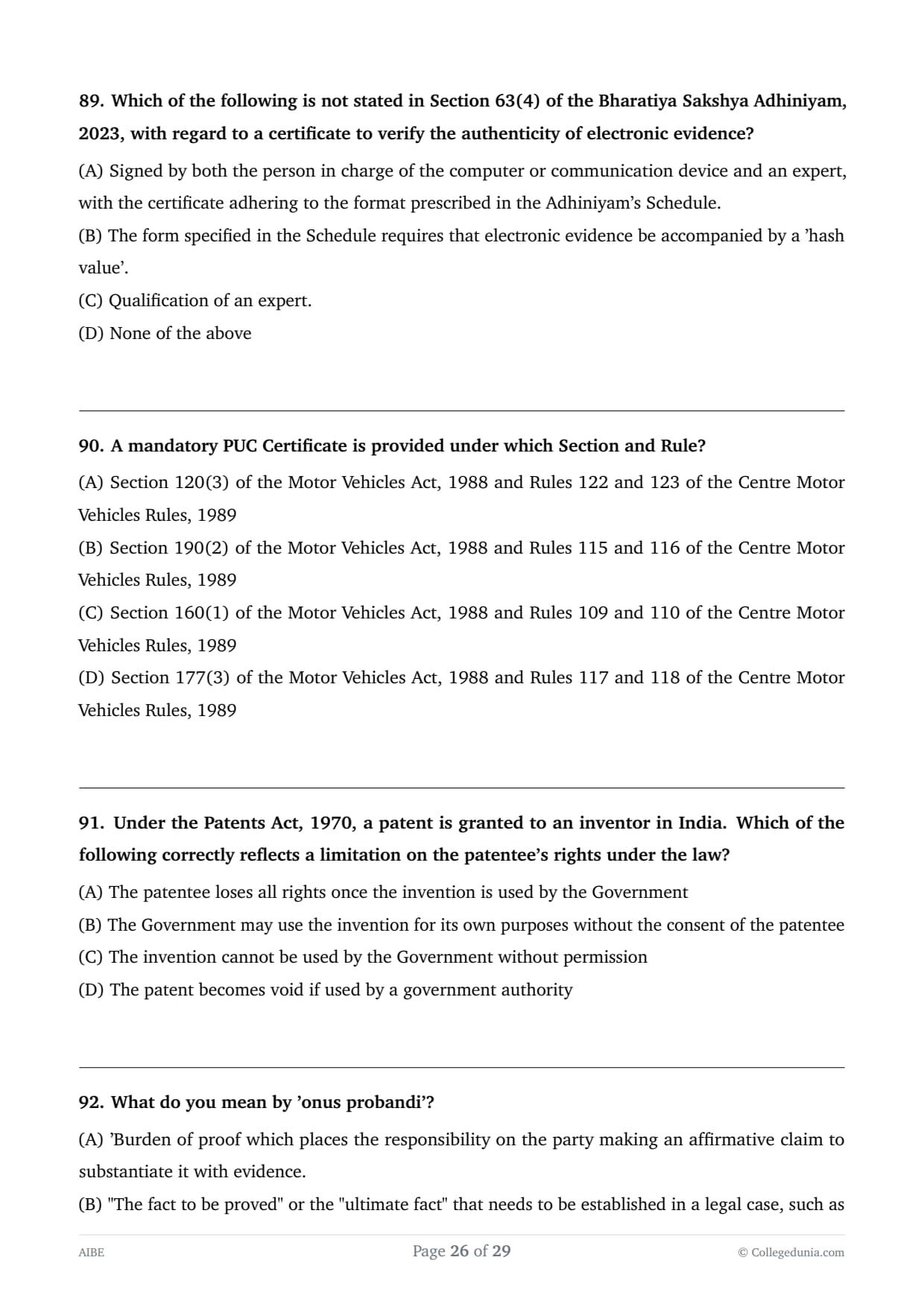
Which of the following is not stated in Section 63(4) of the Bharatiya Sakshya Adhiniyam, 2023, with regard to a certificate to verify the authenticity of electronic evidence?
A mandatory PUC Certificate is provided under which Section and Rule?
Under the Patents Act, 1970, a patent is granted to an inventor in India. Which of the following correctly reflects a limitation on the patentee's rights under the law?
What do you mean by 'onus probandi'?
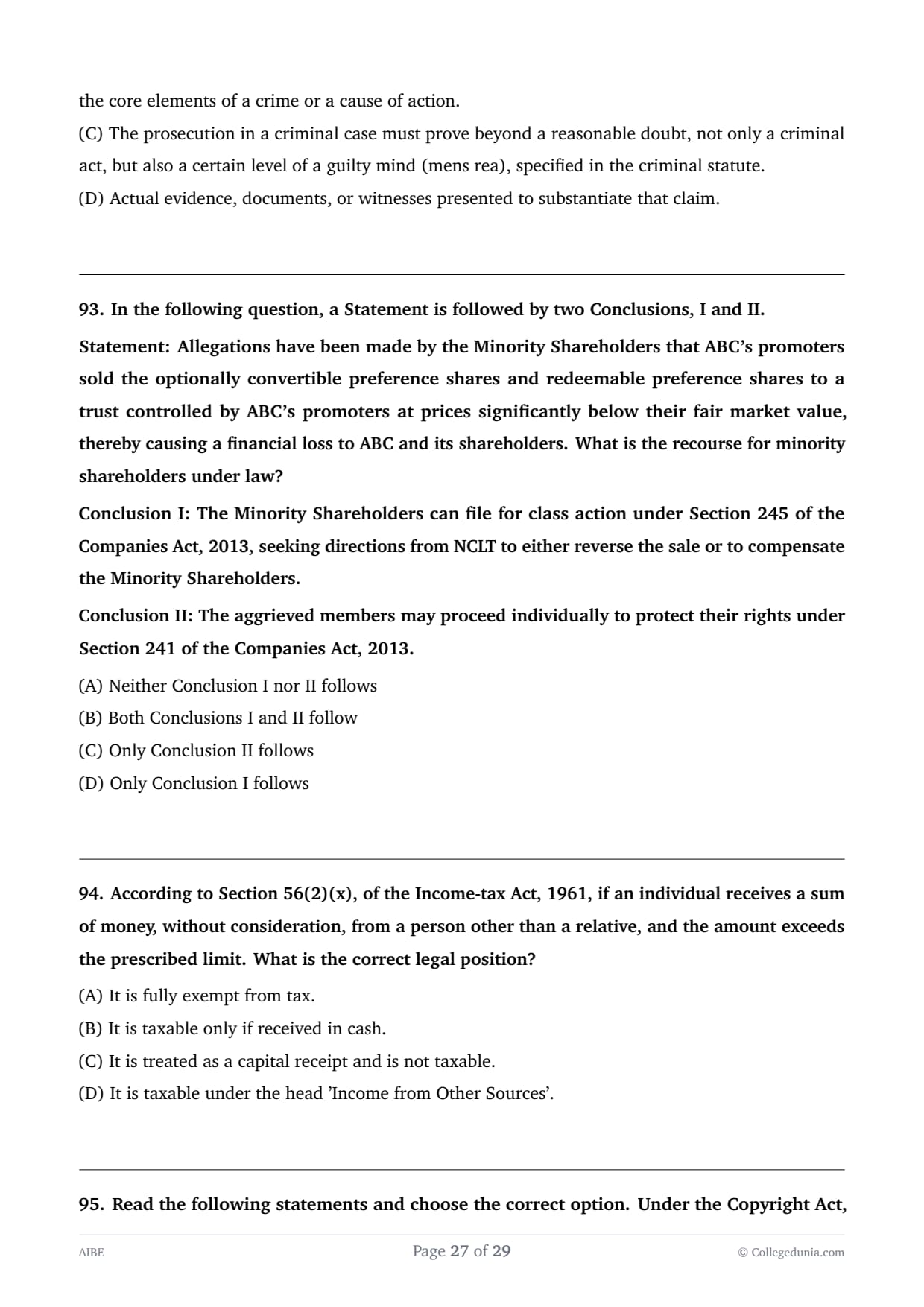
In the following question, a Statement is followed by two Conclusions, I and II.
Statement: Allegations have been made by the Minority Shareholders that ABC's promoters sold the optionally convertible preference shares and redeemable preference shares to a trust controlled by ABC's promoters at prices significantly below their fair market value, thereby causing a financial loss to ABC and its shareholders. What is the recourse for minority shareholders under law?
Conclusion I: The Minority Shareholders can file for class action under Section 245 of the Companies Act, 2013, seeking directions from NCLT to either reverse the sale or to compensate the Minority Shareholders.
Conclusion II: The aggrieved members may proceed individually to protect their rights under Section 241 of the Companies Act, 2013.
According to Section 56(2)(x), of the Income-tax Act, 1961, if an individual receives a sum of money, without consideration, from a person other than a relative, and the amount exceeds the prescribed limit. What is the correct legal position?
Read the following statements and choose the correct option. Under the Copyright Act, 1957:
Statement I: In the case of a posthumous literary work, copyright subsists for sixty years from the beginning of the calendar year next following the year in which the work is first published.
Statement II: For such works, publication refers to making the work available to the public by issue of copies or by communication to the public.
Which of the following statements is not true with respect to Section 65B of the Indian Evidence Act, 1872?
Which of the following is not included in "The Industrial Relations Code, 2020"?
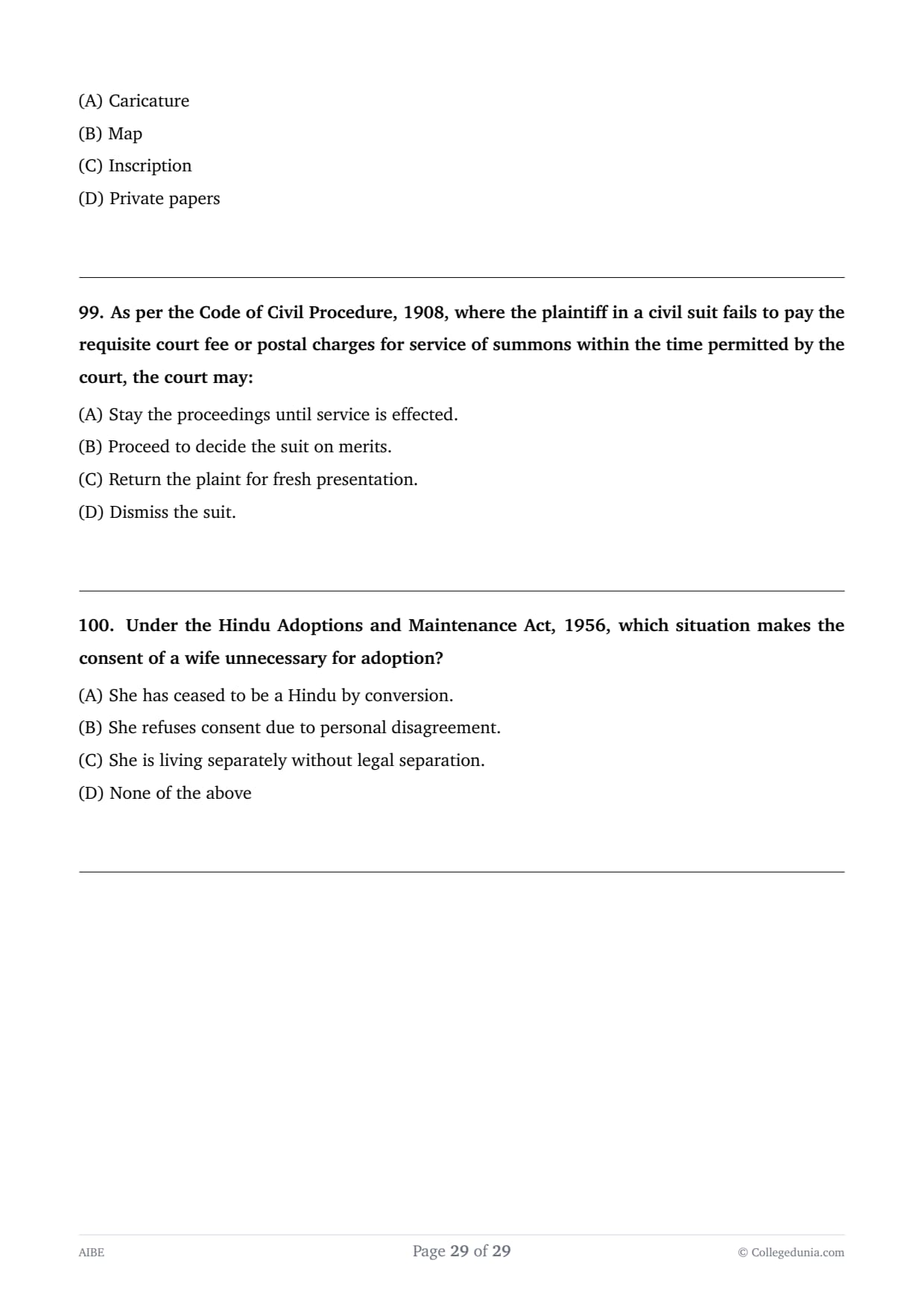
Which of the following is not a document as per the Bharatiya Sakshya Adhiniyam, 2023?
As per the Code of Civil Procedure, 1908, where the plaintiff in a civil suit fails to pay the requisite court fee or postal charges for service of summons within the time permitted by the court, the court may:
Under the Hindu Adoptions and Maintenance Act, 1956, which situation makes the consent of a wife unnecessary for adoption?
AIBE 21 Topic-wise weightage
| Topics | Questions |
|---|---|
| Indian Constitutional Law | 10 |
| Indian Penal Code (IPC) and Bharatiya Nyay Sanhita | 8 |
| Criminal Procedure Code (CrPC) and Bharatiya Nagrik Suraksha Sanhita | 10 |
| Code of Civil Procedure (CPC) | 10 |
| Evidence Act and Bhartiya Sakshya Adhiniyam | 8 |
| Alternative Dispute Redressal including the Arbitration Act | 4 |
| Family Law | 8 |
| Public Interest Litigation | 4 |
| Administrative Law | 3 |
| Professional Ethics & Cases of Professional Misconduct under BCI rules | 4 |
| Company Law | 2 |
| Environment Law | 2 |
| Cyber Law | 2 |
| Labor and Industrial Law | 4 |
| Law of Tort, including the Motor Vehicle Act and the Consumer Protection Law | 5 |
| Law related to Taxation | 4 |
| Law of Contract, Specific Relief, Property Laws, Negotiable Instrument Act | 8 |
| Land Acquisition Act | 2 |
| Intellectual Property Act | 2 |
| Total | 100 |



Comments