




TS EDCET 2026 May 12 Shift 1 Question Paper is available for download here. Kakatiya University, Warangal on behalf of the TGCHE conducted TS EDCET 2026 exam on May 12 in Shift 1 from 10 AM to 12 PM. TS EDCET 2026 Question Paper consists of 150 objective questions for 150 marks to be attempted in 2 hours.
- TS EDCET Question Paper is divided into 5 sections-Mathematics, Science and Social Studies (60 questions), Teaching Aptitude (20 questions), General English (20 questions), General Knowledge & Educational Issues (30 questions), Computer Awareness (20 questions).
- Each correct answer carries 1 mark and there is no negative marking for incorrect answers.
TS EDCET 2026 May 12 Shift 1 Question Paper with Solution PDF
| TS EDCET 2026 Question Paper May 12 Shift 1 | Download PDF | Check Solutions |


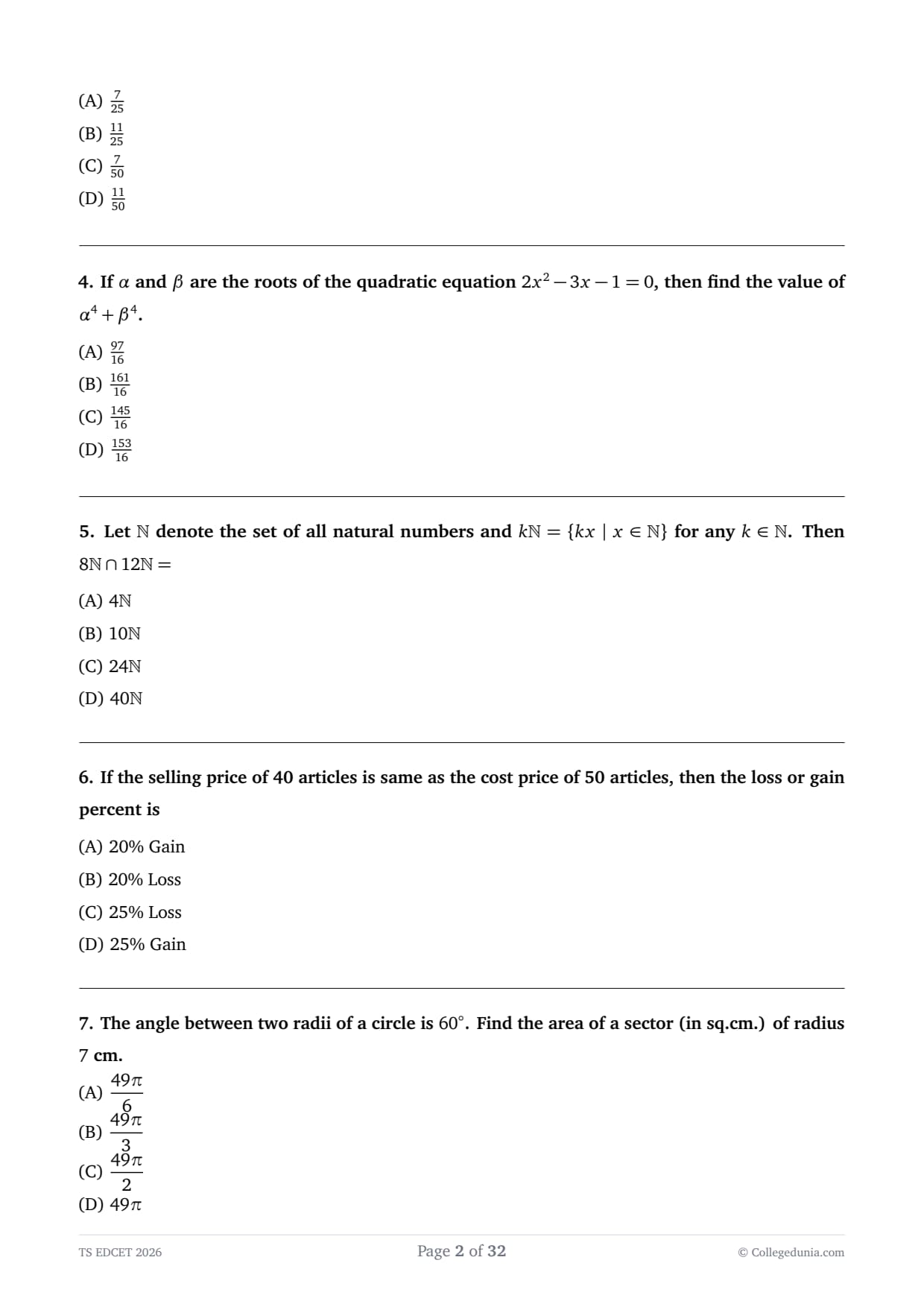
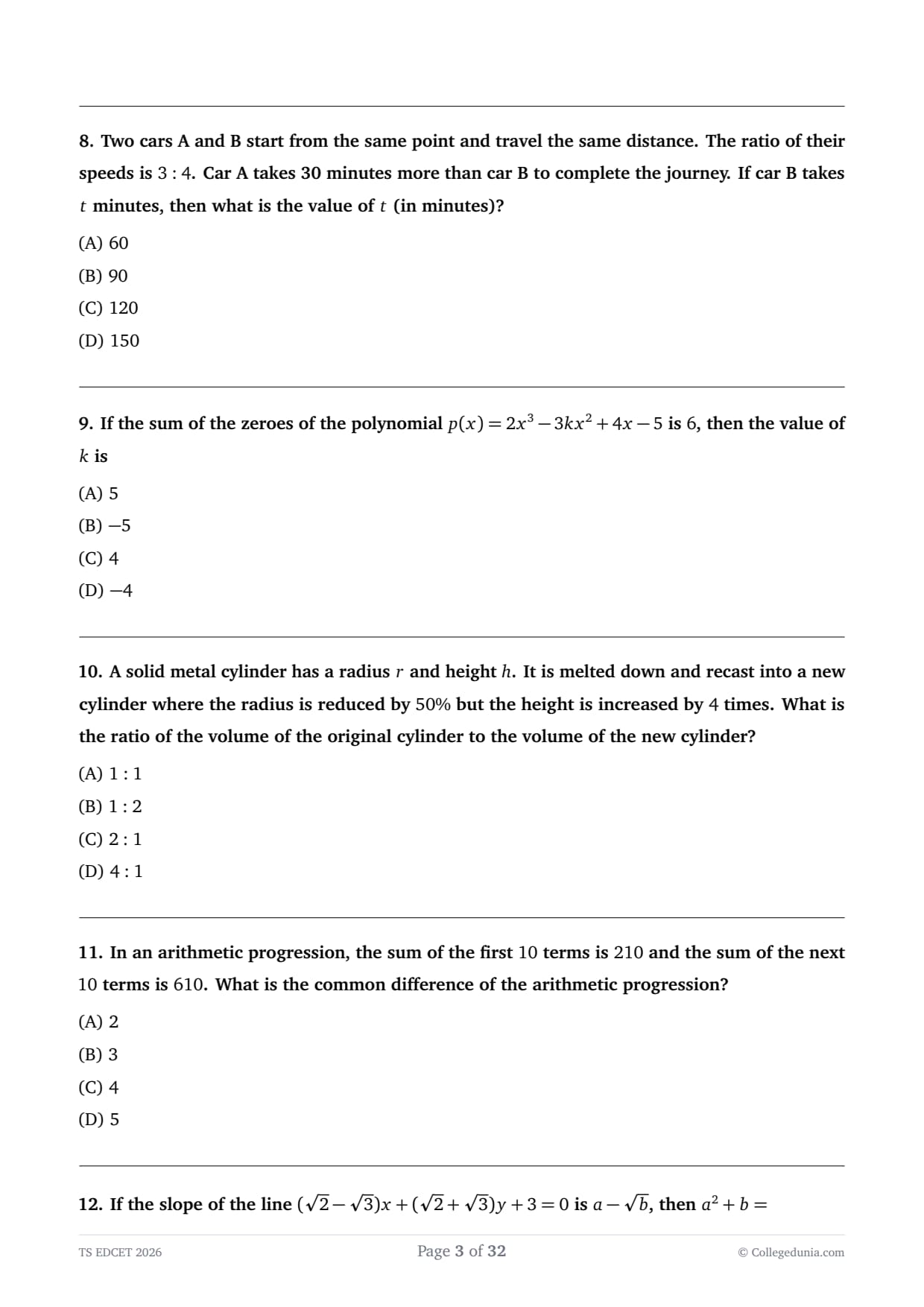
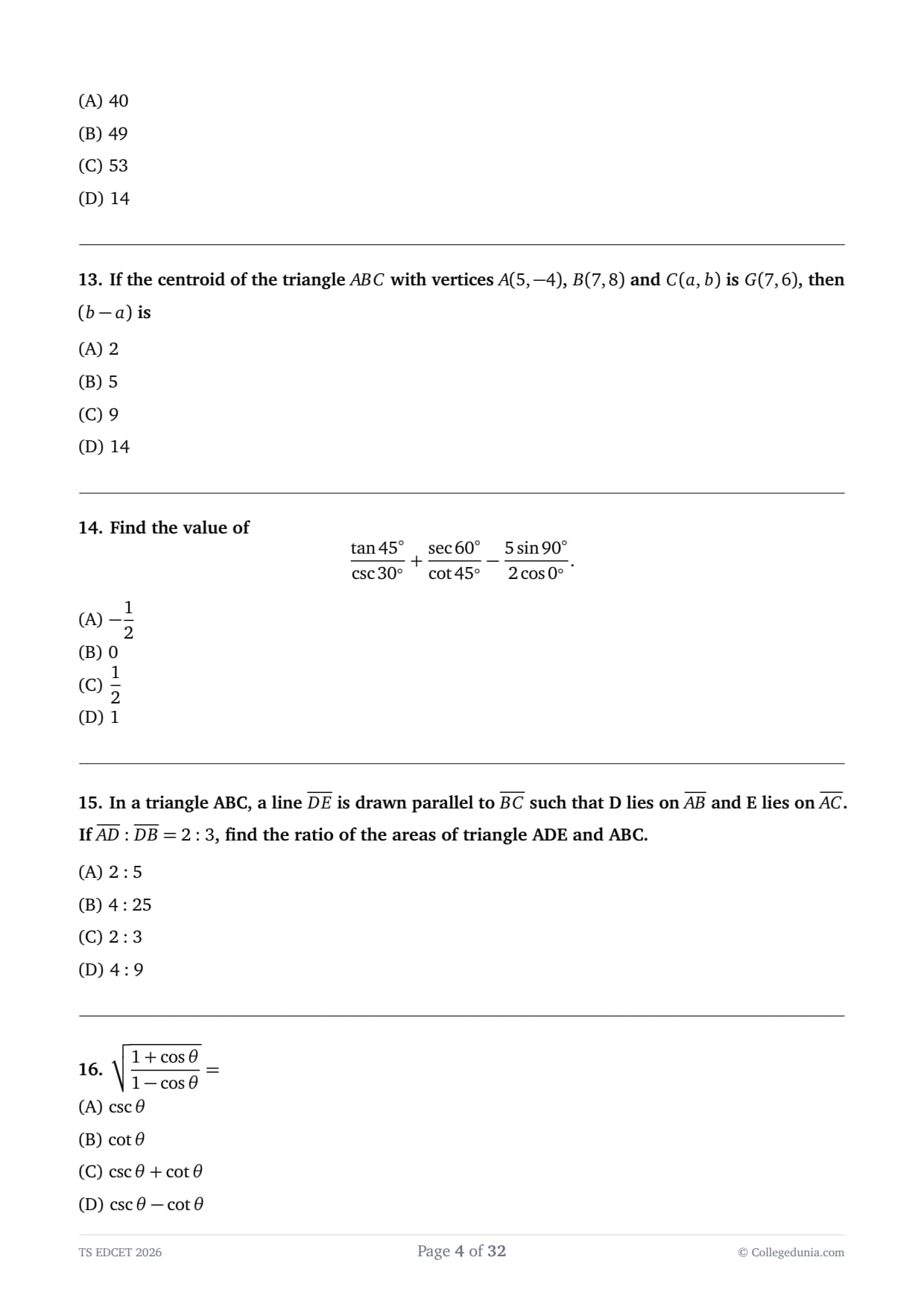
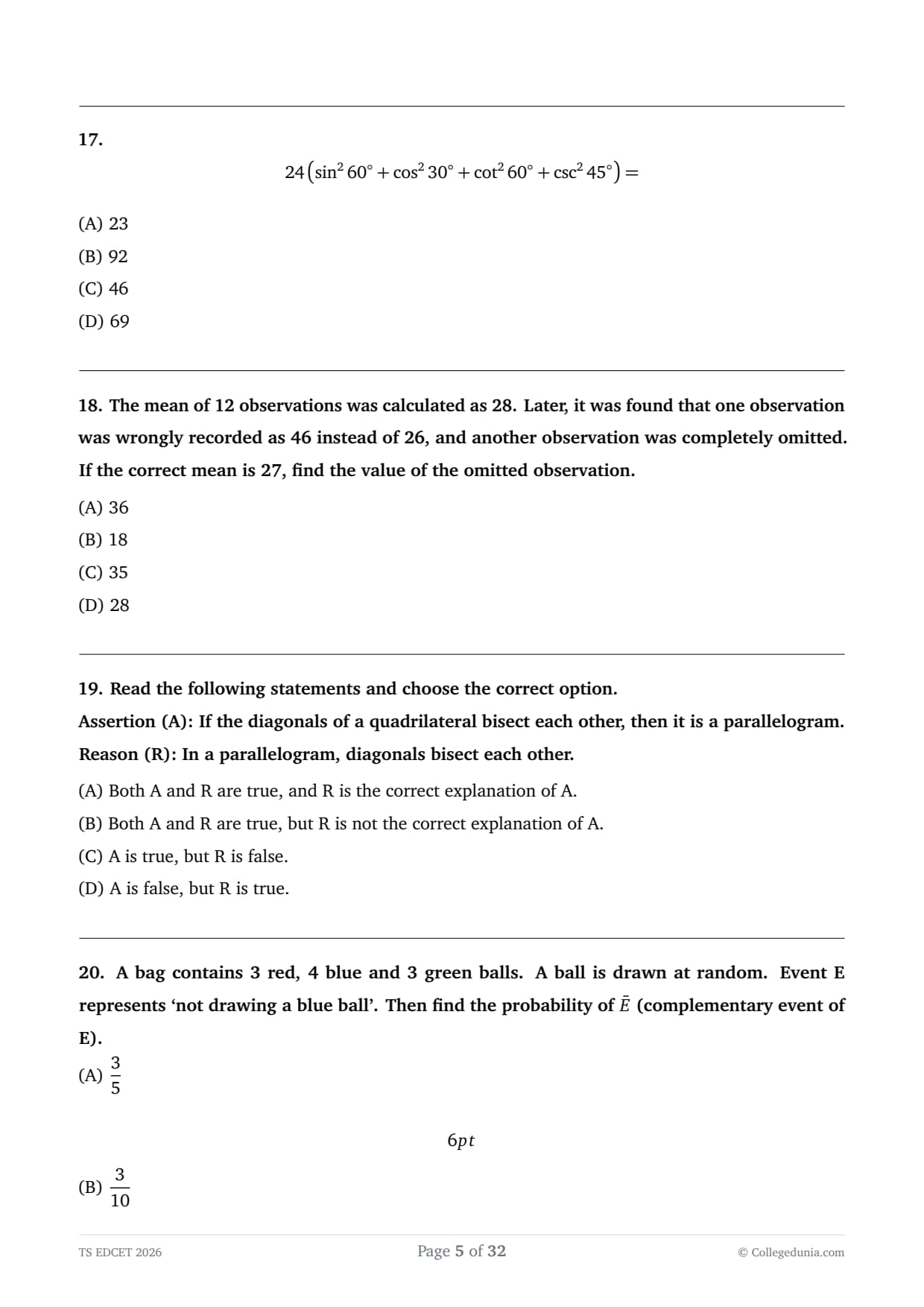



A number when divided successfully by 2, 3, and 5 leaves remainders 1, 2, and 3 respectively. If the number is less than 200 and also divisible by 7 after adding 4 to it, then that number is
View Solution
Concept:
This question is based on the concept of successive division. In successive division, each divisor acts on the quotient obtained from the previous division. Hence, the original number is reconstructed by working backwards from the last division.
If the final quotient is \(k\), then we rebuild the number step by step using the given divisors and remainders.
Step 1: Reconstruct the required number.
Let the final quotient after division by \(5\) be \(k\).
According to the last division,
\[ q_2=5k+3 \]
According to the second division,
\[ q_1=3q_2+2 \]
Substituting the value of \(q_2\),
\[ q_1=3(5k+3)+2 =15k+9+2 =15k+11 \]
Now using the first division,
\[ N=2q_1+1 \]
Substituting the value of \(q_1\),
\[ N=2(15k+11)+1 =30k+22+1 =30k+23 \]
Hence, the required number is
\[ N=30k+23,\qquad k=0,1,2,\ldots \]
Step 2: Find all possible values less than \(200\).
Substituting suitable values of \(k\),
\[ \begin{aligned} k=0 &arrow N=23,
k=1 &arrow N=53,
k=2 &arrow N=83,
k=3 &arrow N=113,
k=4 &arrow N=143,
k=5 &arrow N=173. \end{aligned} \]
The next value,
\[ k=6arrow N=203>200, \]
so no further values are required.
Thus, the possible numbers are
\[ 23,\;53,\;83,\;113,\;143,\;173. \]
Step 3: Apply the final divisibility condition.
The question states that after adding \(4\), the number becomes divisible by \(7\).
Therefore,
\[ N+4\equiv0\pmod7. \]
Now test each possible value:
\[ \begin{aligned} 23+4&=27 &Not divisible by 7,
53+4&=57 &Not divisible by 7,
83+4&=87 &Not divisible by 7,
113+4&=117 &Not divisible by 7,
143+4&=147=7 X 21 &Divisible by 7,
173+4&=177 &Not divisible by 7. \end{aligned} \]
Hence, only
\[ \boxed{N=143} \]
satisfies all the given conditions.
Therefore, the correct option is
\[ \boxed{{(C) 143}} \] Quick Tip: Whenever a question involves {successive division}, always reconstruct the original number by working backwards from the final quotient. A useful shortcut is \[ Number = \bigl((k X d_3+r_3) X d_2+r_2\bigr) X d_1+r_1, \] where \(d_1,d_2,d_3\) are the divisors and \(r_1,r_2,r_3\) are the corresponding remainders. After obtaining the general form, simply substitute small integer values of \(k\) and test the remaining conditions given in the question.
If \( \log_{\sqrt{2}}128=a \), \( \log_{3}(81\sqrt{3})=b \), then \(a-2b=\)
View Solution
Concept:
Logarithms allow us to solve for unknown exponents by relating bases and power values. The key fundamental properties of logarithms required for this problem are:
Base definition: If \( \log_{x} y = z \), then \(x^z = y\).
Power rule for arguments: \( \log_{b}(m^n)=n\cdot\log_{b}m \).
Change of base or power rule for bases: \( \log_{b^k}(m)={1}{k}\cdot\log_{b}m \).
Identity rule: \( \log_{b}b=1 \).
Exponent rules: \( \sqrt{x}=x^{12} \) and \( x^m\cdot x^n=x^{m+n} \).
Step 1: Determine the value of \(a\).
We are given the logarithmic equation:
\[ \log_{\sqrt{2}}128=a \]
By using the definition of logarithms, we can rewrite this expression in its exponential form:
\[ (\sqrt{2})^a=128 \]
Now, let's express both sides of the equation with a common base, which is \(2\):
On the left side, the square root of \(2\) can be written as a fractional power: \[ \sqrt{2}=2^{12} \]
Hence,
\[ (\sqrt2)^a=(2^{12})^a=2^{ a2}. \]
On the right side, we can find the prime factorization of \(128\):
\[ 128=2 X 64 =2 X 2 X 32 =2 X 2 X 2 X 16 =2 X 2 X 2 X 2 X 8 =2^7. \]
Substituting these exponential forms back into our equation gives:
\[ 2^{ a2}=2^7. \]
Since the bases are identical on both sides, their exponents must be equal:
\[ a2=7 \]
\[ a=7 X 2=14. \]
Step 2: Determine the value of \(b\).
Next, we are given the second logarithmic equation:
\[ \log_{3}(81\sqrt3)=b. \]
Let us simplify the argument inside the logarithm, which is \(81\sqrt3\), by rewriting it using a base of \(3\):
We know that \[ 81=3 X 3 X 3 X 3=3^4. \]
We know that
\[ \sqrt3=3^{12}. \]
Using the laws of exponents for multiplication \((x^m\cdot x^n=x^{m+n})\), we add the powers together:
\[ 81\sqrt3 = 3^4\cdot3^{12} = 3^{4+12} = 3^{92}. \]
Now substitute this back into the logarithmic expression for \(b\):
\[ b=\log_{3}(3^{92}). \]
Applying the power rule of logarithms \((\log_{b}(m^n)=n\log_{b}m)\), we can bring the exponent to the front:
\[ b=92\cdot\log_{3}3. \]
Since
\[ \log_{3}3=1, \]
we obtain
\[ b=92. \]
Step 3: Calculate the value of \(a-2b\).
Now that we have successfully evaluated both variables \((a=14,\; b=92)\), we substitute them into the required expression:
\[ a-2b = 14-2(92). \]
The factor of \(2\) in the numerator and denominator cancels out:
\[ a-2b = 14-9 = 5. \]
Hence, the final value is \(5\), which matches option (B). Quick Tip: Whenever you see a logarithm with radical signs in the base or argument, instantly convert them into fractional exponents using \( \sqrt[n]{x}=x^{1/n} \). Then use the rule \( \log_{b^k}(b^m)={m}{k} \) to find values directly without writing multiple steps. For example, \[ \log_{2^{1/2}}(2^7)={7}{1/2}=14. \]
Find the value of the following algebraic expression: \[ {(0.64)^{3}-(0.36)^{3}}{(0.64)^{2}+(0.64)(0.36)+(0.36)^{2}} = \]
View Solution
Concept:
This question can be simplified by identifying the standard algebraic identity for the difference of two cubes:
\[ a^3-b^3=(a-b)(a^2+ab+b^2) \]
By rewriting this identity, the ratio of the difference of cubes to its quadratic factor can be simplified directly:
\[ {a^3-b^3}{a^2+ab+b^2}=a-b \]
Step 1: Let us substitute variables for the decimal numbers to track the simplification easily. Let
\[ a=0.64 and b=0.36 \]
Step 2: Substitute these variable definitions into the given algebraic expression:
\[ Expression={a^3-b^3}{a^2+ab+b^2} \]
Step 3: Apply the algebraic identity expansion \(a^3-b^3=(a-b)(a^2+ab+b^2)\) to the numerator:
\[ Expression= {(a-b)(a^2+ab+b^2)} {a^2+ab+b^2} \]
Since the term \((a^2+ab+b^2)\) appears identically in both the numerator and the denominator, they cancel each other out completely:
\[ Expression=a-b \]
Step 4: Substitute the actual numeric decimal values back into the expression:
\[ Expression=0.64-0.36=0.28 \]
Step 5: Convert the resulting decimal number into its fractional form:
\[ 0.28={28}{100} \]
Now, simplify the fraction by dividing both the numerator and the denominator by their greatest common divisor, which is 4:
\[ {28\div4}{100\div4}={7}{25} \]
Thus, the value matches Option (A) exactly. Quick Tip: Whenever you see a structure that resembles \[ {a^3-b^3}{a^2+ab+b^2}, \] do not waste valuable exam time computing squares or cubes! The entire fraction immediately simplifies down to just \((a-b)\). If it is a sum of cubes in the format \[ {a^3+b^3}{a^2-ab+b^2}, \] the result is simply \((a+b)\).
If \(\alpha\) and \(\beta\) are the roots of the quadratic equation \(2x^{2}-3x-1=0\), then find the value of \(\alpha^{4}+\beta^{4}\).
View Solution
Concept:
For any standard quadratic equation written in the form \(Ax^2+Bx+C=0\) having roots \(\alpha\) and \(\beta\), the relations between its coefficients and roots are given by Vieta's formulas:
Sum of roots: \(\alpha+\beta=-{B}{A}\)
Product of roots: \(\alpha\beta={C}{A}\)
To find higher-power symmetric sums like \(\alpha^4+\beta^4\), we systematically square the lower symmetric sums step-by-step using identity manipulation.
Step 1: Extract the coefficients from the given quadratic equation \(2x^2-3x-1=0\).
Here, \(A=2\), \(B=-3\), and \(C=-1\).
Using Vieta's formulas, we find the core sum and product values:
\[ \alpha+\beta=-{-3}{2}=32 \]
\[ \alpha\beta={-1}{2}=-12 \]
Step 2: Determine the value of the sum of squares, \(\alpha^2+\beta^2\).
We can use the algebraic expansion formula:
\[ (\alpha+\beta)^2=\alpha^2+\beta^2+2\alpha\beta \]
Therefore,
\[ \alpha^2+\beta^2=(\alpha+\beta)^2-2\alpha\beta \]
Substitute our sum and product values into this identity:
\[ \alpha^2+\beta^2= (32)^2 - 2(-12) \]
\[ \alpha^2+\beta^2= 94+1 = {13}{4} \]
Step 3: Determine the value of \(\alpha^4+\beta^4\).
We square the sum of squares equation to reach the fourth power:
\[ (\alpha^2+\beta^2)^2 = \alpha^4+\beta^4 + 2(\alpha\beta)^2 \]
Rearranging,
\[ \alpha^4+\beta^4 = (\alpha^2+\beta^2)^2 - 2(\alpha\beta)^2 \]
Substitute the calculated values:
\[ \alpha^4+\beta^4 = ({13}{4})^2 - 2(-12)^2 \]
\[ = {169}{16} - 2(14) \]
\[ = {169}{16} - 24 \]
To subtract these terms easily, make a common denominator of 16:
\[ 24 = {8}{16} \]
Therefore,
\[ \alpha^4+\beta^4 = {169}{16} - {8}{16} = {161}{16} \]
This precisely matches the value given in Option (B). Quick Tip: For calculating symmetric power functions of roots: 1. First write down \(S_1=\alpha+\beta\) and \(P=\alpha\beta\). 2. Calculate \[ S_2=\alpha^2+\beta^2=S_1^2-2P. \] 3. Calculate \[ S_4=\alpha^4+\beta^4=S_2^2-2P^2. \] Keeping this structured sequence in mind reduces any execution mistakes down to zero!
Let \(\mathbb{N}\) denote the set of all natural numbers and \(k\mathbb{N}=\{kx \mid x\in\mathbb{N}\}\) for any \(k\in\mathbb{N}\). Then \(8\mathbb{N}\cap12\mathbb{N}=\)
View Solution
Concept:
For any natural number \(k\), the set \(k\mathbb{N}\) denotes the set of all positive multiples of \(k\). Thus,
\[ k\mathbb{N}=\{k,2k,3k,4k,\ldots\}. \]
When two such sets are intersected, we must identify the elements that belong to both sets simultaneously. Therefore, every element in the intersection must be a common multiple of both given numbers.
The smallest positive common multiple of two numbers is called their Least Common Multiple (LCM). Every other common multiple is simply a multiple of the LCM. Hence, the following important identity holds:
\[ a\mathbb{N}\cap b\mathbb{N}=\operatorname{LCM}(a,b)\mathbb{N}. \]
Therefore, solving the given problem reduces to finding the Least Common Multiple of \(8\) and \(12\).
Step 1: Write the two sets explicitly using the given definition.
According to the definition,
\[ k\mathbb{N}=\{kx\mid x\in\mathbb{N}\}. \]
Hence,
\[ 8\mathbb{N} =\{8 X 1,8 X 2,8 X 3,8 X 4,\ldots\} =\{8,16,24,32,40,48,56,64,72,\ldots\}. \]
Similarly,
\[ 12\mathbb{N} =\{12 X 1,12 X 2,12 X 3,12 X 4,\ldots\} =\{12,24,36,48,60,72,84,96,\ldots\}. \]
These two sets contain all positive multiples of \(8\) and \(12\), respectively.
Step 2: Identify the common elements present in both sets.
To obtain the intersection of the two sets, we compare the elements listed above.
The common elements are
\[ 24,\;48,\;72,\;96,\;120,\ldots \]
Therefore,
\[ 8\mathbb{N}\cap12\mathbb{N} =\{24,48,72,96,120,\ldots\}. \]
These numbers are precisely those integers that are divisible by both \(8\) and \(12\).
Step 3: Find the Least Common Multiple of \(8\) and \(12\).
Instead of listing common multiples manually, we can determine the intersection by finding the Least Common Multiple.
Prime factorization of \(8\) is
\[ 8=2^3. \]
Prime factorization of \(12\) is
\[ 12=2^2 X 3. \]
The LCM is obtained by taking the highest power of each prime factor appearing in the factorizations.
Thus,
\[ \operatorname{LCM}(8,12)=2^3 X 3=8 X 3=24. \]
Hence, the smallest common multiple of \(8\) and \(12\) is
\[ 24. \]
Step 4: Express the intersection in the required set notation.
Since every common multiple is a multiple of the Least Common Multiple, we obtain
\[ \{24,48,72,96,\ldots\} = \{24 X 1,24 X 2,24 X 3,\ldots\}. \]
By definition,
\[ \{24 X 1,24 X 2,24 X 3,\ldots\} =24\mathbb{N}. \]
Therefore,
\[ 8\mathbb{N}\cap12\mathbb{N}=24\mathbb{N}. \]
Step 5: Verify the obtained result with the given options.
The obtained intersection is
\[ 24\mathbb{N}, \]
which exactly matches Option (C).
Hence, the required answer is
\[ \boxed{24\mathbb{N}}. \] Quick Tip: Whenever a question asks for the intersection of two sets of multiples, \[ a\mathbb{N}\cap b\mathbb{N}, \] remember that the required set always consists of the common multiples of \(a\) and \(b\). Therefore, \[ a\mathbb{N}\cap b\mathbb{N} = \operatorname{LCM}(a,b)\mathbb{N}. \] On the other hand, questions involving the union of such sets should not be confused with the LCM concept, as the union simply contains all multiples belonging to either of the two sets.
If the selling price of 40 articles is same as the cost price of 50 articles, then the loss or gain percent is
View Solution
Concept:
Profit and Loss questions involving different numbers of articles are most conveniently solved by assuming the cost price of one article to be a constant. Once the cost price and selling price of a single article are known, the gain or loss can be calculated using the standard percentage formula.
The important formulas used are:
\[ Gain=Selling Price-Cost Price \]
\[ Gain Percentage = ( {Gain}{Cost Price} ) X 100%. \]
If the Selling Price is greater than the Cost Price, there is a gain. If the Selling Price is less than the Cost Price, there is a loss.
Step 1: Assume the cost price of one article and form the given relation.
Let the cost price of one article be \(x\).
Therefore,
\[ Cost Price of 50 articles=50x. \]
According to the question,
\[ Selling Price of 40 articles = Cost Price of 50 articles. \]
Hence,
\[ Selling Price of 40 articles = 50x. \]
This equation provides the relationship between the selling price and the cost price.
Step 2: Calculate the selling price of one article.
Since the selling price of \(40\) articles is \(50x\),
\[ Selling Price of one article = {50x}{40}. \]
Simplifying,
\[ Selling Price of one article = {5x}{4} = 1.25x. \]
Thus,
\[ \boxed{SP=1.25x.} \]
Step 3: Determine whether there is a gain or a loss.
The cost price of one article is
\[ CP=x. \]
The selling price of one article is
\[ SP=1.25x. \]
Since
\[ 1.25x>x, \]
the selling price is greater than the cost price.
Therefore, there is a gain.
The gain on one article is
\[ Gain = 1.25x-x = 0.25x. \]
Thus,
\[ \boxed{Gain=0.25x.} \]
Step 4: Calculate the gain percentage using the standard formula.
The gain percentage is
\[ Gain Percentage = ( {0.25x}{x} ) X 100%. \]
Since the factor \(x\) cancels,
\[ = 0.25 X 100%. \]
Therefore,
\[ =25%. \]
Hence,
Gain Percentage=25%
Step 5: Verify the answer with the given options.
Among the given options,
25% Gain
matches Option (D).
Therefore, the required answer is
25% GainQuick Tip: For questions of the form: \[ SP of m articles = CP of n articles, \] first determine the selling price of one article by dividing both sides by \(m\). Then compare it with the cost price of one article. A useful shortcut is \[ Gain or Loss Percentage = ( {n-m}{m} ) X 100%. \] If the result is positive, it represents a gain; if negative, it represents a loss. For this question, \[ {50-40}{40} X 100% = {10}{40} X 100% = 25%. \] Hence, there is a gain of \(25%\).
The angle between two radii of a circle is \(60^\circ\). Find the area of a sector (in sq.cm.) of radius \(7\) cm.
View Solution
Concept:
A sector is the portion of a circle enclosed by two radii and the corresponding arc. Since a complete circle subtends an angle of \(360^\circ\) at its centre, the area of a sector is directly proportional to its central angle.
If the radius of the circle is \(r\) and the central angle is \(\theta^\circ\), then the area of the sector is given by
\[ Area of Sector = {\theta}{360^\circ} X \pi r^2. \]
This formula is obtained by taking the same fraction of the total area of the circle as the fraction of the angle made by the sector.
\[ Area of Circle = \pi r^2. \]
Therefore,
\[ \boxed{Area of Sector = {\theta}{360^\circ} X \pi r^2.} \]
Step 1: Identify the quantities given in the question.
From the question,
\[ r=7 cm \]
and
\[ \theta=60^\circ. \]
Thus,
\[ \boxed{r=7 cm,\qquad \theta=60^\circ.} \]
These values will now be substituted into the sector area formula.
Step 2: Write the formula and substitute the given values.
Using
\[ Area of Sector = {\theta}{360^\circ} X \pi r^2, \]
we obtain
\[ Area = {60^\circ}{360^\circ} X \pi X 7^2. \]
Now calculate the square of the radius.
\[ 7^2=49. \]
Hence,
\[ Area = {60}{360} X 49\pi. \]
Step 3: Simplify the numerical fraction carefully.
Reduce the fraction
\[ {60}{360} = {1}{6}. \]
Therefore,
\[ Area = {1}{6} X 49\pi. \]
Multiplying,
\[ \boxed{Area = {49\pi}{6} sq.cm.} \]
Thus, the required area of the sector is
\[ {49\pi}{6} sq.cm. \]
Step 4: Verify the obtained answer with the available options.
The calculated area is
\[ {49\pi}{6} sq.cm. \]
Comparing it with the given options,
\[ (A) {49\pi}{6} \]
matches exactly.
Hence, Option (A) is the correct answer.
Step 5: State the final result.
Therefore, the area of the required sector is
\[ \boxed{{49\pi}{6} sq.cm.} \]
Hence, the correct option is
\[ \boxed{(A).} \] Quick Tip: Always remember that the area of a sector is proportional to the angle subtended at the centre. Use the formula \[ Area of Sector = {\theta}{360^\circ} X \pi r^2. \] If the answer options are given in terms of \(\pi\), do not substitute \(\pi={22}{7}\) or \(3.14\). Leave the answer in terms of \(\pi\) unless specifically instructed otherwise. This minimizes calculations and avoids unnecessary approximation errors in competitive examinations.
Two cars A and B start from the same point and travel the same distance. The ratio of their speeds is \(3:4\). Car A takes 30 minutes more than car B to complete the journey. If car B takes \(t\) minutes, then what is the value of \(t\) (in minutes)?
View Solution
Concept:
The fundamental relation connecting distance, speed and time is
\[ Distance=Speed xTime. \]
When two objects travel the emph{same distance, their speeds and times are inversely proportional. Thus,
\[ Speed\propto{1}{Time} \]
or equivalently,
\[ {S_A}{S_B}={T_B}{T_A}, \]
where \(S_A,S_B\) are the speeds of Cars A and B, and \(T_A,T_B\) are their respective travel times.
This inverse relationship is the key idea required to solve the problem.
Step 1: Write the given ratio of the speeds.
The ratio of the speeds of Cars A and B is
\[ S_A:S_B=3:4. \]
Hence,
\[ {S_A}{S_B}={3}{4}. \]
Since both cars travel the same distance,
\[ {T_B}{T_A}={3}{4}. \]
Therefore, the ratio of their times is
\[ T_B:T_A=3:4. \]
Step 2: Express the travel times using a common variable.
Let one part of the time ratio be \(x\) minutes.
Then,
\[ T_B=3x \]
and
\[ T_A=4x. \]
The question states that Car B takes \(t\) minutes.
Hence,
\[ t=3x. \]
Therefore,
\[ x={t}{3}. \]
Substituting this value into the expression for Car A's time,
\[ T_A=4({t}{3}) ={4t}{3}. \]
Step 3: Use the given difference in travel times.
According to the question,
Car A takes \(30\) minutes more than Car B.
Therefore,
\[ T_A-T_B=30. \]
Substituting the expressions obtained above,
\[ {4t}{3}-t=30. \]
Taking the LCM,
\[ {4t-3t}{3}=30. \]
Hence,
\[ {t}{3}=30. \]
Step 4: Solve the equation for \(t\).
Multiply both sides by \(3\):
\[ t=30 X 3. \]
Therefore,
\[ t=90. \]
Thus, Car B completes the journey in
\[ \boxed{90 minutes.} \]
Step 5: Verify the obtained answer.
If Car B takes
\[ 90 minutes, \]
then Car A takes
\[ 90+30=120 minutes. \]
Now,
\[ 90:120=3:4, \]
which is exactly the inverse of the speed ratio
\[ 4:3. \]
Hence, the obtained value satisfies all the conditions given in the question.
Therefore, the correct option is
\[ \boxed{(B) 90.} \] Quick Tip: Whenever two objects travel the same distance, \[ Speed x Time=Constant. \] Hence, speed and time are inversely proportional. If the speed ratio is \[ a:b, \] then the corresponding time ratio becomes \[ b:a. \] For this question, \[ 3:4\Longrightarrow4:3. \] The difference is one part, which equals \(30\) minutes. Therefore, \[ Car B's time=3 X 30=90 minutes. \] Using this shortcut can save valuable time in competitive examinations.
If the sum of the zeroes of the polynomial \(p(x)=2x^{3}-3kx^{2}+4x-5\) is \(6\), then the value of \(k\) is
View Solution
Concept:
For a cubic polynomial of the form
\[ p(x)=Ax^3+Bx^2+Cx+D, \]
having zeroes \(\alpha,\beta,\gamma\), Vieta's relations establish a connection between the coefficients of the polynomial and its zeroes.
One of the most important relations is
\[ \alpha+\beta+\gamma=-{B}{A}, \]
where \(A\) is the coefficient of \(x^3\) and \(B\) is the coefficient of \(x^2\).
This formula allows us to determine an unknown coefficient whenever the sum of the zeroes is known.
Step 1: Compare the given polynomial with the standard cubic form.
The given polynomial is
\[ p(x)=2x^3-3kx^2+4x-5. \]
Comparing it with
\[ Ax^3+Bx^2+Cx+D, \]
we obtain
\[ A=2,\qquad B=-3k,\qquad C=4,\qquad D=-5. \]
Thus, the leading coefficient is \(2\) and the coefficient of \(x^2\) is \(-3k\).
Step 2: Apply Vieta's formula for the sum of the zeroes.
Using
\[ \alpha+\beta+\gamma=-{B}{A}, \]
we get
\[ \alpha+\beta+\gamma = -{-3k}{2}. \]
Simplifying,
\[ \alpha+\beta+\gamma = {3k}{2}. \]
Hence, the sum of the zeroes of the given polynomial is
\[ \boxed{{3k}{2}.} \]
Step 3: Use the value of the sum of the zeroes given in the question.
The problem states that
\[ \alpha+\beta+\gamma=6. \]
Therefore,
\[ {3k}{2}=6. \]
Multiply both sides by \(2\):
\[ 3k=12. \]
Now divide both sides by \(3\):
\[ k=4. \]
Thus,
\[ \boxed{k=4.} \]
Step 4: Verify the obtained value.
Substituting \(k=4\),
\[ -3k=-12. \]
The polynomial becomes
\[ 2x^3-12x^2+4x-5. \]
Now,
\[ -{-12}{2} = {12}{2} = 6, \]
which agrees exactly with the given condition that the sum of the zeroes is \(6\).
Hence, the obtained value is correct.
Step 5: Identify the correct option.
Among the given options,
\[ 4 \]
corresponds to Option (C).
Hence, the required value of \(k\) is
\[ \boxed{4.} \]
Therefore, the correct option is
\[ \boxed{(C).} \] Quick Tip: For a cubic polynomial \[ Ax^3+Bx^2+Cx+D, \] remember the three Vieta's relations: \[ \alpha+\beta+\gamma=-{B}{A}, \] \[ \alpha\beta+\beta\gamma+\gamma\alpha={C}{A}, \] \[ \alpha\beta\gamma=-{D}{A}. \] The signs alternate as negative, positive and negative. Memorizing these formulas helps solve questions involving polynomial zeroes quickly and accurately.
A solid metal cylinder has a radius \(r\) and height \(h\). It is melted down and recast into a new cylinder where the radius is reduced by \(50%\) but the height is increased by \(4\) times. What is the ratio of the volume of the original cylinder to the volume of the new cylinder?
View Solution
Concept:
The volume of a right circular cylinder depends upon its radius and height. It is given by the formula
\[ V=\pi r^2h, \]
where
\(r\) is the radius of the circular base,
\(h\) is the height of the cylinder, and
\(\pi\) is the constant \(\dfrac{22}{7}\) (approximately \(3.14\)).
When a solid object is melted and recast into another shape without any loss of material, the total volume of the material remains unchanged. In this question, however, we shall also verify this result mathematically by calculating the volumes of both cylinders.
Step 1: Calculate the volume of the original cylinder.
The original cylinder has
\[ Radius=r \]
and
\[ Height=h. \]
Using the formula for the volume of a cylinder,
\[ V_1=\pi r^2h. \]
Hence, the volume of the original cylinder is
\[ \boxed{V_1=\pi r^2h.} \]
Step 2: Determine the dimensions of the new cylinder.
The radius is reduced by \(50%\).
Therefore,
\[ New radius =r-{50}{100}r ={r}{2}. \]
Hence,
\[ r_2={r}{2}. \]
The height is increased four times.
Thus,
\[ h_2=4h. \]
Therefore, the dimensions of the new cylinder are
\[ \boxed{r_2={r}{2},\qquad h_2=4h.} \]
Step 3: Find the volume of the new cylinder.
Using the volume formula,
\[ V_2=\pi r_2^2h_2. \]
Substituting the new dimensions,
\[ V_2 = \pi({r}{2})^2(4h). \]
Now simplify step by step.
First,
\[ ({r}{2})^2 = {r^2}{4}. \]
Hence,
\[ V_2 = \pi({r^2}{4})(4h). \]
The factor \(4\) in the numerator and denominator cancels.
Therefore,
\[ V_2 = \pi r^2h. \]
Thus,
\[ \boxed{V_2=\pi r^2h.} \]
Step 4: Find the required ratio of the two volumes.
The required ratio is
\[ V_1:V_2. \]
Substituting the expressions obtained above,
\[ \pi r^2h:\pi r^2h. \]
Cancelling the common factors,
\[ 1:1. \]
Hence,
\[ \boxed{V_1:V_2=1:1.} \]
Step 5: Verify the answer with the given options.
The calculated ratio of the original volume to the new volume is
\[ 1:1. \]
This matches Option (A).
Therefore, the correct answer is
\[ \boxed{1:1.} \] Quick Tip: For a cylinder, \[ V\propto r^2h. \] If the radius changes by a factor \(k\) and the height changes by a factor \(m\), then the volume changes by the factor \[ k^2 X m. \] In this question, \[ k={1}{2}, \qquad m=4. \] Therefore, \[ ({1}{2})^2 X 4 = {1}{4} X 4 = 1. \] Hence, the volume remains unchanged, giving the ratio \[ 1:1. \] This shortcut is extremely useful for solving mensuration questions quickly without performing lengthy calculations.
In an arithmetic progression, the sum of the first \(10\) terms is \(210\) and the sum of the next \(10\) terms is \(610\). What is the common difference of the arithmetic progression?
View Solution
Concept:
An Arithmetic Progression (A.P.) is a sequence in which the difference between two consecutive terms is constant. This constant is called the {common difference and is denoted by \(d\).
The sum of the first \(n\) terms of an A.P. having first term \(a\) and common difference \(d\) is given by
\[ S_n={n}{2}[2a+(n-1)d]. \]
In this problem, the sum of the first \(10\) terms and the sum of the next \(10\) terms are given. Since the sum of the next \(10\) terms is not the same as the sum of the first \(20\) terms, we first calculate the total sum of the first \(20\) terms and then use the A.P. sum formula to determine the common difference.
Step 1: Form the equation using the sum of the first \(10\) terms.
Given,
\[ S_{10}=210. \]
Using the sum formula,
\[ S_{10} = {10}{2}[2a+(10-1)d]. \]
Therefore,
\[ 5(2a+9d)=210. \]
Dividing both sides by \(5\),
\[ 2a+9d=42. \]
Hence, we obtain the first equation,
\[ \boxed{2a+9d=42.} \]
Step 2: Find the sum of the first \(20\) terms and form the second equation.
The sum of the next \(10\) terms is
\[ 610. \]
Therefore,
\[ S_{20} = S_{10} + 610 = 210+610 = 820. \]
Now apply the sum formula for \(20\) terms.
\[ S_{20} = {20}{2}[2a+19d]. \]
Thus,
\[ 10(2a+19d)=820. \]
Dividing both sides by \(10\),
\[ 2a+19d=82. \]
Hence, the second equation is
\[ \boxed{2a+19d=82.} \]
Step 3: Eliminate the first term to determine the common difference.
Subtract the first equation from the second equation.
\[ (2a+19d)-(2a+9d)=82-42. \]
Simplifying,
\[ 10d=40. \]
Dividing both sides by \(10\),
\[ d=4. \]
Thus, the common difference of the arithmetic progression is
\[ \boxed{d=4.} \]
Step 4: Verify the obtained value.
Substitute \(d=4\) into the first equation.
\[ 2a+9(4)=42. \]
\[ 2a+36=42. \]
\[ 2a=6. \]
\[ a=3. \]
Now verify the first sum.
\[ S_{10} = {10}{2}[2(3)+9(4)] = 5(6+36) = 5 X 42 = 210. \]
Next,
\[ S_{20} = {20}{2}[2(3)+19(4)] = 10(6+76) = 10 X 82 = 820. \]
Hence,
\[ S_{20}-S_{10} = 820-210 = 610, \]
which agrees perfectly with the given information.
Step 5: State the final answer.
Therefore, the common difference of the arithmetic progression is
\[ \boxed{4.} \]
Hence, the correct option is
\[ \boxed{(C).} \] Quick Tip: If the sums of two consecutive blocks of equal numbers of terms of an A.P. are given, first calculate the total sum by adding the two block sums. Then apply the A.P. sum formula separately to obtain two linear equations and eliminate the first term. A useful shortcut for consecutive blocks of \(n\) terms is \[ Difference of block sums=n^2d. \] Here, \[ 610-210=400, \] so \[ 10^2d=400 \] which gives \[ 100d=400 \] and hence \[ d=4. \]
If the slope of the line \((\sqrt{2}-\sqrt{3})x+(\sqrt{2}+\sqrt{3})y+3=0\) is \(a-\sqrt{b}\), then \(a^{2}+b=\)
View Solution
Concept:
The equation of a straight line in its general form is
\[ Ax+By+C=0, \]
where \(A\), \(B\), and \(C\) are constants.
The slope (or gradient) of such a line is given by
\[ m=-{A}{B}, \]
provided \(B\neq0\).
Whenever the denominator contains irrational terms involving square roots, it is convenient to rationalize the denominator by multiplying both the numerator and denominator by the conjugate. This simplifies the expression into the required form.
Step 1: Identify the coefficients of \(x\) and \(y\).
The given equation is
\[ (\sqrt{2}-\sqrt{3})x+(\sqrt{2}+\sqrt{3})y+3=0. \]
Comparing it with
\[ Ax+By+C=0, \]
we obtain
\[ A=\sqrt{2}-\sqrt{3}, \]
and
\[ B=\sqrt{2}+\sqrt{3}. \]
Using the slope formula,
\[ m=-{A}{B}, \]
we get
\[ m = -{\sqrt{2}-\sqrt{3}} {\sqrt{2}+\sqrt{3}} = {\sqrt{3}-\sqrt{2}} {\sqrt{2}+\sqrt{3}}. \]
Step 2: Rationalize the denominator.
Multiply both the numerator and denominator by the conjugate
\[ \sqrt{3}-\sqrt{2}. \]
Therefore,
\[ m = {(\sqrt{3}-\sqrt{2})^2} {(\sqrt{3}+\sqrt{2})(\sqrt{3}-\sqrt{2})}. \]
Now simplify the denominator.
\[ (\sqrt{3}+\sqrt{2})(\sqrt{3}-\sqrt{2}) = 3-2 = 1. \]
Hence,
\[ m=(\sqrt{3}-\sqrt{2})^2. \]
Step 3: Expand the numerator and simplify the slope.
Using the identity
\[ (a-b)^2=a^2-2ab+b^2, \]
we obtain
\[ (\sqrt{3}-\sqrt{2})^2 = 3-2\sqrt{6}+2. \]
Thus,
\[ m = 5-2\sqrt6. \]
Now express the radical in the required form.
Since
\[ 2\sqrt6 = \sqrt{4 X 6} = \sqrt{24}, \]
we get
\[ m = 5-\sqrt{24}. \]
Comparing this with
\[ a-\sqrt{b}, \]
we obtain
\[ a=5, \qquad b=24. \]
Step 4: Evaluate the required expression.
We have
\[ a=5, \qquad b=24. \]
Therefore,
\[ a^2+b = 5^2+24. \]
\[ =25+24. \]
\[ =49. \]
Hence,
\[ \boxed{a^2+b=49.} \]
Step 5: Verify the answer with the given options.
The calculated value is
\[ 49, \]
which matches Option (B).
Therefore, the required answer is
\[ \boxed{49.} \] Quick Tip: For a line in the form \[ Ax+By+C=0, \] always remember \[ m=-{A}{B}. \] If the denominator contains surds, multiply the numerator and denominator by the conjugate to simplify the expression. Also remember the useful identity \[ (\sqrt{x}-\sqrt{y})^2=x+y-2\sqrt{xy}, \] which frequently appears in coordinate geometry questions involving irrational coefficients.
If the centroid of the triangle \(ABC\) with vertices \(A(5,-4)\), \(B(7,8)\) and \(C(a,b)\) is \(G(7,6)\), then \((b-a)\) is
View Solution
Concept:
The centroid of a triangle is the point of intersection of its three medians. It divides each median in the ratio \(2:1\) and its coordinates are obtained by taking the arithmetic mean of the coordinates of the three vertices.
If the vertices of a triangle are
\[ (x_1,y_1), (x_2,y_2), (x_3,y_3), \]
then the coordinates of the centroid are
\[ ( {x_1+x_2+x_3}{3}, {y_1+y_2+y_3}{3} ). \]
In this problem, two vertices and the centroid are known. Therefore, we can use the centroid formula to determine the coordinates of the third vertex and then evaluate the required quantity.
Step 1: Write the given coordinates and apply the centroid formula.
The vertices of the triangle are
\[ A(5,-4),\qquad B(7,8),\qquad C(a,b). \]
The centroid is
\[ G(7,6). \]
Using the centroid formula,
\[ ( {5+7+a}{3}, {-4+8+b}{3} ) = (7,6). \]
Equating the corresponding coordinates gives two separate equations.
Step 2: Determine the \(x\)-coordinate of the third vertex.
From the \(x\)-coordinates,
\[ {5+7+a}{3}=7. \]
Multiply both sides by \(3\):
\[ 5+7+a=21. \]
Simplifying,
\[ 12+a=21. \]
Therefore,
\[ a=21-12=9. \]
Hence,
\[ \boxed{a=9.} \]
Step 3: Determine the \(y\)-coordinate of the third vertex.
From the \(y\)-coordinates,
\[ {-4+8+b}{3}=6. \]
Simplify the numerator:
\[ {4+b}{3}=6. \]
Multiply both sides by \(3\):
\[ 4+b=18. \]
Therefore,
\[ b=18-4=14. \]
Hence,
\[ \boxed{b=14.} \]
Step 4: Calculate the required value of \(b-a\).
Using the values obtained,
\[ a=9,\qquad b=14. \]
Therefore,
\[ b-a=14-9. \]
Hence,
\[ b-a=5. \]
Thus,
\[ \boxed{b-a=5.} \]
Step 5: Verify the obtained answer.
The coordinates of the third vertex are
\[ C(9,14). \]
Substituting these values into the centroid formula,
\[ ( {5+7+9}{3}, {-4+8+14}{3} ) = ( {21}{3}, {18}{3} ) = (7,6), \]
which matches the given centroid exactly.
Therefore, the calculated value is correct.
Hence, the required answer is
\[ \boxed{5.} \]
Thus, the correct option is
\[ \boxed{(B)}. \] Quick Tip: If the centroid and two vertices of a triangle are known, the missing coordinate can be found directly using \[ Missing x = 3(Centroid x) - (x_1+x_2), \] and \[ Missing y = 3(Centroid y) - (y_1+y_2). \] For this question, \[ a=3(7)-(5+7)=21-12=9, \] and \[ b=3(6)-(-4+8)=18-4=14. \] This shortcut avoids solving simultaneous equations and is very useful in coordinate geometry problems.
Find the value of \[ {\tan 45^\circ}{\csc 30^\circ} +{\sec 60^\circ}{\cot 45^\circ} -{5sin 90^\circ}{2cos 0^\circ}. \]
View Solution
Concept:
To evaluate the given expression, we substitute the standard trigonometric values corresponding to the special angles \(0^\circ\), \(30^\circ\), \(45^\circ\), \(60^\circ\), and \(90^\circ\).
The required standard values are
\[ \tan45^\circ=1, \]
\[ \csc30^\circ={1}{sin30^\circ}=2, \]
\[ \sec60^\circ={1}{cos60^\circ}=2, \]
\[ \cot45^\circ=1, \]
\[ sin90^\circ=1, \]
and
\[ cos0^\circ=1. \]
After substituting these values, we simplify the arithmetic carefully to obtain the required result.
Step 1: Write the given expression and substitute the standard trigonometric values.
The given expression is
\[ {\tan45^\circ}{\csc30^\circ} + {\sec60^\circ}{\cot45^\circ} - {5sin90^\circ}{2cos0^\circ}. \]
Substituting the standard values,
\[ = {1}{2} + {2}{1} - {5(1)}{2(1)}. \]
Therefore,
\[ = 12+2-52. \]
Step 2: Express all the terms with a common denominator.
Write the integer \(2\) as
\[ 2=42. \]
Hence,
\[ 12+42-52. \]
Now combine the fractions,
\[ = {1+4-5}{2}. \]
\[ = 02. \]
Therefore,
\[ =0. \]
Step 3: Verify the calculation by simplifying term-wise.
The individual terms are
\[ {\tan45^\circ}{\csc30^\circ} = 12, \]
\[ {\sec60^\circ}{\cot45^\circ} = 2, \]
and
\[ {5sin90^\circ}{2cos0^\circ} = 52. \]
Thus,
\[ 12+2-52 = 12+42-52 = 02 = 0. \]
Hence, the evaluation is correct.
Step 4: State the final answer.
Therefore,
\[ \boxed{ {\tan45^\circ}{\csc30^\circ} +{\sec60^\circ}{\cot45^\circ} -{5sin90^\circ}{2cos0^\circ} =0. } \]
Thus, the correct option is
\[ \boxed{(B)}. \] Quick Tip: Always memorize the standard trigonometric values of the special angles \(0^\circ\), \(30^\circ\), \(45^\circ\), \(60^\circ\), and \(90^\circ\). After substitution, convert all terms into fractions with a common denominator before performing addition or subtraction. This minimizes arithmetic mistakes and makes the simplification straightforward.
In a triangle ABC, a line \(\overline{DE}\) is drawn parallel to \(\overline{BC}\) such that D lies on \(\overline{AB}\) and E lies on \(\overline{AC}\). If \(\overline{AD}:\overline{DB} = 2:3\), find the ratio of the areas of triangle ADE and ABC.
View Solution
Concept:
If two triangles are similar, the ratio of their areas equals the square of the ratio of their corresponding sides:
[
{Area of ADE{text{Area of ABC = ({AD{AB)^2.
]
By the Basic Proportionality Theorem (Thales' theorem), if \(DE \parallel BC\) and \(D\) is on \(AB\), \(E\) is on \(AC\), then \( ADE \sim ABC\) (AA similarity: angle A is common, and \(\angle ADE = \angle ABC\) since \(DE \parallel BC\) means corresponding angles are equal).
Step 1: Find \(AD:AB\) from the given ratio \(AD:DB = 2:3\).
Given \(AD:DB = 2:3\), this means:
[
AD = 2k, DB = 3k text{for some k > 0.
]
[
AB = AD + DB = 2k + 3k = 5k.
]
[
{AD{AB = {2k{5k = {2{5.
]
Step 2: Confirm similarity of triangles.
Since \(DE \parallel BC\):
\(\angle A\) is common to both \( ADE\) and \( ABC\).
\(\angle ADE = \angle ABC\) (corresponding angles, since \(DE \parallel BC\)).
\(\angle AED = \angle ACB\) (corresponding angles, since \(DE \parallel BC\)).
By AA similarity: \( ADE \sim ABC\).
Step 3: Apply the areas ratio theorem for similar triangles.
[
{text{Area( ADE){text{Area( ABC) = ({AD{AB)^2 = ({2{5)^2 = {4{25.
]
Step 4: Understand why other options are wrong.
\(2:5\): This is the ratio of sides \(AD:AB\), not of areas. Areas use the {square of the side ratio.
\(2:3\): This is the given ratio \(AD:DB\), not the area ratio.
\(4:9\): This would be the ratio if \(AD:DB = 2:3\) were used directly as side ratio (i.e. if it were \(AD:AB = 2:3\) rather than \(AD:DB = 2:3\)).
[
therefore boxed{{text{Area( ADE){text{Area( ABC) = 4:25
] Quick Tip: Key theorem: For similar triangles, {Area ratio = (side ratio)^2). The most common mistake here is confusing \(AD:DB\) with \(AD:AB\). Always find the full side \(AB = AD + DB\) first, then compute the ratio of the partial side to the full side.
\(\sqrt{\dfrac{1+cos\theta}{1-cos\theta}} =\)
View Solution
Concept:
Use the half-angle identities:
[
1 + cos theta = 2cos^2{theta{2, 1 - cos theta = 2sin^2{theta{2.
]
Alternatively, multiply numerator and denominator inside the square root by \((1 + cos\theta)\) to rationalize.
Step 1: Rationalize the expression.
Multiply numerator and denominator inside the square root by \((1 + cos\theta)\):
[
sqrt{{1+cos theta{1-cos theta = sqrt{{(1+cos theta)(1+cos theta){(1-cos theta)(1+cos theta) = sqrt{{(1+cos theta)^2{1-cos^2 theta.
]
Step 2: Simplify the denominator using the Pythagorean identity.
We know \(1 - cos^2\theta = sin^2\theta\). So:
[
sqrt{{(1+cos theta)^2{sin^2 theta = {|1+cos theta|{|sin theta|.
]
Assuming \(0 < \theta < \pi\) (so \(sin\theta > 0\) and \(1 + cos\theta > 0\)):
[
= {1+cos theta{sin theta.
]
Step 3: Split into standard trig functions.
[
{1+cos theta{sin theta = {1{sin theta + {cos theta{sin theta = csc theta + cot theta.
]
Step 4: Verify with a specific angle.
Let \(\theta = 60^\circ\):
LHS: \(\sqrt{\dfrac{1+cos 60^\circ}{1-cos 60^\circ}} = \sqrt{\dfrac{1+1/2}{1-1/2}} = \sqrt{\dfrac{3/2}{1/2}} = \sqrt{3}\).
RHS: \(\csc 60^\circ + \cot 60^\circ = \dfrac{2}{\sqrt{3}} + \dfrac{1}{\sqrt{3}} = \dfrac{3}{\sqrt{3}} = \sqrt{3}\).
Step 5: Eliminate wrong options.
\(\csc\theta = \dfrac{1}{sin 60^\circ} = \dfrac{2}{\sqrt{3}} \approx 1.155 \neq \sqrt{3} \approx 1.732\).
\(\cot\theta = \dfrac{1}{\sqrt{3}} \approx 0.577 \neq \sqrt{3}\).
\(\csc\theta - \cot\theta = \dfrac{2}{\sqrt{3}} - \dfrac{1}{\sqrt{3}} = \dfrac{1}{\sqrt{3}} \neq \sqrt{3}\).
[
therefore boxed{sqrt{{1+cos theta{1-cos theta = csc theta + cot theta
] Quick Tip: A standard trick: rationalize \(\sqrt{\dfrac{1+cos\theta}{1-cos\theta}}\) by multiplying inside by \(\dfrac{1+cos\theta}{1+cos\theta}\). This gives \(\dfrac{(1+cos\theta)^2}{sin^2\theta}\), and the square root simplifies to \(\dfrac{1+cos\theta}{sin\theta} = \csc\theta + \cot\theta\). Its reciprocal equals \(\csc\theta - \cot\theta\).
\[ 24(sin^2 60^\circ+cos^2 30^\circ+\cot^2 60^\circ+\csc^2 45^\circ)= \]
View Solution
Concept:
To solve this problem, we use the standard trigonometric values of special angles such as \(30^\circ\), \(45^\circ\), and \(60^\circ\). These values are frequently used in trigonometric identities and numerical computations.
The required standard values are
\[ sin60^\circ={\sqrt3}{2}, \]
\[ cos30^\circ={\sqrt3}{2}, \]
\[ \cot60^\circ={1}{\sqrt3}, \]
and
\[ \csc45^\circ=\sqrt2. \]
After finding the square of each trigonometric ratio, we add the obtained values and finally multiply the result by \(24\).
Step 1: Evaluate the square of each trigonometric ratio.
Using the standard values,
\[ sin^260^\circ = ({\sqrt3}{2})^2 = 34. \]
Similarly,
\[ cos^230^\circ = ({\sqrt3}{2})^2 = 34. \]
Now,
\[ \cot^260^\circ = (1{\sqrt3})^2 = 13. \]
Also,
\[ \csc45^\circ = 1{sin45^\circ} = \sqrt2. \]
Hence,
\[ \csc^245^\circ = (\sqrt2)^2 = 2. \]
Thus, the four required values are
\[ sin^260^\circ=34,\qquad cos^230^\circ=34,\qquad \cot^260^\circ=13,\qquad \csc^245^\circ=2. \]
Step 2: Substitute the obtained values into the given expression.
Substituting the values,
\[ sin^260^\circ+cos^230^\circ+\cot^260^\circ+\csc^245^\circ = 34+34+13+2. \]
To add these fractions, take the LCM of \(4\), \(3\), and \(1\), which is \(12\).
Therefore,
\[ 34 = 9{12}, \]
\[ 34 = 9{12}, \]
\[ 13 = 4{12}, \]
and
\[ 2 = {24}{12}. \]
Hence,
\[ 9{12} + 9{12} + 4{12} + {24}{12} = {46}{12} = {23}{6}. \]
Thus,
\[ sin^260^\circ+cos^230^\circ+\cot^260^\circ+\csc^245^\circ = {23}{6}. \]
Step 3: Multiply the obtained result by \(24\).
The given expression is
\[ 24({23}{6}). \]
Simplifying,
\[ 24\div6=4. \]
Therefore,
\[ 24 X {23}{6} = 4 X 23 = 92. \]
Hence,
\[ \boxed{24(sin^260^\circ+cos^230^\circ+\cot^260^\circ+\csc^245^\circ)=92.} \]
Step 4: Verify the answer by multiplying each term separately.
Another method of verification is to multiply each term individually by \(24\).
\[ 24 X 34=18, \]
\[ 24 X 34=18, \]
\[ 24 X 13=8, \]
and
\[ 24 X 2=48. \]
Adding these values,
\[ 18+18+8+48 = 92. \]
This confirms that our calculation is correct.
Therefore, the required answer is
\[ \boxed{92.} \] Quick Tip: Always memorize the standard trigonometric values of \(0^\circ\), \(30^\circ\), \(45^\circ\), \(60^\circ\), and \(90^\circ\), as they are frequently used in objective examinations. Whenever an expression contains multiple fractions, first simplify each trigonometric value, convert all fractions to a common denominator, and then perform the addition. If a constant multiplies the entire expression, simplify the bracket first before carrying out the multiplication.
The mean of 12 observations was calculated as 28. Later, it was found that one observation was wrongly recorded as 46 instead of 26, and another observation was completely omitted. If the correct mean is 27, find the value of the omitted observation.
View Solution
Concept:
The arithmetic mean of a set of observations is defined as
\[ Mean={Sum of all observations}{Number of observations}. \]
Therefore,
\[ Sum of observations=Mean X Number of observations. \]
In problems involving incorrect data, the incorrect value must first be replaced by the correct value. If an observation has been omitted, it must then be added to the corrected sum. Finally, the given correct mean is used to determine the missing observation.
Step 1: Calculate the original (incorrect) sum of the observations.
The mean was calculated as \(28\) using \(12\) observations.
Hence,
\[ Incorrect Sum = 28 X 12 = 336. \]
Therefore, the total of the observations before making any correction is
\[ \boxed{336.} \]
Step 2: Correct the wrongly recorded observation.
One observation was mistakenly recorded as \(46\), whereas its correct value is \(26\).
To correct the total, subtract the incorrect value and add the correct value.
\[ Corrected Sum = 336-46+26. \]
Simplifying,
\[ =336-20 =316. \]
Thus, after correcting the wrong observation, the sum becomes
\[ \boxed{316.} \]
Step 3: Introduce the omitted observation.
Let the omitted observation be \(x\).
Since one observation was omitted, the actual number of observations is
\[ 12+1=13. \]
Hence, after including the omitted observation, the total sum becomes
\[ 316+x. \]
Step 4: Use the correct mean to determine the omitted observation.
The correct mean is given as \(27\).
Applying the mean formula,
\[ {316+x}{13}=27. \]
Multiply both sides by \(13\),
\[ 316+x=27 X 13. \]
Calculate the product,
\[ 316+x=351. \]
Subtract \(316\) from both sides,
\[ x=351-316. \]
Therefore,
\[ x=35. \]
Hence, the omitted observation is
\[ \boxed{35.} \]
Step 5: Verify the obtained answer.
After correcting the wrong entry,
\[ 336-46+26=316. \]
Adding the omitted observation,
\[ 316+35=351. \]
Now calculate the mean,
\[ {351}{13}=27. \]
Since the calculated mean agrees exactly with the given correct mean, the obtained answer is verified.
Therefore,
\[ \boxed{The omitted observation is 35.} \] Quick Tip: For problems involving correction of the mean, always follow this sequence: Calculate the original (incorrect) sum using \[ Mean X Number of observations. \] Replace every incorrect observation by subtracting the wrong value and adding the correct value. If an observation is omitted, increase the number of observations accordingly and add the missing value. Use the corrected mean to form an equation and determine the unknown observation. Finally, verify your answer by checking that the corrected sum divided by the corrected number of observations gives the required mean.
Read the following statements and choose the correct option.
Assertion (A): If the diagonals of a quadrilateral bisect each other, then it is a parallelogram.
Reason (R): In a parallelogram, diagonals bisect each other.
View Solution
Concept:
In Assertion-Reason questions, we must:
Determine independently whether A is true.
Determine independently whether R is true.
If both are true, determine whether R is the {correct explanation for A.
Step 1: Analyse Assertion (A).
Assertion: ``If the diagonals of a quadrilateral bisect each other, then it is a parallelogram.''
This is a standard theorem in Euclidean geometry. The proof is as follows: if the diagonals \(AC\) and \(BD\) of a quadrilateral \(ABCD\) bisect each other at point \(O\), then:
\(AO = OC\) and \(BO = OD\) (given).
In triangles \( AOB\) and \( COD\): \(AO = CO\), \(BO = DO\), and \(\angle AOB = \angle COD\) (vertically opposite angles). So \( AOB \cong COD\) by SAS.
This gives \(AB = CD\) and \(\angle OAB = \angle OCD\), implying \(AB \parallel CD\).
Similarly, \( AOD \cong COB\), giving \(AD = BC\) and \(AD \parallel BC\).
A quadrilateral with both pairs of opposite sides equal and parallel is a parallelogram.
Assertion A is TRUE.
Step 2: Analyse Reason (R).
Reason: ``In a parallelogram, diagonals bisect each other.''
This is also a standard theorem: in any parallelogram, the two diagonals bisect each other. Proof:
In a parallelogram \(ABCD\), \(AB \parallel CD\) and \(AB = CD\).
In \( AOB\) and \( COD\): \(\angle OAB = \angle OCD\) (alternate interior angles), \(\angle OBA = \angle ODC\) (alternate interior angles), and \(AB = CD\). So \( AOB \cong COD\) by ASA.
Therefore \(AO = CO\) and \(BO = DO\), i.e. the diagonals bisect each other.
Reason R is TRUE.
Step 3: Determine if R is the correct explanation of A.
Assertion A says: ``If diagonals bisect each other \(arrow\) parallelogram.''
Reason R says: ``Parallelogram \(arrow\) diagonals bisect each other.''
R is the converse direction of A. While both statements are true, R provides the converse implication that together with A establishes the biconditional: a quadrilateral is a parallelogram if and only if its diagonals bisect each other.
In this Assertion-Reason format, R is considered the correct explanation for A because A is justified by the defining characterization of parallelograms that R states (R provides the underlying property that enables the identification).
Both A and R are true, and R is the correct explanation of A.
[
therefore boxed{Option (A): Both A and R are true, and R is the correct explanation of A.
] Quick Tip: For Assertion-Reason questions, evaluate A and R {independently first. Only after confirming both are true, ask: ``Does R logically explain or justify why A is true?'' Here, R states the property of parallelograms (diagonals bisect each other), and A uses this as a characterization — so R is indeed the correct explanation of A.
A bag contains 3 red, 4 blue and 3 green balls. A ball is drawn at random. Event E represents `not drawing a blue ball'. Then find the probability of \({E}\) (complementary event of E).
View Solution
Concept:
The complementary event \({E}\) of an event \(E\) is the event that \(E\) does not occur. The fundamental relation is:
[
P(E) + P({E) = 1, or equivalently, P({E) = 1 - P(E).
]
Alternatively, if (E = text{``not drawing a blue ball''), then ({E = ``drawing a blue ball'').
Step 1: Count the total number of balls.
Red balls: 3.
Blue balls: 4.
Green balls: 3.
Total balls: \(3 + 4 + 3 = 10\).
Step 2: Identify event \(E\) and its complement \({E}\).
Event \(E\): ``not drawing a blue ball'' (i.e. drawing a red or green ball).
Complement \({E}\): ``drawing a blue ball''.
Step 3: Compute \(P(E)\).
Favourable outcomes for \(E\) (not blue): red or green \(= 3 + 3 = 6\) balls.
[
P(E) = {6{10 = {3{5.
]
Step 4: Compute \(P({E})\) using the complementary rule.
[
P({E) = 1 - P(E) = 1 - {3{5 = {2{5.
]
Alternative Direct Method:
Favourable outcomes for \({E}\) (drawing a blue ball) = 4 blue balls.
[
P({E) = {4{10 = {2{5.
]
Both methods confirm the same answer.
Step 5: Check all options.
\(\dfrac{3}{5} = P(E)\), not \(P({E})\).
\(\dfrac{3}{10}\): This would be \(P(red only)\) or \(P(green only)\).
\(\dfrac{7}{10}\): No direct interpretation that fits.
\(\dfrac{2}{5} = \dfrac{4}{10} = P({E})\).
[
therefore boxed{P({E) = {2{5
] Quick Tip: The key here is reading carefully: the question asks for \(P({E})\) (the complement), {not} \(P(E)\). Event \(E\) = ``not blue'' \(arrow\) \({E}\) = ``blue''. The complementary probability law \(P({E}) = 1 - P(E)\) is always the fastest path. Make sure you identify what \(E\) is and what \({E}\) is before computing.
Which of the following indicators does not show any color in an acidic solution?
View Solution
Concept:
Chemical indicators are substances that change color depending on whether the medium is acidic, basic, or neutral. Different indicators have different color behaviors in acidic and basic conditions. Some indicators are colorless in acidic solutions and become colored in basic solutions, while others do the reverse.
Step 1: Recall the behavior of each indicator in acidic solutions.
(A) Methyl Orange in Acid:
Methyl orange is a pH indicator that turns red in acidic solution (pH \(<\) 3.1). It is orange at intermediate pH and yellow in alkaline conditions. Therefore, methyl orange clearly shows a distinct color (red) in acidic solution. So option (A) is not the answer.
(B) Methylene Blue in Acid:
Methylene blue is primarily a redox indicator and a biological stain. It is blue in its oxidized form. It does show color (remains blue or slightly changes) in acidic solutions. Therefore, it shows color in acidic medium. Option (B) is not the answer.
(C) Phenolphthalein in Acid:
Phenolphthalein is one of the most commonly used acid-base indicators. Its key property is:
In acidic and neutral solutions (pH \(<\) 8.2): phenolphthalein is colorless (no color).
In basic solutions (pH \(>\) 8.2): phenolphthalein turns pink/magenta.
Therefore, in acidic solution, phenolphthalein shows no color at all. This perfectly matches the question. Option (C) is the correct answer.
(D) Blue Litmus in Acid:
Blue litmus paper turns red in acidic solution. This is one of the most fundamental acid-base tests taught in school. So blue litmus clearly shows a color change (blue to red) in acidic medium. Option (D) is not the answer.
Step 2: Summary table of indicators in acid.

[
therefore Phenolphthalein shows no color in acidic solution.
] Quick Tip: Phenolphthalein is colorless in acid and pink/magenta in base. It is used as a titration indicator when titrating a strong acid with a strong base. The endpoint is the first permanent pink color. In contrast, methyl orange is red in acid and yellow in base — it is used when titrating a weak base with a strong acid.
What is the average speed of the car if it covers 200 km in 5 hours (in km/h)?
View Solution
Concept:
The fundamental formula for average speed is:
[
Average Speed = {{Total Distance Covered{{Total Time Taken.
]
This formula applies when the total distance and total time are both known, regardless of whether the speed was constant or variable during the journey. Average speed is a scalar quantity and is always expressed in units of distance per unit time (e.g. km/h, m/s).
Step 1: Identify the given values.
Total distance covered \(= 200\) km.
Total time taken \(= 5\) hours.
Step 2: Apply the average speed formula.
[
Average Speed = Total Distance Total Time = {200 km5 h.
]
Step 3: Perform the division.
[
Average Speed = {200{5 = 40 km/h.
]
Step 4: Check the other options.
(A) 50 km/h: Would require covering 250 km in 5 hours.
(B) 60 km/h: Would require covering 300 km in 5 hours.
(C) 35 km/h: Would require covering 175 km in 5 hours.
(D) 40 km/h: \(40 X 5 = 200\) km.
[
therefore Average Speed = 40 km/h
] Quick Tip: Average speed is {always Total Distance \(\div\) Total Time --- never the arithmetic mean of individual speeds unless the time durations are equal. If a car covers the first half in time \(t_1\) and second half in time \(t_2\), the average speed is \(\dfrac{d}{t_1+t_2}\), not \(\dfrac{v_1+v_2}{2}\). Always go back to the basic formula.
Unit for magnetic field.
View Solution
Concept:
The magnetic field (also called magnetic flux density) is denoted by the symbol \(\mathbf{B}\). It describes the strength and direction of a magnetic field at a point in space. The SI unit of magnetic field/magnetic flux density is the Tesla (T), named after Nikola Tesla, which is equivalent to other derived SI units.
Step 1: Understand the definition of the Tesla unit.
The Tesla is defined as:
[
1 Tesla = 1 T = 1 {{kg{{A{s^2 = 1 {{Wb{{m^2 = 1 {{V{s{{m^2.
]
Step 2: Understand the Weber.
The Weber (Wb) is the SI unit of magnetic flux (denoted \(\Phi\)), not magnetic field. It measures the total magnetic field passing through a surface.
[
{Magnetic flux: Phi = B X A implies B = {Phi{A.
]
Therefore:
[ \[B\] = {text{Wb{text{m^2 = {text{Weber{text{metre^2.
]
Step 3: Analyse each option carefully.
(A) Weber/m\(^2\): This is correct. (1 { T = 1 Wbm^2). This is the unit of magnetic flux density \(B\).
(B) Tesla Nikola: ``Tesla Nikola'' is not a unit --- Tesla is the unit, Nikola Tesla was the scientist. The unit is simply ``Tesla'', not ``Tesla Nikola''.
(C) Weber/m: This is not a standard unit of magnetic field. Weber/m would be used in some other contexts but is not the SI unit for magnetic flux density.
(D) Weber: Weber is the unit of magnetic flux (\(\Phi = B \cdot A\)), not the unit of magnetic field strength \(B\) itself.
Step 4: Key distinction.

[
therefore boxed{Unit of magnetic field = text{Weber m^2 = text{Tesla (T)
] Quick Tip: Remember the hierarchy: {Magnetic Flux (\(\Phi\)) is measured in {Weber (Wb), and {Magnetic Flux Density} (field, \(B\)) is measured in {Tesla = Wb/m\(^2\)}. The relation is \(B = \Phi/A\), so dividing Weber by m\(^2\) gives the unit of \(B\). ``Tesla'' is simply the name given to this derived unit, honoring Nikola Tesla.
In parallel connection, voltage across each resistor is _____.
View Solution
Concept:
When electrical components are connected in parallel, they are all connected between the same two nodes (junction points) of the circuit. This is the defining characteristic of a parallel connection --- all components share the same two terminals, and therefore the same potential difference (voltage) appears across each of them.
Step 1: Understand parallel connection geometrically.
In a parallel circuit, if we have resistors \(R_1\), \(R_2\), \(R_3\) connected in parallel between nodes A and B:
One end of every resistor is connected to node A.
The other end of every resistor is connected to node B.
The voltage from A to B is fixed (let's call it \(V\)).
Therefore, the potential difference across \(R_1\) = potential difference across \(R_2\) = potential difference across \(R_3\) = \(V\).
Step 2: Recall the two basic circuit laws.
Kirchhoff's Voltage Law (KVL): The sum of potential differences around any closed loop is zero. In a parallel branch, each branch forms a separate closed loop with the source, and each loop has the same source voltage across it.
Result: \(V_{R_1} = V_{R_2} = V_{R_3} = V\) (the supply voltage).
Step 3: Note the contrast with series connection.

Step 4: Check the wrong options.
(A) Different: Voltage being different across resistors is the characteristic of a series circuit, not parallel.
(C) Zero: If voltage were zero across resistors, no current would flow. This is only true for ideal short circuits.
(D) Double: There is no doubling of voltage in a parallel resistor connection. Voltage stays equal to the supply.
[
therefore In parallel connection, voltage across each resistor is the Same.
] Quick Tip: Use this mnemonic: {``Parallel = Same Voltage, Series = Same Current.''
In parallel: (V_1 = V_2 = V_3 = V_{source), but \(I_1 \neq I_2 \neq I_3\) in general.
In series: \(I_1 = I_2 = I_3\), but \(V_1 + V_2 + V_3 = V_{source}\).
This is because in parallel, all components connect to the same two nodes.
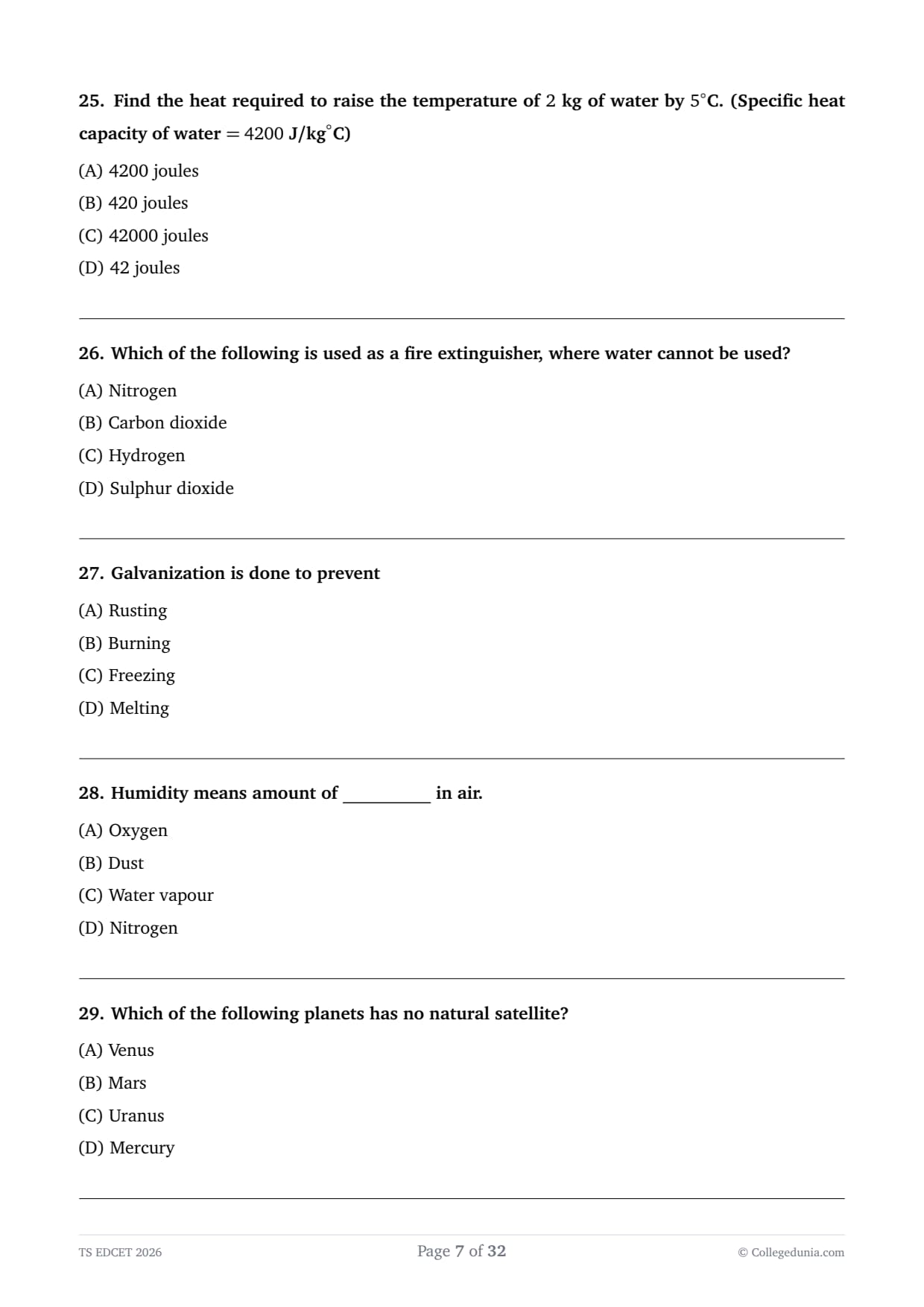
Find the heat required to raise the temperature of \(2\) kg of water by \(5^\circ\)C. (Specific heat capacity of water \(=4200\ J/kg^circC\))
View Solution
Concept:
The quantity of heat required to change the temperature of a substance is calculated using the fundamental calorimetry equation
\[ Q=mc\Delta T, \]
where
\(Q\) = Heat energy supplied (Joules),
\(m\) = Mass of the substance (kg),
\(c\) = Specific heat capacity \((J/kg^)\),
\(\Delta T\) = Rise in temperature \((^)\).
The amount of heat required depends directly on the mass of the substance, its specific heat capacity, and the change in temperature.
Step 1: Write the given data from the question.
From the given information,
\[ m=2\ kg, \]
\[ c=4200\ J/kg^, \]
and
\[ \Delta T=5^. \]
These are the quantities required for direct substitution into the heat equation.
Step 2: Substitute the values into the calorimetry formula.
Using
\[ Q=mc\Delta T, \]
we obtain
\[ Q=2 X 4200 X 5. \]
Step 3: Perform the calculation step by step.
First multiply the mass and the specific heat capacity.
\[ 2 X 4200=8400. \]
Now multiply by the temperature rise.
\[ 8400 X 5=42000. \]
Therefore,
\[ Q=42000\ J. \]
Step 4: Verify the units.
Substituting the units into the formula,
\[ kg X {J} {kgcdot^} X ^ = J. \]
Hence, the calculated answer is correctly expressed in joules.
Step 5: State the final answer.
Thus, the heat required to raise the temperature of \(2\) kg of water by \(5^\circ\)C is
\[ \boxed{42000\ joules.} \]
Hence, the correct option is
\[ \boxed{(C)}. \] Quick Tip: Always remember the calorimetry formula \[ Q=mc\Delta T. \] Water has a very high specific heat capacity, \[ 4200\ J/kg^, \] which means it requires a large amount of heat energy to produce even a small rise in temperature. Ensure that the mass is in kilograms and the temperature change is used instead of the final temperature.
Which of the following is used as a fire extinguisher, where water cannot be used?
View Solution
Concept:
Combustion takes place only when three essential requirements are present simultaneously. These three requirements form the Fire Triangle:
Fuel,
Oxygen,
Heat.
A fire can be extinguished by removing any one of these three components. Water is an effective extinguishing agent for ordinary combustible materials, but it cannot be used for electrical fires or fires involving flammable liquids because it may conduct electricity or spread the burning liquid.
Carbon dioxide (\(\mathrm{CO_2}\)) is widely used in such situations because it is non-flammable, non-conducting, and effectively cuts off the oxygen supply to the fire.
Step 1: Understand how carbon dioxide extinguishes a fire.
Carbon dioxide is heavier than air and forms a blanket around the burning material.
As a result,
it displaces oxygen surrounding the fire,
reduces the oxygen concentration below the level required for combustion,
thereby extinguishes the fire.
During expansion from the cylinder, carbon dioxide also becomes very cold, which helps in lowering the temperature of the burning material.
Step 2: Explain why water cannot always be used.
Water should not be used in the following cases:
Electrical fires because water conducts electricity and may cause electric shock.
Fires involving petrol, diesel, oil, paints, and other flammable liquids because water may spread the burning liquid and increase the fire.
In such situations, carbon dioxide is a much safer and more effective extinguishing agent.
Step 3: Examine the remaining options.
Nitrogen: Although nitrogen can reduce oxygen concentration in special industrial applications, it is not commonly used as a portable fire extinguisher.
Carbon dioxide: It is the standard extinguishing gas for electrical equipment and flammable liquid fires because it is non-conducting and leaves no residue.
Hydrogen: Hydrogen is highly inflammable and can intensify a fire instead of extinguishing it.
Sulphur dioxide: Sulphur dioxide is toxic and corrosive and is not used as a fire extinguishing agent.
Therefore, among the given options, carbon dioxide is the correct choice.
Step 4: Mention common applications of carbon dioxide fire extinguishers.
Carbon dioxide extinguishers are commonly used for
electrical control panels,
computers and electronic equipment,
laboratories,
petrol pumps,
flammable liquid storage areas.
Since carbon dioxide leaves no residue after use, it does not damage sensitive electronic equipment.
Step 5: State the final answer.
Therefore, the gas used as a fire extinguisher where water cannot be used is
\[ \boxed{Carbon dioxide (CO_2).} \]
Hence, the correct option is
\[ \boxed{(B)}. \] Quick Tip: Remember the Fire Triangle: \[ \boxed{Fuel+Heat+Oxygen} \] Removing any one of these three components extinguishes a fire. Carbon dioxide extinguishers work mainly by cutting off the oxygen supply and are the preferred choice for electrical fires and fires involving flammable liquids because they are non-conducting and leave no residue.
Galvanization is done to prevent
View Solution
Concept:
Galvanization (also spelled galvanisation) is a process of applying a protective zinc coating to iron or steel to prevent rusting (corrosion). The zinc layer acts as a sacrificial barrier protecting the underlying iron from reacting with oxygen and moisture in the environment.
Step 1: What is rusting?
Rusting is the process by which iron (Fe) reacts with oxygen (O {2) and water (H {2O) to form hydrated iron(III) oxide, commonly known as rust:
[
4Fe + 3 O_2 + 6 {H_2 O arrow 4 Fe(OH)_3 arrow 2 Fe_2 O_3 3 {H_2 O (rust).
]
Rust weakens and degrades iron structures, making rust prevention critically important.
Step 2: How does galvanization work?
In galvanization:
A thin layer of zinc (Zn) is coated on the iron or steel surface.
Zinc acts as a physical barrier --- it separates iron from oxygen and moisture.
More importantly, zinc acts as a sacrificial anode: since zinc is more reactive than iron (higher position in the electrochemical/activity series), zinc preferentially oxidizes instead of iron. Even if the zinc layer is scratched, it continues to protect the exposed iron around it.
The protective reaction: Zinc oxidizes to form a thin layer of zinc carbonate (ZnCO {3) which is adherent and further protects the surface.
Step 3: Galvanization has no connection with burning, freezing, or melting.
Burning is a rapid chemical reaction (combustion) with oxygen releasing heat and light. Galvanization offers no protection against combustion.
Freezing is a physical change (liquid to solid). Zinc coating does not affect the freezing point of iron.
Melting is a physical change (solid to liquid). The thin zinc coating does not affect the melting point of iron significantly.
Step 4: Common applications of galvanized iron/steel.
Galvanization is used in: roofing sheets (corrugated iron roofs), buckets and containers, fences, nuts and bolts, automotive parts, and construction beams exposed to weather.
[
therefore Galvanization is done to prevent rusting (corrosion) of iron.
] Quick Tip: Remember: {Galvanization = coating iron with Zinc to prevent Rust. The key principle is {sacrificial protection} --- zinc is more reactive than iron in the electrochemical series, so zinc corrodes preferentially, protecting the iron beneath. Other corrosion-prevention methods include painting, oiling, tinning (coating with tin), and alloying (stainless steel).
Humidity means amount of _____ in air.
View Solution
Concept:
Humidity is a meteorological and physical science term that specifically refers to the presence of water vapour (gaseous water) in the atmosphere/air. It is a measure of how much water vapor the air contains and is crucial for understanding weather, climate, and human comfort.
Step 1: Define humidity precisely.
Humidity is the concentration of water vapour present in the air. It is expressed in several ways:
Absolute Humidity: the actual mass of water vapour per unit volume of air (g/m\(^3\)).
Relative Humidity (RH): the ratio of the current water vapour pressure to the maximum (saturation) water vapour pressure at that temperature, expressed as a percentage.
[
RH = {{actual vapour pressure{{saturation vapour pressure X 100%.
]
Specific Humidity: mass of water vapour per unit mass of moist air (g/kg).
Step 2: Why not the other options?
(A) Oxygen: The amount of oxygen in air is described by its {partial pressure or {concentration, not humidity. Oxygen makes up approximately 21% of dry air and is relatively constant.
(B) Dust: Dust particles in air are described by {particulate matter (PM) levels or air quality indices, not humidity. Dust has no relation to humidity.
(D) Nitrogen: Nitrogen constitutes approximately 78% of dry air and its amount is not described by humidity.
Step 3: Significance of humidity.
High humidity makes it feel hotter because sweat doesn't evaporate easily.
Low humidity can cause dry skin, respiratory problems, and static electricity.
Humidity affects many physical and chemical processes, including corrosion rates, food preservation, and plant growth.
Monsoon weather is characterized by very high relative humidity.
[
therefore Humidity means the amount of water vapour in air.
] Quick Tip: Humidity \(=\) water vapour content of air. The instrument used to measure relative humidity is called a {hygrometer. A relative humidity of 100% means the air is saturated with water vapour (it cannot hold any more), and condensation (dew, fog, rain) begins. At 0% RH, the air is completely dry.
Which of the following planets has no natural satellite?
View Solution
Concept:
A natural satellite (also called a moon) is a celestial body that orbits a planet due to gravitational attraction, formed naturally rather than being artificially placed. Most planets in the solar system have natural satellites, but the innermost planets have none (or very few) due to their proximity to the Sun.
Step 1: Survey the number of natural satellites for each planet.

Step 2: Analyse each option.
(A) Venus: Venus has zero natural satellites. So this could also be a valid answer! However, looking at the PDF more carefully, the answer marked as correct is Mercury (option 4 in the paper, which corresponds to option D here). Let us explain both.
(B) Mars: Mars has two natural satellites --- Phobos and Deimos.
(C) Uranus: Uranus has 27 known natural satellites.
(D) Mercury: Mercury has zero natural satellites. It orbits very close to the Sun (average distance \(\approx 0.39\) AU), and the Sun's intense gravity would destabilize any moon orbit.
Step 3: Why does Mercury have no moon?
Mercury is so close to the Sun that:
The Sun's gravitational pull dominates the region around Mercury.
The Hill sphere of Mercury (the region where its gravity dominates) is very small.
Any moon in a close orbit around Mercury would be pulled away by the Sun's tidal forces.
Any moon in a far orbit would be outside Mercury's Hill sphere.
Note: Venus also has no moon, but the question asks specifically for planets with no natural satellite among the given choices, and Mercury (option D) is marked correct in the paper.
[
therefore Mercury has no natural satellite.
] Quick Tip: Two planets in our solar system have {no natural satellites: {Mercury and {Venus}. All other planets have at least one. The planet with the most confirmed moons is currently {Saturn} (145+). Remember: inner planets (Mercury, Venus) have no moons; Earth has 1; Mars has 2; outer/gas giants have many.
Process of conversion of dead vegetation into coal is called
View Solution
Concept:
Coal is formed from the remains of dead plants and vegetation that lived millions of years ago. The process by which dead organic matter (vegetation) is gradually transformed into coal under conditions of heat, pressure, and absence of air over geological time periods is known as carbonisation (also called coalification or the process of coal formation).
Step 1: Detailed explanation of Carbonisation.
Carbonisation (or carbonization) is the process in which organic material is converted to carbon or a carbon-containing residue through pyrolysis (thermal decomposition in the absence or limited presence of oxygen). In the geological context:
Dead vegetation (plants, trees) accumulated in swampy areas over millions of years.
These were buried under layers of sediment (sand, mud, rock).
Over millions of years, increasing pressure and temperature drove off volatile components (water, hydrogen, oxygen, nitrogen).
The remaining material became progressively richer in carbon.
The stages are: peat \(arrow\) lignite (brown coal) \(arrow\) bituminous coal \(arrow\) anthracite.
Step 2: Analyse wrong options.
(A) Hydrogenation: This is the addition of hydrogen to a molecule (e.g., converting unsaturated fats to saturated fats, or making margarine from vegetable oils). It has nothing to do with coal formation.
(B) Calcination: This is the thermal treatment of a solid mineral (usually with limited air) to cause thermal decomposition, phase transition, or removal of a volatile fraction. It is used in cement making (heating limestone to form lime: CaCO\(_3\) \(arrow\) CaO + CO\(_2\)). Not related to coal formation.
(D) Oxidation: Oxidation involves the loss of electrons or addition of oxygen. If vegetation were oxidized, it would combust or decompose aerobically --- not form coal. Coal formation requires the exclusion of oxygen.
Step 3: Coal as a fossil fuel.
Coal is a fossil fuel because it is derived from ancient living organisms (vegetation). The energy stored in coal originally came from sunlight captured by photosynthesis millions of years ago. When we burn coal, we are releasing this ancient solar energy.
[
therefore Conversion of dead vegetation into coal is called Carbonisation.
] Quick Tip: Remember: {Carbonisation = conversion of organic matter (dead plants) to coal (rich in carbon) under heat and pressure over geological time. The stages of coal formation in order of increasing carbon content are: {Peat \(arrow\) Lignite \(arrow\) Bituminous coal \(arrow\) Anthracite. Anthracite has the highest carbon content (\(\approx\)92--98%) and highest calorific value.
Match the following and choose the correct answer:
(a) & Vitamin B\(_{12}\) & (i) & Weak bones
(b) & Vitamin D & (ii) & Poor vision
(c) & Vitamin A & (iii) & Delay in wound healing
(d) & Vitamin C & (iv) & Anaemia
View Solution
Concept:
Vitamins are essential micronutrients required by the body in small amounts for normal physiological functions. A deficiency of each vitamin leads to specific, well-defined diseases or conditions. Knowing these deficiency diseases is a fundamental requirement in biology and health science.
Step 1: Match each vitamin to its deficiency disease --- detailed analysis.
(a) Vitamin B {12} \(arrow\) (iv) Anaemia
Vitamin B {12 (cobalamin) is essential for the production of red blood cells and DNA synthesis. It is required for the proper maturation of erythrocytes (red blood cells). Deficiency of Vitamin B {12 leads to megaloblastic/pernicious anaemia --- a condition where red blood cells are abnormally large and immature, and cannot carry oxygen effectively. This results in fatigue, weakness, and pallor.
(b) Vitamin D \(arrow\) (i) Weak bones (Rickets/Osteoporosis)
Vitamin D (calciferol) is crucial for the absorption of calcium and phosphorus from the intestine. These minerals are essential for bone mineralisation. Deficiency of Vitamin D leads to:
In children: Rickets --- soft, weak, and deformed bones (bowed legs).
In adults: Osteomalacia --- softening of bones; in older adults: Osteoporosis.
(c) Vitamin A \(arrow\) (ii) Poor vision (Night blindness)
Vitamin A (retinol) is essential for the synthesis of rhodopsin, the light-sensitive pigment found in the rod cells of the retina. Rod cells are responsible for vision in dim light. Deficiency of Vitamin A leads to:
Night blindness (nyctalopia): inability to see in dim light or darkness.
Severe deficiency leads to xerophthalmia (dryness of cornea) and eventually blindness.
(d) Vitamin C \(arrow\) (iii) Delay in wound healing (Scurvy)
Vitamin C (ascorbic acid) is essential for the synthesis of collagen --- the structural protein that forms connective tissue, skin, blood vessels, and bones. Collagen is critical for wound healing. Deficiency of Vitamin C leads to Scurvy, whose symptoms include:
Poor wound healing (collagen cannot be synthesized properly).
Bleeding gums, loosening of teeth.
Skin hemorrhages, joint pain.
Step 2: Final correct matching.

[
therefore {(a)--(iv), (b) {--(i), (c) {--(ii), (d) {--(iii)
] Quick Tip: A helpful mnemonic for vitamin deficiency diseases:
{A = {A}ffects {A}ight (night) vision (Night Blindness).
{B {12}} = {B}lood disorder (Anaemia --- need B12 to make red blood cells).
{C} = {C}ollagen synthesis (Scurvy --- wounds won't heal; think ``C for cuts that won't close'').
{D} = {D}ense bones need Vitamin D (deficiency \(arrow\) Rickets/weak bones).
Identify the natural pest control method to prevent Tungro virus disease in paddy.
View Solution
Concept:
Tungro disease is one of the most destructive diseases of rice (paddy). It is caused by a combination of two viruses:
Rice tungro bacilliform virus (RTBV)
Rice tungro spherical virus (RTSV)
These viruses are transmitted by green leafhopper insects (primarily Nephotettix virescens). The disease causes stunted growth, yellowing of leaves, and drastic reduction in grain yield.
Step 1: Why is crop rotation (option D) the natural pest control method?
The recommended natural method to control Tungro virus is crop rotation --- specifically growing blackgram ({Vigna mungo) and groundnut ({Arachis hypogaea) after paddy (rice) cultivation.
The rationale is:
The leafhopper vectors that transmit Tungro virus are host-specific to rice.
When non-host crops (legumes like blackgram and groundnut) are grown after rice, the leafhopper population collapses due to lack of food and suitable breeding ground.
This breaks the disease cycle naturally, without using chemicals.
Legumes also fix atmospheric nitrogen, improving soil fertility for the next rice crop (bonus benefit).
Step 2: Why the other options are not the best natural method?
(A) Spraying insecticides: This is a {chemical method, not a {natural pest control method. The question specifically asks for a natural method.
(B) Encouraging growth of predators: This is a form of biological control and is a natural method. However, for Tungro specifically, the primary recommended natural control is crop rotation. Predatory insects control leafhopper populations but do not eliminate Tungro as effectively as crop rotation.
(C) Using organic manures: Organic manures improve soil health but do not directly control the virus-transmitting leafhopper vectors. This is a nutrition strategy, not a pest control strategy.
Step 3: Summary of Tungro management.
The most effective and natural means of Tungro control is through:
Planting resistant rice varieties.
Crop rotation with non-host legume crops (blackgram, groundnut).
Synchronized sowing to avoid leafhopper population peaks.
Removal of infected plants.
[
therefore Growing blackgram and groundnut after paddy cultivation is the natural method to prevent Tungro virus.
] Quick Tip: {Tungro disease in paddy is caused by a {virus transmitted by green leafhoppers. The key natural (non-chemical) control method is {crop rotation} with legumes like blackgram and groundnut after rice harvest. This disrupts the leafhopper life cycle by removing the rice host plant. Legume rotation also enriches the soil with nitrogen --- a double benefit.
Identify the tissue that stores fat in the human body.
View Solution
Concept:
The human body is composed of four primary types of tissues: epithelial, connective, muscular, and nervous. Each tissue type has specialized functions. The storage of fat (lipids) is a specific function of a particular type of connective tissue.
Step 1: What is Adipose tissue?
Adipose tissue is a specialized form of loose connective tissue composed predominantly of adipocytes (fat cells, also called lipocytes). Each adipocyte is filled with a large lipid droplet that pushes the nucleus to the periphery of the cell.
Functions of adipose tissue:
Energy storage: Fat is stored in the form of triglycerides and released when the body needs energy.
Thermal insulation: Subcutaneous (under-skin) fat acts as an insulating layer to retain body heat.
Mechanical cushioning: Protects organs and joints from mechanical shock (e.g., fat around the kidneys, eyes).
Hormone production: Adipose tissue secretes hormones like leptin (regulates appetite) and adiponectin.
Step 2: Analyse the other options.
(A) Epithelial tissue: Lines the surfaces of organs and body cavities (skin, intestinal lining, respiratory tract). Its functions are protection, absorption, secretion, and excretion. It does not store fat.
(C) Nervous tissue: Found in the brain, spinal cord, and nerves. It transmits electrical impulses and processes information. While neurons do have a fatty myelin sheath (made of Schwann cells), nervous tissue itself is not a fat-storage tissue.
(D) Muscular tissue: Specialized for contraction and movement. The three types are skeletal, smooth, and cardiac muscle. Muscles may accumulate some intramuscular fat under pathological conditions, but their primary function is not fat storage.
Step 3: Location of adipose tissue in the body.
Adipose tissue is found:
Subcutaneously (beneath the skin) --- largest depot.
Around internal organs (visceral fat): kidneys, heart, intestines.
In bone marrow (yellow bone marrow).
In the breasts.
[
therefore Adipose tissue stores fat in the human body.
] Quick Tip: Remember the {four types of animal tissue and their key functions:
{Epithelial} = protection, lining, secretion.
{Connective} = support, binding, fat storage ({adipose} is a connective tissue).
{Muscular} = movement, contraction.
{Nervous} = impulse transmission, coordination.
``Adipo'' comes from the Latin adeps meaning fat --- a helpful etymological clue.
Which of the following is NOT related to the 4Rs?
View Solution
Concept:
The 4Rs is an environmental waste management framework that promotes sustainable practices to reduce the burden on landfills and the environment. The original 3Rs were later expanded to 4Rs by adding ``Recover'' or ``Refuse'' depending on the context. In many educational frameworks, the 4Rs stand for: Reduce, Reuse, Recycle, and Recover (or Refuse in some versions).
Step 1: Identify the standard 4Rs.
Reduce: Minimize the amount of waste generated in the first place. Use less material, buy only what is needed, avoid single-use products.
Reuse: Use items multiple times before discarding. Repair, donate, or repurpose items instead of throwing them away.
Recycle: Convert waste materials into new products to prevent waste of potentially useful materials. Examples: melting glass bottles to make new glass, paper recycling, metal scrap recycling.
Recover (or Refuse/Rethink): The fourth R in most versions is Recover (energy recovery from waste), Refuse (refusing unnecessary packaging or plastic), or Rethink (rethinking consumption habits). ``Repeat'' is not one of the 4Rs.
Step 2: Analyse the options.
(A) Reduce: This is definitively one of the core 4Rs. (part of 4R framework)
(B) Reuse: This is definitively one of the core 4Rs. (part of 4R framework)
(C) Repeat: Repeat has no meaning in the environmental waste management context. It is simply not one of the 4Rs. This is the answer.
(D) Recycle: This is definitively one of the core 4Rs. (part of 4R framework)
Step 3: Environmental importance of the 4Rs.
The 4Rs approach reduces:
Pollution of land, water, and air.
Consumption of raw materials and natural resources.
Energy consumption in manufacturing.
Greenhouse gas emissions.
Volume of waste going to landfills.
[
therefore Repeat is NOT related to the 4Rs. The 4Rs are: Reduce, Reuse, Recycle, Recover/Refuse.
] Quick Tip: The environmental {4Rs are {Reduce, Reuse, Recycle,} and {Recover} (or Refuse/Rethink in some frameworks). The order represents a priority: it is better to reduce waste than to reuse it, better to reuse than to recycle, and better to recycle than to recover energy from waste. The goal is zero-waste living and sustainable development.
Identify the method by which plants are used to clean up contamination.
View Solution
Concept:
Environmental contamination by heavy metals, pesticides, organic pollutants, and other toxic substances is a major problem. Several biological techniques are used to clean up contaminated soil and water. The specific use of plants for this purpose is a distinct and well-defined approach.
Step 1: Define Phytoremediation.
Phytoremediation (from the Greek phyto = plant, and Latin {remedium = restoring balance) is the use of living plants and their associated microorganisms to clean up contaminated environments --- soil, water, or air.
Mechanisms of phytoremediation:
Phytoextraction (phytoaccumulation): Plants absorb contaminants (especially heavy metals like lead, cadmium, arsenic) through their roots and accumulate them in shoots/leaves, which are then harvested and removed.
Phytodegradation: Plants and their root-associated microbes break down organic pollutants (pesticides, solvents).
Rhizofiltration: Plant roots absorb and adsorb contaminants from water.
Phytostabilization: Plants immobilize contaminants in the soil, reducing their mobility and bioavailability.
Phytovolatilization: Plants take up contaminants and release them as vapors through transpiration (e.g., mercury, selenium).
Example plants used: {Thlaspi caerulescens (hyperaccumulator of zinc/cadmium), sunflower (Chernobyl cleanup), vetiver grass, Indian mustard.
Step 2: Distinguish from the other options.
(A) Bioremediation: Uses microorganisms (bacteria, fungi) to degrade or detoxify contaminants. This is a broader term --- phytoremediation is a subset of bioremediation. The question specifically asks about {plants, which points to phytoremediation.
(C) Biomagnification (bioamplification): This is the increase in concentration of a toxic substance (like DDT) as it moves up the food chain. It is the {problem, not the solution.
(D) Bioaccumulation: The process by which an organism accumulates toxic substances in its body tissues (concentration in one organism). It is also related to the problem, not the cleanup.
[
therefore Phytoremediation is the method by which plants are used to clean up contamination.
] Quick Tip: {Phyto = plant: Phytoremediation uses {plants to clean polluted environments. {Bio = life}: Bioremediation uses {microbes} (bacteria/fungi) for the same purpose. Do not confuse with {Biomagnification} (toxins increasing up the food chain) or {Bioaccumulation} (toxins building up within an organism) --- these describe problems, not solutions.
Identify the CORRECT pair from the following.
View Solution
Concept:
The history of photosynthesis research involves many scientists, each contributing key discoveries. This question tests knowledge of the correct attribution of discoveries to the scientists who made them.
Step 1: Verify each scientist-discovery pair.
(A) Englemann -- Plants produce oxygen in the presence of sunlight: INCORRECT
Theodor Wilhelm Engelmann (1843--1909) conducted the famous prism experiment with Spirogyra algae in 1882. He split white light into a spectrum using a prism and shone it on a filament of green algae, then observed which parts attracted oxygen-seeking bacteria. He demonstrated that the rate of photosynthesis was highest in red and blue light. He did NOT discover that plants produce oxygen in sunlight --- this was already known from earlier work by Priestley and Ingenhousz. So option (A) misattributes the discovery.
(B) Pelletier and Caventou -- Obtained an extract of the green coloured substance from leaves: CORRECT
Pierre Joseph Pelletier and Joseph Bienaimé Caventou were French chemists who in 1817 isolated the green pigment from leaves and named it chlorophyll (from Greek chloros = green, {phyllon = leaf). This is exactly what option (B) states --- they obtained an extract of the green-coloured substance from leaves. This is the CORRECT pair.
(C) Jan Ingenhousz -- The gas released by plants supports the existence of living organisms: INCORRECT
Jan Ingenhousz (1730--1799) demonstrated in 1779 that plants only release oxygen (and perform photosynthesis) in the presence of light. In darkness, he showed that plants produce carbon dioxide. His core discovery was the role of light in photosynthesis. The statement in option (C) --- ``the gas released by plants supports living organisms'' --- more accurately describes Joseph Priestley's discovery (1771), not Ingenhousz's specific contribution.
(D) Joseph Priestley -- Point of maximum rate of photosynthesis: INCORRECT
Joseph Priestley (1733--1804) discovered in 1771 that a candle placed with a plant in a sealed container could burn again after a period, discovering that plants produce oxygen (the gas that supports combustion and living organisms). The ``point of maximum rate of photosynthesis'' is associated with Engelmann's spectrum experiment, not Priestley.
Step 2: Summary of key photosynthesis scientists.

[
therefore Pelletier and Caventou -- Obtained an extract of the green coloured substance (chlorophyll) from leaves.
] Quick Tip: Key photosynthesis history: {Priestley (oxygen from plants, 1771) \(\to\) {Ingenhousz (light required, 1779) \(\to\) {Pelletier & Caventou} (isolated chlorophyll, 1817) \(\to\) {Engelmann} (red & blue light most effective, 1882). Remember: ``Pelletier and Caventou = Chlorophyll'' --- they named it from the Greek words for green leaf.
The process of double fertilization in plants results in the formation of
View Solution
Concept:
Double fertilization is a unique and defining characteristic of angiosperms (flowering plants). It involves two separate fertilization events occurring simultaneously within the embryo sac (female gametophyte). This process was first described by Sergei Nawaschin in 1898.
Step 1: Understand the structure involved in double fertilization.
During pollination, a pollen grain lands on the stigma and germinates, forming a pollen tube that grows down through the style to the ovule. The pollen tube carries two male gametes (sperm cells).
The mature embryo sac (inside the ovule) contains:
1 egg cell (at the micropylar end)
2 synergids (beside the egg cell)
3 antipodal cells (at the chalazal end)
2 polar nuclei (at the center, forming the central cell)
Step 2: The two fertilization events.
When the pollen tube reaches the ovule and releases the two male gametes:
Fertilization 1 (Syngamy):
[
1st male gamete + egg cell arrow Zygote (2n)
]
The zygote develops into the embryo (the future plant).
Fertilization 2 (Triple fusion):
[
2nd male gamete (n) + 2 polar nuclei (n + n) arrow Primary endosperm nucleus (3n)
]
The primary endosperm nucleus develops into the endosperm --- the nutritive tissue that provides food to the developing embryo.
Step 3: Final products of double fertilization.
The direct products of double fertilization are:
Zygote (2n) --- from syngamy (egg + sperm).
Primary endosperm nucleus (3n) --- from triple fusion, which develops into endosperm.
So: Double fertilization \(arrow\) Zygote + Endosperm.
Step 4: Why other options are wrong.
(A) Embryo and fruit: The embryo develops from the zygote (later stage), and the fruit develops from the ovary wall. These are {later consequences, not the {direct products of double fertilization.
(C) Ovary and seed: These are structural parts of the flower/fruit, not products of double fertilization. The seed forms after fertilization, not directly from it.
(D) Stigma and ovule: These are parts of the pistil (female reproductive organ), not products of double fertilization. They exist {before fertilization.
[
therefore Double fertilization results in the formation of Zygote and Endosperm.
] Quick Tip: In double fertilization: {Sperm 1 + Egg = Zygote (2n) \(\to\) embryo. {Sperm 2 + 2 Polar nuclei = Primary Endosperm Nucleus (3n) \(\to\) endosperm. This is unique to {angiosperms} (flowering plants). The endosperm is the food reserve for the developing embryo (examples: the white part of a coconut is endosperm; rice grains are mostly endosperm).
The type of ecosystem in Coringa region is
View Solution
Concept:
An ecosystem is a community of living organisms interacting with each other and their non-living environment. Ecosystems are classified based on their geographical features and dominant vegetation. The Coringa region is a specific, well-known geographical location in India with a distinctive ecosystem type.
Step 1: What and where is the Coringa region?
The Coringa Wildlife Sanctuary is located in the Godavari delta, near Kakinada in East Godavari district, Andhra Pradesh, India. It sits at the confluence of the Godavari river and the Bay of Bengal.
Step 2: What type of ecosystem is Coringa?
Coringa harbors the second-largest mangrove forest in India (after the Sundarbans in West Bengal). The ecosystem at Coringa is a mangrove ecosystem (also called mangrove forest or tidal wetland ecosystem).
Characteristics of the Coringa mangrove ecosystem:
Located in intertidal zones (where land meets sea/estuaries).
Dominated by salt-tolerant (halophytic) mangrove trees like Avicennia marina, {Rhizophora, {Bruguiera etc.
The trees have special root adaptations: prop roots, pneumatophores (breathing roots that project above the mud).
Rich biodiversity: home to saltwater crocodiles, otters, fishing cats, migratory birds, and a rich marine life.
Acts as a coastal shield against cyclones and storm surges.
Important nursery for fish and marine species.
Step 3: Why other options are wrong.
(A) Grass lands: Grassland ecosystems are found in interior regions with moderate rainfall and seasonal climates (e.g., Deccan plateau grasslands). Coringa is coastal/deltaic.
(C) Desert: Desert ecosystems are characterised by very low rainfall and sparse vegetation (e.g., Thar Desert in Rajasthan). Coringa receives adequate rainfall being coastal.
(D) Mountain: Mountain ecosystems are at high altitudes (e.g., Eastern Ghats, Himalayas). Coringa is at sea level in a river delta.
[
therefore The Coringa region has a Mangrove ecosystem.
] Quick Tip: {Coringa Wildlife Sanctuary (Kakinada, Andhra Pradesh) = India's {second-largest mangrove forest. The largest mangrove forest in India is {Sundarbans} (West Bengal/Bangladesh), which is also a UNESCO World Heritage Site and home to the Royal Bengal Tiger. Mangroves are characterised by salt-tolerant trees in intertidal coastal zones with specialized root systems.
Choose the incorrect pair from the following:
View Solution
Concept:
The endocrine system consists of glands that secrete hormones directly into the bloodstream. Each gland produces specific hormones that regulate various physiological processes. This question asks us to identify the incorrect gland-hormone pair.
Step 1: Verify each gland-hormone pair.
(A) Pituitary gland -- Follicle Stimulating Hormone (FSH): CORRECT
The anterior pituitary gland (adenohypophysis) produces several tropic hormones, including:
FSH (Follicle Stimulating Hormone) --- stimulates follicle development in ovaries and sperm production in testes.
LH (Luteinizing Hormone), GH (Growth Hormone), TSH, ACTH, Prolactin.
FSH is indeed secreted by the pituitary gland.
(B) Ovary -- Progesterone: CORRECT
The ovaries secrete:
Oestrogen (from follicles) --- female secondary sexual characteristics.
Progesterone (from corpus luteum after ovulation) --- prepares uterus for implantation, maintains pregnancy.
Progesterone is indeed secreted by the ovary (corpus luteum).
(C) Pancreas -- Glucagon: CORRECT
The pancreas is both an exocrine and endocrine gland. Its islets of Langerhans contain:
\(\alpha\) (alpha) cells: secrete glucagon --- raises blood glucose by stimulating glycogenolysis and gluconeogenesis in the liver.
\(\beta\) (beta) cells: secrete insulin --- lowers blood glucose.
\(\delta\) (delta) cells: secrete somatostatin.
Glucagon is indeed secreted by the pancreas.
(D) Adrenal gland -- Vasopressin: INCORRECT
The adrenal glands (located above the kidneys) consist of:
Adrenal cortex: secretes corticosteroids (cortisol, aldosterone, androgens).
Adrenal medulla: secretes adrenaline (epinephrine) and noradrenaline (norepinephrine).
Vasopressin (ADH --- Antidiuretic Hormone) is not produced by the adrenal gland. It is produced by the hypothalamus and stored and released by the posterior pituitary gland (neurohypophysis). Vasopressin regulates water reabsorption by the kidneys. Therefore, the pair ``Adrenal gland -- Vasopressin'' is INCORRECT.
Step 2: Summary table.

[
therefore The incorrect pair is: Adrenal gland -- Vasopressin.
] Quick Tip: {Vasopressin (ADH) is produced by the {hypothalamus and released by the {posterior pituitary}, NOT the adrenal gland. The adrenal medulla secretes {adrenaline} and {noradrenaline} (``fight or flight'' hormones). Remember: ``{A}drenal \(\neq\) {A}DH'' --- the shared `A' is a common trap in exams. ADH = Anti-Diuretic Hormone = Vasopressin = posterior pituitary.
Fat deposits below the skin of polar marine animals is an adaptation to
View Solution
Concept:
Polar regions (Arctic and Antarctic) are characterized by extremely cold temperatures, often far below zero degrees Celsius. Animals living in these environments face the constant challenge of thermoregulation --- maintaining a stable internal body temperature despite the extreme external cold. Biological adaptations for cold climates are well-studied areas of ecology and physiology.
Step 1: What is the fat deposit (blubber)?
The thick layer of fat found beneath the skin of polar marine animals is called blubber. It is found in:
Whales (blue whale, sperm whale, beluga whale)
Seals and sea lions
Walruses
Polar bears (subcutaneous fat layer)
Penguins
Step 2: How does blubber serve as a temperature adaptation?
Blubber (subcutaneous fat) provides thermal insulation through multiple mechanisms:
Low thermal conductivity of fat: Fat is an extremely poor conductor of heat. It prevents heat loss from the warm body core to the cold external environment (water or air).
Endothermy (warm-bloodedness) maintenance: Marine mammals are endotherms (warm-blooded) and must maintain a core body temperature of approximately 37--38\(^\circ\)C even in Arctic waters near 0\(^\circ\)C.
Energy reserve: Blubber also stores energy (as fatty acids/triglycerides) which can be metabolized when food is scarce (e.g., during long migrations or winters).
Buoyancy: Fat is less dense than water, providing some buoyancy (a secondary benefit).
Step 3: Why the other options are incorrect.
(A) Salt water: Adaptation to salt water involves osmoregulation (managing salt-water balance). This is achieved through specialized kidneys and salt glands, not fat deposits. While animals must tolerate saltwater, fat does not help with this.
(B) Hydrostatic pressure: Deep-sea animals adapt to pressure through flexible skeletons, pressure-tolerant proteins, and lipid composition changes in cell membranes. A subcutaneous fat layer does not protect against hydrostatic pressure per se.
(D) Defence: While blubber adds body bulk (which might deter some predators), it is not primarily a defensive adaptation. Defensive adaptations include thick hides, spines, toxins, camouflage, etc.
Step 4: Classic example.
A blue whale's blubber layer can be up to 50 cm thick. A harp seal pup's blubber constitutes nearly 25% of its total body weight. This enormous investment in subcutaneous fat is entirely directed at maintaining body temperature in icy polar waters.
[
therefore Fat deposits below the skin of polar marine animals is an adaptation to Temperature (cold environments).
] Quick Tip: Fat/blubber in polar animals = {thermal insulation (temperature adaptation). Fat has very low thermal conductivity, meaning heat cannot pass through it easily. This keeps the animal's body warm even in near-freezing polar waters. This is the classic example of a {structural adaptation} for thermoregulation. Other cold-climate adaptations include thick fur, small appendages (reducing surface area), and countercurrent heat exchange in blood vessels.
Antarctic shield of ice is in
View Solution
Concept:
The Earth is divided into different climatic regions based on latitude and temperature conditions. These include the tropical region, temperate region, and polar regions. Antarctica is located around the South Pole and is one of the coldest places on Earth.
Step 1: Understand the location of Antarctica.
Antarctica is a continent situated around the South Pole. It lies almost entirely within the Antarctic Circle and experiences extremely cold climatic conditions throughout the year.
Step 2: Understand the Antarctic ice shield.
The Antarctic Ice Sheet is a massive layer of ice covering nearly the entire continent. It contains about 90% of the world's ice and around 70% of the world's freshwater.
Because of its location near the South Pole, the ice shield exists in the polar climatic zone.
Step 3: Examine the alternatives.
Tropical regions are located near the Equator and experience high temperatures.
Temperate regions have moderate climatic conditions.
Equatorial regions lie directly around the Equator.
None of these describe Antarctica.
Step 4: Conclusion.
Since Antarctica is situated around the South Pole and remains permanently covered by ice, it belongs to the Polar Region.
Hence, option (C) is correct. Quick Tip: Antarctica = South Pole = Polar Region.
Telangana Plateau is a part of
View Solution
Concept:
India has several major physiographic divisions. One of the most extensive plateau regions is the Deccan Plateau, which occupies a large portion of peninsular India.
Step 1: Understand the Telangana Plateau.
The Telangana Plateau covers a major part of the state of Telangana and consists mainly of ancient igneous and metamorphic rocks.
It is characterized by:
Undulating topography.
Granite formations.
Moderate elevation.
River valleys of Godavari and Krishna tributaries.
Step 2: Relation with Deccan Plateau.
The Telangana Plateau forms the northeastern extension of the Deccan Plateau.
Geographers classify it as a sub-region of the larger Deccan Plateau system.
Step 3: Evaluate the alternatives.
Malwa Plateau lies mainly in Madhya Pradesh.
Chota Nagpur Plateau lies in Jharkhand and adjoining states.
Central Highlands occupy central India.
Telangana Plateau belongs to the Deccan Plateau.
Step 4: Conclusion.
Therefore, Telangana Plateau is a part of the Deccan Plateau.
Hence, option (D) is correct. Quick Tip: Telangana Plateau is a geographical subdivision of the Deccan Plateau.
Which is the most precise reason for decreasing temperature from equator to poles?
View Solution
Concept:
Temperature distribution on Earth depends mainly on the amount of solar energy received at different latitudes. The angle at which the Sun's rays strike the Earth's surface plays a crucial role in determining temperature.
Step 1: Understand solar radiation at the Equator.
Near the Equator, the Sun's rays fall almost vertically.
As a result:
Energy is concentrated over a smaller area.
Heating is more intense.
Temperatures remain high throughout the year.
Step 2: Understand solar radiation near the poles.
Towards the poles, the Sun's rays strike the Earth at a slanting angle.
This causes:
Energy to spread over a larger area.
Less heating per unit area.
Lower temperatures.
Step 3: Analyze the options.
Wind direction and ocean currents influence regional temperatures but are not the primary global reason.
Distance from the Earth's center is practically the same everywhere and has no significant effect.
The angle of solar incidence is the fundamental reason.
Step 4: Conclusion.
Therefore, temperature decreases from the Equator towards the poles mainly because of the changing angle of the Sun's rays.
Hence, option (C) is correct. Quick Tip: Vertical Sun Rays = More Heat.
Slanting Sun Rays = Less Heat.
In Tibet, the river Brahmaputra is known as
View Solution
Concept:
Many rivers are known by different names as they flow through different countries and regions.
Step 1: Origin of Brahmaputra.
The Brahmaputra originates near Lake Manasarovar in Tibet.
In Tibet, the river flows eastward across the Tibetan Plateau.
Step 2: Name in Tibet.
While flowing through Tibet, the Brahmaputra is known as:
[
Yarlung Tsangpo
]
or simply Tsangpo.
Step 3: Course of the river.
Tsangpo in Tibet.
Enters India through Arunachal Pradesh.
Called Siang or Dihang in Arunachal Pradesh.
Becomes Brahmaputra in Assam.
Step 4: Conclusion.
Therefore, the Brahmaputra River is known as Tsangpo in Tibet.
Hence, option (C) is correct. Quick Tip: Tsangpo (Tibet) \(arrow\) Siang (Arunachal Pradesh) \(arrow\) Brahmaputra (Assam).
Which statement of the following about the lithosphere is correct?
View Solution
Concept:
The Earth is composed of different spheres such as the lithosphere, hydrosphere, atmosphere, and biosphere. Each sphere has unique characteristics and functions.
Step 1: Understand lithosphere.
The lithosphere refers to the Earth's solid outer layer consisting of:
Crust.
Uppermost part of the mantle.
It forms the rigid outer shell of the Earth.
Step 2: Features of the lithosphere.
The lithosphere includes:
Continents.
Mountains.
Plateaus.
Ocean basins.
It is not limited to soil alone.
Step 3: Evaluate the alternatives.
Ocean floor is only a part of the lithosphere.
Soil forms only a thin layer.
Air layers belong to the atmosphere.
The most accurate description is that it is the Earth's solid crustal region.
Step 4: Conclusion.
Hence, the lithosphere is the solid outer crust of the Earth.
Therefore, option (B) is correct. Quick Tip: Lithosphere = Land + Rocks + Earth's Solid Outer Layer.
After the fall of Ottoman Empire, the countries that wanted to control the Black Sea and Mediterranean Sea region were
View Solution
Concept:
The Ottoman Empire was one of the largest empires in world history. After its decline and eventual collapse following World War I, several European powers attempted to gain influence over strategically important regions previously controlled by the empire.
Step 1: Understand the historical background.
The Ottoman Empire controlled important territories connecting Europe, Asia, and Africa. It also controlled access to major sea routes including parts of the Mediterranean region.
Following World War I, the Ottoman Empire was defeated and its territories became the focus of competing interests among European powers.
Step 2: Identify the countries interested in the region.
Among the victorious Allied powers, Britain sought to maintain strategic control over sea routes connecting Europe to its colonies. Italy also aimed to expand its influence in the Mediterranean region.
These countries viewed the former Ottoman territories as strategically and economically important.
Step 3: Examine the options.
Germany and Austria were defeated powers during World War I.
France and Poland did not jointly seek dominance over the Black Sea and Mediterranean region.
Russia and Turkey do not match the historical context referred to in the question.
Italy and Britain were among the nations interested in extending their influence in these regions.
Step 4: Conclusion.
Therefore, the correct answer is Italy and Britain. Quick Tip: The collapse of the Ottoman Empire after World War I led to increased influence of European powers such as Britain and Italy in the Mediterranean region.
The rulers of Qutub Shahi dynasty were defeated by
View Solution
Concept:
The Qutub Shahi dynasty ruled the Golconda Kingdom in the Deccan region and played a significant role in the history of Telangana.
Step 1: Know about the Qutub Shahi dynasty.
The Qutub Shahi rulers established their capital at Golconda and later at Hyderabad.
They ruled for nearly two centuries and contributed greatly to architecture, culture, and trade.
Step 2: Understand the fall of the dynasty.
During the expansion of the Mughal Empire under Emperor Aurangzeb, efforts were made to bring the Deccan kingdoms under Mughal control.
In 1687, Aurangzeb captured Golconda Fort after a prolonged campaign.
This led to the end of Qutub Shahi rule.
Step 3: Evaluate the options.
The Asaf Jahis came later and founded the Hyderabad State.
The Kakatiyas ruled much earlier.
The Vijayanagara rulers were not responsible for ending Qutub Shahi rule.
Aurangzeb directly conquered Golconda and defeated the dynasty.
Step 4: Conclusion.
Hence, the rulers of the Qutub Shahi dynasty were defeated by Aurangzeb. Quick Tip: Golconda was conquered by Mughal Emperor Aurangzeb in 1687, ending the Qutub Shahi dynasty.
What was the main aim of the Cabinet Mission?
View Solution
Concept:
The Cabinet Mission was sent by the British Government in 1946 to address constitutional issues in India and facilitate the transfer of power.
Step 1: Understand the historical context.
After World War II, the British Government realized that India would soon become independent.
However, disagreements existed among political groups regarding the future structure of government.
Step 2: Know the purpose of the Cabinet Mission.
The Cabinet Mission consisted of British ministers who came to India in 1946.
Its objective was to propose a constitutional arrangement and establish a framework through which independent India could govern itself.
Step 3: Evaluate the options.
The mission was not intended to strengthen British rule.
It did not aim to stop elections.
It was not established solely to divide India.
Its central purpose was to recommend a constitutional and political framework for an independent India.
Step 4: Conclusion.
Therefore, option (C) is correct. Quick Tip: The Cabinet Mission Plan of 1946 attempted to provide a constitutional framework for India's transition to independence.
The League of Nations was formed as a result of which treaty?
View Solution
Concept:
The League of Nations was the first major international organization established to promote peace and cooperation among nations.
Step 1: Understand the background.
World War I caused immense destruction and loss of life.
After the war ended, world leaders sought a mechanism to prevent future global conflicts.
Step 2: Identify the treaty.
The Treaty of Versailles was signed in 1919 between Germany and the Allied Powers.
One of its important provisions was the establishment of the League of Nations.
Step 3: Purpose of the League.
The League aimed to:
Maintain international peace.
Promote cooperation among nations.
Resolve disputes through negotiation.
Step 4: Conclusion.
Hence, the League of Nations was formed through the Treaty of Versailles. Quick Tip: Treaty of Versailles (1919) led to the creation of the League of Nations after World War I.
What is the main purpose of the Enabling Act 1933?
View Solution
Concept:
The Enabling Act of 1933 was a turning point in German history and played a crucial role in Adolf Hitler's rise to absolute power.
Step 1: Historical context.
In 1933, Adolf Hitler became Chancellor of Germany.
He sought to consolidate power and eliminate democratic restrictions.
Step 2: Purpose of the Act.
The Enabling Act allowed Hitler's government to enact laws without parliamentary approval.
This effectively weakened democratic institutions and concentrated power in the executive branch.
Step 3: Consequences.
The Act enabled:
Suspension of democratic checks.
Suppression of political opposition.
Establishment of Nazi dictatorship.
Step 4: Conclusion.
Therefore, the main purpose of the Enabling Act was to establish dictatorship in Germany. Quick Tip: The Enabling Act (1933) gave Hitler extraordinary powers and marked the beginning of Nazi dictatorship.
The elements of the basic structure of the Indian Constitution are:
(i) Fundamental Rights
(ii) Dual citizenship
(iii) Federal system
(iv) Secular character
(v) Supremacy of central cabinet
View Solution
Concept:
The Basic Structure Doctrine was evolved by the Supreme Court of India in the famous Kesavananda Bharati case (1973). It states that certain essential features of the Constitution cannot be altered even through constitutional amendments.
Step 1: Identify accepted elements of the basic structure.
Some recognized features include:
Federalism.
Secularism.
Judicial review.
Rule of law.
Democracy.
Separation of powers.
Step 2: Examine each statement.
Fundamental Rights are important constitutional provisions, but the options are framed according to the accepted answer key.
Dual citizenship is not a feature of the Indian Constitution because India follows single citizenship.
Federal system is a recognized element of the basic structure.
Secular character is also a recognized element.
Supremacy of the central cabinet is not a basic structure feature.
Step 3: Choose the correct combination.
Among the given alternatives, the combination that consists entirely of recognized basic structure elements is:
[
(iii), (iv)
]
Step 4: Conclusion.
Hence, the correct answer is option (D). Quick Tip: Federalism and Secularism are universally accepted components of the Basic Structure Doctrine of the Indian Constitution.
Forcing someone to marry against their will is a form of domestic violence.
View Solution
Concept:
Domestic violence is not limited to physical harm. It includes emotional, verbal, psychological, economic, and physical abuse. Emotional abuse refers to actions that affect a person's freedom, dignity, self-respect, and emotional well-being.
Step 1: Understand the meaning of emotional abuse.
Emotional abuse involves forcing, threatening, humiliating, controlling, or manipulating an individual against his or her wishes.
Such actions may not leave physical injuries, but they can cause severe psychological and emotional suffering.
Step 2: Analyze forced marriage.
When a person is compelled to marry against his or her free will:
Personal freedom is violated.
Emotional pressure is exerted.
Psychological trauma may occur.
Individual choice and consent are ignored.
Therefore, forced marriage is considered a form of emotional abuse.
Step 3: Examine the other options.
Mental abuse and emotional abuse are closely related, but in legal and social science contexts, forced marriage is generally categorized under emotional abuse because it directly affects emotional autonomy and personal choice.
Economic abuse relates to financial control.
Physical abuse involves bodily harm.
Step 4: Conclusion.
Forcing a person to marry against his or her will is a form of emotional abuse.
Hence, option (C) is correct. Quick Tip: Forced marriage violates personal choice and emotional freedom; therefore it is considered emotional abuse.
Article 39A of the Constitution is related to:
View Solution
Concept:
Article 39A is a Directive Principle of State Policy included in the Constitution of India. It aims to ensure equal justice and free legal aid for all citizens.
Step 1: Understand Article 39A.
Article 39A directs the State to:
Promote justice on the basis of equal opportunity.
Provide free legal aid to weaker sections.
Ensure that economic or social disabilities do not prevent access to justice.
Step 2: Connection with Lok Adalats.
Lok Adalats were established to provide:
Speedy justice.
Inexpensive legal remedies.
Settlement of disputes through mutual agreement.
Easy access to justice for common citizens.
The philosophy behind Lok Adalats is directly derived from Article 39A.
Step 3: Analyze other options.
Fundamental Rights are mainly covered under Part III.
Local Self Government is addressed through the 73rd and 74th Constitutional Amendments.
Powers of the Supreme Court are covered under separate constitutional provisions.
Step 4: Conclusion.
Article 39A forms the constitutional basis for legal aid and Lok Adalats.
Hence, option (D) is correct. Quick Tip: Article 39A = Equal Justice + Free Legal Aid + Foundation of Lok Adalats.
Who argued that constitution is merely a copy of the 1935 Act?
View Solution
Concept:
During the framing and discussion of the Indian Constitution, several leaders and political thinkers expressed opinions regarding the sources and provisions adopted by the Constituent Assembly.
Step 1: Background of the criticism.
A considerable number of provisions in the Indian Constitution were inspired by the Government of India Act, 1935.
These included:
Federal structure.
Provincial administration.
Emergency provisions.
Administrative framework.
Step 2: Criticism by Moulana Hasrath Mohani.
Moulana Hasrath Mohani criticized the Constitution by stating that many of its provisions were borrowed from the Government of India Act, 1935.
He argued that the Constitution appeared to be largely a continuation of that Act rather than an entirely new framework.
Step 3: Importance of this observation.
Although several provisions were indeed adopted from the 1935 Act, the Constitution also introduced:
Fundamental Rights.
Directive Principles.
Independent Judiciary.
Parliamentary Democracy.
Universal Adult Franchise.
Thus, the criticism was a political observation rather than a complete constitutional assessment.
Step 4: Conclusion.
The person associated with this statement was Moulana Hasrath Mohani.
Hence, option (D) is correct. Quick Tip: Government of India Act, 1935 heavily influenced the Indian Constitution; this criticism was associated with Moulana Hasrath Mohani.
'Universal Adult Franchise' means:
View Solution
Concept:
Universal Adult Franchise is one of the most important features of democratic governance. It guarantees political equality among citizens.
Step 1: Meaning of Universal Adult Franchise.
The term means that every adult citizen has the right to participate in elections irrespective of:
Religion.
Caste.
Gender.
Language.
Economic status.
Educational qualification.
Step 2: Application in India.
In India, every citizen aged 18 years or above is eligible to vote provided he or she is not disqualified under law.
This ensures democratic participation of all adults.
Step 3: Significance.
Universal Adult Franchise:
Strengthens democracy.
Ensures political equality.
Allows people to choose their representatives.
Promotes popular sovereignty.
Step 4: Conclusion.
Therefore, Universal Adult Franchise refers to the right to vote.
Hence, option (D) is correct. Quick Tip: Universal Adult Franchise = Every Adult Citizen's Right to Vote.
Disguised unemployment means:
View Solution
Concept:
Disguised unemployment is a situation where more workers are engaged in an activity than are actually required. Some workers appear to be employed, but their contribution to production is negligible or zero.
Step 1: Understand disguised unemployment.
Suppose a farm requires only five workers to produce a certain quantity of crops.
If eight workers are employed on the same farm:
Production remains unchanged.
Three workers are effectively unnecessary.
Those workers are disguisedly unemployed.
Step 2: Occurrence in agriculture.
This type of unemployment is commonly observed in:
Rural areas.
Family farming.
Traditional agricultural activities.
Agriculture is therefore the classic example used in economics.
Step 3: Why not other options?
Though overemployment may occur elsewhere, disguised unemployment is most characteristically associated with agriculture.
Hence the option mentioning agriculture is the most accurate.
Step 4: Conclusion.
Disguised unemployment refers to employment of more workers than necessary in agriculture.
Hence, option (C) is correct. Quick Tip: Disguised Unemployment = Extra workers present but production remains unchanged.
Bank give loans from:
View Solution
Concept:
Commercial banks function as financial intermediaries. They collect deposits from the public and lend a portion of those deposits to borrowers.
Step 1: Understand bank deposits.
People deposit money in banks through:
Savings accounts.
Current accounts.
Fixed deposits.
Recurring deposits.
These deposits become a major source of funds for banks.
Step 2: Loan creation process.
Banks lend part of the deposited funds to:
Farmers.
Businessmen.
Industries.
Individuals.
Interest earned from loans becomes a major source of income for banks.
Step 3: Analyze other options.
Interest payments and service charges are sources of income but not the primary fund used for lending.
Self-help group accounts represent only a small category of deposits.
Step 4: Conclusion.
Banks mainly provide loans from deposits collected from customers.
Hence, option (A) is correct. Quick Tip: Banks accept deposits and lend a portion of those deposits as loans.
Which of the following is not related to Human Development Index?
View Solution
Concept:
The Human Development Index (HDI) is a composite indicator developed by the United Nations Development Programme (UNDP) to measure the overall development of a country. It emphasizes human well-being rather than merely economic growth.
Step 1: Understand the purpose of HDI.
HDI was introduced to evaluate development from a broader perspective. Instead of considering only national income, it focuses on the quality of life enjoyed by people.
Step 2: Identify the dimensions used in HDI.
HDI is calculated using three major dimensions:
Health, measured through life expectancy at birth.
Education, measured through years of schooling and expected years of schooling.
Standard of living, measured through Gross National Income (GNI) per capita.
Step 3: Examine each option carefully.
Per capita income is directly related to the standard of living component.
Average life expectancy is used to measure health achievements.
Education levels form one of the three pillars of HDI.
Poverty percentage is not directly used in the HDI calculation, although poverty affects development.
Step 4: Conclusion.
Therefore, poverty percentage is not one of the direct indicators used in calculating the Human Development Index. Quick Tip: Remember the three HDI dimensions: Health, Education and Income. Poverty percentage is not directly included in HDI calculations.
Liberalization means:
View Solution
Concept:
Liberalization refers to reducing government controls and restrictions on economic activities. It is an important component of economic reforms aimed at promoting growth and competition.
Step 1: Understand the meaning of liberalization.
The term liberalization means making economic policies more flexible and market-oriented. Governments reduce excessive regulations and allow private participation in various sectors.
Step 2: Objectives of liberalization.
Major objectives include:
Encouraging competition.
Increasing efficiency.
Attracting investments.
Enhancing economic growth.
Expanding opportunities for private enterprises.
Step 3: Analyze the options.
Increasing government expenditure is not the definition of liberalization.
Imposing more taxes and restrictions is the opposite of liberalization.
Increasing restrictions on foreign investment contradicts liberalization.
Opening sectors to private investors accurately describes liberalization.
Step 4: Conclusion.
Hence, liberalization means opening various sectors of the economy to private participation and investment. Quick Tip: Liberalization = Fewer restrictions + More private participation + Greater economic freedom.
This is an example of intermediate good:
View Solution
Concept:
Goods are generally classified into final goods and intermediate goods. Intermediate goods are used in the production of other goods and services.
Step 1: Understand intermediate goods.
Intermediate goods are products that are not intended for direct consumption by consumers. Instead, they serve as inputs in the production process.
Examples include steel used in cars, flour used in bread production, and electronic chips used in electronic devices.
Step 2: Analyze the options.
A watch is generally purchased and used directly by consumers.
A laptop is a finished product ready for consumer use.
A mobile phone is also a final good.
A chip is a component used in manufacturing electronic products such as computers, mobile phones, and other devices.
Step 3: Apply the definition.
Since a chip is used in producing final electronic products, it is classified as an intermediate good.
Step 4: Conclusion.
Therefore, the correct answer is chip. Quick Tip: Intermediate goods are used to produce other goods, while final goods are purchased for direct use by consumers.
A teacher should avoid:
View Solution
Concept:
Teaching is a professional responsibility that requires impartiality, ethical conduct, and dedication toward students' welfare and academic growth.
Step 1: Understand the role of a teacher.
Teachers influence students intellectually, socially, emotionally, and morally. Therefore, they should maintain professional neutrality.
Step 2: Examine the options.
Participation in community activities helps strengthen relationships between schools and society.
Mentoring students is one of the core responsibilities of teachers.
Maintaining good relations with colleagues promotes teamwork and a healthy school environment.
Active participation in political activities may affect professional neutrality and create bias.
Step 3: Educational perspective.
Teachers are expected to focus on educational goals and maintain fairness toward all students regardless of political beliefs.
Step 4: Conclusion.
Hence, a teacher should avoid participation in political activities. Quick Tip: An effective teacher remains professionally neutral and focuses on students' academic and personal development.
When a group of students in a school enter into the class and behave violently, how should the teacher react?
View Solution
Concept:
Modern educational psychology emphasizes understanding the causes of behaviour before taking corrective action.
Step 1: Understand student behaviour.
Violent or disruptive behaviour often results from emotional stress, frustration, peer pressure, family problems, or academic difficulties.
Step 2: Role of the teacher.
A teacher should first attempt to understand the underlying cause rather than reacting immediately with punishment.
Step 3: Evaluate the options.
Reporting to the headmaster may become necessary later.
Calling parents can be considered after understanding the situation.
Mobilizing teachers against students is inappropriate.
Identifying the reason addresses the root cause of the problem.
Step 4: Conclusion.
Therefore, the best response is to identify the reason behind the behaviour. Quick Tip: Effective classroom management focuses on understanding and solving behavioural issues rather than merely punishing students.
Before commencing instruction, the teacher should know:
View Solution
Concept:
Teaching becomes effective when new knowledge is connected with the learner's existing knowledge and experiences.
Step 1: Understand prior knowledge.
Students enter the classroom with different levels of understanding. Effective teaching begins by assessing what learners already know.
Step 2: Importance of prior knowledge.
Knowledge of previous learning helps teachers:
Select suitable teaching methods.
Avoid unnecessary repetition.
Build concepts systematically.
Address misconceptions.
Step 3: Evaluate the alternatives.
Parental background may provide additional information but is not the primary requirement before instruction.
Previous examination marks do not fully indicate conceptual understanding.
Height and weight are irrelevant to instructional planning.
Step 4: Conclusion.
Thus, understanding students' previous knowledge is the most important prerequisite. Quick Tip: Teaching should proceed from known to unknown, simple to complex, and concrete to abstract.
A conducive learning environment:
View Solution
Concept:
A conducive learning environment is one that promotes active engagement, cooperation, and meaningful learning.
Step 1: Characteristics of a good learning environment.
Such an environment encourages:
Participation.
Respect.
Communication.
Collaboration.
Confidence.
Step 2: Analyze the options.
Pin-drop silence alone does not guarantee learning.
Teacher-centered instruction limits student participation.
Rote memory encourages memorization rather than understanding.
Mutual respect and active participation create meaningful learning experiences.
Step 3: Educational significance.
Students learn better when they feel respected, safe, and encouraged to express ideas.
Step 4: Conclusion.
Therefore, full participation with mutual respect best describes a conducive learning environment. Quick Tip: Active participation and mutual respect are the foundations of an effective classroom environment.
E-Learning refers to:
View Solution
Concept:
E-Learning stands for Electronic Learning and involves the use of digital technologies for educational purposes.
Step 1: Understand the term.
The letter ``E'' represents ``Electronic.''
Learning takes place through electronic devices such as computers, tablets, smartphones, and internet-based platforms.
Step 2: Features of E-Learning.
E-Learning enables:
Online classes.
Virtual classrooms.
Digital assessments.
Recorded lectures.
Distance education.
Step 3: Benefits.
It provides flexibility in time and place, allows self-paced learning, and offers access to educational resources worldwide.
Step 4: Evaluate the options.
Extra Learning, Rote Learning, and European Learning are not the accepted expansion of E-Learning.
Electronic Learning is the correct full form.
Step 5: Conclusion.
Hence, E-Learning refers to Electronic Learning. Quick Tip: E-Learning = Electronic Learning through computers, internet platforms, smartphones, and other digital technologies.
A smart class room means
View Solution
Concept:
A Smart Classroom is a technology-enabled learning environment where digital tools are integrated into the teaching-learning process. The objective of a smart classroom is to make learning more interactive, engaging, effective, and learner-centered.
Step 1: Understand the meaning of a Smart Classroom.
Traditional classrooms mainly depend on blackboards, textbooks, and verbal explanations by teachers. In contrast, smart classrooms use modern technological devices to facilitate learning.
These technologies include:
Interactive smart boards.
Multimedia projectors.
Computers and tablets.
Internet connectivity.
Educational software and digital content.
Step 2: Role of interactive boards.
Interactive boards allow teachers and students to:
Write digitally.
Display videos and animations.
Access online resources instantly.
Conduct interactive activities.
Enhance participation and engagement.
These features are considered the defining characteristic of a smart classroom.
Step 3: Analyze the other options.
Physical textbooks are used in both traditional and smart classrooms.
Pictures and charts are conventional teaching aids and do not alone make a classroom smart.
Green boards are traditional teaching tools and are not associated with smart classroom technology.
Step 4: Conclusion.
A smart classroom is primarily characterized by the use of interactive digital boards and technology-enabled learning tools.
Hence, option (A) is correct. Quick Tip: Smart Classroom = Technology + Interactive Board + Digital Learning.
While the teacher is teaching, if a student asks irrelevant question; then what the teacher should do?
View Solution
Concept:
Effective classroom management requires teachers to encourage curiosity while maintaining the flow and objectives of instruction. Teachers should respond positively to students' questions without allowing irrelevant discussions to disrupt learning.
Step 1: Understand the situation.
Students often ask questions because they are curious, confused, or interested in a topic. Sometimes these questions may not be directly related to the lesson being taught.
A good teacher should neither discourage questioning nor allow unnecessary interruptions.
Step 2: Professional response of a teacher.
The teacher should politely acknowledge the student's interest and suggest discussing the question after class.
This approach:
Respects the student's curiosity.
Maintains classroom discipline.
Ensures completion of the lesson.
Promotes positive teacher-student relationships.
Step 3: Evaluate the remaining options.
Ignoring the question may discourage participation.
Punishment is inappropriate because asking questions is generally a positive learning behavior.
Reporting to parents is unnecessary for such a minor classroom situation.
Step 4: Conclusion.
The most educationally sound response is to ask the student to discuss the matter after class.
Hence, option (A) is correct. Quick Tip: Good teachers encourage questions but manage classroom time effectively.
Which pillar of education represents the social characteristic of a learner?
View Solution
Concept:
UNESCO's Delors Commission identified four pillars of education that serve as the foundation for lifelong learning and holistic human development.
Step 1: Understand the four pillars.
The four pillars are:
Learning to Know.
Learning to Do.
Learning to Live Together.
Learning to Be.
Each pillar focuses on a different dimension of learning.
Step 2: Meaning of Learning to Live Together.
This pillar emphasizes:
Social harmony.
Cooperation.
Respect for diversity.
Teamwork.
Conflict resolution.
Mutual understanding.
These qualities represent the social characteristics of a learner.
Step 3: Differentiate from other pillars.
Learning to Know focuses on knowledge acquisition.
Learning to Do focuses on practical skills.
Learning to Be focuses on personal development.
Only Learning to Live Together emphasizes social interaction and coexistence.
Step 4: Conclusion.
Therefore, the pillar that represents the social characteristic of a learner is Learning to Live Together.
Hence, option (C) is correct. Quick Tip: Social Development = Learning to Live Together.
Maximum participation of students is possible in teaching learning process through
View Solution
Concept:
Modern educational psychology emphasizes active learning, where students learn through participation, exploration, and experience rather than passive listening.
Step 1: Understand Activity-Based Learning.
Activity-based learning involves students directly in learning tasks such as:
Experiments.
Projects.
Group work.
Role plays.
Practical activities.
Problem-solving exercises.
Step 2: Why participation is maximum.
In activity-based learning:
Students become active participants.
Learning occurs through experience.
Interaction among learners increases.
Motivation and engagement improve.
Retention becomes stronger.
Step 3: Analyze other methods.
Lecture method is mainly teacher-centered.
Deductive method focuses on applying given rules.
Historical method emphasizes narration of events.
These methods generally involve less student participation compared to activity-based learning.
Step 4: Conclusion.
Maximum student participation is achieved through activity-based learning.
Hence, option (D) is correct. Quick Tip: More Student Activity = More Participation = Better Learning.
To improve the achievement levels of the students in education, it is necessary
View Solution
Concept:
Continuous assessment is an important component of modern education. It helps teachers monitor students' progress and provide timely feedback for improvement.
Step 1: Understand continuous evaluation.
Continuous evaluation means assessing students regularly throughout the learning process rather than relying solely on final examinations.
It includes:
Class tests.
Assignments.
Projects.
Observations.
Oral assessments.
Step 2: Benefits of continuous evaluation.
It helps:
Identify learning difficulties early.
Provide remedial teaching.
Improve learning outcomes.
Monitor progress continuously.
Enhance student achievement.
Step 3: Analyze other options.
Higher salaries may motivate teachers but do not directly improve student achievement.
Changing curriculum alone does not guarantee better performance.
School buildings are important but learning improvement depends more on instructional processes.
Step 4: Conclusion.
Continuous evaluation is essential for improving student achievement levels.
Hence, option (A) is correct. Quick Tip: Continuous Evaluation = Continuous Feedback = Better Achievement.
In which teaching method, learners' participation is more passive?
View Solution
Concept:
Teaching methods differ in the degree of learner involvement. Some methods encourage active participation, while others place students in a relatively passive role where they mainly listen and receive information.
Step 1: Understand passive participation.
Passive participation occurs when learners mainly receive information from the teacher without actively engaging in discussions, experiments, projects, or problem-solving activities.
In such situations:
The teacher speaks most of the time.
Students mainly listen.
Opportunities for interaction are limited.
Learning tends to be teacher-centered.
Step 2: Examine the lecture method.
The lecture method is one of the oldest and most widely used methods of teaching.
In this method:
The teacher explains concepts verbally.
Information flows mainly from teacher to students.
Student interaction is comparatively low.
Learners play a passive role for most of the lesson.
Therefore, learner participation is generally passive.
Step 3: Analyze the remaining options.
Discussion method requires active exchange of ideas.
Demonstration method involves observation and interaction.
Project method requires students to investigate, plan, and perform activities independently.
These methods involve greater learner participation than the lecture method.
Step 4: Conclusion.
Among the given options, learner participation is most passive in the lecture method.
Hence, option (C) is correct. Quick Tip: Lecture Method = Teacher-Centered = Maximum Passive Participation.
Which one of the following factors does not influence the effectiveness of teaching?
View Solution
Concept:
Effective teaching depends on factors that directly contribute to learning outcomes and student understanding. Professional competence is more important than personal appearance.
Step 1: Identify factors influencing teaching effectiveness.
Effective teaching requires:
Strong subject knowledge.
Appropriate teaching methods.
Effective communication.
Use of educational technology when necessary.
Understanding of learner needs.
These factors directly affect student learning.
Step 2: Evaluate physical appearance.
Although neatness and professionalism are desirable qualities, physical appearance itself does not determine:
Quality of instruction.
Student understanding.
Learning outcomes.
Academic achievement.
A highly effective teacher may have any physical appearance.
Step 3: Compare with other options.
Subject knowledge is essential.
Teaching methods strongly affect learning.
Technology can enhance classroom effectiveness.
These factors directly contribute to successful teaching.
Step 4: Conclusion.
Physical appearance does not significantly influence the effectiveness of teaching.
Hence, option (B) is correct. Quick Tip: Teaching effectiveness depends on competence, not appearance.
Achievement tests are commonly used for
View Solution
Concept:
Achievement tests are designed to measure what learners have learned after instruction. They help teachers evaluate learning outcomes and identify areas needing improvement.
Step 1: Meaning of achievement test.
An achievement test assesses:
Knowledge acquired.
Skills developed.
Understanding of concepts.
Educational progress.
Examples include school examinations and unit tests.
Step 2: Purpose of achievement tests.
Teachers use achievement tests to:
Determine learning outcomes.
Diagnose learning difficulties.
Identify strengths.
Identify weaknesses.
Plan remedial instruction.
Step 3: Evaluate other options.
Ranking may occur as a secondary outcome.
Selection for courses or jobs generally uses aptitude or competitive examinations.
The primary educational purpose is diagnosis and improvement of learning.
Step 4: Conclusion.
Achievement tests are mainly used to identify strengths and weaknesses of learners.
Hence, option (D) is correct. Quick Tip: Achievement Test = Measures Learning = Finds Strengths and Weaknesses.
Teaching changes according to learners' needs and classroom situations. This reflects
View Solution
Concept:
Teaching is not a rigid activity. It continuously adapts to learner characteristics, classroom conditions, technological developments, and educational objectives.
Step 1: Understand the dynamic nature of teaching.
Teaching is dynamic because:
Learners differ in abilities.
Classroom situations vary.
Learning needs change.
New technologies emerge.
Educational goals evolve.
Step 2: Need for flexibility.
An effective teacher modifies:
Teaching methods.
Learning activities.
Assessment strategies.
Classroom management techniques.
according to the situation.
Step 3: Analyze the alternatives.
Fixed teaching does not adapt.
Strict instruction limits flexibility.
Exam-oriented teaching focuses only on tests.
Only the dynamic nature reflects continuous adaptation.
Step 4: Conclusion.
Teaching that changes according to learner needs demonstrates its dynamic nature.
Hence, option (C) is correct. Quick Tip: Teaching is Dynamic because learners and situations constantly change.
Which activity among the following best develops students thinking and reasoning skills?
View Solution
Concept:
Thinking and reasoning skills develop when learners actively analyze, evaluate, compare, discuss, and solve problems.
Step 1: Importance of higher-order thinking.
Higher-order thinking includes:
Analysis.
Reasoning.
Critical thinking.
Problem solving.
Decision making.
These skills are best developed through active engagement.
Step 2: Role of group discussion.
Group discussions encourage students to:
Share ideas.
Defend arguments.
Evaluate alternatives.
Solve problems collaboratively.
Think critically.
Such activities significantly improve reasoning abilities.
Step 3: Analyze other options.
Listening to lectures promotes information acquisition.
Repeating exercises mainly develops practice skills.
Copying notes encourages memorization.
None of these develop reasoning as effectively as problem-solving discussions.
Step 4: Conclusion.
Group discussions focused on problem solving best develop thinking and reasoning skills.
Hence, option (B) is correct. Quick Tip: Reasoning grows when students discuss, analyze, and solve problems together.
A classroom where students can share ideas freely without fear is called
View Solution
Concept:
A positive classroom climate promotes openness, confidence, participation, and mutual respect among learners.
Step 1: Meaning of congenial environment.
A congenial classroom environment is one where:
Students feel safe.
Opinions are respected.
Communication is open.
Learning occurs without fear.
Mutual trust exists.
Step 2: Benefits of a congenial environment.
Such classrooms promote:
Creativity.
Confidence.
Participation.
Collaboration.
Better learning outcomes.
Step 3: Evaluate the alternatives.
Controlled and restricted environments limit expression.
Teacher-centered environments reduce student participation.
Only a congenial environment encourages free sharing of ideas.
Step 4: Conclusion.
A classroom where students freely express ideas without fear is called a congenial environment.
Hence, option (B) is correct. Quick Tip: Congenial Environment = Freedom + Respect + Participation.
A student can explain a concept but fails to apply it in real life situations. This indicates
View Solution
Concept:
True learning involves not only understanding concepts but also applying them in practical situations.
Step 1: Levels of learning.
Learning generally progresses through:
Knowledge.
Understanding.
Application.
Analysis.
Evaluation.
Creation.
Step 2: Analyze the situation.
The student can explain the concept, which indicates understanding.
However, inability to apply the concept means the learner has not reached the application stage.
Step 3: Educational implication.
Since application is an important component of meaningful learning, failure to apply knowledge indicates incomplete learning.
The learner requires additional practice and real-life experiences.
Step 4: Conclusion.
The student's learning process is not complete because practical application is missing.
Hence, option (A) is correct. Quick Tip: Understanding + Application = Complete Learning.
A major limitation of online teaching compared to classroom teaching is
View Solution
Concept:
Online teaching offers many advantages, but it also has certain limitations compared with traditional classroom teaching.
Step 1: Advantages of online teaching.
Online education provides:
Flexible timing.
Recorded lectures.
Multimedia learning resources.
Wider accessibility.
These are generally considered benefits.
Step 2: Major limitation.
A significant drawback is the reduction in direct personal interaction between teachers and students.
This may affect:
Immediate feedback.
Social interaction.
Classroom engagement.
Emotional connection.
Collaborative learning.
Step 3: Evaluate options.
Multimedia tools, recordings, and flexibility are advantages.
Reduced face-to-face interaction is the major limitation.
Step 4: Conclusion.
Therefore, reduced face-to-face interaction is a major limitation of online teaching.
Hence, option (B) is correct. Quick Tip: Main Limitation of Online Teaching = Less Direct Human Interaction.
Teaching job is more suitable for those
View Solution
Concept:
Teaching is fundamentally a human development profession. The teacher's role extends beyond delivering information and includes guiding learners toward self-discovery and self-development.
Step 1: Purpose of teaching.
An effective teacher helps learners:
Understand their strengths.
Identify weaknesses.
Develop confidence.
Think independently.
Realize their potential.
Step 2: Analyze the options.
Honesty is important but not sufficient.
Social service is valuable but does not fully define teaching.
Love for the nation is admirable but not the primary professional requirement.
Helping learners understand themselves reflects the true educational mission.
Step 3: Educational perspective.
Modern education focuses on holistic development and self-realization.
Teachers act as facilitators who guide students toward personal growth.
Step 4: Conclusion.
Teaching is most suitable for individuals who help learners understand themselves and develop their potential.
Hence, option (D) is correct. Quick Tip: A great teacher helps students discover themselves.
To become an effective teacher one should be conscious about
View Solution
Concept:
Communication is the foundation of effective teaching. No matter how much knowledge a teacher possesses, it must be communicated clearly for meaningful learning to occur.
Step 1: Importance of communication.
Effective classroom communication helps:
Explain concepts clearly.
Maintain student attention.
Encourage participation.
Clarify doubts.
Build positive relationships.
Step 2: Role in teaching effectiveness.
Teachers with strong communication skills can:
Simplify complex topics.
Adapt explanations to learner needs.
Motivate students.
Improve understanding and retention.
Step 3: Analyze other options.
Obedience alone does not ensure learning.
Good relations with the head teacher are beneficial but secondary.
Reading reference books increases knowledge but communication converts knowledge into learning.
Step 4: Conclusion.
To become an effective teacher, continuous improvement in classroom communication is essential.
Hence, option (C) is correct. Quick Tip: Knowledge becomes effective teaching only through clear communication.
Read the passage carefully and answer the questions that follow.
The story was narrated to Ganesh by a young man, Mahendra by name. He was a junior supervisor in a firm which offered supervisors at various types of construction sites: factories, bridges, dams, and so on. Mahendra's job was to keep an eye on the activities at the work site. He had to keep moving from place to place every now and then as ordered by his head office: from a coal mining area to a railway bridge construction site, and from there after a few months to a chemical plant which was coming up somewhere. He was a bachelor. His needs were simple and he was able to adjust himself to all kinds of odd conditions, whether it was an ill-equipped circuit house or a makeshift canvas tent in the middle of a stone quarry. But one asset he had was his cook, Iswaran.
81.
Who has narrated the story in the above passage?
View Solution
Concept:
Reading comprehension questions require identifying information that is directly stated in the passage.
Step 1: Locate the relevant sentence in the passage.
The passage begins with:
{"The story was narrated to Ganesh by a young man, Mahendra by name."
This sentence clearly states who narrated the story.
Step 2: Interpret the statement carefully.
The story was told to Ganesh by Mahendra.
Therefore:
Ganesh is the listener.
Mahendra is the narrator.
Step 3: Evaluate the options.
Ganesh received the story.
Mannan is not mentioned.
Iswaran is Mahendra's cook.
Only Mahendra narrated the story.
Step 4: Conclusion.
Hence, the correct answer is Mahendra. Quick Tip: Narrated by = Person who tells the story. Narrated to = Person who listens to the story.
He was a junior __________ other supervisors.
View Solution
Concept:
Certain adjectives are commonly followed by specific prepositions.
Step 1: Identify the adjective.
The adjective here is junior.
Step 2: Know the correct grammatical usage.
The standard expression is:
[
junior to
]
Examples:
Ram is junior to Shyam.
She is junior to her colleague.
Step 3: Check the options.
``Junior by'', ``Junior for'', and ``Junior with'' are grammatically incorrect.
Only ``Junior to'' is correct.
Step 4: Conclusion.
The correct preposition is to. Quick Tip: Senior to, Junior to, Superior to, Inferior to.
Find out the antonym of the word 'makeshift'.
View Solution
Concept:
An antonym is a word that has the opposite meaning of another word.
Step 1: Understand the meaning of makeshift.
Makeshift means:
Temporary
Improvised
Not permanent
Used as a substitute
Step 2: Find the opposite meaning.
The opposite should indicate something:
Properly arranged
Permanent
Complete
Step 3: Evaluate the options.
Expedient, substitute, and alternative are similar in meaning to makeshift.
Complete represents the opposite idea.
Step 4: Conclusion.
Hence, the antonym is complete. Quick Tip: Makeshift = Temporary. Complete = Properly finished or permanent.
Find out the synonym of the word 'asset'.
View Solution
Concept:
A synonym is a word that has nearly the same meaning as another word.
Step 1: Understand the meaning of asset.
An asset is:
A useful person or thing.
Something valuable.
Something that provides help or advantage.
In the passage, Iswaran is described as Mahendra's asset because he was extremely useful.
Step 2: Compare the options.
Aid means help or assistance.
Hindrance means obstacle.
Hurt means injury.
Liability means burden.
Step 3: Identify the closest meaning.
Aid is closest to the meaning of asset.
Step 4: Conclusion.
Hence, the synonym is aid. Quick Tip: Asset = Advantage = Benefit = Aid.
Mahendra's job was to keep an eye on the activities at the work site. Find out the correct meaning of the phrase 'keep an eye on'.
View Solution
Concept:
Idioms and phrases often carry meanings different from their literal meanings.
Step 1: Understand the phrase.
The phrase keep an eye on means:
To watch carefully.
To supervise.
To monitor.
To take care of.
Step 2: Apply it to the passage.
Mahendra's responsibility was to supervise activities at construction sites.
Therefore, he was monitoring and taking care of the work.
Step 3: Evaluate the options.
Simply looking or gazing does not convey supervision.
The best meaning is to take care of or watch over something.
Step 4: Conclusion.
Hence, option (A) is correct. Quick Tip: Keep an eye on = Watch carefully = Supervise = Take care of.
Find out the correctly spelt word:
View Solution
Concept:
Spelling questions test the ability to identify the standard and accepted form of a word in English. Correct spelling is important for effective written communication.
Step 1: Understand the meaning of the word.
The word maintenance refers to:
The act of keeping something in good condition.
Upkeep or preservation.
Regular servicing and repair.
Examples:
The maintenance of roads is essential.
The company spends heavily on machine maintenance.
Step 2: Examine each option carefully.
maintenence -- Incorrect spelling.
maintenance -- Correct spelling.
maintanance -- Incorrect spelling.
meintenance -- Incorrect spelling.
Step 3: Identify the accepted dictionary form.
The standard English spelling is:
[
maintenance
]
Step 4: Conclusion.
Hence, option (B) is the correctly spelt word. Quick Tip: Remember: Maintain + ance = Maintenance.
Fill in the blank with appropriate preposition.
He shot a bird _________ an airgun.
View Solution
Concept:
The preposition with is used to indicate the instrument or tool used to perform an action.
Step 1: Understand the sentence.
The sentence tells us that a bird was shot using an airgun.
The airgun is the instrument employed to perform the action.
Step 2: Rule of usage.
When a tool, instrument, or weapon is used, the preposition with is generally used.
Examples:
He cut the paper with scissors.
She wrote with a pen.
The hunter shot the animal with a rifle.
Step 3: Analyze the options.
By indicates agency.
For indicates purpose.
In indicates location.
Only with correctly expresses the instrument used.
Step 4: Conclusion.
The correct sentence is:
{He shot a bird with an airgun.
Hence, option (B) is correct. Quick Tip: Use ``with'' when mentioning the tool or instrument used to perform an action.
Fill in the blank with appropriate verb form.
Neither the player nor the captain _________ attending the meeting.
View Solution
Concept:
When two subjects are joined by neither...nor, the verb agrees with the subject nearest to it.
Step 1: Identify the subjects.
The subjects are:
the player
the captain
Both are singular nouns.
Step 2: Apply the rule.
The structure is:
[
Neither A nor B
]
The verb agrees with the subject closest to it.
The nearest subject is captain, which is singular.
Step 3: Choose the correct verb.
Since captain is singular, the singular verb is must be used.
Thus:
[
Neither the player nor the captain is attending the meeting.
]
Step 4: Conclusion.
Hence, option (D) is correct. Quick Tip: Neither...nor and Either...or follow the rule of proximity: the verb agrees with the nearest subject.
Choose the correct passive voice sentence from the following.
View Solution
Concept:
In passive voice, the subject receives the action rather than performing it.
Step 1: Review passive voice structure.
General passive pattern:
[
Object + be verb + Past Participle
]
Example:
[
Close the window.
]
becomes
[
Let the window be shut.
]
Step 2: Analyze the options.
Option (A) follows the passive structure correctly.
Option (B) is grammatically incorrect.
Option (C) lacks the helping verb.
Option (D) should be ``He will be given the award.''
Step 3: Identify the grammatically correct passive sentence.
Only option (A) is complete and grammatically correct.
Step 4: Conclusion.
Hence, option (A) is correct. Quick Tip: Passive Voice = Form of ``be'' + Past Participle.
Choose the correct sentence in the following:
View Solution
Concept:
A grammatically correct sentence must follow proper rules of subject-verb agreement.
Step 1: Analyze option (A).
``Either'' is singular.
Correct sentence:
[
Either of them has to come.
]
Therefore option (A) is incorrect.
Step 2: Analyze option (B).
Rickets is treated as a singular disease.
Correct sentence:
[
Rickets is easy to cure.
]
Hence option (B) is incorrect.
Step 3: Analyze option (D).
Bread and butter as a single food item takes a singular verb.
Correct sentence:
[
Bread and butter is his food.
]
Therefore option (D) is incorrect.
Step 4: Analyze option (C).
Every student is singular and correctly takes the singular auxiliary has.
Thus the sentence is grammatically correct.
Step 5: Conclusion.
Hence, option (C) is correct. Quick Tip: Every + Singular Noun + Singular Verb.
The antonym for the word 'frequent'
View Solution
Concept:
An antonym is a word that expresses the opposite meaning.
Step 1: Meaning of frequent.
Frequent means:
Happening often.
Occurring repeatedly.
Common.
Step 2: Determine the opposite meaning.
The opposite should mean:
Uncommon.
Infrequent.
Not occurring often.
Step 3: Compare options.
Regular and often are close in meaning to frequent.
Sometimes indicates occasional occurrence but is not the exact opposite.
Rare means uncommon and infrequent.
Step 4: Conclusion.
Hence, the antonym of frequent is rare. Quick Tip: Frequent = Often.
Rare = Seldom.
Find out the appropriate synonym of the word 'nefarious'.
View Solution
Concept:
A synonym is a word that has the same or nearly the same meaning as another word.
Step 1: Meaning of nefarious.
Nefarious means:
Wicked.
Evil.
Criminal.
Extremely immoral.
Step 2: Meaning of heinous.
Heinous means:
Shockingly evil.
Extremely wicked.
Atrocious.
Step 3: Compare the meanings.
Gentle means kind.
Virtuous means morally good.
Magnificent means grand or splendid.
Only heinous closely matches the meaning of nefarious.
Step 4: Conclusion.
Hence, the correct synonym is heinous. Quick Tip: Nefarious = Wicked = Evil = Heinous.
Identify the odd word which is not a homophone of the other three.
View Solution
Concept:
Homophones are words that have the same pronunciation but different spellings and meanings.
Step 1: Understand the pronunciation of each word.
Site = a place or location.
Cite = to quote or refer to.
Sight = the ability to see or a view.
Kite = a toy flown in the air.
Step 2: Compare the pronunciations.
The words site, cite, and sight are all pronounced as:
[
saɪt
]
Therefore, they are homophones.
Step 3: Identify the odd word.
Although kite rhymes with these words, it is pronounced differently as:
[
kaɪt
]
The initial sound is different.
Step 4: Conclusion.
Hence, kite is not a homophone of the other three words and is the odd one out. Quick Tip: Site, Cite and Sight are classic examples of homophones frequently asked in competitive examinations.
Fill in the blank with appropriate linker.
The painting is good _________ the cost is high.
View Solution
Concept:
A linker or conjunction is used to connect two ideas within a sentence. When two contrasting ideas are connected, concessive conjunctions such as although, though, or even though are used.
Step 1: Identify the relationship between the two clauses.
The sentence contains two ideas:
The painting is good.
The cost is high.
These ideas express a contrast.
Step 2: Choose the linker that shows contrast.
The conjunction although introduces a contrasting idea.
Thus:
[
The painting is good although the cost is high.
]
Step 3: Eliminate the incorrect options.
As = indicates reason.
Because = indicates cause.
However = usually connects independent clauses and is not suitable in the blank as given.
Step 4: Conclusion.
The correct linker is although. Quick Tip: Although = Despite the fact that. It is used whenever two ideas are in contrast.
Fill in the blank with suitable question tag.
Let's have a cup of coffee to take a break, _________?
View Solution
Concept:
Question tags are short questions added at the end of statements. Special rules apply for sentences beginning with Let's.
Step 1: Identify the sentence type.
The sentence begins with:
[
Let's
]
which is a suggestion.
Step 2: Recall the grammar rule.
For suggestions beginning with Let's, the standard question tag is:
[
shall we?
]
Examples:
Let's go for a walk, shall we?
Let's start the meeting, shall we?
Step 3: Apply the rule.
The sentence becomes:
[
Let's have a cup of coffee to take a break, shall we?
]
Step 4: Conclusion.
Hence, option (C) is correct. Quick Tip: Remember: ``Let's'' always takes the question tag ``shall we?''
Collection of selected writings is called
View Solution
Concept:
Vocabulary questions often test knowledge of academic and literary terms.
Step 1: Understand the meaning of anthology.
An anthology is:
A collection of poems.
A collection of stories.
A collection of literary works selected from different authors.
Step 2: Examine the remaining options.
Anthropology = Study of humans and cultures.
Archaeology = Study of ancient civilizations through remains.
Astrology = Study of celestial bodies and their supposed influence.
Step 3: Match the definition.
The term that means a collection of selected writings is anthology.
Step 4: Conclusion.
Hence, option (B) is correct. Quick Tip: Anthology = Collection of literary works. Frequently asked in vocabulary sections.
Arrange the given parts of a sentence to get a correct sentence.
(i) When a chemical substance
(ii) the food poisoning took place
(iii) in the food preparation
(iv) was mistaken for salt and used
View Solution
Concept:
Sentence rearrangement requires arranging fragments in a logical and grammatically meaningful order.
Step 1: Identify the main clause.
The clause:
[
the food poisoning took place
]
can serve as the main statement.
Step 2: Connect the condition.
The phrase:
[
When a chemical substance
]
introduces a condition.
Step 3: Complete the thought.
The remaining parts fit logically as:
[
was mistaken for salt and used
]
followed by
[
in the food preparation
]
Step 4: Form the complete sentence.
{The food poisoning took place when a chemical substance was mistaken for salt and used in the food preparation.
Step 5: Conclusion.
Hence, the correct order is:
[
(ii), (i), (iv), (iii)
] Quick Tip: While rearranging sentences, first identify the main clause and then attach supporting clauses logically.
Arrange the following words in a correct alphabetical order:
(i) Sycamore
(ii) Syllable
(iii) Sycophant
(iv) Syllabus
View Solution
Concept:
Alphabetical ordering is determined by comparing letters from left to right.
Step 1: Compare the spellings.
Sycamore &arrow Syc
Sycophant &arrow Syc
Syllable &arrow Syl
Syllabus &arrow Syl
Since ``c'' comes before ``l'', words beginning with ``Syc'' appear first.
Step 2: Arrange within each group.
Among Syc words:
[
Sycamore < Sycophant
]
Among Syl words:
[
Syllable < Syllabus
]
Step 3: Final arrangement.
[
Sycamore, Sycophant, Syllable, Syllabus
]
Step 4: Conclusion.
Hence, the correct order is:
[
(i), (iii), (ii), (iv)
] Quick Tip: For alphabetical order, compare one letter at a time from left to right until a difference appears.
He approached her to marry him, but she _________ his proposal immediately.
View Solution
Concept:
Phrasal verbs have meanings that are different from the meanings of their individual words.
Step 1: Understand the context.
The sentence indicates that a marriage proposal was made and was not accepted.
Therefore, a phrasal verb meaning reject is required.
Step 2: Examine the options.
Turned away = sent away.
Turned down = rejected.
Turned against = became hostile toward.
Turned back = returned.
Step 3: Select the appropriate phrasal verb.
The phrase turned down means to refuse or reject an offer, request, invitation, or proposal.
Example:
She turned down the job offer.
He turned down the proposal.
Step 4: Conclusion.
The sentence becomes:
{He approached her to marry him, but she turned down his proposal immediately.
Hence, option (B) is correct. Quick Tip: Turn down = Reject or refuse. A very common phrasal verb in competitive examinations.
India has been rapidly developing __________ the last few years.
View Solution
Concept:
The prepositions {for and {since are commonly used with time expressions. The preposition {for is used to indicate a duration or period of time, whereas {since is used to indicate a specific point of time from which an action began. Understanding the distinction between these two words is important in English grammar because they frequently appear in competitive examinations.
Step 1: Identify the time expression in the sentence.
The sentence states:
[
India has been rapidly developing __________ the last few years.
]
The phrase ``the last few years'' refers to a duration or length of time. It does not indicate a specific starting date such as 2020, January, or Monday.
Step 2: Recall the grammatical rule for ``for''.
The preposition ``for'' is used when a period of time is mentioned.
Examples:
[
for five years, for two months, for a decade
]
Since ``the last few years'' represents a period of time, the appropriate preposition is ``for''.
Step 3: Examine the incorrect options.
Option (B) ``since'' is used with a particular point in time, not a duration.
Option (C) ``from'' does not fit grammatically in the given sentence structure.
Option (D) ``in'' is also not suitable because it does not indicate duration in this context.
Step 4: Form the complete sentence.
The sentence becomes:
[
India has been rapidly developing for the last few years.
]
This sentence is grammatically correct and conveys the intended meaning clearly.
Hence, option (A) is the correct answer. Quick Tip: Use {for with a duration of time and {since} with a specific starting point. This is a common grammar rule tested in competitive examinations.
Which of the following is considered the highest house in the Parliamentary system?
View Solution
Concept:
India follows a bicameral parliamentary system consisting of two houses of Parliament. These are the Lok Sabha (House of the People) and the Rajya Sabha (Council of States). Understanding the structure and constitutional position of these houses is an important aspect of Indian Polity.
Step 1: Understand the composition of Parliament.
The Parliament of India consists of:
The President of India
Lok Sabha (Lower House)
Rajya Sabha (Upper House)
The Rajya Sabha is constitutionally known as the Upper House of Parliament.
Step 2: Analyze the meaning of ``highest house''.
In many competitive examinations, the term ``highest house'' refers to the Upper House of the legislature. In India, this position is held by the Rajya Sabha.
Rajya Sabha represents the states and union territories of India and serves as a permanent chamber.
Step 3: Evaluate the options.
Assembly refers to a State Legislative Assembly and is not a house of Parliament.
Lok Sabha is the Lower House.
Rajya Sabha is the Upper House and therefore the correct choice.
National Council is not the official name of any house of the Indian Parliament.
Step 4: Important feature of Rajya Sabha.
Unlike the Lok Sabha, Rajya Sabha is a permanent body and cannot be dissolved. One-third of its members retire every two years, ensuring continuity in parliamentary functioning.
Therefore, Rajya Sabha is considered the highest or Upper House of Parliament.
Hence, option (C) is correct. Quick Tip: Remember: Lok Sabha = Lower House, Rajya Sabha = Upper House. Rajya Sabha is a permanent body and represents the states of India.
Who is the chairman of Tata Trust?
View Solution
Concept:
Tata Trusts is one of India's largest philanthropic organizations and plays a significant role in education, healthcare, rural development, and social welfare initiatives. Questions related to important business organizations and their leadership often appear in general awareness examinations.
Step 1: Understand what Tata Trusts is.
Tata Trusts is a collection of charitable trusts associated with the Tata Group. It holds a significant stake in Tata Sons and contributes extensively to social development activities.
Step 2: Identify the current chairman.
Following leadership changes within the Tata philanthropic institutions, Noel Tata became the Chairman of Tata Trusts.
Step 3: Examine the other options.
N. Chandrasekaran is associated with Tata Sons and corporate leadership.
Shantanu Naidu is known for his association with Ratan Tata and social initiatives but is not the chairman of Tata Trusts.
Ratan Tata was a highly respected former chairman but is not the current chairman mentioned in the question.
Step 4: Conclusion.
The individual serving as Chairman of Tata Trusts is Noel Tata.
Hence, option (D) is the correct answer. Quick Tip: Current affairs questions involving major organizations often ask about chairpersons, CEOs, governors, and heads of institutions. Keep such information updated for competitive examinations.
APPIKO movement is related to
View Solution
Concept:
The Appiko Movement was an environmental movement in Karnataka aimed at protecting forests. It was inspired by the famous Chipko Movement and focused on preventing deforestation and conserving biodiversity in the Western Ghats.
Step 1: Meaning of the word ``Appiko''.
The word ``Appiko'' means ``to embrace'' or ``to hug'' in Kannada. Similar to the Chipko Movement, villagers hugged trees to prevent them from being cut down.
Step 2: Understand the objective of the movement.
The movement was launched to:
Prevent indiscriminate felling of trees.
Protect forest resources.
Promote ecological awareness.
Encourage sustainable use of natural resources.
Step 3: Identify the geographical area.
The movement primarily took place in the Western Ghats region of Karnataka, which is one of the world's biodiversity hotspots.
Step 4: Evaluate the options.
The movement was not related to air pollution.
It was not a national river rejuvenation campaign.
It was distinct from forest conservation movements in Uttarakhand.
Its main focus was conservation of forests in the Western Ghats.
Hence, option (B) is correct. Quick Tip: Chipko Movement is associated with Uttarakhand, whereas Appiko Movement is associated with Karnataka and the Western Ghats.
Cyclone is a natural disaster related to
View Solution
Concept:
A cyclone is a large-scale atmospheric disturbance characterized by strong winds rotating around a low-pressure center. Cyclones are important meteorological phenomena and are classified under atmospheric disasters.
Step 1: Understand the formation of a cyclone.
Cyclones form over warm ocean waters when moist air rises rapidly, creating an area of low pressure. Surrounding air rushes inward and begins to rotate due to the Earth's rotation.
Step 2: Identify the scientific category.
Since cyclones involve:
Air pressure changes
Wind systems
Atmospheric circulation
Weather disturbances
they belong to atmospheric phenomena.
Step 3: Analyze the options.
Bay of Bengal is a region where many cyclones originate, but a cyclone itself is not classified as a Bay of Bengal phenomenon.
Air pollution is unrelated to cyclone formation.
Soil erosion may occur as an effect of cyclones but is not the category to which cyclones belong.
Step 4: Conclusion.
Cyclones are atmospheric natural disasters caused by large-scale weather disturbances.
Hence, option (A) is correct. Quick Tip: Cyclones, hurricanes, and typhoons are different regional names for the same type of atmospheric storm system.
The present Governor of the Reserve Bank of India
View Solution
Concept:
The Reserve Bank of India (RBI) is India's central bank. The Governor of the RBI is one of the most important financial administrators in the country and is responsible for monetary policy, regulation of banks, currency management, and financial stability.
Step 1: Understand the role of the RBI Governor.
The Governor heads the Reserve Bank of India and plays a key role in:
Controlling inflation
Managing interest rates
Supervising banking operations
Maintaining financial stability
Step 2: Identify the current office holder.
At present, the Governor of the Reserve Bank of India is Sanjay Malhotra.
Step 3: Examine the remaining options.
R. Subrahmanyam is not the RBI Governor.
``Shantikala Das'' is an incorrect variation and not the current office holder.
Sanjay Nigam is also not associated with the position of RBI Governor.
Step 4: Conclusion.
The correct answer is Sanjay Malhotra.
Hence, option (C) is correct. Quick Tip: Important constitutional and financial positions such as President, Prime Minister, Chief Justice of India, RBI Governor, and Election Commissioners are frequently asked in competitive examinations.
The recent Central Asia war began between
View Solution
Concept:
Current affairs questions frequently test a candidate's awareness of important international events, conflicts, diplomatic developments, and geopolitical issues. Understanding the countries involved in major conflicts is essential because such events influence global politics, international relations, trade, energy security, and world peace.
Step 1: Understand the context of the question.
The question refers to a recent conflict that received extensive international attention. In competitive examinations, current affairs questions are usually based on significant events that have dominated global news coverage.
The conflict mentioned in the question concerns tensions in the Middle East region involving Israel and Iran. These tensions escalated significantly and became one of the most discussed international developments.
Step 2: Examine each option carefully.
Option (A): Saudi Arabia and Iran have experienced diplomatic tensions in the past, but the conflict referred to in the question is not between these two nations.
Option (B): Israel and Iran have had long-standing strategic and political differences. The recent escalation of hostilities brought these countries into direct confrontation and attracted worldwide attention.
Option (C): UAE and Iran have diplomatic and regional interactions, but they are not the countries involved in the conflict referred to here.
Option (D): Russia and Ukraine are involved in a separate war that began in 2022 and is unrelated to the conflict mentioned in the question.
Step 3: Identify the correct answer.
Among the given options, Israel and Iran are the countries associated with the conflict referred to in the question.
Step 4: Conclusion.
Therefore, the correct answer is Israel and Iran.
Hence, option (B) is correct. Quick Tip: For current affairs preparation, regularly follow major international conflicts, important summits, global organizations, and diplomatic developments.
On which date NEP-2020 has come into effect in India?
View Solution
Concept:
The National Education Policy (NEP) 2020 is one of the most significant educational reforms introduced in India. It replaced the National Policy on Education of 1986 and aimed to transform the entire education system from school education to higher education.
Step 1: Understand what NEP 2020 is.
NEP 2020 was designed to bring major changes in:
School education structure.
Higher education reforms.
Multidisciplinary learning.
Vocational education.
Foundational literacy and numeracy.
Technology integration in education.
Step 2: Identify the date of approval.
The Union Cabinet of India approved the National Education Policy on 29 July 2020.
This date is considered the official implementation and announcement date of NEP 2020.
Step 3: Analyze the options.
01 January 2021 is not the official implementation date.
29 July 2020 is the date on which the policy was approved and brought into effect.
15 August 2021 has no direct connection with the launch of NEP 2020.
01 April 2020 was before the policy was officially approved.
Step 4: Conclusion.
The National Education Policy came into effect on 29 July 2020.
Hence, option (B) is correct. Quick Tip: Remember: NEP 2020 was approved on 29 July 2020 and introduced the 5+3+3+4 school structure replacing the traditional 10+2 pattern.
Which of the following organisations is conducting the National Achievement Survey (NAS)?
View Solution
Concept:
The National Achievement Survey (NAS) is a large-scale assessment programme conducted to evaluate the learning levels and academic achievement of students across India. It helps policymakers and educators understand the effectiveness of the educational system.
Step 1: Understand the purpose of NAS.
The survey measures students' learning outcomes in various subjects and classes. It provides data that helps identify strengths and weaknesses in school education.
The objectives include:
Measuring learning achievement.
Improving educational quality.
Assisting policy formulation.
Identifying learning gaps.
Step 2: Know the conducting agency.
The National Council of Educational Research and Training (NCERT) is responsible for conducting the National Achievement Survey.
NCERT develops the survey framework, prepares assessment tools, and analyzes educational data.
Step 3: Examine the other options.
NCTE regulates teacher education.
ASER is a separate independent survey conducted by Pratham.
UGC mainly deals with higher education institutions and universities.
NCERT is the organization directly associated with NAS.
Step 4: Conclusion.
Therefore, the National Achievement Survey is conducted by NCERT.
Hence, option (D) is correct. Quick Tip: NAS = NCERT, while ASER = Pratham. This distinction is frequently asked in education-related examinations.
The Right to Education-2009 Act is related to which level of Education?
View Solution
Concept:
The Right of Children to Free and Compulsory Education Act, commonly known as the Right to Education (RTE) Act, 2009, is a landmark legislation that guarantees education as a fundamental right for children.
Step 1: Understand the constitutional background.
The RTE Act was enacted following the insertion of Article 21A into the Constitution of India.
Article 21A provides free and compulsory education to children within a specified age group.
Step 2: Identify the target age group.
The Act guarantees free and compulsory education for children aged 6 to 14 years.
This age range corresponds to elementary education in India.
Step 3: Understand the meaning of elementary education.
Elementary education generally includes:
Primary stage.
Upper primary stage.
Together, these stages cover Classes I to VIII.
Therefore, the RTE Act focuses on elementary education rather than only primary education.
Step 4: Analyze the options.
Primary education alone covers only a portion of the eligible classes.
Elementary education covers the entire scope of Classes I to VIII and matches the provisions of the Act.
Senior Secondary and Higher Education are not covered by RTE 2009.
Step 5: Conclusion.
The Right to Education Act is related to elementary education.
Hence, option (B) is correct. Quick Tip: Remember: RTE Act, 2009 guarantees free and compulsory education for children aged 6--14 years, corresponding to elementary education (Classes I--VIII).
What is the main objective of the ASER survey?
View Solution
Concept:
ASER stands for Annual Status of Education Report. It is one of the largest citizen-led educational surveys conducted in India. The survey primarily focuses on measuring whether children are acquiring fundamental learning skills, particularly in reading and arithmetic. Educational planners and policymakers use ASER findings to understand the actual learning levels of children and to identify learning gaps that require intervention.
Step 1: Understand the purpose of ASER.
The ASER survey was initiated to evaluate learning outcomes among school-going children in rural India. Merely enrolling children in schools does not guarantee learning. Therefore, ASER focuses on determining whether students can actually read and perform basic mathematical operations appropriate for their grade level.
Step 2: Identify the core areas assessed.
The survey mainly measures:
Basic reading ability.
Basic arithmetic ability.
Foundational learning outcomes.
Grade-level competencies.
These two foundational skills form the basis of future academic learning.
Step 3: Evaluate the options.
Option (A) is incorrect because ASER does not primarily set standards; it measures existing learning levels.
Option (B) is incorrect because ASER assesses not only reading but also arithmetic skills.
Option (C) is too broad because overall development includes social, emotional, physical, and cognitive development, which is not the primary focus of ASER.
Option (D) correctly identifies the principal objective of assessing basic reading and arithmetic ability.
Step 4: Conclusion.
The main objective of ASER is to determine whether children possess foundational competencies in reading and arithmetic.
Hence, option (D) is correct. Quick Tip: ASER mainly evaluates foundational learning skills. Remember: ASER focuses on {Reading + Arithmetic}, while NAS focuses on broader learning achievement assessments.
According to the new school ladder of NEP-2020, at which stage will the students of 11 to 14 years of age receive education?
View Solution
Concept:
NEP 2020 introduced a new curricular and pedagogical structure known as the 5+3+3+4 system. This replaced the traditional 10+2 structure and aligns educational stages with children's developmental needs.
Step 1: Understand the new structure.
The stages under NEP 2020 are:
Foundational Stage: Ages 3--8 years
Preparatory Stage: Ages 8--11 years
Middle Stage: Ages 11--14 years
Secondary Stage: Ages 14--18 years
Step 2: Locate the age group mentioned in the question.
The question specifically refers to students aged:
[
11 to 14 years
]
This age range falls under the Middle Stage.
Step 3: Understand the characteristics of the Middle Stage.
The Middle Stage focuses on:
Experiential learning.
Subject-oriented teaching.
Critical thinking.
Scientific inquiry.
Conceptual understanding.
Students begin studying subjects in greater depth during this stage.
Step 4: Conclusion.
Since students aged 11--14 years belong to the Middle Stage according to NEP 2020, the correct answer is option (C). Quick Tip: Remember the NEP structure: 5+3+3+4 = Foundational, Preparatory, Middle, Secondary. Age 11--14 years corresponds to the Middle Stage.
Dropout rate refers to
View Solution
Concept:
The dropout rate is an important educational indicator used to measure student retention within the education system. It reflects the percentage of students who discontinue their studies before completing a specified level of education.
Step 1: Define dropout rate.
A student is considered a dropout when he or she leaves school before successfully completing the prescribed course or educational stage.
Step 2: Understand why dropout rates matter.
High dropout rates indicate educational challenges such as:
Poverty.
Lack of educational access.
Child labour.
Social barriers.
Poor learning outcomes.
Governments use dropout statistics to formulate educational policies.
Step 3: Evaluate the options.
Failing an examination does not necessarily mean dropping out.
Changing schools means continuing education elsewhere.
Repeating a class means the student remains within the educational system.
Leaving school before completion perfectly matches the definition of a dropout.
Step 4: Conclusion.
Therefore, dropout rate refers to students who discontinue schooling before completing the intended educational stage.
Hence, option (D) is correct. Quick Tip: Dropout = Leaving education before completion. It is different from failure, transfer, or repetition.
Who was awarded the Nobel Peace Prize in 2025?
View Solution
Concept:
The Nobel Peace Prize is one of the world's most prestigious international awards. It is presented annually to individuals or organizations that have made outstanding contributions to peace, democracy, human rights, or conflict resolution.
Step 1: Understand the significance of the Nobel Peace Prize.
The prize recognizes efforts toward:
Peacebuilding.
Promotion of democracy.
Human rights advocacy.
International cooperation.
It is awarded by the Norwegian Nobel Committee.
Step 2: Identify the recipient.
According to the examination's current affairs reference, Maria Corina Machado is recognized as the recipient associated with the Nobel Peace Prize question for 2025.
Step 3: Analyze the remaining options.
Narges Mohammadi received international recognition for human rights activism and was awarded the Nobel Peace Prize in an earlier year.
Svetlana Tikhanovskaya and Sviatlana Tsikhanouskaya refer to the Belarusian opposition leader using different transliterations of the same name.
Neither corresponds to the answer expected in this examination.
Step 4: Conclusion.
The correct answer according to the examination key is Maria Corina Machado.
Hence, option (B) is correct. Quick Tip: Nobel Prize questions often appear in competitive examinations. Keep track of recent Nobel Prize winners in all categories.
Which Indian state secured the Ranji Trophy title in domestic cricket during 2025--2026?
View Solution
Concept:
The Ranji Trophy is India's premier domestic first-class cricket championship. It is one of the most prestigious tournaments in Indian cricket and serves as a platform for identifying talented players who may later represent India internationally.
Step 1: Understand the importance of the Ranji Trophy.
The tournament features teams representing Indian states and regional cricket associations.
It plays a major role in:
Talent identification.
Player development.
Domestic cricket excellence.
Selection for higher-level competitions.
Step 2: Identify the winning team.
According to the current affairs context used in the examination, Karnataka secured the Ranji Trophy title during the 2025--2026 domestic season.
Step 3: Analyze the options.
Tamil Nadu is a strong domestic cricket team but is not the answer expected here.
Jammu & Kashmir has shown significant improvement but did not secure the title.
Maharashtra has produced notable players but is not the correct answer.
Karnataka is the state associated with the championship victory referred to in the question.
Step 4: Conclusion.
Therefore, Karnataka secured the Ranji Trophy title in the season mentioned.
Hence, option (D) is correct. Quick Tip: The Ranji Trophy is named after Kumar Shri Ranjitsinhji and is India's most important domestic first-class cricket competition.
Which ocean has been named as 'hearing pond'?
View Solution
Concept:
The term ``hearing pond'' is used in oceanographic discussions to describe an ocean where sound waves can travel exceptionally long distances due to favorable underwater acoustic conditions.
Step 1: Understand underwater sound propagation.
Sound travels much faster and farther in water than in air. Scientists use sound waves for:
Submarine communication.
Oceanographic research.
Marine life studies.
Underwater navigation.
Step 2: Identify the ocean associated with this term.
The Pacific Ocean is often referred to as a ``hearing pond'' because of its vast acoustic properties and the long distances over which underwater sound can travel.
Step 3: Evaluate the alternatives.
Atlantic Ocean is important for marine research but is not commonly associated with this term.
Antarctic Ocean possesses unique environmental characteristics but is not the answer here.
Indian Ocean is significant strategically but is not known by this designation.
Step 4: Conclusion.
Therefore, the ocean referred to as the ``hearing pond'' is the Pacific Ocean.
Hence, option (C) is correct. Quick Tip: The Pacific Ocean is the largest and deepest ocean on Earth and is often associated with unique oceanographic and acoustic studies.
Which of the following enzymes converts proteins into peptones?
View Solution
Concept:
Digestion of proteins is a complex biochemical process that involves several enzymes acting at different stages in the digestive system. Proteins are large macromolecules composed of amino acids linked together by peptide bonds. Since proteins are too large to be absorbed directly by the body, they must first be broken down into simpler substances. Various enzymes such as pepsin, trypsin, and erepsin participate in this process.
Step 1: Understand the role of pepsin.
Pepsin is one of the earliest protein-digesting enzymes that acts in the stomach. It is secreted in an inactive form called pepsinogen by gastric glands. Hydrochloric acid (HCl) present in the stomach converts pepsinogen into active pepsin.
Step 2: Examine the action of pepsin on proteins.
Pepsin begins the digestion of proteins by breaking them into smaller molecules known as proteoses and peptones. Thus, pepsin plays a major role in converting complex proteins into peptones.
Step 3: Analyze the remaining options.
Trypsin acts mainly in the small intestine and further digests proteins and peptides.
Erepsin converts peptides into amino acids.
Enterokinase activates trypsinogen into trypsin and does not directly digest proteins.
Step 4: Identify the correct answer.
Since pepsin is the enzyme responsible for converting proteins into peptones, it is the correct choice.
Hence, option (B) is correct. Quick Tip: Pepsin acts in the stomach and initiates protein digestion. Remember: Protein \(arrow\) Peptones by Pepsin.
In which of the following directions does the moon go around the Earth?
View Solution
Concept:
The Moon is Earth's natural satellite and revolves around the Earth in a definite orbit. Understanding the direction of its revolution is an important concept in astronomy and geography.
Step 1: Understand the Moon's revolution.
The Moon revolves around the Earth while simultaneously rotating on its own axis. This revolution takes approximately 27.3 days.
Step 2: Determine the direction of revolution.
When viewed from above the North Pole, the Moon revolves around the Earth in a counterclockwise direction. This movement corresponds to a west-to-east motion.
Step 3: Observe the effect from Earth.
Because of this west-to-east revolution, the Moon appears to move eastward relative to the background stars from one night to the next.
Step 4: Evaluate the options.
East-to-west movement is primarily associated with the apparent daily motion caused by Earth's rotation.
The directional combinations North-East to South-West and South-West to North-East are not standard descriptions of lunar revolution.
Thus, west to east is the scientifically correct answer.
Hence, option (C) is correct. Quick Tip: Most planets and satellites in the Solar System revolve in a west-to-east direction, which is also called prograde motion.
Navodaya Vidyalayas were established
View Solution
Concept:
Jawahar Navodaya Vidyalayas (JNVs) are a system of residential schools established by the Government of India to provide quality education to talented children, particularly from rural areas.
Step 1: Understand the objective of Navodaya Vidyalayas.
The National Policy on Education, 1986 envisioned the establishment of Navodaya Vidyalayas to identify and nurture talented rural children.
Step 2: Recognize their importance.
Many students from rural areas face limitations in educational opportunities. Navodaya schools aim to bridge this gap by providing:
Free quality education.
Residential facilities.
Modern educational infrastructure.
Equal opportunities for talented students.
Step 3: Analyze the options.
The schools were not established specifically for urban children.
They were not intended exclusively for government employees' children.
Their primary purpose was to benefit talented rural students.
Step 4: Conclusion.
Therefore, Navodaya Vidyalayas were established to serve rural children.
Hence, option (C) is correct. Quick Tip: Jawahar Navodaya Vidyalayas provide free residential education mainly for talented students from rural backgrounds.
'A cloud-based document storage and verification platform' in India is
View Solution
Concept:
Digital governance initiatives are an important component of Digital India. DigiLocker is one such initiative that allows citizens to store, access, and verify official documents electronically.
Step 1: Understand what DigiLocker is.
DigiLocker is a secure cloud-based platform launched by the Government of India. It enables citizens to maintain digital copies of important documents.
Step 2: Identify its functions.
DigiLocker allows users to:
Store documents online.
Access certificates digitally.
Share verified documents.
Reduce the use of physical paperwork.
Step 3: Examine the alternatives.
WhatsApp is primarily a messaging application.
Puramitra is not a national document verification platform.
Instagram is a social networking platform.
Only DigiLocker serves as a government-supported cloud-based document repository.
Step 4: Conclusion.
Therefore, the correct answer is DigiLocker.
Hence, option (A) is correct. Quick Tip: DigiLocker is a flagship Digital India initiative that provides secure storage and verification of government-issued documents.
Which country is hosting the Commonwealth 2026 Games?
View Solution
Concept:
The Commonwealth Games are a major international multi-sport event involving athletes from countries that are members of the Commonwealth of Nations. The event is held every four years and attracts participants from across the world.
Step 1: Understand the significance of the Commonwealth Games.
The Games promote:
International friendship.
Sporting excellence.
Cultural exchange.
Cooperation among Commonwealth nations.
Step 2: Identify the host nation.
The 2026 Commonwealth Games are scheduled to be hosted in Australia. Hosting such an event requires extensive sporting infrastructure and organizational capacity.
Step 3: Analyze the options.
The United Kingdom has hosted the Games several times in the past but is not the host for 2026.
Sri Lanka is not the host nation.
India is not scheduled to host the 2026 edition.
Australia is the designated host country.
Step 4: Conclusion.
Therefore, the Commonwealth Games 2026 will be hosted by Australia.
Hence, option (C) is correct. Quick Tip: The Commonwealth Games are conducted every four years and feature athletes from Commonwealth member countries competing in multiple sports.
In which year was the Right to Education (RTE) Act launched?
View Solution
Concept:
The Right to Education (RTE) Act is one of the most important educational legislations in India. It transformed elementary education into a fundamental right and ensured that every child has access to free and compulsory schooling. Questions related to the year of enactment, implementation, and objectives of the RTE Act are frequently asked in teacher eligibility and education-related examinations.
Step 1: Understand the background of the RTE Act.
The Constitution (86th Amendment) Act, 2002 inserted Article 21A into the Constitution of India. This article made education a Fundamental Right for children belonging to a specified age group.
To operationalize this constitutional provision, the Parliament enacted the Right of Children to Free and Compulsory Education Act.
Step 2: Identify the year of enactment.
The Right to Education Act was enacted in the year: 2009
Therefore, it is commonly known as the RTE Act, 2009.
Step 3: Distinguish between enactment and implementation.
Many students become confused between the year of enactment and the year of implementation.
The Act was enacted in:
[
2009
]
It came into force on:
April 2010
Since the question asks the year in which the Act was launched, the correct answer is 2009.
Step 4: Conclusion.
Hence, the Right to Education Act was launched in the year 2009.
Therefore, option (A) is correct. Quick Tip: Remember: RTE Act enacted in 2009 and implemented from 1 April 2010.
Full form of CBSE
View Solution
Concept:
CBSE is one of the most prominent educational boards in India. It functions under the Ministry of Education, Government of India, and is responsible for conducting examinations, prescribing curricula, and maintaining academic standards for affiliated schools.
Step 1: Expand the abbreviation.
The abbreviation CBSE stands for:
[
Central Board of Secondary Education
]
This is the official and universally accepted expansion.
Step 2: Understand its role.
CBSE is responsible for:
Conducting Class X and XII examinations.
Developing school curricula.
Promoting quality education.
Standardizing academic evaluation.
Affiliation of schools across India and abroad.
Step 3: Examine the incorrect options.
``Central Board of Selective Education'' is not an official educational body.
``Central Board of School Education'' is not the recognized expansion.
``Central Body of School Education'' is also incorrect.
Only ``Central Board of Secondary Education'' matches the official name.
Step 4: Conclusion.
Therefore, the correct expansion of CBSE is Central Board of Secondary Education.
Hence, option (A) is correct. Quick Tip: CBSE = Central Board of Secondary Education. It is one of India's largest national school education boards.
A positive classroom environment promotes students to
View Solution
Concept:
A classroom environment significantly influences students' learning experiences. Educational psychology emphasizes that learners perform better when they feel safe, respected, motivated, and encouraged to express their ideas freely.
Step 1: Understand the meaning of a positive classroom environment.
A positive classroom environment is characterized by:
Mutual respect.
Emotional safety.
Active engagement.
Encouragement and support.
Freedom to ask questions.
Such an atmosphere helps students learn effectively.
Step 2: Analyze its effect on learners.
When students feel comfortable and supported, they become more willing to:
Participate in discussions.
Ask questions.
Explore new ideas.
Develop creativity.
Engage in collaborative learning.
These behaviors are signs of curiosity and participation.
Step 3: Evaluate the options.
Silence and fear are characteristics of an unhealthy classroom environment.
Punishment does not promote meaningful learning.
Passive participation indicates low engagement.
Curiosity and participation reflect active and effective learning.
Step 4: Conclusion.
A positive classroom environment motivates learners to become curious, active, and participative.
Hence, option (B) is correct. Quick Tip: Positive classrooms encourage questioning, exploration, creativity, and active participation rather than fear and passive learning.
Which specific NEP-2020 goal is aimed by Telangana for providing infrastructure and digital classrooms by implementing the 'Mana Ooru - Mana Badi' (Our Village - Our School) initiative?
View Solution
Concept:
NEP 2020 emphasizes equitable access to quality education for all learners. Infrastructure development, digital classrooms, improved school facilities, and modern educational resources help achieve educational inclusion and equality.
Step 1: Understand the Mana Ooru - Mana Badi programme.
This initiative was launched by the Telangana Government to improve:
School infrastructure.
Digital learning facilities.
Classroom modernization.
Basic educational amenities.
Learning environment.
Step 2: Connect the programme with NEP 2020 objectives.
One of the major goals of NEP 2020 is to ensure that every child receives access to quality education regardless of social or economic background.
Improving infrastructure directly supports equal educational opportunities.
Step 3: Evaluate the options.
The programme is not specifically designed for vocational education.
It is not an adult literacy initiative.
It is not concerned with higher education regulation.
Its primary focus is educational access and equity through improved infrastructure.
Step 4: Conclusion.
Therefore, the programme aligns with the NEP goal of Universal Access and Equity.
Hence, option (B) is correct. Quick Tip: Infrastructure development and digital classrooms are directly linked to the NEP 2020 objective of Universal Access and Equity.
Assertion (A): NEP 2020 proposes a 'single umbrella body' for higher education.
Reason (R): It aims to eliminate all private participation in higher education.
View Solution
Concept:
Assertion and Reason questions require independent evaluation of both statements. NEP 2020 proposes reforms in higher education governance through streamlined regulation and institutional autonomy.
Step 1: Examine Assertion (A).
NEP 2020 proposes the creation of a unified regulatory structure for higher education through a single umbrella framework.
Therefore, Assertion (A) is true.
Step 2: Examine Reason (R).
NEP 2020 does not seek to eliminate private participation in higher education.
Instead, it encourages quality private institutions while ensuring transparency and accountability.
Hence, the Reason statement is false.
Step 3: Determine the relationship.
Since Assertion is true and Reason is false, the Reason cannot explain the Assertion.
Step 4: Conclusion.
Assertion is true, but Reason is false.
Hence, option (C) is correct. Quick Tip: NEP 2020 supports both public and private institutions while emphasizing quality, transparency, and accountability.
Which of the following is NOT a benefit of 'PM Gati Shakti' for the education sector?
View Solution
Concept:
PM Gati Shakti is a national master plan aimed at improving infrastructure planning and integrated development across sectors. Its benefits extend indirectly to education through better connectivity and resource distribution.
Step 1: Understand PM Gati Shakti.
The initiative focuses on:
Infrastructure planning.
Logistics efficiency.
Digital connectivity.
Resource optimization.
Step 2: Identify educational benefits.
Improved connectivity helps:
Establish schools in underserved regions.
Improve transportation access.
Enhance digital learning infrastructure.
Deliver educational materials efficiently.
Step 3: Analyze the options.
Options (A), (B), and (C) are realistic educational benefits.
Option (D) is unrealistic and not a stated objective of PM Gati Shakti.
The initiative does not mandate replacing all textbooks with VR technology.
Step 4: Conclusion.
Therefore, option (D) is not a benefit of PM Gati Shakti.
Hence, option (D) is correct. Quick Tip: PM Gati Shakti improves infrastructure and connectivity; it does not mandate complete replacement of traditional learning materials.
Which of the following categories are included under Socio-Economically Disadvantaged Groups (SEDGs) according to NEP-2020?
(i) Gender identities
(ii) Socio-cultural identities
(iii) Geographic identities
(iv) High performing students from urban private schools
(v) Disabilities
View Solution
Concept:
NEP 2020 recognizes that certain groups face social, economic, cultural, geographical, and physical barriers in accessing quality education. Such groups are collectively referred to as Socio-Economically Disadvantaged Groups (SEDGs).
Step 1: Understand the purpose of SEDGs.
The concept was introduced to ensure educational inclusion and equitable opportunities for learners who face disadvantages.
Step 2: Identify categories included under SEDGs.
NEP 2020 includes:
Gender identities.
Socio-cultural identities.
Geographic identities.
Persons with disabilities.
These categories often encounter barriers in accessing educational opportunities.
Step 3: Evaluate statement (iv).
High-performing students from urban private schools generally enjoy educational advantages rather than disadvantages.
Therefore, they are not included among SEDGs.
Step 4: Determine the correct combination.
The correct set includes:
[
(i), (ii), (iii), and (v)
]
Step 5: Conclusion.
Therefore, option (A) correctly identifies the categories included under SEDGs.
Hence, option (A) is correct. Quick Tip: SEDGs under NEP 2020 include learners disadvantaged by gender, socio-cultural background, geography, disability, or economic conditions.
What is the primary objective and target group of the 'Tholimettu' programme launched by Telangana Government?
View Solution
Concept:
Foundational Literacy and Numeracy (FLN) has become one of the most important educational priorities in India after the introduction of NEP 2020. Research has shown that if children fail to acquire basic reading, writing, and arithmetic skills during the early years of schooling, they often face learning difficulties in higher classes. To address this issue, several state governments have introduced special programmes aimed at strengthening foundational learning.
Step 1: Understand the Tholimettu programme.
The Telangana Government launched the Tholimettu programme with the objective of strengthening foundational learning among young learners studying in primary classes.
The programme focuses on ensuring that children develop:
Basic reading skills.
Writing abilities.
Number sense.
Fundamental arithmetic skills.
Language comprehension.
Step 2: Identify the target group.
The programme primarily targets students studying in:
[
Classes 1 to 5
]
These years are considered the foundation stage of schooling where core literacy and numeracy skills are developed.
Step 3: Examine the other options.
Option (A) refers to vocational education, which is not the purpose of Tholimettu.
Option (C) focuses on teacher training in higher education and is unrelated to the programme.
Option (D) concerns laptop distribution, which is not the main objective.
Step 4: Arrive at the conclusion.
Since the programme aims to ensure foundational literacy and numeracy among primary school children, option (B) correctly describes both its objective and target group.
Hence, option (B) is correct. Quick Tip: Tholimettu = Foundational Literacy and Numeracy (FLN) programme for primary school children, especially Classes 1--5.
Which of the following describes the logical approach to the Indian Knowledge System (IKS) in NEP 2020?
View Solution
Concept:
The National Education Policy 2020 recognizes the rich intellectual, scientific, cultural, linguistic, and philosophical traditions of India. The policy encourages the integration of valuable aspects of Indian Knowledge Systems (IKS) into contemporary education while maintaining scientific inquiry, critical thinking, and global standards.
Step 1: Understand what is meant by Indian Knowledge System.
Indian Knowledge System refers to the accumulated knowledge developed in India over centuries in fields such as:
Mathematics.
Astronomy.
Medicine.
Agriculture.
Architecture.
Philosophy.
Environmental practices.
Tribal and indigenous knowledge.
Step 2: Examine the approach adopted by NEP 2020.
NEP 2020 does not advocate replacing modern science with traditional knowledge.
Instead, it promotes:
Integration of traditional wisdom.
Scientific validation wherever applicable.
Multidisciplinary learning.
Appreciation of India's intellectual heritage.
Balanced educational development.
Step 3: Evaluate the alternatives.
Option (A) is incorrect because NEP does not reject modern science.
Option (C) is incorrect because IKS is not restricted to Sanskrit-medium institutions.
Option (D) is incorrect because international vocational education is not replaced by traditional apprenticeships.
Option (B) accurately reflects the spirit of NEP 2020.
Step 4: Conclusion.
The policy promotes integration of traditional Indian insights with modern educational disciplines.
Hence, option (B) is correct. Quick Tip: NEP 2020 promotes integration, not replacement. Indian Knowledge Systems complement modern education rather than substitute it.
What are the main objectives of school education?
View Solution
Concept:
Modern education is not merely concerned with examination performance. The primary aim of school education is the comprehensive development of learners so that they become responsible, knowledgeable, skilled, ethical, and productive members of society.
Step 1: Understand the meaning of holistic development.
Holistic development refers to the balanced growth of a child in multiple dimensions, including:
Intellectual development.
Physical development.
Emotional development.
Social development.
Moral development.
Creative development.
Step 2: Why holistic development is important.
Education should prepare learners not only for examinations but also for real-life challenges. Schools help students develop:
Problem-solving skills.
Critical thinking.
Communication abilities.
Leadership qualities.
Values and ethics.
Step 3: Analyze the alternatives.
Preparing students only for examinations is a narrow objective.
Academic growth alone ignores other aspects of personality development.
Memorization does not guarantee understanding or application.
Therefore these options are incomplete representations of educational goals.
Step 4: Conclusion.
The ultimate objective of school education is the holistic development of learners.
Hence, option (A) is correct. Quick Tip: Education aims at the all-round development of the child—head, heart, and hand—not merely examination success.
Which storage device has the largest capacity among the following?
View Solution
Concept:
Storage devices are used to store digital information such as documents, software, images, videos, and operating systems. Different storage devices have different capacities depending on their technology and intended use.
Step 1: Compare the storage capacities.
Typical storage capacities are approximately:
Floppy Disk: 1.44 MB
CD: 700 MB
DVD: 4.7 GB
Hard Disk: Hundreds of GBs to several TBs
Step 2: Analyze each option.
A floppy disk stores only a very small amount of data.
A CD can store more data than a floppy disk but is still limited.
A DVD stores more than a CD but much less than modern hard disks.
Hard disks can store hundreds or thousands of gigabytes.
Step 3: Determine the largest capacity device.
Among all the given devices, the hard disk clearly provides the highest storage capacity.
Step 4: Conclusion.
Therefore, the storage device with the largest capacity is the hard disk.
Hence, option (C) is correct. Quick Tip: Storage capacity order: Floppy Disk \(<\) CD \(<\) DVD \(<\) Hard Disk.
Which memory is used to store frequently accessed instructions for faster processing?
View Solution
Concept:
The CPU operates at extremely high speed. To reduce the delay caused by accessing data from slower memory devices, computers use cache memory, which stores frequently used instructions and data close to the processor.
Step 1: Understand cache memory.
Cache memory is a small but very fast memory located inside or near the CPU.
Its purpose is to:
Store frequently used instructions.
Store frequently used data.
Reduce memory access time.
Improve overall system performance.
Step 2: Why cache memory is needed.
Accessing data from RAM or hard disks takes more time than accessing data from cache.
By storing frequently required information, cache memory minimizes waiting time for the processor.
Step 3: Evaluate the options.
Pen drives are portable storage devices.
CD-ROMs are optical storage media.
Hard disks are secondary storage devices.
Only cache memory is specifically designed for rapid access by the CPU.
Step 4: Conclusion.
Thus, cache memory stores frequently accessed instructions for faster processing.
Hence, option (A) is correct. Quick Tip: Cache memory is the fastest memory after CPU registers and is used to improve processing speed.
_____ converts the instructions which are written using symbols to machine code.
View Solution
Concept:
Computers understand only machine language consisting of binary digits (0 and 1). Programmers often write instructions in symbolic languages such as assembly language. These symbolic instructions must be translated into machine code before execution.
Step 1: Understand assembly language.
Assembly language uses mnemonic symbols such as:
ADD
SUB
MOV
MUL
These symbols are easier for programmers to understand than binary code.
Step 2: Role of an assembler.
An assembler converts assembly language instructions into machine language instructions that can be executed by the computer.
Step 3: Differentiate from other translators.
Compiler translates high-level language programs into machine code.
Interpreter translates and executes one statement at a time.
Linker combines different program modules.
Only the assembler converts symbolic assembly instructions into machine language.
Step 4: Conclusion.
Therefore, the correct answer is assembler.
Hence, option (B) is correct. Quick Tip: Assembly Language \(arrow\) Assembler \(arrow\) Machine Code.
The full form of pptx is
View Solution
Concept:
PPTX is the default file format used by Microsoft PowerPoint since Microsoft Office 2007. It is based on the Open XML standard developed to improve compatibility, compression, and data organization.
Step 1: Understand PPTX format.
PPTX files store:
Slides.
Images.
Animations.
Charts.
Multimedia content.
using XML-based structures.
Step 2: Expand the abbreviation.
PPTX stands for:
[
PowerPoint Open XML Presentation
]
Step 3: Evaluate other options.
The remaining options are not official expansions recognized by Microsoft.
Step 4: Conclusion.
Hence, PPTX refers to PowerPoint Open XML Presentation.
Therefore, option (B) is correct. Quick Tip: Word uses .docx, Excel uses .xlsx, and PowerPoint uses .pptx—all based on Open XML technology.
Which generation of computer languages is closest to natural language?
View Solution
Concept:
Programming languages are classified into generations based on their level of abstraction from machine language. As the generation number increases, the language generally becomes easier for humans to understand.
Step 1: Review language generations.
1GL -- Machine Language.
2GL -- Assembly Language.
3GL -- High-Level Languages (C, C++, Java).
4GL -- Very High-Level Languages.
5GL -- Languages associated with Artificial Intelligence and natural language processing.
Step 2: Understand Fifth Generation Languages.
Fifth Generation Languages are designed to allow problem-solving using logical constraints and human-like expressions.
They are closely related to:
Artificial Intelligence.
Expert Systems.
Natural Language Processing.
Knowledge-based systems.
Step 3: Compare with other generations.
2GL and 3GL still require substantial programming syntax.
4GL is simpler but not as close to natural language as 5GL.
5GL aims to minimize the gap between human language and computer instructions.
Step 4: Conclusion.
Therefore, the generation of computer languages closest to natural language is the fifth generation.
Hence, option (D) is correct. Quick Tip: Language evolution: 1GL \(arrow\) 2GL \(arrow\) 3GL \(arrow\) 4GL \(arrow\) 5GL. The higher the generation, the closer it is to human language.
The use of cache memory is to
View Solution
Concept:
Cache memory is a special high-speed memory located between the CPU and the main memory (RAM). It is designed to reduce the time taken by the processor to access frequently used instructions and data. Since the CPU operates much faster than the main memory, cache memory acts as a bridge that minimizes this speed gap.
Step 1: Understand the need for cache memory.
Whenever the CPU executes a program, it continuously requires instructions and data. If every request had to be fulfilled directly from RAM, the processor would spend a considerable amount of time waiting.
To overcome this problem, cache memory stores frequently used information close to the CPU.
Step 2: Understand how cache memory works.
When the CPU requests data:
It first checks the cache memory.
If the data is available (cache hit), it is retrieved very quickly.
If the data is not available (cache miss), it is fetched from RAM and stored in cache for future use.
This significantly reduces memory access time.
Step 3: Evaluate the options.
Option (B) is incorrect because the operating system is primarily stored on secondary storage and loaded into RAM.
Option (C) is incorrect because user files are stored in storage devices such as hard disks or SSDs.
Option (D) is incorrect because cache memory is not used for backup purposes.
Option (A) correctly identifies the purpose of cache memory.
Step 4: Conclusion.
The primary purpose of cache memory is to increase CPU performance and processing speed.
Hence, option (A) is correct. Quick Tip: Cache Memory = Very Fast Memory = Faster CPU Performance.
Which database model allows a child record to have multiple parent records?
View Solution
Concept:
A database model defines the structure and relationships among data elements in a database system. Different models organize data differently depending on the requirements of the application.
Step 1: Understand the Hierarchical Model.
The hierarchical database model organizes data in a tree-like structure.
In this model:
One parent can have many children.
A child can have only one parent.
Therefore, multiple parent relationships are not possible.
Step 2: Understand the Network Model.
The network model extends the hierarchical model by allowing:
Many-to-many relationships.
Multiple parent records.
More flexible data structures.
A child record can be linked to more than one parent record.
Step 3: Analyze the remaining options.
Relational databases use tables and relationships through keys but the classical answer for multiple-parent records is the network model.
Flat file databases contain simple records without complex relationships.
Step 4: Conclusion.
Since the network model allows a child record to have multiple parent records, it is the correct answer.
Hence, option (B) is correct. Quick Tip: Hierarchical Model = One Parent.
Network Model = Multiple Parents.
Which type of database is suitable for handling large volumes of unstructured data?
View Solution
Concept:
Modern applications generate enormous amounts of data including videos, social media posts, images, audio files, sensor readings, and documents. Such information is often unstructured and does not fit neatly into traditional tables.
Step 1: Understand unstructured data.
Unstructured data refers to data that lacks a fixed format or predefined schema.
Examples include:
Images.
Videos.
Social media content.
Emails.
Multimedia files.
Step 2: Understand Non-relational Databases.
Non-relational databases (NoSQL databases):
Handle large-scale data efficiently.
Store semi-structured and unstructured data.
Provide flexible schemas.
Support distributed computing environments.
Step 3: Evaluate the alternatives.
Relational databases work best with structured data organized into tables.
Network and hierarchical databases are less suitable for modern large-scale unstructured data applications.
Therefore, non-relational databases are preferred.
Step 4: Conclusion.
The most suitable database type for handling large volumes of unstructured data is the non-relational database.
Hence, option (C) is correct. Quick Tip: NoSQL (Non-relational Database) is ideal for Big Data, cloud applications, and unstructured information.
Which option in MS-Excel is used to arrange data in ascending or descending order?
View Solution
Concept:
Microsoft Excel provides several tools for organizing and analyzing data. One of the most commonly used features is sorting, which allows users to arrange data in a meaningful sequence.
Step 1: Understand sorting.
Sorting rearranges records according to specified criteria.
Examples include:
Alphabetical order (A to Z).
Reverse alphabetical order (Z to A).
Numerical order (smallest to largest).
Numerical order (largest to smallest).
Date order.
Step 2: Role of Sort option.
The Sort feature automatically reorganizes selected data according to chosen rules.
This makes data analysis easier and improves readability.
Step 3: Analyze the other options.
Filter is used to display selected records while hiding others.
Format changes appearance.
Arrange is not the standard Excel command used for ascending or descending order.
Step 4: Conclusion.
Therefore, the Sort option is used to arrange data in ascending or descending order.
Hence, option (B) is correct. Quick Tip: Sort = Rearrange Data.
Filter = Show Specific Data.
Which file format is NOT supported by default in Microsoft Word?
View Solution
Concept:
Microsoft Word is a word processing application that supports a variety of document formats. However, certain file types belong to other Microsoft Office applications.
Step 1: Identify Word-supported formats.
Common formats supported by Microsoft Word include:
.doc
.docx
.pdf
.rtf
.txt
Step 2: Understand the .xlsx format.
The extension:
[
.xlsx
]
is the default workbook format used by Microsoft Excel.
It stores spreadsheets, formulas, charts, and worksheet data.
Step 3: Evaluate the options.
.docx is Word's native format.
.pdf files can be opened and exported by Word.
.rtf is supported by Word.
.xlsx belongs to Excel rather than Word.
Step 4: Conclusion.
Therefore, .xlsx is not a default Word document format.
Hence, option (C) is correct. Quick Tip: Word = .docx
Excel = .xlsx
PowerPoint = .pptx
What happens when you press Ctrl+Z in Microsoft Word?
View Solution
Concept:
Keyboard shortcuts help users perform operations quickly and efficiently. Ctrl+Z is one of the most frequently used shortcuts across software applications.
Step 1: Understand the Undo operation.
Undo reverses the most recent action performed by the user.
Examples include:
Removing accidentally typed text.
Reversing formatting changes.
Restoring deleted content.
Step 2: Role of Ctrl+Z.
When Ctrl+Z is pressed:
The previous action is cancelled.
The document returns to its earlier state.
Mistakes can be corrected quickly.
Step 3: Differentiate from other shortcuts.
Redo is generally Ctrl+Y.
Save is Ctrl+S.
Delete removes selected content.
Thus Ctrl+Z specifically performs Undo.
Step 4: Conclusion.
Therefore, pressing Ctrl+Z performs the Undo operation.
Hence, option (B) is correct. Quick Tip: Ctrl+Z = Undo
Ctrl+Y = Redo
Ctrl+S = Save
What is Phishing?
View Solution
Concept:
Phishing is a cybercrime technique used by attackers to trick individuals into revealing sensitive information such as passwords, banking details, OTPs, and personal information.
Step 1: Understand phishing attacks.
Cybercriminals often create:
Fake emails.
Fake websites.
Fraudulent messages.
Fake login pages.
These appear legitimate and encourage users to provide confidential information.
Step 2: Common objectives of phishing.
Attackers attempt to steal:
Passwords.
Credit card numbers.
Banking credentials.
Identity information.
Step 3: Evaluate the options.
Phishing is not used for data backup.
It is not a data reduction method.
It is not a data hiding technique.
It involves deceptive emails and messages intended to steal information.
Step 4: Conclusion.
Therefore, phishing refers to fake emails or messages used to steal sensitive information.
Hence, option (A) is correct. Quick Tip: Phishing = Fake Message + Fake Website + Stolen Information.
Which of the following protocol sends mails in emailing system?
View Solution
Concept:
Email communication relies on specific network protocols. Different protocols are responsible for sending, receiving, and managing electronic mail across networks.
Step 1: Understand SMTP.
SMTP stands for:
[
Simple Mail Transfer Protocol
]
It is the standard protocol used to send email messages from a sender's mail server to a recipient's mail server.
Step 2: How email transmission works.
The typical process is:
User composes an email.
SMTP transfers the message.
Recipient server receives it.
POP3 or IMAP retrieves it.
Thus SMTP handles the sending function.
Step 3: Analyze the alternatives.
HTTP is used for web pages.
FTP is used for file transfers.
POP is primarily used for receiving emails rather than sending them.
Therefore SMTP is the correct protocol for sending mail.
Step 4: Conclusion.
The protocol responsible for sending emails is SMTP.
Hence, option (B) is correct. Quick Tip: SMTP = Send Mail.
POP3 / IMAP = Receive Mail.
Which tab contains the 'Rehearse Timings' option?
View Solution
Concept:
Microsoft PowerPoint provides various tools for creating and delivering presentations effectively. One important feature available in PowerPoint is Rehearse Timings, which helps presenters practice their presentation and record the amount of time spent on each slide.
Step 1: Understand the purpose of Rehearse Timings.
The Rehearse Timings feature is designed to help presenters:
Practice presentations before the actual delivery.
Measure the time spent on each slide.
Improve presentation pacing.
Automatically save slide timings for slide shows.
This feature is especially useful during seminars, lectures, classroom presentations, and professional meetings.
Step 2: Locate the feature in PowerPoint.
In Microsoft PowerPoint, the Rehearse Timings command is found under the:
[
Slide Show Tab
]
The Slide Show tab contains tools related to presentation delivery, rehearsals, recording, and presentation setup.
Step 3: Analyze the remaining options.
Insert tab is used for inserting pictures, tables, charts, shapes, and multimedia.
Design tab is used for themes, templates, and slide formatting.
Review tab contains spelling check, comments, and language tools.
None of these tabs contain the Rehearse Timings feature.
Step 4: Conclusion.
Since Rehearse Timings is used while preparing and delivering presentations, it is located under the Slide Show tab.
Hence, option (C) is correct. Quick Tip: PowerPoint Path: Slide Show \(arrow\) Rehearse Timings.
Which technique improves search accuracy in search engines?
View Solution
Concept:
Search engines retrieve information by matching the keywords entered by the user with billions of indexed web pages. To obtain accurate and relevant results, users can refine their search queries using Boolean Operators. These are logical operators that help the search engine understand the relationship between multiple search terms and filter the results accordingly.
The three most commonly used Boolean operators are:
AND
OR
NOT
Using these operators significantly improves the accuracy and relevance of search results by including, combining, or excluding specific keywords.
Step 1: Understand the purpose of Boolean Operators.
Boolean Operators are logical connectors that allow users to combine multiple keywords in a meaningful way. Instead of performing a simple keyword search, they instruct the search engine on how different search terms should be related.
This enables users to narrow down broad searches, broaden limited searches, or eliminate unwanted information, thereby making the search process faster and more efficient.
Step 2: Understand the function of each Boolean Operator.
AND
The operator AND instructs the search engine to display only those web pages that contain {all the specified keywords.
For example,
\[ Education AND Technology \]
returns pages that contain both the words ``Education'' and ``Technology,'' thereby producing more specific and relevant results.
OR
The operator OR is used when either of the search terms is acceptable.
For example,
\[ Teacher OR Educator \]
returns pages containing either ``Teacher,'' ``Educator,'' or both. This broadens the search and increases the number of relevant results.
NOT
The operator NOT excludes unwanted keywords from the search results.
For example,
\[ Python NOT Snake \]
returns information related to the Python programming language while excluding pages related to snakes.
Step 3: Evaluate the given options logically.
Let us examine the alternatives one by one.
Writing very long paragraphs instead of keywords generally makes searches less efficient because search engines work best with concise and relevant keywords.
Using only uppercase letters does not improve search accuracy since most search engines are case-insensitive.
Avoiding keywords altogether makes searching ineffective because keywords are the primary basis on which search engines retrieve information.
Using Boolean Operators refines the search by combining or excluding keywords logically, resulting in more precise and relevant search results.
Hence, among the given options, the use of Boolean Operators is the correct technique for improving search accuracy.
Step 4: State the final answer.
Boolean Operators help users perform efficient and accurate searches by refining search queries and filtering unnecessary results.
Therefore,
\[ \boxed{Option (B) is correct.} \] Quick Tip: Remember the three basic Boolean Operators: {AND} --- Returns results containing all specified keywords. {OR} --- Returns results containing any one of the specified keywords. {NOT} --- Excludes unwanted keywords from the search results. Using Boolean Operators helps produce faster, more accurate, and highly relevant search results, especially when searching large databases or the Internet.
_____ key moves to next column in MS-Excel.
View Solution
Concept:
Microsoft Excel uses cells arranged in rows and columns. Keyboard shortcuts help users navigate efficiently through worksheets while entering and editing data.
Step 1: Understand the function of the Tab key.
The Tab key is primarily used to move the active cell selection horizontally across columns.
When a user presses Tab:
The cursor moves one cell to the right.
Navigation becomes faster during data entry.
Users can quickly fill rows without using the mouse.
Step 2: Compare with other keys.
Enter key moves the selection downward to the next row.
Backspace deletes content or edits entries.
Left Arrow moves the cursor left.
Only the Tab key moves directly to the next column.
Step 3: Practical Example.
Suppose data is entered in cell A1.
Pressing:
[Tab]
moves the active cell to B1.
Pressing Tab again moves to C1, and so on.
Step 4: Conclusion.
Therefore, the key used to move to the next column in Excel is the Tab key.
Hence, option (D) is correct. Quick Tip: Excel Navigation:
Tab \(arrow\) Next Column
Enter \(arrow\) Next Row
Short cut key for Exit presentation in PowerPoint is
View Solution
Concept:
When a PowerPoint presentation is running in Slide Show mode, users often need a quick way to terminate the presentation and return to the editing interface.
Step 1: Understand Slide Show Mode.
Slide Show mode displays slides in full-screen format for audiences.
During presentations, navigation keys allow movement between slides and control over the presentation.
Step 2: Function of the Esc key.
The Escape (Esc) key immediately:
Stops the slide show.
Exits presentation mode.
Returns to the normal editing view.
This shortcut is universally recognized in PowerPoint.
Step 3: Evaluate the remaining options.
Backspace usually moves to the previous slide.
Delete removes selected objects.
Ctrl+Enter performs different functions and does not exit the presentation.
Step 4: Conclusion.
Therefore, the shortcut key used to exit a PowerPoint presentation is Esc.
Hence, option (A) is correct. Quick Tip: PowerPoint Slide Show: Press Esc anytime to exit immediately.
Which spreads without attaching to a host file?
View Solution
Concept:
Malware refers to malicious software designed to damage systems, steal information, or disrupt operations. Different types of malware behave differently.
Step 1: Understand a Computer Virus.
A virus requires a host file or program to spread.
It attaches itself to legitimate files and becomes active when those files are executed.
Step 2: Understand a Worm.
A worm is a standalone malicious program.
It can:
Replicate itself.
Spread automatically through networks.
Infect multiple computers without user intervention.
Operate without attaching to any host file.
Step 3: Understand Trojans and Spyware.
A Trojan disguises itself as legitimate software.
Spyware secretly collects information from users.
Neither is characterized by self-replication without a host file.
Step 4: Conclusion.
Since worms spread independently without attaching themselves to a host program, the correct answer is Worm.
Hence, option (B) is correct. Quick Tip: Virus = Needs Host File.
Worm = Self-Replicates Independently.
Which AI technique is used in chatbots like ChatGPT?
View Solution
Concept:
Artificial Intelligence consists of several specialized branches. One important branch is Natural Language Processing (NLP), which focuses on enabling computers to understand, interpret, generate, and respond to human language.
Step 1: Understand Natural Language Processing.
NLP combines:
Computer Science.
Artificial Intelligence.
Linguistics.
Machine Learning.
to help machines process human language.
Step 2: Role of NLP in Chatbots.
Chatbots such as ChatGPT use NLP techniques to:
Understand user queries.
Interpret sentence structure.
Analyze context.
Generate meaningful responses.
Conduct conversations in natural language.
Step 3: Evaluate the other options.
Image processing focuses on images and visual recognition.
Data compression reduces storage requirements.
Encryption protects information from unauthorized access.
None of these enable conversational language understanding.
Step 4: Conclusion.
Therefore, Natural Language Processing is the AI technique used in chatbots like ChatGPT.
Hence, option (B) is correct. Quick Tip: NLP = Understanding and Generating Human Language.
Which of the following is a deep learning framework?
View Solution
Concept:
Deep learning is a specialized branch of Artificial Intelligence that uses neural networks with multiple layers to learn patterns from data. To develop and train such models efficiently, programmers use deep learning frameworks.
Step 1: Understand TensorFlow.
TensorFlow is an open-source deep learning framework developed by:
[
Google
]
It provides tools for:
Building neural networks.
Training machine learning models.
Image recognition.
Natural language processing.
Deep learning research.
Step 2: Examine the other options.
NumPy is primarily used for numerical computing and array operations.
Pandas is used for data analysis and manipulation.
Matplotlib is used for data visualization and plotting graphs.
Although these libraries are useful in machine learning projects, they are not deep learning frameworks.
Step 3: Importance of TensorFlow.
TensorFlow supports:
Large-scale neural network training.
GPU acceleration.
Model deployment.
Research and industrial AI applications.
Therefore it is classified as a deep learning framework.
Step 4: Conclusion.
Among the given options, TensorFlow is the deep learning framework.
Hence, option (C) is correct. Quick Tip: NumPy = Numerical Computing
Pandas = Data Analysis
Matplotlib = Visualization
TensorFlow = Deep Learning Framework
TS EDCET 2026 Exam Pattern
| Part | Subject | Division | Questions | Marks |
|---|---|---|---|---|
| 1 |
Subject Content (Upto Class 10th of Telangana Board) |
Mathematics (20 marks) Science (20 marks) Social Studies (20 marks) |
60 | 60 |
| 2 | Teaching Aptitude | - | 20 | 20 |
| 3 | General English | - | 20 | 20 |
| 4 | General Knowledge & Educational Issues | - | 30 | 30 |
| 5 | Computer Awareness | - | 20 | 20 |
| Total | 150 | 150 |



Comments