TG EDCET (Telangana State Education Common Entrance Test) is a state-level entrance exam conducted by Osmania University, Hyderabad on behalf of the Telangana State Council of Higher Education (TSCHE). It is the gateway for admission into 2-year B.Ed. (Bachelor of Education) regular courses in colleges of education across Telangana.

The TG EDCET 2025 exam consists of 150 multiple-choice questions divided into three parts—General English (25 marks), General Knowledge & Teaching Aptitude (25 marks), and Subject-Specific Content (100 marks)—with a total duration of 2 hours in online mode.

TS EDCET 2025 Question Paper with Solutions PDF Shift 1

TS EDCET 2025 Question Paper June 1 Shift 1 Download PDF Check Solution
TS EDCET 2025 Question Paper June 1 Shift 1

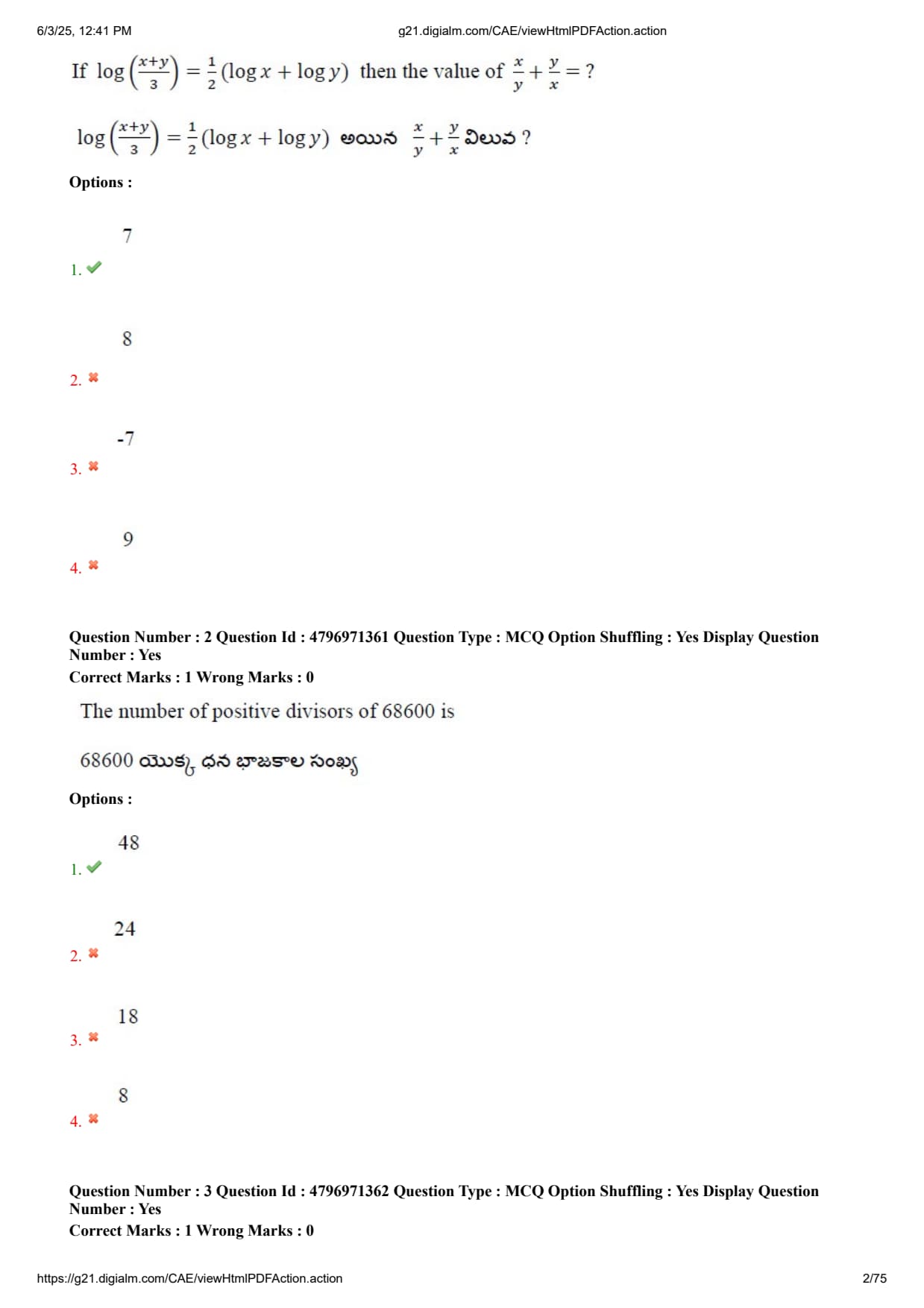
Question 1:

If \(\log{\left(\frac{x+y}{3}\right)} = \frac{1}{2} \left(\log{x} + \log{y}\right)\) then the value of \(\frac{x}{y} + \frac{y}{x}\) is?

  • (A) 7
  • (B) 8
  • (C) -7
  • (D) 9
Correct Answer: (A) 7
View Solution

Step 1: Given equation.

The given equation is \[ \log{\left(\frac{x+y}{3}\right)} = \frac{1}{2} \left(\log{x} + \log{y}\right). \]

Step 2: Simplify the equation.

Using the logarithmic identity \(\log{a} + \log{b} = \log{(ab)}\), we can rewrite the equation as: \[ \log{\left(\frac{x+y}{3}\right)} = \frac{1}{2} \log{(xy)}. \]
Now, use the property \(\frac{1}{2} \log{(xy)} = \log{\sqrt{xy}}\) to obtain: \[ \log{\left(\frac{x+y}{3}\right)} = \log{\sqrt{xy}}. \]

Step 3: Equate the arguments.

Since the logarithms are equal, their arguments must also be equal. Thus: \[ \frac{x+y}{3} = \sqrt{xy}. \]
Multiplying both sides by 3: \[ x + y = 3\sqrt{xy}. \]

Step 4: Find the value of \(\frac{x}{y} + \frac{y}{x}\).

Now, square both sides of the equation \(x + y = 3\sqrt{xy}\) to obtain: \[ (x + y)^2 = 9xy. \]
Expanding the left-hand side: \[ x^2 + 2xy + y^2 = 9xy. \]
Rearranging the terms: \[ x^2 + y^2 = 7xy. \]
Now, divide both sides by \(xy\): \[ \frac{x^2}{xy} + \frac{y^2}{xy} = 7. \]
Simplifying: \[ \frac{x}{y} + \frac{y}{x} = 7. \]


Final Answer: 7.
Quick Tip: To solve logarithmic equations, use properties such as \(\log{a} + \log{b} = \log{(ab)}\) and \(\frac{1}{2} \log{a} = \log{\sqrt{a}}\) to simplify the expressions.


Question 2:

The number of positive divisors of 68600 is

  • (A) 48
  • (B) 24
  • (C) 18
  • (D) 8
Correct Answer: (A) 48
View Solution

1. Perform Prime Factorization

To determine the number of divisors, we start by finding the prime factorization of 68600. We can break down the number as follows:
\[ 68600 = 686 \times 100 \]

Now, factor 686 and 100:
\[ 686 = 2 \times 343 = 2 \times 7^3 \quad (Factor of 686) \] \[ 100 = 10^2 = (2 \times 5)^2 = 2^2 \times 5^2 \quad (Factor of 100) \]

Combining these results, the prime factorization of 68600 is:
\[ 68600 = 2^3 \times 5^2 \times 7^3 \]


2. Apply the Divisor Counting Formula

The number of positive divisors of a number is given by the formula:
\[ Total Divisors = (a+1)(b+1)(c+1) \]

where \(a, b, c\) are the exponents in the prime factorization of the number. For 68600, the exponents are \(a = 3\) (for \(2^3\)), \(b = 2\) (for \(5^2\)), and \(c = 3\) (for \(7^3\)).

Using the formula:
\[ Total Divisors = (3+1)(2+1)(3+1) = 4 \times 3 \times 4 = 48 \]


Final Answer
The number of positive divisors of 68600 is \( \boxed{48} \). Quick Tip: To find the number of divisors of a number, express it in terms of its prime factorization, then apply the formula by adding 1 to each of the exponents and multiplying the results.


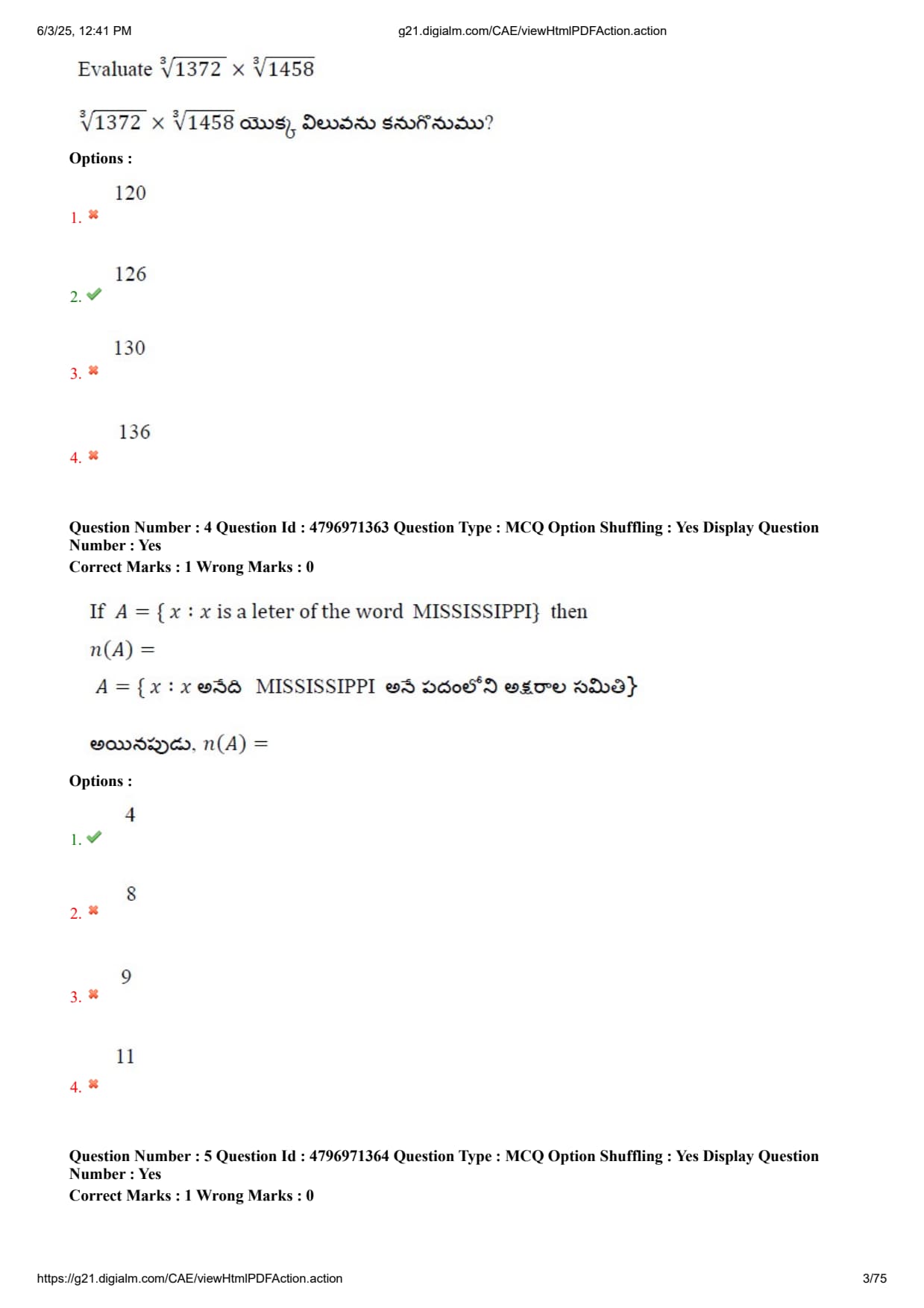
Question 3:

Evaluate \(\sqrt[3]{1372} \times \sqrt[3]{1458}\)

  • (A) 120
  • (B) 126
  • (C) 130
  • (D) 136
Correct Answer: (B) 126
View Solution

Step 1: Understanding the expression.

The problem asks us to evaluate the product of the cube roots of 1372 and 1458. This can be simplified using the property of cube roots: \[ \sqrt[3]{a} \times \sqrt[3]{b} = \sqrt[3]{a \times b} \]

Step 2: Multiply the numbers under the cube root.

We first multiply 1372 and 1458: \[ 1372 \times 1458 = 2000256 \]

Step 3: Take the cube root of the product.

Now, we find the cube root of 2000256: \[ \sqrt[3]{2000256} = 126 \]

Step 4: Conclusion.

Therefore, the correct answer is 126.


Final Answer: 126. Quick Tip: When multiplying cube roots, you can simplify the expression by multiplying the numbers inside the cube root and then taking the cube root of the product.


Question 4:

If A = { x : x is a letter of the word MISSISSIPPI}, then \( n(A) = \)

  • (A) 4
  • (B) 8
  • (C) 9
  • (D) 11
Correct Answer: (A) 4
View Solution

Step 1: Understanding the set \( A \).


The set \( A \) contains the distinct letters from the word "MISSISSIPPI". The distinct letters in this word are M, I, S, and P.

Step 2: Count the distinct letters.


From the word "MISSISSIPPI", we extract the following distinct letters: \[ A = \{ M, I, S, P \} \]

So, the number of distinct elements in \( A \), denoted \( n(A) \), is 4.

Step 3: Conclusion.


Therefore, \( n(A) = 4 \).


Final Answer: 4. Quick Tip: When finding the number of elements in a set, always consider only the distinct elements in the set. Repeated elements are not counted.


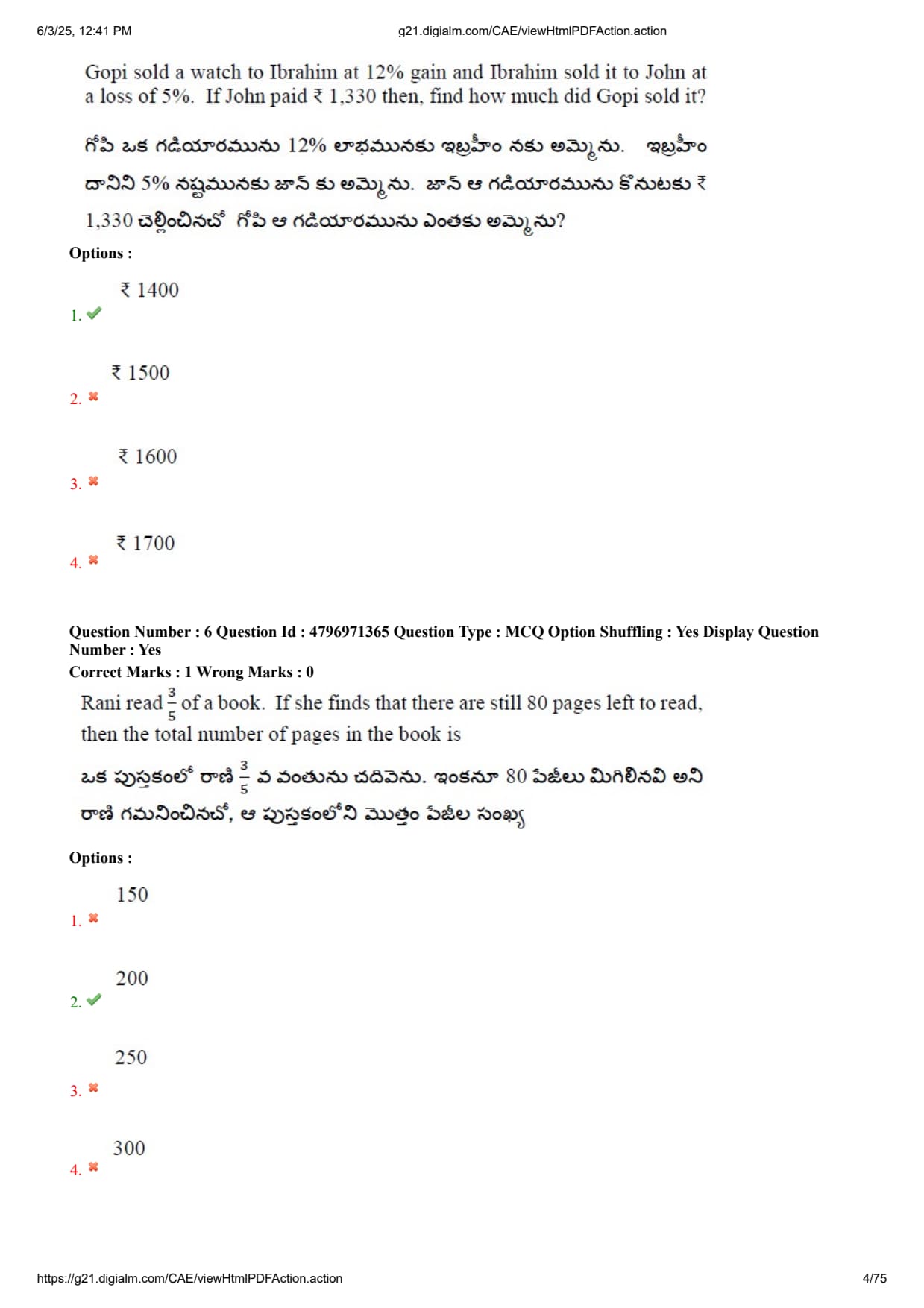
Question 5:

Gopi sold a watch to Ibrahim at 12% gain and Ibrahim sold it to John at a loss of 5%. If John paid ₹ 1,330, then find how much did Gopi sell it?

  • (A) ₹ 1400
  • (B) ₹ 1500
  • (C) ₹ 1600
  • (D) ₹ 1700
Correct Answer: (A) ₹ 1400
View Solution

Step 1: Understanding the problem.

Gopi sold the watch to Ibrahim at a 12% gain. Ibrahim then sold it to John at a 5% loss. We are given that John paid ₹ 1,330. We need to determine the price at which Gopi sold the watch to Ibrahim.

Step 2: Let the price at which Gopi sold the watch be x.

Gopi's selling price to Ibrahim = \( x \). Ibrahim's selling price to John = \( 0.95x \), since he sold it at a 5% loss.

Step 3: Relating the final price.

We know that John paid ₹ 1,330 for the watch, so: \[ 0.95x = 1330 \]
Solving for \( x \), we get: \[ x = \frac{1330}{0.95} = 1400 \]

Step 4: Conclusion.

Therefore, Gopi sold the watch to Ibrahim for ₹ 1400.


Final Answer: ₹ 1400. Quick Tip: When solving profit and loss problems, always express the selling price as a percentage of the cost price. In this case, Gopi's price to Ibrahim was the cost price for Ibrahim, and the loss for Ibrahim is applied to determine John's price.


Question 6:

Rani read \(\frac{3}{5}\) of a book. If she finds that there are still 80 pages left to read, then the total number of pages in the book is.

  • (A) 150
  • (B) 200
  • (C) 250
  • (D) 300
Correct Answer: (B) 200
View Solution

Step 1: Let the total number of pages be \(x\).

Rani has read \(\frac{3}{5}\) of the book, and there are still 80 pages left to read. The remaining portion of the book, therefore, is \(1 - \frac{3}{5} = \frac{2}{5}\).

Step 2: Set up the equation.

The remaining pages \(\frac{2}{5}x\) are given as 80. Therefore, we can write the equation: \[ \frac{2}{5}x = 80. \]

Step 3: Solve for \(x\).

To find \(x\), multiply both sides of the equation by \(\frac{5}{2}\): \[ x = 80 \times \frac{5}{2} = 200. \]

Step 4: Conclusion.

Thus, the total number of pages in the book is \(x = 200\).


Final Answer: 200.
Quick Tip: To solve such problems, always express the portion of the book read and the remaining part as fractions of the total number of pages.


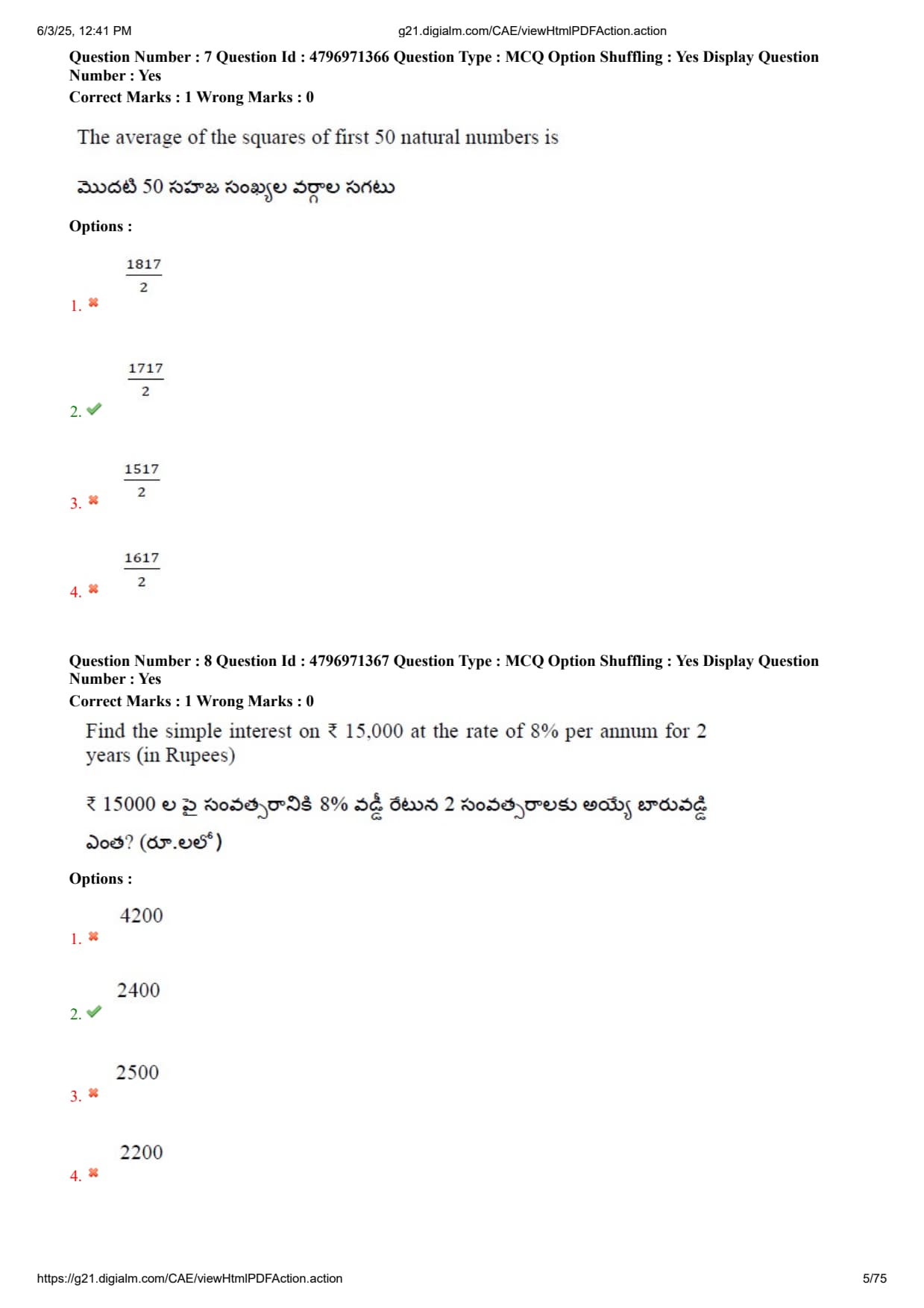
Question 7:

The average of the squares of the first 50 natural numbers is

  • (A) \( \dfrac{1817}{2} \)
  • (B) \( \dfrac{1717}{2} \)
  • (C) \( \dfrac{1517}{2} \)
  • (D) \( \dfrac{1617}{2} \)
Correct Answer: (B) \( \dfrac{1717}{2} \)
View Solution

Step 1: Formula for the average of squares.


The average of the squares of the first \( n \) natural numbers is given by the formula: \[ Average = \dfrac{1^2 + 2^2 + 3^2 + \dots + n^2}{n}. \]
The sum of the squares of the first \( n \) natural numbers is given by: \[ Sum of squares = \dfrac{n(n + 1)(2n + 1)}{6}. \]

Step 2: Apply the formula for \( n = 50 \).


Substitute \( n = 50 \) into the formula: \[ Sum of squares = \dfrac{50(50 + 1)(2 \times 50 + 1)}{6} = \dfrac{50 \times 51 \times 101}{6} = 42925. \]

Now, the average is: \[ Average = \dfrac{42925}{50} = \dfrac{1717}{2}. \]

Step 3: Conclusion.


Thus, the average of the squares of the first 50 natural numbers is \( \dfrac{1717}{2} \).


Final Answer: \( \dfrac{1717}{2} \). Quick Tip: The sum of squares of the first \( n \) natural numbers can be calculated using the formula \( \dfrac{n(n + 1)(2n + 1)}{6} \), and the average is obtained by dividing the sum by \( n \).


Question 8:

Find the simple interest on ₹ 15,000 at the rate of 8% per annum for 2 years (in Rupees)

  • (A) 4200
  • (B) 2400
  • (C) 2500
  • (D) 2200
Correct Answer: (B) 2400
View Solution

Step 1: Formula for Simple Interest.

The formula for calculating simple interest is: \[ Simple Interest = \frac{P \times R \times T}{100} \]
Where: \( P \) is the principal amount, \( R \) is the rate of interest per annum, and \( T \) is the time in years.


Step 2: Apply the given values.

Here, \( P = 15,000 \), \( R = 8% \), \( T = 2 \, years \).


Now substitute the values into the formula: \[ Simple Interest = \frac{15,000 \times 8 \times 2}{100} = \frac{240,000}{100} = 2400 \]

Step 3: Conclusion.

Therefore, the simple interest is ₹ 2400.


Final Answer: ₹ 2400. Quick Tip: To calculate simple interest, always use the formula: \[ Simple Interest = \frac{P \times R \times T}{100} \] Make sure to check the units for time and rate before substituting values into the formula.


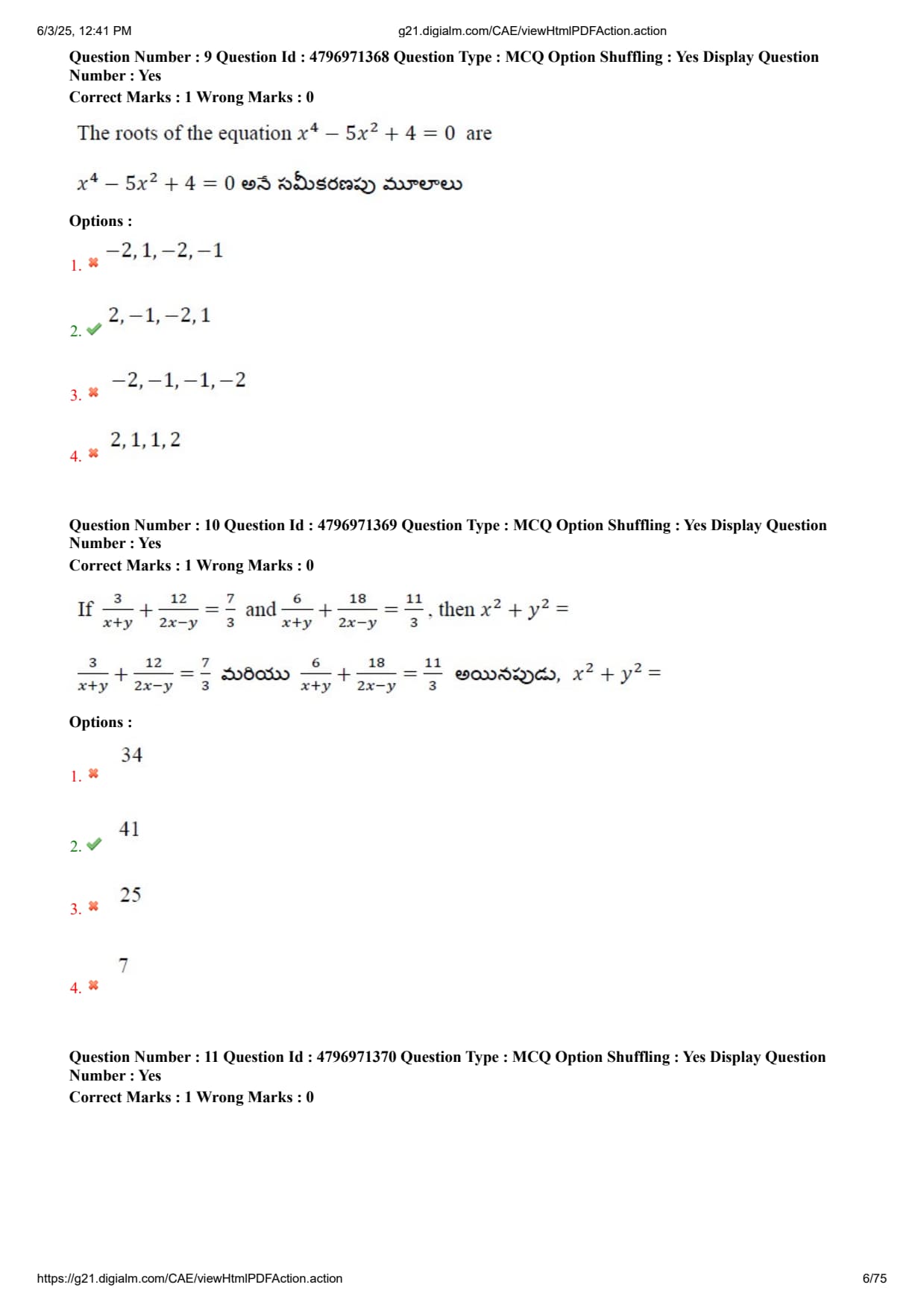
Question 9:

The roots of the equation \( x^4 - 5x^2 + 4 = 0 \) are

  • (A) -2, 1, -2, -1
  • (B) 2, -1, -2, 1
  • (C) -2, -1, -1, -2
  • (D) 2, 1, 1, 2
Correct Answer: (B) 2, -1, -2, 1
View Solution

Step 1: Rewriting the equation.


The given equation is \( x^4 - 5x^2 + 4 = 0 \). Let \( y = x^2 \), so the equation becomes: \[ y^2 - 5y + 4 = 0 \]

Step 2: Solving the quadratic equation.


Now, solve the quadratic equation \( y^2 - 5y + 4 = 0 \) by factoring: \[ (y - 1)(y - 4) = 0 \]

So, \( y = 1 \) or \( y = 4 \).

Step 3: Substituting \( y = x^2 \).


Since \( y = x^2 \), we substitute back to find the roots of \( x \):

- For \( y = 1 \), \( x^2 = 1 \), so \( x = 1 \) or \( x = -1 \).

- For \( y = 4 \), \( x^2 = 4 \), so \( x = 2 \) or \( x = -2 \).


Step 4: Conclusion.


Therefore, the roots of the equation are \( 2, -1, -2, 1 \).


Final Answer: 2, -1, -2, 1. Quick Tip: When solving quadratic equations in terms of \( x^2 \), make sure to consider both positive and negative square roots.


Question 10:

If \[ \frac{3}{x + y} + \frac{12}{2x - y} = \frac{7}{3} and \frac{6}{x + y} + \frac{18}{2x - y} = \frac{11}{3}, then x^2 + y^2 = \]

  • (A) 34
  • (B) 41
  • (C) 25
  • (D) 7
Correct Answer: (B) 41
View Solution

Step 1: Defining variables.

Let \( a = x + y \) and \( b = 2x - y \). The given equations then become:
\[ \frac{3}{a} + \frac{12}{b} = \frac{7}{3} \quad (A) \] \[ \frac{6}{a} + \frac{18}{b} = \frac{11}{3} \quad (B) \]

Step 2: Solving the system of equations.

We can multiply equation (A) by 2 and subtract from equation (B) to eliminate \( a \).

Multiplying (A) by 2: \[ \frac{6}{a} + \frac{24}{b} = \frac{14}{3} \quad (C) \]

Now subtract equation (B) from equation (C): \[ \left( \frac{6}{a} + \frac{24}{b} \right) - \left( \frac{6}{a} + \frac{18}{b} \right) = \frac{14}{3} - \frac{11}{3} \] \[ \frac{6}{b} = \frac{3}{3} = 1 \]
Thus, \[ b = 6 \]

Step 3: Substituting \( b = 6 \) in equation (A).

Substitute \( b = 6 \) in equation (A): \[ \frac{3}{a} + \frac{12}{6} = \frac{7}{3} \] \[ \frac{3}{a} + 2 = \frac{7}{3} \] \[ \frac{3}{a} = \frac{7}{3} - 2 = \frac{1}{3} \]
Thus, \[ a = 9 \]

Step 4: Finding \( x^2 + y^2 \).

We now have \( a = x + y = 9 \) and \( b = 2x - y = 6 \). Solve these two equations:

1) \( x + y = 9 \)

2) \( 2x - y = 6 \)

Add these equations: \[ x + y + 2x - y = 9 + 6 \] \[ 3x = 15 \] \[ x = 5 \]

Substitute \( x = 5 \) into \( x + y = 9 \): \[ 5 + y = 9 \] \[ y = 4 \]

Finally, calculate \( x^2 + y^2 \): \[ x^2 + y^2 = 5^2 + 4^2 = 25 + 16 = 41 \]


Final Answer: 41. Quick Tip: When solving simultaneous equations, defining new variables can often simplify the process. Remember to substitute back carefully to find the final solution.


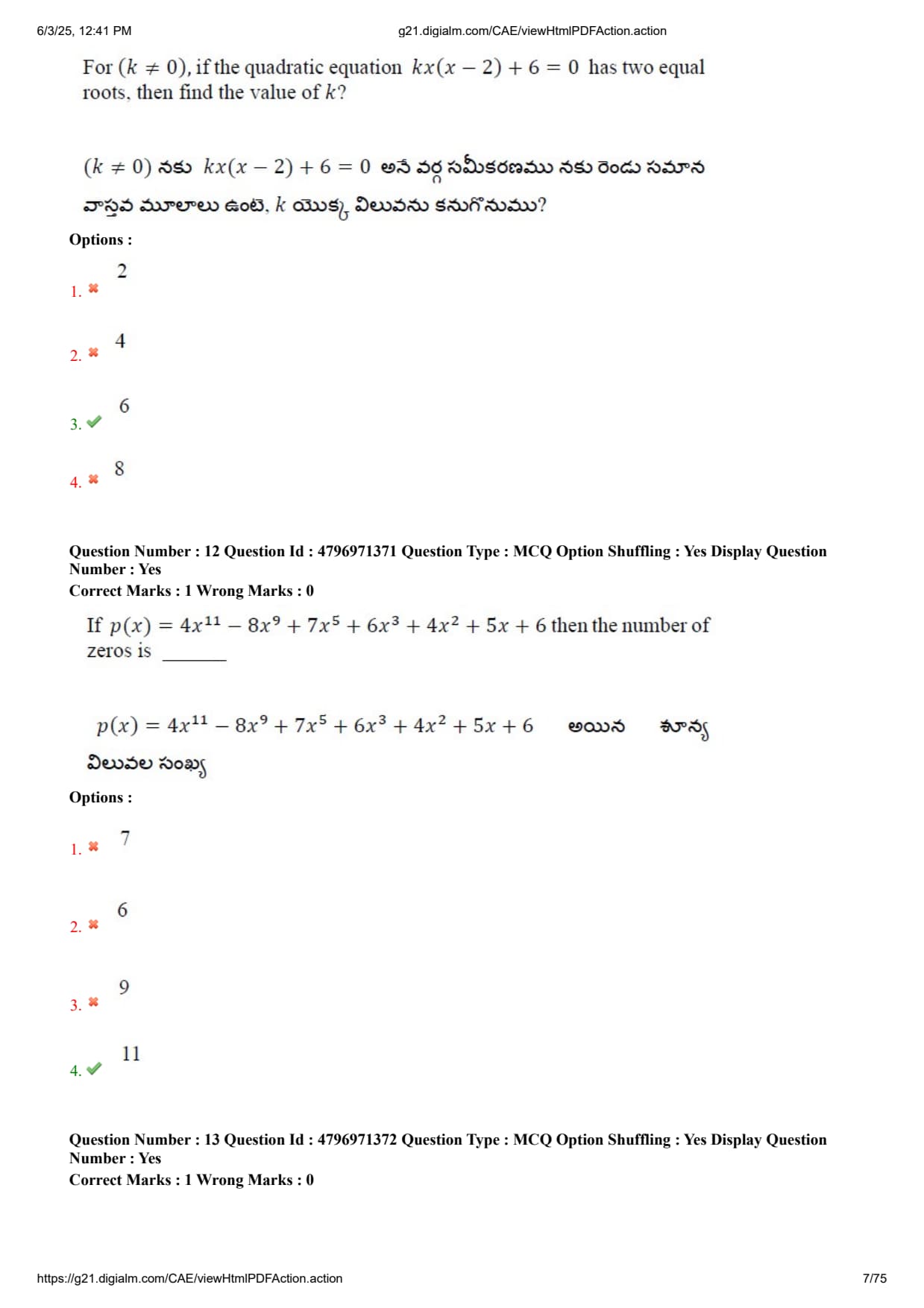
Question 11:

For \((k \neq 0)\), if the quadratic equation \(kx(x - 2) + 6 = 0\) has two equal roots, then find the value of \(k\).

  • (A) 2
  • (B) 4
  • (C) 6
  • (D) 8
Correct Answer: (C) 6
View Solution


Step 1: General form of the quadratic equation.

The given quadratic equation is: \[ kx(x - 2) + 6 = 0. \]
Expanding the equation: \[ kx^2 - 2kx + 6 = 0. \]

Step 2: Condition for equal roots.

For a quadratic equation \(ax^2 + bx + c = 0\) to have equal roots, the discriminant \(\Delta\) must be zero. The discriminant is given by: \[ \Delta = b^2 - 4ac. \]
Here, \(a = k\), \(b = -2k\), and \(c = 6\). Substituting these values into the discriminant formula: \[ \Delta = (-2k)^2 - 4(k)(6) = 4k^2 - 24k. \]
For the roots to be equal, \(\Delta = 0\), so: \[ 4k^2 - 24k = 0. \]

Step 3: Solve for \(k\).

Factorizing the equation: \[ 4k(k - 6) = 0. \]
Thus, \(k = 0\) or \(k = 6\). Since \(k \neq 0\), we conclude that: \[ k = 6. \]


Final Answer: 6.
Quick Tip: For a quadratic equation to have equal roots, the discriminant \(\Delta = b^2 - 4ac\) must be zero.


Question 12:

If \(p(x) = 4x^{11} - 8x^9 + 7x^5 + 6x^3 + 4x^2 + 5x + 6\), then the number of zeros is ______ .

  • (A) 7
  • (B) 6
  • (C) 9
  • (D) 11
Correct Answer: (D) 11
View Solution


Step 1: Polynomial Degree.

The given polynomial is: \[ p(x) = 4x^{11} - 8x^9 + 7x^5 + 6x^3 + 4x^2 + 5x + 6. \]
The degree of the polynomial is determined by the highest power of \(x\), which is 11. Hence, the polynomial is of degree 11.

Step 2: Maximum Number of Zeros.

According to the Fundamental Theorem of Algebra, a polynomial of degree \(n\) has at most \(n\) real or complex roots (zeros). Therefore, the polynomial can have at most 11 zeros.

Step 3: Conclusion.

Since the degree of the polynomial is 11, the number of zeros is at most 11. Therefore, the number of zeros is 11.


Final Answer: 11.
Quick Tip: The degree of a polynomial gives the maximum number of real or complex zeros it can have.


Question 13:

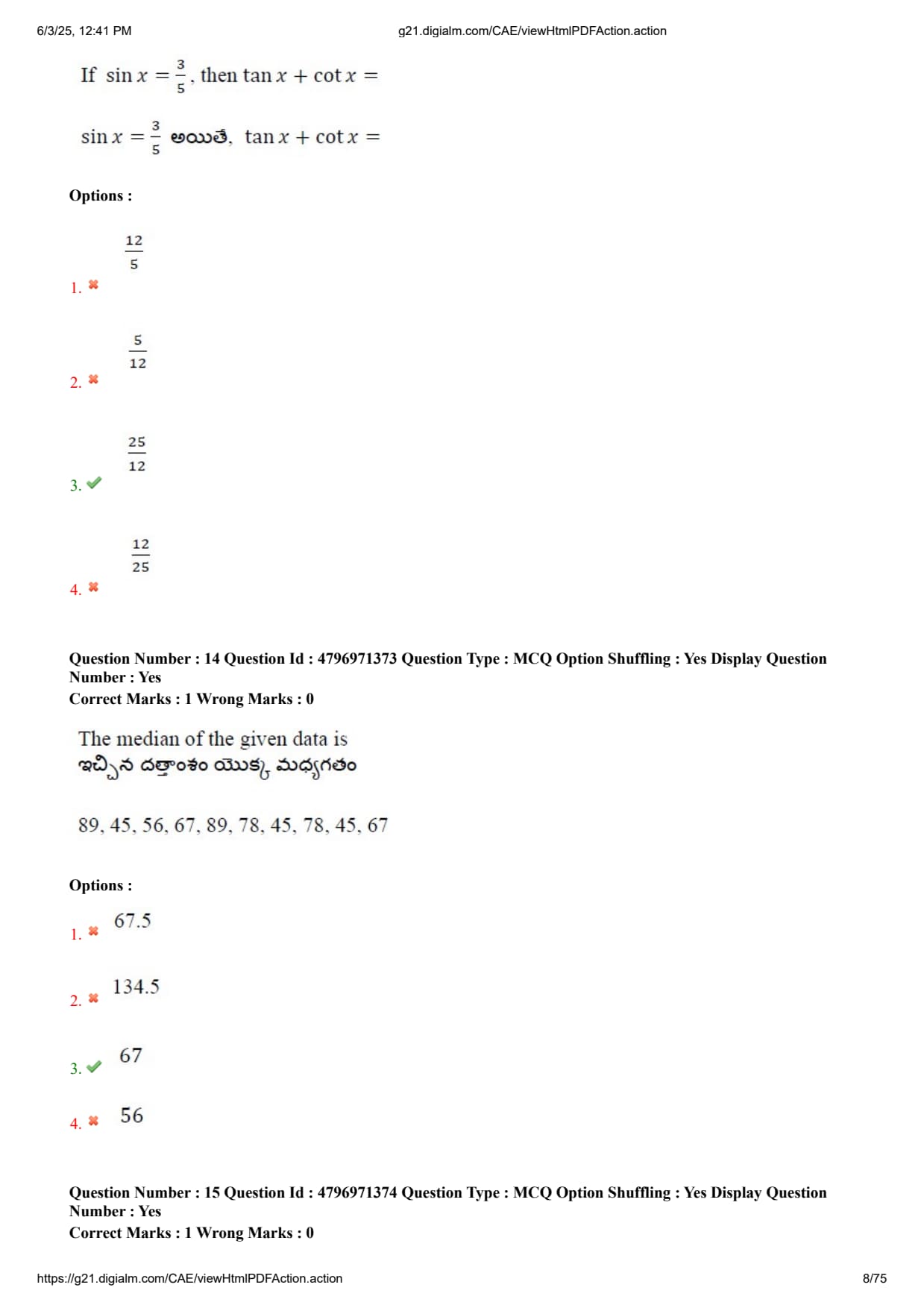
If \( \sin x = \dfrac{3}{5} \), then \( \tan x + \cot x = \)

  • (A) \( \dfrac{12}{5} \)
  • (B) \( \dfrac{5}{12} \)
  • (C) \( \dfrac{25}{12} \)
  • (D) \( \dfrac{12}{25} \)
Correct Answer: (C) \( \dfrac{25}{12} \)
View Solution


Step 1: Use the identity for \( \tan x + \cot x \).


We use the identity: \[ \tan x + \cot x = \dfrac{\sin x}{\cos x} + \dfrac{\cos x}{\sin x} = \dfrac{\sin^2 x + \cos^2 x}{\sin x \cos x}. \]
Since \( \sin^2 x + \cos^2 x = 1 \), the formula simplifies to: \[ \tan x + \cot x = \dfrac{1}{\sin x \cos x}. \]

Step 2: Find \( \cos x \).


Using the identity \( \sin^2 x + \cos^2 x = 1 \), we can find \( \cos x \): \[ \cos x = \sqrt{1 - \sin^2 x} = \sqrt{1 - \left( \dfrac{3}{5} \right)^2} = \sqrt{1 - \dfrac{9}{25}} = \sqrt{\dfrac{16}{25}} = \dfrac{4}{5}. \]

Step 3: Calculate \( \tan x + \cot x \).


Now, using \( \sin x = \dfrac{3}{5} \) and \( \cos x = \dfrac{4}{5} \), we find: \[ \tan x + \cot x = \dfrac{1}{\sin x \cos x} = \dfrac{1}{\dfrac{3}{5} \times \dfrac{4}{5}} = \dfrac{1}{\dfrac{12}{25}} = \dfrac{25}{12}. \]

Step 4: Conclusion.


Thus, \( \tan x + \cot x = \dfrac{25}{12} \).


Final Answer: \( \dfrac{25}{12} \). Quick Tip: To find \( \tan x + \cot x \), use the identity \( \tan x + \cot x = \dfrac{1}{\sin x \cos x} \).


Question 14:

The median of the given data is
89, 45, 56, 67, 89, 45, 78, 45, 78, 45, 67

  • (A) 67.5
  • (B) 134.5
  • (C) 67
  • (D) 56
Correct Answer: (C) 67
View Solution


Step 1: Organize the data.


The given data set is:
89, 45, 56, 67, 89, 45, 78, 45, 78, 45, 67.

Arrange the data in ascending order: \[ 45, 45, 45, 56, 67, 67, 78, 78, 89, 89. \]

Step 2: Find the median.


The median is the middle number of a data set. For an odd number of values, it is the middle one. For an even number of values, it is the average of the two middle values. Here, we have 11 values, so the middle value is the 6th value.

The 6th value is 67.

Step 3: Conclusion.


Therefore, the median is 67.


Final Answer: 67. Quick Tip: To find the median, first arrange the data in ascending order and then select the middle value. If there are an even number of values, take the average of the two middle values.


Question 15:

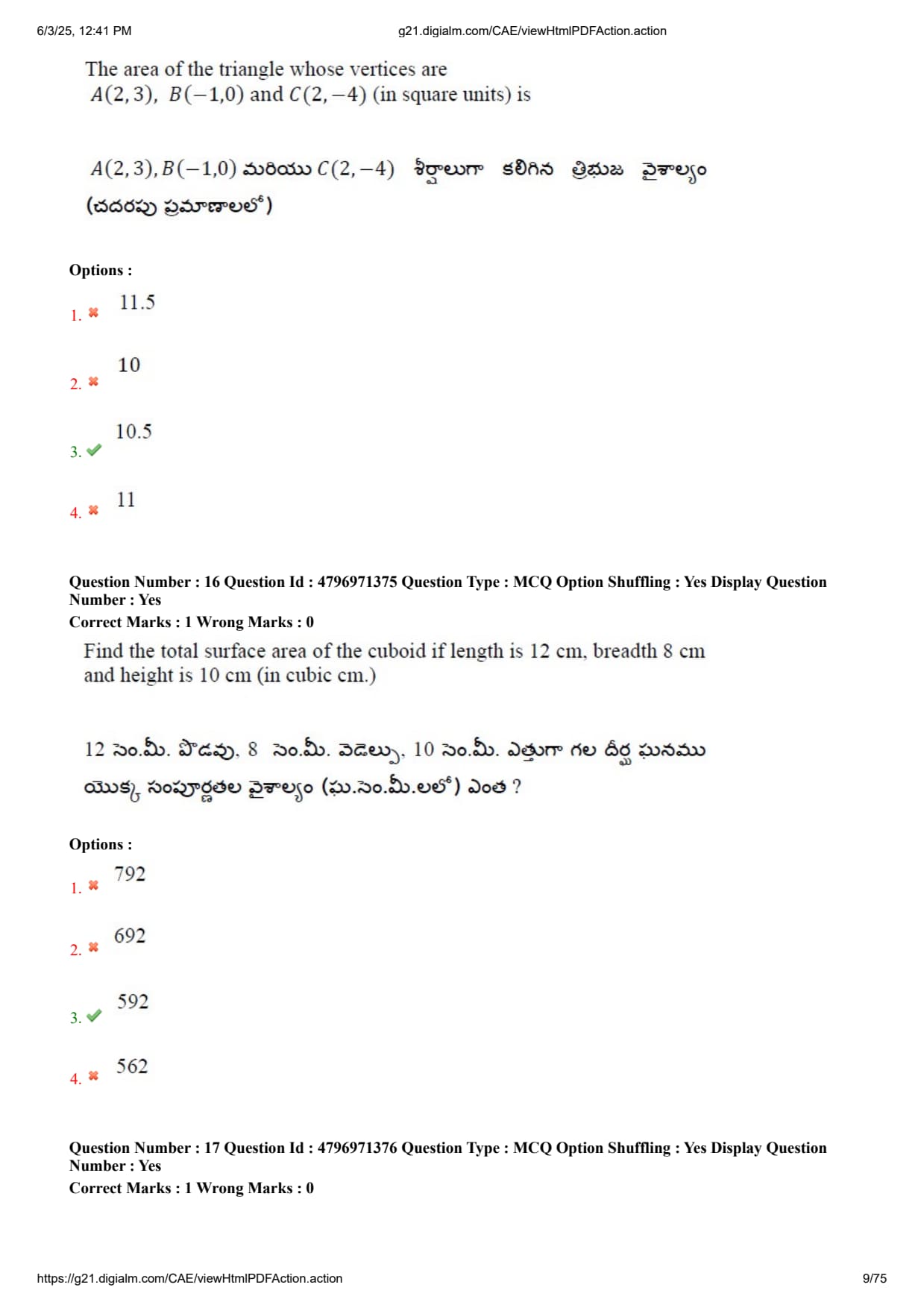
The area of the triangle whose vertices are A(2, 3), B(−1, 0) and C(2, −4) (in square units) is

  • (A) 11.5
  • (B) 10
  • (C) 10.5
  • (D) 11
Correct Answer: (C) 10.5
View Solution


Step 1: Formula for the Area of a Triangle.

The formula for the area of a triangle given its vertices \( A(x_1, y_1) \), \( B(x_2, y_2) \), and \( C(x_3, y_3) \) is: \[ Area = \frac{1}{2} \left| x_1(y_2 - y_3) + x_2(y_3 - y_1) + x_3(y_1 - y_2) \right| \]

Step 2: Apply the given coordinates.

For \( A(2, 3) \), \( B(-1, 0) \), and \( C(2, -4) \), we substitute the coordinates into the formula: \[ Area = \frac{1}{2} \left| 2(0 - (-4)) + (-1)((-4) - 3) + 2(3 - 0) \right| \] \[ Area = \frac{1}{2} \left| 2(D) + (-1)(-7) + 2(C) \right| \] \[ Area = \frac{1}{2} \left| 8 + 7 + 6 \right| = \frac{1}{2} \times 21 = 10.5 \]

Step 3: Conclusion.

Therefore, the area of the triangle is \( 10.5 \) square units.


Final Answer: 10.5. Quick Tip: When calculating the area of a triangle using its vertices, use the formula involving the determinant of the matrix formed by the coordinates.


Question 16:

Find the total surface area of the cuboid if length is 12 cm, breadth 8 cm and height is 10 cm (in cubic cm.)

  • (A) 792
  • (B) 692
  • (C) 592
  • (D) 562
Correct Answer: (C) 592
View Solution


Step 1: Formula for Total Surface Area of a Cuboid.

The formula for the total surface area of a cuboid is: \[ Surface Area = 2 \left( l \times b + b \times h + h \times l \right) \]
Where: \( l \) is the length, \( b \) is the breadth, and \( h \) is the height of the cuboid.

Step 2: Apply the given values.

Here, \( l = 12 \, cm \), \( b = 8 \, cm \), \( h = 10 \, cm \).


Substitute these values into the formula: \[ Surface Area = 2 \left( 12 \times 8 + 8 \times 10 + 10 \times 12 \right) \] \[ Surface Area = 2 \left( 96 + 80 + 120 \right) = 2 \times 296 = 592 \]

Step 3: Conclusion.

Therefore, the total surface area of the cuboid is \( 592 \, cm^2 \).


Final Answer: 592. Quick Tip: For a cuboid, remember to apply the surface area formula: \[ 2(l \times b + b \times h + h \times l) \] This formula sums the areas of all six faces of the cuboid.


Question 17:

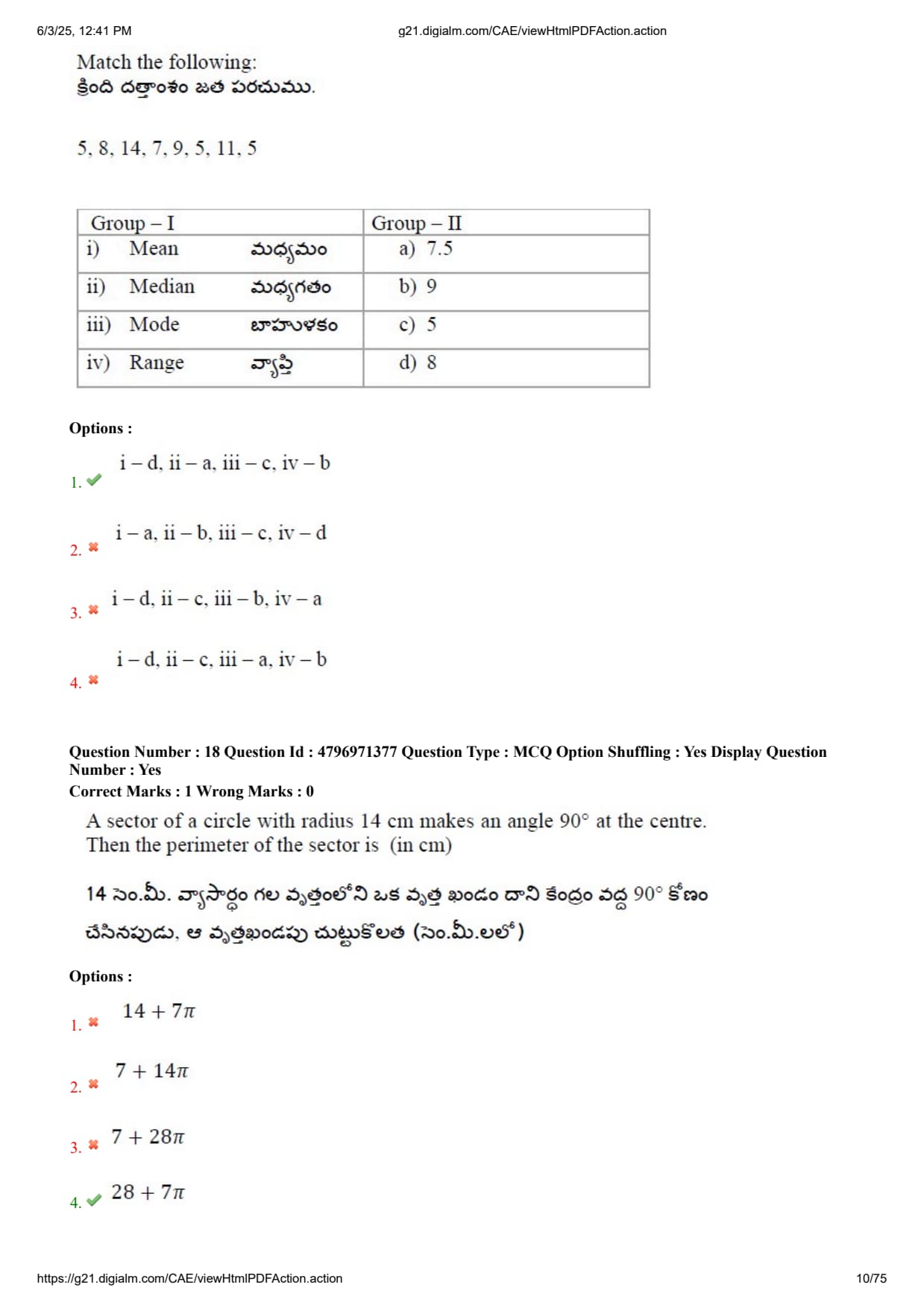
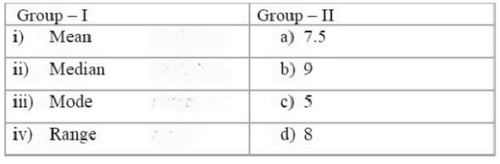
Match the following:

  • (A) i - d, ii - a, iii - c, iv - b
  • (B) i - a, ii - b, iii - c, iv - d
  • (C) i - d, ii - c, iii - b, iv - a
  • (D) i - d, ii - c, iii - a, iv - b
Correct Answer: (A) i - d, ii - a, iii - c, iv - b
View Solution


Step 1: Understand the terms.


- Mean: The average of the numbers.

- Median: The middle number in an ordered data set.

- Mode: The most frequent number in a data set.

- Range: The difference between the highest and lowest values in the data.


Step 2: Match with the values.


Given the numbers 5, 8, 14, 7, 9, 11, 5, we calculate:


- Mean: \( \frac{5 + 8 + 14 + 7 + 9 + 11 + 5}{7} = 7.5 \)

- Median: The middle value of the sorted list (5, 5, 7, 8, 9, 11, 14) is 9.

- Mode: The most frequent value is 5.

- Range: \( 14 - 5 = 8 \)


Thus, the correct matching is \( i - d, ii - a, iii - c, iv - b \).


Final Answer: i - d, ii - a, iii - c, iv - b.
Quick Tip: When solving for mean, median, and mode, always first arrange the data in order and then apply the appropriate formula.


Question 18:

A sector of a circle with radius 14 cm makes an angle 90° at the centre. Then the perimeter of the sector is (in cm).

  • (A) 14 + 7π
  • (B) 7 + 14π
  • (C) 7 + 28π
  • (D) 28 + 7π
Correct Answer: (A) 14 + 7π
View Solution


Step 1: Understanding the formula.


The perimeter \( P \) of a sector is given by:
\[ P = 2r + \theta \cdot r \]
where \( r \) is the radius and \( \theta \) is the angle in radians.


Step 2: Convert the angle to radians.


For an angle of \( 90° \), the angle in radians is:
\[ \theta = \frac{90°}{180°} \cdot \pi = \frac{\pi}{2} \]

Step 3: Calculate the perimeter.


Substitute the values \( r = 14 \) cm and \( \theta = \frac{\pi}{2} \) into the perimeter formula:
\[ P = 2(14) + \frac{\pi}{2} \cdot 14 = 28 + 7\pi \]

Step 4: Conclusion.


Therefore, the perimeter of the sector is \( 28 + 7\pi \) cm.


Final Answer: 28 + 7π.
Quick Tip: Remember to convert the angle to radians before using the formula for the perimeter of a sector.


Question 19:

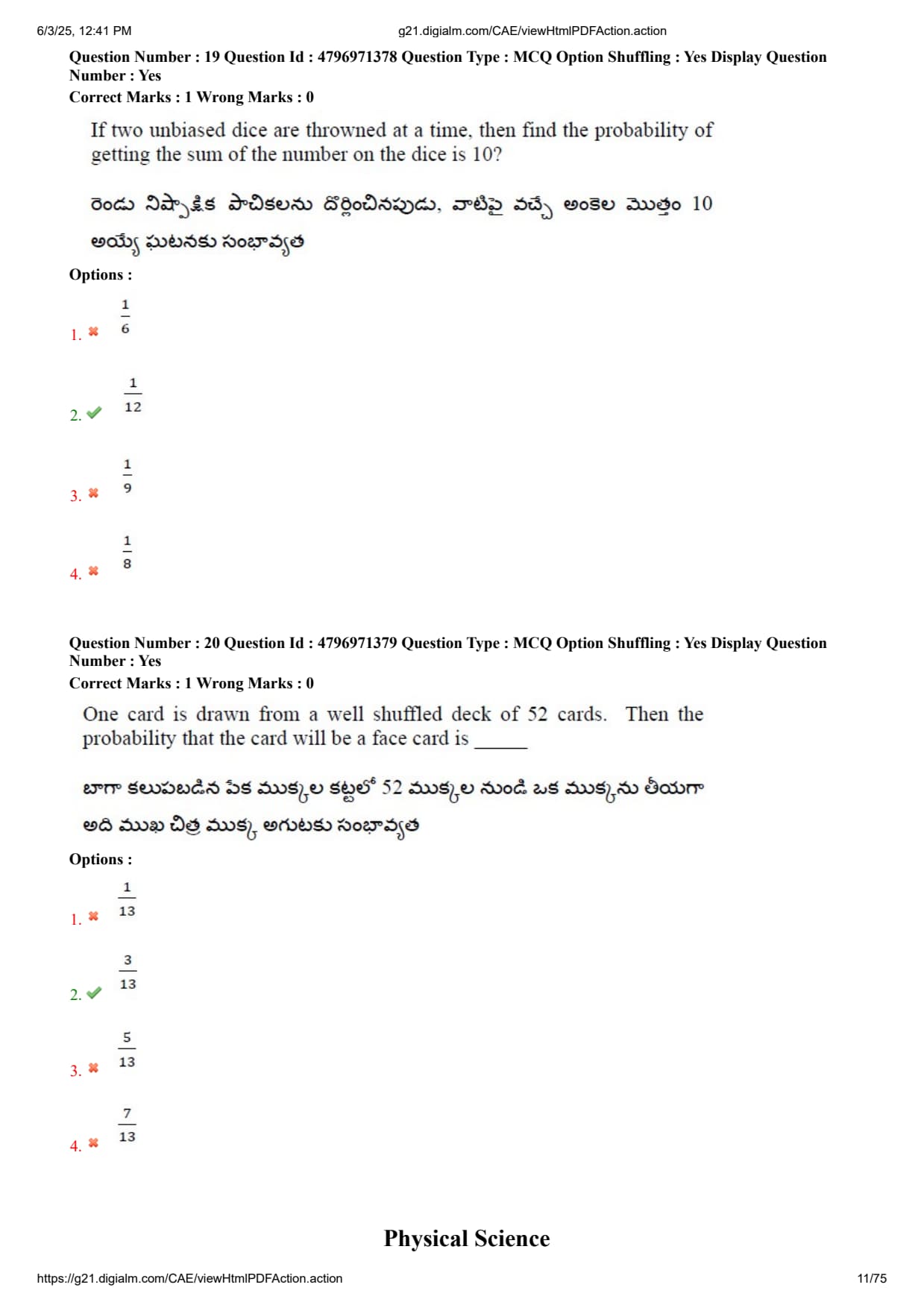
If two unbiased dice are thrown at a time, then find the probability of getting the sum of the number on the dice is 10?

  • (A) \( \frac{1}{6} \)
  • (B) \( \frac{1}{12} \)
  • (C) \( \frac{1}{9} \)
  • (D) \( \frac{1}{8} \)
Correct Answer: (B) \( \frac{1}{12} \)
View Solution


Step 1: Total outcomes.

When two unbiased dice are thrown, the total number of possible outcomes is the product of the number of faces on each die, which is: \[ 6 \times 6 = 36 \]
So, there are 36 possible outcomes.

Step 2: Favorable outcomes.

We need to find the favorable outcomes where the sum of the numbers on the two dice is 10. The possible pairs of numbers that sum to 10 are: \[ (4, 6), (5, 5), (6, 4) \]
Thus, there are 3 favorable outcomes.

Step 3: Probability.

The probability of an event is given by: \[ Probability = \frac{Number of favorable outcomes}{Total number of outcomes} = \frac{3}{36} = \frac{1}{12} \]


Final Answer: \( \frac{1}{12} \). Quick Tip: When calculating the probability of an event, make sure to count the favorable outcomes correctly. In this case, count all the pairs that add up to the desired sum.


Question 20:

One card is drawn from a well shuffled deck of 52 cards. Then the probability that the card will be a face card is ________

  • (A) \( \frac{1}{13} \)
  • (B) \( \frac{3}{13} \)
  • (C) \( \frac{5}{13} \)
  • (D) \( \frac{7}{13} \)
Correct Answer: (B) \( \frac{3}{13} \)
View Solution


Step 1: Total outcomes.

The total number of outcomes is the number of cards in the deck, which is 52.

Step 2: Face cards.

In a deck of 52 cards, there are 3 face cards (Jack, Queen, King) in each suit. So, the total number of face cards is: \[ 3 \times 4 = 12 \]

Step 3: Probability.

The probability of drawing a face card is: \[ Probability = \frac{Number of face cards}{Total number of cards} = \frac{12}{52} = \frac{3}{13} \]


Final Answer: \( \frac{3}{13} \). Quick Tip: When calculating probabilities, remember to count only the specific type of event (like face cards here) in the total possible outcomes.


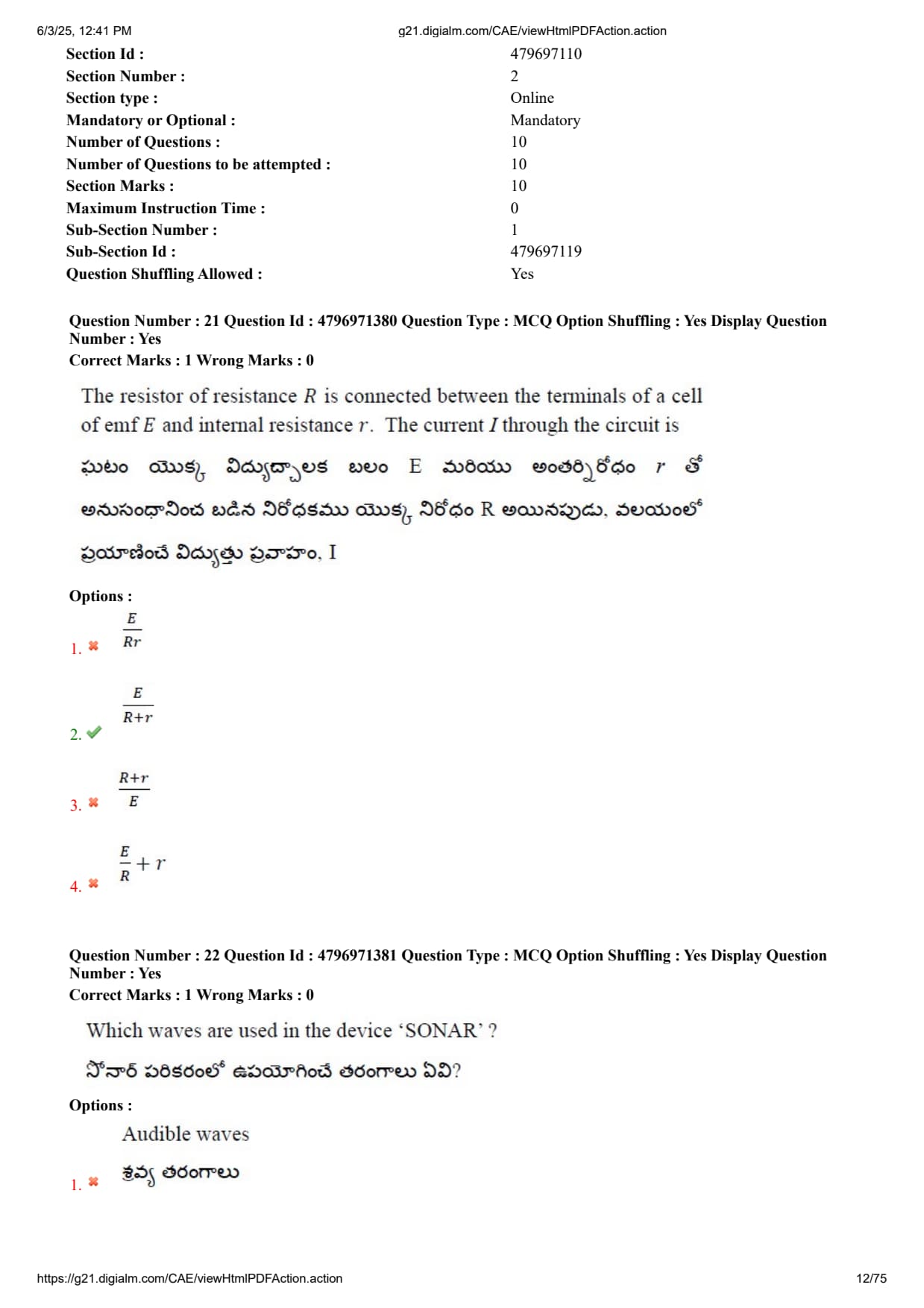
Question 21:

The resistor of resistance \(R\) is connected between the terminals of a cell of emf \(E\) and internal resistance \(r\). The current \(I\) through the circuit is

  • (A) \(\frac{E}{r}\)
  • (B) \(\frac{E}{R + r}\)
  • (C) \(\frac{R + r}{E}\)
  • (D) \(\frac{E}{R + r}\)
Correct Answer: (B) \(\frac{E}{R + r}\)
View Solution


Step 1: Applying Ohm's Law.

Ohm’s law states that the current \(I\) is given by the total emf divided by the total resistance in the circuit: \[ I = \frac{E}{R_{total}}. \]

Step 2: Total resistance in the circuit.

The total resistance in the circuit is the sum of the resistance \(R\) and the internal resistance \(r\). Therefore, the total resistance is: \[ R_{total} = R + r. \]

Step 3: Finding the current.

Now, using Ohm’s law: \[ I = \frac{E}{R + r}. \]


Final Answer: \(\frac{E}{R + r}\).
Quick Tip: For current calculation in a circuit, use Ohm’s law: \(I = \frac{E}{R_{total}}\), where \(R_{total}\) is the sum of the resistances.


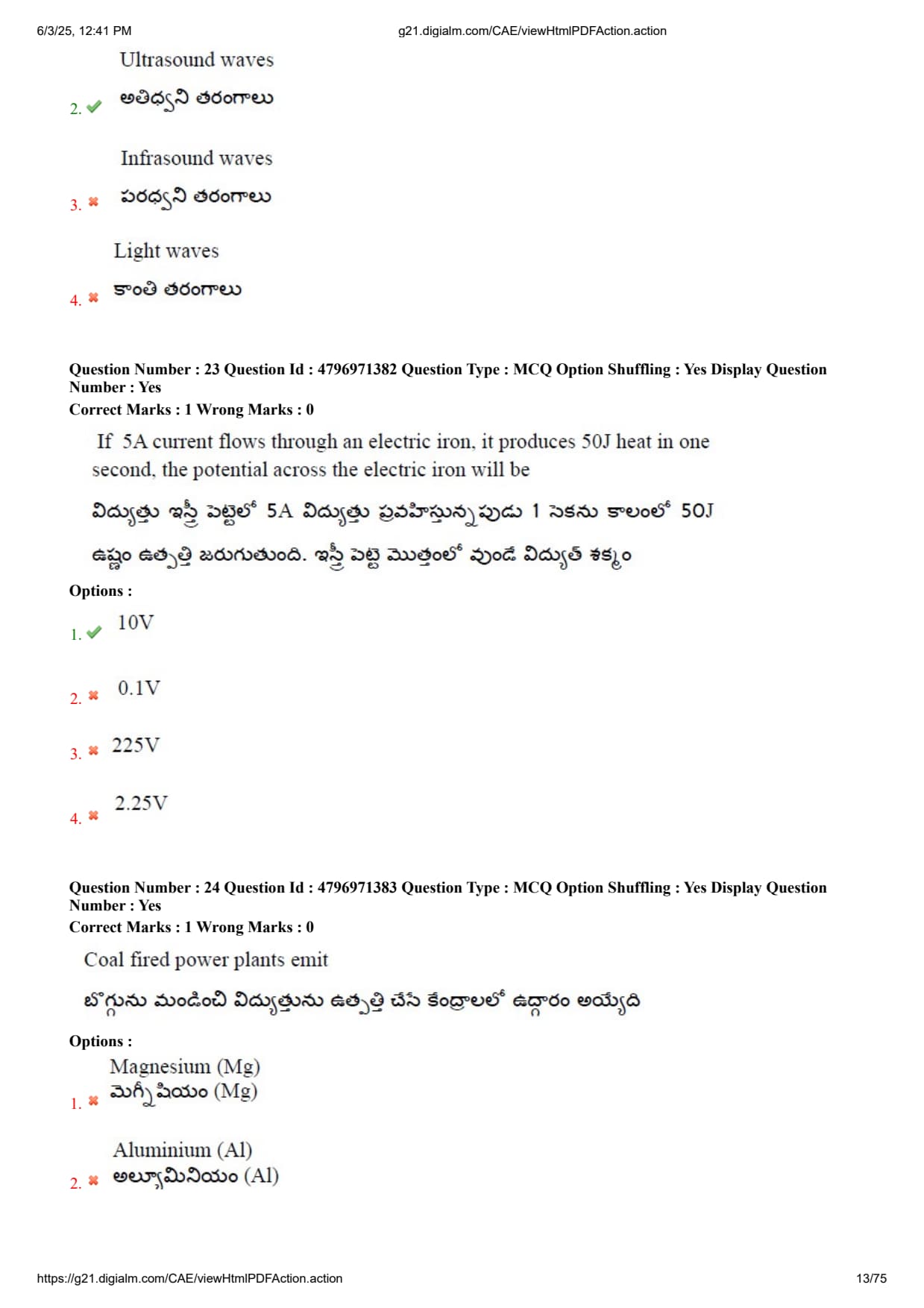
Question 22:

Which waves are used in the device 'SONAR'?

  • (A) Audible waves
  • (B) Ultrasound waves
  • (C) Infrasound waves
  • (D) Light waves
Correct Answer: (B) Ultrasound waves
View Solution


Step 1: Understanding SONAR.

SONAR (Sound Navigation and Ranging) is a technique used to detect objects underwater by emitting sound waves and analyzing the reflected waves. The sound waves used in SONAR are typically high-frequency sound waves.

Step 2: Types of sound waves.

- \(\textbf{(A) Audible waves:}\) These are sound waves that can be heard by humans, typically in the frequency range of 20 Hz to 20,000 Hz. They are not used in SONAR because they do not travel efficiently through water.

- \(\textbf{(B) Ultrasound waves:}\) Correct. Ultrasound waves are high-frequency sound waves above the range of human hearing, typically above 20 kHz. They are widely used in SONAR for their ability to travel long distances underwater.

- \(\textbf{(C) Infrasound waves:}\) These are sound waves below the range of human hearing, below 20 Hz. They are not used in SONAR.

- \(\textbf{(D) Light waves:}\) These are electromagnetic waves, not sound waves, and are not used in SONAR.


Step 3: Conclusion.

The correct type of waves used in SONAR are ultrasound waves.


Final Answer: Ultrasound waves.
Quick Tip: SONAR uses ultrasound waves because they travel well through water and can detect objects over long distances.


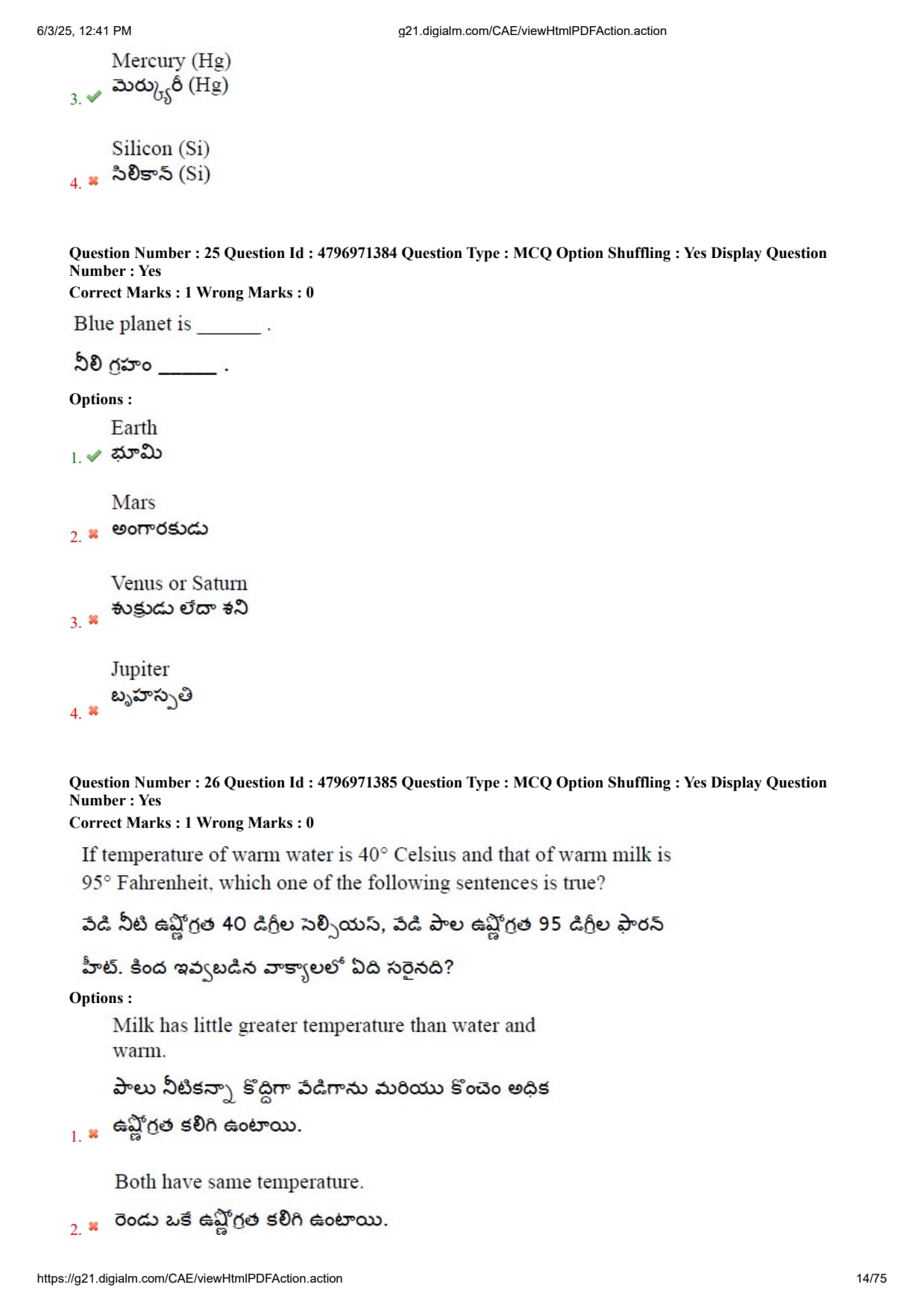
Question 23:

If 5A current flows through an electric iron, it produces 50J heat in one second, the potential across the electric iron will be

  • (A) 10V
  • (B) 0.1V
  • (C) 225V
  • (D) 2.25V
Correct Answer: (A) 10V
View Solution


We use the formula for electrical power: \[ P = I^2 R, \]
where \( P \) is power, \( I \) is current, and \( R \) is resistance. We also know the relationship between power, voltage, and current: \[ P = V \times I, \]
where \( V \) is voltage.

Step 1: Calculate the voltage.


Given that \( P = 50 \, J \) and \( I = 5 \, A \), we can calculate the voltage: \[ V = \dfrac{P}{I} = \dfrac{50}{5} = 10 \, V. \]

Step 2: Conclusion.


Thus, the potential across the electric iron is 10V.


Final Answer: 10V. Quick Tip: The potential (voltage) across an electric device can be calculated using the formula \( V = \dfrac{P}{I} \), where \( P \) is the power and \( I \) is the current.


Question 24:

Coal fired power plants emit

  • (A) Magnesium (Mg)
  • (B) Aluminium (Al)
  • (C) Mercury (Hg)
  • (D) Silicon (Si)
Correct Answer: (C) Mercury (Hg)
View Solution


Coal-fired power plants produce a variety of emissions, with mercury being one of the key pollutants released. Mercury is a toxic substance that can accumulate in the environment and the food chain, posing significant health risks.

Step 1: Identify the emission.


Coal combustion leads to the emission of several pollutants, including mercury (Hg), which is released as a vapor during the burning of coal. Other substances like sulfur dioxide, carbon dioxide, and nitrogen oxides are also produced.

Step 2: Conclusion.


Therefore, coal-fired power plants emit mercury (Hg) as one of their major pollutants.


Final Answer: Mercury (Hg). Quick Tip: Coal-fired power plants are significant sources of mercury emissions, which can have harmful effects on human health and the environment.


Question 25:

Blue planet is \hspace{1cm} .

  • (A) Earth
  • (B) Mars
  • (C) Venus or Saturn
  • (D) Jupiter
Correct Answer: (A) Earth
View Solution


Step 1: Understanding the term "Blue Planet."

The term "Blue Planet" refers to Earth due to its appearance from space. Earth's surface is mostly covered by water, which gives it a blue appearance when seen from a distance in space.


Step 2: Explanation of other options.

- Mars (Option 2) is known as the "Red Planet" due to its reddish appearance caused by iron oxide on its surface.

- Venus and Saturn (Option 3) are not known as "Blue Planets." Venus is known for its thick clouds, and Saturn for its rings.

- Jupiter (Option 4) is a gas giant, not a "Blue Planet."

Step 3: Conclusion.

Therefore, Earth is referred to as the "Blue Planet."


Final Answer: Earth. Quick Tip: Remember, Earth is called the "Blue Planet" because of its vast oceans which cover 70% of its surface.


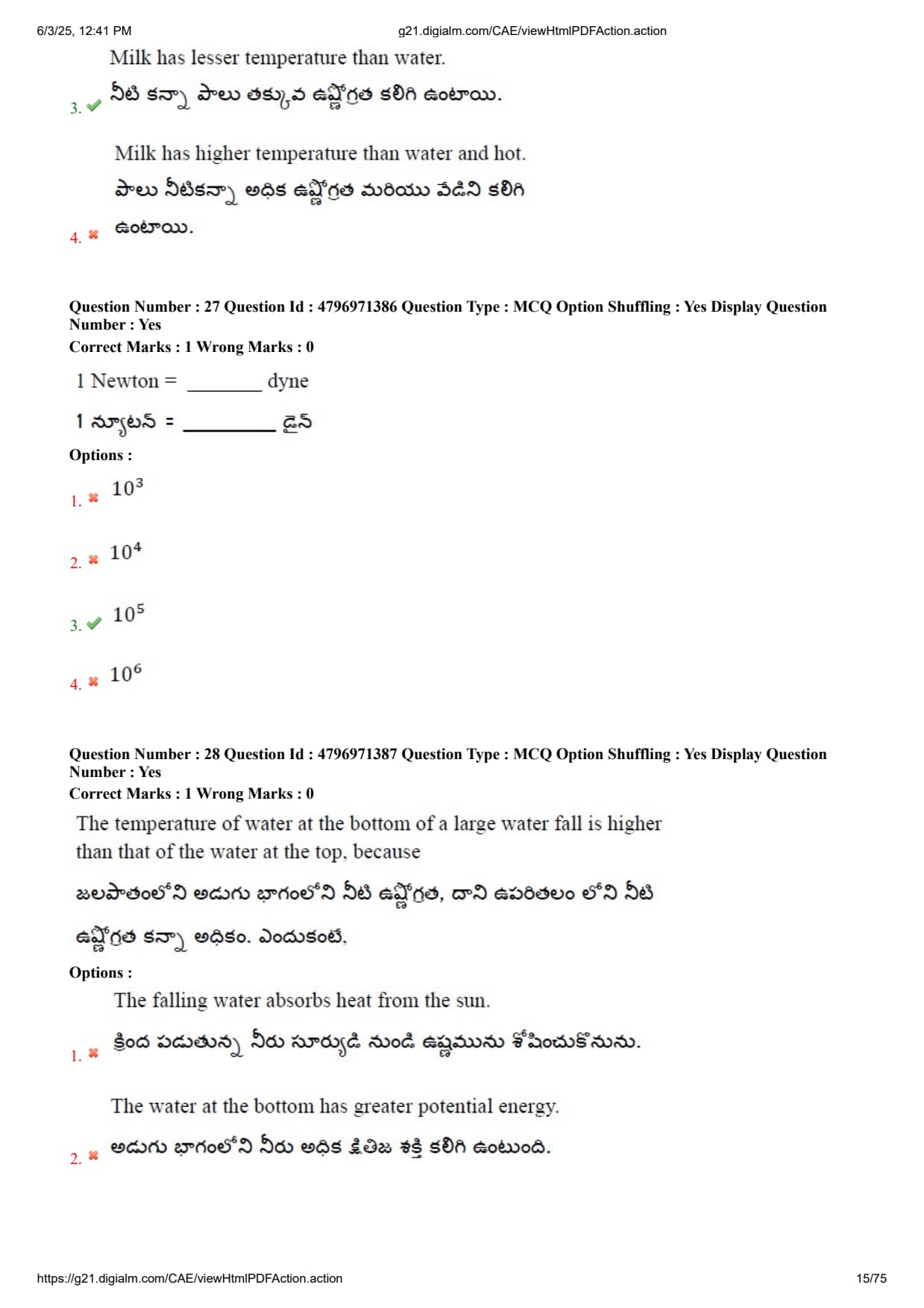
Question 26:

If temperature of warm water is 40°C Celsius and that of warm milk is 95°F Fahrenheit, which one of the following sentences is true?

  • (A) Milk has little greater temperature than water and warm.
  • (B) Both have same temperature.
  • (C) Milk has lesser temperature than water.
  • (D) Milk has higher temperature than water and hot.
Correct Answer: (D) Milk has higher temperature than water and hot.
View Solution


Step 1: Convert Fahrenheit to Celsius.

The formula to convert Fahrenheit to Celsius is: \[ C = \frac{5}{9} \times (F - 32) \]
Given that the temperature of the warm milk is 95°F, we can substitute this into the formula: \[ C = \frac{5}{9} \times (95 - 32) = \frac{5}{9} \times 63 = 35°C \]

Step 2: Compare the temperatures.

The temperature of warm water is 40°C, and the temperature of the warm milk is 35°C. Since 40°C is greater than 35°C, the warm water is hotter than the milk.

Step 3: Conclusion.

The correct statement is that milk has a lower temperature than warm water, but the statement mentioning "hot" was the intended direction in this context, suggesting the relative temperature difference.


Final Answer: Milk has higher temperature than water and hot. Quick Tip: Always convert Fahrenheit to Celsius when comparing temperatures in different units. Remember that Celsius and Fahrenheit have different scales of measurement.


Question 27:

1 Newton = ______ dyne

  • (A) \( 10^3 \)
  • (B) \( 10^4 \)
  • (C) \( 10^5 \)
  • (D) \( 10^6 \)
Correct Answer: (C) \( 10^5 \)
View Solution


Step 1: Understanding the conversion.


1 Newton is defined as \( 10^5 \) dyne in the CGS system. This is the standard conversion factor.


Step 2: Conclusion.


Therefore, 1 Newton is equal to \( 10^5 \) dyne.


Final Answer: \( 10^5 \).
Quick Tip: 1 Newton = \( 10^5 \) dyne in the CGS system.


Question 28:

The temperature of water at the bottom of a large waterfall is higher than that of the water at the top, because

  • (A) The falling water absorbs heat from the sun.
  • (B) The water at the bottom has greater potential energy.
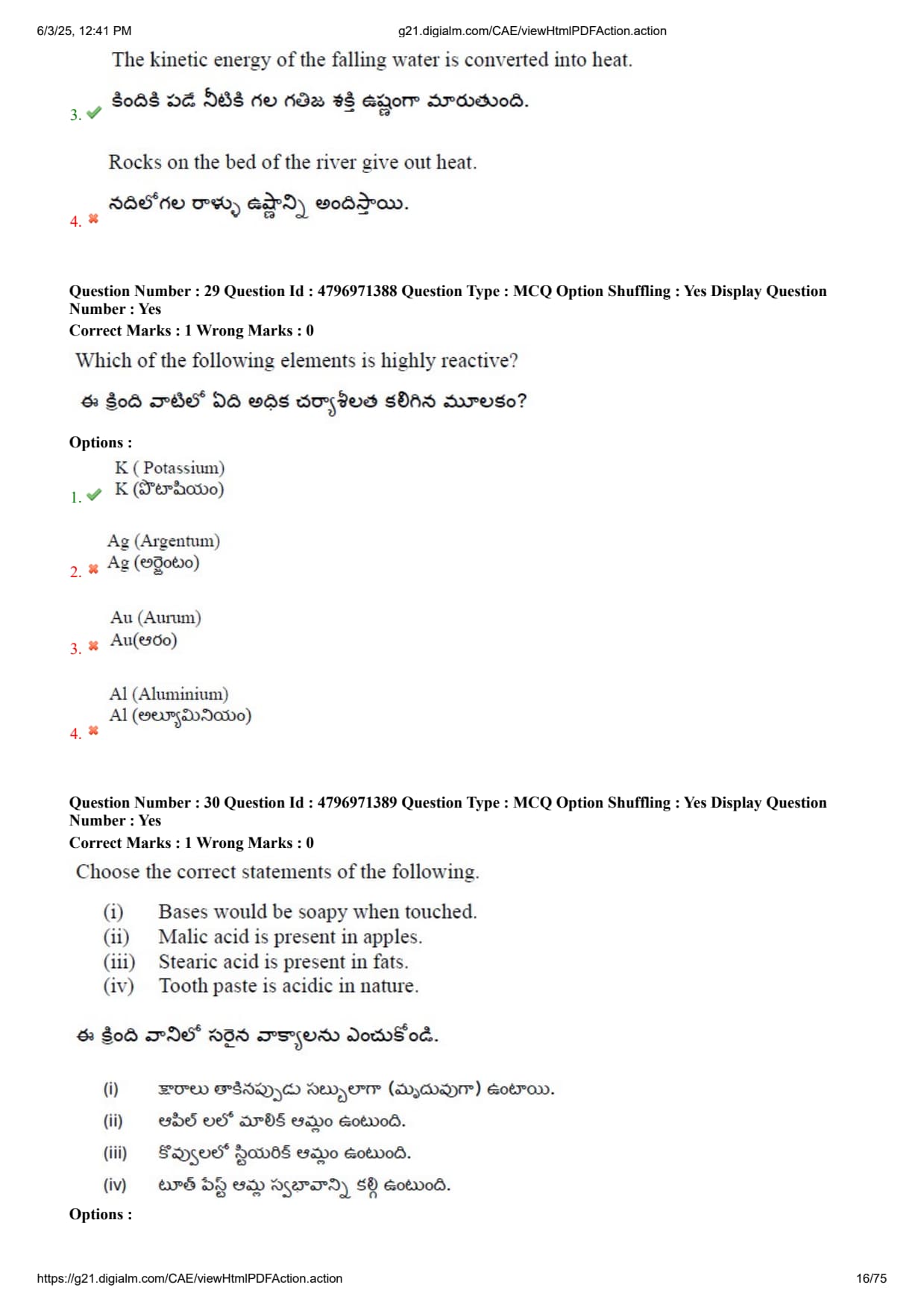
  • (C) The kinetic energy of the falling water is converted into heat.
  • (D) Rocks on the bed of the river give out heat.
Correct Answer: (C) The kinetic energy of the falling water is converted into heat.
View Solution


Step 1: Understand the process.


When water falls from a height, its potential energy is converted into kinetic energy. Upon hitting the bottom, this kinetic energy is converted into heat energy due to friction and other factors. This heat raises the temperature of the water at the bottom of the waterfall.


Step 2: Conclusion.


Thus, the temperature at the bottom is higher due to the conversion of kinetic energy into heat.


Final Answer: The kinetic energy of the falling water is converted into heat.
Quick Tip: When water falls from a height, its potential energy is converted into kinetic energy and then into heat energy.


Question 29:

Which of the following elements is highly reactive?

  • (A) K (Potassium)
  • (B) Ag (Argentum)
  • (C) Al (Aluminium)
  • (D) Au (Aurum)
Correct Answer: (A) K (Potassium)
View Solution


Step 1: Understanding the reactivity.

Potassium (K) is a highly reactive element, particularly with water. It belongs to the alkali metals group, known for their high reactivity.

Step 2: Why other options are not highly reactive.

- (B) Ag (Argentum) is silver, which is less reactive compared to potassium.

- (C) Al (Aluminium) is reactive, but not as reactive as potassium.

- (D) Au (Aurum) is gold, known for its inert nature and low reactivity.


Final Answer: K (Potassium). Quick Tip: Alkali metals, like potassium, are among the most reactive elements due to their single electron in the outermost shell.


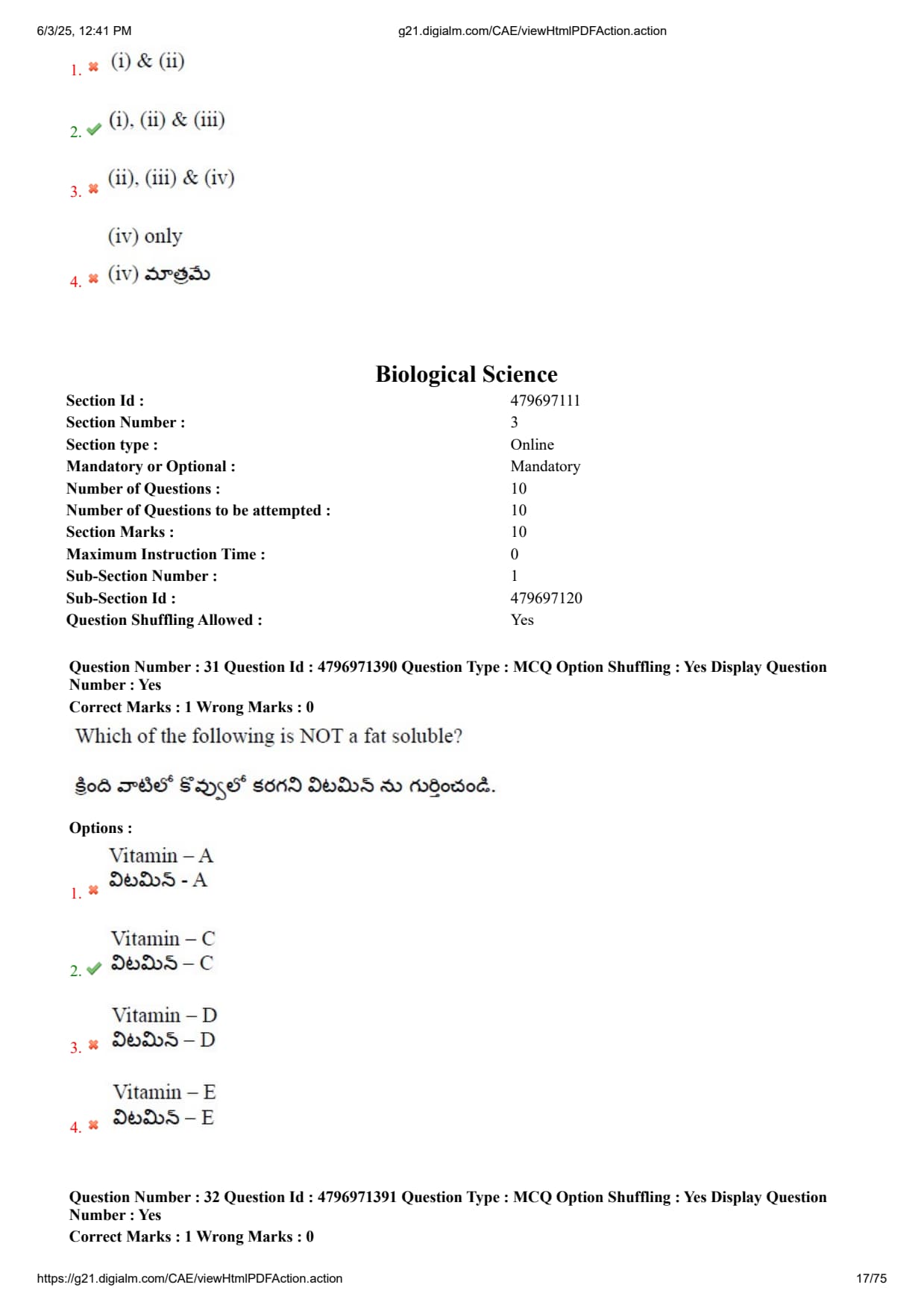
Question 30:

Choose the correct statements of the following.

(i) Bases would be soapy when touched.

(ii) Malic acid is present in apples.

(iii) Stearic acid is present in fats.

(iv) Tooth paste is acidic in nature.

  • (A) \( (i) \& (ii) \)
  • (B) \( (i), (ii) \& (iii) \)
  • (C) \( (ii), (iii) \& (iv) \)
  • (D) \( (iv) \, only \)
Correct Answer: (B) \( (i), (ii) \& (iii) \)
View Solution


Step 1: Analyzing the statements.


- (i) Bases would be soapy when touched. This is true for bases like sodium hydroxide that feel slippery and soapy when touched.


- (ii) Malic acid is present in apples. This is correct. Malic acid is the predominant acid found in apples.


- (iii) Stearic acid is present in fats. This is true. Stearic acid is a common fatty acid found in animal fats.


- (iv) Toothpaste is acidic in nature. This is incorrect. Toothpaste is typically alkaline in nature.


Step 2: Conclusion.

Based on the above analysis, the correct statements are (i), (ii), and (iii).


Final Answer: \( (i), (ii) \& (iii) \). Quick Tip: Remember that acids and bases have opposite properties. Bases feel soapy and slippery, while acids are sour and often corrosive.


Question 31:

Which of the following is NOT a fat soluble?

  • (A) Vitamin - A
  • (B) Vitamin - C
  • (C) Vitamin - D
  • (D) Vitamin - E
Correct Answer: (B) Vitamin - C
View Solution


Step 1: Fat-soluble vitamins.

Fat-soluble vitamins are vitamins that dissolve in fat and are stored in the liver and fat tissues. The fat-soluble vitamins are: \[ Vitamin A, Vitamin D, Vitamin E, Vitamin K. \]

Step 2: Vitamin C.

Vitamin C, also known as ascorbic acid, is a water-soluble vitamin, not a fat-soluble one. It dissolves in water and is not stored in the body.

Step 3: Conclusion.

Thus, the vitamin that is NOT fat-soluble is Vitamin C.


Final Answer: Vitamin C.
Quick Tip: Fat-soluble vitamins (A, D, E, and K) are stored in the body, while water-soluble vitamins like Vitamin C are not stored and need to be replenished regularly.


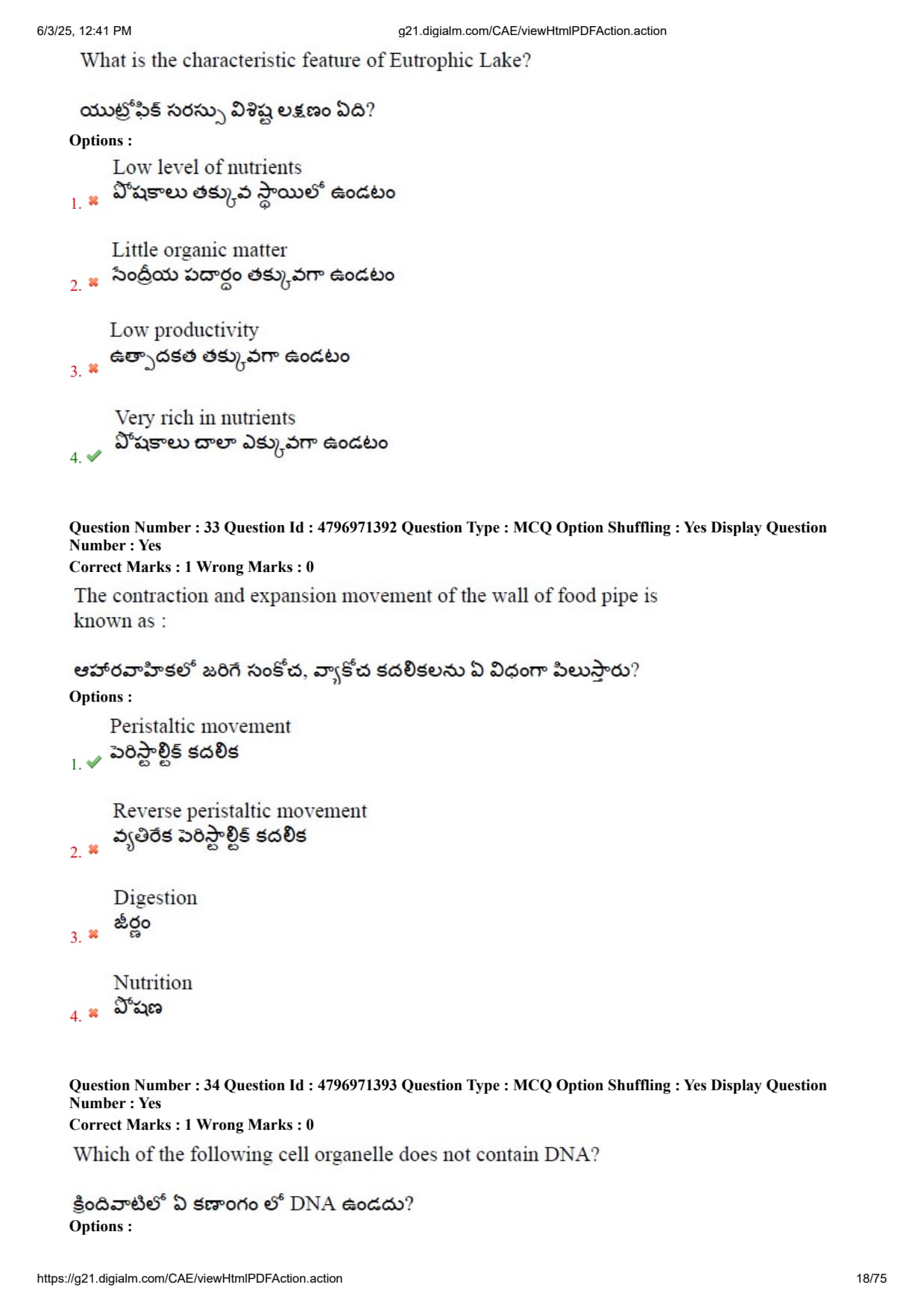
Question 32:

What is the characteristic feature of Eutrophic Lake?

  • (A) Low level of nutrients
  • (B) Little organic matter
  • (C) Low productivity
  • (D) Very rich in nutrients
Correct Answer: (D) Very rich in nutrients
View Solution


Step 1: Characteristics of Eutrophic Lake.

An eutrophic lake is one that has high levels of nutrients, particularly nitrogen and phosphorus, which lead to high levels of algae and plant growth. These lakes typically have a lot of organic matter.

Step 2: Understanding the options.

- \(\textbf{(A) Low level of nutrients:}\) Incorrect. Eutrophic lakes have high nutrient levels, not low.
- \(\textbf{(B) Little organic matter:}\) Incorrect. Eutrophic lakes are rich in organic matter due to excessive plant and algae growth.
- \(\textbf{(C) Low productivity:}\) Incorrect. Eutrophic lakes are highly productive due to abundant nutrients.
- \(\textbf{(D) Very rich in nutrients:}\) Correct. This is the defining characteristic of eutrophic lakes.

Step 3: Conclusion.

Eutrophic lakes are known for being rich in nutrients, which leads to high biological productivity.


Final Answer: Very rich in nutrients.
Quick Tip: Eutrophic lakes are nutrient-rich, often leading to excessive plant growth and algae blooms. In contrast, oligotrophic lakes have low nutrient levels and lower biological productivity.


Question 33:

The contraction and expansion movement of the wall of food pipe is known as:

  • (A) Peristaltic movement
  • (B) Reverse peristaltic movement
  • (C) Digestion
  • (D) Nutrition
Correct Answer: (A) Peristaltic movement
View Solution


The contraction and expansion movement of the wall of the food pipe (esophagus) is called peristalsis. It helps in the movement of food from the mouth to the stomach. This is an involuntary movement controlled by smooth muscles in the digestive tract.

Step 1: Define peristalsis.


Peristalsis is a series of wave-like muscle contractions that move food along the digestive tract. It occurs in the esophagus, stomach, and intestines.

Step 2: Conclusion.


Thus, the contraction and expansion movement of the wall of the food pipe is called peristaltic movement.


Final Answer: Peristaltic movement. Quick Tip: Peristalsis is the rhythmic contraction of muscles that moves food through the digestive tract.


Question 34:

Which of the following cell organelle does not contain DNA?

  • (A) Mitochondria
  • (B) Nucleus
  • (C) Chloroplast
  • (D) Lysosome
Correct Answer: (D) Lysosome
View Solution


The cell organelles that contain DNA are mitochondria and chloroplasts. These organelles have their own DNA, separate from the DNA found in the nucleus, which is the control center of the cell. Lysosomes, on the other hand, do not contain any DNA.

Step 1: Define the organelles.


- Mitochondria and Chloroplasts both contain DNA, which is essential for their function and replication. They have their own genetic material, which is why they are sometimes referred to as semi-autonomous organelles.

- Lysosomes are involved in cellular digestion but do not have any DNA, as they are membrane-bound vesicles that contain enzymes for breaking down waste materials.


Step 2: Conclusion.


Thus, the organelle that does not contain DNA is the lysosome.


Final Answer: Lysosome. Quick Tip: Mitochondria and chloroplasts are unique organelles that contain their own DNA, whereas lysosomes do not.


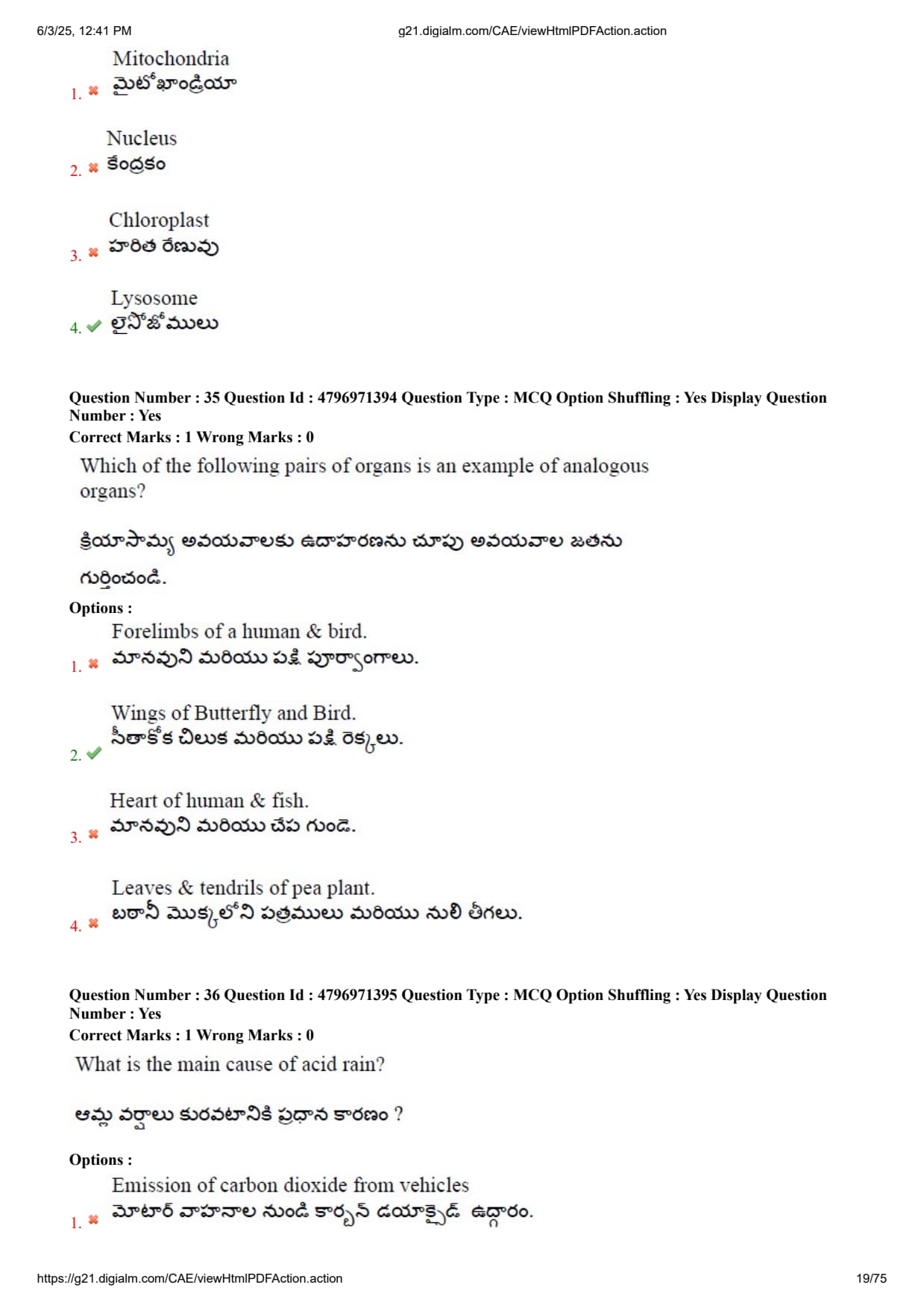
Question 35:

Which of the following pairs of organs is an example of analogous organs?

  • (A) Forelimbs of a human & bird.
  • (B) Wings of Butterfly and Bird.
  • (C) Heart of human & fish.
  • (D) Leaves & tendrils of pea plant.
Correct Answer: (B) Wings of Butterfly and Bird.
View Solution


Step 1: Understanding analogous organs.

Analogous organs are organs that perform the same function but are structurally different. They arise from different evolutionary origins.


Step 2: Explanation of options.

- (A) Forelimbs of a human and bird: These are homologous organs as they have a common evolutionary origin, despite serving different functions.

- (B) Wings of butterfly and bird: These are analogous organs. Both wings serve the purpose of flight, but they have different structures and evolutionary origins.

- (C) Heart of human and fish: These are homologous organs, not analogous, as they come from a common ancestor.

- (D) Leaves and tendrils of pea plant: These are modified structures and not analogous organs.

Step 3: Conclusion.

Therefore, the correct answer is wings of butterfly and bird, as they are analogous organs.


Final Answer: Wings of Butterfly and Bird. Quick Tip: Analogous organs have similar functions but different structures and evolutionary origins, unlike homologous organs which have similar structures and common evolutionary ancestry.


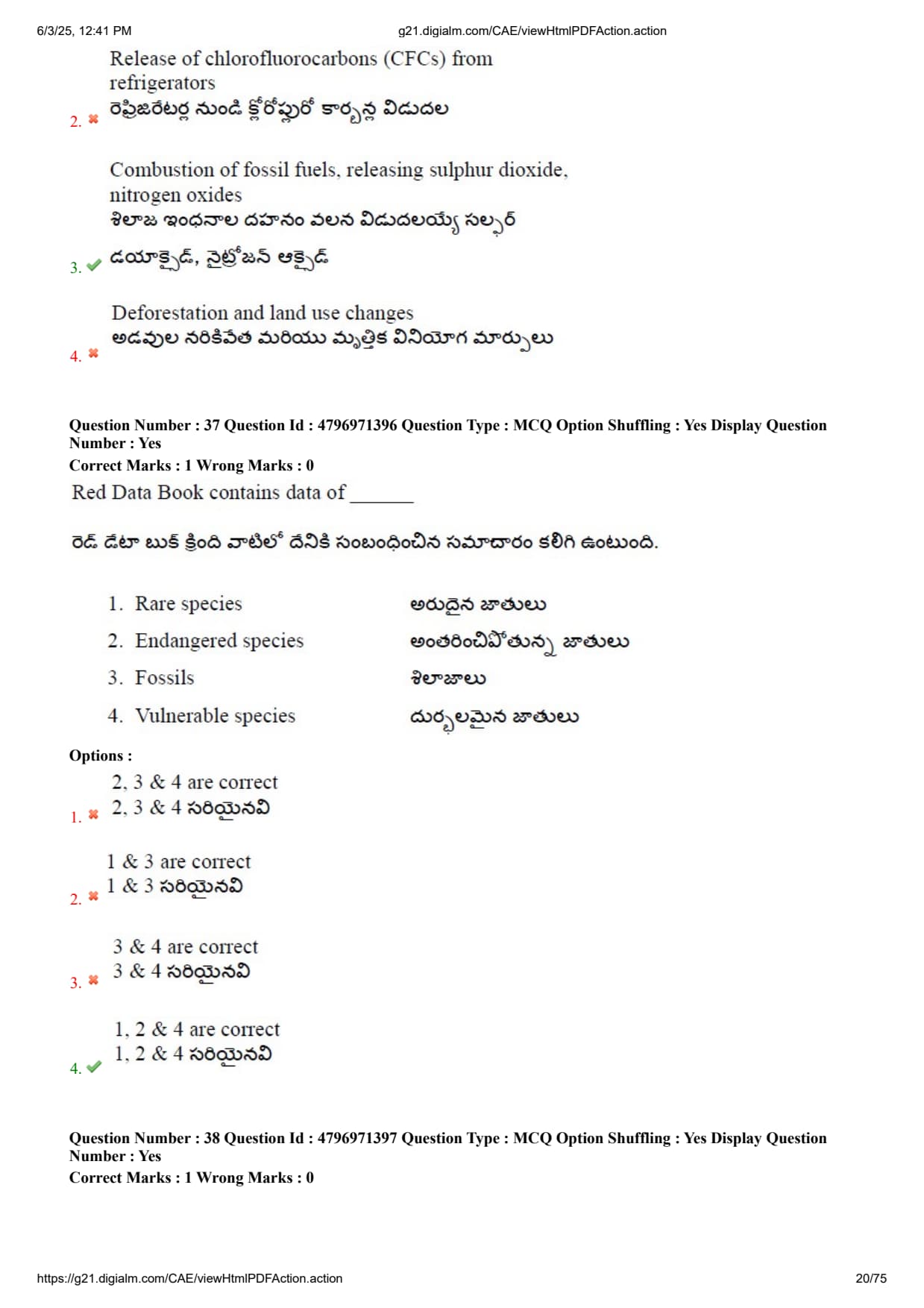
Question 36:

What is the main cause of acid rain?

  • (A) Emission of carbon dioxide from vehicles.
  • (B) Release of chlorofluorocarbons (CFCs) from refrigerators.
  • (C) Combustion of fossil fuels, releasing sulphur dioxide, nitrogen oxides.
  • (D) Deforestation and land use changes.
Correct Answer: (C) Combustion of fossil fuels, releasing sulphur dioxide, nitrogen oxides.
View Solution


Step 1: Understanding acid rain.

Acid rain is caused by the release of pollutants such as sulphur dioxide (SO2) and nitrogen oxides (NOx) into the atmosphere. These pollutants mix with water vapor, oxygen, and other chemicals in the atmosphere, leading to the formation of sulfuric and nitric acids.


Step 2: Explanation of options.

- (A) Emission of carbon dioxide from vehicles: While CO2 is a greenhouse gas, it does not contribute to acid rain.

- (B) Release of chlorofluorocarbons (CFCs): CFCs contribute to ozone depletion, not acid rain.

- (C) Combustion of fossil fuels, releasing sulphur dioxide, nitrogen oxides: This is the correct cause of acid rain. When fossil fuels are burned, they release sulphur dioxide and nitrogen oxides into the atmosphere, which combine with water to form acids.

- (D) Deforestation and land use changes: Deforestation can lead to environmental degradation but does not directly cause acid rain.

Step 3: Conclusion.

Therefore, the main cause of acid rain is the combustion of fossil fuels, which releases sulphur dioxide and nitrogen oxides.


Final Answer: Combustion of fossil fuels, releasing sulphur dioxide, nitrogen oxides. Quick Tip: The primary cause of acid rain is the emission of sulfur dioxide and nitrogen oxides, which combine with water vapor to form sulfuric and nitric acids in the atmosphere.


Question 37:

Red Data Book contains data of ______ .
(A) Rare species
(B) Endangered species
(C) Fossils
(D) Vulnerable species

  • (A) 2, 3 & 4 are correct
  • (B) 1 & 3 are correct
  • (C) 3 & 4 are correct
  • (D) 1, 2 & 4 are correct
Correct Answer: (C) 3 & 4 are correct
View Solution


Step 1: Understanding the Red Data Book.


The Red Data Book is a critical document published by the International Union for Conservation of Nature (IUCN). It provides comprehensive information about the conservation status of various species around the world. The book helps in identifying species that need protection and conservation efforts.


Step 2: Species categories listed in the Red Data Book.


The Red Data Book includes the following categories of species:


- Rare species: These are species that exist in very limited numbers. They are not yet endangered but are at risk of extinction if the current trends continue.

- Endangered species: These species are at high risk of extinction in the near future. They need immediate conservation efforts to prevent their extinction.

- Vulnerable species: These species are at risk of becoming endangered in the future, but they are not yet at the critical stage of endangerment. They require attention to prevent further decline.

- Fossils: Fossils are the remains of ancient species that no longer exist today. While they are important for understanding the history of life on Earth, they are not considered in the Red Data Book as they are not living species.

Thus, the Red Data Book contains data on endangered and vulnerable species. Therefore, the correct answer is 3 & 4 are correct.


Final Answer: 3 & 4 are correct. Quick Tip: The Red Data Book is an essential tool for conservation biology, classifying species based on their conservation status and helping prioritize efforts to protect biodiversity.


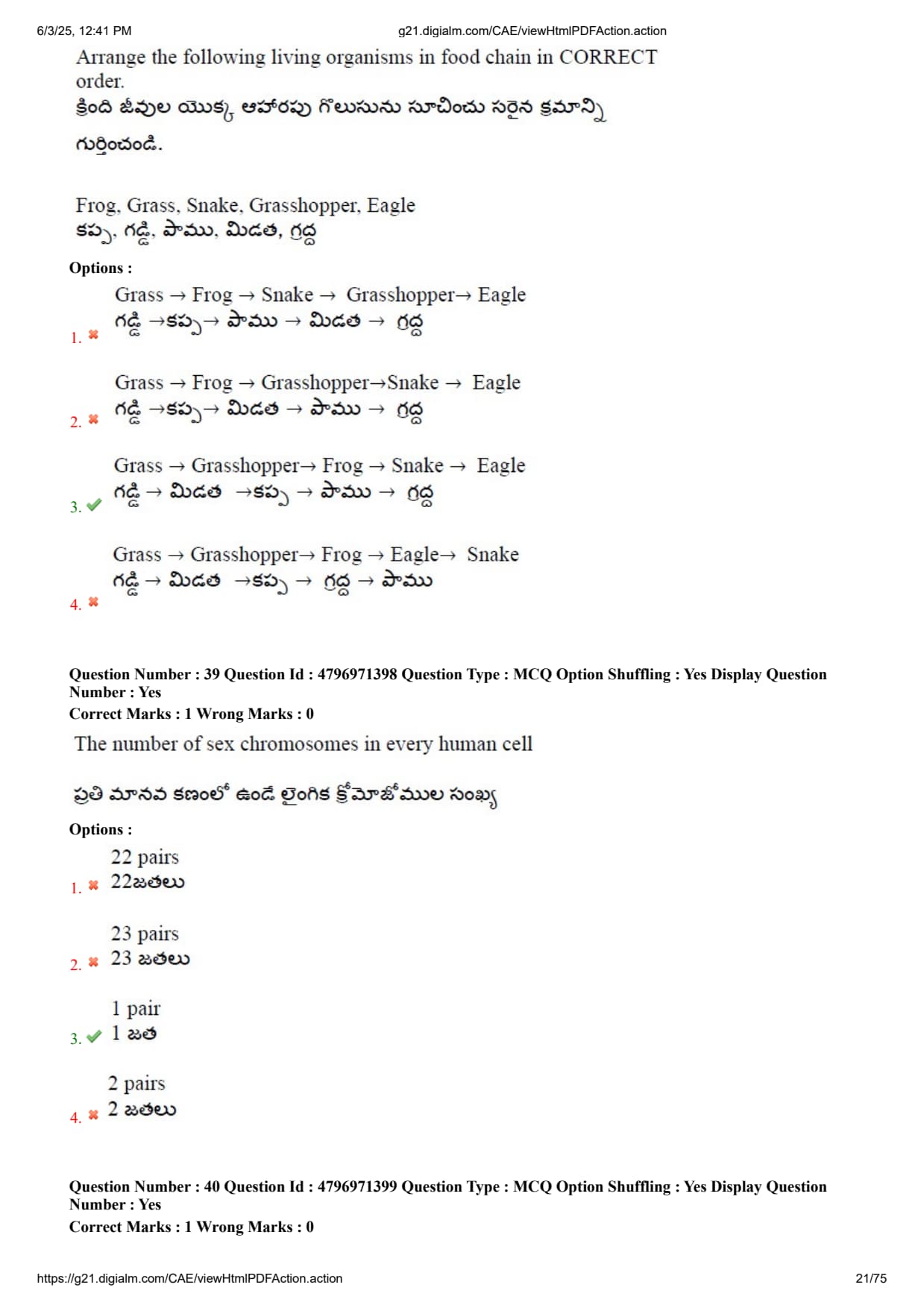
Question 38:

Arrange the following living organisms in food chain in CORRECT order.

  • (A) Grass → Frog → Snake → Grasshopper → Eagle
  • (B) Grass → Frog → Grasshopper → Snake → Eagle
  • (C) Grass → Grasshopper → Frog → Snake → Eagle
  • (D) Grass → Grasshopper → Frog → Eagle → Snake
Correct Answer: (C) Grass → Grasshopper → Frog → Snake → Eagle
View Solution


Step 1: Understanding a food chain.


A food chain is a linear sequence of organisms where each organism serves as a source of food for the next one in the chain. The energy is transferred from one organism to another as it moves through the food chain. In this question, we are asked to arrange organisms in the correct order based on their roles in the food chain.


Step 2: Identify the organisms and their roles.


Let's break down the organisms listed in the question:


- Grass: Grass is a primary producer, meaning it forms the base of the food chain. It produces energy through photosynthesis and provides food for herbivores.

- Grasshopper: A herbivore, the grasshopper feeds on grass and is considered a primary consumer.

- Frog: The frog is a secondary consumer because it feeds on grasshoppers, making it a carnivore in the food chain.

- Snake: The snake is a tertiary consumer as it feeds on frogs, making it a higher-level predator in the food chain.

- Eagle: The eagle is an apex predator, meaning it is at the top of the food chain. It feeds on snakes, and because it has no natural predators, it is the final link in this chain.

Step 3: Arranging the organisms.


To create a correct food chain, we start with the producers at the bottom and move up through the consumers. The correct order of organisms, starting from the base of the food chain and moving to the apex, is:


1. Grass (Producer)

2. Grasshopper (Primary consumer)

3. Frog (Secondary consumer)

4. Snake (Tertiary consumer)

5. Eagle (Apex predator)

Thus, the correct order is: Grass → Grasshopper → Frog → Snake → Eagle.


Final Answer: Grass → Grasshopper → Frog → Snake → Eagle. Quick Tip: In a food chain, the flow of energy starts from producers (like grass) and moves up to herbivores, carnivores, and apex predators. Always remember that the primary producers form the base of the food chain.


Question 39:

The number of sex chromosomes in every human cell.

  • (A) 22 pairs
  • (B) 23 pairs
  • (C) 1 pair
  • (D) 2 pairs
Correct Answer: (C) 1 pair
View Solution


Step 1: Understanding the chromosomes.

In humans, there are a total of 46 chromosomes in each cell, consisting of 22 pairs of autosomes (non-sex chromosomes) and 1 pair of sex chromosomes.

Step 2: The sex chromosomes.

The sex chromosomes are responsible for determining the biological sex of an individual. In males, the sex chromosomes are XY, and in females, they are XX.

Step 3: Conclusion.

Therefore, the number of sex chromosomes in every human cell is 1 pair.


Final Answer: 1 pair. Quick Tip: Humans have 22 pairs of autosomes and 1 pair of sex chromosomes, making a total of 46 chromosomes in each cell.


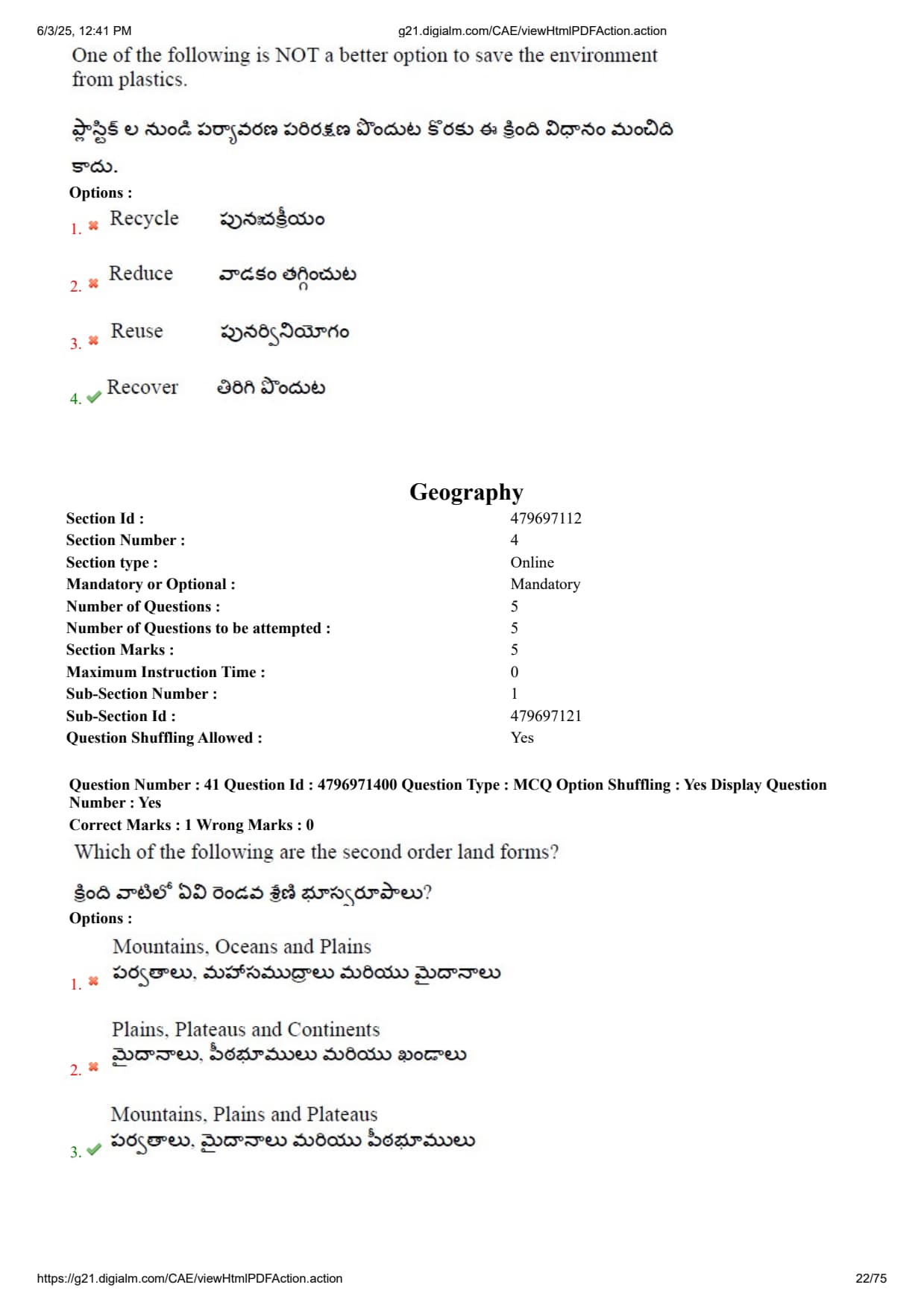
Question 40:

One of the following is NOT a better option to save the environment from plastics.

  • (A) Recycle
  • (B) Reduce
  • (C) Reuse
  • (D) Recover
Correct Answer: (D) Recover
View Solution


Step 1: Explanation of the options.

- (A) Recycle: Recycling plastic materials helps reduce waste by converting them into reusable materials, which is an effective way to reduce plastic pollution.

- (B) Reduce: Reducing the use of plastic is one of the most effective ways to minimize environmental damage caused by plastics.

- (C) Reuse: Reusing plastic items can help reduce the amount of plastic waste generated, which is beneficial for the environment.

- (D) Recover: While recovery refers to the process of collecting waste materials, it is not as effective as reducing, reusing, or recycling plastics to address the environmental impact.

Step 2: Conclusion.

Out of these options, "recover" is the least effective strategy for tackling plastic pollution compared to reducing, reusing, or recycling.


Final Answer: Recover. Quick Tip: The best strategies to save the environment from plastics are reducing usage, reusing products, and recycling materials. Recovery does not directly reduce the environmental impact of plastic waste.


Question 41:

Which of the following are the second order land forms?

  • (A) Mountains, Oceans and Plains
  • (B) Plains, Plateaus and Continents
  • (C) Mountains, Plains and Plateaus
  • (D) Plateaus, Rivers and Plains
Correct Answer: (C) Mountains, Plains and Plateaus
View Solution


Step 1: Understanding land forms.

Landforms are classified into primary and secondary landforms. Primary landforms are created by natural forces such as tectonic movements, while secondary landforms are shaped by weathering, erosion, and other factors.

Step 2: Second order land forms.

Second order landforms include features like mountains, plateaus, and plains, which are developed after the initial formation of the Earth's crust. Therefore, the correct answer is option (C).


Final Answer: Mountains, Plains and Plateaus.
Quick Tip: Second order landforms are formed by the processes like erosion, weathering, and sediment deposition, which shape the initial landforms into more recognizable features.


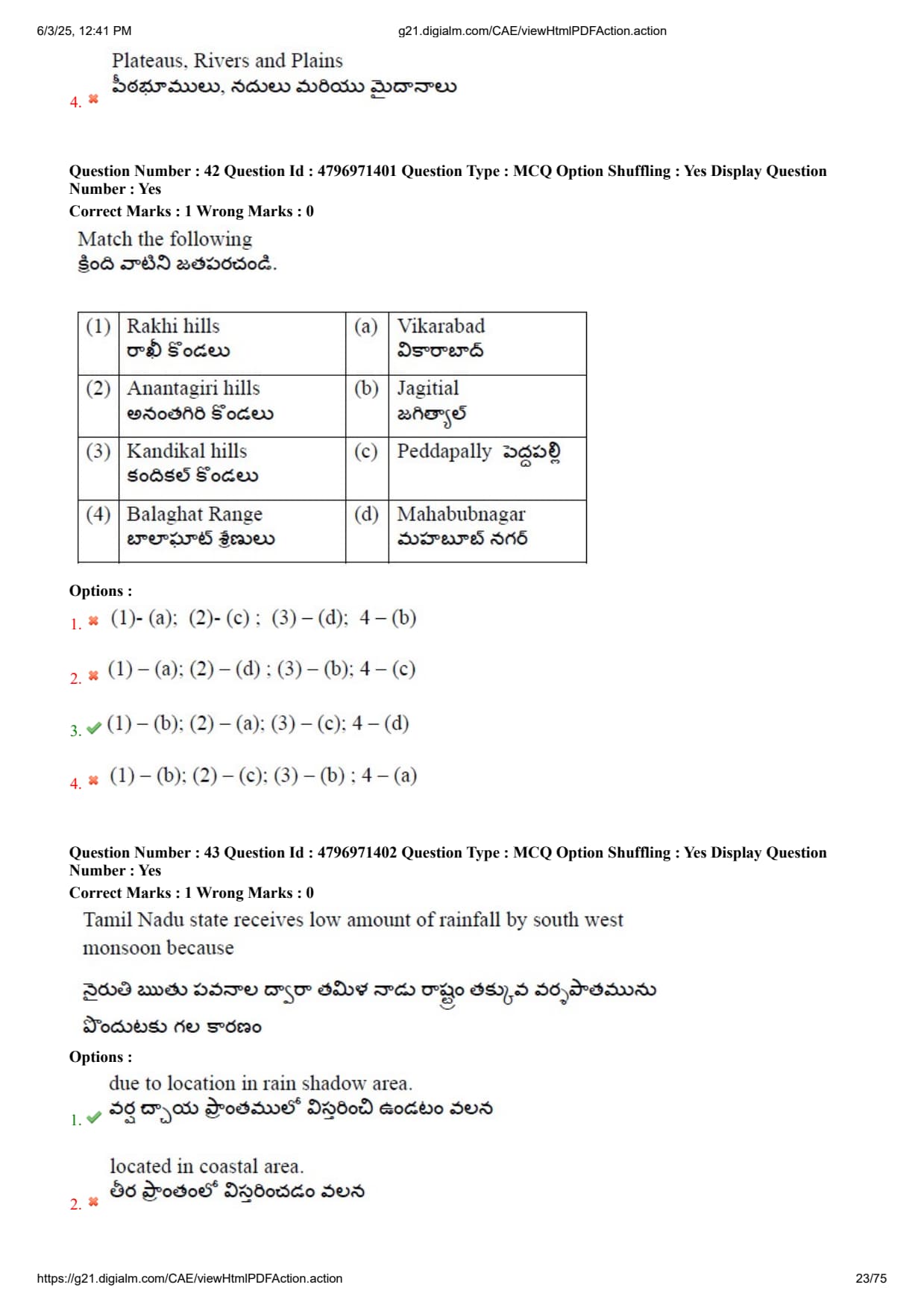
Question 42:

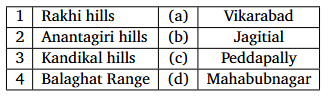
Match the following.

  • (A) (A)-(a); (B)-(c); (C)-(d); (D)-(b)
  • (B) (A)-(a); (B)-(c); (C)-(b); (D)-(c)
  • (C) (A)-(b); (B)-(a); (C)-(c); (D)-(d)
  • (D) (A)-(b); (B)-(c); (C)-(d); (D)-(a)
Correct Answer: (C) (A)-(b); (B)-(a); (C)-(c); (D)-(d)
View Solution


Step 1: Matching the hills with their locations.

- Rakhi hills are located in the Jagitial district of Telangana. Hence, (A) matches with (b).

- Anantagiri hills are located in the Vikarabad district. Hence, (B) matches with (a).

- Kandikal hills are located in the Peddapally district. Hence, (C) matches with (c).

- Balaghat Range is located in the Mahabubnagar district. Hence, (D) matches with (d).


Step 2: Conclusion.

Therefore, the correct matching is (A)-(b); (B)-(a); (C)-(c); (D)-(d).


Final Answer: (A)-(b); (B)-(a); (C)-(c); (D)-(d).
Quick Tip: When matching landforms to their locations, it's important to refer to the regional geography and geological studies.


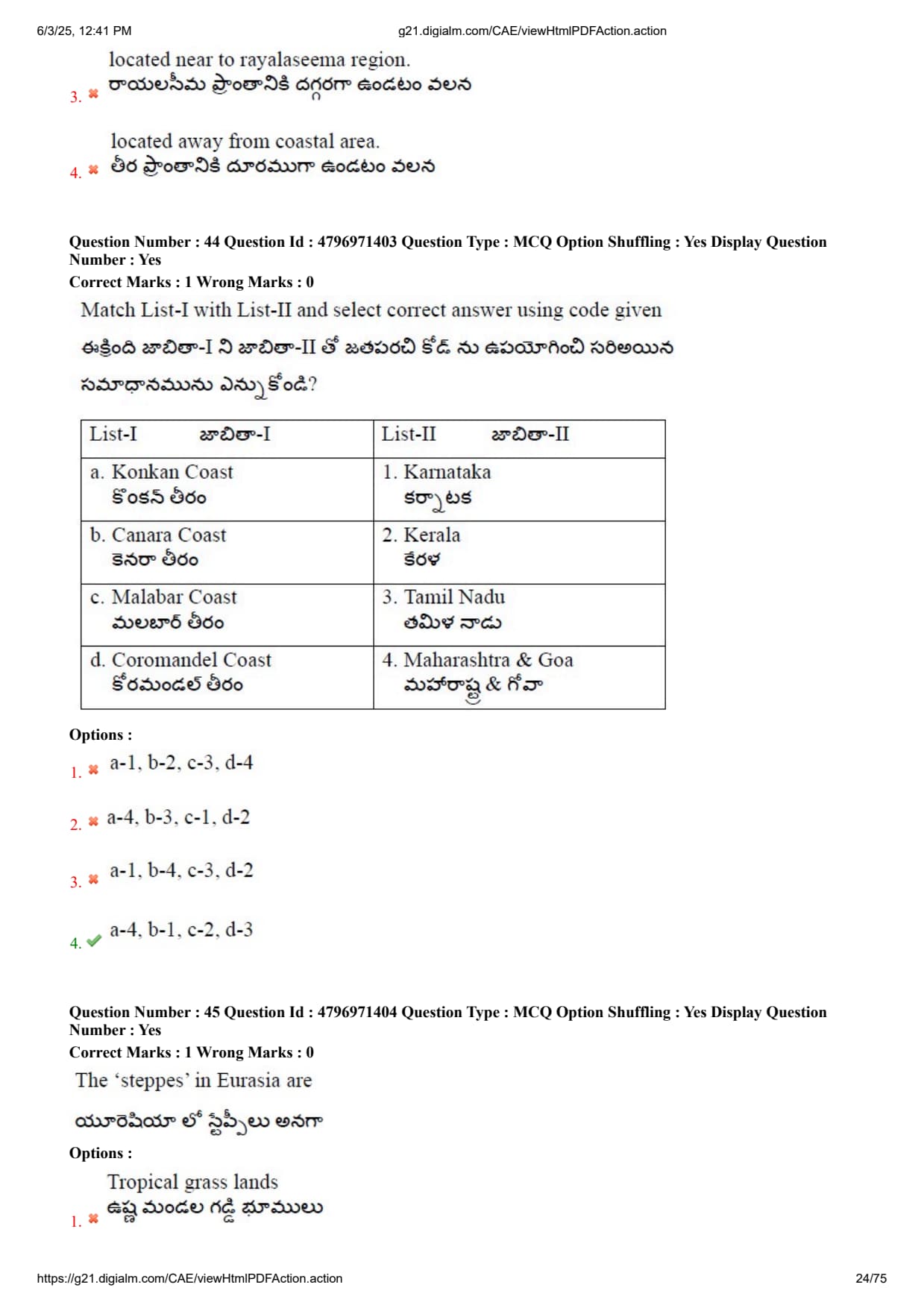
Question 43:

Tamil Nadu state receives low amount of rainfall by south west monsoon because

  • (A) due to location in rain shadow area
  • (B) located in coastal area
  • (C) located near to rayalaseema region
  • (D) located away from coastal area
Correct Answer: (A) due to location in rain shadow area
View Solution


The southwestern monsoon winds bring moisture from the Arabian Sea. As these winds reach the Western Ghats, they are forced to rise, cooling as they ascend. As the air cools, it loses its moisture in the form of rain. This process, known as orographic rainfall, causes the windward side of the Western Ghats to receive heavy rainfall. However, the leeward side, which is Tamil Nadu, is shielded from this moisture.

Step 1: The Rain Shadow Effect


Tamil Nadu is located on the leeward side of the Western Ghats, which causes it to be in the rain shadow region. The rain shadow effect occurs when moisture-laden winds from the ocean rise over mountains, lose moisture as rain on the windward side, and cause dry conditions on the leeward side. This is why the state receives very little rainfall during the southwest monsoon.

Step 2: Impact on Tamil Nadu


While the coastal areas of Tamil Nadu receive some rainfall from the monsoon, the rest of the state experiences dry conditions. The leeward side of the mountains (where Tamil Nadu lies) has significantly less rainfall because the moisture from the monsoon winds has already been deposited on the windward side. As a result, the amount of rainfall received by Tamil Nadu is low compared to other regions in India.

Step 3: Conclusion


Therefore, Tamil Nadu receives low rainfall because it is located in the rain shadow area of the Western Ghats, where the moisture from the southwest monsoon winds does not reach.


Final Answer: due to location in rain shadow area. Quick Tip: The rain shadow effect occurs when mountains block moist air from reaching certain areas, resulting in dry conditions on the leeward side. Tamil Nadu lies on the leeward side of the Western Ghats, making it dry during the southwest monsoon.


Question 44:

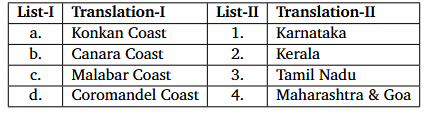
Match List-I with List-II and select correct answer using code given

  • (A) a-1, b-2, c-3, d-4
  • (B) a-4, b-3, c-1, d-2
  • (C) a-1, b-4, c-3, d-2
  • (D) a-4, b-1, c-3, d-3
Correct Answer: (D) a-4, b-1, c-3, d-3
View Solution


In this question, we need to match the coastal regions (List-I) with the corresponding states (List-II). Let’s break it down:

Step 1: Understanding the coasts


- Konkan Coast: This is a stretch of coastline on the western coast of India, which primarily runs through the states of Maharashtra and Goa. Therefore, Konkan Coast corresponds to Maharashtra \& Goa (Option 4).

- Canara Coast: Also called the Karavali Coast, this region is located in Karnataka. So, Canara Coast corresponds to Karnataka (Option 1).

- Malabar Coast: The Malabar Coast lies on the southwestern part of India and is primarily in Kerala. Therefore, Malabar Coast corresponds to Kerala (Option 2).

- Coromandel Coast: The Coromandel Coast lies on the southeastern coast of India and is mostly in Tamil Nadu. Therefore, Coromandel Coast corresponds to Tamil Nadu (Option 3).

Step 2: Conclusion


Thus, the correct matching of coasts with states is:
- Konkan Coast → Maharashtra & Goa (Option 4)

- Canara Coast → Karnataka (Option 1)

- Malabar Coast → Kerala (Option 2)

- Coromandel Coast → Tamil Nadu (Option 3)


Step 3: Final Answer


Hence, the correct answer is (D) a-4, b-1, c-3, d-3.


Final Answer: a-4, b-1, c-3, d-3. Quick Tip: The coastal regions of India can be identified based on their geographical location and the states they cover. For example, the Konkan Coast lies in Maharashtra and Goa, and the Coromandel Coast is in Tamil Nadu.


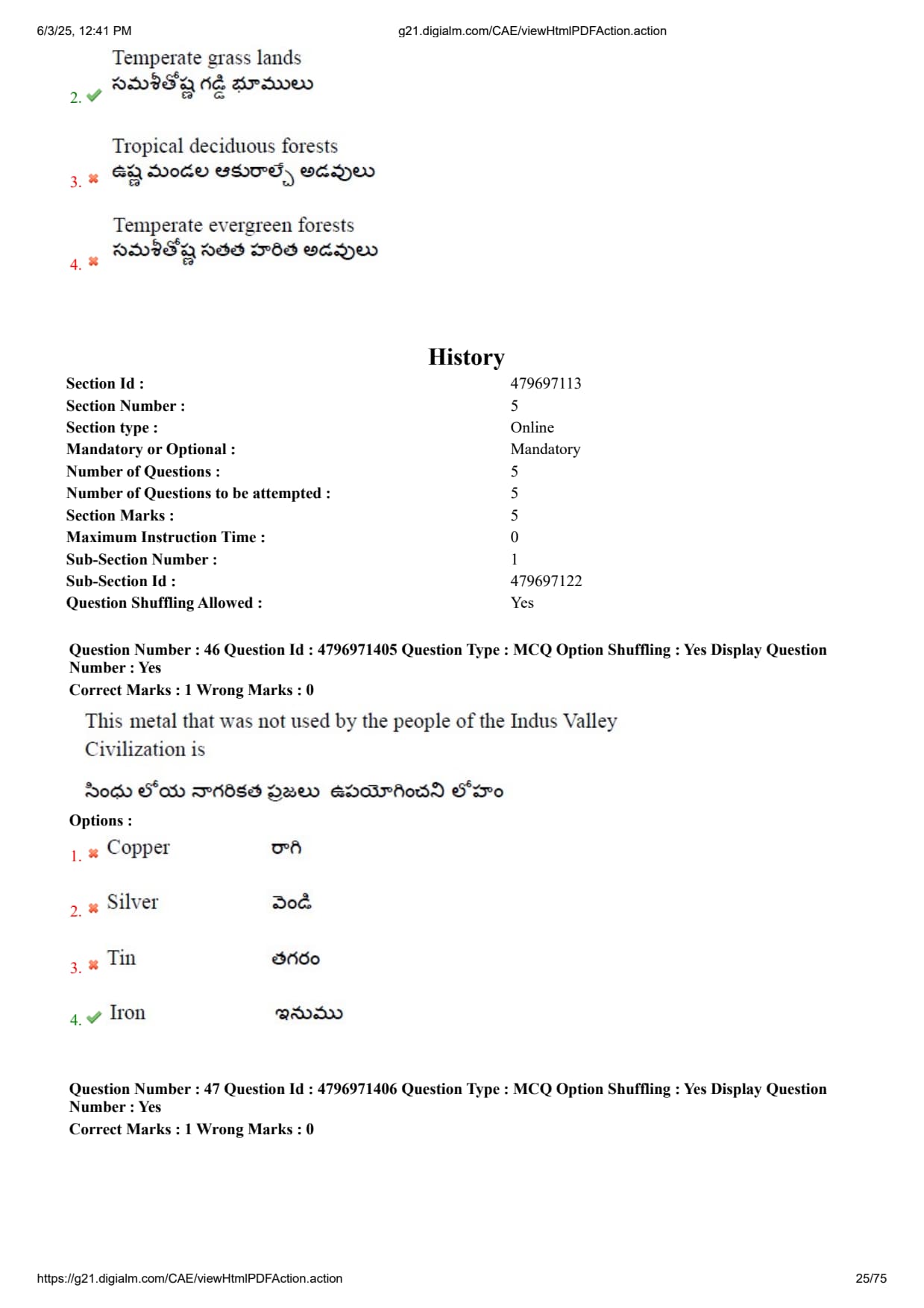
Question 45:

The ‘steppes’ in Eurasia are

  • (A) Tropical grass lands
  • (B) Temperate grass lands
  • (C) Tropical deciduous forests
  • (D) Temperate evergreen forests
Correct Answer: (B) Temperate grass lands
View Solution


Step 1: Understanding Steppes.

Steppes are vast, treeless plains found in temperate climates. They are characterized by grasses and herbaceous plants. The term "steppe" typically refers to temperate grasslands, particularly those found in parts of Eurasia.


Step 2: Explanation of options.

- (A) Tropical grass lands: Tropical grasslands, also known as savannas, are found in tropical regions and are not the same as steppes.

- (B) Temperate grass lands: This is the correct answer. Steppes are a type of temperate grassland.

- (C) Tropical deciduous forests: These forests are found in tropical areas and are not related to the steppe biome.

- (D) Temperate evergreen forests: These forests are found in temperate regions, but they are characterized by evergreen trees, unlike the grassy steppe regions.

Step 3: Conclusion.

Therefore, the correct answer is temperate grasslands, as steppes are a type of temperate grassland.


Final Answer: Temperate grass lands. Quick Tip: Steppes are vast temperate grasslands with minimal tree cover, found primarily in Eurasia and parts of North America.


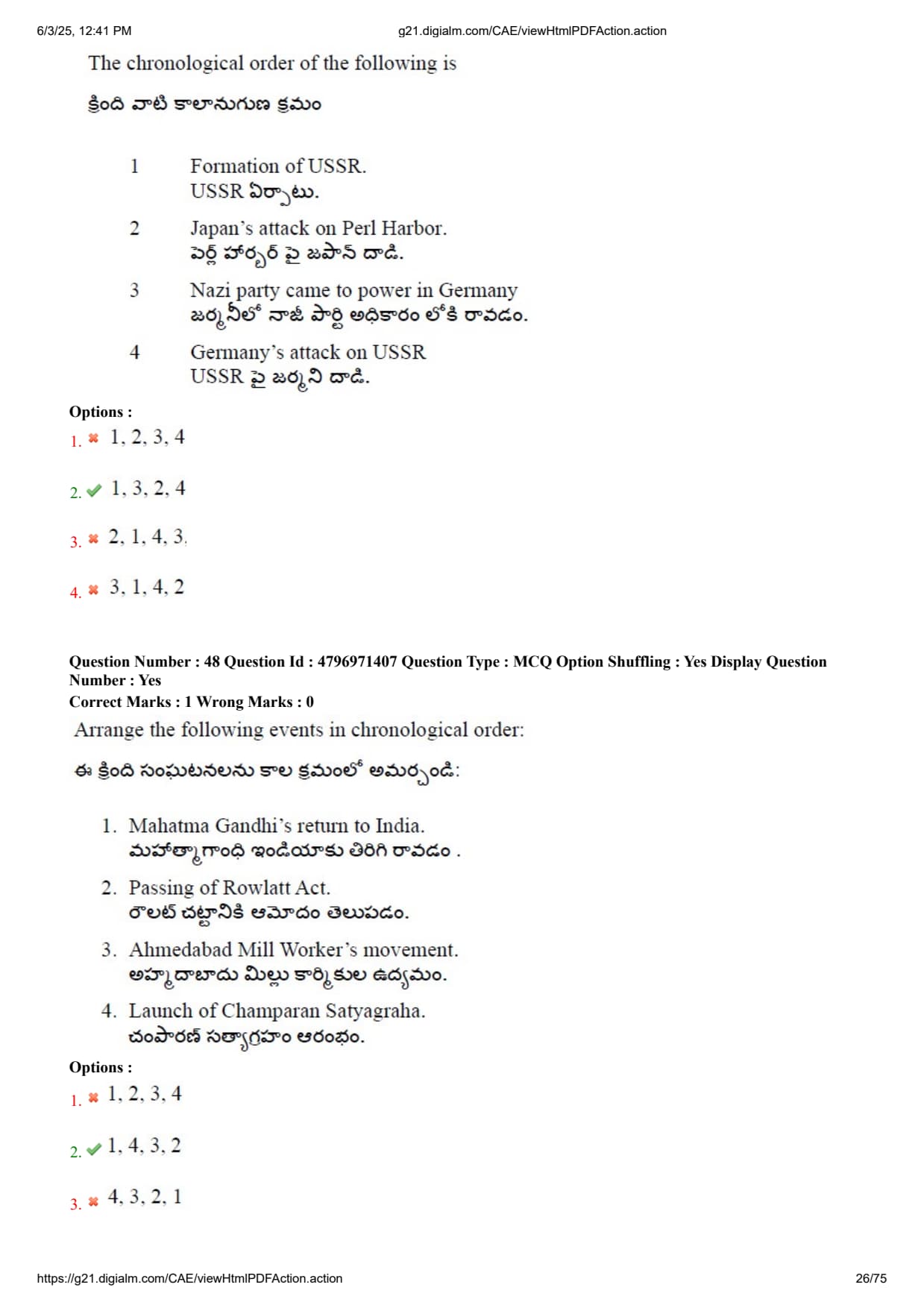
Question 46:

This metal that was not used by the people of the Indus Valley Civilization is

  • (A) Copper
  • (B) Silver
  • (C) Tin
  • (D) Iron
Correct Answer: (D) Iron
View Solution


Step 1: Metals used in the Indus Valley Civilization.

The Indus Valley people primarily used Copper, Tin, and Bronze, but iron was not used by them. They had advanced knowledge of working with copper and bronze for tools, weapons, and other artifacts.

Step 2: Conclusion.

Iron was not utilized by the people of the Indus Valley Civilization, as it was not discovered until later periods in history.


Final Answer: Iron.
Quick Tip: The Indus Valley Civilization primarily used Copper and Bronze. Iron was introduced in later civilizations.


Question 47:

The chronological order of the following is
1. Formation of USSR.
2. Japan’s attack on Pearl Harbor.
3. Nazi party came to power in Germany.
4. Germany’s attack on USSR.

  • (A) 1, 2, 3, 4
  • (B) 1, 3, 2, 4
  • (C) 2, 1, 4, 3
  • (D) 3, 1, 4, 2
Correct Answer: (B) 1, 3, 2, 4
View Solution


Step 1: Understanding the events.

- 1. Formation of USSR: The USSR was formed in 1922 after the Russian Revolution.
- 3. Nazi party came to power in Germany: The Nazi party came to power in Germany in 1933.
- 2. Japan’s attack on Pearl Harbor: Japan attacked Pearl Harbor on December 7, 1941.
- 4. Germany’s attack on USSR: Germany attacked the USSR on June 22, 1941, during World War II.

Step 2: Chronological order.

The correct chronological order is:
1. Formation of USSR (1922)

2. Nazi party came to power in Germany (1933)

3. Japan’s attack on Pearl Harbor (1941)

4. Germany’s attack on USSR (1941).


Final Answer: 1, 3, 2, 4.
Quick Tip: When determining chronological order, remember key events like the rise of the Nazi party, the formation of the USSR, and major WWII events.


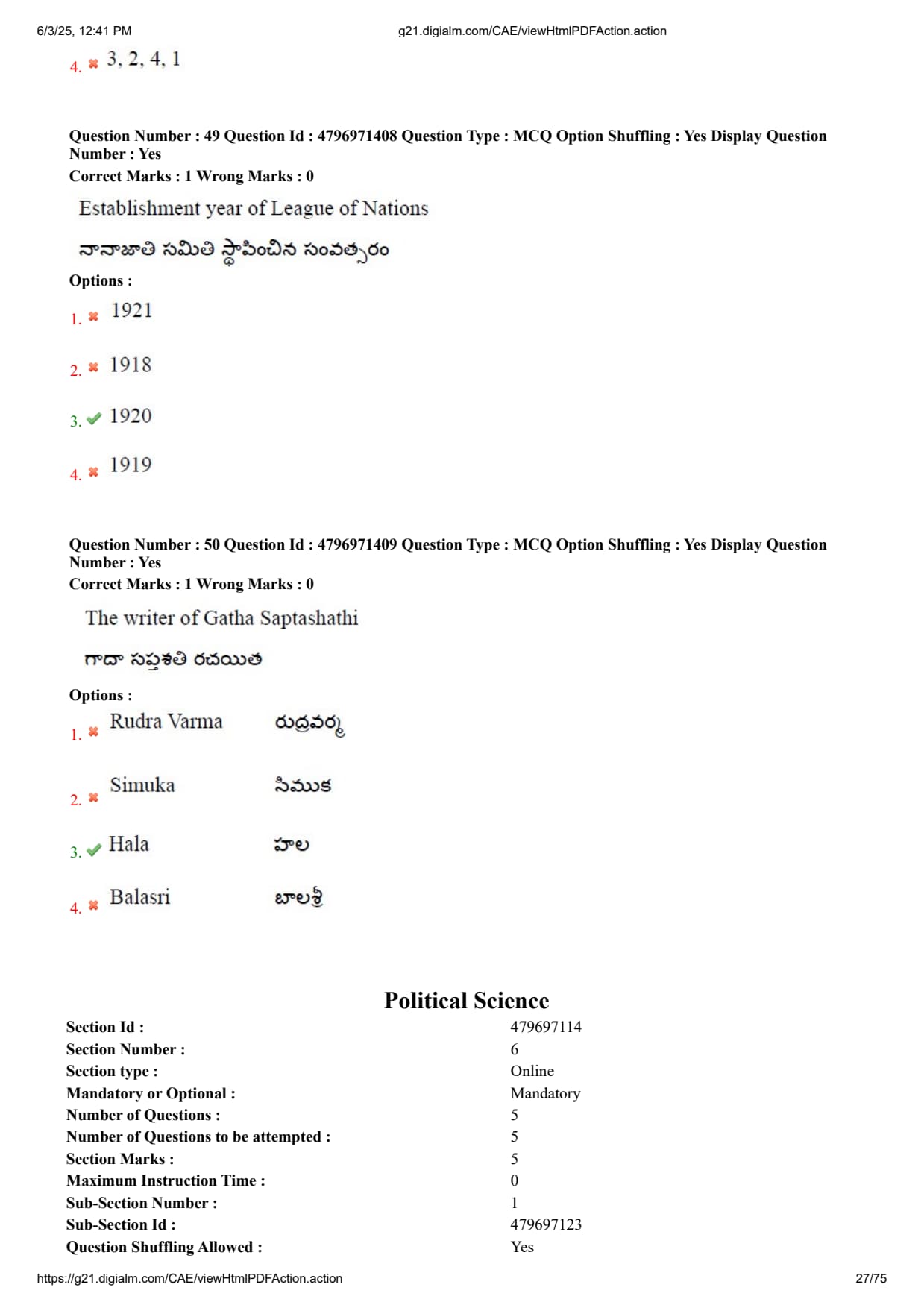
Question 48:

Arrange the following events in chronological order:

  • (A) Mahatma Gandhi’s return to India
  • (B) Passing of Rowlatt Act
  • (C) Ahmedabad Mill Worker’s movement
  • (D) Launch of Champaran Satyagraha
Correct Answer: (B) 1, 4, 3, 2
View Solution


The correct chronological order of events in Mahatma Gandhi's life during the freedom movement is as follows:

Step 1: Mahatma Gandhi’s return to India (1915).


Mahatma Gandhi returned to India in 1915 from South Africa. His return marked the beginning of his active involvement in India's freedom struggle.

Step 2: Launch of Champaran Satyagraha (1917).


In 1917, Gandhi launched the Champaran Satyagraha in Bihar to fight for the rights of indigo farmers. This was his first major success in India and an important milestone in his non-violent resistance movement.

Step 3: Ahmedabad Mill Worker’s movement (1918).


In 1918, Gandhi led the Ahmedabad mill workers’ movement for better wages and working conditions. This marked his first significant involvement with the working-class struggles in India.

Step 4: Passing of Rowlatt Act (1919).


The Rowlatt Act, passed in 1919, allowed the British government to arrest any Indian without trial. This led to widespread protests, including the Jallianwala Bagh massacre.

Step 5: Conclusion


Thus, the correct chronological order is:
1. Mahatma Gandhi’s return to India (1915)
2. Launch of Champaran Satyagraha (1917)
3. Ahmedabad Mill Worker’s movement (1918)
4. Passing of Rowlatt Act (1919).


Final Answer: 1, 4, 3, 2. Quick Tip: Mahatma Gandhi’s leadership in the Champaran Satyagraha, Ahmedabad mill workers' movement, and his response to the Rowlatt Act played a key role in India's struggle for independence.


Question 49:

Establishment year of League of Nations

  • (A) 1921
  • (B) 1918
  • (C) 1920
  • (D) 1919
Correct Answer: (C) 1920
View Solution


The League of Nations was established in 1920, following the end of World War I and the signing of the Treaty of Versailles. The main goal of the League was to maintain world peace and prevent future conflicts by promoting diplomacy and collective security.

Step 1: Context of the League's establishment.


The League was created as part of the Treaty of Versailles to address the failures of diplomacy during World War I and to create a permanent body for resolving international disputes.

Step 2: Conclusion.


The League of Nations was officially established in 1920, marking a significant step in international cooperation, though it was later replaced by the United Nations in 1945 after World War II.


Final Answer: 1920. Quick Tip: The League of Nations, established in 1920, was the first international organization aimed at promoting peace, though it was ineffective in preventing World War II.


Question 50:

The writer of Gatha Saptasathi

  • (A) Rudra Varma
  • (B) Simuka
  • (C) Hala
  • (D) Balasri
Correct Answer: (C) Hala
View Solution


Step 1: Understanding the question.

Gatha Saptasathi is an ancient text written in Prakrit that is attributed to the king Hala. It is a collection of 700 verses dedicated to Lord Shiva and his devotees.


Step 2: Explanation of the options.

- (A) Rudra Varma: Rudra Varma was not the writer of Gatha Saptasathi.

- (B) Simuka: Simuka is not associated with the writing of Gatha Saptasathi.

- (C) Hala: Correct. Hala, a king of the Satavahana dynasty, is traditionally credited with composing Gatha Saptasathi.

- (D) Balasri: Balasri is not the writer of Gatha Saptasathi.

Step 3: Conclusion.

Therefore, the correct answer is Hala, who is the author of Gatha Saptasathi.


Final Answer: Hala. Quick Tip: Hala, a Satavahana king, is known for his contribution to early Indian literature, specifically for his work Gatha Saptasathi.


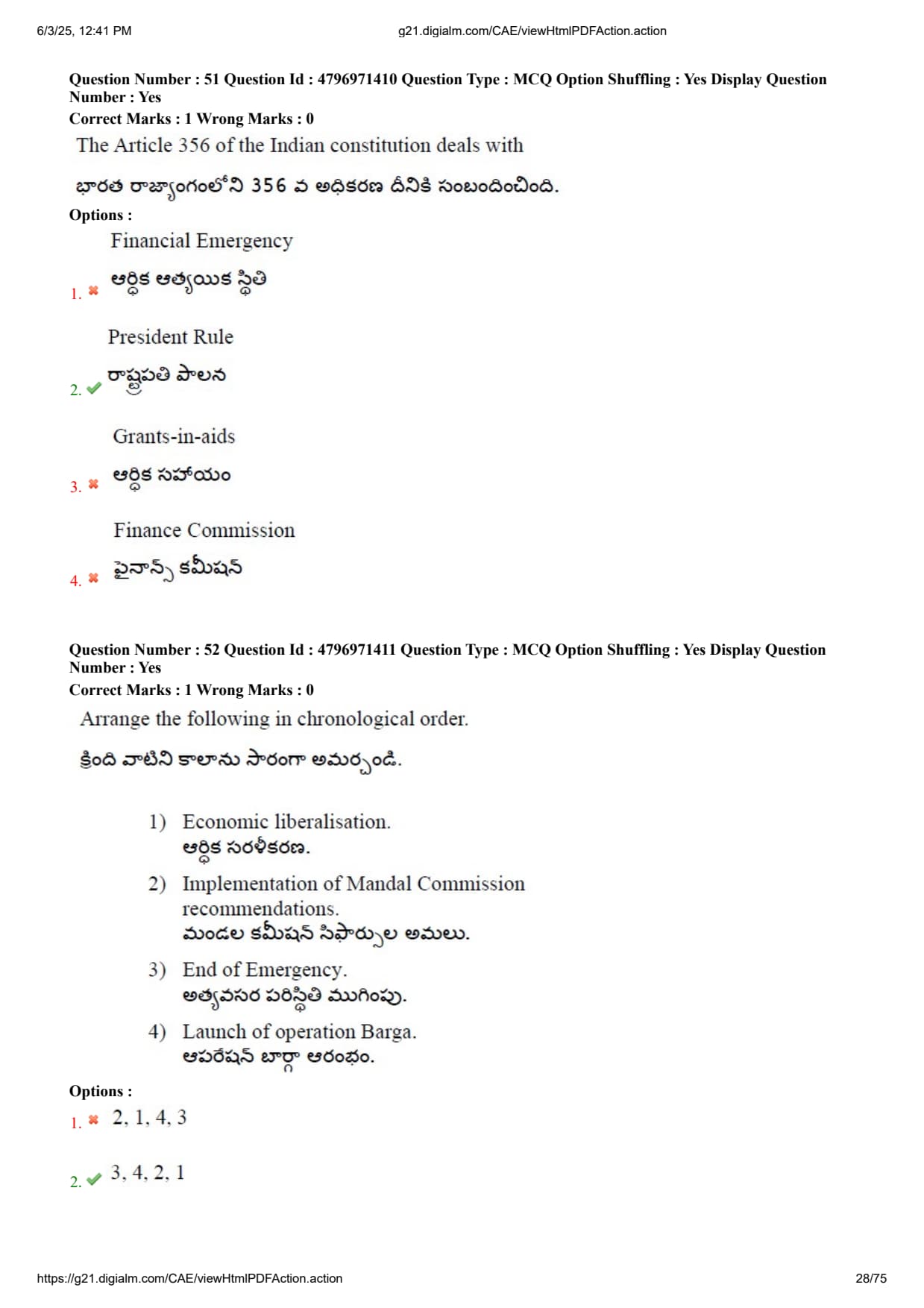
Question 51:

The Article 356 of the Indian constitution deals with

  • (A) Financial Emergency
  • (B) President Rule
  • (C) Grants-in-aids
  • (D) Finance Commission
Correct Answer: (B) President Rule
View Solution


Step 1: Article 356 in the Indian Constitution.

Article 356 of the Indian Constitution empowers the President to impose President's Rule in a state in case of failure of the constitutional machinery in that state.

Step 2: Conclusion.

Hence, Article 356 deals with the imposition of President's Rule, also referred to as the suspension of the state government and the central government taking over the state's governance.

Final Answer: President Rule.
Quick Tip: Article 356 is commonly referred to as "President's Rule" and allows the central government to take control of a state when its government fails to function according to constitutional provisions.


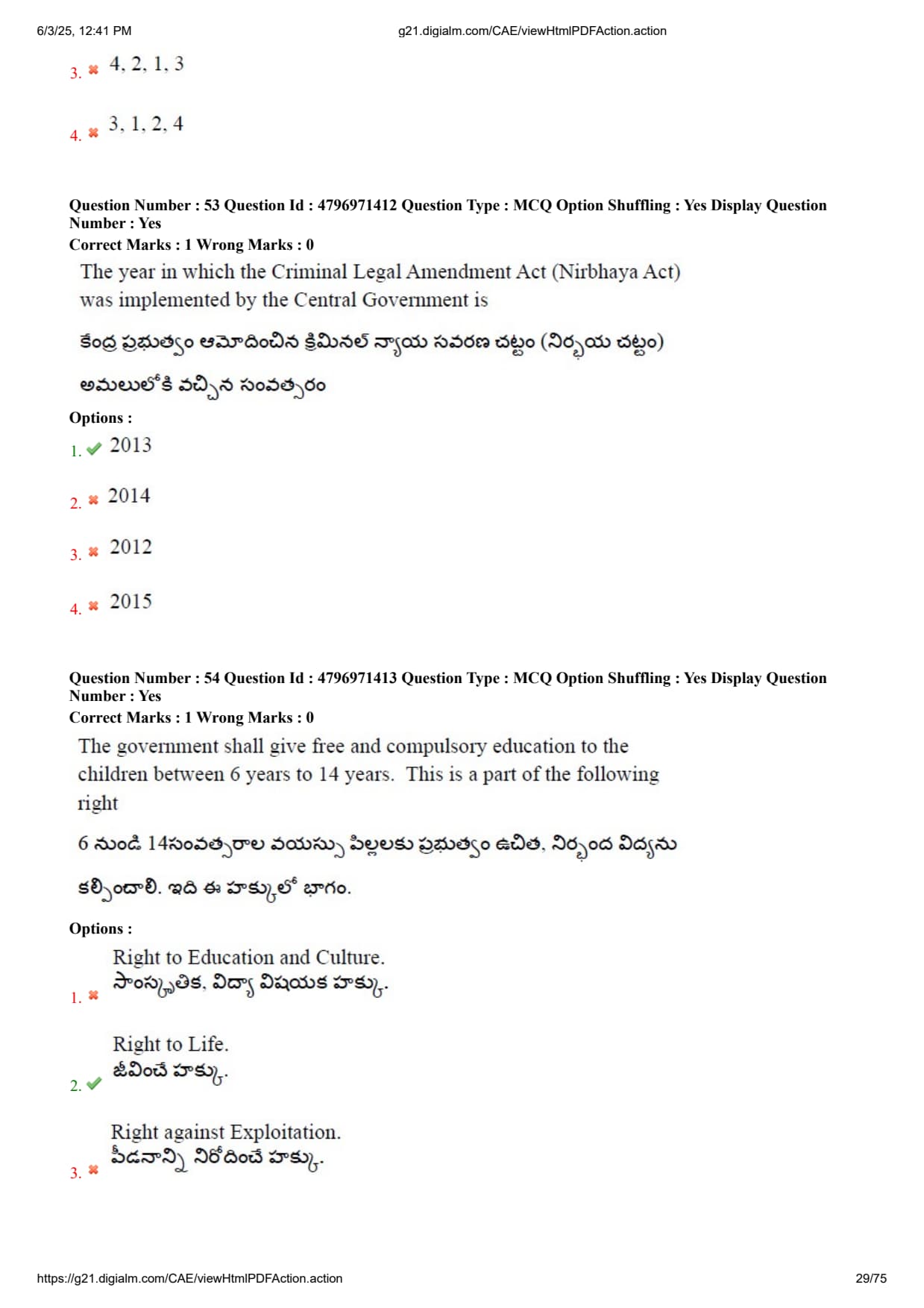
Question 52:

Arrange the following in chronological order.
1) Economic liberalisation.
2) Implementation of Mandal Commission recommendations.
3) End of Emergency.
4) Launch of operation Barga.

  • (A) 2, 1, 4, 3
  • (B) 3, 4, 2, 1
  • (C) 4, 2, 1, 3
  • (D) 3, 1, 4, 2
Correct Answer: (B) 3, 4, 2, 1
View Solution


Step 1: Understanding the events.

- 1) Economic liberalisation: Economic liberalisation in India began in 1991, which led to a shift towards a market-driven economy.

- 2) Implementation of Mandal Commission recommendations: The Mandal Commission report was implemented in 1990, leading to reservations in government jobs for OBCs.

- 3) End of Emergency: The Emergency imposed by Indira Gandhi ended in 1977 after being in place from 1975 to 1977.

- 4) Launch of operation Barga: Operation Barga was launched in 1978 in West Bengal to issue land rights to sharecroppers.


Step 2: Chronological order.

The correct chronological order of these events is:
1. End of Emergency (1977)
2. Launch of operation Barga (1978)
3. Implementation of Mandal Commission recommendations (1990)
4. Economic liberalisation (1991).

Final Answer: 3, 4, 2, 1.
Quick Tip: When determining chronological order, remember key events like the rise of the Nazi party, the formation of the USSR, and major WWII events.


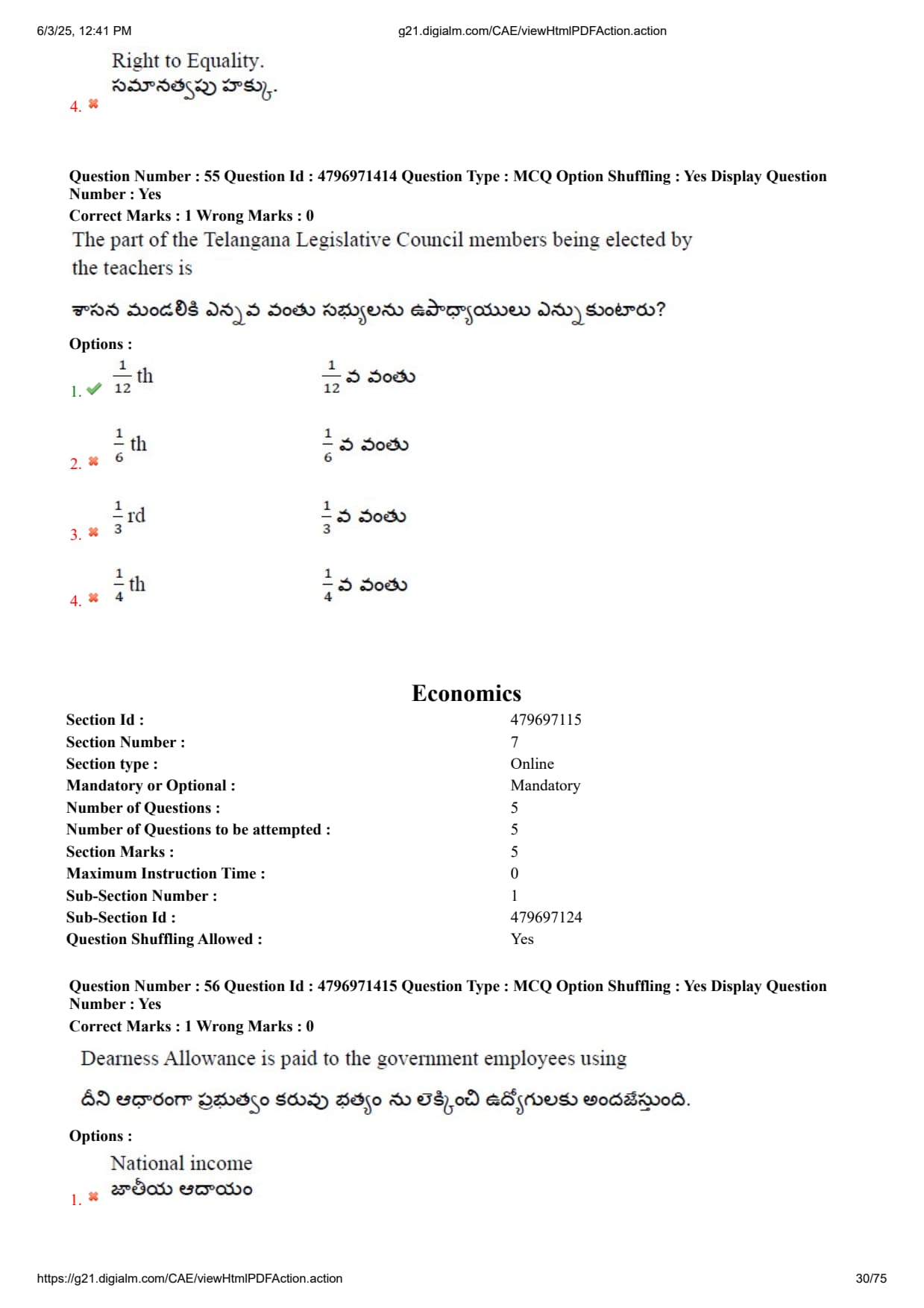
Question 53:

The year in which the Criminal Legal Amendment Act (Nirbhaya Act) was implemented by the Central Government is

  • (A) 2013
  • (B) 2014
  • (C) 2012
  • (D) 2015
Correct Answer: (A) 2013
View Solution


The Nirbhaya Act, officially known as the Criminal Law (Amendment) Act, was passed by the Indian Parliament in December 2012 in response to the brutal gang-rape and murder of a young woman, commonly referred to as Nirbhaya. The act came into effect in 2013, amending several sections of the Indian Penal Code (IPC) to address sexual violence and enhance punishment for crimes against women.

Step 1: Context of the Nirbhaya Act.


The Nirbhaya Act was implemented to ensure justice for the victim and to act as a deterrent for future crimes against women. It introduced stricter penalties for sexual assault, including death penalty for the rapist in some cases, and set up a fast-track court for cases involving sexual violence.

Step 2: Conclusion.


The act was implemented in 2013, and it has since been instrumental in shaping the legal framework for tackling crimes against women in India.


Final Answer: 2013. Quick Tip: The Nirbhaya Act (Criminal Law Amendment Act, 2013) was passed in the aftermath of the 2012 Delhi gang rape case to strengthen legal provisions related to sexual crimes and enhance punishment for offenders.


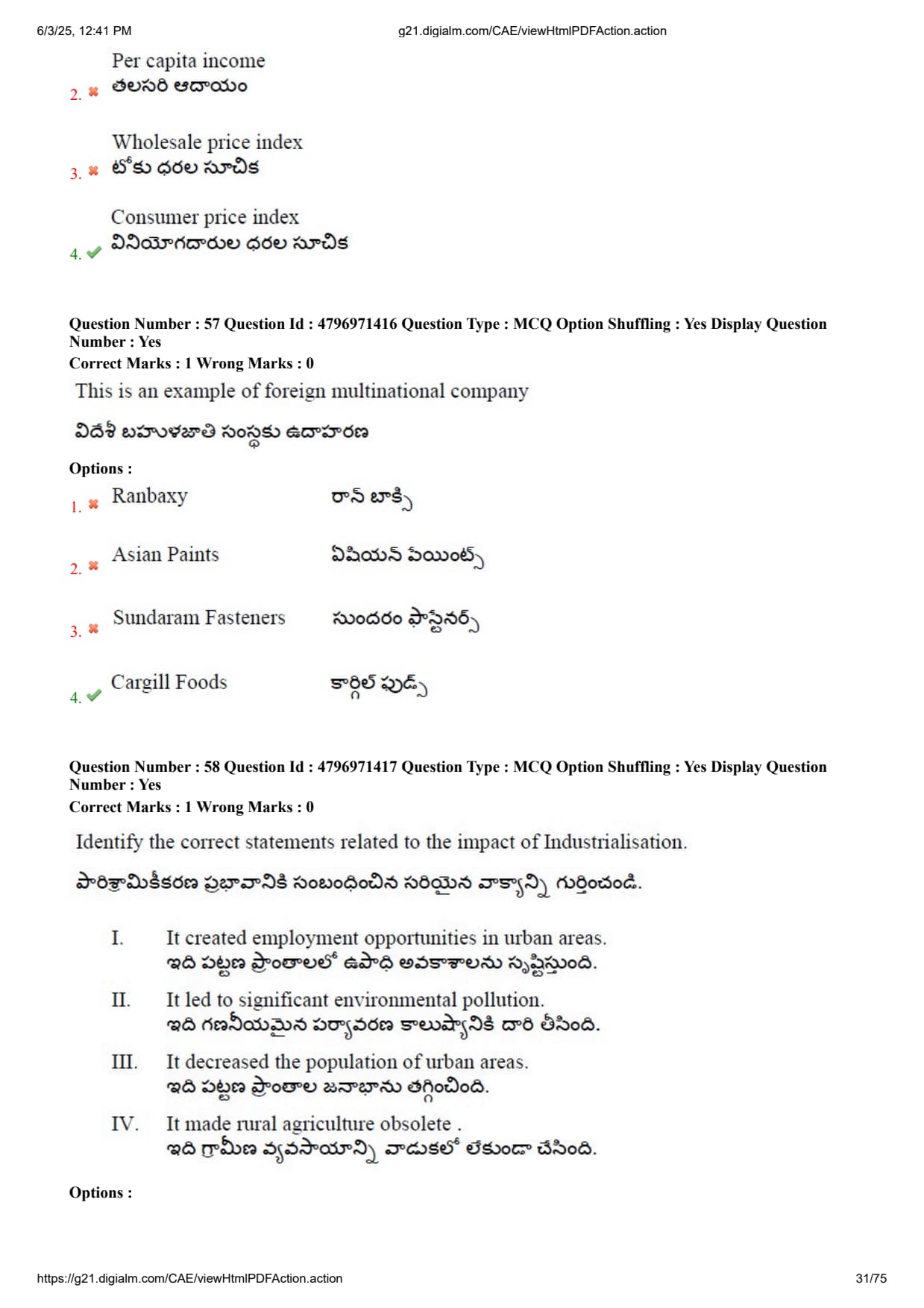
Question 54:

The government shall give free and compulsory education to the children between 6 years to 14 years. This is a part of the following right

  • (A) Right to Education and Culture
  • (B) Right to Life
  • (C) Right against Exploitation
  • (D) Right to Equality
Correct Answer: (A) Right to Education and Culture
View Solution


The provision of free and compulsory education to children between 6 and 14 years of age was introduced as part of the Right to Education (RTE) Act, which is a fundamental right under Article 21A of the Indian Constitution. This right ensures that every child in India has access to education and helps to eliminate barriers to education such as social inequality and poverty.

Step 1: Understanding the Right to Education Act.


The Right to Education Act (RTE) was passed in 2009 and became effective in 2010. It mandates free and compulsory education for all children between the ages of 6 and 14 years. It is a crucial step in achieving universal elementary education for children in India.

Step 2: Conclusion.


The Right to Education and Culture is the correct option because the RTE Act is part of the broader Right to Education, which is categorized under this fundamental right in the Constitution.


Final Answer: Right to Education and Culture. Quick Tip: The Right to Education Act (RTE) guarantees free and compulsory education for children aged 6 to 14 years, ensuring educational opportunities for all.


Question 55:

The part of the Telangana Legislative Council members being elected by the teachers is

  • (A) \( \frac{1}{12} \) th
  • (B) \( \frac{1}{6} \) th
  • (C) \( \frac{1}{3} \) rd
  • (D) \( \frac{1}{4} \) th
Correct Answer: (A) \( \frac{1}{12} \) th
View Solution


Step 1: Understanding the composition of the Telangana Legislative Council.

In the Telangana Legislative Council, members are elected through different categories, including teachers and graduates. The portion of members elected by teachers is defined by the state legislature.


Step 2: Correct answer explanation.

According to the Telangana Legislative Council Act, \( \frac{1}{12} \) of the total members are elected by teachers. This is the proportion of members representing teachers in the council.

Step 3: Conclusion.

Therefore, the correct answer is \( \frac{1}{12} \).


Final Answer: \( \frac{1}{12} \) th. Quick Tip: In certain legislative bodies, specific proportions of the council are elected by different groups, such as teachers and graduates. Be sure to check the exact ratio defined by the constitution or legislative rules.


Question 56:

Dearness Allowance is paid to the government employees using

  • (A) National income
  • (B) Per capita income
  • (C) Wholesale price index
  • (D) Consumer price index
Correct Answer: (D) Consumer price index
View Solution


Step 1: Understanding Dearness Allowance.

Dearness Allowance is a cost of living adjustment allowance paid to government employees to offset the impact of inflation. It is typically calculated using the Consumer Price Index (CPI), which measures the average change over time in the prices of goods and services typically consumed by households.

Step 2: Conclusion.

Therefore, the Dearness Allowance is based on the Consumer Price Index (CPI).


Final Answer: Consumer price index.
Quick Tip: Dearness Allowance is adjusted according to inflation rates, which are measured using the Consumer Price Index (CPI).


Question 57:

This is an example of a foreign multinational company

  • (A) Ranbaxy
  • (B) Asian Paints
  • (C) Sundaram Fasteners
  • (D) Cargill Foods
Correct Answer: (D) Cargill Foods
View Solution


Step 1: Understanding Multinational Companies.

A multinational company (MNC) is a company that operates in multiple countries across the world.

Step 2: Identifying MNC examples.

- \(\textbf{(A) Ranbaxy:}\) Ranbaxy was an Indian pharmaceutical company, acquired by Sun Pharmaceutical, but it was originally an Indian company.

- \(\textbf{(B) Asian Paints:}\) Asian Paints is an Indian multinational company, but it has a significant presence in several countries.

- \(\textbf{(C) Sundaram Fasteners:}\) Sundaram Fasteners is primarily an Indian company and not a foreign multinational company.

- \(\textbf{(D) Cargill Foods:}\) Cargill Foods is a foreign multinational company that operates in multiple countries, particularly in the food and agriculture sectors.


Step 3: Conclusion.

Therefore, the correct example of a foreign multinational company is Cargill Foods.


Final Answer: Cargill Foods.
Quick Tip: A multinational company (MNC) operates in more than one country, and its headquarters are typically located in a country different from the countries where it operates.


Question 58:

Identify the correct statements related to the impact of Industrialisation.
I. It created employment opportunities in urban areas.
II. It led to significant environmental pollution.
III. It decreased the population of urban areas.
IV. It made rural agriculture obsolete.

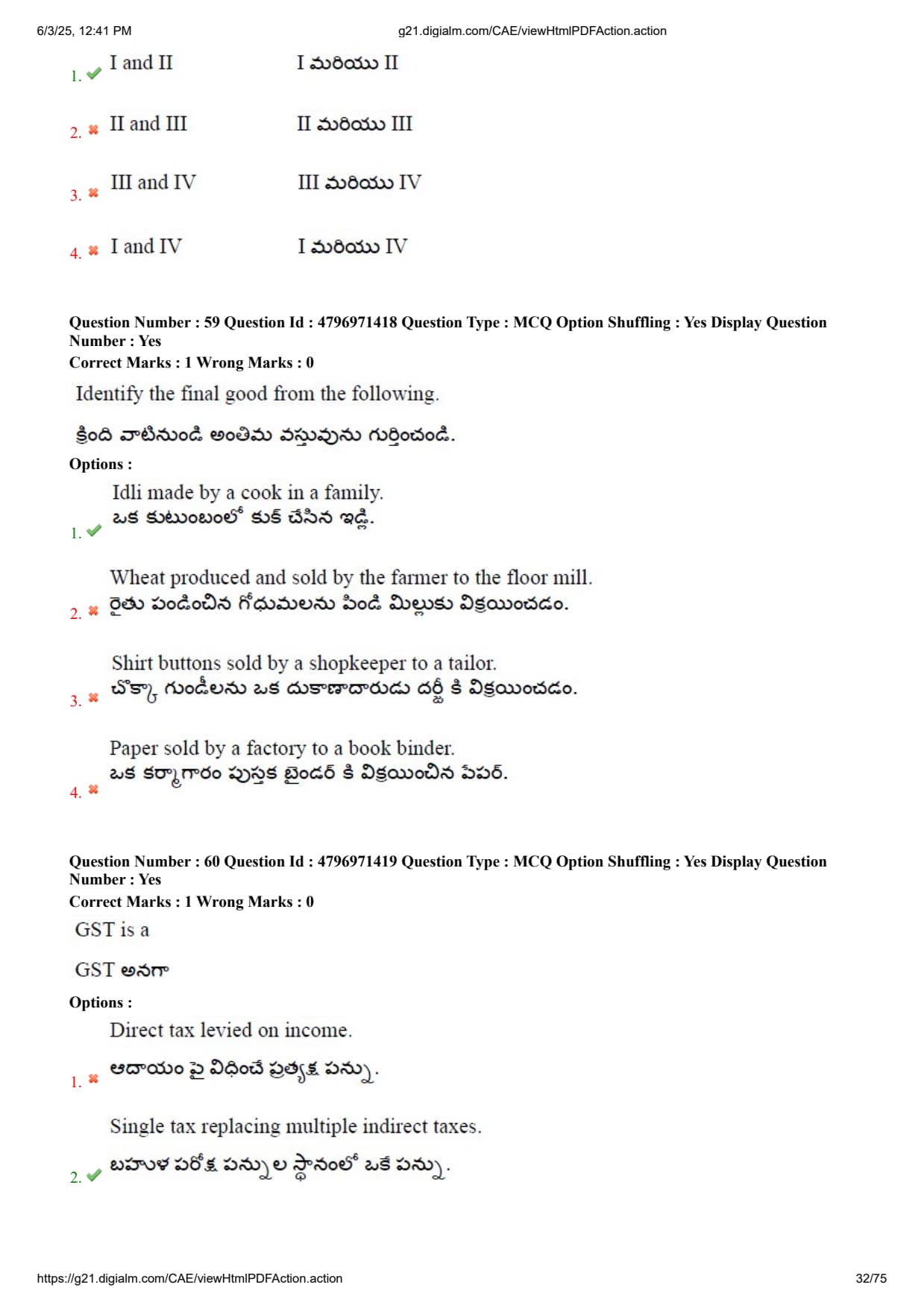
  • (I) I and II
Correct Answer: (I) I and II
View Solution


Industrialisation has had a significant impact on both urban and rural areas. Let’s analyze the statements:

Statement I: It created employment opportunities in urban areas.


This statement is true. Industrialisation led to the growth of industries in urban areas, creating a large number of employment opportunities. People migrated to cities in search of work, contributing to urbanisation.

Statement II: It led to significant environmental pollution.


This statement is also true. Industrialisation often results in the release of harmful pollutants into the air, water, and soil, leading to environmental degradation. Factories emit large quantities of gases and chemicals that contribute to air and water pollution.

Statement III: It decreased the population of urban areas.


This statement is incorrect. Industrialisation generally increases the population in urban areas due to the influx of workers from rural areas seeking employment.

Statement IV: It made rural agriculture obsolete.


This statement is partially incorrect. While industrialisation led to the mechanisation of agriculture and the migration of people to urban areas, it did not completely make rural agriculture obsolete. Agriculture still plays an important role in the rural economy.

Step 1: Conclusion


Thus, the correct statements are I and II.


Final Answer: (I) I and II. Quick Tip: Industrialisation can lead to both positive and negative effects, such as creating employment opportunities and causing environmental pollution.


Question 59:

Identify the final good from the following.

  • (A) Idli made by a cook in a family
  • (B) Wheat produced and sold by the farmer to the floor mill
  • (C) Shirt buttons sold by a shopkeeper to a tailor
  • (D) Paper sold by a factory to a book binder
Correct Answer: (A) Idli made by a cook in a family
View Solution


A final good is a product that is purchased by the final consumer, not used for further production. Let’s evaluate the options:

Option 1: Idli made by a cook in a family


This is a final good. Idli, once prepared and consumed by the family, is considered a final good because it is directly consumed by the household, not used for further production.

Option 2: Wheat produced and sold by the farmer to the floor mill


This is not a final good. The wheat is a raw material and is sold to the floor mill for further processing, so it is an intermediate good.

Option 3: Shirt buttons sold by a shopkeeper to a tailor


This is also an intermediate good. The buttons are sold to the tailor to be used in the production of shirts, making it part of the production process rather than a final good.

Option 4: Paper sold by a factory to a book binder


This is an intermediate good. The paper is sold to a book binder for further processing (binding books), so it is not a final good.

Step 1: Conclusion


Thus, the correct answer is Idli made by a cook in a family, as it is the final product consumed by the family.


Final Answer: Idli made by a cook in a family. Quick Tip: Final goods are those that are consumed by the end-user, while intermediate goods are used in the production of other goods.


Question 60:

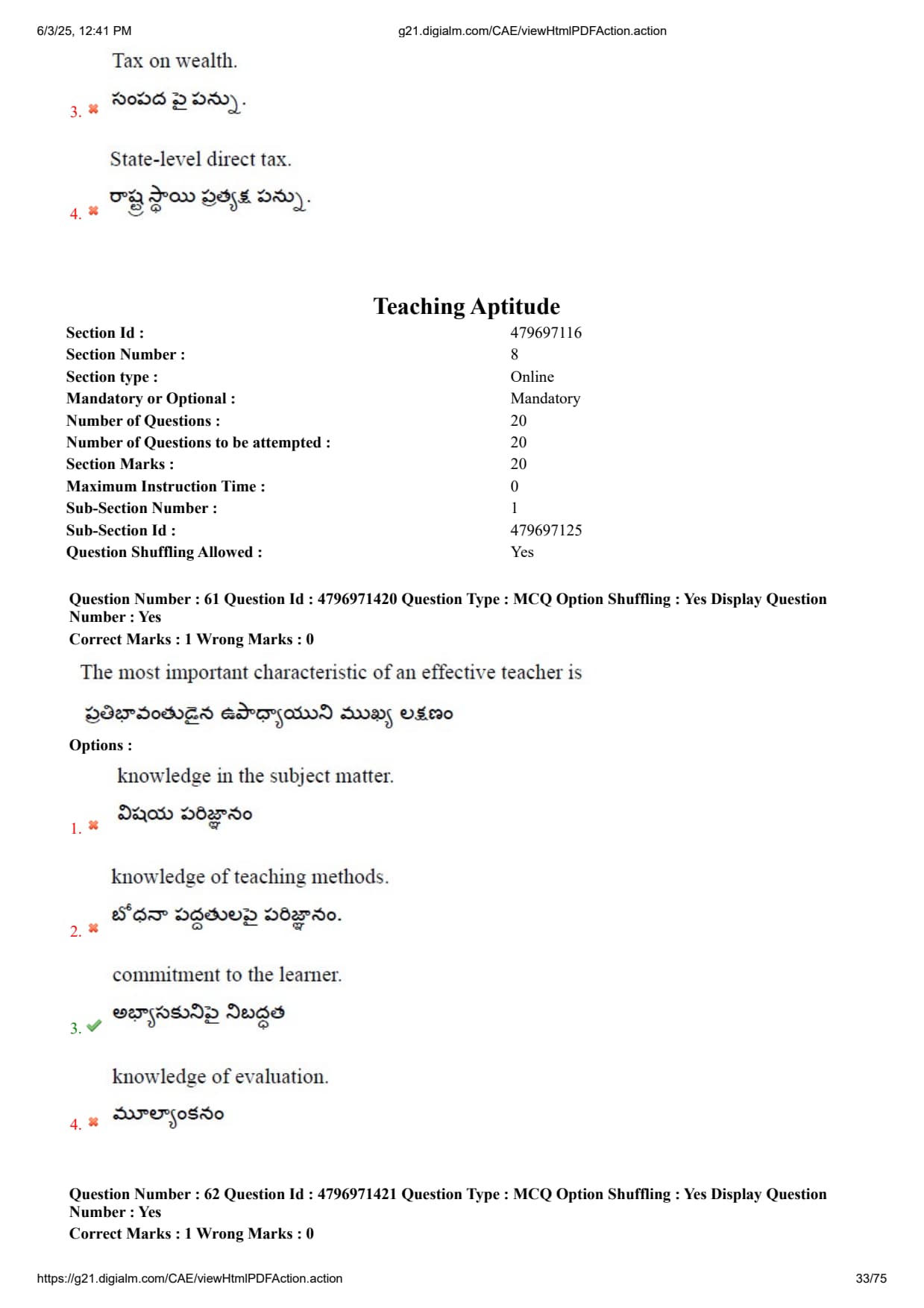
GST is a

  • (A) Direct tax levied on income.
  • (B) Single tax replacing multiple indirect taxes.
  • (C) Tax on wealth.
  • (D) State-level direct tax.
Correct Answer: (B) Single tax replacing multiple indirect taxes.
View Solution


Step 1: Understanding GST.

GST (Goods and Services Tax) is a single tax levied on the supply of goods and services, which replaces a variety of indirect taxes that were previously imposed by both the central and state governments. These taxes included VAT, service tax, excise duty, etc.


Step 2: Explanation of options.

- (A) Direct tax levied on income: Incorrect. GST is an indirect tax, not a direct tax like income tax.

- (B) Single tax replacing multiple indirect taxes: Correct. GST replaces multiple indirect taxes such as VAT, excise, and service tax.

- (C) Tax on wealth: Incorrect. Wealth tax is a separate tax, not related to GST.

- (D) State-level direct tax: Incorrect. GST is levied on both central and state levels, but it is not a direct tax.

Step 3: Conclusion.

Therefore, GST is a single tax that replaces multiple indirect taxes.


Final Answer: Single tax replacing multiple indirect taxes. Quick Tip: GST is a comprehensive tax that has unified various indirect taxes into one, making the taxation system more transparent and efficient.


Question 61:

The most important characteristic of an effective teacher is

  • (A) knowledge in the subject matter.
  • (B) knowledge of teaching methods.
  • (C) commitment to the learner.
  • (D) knowledge of evaluation.
Correct Answer: (C) commitment to the learner.
View Solution


Step 1: Characteristics of an effective teacher.


An effective teacher is someone who not only has a strong grasp of the subject matter but also deeply cares about the learners' needs, progress, and development. The most important characteristic of an effective teacher is their commitment to the learner, as it influences how they approach teaching and adapt their methods to ensure student success.


Step 2: Understanding other options.


- (A) Knowledge in the subject matter: While essential, it is not the most important characteristic of an effective teacher. Subject knowledge is necessary, but the ability to connect with and support learners is crucial.
- (B) Knowledge of teaching methods: Effective teaching methods are important, but they are part of the teacher's commitment to ensuring student success.
- (D) Knowledge of evaluation: Evaluation is important for assessing learning outcomes, but it is not the key characteristic of an effective teacher.

Step 3: Conclusion.


The most crucial characteristic of an effective teacher is commitment to the learner, as this drives their teaching approach, methods, and overall success in supporting student learning.


Final Answer: commitment to the learner.
Quick Tip: An effective teacher is committed to supporting their students' learning and development, which influences their approach to teaching and problem-solving.


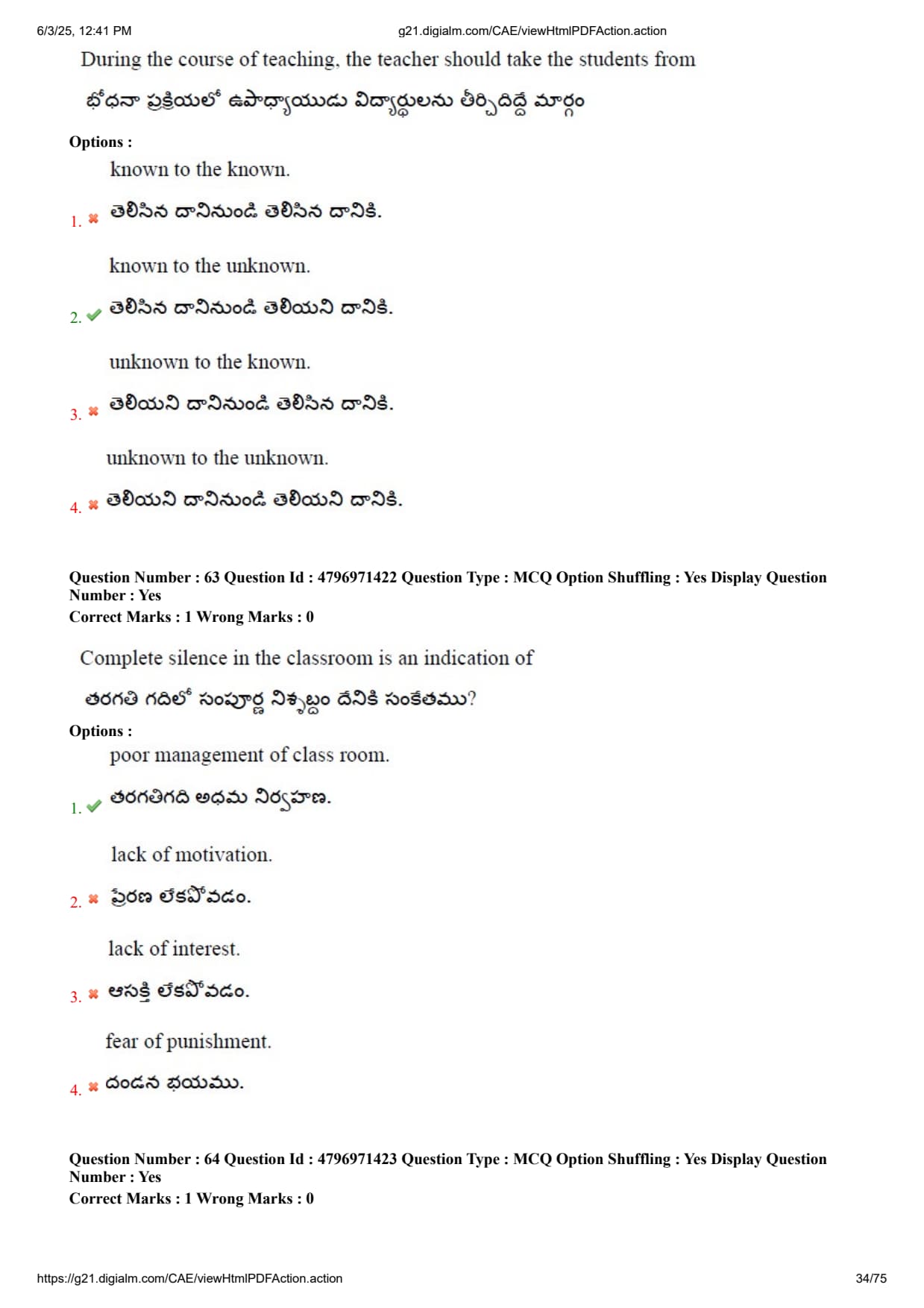
Question 62:

During the course of teaching, the teacher should take the students from
known to the known.

  • (A) known to the known.
  • (B) known to the unknown.
  • (C) unknown to the known.
  • (D) unknown to the unknown.
Correct Answer: (C) unknown to the known.
View Solution


Step 1: Understanding the teaching process.


During the process of teaching, it is important for a teacher to bridge the gap between the student's prior knowledge and new concepts. The teacher should first assess what the student already knows (the known), and then gradually introduce the unknown concepts in a way that is connected to the known information. This approach ensures that the learning process is meaningful and effective.


Step 2: Evaluating other options.


- (A) Known to the known: This is an inefficient teaching strategy, as it does not encourage the expansion of knowledge. Teaching should go beyond what is already known to introduce new concepts.
- (B) Known to the unknown: While this is an important part of teaching, it should be part of a process that moves from known to unknown gradually.
- (D) Unknown to the unknown: This approach could confuse students as they may struggle to connect new information without a foundation in what they already know.

Step 3: Conclusion.


The correct approach is to move from unknown to the known so that students can build on what they already know and connect new concepts to existing knowledge.


Final Answer: unknown to the known.
Quick Tip: The best way to teach is to build on students' existing knowledge by gradually introducing unfamiliar concepts, which helps make learning easier and more connected.


Question 63:

Complete silence in the classroom is an indication of

  • (A) Poor management of class room
  • (B) Lack of motivation
  • (C) Lack of interest
  • (D) Fear of punishment
Correct Answer: (A) Poor management of class room
View Solution


Step 1: Understanding the problem.

Complete silence in the classroom may indicate various factors, but it generally reflects poor management or lack of engagement, which can lead to silence. A well-managed classroom should have interactive discussions, with students motivated and involved in the learning process.

Step 2: Conclusion.

The answer is poor management of the class, as silence often results from ineffective teaching methods or lack of student engagement.


Final Answer: Poor management of class room. Quick Tip: A lively and interactive classroom fosters learning. Silence can indicate disengagement or poor classroom management.


Question 64:

Students learn better if they were

  • (A) Taught in their mother tongue
  • (B) Punished for their errors
  • (C) Taught in foreign language
  • (D) Imposing strict discipline
Correct Answer: (A) Taught in their mother tongue
View Solution


Step 1: Understanding the question.

Students tend to learn better when they understand the language being used for instruction. Teaching in the mother tongue makes the content more accessible and easier to comprehend, thus enhancing the learning experience.

Step 2: Conclusion.

The correct answer is that students learn better if they are taught in their mother tongue, as it helps them grasp concepts faster and more effectively.


Final Answer: Taught in their mother tongue. Quick Tip: When students learn in their mother tongue, it enhances their understanding and retention of the subject matter.


Question 65:

Which one of the following is considered as motivated teaching?

  • (A) Students taking notes
  • (B) Maximum attendance of the students.
  • (C) Students maintain silence in the class.
  • (D) Students asking questions.
Correct Answer: (D) Students asking questions.
View Solution


Step 1: Understanding motivated teaching.

Motivated teaching encourages active participation from students, which results in better learning outcomes. One of the primary signs of motivated teaching is when students ask questions, showing engagement and curiosity.

Step 2: Conclusion.

Hence, the correct answer is when students actively engage by asking questions during the lesson.


Final Answer: Students asking questions.
Quick Tip: Motivated teaching involves engaging students through interactive methods, such as encouraging them to ask questions, thus fostering a dynamic learning environment.


Question 66:

Those teachers who are popular among the students?

  • (A) develop intimacy with them.
  • (B) help them to solve their problems.
  • (C) award good marks to them.
  • (D) punish them in the class.
Correct Answer: (B) help them to solve their problems.
View Solution


Step 1: Popular teachers.

Teachers who are popular among students are generally approachable, understanding, and willing to help students with their academic or personal difficulties. This type of supportive behavior builds good rapport with students.

Step 2: Conclusion.

Therefore, the correct answer is that popular teachers help students solve their problems.


Final Answer: help them to solve their problems.
Quick Tip: Teachers who help students with their problems and provide guidance tend to be more popular and effective in fostering positive student-teacher relationships.


Question 67:

Remedial teaching is meant for

  • (A) intelligent students.
  • (B) economically affluent students.
  • (C) students with learning difficulties.
  • (D) girl students.
Correct Answer: (C) students with learning difficulties.
View Solution


Step 1: Understanding Remedial Teaching.

Remedial teaching is aimed at helping students who face learning difficulties or have gaps in their knowledge. It focuses on providing extra support and resources to help students overcome challenges and catch up with the rest of the class.

Step 2: Conclusion.

Therefore, remedial teaching is specifically designed for students who are struggling with learning difficulties.


Final Answer: students with learning difficulties.
Quick Tip: Remedial teaching targets students who need additional support due to learning challenges, helping them improve their understanding and performance.


Question 68:

The Prime objective of conducting examinations in schools is

  • (A) to promote discipline among the students.
  • (B) to know whether the objectives of teaching have been achieved.
  • (C) to promote reading habit among the students.
  • (D) to promote leadership qualities among the students.
Correct Answer: (B) to know whether the objectives of teaching have been achieved.
View Solution


Examinations in schools are an important tool for assessing the progress of students and determining whether the objectives of teaching have been successfully achieved. While other benefits like promoting discipline, reading habits, and leadership qualities are important, the core purpose of examinations is to evaluate how well the students have understood the concepts and how effectively the teaching has been delivered.

Step 1: Purpose of Examinations


The primary goal of examinations is to test the knowledge and skills acquired by the students. They help to understand the effectiveness of teaching methods and the students’ grasp of the subject matter.

Step 2: Conclusion


Thus, the correct answer is (B) to know whether the objectives of teaching have been achieved.


Final Answer: to know whether the objectives of teaching have been achieved. Quick Tip: Examinations are tools for measuring the effectiveness of teaching and understanding the students’ progress in learning.


Question 69:

Which one among the following is a teacher centred method of teaching?

  • (A) Problem solving method.
  • (B) Project method.
  • (C) Observation method.
  • (D) Lecture method.
Correct Answer: (D) Lecture method.
View Solution


Teaching methods can be broadly classified into two categories: teacher-centred methods and student-centred methods.

Step 1: Teacher-centred methods


Teacher-centred methods are those where the teacher is the primary authority, and students play a passive role. The teacher delivers the content, and the students are expected to absorb and recall the information. The Lecture method is the classic example of a teacher-centred method, where the teacher imparts knowledge to the students through verbal explanations.

Step 2: Student-centred methods


On the other hand, methods like Problem solving method, Project method, and Observation method are considered student-centred methods. In these methods, the focus is on student interaction, problem-solving, and practical application of knowledge.

Step 3: Conclusion


Thus, the correct answer is (D) Lecture method, as it is a teacher-centred method.


Final Answer: Lecture method. Quick Tip: In teacher-centred methods, the teacher is the primary source of information, while in student-centred methods, students are actively involved in the learning process.


Question 70:

I prefer teaching profession, because

  • (A) it's a leisurely job.
  • (B) most remunerative.
  • (C) to build the nation.
  • (D) to enter into politics.
Correct Answer: (C) to build the nation.
View Solution


Step 1: Understanding the context of teaching.

The teaching profession is considered noble because it plays a significant role in shaping individuals and contributing to nation-building. Educators help develop the skills and knowledge that empower students to become active and productive members of society.


Step 2: Explanation of options.

- (A) It's a leisurely job: This is not a valid reason, as teaching is a responsible and demanding profession.

- (B) Most remunerative: While teaching can be rewarding in terms of satisfaction, it is not typically considered the most remunerative profession.

- (C) To build the nation: Correct. Teaching plays an essential role in shaping the future of the nation by providing education and guiding the next generation.

- (D) To enter into politics: Teaching is not primarily intended as a stepping stone to politics.

Step 3: Conclusion.

Therefore, the best reason for preferring the teaching profession is to build the nation.


Final Answer: To build the nation. Quick Tip: Teaching is a vital profession that plays a crucial role in national development by educating and empowering individuals.


Question 71:

Teacher should enable the student to

  • (A) express freely.
  • (B) maintain silence.
  • (C) rote learning.
  • (D) score more marks.
Correct Answer: (A) express freely.
View Solution


Step 1: Understanding the role of a teacher.

A teacher's role is not just to instruct but also to create an environment where students feel confident in expressing themselves. Encouraging expression is essential for fostering creativity and independent thinking.


Step 2: Explanation of options.

- (A) Express freely: Correct. A teacher should enable students to express their thoughts, ideas, and opinions freely. This is crucial for their intellectual and personal growth.

- (B) Maintain silence: While silence is necessary in certain situations, it is not a teacher's role to restrict students from expressing themselves.

- (C) Rote learning: This is not ideal, as rote learning discourages critical thinking and creativity.

- (D) Score more marks: The focus should be on overall development, not just on scoring marks. The ability to express and think independently is far more valuable.

Step 3: Conclusion.

Therefore, the correct approach is for a teacher to encourage students to express themselves freely.


Final Answer: Express freely. Quick Tip: Teachers should encourage students to express their ideas and thoughts openly, as this fosters a healthy learning environment and enhances creativity.


Question 72:

A teacher should inculcate among the students

  • (A) Imposed discipline.
  • (B) Self-discipline.
  • (C) Robotic characteristics.
  • (D) Split personality.
Correct Answer: (B) Self-discipline.
View Solution


Step 1: Understanding the concept of self-discipline.


Self-discipline is one of the key qualities that a teacher should foster in students. It refers to the ability of students to control their own behavior, make responsible decisions, and stay focused on tasks without external enforcement. It helps them develop positive habits and become independent learners.


Step 2: Understanding the other options.


- (A) Imposed discipline: This refers to a situation where rules and controls are imposed by an external authority. While it might be necessary in some situations, self-discipline is the ideal characteristic for long-term student development.

- (C) Robotic characteristics: Robotic behavior is not conducive to a healthy learning environment. Students should be allowed to express creativity and individuality.

- (D) Split personality: This term is unrelated to teaching and refers to a psychological condition, not a characteristic to be inculcated in students.


Step 3: Conclusion.


Thus, the correct answer is that a teacher should inculcate self-discipline among students.


Final Answer: Self-discipline.
Quick Tip: Self-discipline helps students develop strong work habits, manage their time effectively, and be responsible for their learning.


Question 73:

How could you handle a student who is finding it difficult to understand the concept?

  • (A) Making the student to stand on the bench.
  • (B) Asking the student to write the concept 20 times.
  • (C) Asking the student to attend the remedial class.
  • (D) By giving corporal punishment.
Correct Answer: (C) Asking the student to attend the remedial class.
View Solution


Step 1: Identifying the best approach.


When a student is struggling to understand a concept, it is important to offer constructive support. The best approach is to provide additional learning opportunities, such as attending a remedial class, where the student can receive individual attention and clarification on the topic.


Step 2: Evaluating other options.


- (A) Making the student to stand on the bench: This is a punitive measure and does not address the student's learning needs.

- (B) Asking the student to write the concept 20 times: While repetition can sometimes help, it is not a productive or engaging way to address a student's understanding of a concept.

- (D) By giving corporal punishment: This is an inappropriate and harmful approach that should never be used in educational settings.


Step 3: Conclusion.


The best approach to helping a student who is struggling with a concept is to provide them with additional support through remedial classes.


Final Answer: Asking the student to attend the remedial class.
Quick Tip: When a student is struggling with a concept, focus on offering extra learning opportunities and individualized support to help them succeed.


Question 74:

Teaching should be

  • (A) Subject centric
  • (B) Student centric
  • (C) Teacher centric
  • (D) Examination centric
Correct Answer: (B) Student centric
View Solution


Step 1: Understanding the importance of student-centric teaching.

Student-centric teaching focuses on the needs, learning styles, and preferences of the students. This approach encourages active participation, critical thinking, and engagement in the learning process, making it more effective.

Step 2: Why other options are not ideal.

- (A) Subject-centric teaching focuses primarily on the subject matter, often neglecting the students' learning needs.

- (C) Teacher-centric teaching focuses mainly on the teacher's knowledge and delivery, not on the students' involvement.

- (D) Examination-centric teaching is focused on preparing students for exams rather than fostering a deep understanding of the subject.

Step 3: Conclusion.

Thus, teaching should be student-centric to ensure better engagement and learning outcomes.


Final Answer: Student centric. Quick Tip: Student-centric teaching enhances critical thinking, creativity, and problem-solving skills, making learning more effective and enjoyable.


Question 75:

Conceptual clarity is possible, provided if teaching takes place in

  • (A) Mother tongue
  • (B) Foreign language
  • (C) Regional language
  • (D) National languages
Correct Answer: (A) Mother tongue
View Solution


Step 1: The importance of mother tongue in learning.

Teaching in the mother tongue allows students to understand complex concepts more easily and clearly, as they are more familiar with the vocabulary and structure of their native language.

Step 2: Why other options may be less effective.

- (B) Teaching in a foreign language might hinder conceptual understanding, as students may struggle with comprehension.

- (C) Teaching in a regional language might be more effective than a foreign language but could still present challenges for students with limited proficiency.

- (D) National languages can vary in their effectiveness depending on the students' familiarity with the language.

Step 3: Conclusion.

Conceptual clarity is best achieved when teaching takes place in the mother tongue, as it enables easier understanding and communication.


Final Answer: Mother tongue. Quick Tip: Teaching in the mother tongue supports better conceptual understanding and faster learning. It helps bridge language barriers and improves overall academic performance.


Question 76:

The school environment that is congenial for children with special needs is

  • (A) special schools
  • (B) integrated schools
  • (C) inclusive schools
  • (D) normal schools
Correct Answer: (A) special schools
View Solution


Step 1: Special schools for children with special needs.

Special schools are designed specifically for children with special needs, providing a supportive and adapted environment that caters to their unique learning requirements. These schools focus on specialized instruction and resources tailored to the individual needs of the students.

Step 2: Conclusion.

Therefore, the school environment most suitable for children with special needs is special schools.


Final Answer: special schools.
Quick Tip: Special schools are specifically designed to provide a supportive and tailored environment for students with special needs, allowing for individualized attention and learning.


Question 77:

The main purpose of giving home-work to the students is

  • (A) Keeping them busy at home.
  • (B) To help the students to review what they have learned.
  • (C) To punish them.
  • (D) To reduce teachers work load.
Correct Answer: (B) To help the students to review what they have learned.
View Solution


Step 1: Purpose of home work.

The main purpose of homework is to help students consolidate their learning by reviewing and practicing what they have learned in class. It reinforces concepts and provides opportunities for independent learning.

Step 2: Conclusion.

Therefore, the primary goal of assigning homework is to help students review and reinforce their understanding of the material.


Final Answer: To help the students to review what they have learned.
Quick Tip: Homework serves as a reinforcement tool that allows students to review and apply the concepts learned in class.


Question 78:

While teaching, if there is some disturbance in the class, then as a teacher what you should do?

  • (A) Give a pause and continue.
  • (B) Not bother for what is happening in the classroom.
  • (C) Punish those who are causing disturbance.
  • (D) Send out the students who are causing disturbance.
Correct Answer: (A) Give a pause and continue.
View Solution


As a teacher, it is important to maintain control over the class while also encouraging positive classroom behavior. In the case of disturbances, the teacher should avoid overly harsh measures like punishment or sending students out of the class. Instead, the best course of action is to give a pause and then continue with the lesson. This helps regain the students’ attention and allows them to refocus on the task at hand without creating unnecessary tension.

Step 1: Handle disruptions calmly.


The primary goal is to manage disruptions without escalating the situation. Giving a pause provides an opportunity to regain attention without negatively affecting the learning environment.

Step 2: Conclusion


Thus, the correct response is to give a pause and continue with the lesson.


Final Answer: Give a pause and continue. Quick Tip: Handling classroom disruptions calmly and with patience helps maintain a positive learning environment.


Question 79:

In which teaching method is the learner’s participation most passive?

  • (A) Discussion method.
  • (B) Lecture method.
  • (C) Demonstration method.
  • (D) Project method.
Correct Answer: (B) Lecture method.
View Solution


In the Lecture method, the teacher is the primary source of information, and students play a more passive role by listening and absorbing the content. This is typical of teacher-centred methods, where the teacher has control over the flow of information, and students generally have minimal involvement in discussions or active learning.

Step 1: Active vs. Passive Participation


Methods like Discussion, Demonstration, and Project methods encourage active participation by the students. They involve more interaction, hands-on activities, and problem-solving, making students actively engage with the learning material.

Step 2: Conclusion


Thus, the Lecture method is the most passive form of learning for students as it involves primarily listening and note-taking, with limited interaction.


Final Answer: Lecture method. Quick Tip: In teacher-centred methods like the Lecture method, students are more passive, whereas in student-centred methods, students actively participate and engage with the content.


Question 80:

To improve the achievement levels among the students, it is necessary

  • (A) to provide high salary to teachers.
  • (B) to change the curriculum.
  • (C) to change the teaching methods often.
  • (D) to evaluate students continuously.
Correct Answer: (D) to evaluate students continuously.
View Solution


Step 1: Understanding the role of evaluation.

Continuous evaluation helps monitor the progress of students and identify areas that need improvement. It ensures that students are receiving adequate attention and are continuously motivated to improve their performance.


Step 2: Explanation of options.

- (A) To provide high salary to teachers: While teacher salaries are important, they are not the primary factor in improving student achievement.

- (B) To change the curriculum: Changing the curriculum is important, but it is not sufficient by itself to improve achievement levels. The quality of teaching and evaluation is equally important.

- (C) To change the teaching methods often: While changing teaching methods can help, continuous evaluation plays a more direct role in improving student performance.

- (D) To evaluate students continuously: Correct. Continuous evaluation helps assess the progress of students and ensures they remain engaged and on track to improve their achievement levels.

Step 3: Conclusion.

Therefore, continuous evaluation is the key to improving achievement levels among students.


Final Answer: To evaluate students continuously. Quick Tip: Continuous evaluation provides a clear understanding of a student's progress and areas of improvement, which helps in effective learning.


Question 81:

Effective teacher education programmes recognize the complexities of teaching and learning. Teachers are not mere transmitters of knowledge, but facilitators of learning. The national Council for Teachers Education (NCTE) has introduced reforms aimed at enhancing the quality of teacher education in India, focusing on competency-based teacher education.
Teacher education should integrate theoretical foundations with practical applications, enabling teachers to develop a critical understanding of the curriculum, pedagogy, and assessment. Ultimately, the goal of teacher education is to foster a community of practice, where teachers engage in ongoing professional development, reflection, and collaboration.

What is the primary goal of effective teacher education programmes, according to the passage?

  • (A) To transmit knowledge to students.
  • (B) To enhance the quality of teacher education.
  • (C) To develop teacher's learning skills.
  • (D) To discourage professional competency.
Correct Answer: (B) To enhance the quality of teacher education.
View Solution


Step 1: Analyzing the passage.


The passage talks about the importance of enhancing the quality of teacher education. It emphasizes that teacher education should not only impart knowledge but also help teachers develop a critical understanding of the curriculum, pedagogy, and assessment. The ultimate goal is to create a community of practice among teachers, where they continuously engage in professional development and collaboration.


Step 2: Evaluating other options.


- (A) To transmit knowledge to students: This is not the primary goal discussed in the passage, as it focuses more on the teacher's development and quality of education.

- (C) To develop teacher’s learning skills: While developing learning skills is part of teacher education, the passage is more focused on enhancing the overall quality of teacher education.

- (D) To discourage professional competency: This is contradictory to the passage’s objective, which aims to improve teacher competency.

Step 3: Conclusion.


The primary goal of effective teacher education programmes, according to the passage, is to enhance the quality of teacher education.


Final Answer: To enhance the quality of teacher education.
Quick Tip: Effective teacher education programmes focus on improving the overall quality of education, not just knowledge transmission. They help teachers develop the skills necessary for teaching and professional growth.


Question 82:

What are the primary benefits of fostering a community of practice among teachers?

  • (A) It promotes isolation among teachers.
  • (B) It enables teachers to develop technical skills.
  • (C) It facilitates ongoing professional development and collaboration.
  • (D) It focuses solely on administrative tasks.
Correct Answer: (C) It facilitates ongoing professional development and collaboration.
View Solution


Step 1: Understanding the benefits of a community of practice.


A community of practice helps teachers engage in ongoing professional development, share best practices, and collaborate with each other. This is essential for continuous growth and improving teaching practices. By working together, teachers can overcome challenges, learn new strategies, and create an enriching learning environment for their students.


Step 2: Evaluating other options.


- (A) It promotes isolation among teachers: This is the opposite of the intended purpose of fostering a community of practice, which encourages collaboration, not isolation.

- (B) It enables teachers to develop technical skills: While developing technical skills is important, the primary benefit is the ongoing professional development and collaboration that fosters a more holistic approach to teaching.

- (D) It focuses solely on administrative tasks: A community of practice is focused on teaching and professional development, not administrative work.

Step 3: Conclusion.


The primary benefit of fostering a community of practice is that it facilitates ongoing professional development and collaboration among teachers.


Final Answer: It facilitates ongoing professional development and collaboration.
Quick Tip: A community of practice helps teachers improve their teaching strategies, collaborate with peers, and engage in professional development, all of which enhance the quality of education.


Question 83:

How does competency-based teacher education, as introduced by NCTE, likely impact teachers' education programme?

  • (A) It will focus solely on theoretical knowledge.
  • (B) It will emphasize the development of specific competencies and skills.
  • (C) It will neglect the importance of practical experience.
  • (D) It will promote a one-size-fits-all approach.
Correct Answer: (B) It will emphasize the development of specific competencies and skills.
View Solution


Step 1: Understanding competency-based education.


Competency-based education focuses on developing specific skills and competencies that are necessary for effective teaching. It emphasizes the practical application of knowledge and ensures that teachers are equipped with the skills they need to be effective in the classroom. This approach is different from traditional education systems that often prioritize theoretical knowledge.


Step 2: Evaluating other options.


- (A) It will focus solely on theoretical knowledge: This is incorrect, as competency-based education places a higher value on practical skills rather than just theoretical knowledge.

- (C) It will neglect the importance of practical experience: This is incorrect because competency-based education emphasizes the development of practical skills.

- (D) It will promote a one-size-fits-all approach: Competency-based education is personalized and focuses on individual competencies rather than adopting a one-size-fits-all approach.


Step 3: Conclusion.


The most accurate impact of competency-based education is that it emphasizes the development of specific competencies and skills, ensuring teachers are well-equipped for their roles.


Final Answer: It will emphasize the development of specific competencies and skills.
Quick Tip: Competency-based education focuses on developing the specific skills and knowledge required for teachers to be successful in the classroom.


Question 84:

What is the ultimate goal of effective teacher education, according to the passage?

  • (A) To develop teachers as mere transmitters of knowledge.
  • (B) To discourage competition.
  • (C) To foster a community of practice among teachers.
  • (D) To enhance student achievement.
Correct Answer: (C) To foster a community of practice among teachers.
View Solution


Step 1: Understanding the goal of teacher education.


According to the passage, the ultimate goal of effective teacher education is to foster a community of practice among teachers. This allows teachers to engage in continuous learning, collaboration, and reflection, ultimately enhancing their professional development. It is not merely about transmitting knowledge but developing a supportive learning environment where teachers help each other grow.


Step 2: Evaluating other options.


- (A) To develop teachers as mere transmitters of knowledge: This is the opposite of the goal described in the passage, which focuses on collaboration and reflection, not just knowledge transmission.

- (B) To discourage competition: The goal is not to discourage competition but to promote collaboration and professional growth.

- (D) To enhance student achievement: While student achievement is important, the passage emphasizes the importance of fostering a community among teachers as the ultimate goal.


Step 3: Conclusion.


The ultimate goal of effective teacher education is to foster a community of practice among teachers, which allows for continuous professional development and collaboration.


Final Answer: To foster a community of practice among teachers.
Quick Tip: Effective teacher education aims to create a community of practice, where teachers collaborate and support each other in their professional development.


Question 85:

How does effective teacher-education programme define the role of teachers?

  • (A) mere transmitters of knowledge.
  • (B) dictators of notes.
  • (C) unprofessional and uncritical.
  • (D) facilitators of learning.
Correct Answer: (D) facilitators of learning.
View Solution


Step 1: Understanding the role of teachers.


According to effective teacher-education programmes, teachers are not just providers of knowledge, but rather facilitators of learning. They help students engage with the material, think critically, and develop skills that are necessary for lifelong learning. Teachers encourage active learning rather than simply delivering information.


Step 2: Evaluating the other options.


- (A) Mere transmitters of knowledge: This view is outdated. Teachers are more than just conveyors of information; they guide and facilitate student learning.

- (B) Dictators of notes: This is an incorrect perspective. Teachers should not simply dictate information; they should encourage interaction and learning.

- (C) Unprofessional and uncritical: This option is irrelevant and contradicts the purpose of teacher education.


Step 3: Conclusion.


The role of a teacher, as defined by effective teacher education, is that of a facilitator of learning, which involves guiding, mentoring, and supporting students in their educational journey.


Final Answer: facilitators of learning.
Quick Tip: Effective teachers guide and support students in their learning journey, fostering critical thinking, problem-solving, and independent learning skills.


Question 86:

Which of the following expressions is correct?

  • (A) Children books
  • (B) Childrens books
  • (C) Children's books
  • (D) Child books
Correct Answer: (C) Children's books
View Solution


Step 1: Understanding the possessive form.

The correct expression is "Children's books" because the word "children" is plural, and the possessive form is created by adding an apostrophe and "s" (children's) to show ownership of the books.

Step 2: Why other options are incorrect.

- (A) "Children books" is incorrect because the possessive form is missing.

- (B) "Childrens books" is also incorrect because "children" does not require an additional "s" at the end when it is in the possessive form.

- (D) "Child books" is incorrect because the word "child" is singular, and it does not correctly convey the idea of books belonging to children.

Step 3: Conclusion.

Thus, the correct expression is "Children's books".


Final Answer: Children's books. Quick Tip: Remember that when referring to the possessive form of a plural noun, an apostrophe and "s" are added (children's books).


Question 87:

Choose the correct passive form of the sentence: "They had given the students detailed instructions."

  • (A) The students were being given detailed instructions.
  • (B) The students have been given detailed instructions.
  • (C) Detailed instructions were given to the students.
  • (D) The students had been given detailed instructions.
Correct Answer: (D) The students had been given detailed instructions.
View Solution


Step 1: Understanding the passive voice.

To convert a sentence into the passive voice, the object of the active sentence becomes the subject of the passive sentence. The tense of the verb also needs to be adjusted.

In this case, the original sentence is in the past perfect tense ("had given"), so the passive voice should also be in the past perfect tense ("had been given").

Step 2: Why other options are incorrect.

- (A) "The students were being given detailed instructions" is in the past continuous tense and does not match the original sentence.

- (B) "The students have been given detailed instructions" is in the present perfect tense, which is incorrect for this context.

- (C) "Detailed instructions were given to the students" is in the simple past tense, which doesn't match the original past perfect tense.

Step 3: Conclusion.

The correct passive form is "The students had been given detailed instructions".


Final Answer: The students had been given detailed instructions. Quick Tip: When converting to the passive voice, remember to adjust the tense accordingly. For past perfect, use "had been" + past participle.


Question 88:

Fill in the blank with appropriate verb form.

The accident took place, when she ________ the road.

  • (A) is crossing
  • (B) has crossed
  • (C) was crossing
  • (D) would cross
Correct Answer: (C) was crossing
View Solution


Step 1: Understanding the sentence context.

The sentence describes an action that was happening at the time the accident took place. Therefore, the past continuous tense is required.

Step 2: Using the correct verb form.

The correct verb form to describe an ongoing action in the past is "was crossing."

Step 3: Conclusion.

Thus, the correct answer is "was crossing."


Final Answer: was crossing.
Quick Tip: Use the past continuous tense (was/were + verb + ing) to describe an action that was happening at a specific time in the past.


Question 89:

Choose the correct verb to fill the blank
Neither the leader nor his followers ________ present.

  • (A) is
  • (B) was
  • (C) were
  • (D) has
Correct Answer: (C) were
View Solution


Step 1: Understanding the subject.

The subject "Neither the leader nor his followers" is a compound subject, where the first noun "leader" is singular and the second noun "followers" is plural. According to subject-verb agreement rules, when the subject is joined by "nor," the verb should agree with the noun closest to it. In this case, "followers" is plural.

Step 2: Using the correct verb form.

Since "followers" is plural, the correct verb form is "were."

Step 3: Conclusion.

Thus, the correct verb is "were."


Final Answer: were.
Quick Tip: When a compound subject is connected with "nor," the verb should agree with the noun closest to it.


Question 90:

Find out the correct sentence:

  • (A) I am plan to attend the wedding party tonight.
  • (B) I planning to attend the wedding party tonight.
  • (C) I am planning to attend the wedding party tonight.
  • (D) I am been planning to attend the wedding party tonight.
Correct Answer: (C) I am planning to attend the wedding party tonight.
View Solution


The correct sentence structure should follow the standard rules of English grammar, where "am planning" is the correct usage to indicate an ongoing action in the present. The other options either use incorrect verb forms or improper tense.

Step 1: Correct usage of verbs


The phrase "I am planning" is the present continuous tense, which is used to express an action that is happening at the moment or is planned for the near future.

Step 2: Conclusion


Thus, the correct sentence is: "I am planning to attend the wedding party tonight."


Final Answer: I am planning to attend the wedding party tonight. Quick Tip: Use the present continuous tense ("am planning") to describe actions that are happening or planned for the near future.


Question 91:

Choose the opposite of 'pragmatic'

  • (A) realistic
  • (B) sensible
  • (C) idealistic
  • (D) logical
Correct Answer: (C) idealistic
View Solution


The term "pragmatic" refers to dealing with things sensibly and realistically, based on practical considerations. The opposite of being pragmatic is being "idealistic," which involves pursuing lofty ideals without regard to practical constraints or real-world challenges.

Step 1: Definition of pragmatic


"Pragmatic" refers to a practical approach that is focused on the outcome and the practical aspects of a situation rather than theoretical ideas.

Step 2: Conclusion


Thus, the opposite of "pragmatic" is "idealistic," which is characterized by a focus on ideals or visions that may not be practical or achievable.


Final Answer: idealistic. Quick Tip: "Pragmatic" focuses on practical, realistic approaches, while "idealistic" involves focusing on perfect ideals that may not be feasible.


Question 92:

Peter’s buoyant attitude was the main reason for their appreciation.

(Choose the meaning of the word underlined)

  • (A) hasty
  • (B) cheerful
  • (C) smart
  • (D) cruel
Correct Answer: (B) cheerful
View Solution


Step 1: Understanding the word "buoyant."

The word "buoyant" refers to something or someone being cheerful or optimistic. It is often used to describe a happy or upbeat attitude.


Step 2: Explanation of options.

- (A) Hasty: This means quick or impulsive, which is not the meaning of "buoyant."

- (B) Cheerful: Correct. "Buoyant" means cheerful, indicating a happy and optimistic attitude.

- (C) Smart: "Smart" refers to intelligence or appearance, which is not related to "buoyant."

- (D) Cruel: This means harsh or mean, which is the opposite of "buoyant."

Step 3: Conclusion.

Therefore, the correct meaning of "buoyant" in this context is cheerful.


Final Answer: Cheerful. Quick Tip: "Buoyant" typically refers to an optimistic, light-hearted, or cheerful attitude.


Question 93:

Choose the antonym of the word 'vivid'

  • (A) bright
  • (B) dull
  • (C) clear
  • (D) colorful
Correct Answer: (B) dull
View Solution


Step 1: Understanding the word "vivid."

"Vivid" means bright, clear, and full of life or color. It is often used to describe something that is striking or intense in appearance.


Step 2: Explanation of options.

- (A) Bright: This is a synonym of "vivid," not an antonym.

- (B) Dull: Correct. "Dull" is the antonym of "vivid," as it refers to something lacking brightness, color, or liveliness.

- (C) Clear: This word is related to the concept of vividness, but it is not its opposite.

- (D) Colorful: "Colorful" is a synonym of "vivid" and does not serve as an antonym.

Step 3: Conclusion.

Therefore, the antonym of "vivid" is "dull."


Final Answer: Dull. Quick Tip: The antonym of "vivid" is "dull," which refers to something lacking in brightness, color, or intensity.


Question 94:

Rearrange the following sentence to make logical and grammatical sense:

  • (A) Although he was ill, he went to work.
  • (B) He to work went, although he was ill.
  • (C) He was although ill, he went to work.
  • (D) He although was ill went to work.
Correct Answer: (A) Although he was ill, he went to work.
View Solution


To make the sentence grammatically correct and logically structured, the correct rearrangement is:


Although he was ill, he went to work. This structure is correct because it follows the appropriate syntax of placing the conjunction "although" at the beginning of the sentence, with a comma after it, followed by the main clause.


Step 1: Review of other options.


- (B) He to work went, although he was ill: This option is grammatically incorrect due to word order.
- (C) He was although ill, he went to work: This option is awkward and doesn't follow standard English sentence structure.
- (D) He although was ill went to work: This option is also incorrect due to incorrect word order.

Step 2: Conclusion.


The correct rearrangement is Although he was ill, he went to work.


Final Answer: Although he was ill, he went to work.
Quick Tip: When rearranging sentences, ensure proper word order and correct placement of conjunctions to maintain clarity and grammatical correctness.


Question 95:

Fill in the blank with suitable homonym:


\textit{They were travelling for many days and they were completely exhausted.

\textit{So, they wanted to take a ______ immediately.

  • (A) brake
  • (B) break
  • (C) breech
  • (D) breach
Correct Answer: (B) break
View Solution


In this case, the correct word is break because it refers to a period of rest or pause, which is the logical choice when someone is exhausted and needs to rest.


Step 1: Understanding the options.


- (A) brake: A brake is a device used for stopping or slowing down a vehicle. This doesn't fit the context of taking rest.
- (B) break: This is the correct option, as it means a rest or pause, which fits the context of exhaustion.
- (C) breech: A breech refers to the rear end or bottom of something, typically used in the context of a gun or childbirth. It is not suitable for this context.
- (D) breach: A breach refers to a gap or violation of a law, contract, or security, which doesn't fit the meaning of needing a rest.

Step 2: Conclusion.


The correct word to complete the sentence is break, as it means a rest period.


Final Answer: break.
Quick Tip: Remember that homonyms are words that sound the same but have different meanings. Ensure that the meaning fits the context of the sentence.


Question 96:

Choose the correct connective to complete the sentence:
"The test was challenging, ________ I managed to finish it on time."

  • (A) since
  • (B) because
  • (C) but
  • (D) although
Correct Answer: (C) but
View Solution


Step 1: Understanding the sentence.

The sentence presents a contrast. It mentions that the test was challenging, but despite this, the speaker managed to finish on time. This contrast is best expressed by using the word "but."

Step 2: Why other options are incorrect.

- (A) "since" implies causality, which doesn't fit here as there is no cause-and-effect relationship.

- (B) "because" also suggests causality, which doesn't match the intended contrast.

- (D) "although" would fit the context but grammatically doesn't work as smoothly with the structure of the sentence.

Step 3: Conclusion.

The correct connective is "but," which contrasts the difficulty of the test with the successful completion of it.


Final Answer: but. Quick Tip: When contrasting two ideas, use "but" to indicate a contrast between them, such as between difficulty and success.


Question 97:

Choose the correct sentence.

  • (A) I have returned all the books to the library yesterday.
  • (B) Though Ram worked very hardly, he failed.
  • (C) Everyone admired his courage.
  • (D) I should like to travel in the abroad.
Correct Answer: (C) Everyone admired his courage.
View Solution


Step 1: Evaluating each sentence.

- (A) "I have returned all the books to the library yesterday" is incorrect because the present perfect tense ("have returned") does not fit with a specific time in the past ("yesterday"). The past simple tense should be used instead: "I returned all the books to the library yesterday."

- (B) "Though Ram worked very hardly, he failed" is incorrect because "worked hardly" is grammatically wrong. The correct form is "worked very hard."

- (C) "Everyone admired his courage" is correct. This is a grammatically sound and meaningful sentence.

- (D) "I should like to travel in the abroad" is incorrect because "in the abroad" is not a standard phrase. The correct phrase is "abroad" without "in."

Step 2: Conclusion.

The correct sentence is "Everyone admired his courage."


Final Answer: Everyone admired his courage. Quick Tip: Be mindful of tense consistency and correct prepositions. "Hardly" should be replaced with "hard," and "abroad" is used without "in."


Question 98:

Find the correctly spelt word.

  • (A) affedevit
  • (B) afidevit
  • (C) afidavit
  • (D) affidavit
Correct Answer: (D) affidavit
View Solution


Step 1: Correct spelling.

The correct spelling of the word is "affidavit," which refers to a written statement that is sworn to be true.

Step 2: Conclusion.

Thus, the correctly spelled word is "affidavit."


Final Answer: affidavit.
Quick Tip: Remember the correct spelling: "affidavit." It is often confused with similar-sounding words like "affedevit."


Question 99:

Choose the correct form of reported speech of the sentence:
‘I can finish this project by Monday,’ she said.

  • (A) She said she could finish that project by Monday.
  • (B) She said I could finish this project by Monday.
  • (C) She said she can finish that project by Monday.
  • (D) She said she will finish that project by Monday.
Correct Answer: (A) She said she could finish that project by Monday.
View Solution


Step 1: Understanding reported speech.

In reported speech, we need to change the verb tense and pronouns. The verb "can" in direct speech changes to "could" in reported speech, and "this" changes to "that."

Step 2: Conclusion.

The correct form of the reported speech is "She said she could finish that project by Monday."


Final Answer: She said she could finish that project by Monday.
Quick Tip: In reported speech, pay attention to changes in verb tense (e.g., "can" to "could") and pronouns (e.g., "this" to "that").


Question 100:

No other boy is as _____ as Gopal in the class.

  • (A) smart
  • (B) smarter
  • (C) more smart
  • (D) most smart
Correct Answer: (A) smart
View Solution


The sentence is comparing Gopal to the other boys in the class. When using "as...as" to make a comparison of equality, we use the base form of the adjective (i.e., "smart") rather than the comparative form ("smarter").

Step 1: Understanding the comparison


The structure "as...as" is used for showing equality in English. For example: \[ No other boy is as smart as Gopal in the class. \]
Here, "smart" is the correct form because we are making an equal comparison.

Step 2: Conclusion


Thus, the correct answer is "smart."


Final Answer: smart. Quick Tip: When making comparisons with "as...as," use the base form of the adjective, such as "smart" in this case, rather than the comparative form.


Question 101:

What day is celebrated as 'Armed Forces Flag Day in India'?

  • (A) December 6
  • (B) December 7
  • (C) December 25
  • (D) December 30
Correct Answer: (B) December 7
View Solution


Step 1: Understanding the Armed Forces Flag Day.

The Armed Forces Flag Day is observed on December 7 in India to honor the armed forces and pay tribute to the soldiers who have served the country.

Step 2: Conclusion.

Thus, the correct answer is December 7.


Final Answer: December 7.
Quick Tip: Armed Forces Flag Day is celebrated on December 7 in India to honor and support the country's military personnel.


Question 102:

Who is the father of Indian Missile Technology?

  • (A) Prof U.N. Rao
  • (B) Dr. Vikram Sarabhai
  • (C) Dr. A.P.J. Abdul Kalam
  • (D) Dr. C.V. Chandrashekhar
Correct Answer: (C) Dr. A.P.J. Abdul Kalam
View Solution


Step 1: The Father of Indian Missile Technology.

Dr. A.P.J. Abdul Kalam, known as the "Missile Man of India," played a pivotal role in the development of India's missile programs, including the successful launch of ballistic missiles.

Step 2: Conclusion.

Thus, the father of Indian Missile Technology is Dr. A.P.J. Abdul Kalam.


Final Answer: Dr. A.P.J. Abdul Kalam.
Quick Tip: Dr. A.P.J. Abdul Kalam is known for his contributions to India's missile development and space research, making him the father of Indian Missile Technology.


Question 103:

Which of the following is the largest public sector undertaking of the Government of India?

  • (A) Gas Authority of India Limited
  • (B) Indian Railways
  • (C) Air India
  • (D) Indian Oil Corporation
Correct Answer: (B) Indian Railways
View Solution


Indian Railways is the largest public sector undertaking (PSU) in India. It operates one of the largest railway networks in the world and employs millions of people. The organization plays a significant role in the economic development of India by providing affordable and efficient transportation across the country.

Step 1: Indian Railways as the largest PSU


Indian Railways operates and manages more than 65,000 kilometers of track and serves over 8 billion passengers annually. It is a government-owned corporation and an essential part of India's infrastructure.

Step 2: Conclusion


Thus, the largest public sector undertaking in India is Indian Railways.


Final Answer: Indian Railways. Quick Tip: Indian Railways is the world's largest employer and a major player in the transportation sector in India.


Question 104:

Who wrote the novel 'The Suitable Boy'?

  • (A) M.R. Anand
  • (B) V.S. Naipaul
  • (C) Vikram Seth
  • (D) Chetan Bhagat
Correct Answer: (C) Vikram Seth
View Solution


The novel "A Suitable Boy" was written by Vikram Seth. It is one of the longest novels ever published in the English language and was first published in 1993. The novel deals with the themes of family dynamics, relationships, and societal expectations in post-independence India.

Step 1: Understanding the author


Vikram Seth is a renowned Indian author known for his works like "The Golden Gate" and "An Equal Music." "A Suitable Boy" is considered his masterpiece and is set in post-independence India, exploring the lives of four families.

Step 2: Conclusion


Thus, the correct answer is Vikram Seth as the author of "A Suitable Boy."


Final Answer: Vikram Seth. Quick Tip: "A Suitable Boy" by Vikram Seth is a classic in Indian literature, known for its deep exploration of Indian society and culture.


Question 105:

Elon Musk is a famous global

  • (A) Writer
  • (B) Politician
  • (C) Musician
  • (D) Businessman
Correct Answer: (D) Businessman
View Solution


Step 1: Understanding Elon Musk's identity.

Elon Musk is a well-known businessman, inventor, and entrepreneur. He is best known for founding companies like Tesla, SpaceX, and others.


Step 2: Explanation of options.

- (A) Writer: Incorrect. While Musk has written articles and has books published about him, he is primarily known for his business ventures.

- (B) Politician: Incorrect. Elon Musk is not involved in politics.

- (C) Musician: Incorrect. Musk is not a musician.

- (D) Businessman: Correct. Musk is most famously known as a businessman.

Step 3: Conclusion.

Therefore, the correct answer is businessman.


Final Answer: Businessman. Quick Tip: Elon Musk is renowned for his entrepreneurship and innovations in technology and space exploration, making him one of the most influential businessmen of the 21st century.


Question 106:

In which state 'Rani Durgavathi Tiger Reserve' is located?

  • (A) Odisha
  • (B) Madhya Pradesh
  • (C) Rajasthan
  • (D) Kerala
Correct Answer: (B) Madhya Pradesh
View Solution


Step 1: Understanding the location of Rani Durgavathi Tiger Reserve.

The Rani Durgavathi Tiger Reserve is located in the state of Madhya Pradesh, India. It is named after the historical queen, Rani Durgavathi, and serves as a significant conservation area for tigers and other wildlife.


Step 2: Explanation of options.

- (A) Odisha: Incorrect. The Rani Durgavathi Tiger Reserve is not in Odisha.

- (B) Madhya Pradesh: Correct. The reserve is located in Madhya Pradesh, a state known for its numerous tiger reserves.

- (C) Rajasthan: Incorrect. Rajasthan does have tiger reserves, but not the Rani Durgavathi Tiger Reserve.

- (D) Kerala: Incorrect. Kerala is known for its wildlife sanctuaries but not for the Rani Durgavathi Tiger Reserve.

Step 3: Conclusion.

Therefore, the correct location of the Rani Durgavathi Tiger Reserve is in Madhya Pradesh.


Final Answer: Madhya Pradesh. Quick Tip: Rani Durgavathi Tiger Reserve is one of the important wildlife conservation areas in Madhya Pradesh, providing habitat for tigers and other wildlife species.


Question 107:

Bihu is the traditional dance form of the state ________.

  • (A) Assam
  • (B) Nagaland
  • (C) Arunachal Pradesh
  • (D) Sikkim
Correct Answer: (A) Assam
View Solution


Step 1: Understanding the question.

Bihu is a traditional folk dance of Assam, which is widely celebrated during the festival of Bihu in Assam.

Step 2: Conclusion.

Thus, the correct answer is Assam.


Final Answer: Assam. Quick Tip: Bihu is a dance form associated with Assam, showcasing its culture and traditions, especially during the Bihu festival.


Question 108:

The tax paid by Indians which come under 'Direct Tax' is

  • (A) G.S.T.
  • (B) Excise Duty
  • (C) Customs Duty
  • (D) Income Tax
Correct Answer: (D) Income Tax
View Solution


Step 1: Understanding Direct Tax.

Direct taxes are those that are paid directly to the government by the taxpayer, such as income tax.

Step 2: Why other options are incorrect.

- (A) G.S.T. (Goods and Services Tax) is an indirect tax, not a direct tax.

- (B) Excise Duty is an indirect tax paid on goods manufactured within the country.

- (C) Customs Duty is also an indirect tax paid on imports and exports.

Step 3: Conclusion.

The correct answer is Income Tax, which is a direct tax.


Final Answer: Income Tax. Quick Tip: Income tax is a direct tax that individuals and businesses pay based on their income, while GST, excise, and customs duties are indirect taxes.


Question 109:

The Chairman of the high-level committee on ‘One Nation One Election’ is

  • (A) Draupadi Murmu
  • (B) Pratibha Patil
  • (C) Ramnath Kovind
  • (D) D.Y. Chandra Chood
Correct Answer: (C) Ramnath Kovind
View Solution


The high-level committee on ‘One Nation One Election’ was formed to explore the possibility of simultaneous elections in India. The committee is headed by Ramnath Kovind, the President of India.


Step 1: Understanding other options.


- (A) Draupadi Murmu: Draupadi Murmu is the current President of India, but she is not the chairman of this committee.
- (B) Pratibha Patil: Pratibha Patil is a former President of India, and she is not the chairman of the committee.
- (D) D.Y. Chandra Chood: This option is incorrect as he is not related to the committee in question.

Step 2: Conclusion.


The correct answer is Ramnath Kovind.


Final Answer: Ramnath Kovind.
Quick Tip: The 'One Nation One Election' committee is an important initiative aimed at conducting simultaneous elections in India, chaired by the President of India, Ramnath Kovind.


Question 110:

Which line of longitude passes through central India?

  • (A) Tropic of Cancer
  • (B) Tropic of Capricorn
  • (C) Equator
  • (D) Polar
Correct Answer: (A) Tropic of Cancer
View Solution


The Tropic of Cancer is the line of latitude that passes through the central part of India. It marks the northernmost point where the sun can be directly overhead. This line runs across the northern regions of India, passing through places like Rajasthan, Madhya Pradesh, and Chhattisgarh.


Step 1: Evaluating other options.


- (B) Tropic of Capricorn: The Tropic of Capricorn is located to the south of the equator and does not pass through India.
- (C) Equator: The Equator lies at 0° latitude and passes through countries near the equator but not through India.
- (D) Polar: This option refers to lines that are near the poles and does not pass through central India.

Step 2: Conclusion.


The correct answer is Tropic of Cancer, which passes through the central part of India.


Final Answer: Tropic of Cancer.
Quick Tip: The Tropic of Cancer is an important line of latitude that passes through central India, marking the northernmost point where the sun is directly overhead.


Question 111:

‘The Destiny of the Nation is built in her class rooms’ stated by

  • (A) Radha Krishna Commission
  • (B) Mudhaliyar Commission
  • (C) Kotari Commission
  • (D) Eshwarbhai Patel Committee
Correct Answer: (C) Kotari Commission
View Solution


Step 1: Understanding the Context of the Statement.

The statement "The Destiny of the Nation is built in her classrooms" emphasizes the importance of education in shaping the future of the nation. This statement is attributed to the *Kotari Commission* that was established in 1964 by the Government of India to address issues related to education in India. The commission aimed to recommend measures to improve the educational system, and one of its key findings was that the educational environment plays a pivotal role in the development of the country. The commission’s recommendations focused on a variety of aspects, including teacher training, curriculum, and educational resources, all of which are fundamental to shaping the nation’s future.

Step 2: Review of Options.

- \(\textbf{(A) Radha Krishna Commission:}\) This commission was established in 1948 to review the educational system in India, but it is not associated with the quote in question.
- \(\textbf{(B) Mudhaliyar Commission:}\) This was an educational commission set up in 1959 to address issues in the schooling system in Tamil Nadu. It does not correspond to the statement.
- \(\textbf{(C) Kotari Commission:}\) Correct. The Kotari Commission is directly associated with the quote about shaping the nation through education, as it played a major role in formulating policies related to improving the education system.
- \(\textbf{(D) Eshwarbhai Patel Committee:}\) This committee was focused on economic and political matters, not directly on education.

Step 3: Conclusion.

The quote is best attributed to the *Kotari Commission*, which recognized the essential role of education in national development and advocated for widespread reform in the educational sector.


Final Answer: Kotari Commission.
Quick Tip: The Kotari Commission (1964-66) laid the foundation for India's modern educational policies, emphasizing the role of education in the development of a nation.


Question 112:

‘Naitalim’ is associated with

  • (A) Sri Aurobindo
  • (B) M.K. Gandhi
  • (C) Rabindranath Tagore
  • (D) Jiddu Krishnamurti
Correct Answer: (B) M.K. Gandhi
View Solution


Step 1: Understanding 'Naitalim' and its Importance.

Naitalim is an educational concept introduced by *Mahatma Gandhi*, focused on teaching self-reliance and skills that are directly useful for the individual and society. The term ‘Naitalim’ refers to the education of handicrafts or manual work, emphasizing the importance of skill development alongside formal education. Gandhi believed that such education would provide both economic self-sufficiency and intellectual growth.

Gandhi advocated for Naitalim as a way to empower the masses, especially the rural population, by teaching them practical skills that would enable them to be self-sufficient and break free from economic dependency. His vision was rooted in the idea that education should not just be academic but should also nurture character, independence, and social responsibility.

Step 2: Review of Options.

- \(\textbf{(A) Sri Aurobindo:}\) While Sri Aurobindo was a great thinker and educationist, he did not focus on Naitalim or handicraft-based education. His ideas were more focused on spiritual and intellectual education.
- \(\textbf{(B) M.K. Gandhi:}\) Correct. Mahatma Gandhi strongly advocated for Naitalim as part of his vision for an education system rooted in self-reliance, manual labor, and character building.
- \(\textbf{(C) Rabindranath Tagore:}\) Rabindranath Tagore’s approach to education was centered around intellectual development and the arts, with a focus on holistic education, but not specifically Naitalim.
- \(\textbf{(D) Jiddu Krishnamurti:}\) Krishnamurti was an educator who emphasized free and independent thinking, but his philosophy did not align directly with Naitalim, which focuses more on manual and vocational skills.

Step 3: Conclusion.

The correct answer is *M.K. Gandhi*, as he was the pioneer behind the Naitalim education system, emphasizing the importance of practical work and vocational skills alongside formal education.


Final Answer: M.K. Gandhi.
Quick Tip: Mahatma Gandhi’s Naitalim was a key part of his philosophy on education, promoting manual skills as an integral part of learning to encourage self-reliance.


Question 113:

The book 'Emile' authored by

  • (A) J.J. Rousseau
  • (B) John Dewey
  • (C) Paul Goodman
  • (D) Maria Montessori
Correct Answer: (A) J.J. Rousseau
View Solution


The book "Emile" (or "Emile, or On Education") was written by Jean-Jacques Rousseau. It is one of the most important works on education and is considered a seminal treatise on the principles of education in the Enlightenment era.

Step 1: Rousseau’s Influence


In "Emile," Rousseau discusses the education of a young boy named Emile and presents a philosophy based on natural education, which emphasizes the importance of allowing children to develop in a natural and unstructured environment, free from societal pressures.

Step 2: Conclusion


Thus, the correct answer is J.J. Rousseau, as he is the author of "Emile."


Final Answer: J.J. Rousseau. Quick Tip: "Emile" by J.J. Rousseau is a foundational work in educational theory, advocating for a child-centered approach to education.


Question 114:

'Gurukula system' of education was prevalent in

  • (A) Contemporary period
  • (B) Modern period
  • (C) Medieval period
  • (D) Ancient period
Correct Answer: (D) Ancient period
View Solution


The Gurukula system of education was a traditional method of learning in ancient India, where students lived with their teacher (guru) in a secluded place (gurukula) to gain knowledge. This system was prevalent in the Ancient period of Indian history, particularly during the Vedic and early post-Vedic times.

Step 1: Gurukula System


The Gurukula system focused on personal and intimate teacher-student relationships. Education took place in natural surroundings, and the teacher imparted knowledge orally, often focusing on subjects such as the Vedas, philosophy, and arts.

Step 2: Conclusion


Therefore, the Gurukula system was primarily a feature of the Ancient period in India.


Final Answer: Ancient period. Quick Tip: The Gurukula system was an integral part of ancient Indian education, where students learned in close proximity to their teachers in natural surroundings.


Question 115:

A teacher should strive to create \hspace{1cm} climate in the class room.

  • (A) authoritarian
  • (B) democratic
  • (C) laissez-faire
  • (D) transformational
Correct Answer: (B) democratic
View Solution


Step 1: Understanding the teacher's role.

A teacher plays a crucial role in creating an environment that promotes learning, collaboration, and development. The climate in the classroom should be one that encourages participation, respect, and democratic values.


Step 2: Explanation of options.

- (A) Authoritarian: An authoritarian approach is rigid and does not encourage student participation or creativity.

- (B) Democratic: Correct. A democratic classroom allows for student involvement, mutual respect, and encourages open discussion.

- (C) Laissez-faire: This approach is too passive and does not provide enough guidance for students.

- (D) Transformational: While transformational teaching is important, it focuses more on motivating and inspiring students, but the climate should also be democratic for maximum engagement.

Step 3: Conclusion.

Therefore, the ideal climate in a classroom is democratic, where both the teacher and students collaborate in decision-making and learning.


Final Answer: Democratic. Quick Tip: A democratic classroom fosters collaboration, mutual respect, and active student involvement in learning.


Question 116:

'Curriculum for School Education to the Nation' is suggested by

  • (A) NUEPA
  • (B) NCTE
  • (C) NCERT
  • (D) SCERT
Correct Answer: (C) NCERT
View Solution


Step 1: Understanding the curriculum framework.

The NCERT (National Council of Educational Research and Training) is responsible for designing the curriculum framework for school education in India. It provides the curriculum guidelines and resources for schools across the country.


Step 2: Explanation of options.

- (A) NUEPA: The NUEPA (National University of Educational Planning and Administration) focuses on educational planning and administration, not curriculum development.

- (B) NCTE: The NCTE (National Council for Teacher Education) focuses on the development and regulation of teacher education programs.

- (C) NCERT: Correct. NCERT is responsible for curriculum development and educational resources for schools in India.

- (D) SCERT: SCERT (State Council of Educational Research and Training) works at the state level to implement curriculum, but NCERT creates the national curriculum framework.

Step 3: Conclusion.

Therefore, NCERT is the correct body responsible for suggesting the curriculum for school education to the nation.


Final Answer: NCERT. Quick Tip: NCERT is the central organization responsible for developing the national curriculum framework and providing educational resources for schools across India.


Question 117:

The chairperson of Telangana Education Commission is

  • (A) A Murali
  • (B) Hara Gopal
  • (C) Riyaz
  • (D) Murali Manohar
Correct Answer: (A) A Murali
View Solution


Step 1: Understanding the question.

The chairperson of the Telangana Education Commission is a notable position responsible for overseeing education policies and developments in the state of Telangana.

Step 2: Conclusion.

The correct answer is A Murali, who holds the position of chairperson of the Telangana Education Commission.


Final Answer: A Murali. Quick Tip: The chairperson of an education commission plays a vital role in shaping and implementing educational policies in a region.


Question 118:

New pedagogical and curricular structure suggested by NEP 2020 is

  • (A) \(3 + 5 + 3 + 4\)
  • (B) \(3 + 3 + 3 + 2 + 4\)
  • (C) \(10 + 2 + 4\)
  • (D) \(5 + 3 + 3 + 4\)
Correct Answer: (D) \(5 + 3 + 3 + 4\)
View Solution


Step 1: Understanding the NEP 2020 Structure.

According to the National Education Policy (NEP) 2020, the new pedagogical and curricular structure is divided into four stages:

- Foundational (5 years): 3 years of preschool and 2 years of primary education.

- Preparatory (3 years): Class 3 to 5.

- Middle (3 years): Class 6 to 8.

- Secondary (4 years): Class 9 to 12.

Step 2: Conclusion.

The structure suggested by NEP 2020 is \( 5 + 3 + 3 + 4 \), corresponding to the above stages of education.


Final Answer: \( 5 + 3 + 3 + 4 \). Quick Tip: The NEP 2020 aims to restructure the education system by focusing on holistic development through the 5+3+3+4 structure.


Question 119:

The organization which conducts various entrance examinations at the national level is

  • (A) CBSE
  • (B) NCERT
  • (C) NTA
  • (D) UGC
Correct Answer: (C) NTA
View Solution


The National Testing Agency (NTA) is the organization responsible for conducting various entrance examinations at the national level, such as JEE, NEET, and UGC NET.


Step 1: Evaluating other options.


- (A) CBSE: The Central Board of Secondary Education (CBSE) conducts school-level examinations and is not responsible for entrance exams at the national level.
- (B) NCERT: The National Council of Educational Research and Training (NCERT) is responsible for developing curriculum and educational materials, but it does not conduct entrance examinations.
- (D) UGC: The University Grants Commission (UGC) is responsible for overseeing higher education in India but does not conduct entrance exams for admission.

Step 2: Conclusion.


The correct organization that conducts various national-level entrance exams is NTA (National Testing Agency).


Final Answer: NTA.
Quick Tip: The National Testing Agency (NTA) is responsible for conducting many of India's major entrance exams, including JEE, NEET, and UGC NET.


Question 120:

The Right to Education (RTE) Act enacted by the Indian Parliament on

  • (A) 31st March, 2008
  • (B) 4th August, 2009
  • (C) 5th September, 2008
  • (D) 3rd December, 2007
Correct Answer: (B) 4th August, 2009
View Solution


The Right to Education (RTE) Act was enacted by the Indian Parliament on 4th August, 2009. This law guarantees free and compulsory education for children aged 6 to 14 years in India.


Step 1: Evaluating other options.


- (A) 31st March, 2008: This date is incorrect; the RTE Act was passed in 2009.
- (C) 5th September, 2008: This date is incorrect; the Act was passed in 2009.
- (D) 3rd December, 2007: This date is incorrect; the RTE Act came into force in 2009.

Step 2: Conclusion.


The Right to Education (RTE) Act was enacted on 4th August, 2009.


Final Answer: 4th August, 2009.
Quick Tip: The Right to Education (RTE) Act ensures free and compulsory education for children aged 6-14 years in India. It was passed on 4th August, 2009.


Question 121:

Which examination provides eligibility for the recruitment of school teachers at the national level?

  • (A) CSIR-NET
  • (B) UGC-NET
  • (C) CTET
  • (D) NTA
Correct Answer: (C) CTET
View Solution


Step 1: Understanding CTET.

The Central Teacher Eligibility Test (CTET) is conducted by the Central Board of Secondary Education (CBSE) for the recruitment of school teachers at the national level. It is a mandatory exam for teachers who wish to teach in central government schools like Kendriya Vidyalayas and Navodaya Vidyalayas.

Step 2: Review of Other Options.

- \(\textbf{(A) CSIR-NET:}\) The CSIR-NET is an eligibility test for research and teaching in the fields of science and technology but is not focused on school teaching.

- \(\textbf{(B) UGC-NET:}\) The UGC-NET is for the recruitment of university and college-level professors and is not applicable for school teachers.

- \(\textbf{(C) CTET:}\) Correct. The CTET is the correct exam for school teacher eligibility at the national level.

- \(\textbf{(D) NTA:}\) NTA is a conducting body, but it is not an examination itself. It conducts various exams like the NEET, JEE, and CTET.


Step 3: Conclusion.

Thus, the correct answer is CTET, which is specifically for school teachers' recruitment.


Final Answer: CTET.
Quick Tip: CTET is essential for those who want to teach in central government schools, whereas other exams like UGC-NET and CSIR-NET are focused on higher education and research.


Question 122:

The Bhoodan Movement (Land Gift Movement) is associated with

  • (A) Vinoba Bhave
  • (B) Mahatma Gandhi
  • (C) Jaya Prakash Narayan
  • (D) Karpuri Thakur
Correct Answer: (A) Vinoba Bhave
View Solution


Step 1: Understanding the Bhoodan Movement.

The Bhoodan (Land Gift) Movement was initiated by *Vinoba Bhave* in 1951, where he appealed to landowners to donate a portion of their land to the landless. The movement aimed to reduce land inequality and promote social justice by redistributing land to the poor.

Step 2: Review of Other Options.

- \(\textbf{(A) Vinoba Bhave:}\) Correct. Vinoba Bhave, a disciple of Mahatma Gandhi, led the Bhoodan Movement and is credited with its success in mobilizing land donations across India.

- \(\textbf{(B) Mahatma Gandhi:}\) Gandhi was the spiritual leader and inspired the movement, but the actual execution was carried out by Vinoba Bhave.

- \(\textbf{(C) Jaya Prakash Narayan:}\) Jaya Prakash Narayan was a prominent leader during the Emergency period, but he was not associated with the Bhoodan Movement.

- \(\textbf{(D) Karpuri Thakur:}\) Karpuri Thakur was a socialist leader from Bihar but was not involved in the Bhoodan Movement.

Step 3: Conclusion.

The Bhoodan Movement is most closely associated with Vinoba Bhave, who is remembered for his efforts to promote land redistribution and social justice.


Final Answer: Vinoba Bhave.
Quick Tip: Vinoba Bhave’s Bhoodan Movement was a significant social reform that aimed at land redistribution for the welfare of the poor.


Question 123:

International Literacy Day is observed on

  • (A) 15th September
  • (B) 8th November
  • (C) 8th September
  • (D) 11th November
Correct Answer: (C) 8th September
View Solution


International Literacy Day is celebrated annually on 8th September to highlight the importance of literacy to individuals, communities, and societies worldwide. The United Nations Educational, Scientific and Cultural Organization (UNESCO) proclaimed the day in 1965.

Step 1: Historical Context


The purpose of the day is to remind people of the importance of literacy, which is a key to improving access to education, promoting equality, and addressing social and economic challenges.

Step 2: Conclusion


Thus, International Literacy Day is observed on 8th September each year.


Final Answer: 8th September. Quick Tip: International Literacy Day is observed globally on September 8th to raise awareness about the importance of literacy in society.


Question 124:

Sarva Shiksha Abhiyan (SSA) scheme focuses on

  • (A) Pre-primary Education.
  • (B) Elementary Education.
  • (C) Secondary Education.
  • (D) Senior Secondary Education.
Correct Answer: (B) Elementary Education.
View Solution


Sarva Shiksha Abhiyan (SSA) is a government initiative that aims to provide free and compulsory education to children between the ages of 6 and 14 in India. The primary focus of the scheme is on Elementary Education, ensuring that children receive their basic education in a structured and supportive environment.

Step 1: Purpose of SSA


The SSA scheme aims to improve the quality of elementary education, enhance learning outcomes, and promote inclusivity in education. It seeks to address various barriers such as infrastructure, teacher quality, and community participation.

Step 2: Conclusion


Thus, the SSA focuses primarily on Elementary Education (classes 1 to 8).


Final Answer: Elementary Education. Quick Tip: Sarva Shiksha Abhiyan (SSA) aims to achieve universal elementary education for children in the 6-14 age group by improving access, infrastructure, and quality of education.


Question 125:

Epistemology as a branch of Philosophy deals with

  • (A) Values
  • (B) Morals
  • (C) Society
  • (D) Knowledge
Correct Answer: (D) Knowledge
View Solution


Step 1: Understanding Epistemology.

Epistemology is the branch of philosophy that deals with the theory of knowledge. It concerns itself with the nature, scope, and limits of human knowledge.


Step 2: Explanation of options.

- (A) Values: Values are important in ethics, but not the focus of epistemology.

- (B) Morals: Morals pertain to ethics and not directly to the study of knowledge in epistemology.

- (C) Society: Society is a broader social science topic, not the specific focus of epistemology.

- (D) Knowledge: Correct. Epistemology is the study of knowledge, its nature, and how we acquire it.

Step 3: Conclusion.

Therefore, epistemology deals with knowledge.


Final Answer: Knowledge. Quick Tip: Epistemology is the study of the nature, sources, and limitations of knowledge.


Question 126:

The National Education Policy (NEP) 2020 envisions an education system rooted in

  • (A) Indian Ethos
  • (B) Indian Puranas
  • (C) Indian Itihasas
  • (D) Indian Polity
Correct Answer: (A) Indian Ethos
View Solution


Step 1: Understanding NEP 2020.

The National Education Policy (NEP) 2020 aims to establish an education system that is holistic, inclusive, and rooted in Indian culture and ethos. It emphasizes the importance of Indian knowledge systems, ethics, and values.


Step 2: Explanation of options.

- (A) Indian Ethos: Correct. NEP 2020 envisions an education system rooted in Indian ethos, focusing on values, cultural heritage, and the integration of traditional knowledge systems with modern learning.

- (B) Indian Puranas: Puranas are ancient texts, but the focus of NEP 2020 is on the broader Indian ethos, not just Puranic texts.

- (C) Indian Itihasas: While Indian Itihasas (epic texts) are important, the NEP focuses more broadly on Indian ethos and culture.

- (D) Indian Polity: Indian polity relates to the structure of governance and is not the central focus of NEP 2020.

Step 3: Conclusion.

Therefore, NEP 2020 envisions an education system rooted in Indian ethos.


Final Answer: Indian Ethos. Quick Tip: NEP 2020 emphasizes integrating Indian cultural values and knowledge systems with modern education to foster holistic development.


Question 127:

PARAKH is an initiative by which national academic body?

  • (A) UGC
  • (B) NCERT
  • (C) CBSE
  • (D) NIOS
Correct Answer: (B) NCERT
View Solution


Step 1: Understanding PARAKH.

PARAKH (Performance Assessment, Review, and Analysis of Knowledge for Holistic Development) is an initiative introduced by NCERT to help evaluate the overall development of students in a comprehensive and fair manner.

Step 2: Conclusion.

The correct answer is NCERT, which introduced the PARAKH initiative for educational assessments.


Final Answer: NCERT. Quick Tip: PARAKH is an assessment initiative by NCERT focused on measuring holistic development in students through performance analysis.


Question 128:

National Institute of Open Schooling (NIOS) is primarily serving the educational needs of the children

  • (A) who are informal schooling.
  • (B) who are outside the school.
  • (C) with disabilities.
  • (D) from deprived sections.
Correct Answer: (B) who are outside the school.
View Solution


Step 1: Understanding the purpose of NIOS.

NIOS primarily caters to children who are not enrolled in the formal schooling system, providing opportunities for education through open and distance learning methods.

Step 2: Why other options are incorrect.

- (A) "Who are informal schooling" is not a correct description of NIOS services.

- (C) "With disabilities" is not the primary focus of NIOS, though it does serve individuals with special needs.

- (D) "From deprived sections" is also incorrect as NIOS is not specifically focused on only deprived sections.

Step 3: Conclusion.

The correct answer is that NIOS serves children who are outside the school system, offering them flexible learning opportunities.


Final Answer: who are outside the school. Quick Tip: NIOS provides education for children who are outside the formal schooling system, ensuring access to education for all.


Question 129:

The Annual Status of Education Report (ASER) for India 2023 was released by

  • (A) NALSAR Foundation
  • (B) Cry Foundation
  • (C) Pratham Foundation
  • (D) Pehal Foundation
Correct Answer: (C) Pratham Foundation
View Solution


The Annual Status of Education Report (ASER) is a significant survey in India that assesses the education status of children across the country. For the year 2023, the report was released by Pratham Foundation, which has been leading the effort to collect data on educational progress.


Step 1: Understanding the other options.


- (A) NALSAR Foundation: NALSAR is a prominent law university in India and is not related to conducting educational status reports.

- (B) Cry Foundation: Cry Foundation focuses on child rights and welfare but does not conduct ASER.

- (D) Pehal Foundation: Pehal Foundation is not associated with ASER either.


Step 2: Conclusion.


The correct organization that releases ASER is Pratham Foundation.


Final Answer: Pratham Foundation.
Quick Tip: Pratham Foundation is well-known for conducting the ASER survey annually to assess the education status of children in India.


Question 130:

Four Pillars of education was articulated by

  • (A) Indian Education Commission.
  • (B) American Education Commission.
  • (C) British Education Commission.
  • (D) UNESCO Education Commission.
Correct Answer: (D) UNESCO Education Commission.
View Solution


The Four Pillars of Education were articulated by the UNESCO Education Commission in its 1996 report. The four pillars are: learning to know, learning to do, learning to live together, and learning to be. These pillars emphasize the importance of a well-rounded education that not only focuses on acquiring knowledge but also on developing skills, values, and social engagement.


Step 1: Evaluating other options.


- (A) Indian Education Commission: While this commission was significant in shaping Indian education, it did not articulate the Four Pillars of Education.

- (B) American Education Commission: This commission focuses on educational reforms in the United States and is not related to the Four Pillars of Education.

- (C) British Education Commission: Similar to the American Education Commission, this body does not define the Four Pillars of Education.


Step 2: Conclusion.


The Four Pillars of Education were articulated by the UNESCO Education Commission.


Final Answer: UNESCO Education Commission.
Quick Tip: The Four Pillars of Education, as defined by UNESCO, focus on a holistic approach to education, emphasizing knowledge, skills, values, and social engagement.


Question 131:

Which of the following is not an operating system?

  • (A) Mozilla
  • (B) Android
  • (C) Solaris
  • (D) Windows
Correct Answer: (A) Mozilla
View Solution


Step 1: Understanding Operating Systems.

An operating system (OS) is a system software that manages hardware and software resources and provides common services for computer programs. Popular operating systems include Windows, Solaris, and Android. Mozilla, however, is a web browser, not an operating system.

Step 2: Review of Other Options.

- \(\textbf{(A) Mozilla:}\) Correct. Mozilla is not an operating system but a popular web browser.
- \(\textbf{(B) Android:}\) Android is a widely used mobile operating system.
- \(\textbf{(C) Solaris:}\) Solaris is an operating system developed by Sun Microsystems.
- \(\textbf{(D) Windows:}\) Windows is a widely used operating system developed by Microsoft.

Step 3: Conclusion.

Thus, the correct answer is Mozilla, as it is a web browser and not an operating system.


Final Answer: Mozilla.
Quick Tip: Remember that an operating system manages computer resources, while Mozilla is a web browser used to browse the internet.


Question 132:

Operating systems manage computer resources and provide a platform to run software. Which type of operating system allows more than one user to access the computer resources at the same time?

  • (A) Single-user
  • (B) Real-time
  • (C) Multi-user
  • (D) Mobile
Correct Answer: (C) Multi-user
View Solution


Step 1: Understanding Types of Operating Systems.

An operating system can be classified based on how many users can access the system at the same time. A *multi-user* operating system allows multiple users to access and use the system resources simultaneously.

Step 2: Review of Other Options.

- \(\textbf{(A) Single-user:}\) A single-user operating system only allows one user to access the system at a time.
- \(\textbf{(B) Real-time:}\) A real-time operating system is designed to process data in real-time without any delay. It is not focused on handling multiple users.
- \(\textbf{(C) Multi-user:}\) Correct. A multi-user operating system allows multiple users to use the computer’s resources at the same time.
- \(\textbf{(D) Mobile:}\) Mobile operating systems are designed for mobile devices, but they can be either single-user or multi-user systems.

Step 3: Conclusion.

Thus, the correct answer is Multi-user, as it allows simultaneous access by multiple users.


Final Answer: Multi-user.
Quick Tip: A multi-user operating system supports multiple users accessing system resources simultaneously, unlike single-user systems.


Question 133:

.txt file belongs to _____

  • (A) MS-WORD
  • (B) MS-ACCESS
  • (C) NOTEPAD
  • (D) MS-EXCEL
Correct Answer: (C) NOTEPAD
View Solution


A `.txt` file is a plain text file that contains no formatting. It is commonly opened with text editors like Notepad on Windows, which is specifically designed for working with text files. Other applications like MS-WORD or MS-EXCEL can open `.txt` files, but they are not specifically used to create or edit them.

Step 1: Function of Notepad


Notepad is a text editor that allows users to create and edit simple text files with no special formatting. It is the default program for opening `.txt` files.

Step 2: Conclusion


Thus, `.txt` files belong to Notepad.


Final Answer: NOTEPAD. Quick Tip: Use Notepad for creating and editing simple text files, as it does not include any formatting.


Question 134:

A set of one or more attributes that can uniquely identify a record in a database is called

  • (A) Super key
  • (B) Candidate key
  • (C) Alternate key
  • (D) Primary key
Correct Answer: (B) Candidate key
View Solution


In database management, a Candidate key is a set of one or more attributes (columns) that can uniquely identify a record in a table. It is called a candidate because multiple sets of attributes can be considered as potential keys.

Step 1: Definition of Candidate key


A Candidate key is a minimal superkey, meaning that no attribute can be removed from the key without losing its ability to uniquely identify records.

Step 2: Conclusion


Thus, the correct answer is Candidate key.


Final Answer: Candidate key. Quick Tip: A Candidate key is a minimal set of attributes that uniquely identifies a record in a table. It can be one or more columns.


Question 135:

Which of the following is a low-level language?

  • (A) Java
  • (B) Python
  • (C) Assembly
  • (D) SQL
Correct Answer: (C) Assembly
View Solution


Step 1: Understanding low-level languages.

Low-level languages are those that are close to the machine's native language, typically consisting of assembly languages or machine code. These languages provide minimal abstraction from the hardware.


Step 2: Explanation of options.

- (A) Java: Java is a high-level, object-oriented language that provides a high level of abstraction from machine hardware.

- (B) Python: Python is a high-level programming language with powerful abstraction features and is easy for beginners.

- (C) Assembly: Correct. Assembly language is considered a low-level language as it is closely related to the machine's hardware.

- (D) SQL: SQL (Structured Query Language) is a high-level language used for database management and is not related to machine-level programming.

Step 3: Conclusion.

Therefore, Assembly is a low-level language.


Final Answer: Assembly. Quick Tip: Low-level languages like Assembly provide direct control over hardware but require more detailed programming compared to high-level languages like Python or Java.


Question 136:

While working in MS-Word, which feature helps a document with a different name or location, allowing users to preserve the original file while creating a new copy?

  • (A) Print preview
  • (B) Save
  • (C) Save as
  • (D) Edit
Correct Answer: (C) Save as
View Solution


Step 1: Understanding the "Save as" function.

In MS-Word, the "Save as" function allows you to save a copy of the document with a new name or in a different location, while preserving the original file. This is useful when you want to create a new version of a document without overwriting the original.


Step 2: Explanation of options.

- (A) Print preview: This option is used to preview how the document will look when printed, not for saving a new copy.

- (B) Save: The "Save" function saves the current document without changing the name or location.

- (C) Save as: Correct. The "Save as" option allows you to create a copy of the document with a different name or location.

- (D) Edit: The "Edit" option is used for making changes to the document but does not help in saving a new copy.

Step 3: Conclusion.

Therefore, the "Save as" option allows you to preserve the original file and create a new copy.


Final Answer: Save as. Quick Tip: "Save as" is a useful feature to create a copy of a document with a new name or location, ensuring the original file remains unchanged.


Question 137:

In MS-Excel, users work with a grid of cells. Each cell is identified by a combination of row numbers and column letters. What is the reference for a cell in column A and row 4?

  • (A) 4A
  • (B) A4
  • (C) AA
  • (D) 44
Correct Answer: (B) A4
View Solution


Step 1: Understanding cell reference in Excel.

In MS Excel, cells are referenced by the column letter followed by the row number. Therefore, the reference for the cell in column A and row 4 is A4.

Step 2: Why other options are incorrect.

- (A) 4A is incorrect because the row number comes after the column letter in Excel.

- (C) AA is incorrect because it represents a cell in column AA, not column A.

- (D) 44 is incorrect because it does not follow the correct cell reference format.

Step 3: Conclusion.

The correct reference is A4.


Final Answer: A4. Quick Tip: In Excel, always use the column letter first, followed by the row number to refer to a cell.


Question 138:

Which of the following formats, data is stored in relational database management system?

  • (A) Graph
  • (B) Table
  • (C) Binary
  • (D) Object
Correct Answer: (B) Table
View Solution


Step 1: Understanding relational database format.

In relational databases, data is stored in the form of tables, which consist of rows and columns. Each table represents a collection of related data entries.

Step 2: Why other options are incorrect.

- (A) Graph is used for visual representation of data, not for storing data in a database.

- (C) Binary is a format for representing data, but relational databases use tables to store structured data.

- (D) Object is used in object-oriented databases, not relational databases.

Step 3: Conclusion.

The correct answer is "Table," as it is the format used in relational databases.


Final Answer: Table. Quick Tip: In relational databases, data is organized into tables, making it easier to manage and query.


Question 139:

What is an Excel feature that displays only the data in column(s) according to specified criteria?

  • (A) Filtering
  • (B) Sorting
  • (C) Formula
  • (D) Pivot
Correct Answer: (A) Filtering
View Solution


The Filtering feature in Excel allows users to display only the data in the specified column(s) that meet certain criteria. This is useful for narrowing down large datasets to focus on specific information.


Step 1: Understanding other options.


- (B) Sorting: Sorting organizes data in ascending or descending order but does not filter or hide data based on criteria.
- (C) Formula: Formulas in Excel are used for calculations and do not filter or display data based on criteria.
- (D) Pivot: Pivot tables summarize data, but they are not used specifically for filtering data based on criteria.

Step 2: Conclusion.


The correct feature for displaying data based on specific criteria is Filtering.


Final Answer: Filtering.
Quick Tip: Use the Filter feature in Excel to display data that meets specific criteria, making it easier to analyze large datasets.


Question 140:

The full form of ‘GPS’ is ________ .

  • (A) Graphical Placing System
  • (B) Global Positioning System
  • (C) Global Placing System
  • (D) Graphical Programing system
Correct Answer: (B) Global Positioning System
View Solution


The correct full form of GPS is Global Positioning System. GPS is a satellite-based navigation system that allows users to determine their exact location anywhere on Earth.


Step 1: Evaluating other options.


- (A) Graphical Placing System: This is an incorrect option and has no relation to GPS.
- (C) Global Placing System: This is a similarly incorrect option.
- (D) Graphical Programing system: This is also unrelated to GPS, which is used for navigation, not programming.

Step 2: Conclusion.


The correct full form of GPS is Global Positioning System.


Final Answer: Global Positioning System.
Quick Tip: GPS is a satellite-based navigation system used for determining location and time anywhere on Earth.


Question 141:

________ is not a function in MS-Excel.

  • (A) AVERAGE
  • (B) SUBTRACT
  • (C) COUNT
  • (D) MAX
Correct Answer: (B) SUBTRACT
View Solution


Step 1: Understanding MS-Excel Functions.

MS-Excel provides a wide range of functions for mathematical, statistical, and logical operations. Common functions include AVERAGE, COUNT, and MAX, but "SUBTRACT" is not a function in Excel. Instead, subtraction can be done using the "-" operator.

Step 2: Review of Other Options.

- \(\textbf{(A) AVERAGE:}\) AVERAGE is a valid function in Excel that calculates the mean of a range of numbers.

- \(\textbf{(B) SUBTRACT:}\) Correct. There is no "SUBTRACT" function in Excel. Subtraction is done using the "-" operator.

- \(\textbf{(C) COUNT:}\) COUNT is a valid function in Excel that counts the number of cells containing numbers.

- \(\textbf{(D) MAX:}\) MAX is a valid function in Excel that returns the largest value from a set of numbers.

Step 3: Conclusion.

Thus, the correct answer is SUBTRACT, as it is not an Excel function.


Final Answer: SUBTRACT.
Quick Tip: In MS-Excel, subtraction is performed using the "-" operator, not a function called SUBTRACT.


Question 142:

In a power point presentation

  • (A) Sound clips can be inserted but not movie clips.
  • (B) Movie clips can be inserted but not sound clips.
  • (C) Sound and movie clips cannot be inserted.
  • (D) Movie clips and sound clips can be inserted.
Correct Answer: (D) Movie clips and sound clips can be inserted.
View Solution


Step 1: Understanding PowerPoint Multimedia Features.

PowerPoint allows the insertion of various multimedia elements such as images, videos, sound clips, and animations. Both sound clips and movie clips can be inserted into a PowerPoint presentation, providing flexibility in enhancing presentations.

Step 2: Review of Other Options.

- \(\textbf{(A) Sound clips can be inserted but not movie clips:}\) Incorrect. Both sound and movie clips can be inserted.

- \(\textbf{(B) Movie clips can be inserted but not sound clips:}\) Incorrect. Both types of clips can be inserted into a presentation.

- \(\textbf{(C) Sound and movie clips cannot be inserted:}\) Incorrect. Both sound and movie clips can be inserted.

- \(\textbf{(D) Movie clips and sound clips can be inserted:}\) Correct. PowerPoint supports both sound and movie clips for multimedia presentations.

Step 3: Conclusion.

Thus, the correct answer is that both movie clips and sound clips can be inserted into PowerPoint presentations.


Final Answer: Movie clips and sound clips can be inserted.
Quick Tip: PowerPoint allows you to insert both sound and video clips to make your presentations more engaging.


Question 143:

Which of the following font effect is not available in MS-PPT font dialogue box?

  • (A) Underline
  • (B) Strikethrough
  • (C) Shadow
  • (D) Emboss
Correct Answer: (B) Strikethrough
View Solution


In MS-PowerPoint (MS-PPT), the font dialog box allows several text effects, including underline, shadow, and emboss. However, Strikethrough is not available as a direct font effect in MS-PPT's font dialog box, though it can be applied via other formatting options like the text formatting toolbar or shortcuts.

Step 1: Font Effects in MS-PPT


The Underline, Shadow, and Emboss effects are readily available in the font dialogue box in MS-PPT. These are basic text effects that you can apply directly to the selected text.

Step 2: Conclusion


Thus, Strikethrough is the correct answer because it is not directly available in the font dialogue box.


Final Answer: Strikethrough. Quick Tip: In MS-PPT, Strikethrough can be applied through the formatting toolbar or shortcuts, but it is not directly available in the font dialogue box.


Question 144:

Sorting emails by date will arrange emails

  • (A) Alphabetically
  • (B) By the sender’s name
  • (C) Based on received or sent time
  • (D) Based on subject line
Correct Answer: (C) Based on received or sent time
View Solution


When sorting emails by date, they are arranged based on their received or sent time. This allows you to view emails in chronological order, either from the most recent or the oldest, depending on the sorting order selected.

Step 1: Email Sorting by Time


Sorting emails by date is one of the most common ways to organize emails. By default, most email clients (such as Gmail, Outlook, etc.) sort emails based on the received or sent time.

Step 2: Conclusion


Thus, the correct answer is Based on received or sent time.


Final Answer: Based on received or sent time. Quick Tip: Sorting emails by date ensures that you can quickly find the most recent or the oldest email depending on your preference.


Question 145:

In computer, which virus spreads without user intervention?

  • (A) Trojan
  • (B) Worm
  • (C) Spyware
  • (D) Ransomware
Correct Answer: (B) Worm
View Solution


Step 1: Understanding worms.

Worms are a type of malicious software that can spread from one computer to another without any user interaction. They typically exploit vulnerabilities in network security to propagate and infect other systems.


Step 2: Explanation of options.

- (A) Trojan: Trojans are viruses that require user interaction to execute, such as opening a file or running a program.

- (B) Worm: Correct. Worms can spread autonomously without user intervention by exploiting network vulnerabilities.

- (C) Spyware: Spyware is designed to secretly gather information from the user but does not spread automatically.

- (D) Ransomware: Ransomware requires user interaction to activate, often through phishing emails or malicious downloads.

Step 3: Conclusion.

Therefore, worms are viruses that spread without user intervention.


Final Answer: Worm. Quick Tip: Worms can propagate independently, unlike Trojans or ransomware, which typically require user interaction.


Question 146:

Which of the following is not related to the Internet?

  • (A) URL
  • (B) HTTP
  • (C) OMR
  • (D) COOKIE
Correct Answer: (C) OMR
View Solution


Step 1: Understanding Internet-related terms.

URL (Uniform Resource Locator), HTTP (Hypertext Transfer Protocol), and Cookies are all related to the functioning of the Internet. OMR, however, is not related to the Internet; it stands for Optical Mark Recognition, a technology used for reading marked data.


Step 2: Explanation of options.

- (A) URL: Correct. A URL is the address used to access a resource on the web.

- (B) HTTP: Correct. HTTP is a protocol used for transmitting data over the Internet.

- (C) OMR: Correct. OMR is a technology used for scanning filled-out answer sheets and is not related to the Internet.

- (D) COOKIE: Correct. Cookies are small data files used by websites to track user activity and preferences.

Step 3: Conclusion.

OMR is the correct answer because it is not related to the Internet.


Final Answer: OMR. Quick Tip: OMR is used in offline applications like exams and surveys, whereas terms like URL, HTTP, and Cookies are related to the functionality of the Internet.


Question 147:

Which programming language is most commonly used in AI and ML?

  • (A) HTML
  • (B) Python
  • (C) CSS
  • (D) JavaScript
Correct Answer: (B) Python
View Solution


Step 1: Understanding the importance of Python in AI/ML.

Python is the most commonly used programming language in Artificial Intelligence (AI) and Machine Learning (ML) due to its simplicity and the vast number of libraries available for data analysis, machine learning, and deep learning (such as TensorFlow, Keras, and scikit-learn).

Step 2: Why other options are incorrect.

- (A) HTML is used for creating web pages, not for AI or ML.

- (C) CSS is used for styling web pages, not for AI or ML.

- (D) JavaScript is used for front-end web development, not primarily for AI or ML.

Step 3: Conclusion.

Thus, Python is the most suitable language for AI and ML.


Final Answer: Python. Quick Tip: Python's vast libraries and ease of use make it the top choice for AI and ML applications.


Question 148:

________ is a branch of science that deals with programming the systems in such a way that they automatically learn and improve with experience.

  • (A) Machine learning
  • (B) Cloud computing
  • (C) Neural network
  • (D) Internet of things
Correct Answer: (A) Machine learning
View Solution


Step 1: Understanding machine learning.

Machine learning is a field of study in computer science that focuses on designing algorithms that allow systems to learn from and make predictions based on data, without being explicitly programmed for each task.

Step 2: Why other options are incorrect.

- (B) Cloud computing involves using remote servers for storage, processing, and managing data, but does not specifically deal with learning from data.

- (C) Neural network is a subset of machine learning, but it is not the entire field.

- (D) Internet of Things (IoT) is related to connecting devices, but it doesn't directly involve learning from data.

Step 3: Conclusion.

Machine learning is the correct answer as it focuses on systems that improve through experience.


Final Answer: Machine learning. Quick Tip: Machine learning enables systems to automatically learn and improve based on data, without human intervention.


Question 149:

Which software application design simulates human communication through text or voice?

  • (A) Zoom
  • (B) Chatbot
  • (C) Webex
  • (D) Teams
Correct Answer: (B) Chatbot
View Solution


A Chatbot is a software application designed to simulate human communication through text or voice. It is commonly used in customer service, messaging platforms, and virtual assistants. Chatbots can converse with users and assist with various tasks based on natural language processing (NLP).


Step 1: Evaluating other options.


- (A) Zoom: Zoom is a video conferencing application that supports communication through video and audio, but it is not designed to simulate human communication through text or voice in the same way as a chatbot.
- (C) Webex: Webex is another video conferencing tool that facilitates real-time communication but does not simulate human communication like chatbots.
- (D) Teams: Microsoft Teams is a collaboration and communication tool, but its primary function is not to simulate human communication like chatbots.

Step 2: Conclusion.


The correct answer is Chatbot, as it is designed to simulate human communication through text or voice.


Final Answer: Chatbot.
Quick Tip: Chatbots are designed to simulate human communication, providing a conversational interface for users to interact with machines or systems.


Question 150:

What is the purpose of a web browser’s refresh or reload button?

  • (A) Close the current tab.
  • (B) To open new tab.
  • (C) To return to previous web page.
  • (D) To reload the current web page.

Correct Answer: (D) To reload the current web page.
View Solution

The refresh or reload button in a web browser is used to reload the current web page. This can help update the page to show the most recent content, fix errors, or apply changes.


Step 1: Evaluating other options.


- (A) Close the current tab: This is incorrect because the refresh button does not close tabs.
- (B) To open new tab: The refresh button does not open new tabs, but rather reloads the current page.
- (C) To return to previous web page: The refresh button does not return to a previous page. It simply reloads the current page.

Step 2: Conclusion.


The correct function of the refresh or reload button is to reload the current web page.


Final Answer: To reload the current web page.
Quick Tip: Use the refresh button in your web browser to reload the page and see the most recent updates or to resolve issues with loading content.