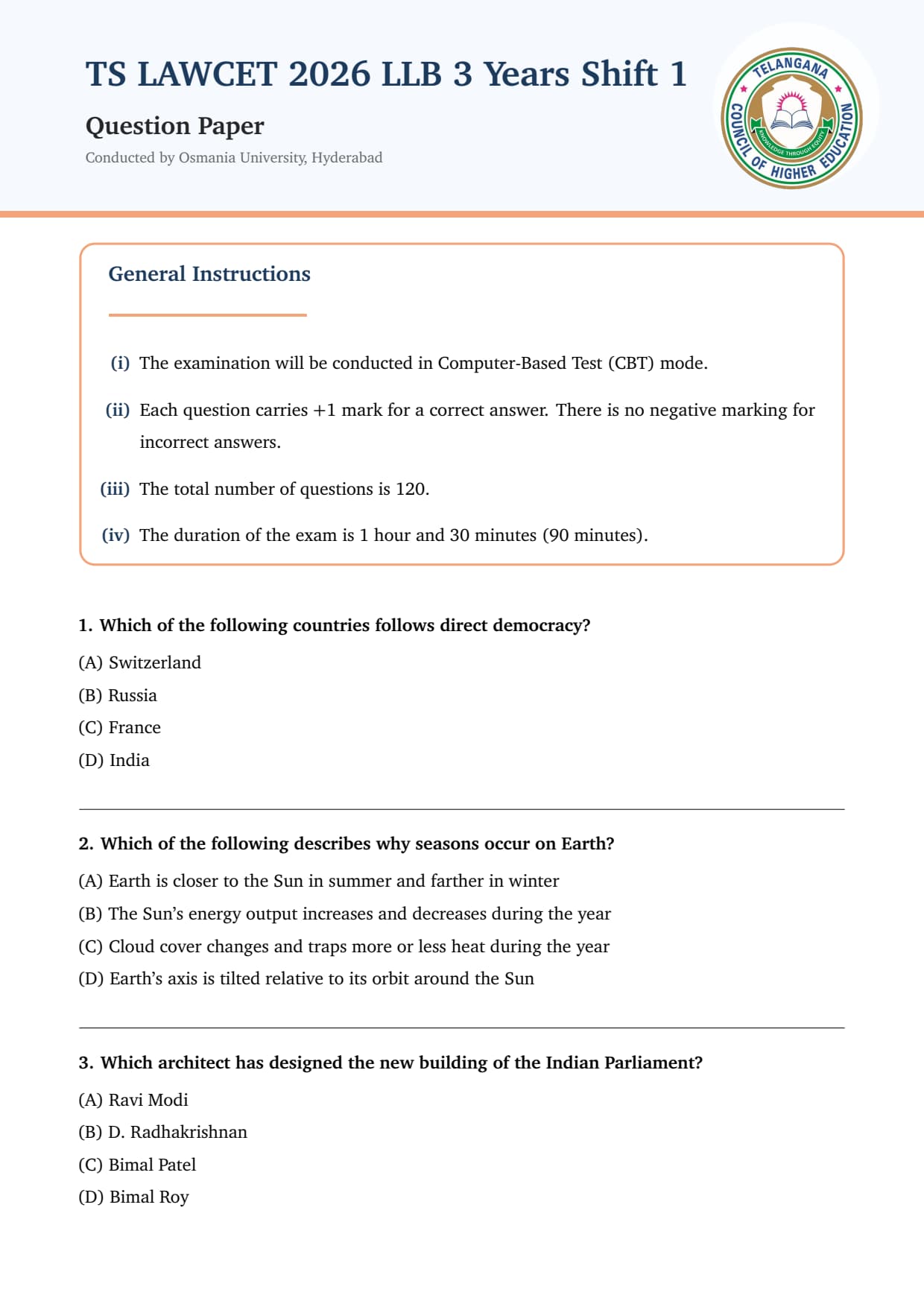
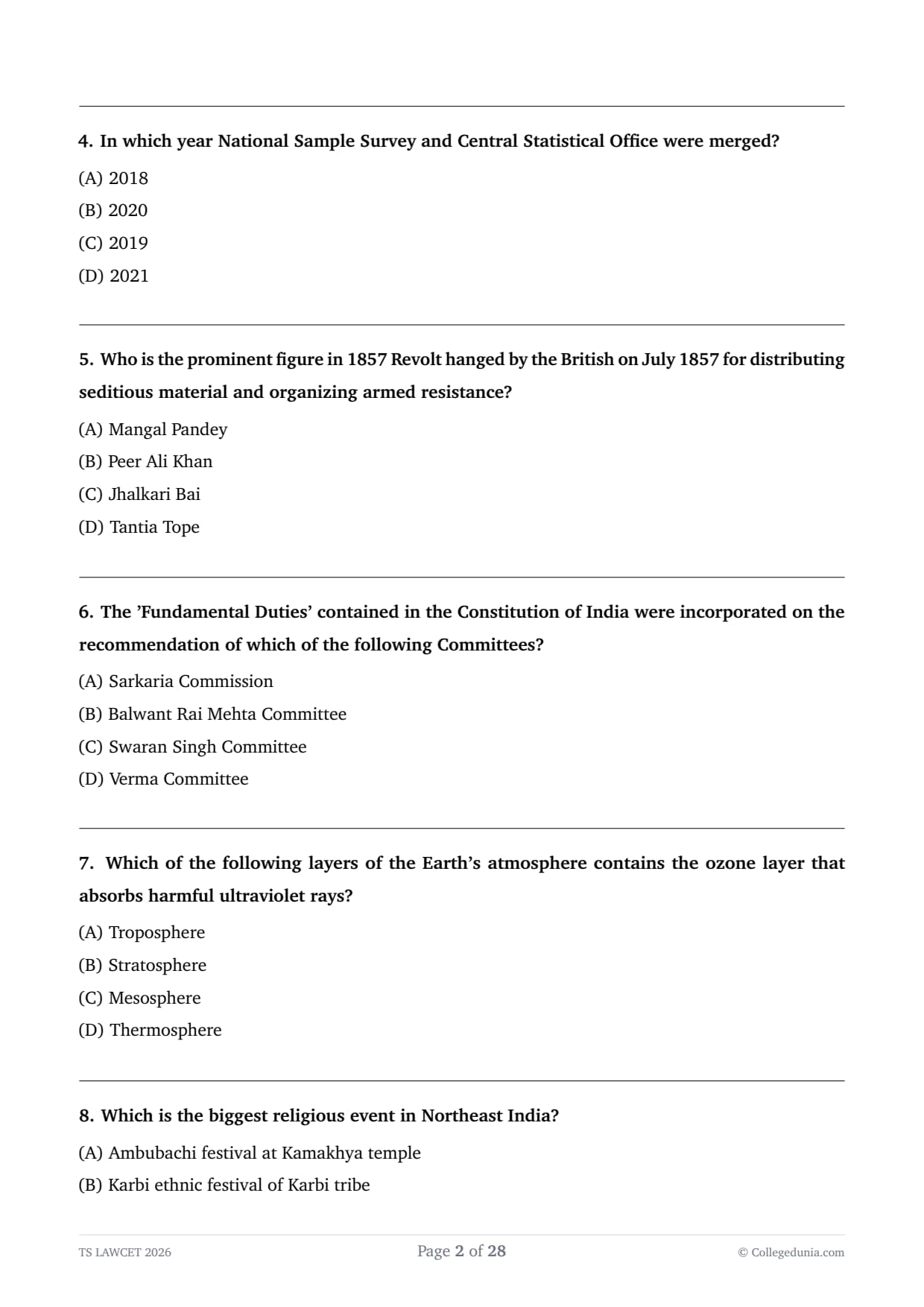
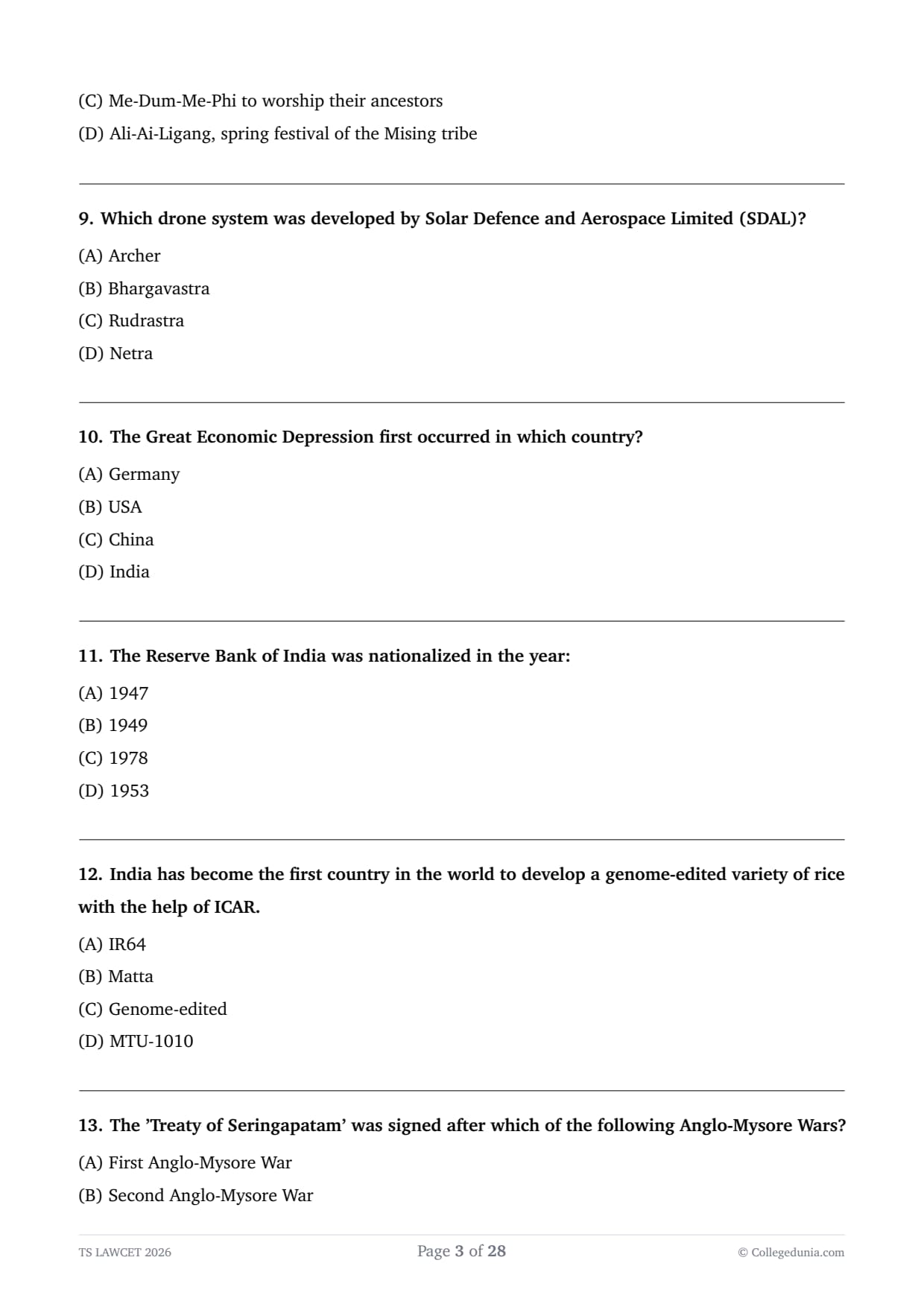
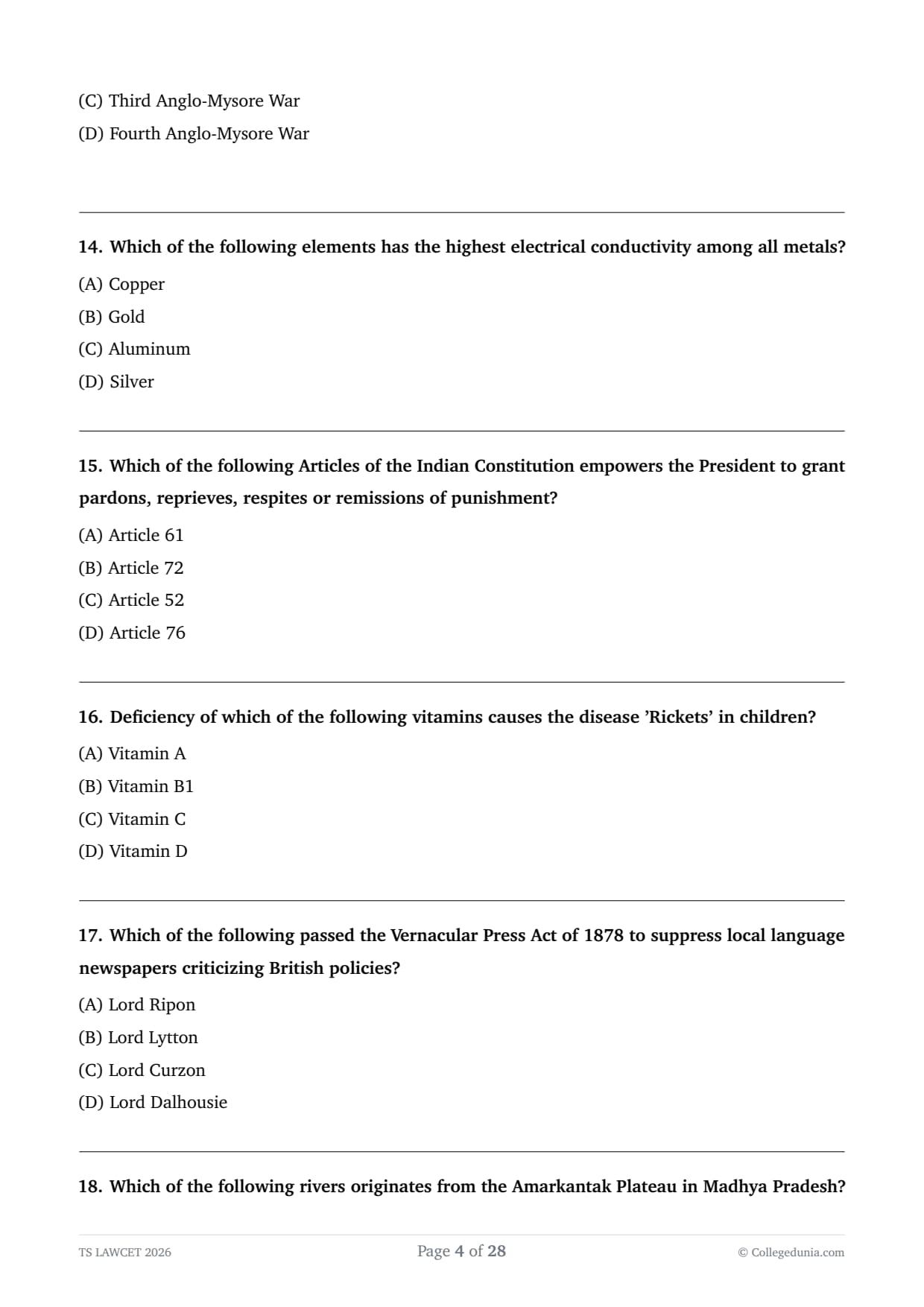
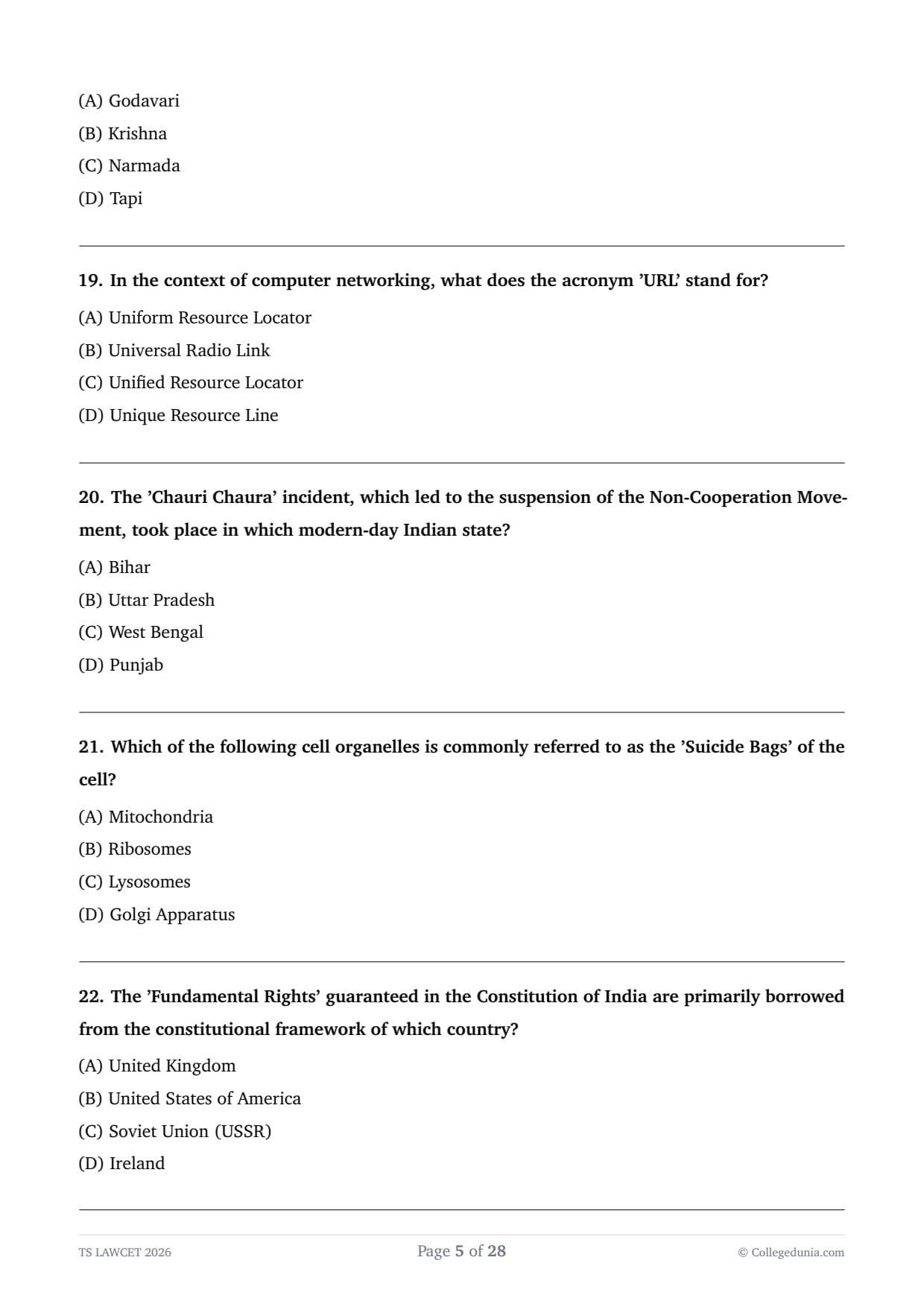
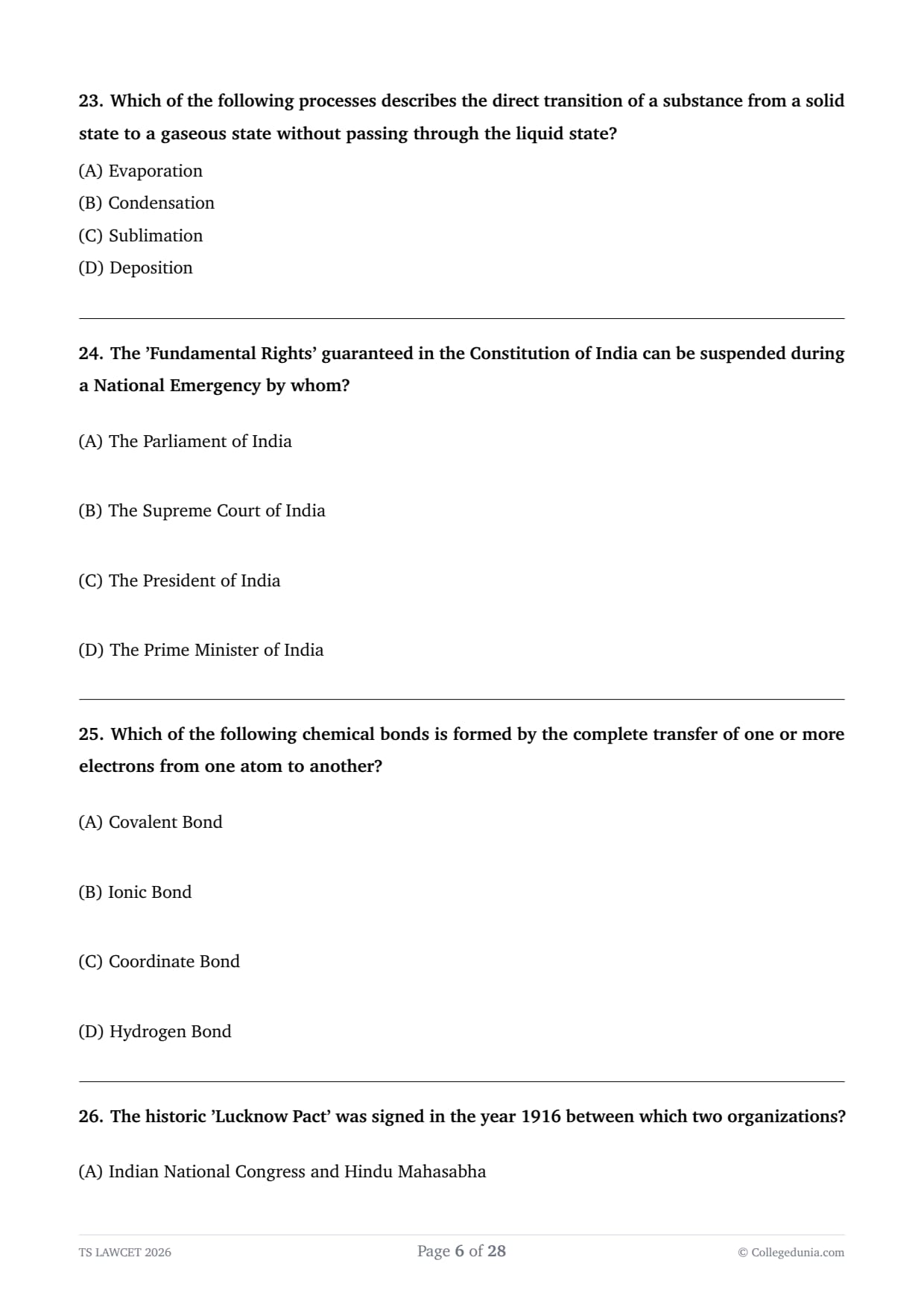
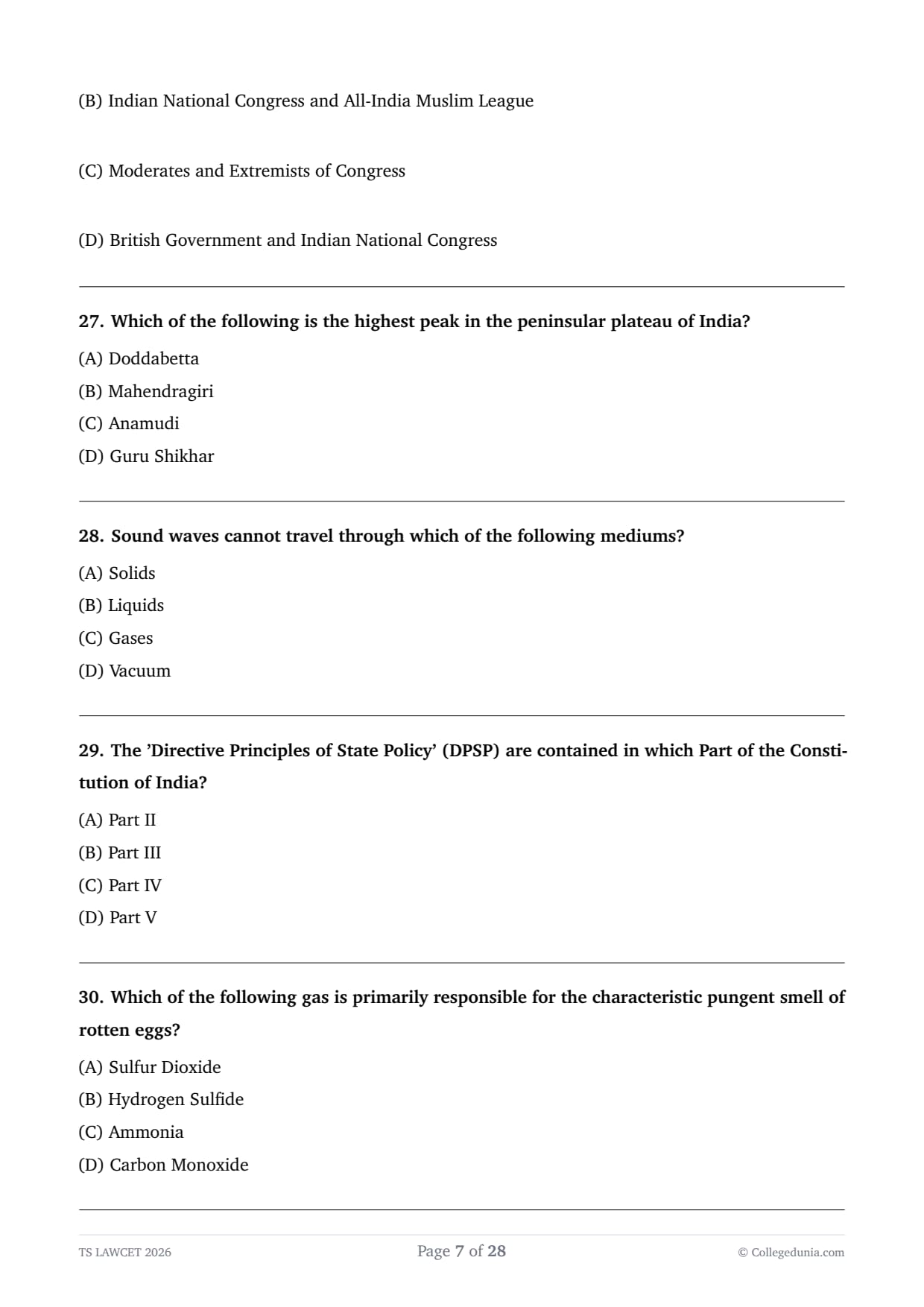
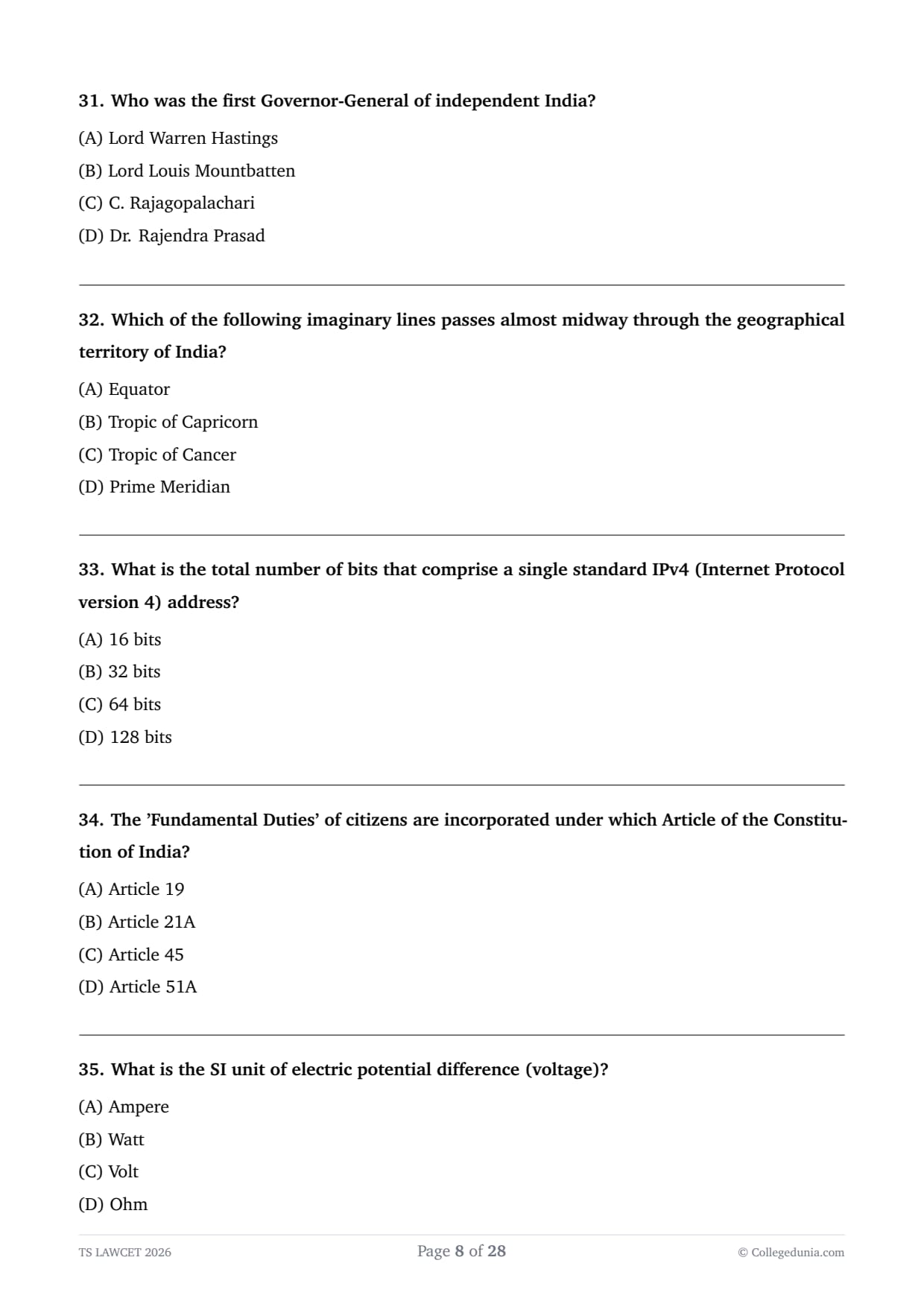
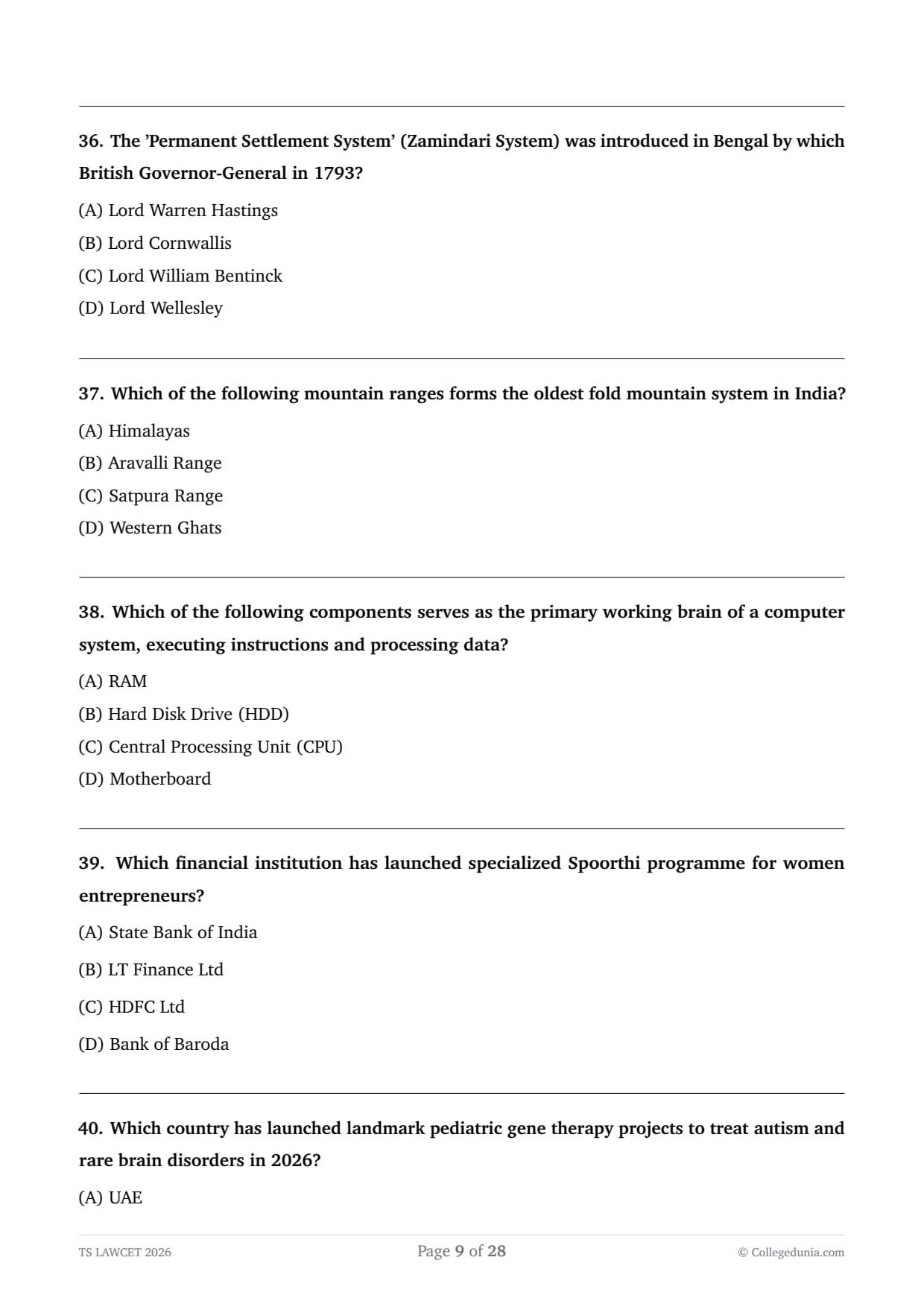
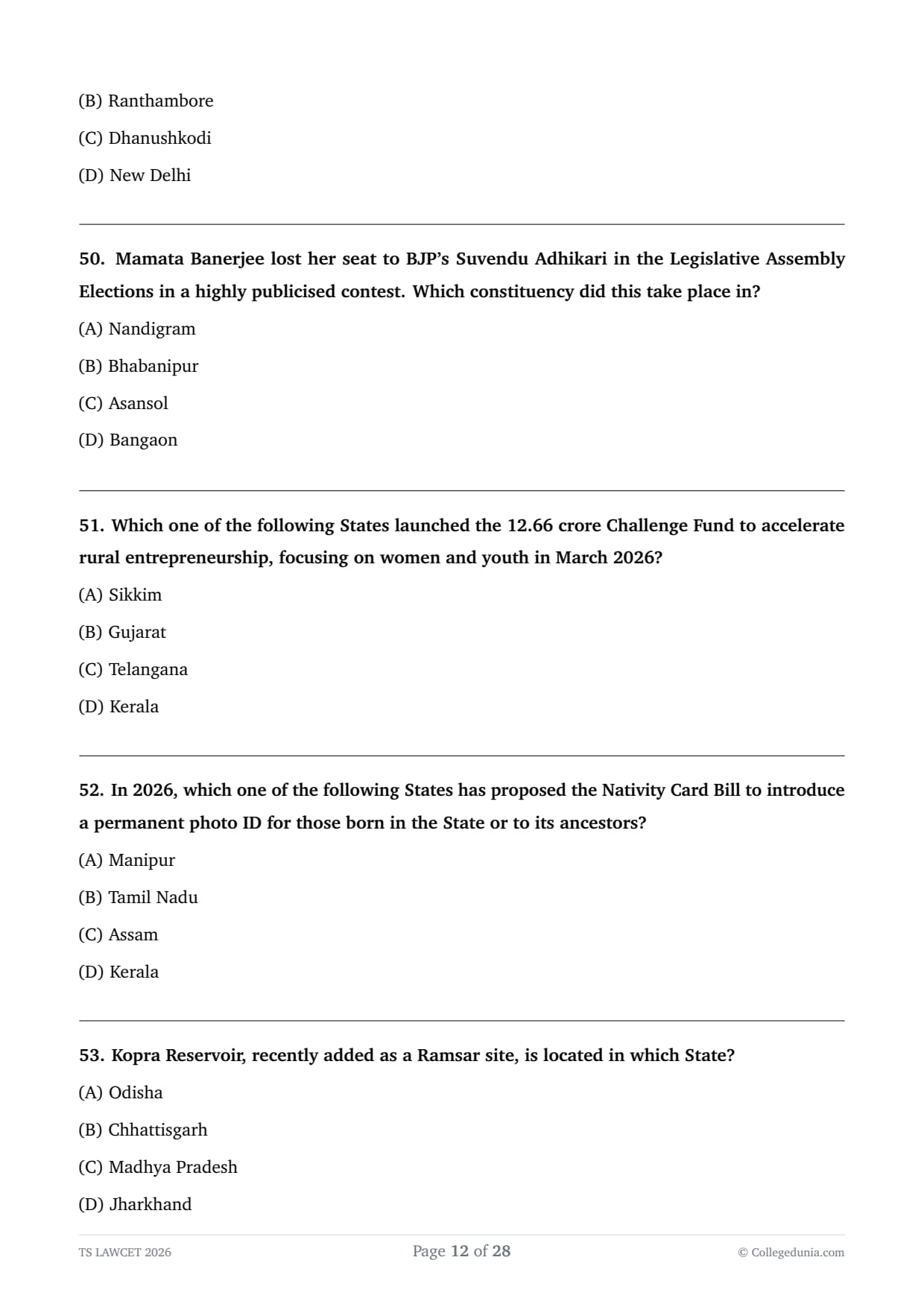
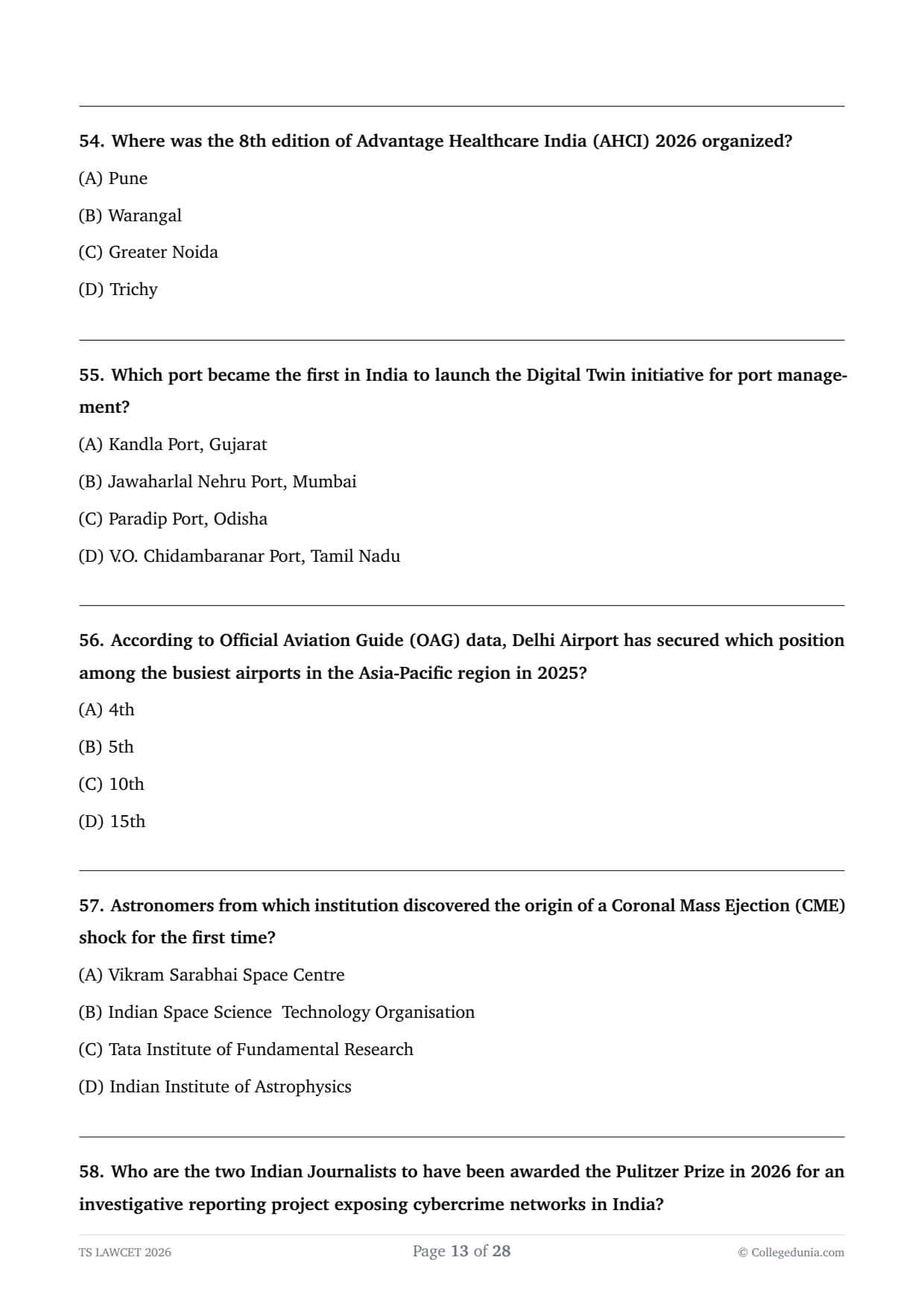
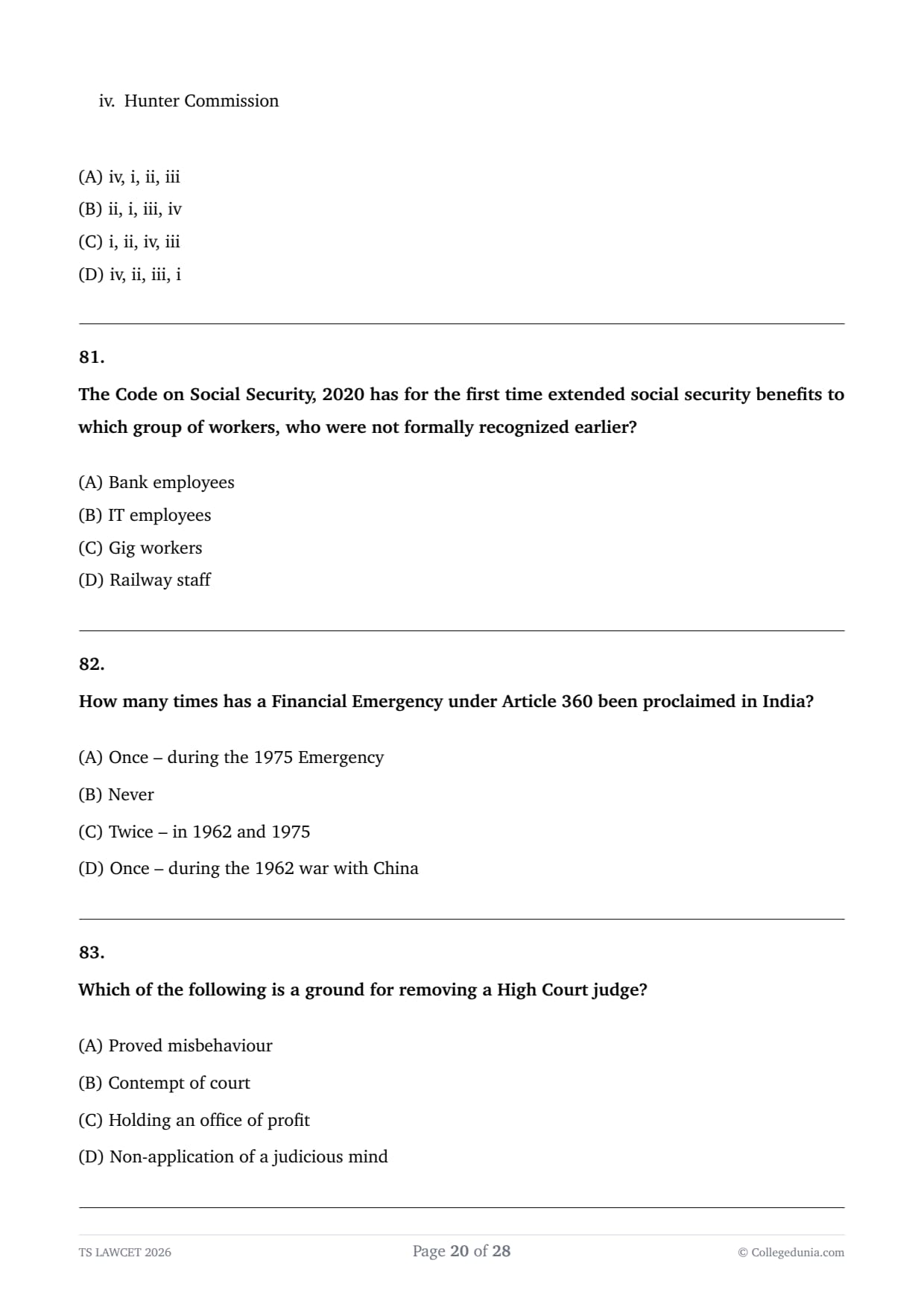
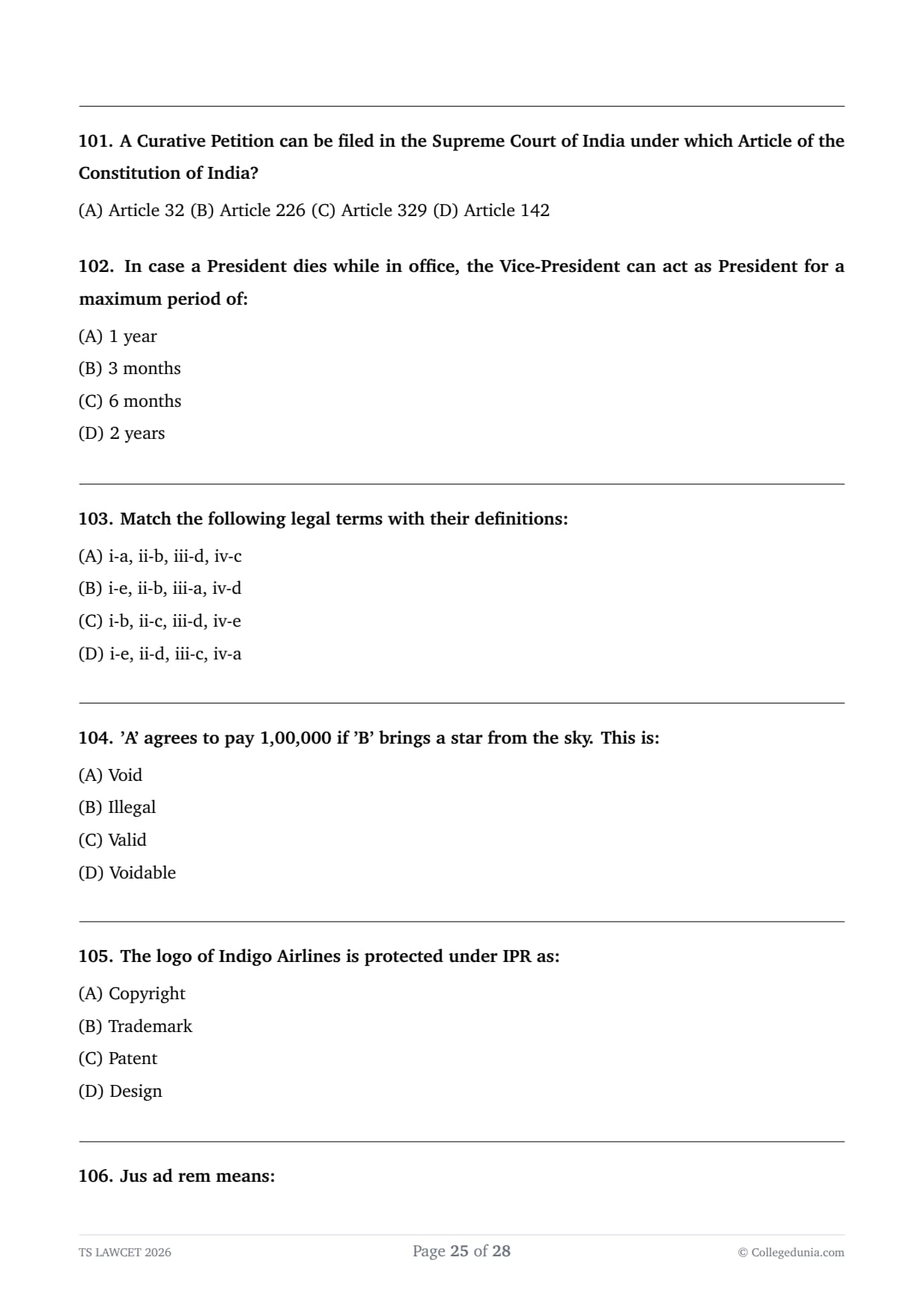
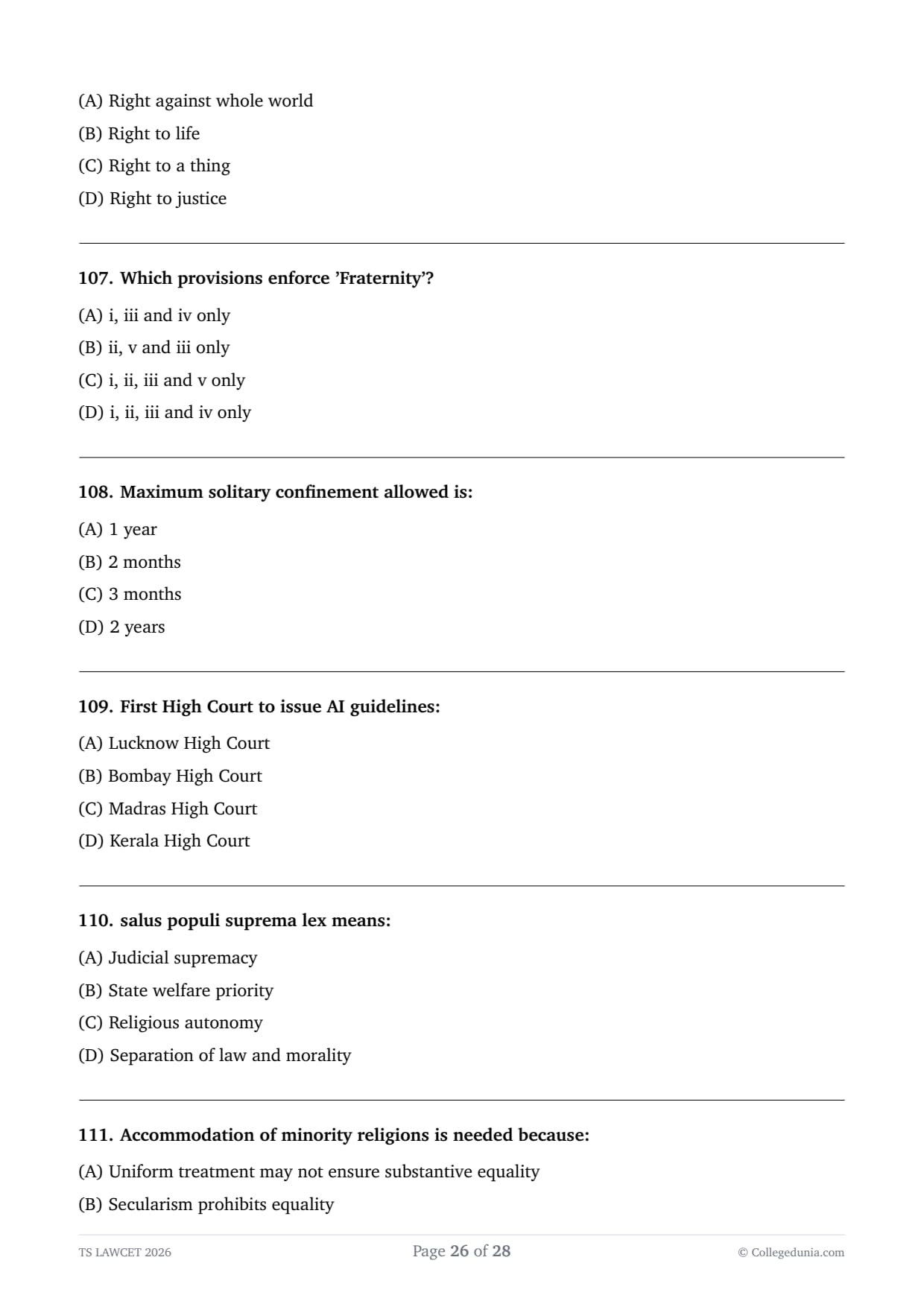
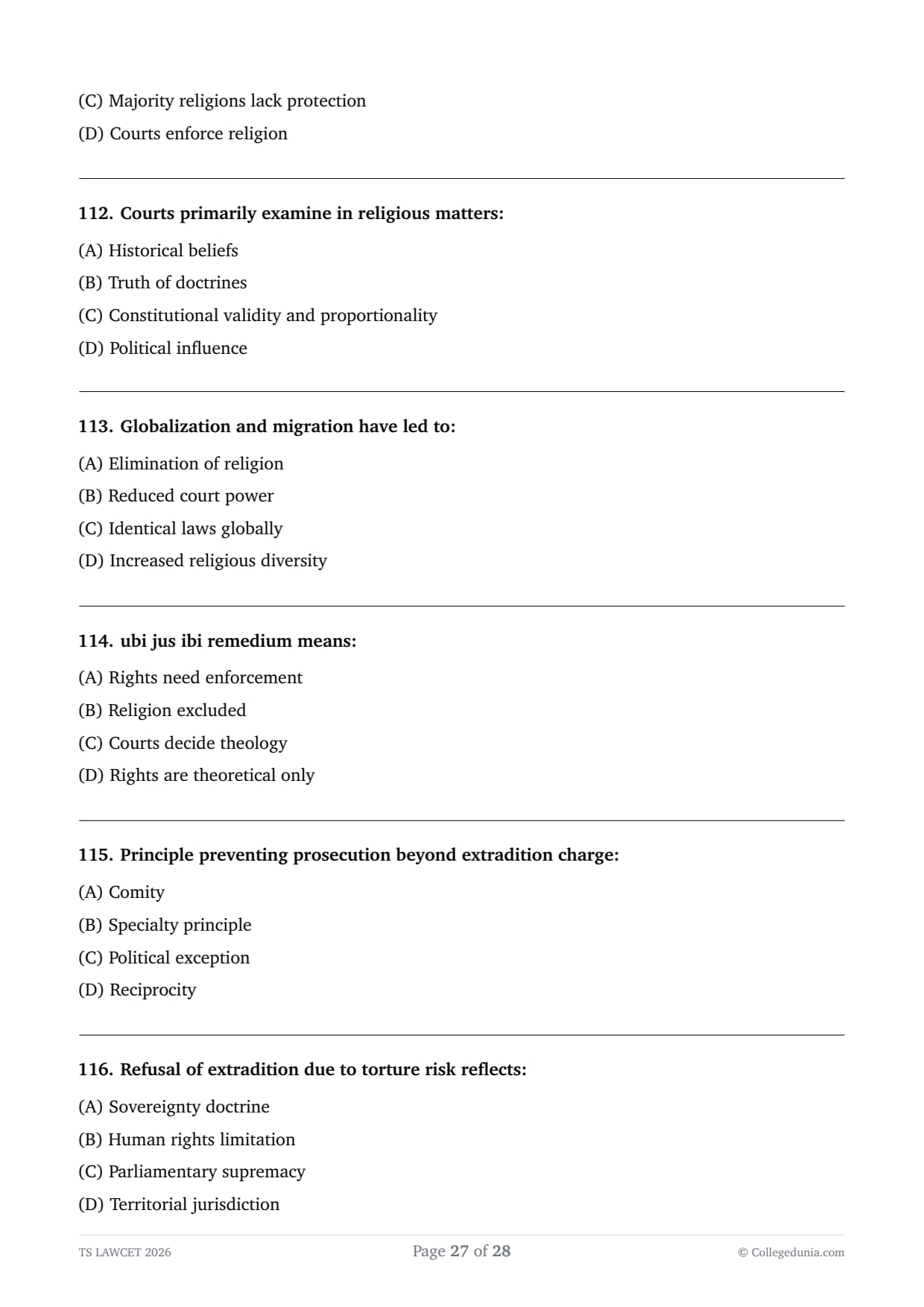
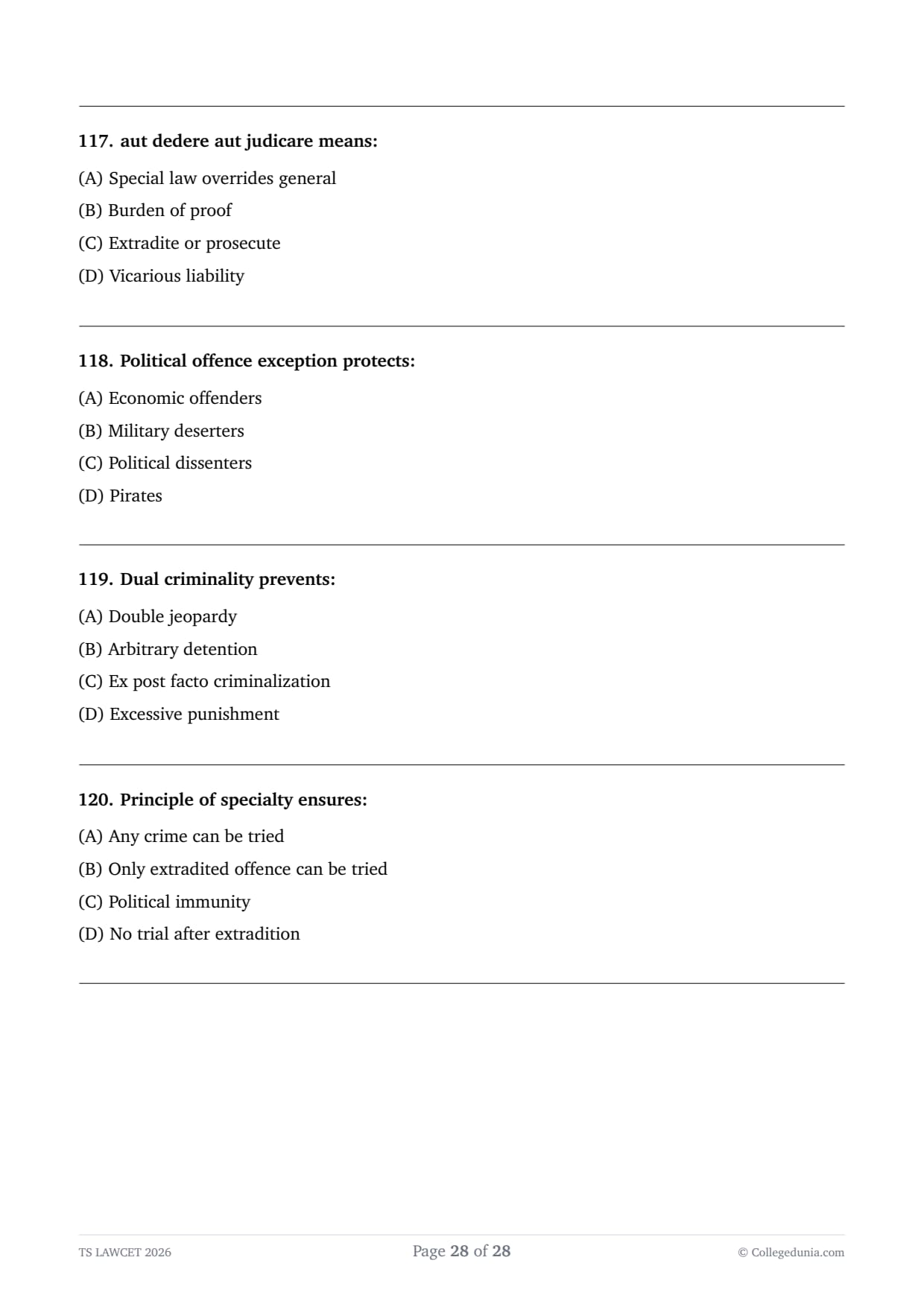
TS LAWCET 2026 LLB 3 Years Question Paper for Shift 1 is available here. Osmania University, Hyderabad on behalf of TGCHE conducted TS LAWCET 2026 LLB 3 Years exam on May 18 in Shift 1 from 9.30 AM to 11 AM. TS LAWCET 2026 Question Paper consists of 120 questions for 120 marks to be attempted in 90 minutes.

  • TS LAWCET Question Paper 2026 is divided into 3 sections- General Knowledge and Mental Ability with 30 questions, Current Affairs with 30 questions, Aptitude for the Study of Law with 60 questions.
  • Each correct answer carries 1 mark and there is no negative marking for incorrect answer.

Related Links:

TS LAWCET 2026 LLB 3 Years Shift 1 Question Paper with Solutions

TS LAWCET 2026 LLB 3 Years Question Paper Shift 1 Download PDF Check Solutions


Question 1:

The Great Economic Depression of 1929 first began in which country, triggering a worldwide financial crisis?

  • (A) United Kingdom
  • (B) Germany
  • (C) United States of America
  • (D) France
Correct Answer: (C) United States of America
View Solution


Concept:
The study of global macroeconomics and modern history highlights specific systemic vulnerabilities where a localized financial collapse can rapidly spread across international borders due to intertwined credit, trade agreements, and foreign exchange dependencies.


Step 1: Tracking the historical event and geographic origin of the 1929 market crash.

The Great Depression represents the most severe, long-lasting economic downturn in industrialized history. The initial catalyst for this global catastrophe occurred within the financial markets of the United States of America. During the "Roaring Twenties," the American stock market expanded rapidly, reaching unsustainable peaks driven by wild speculation and margin trading.

This speculative bubble burst violently on October 29, 1929—a day remembered historically as "Black Tuesday." The stock market crash on Wall Street instantly wiped out billions of dollars in asset values, decimated consumer confidence, and triggered an immediate run on commercial banking institutions.


Step 2: Analyzing the systemic transmission of the shock worldwide.

Because the United States had emerged from World War I as the world's primary creditor and economic engine, its domestic collapse destabilized international trade networks. American banks quickly recalled overseas loans, particularly those vital for the reconstruction of Weimar Germany and central Europe.

Simultaneously, the implementation of highly protectionist trade policies, such as the Smoot-Hawley Tariff Act in the U.S., caused a retaliatory chain reaction that effectively paralyzed global commerce. This structural breakdown sent a massive deflationary shockwave through both industrial and agrarian economies across the globe, leading to soaring unemployment and widespread political instability. Quick Tip: Associate the Great Depression directly with the catastrophic Wall Street Crash of 1929. Remembering that Wall Street is the financial heart of New York instantly roots the origin of this historical crisis in the United States.


Question 2:

The Strait of Malacca connects which two major water bodies?

  • (A) Arabian Sea and Red Sea
  • (B) Indian Ocean and Pacific Ocean
  • (C) Mediterranean Sea and Atlantic Ocean
  • (D) South China Sea and Coral Sea
Correct Answer: (B) Indian Ocean and Pacific Ocean
View Solution


Concept:
In maritime geography and geopolitics, straits are naturally formed, narrow navigable waterways that connect two larger, distinct bodies of water. These geographic chokepoints dictate global commercial shipping routes and naval strategic movements.


Step 1: Analyzing the physical geography of the Southeast Asian region.

The Strait of Malacca is a narrow stretch of water, approximately 580 miles in length, sandwiched precisely between the Malay Peninsula of mainland Southeast Asia and the large Indonesian island of Sumatra.


Northwestern Outlet: At its northwestern mouth, the strait connects directly with the Andaman Sea, which forms an integral marginal basin of the larger Indian Ocean.


Southeastern Outlet: At its southeastern terminus, the strait funnels through the Singapore Strait and flows straight into the South China Sea, which serves as a vital western arm of the Pacific Ocean.


Step 2: Evaluating alternative options based on global geography.

To ensure absolute accuracy, we can look at the locations of the other water bodies:

The Bab-el-Mandeb Strait connects the Red Sea to the Arabian Sea.


The Strait of Gibraltar connects the Mediterranean Sea to the Atlantic Ocean.


The Torres Strait or regional passages connect the South China Sea toward deeper Pacific networks, but do not align with Malacca.

Therefore, the Strait of Malacca uniquely bridges the Indian Ocean and the Pacific Ocean. Quick Tip: The Strait of Malacca is the world's premier maritime trade superhighway. It acts as the shortest marine transit path for cargo moving between Europe/India and East Asia. Think of it as the ultimate gateway between the Indian and Pacific oceans.


Question 3:

India's first inland lighthouse is proposed to be constructed in which city?

  • (A) Varanasi
  • (B) Patna
  • (C) Prayagraj
  • (D) Kanpur
Correct Answer: (A) Varanasi
View Solution


Concept:
National infrastructure development often requires innovating traditional maritime tools to fit inland contexts. This supports multi-modal logistics, riverine shipping, and safe night navigation along internal national waterways.


Step 1: Understanding the scope of National Waterway 1 (NW-1).

The Government of India has placed a massive strategic focus on reviving inland water transport through the Jal Marg Vikas Project. This project spans National Waterway 1 on the Ganga River, running from Haldia to Prayagraj. To make high-volume commercial shipping viable on rivers, vessels must be able to navigate safely 24/7, which presents unique structural challenges due to shifting riverbeds, heavy silting, and variable water currents.


Step 2: Identifying the specific location and purpose of the inland lighthouse.

To provide reliable visual cues and telemetry support for vessels at night, India's very first inland lighthouse has been planned for construction in the historic city of Varanasi.

Unlike classic ocean lighthouses built on rocky ocean coastlines to warn ships of shallow reefs, this specialized riverine structure acts as a central guidance and signaling tower. It helps large cargo vessels, modern passenger cruise liners, and local transport boats safely navigate the river channels passing through Uttar Pradesh, significantly reducing transit risks and boosting regional eco-tourism. Quick Tip: Varanasi is a primary multimodal transport hub under the central government's river logistics master plan. Whenever you encounter cutting-edge river freight, cruise terminals, or navigation infrastructure along the Ganga,Varanasi is highly likely to be the core destination.


Question 4:

The SITAC (Sweden-India Technology and Artificial Intelligence Corridor) initiative was first launched by which country?

  • (A) India
  • (B) Sweden
  • (C) United States
  • (D) Germany
Correct Answer: (B) Sweden
View Solution


Concept:
Bilateral institutional frameworks and dedicated technological corridors are designed to build operational bridges between foreign countries. They accelerate co-investment, startup incubation, cross-border research, and ethical AI development.


Step 1: Identifying the administrative driver behind the SITAC blueprint.

The Sweden-India Technology and Artificial Intelligence Corridor (SITAC) is a strategic platform created to foster deep collaboration between the technological ecosystems of Sweden and India. While the platform operates as a mutual partnership, the operational initiative and formal launch were driven by Sweden.

Through institutional bodies like Business Sweden, Vinnova (the Swedish Innovation Agency), and Swedish embassy branches, the nation actively built this corridor to tap into India's massive software engineering talent pool and rapidly expanding digital market.


Step 2: Examining the focus areas of the tech corridor.

SITAC provides a structured pathway for small-to-medium enterprises (SMEs), academic researchers, and tech startups in both nations to collaborate on complex artificial intelligence fields. Key areas of focus include:

Generative AI safety and deep tech alignment.


Smart city management and IoT sensor integration.


Green technology and sustainable AI infrastructure to minimize the carbon footprint of massive data centers. Quick Tip: Nordic nations like Sweden consistently lead global innovation and sustainability indexes. To accelerate their digital transformation, they proactively set up dedicated technology corridors like SITAC to anchor long-term development ties with India.


Question 5:

What is meant by jus ad rem in legal terminology?

  • (A) Absolute ownership over a property enforceable against the world
  • (B) A right to a thing enforceable against a specific person
  • (C) A criminal liability under tort law
  • (D) A constitutional right to property
Correct Answer: (B) A right to a thing enforceable against a specific person
View Solution


Concept:
Jurisprudence classifies legal rights based on their strength, nature, and enforceability. A core distinction is made between a right held directly over a physical object against all citizens versus a personal claim against a specific individual to deliver or complete something.


Step 1: Deconstructing the specific Latin phrase and its jurisprudential meaning.

The Latin term jus ad rem translates directly to a "right to a thing". It represents an incomplete, inchoate, or personal right. When a person holds a \textit{jus ad rem, they do not yet possess full, absolute ownership of the property itself.

Instead, they possess a valid legal right to claim or acquire that property from a designated individual. This right typically stems from an existing contract, an unexecuted lease agreement, or an obligation under equity law, making it enforceable purely against a specific person.


Step 2: Contrasting \textit{jus ad rem with \textit{jus in rem.

To prevent errors in exams, it is vital to contrast this with its counterpart:

\textit{Jus in rem: A complete, absolute right in a thing itself. It is enforceable against the entire world. For example, if you hold the registered title deed to a house, your ownership right is a \textit{jus in rem; nobody may trespass on it.


\textit{Jus ad rem: If you have paid an advance amount and signed an agreement to purchase that house from a seller, you do not yet own the house against the world. You simply have a jus ad rem—a right to force that specific seller to complete the transaction and hand over ownership. Quick Tip: Think of the Latin prepositions: Jus in rem means you are already fully in absolute possession/ownership against the entire world. Jus ad rem means your right is moving ad (toward) getting the item, meaning you hold a claim to force a specific person to hand it over.


Question 6:

If a person causes harm to prevent a greater harm, under which legal principle is such an act justified?

  • (A) Strict liability
  • (B) Doctrine of estoppel
  • (C) Doctrine of necessity
  • (D) Res ipsa loquitur
Correct Answer: (C) Doctrine of necessity
View Solution


Concept:
Criminal law and civil tort law recognize general defenses that excuse otherwise unlawful or harmful acts if they were performed under extraordinary pressure to prevent a much larger, imminent catastrophe.


Step 1: Defining the core components of the Doctrine of Necessity.

The Doctrine of Necessity operates on the practical premise that the law will not punish an individual who, when forced by circumstances, chooses the lesser of two inevitable evils. For this defense to apply perfectly, three strict criteria must be met:

The threat or danger must be real, extreme, and immediate.


There must be no alternative, harm-free way to avoid the danger.


The harm intentionally caused must be significantly smaller than the greater harm the individual sought to prevent.

A classic example is a captain who deliberately steers their vessel into a small pier, damaging it, to avoid colliding with a crowded passenger ferry out in the harbor. The intentional property damage is completely excused under necessity.


Step 2: Disproving the alternative doctrines for clarity.


Strict Liability: A rule where a defendant is held fully liable for damages even if they acted without any negligence, fault, or bad intention.


Doctrine of Estoppel: A rule of evidence that prevents a person from denying or contradicting a statement they previously made in court.


Res Ipsa Loquitur: A legal maxim meaning "the thing speaks for itself," used in civil negligence cases when the accident itself provides obvious proof of fault.

Thus, the correct legal principle matching the scenario is the Doctrine of Necessity. Quick Tip: The Doctrine of Necessity is grounded in the famous Latin legal maxim: "Salus populi est suprema lex", meaning the welfare of the people is the supreme law. An act that would normally be a crime or a tort becomes fully justified because it was absolutely necessary to prevent a much worse disaster.


Question 7:

“To protect the lives and dignity of victims of armed conflict and violence and to provide them with assistance” - is the mission statement of which of the following international organizations?

  • (A) World Health Organisation (WHO)
  • (B) Food and Agricultural Organisation (FAO)
  • (C) International Committee of the Red Cross (ICRC)
  • (D) World Food Council (WFC)
Correct Answer: (C) International Committee of the Red Cross (ICRC)
View Solution


Concept:
International humanitarian organizations operate under specific mandates and mission statements that define their core areas of focus, such as public health, food security, or humanitarian protection during wartime.

Step 1: Analyzing the mission statements of the given organizations.


WHO: Focuses on global public health and disease control.
FAO: Directs international efforts to defeat hunger and improve nutrition.
ICRC: An independent, neutral organization ensuring humanitarian protection and assistance for victims of armed conflict and other situations of violence.
WFC: Was a former UN body focused on food security policies.

Therefore, the statement directly matches the mandate of the International Committee of the Red Cross (ICRC). Quick Tip: When a mission statement explicitly mentions keywords like "armed conflict," "violence," and "victims," look for organizations specifically governed by International Humanitarian Law (like the Geneva Conventions), which points directly to the ICRC.


Question 8:

In the Indian cinema industry, Kollywood denotes:

  • (A) Tamil Cinema
  • (B) Kannada Cinema
  • (C) Malayalam Cinema
  • (D) Telugu Cinema
Correct Answer: (A) Tamil Cinema
View Solution


Concept:
The Indian film industry consists of various regional language film industries, commonly referred to using informal portmanteaus combining their production hub location (or language) with "Hollywood".

Step 1: Identifying regional cinematic terms in Southern India.


Kollywood: Derived from Kodambakkam (the neighborhood in Chennai, Tamil Nadu, where Tamil film production is traditionally centered) + Hollywood. Thus, it denotes Tamil Cinema.
Sandalwood: Denotes Kannada Cinema.
Mollywood: Denotes Malayalam Cinema.
Tollywood: Denotes Telugu Cinema (and historically, Bengali Cinema as well). Quick Tip: Remember the unique geographical locations to avoid confusion: K for Kodambakkam (Tamil), T for Tuniz/Telugu, and Sandalwood for Karnataka's major crop export.


Question 9:

Prince Philip, Duke of Edinburgh, and the husband of Queen Elizabeth-II, died in April, 2021 at the age of \hspace{2cm}.

  • (A) 99 years
  • (B) 89 years
  • (C) 101 years
  • (D) 95 years
Correct Answer: (A) 99 years
View Solution


Concept:
Basic biographical timelines of prominent global historical figures and heads of state/royal families.

Step 1: Calculating lifespan from birth and death data.

Prince Philip was born on June 10, 1921. He passed away on April 9, 2021. \[ Lifespan = 2021 - 1921 = 100 years (short of his 100th birthday by roughly two months). \]
Therefore, at the time of his death in April 2021, his completed age was exactly 99 years. Quick Tip: Prince Philip passed away just a few weeks short of reaching his historic centenary milestone (100th birthday), which helps easily recall that he died at 99.


Question 10:

‘Raising and Accelerating MSME Performance’ (RAMP) which is a new Central Sector scheme for supporting various Corona Virus Disease 2019 (COVID) Resilience and Recovery Interventions of the Ministry of Micro, Small and Medium Enterprises (MoMSME) and which would commence in FY 2022-23 is supported by which global institution?

  • (A) International Monetary Fund
  • (B) World Bank
  • (C) UNICEF
  • (D) World Economic Forum
Correct Answer: (B) World Bank
View Solution


Concept:
Major public welfare and infrastructure financial policies in India are frequently co-funded or supported via loan programs initiated by global financial multilateral institutions like the World Bank or Asian Development Bank (ADB).


Step 1: Identifying institutional funding bodies for Indian MSME programs.


The RAMP scheme is a World Bank-assisted Central Sector Scheme launched to strengthen the institutions and governance at the Centre and State,


supporting market linkages and greening initiatives for MSMEs affected by the COVID pandemic. The total outlay of the scheme includes a significant loan component provided by the World Bank (International Bank for Reconstruction and Development). Quick Tip: Large-scale structural reforms, institutional capacity building, and post-disaster resilience projects in India are primarily assisted by the World Bank.


Question 11:

‘Varuna’ is the bilateral naval exercise between India and which country?

  • (A) France
  • (B) Japan
  • (C) Oman
  • (D) UAE
Correct Answer: (A) France
View Solution


Concept:
Bilateral and multilateral military joint exercises are systematically named to establish standardized training partnerships between nations.


Step 1: Matching Indian defense exercises with partner nations.


The strategic defense partnership between India and France features three distinct wings of exercises:


Varuna: Bilateral Naval Exercise.
Garuda: Bilateral Air Force Exercise.
Shakti: Bilateral Army Exercise.

Thus, ‘Varuna’ corresponds to the Indo-French naval cooperative exercise. Quick Tip: In Hindu mythology, Varuna is the god of the oceans/seas. This helps explicitly link the name 'Varuna' to a Naval exercise. Pair it with France!


Question 12:

Which new ministry was formed under the Government of India in July 2021?

  • (A) Ministry of Logistics
  • (B) Ministry of Internal Security
  • (C) Ministry of Cooperation
  • (D) Ministry of Kashmir
Correct Answer: (C) Ministry of Cooperation
View Solution


Concept:
The administrative structure of the Union Cabinet changes periodically through the creation, merger, or renaming of portfolios to prioritize targeted socio-economic growth sectors.


Step 1: Reviewing administrative changes of July 2021.


In July 2021, the Government of India created a separate Ministry of Cooperation to realize the vision of 'Sahakar se Samriddhi' (Prosperity through Cooperation). This ministry was carved out to provide a separate administrative, legal, and policy framework for strengthening the cooperative movement in the country. Quick Tip: Think of the slogan \textit{"Sahakar se Samriddhi". It was heavily in the news during the cabinet reshuffle of July 2021 when Amit Shah was appointed as its first Union Minister.


Question 13:

Which of the following words has NOT been written in the Preamble of the Indian Constitution?

  • (A) Sovereign
  • (B) Socialist
  • (C) Democratic
  • (D) Bharat
Correct Answer: (D) Bharat
View Solution


Concept:
The Preamble acts as the introductory key to the Indian Constitution, explicitly defining the nature of the Indian State and its core democratic objectives.

Step 1: Verifying the text of the Preamble.

The opening lines of the Preamble state: \[ "WE, THE PEOPLE OF INDIA, having solemnly resolved to constitute India into a \] \[ SOVEREIGN, SOCIALIST, SECULAR, DEMOCRATIC REPUBLIC..." \]
While the term "Bharat" is explicitly used in Article 1 of the Constitution (\textit{"India, that is Bharat, shall be a Union of States"), it does not appear anywhere within the text of the Preamble. The Preamble exclusively uses the term "India". Quick Tip: The Preamble is written completely in English natively using the word "India". The term "Bharat" is a prominent element of Article 1, not the introductory Preamble text.


Question 14:

Which of the following is NOT a Fundamental Duty?

  • (A) Safeguarding public property
  • (B) Protecting the sovereignty, integrity and unity of India
  • (C) Developing scientific temper and humanism
  • (D) Protecting religious rights
Correct Answer: (D) Protecting religious rights
View Solution


Concept:
Fundamental Duties are enshrined in Article 51A (Part IV-A) of the Constitution of India. There are currently 11 explicit duties listed for citizens.

Step 1: Evaluating against the text of Article 51A.

Let's check the listed options against the items under Article 51A:

Article 51A(i) explicitly directs: "to safeguard public property and to abjure violence". (Option A is a duty)
Article 51A(c) explicitly directs: \textit{"to uphold and protect the sovereignty, unity and integrity of India". (Option B is a duty)
Article 51A(h) explicitly directs: \textit{"to develop the scientific temper, humanism and the spirit of inquiry and reform". (Option C is a duty)
Protecting religious rights is part of the state's domain or individual Fundamental Rights (Articles 25–28), but it is not listed as a citizen's Fundamental Duty. Quick Tip: Religious rights fall under freedoms guaranteed to you \textit{by the state (Fundamental Rights), whereas duties require you to preserve public properties, national integrity, and logic/scientific mindset.


Question 15:

Writ Petitions filed before the Supreme Court under Article 32 are subject to the rule of Res Judicata except in the case of:

  • (A) Quo Warranto
  • (B) Habeas Corpus
  • (C) Certiorari
  • (D) Prohibition
Correct Answer: (B) Habeas Corpus
View Solution


Concept:
Res Judicata (Section 11 of CPC) prevents the same parties from relitigating an issue that has already been decided by a competent court. While this rule applies to writ petitions under Articles 32 and 226 to ensure judicial finality, exceptions exist due to overriding concerns for personal liberty.

Step 1: Understanding the nature of Habeas Corpus.

The writ of \textit{Habeas Corpus ("To have the body") is issued against unlawful detention. Because illegal confinement represents a continuous violation of the fundamental right to life and liberty (Article 21), a dismissed Habeas Corpus petition does not bar a fresh petition if fresh grounds or new facts emerge. The Supreme Court ruled in landmark cases (such as Lallubhai Jogibhai Patel v. Union of India) that the rule of constructive \textit{res judicata does not apply to a writ of \textit{Habeas Corpus. Quick Tip: Personal Liberty is treated with the highest priority in constitutional law. Since unlawful detention is a continuous wrong, the technical bar of \textit{Res Judicata yields to the safety of life and limb via Habeas Corpus.


Question 16:

Which of the following rights has NOT been laid down under Article 19 of the Constitution?

  • (A) Freedom of speech and expression
  • (B) Freedom of Association
  • (C) Freedom of Assembly
  • (D) Freedom of minorities to open their educational institutions
Correct Answer: (D) Freedom of minorities to open their educational institutions
View Solution


Concept:
Article 19 protects six basic democratic freedoms categorized under Right to Freedom, whereas distinct separate cultural and educational provisions protect minority rights.

Step 1: Deconstructing the Six Freedoms of Article 19(1).

Article 19(1) explicitly guarantees:

19(1)(a): Freedom of speech and expression.
19(1)(b): Freedom to assemble peaceably and without arms.
19(1)(c): Freedom to form associations or unions or co-operative societies.
19(1)(d) & (e) & (g): Movement, residence, and profession.


Step 2: Locating minority institutional rights.

The right of minorities to establish and administer educational institutions of their choice is a separate fundamental right specifically explicit under Article 30(1) of the Constitution (Cultural and Educational Rights), not Article 19. Quick Tip: Article 19 deals exclusively with common individual freedoms for all citizens, while individual and collective rights specific to minorities are contained in Articles 29 and 30.

TS LAWCET 2026 Distribution of Questions

Section Maximum Marks Maximum Questions
Current Affairs 30 30
General Knowledge and Mental Ability 30 30
Aptitude for the Study of Law 60 60
Total 120 Marks 120 Questions

TS LAWCET 2026 Exam Analysis