BCECE 2026 Mathematics Question Paper with Solution PDF is available for download here. The BCECE 2026 exam was conducted on May 30, 2026, in offline mode for subject combinations PCM, PCB, and PCA at various exam centres across Bihar.

The BCECE 2026 Mathematics question paper consisted of 100 objective-type questions, to be completed in 90 minutes, carrying a total of 400 marks.

Also Check: BCECE 2026 Physics Question Paper with Solutions

BCECE 2026 Mathematics Question Paper with Solution PDF

BCECE 2026 Mathematics Question Paper Download PDF Check Solution


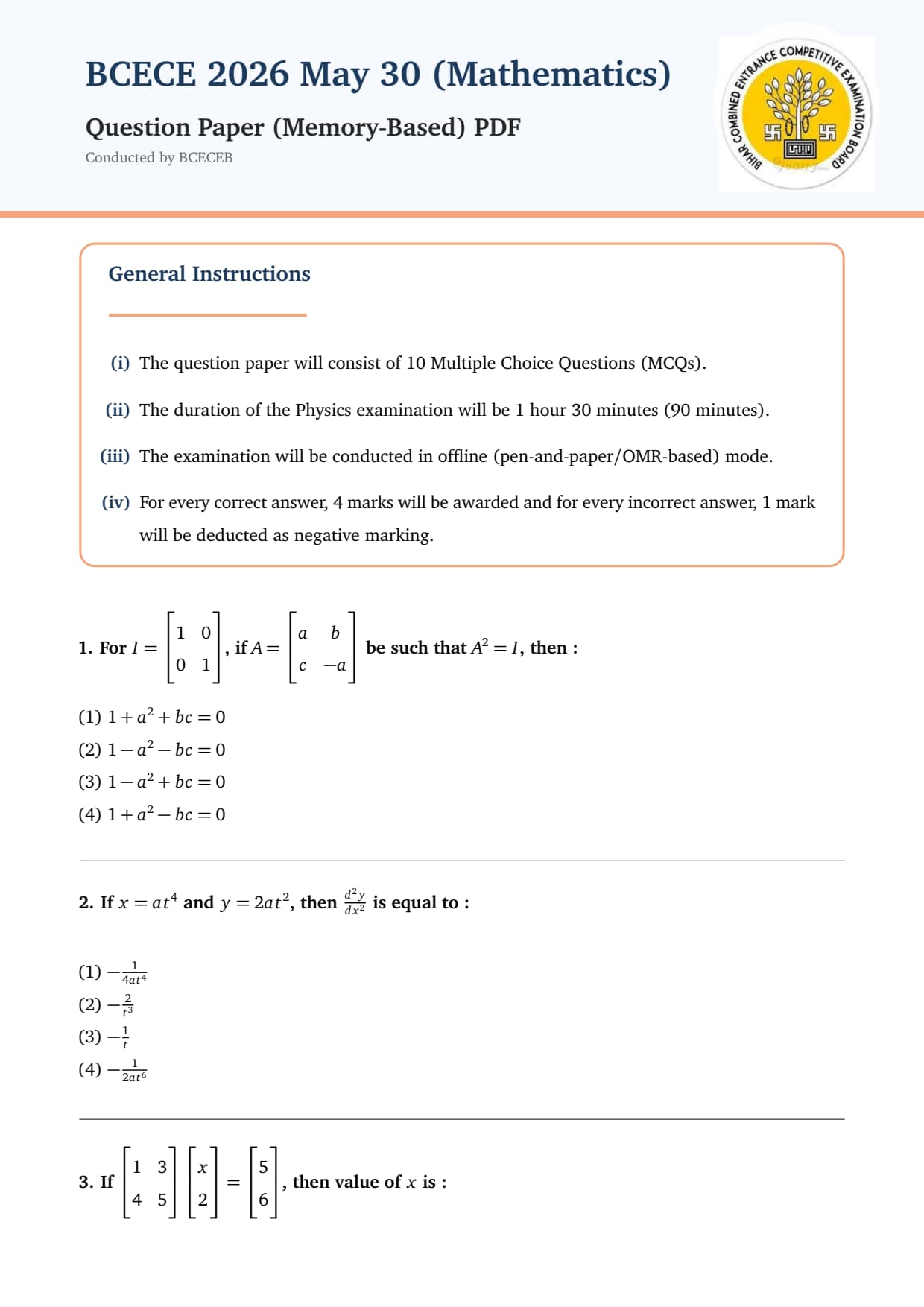
Question 1:

For \( I = \begin{bmatrix} 1 & 0
0 & 1 \end{bmatrix} \), if \( A = \begin{bmatrix} a & b
c & -a \end{bmatrix} \) be such that \( A^2 = I \), then :

  • (1) \( 1 + a^2 + bc = 0 \)
  • (2) \( 1 - a^2 - bc = 0 \)
  • (3) \( 1 - a^2 + bc = 0 \)
  • (4) \( 1 + a^2 - bc = 0 \)
Correct Answer: (2) \( 1 - a^2 - bc = 0 \)
View Solution


Step 1: Understanding the Concept:

The problem explores the properties of square matrices, specifically focusing on a special type known as an involutory matrix. An involutory matrix \( A \) is defined by the property that its square is equal to the identity matrix \( I \). In the context of linear transformations, this means that the transformation represented by \( A \) is its own inverse; applying the transformation twice returns the system to its original state.

The identity matrix \( I \) of order \( 2 \times 2 \) is given as \( \begin{bmatrix} 1 & 0
0 & 1 \end{bmatrix} \). We are provided with a general form for matrix \( A \) where the diagonal elements are \( a \) and \( -a \). This structure is significant because the sum of the diagonal elements (the trace of the matrix) is zero. Matrices with a trace of zero often play a central role in linear algebra and physics. The objective is to identify the algebraic relationship between the variables \( a, b, \) and \( c \) that makes the matrix equation \( A^2 = I \) true.


Step 2: Key Formula or Approach:

To solve this, we utilize the definition of matrix multiplication. For two matrices to be multiplied, the number of columns in the first must match the number of rows in the second. Since \( A \) is a \( 2 \times 2 \) matrix, \( A^2 = A \times A \) is also a \( 2 \times 2 \) matrix.

The general formula for the square of a \( 2 \times 2 \) matrix \( A = \begin{bmatrix} x & y
z & w \end{bmatrix} \) is:
\[ A^2 = \begin{bmatrix} x^2 + yz & xy + yw
zx + wz & zy + w^2 \end{bmatrix} \]

Once the product is computed, we use the principle of matrix equality, which states that two matrices are equal if and only if every corresponding entry is identical. This will yield a system of equations.


Step 3: Detailed Explanation:

Let's calculate the square of matrix \( A \).

Given \( A = \begin{bmatrix} a & b
c & -a \end{bmatrix} \).

The operation is \( A \cdot A \):
\[ A^2 = \begin{bmatrix} a & b
c & -a \end{bmatrix} \begin{bmatrix} a & b
c & -a \end{bmatrix} \]

Calculating the first row, first column entry (\( R_1C_1 \)):
\[ (a)(a) + (b)(c) = a^2 + bc \]

Calculating the first row, second column entry (\( R_1C_2 \)):
\[ (a)(b) + (b)(-a) = ab - ab = 0 \]

Calculating the second row, first column entry (\( R_2C_1 \)):
\[ (c)(a) + (-a)(c) = ac - ac = 0 \]

Calculating the second row, second column entry (\( R_2C_2 \)):
\[ (c)(b) + (-a)(-a) = bc + a^2 \]

Assembling these results into a matrix:
\[ A^2 = \begin{bmatrix} a^2 + bc & 0
0 & bc + a^2 \end{bmatrix} \]

We are given the condition \( A^2 = I \). Therefore:
\[ \begin{bmatrix} a^2 + bc & 0
0 & a^2 + bc \end{bmatrix} = \begin{bmatrix} 1 & 0
0 & 1 \end{bmatrix} \]

Equating the top-left (and bottom-right) entries gives:
\[ a^2 + bc = 1 \]

This is a standard relationship. To match the options provided in the question, we need to manipulate the equation. By subtracting both \( a^2 \) and \( bc \) from both sides, or moving everything to one side relative to the number 1, we get:
\[ 1 - a^2 - bc = 0 \]

This matches Option (2) exactly. We should also note that the off-diagonal entries are already 0, which satisfies the identity matrix structure regardless of the values of \( a, b, \) or \( c \).


Step 4: Final Answer:

The algebraic condition derived from the matrix squaring process is \( a^2 + bc = 1 \). Rearranging this leads to the expression \( 1 - a^2 - bc = 0 \). Consequently, the correct choice is option (2).
Quick Tip: For any matrix \( A = \begin{bmatrix} a & b
c & d \end{bmatrix} \), the Cayley-Hamilton theorem states \( A^2 - (Tr(A))A + |A|I = 0 \).
If \( Tr(A) = 0 \), then \( A^2 = -|A|I \).
For \( A^2 = I \), we need \( -|A| = 1 \), which means \( |A| = -1 \).
The determinant \( |A| = -a^2 - bc \). Setting \( -a^2 - bc = -1 \) gives \( a^2 + bc = 1 \).


Question 2:

If \( x = at^4 \) and \( y = 2at^2 \), then \( \frac{d^2y}{dx^2} \) is equal to :

  • (1) \( -\frac{1}{4at^4} \)
  • (2) \( -\frac{2}{t^3} \)
  • (3) \( -\frac{1}{t} \)
  • (4) \( -\frac{1}{2at^6} \)
Correct Answer: (4) \( -\frac{1}{2at^6} \)
View Solution


Step 1: Understanding the Concept:

This problem deals with the differentiation of parametric equations. In many physical or geometric contexts, coordinates \( x \) and \( y \) are not expressed directly as functions of each other but are instead defined in terms of a third variable, often called a parameter (denoted here as \( t \)). This is common in kinematics where \( x \) and \( y \) positions depend on time.

To find the second derivative of \( y \) with respect to \( x \), denoted as \( \frac{d^2y}{dx^2} \), we cannot simply differentiate \( y \) twice and divide by the second derivative of \( x \). Instead, we must apply the chain rule carefully. The second derivative represents the rate of change of the first derivative (\( \frac{dy}{dx} \)) with respect to \( x \). Since our expression for \( \frac{dy}{dx} \) will be in terms of \( t \), we must differentiate it with respect to \( t \) and then multiply by \( \frac{dt}{dx} \).


Step 2: Key Formula or Approach:

The step-by-step approach involves:

1. Finding the first derivatives of \( x \) and \( y \) with respect to the parameter: \( \frac{dx}{dt} \) and \( \frac{dy}{dt} \).

2. Computing the first derivative of \( y \) with respect to \( x \) using the formula:
\[ \frac{dy}{dx} = \frac{\frac{dy}{dt}}{\frac{dx}{dt}} \]

3. Computing the second derivative using the formula:
\[ \frac{d^2y}{dx^2} = \frac{d}{dx} \left( \frac{dy}{dx} \right) = \frac{\frac{d}{dt} \left( \frac{dy}{dx} \right)}{\frac{dx}{dt}} \]

This final step is where most errors occur, as it is easy to forget to divide by \( \frac{dx}{dt} \) a second time.


Step 3: Detailed Explanation:

Step 3.1: Differentiating the parametric equations with respect to \( t \).

Given \( x = at^4 \):
\[ \frac{dx}{dt} = \frac{d}{dt}(at^4) = 4at^3 \]

Given \( y = 2at^2 \):
\[ \frac{dy}{dt} = \frac{d}{dt}(2at^2) = 4at \]

Step 3.2: Finding the first derivative \( \frac{dy}{dx} \).
\[ \frac{dy}{dx} = \frac{4at}{4at^3} \]

Canceling common factors (\( 4a \) and one \( t \)):
\[ \frac{dy}{dx} = \frac{1}{t^2} = t^{-2} \]

Step 3.3: Finding the second derivative \( \frac{d^2y}{dx^2} \).

First, differentiate \( \frac{dy}{dx} \) with respect to \( t \):
\[ \frac{d}{dt} \left( \frac{dy}{dx} \right) = \frac{d}{dt}(t^{-2}) = -2t^{-3} = -\frac{2}{t^3} \]

Now, apply the parametric second derivative formula:
\[ \frac{d^2y}{dx^2} = \frac{\frac{d}{dt}(\frac{dy}{dx})}{\frac{dx}{dt}} = \frac{-\frac{2}{t^3}}{4at^3} \]

Simplifying the fraction:
\[ \frac{d^2y}{dx^2} = -\frac{2}{4at^3 \cdot t^3} = -\frac{2}{4at^6} \]

Reducing the fraction \( \frac{2}{4} \) to \( \frac{1}{2} \):
\[ \frac{d^2y}{dx^2} = -\frac{1}{2at^6} \]

This matches option (4) provided in the question.


Step 4: Final Answer:

By systematically differentiating the parametric equations and correctly applying the chain rule for the second derivative, we find that \( \frac{d^2y}{dx^2} = -\frac{1}{2at^6} \). This is a classical result for such power-form parametric equations. Therefore, Option (4) is the correct answer.
Quick Tip: Remember: \( \frac{d^2y}{dx^2} \neq \frac{y''(t)}{x''(t)} \).
A helpful mnemonic for the parametric second derivative is:
\( Derivative of Slope \div Derivative of x \).
Always express your final answer in the simplest power form to avoid confusion with the options.


Question 3:

If \( \begin{bmatrix} 1 & 3
4 & 5 \end{bmatrix} \begin{bmatrix} x
2 \end{bmatrix} = \begin{bmatrix} 5
6 \end{bmatrix} \), then value of \( x \) is :

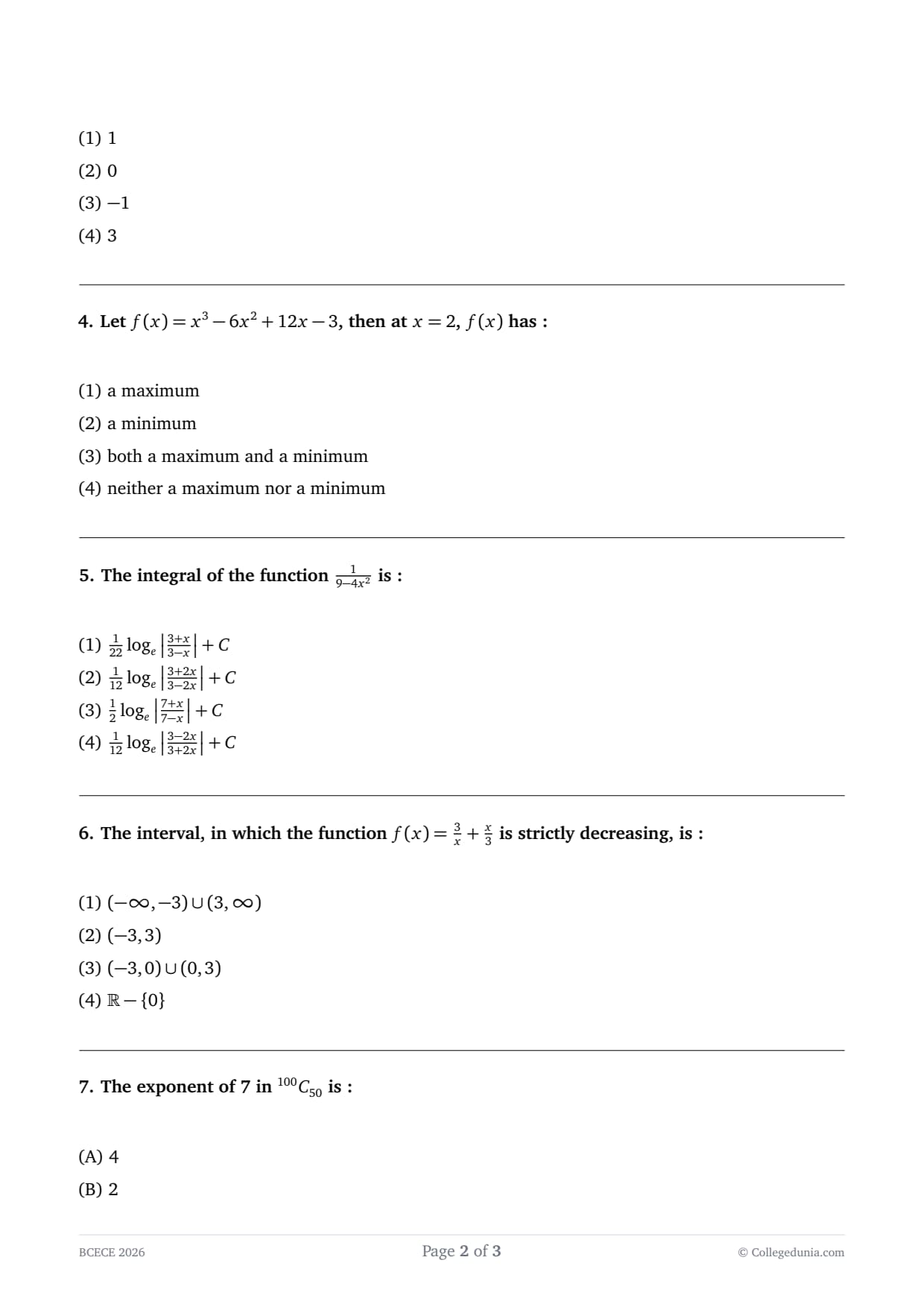
  • (1) \( 1 \)
  • (2) \( 0 \)
  • (3) \( -1 \)
  • (4) \( 3 \)
Correct Answer: (3) \( -1 \)
View Solution


Step 1: Understanding the Concept:

This problem presents a linear system in matrix form, typically represented as \( AX = B \), where \( A \) is the coefficient matrix, \( X \) is the vector of variables (here containing \( x \) and a constant 2), and \( B \) is the constant vector. Matrix equations are fundamental in solving simultaneous linear equations efficiently.

In this specific case, the product of a \( 2 \times 2 \) matrix and a \( 2 \times 1 \) vector results in another \( 2 \times 1 \) vector. The operation follows the "row-by-column" rule, where the components of the rows of the first matrix are multiplied by the components of the column of the second matrix and then summed. This results in two separate scalar equations that must both be satisfied for the same value of \( x \).


Step 2: Key Formula or Approach:

The multiplication of a \( 2 \times 2 \) matrix by a column vector is defined as:
\[ \begin{bmatrix} a & b
c & d \end{bmatrix} \begin{bmatrix} u
v \end{bmatrix} = \begin{bmatrix} au + bv
cu + dv \end{bmatrix} \]

We will apply this to the left side of the given equation. Once we have the resulting vector, we set it equal to the vector on the right side. This leads to a system of two equations:

1) \( 1(x) + 3(2) = 5 \)

2) \( 4(x) + 5(2) = 6 \)

We only need to solve one of these to find \( x \), but using the second one serves as an excellent verification of our work.


Step 3: Detailed Explanation:

Step 3.1: Expanding the matrix multiplication.

The first row of the matrix is \( [1, 3] \) and the column vector is \( \begin{bmatrix} x
2 \end{bmatrix} \).

Product for the first row: \( (1 \cdot x) + (3 \cdot 2) = x + 6 \).

The second row of the matrix is \( [4, 5] \).

Product for the second row: \( (4 \cdot x) + (5 \cdot 2) = 4x + 10 \).

So, the matrix equation becomes:
\[ \begin{bmatrix} x + 6
4x + 10 \end{bmatrix} = \begin{bmatrix} 5
6 \end{bmatrix} \]

Step 3.2: Setting up and solving the equations.

From the first row components:
\[ x + 6 = 5 \]

Subtracting 6 from both sides:
\[ x = 5 - 6 = -1 \]

Step 3.3: Verification with the second row components.

Now substitute \( x = -1 \) into the second equation:
\[ 4(-1) + 10 = -4 + 10 = 6 \]

Since \( 6 = 6 \), the value \( x = -1 \) is consistent across both equations. This confirms that the system is consistent and our calculation is correct.


Step 4: Final Answer:

After performing the matrix multiplication and solving the resulting linear equations, we determined that \( x = -1 \). Checking this value against all constraints confirms its accuracy. Thus, Option (3) is the correct answer.
Quick Tip: In a multiple-choice setting, you can also "plug and play." If you substitute the options into the matrix multiplication, only \( x = -1 \) satisfies both rows. For example, if \( x=1 \), row 1 would give \( 1+6=7 \), which does not equal 5. This saves time in exam conditions.


Question 4:

Let \( f(x) = x^3 - 6x^2 + 12x - 3 \), then at \( x = 2 \), \( f(x) \) has :

  • (1) a maximum
  • (2) a minimum
  • (3) both a maximum and a minimum
  • (4) neither a maximum nor a minimum
Correct Answer: (4) neither a maximum nor a minimum
View Solution


Step 1: Understanding the Concept:

To analyze the local behavior of a function at a point, we use tools from calculus: the first, second, and sometimes third derivative tests.

A local maximum occurs when the function stops increasing and starts decreasing (\( f'(x) \) changes from \( + \) to \( - \)). A local minimum occurs when the function stops decreasing and starts increasing (\( f'(x) \) changes from \( - \) to \( + \)).

If the derivative at a point is zero (\( f'(a) = 0 \)), it is a critical point. We then use the second derivative to determine concavity. If \( f''(a) > 0 \), it's a minimum (concave up). If \( f''(a) < 0 \), it's a maximum (concave down). However, if \( f''(a) = 0 \), the point could be a point of inflection where the function's rate of change reaches a plateau but continues in the same direction.


Step 2: Key Formula or Approach:

1. Calculate the first derivative \( f'(x) \) and evaluate it at \( x = 2 \) to see if it is a critical point.

2. Calculate the second derivative \( f''(x) \) and evaluate it at \( x = 2 \).

3. If both are zero, analyze the nature of \( f'(x) \) around \( x = 2 \) or check the third derivative \( f'''(x) \). If \( f'''(a) \neq 0 \) when \( f'(a) = f''(a) = 0 \), the point is a point of inflection.


Step 3: Detailed Explanation:

Step 3.1: Finding the first derivative.

Function: \( f(x) = x^3 - 6x^2 + 12x - 3 \).

Power rule (\( \frac{d}{dx}x^n = nx^{n-1} \)):
\[ f'(x) = 3x^2 - 12x + 12 \]

At \( x = 2 \):
\[ f'(2) = 3(2)^2 - 12(2) + 12 = 3(4) - 24 + 12 = 12 - 24 + 12 = 0 \]

Since \( f'(2) = 0 \), \( x = 2 \) is a critical point.

Step 3.2: Finding the second derivative.
\[ f''(x) = \frac{d}{dx}(3x^2 - 12x + 12) = 6x - 12 \]

At \( x = 2 \):
\[ f''(2) = 6(2) - 12 = 12 - 12 = 0 \]

Step 3.3: Analyzing the nature.

Since both \( f'(2) = 0 \) and \( f''(2) = 0 \), the standard second derivative test is inconclusive. Let's look at \( f'(x) \) more closely:
\[ f'(x) = 3(x^2 - 4x + 4) = 3(x - 2)^2 \]

The term \( (x-2)^2 \) is always greater than or equal to 0 for all real \( x \). This means for \( x < 2 \), \( f'(x) > 0 \) (increasing), and for \( x > 2 \), \( f'(x) > 0 \) (increasing).

Because the sign of the derivative does not change as we pass through \( x=2 \), the function is strictly increasing at that point. It momentarily levels off (horizontal tangent) but does not turn back. This is the definition of a point of inflection with a horizontal tangent. Thus, it is neither a maximum nor a minimum.


Step 4: Final Answer:

The function \( f(x) \) levels off at \( x=2 \) but continues to increase thereafter. Since there is no change in the sign of the slope, the point \( x=2 \) represents neither a maximum nor a minimum. This corresponds to Option (4).
Quick Tip: Notice that \( f(x) = x^3 - 6x^2 + 12x - 8 + 5 = (x - 2)^3 + 5 \).
The function \( y = x^3 \) has a point of inflection at \( x = 0 \). Shifting it right by 2 and up by 5 yields \( f(x) \), which must have a point of inflection at \( x = 2 \). Points of inflection are neither maxima nor minima.


Question 5:

The integral of the function \( \frac{1}{9 - 4x^2} \) is :

  • (1) \( \frac{1}{22} \log_e \left| \frac{3+x}{3-x} \right| + C \)
  • (2) \( \frac{1}{12} \log_e \left| \frac{3+2x}{3-2x} \right| + C \)
  • (3) \( \frac{1}{2} \log_e \left| \frac{7+x}{7-x} \right| + C \)
  • (4) \( \frac{1}{12} \log_e \left| \frac{3-2x}{3+2x} \right| + C \)
Correct Answer: (2) \( \frac{1}{12} \log_e \left| \frac{3+2x}{3-2x} \right| + C \)
View Solution


Step 1: Understanding the Concept:

This problem involves indefinite integration, specifically of a rational function where the denominator is a quadratic expression of the form \( a^2 - x^2 \). This category of integrals is standard in calculus and is solved using partial fraction decomposition or by applying a specialized formula for inverse hyperbolic/logarithmic forms.

The expression \( \frac{1}{a^2 - x^2} \) integrates to a logarithmic function because its partial fraction components are of the form \( \frac{1}{a-x} + \frac{1}{a+x} \), and the integral of \( \frac{1}{x} \) is \( \log|x| \). A key detail in these problems is handling the coefficients of \( x^2 \) correctly to ensure the final scaling factor is accurate.


Step 2: Key Formula or Approach:

We can use the general integration formula:
\[ \int \frac{dx}{a^2 - x^2} = \frac{1}{2a} \log \left| \frac{a+x}{a-x} \right| + C \]

Alternatively, we can use the method of substitution if the \( x^2 \) term has a coefficient. For an integral of the form \( \int \frac{dx}{a^2 - k^2x^2} \), we substitute \( u = kx \), which results in a factor of \( \frac{1}{k} \) being pulled out front. Combining this with the formula gives:
\[ \int \frac{dx}{a^2 - (kx)^2} = \frac{1}{k} \cdot \frac{1}{2a} \log \left| \frac{a+kx}{a-kx} \right| + C \]


Step 3: Detailed Explanation:

Step 3.1: Identifying parameters.

The given expression is \( \frac{1}{9 - 4x^2} \).

We can rewrite this as:
\[ \frac{1}{3^2 - (2x)^2} \]

Here, \( a = 3 \) and the term being squared is \( 2x \).

Step 3.2: Applying substitution.

Let \( 2x = t \).

Differentiating both sides: \( 2 dx = dt \implies dx = \frac{dt}{2} \).

Substituting these into the integral:
\[ I = \int \frac{1}{3^2 - t^2} \cdot \frac{dt}{2} = \frac{1}{2} \int \frac{dt}{3^2 - t^2} \]

Step 3.3: Evaluating using the standard formula.

Using \( \int \frac{dt}{a^2 - t^2} = \frac{1}{2a} \log \left| \frac{a+t}{a-t} \right| \) with \( a = 3 \):
\[ I = \frac{1}{2} \left[ \frac{1}{2(3)} \log \left| \frac{3+t}{3-t} \right| \right] + C \]
\[ I = \frac{1}{2} \cdot \frac{1}{6} \log \left| \frac{3+t}{3-t} \right| + C \]

Step 3.4: Re-substituting and simplifying.

Substitute \( t = 2x \) back into the expression:
\[ I = \frac{1}{12} \log \left| \frac{3+2x}{3-2x} \right| + C \]

Comparing this result with the provided options, we see it perfectly matches Option (2). Note that Option (4) is a distractor with the numerator and denominator swapped; the formula for \( a^2 - x^2 \) always has \( a+x \) on top.


Step 4: Final Answer:

By utilizing the standard integration form for the difference of squares and carefully managing the coefficient of \( x \), we obtain \( \frac{1}{12} \log_e \left| \frac{3+2x}{3-2x} \right| + C \). Thus, Option (2) is correct.
Quick Tip: To avoid confusion between \( a^2-x^2 \) and \( x^2-a^2 \), remember:
If \( x \) is subtracted (\( a^2-x^2 \)), the log has \( (a+x) \) in the numerator.
If \( a \) is subtracted (\( x^2-a^2 \)), the log has \( (x-a) \) in the numerator.
Check the coefficient of \( x^2 \) first! If it's 4, your multiplier will be \( \frac{1}{\sqrt{4}} \times \frac{1}{2a} \).


Question 6:

The interval, in which the function \( f(x) = \frac{3}{x} + \frac{x}{3} \) is strictly decreasing, is :

  • (1) \( (-\infty, -3) \cup (3, \infty) \)
  • (2) \( (-3, 3) \)
  • (3) \( (-3, 0) \cup (0, 3) \)
  • (4) \( \mathbb{R} - \{0\} \)
Correct Answer: (3) \( (-3, 0) \cup (0, 3) \)
View Solution


Step 1: Understanding the Concept:

Monotonicity of a function refers to whether it is increasing or decreasing over a specific domain. A differentiable function \( f(x) \) is strictly decreasing on an interval if its first derivative \( f'(x) \) is strictly negative (\( < 0 \)) for every \( x \) in that interval.

An important consideration for this specific function, \( f(x) = \frac{3}{x} + \frac{x}{3} \), is its domain. Because of the \( \frac{3}{x} \) term, the function is undefined at \( x = 0 \). Therefore, any interval describing the behavior of the function must explicitly exclude 0. This is a common point where errors occur in multiple-choice questions.


Step 2: Key Formula or Approach:

1. Define the domain: \( x \in \mathbb{R}, x \neq 0 \).

2. Find the first derivative \( f'(x) \) using the power rule.

3. Set up the inequality \( f'(x) < 0 \).

4. Solve the inequality for \( x \), keeping in mind that when taking square roots or multiplying by variables, the sign of the variable matters. However, since we deal with \( x^2 \) in the denominator, it will always be positive in the domain.


Step 3: Detailed Explanation:

Step 3.1: Differentiating the function.

We can write the function as \( f(x) = 3x^{-1} + \frac{1}{3}x \).

Using \( \frac{d}{dx}x^n = nx^{n-1} \):
\[ f'(x) = 3(-1)x^{-2} + \frac{1}{3}(1) \]
\[ f'(x) = -\frac{3}{x^2} + \frac{1}{3} \]

Step 3.2: Solving the inequality for decreasing behavior.

We need \( f'(x) < 0 \):
\[ -\frac{3}{x^2} + \frac{1}{3} < 0 \]

Add \( \frac{3}{x^2} \) to both sides:
\[ \frac{1}{3} < \frac{3}{x^2} \]

Since \( x^2 > 0 \) for all \( x \) in the domain, we can safely multiply both sides by \( 3x^2 \) without changing the inequality sign:
\[ x^2 < 9 \]

Step 3.3: Interpreting the result.

The inequality \( x^2 < 9 \) is satisfied when the magnitude of \( x \) is less than 3:
\[ |x| < 3 \implies -3 < x < 3 \]

Step 3.4: Applying domain constraints.

Recall from Step 1 that \( x \neq 0 \). Therefore, we must remove 0 from the interval \( (-3, 3) \).

This results in two sub-intervals: \( (-3, 0) \) and \( (0, 3) \).

Written in union notation, this is \( (-3, 0) \cup (0, 3) \).

Checking the options:

Option (1) is where the function is increasing.

Option (2) incorrectly includes 0.

Option (3) is the correct representation.


Step 4: Final Answer:

The function's derivative is negative when \( x^2 < 9 \), excluding zero. Thus, the interval of strict decrease is \( (-3, 0) \cup (0, 3) \). This corresponds to Option (3).
Quick Tip: Always look at the denominator of the original function. If it contains \( x \), any answer that is a single continuous interval crossing 0 (like Option 2) is almost certainly wrong.
Also, note that for \( x > 0 \), this is \( AM \ge GM \) territory. The minimum value occurs at \( x=3 \). For \( 0 < x < 3 \), the function must be decreasing towards that minimum.


Question 7:

The exponent of 7 in \( ^{100}C_{50} \) is :

  • (A) \( 4 \)
  • (B) \( 2 \)
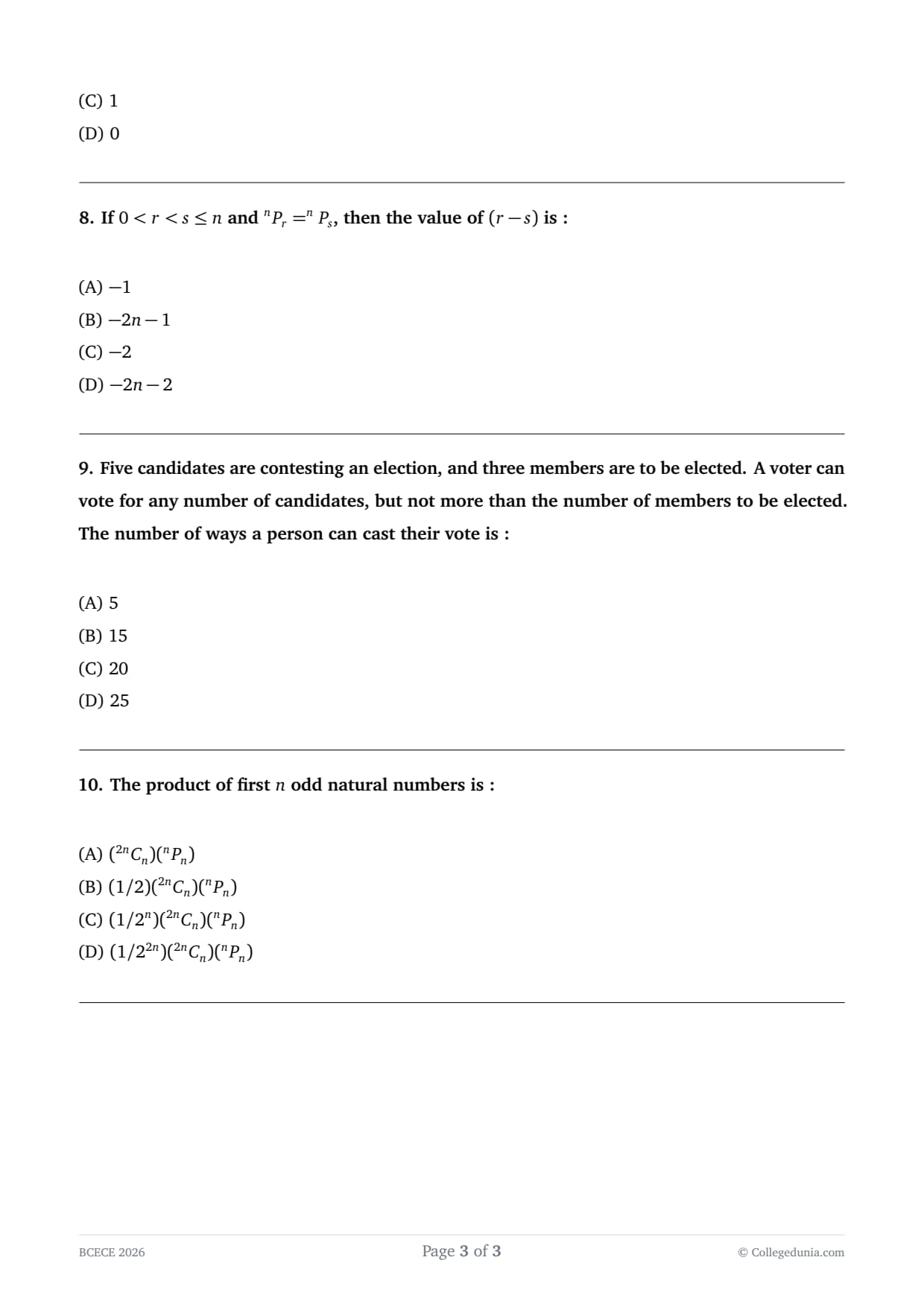
  • (C) \( 1 \)
  • (D) \( 0 \)
Correct Answer: (D) \( 0 \)
View Solution


Step 1: Understanding the Concept:

The "exponent of a prime \( p \) in \( n! \)" refers to the highest power of \( p \) that divides the factorial \( n! \). This is calculated using Legendre's Formula. Since binomial coefficients like \( ^nC_r \) are defined as fractions of factorials (\( \frac{n!}{r!(n-r)!} \)), the exponent of a prime in the coefficient is simply the exponent in the numerator minus the sum of the exponents in the denominator terms (based on the laws of exponents: \( p^a / (p^b \cdot p^c) = p^{a-b-c} \)).

This problem asks for the specific prime \( p = 7 \) in the context of \( ^{100}C_{50} \). This means we need to find how many times 7 appears as a factor in \( 100! \) and how many times it appears in \( (50!)^2 \).


Step 2: Key Formula or Approach:

Legendre's Formula: The exponent of prime \( p \) in \( n! \), denoted \( E_p(n!) \), is:
\[ E_p(n!) = \lfloor n/p \rfloor + \lfloor n/p^2 \rfloor + \lfloor n/p^3 \rfloor + \dots \]

where \( \lfloor x \rfloor \) is the floor function (greatest integer less than or equal to \( x \)).

For \( ^{n}C_{r} \), the exponent of \( p \) is:
\[ E_p(^nC_r) = E_p(n!) - E_p(r!) - E_p((n-r)!) \]


Step 3: Detailed Explanation:

Step 3.1: Calculate \( E_7(100!) \).

- \( \lfloor 100/7 \rfloor = 14 \) (There are 14 multiples of 7: 7, 14, ..., 98)

- \( \lfloor 100/49 \rfloor = 2 \) (There are 2 multiples of 49: 49, 98. Each contributes an extra factor of 7)

- \( \lfloor 100/343 \rfloor = 0 \)

Total \( E_7(100!) = 14 + 2 = 16 \).

Step 3.2: Calculate \( E_7(50!) \).

- \( \lfloor 50/7 \rfloor = 7 \) (Multiples: 7, 14, 21, 28, 35, 42, 49)

- \( \lfloor 50/49 \rfloor = 1 \) (Multiple: 49. It contributes an extra factor)

Total \( E_7(50!) = 7 + 1 = 8 \).

Step 3.3: Final Calculation for \( ^{100}C_{50} \).

The formula for the binomial coefficient is \( \frac{100!}{50! \cdot 50!} \).

The exponent of 7 is:
\[ E_7(^{100}C_{50}) = E_7(100!) - [E_7(50!) + E_7(50!)] \]

Substituting our calculated values:
\[ E_7(^{100}C_{50}) = 16 - [8 + 8] = 16 - 16 = 0 \]

This means that \( ^{100}C_{50} \) is not divisible by 7. In other words, 7 does not appear in its prime factorization.


Step 4: Final Answer:

The prime factor 7 appears exactly zero times in the expansion of \( ^{100}C_{50} \). This is because the number of factors of 7 in the denominator exactly cancels out those in the numerator. Thus, Option (D) is the correct answer.
Quick Tip: Kummer's Theorem: The exponent of a prime \( p \) in \( ^nC_r \) is the number of "carries" when adding \( r \) and \( n-r \) in base \( p \).
For \( 50 + 50 \) in base 7:
\( 50 = (1 \cdot 7^2) + (0 \cdot 7^1) + (1 \cdot 7^0) = 101_7 \).
Adding \( 101_7 + 101_7 = 202_7 \).
Since there were 0 carries during the addition, the exponent is 0.


Question 8:

If \( 0 < r < s \le n \) and \( ^nP_r = ^nP_s \), then the value of \( (r - s) \) is :

  • (A) \( -1 \)
  • (B) \( -2n - 1 \)
  • (C) \( -2 \)
  • (D) \( -2n - 2 \)
Correct Answer: (A) \( -1 \)
View Solution


Step 1: Understanding the Concept:

The notation \( ^nP_k \) represents the number of permutations of \( n \) distinct objects taken \( k \) at a time. The formula is defined as \( \frac{n!}{(n-k)!} \).

Usually, as you increase the number of items you pick (\( k \)), the number of ways to arrange them increases significantly because each new slot adds more possibilities. However, factorials have a unique property at the very end of their range: \( 1! \) and \( 0! \) are both equal to 1. This mathematical convention (which arises from the definition of the Gamma function and the identity for the empty product) implies that the number of ways to arrange almost all items (\( n-1 \)) is the same as the number of ways to arrange every single item (\( n \)).


Step 2: Key Formula or Approach:

The general formula is \( ^nP_k = \frac{n!}{(n-k)!} \).

We are given \( ^nP_r = ^nP_s \) with \( r < s \).

This implies \( \frac{n!}{(n-r)!} = \frac{n!}{(n-s)!} \).

Since \( n! \) is a non-zero constant for \( n \ge 1 \), we can divide both sides by \( n! \):
\[ \frac{1}{(n-r)!} = \frac{1}{(n-s)!} \implies (n-r)! = (n-s)! \]

Since \( x! = y! \) for distinct non-negative integers \( x, y \) only when one is 0 and the other is 1, we look for that specific scenario.


Step 3: Detailed Explanation:

Step 3.1: Identifying the values for \( r \) and \( s \).

We know that \( 0! = 1 \) and \( 1! = 1 \).

For the equation \( (n-r)! = (n-s)! \) to hold for distinct values of \( r \) and \( s \), the only possibility within the factorial domain is:

One side equals \( 0! \) and the other side equals \( 1! \).

Since we are given \( r < s \), then \( n-r \) must be larger than \( n-s \).

Thus:
\[ n - r = 1 \]
\[ n - s = 0 \]

Step 3.2: Solving for \( r \) and \( s \).

From \( n - s = 0 \), we get \( s = n \).

From \( n - r = 1 \), we get \( r = n - 1 \).

Checking constraints: \( 0 < n-1 < n \le n \). This fits the given condition \( 0 < r < s \le n \).

Step 3.3: Calculating \( r - s \).
\[ r - s = (n - 1) - n \]
\[ r - s = n - 1 - n = -1 \]

This matches Option (A).


Step 4: Final Answer:

The only case where \( ^nP_r = ^nP_s \) for \( r \neq s \) is when we compare arranging all \( n \) items versus \( n-1 \) items. In both cases, the result is \( n! \). Calculating the difference between these indices (\( n-1 \) and \( n \)) gives \( -1 \). Thus, Option (A) is the correct answer.
Quick Tip: Remember the "Last Two Rule" for permutations:
\( ^nP_n = ^nP_{n-1} = n! \).
For combinations, the rule is symmetric: \( ^nC_r = ^nC_{n-r} \).
Don't get confused between the two; permutations only have this single specific collision of values.


Question 9:

Five candidates are contesting an election, and three members are to be elected. A voter can vote for any number of candidates, but not more than the number of members to be elected. The number of ways a person can cast their vote is :

  • (A) \( 5 \)
  • (B) \( 15 \)
  • (C) \( 20 \)
  • (D) \( 25 \)
Correct Answer: (D) \( 25 \)
View Solution


Step 1: Understanding the Concept:

This is a counting problem involving combinations. In an election where multiple seats are available, a voter usually has the freedom to choose how many people they want to support, up to the limit of available seats.

The phrase "not more than the number of members to be elected" establishes an upper bound. Since 3 members are to be elected, a voter can choose to vote for 1 person, 2 people, or 3 people.

Note: In standard combinatorial problems of this type, we assume the voter must vote for at least one person (casting a blank ballot is usually not counted unless specified). Since the options do not include 26 (\( 25 + 1 \)), we exclude the 0-vote case.


Step 2: Key Formula or Approach:

We use the combination formula \( ^nC_r \), which calculates the number of ways to select \( r \) items from a set of \( n \) distinct items where order doesn't matter.
\[ ^nC_r = \frac{n!}{r!(n-r)!} \]

The total number of ways is the sum of the mutually exclusive scenarios:

Total = (Ways to choose 1) + (Ways to choose 2) + (Ways to choose 3).


Step 3: Detailed Explanation:

We have \( n = 5 \) candidates. The voter can choose \( r \in \{1, 2, 3\} \).

Step 3.1: Calculate \( ^5C_1 \).

The number of ways to pick exactly one candidate from five:
\[ ^5C_1 = 5 \]

Step 3.2: Calculate \( ^5C_2 \).

The number of ways to pick exactly two candidates from five:
\[ ^5C_2 = \frac{5 \cdot 4}{2 \cdot 1} = 10 \]

Step 3.3: Calculate \( ^5C_3 \).

The number of ways to pick exactly three candidates from five. Using the property \( ^nC_r = ^nC_{n-r} \):
\[ ^5C_3 = ^5C_2 = 10 \]

Step 3.4: Summing the totals.

Total ways = \( 5 (one vote) + 10 (two votes) + 10 (three votes) \)

Total ways = \( 25 \).

Comparing this result with the options, it matches Option (D).


Step 4: Final Answer:

By considering all valid voting scenarios (voting for 1, 2, or 3 candidates) and summing the possible combinations for each, we find that there are 25 distinct ways for a voter to cast their vote. Therefore, Option (D) is the correct choice.
Quick Tip: Always read carefully if the question allows for a "zero" vote (abstaining). If it did, the answer would be \( \sum_{r=0}^{3} ^5C_r = 1 + 25 = 26 \).
Also, for small values like \( n=5 \), sketching the Pascal's triangle row \( (1, 5, 10, 10, 5, 1) \) is a very fast way to get the values for \( ^5C_r \).


Question 10:

The product of first \( n \) odd natural numbers is :

  • (A) \( (^{2n}C_n) (^nP_n) \)
  • (B) \( (1/2) (^{2n}C_n) (^nP_n) \)
  • (C) \( (1/2^n) (^{2n}C_n) (^nP_n) \)
  • (D) \( (1/2^{2n}) (^{2n}C_n) (^nP_n) \)
Correct Answer: (C) \( (1/2^n) (^{2n}C_n) (^nP_n) \)
View Solution


Step 1: Understanding the Concept:

The product of the first \( n \) odd numbers is expressed as \( 1 \cdot 3 \cdot 5 \cdot \dots \cdot (2n-1) \). In mathematics, this is sometimes called the "double factorial" of \( (2n-1) \), written as \( (2n-1)!! \).

Since factorials represent products of consecutive integers, we can represent a product of only odd integers by taking a full factorial of all integers up to \( 2n \) and then dividing out the even integers. This approach allows us to use standard combinatorial notations like \( ^nC_r \) (combinations) and \( ^nP_n \) (permutations, which is simply \( n! \)) to represent the result.


Step 2: Key Formula or Approach:

The core algebraic trick is:
\[ Product of odds = \frac{Product of all integers up to 2n}{Product of even integers up to 2n} \]

We know:

1. Product of all integers up to \( 2n = (2n)! \)

2. Product of even integers = \( 2 \cdot 4 \cdot 6 \cdot \dots \cdot (2n) = 2^n \cdot (1 \cdot 2 \cdot 3 \cdot \dots \cdot n) = 2^n \cdot n! \)

3. \( ^{2n}C_n = \frac{(2n)!}{n! \cdot n!} \)

4. \( ^nP_n = n! \)


Step 3: Detailed Explanation:

Step 3.1: Constructing the odd product.

Let \( P = 1 \cdot 3 \cdot 5 \cdot \dots \cdot (2n-1) \).

Multiply and divide by \( 2 \cdot 4 \cdot 6 \cdot \dots \cdot (2n) \):
\[ P = \frac{1 \cdot 2 \cdot 3 \cdot 4 \cdot 5 \cdot \dots \cdot (2n-1) \cdot 2n}{2 \cdot 4 \cdot 6 \cdot \dots \cdot 2n} \]

The numerator is \( (2n)! \).

The denominator is \( 2^n(n!) \).

So, \( P = \frac{(2n)!}{2^n n!} \).

Step 3.2: Converting to the desired notation.

The options involve \( ^{2n}C_n \). Let's expand that:
\[ ^{2n}C_n = \frac{(2n)!}{n! n!} \]

If we multiply this by \( ^nP_n \) (which is \( n! \)):
\[ (^{2n}C_n) \cdot (^nP_n) = \frac{(2n)!}{n! n!} \cdot n! = \frac{(2n)!}{n!} \]

Step 3.3: Comparing the two results.

Our target product is \( P = \frac{(2n)!}{2^n n!} \).

Our notation product is \( K = \frac{(2n)!}{n!} \).

Clearly, \( P = \frac{K}{2^n} \).

Substituting \( K \) back:
\[ P = \frac{1}{2^n} \left( ^{2n}C_n \cdot ^nP_n \right) \]

This matches Option (C).


Step 4: Final Answer:

By expressing the product of odd integers as a ratio of full factorials and then substituting the definitions of permutations and combinations, we find the relation \( \frac{1}{2^n} (^{2n}C_n) (^nP_n) \). This confirms Option (C) is correct.
Quick Tip: To verify such general formulas quickly in an exam, test with \( n=2 \).
Product of first 2 odds: \( 1 \cdot 3 = 3 \).
Using option (C) for \( n=2 \):
\( \frac{1}{2^2} \cdot ^4C_2 \cdot ^2P_2 = \frac{1}{4} \cdot 6 \cdot 2 = \frac{12}{4} = 3 \).
Since the values match, the formula is correct. This is much faster than deriving factorials.

BCECE 2026 Mathematics Marking Scheme

Parameter Details
Total Questions 100
Total Marks 400
Marks for Correct Answer +4 Marks
Marks for Wrong Answer -1 Mark
Marks for Unattempted Question 0 Marks
Type of Questions Objective Type (MCQs)
Exam Duration 90 Minutes

BIHAR BCECE 2026 Mathematics PYQs