




The Quantitative Ability section of the ICFAI Business School Aptitude Test (IBSAT) assesses candidates on mathematical concepts, problem-solving ability, and numerical reasoning. It covers topics like arithmetic, algebra, geometry, and data sufficiency, testing speed, accuracy, and logical thinking essential for management studies.
IBSAT Quantitative Ability Question Paper with Answer Key PDF
| IBSAT Quantitative Ability Sample Question Paper PDF | Download PDF | Check Solutions |
IBSAT Quantitative Ability Question Paper with Solutions
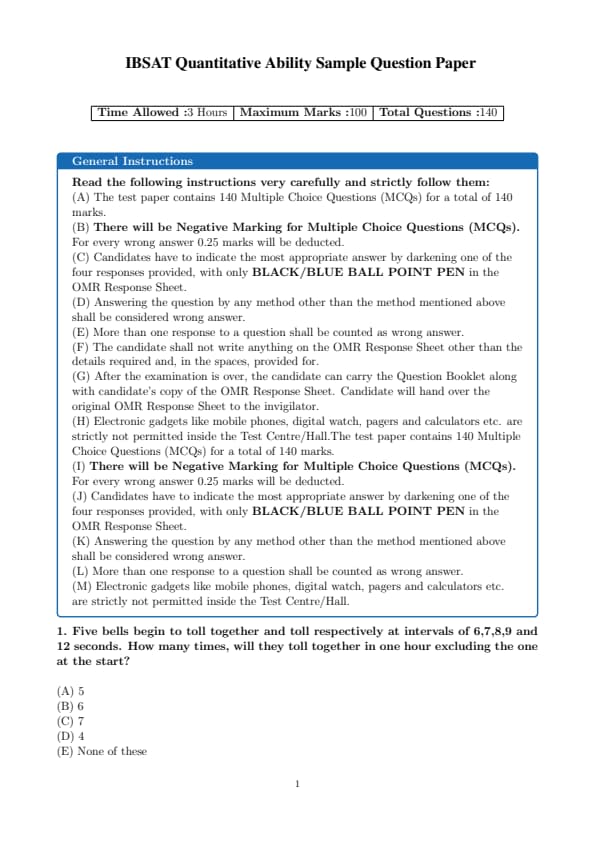
Five bells begin to toll together and toll respectively at intervals of 6,7,8,9 and 12 seconds. How many times, will they toll together in one hour excluding the one at the start?
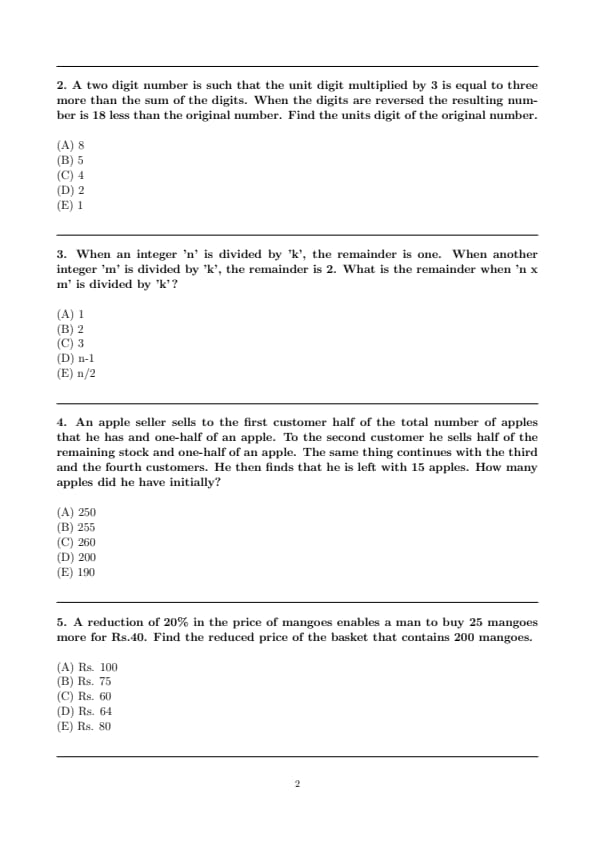
A two digit number is such that the unit digit multiplied by 3 is equal to three more than the sum of the digits. When the digits are reversed the resulting number is 18 less than the original number. Find the units digit of the original number.
When an integer 'n' is divided by 'k', the remainder is one. When another integer 'm' is divided by 'k', the remainder is 2. What is the remainder when 'n x m' is divided by 'k'?
An apple seller sells to the first customer half of the total number of apples that he has and one-half of an apple. To the second customer he sells half of the remaining stock and one-half of an apple. The same thing continues with the third and the fourth customers. He then finds that he is left with 15 apples. How many apples did he have initially?
A reduction of 20% in the price of mangoes enables a man to buy 25 mangoes more for Rs.40. Find the reduced price of the basket that contains 200 mangoes.
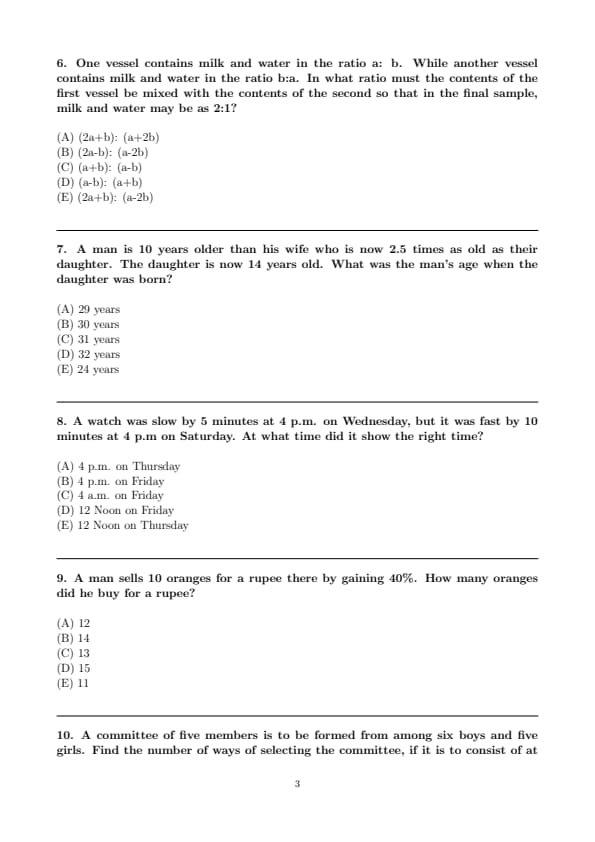
One vessel contains milk and water in the ratio a: b. While another vessel contains milk and water in the ratio b:a. In what ratio must the contents of the first vessel be mixed with the contents of the second so that in the final sample, milk and water may be as 2:1?
A man is 10 years older than his wife who is now 2.5 times as old as their daughter. The daughter is now 14 years old. What was the man's age when the daughter was born?
View Solution
Step 1: Understanding the Question:
This is a word problem involving ages. We are given relationships between the current ages of a man, his wife, and their daughter. We need to find the man's age at a past event (daughter's birth).
Step 2: Key Formula or Approach:
Calculate the current ages of all individuals step-by-step based on the given information. Then, calculate the man's age in the past.
Step 3: Detailed Explanation:
Step 1: Find the daughter's current age.
The daughter is now 14 years old.
\[ Daughter's current age = 14 \]
Step 2: Find the wife's current age.
The wife is 2.5 times as old as the daughter.
\[ Wife's current age = 2.5 \times 14 = 35 years \]
Step 3: Find the man's current age.
The man is 10 years older than his wife.
\[ Man's current age = 35 + 10 = 45 years \]
Step 4: Find the man's age when the daughter was born.
The daughter was born 14 years ago. So, we need to find the man's age 14 years ago.
\[ Man's age at daughter's birth = Man's current age - Daughter's current age \] \[ = 45 - 14 = 31 years \]
Step 4: Final Answer:
The man's age when the daughter was born was 31 years.
Quick Tip: In age problems, it's crucial to establish a baseline time (usually the present) and calculate all ages for that specific time before calculating ages in the past or future.
A watch was slow by 5 minutes at 4 p.m. on Wednesday, but it was fast by 10 minutes at 4 p.m on Saturday. At what time did it show the right time?
A man sells 10 oranges for a rupee there by gaining 40%. How many oranges did he buy for a rupee?
A committee of five members is to be formed from among six boys and five girls. Find the number of ways of selecting the committee, if it is to consist of at least one boy and at least one girl?
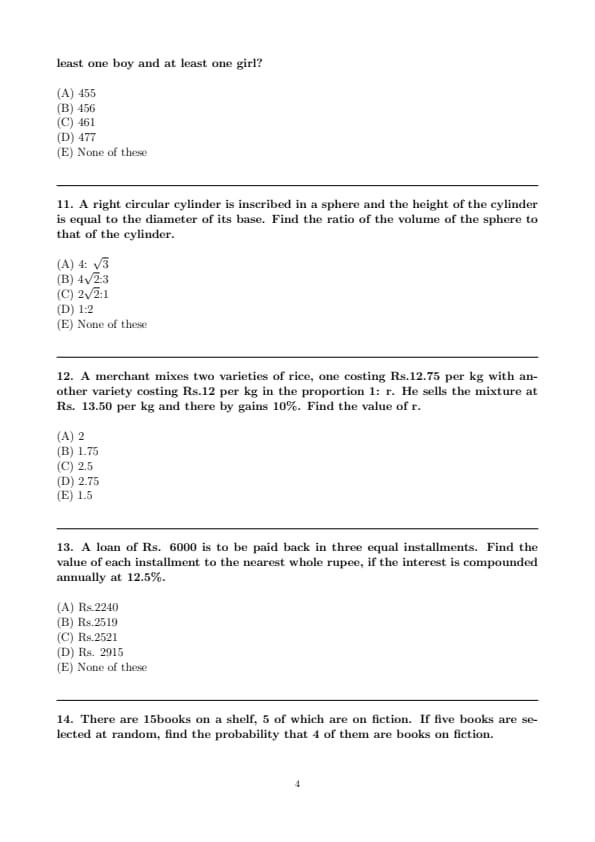
A right circular cylinder is inscribed in a sphere and the height of the cylinder is equal to the diameter of its base. Find the ratio of the volume of the sphere to that of the cylinder.
A merchant mixes two varieties of rice, one costing Rs.12.75 per kg with another variety costing Rs.12 per kg in the proportion 1: r. He sells the mixture at Rs. 13.50 per kg and there by gains 10%. Find the value of r.
A loan of Rs. 6000 is to be paid back in three equal installments. Find the value of each installment to the nearest whole rupee, if the interest is compounded annually at 12.5%.
There are 15 books on a shelf, 5 of which are on fiction. If five books are selected at random, find the probability that 4 of them are books on fiction.
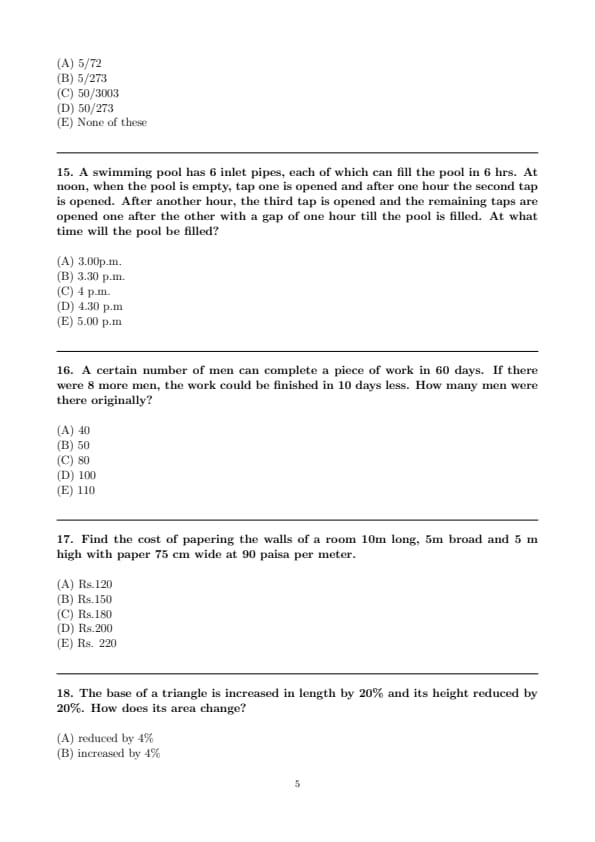
A swimming pool has 6 inlet pipes, each of which can fill the pool in 6 hrs. At noon, when the pool is empty, tap one is opened and after one hour the second tap is opened. After another hour, the third tap is opened and the remaining taps are opened one after the other with a gap of one hour till the pool is filled. At what time will the pool be filled?
A certain number of men can complete a piece of work in 60 days. If there were 8 more men, the work could be finished in 10 days less. How many men were there originally?
Find the cost of papering the walls of a room 10m long, 5m broad and 5 m high with paper 75 cm wide at 90 paisa per meter.
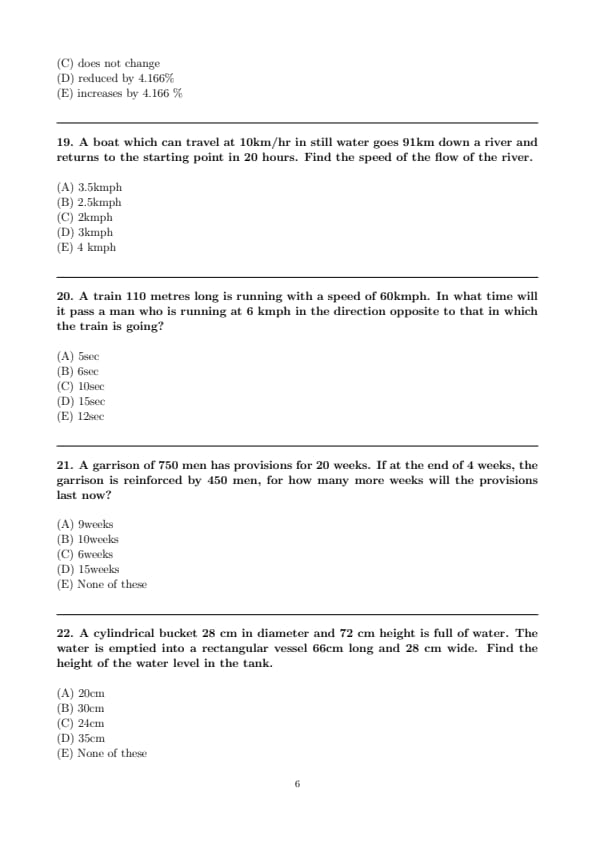
The base of a triangle is increased in length by 20% and its height reduced by 20%. How does its area change?
A boat which can travel at 10km/hr in still water goes 91km down a river and returns to the starting point in 20 hours. Find the speed of the flow of the river.
A train 110 metres long is running with a speed of 60kmph. In what time will it pass a man who is running at 6 kmph in the direction opposite to that in which the train is going?
A garrison of 750 men has provisions for 20 weeks. If at the end of 4 weeks, the garrison is reinforced by 450 men, for how many more weeks will the provisions last now?
A cylindrical bucket 28 cm in diameter and 72 cm height is full of water. The water is emptied into a rectangular vessel 66cm long and 28 cm wide. Find the height of the water level in the tank.
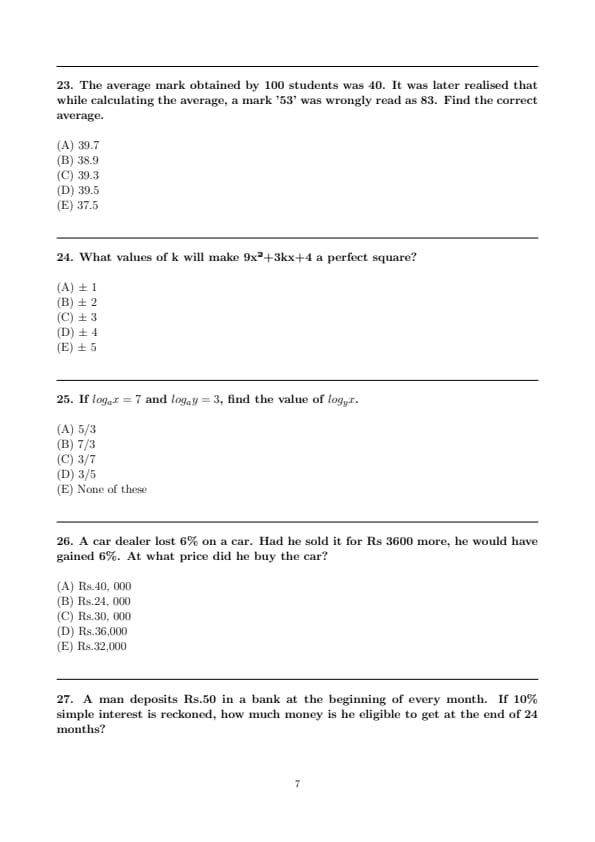
The average mark obtained by 100 students was 40. It was later realised that while calculating the average, a mark '53' was wrongly read as 83. Find the correct average.
View Solution
Step 1: Understanding the Question:
This is a problem on averages where an error in one of the data points needs to be corrected. We need to find the new, correct average after adjusting the total sum.
Step 2: Key Formula or Approach:
Average = \(\frac{Sum of observations}{Number of observations}\).
Therefore, Sum = Average \(\times\) Number.
Correct Sum = Incorrect Sum - Incorrect Value + Correct Value.
Correct Average = \(\frac{Correct Sum}{Number of observations}\).
Step 3: Detailed Explanation:
1. Calculate the incorrect total sum of marks:
Number of students = 100.
Incorrect average = 40.
\[ Incorrect Sum = 100 \times 40 = 4000 \]
2. Find the error and calculate the correct sum:
A mark was wrongly read as 83 instead of the correct value 53.
The error in the sum = Incorrect value - Correct value = \(83 - 53 = 30\).
The calculated sum is 30 more than the actual sum.
\[ Correct Sum = Incorrect Sum - Error = 4000 - 30 = 3970 \]
3. Calculate the correct average:
The number of students remains the same (100).
\[ Correct Average = \frac{Correct Sum}{Number of students} = \frac{3970}{100} = 39.7 \]
Step 4: Final Answer:
The correct average is 39.7.
Quick Tip: To correct an average, you don't need to recalculate everything. Simply find the total error in the sum and distribute this error over the number of observations. Change in Average = Total Error / Number of Observations. Here, change is -30/100 = -0.3. New average = 40 - 0.3 = 39.7.
What values of k will make 9x²+3kx+4 a perfect square?
If \(log_a x = 7\) and \(log_a y = 3\), find the value of \(log_y x\).
A car dealer lost 6% on a car. Had he sold it for Rs 3600 more, he would have gained 6%. At what price did he buy the car?
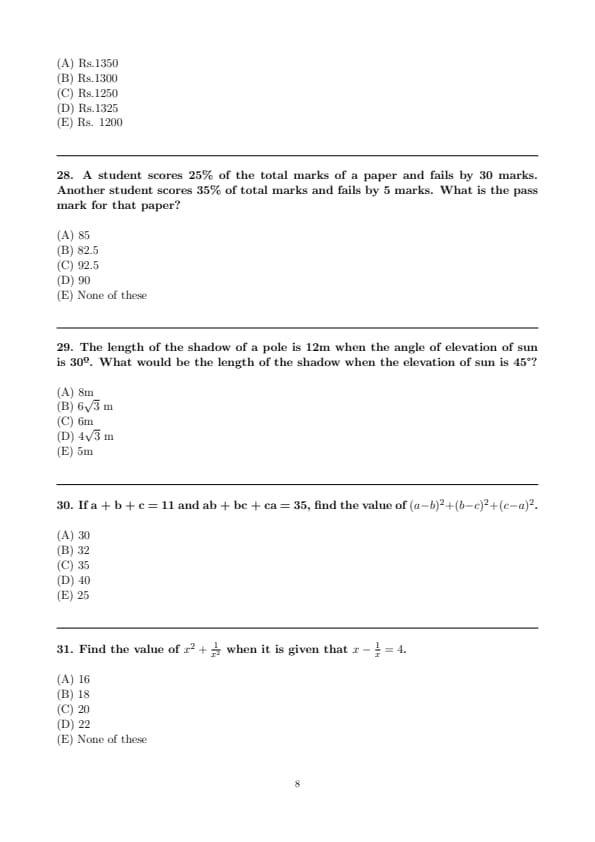
A man deposits Rs.50 in a bank at the beginning of every month. If 10% simple interest is reckoned, how much money is he eligible to get at the end of 24 months?
A student scores 25% of the total marks of a paper and fails by 30 marks. Another student scores 35% of total marks and fails by 5 marks. What is the pass mark for that paper?
The length of the shadow of a pole is 12m when the angle of elevation of sun is 30º. What would be the length of the shadow when the elevation of sun is 45°?
If a + b + c = 11 and ab + bc + ca = 35, find the value of \((a-b)^2+(b-c)^2+(c-a)^2\).
Find the value of \(x^2+ \frac{1}{x^2}\) when it is given that \(x- \frac{1}{x} =4\).
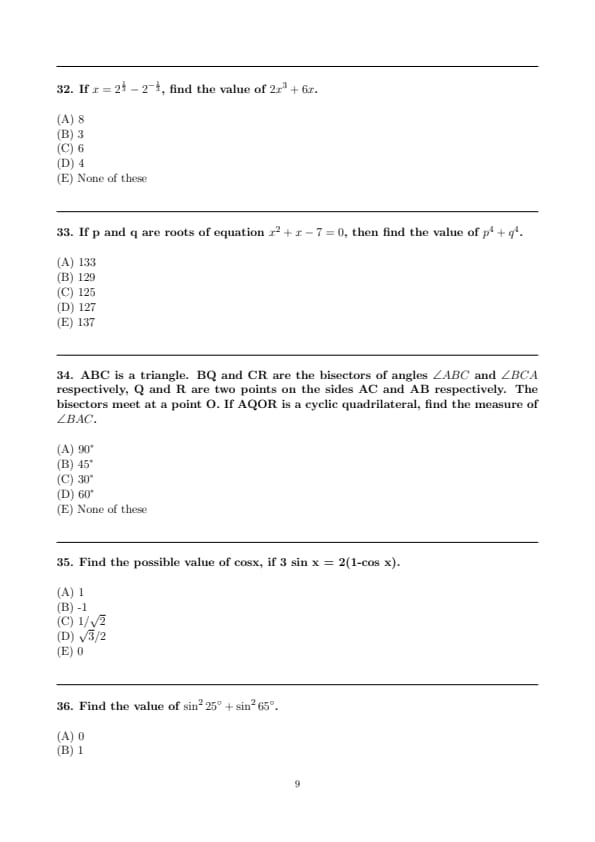
If \(x= 2^{\frac{1}{3}} - 2^{-\frac{1}{3}}\), find the value of \(2x^3+6x\).
If p and q are roots of equation \(x^2+x-7=0\), then find the value of \(p^4+q^4\).
ABC is a triangle. BQ and CR are the bisectors of angles \(\angle ABC\) and \(\angle BCA\) respectively, Q and R are two points on the sides AC and AB respectively. The bisectors meet at a point O. If AQOR is a cyclic quadrilateral, find the measure of \(\angle BAC\).
Find the possible value of cosx, if 3 sin x = 2(1-cos x).
Find the value of \(\sin^2 25^\circ+\sin^2 65^\circ\).
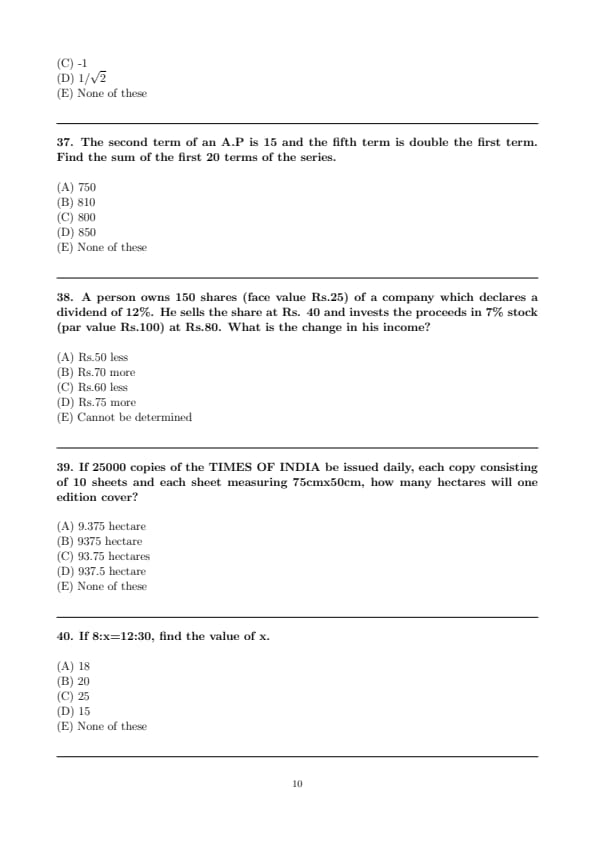
The second term of an A.P is 15 and the fifth term is double the first term. Find the sum of the first 20 terms of the series.
A person owns 150 shares (face value Rs.25) of a company which declares a dividend of 12%. He sells the share at Rs. 40 and invests the proceeds in 7% stock (par value Rs.100) at Rs.80. What is the change in his income?
If 25000 copies of the TIMES OF INDIA be issued daily, each copy consisting of 10 sheets and each sheet measuring 75cmx50cm, how many hectares will one edition cover?
If 8:x=12:30, find the value of x.
Which term of the series 545, 525, 505, 485.... is closest to zero?
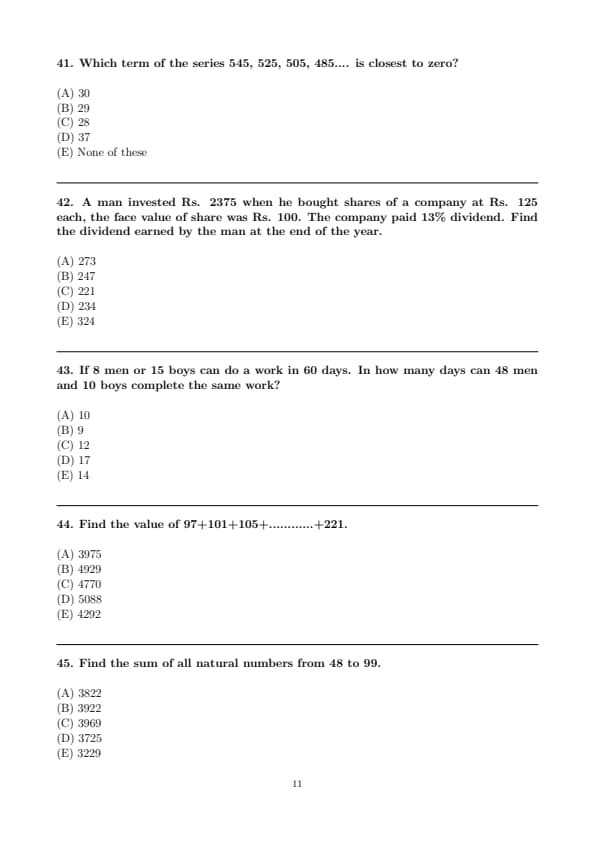
A man invested Rs. 2375 when he bought shares of a company at Rs. 125 each, the face value of share was Rs. 100. The company paid 13% dividend. Find the dividend earned by the man at the end of the year.
If 8 men or 15 boys can do a work in 60 days. In how many days can 48 men and 10 boys complete the same work?
Find the value of 97+101+105+............+221.
Find the sum of all natural numbers from 48 to 99.
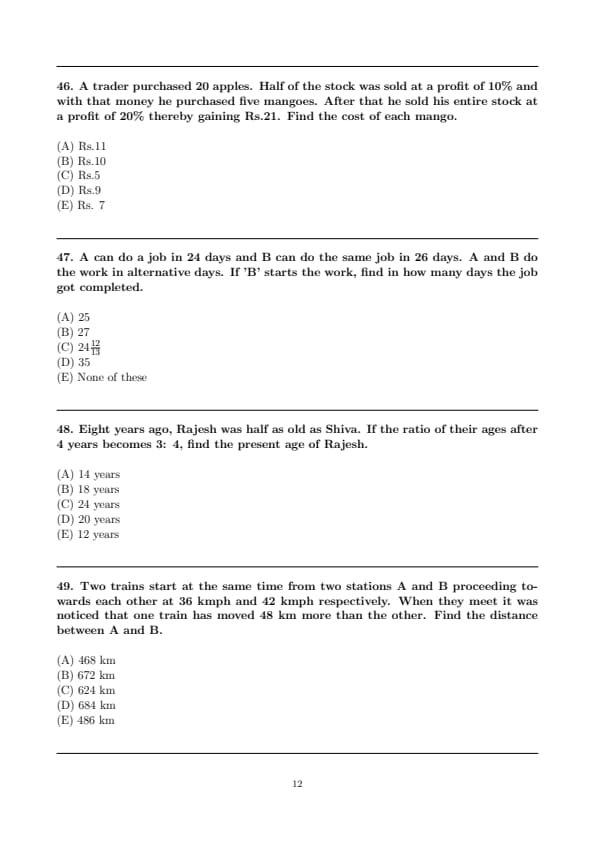
A trader purchased 20 apples. Half of the stock was sold at a profit of 10% and with that money he purchased five mangoes. After that he sold his entire stock at a profit of 20% thereby gaining Rs.21. Find the cost of each mango.
A can do a job in 24 days and B can do the same job in 26 days. A and B do the work in alternative days. If 'B' starts the work, find in how many days the job got completed.
Eight years ago, Rajesh was half as old as Shiva. If the ratio of their ages after 4 years becomes 3: 4, find the present age of Rajesh.
Two trains start at the same time from two stations A and B proceeding towards each other at 36 kmph and 42 kmph respectively. When they meet it was noticed that one train has moved 48 km more than the other. Find the distance between A and B.
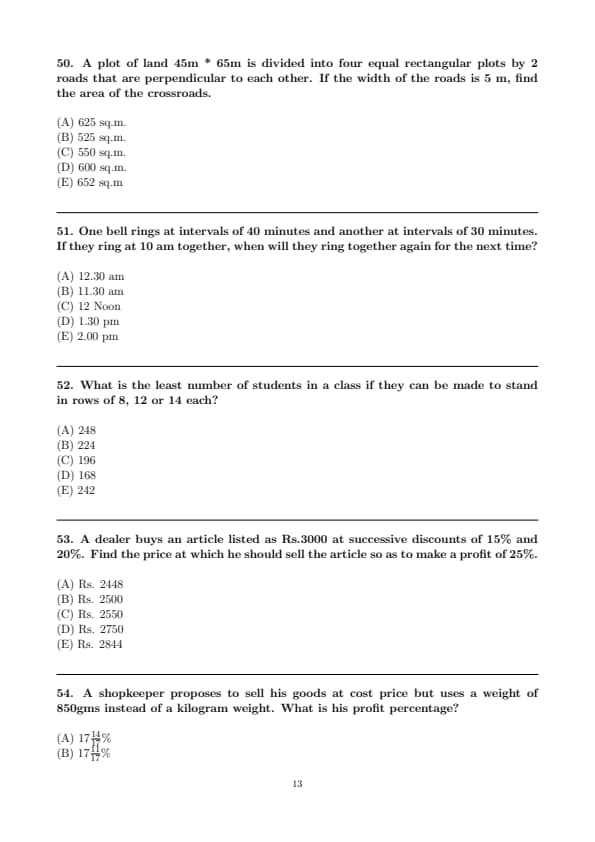
A plot of land 45m * 65m is divided into four equal rectangular plots by 2 roads that are perpendicular to each other. If the width of the roads is 5 m, find the area of the crossroads.
One bell rings at intervals of 40 minutes and another at intervals of 30 minutes. If they ring at 10 am together, when will they ring together again for the next time?
What is the least number of students in a class if they can be made to stand in rows of 8, 12 or 14 each?
A dealer buys an article listed as Rs.3000 at successive discounts of 15% and 20%. Find the price at which he should sell the article so as to make a profit of 25%.
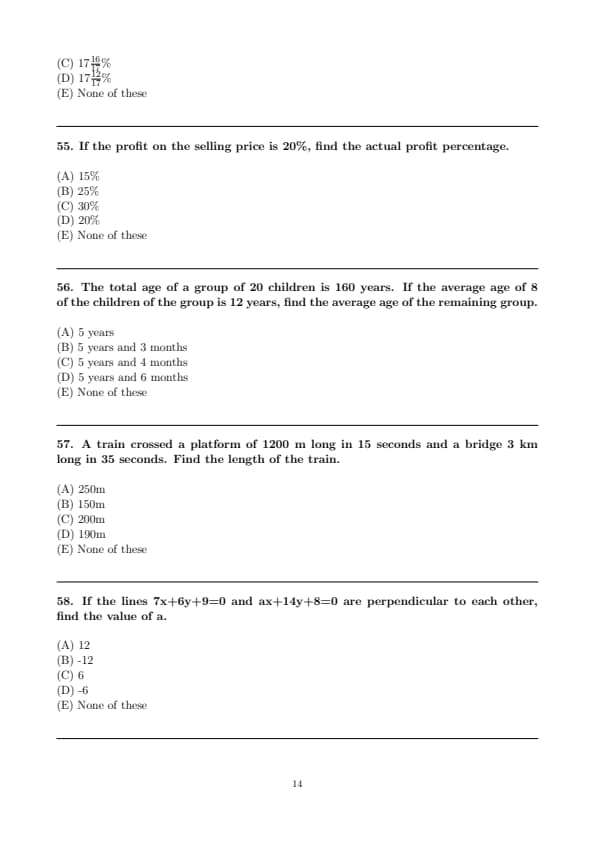
A shopkeeper proposes to sell his goods at cost price but uses a weight of 850gms instead of a kilogram weight. What is his profit percentage?
If the profit on the selling price is 20%, find the actual profit percentage.
The total age of a group of 20 children is 160 years. If the average age of 8 of the children of the group is 12 years, find the average age of the remaining group.
A train crossed a platform of 1200 m long in 15 seconds and a bridge 3 km long in 35 seconds. Find the length of the train.
If the lines 7x+6y+9=0 and ax+14y+8=0 are perpendicular to each other, find the value of a.
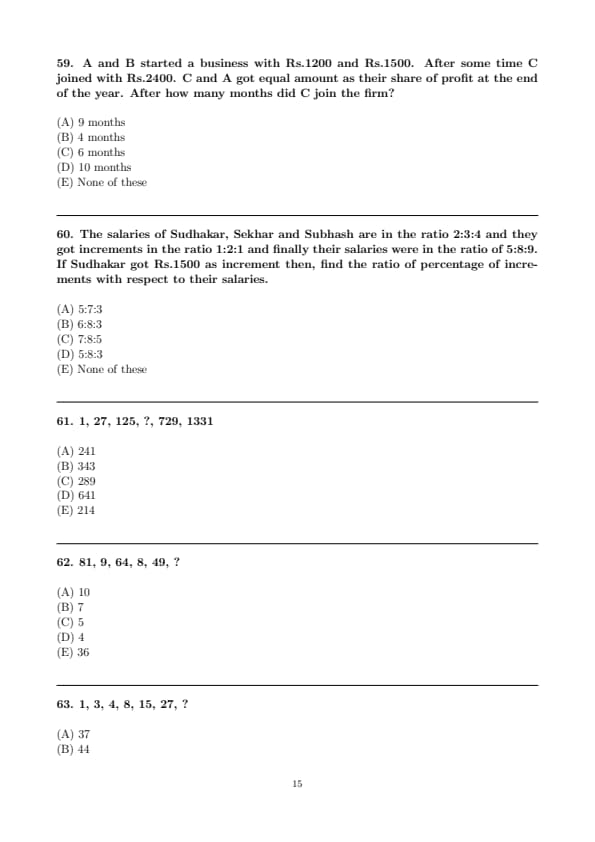
A and B started a business with Rs.1200 and Rs.1500. After some time C joined with Rs.2400. C and A got equal amount as their share of profit at the end of the year. After how many months did C join the firm?
The salaries of Sudhakar, Sekhar and Subhash are in the ratio 2:3:4 and they got increments in the ratio 1:2:1 and finally their salaries were in the ratio of 5:8:9. If Sudhakar got Rs.1500 as increment then, find the ratio of percentage of increments with respect to their salaries.
1, 27, 125, ?, 729, 1331
81, 9, 64, 8, 49, ?
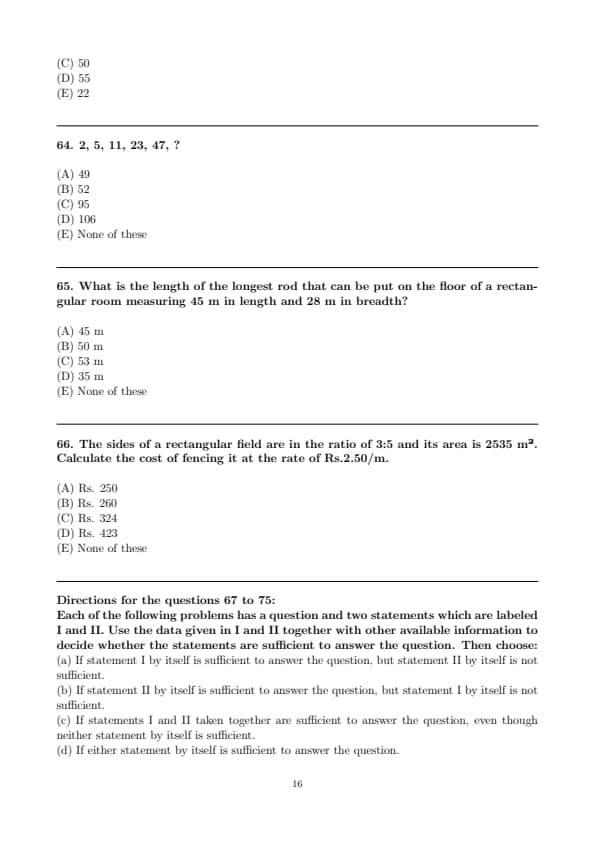
1, 3, 4, 8, 15, 27, ?
2, 5, 11, 23, 47, ?
What is the length of the longest rod that can be put on the floor of a rectangular room measuring 45 m in length and 28 m in breadth?
The sides of a rectangular field are in the ratio of 3:5 and its area is 2535 m². Calculate the cost of fencing it at the rate of Rs.2.50/m.
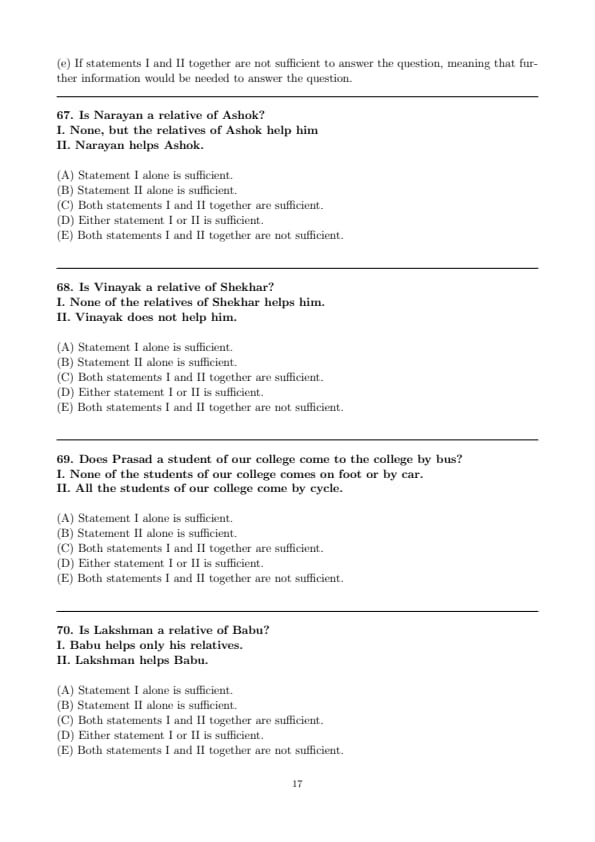
Is Narayan a relative of Ashok?
I. None, but the relatives of Ashok help him
II. Narayan helps Ashok.
View Solution
Step 1: Understanding the Question:
The question asks for a definitive "Yes" or "No" answer regarding whether Narayan is a relative of Ashok.
Step 2: Detailed Explanation:
Analyzing Statement I: "None, but the relatives of Ashok help him". This is phrased ambiguously. A logical interpretation is "Only the relatives of Ashok help him". This statement establishes a rule, but it does not mention Narayan. Therefore, we cannot determine if Narayan is a relative. So, Statement I alone is not sufficient.
Analyzing Statement II: "Narayan helps Ashok." This statement tells us an action performed by Narayan. However, people other than relatives can also help. So, this statement alone does not establish a relationship. So, Statement II alone is not sufficient.
Analyzing Statements I and II Together:
From Statement I, we establish the rule: "If someone helps Ashok, then that person is a relative of Ashok".
From Statement II, we are given a fact: "Narayan helps Ashok".
By combining the rule from Statement I and the fact from Statement II, we can logically conclude that Narayan must be a relative of Ashok. This provides a definite "Yes" to the question.
Step 3: Final Answer:
Since both statements together are required to answer the question, the correct option is (C).
Quick Tip: In data sufficiency, the goal is not to find the answer but to determine if you *can* find the answer. A definite "Yes" or a definite "No" both count as sufficient information.
Is Vinayak a relative of Shekhar?
I. None of the relatives of Shekhar helps him.
II. Vinayak does not help him.
View Solution
Step 1: Understanding the Question:
We need to determine with certainty whether Vinayak is a relative of Shekhar.
Step 2: Detailed Explanation:
Analyzing Statement I: "None of the relatives of Shekhar helps him." This can be written as a conditional statement: If a person is a relative of Shekhar, then that person does not help him. This gives a property of relatives, but it doesn't mention Vinayak. So, Statement I alone is not sufficient.
Analyzing Statement II: "Vinayak does not help him." This tells us about Vinayak's action (or inaction). It doesn't provide information about his relationship with Shekhar. So, Statement II alone is not sufficient.
Analyzing Statements I and II Together:
From Statement I: All relatives of Shekhar do not help him.
From Statement II: Vinayak does not help him.
This means Vinayak behaves in a way that is consistent with him being a relative. However, it's also possible that Vinayak is a non-relative who also does not help Shekhar. The statements do not exclude this possibility. Since we cannot definitively conclude whether Vinayak is a relative or not, the information is insufficient. This is an example of the logical fallacy of affirming the consequent.
Step 3: Final Answer:
Even with both statements, we cannot answer the question with certainty. The correct option is (E).
Quick Tip: Be careful with conditional statements (If P, then Q). Given Q is true, you cannot conclude P is true. However, if you are given that Q is false, you can conclude that P is false (this is called the contrapositive).
Does Prasad a student of our college come to the college by bus?
I. None of the students of our college comes on foot or by car.
II. All the students of our college come by cycle.
View Solution
Step 1: Understanding the Question:
The question asks for a "Yes" or "No" answer to whether Prasad, a student, travels to college by bus.
Step 2: Detailed Explanation:
Analyzing Statement I: "None of the students of our college comes on foot or by car." This statement eliminates two modes of transport for all students, including Prasad. However, it doesn't rule out other modes like bus, train, or cycle. We cannot be certain if Prasad uses a bus. So, Statement I alone is not sufficient.
Analyzing Statement II: "All the students of our college come by cycle." Since Prasad is a student of the college, this statement implies that Prasad must come by cycle. If Prasad comes by cycle, he does not come by bus. This gives a definitive "No" answer to the question. So, Statement II alone is sufficient.
Step 3: Final Answer:
Since Statement II alone is sufficient to answer the question, but Statement I alone is not, the correct option is (B).
Quick Tip: In data sufficiency, a statement is sufficient if it leads to a single, unambiguous answer. "No" is as valid an answer as "Yes".
Is Lakshman a relative of Babu?
I. Babu helps only his relatives.
II. Lakshman helps Babu.
View Solution
Step 1: Understanding the Question:
We need to determine if there is a family relationship between Lakshman and Babu.
Step 2: Detailed Explanation:
Analyzing Statement I: "Babu helps only his relatives." This statement sets a condition on whom Babu helps. It doesn't provide any information about Lakshman or who helps Babu. So, Statement I alone is not sufficient.
Analyzing Statement II: "Lakshman helps Babu." This statement describes an action from Lakshman to Babu. It does not provide any context about the reason for the help or their relationship. So, Statement II alone is not sufficient.
Analyzing Statements I and II Together:
Statement I is about the people that Babu helps.
Statement II is about Lakshman helping Babu.
There is no connection between the two statements. Statement I's condition applies when Babu is the one giving help. Statement II describes a situation where Babu is receiving help. The information is unrelated and cannot be combined to reach a conclusion.
Step 3: Final Answer:
Even when combined, the statements do not provide enough information to answer the question. The correct option is (E).
Quick Tip: Pay close attention to the subject and object of the action in each statement. A statement like "A helps B" is very different from "B helps A", and rules applying to one case cannot be applied to the other.
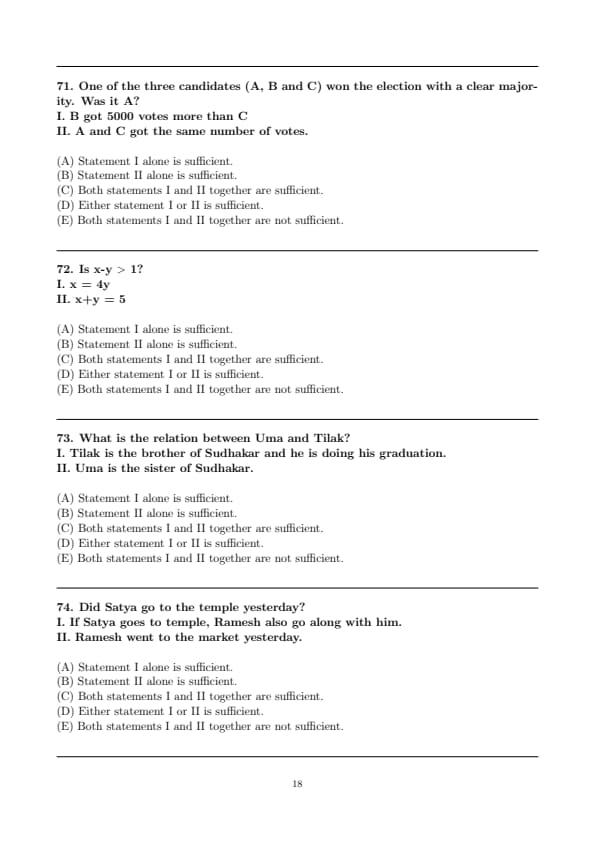
One of the three candidates (A, B and C) won the election with a clear majority. Was it A?
I. B got 5000 votes more than C
II. A and C got the same number of votes.
View Solution
Step 1: Understanding the Question:
We are told that one candidate (A, B, or C) won with a "clear majority" (more than 50% of the total votes). The question is specifically "Was it A?".
Step 2: Detailed Explanation:
Analyzing Statement I: "B got 5000 votes more than C." Let the votes be \(V_A, V_B, V_C\). This gives us \(V_B = V_C + 5000\). This tells us \(V_B > V_C\), but we know nothing about \(V_A\). A could have received the most or fewest votes. So, Statement I alone is not sufficient.
Analyzing Statement II: "A and C got the same number of votes." This means \(V_A = V_C\). This doesn't tell us how B's votes compare. B could have more or fewer votes than A and C. So, Statement II alone is not sufficient.
Analyzing Statements I and II Together:
From statement II, we have \(V_A = V_C\).
From statement I, we have \(V_B > V_C\).
Combining these, we get \(V_B > V_C = V_A\). This means B received the most votes.
The initial problem states that one candidate won with a clear majority. Since B received more votes than A and C, B must be the candidate who won with the majority.
Therefore, A did not win the election. We can answer the question "Was it A?" with a definite "No".
Step 3: Final Answer:
Since we need both statements to get a definitive answer, the correct option is (C).
Quick Tip: In data sufficiency, if you can determine the unique winner of a contest, you can answer the question "Did person X win?". Even if X did not win, that is a sufficient answer.
Is x-y \(>\) 1?
I. x = 4y
II. x+y = 5
View Solution
Step 1: Understanding the Question:
We need to determine if the expression \(x-y\) is definitively greater than 1.
Step 2: Key Formula or Approach:
We will analyze each statement to see if it constrains the values of \(x\) and \(y\) enough to answer the question. If not, we will solve the system of equations formed by both statements.
Step 3: Detailed Explanation:
Analyzing Statement I: \(x = 4y\).
Substitute this into the inequality: Is \(4y - y > 1\)? This simplifies to "Is \(3y > 1\)?", or "Is \(y > 1/3\)?".
Since we don't know the value of \(y\), we cannot answer. If \(y=1\), then \(3>1\) (Yes). If \(y=0\), then \(0>1\) (No). So, Statement I alone is not sufficient.
Analyzing Statement II: \(x + y = 5\).
From this, \(x = 5-y\). Substitute into the inequality: Is \((5-y) - y > 1\)? This simplifies to "Is \(5 - 2y > 1\)?", or "Is \(4 > 2y\)?", or "Is \(2 > y\)?"
Again, we don't know the value of \(y\). If \(y=1\), then \(2>1\) (Yes). If \(y=3\), then \(2>3\) (No). So, Statement II alone is not sufficient.
Analyzing Statements I and II Together:
We have a system of two linear equations: \[ x = 4y \quad ---(1) \] \[ x + y = 5 \quad ---(2) \]
Substitute equation (1) into equation (2): \[ (4y) + y = 5 \] \[ 5y = 5 \] \[ y = 1 \]
Now find \(x\) using equation (1): \[ x = 4(1) = 4 \]
We have found unique values for \(x\) and \(y\). Now we can check the condition: Is \(x - y > 1\)?
Is \(4 - 1 > 1\)? Is \(3 > 1\)? Yes.
This gives a definite "Yes" answer.
Step 4: Final Answer:
Both statements together are required to find a unique solution and answer the question. The correct option is (C).
Quick Tip: For algebraic data sufficiency questions, you don't always need to solve completely. The goal is to see if you *can* find a unique answer. If you have two distinct linear equations for two variables, you can generally find a unique solution.
What is the relation between Uma and Tilak?
I. Tilak is the brother of Sudhakar and he is doing his graduation.
II. Uma is the sister of Sudhakar.
Did Satya go to the temple yesterday?
I. If Satya goes to temple, Ramesh also go along with him.
II. Ramesh went to the market yesterday.
View Solution
Step 1: Understanding the Question:
We need a definite "Yes" or "No" answer to the question of whether Satya visited the temple yesterday.
Step 2: Detailed Explanation:
Analyzing Statement I: "If Satya goes to temple, Ramesh also go along with him." This is a conditional rule. Let S = "Satya goes to temple" and R = "Ramesh goes to temple". The rule is S \( \implies \) R. This rule alone does not tell us whether S happened. So, Statement I alone is not sufficient.
Analyzing Statement II: "Ramesh went to the market yesterday." This statement provides information about Ramesh's whereabouts, but it is about the market, not the temple. It also doesn't mention Satya. So, Statement II alone is not sufficient.
Analyzing Statements I and II Together:
We have the rule S \( \implies \) R. Statement II tells us that Ramesh went to the market. This does not confirm or deny whether Ramesh went to the temple. He could have gone to both the market and the temple, or only to the market. Since we cannot be sure if R (Ramesh goes to temple) is true or false, we cannot use the rule S \( \implies \) R to deduce anything about S (Satya goes to temple). The information is insufficient.
Step 3: Final Answer:
The statements together do not provide enough information to answer the question. The correct option is (E).
Quick Tip: Information that seems related might be irrelevant. Knowing Ramesh went to the market doesn't impact whether he went to the temple unless a statement explicitly links the two activities (e.g., "he only went to one place").
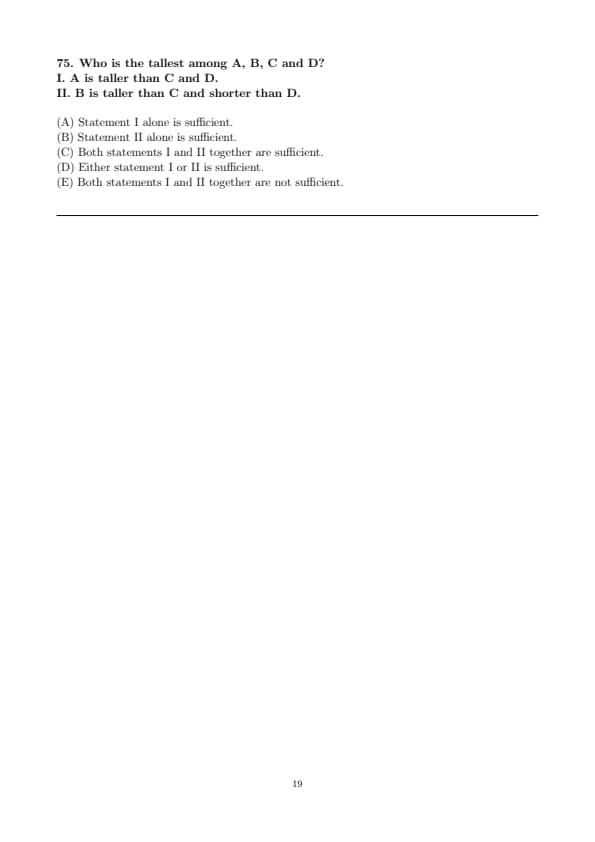
Who is the tallest among A, B, C and D?
I. A is taller than C and D.
II. B is taller than C and shorter than D.
View Solution
Step 1: Understanding the Question:
We need to identify the single tallest person from a group of four (A, B, C, D).
Step 2: Detailed Explanation:
Analyzing Statement I: "A is taller than C and D."
This gives us the relationships: \(A > C\) and \(A > D\).
This tells us that A is taller than C and D, but it does not provide any information about B. B could be taller than A, making B the tallest. We cannot be certain who is the tallest. So, Statement I alone is not sufficient.
Analyzing Statement II: "B is taller than C and shorter than D."
This gives us the relationship: \(D > B > C\).
This provides an order for B, C, and D, but it does not include A. A could be taller than D, making A the tallest. We cannot be certain who is the tallest. So, Statement II alone is not sufficient.
Analyzing Statements I and II Together:
From Statement I, we know: \(A > D\).
From Statement II, we know: \(D > B > C\).
We can combine these two inequalities:
Since \(A > D\) and \(D > B\), it follows that \(A > B\).
Since \(A > D\) and \(D > C\), it follows that \(A > C\).
We have established that A is taller than D, B, and C. Therefore, A is the tallest among the four.
Step 3: Final Answer:
Both statements together are needed to establish the complete order and identify the tallest person. The correct option is (C).
Quick Tip: For ordering and ranking problems, try to combine the inequalities from the statements to form a single chain of comparison. If you can establish a unique first or last position, the data is sufficient to answer questions about the "tallest", "shortest", "highest", etc.



Comments