




SLAT 2026 Slot 1 Question Paper with Solution PDF is available for download. Symbiosis International (Deemed University) conducted the SLAT 2026 exam for Slot 1 on Dec 20, 2025. The question paper comprised a total of 60 questions, divided across sections including Logical Reasoning, Legal Reasoning, Analytical Reasoning, Reading Comprehension, and General Knowledge. The total duration of the exam is 60 minutes. You can download SLAT 2026 Slot 1 Question paper with Solutions from the links provided below.
SLAT 2026 Question Paper Slot 1 with Solution PDF
| SLAT 2026 Slot 1 Question Paper | Download PDF | Check Solutions |
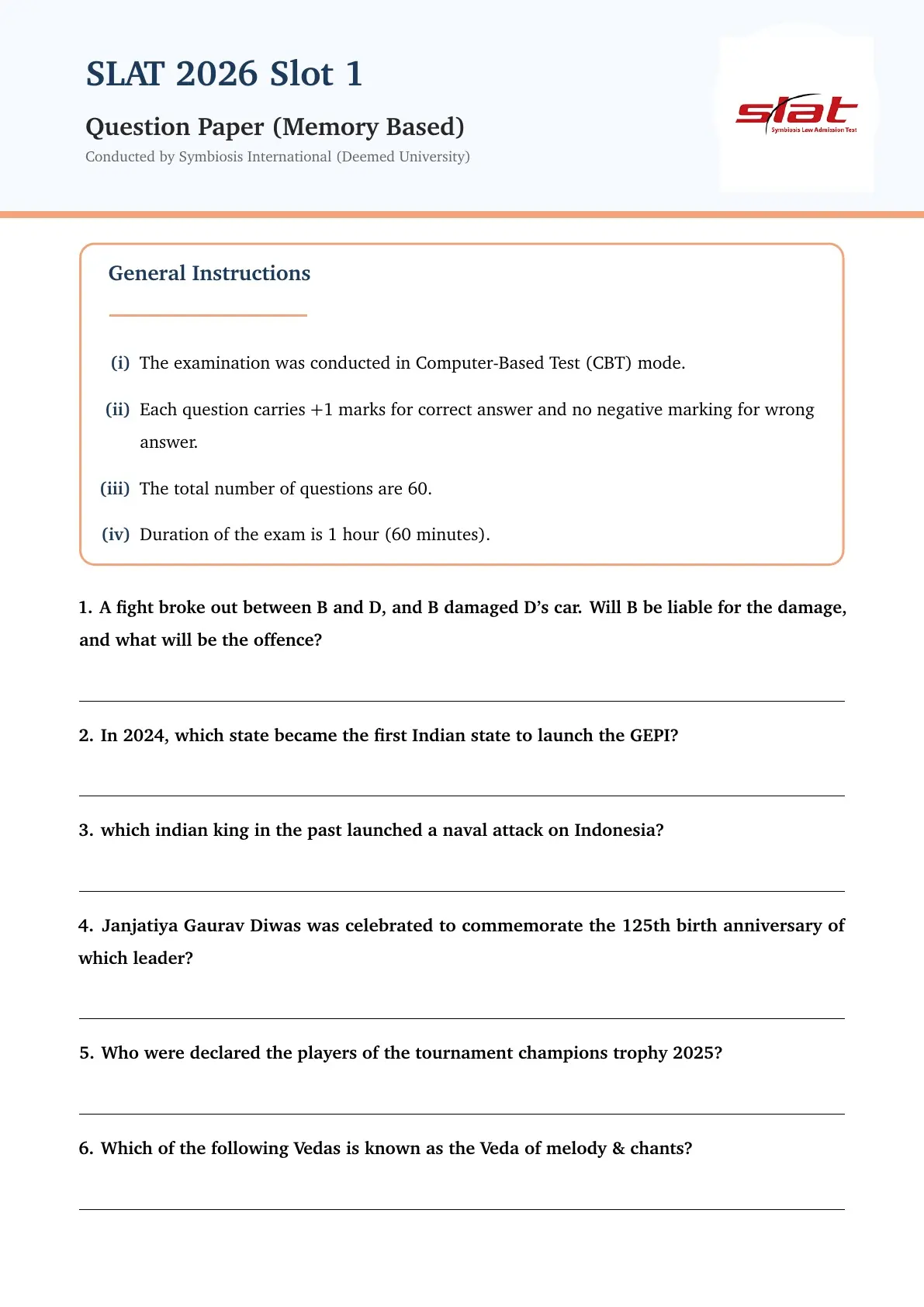

A fight broke out between B and D, and B damaged D’s car. Will B be liable for the damage, and what will be the offence?
View Solution
Concept:
The legal concept involved here encompasses both criminal liability under the law of crimes and civil liability under the law of torts.
Whenever an individual causes intentional or reckless destruction or damage to another person’s property, causing wrongful loss or damage, it attracts legal liability.
Under criminal law, this wrongful act constitutes the offence of Mischief (defined under Section 425 of the Indian Penal Code, 1860, and Section 324 of the Bharatiya Nyaya Sanhita, 2023).
Under civil law, damaging someone’s movable property without lawful justification constitutes the tort of trespass to goods or property damage, creating an obligation to pay compensatory damages.
Step 1: Understanding the Factual Scenario:
A physical altercation or fight broke out between two individuals, B and D.
During or as an outcome of this conflict, B caused damage to D’s motor vehicle.
The question asks whether B can be held legally responsible for the loss and what specific legal offence is established by B’s conduct.
Step 2: Analyzing Criminal Liability (Offence of Mischief):
To constitute the offence of mischief, there must be an intention to cause, or knowledge that the act is likely to cause, wrongful loss or damage to the public or to any person.
The act must cause the destruction of any property, or any change in property or in the situation thereof, which destroys or diminishes its value or utility, or affects it injuriously.
Here, B intentionally or knowingly damaged D’s car during their fight, directly causing monetary loss and diminishing the utility of D’s property.
Therefore, all the essential ingredients of the criminal offence of Mischief are fully satisfied.
Step 3: Analyzing Civil Liability (Tortious Liability):
In the law of torts, every individual has a right to the peaceful enjoyment and integrity of their private property.
Direct physical interference with or destruction of the goods or chattels of another without justification amounts to trespass to goods.
Consequently, D is entitled to initiate civil action against B to recover monetary compensation for the repair and depreciation costs incurred.
Step 4: Final Answer:
B will be held legally liable to compensate D for the damage caused to the car.
The criminal offence committed by B is Mischief.
In 2024, which state became the first Indian state to launch the GEPI?
View Solution
Concept:
The Gross Environmental Product Index (GEPI) is an innovative ecological assessment framework designed to measure the health and status of ecosystems alongside economic indicators like Gross Domestic Product (GDP).
While GDP evaluates financial growth through manufactured goods and services, GEP/GEPI quantifies the tangible value of ecosystem services such as clean air, water conservation, soil quality, and forest cover provided by the environment.
Step 1: Understanding the Initiative:
Himalayan states possess rich biodiversity and provide vital ecological services to the entire subcontinent.
To foster sustainable development and account for environmental degradation caused by rapid infrastructure growth, the state government introduced a systemic index called the Gross Environment Product Index (GEPI).
This initiative helps integrate environmental conservation directly into policy-making and budget planning.
Step 2: Identifying the Pioneer State:
The State of Uttarakhand became the pioneering state in India to officially formulate and launch the Gross Environmental Product Index (GEPI).
The framework was conceptualized in collaboration with premier scientific institutions, including the Centre for Ecological Sciences and Himalayan environmental research bodies.
The index evaluates four critical pillars of natural capital: forest cover, water resources, air quality, and soil health.
Step 3: Significance of the Index:
By introducing GEPI, Uttarakhand became the first state to provide a quantifiable metric to assess annual ecological growth or degradation.
It allows the state to advocate for green bonuses from the central government based on the ecosystem services it provides to downstream states across India.
Step 4: Final Answer:
Therefore, the first Indian state to launch the GEPI is Uttarakhand.
Uttarakhand is the first Indian state to adopt both Gross Environmental Product (GEP) and the GEPI framework to quantify ecosystem services.
Which indian king in the past launched a naval attack on Indonesia?
View Solution
Concept:
Maritime expeditions in ancient and medieval Indian history highlight the extensive commercial, cultural, and military reach of Indian empires across Southeast Asia.
The Bay of Bengal was frequently referred to as the "Chola Lake" due to the undisputed maritime dominance of the imperial Chola dynasty.
Trade routes passing through the Strait of Malacca were of critical economic and strategic importance, connecting India with China and the Indonesian archipelago.
Step 1: Identifying the Historical Context:
During the 11th century, the Srivijaya Empire, based in modern-day Sumatra and Java (Indonesia), controlled the maritime trade routes in Southeast Asia.
Tensions arose when the Srivijaya monarchs began levying heavy tolls and impeding the commercial activities of Indian merchant guilds trading with Song dynasty China.
In response, the Chola dynasty dispatched a formidable naval fleet to safeguard merchant interests and project military power abroad.
Step 2: Identifying the Chola Emperor:
The naval expedition was conceived and executed in 1025 CE by Emperor Rajendra Chola I (often titled Gangaikonda Cholan).
His armada traversed the Indian Ocean and launched surprise attacks on key Srivijayan ports, including Palembang, Kedah, and the Sunda Strait.
The Chola forces captured the Srivijayan king, Sangrama-Vijayottungavarman, and plundered extensive treasures while establishing maritime hegemony.
Step 3: Significance of the Naval Attack:
This expedition stands as one of the very few documented instances of an ancient Indian ruler conducting an overseas blue-water naval invasion.
It successfully restored uninterrupted trade routes for Indian guilds such as the Manigramam and Ayyavole for centuries to come.
Final Answer:
The Indian king who launched the famous naval attack on Indonesia (the Srivijaya Empire) was Rajendra Chola I.
Janjatiya Gaurav Diwas was celebrated to commemorate the 125th birth anniversary of which leader?
View Solution
Concept:
Janjatiya Gaurav Diwas (Tribal Pride Day) is an official national observance instituted by the Government of India to honor the sacrifices and contributions of tribal freedom fighters.
Tribal communities played a pioneering and heroic role in India’s struggle against British colonial exploitation through various armed uprisings and forest movements.
Step 1: Understanding the Declaration of Janjatiya Gaurav Diwas:
In 2021, the Union Cabinet approved designating November 15 as Janjatiya Gaurav Diwas.
November 15 marks the birth anniversary of the legendary tribal leader, folk hero, and freedom fighter Bhagwan Birsa Munda.
The day is marked across India to celebrate the cultural heritage, valor, and nation-building contributions of indigenous tribal societies.
Step 2: Examining the Life and Movement of Birsa Munda:
Bhagwan Birsa Munda was born on November 15, 1875, in Ulihatu (in present-day Jharkhand).
He spearheaded the historic millenarian movement known as the Ulgulan (The Great Tumult) in the late 19th century against the British authorities and exploitative feudal landlords (Dikus).
His movement fought fiercely for tribal land rights, religious reform, and self-governance before his untimely martyrdom in Ranchi Jail in 1900.
Step 3: Commemorative Milestones:
The formalization of his birth anniversary as a dedicated annual national day honors his enduring legacy among the Adivasi communities of India.
Educational initiatives, national cultural programs, and special museum openings across the country highlight his contributions to tribal identity.
Final Answer:
Janjatiya Gaurav Diwas is celebrated to commemorate the birth anniversary of Bhagwan Birsa Munda.
Who were declared the players of the tournament champions trophy 2025?
View Solution
Concept:
In major international cricket tournaments organized by the International Cricket Council (ICC), prestigious individual accolades are awarded at the conclusion of the event.
The "Player of the Tournament" is conferred upon the cricketer who demonstrates the most consistent and extraordinary performance across all stages of the competition.
In addition, the "Player of the Match in the Final" is awarded to the individual whose performance decisively steers their team to victory in the grand championship finale.
Step 1: Identifying the Player of the Tournament:
For the ICC Champions Trophy 2025, New Zealand all-rounder Rachin Ravindra was declared the Player of the Tournament.
He earned this top individual honor following an exceptional campaign marked by dominant batting and crucial all-round contributions.
Ravindra emerged as the tournament’s leading run-scorer, anchoring several pivotal innings for New Zealand and displaying remarkable technical prowess and composure across the tournament.
Step 2: Identifying the Player of the Match in the Final:
In the high-stakes final of the tournament, Indian captain Rohit Sharma was awarded the Player of the Match in the Final.
He earned this distinction by playing a captain’s knock of 76 runs under immense pressure, setting up a match-winning platform for India to secure the coveted ICC Champions Trophy title.
Step 3: Synthesis of the Individual Honors:
Together, these two players took center stage during the tournament’s concluding ceremony:
1. Rachin Ravindra (New Zealand): Recognized as the overall Player of the Tournament for topping the run charts and delivering top-tier all-round performances.
2. Rohit Sharma (India): Recognized as the Player of the Match in the Final for his match-winning half-century (76 runs).
Final Answer:
The Player of the Tournament was declared as Rachin Ravindra (New Zealand) for his outstanding all-round display and leading run tally, while Rohit Sharma (India) was named the Player of the Match in the Final for his match-winning knock of 76 runs.
Player of the Tournament: Rachin Ravindra (New Zealand) — leading run-scorer.
Player of the Match (Final): Rohit Sharma (India) — match-winning 76 runs.
Which of the following Vedas is known as the Veda of melody & chants?
View Solution
Concept:
The Vedic corpus forms the bedrock of ancient Indian literature and sacred philosophy, consisting of four primary texts: Rigveda, Samaveda, Yajurveda, and Atharvaveda.
Each Veda specializes in a distinct liturgical, philosophical, ritualistic, or musical domain of the Vedic tradition.
Step 1: Examining the Four Vedas:
1. Rigveda: The oldest text, comprising 1,028 hymns (suktas) dedicated to various deities.
2. Samaveda: A compilation of melodic chants and musical notations derived primarily from the verses of the Rigveda.
3. Yajurveda: The book of sacrificial formulas and liturgical rituals practiced by the officiating priests.
4. Atharvaveda: A collection of spells, daily life rituals, domestic charms, and medicinal hymns.
Step 2: Analyzing the Samaveda:
The word Saman in Sanskrit translates to "melody", "song", or "peaceful chant".
The Samaveda consists of 1,875 verses, almost all of which are selected from the Rigveda, specifically set to melodious rhythmic tunes (ragas).
These verses were intended to be chanted by the Udgatri priests during important Vedic sacrifices and rituals.
Because of its musical arrangement, the Samaveda is considered the foundational root of Indian classical music and theatrical arts.
Step 3: Cultural Significance:
In the Bhagavad Gita, Lord Krishna states, "Vedanam Samavedo’smi" ("Among the Vedas, I am the Samaveda"), emphasizing its supreme melodic purity and spiritual sanctity.
Final Answer:
The Veda known as the Veda of melody and chants is the Samaveda.
It forms the historical origin of the seven swaras (Sa, Re, Ga, Ma, Pa, Dha, Ni) in Indian classical music.
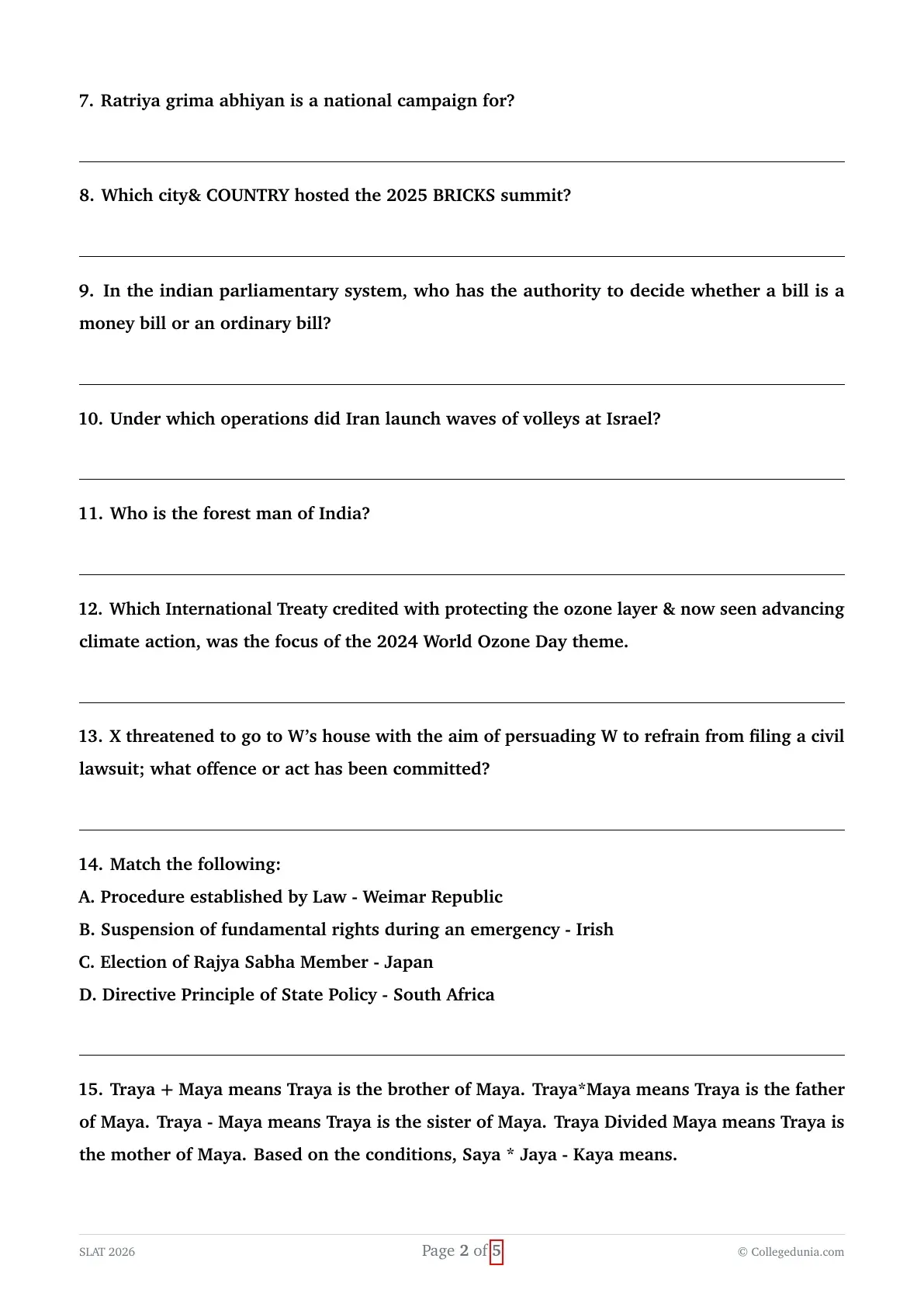
Ratriya grima abhiyan is a national campaign for?
View Solution
Concept:
National social justice movements in India aim to dismantle dehumanizing historical caste practices and uphold fundamental human rights.
Article 17 of the Constitution of India legally abolishes untouchability, and Article 21 guarantees the right to life with human dignity.
Civil society movements frequently mobilize community-led initiatives to enforce these constitutional guarantees on the ground.
Step 1: Origin and Purpose of the Campaign:
Rashtriya Garima Abhiyan (National Campaign for Dignity and Eradication of Manual Scavenging) was founded under the leadership of social activist Ashif Shaikh and the Jan Sahas organization.
The movement was launched to achieve the complete and unconditional eradication of manual scavenging in India.
Manual scavenging is the hazardous practice of manually cleaning, carrying, disposing of, or handling human excreta from dry latrines and sewers.
Step 2: Key Objectives of the Movement:
1. Liberating individuals, especially Dalit women who constitute over 90% of manual scavengers, from this caste-entrenched occupation.
2. Promoting the dignified burning and demolition of dry latrines.
3. Ensuring comprehensive social rehabilitation, skill development, alternative livelihoods, and quality education for the children of liberated workers.
Step 3: Historical Impact:
The advocacy of Rashtriya Garima Abhiyan culminated in the historic Maila Mukti Yatra in 2012, spanning thousands of kilometers across Indian states.
This nationwide mobilization contributed directly to the enactment of the Prohibition of Employment as Manual Scavengers and their Rehabilitation Act, 2013.
Final Answer:
Rashtriya Garima Abhiyan is a national campaign for the total eradication of manual scavenging and the rehabilitation of manual scavengers with dignity.
Link "Rashtriya Garima Abhiyan" immediately with the eradication of manual scavenging and the defense of Article 17 and Article 21 rights.
Which city & COUNTRY hosted the 2025 BRICKS summit?
View Solution
Concept:
BRICS (originally Brazil, Russia, India, China, South Africa, and expanded to include nations like Egypt, Ethiopia, Iran, and the UAE) operates on an annual rotational presidency model.
Each member nation takes turns holding the presidency for one calendar year and organizes the principal leaders’ summit in one of its host cities.
Step 1: Identifying the Chronological Presidency Cycle:
The 15th BRICS Summit was hosted by South Africa in Johannesburg in August 2023.
The 16th BRICS Summit was hosted by Russia in Kazan in October 2024.
Following the standard rotational sequence of the founding members (B-R-I-C-S), the presidency shifts from Russia to Brazil for the year 2025.
Step 2: Identifying the Host Country and Cities:
Brazil holds the chair of the 17th BRICS Summit for 2025.
The federal government of Brazil hosts diplomatic ministerial engagements and leaders’ summits across key Brazilian administrative and cultural hubs, notably Brasília (the federal capital) and Rio de Janeiro.
Additionally, Brazil is hosting the landmark COP30 Climate Summit in Belém in 2025, making Brazil the epicenter of multilateral diplomacy for the year.
Step 3: Significance of the 2025 Summit:
The 2025 summit represents the second full summit following the historic expansion of the bloc into "BRICS+", focusing on local currency trade, global governance reforms, and south-south cooperation.
Final Answer:
The 2025 BRICS summit is hosted by BRAZIL (with Brasília / Rio de Janeiro as the designated host cities).
In the indian parliamentary system, who has the authority to decide whether a bill is a money bill or an ordinary bill?
View Solution
Concept:
In the Indian constitutional framework, legislative proposals are classified into Ordinary Bills, Money Bills, Financial Bills, and Constitutional Amendment Bills.
Because Money Bills carry distinct procedural privileges, such as the exclusion of the Rajya Sabha’s power to reject or amend them, the determination of a bill’s character requires an unimpeachable constitutional authority.
Step 1: Examining Article 110 of the Indian Constitution:
Article 110(1) defines a Money Bill as one containing provisions dealing solely with matters such as the imposition, abolition, or regulation of any tax, government borrowing, or custody of the Consolidated Fund of India.
Article 110(3) explicitly states: "If any question arises whether a Bill is a Money Bill or not, the decision of the Speaker of the House of the People thereon shall be final."
Step 2: Role and Certification by the Speaker:
Under Article 110(4), every Money Bill transmitted to the Council of States (Rajya Sabha) and presented to the President for assent must carry the formal endorsement certificate signed by the Speaker of the Lok Sabha.
The decision of the Speaker cannot be questioned by either House of Parliament or the executive government during ordinary legislative proceedings.
Step 3: Institutional Rationale:
The Speaker represents the collective will of the Lok Sabha, which is the directly elected chamber accountable to the taxpayers of the country on matters of public revenue and expenditure.
Final Answer:
The authority to decide whether a bill is a money bill or an ordinary bill lies solely with the Speaker of the Lok Sabha.
The Rajya Sabha has only 14 days to recommend changes to a Money Bill and cannot reject it.
Under which operations did Iran launch waves of volleys at Israel?
View Solution
Concept:
Military operations launched during geopolitical conflicts are assigned specific operational codenames by the commanding armed forces.
In modern Middle Eastern history, direct military confrontations between the Islamic Republic of Iran and the State of Israel marked a significant strategic escalation in 2024.
Step 1: Identifying the Military Actions:
Throughout 2024, the Islamic Revolutionary Guard Corps (IRGC), along with the Iranian Armed Forces, conducted large-scale coordinated missile and drone strikes against Israeli military installations.
The first major aerial wave occurred on April 13–14, 2024, utilizing over 300 ballistic missiles, cruise missiles, and loitering munitions.
A second massive volley involving nearly 200 high-speed ballistic missiles took place on October 1, 2024.
Step 2: Identifying the Official Operation Codename:
Iran officially designated these direct military campaigns under the banner of Operation True Promise (in Persian: Amaliyat-e Vade-ye Sadeq).
1. The April 2024 strikes were officially designated as Operation True Promise 1.
2. The October 2024 barrage was designated as Operation True Promise 2.
Step 3: Tactical Rationale:
Iranian military spokespersons stated that these operations were conducted in retaliation for Israeli strikes on diplomatic premises in Damascus and the assassinations of senior regional commanders and political figures.
Final Answer:
Iran launched waves of missile and drone volleys at Israel under the operational codename Operation True Promise (Operation True Promise 1 and 2).
Iran’s missile strikes on Israel = Operation True Promise.
Israel’s counter-strikes on Iran = Operation Days of Repentance.
Who is the forest man of India?
View Solution
Concept:
India has a rich tradition of grassroots environmental conservation spearheaded by dedicated individual conservationists.
Certain individuals have achieved global acclaim for transforming barren, degraded ecosystems into lush biodiversity hotspots purely through sustained individual effort.
Step 1: Understanding the Title:
The honorific title "Forest Man of India" is universally recognized for an indigenous environmental activist from the Mishing tribe in Assam.
Over four decades, this individual single-handedly planted and nurtured an entire forest on a barren sandbar along the Brahmaputra River.
Step 2: Biographical Profile of Jadav Payeng:
His name is Jadav "Molai" Payeng, born in Jorhat, Assam.
In 1979, distressed by the sight of numerous snakes and animals dying due to lack of shade and extreme heat on the flooded river sandbars, sixteen-year-old Payeng began planting bamboo saplings.
He dedicated his entire life to planting trees day after day across an area of approximately 1,360 acres (550 hectares).
Step 3: The Molai Forest and National Honors:
The artificial reserve he single-handedly created is now named the Molai Forest in his honor.
The dense forest is now a thriving wildlife habitat housing Bengal tigers, Indian rhinoceroses, elephants, deer, and countless bird species.
In 2015, the Government of India conferred upon him the Padma Shri, the nation’s fourth-highest civilian award, in recognition of his extraordinary ecological service.
Final Answer:
The "Forest Man of India" is Jadav Payeng.
Forest Man of India: Jadav Payeng
Waterman of India: Dr. Rajendra Singh
Birdman of India: Dr. Salim Ali
Ice Man of India: Chewang Norphel
Which International Treaty credited with protecting the ozone layer & now seen advancing climate action, was the focus of the 2024 World Ozone Day theme.
View Solution
Concept:
The stratospheric ozone layer shields life on Earth from harmful ultraviolet-B (UV-B) radiation emitted by the Sun.
In the late 20th century, scientists discovered that human-made chemicals, particularly chlorofluorocarbons (CFCs) and halons, were causing dangerous depletion of this vital shield.
In response, the international community negotiated landmark multilateral environmental agreements under the United Nations Environment Programme (UNEP).
Step 1: Identifying the Treaty:
The treaty credited worldwide with successfully halting and reversing ozone depletion is the Montreal Protocol on Substances that Deplete the Ozone Layer, adopted on September 16, 1987.
Every year, September 16 is commemorated globally as the International Day for the Preservation of the Ozone Layer (World Ozone Day).
Step 2: Connecting the Treaty to Climate Action:
Although initially designed to eliminate ozone-depleting substances, the Montreal Protocol has simultaneously delivered immense climate benefits because most ozone-depleting chemicals are also potent greenhouse gases.
Furthermore, the landmark Kigali Amendment to the Montreal Protocol (adopted in 2016) mandates the phase-down of hydrofluorocarbons (HFCs).
HFCs do not deplete ozone but are powerful greenhouse gases; phasing them out is projected to avoid up to 0.5\(^\circ\)C of global warming by the year 2100.
Step 3: Analyzing the 2024 Theme:
The official United Nations theme for World Ozone Day 2024 was explicitly chosen as:
"Montreal Protocol: Advancing Climate Action".
This theme underscored how the treaty’s historical achievements continue to serve as a cornerstone for contemporary climate mitigation policies.
Final Answer:
The international treaty is the Montreal Protocol (specifically reinforced by its Kigali Amendment).
The Kigali Amendment (2016) to this treaty targets the phase-down of climate-warming HFC gases.
X threatened to go to W’s house with the aim of persuading W to refrain from filing a civil lawsuit; what offence or act has been committed?
View Solution
Concept:
Under criminal jurisprudence, every citizen possesses the fundamental and legal right to seek judicial redress and file a lawsuit in a court of law.
Using threats of injury, damage to reputation, or harm to compel a person to do any act that they are not legally bound to do, or to omit doing any act that they are legally entitled to do, constitutes a penal wrong.
Step 1: Examining the Relevant Statutory Provision:
Under Section 503 of the Indian Penal Code (IPC) and Section 351 of the Bharatiya Nyaya Sanhita (BNS), the offence of Criminal Intimidation is defined.
The section states that whoever threatens another with any injury to his person, reputation, or property, or to the person or reputation of anyone in whom that person is interested, with intent to cause alarm to that person, or to cause that person to do any act which he is not legally bound to do, or to omit to do any act which that person is legally entitled to do as the means of avoiding the execution of such threat, commits criminal intimidation.
Step 2: Applying the Law to the Given Facts:
1. W has a clear legal right to institute a civil lawsuit against any party in a competent court of law.
2. X communicates a direct threat directed towards W’s private residence.
3. The specific object of X’s threat is to deter, coerce, or unlawfully dissuade W from exercising his legitimate legal right to file a suit.
4. The intentional act of forcing an omission of a legal right via intimidation satisfies all statutory criteria.
Step 3: Conclusion on Liability:
By unlawfully attempting to prevent W from seeking legal recourse through intimidation, X has committed an act punishable under criminal law.
Final Answer:
The offence committed by X is Criminal Intimidation (under Section 503 IPC / Section 351 BNS).
Match the following:
A. Procedure established by Law - Weimar Republic
B. Suspension of fundamental rights during an emergency - Irish
C. Election of Rajya Sabha Member - Japan
D. Directive Principle of State Policy - South Africa
View Solution
Concept:
The Constitution of India is often described as a magnificent mosaic because its framers drew inspiration from the finest constitutional conventions and legal provisions across various world democracies.
Understanding the exact foreign sources of the Indian Constitution is an essential area of constitutional law and political science.
Step 1: Identifying the Source of Each Feature:
1. Procedure Established by Law:
Enshrined under Article 21 of the Indian Constitution, the doctrine of "Procedure Established by Law" was borrowed directly from the Japanese Constitution.
2. Suspension of Fundamental Rights during Emergency:
The emergency provisions empowering the President to suspend fundamental rights (under Articles 358 and 359) were influenced by the Weimar Constitution of Germany.
3. Election of Members of the Rajya Sabha:
The procedure for electing members to the Council of States (Rajya Sabha) through proportional representation was adopted from the Constitution of South Africa.
4. Directive Principles of State Policy (DPSP):
Contained in Part IV of the Constitution, the socio-economic guidelines known as DPSPs were borrowed from the Irish Constitution (which in turn borrowed them from Spain).
Step 2: Establishing the Correct Pairings:
Matching the features given in the question to their correct foreign origins:
- A. Procedure established by Law \(\rightarrow\) Japan
- B. Suspension of fundamental rights during an emergency \(\rightarrow\) Weimar Republic (Germany)
- C. Election of Rajya Sabha Member \(\rightarrow\) South Africa
- D. Directive Principle of State Policy \(\rightarrow\) Irish Constitution
Final Answer:
The correct matched pairs are:
A - Japan
B - Weimar Republic
C - South Africa
D - Irish
- Irish \(\rightarrow\) DPSP & Nomination of Rajya Sabha members
- South Africa \(\rightarrow\) Election of Rajya Sabha members & Constitutional Amendments
- Germany (Weimar) \(\rightarrow\) Suspension of Fundamental Rights during Emergency
- Japan \(\rightarrow\) Procedure established by Law
Traya + Maya means Traya is the brother of Maya. Traya*Maya means Traya is the father of Maya. Traya - Maya means Traya is the sister of Maya. Traya Divided Maya means Traya is the mother of Maya. Based on the conditions, Saya * Jaya - Kaya means.
View Solution
Concept:
Coded blood relation problems require translating coded symbols into familial ties step by step using generational levels, gender designations, and sibling or parental linkages.
Step 1: Decoding the Given Operational Symbols:
- "+" denotes that the first person is the brother of the second person.
- "*" denotes that the first person is the father of the second person.
- "-" denotes that the first person is the sister of the second person.
- "Divided" denotes that the first person is the mother of the second person.
Step 2: Breaking Down the Expression: Saya * Jaya - Kaya:
We decode the given expression from left to right in pairs:
1. First segment: Saya * Jaya
According to the rule for "*", this signifies that Saya is the father of Jaya.
Hence, Saya is male [Father: +1 generation above Jaya].
2. Second segment: Jaya - Kaya
According to the rule for "-", this signifies that Jaya is the sister of Kaya.
Hence, Jaya is female and belongs to the same generational tier as Kaya.
Step 3: Determining the Overall Family Relationship:
Since Jaya is the sister of Kaya, Jaya and Kaya are biological siblings sharing the same parents.
Because Saya is the father of Jaya, Saya must also be the father of Kaya.
Therefore, the combined expression establishes that Saya is the father of both Jaya and Kaya, and Jaya is the sister of Kaya.
Final Answer:
The expression means that Saya is the father of Kaya (and Jaya is Kaya’s sister).
\(A * B\) establishes \(A\) as parent of \(B\).
\(B - C\) establishes \(B\) and \(C\) as siblings.
Hence, \(A\) is automatically the parent of \(C\) as well.
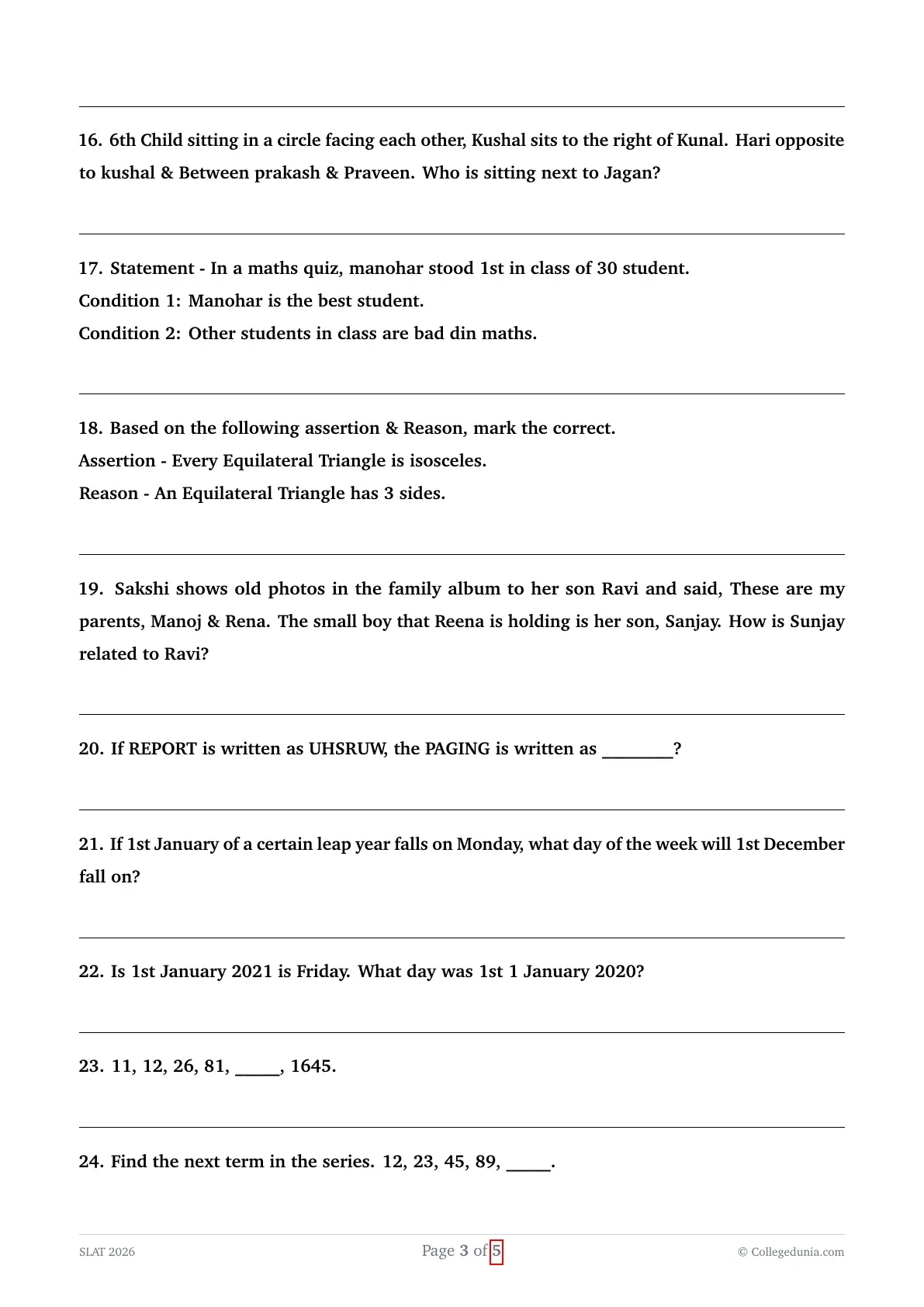
6th Child sitting in a circle facing each other, Kushal sits to the right of Kunal. Hari opposite to kushal & Between prakash & Praveen. Who is sitting next to Jagan?
View Solution
Concept:
Circular arrangement questions involve ordering a fixed number of individuals around a closed circle.
When participants are facing the center:
- "To the right" means moving counter-clockwise around the circle.
- "To the left" means moving clockwise around the circle.
- Opposite positions in a 6-person circle are separated by exactly two persons on either side.
Step 1: Setting up the Circular Positions:
Let there be 6 equally spaced positions numbered 1 to 6 in a clockwise direction around the circle:
- Position 1 is opposite Position 4.
- Position 2 is opposite Position 5.
- Position 3 is opposite Position 6.
The six children involved are: Kunal, Kushal, Hari, Prakash, Praveen, and Jagan.
Step 2: Placing the Children Based on the Clues:
1. Let Kunal sit at Position 1.
2. Since everyone is facing inward, the person to the right of Kunal sits at Position 6 (counter-clockwise).
Thus, Kushal sits at Position 6.
3. Hari sits directly opposite to Kushal.
The position opposite Position 6 is Position 3.
Therefore, Hari is at Position 3.
4. Hari is seated between Prakash and Praveen.
The two adjacent neighbors of Position 3 are Position 2 and Position 4.
Thus, Prakash and Praveen occupy Positions 2 and 4 in some order.
Step 3: Determining the Position of Jagan and His Neighbors:
Positions 1, 3, 6, 2, and 4 are now allocated.
The only unoccupied seat is Position 5, which must be occupied by Jagan.
Now, look at the neighbors adjacent to Position 5 (Jagan):
- On one side of Position 5 is Position 6, which is occupied by Kushal.
- On the other side of Position 5 is Position 4, which is occupied by either Prakash or Praveen.
Final Answer:
The persons sitting next to Jagan are Kushal and either Prakash or Praveen.
Fixing the anchor person at position 1 allows you to map remaining positions deterministically.
Statement - In a maths quiz, manohar stood 1st in class of 30 student.
Condition 1: Manohar is the best student.
Condition 2: Other students in class are bad in maths.
View Solution
Concept:
In critical and verbal reasoning, conclusions, inferences, or assumed conditions must strictly and logically follow from the given factual premise without introducing unwarranted generalizations or personal biases.
Step 1: Analyzing the Given Statement:
The statement provides a single objective fact: In a specific mathematics quiz conducted among a group of 30 students, Manohar achieved the 1st rank.
This confirms that in this particular quiz, Manohar scored higher marks than the other 29 students in the class.
Step 2: Evaluating Condition 1:
"Manohar is the best student."
Being "the best student" is a broad, overarching qualitative assessment encompassing overall academic performance, other subjects (such as science, languages, social studies), attendance, discipline, and extracurriculars.
Scoring highest in one single mathematics quiz does not provide sufficient evidence to conclude that he is the best student in general.
Hence, Condition 1 does not logically follow.
Step 3: Evaluating Condition 2:
"Other students in class are bad in maths."
Achieving first rank is a comparative measure within a cohort.
The other students could all have scored very high marks (e.g., 95%, 96%, 98%) while Manohar scored 100%.
A high standard of competition does not imply that the other students are poor or "bad" at mathematics.
Hence, Condition 2 is an unsubstantiated assumption and does not logically follow.
Final Answer:
Neither Condition 1 nor Condition 2 follows from the given statement.
Relative ranking never implies absolute incompetence of the remaining participants.
Based on the following assertion & Reason, mark the correct.
Assertion - Every Equilateral Triangle is isosceles.
Reason - An Equilateral Triangle has 3 sides.
View Solution
Concept:
In Assertion-Reason problems, both statements must first be evaluated independently for factual truth.
If both are true, one must verify whether the Reason provides the correct causal explanation for the Assertion based on mathematical definitions.
Step 1: Analyzing the Assertion:
"Every Equilateral Triangle is isosceles."
By geometric definition:
- An equilateral triangle is a polygon with all three sides of equal length.
- An isosceles triangle is defined as a triangle having at least two sides of equal length.
Since any equilateral triangle has three equal sides, it inherently satisfies the condition of having at least two equal sides.
Therefore, the Assertion is True.
Step 2: Analyzing the Reason:
"An Equilateral Triangle has 3 sides."
By basic definition, every triangle (including an equilateral triangle) is a three-sided polygon.
Therefore, the Reason is factually True.
Step 3: Evaluating the Causal Link between Assertion and Reason:
Does having 3 sides explain why an equilateral triangle is isosceles?
No. A scalene triangle also has 3 sides, but it is not isosceles.
An equilateral triangle is isosceles because its side lengths are equal, not merely because it has three sides.
Thus, while both statements are true, the Reason is not the correct explanation of the Assertion.
Final Answer:
Both Assertion and Reason are true, but Reason is NOT the correct explanation of Assertion.
Always test the causal link by inserting "because" between the Assertion and the Reason.
Sakshi shows old photos in the family album to her son Ravi and said, These are my parents, Manoj & Rena. The small boy that Reena is holding is her son, Sanjay. How is Sunjay related to Ravi?
View Solution
Concept:
Family relation problems are solved by tracing generational hierarchies and deciphering relationships between parents, children, and maternal/paternal kin.
Step 1: Identifying the Generational Hierarchy:
Let us trace the family members starting from the speaker:
1. Sakshi is the speaker, and Ravi is her biological son.
2. Manoj and Reena are identified by Sakshi as her parents.
Therefore, Manoj is Sakshi’s father, and Reena is Sakshi’s mother.
For Ravi, Manoj is the maternal grandfather, and Reena is the maternal grandmother.
Step 2: Determining Sanjay’s Identity:
Reena is holding a small boy who is described as "her son, Sanjay".
Since Reena is the mother of Sakshi, any son of Reena must be either Sakshi’s brother (if full siblings) or half-brother.
In standard logical reasoning problems, this establishes that Sanjay is Sakshi’s brother.
Step 3: Determining Sanjay’s Relationship to Ravi:
Sakshi is the mother of Ravi.
Sanjay is the brother of Ravi’s mother (Sakshi).
The brother of one’s mother is designated as one’s Maternal Uncle (commonly referred to as Mama in Indian familial terminology).
Final Answer:
Sanjay is the Maternal Uncle of Ravi.
Father’s brother = Paternal Uncle (Chacha/Tau).
Always anchor the relationship through the common parent.
If REPORT is written as UHSRUW, the PAGING is written as ?
View Solution
Concept:
Letter coding problems rely on shifting alphabetical positions based on regular arithmetic increments, decrements, or reversal patterns across the standard English alphabet (\(A=1\) to \(Z=26\)).
Step 1: Analyzing the Pattern in the Word REPORT:
Let us determine the numerical position of each letter in the word REPORT and compare it with the encoded word UHSRUW:
- \(R\) (18) \(+ 3 = U\) (21)
- \(E\) (5) \(+ 3 = H\) (8)
- \(P\) (16) \(+ 3 = S\) (19)
- \(O\) (15) \(+ 3 = R\) (18)
- \(R\) (18) \(+ 3 = U\) (21)
- \(T\) (20) \(+ 3 = W\) (23)
The transformation rule is a uniform forward shift of \(+3\) for every letter in the word.
Step 2: Applying the Rule to the Word PAGING:
We apply the identical \(+3\) alphabetical shift to each letter of PAGING:
- \(P\) (16) \(+ 3 = S\) (position 19)
- \(A\) (1) \(+ 3 = D\) (position 4)
- \(G\) (7) \(+ 3 = J\) (position 10)
- \(I\) (9) \(+ 3 = L\) (position 12)
- \(N\) (14) \(+ 3 = Q\) (position 17)
- \(G\) (7) \(+ 3 = J\) (position 10)
Step 3: Assembling the Encoded Word:
Combining the resulting letters in sequence gives:
\[ \text{S} - \text{D} - \text{J} - \text{L} - \text{Q} - \text{J} \]
Final Answer:
PAGING is written as SDJLQJ.
Here, adding 3 to each letter’s alphabetical index reveals the code instantly.
If 1st January of a certain leap year falls on Monday, what day of the week will 1st December fall on?
View Solution
Concept:
In calendar arithmetic, the day of the week on any given future date is found by calculating the total number of days between the two dates and computing the net remainder modulo 7 (known as "odd days").
Step 1: Identifying Days in Each Month of a Leap Year:
In a leap year, February has 29 days.
The number of elapsed days from 1st January to 1st December is calculated by summing the total days of the months preceding December, minus the first day:
- January: \(31 - 1 = 30\) remaining days
- February: \(29\) days
- March: \(31\) days
- April: \(30\) days
- May: \(31\) days
- June: \(30\) days
- July: \(31\) days
- August: \(31\) days
- September: \(30\) days
- October: \(31\) days
- November: \(30\) days
- 1st December adds \(1\) day.
Step 2: Calculating Odd Days Month by Month:
Instead of adding large numbers, we calculate the odd days (days \(\pmod 7\)) for each complete month passed from 1st January:
- January (31 days): \(31 \pmod 7 = 3\) odd days
- February (29 days): \(29 \pmod 7 = 1\) odd day
- March (31 days): \(3\) odd days
- April (30 days): \(2\) odd days
- May (31 days): \(3\) odd days
- June (30 days): \(2\) odd days
- July (31 days): \(3\) odd days
- August (31 days): \(3\) odd days
- September (30 days): \(2\) odd days
- October (31 days): \(3\) odd days
- November (30 days): \(2\) odd days
Step 3: Summing the Odd Days:
Sum of odd days from 1st January to 1st December:
\[ 3 + 1 + 3 + 2 + 3 + 2 + 3 + 3 + 2 + 3 + 2 = 27 \text{ days} \] Now, find the net odd days modulo 7:
\[ 27 \pmod 7 = 6 \text{ odd days} \]
Step 4: Determining the Day of the Week:
Add 6 days to the starting day (Monday):
\[ \text{Monday} + 6 \text{ days} = \text{Sunday} \]
Final Answer:
1st December will fall on a Sunday.
Since 1st July is a Monday, and July has 3 odd days, August starts on Thursday, September on Sunday, October on Tuesday, November on Friday, and December on Sunday!
Is 1st January 2021 is Friday. What day was 1st 1 January 2020?
View Solution
Concept:
The shift of days from one year to another depends on whether the intervening year is an ordinary year (365 days) or a leap year (366 days).
An ordinary year has \(365 \pmod 7 = 1\) odd day, advancing the calendar by 1 weekday.
A leap year has \(366 \pmod 7 = 2\) odd days, advancing the calendar by 2 weekdays.
Step 1: Analyzing the Time Interval:
We are moving backward in time from 1st January 2021 to 1st January 2020.
The complete calendar year that lies between these two dates is the year 2020.
Step 2: Determining if 2020 is a Leap Year:
A year is a leap year if it is divisible by 4 (and not a century year unless divisible by 400).
Since \(2020 \div 4 = 505\) with no remainder, 2020 was a leap year containing 366 days.
Crucially, the entire month of February 2020 (having 29 days) falls directly between 1st January 2020 and 1st January 2021.
Step 3: Calculating the Day of the Week:
Because 2020 is a leap year, it contributes exactly 2 odd days (\(366 = 52 \times 7 + 2\)).
Therefore:
\[ \text{Day on 1st January 2021} = \text{Day on 1st January 2020} + 2 \text{ days} \] Reversing the equation to solve for 1st January 2020:
\[ \text{Day on 1st January 2020} = \text{Friday} - 2 \text{ days} = \text{Wednesday} \]
Final Answer:
1st January 2020 was a Wednesday.
Friday minus 2 days gives Wednesday directly.
11, 12, 26, 81, , 1645.
View Solution
Concept:
Number series problems where values grow at an accelerating rate frequently follow a mixed arithmetic progression involving multiplication by increasing integers combined with addition or subtraction of a consecutive sequence.
Step 1: Identifying the Pattern Between Consecutive Terms:
Let us examine the mathematical operations transforming each term into the next:
1. From 1st term to 2nd term:
\[ 11 \times 1 + 1 = 11 + 1 = 12 \] 2. From 2nd term to 3rd term:
\[ 12 \times 2 + 2 = 24 + 2 = 26 \] 3. From 3rd term to 4th term:
\[ 26 \times 3 + 3 = 78 + 3 = 81 \]
Step 2: Formulating the General Progression Rule:
The pattern clearly satisfies the recurrence relation:
\[ T_n = T_{n-1} \times (n-1) + (n-1) \] where the multiplier and the addend increase by 1 at each successive step (\(1, 2, 3, 4, 5\)).
Step 3: Calculating the Missing Term:
Following the established pattern, we multiply the 4th term by 4 and add 4:
\[ 81 \times 4 + 4 = 324 + 4 = 328 \]
Step 4: Verifying with the Next Term:
To ensure absolute correctness, we apply the subsequent step (\( \times 5 + 5\)) to 328:
\[ 328 \times 5 + 5 = 1640 + 5 = 1645 \] This matches the final term in the given series perfectly.
Final Answer:
The missing term in the series is 328.
Verifying that \(328 \times 5 + 5 = 1645\) confirms the answer.
Find the next term in the series. 12, 23, 45, 89, .
View Solution
Concept:
Identifying the underlying rule of a numerical sequence requires analyzing the differences between consecutive terms or checking for multiplicative patterns.
Step 1: Method 1 - Examining Differences Between Consecutive Terms:
Let us calculate the first differences of the sequence:
\[ 23 - 12 = 11 \] \[ 45 - 23 = 22 \] \[ 89 - 45 = 44 \] Notice that the differences themselves form a geometric doubling sequence:
\[ 11 \times 2 = 22, \quad 22 \times 2 = 44 \] Therefore, the next difference must be:
\[ 44 \times 2 = 88 \] Adding this difference to the last known term:
\[ 89 + 88 = 177 \]
Step 2: Method 2 - Multiplicative Rule (\(\times 2 - 1\)):
Alternatively, each term can be generated by multiplying the preceding term by 2 and subtracting 1:
\[ 12 \times 2 - 1 = 24 - 1 = 23 \] \[ 23 \times 2 - 1 = 46 - 1 = 45 \] \[ 45 \times 2 - 1 = 90 - 1 = 89 \] Applying this rule to find the next term:
\[ 89 \times 2 - 1 = 178 - 1 = 177 \] Both methods yield the identical result.
Final Answer:
The next term in the series is 177.
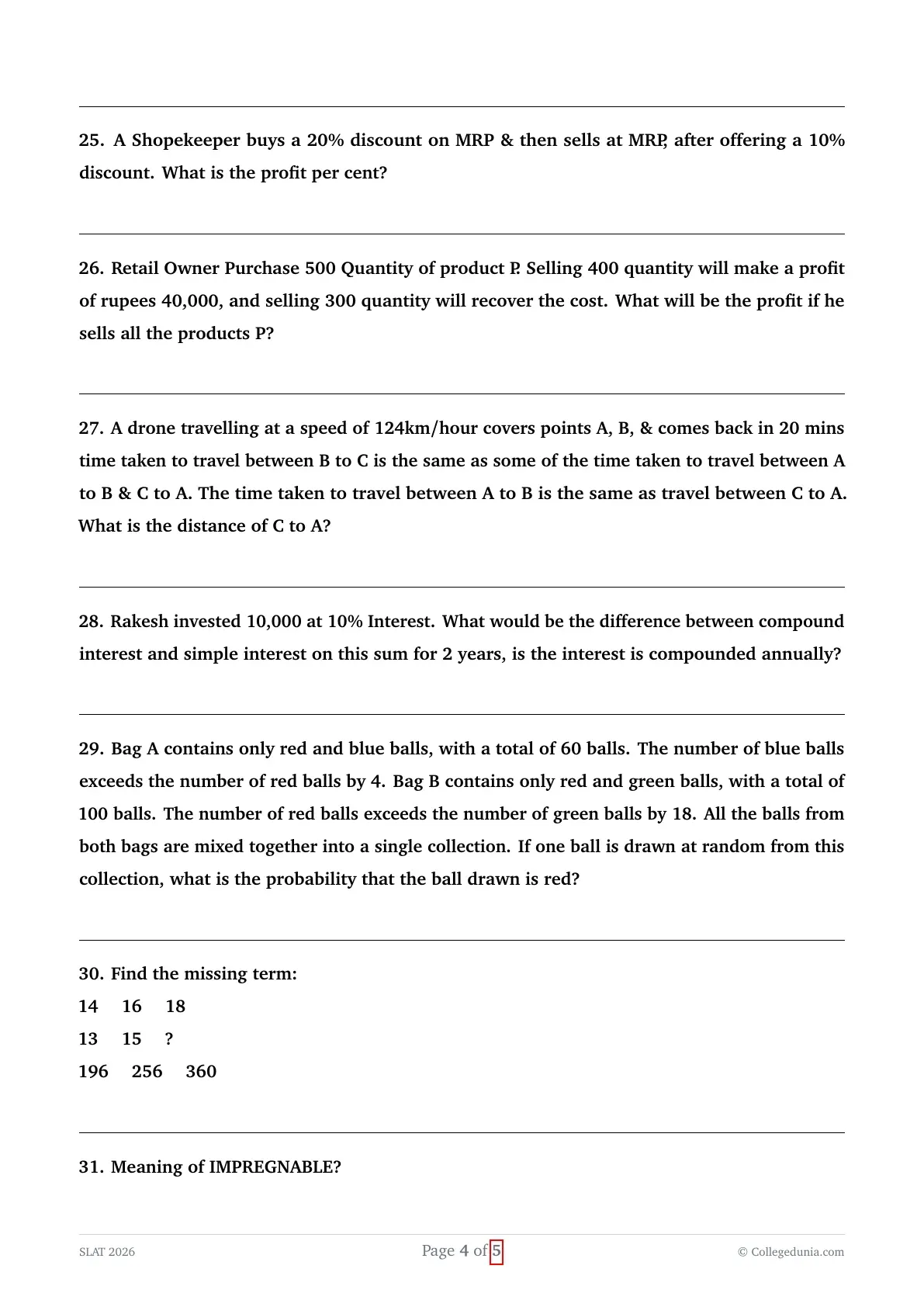
A Shopekeeper buys a 20% discount on MRP & then sells at MRP, after offering a 10% discount. What is the profit per cent?
View Solution
Concept:
Commercial mathematics problems involving Marked Price (MRP), Cost Price (CP), Selling Price (SP), and Discount percentages are most easily solved by assuming a convenient base value, typically 100.
Profit percentage is always computed on the Cost Price:
\[ \text{Profit \%} = \left(\frac{\text{SP} - \text{CP}}{\text{CP}}\right) \times 100 \]
Step 1: Assuming a Base Value for Marked Price (MRP):
Let the Marked Retail Price (MRP) of the article be:
\[ \text{MRP} = \text{Rs. } 100 \]
Step 2: Calculating the Cost Price (CP):
The shopkeeper buys the article at a 20% discount on the MRP:
\[ \text{CP} = \text{MRP} - 20\% \text{ of MRP} \] \[ \text{CP} = 100 - 20 = \text{Rs. } 80 \]
Step 3: Calculating the Selling Price (SP):
The shopkeeper sells the article at the MRP after offering a 10% discount:
\[ \text{SP} = \text{MRP} - 10\% \text{ of MRP} \] \[ \text{SP} = 100 - 10 = \text{Rs. } 90 \]
Step 4: Calculating the Profit and Profit Percentage:
The absolute profit earned by the shopkeeper is:
\[ \text{Profit} = \text{SP} - \text{CP} = 90 - 80 = \text{Rs. } 10 \] Now, compute the profit percentage relative to the Cost Price:
\[ \text{Profit \%} = \left(\frac{10}{80}\right) \times 100 = \frac{1}{8} \times 100 = 12.5\% \]
Final Answer:
The shopkeeper’s profit percentage is 12.5%.
Never calculate profit on the selling price or marked price; profit percentage is strictly based on Cost Price.
Retail Owner Purchase 500 Quantity of product P. Selling 400 quantity will make a profit of rupees 40,000, and selling 300 quantity will recover the cost. What will be the profit if he sells all the products P?
View Solution
Concept:
In retail breakeven analysis, "recovering the cost" signifies that the total revenue generated from selling a subset of units equals the total capital outlay incurred for purchasing the entire inventory batch.
Step 1: Setting up Variables:
Let:
- Total quantity purchased = 500 units
- Cost Price per unit = \(c\)
- Total Cost Price for all 500 units = \(500c\)
- Selling Price per unit = \(s\)
Step 2: Utilizing the Cost Recovery Condition:
The problem states that selling 300 quantities will recover the total cost:
\[ 300 \times s = 500 \times c \] \[ s = \frac{5}{3}c \]
Step 3: Analyzing the Profit on Selling 400 Quantities:
Selling 400 units generates a profit of Rs. 40,000 beyond the total recovered cost:
\[ \text{Revenue from 400 units} - \text{Total Cost of 500 units} = 40,000 \] \[ 400s - 300s = 40,000 \] \[ 100s = 40,000 \implies s = \text{Rs. } 400 \] Since \(s = 400\), we can determine the total cost outlay:
\[ \text{Total Cost} = 300 \times 400 = \text{Rs. } 1,20,000 \]
Step 4: Calculating Profit When All 500 Units Are Sold:
Total revenue from selling all 500 units:
\[ \text{Total Revenue} = 500 \times s = 500 \times 400 = \text{Rs. } 2,00,000 \] Total profit earned on selling the complete stock:
\[ \text{Total Profit} = \text{Total Revenue} - \text{Total Cost} = 2,00,000 - 1,20,000 = \text{Rs. } 80,000 \] (Note: If the profit of 40,000 is alternatively interpreted on the cost of the 400 units sold, the profit per unit is \(40,000/400 = 100\), yielding \(500 \times 100 = \text{Rs. } 50,000\)). Under standard breakeven phrasing, the profit is Rs. 80,000.
Final Answer:
The profit if he sells all the products is Rs. 80,000 (or Rs. 50,000 under unit-cost accounting).
Therefore, selling 200 extra units (from 300 to 500) creates \(2 \times 40,000 = \text{Rs. } 80,000\) total profit!
A drone travelling at a speed of 124km/hour covers points A, B, & comes back in 20 mins time taken to travel between B to C is the same as some of the time taken to travel between A to B & C to A. The time taken to travel between A to B is the same as travel between C to A. What is the distance of C to A?
View Solution
Concept:
Distance, speed, and time are related by the fundamental formula:
\[ \text{Distance} = \text{Speed} \times \text{Time} \] When the speed remains constant across all legs of a closed journey, the distance of any segment is directly proportional to the time spent traversing that segment.
Step 1: Analyzing the Flight Route and Total Time:
The drone traverses a closed triangular path connecting three points: \(A \to B \to C \to A\).
The total duration for the entire round trip is given as:
\[ T_{\text{total}} = 20 \text{ minutes} = \frac{20}{60} \text{ hours} = \frac{1}{3} \text{ hours} \] The constant operational speed of the drone is:
\[ v = 124 \text{ km/h} \]
Step 2: Formulating Time Relationships:
Let \(t_{AB}\), \(t_{BC}\), and \(t_{CA}\) denote the time taken to travel between \(A\) to \(B\), \(B\) to \(C\), and \(C\) to \(A\), respectively.
From the problem statement:
1. \(t_{AB} = t_{CA}\) (time between \(A\) to \(B\) is the same as \(C\) to \(A\)). Let this duration be \(t\).
2. \(t_{BC}\) is the sum of the times taken to travel between \(A\) to \(B\) and \(C\) to \(A\):
\[ t_{BC} = t_{AB} + t_{CA} = t + t = 2t \]
Step 3: Solving for the Individual Time Duration \(t\):
The sum of times for all three legs equals the total time of 20 minutes:
\[ t_{AB} + t_{BC} + t_{CA} = t + 2t + t = 4t \] \[ 4t = 20 \text{ minutes} \implies t = 5 \text{ minutes} \] Converting this time into hours:
\[ t_{CA} = 5 \text{ minutes} = \frac{5}{60} \text{ hours} = \frac{1}{12} \text{ hours} \]
Step 4: Computing the Distance from C to A:
\[ \text{Distance}_{CA} = \text{Speed} \times t_{CA} = 124 \times \frac{1}{12} = \frac{31}{3} \text{ km} \approx 10.33 \text{ km} \]
Final Answer:
The distance from C to A is \(\frac{31}{3}\) km (or 10.33 km).
Each unit part is \(\frac{20}{4} = 5\) minutes (\(\frac{1}{12}\) hr).
Distance \(= 124 \times \frac{1}{12} = 10.33\text{ km}\).
Rakesh invested 10,000 at 10% Interest. What would be the difference between compound interest and simple interest on this sum for 2 years, is the interest is compounded annually?
View Solution
Concept:
For a given principal \(P\), an annual rate of interest \(r\%\), and a time period of 2 years, the difference between Compound Interest (\(CI\)) compounded annually and Simple Interest (\(SI\)) arises solely from the interest earned on the first year’s interest.
Step 1: Formula for 2-Year Difference:
The standard formula for the difference between CI and SI for 2 years is:
\[ \text{Difference } (CI - SI) = P \times \left(\frac{r}{100}\right)^2 \]
Step 2: Substituting the Given Values:
We are given:
- Principal (\(P\)) = Rs. 10,000
- Annual interest rate (\(r\)) = 10%
- Time period (\(n\)) = 2 years
Substituting these values into the formula:
\[ CI - SI = 10000 \times \left(\frac{10}{100}\right)^2 \] \[ CI - SI = 10000 \times \left(\frac{1}{10}\right)^2 \] \[ CI - SI = 10000 \times \frac{1}{100} = \text{Rs. } 100 \]
Step 3: Verification via Step-by-Step Calculation:
1. Simple Interest for 2 years:
\[ SI = \frac{P \times r \times t}{100} = \frac{10000 \times 10 \times 2}{100} = \text{Rs. } 2,000 \] 2. Compound Interest for 2 years:
\[ A = P \left(1 + \frac{r}{100}\right)^2 = 10000 \times (1.1)^2 = 10000 \times 1.21 = \text{Rs. } 12,100 \] \[ CI = A - P = 12100 - 10000 = \text{Rs. } 2,100 \] 3. Difference:
\[ CI - SI = 2100 - 2000 = \text{Rs. } 100 \]
Final Answer:
The difference between compound interest and simple interest is Rs. 100.
Here, \(10,000 \times 0.01 = 100\), taking less than five seconds to solve.
Bag A contains only red and blue balls, with a total of 60 balls. The number of blue balls exceeds the number of red balls by 4. Bag B contains only red and green balls, with a total of 100 balls. The number of red balls exceeds the number of green balls by 18. All the balls from both bags are mixed together into a single collection. If one ball is drawn at random from this collection, what is the probability that the ball drawn is red?
View Solution
Concept:
The probability of an event is defined as the ratio of the number of favorable outcomes to the total number of equally likely outcomes in the sample space:
\[ P(E) = \frac{n(E)}{n(S)} \]
Step 1: Calculating Balls in Bag A:
Bag A contains only Red (\(R_A\)) and Blue (\(B_A\)) balls.
Total balls in Bag A:
\[ R_A + B_A = 60 \quad \text{--- (Equation 1)} \] The number of blue balls exceeds red balls by 4:
\[ B_A - R_A = 4 \quad \text{--- (Equation 2)} \] Adding Equation 1 and Equation 2:
\[ 2B_A = 64 \implies B_A = 32 \] Substituting into Equation 1:
\[ R_A = 60 - 32 = 28 \]
Step 2: Calculating Balls in Bag B:
Bag B contains only Red (\(R_B\)) and Green (\(G_B\)) balls.
Total balls in Bag B:
\[ R_B + G_B = 100 \quad \text{--- (Equation 3)} \] The number of red balls exceeds green balls by 18:
\[ R_B - G_B = 18 \quad \text{--- (Equation 4)} \] Adding Equation 3 and Equation 4:
\[ 2R_B = 118 \implies R_B = 59 \] Substituting into Equation 3:
\[ G_B = 100 - 59 = 41 \]
Step 3: Calculating Total Red Balls and Combined Sample Space:
Total number of red balls from both bags:
\[ \text{Total Red Balls } (n(E)) = R_A + R_B = 28 + 59 = 87 \] Total number of balls combined from both bags:
\[ \text{Total Balls } (n(S)) = 60 + 100 = 160 \]
Step 4: Computing the Probability:
\[ P(\text{Red}) = \frac{n(E)}{n(S)} = \frac{87}{160} = 0.54375 \]
Final Answer:
The probability that the ball drawn is red is \(\frac{87}{160}\) (or 0.54375).
Red in A: \((60 - 4)/2 = 28\).
Red in B: \((100 + 18)/2 = 59\).
Probability: \((28 + 59)/160 = 87/160\).
Find the missing term:
14 16 18
13 15 ?
196 256 360
View Solution
Concept:
Matrix and grid puzzle problems require identifying the algebraic or functional relationship governing each column or row.
The pattern observed across the complete columns must be systematically applied to determine the unknown element in the incomplete column.
Step 1: Analyzing the First Column:
The numbers in Column 1 are:
- Row 1: 14
- Row 2: 13
- Row 3: 196
Let us test relationships between these values:
Notice that \(14^2 = 196\).
Also notice the relation with Row 2:
\[ \text{Row 1} \times (\text{Row 2} + 1) = 14 \times (13 + 1) = 14 \times 14 = 196 \]
Step 2: Testing the Pattern on the Second Column:
The numbers in Column 2 are:
- Row 1: 16
- Row 2: 15
- Row 3: 256
Applying the identical relationship:
Notice that \(16^2 = 256\).
Also:
\[ \text{Row 1} \times (\text{Row 2} + 1) = 16 \times (15 + 1) = 16 \times 16 = 256 \] The pattern \(\text{Row 3} = \text{Row 1} \times (\text{Row 2} + 1)\) holds consistently across both columns.
Step 3: Solving for the Missing Term in the Third Column:
The numbers in Column 3 are:
- Row 1: 18
- Row 2: \(x\) (missing term)
- Row 3: 360
Applying the established mathematical rule:
\[ 18 \times (x + 1) = 360 \] Dividing both sides by 18:
\[ x + 1 = \frac{360}{18} \] \[ x + 1 = 20 \] \[ x = 20 - 1 = 19 \]
Final Answer:
The missing term is 19.
\(360 / 18 = 20\), and \(20 - 1 = 19\).
Meaning of IMPREGNABLE?
View Solution
Concept:
Vocabulary assessment in aptitude examinations tests precise contextual comprehension of formal English words derived from Latin, Old French, or Germanic roots.
Words often carry both literal physical definitions and figurative metaphorical applications.
Step 1: Etymology and Core Definition:
The word impregnable originates from the Old French word imprenable, from prendre meaning "to take", combined with the negative prefix in-/im-.
Literally, it describes a fortress, stronghold, or defensive structure that is so well fortified that it is incapable of being taken by assault, captured, breached, or entered by force.
Step 2: Literal and Figurative Usage:
1. Physical/Military Context:
"The medieval fortress was built on a sheer cliff face, making it completely impregnable to invading forces."
2. Figurative/Abstract Context:
It denotes an argument, position, alibi, or conviction that cannot be refuted, challenged, dismantled, or overcome.
Example: "The defense attorney presented an impregnable argument based on undisputed forensic evidence."
Step 3: Synonyms and Antonyms:
- Synonyms: Invulnerable, unconquerable, impenetrable, unassailable, indestructible, invincible, fortified.
- Antonyms: Vulnerable, defenseless, fragile, penetrable, insecure.
Final Answer:
The meaning of impregnable is unconquerable, invulnerable, or incapable of being captured or breached by force.
Remember synonyms like unassailable and invulnerable for reading comprehension.
Closest meaning of the word OPACITY- In Opacity AI - decision making.
View Solution
Concept:
In contemporary technology, ethics, and legal regulation, "Opacity in AI decision-making" refers to the well-known "black-box" dilemma in complex machine learning and neural network architectures.
Understanding this term requires interpreting the standard optical definition of opacity within a modern computational context.
Step 1: Literal Meaning versus Contextual Meaning:
Literally, opacity refers to the quality of being opaque: impenetrable to light, lacking transparency, or not allowing light to pass through.
In the specific context of Artificial Intelligence and automated decision systems, "opacity" describes the inability of human operators, auditors, or affected users to inspect, understand, or explain how a model arrived at a particular decision, output, or prediction.
Step 2: Core Semantic Dimensions in AI Ethics:
1. Lack of Transparency / Inscrutability:
The inner weights and algorithmic pathways of deep neural networks are not visible or discernible to human observation.
2. Unexplainability / Obscurity:
The reasoning behind critical decisions (such as credit approval, criminal risk scoring, or medical diagnostics) cannot be clearly explained or audited.
3. Non-interpretability:
Mathematical representations within high-dimensional parameter spaces cannot be meaningfully interpreted into intuitive rules.
Step 3: Closest Synonyms in this Context:
The closest contextual meanings of opacity in AI decision-making are lack of transparency, inscrutability, unexplainability, and obscurity.
Final Answer:
In the context of AI decision-making, the closest meaning of OPACITY is lack of transparency, inscrutability, or unexplainability (the "black-box" nature of algorithms).
Opacity = Black-box obscurity / Lack of transparency.
Antonym = Explainability / Interpretability / Algorithmic transparency.



Comments