




The Odisha CPET 2025 Statistics question paper is now available with detailed solutions for free download. The Common PG Entrance Test (CPET) 2025 was conducted by the State Selection Board (SSB), Higher Education Department, Government of Odisha, and the Statistics paper carried 100 questions in 80 minutes.
| Odisha CPET 2025 Statistics Question Paper with Solutions | Download PDF | Check Solutions |
Odisha CPET 2025 Statistics Questions with Solutions
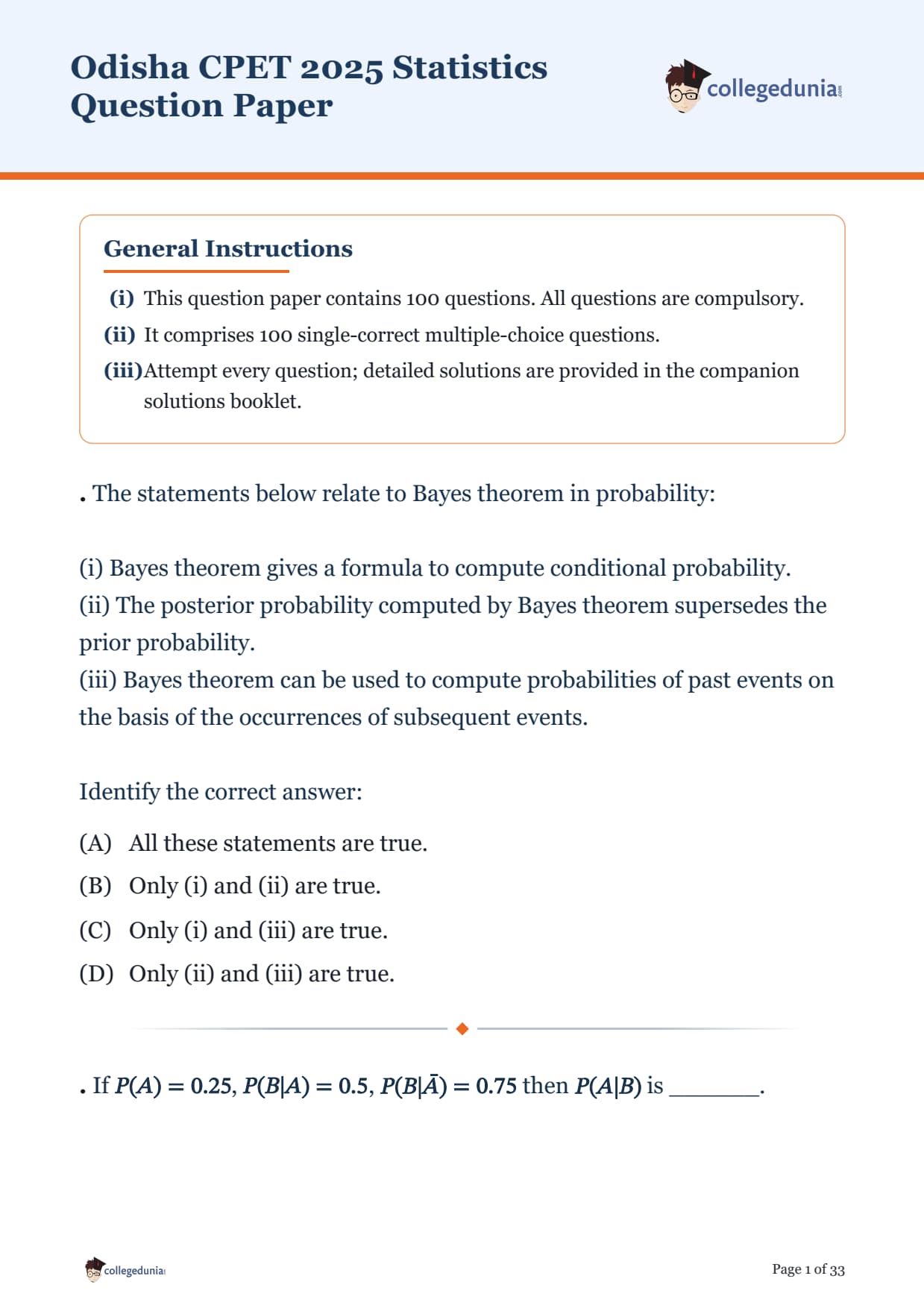
The statements below relate to Bayes theorem in probability:
(i) Bayes theorem gives a formula to compute conditional probability.
(ii) The posterior probability computed by Bayes theorem supersedes the prior probability.
(iii) Bayes theorem can be used to compute probabilities of past events on the basis of the occurrences of subsequent events.
Identify the correct answer:
If \(P(A) = 0.25\), \(P(B|A) = 0.5\), \(P(B|\bar{A}) = 0.75\) then \(P(A|B)\) is ______.
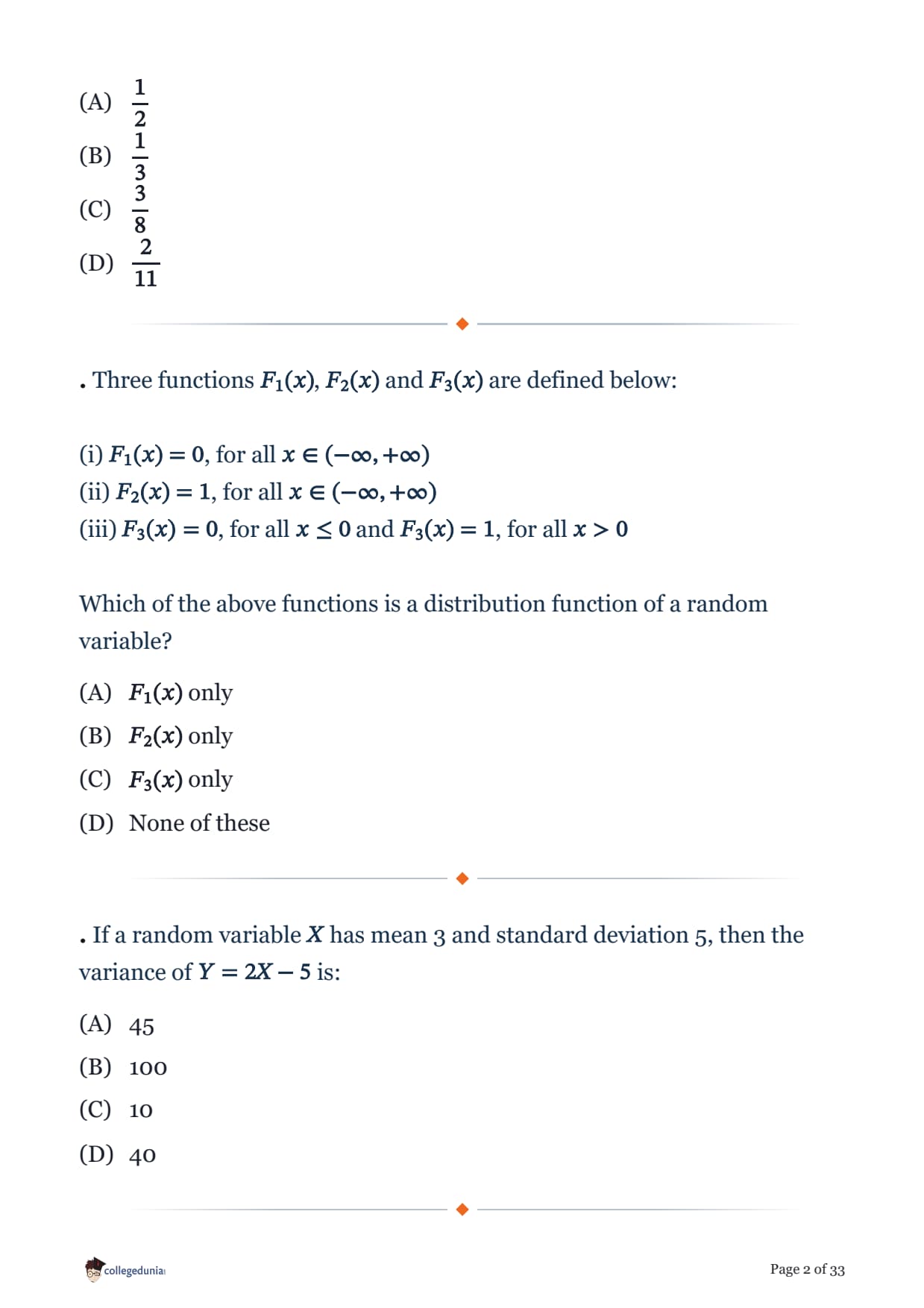
Three functions \(F_1(x)\), \(F_2(x)\) and \(F_3(x)\) are defined below:
(i) \(F_1(x) = 0\), for all \(x \in (-\infty, +\infty)\)
(ii) \(F_2(x) = 1\), for all \(x \in (-\infty, +\infty)\)
(iii) \(F_3(x) = 0\), for all \(x \le 0\) and \(F_3(x) = 1\), for all \(x > 0\)
Which of the above functions is a distribution function of a random variable?
If a random variable \(X\) has mean 3 and standard deviation 5, then the variance of \(Y = 2X - 5\) is:
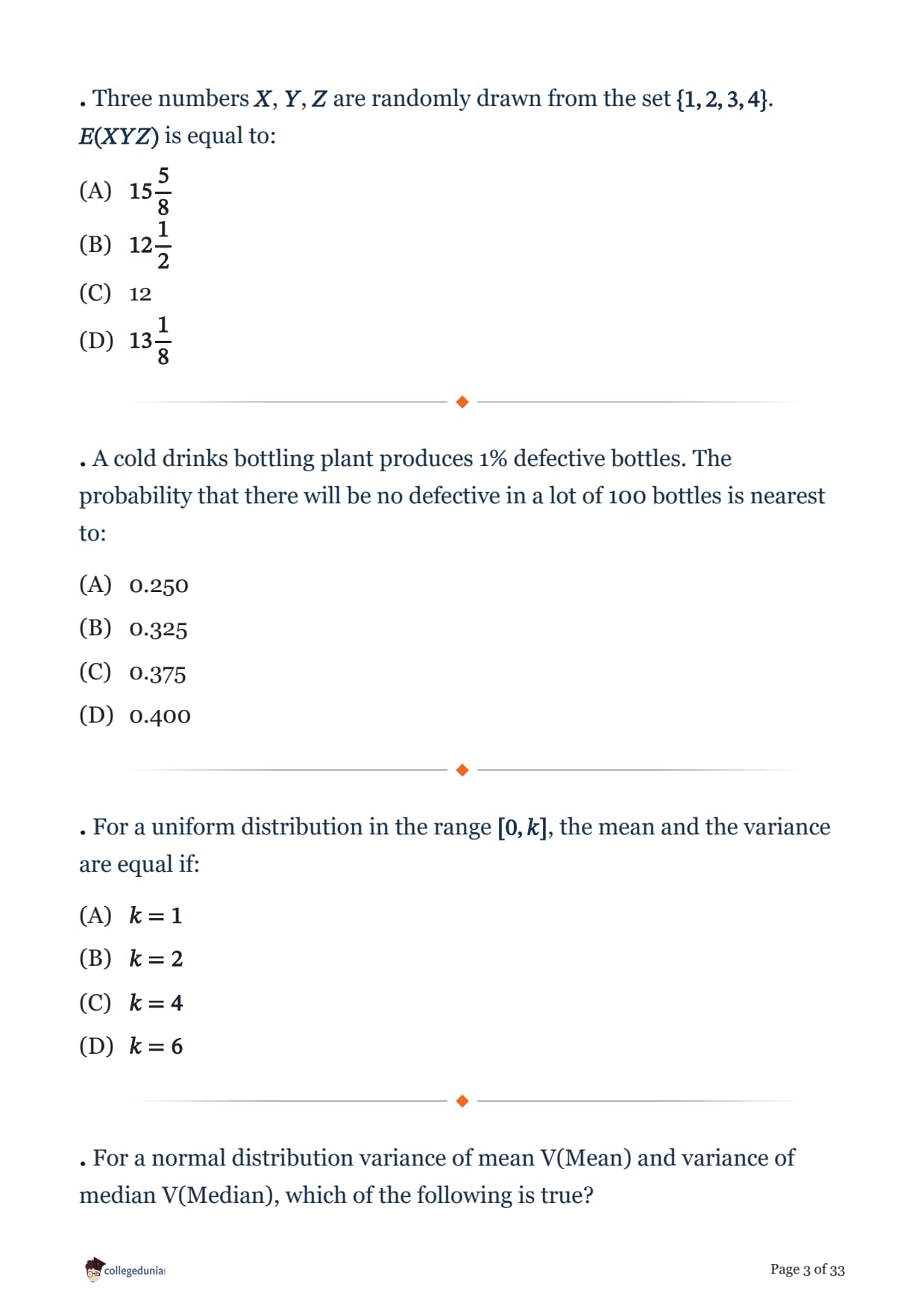
Three numbers \(X\), \(Y\), \(Z\) are randomly drawn from the set \(\{1, 2, 3, 4\}\). \(E(XYZ)\) is equal to:
A cold drinks bottling plant produces 1% defective bottles. The probability that there will be no defective in a lot of 100 bottles is nearest to:
For a uniform distribution in the range \([0, k]\), the mean and the variance are equal if:
For a normal distribution variance of mean V(Mean) and variance of median V(Median), which of the following is true?
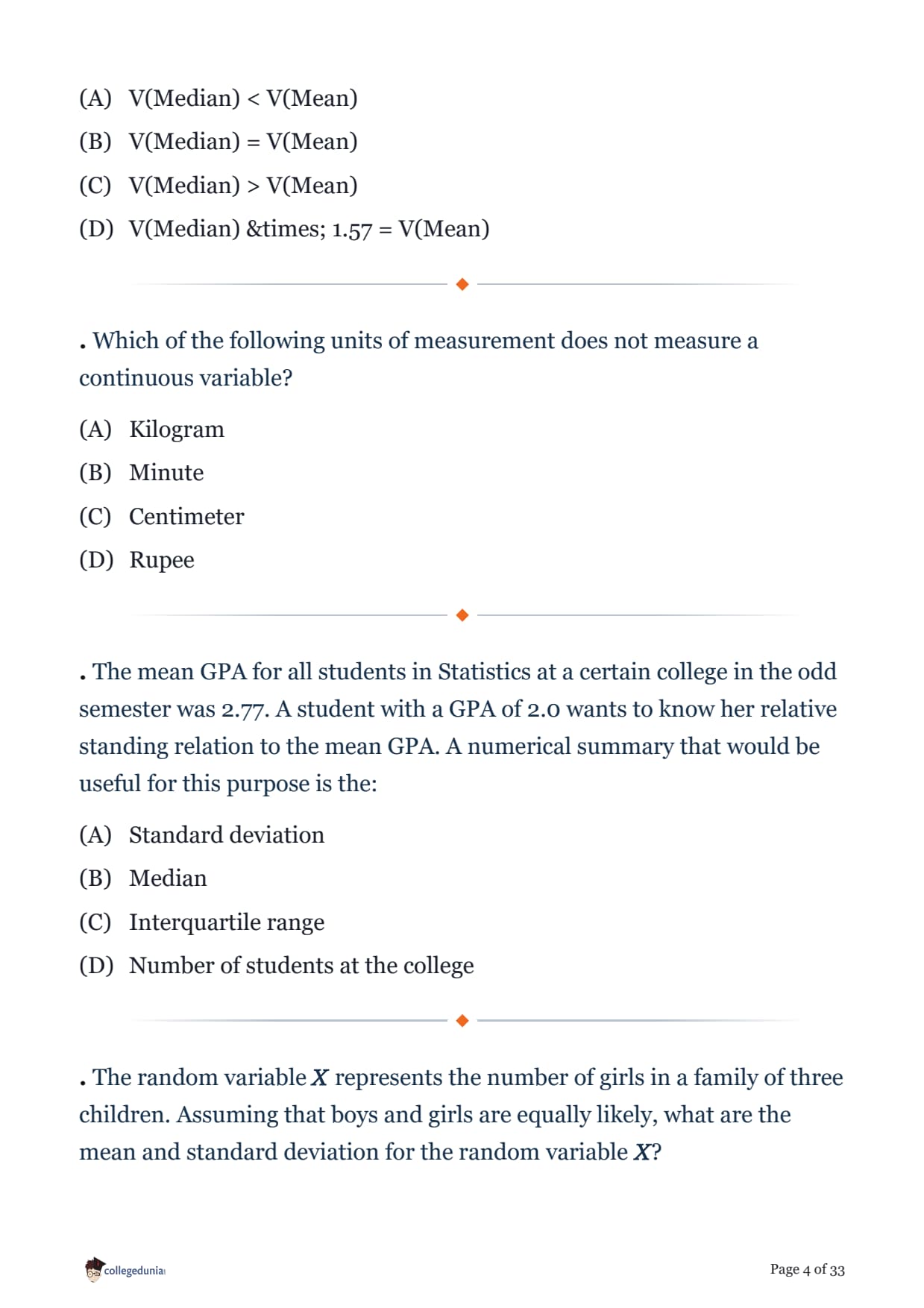
Which of the following units of measurement does not measure a continuous variable?
The mean GPA for all students in Statistics at a certain college in the odd semester was 2.77. A student with a GPA of 2.0 wants to know her relative standing relation to the mean GPA. A numerical summary that would be useful for this purpose is the:
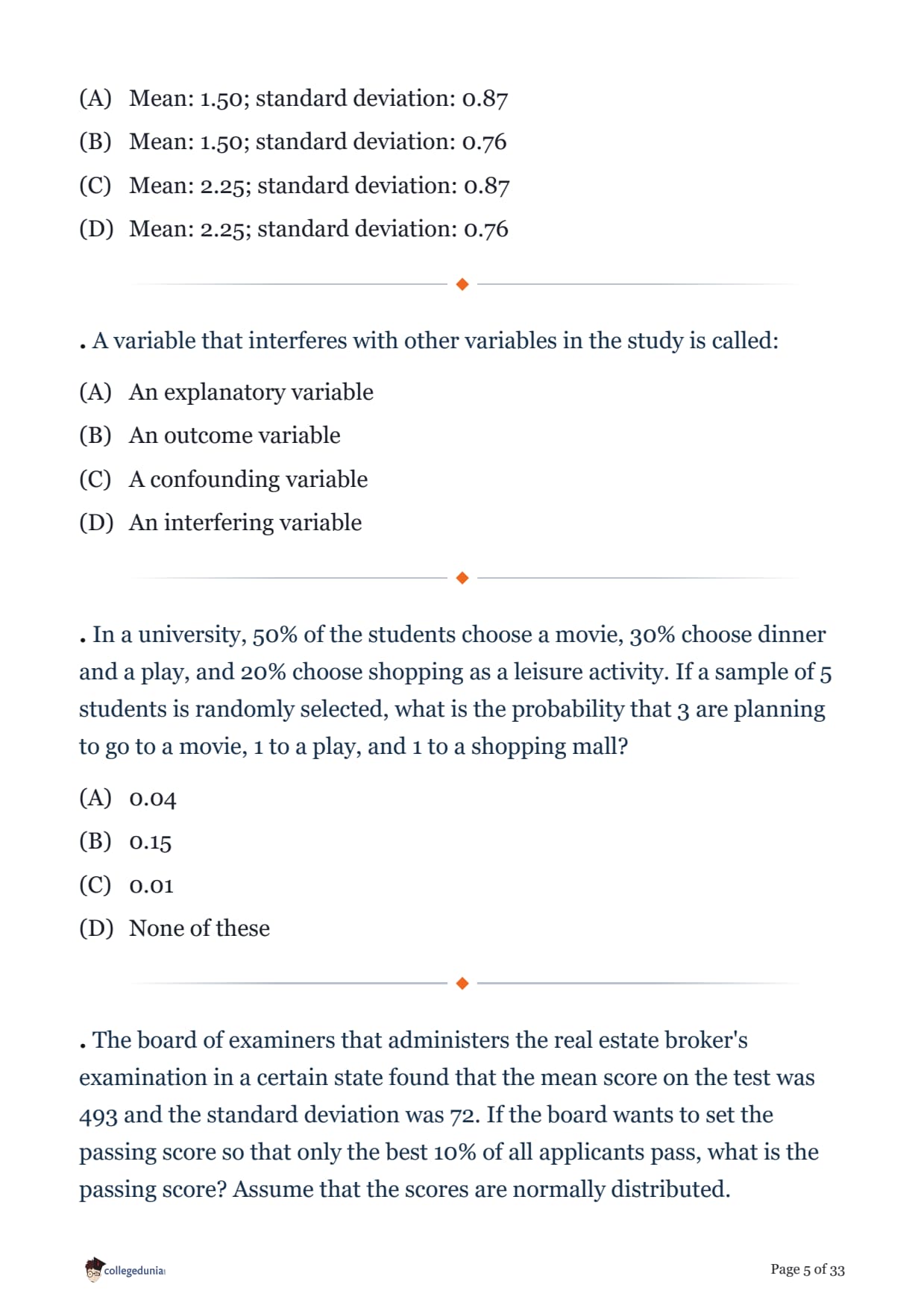
The random variable \(X\) represents the number of girls in a family of three children. Assuming that boys and girls are equally likely, what are the mean and standard deviation for the random variable \(X\)?
A variable that interferes with other variables in the study is called:
In a university, 50% of the students choose a movie, 30% choose dinner and a play, and 20% choose shopping as a leisure activity. If a sample of 5 students is randomly selected, what is the probability that 3 are planning to go to a movie, 1 to a play, and 1 to a shopping mall?
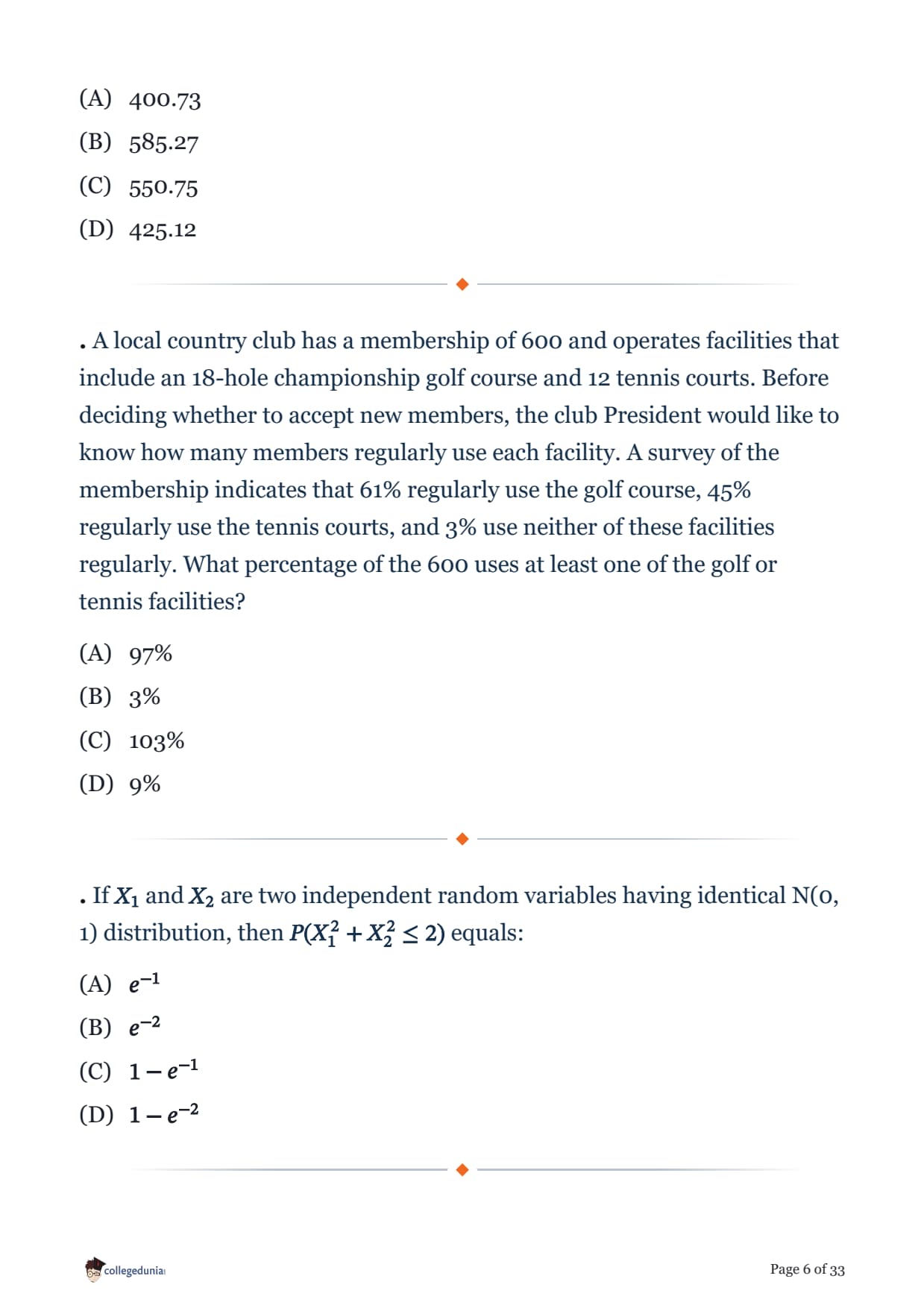
The board of examiners that administers the real estate broker's examination in a certain state found that the mean score on the test was 493 and the standard deviation was 72. If the board wants to set the passing score so that only the best 10% of all applicants pass, what is the passing score? Assume that the scores are normally distributed.
A local country club has a membership of 600 and operates facilities that include an 18-hole championship golf course and 12 tennis courts. Before deciding whether to accept new members, the club President would like to know how many members regularly use each facility. A survey of the membership indicates that 61% regularly use the golf course, 45% regularly use the tennis courts, and 3% use neither of these facilities regularly. What percentage of the 600 uses at least one of the golf or tennis facilities?
If \(X_1\) and \(X_2\) are two independent random variables having identical N(0, 1) distribution, then \(P(X_1^2 + X_2^2 \le 2)\) equals:
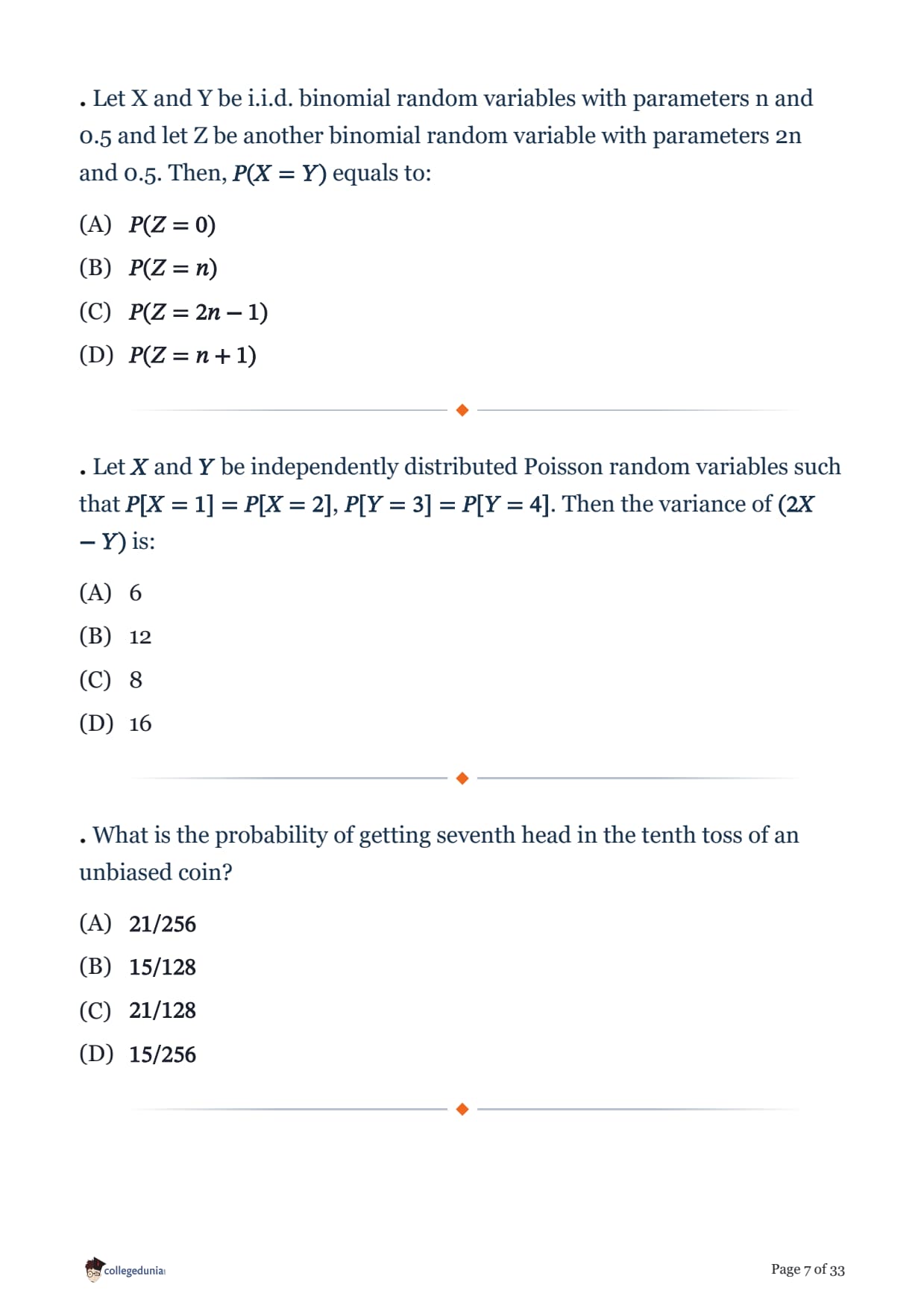
Let X and Y be i.i.d. binomial random variables with parameters n and 0.5 and let Z be another binomial random variable with parameters 2n and 0.5. Then, \(P(X = Y)\) equals to:
Let \(X\) and \(Y\) be independently distributed Poisson random variables such that \(P[X=1]=P[X=2]\), \(P[Y=3]=P[Y=4]\). Then the variance of \((2X-Y)\) is:
What is the probability of getting seventh head in the tenth toss of an unbiased coin?
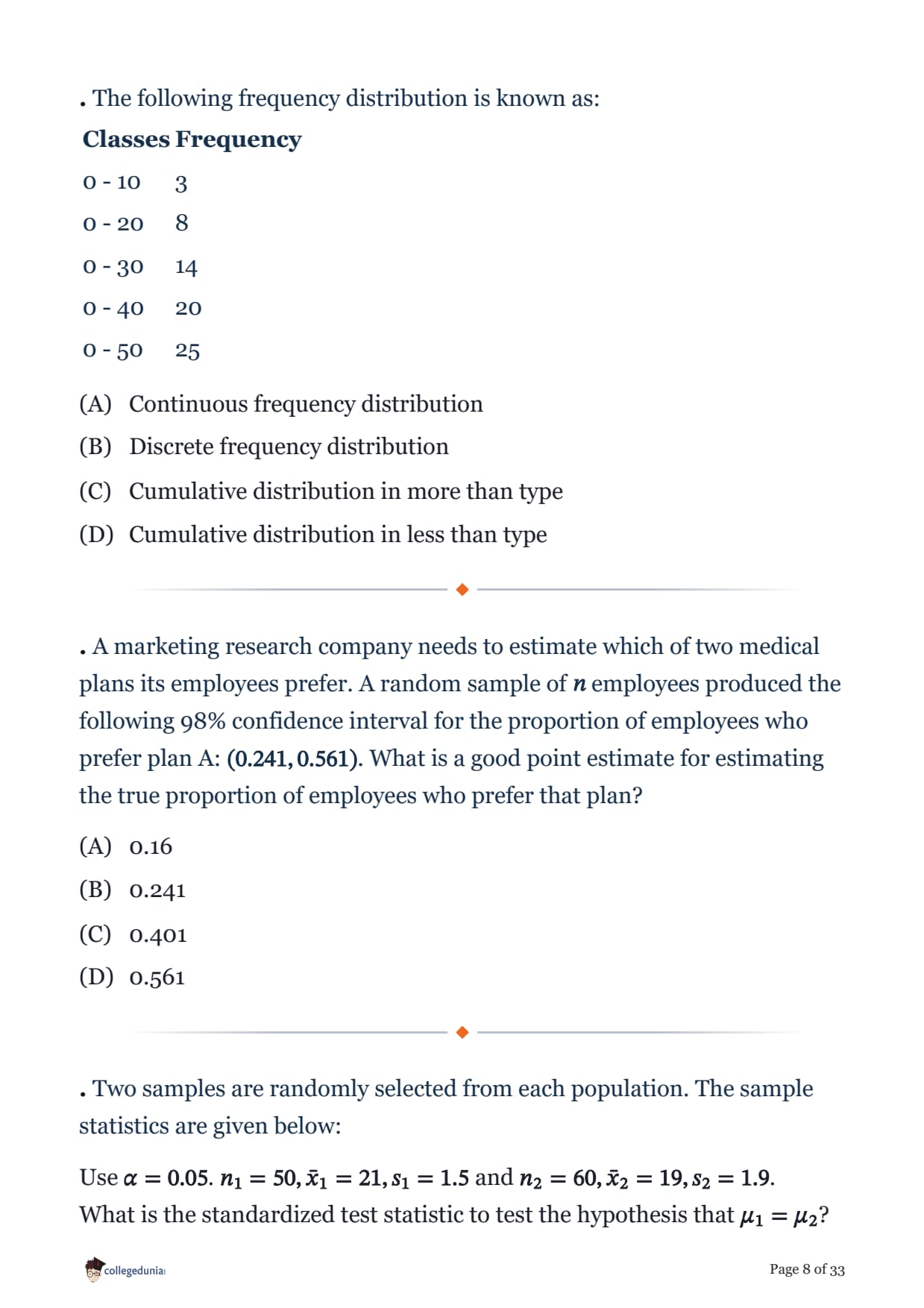
The following frequency distribution is known as:
| Classes | Frequency |
|---|---|
| 0 - 10 | 3 |
| 0 - 20 | 8 |
| 0 - 30 | 14 |
| 0 - 40 | 20 |
| 0 - 50 | 25 |
A marketing research company needs to estimate which of two medical plans its employees prefer. A random sample of \(n\) employees produced the following 98% confidence interval for the proportion of employees who prefer plan A: \((0.241, 0.561)\). What is a good point estimate for estimating the true proportion of employees who prefer that plan?
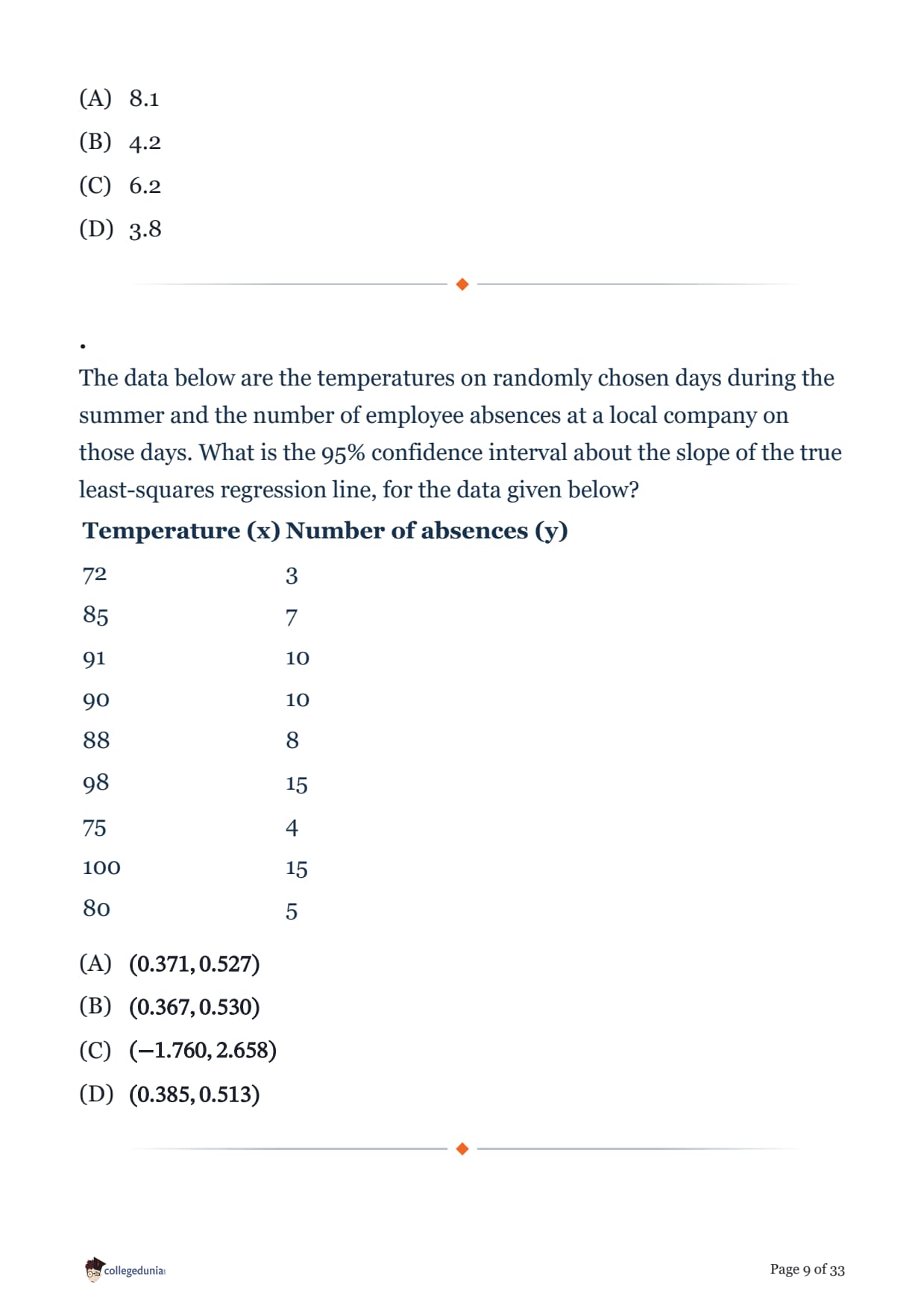
Two samples are randomly selected from each population. The sample statistics are given below:
| Temperature (x) | Number of absences (y) |
|---|---|
| 72 | 3 |
| 85 | 7 |
| 91 | 10 |
| 90 | 10 |
| 88 | 8 |
| 98 | 15 |
| 75 | 4 |
| 100 | 15 |
| 80 | 5 |
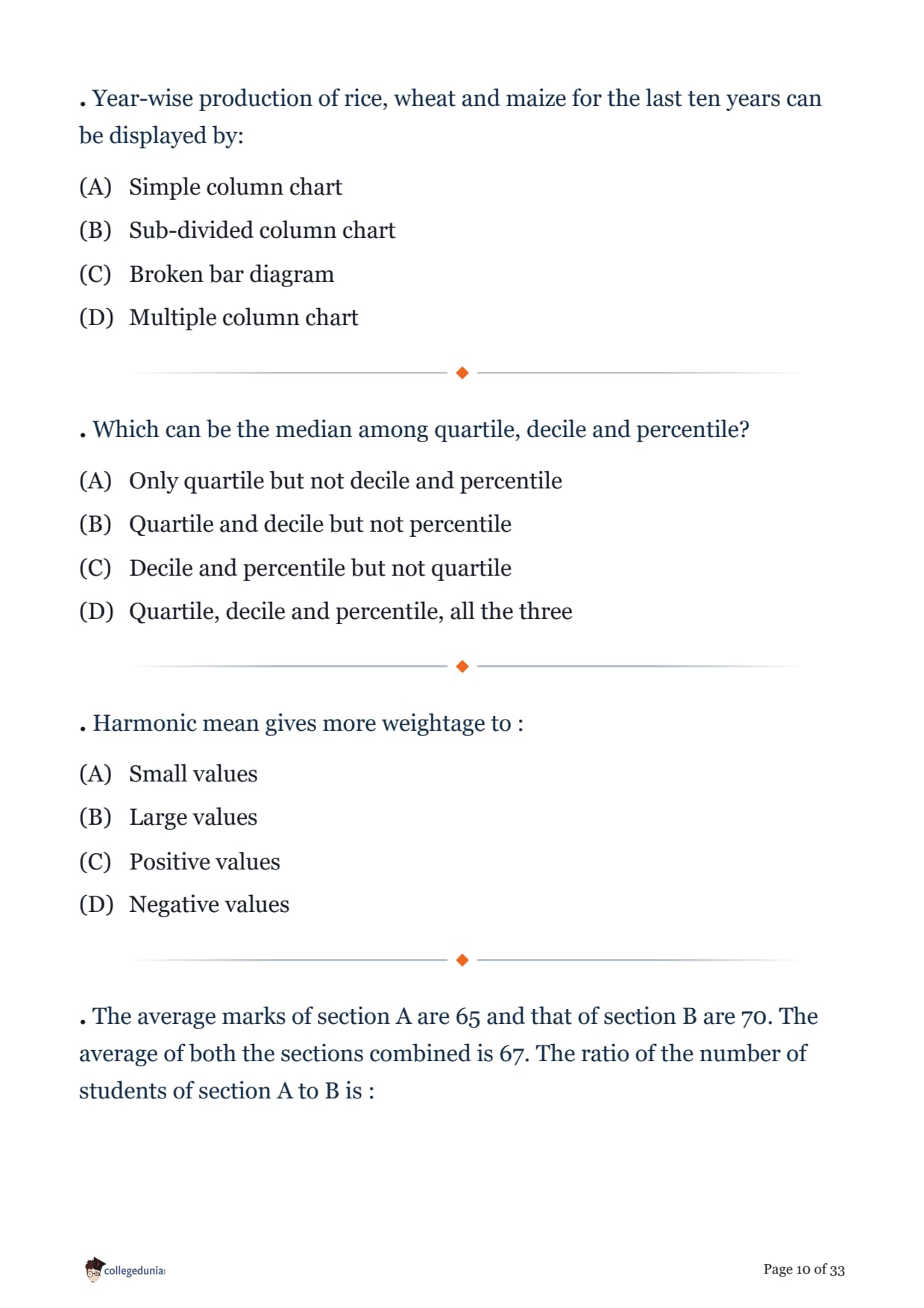
Year-wise production of rice, wheat and maize for the last ten years can be displayed by:
Which can be the median among quartile, decile and percentile?
Harmonic mean gives more weightage to :
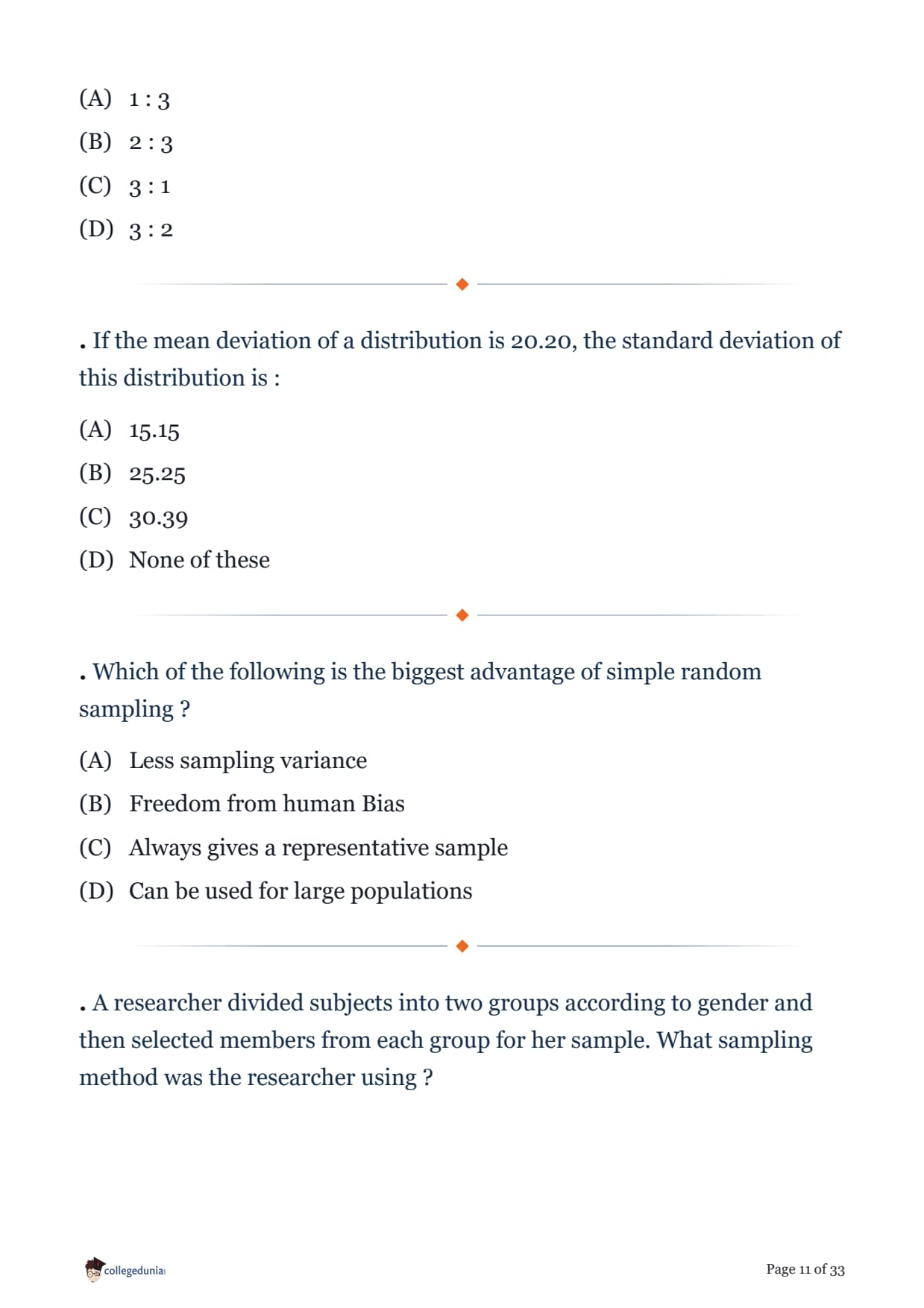
The average marks of section A are 65 and that of section B are 70. The average of both the sections combined is 67. The ratio of the number of students of section A to B is :
If the mean deviation of a distribution is 20.20, the standard deviation of this distribution is :
Which of the following is the biggest advantage of simple random sampling ?
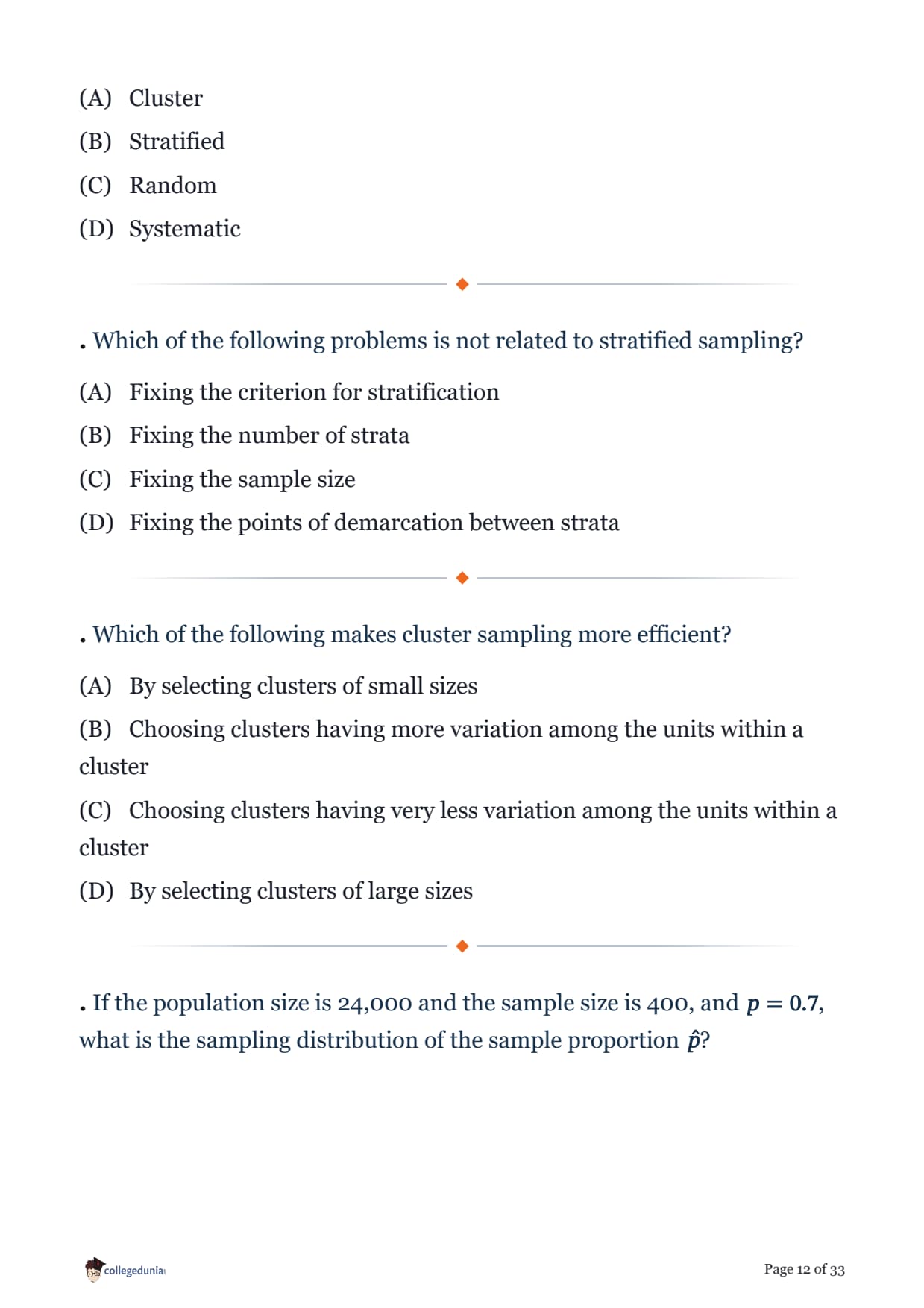
A researcher divided subjects into two groups according to gender and then selected members from each group for her sample. What sampling method was the researcher using ?
Which of the following problems is not related to stratified sampling?
Which of the following makes cluster sampling more efficient?
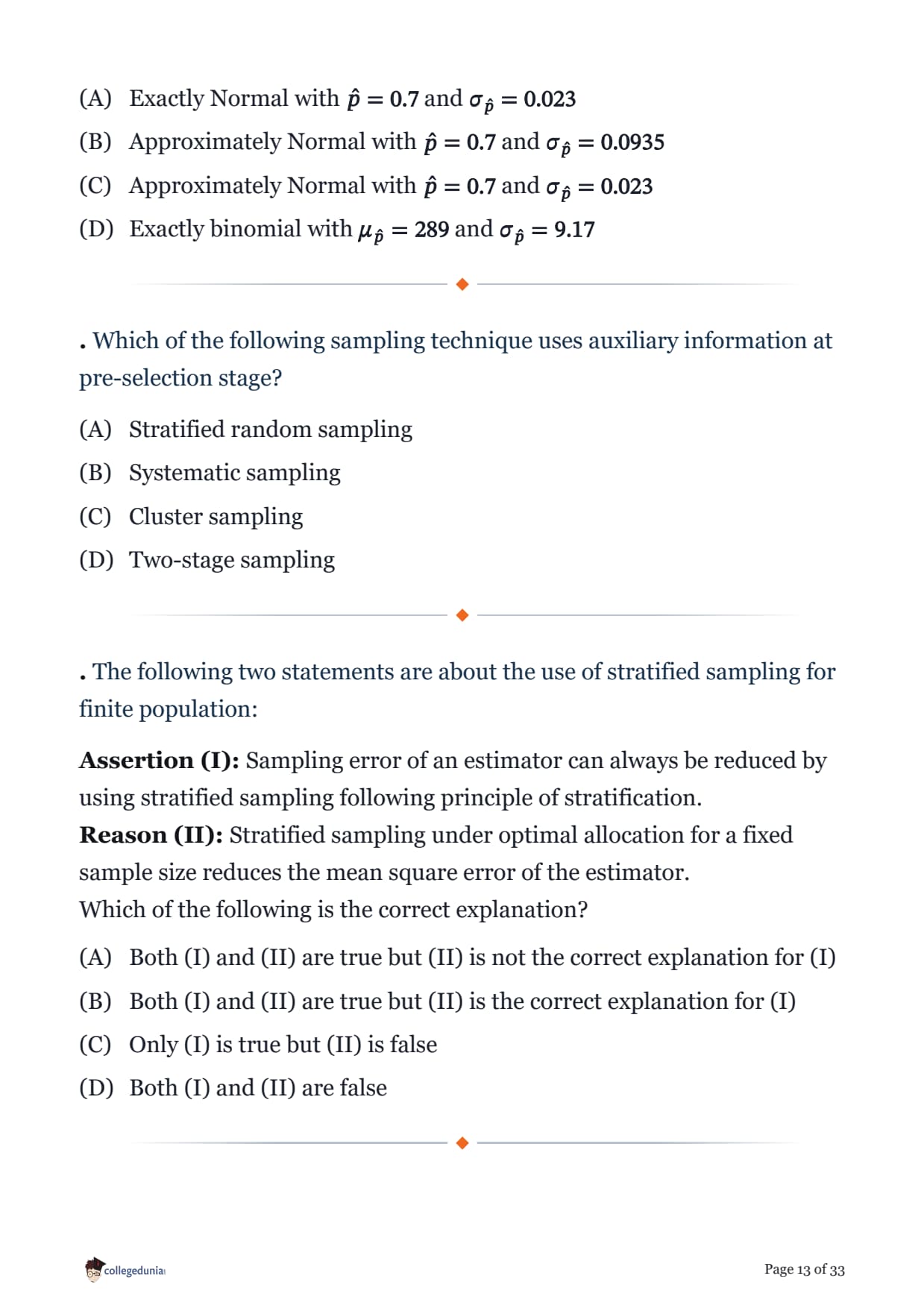
If the population size is 24,000 and the sample size is 400, and \(p = 0.7\), what is the sampling distribution of the sample proportion \(\hat{p}\)?
Which of the following sampling technique uses auxiliary information at pre-selection stage?
The following two statements are about the use of stratified sampling for finite population:
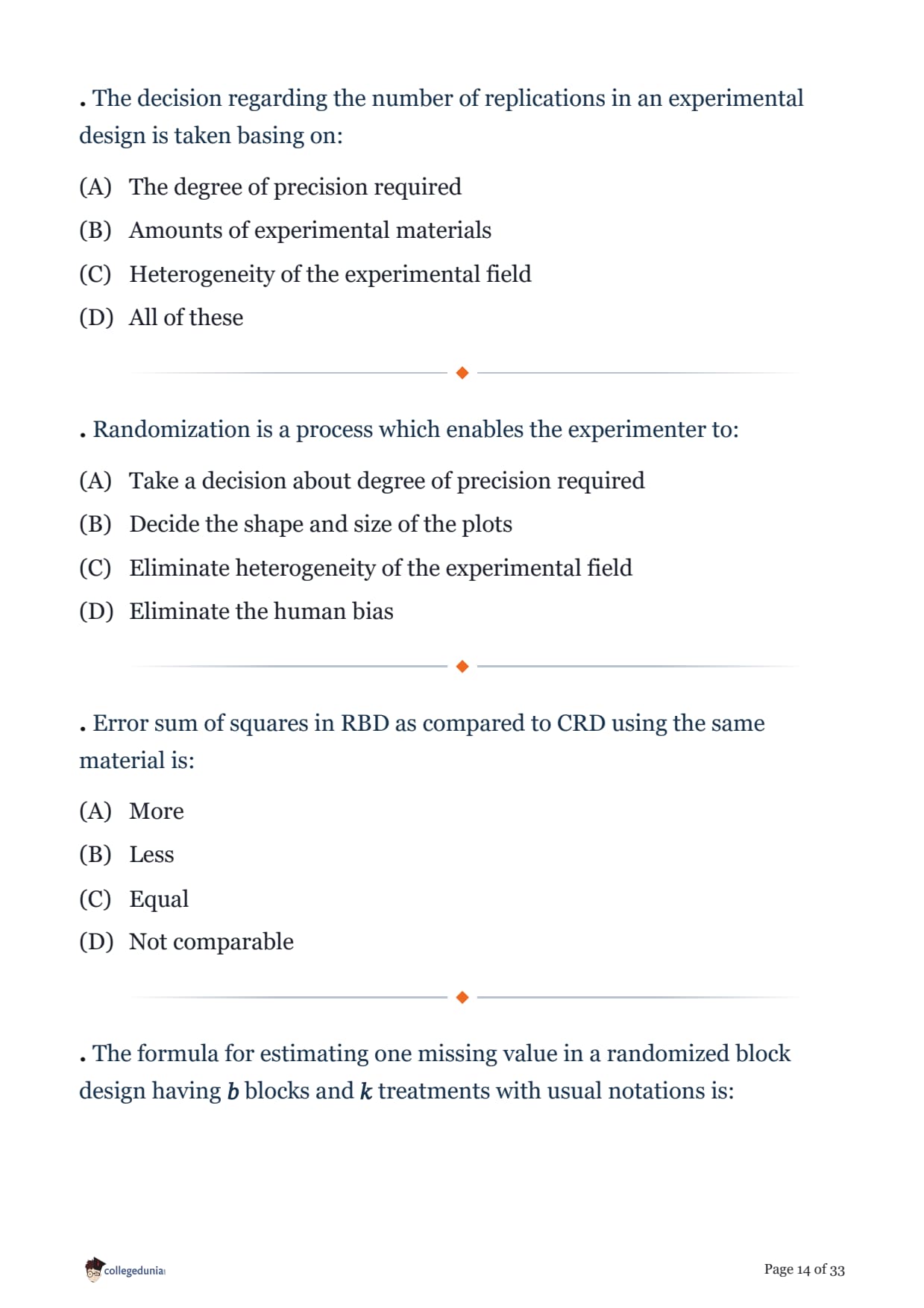
The decision regarding the number of replications in an experimental design is taken basing on:
Randomization is a process which enables the experimenter to:
Error sum of squares in RBD as compared to CRD using the same material is:
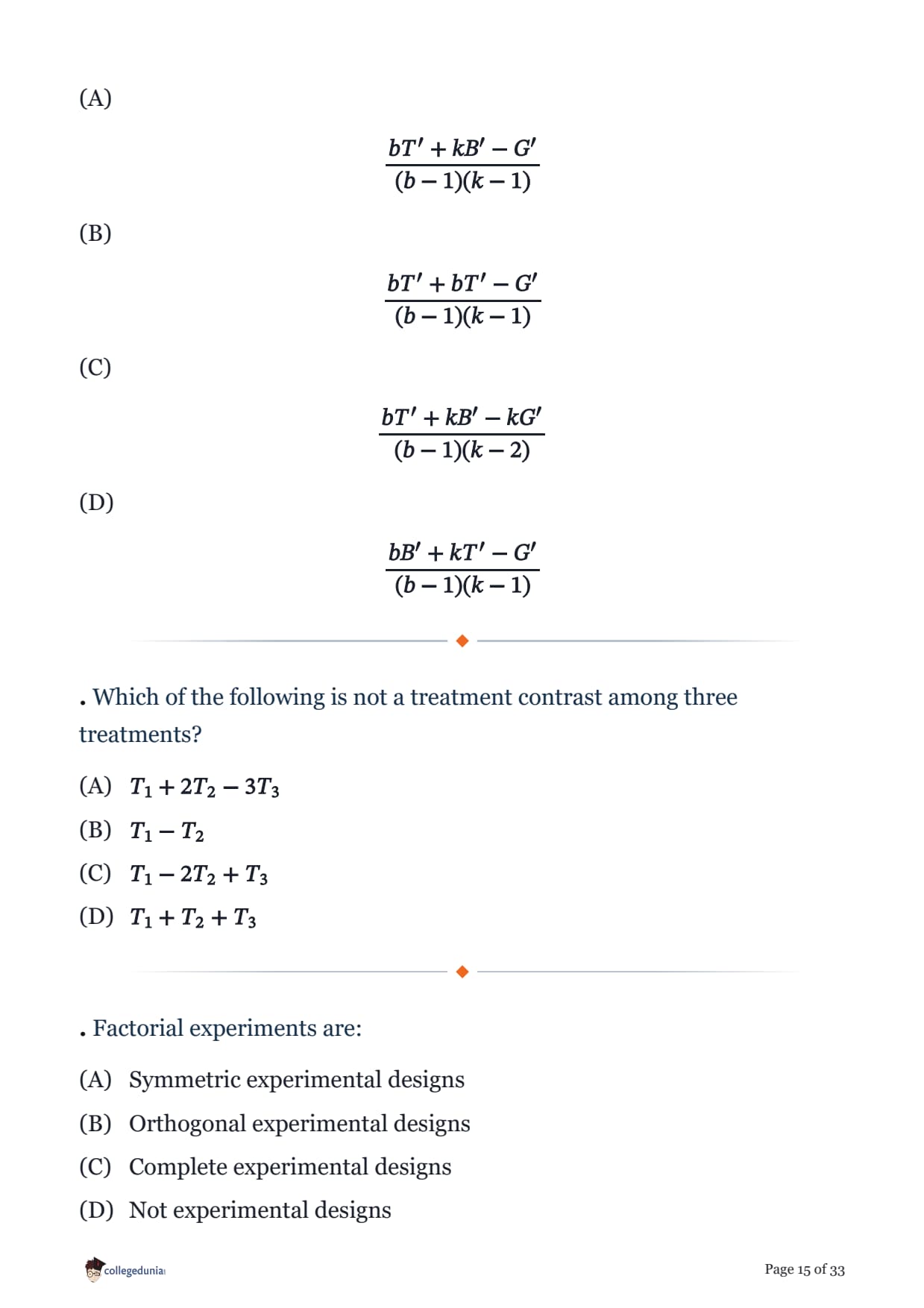
The formula for estimating one missing value in a randomized block design having \(b\) blocks and \(k\) treatments with usual notations is:
Which of the following is not a treatment contrast among three treatments?
Factorial experiments are:
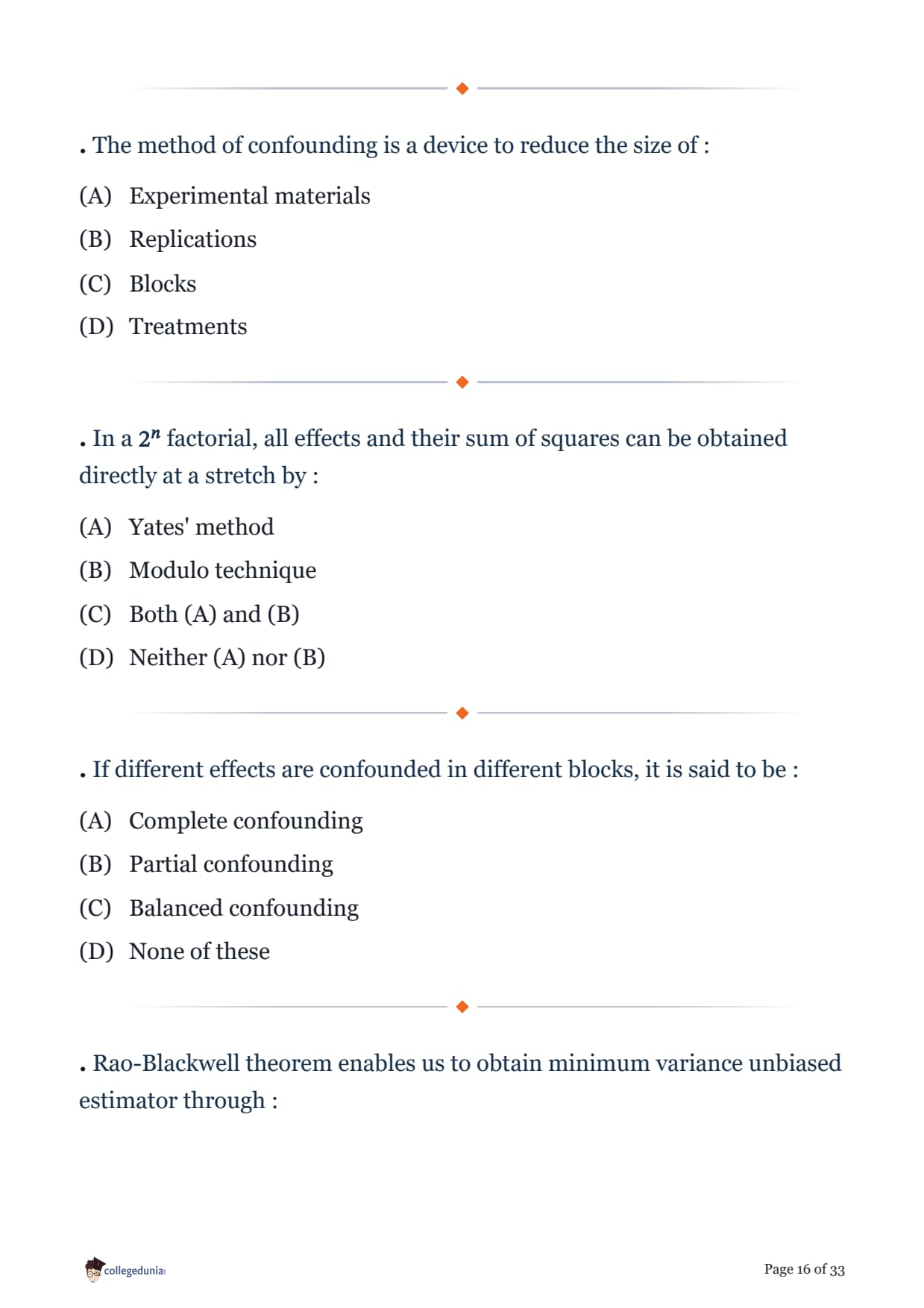
The method of confounding is a device to reduce the size of :
In a \(2^n\) factorial, all effects and their sum of squares can be obtained directly at a stretch by :
If different effects are confounded in different blocks, it is said to be :
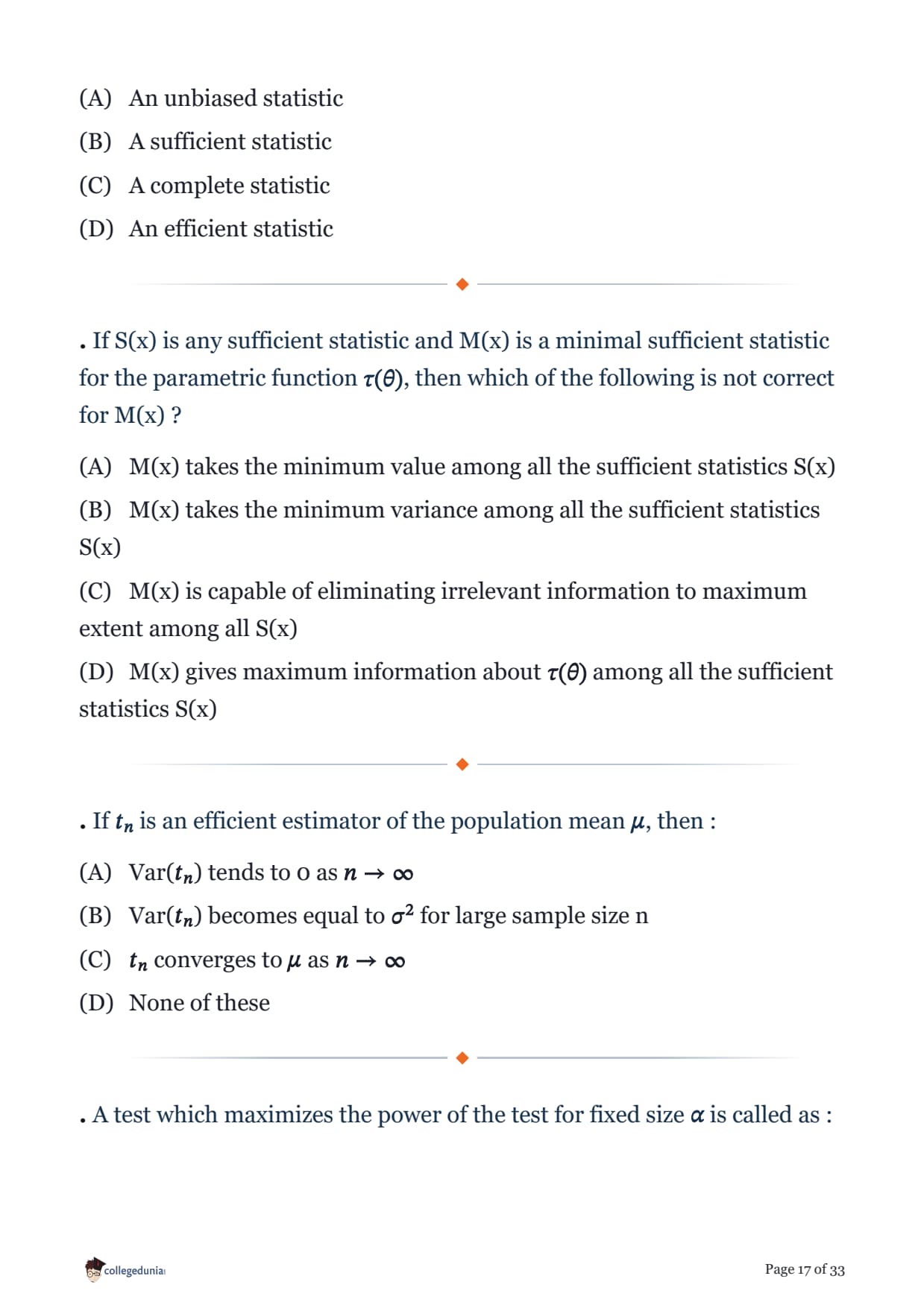
Rao-Blackwell theorem enables us to obtain minimum variance unbiased estimator through :
If S(x) is any sufficient statistic and M(x) is a minimal sufficient statistic for the parametric function \(\tau(\theta)\), then which of the following is not correct for M(x) ?
If \(t_n\) is an efficient estimator of the population mean \(\mu\), then :
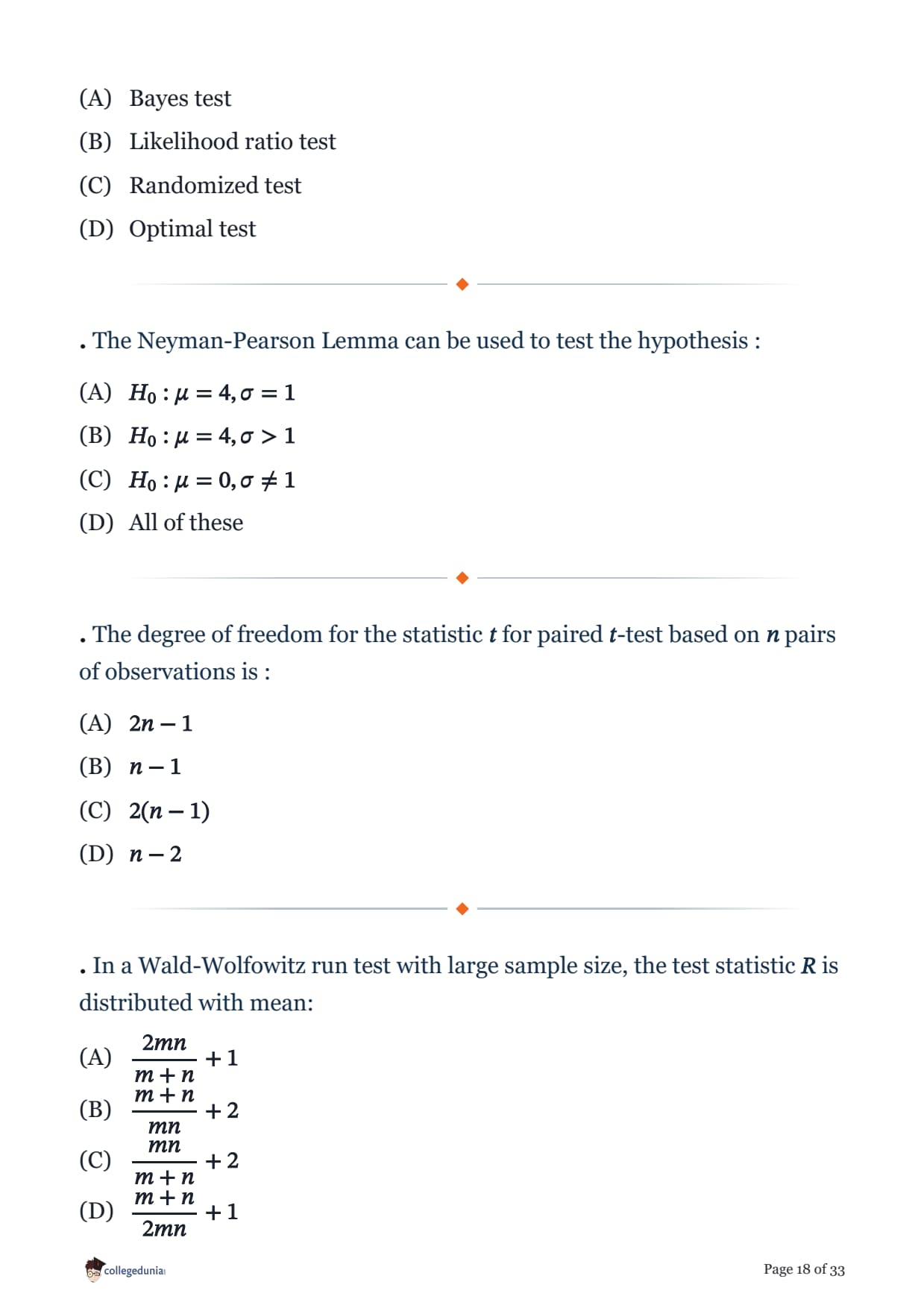
A test which maximizes the power of the test for fixed size \(\alpha\) is called as :
The Neyman-Pearson Lemma can be used to test the hypothesis :
The degree of freedom for the statistic \(t\) for paired \(t\)-test based on \(n\) pairs of observations is :
In a Wald-Wolfowitz run test with large sample size, the test statistic \(R\) is distributed with mean:
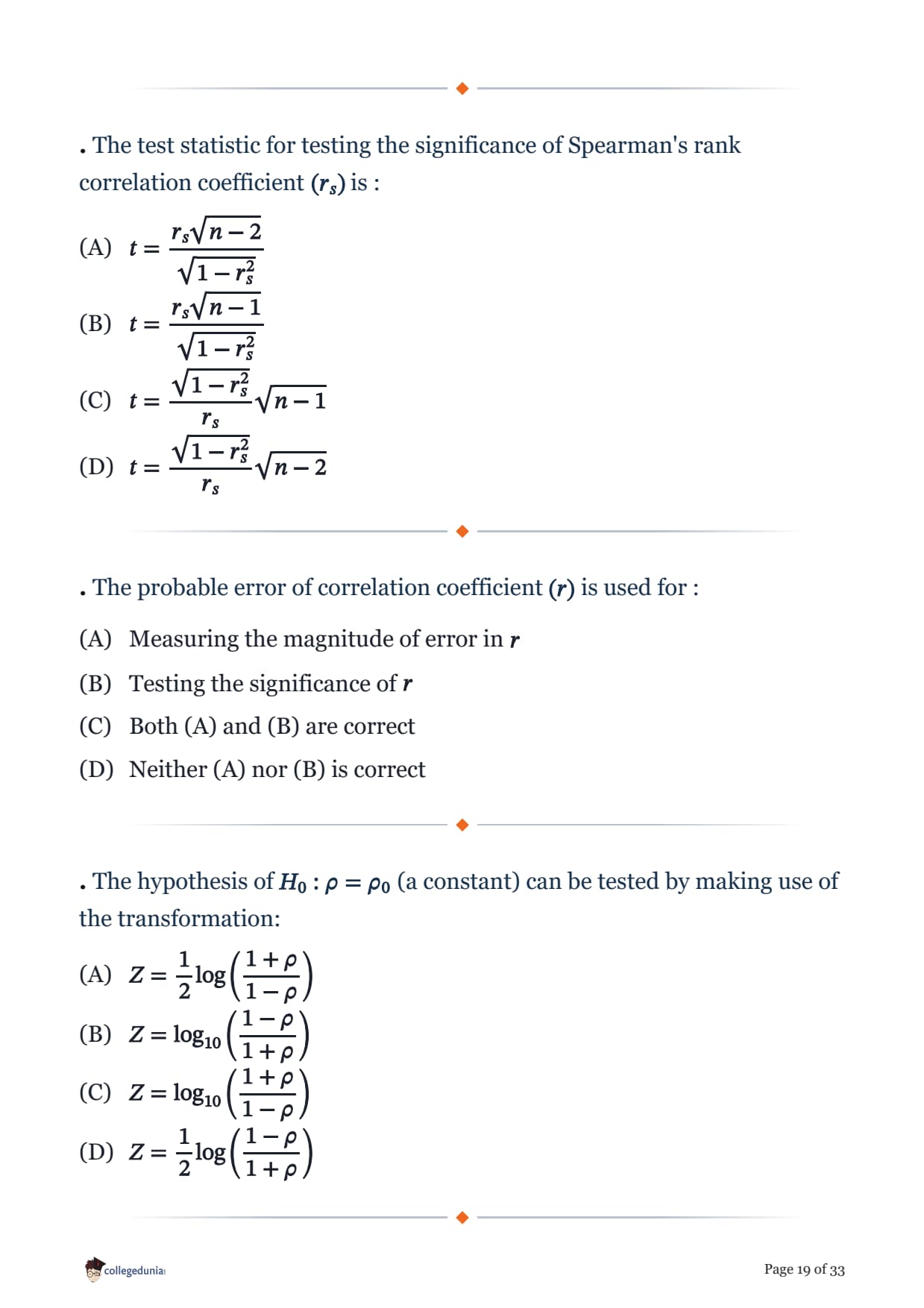
The test statistic for testing the significance of Spearman's rank correlation coefficient \((r_s)\) is :
The probable error of correlation coefficient \((r)\) is used for :
The hypothesis of \(H_0: \rho = \rho_0\) (a constant) can be tested by making use of the transformation:
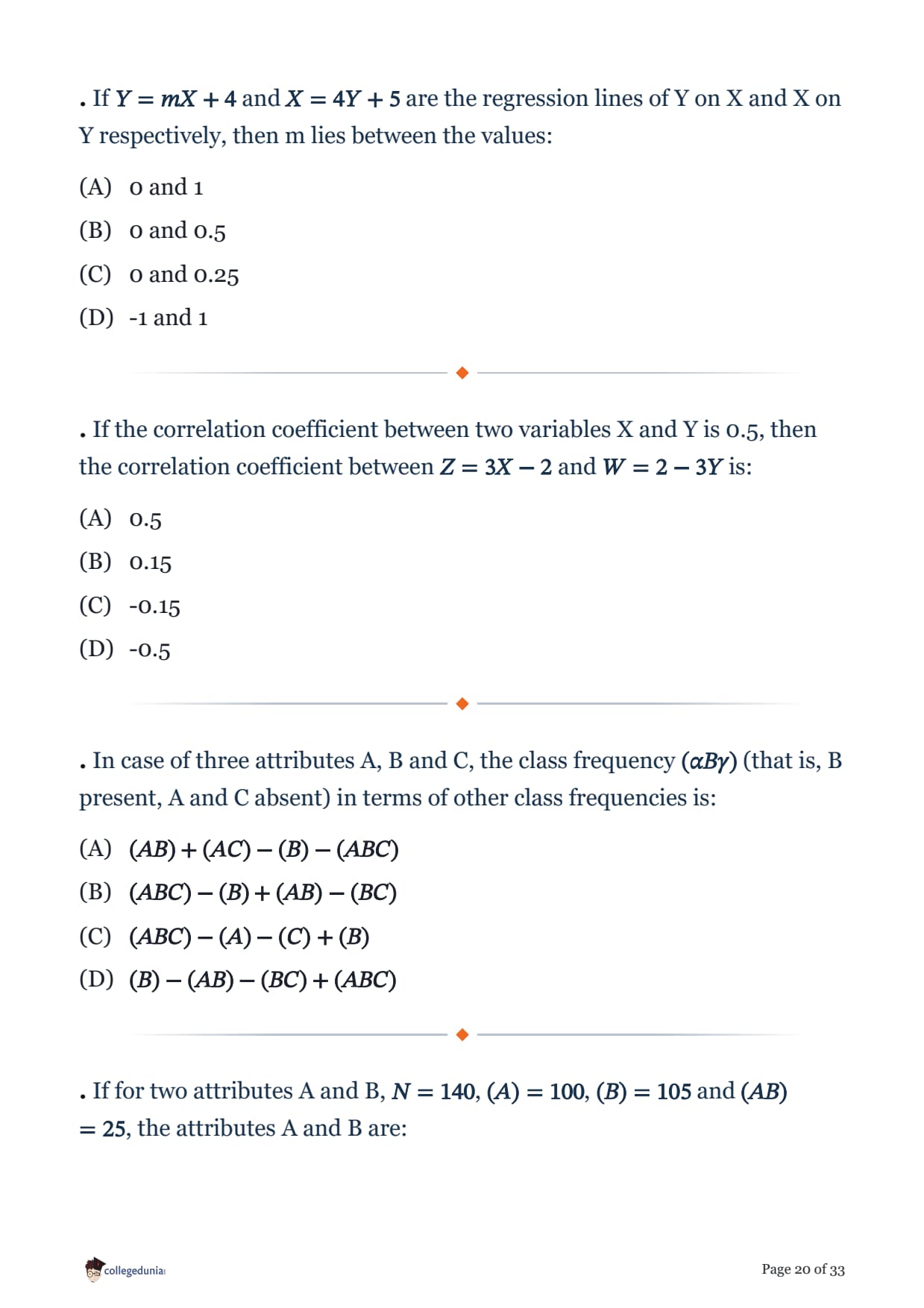
If \(Y = mX + 4\) and \(X = 4Y + 5\) are the regression lines of Y on X and X on Y respectively, then m lies between the values:
If the correlation coefficient between two variables X and Y is 0.5, then the correlation coefficient between \(Z = 3X - 2\) and \(W = 2 - 3Y\) is:
In case of three attributes A, B and C, the class frequency \((\alpha B \gamma)\) (that is, B present, A and C absent) in terms of other class frequencies is:
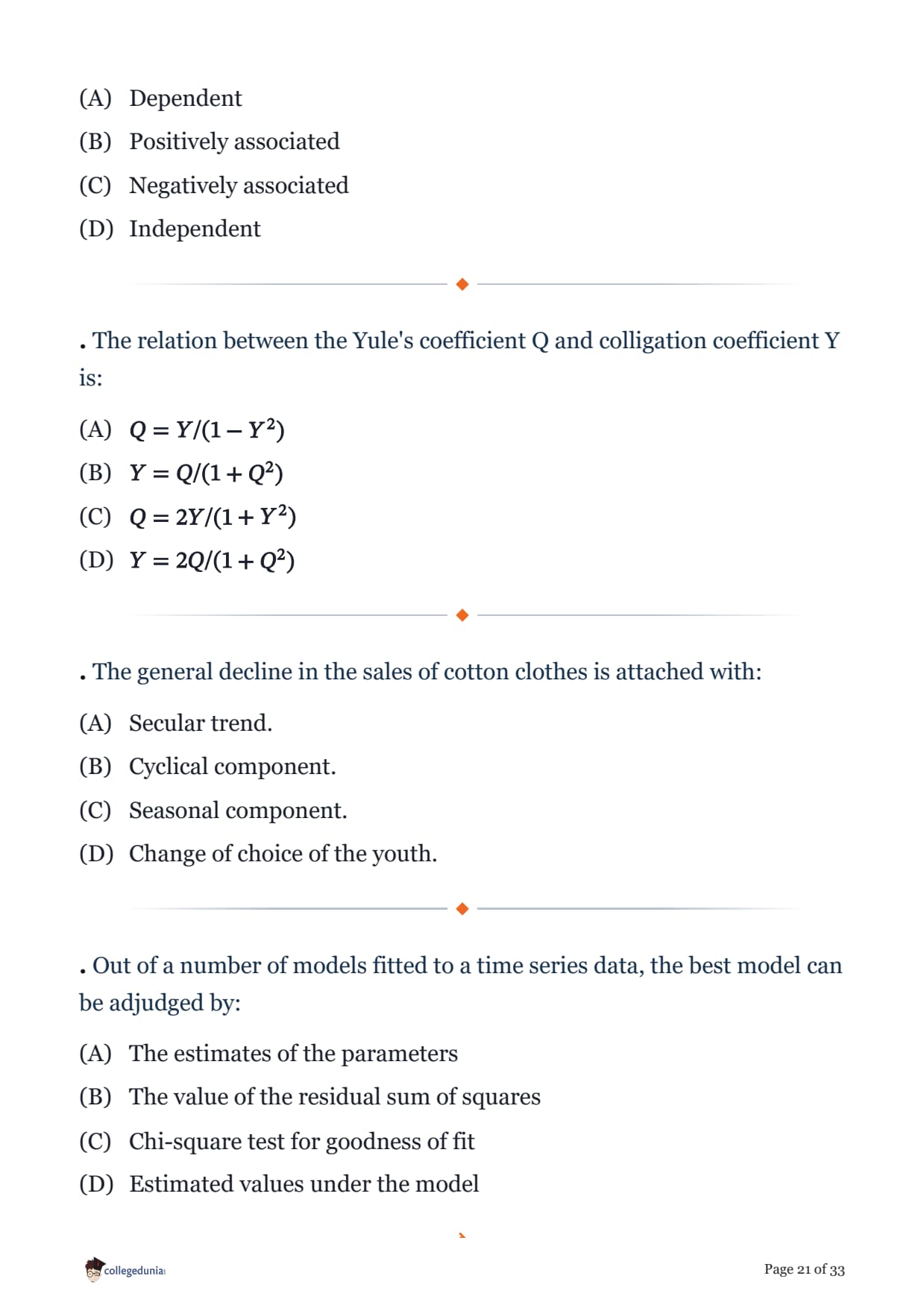
If for two attributes A and B, \(N = 140\), \((A) = 100\), \((B) = 105\) and \((AB) = 25\), the attributes A and B are:
The relation between the Yule's coefficient Q and colligation coefficient Y is:
The general decline in the sales of cotton clothes is attached with:
Out of a number of models fitted to a time series data, the best model can be adjudged by:
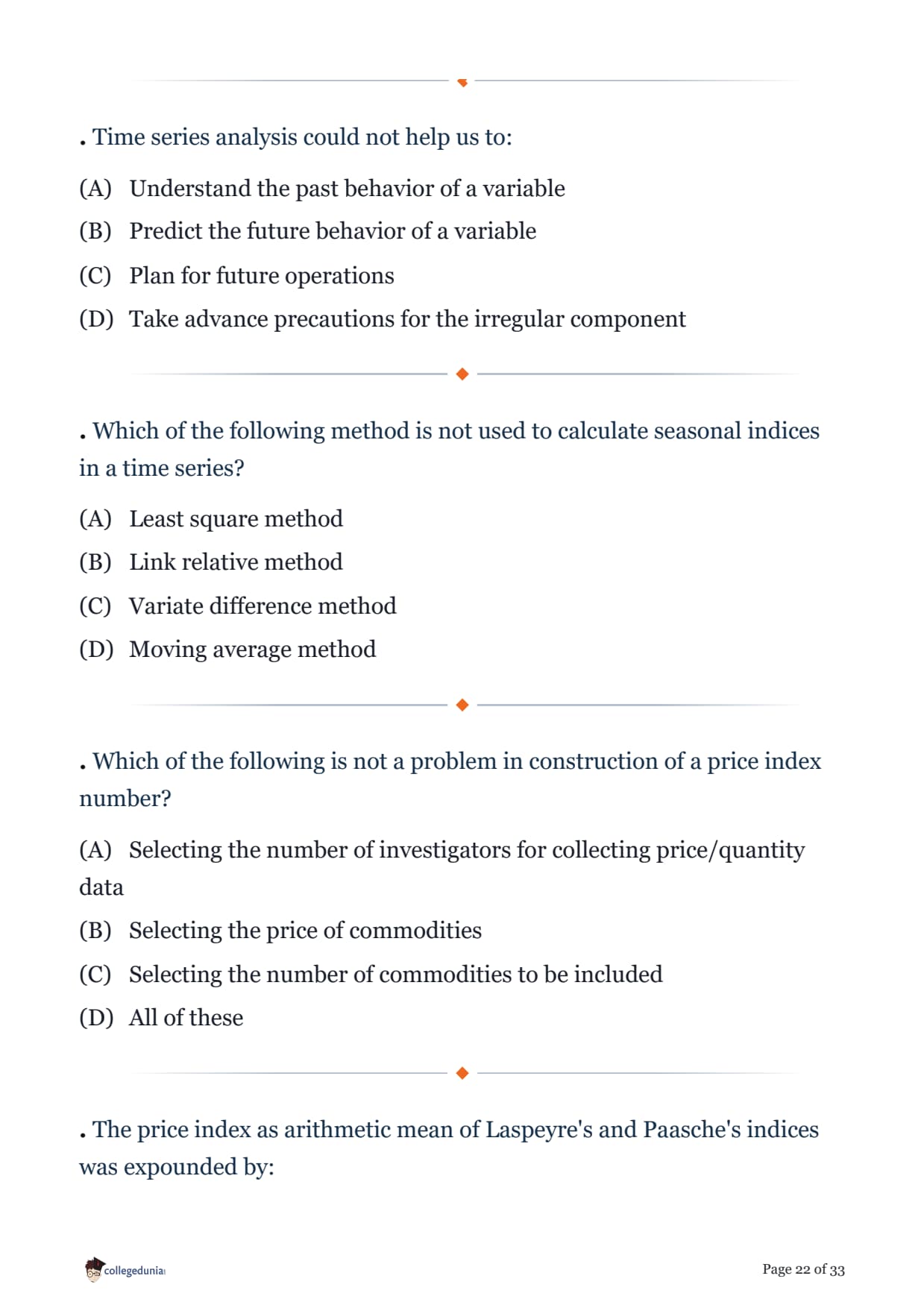
Time series analysis could not help us to:
Which of the following method is not used to calculate seasonal indices in a time series?
Which of the following is not a problem in construction of a price index number?
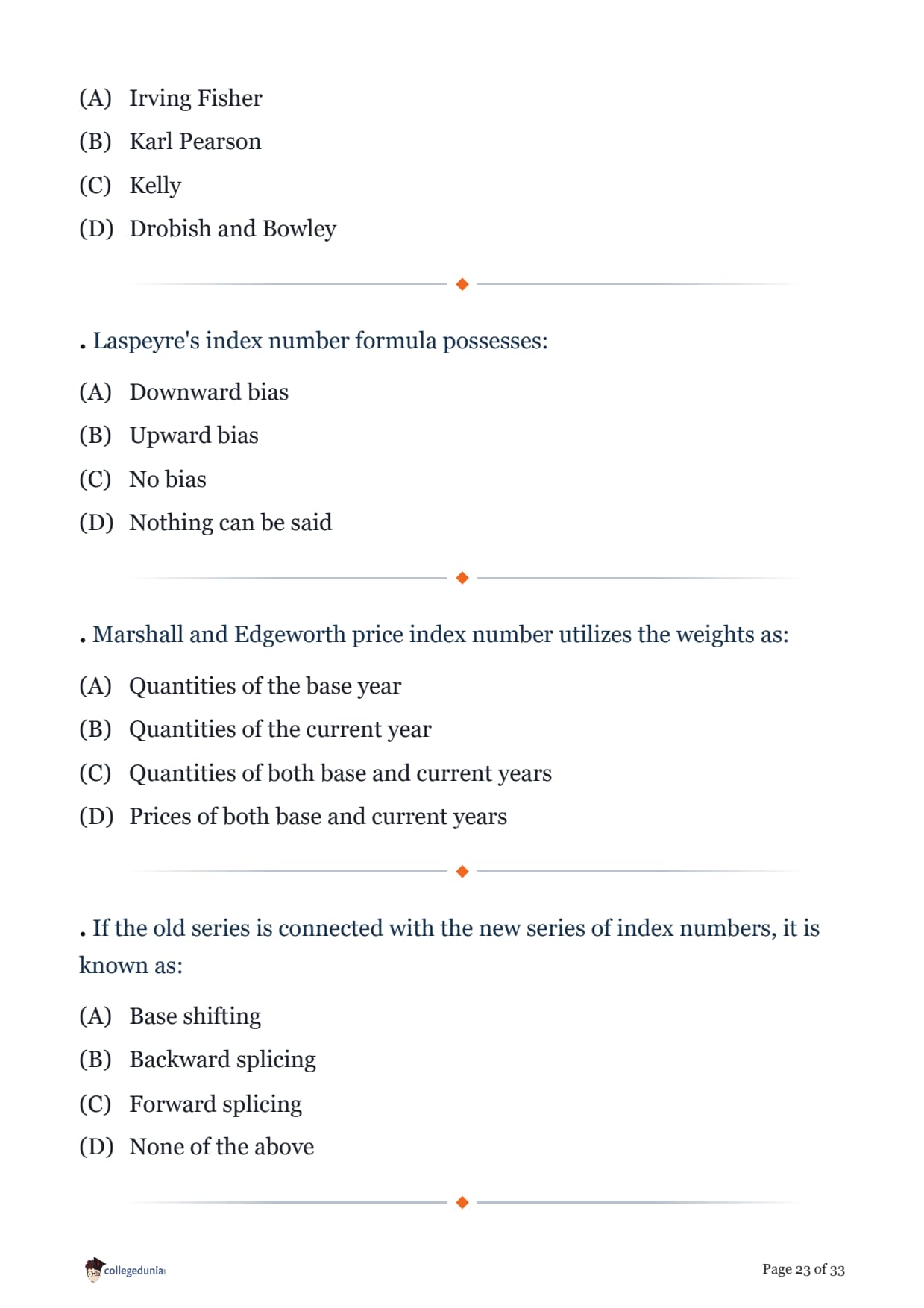
The price index as arithmetic mean of Laspeyre's and Paasche's indices was expounded by:
Laspeyre's index number formula possesses:
Marshall and Edgeworth price index number utilizes the weights as:
If the old series is connected with the new series of index numbers, it is known as:
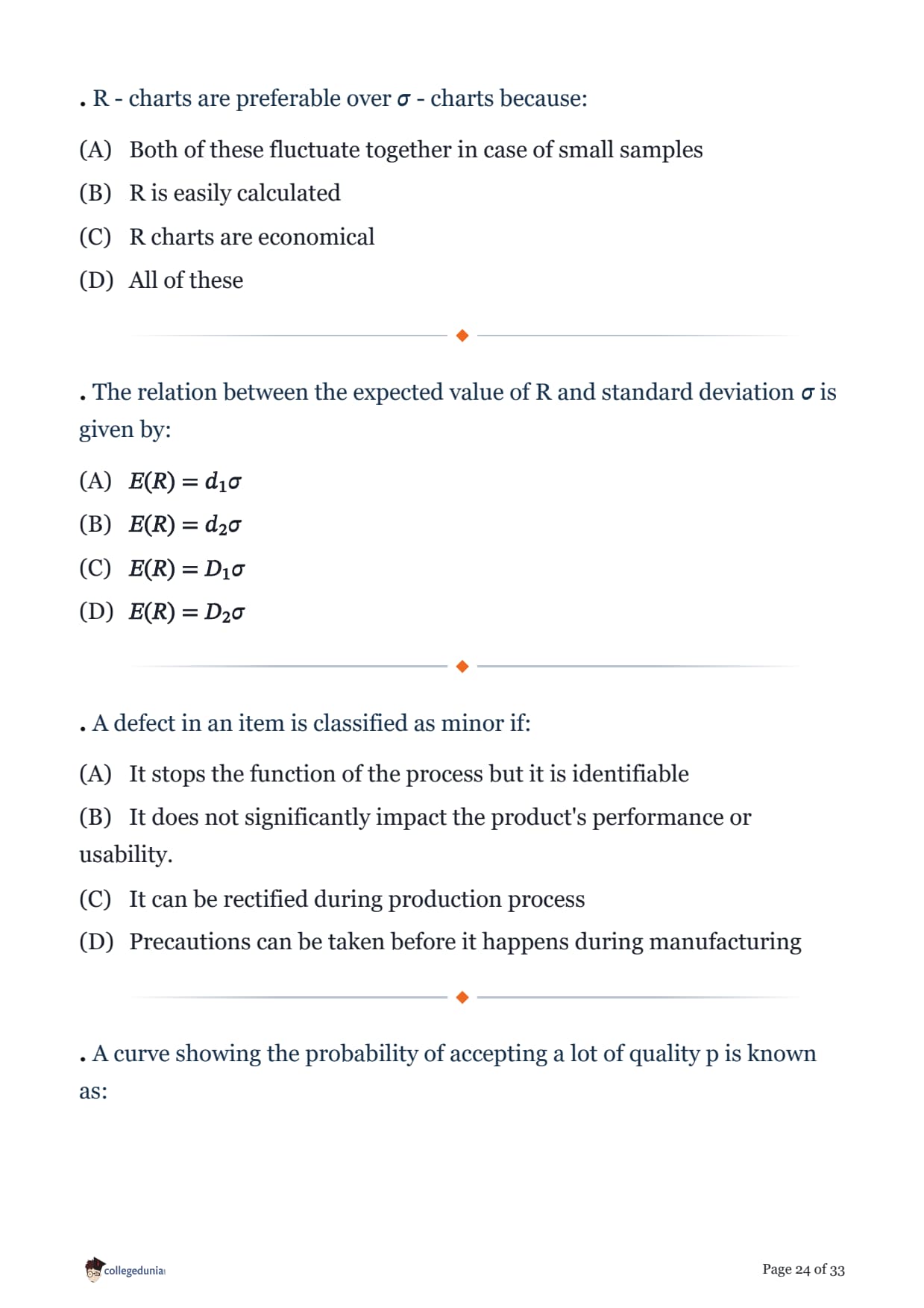
R - charts are preferable over \(\sigma\) - charts because:
The relation between the expected value of R and standard deviation \(\sigma\) is given by:
A defect in an item is classified as minor if:
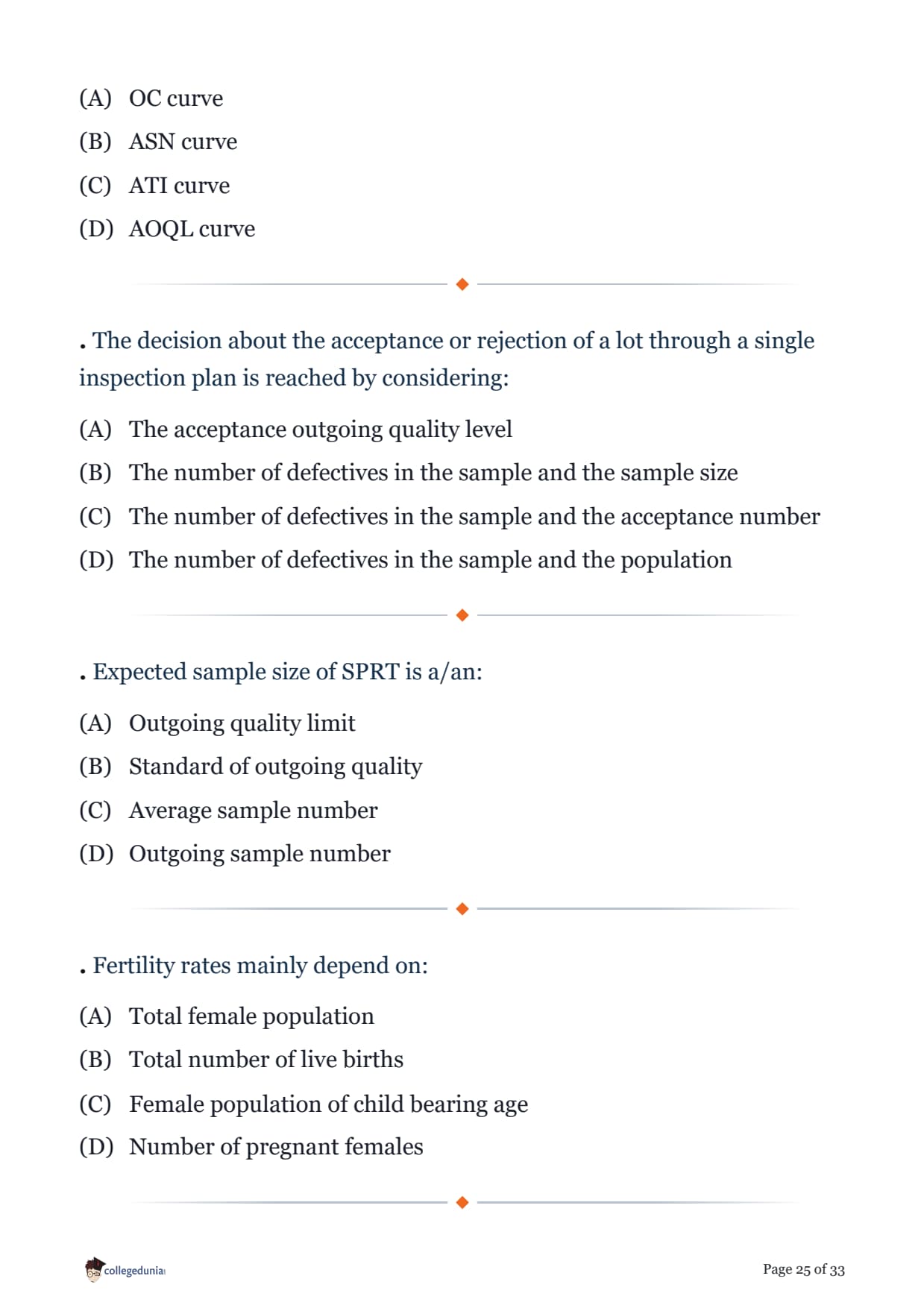
A curve showing the probability of accepting a lot of quality p is known as:
The decision about the acceptance or rejection of a lot through a single inspection plan is reached by considering:
Expected sample size of SPRT is a/an:
Fertility rates mainly depend on:
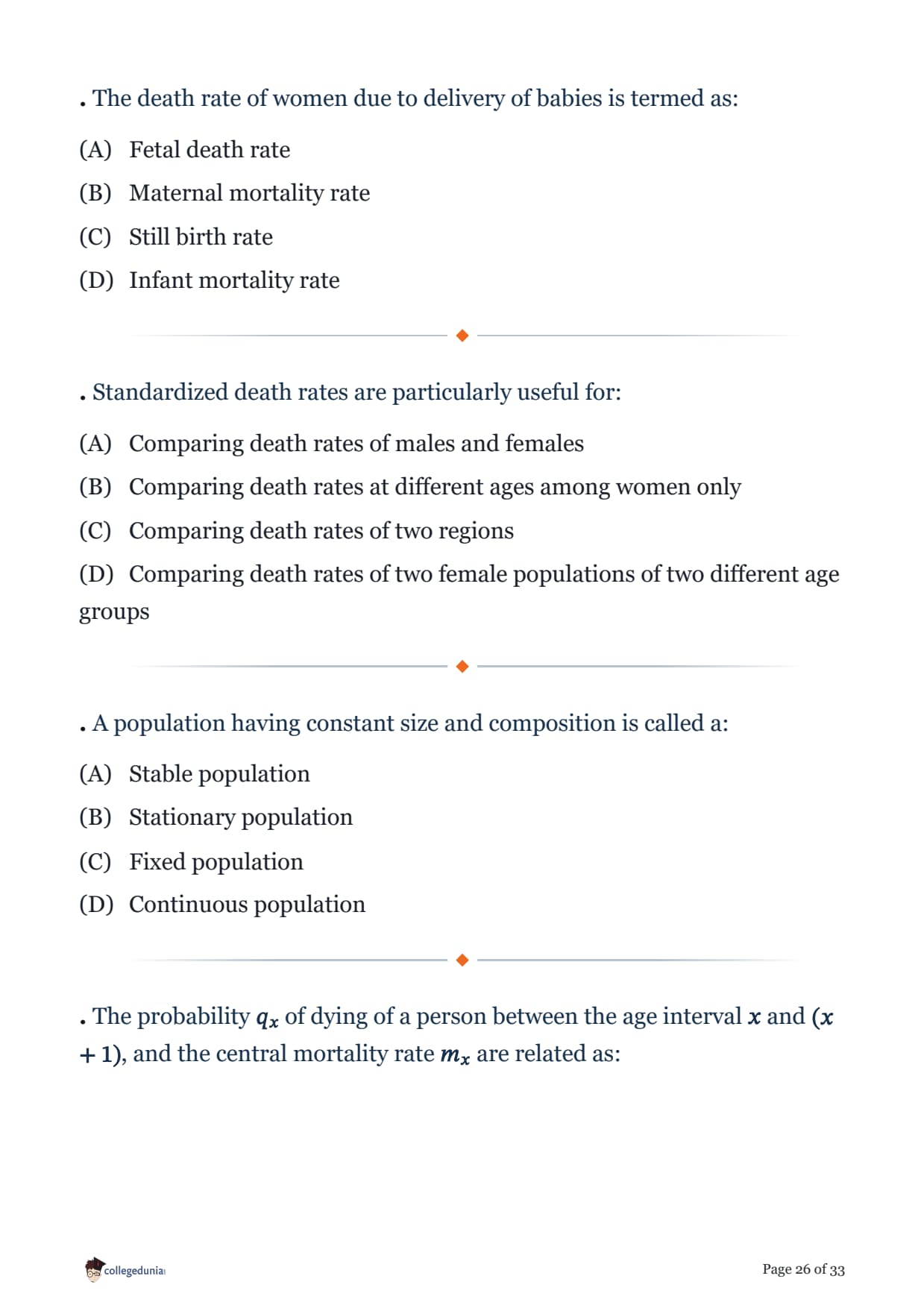
The death rate of women due to delivery of babies is termed as:
Standardized death rates are particularly useful for:
A population having constant size and composition is called a:
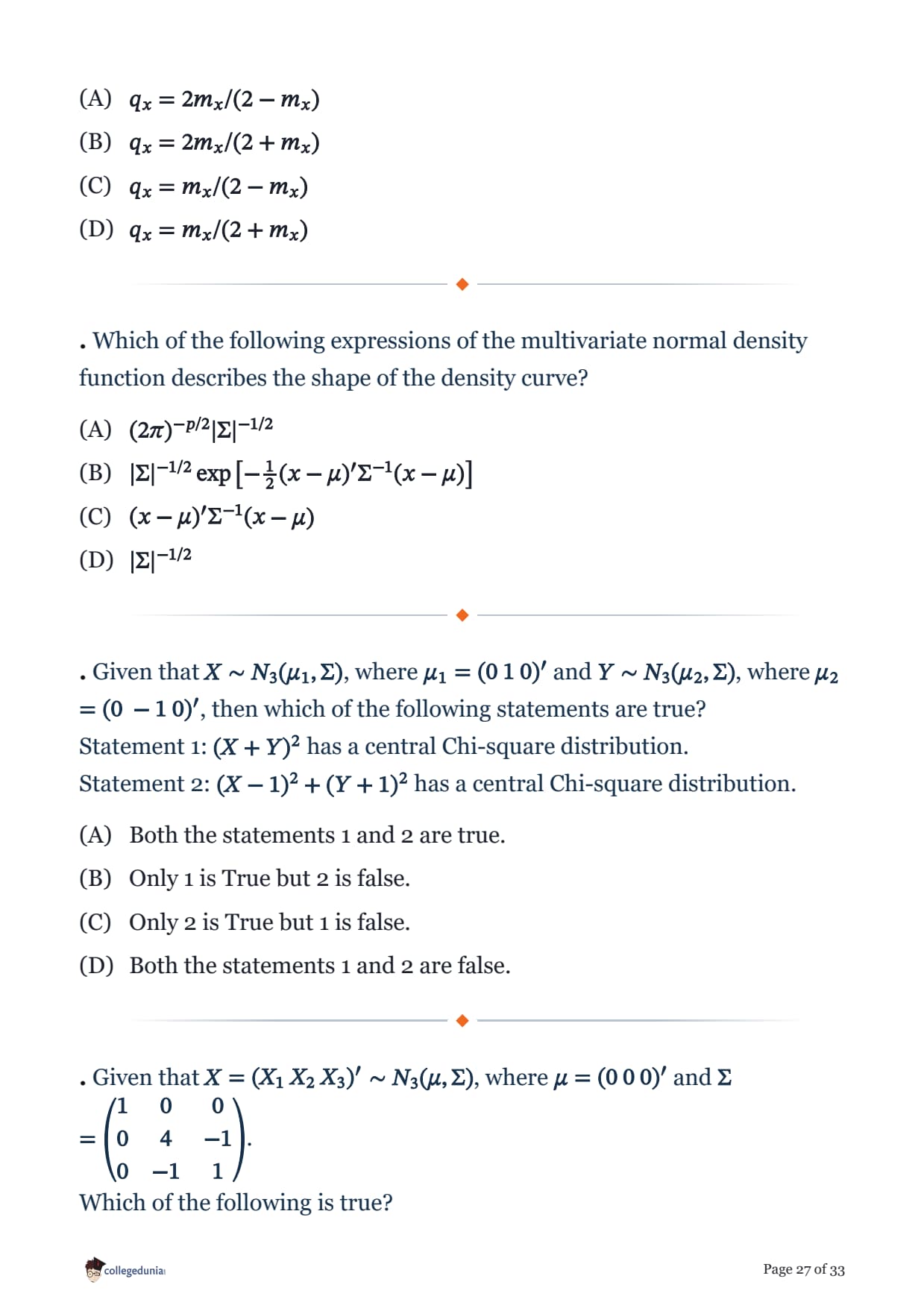
The probability \(q_x\) of dying of a person between the age interval \(x\) and \((x+1)\), and the central mortality rate \(m_x\) are related as:
Which of the following expressions of the multivariate normal density function describes the shape of the density curve?
Given that \(X \sim N_3(\mu_1, \Sigma)\), where \(\mu_1 = (0\ 1\ 0)'\) and \(Y \sim N_3(\mu_2, \Sigma)\), where \(\mu_2 = (0\ -1\ 0)'\), then which of the following statements are true?
Statement 1: \((X+Y)^2\) has a central Chi-square distribution.
Statement 2: \((X-1)^2 + (Y+1)^2\) has a central Chi-square distribution.
Given that \(X=(X_1\ X_2\ X_3)' \sim N_3(\mu, \Sigma)\), where \(\mu=(0\ 0\ 0)'\) and \(\Sigma = \begin{pmatrix}1 & 0 & 0\\0 & 4 & -1\\0 & -1 & 1\end{pmatrix}\).
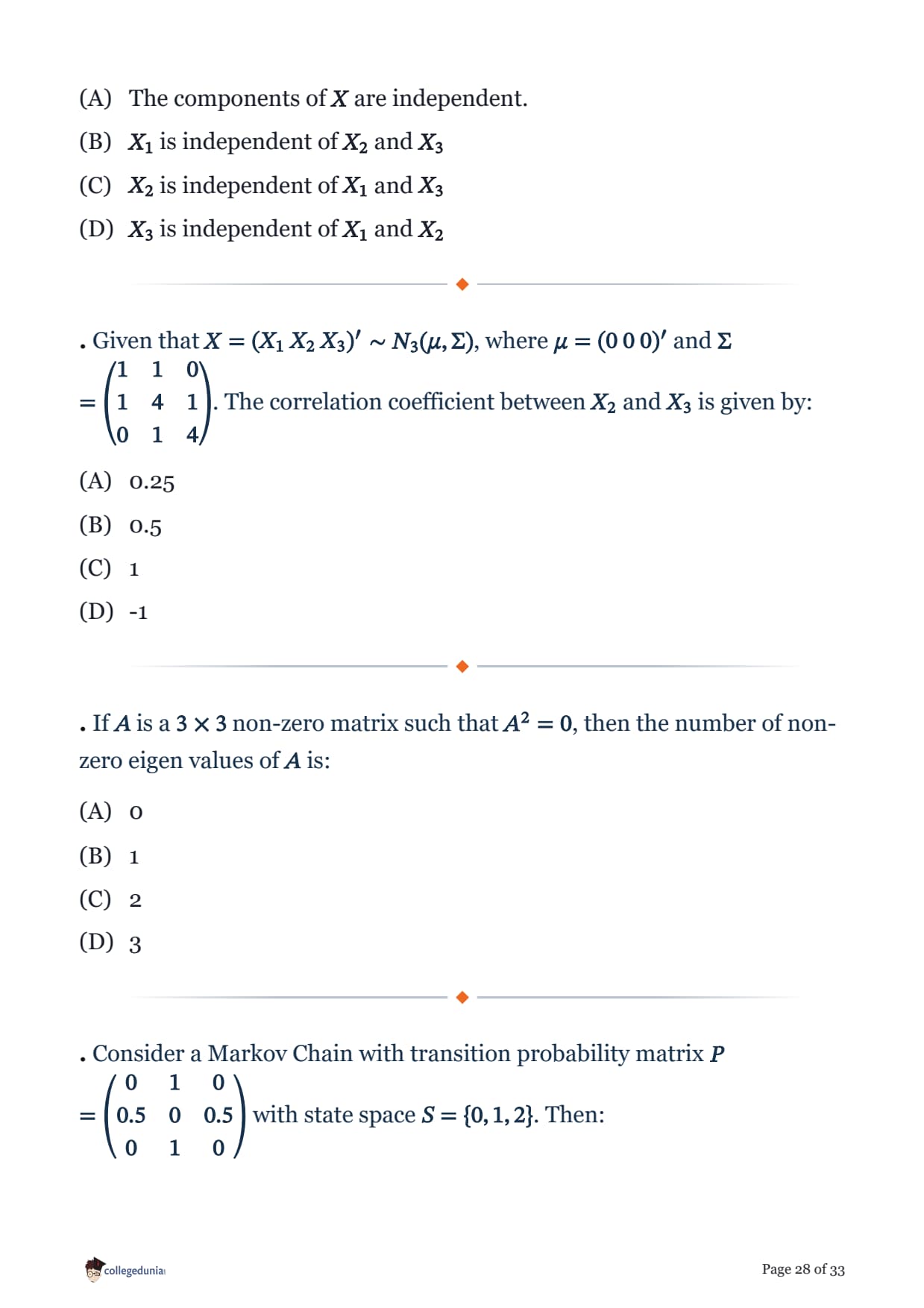
Which of the following is true?
Given that \(X=(X_1\ X_2\ X_3)' \sim N_3(\mu,\Sigma)\), where \(\mu=(0\ 0\ 0)'\) and \(\Sigma=\begin{pmatrix}1 & 1 & 0\\1 & 4 & 1\\0 & 1 & 4\end{pmatrix}\). The correlation coefficient between \(X_2\) and \(X_3\) is given by:
If \(A\) is a \(3\times 3\) non-zero matrix such that \(A^2=0\), then the number of non-zero eigen values of \(A\) is:
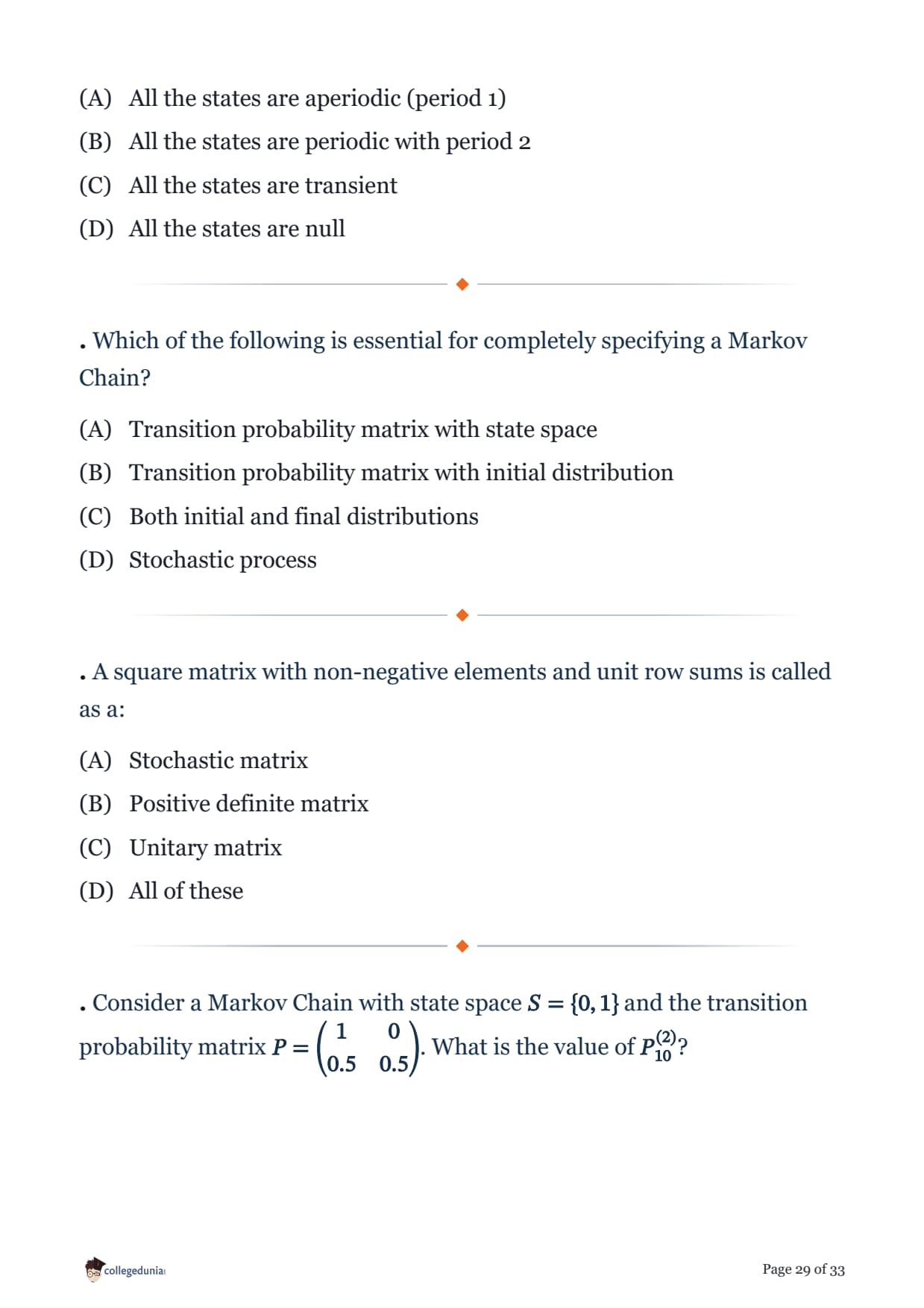
Consider a Markov Chain with transition probability matrix \(P = \begin{pmatrix}0 & 1 & 0\\0.5 & 0 & 0.5\\0 & 1 & 0\end{pmatrix}\) with state space \(S=\{0,1,2\}\). Then:
Which of the following is essential for completely specifying a Markov Chain?
A square matrix with non-negative elements and unit row sums is called as a:
Consider a Markov Chain with state space \(S = \{0, 1\}\) and the transition probability matrix \(P = \begin{pmatrix} 1 & 0 \\ 0.5 & 0.5 \end{pmatrix}\). What is the value of \(P^{(2)}_{10}\)?
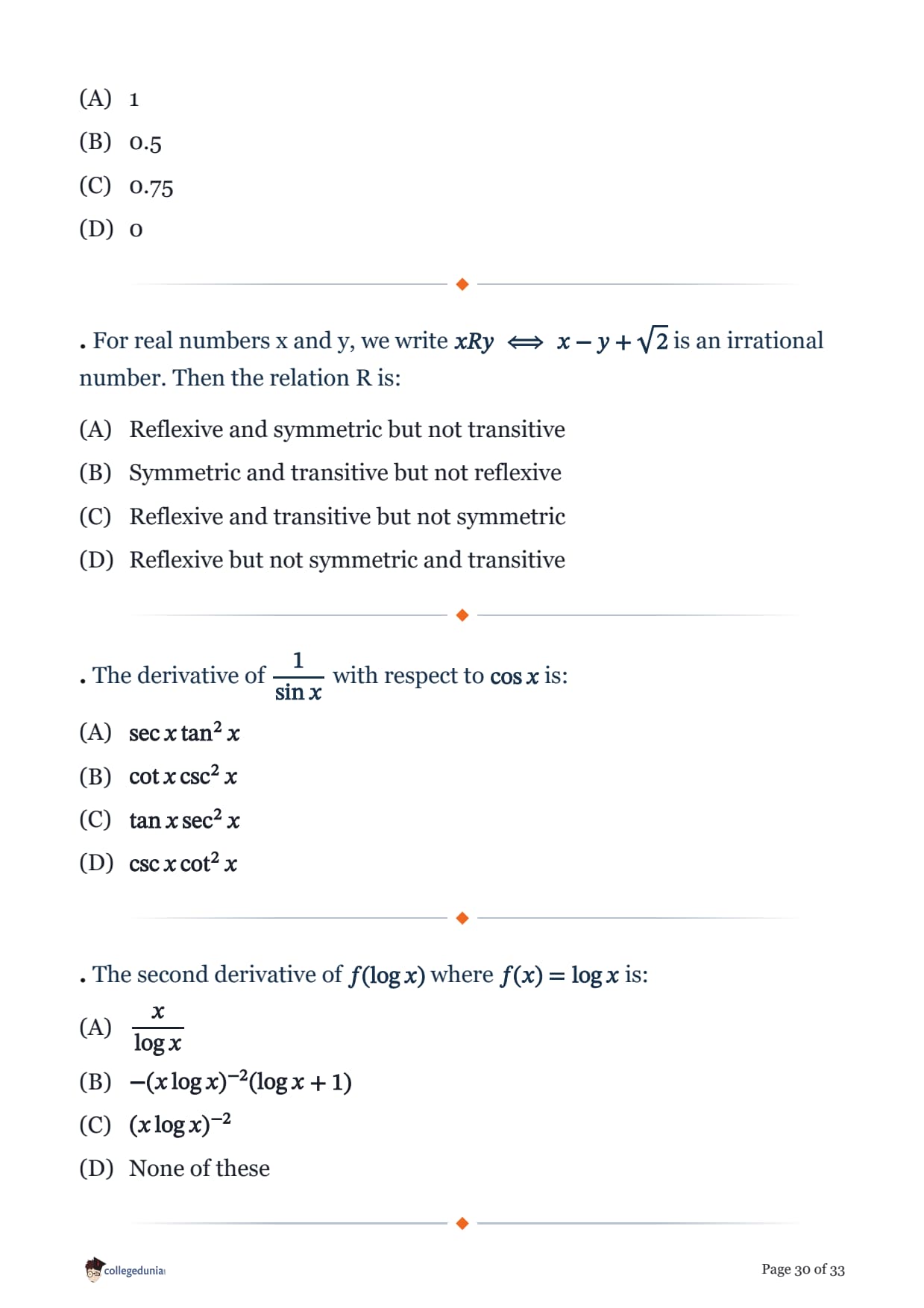
For real numbers x and y, we write \(xRy \iff x - y + \sqrt{2}\) is an irrational number. Then the relation R is:
The derivative of \(\dfrac{1}{\sin x}\) with respect to \(\cos x\) is:
The second derivative of \(f(\log x)\) where \(f(x) = \log x\) is:
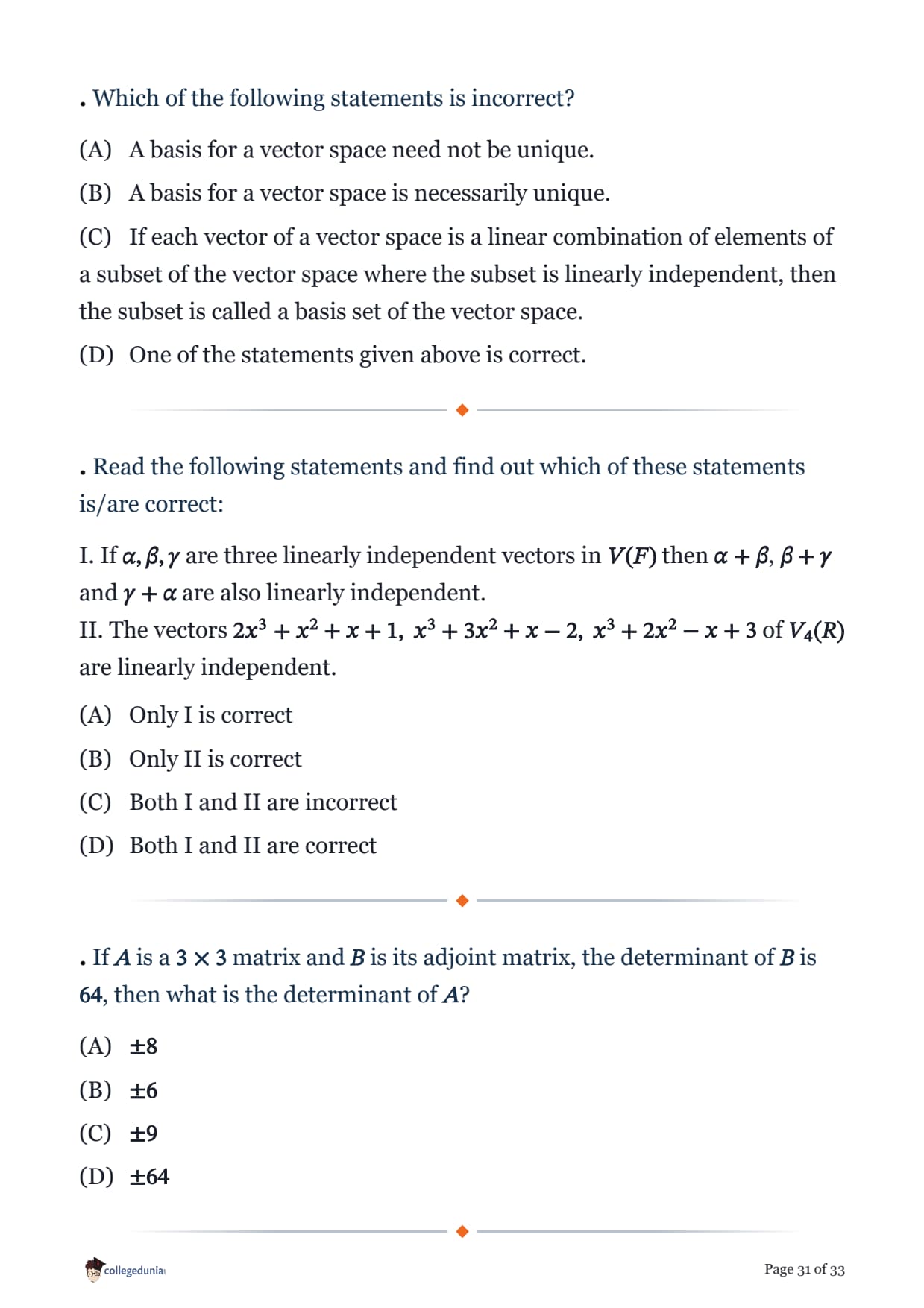
Which of the following statements is incorrect?
Read the following statements and find out which of these statements is/are correct:
If \(A\) is a \(3\times 3\) matrix and \(B\) is its adjoint matrix, the determinant of \(B\) is \(64\), then what is the determinant of \(A\)?
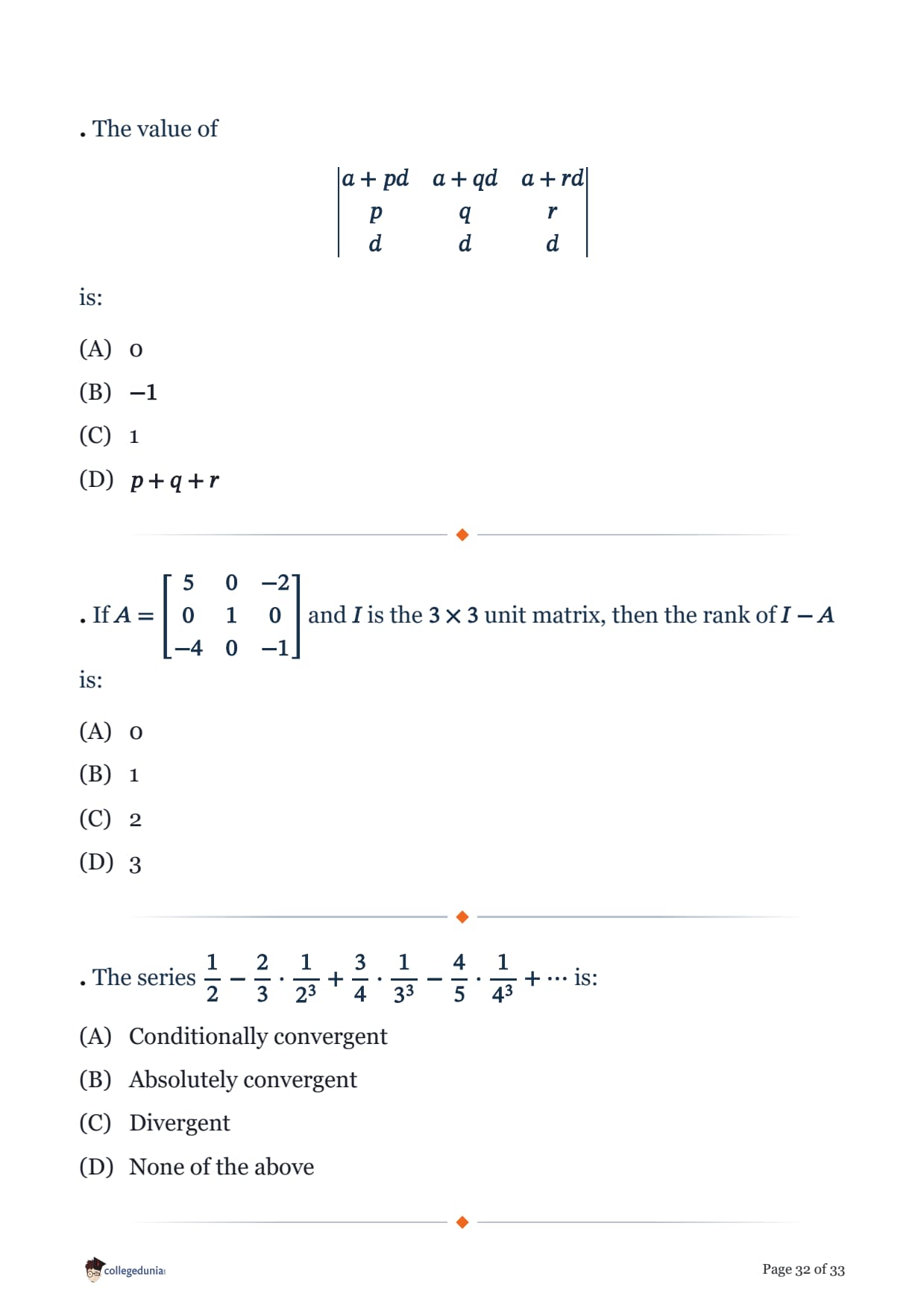
The value of \[\begin{vmatrix} a+pd & a+qd & a+rd \\ p & q & r \\ d & d & d \end{vmatrix}\] is:
If \(A = \begin{bmatrix} 5 & 0 & -2 \\ 0 & 1 & 0 \\ -4 & 0 & -1 \end{bmatrix}\) and \(I\) is the \(3 \times 3\) unit matrix, then the rank of \(I - A\) is:
The series \(\dfrac{1}{2} - \dfrac{2}{3}\cdot\dfrac{1}{2^3} + \dfrac{3}{4}\cdot\dfrac{1}{3^3} - \dfrac{4}{5}\cdot\dfrac{1}{4^3} + \cdots\) is:
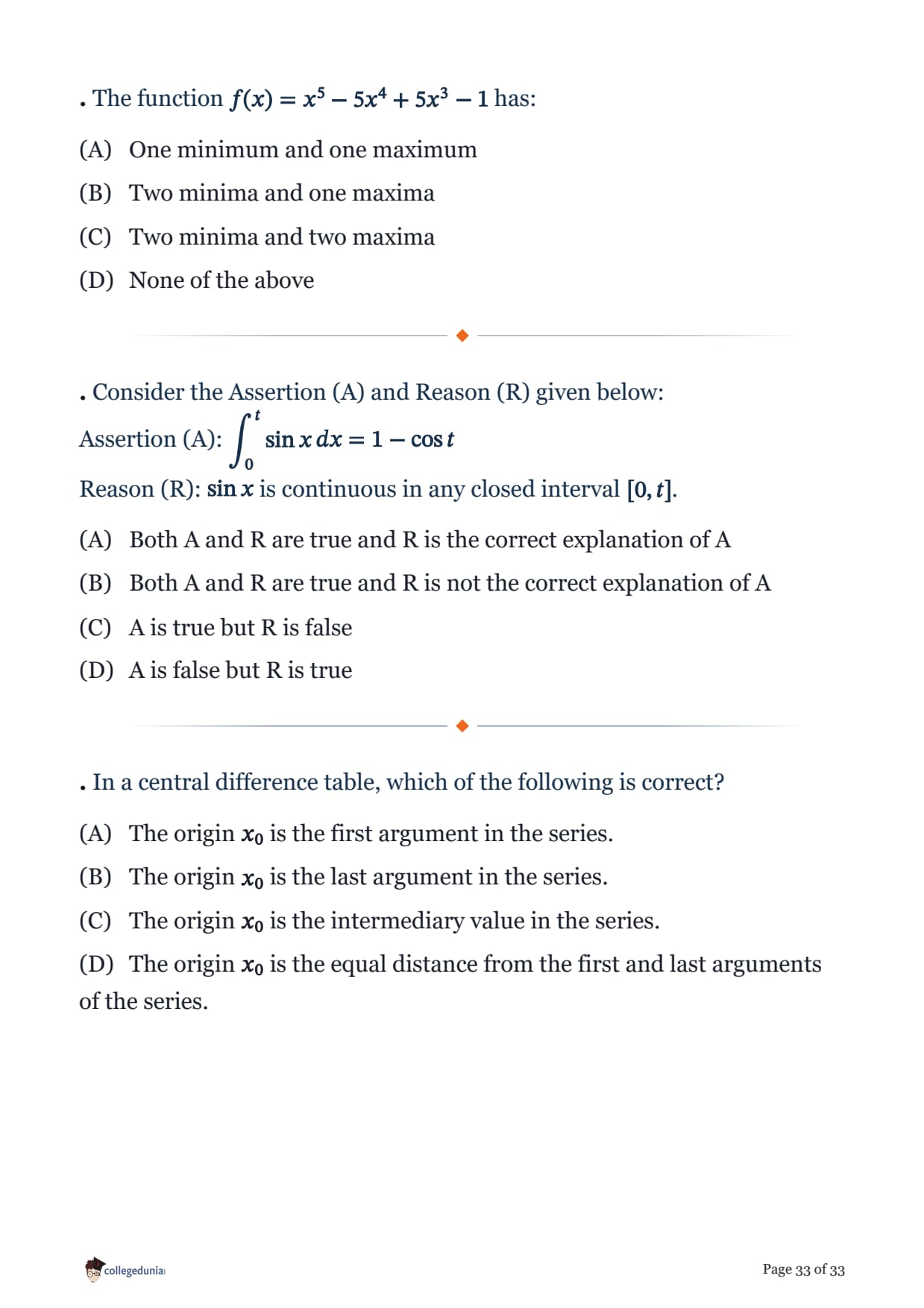
The function \(f(x) = x^5 - 5x^4 + 5x^3 - 1\) has:
Consider the Assertion (A) and Reason (R) given below:
Assertion (A): \(\displaystyle\int_0^t \sin x\, dx = 1 - \cos t\)
Reason (R): \(\sin x\) is continuous in any closed interval \([0, t]\).
In a central difference table, which of the following is correct?
Odisha CPET 2025 Statistics Exam Pattern and Marking Scheme Explained
The Statistics paper (Subject Code 44, Test Booklet UB-44/18) followed a straight single-booklet MCQ format, and the syllabus was drawn entirely from the undergraduate Statistics curriculum as per the official SAMS Odisha bulletin.
- Total questions: 100 MCQs, each with 4 options (A to D)
- Duration: 80 minutes
- Total marks: 100
- Marking scheme: +1 for a correct answer, -0.25 for a wrong one
- Question types: theory-based single-answer MCQs, numerical/formula-based MCQs, and a few assertion-reason and statement-based questions
High-Weightage Topics in Odisha CPET 2025 Statistics to Focus On First
Going by the actual 2025 paper, four areas together made up more than half the 100 questions.
- Probability and distribution theory (Bayes theorem, binomial/Poisson/normal distributions, multivariate normal) - 15 of the 100 questions
- Sampling theory and its allied topics (sampling distributions, acceptance sampling, non-parametric tests) - 12 questions
- Design of experiments (RBD, CRD, confounding, missing plot technique) - 9 questions, the single biggest individual topic
- Correlation and regression - 7 questions
- Index numbers and vital statistics - 5 questions each
- Linear algebra and calculus (matrices, vector spaces, derivatives) carried over from the general core paper - 7 questions
Odisha CPET 2025 Statistics Question Paper Analysis Video
Source: MISS ROUT
How to Use the Odisha CPET Statistics Question Paper for Practice
Treat this paper as a timed mock before you touch the next one.
- Attempt all 100 questions in 80 minutes first, exactly as it was conducted
- Check your score against the +1/-0.25 marking scheme, not just the raw correct count
- Review every wrong answer with the solution PDF, then redo just those questions after a day
- Repeat the design-of-experiments and sampling-theory sets separately since they carried the most questions
Odisha CPET Statistics Good Attempts and Qualifying Score Benchmark
- The overall Odisha CPET 2025 general-category qualifying cutoff (entrance score plus academic weightage) was 75.32 out of 100
- A score of 45-59 out of 100 on a single subject paper is treated as a good score, and 60 and above as a strong one
- With -0.25 negative marking, guessing on unfamiliar design-of-experiments or index-number questions costs more than skipping them
Odisha CPET 2025 Statistics Question Paper FAQs
Ques. How many questions were there in the Odisha CPET 2025 Statistics paper and what was the marking scheme?
Ans. The paper had 100 MCQs to be attempted in 80 minutes, with +1 mark for every correct answer and -0.25 for every wrong one, for a total of 100 marks.
Ques. Which topics had the highest weightage in Odisha CPET 2025 Statistics?
Ans. Probability and distribution theory led with 15 of the 100 questions, followed by sampling theory and its allied topics with 12, and design of experiments alone with 9 - the single biggest individual topic on this paper.
Ques. What is a good score in the Odisha CPET Statistics paper?
Ans. A score of 45-59 out of 100 is considered a good score for a single subject paper, and 60 and above is considered strong; the overall CPET 2025 general-category qualifying cutoff was 75.32 out of 100 on the combined merit score.
Ques. Is there negative marking in Odisha CPET Statistics?
Ans. Yes, 0.25 marks are deducted for every wrong answer, so guessing on a design-of-experiments or index-number question you are unsure of costs more than leaving it unattempted.
Ques. Where can I download the Odisha CPET 2025 Statistics question paper with solutions PDF for free?
Ans. You can download both the question paper and the full solved solutions PDF for free from the table above on Collegedunia; the official previous-year papers are also hosted on the SAMS Odisha portal at pg.samsodisha.gov.in.
Ques. Who conducts the Odisha CPET exam?
Ans. Odisha CPET is conducted by the State Selection Board (SSB), Higher Education Department, Government of Odisha, with registration and previous papers hosted on the SAMS Odisha portal (pg.samsodisha.gov.in).



Comments