




The Odisha CPET 2025 Mathematics question paper is available here with detailed solutions for free download. Odisha CPET 2025 was conducted by the State Selection Board (SSB), Odisha, Higher Education Department, in offline mode, and the Mathematics paper carried 100 questions in 80 minutes.
| Odisha CPET 2025 Mathematics Question Paper with Solutions | Download PDF | Check Solutions |
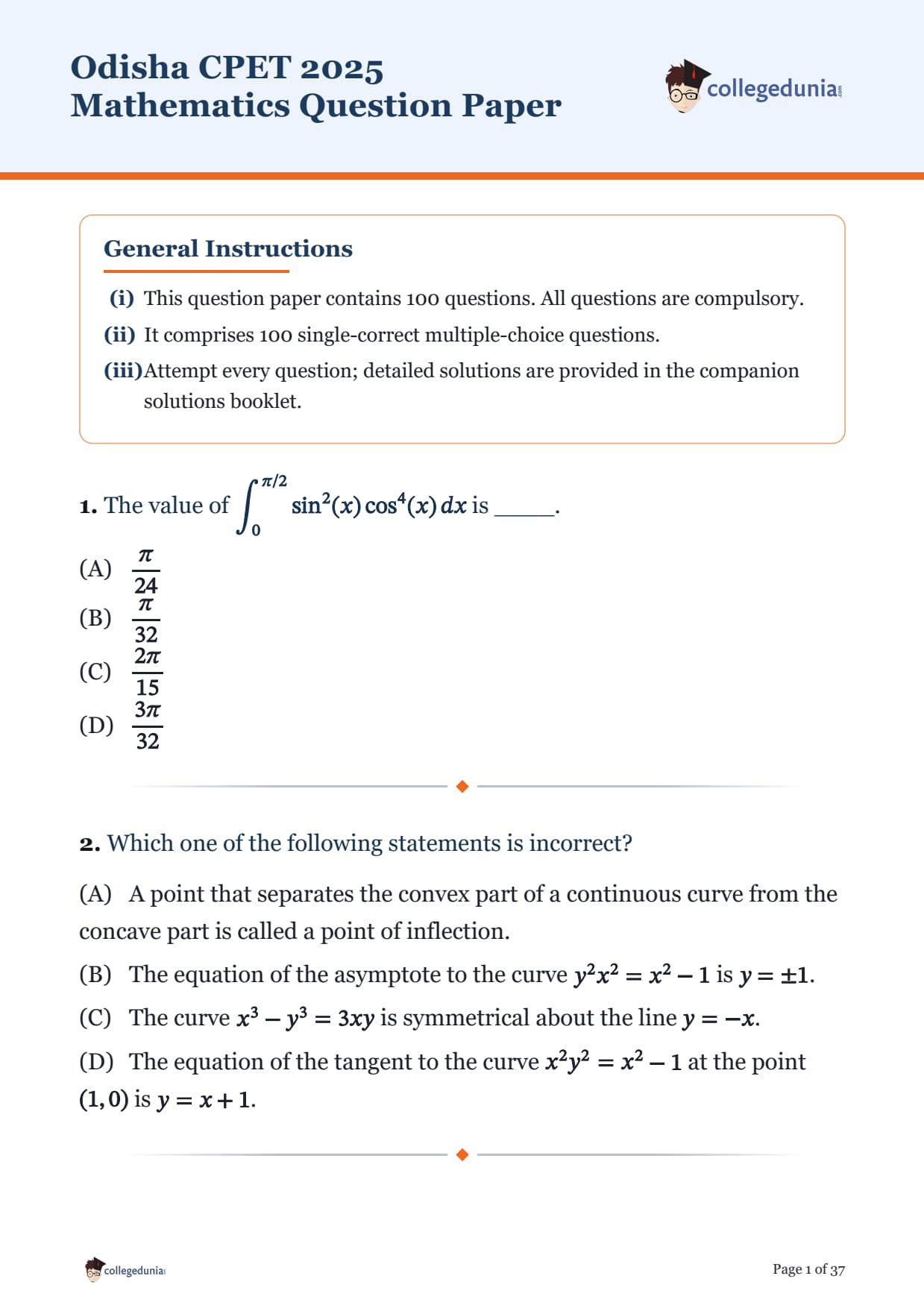
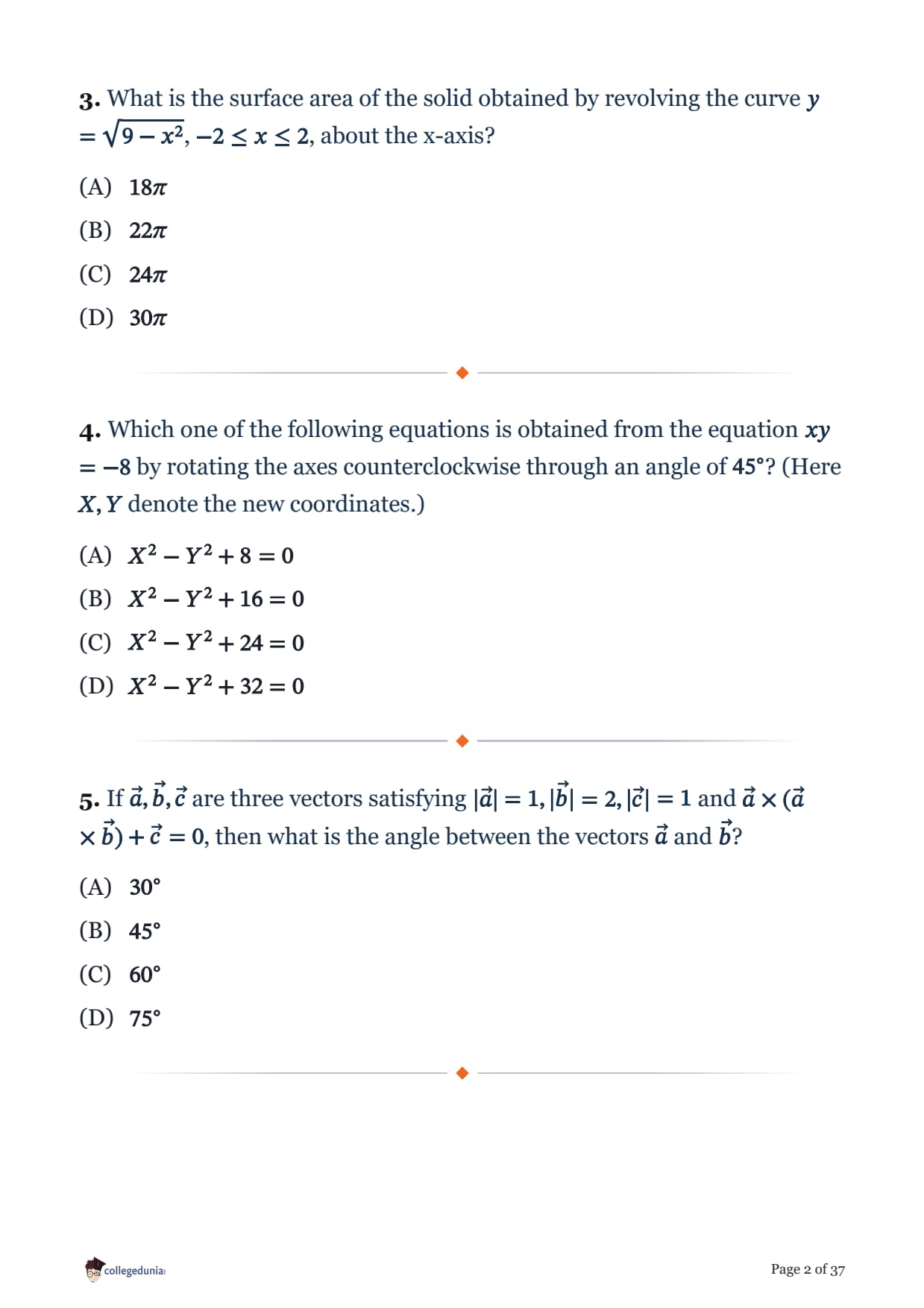
Odisha CPET 2025 Mathematics Questions with Solutions
The value of \(\displaystyle\int_0^{\pi/2} \sin^2(x)\cos^4(x)\,dx\) is ____.
Which one of the following statements is incorrect?
What is the surface area of the solid obtained by revolving the curve \(y=\sqrt{9-x^2}\), \(-2\le x\le 2\), about the x-axis?
Which one of the following equations is obtained from the equation \(xy=-8\) by rotating the axes counterclockwise through an angle of \(45^\circ\)? (Here \(X, Y\) denote the new coordinates.)
If \(\vec{a}, \vec{b}, \vec{c}\) are three vectors satisfying \(|\vec{a}|=1, |\vec{b}|=2, |\vec{c}|=1\) and \(\vec{a}\times(\vec{a}\times\vec{b}) + \vec{c} = 0\), then what is the angle between the vectors \(\vec{a}\) and \(\vec{b}\)?
Consider the following statements:
(I) The set \(\{\sin(1/x): x \in (0,1)\}\) is uncountable.
(II) The set \(\{(x,y) \in \mathbb{R}^2 : xy \in \mathbb{Z}\}\) is uncountable.
(III) The set of all \(2 \times 2\) real matrices with rational eigenvalues is uncountable.
Choose the correct answer:
For the propositions p and q, consider the following statements:
(I) \((p \vee q) \wedge (\neg p \vee \neg q)\) is a tautology.
(II) \((p \vee q) \wedge (\neg p \wedge \neg q)\) is a contradiction.
Choose the correct answer:
Which one of the following options is the general solution(s) of the linear congruences \(x \equiv 1 \pmod{3}\), \(x \equiv 2 \pmod{5}\) and \(x \equiv 3 \pmod{7}\)?
In how many ways can 12 distinct people be arranged around a circular table, if exactly two of them must always have at least one person between them?
If a, b are integers and p is a prime number, then which of the following statements is/are false?
(I) If \((a,p) = (b,p) = 1\) and \(a^k \equiv b^k \pmod{p}\) (\(k \in \mathbb{N}\)), then \(a \equiv b \pmod{p}\).
(II) If \((a,p) = 1\) and \(ax \equiv 1 \pmod{p}\), then \(a \equiv a^{p-2} \pmod{p}\).
What is the value of \(a_{32}\) from the recurrence relation: \(a_1 = 4,\ a_n = 5n + a_{n-1}\ (n \ge 2)\)?
Which one of the following statements is true for every square matrix with only real eigenvalues?
For a system \(AX = b\) of linear equations to have infinitely many solutions, which one of the following options must be true?
In a simple graph, which of the following statements is/are true?
(I) Adjacency matrix is symmetric.
(II) Trace of the adjacency matrix is 1.
Which one of the following options is always true?
Which one of the following options is incorrect for the set \(S = \{x \in \mathbb{Q} : x^2 < 5\}\)?
Which one of the following statements is incorrect?
Consider the sequences \(\{a_n\}\), \(\{b_n\}\), \(\{c_n\}\) defined for \(n \in \mathbb{N}\) by \[\text{(I) } a_n = n^2 \sin\left(\frac{1}{n}\right), \qquad \text{(II) } b_n = 1 + \frac{(-1)^n}{n}, \qquad \text{(III) } c_n = n\cos\left(\frac{1}{n}\right).\] Pick out the correct option.
Let the limits of the sequences \(\{x_n\}_{n\ge1}\) and \(\{y_n\}_{n\ge1}\) be \(\lambda\) and \(\lambda^3\) respectively. If the interleaved sequence \(x_1, y_1, x_2, y_2, x_3, y_3, \dots\) has a limit, then its value is ____.
Which of the following assertions is correct? \[\text{(I) } \lim_{n\to\infty}\left(1+\frac1n\right)^{n^2}e^{-n} = 1 \qquad \text{(II) For } 0 < a < 1 < b,\ \lim_{n\to\infty}\left(a+\frac{b}{n}\right)^n = e^{b/a}\]
Consider the following statements:
(I) If \(a_n \ge 0\) for each \(n \in \mathbb{N}\) and the series \(\sum_{n=1}^\infty a_n\) converges, then the series \(\sum_{n=1}^\infty \dfrac{\sqrt{a_n}}{n^p}\) converges for \(p > 1/2\).
(II) The series \(\sum_{n=1}^\infty (-1)^n \sin(1/n)\) is conditionally convergent.
Which one of the options given below is correct?
For a function \(f: \mathbb{R}\to\mathbb{R}\), consider the following statements:
(I) If \(\lim_{h\to0}\{f(x+h)-f(x-h)\} = 0\), then f is continuous on \(\mathbb{R}\).
(II) If \(\lim_{h\to0}\dfrac{f(x+h)-f(x-h)}{2h} = 0\), then f is differentiable on \(\mathbb{R}\).
Choose the correct answer.
Which one of the following options is true for the function \(f:\mathbb{R}\to\mathbb{R}\) defined by \(f(x) = \min\{|x|,\, x^2-1\}\), \(x\in\mathbb{R}\)?
If a function \(f:[0,1]\to\mathbb{R}\) is differentiable, \(f'(0) = -1\) and \(f'(1) = 5\), then which one of the following statements is true?
Consider the improper integrals \(I_\lambda = \displaystyle\int_0^1 \dfrac{dx}{(1-x)^\lambda}\) and \(J_\lambda = \displaystyle\int_1^\infty \dfrac{dx}{x^\lambda}\), \(\lambda \in \mathbb{R}\), and the statements:
(I) For \(\lambda = 1\), \(I_\lambda\) converges, but \(J_\lambda\) diverges.
(II) For \(\lambda = 2\), \(I_\lambda\) diverges, but \(J_\lambda\) converges.
Choose the correct option.
Evaluate: \(\displaystyle\int_0^2 \left([x^2]-[x]^2\right)dx\), where \([\cdot]\) denotes the greatest integer (floor) function.
Consider the following statements for a function \(f:[a,b]\to\mathbb{R}\):
(I) \(f\) is Riemann integrable if and only if it is bounded on \([a,b]\).
(II) \(f\) is Riemann integrable if and only if it is monotonic on \([a,b]\).
(III) \(f\) is Riemann integrable if and only if it is continuous on \([a,b]\).
Which one of the following options is correct?
The coefficient of \(x^5\) in the Taylor series expansion of \(f(x)=\tan(x)\) about the point \(x=0\) is ____.
Consider the following statements:
(I) The sequence \(\{f_n\}_{n\ge1}\) of functions defined by \(f_n(x)=x^n\) is both point-wise and uniformly convergent on \([0,1]\).
(II) The sequence \(\{f_n\}_{n\ge1}\) of functions defined by \(f_n(x)=\dfrac{\ln(1+nx)}{n}\) is both point-wise and uniformly convergent on \([0,1]\).
Choose the correct answer.
Which of the following series does not converge uniformly on \((0,1)\)?
(I) \(\displaystyle\sum_{n=1}^\infty \frac{x^n}{n+x}\)
(II) \(\displaystyle\sum_{n=1}^\infty \frac{x}{n^2+x}\)
(III) \(\displaystyle\sum_{n=1}^\infty \frac{x^n}{1+x^n}\)
Which one of the following is not a valid metric on \(\mathbb{R}\)?
Let \((X,d)\) be a metric space. If \(S\) and \(T\) are subsets of \(X\), then which one of the options given below is NOT necessarily true? (For any \(Y\subseteq X\), \(\text{Int}(Y)\) denotes the interior of \(Y\) and \(\text{Clos}(Y)\) denotes the closure of \(Y\).)
Consider the metric spaces \((C[0,1],d_1)\) and \((C[0,1],d_\infty)\), under the metrics \(d_1(f,g)=\int_0^1 |f(x)-g(x)|\,dx\) and \(d_\infty(f,g)=\sup_{x\in[0,1]}\{|f(x)-g(x)|\}\), for \(f,g\in C[0,1]\). Then which one of the options given below is correct?
Consider the following statements:
(I) \((0,1)\) and \(\mathbb{R}\) are homeomorphic.
(II) \((0,1)\) and \((0,1]\) are homeomorphic.
(III) \((0,1)\) and \([0,1]\) are homeomorphic.
Choose the correct option.
Which one of the following options is necessarily true?
Consider the function \[f(x,y)=\begin{cases}(x^2+y^2)\sin\dfrac{1}{x^2+y^2}, & (x,y)\neq(0,0)\\ 0, & (x,y)=(0,0)\end{cases}\] Which one of the following statements is correct for this function?
For the function \(f(x,y)=x^3+y^3-3xy\), consider the following statements:
(I) f has 3 critical points.
(II) f has two saddle points and one point for local minimum.
(III) f has only one saddle point, a point for local minimum and a point for local maximum.
Choose the correct answer.
A unit vector that maximizes the directional derivative of the function \(f(x,y)=g(2x+y)\), where \(g'(3)=3\), at the point (1,1) is ____.
What is the value of the integral \(\iint_D dA\), where D is the region bounded by the curve \(y=x^2\) and the line \(y=4\)?
The iterated integral \[\int_0^2\int_0^{4-y^2}\int_0^{2-x} dz\,dy\,dx\] represents the volume of which one of the following solid regions?
Which of the following statements is/are true?
(I) The vector field \(\vec{F}(x,y,z)=(yz,\,zx,\,xy)\) is solenoidal.
(II) The vector field \(\vec{F}(x,y,z)=(x^2-y^2,\,2xy,\,z^3)\) is conservative.
Consider the following assertions:
(I) \(\displaystyle\iint_S(x\hat i+y\hat j+z\hat k)\cdot\hat n\,dS=2V\), where \(\hat n\) is the unit outward surface normal and S is a closed surface enclosing a volume V.
(II) \(\displaystyle\int_C(yz\hat i+xz\hat j+xy\hat k)\cdot d\vec r=3\), where C is the boundary of a surface S.
Choose the correct option:
Consider the following statements:
(I) The function \(f(z)=\dfrac{x^2-y^2+2ixy}{x^2+y^2}\) (\(z=x+iy\)) has a limit as \(z\to0\).
(II) The function \(f(z)=\begin{cases}\operatorname{Re}(z)/|z|, & z\ne0\\ 1, & z=0\end{cases}\) is continuous at \(z=0\).
Choose the correct answer:
Which of the statements given below is/are false?
(I) \(f(z)=x^2+y^2+2ixy\) (\(z=x+iy\)) is differentiable only at the points that lie on the x-axis.
(II) \(f(z)=|z-1|^2\) is differentiable at \(z=1\), but not analytic at \(z=1\).
(III) There exists an analytic function in \(\mathbb{C}\) whose imaginary part is \(x^2\).
Which one of the following options is true?
(A) If \(\operatorname{Log}(z)\) denotes the principal value of the logarithm, then \(\operatorname{Log}(zw)=\operatorname{Log}(z)+\operatorname{Log}(w)\) for all \(z,w\in\mathbb{C}\setminus\{0\}\).
(B) The solution set of the equation \(e^{iz}=-1\) is \(\{(2k+1)\pi:k\in\mathbb{Z}\}\).
(C) \(\cos(z)\) is bounded in the whole complex plane.
(D) A Mobius transformation with three fixed points is a constant.
The radius of convergence of the power series \(\sum_{n=1}^\infty\left(\frac{2^n}{n}+\frac{3^n}{n^2}\right)z^n\) is ____.
If \(C\) is a simple closed curve not passing through the points \(-1\), \(0\) and \(1\) in the complex plane, then the set of all possible value(s) of the integral \(\int_C \dfrac{dz}{z(1-z^2)}\) is ____.
Which one of the options given below is false?
For an entire function \(f\), which one of the following statements is false?
If \(\displaystyle\sum_{n=-\infty}^{\infty}a_nz^n\) is the Laurent series expansion of the function \(f(z)=\dfrac{1}{2z^2-13z+15}\) in the annulus \(\{z\in\mathbb{C}:3/2<|z|<5\}\), then \(a_1/a_2=\) ____.
Which of the following statements is/are true?
(I) The function \(f(z)=\sin\left(\frac{1}{\cos(1/z)}\right)\) has an isolated singularity at \(z=0\).
(II) The value of the integral \(\oint_{|z|=1}\frac{dz}{z\sin(z)}\) is zero.
Consider the following statements:
(I) Residue of \(f(z)=e^z\) at \(z=\infty\) is \(-1\).
(II) If a meromorphic function \(f\) has 5 simple zeros and 2 simple poles inside \(|z|=1\), then \(\oint_{|z|=1}\frac{f'(z)}{f(z)}dz = 6i\pi\).
Pick out the correct option.
In the dihedral group \(D_5=\{r,s:\; r^5=e,\; s^2=e,\; sr=r^{-1}s\}\) under composition as the binary operation, which of the following options is NOT true?
In a group \(G\), let \(x^5=e\) (\(e\): identity element of \(G\)) and \(xyx^{-1}=y^2\) for \(x,y\in G\). If \(y\ne e\), then the order of \(y\) is ____.
Let \(G\) be a finite Abelian group. If the subgroups \(H\) and \(K\) are of index 3 each in \(G\), then what is the index of the subgroup \(H\cap K\) in \(G\)?
Which of the following statements is/are true?
(I) The maximum possible order of an element in the group \(S_5\) (with composition \(\circ\)) is 6.
(II) If \(f:(S_3,\circ)\to(\mathbb{Z}_6,+_6)\) is a group homomorphism, then the order of \(f(S_3)\) is 1, 2 or 3.
Which one of the following statements is incorrect?
(I) The group \(\mathbb{Z}_{15}\) is isomorphic to \(\mathbb{Z}_3\times\mathbb{Z}_5\)
(II) \(\text{Inn}(A_3)\) is isomorphic to \(A_3\)
Which of the following statements is/are correct?
(I) In \(GL_2(\mathbb{R})\), matrices with the same determinant always belong to the same conjugacy class.
(II) The class equation of \(A_5\) (the alternating group on 5 elements) is \(60=1+6+10+15+28\).
Which of the following statements is false?
(I) \(\mathbb{Z}_5\times\mathbb{Z}_7\) is a cyclic group.
(II) The order of the element \((2,5)\in\mathbb{Z}_5\times\mathbb{Z}_7\) is 10.
(III) \(\text{Aut}(\mathbb{Z}_5\times\mathbb{Z}_7)\) is isomorphic to \(\mathbb{Z}_{35}\).
Which one of the following options is correct? (\(p\) is a prime number.)
If \(G\) is a group of order 30, then the number of Sylow 5-subgroups in \(G\) must be ____.
On \(R=\left\{\begin{pmatrix}a&b\\0&c\end{pmatrix}: a,b,c\in\mathbb{R}\right\}\) with the usual addition and multiplication of matrices, which of the following statements is true?
Which of the following statements is/are false?
(I) \(I=\left\{\begin{pmatrix}a&0\\c&d\end{pmatrix}: a,c,d\in\mathbb{R}\right\}\) is both a subring and an ideal of \(M_2(\mathbb{R})\).
(II) \(\mathbb{Z}[\sqrt2]=\{a+b\sqrt2 : a,b\in\mathbb{Z}\}\) is an integral domain, but not a field.
Which one of the following options is correct for the ideal \(I=\langle x^2+5\rangle\) in the ring \(\mathbb{Q}[x]\)?
Consider the following statements:
(I) The kernel of the ring homomorphism \(f:\mathbb{Z}[x]\to\mathbb{Z}\) given by \(f(p(x))=p(1)\) is \(\{(x-1)q(x): q(x)\in\mathbb{Z}[x]\}\).
(II) The ring \(\mathbb{Z}_4\) is isomorphic to \(\mathbb{Z}_2\times\mathbb{Z}_2\).
Choose the correct answer:
Which one of the following options is incorrect?
Which of the statements given below is/are true?
(I) \(\mathbb{Z}[i]\) is a Principal ideal domain and Euclidean domain.
(II) \(\mathbb{Z}[\sqrt{-5}]\) is neither a Principal ideal domain nor a Unique factorization domain.
Let V be the real vector space consisting of all polynomials in one real variable with real coefficients of degree at most 6, including the zero polynomial. Then which one of the following options is true?
For a real \(4 \times 3\) matrix \(M\) and the standard basis \(\{e_1,e_2,e_3\}\) of \(\mathbb{R}^3\), which of the following statements is/are true?
(I) If \(\text{rank}(M)=1\), then \(\{Me_1,Me_2\}\) is a linearly independent set in \(\mathbb{R}^4\).
(II) If \(\text{rank}(M)=2\), then \(\{Me_1,Me_2\}\) is a linearly independent set in \(\mathbb{R}^4\).
(III) If \(\text{rank}(M)=3\), then \(\{Me_1,Me_2\}\) is a linearly independent set in \(\mathbb{R}^4\).
Let V be a 7-dimensional vector space. If U, W are subspaces of V with dimensions 4 and 5 respectively, then which of the following is NOT a possible value of dimension of \(U \cap W\)?
For a linear transformation \(L:V\to W\) with \(\dim(V)=10\) and \(\dim(W)=8\), which one of the following options is correct?
Let \(L\) be a linear transformation defined on the vector space \(\mathbb{R}^6\) over the field \(\mathbb{R}\). If \(\operatorname{Rank}(L)=4\) and \(\operatorname{Nullity}(L^2)=3\), then \(\operatorname{Rank}(L^2)\) is ____ (\(L^2\) denotes the composition of \(L\) with itself).
On the vector space \(\mathbb{R}^3\) over the field \(\mathbb{R}\) with the standard basis \(\{e_1,e_2,e_3\}\), what is the annihilator \((S^0)\) of the subspace \(S=\text{span}\{e_1,e_2\}\)?
If \(\lambda_1,\lambda_2,\lambda_3\) are the eigenvalues of the matrix \[\begin{pmatrix}-2&2&-3\\2&1&-6\\-1&-2&0\end{pmatrix}\] then the value of \(\lambda_1^2+\lambda_2^2+\lambda_3^2\) is ____.
If the eigenvalue \(\lambda\) of a matrix \(M\) has algebraic multiplicity 3 and geometric multiplicity 2, then which one of the following options is true?
Which one of the following matrices has \(p(x) = x^3 - 8x^2 + 5x + 7\) as the minimal polynomial?
Let \((V, \langle,\rangle)\) be an inner product space and let \(\langle x,y\rangle = \|x\|\|y\|\) for all \(x,y \in V\). Then which one of the following options is true?
The projection of the vector \(u=(2,-1,3) \in \mathbb{R}^3\) onto the vector \(v=(1,2,-1)\) of the vector space \(\mathbb{R}^3\) is ____.
Which one of the following statements is false?
(I) The linear transformation \(L:\mathbb{R}^2 \to \mathbb{R}^2\) that reflects a vector across the line \(y=x\) is both self-adjoint and normal.
(II) The linear transformation \(L:\mathbb{R}^2 \to \mathbb{R}^2\) which rotates a vector by an angle \(\pi/4\) in the anti-clockwise direction is both self-adjoint and normal.
What does the differential equation \((2x+y+1)dx+(x+2y+1)dy=0\) represent?
If the non-homogeneous term in an ordinary differential equation (ODE) is \(xe^{3x}\) and 3 is a root of the characteristic equation with multiplicity 2, then what is the form of the particular solution (i.e. \(y_p\))? (c is a constant.)
The Bernoulli equation \(\frac{dy}{dx}+P(x)y=Q(x)y^3\) is best solved by making which of the following substitutions?
The general solution of the ODE \((D^2+6D+9)y=\frac{e^{-3x}}{x^3}\), \(D=\frac{d}{dx}\) (\(c_1,c_2\) are arbitrary constants) is ____.
Which one of the following options is true for the initial value problem: \(\frac{dy}{dx}=2y^{1/3}\), \(y(0)=0\)?
If \(u=x^3\) and \(v=y^2\) transforms the ODE: \(3x^5dx - y(y^2-x^3)dy=0\) into \(\frac{dy}{du}=\frac{\lambda u}{(u-v)}\), then what is the value of \(\lambda\)?
If the roots of the characteristic equation of the Euler's ODE has a repeated root m, then what is the correct form of the general solution? (\(c_1,c_2\) are arbitrary constants.)
The general solution of the linear partial differential equation (PDE): \(x\frac{\partial u}{\partial x}+y\frac{\partial u}{\partial y}=z\) is ____ (\(\phi\) is an arbitrary function).
In solving the heat equation using separation of variables, the eigenvalues correspond to ____.
Which of the following statements is/are true for the PDE: \((1+x^2)u_{xx}+(1+y^2)u_{yy}+xu_x+yu_y=0\)?
(I) It is classified as parabolic PDE.
(II) The canonical equation is \(u_{\xi\xi}+u_{\eta\eta}=0\).
Solution of the PDE \(u_x+yu_y=0\) with the initial condition \(u(0,y)=y^3\) is ____.
A string of length 1 meter is fixed at both ends and obeys the wave equation \(u_{tt}=4u_{xx}\) with initial conditions: \(u(x,0)=\sin(\pi x)\), \(u_t(x,0)=0\). Then its solution \(u(x,t)\) is ____.
The solution of the system of ODEs: \(\frac{dx}{dt}=x+2y\), \(\frac{dy}{dt}=3x+2y\) with initial conditions x(0)=6 and y(0)=4 is ____.
Regula Falsi method is used to find a root of the equation \(f(x)=x^3-x-1\) by choosing the initial guesses \(x_0=1\) and \(x_1=2\). What would be the value of the next iteration (i.e. \(x_3\)) up to two decimal places?
Using Newton's divided difference method, the second divided difference for the function values f(1)=2, f(2)=3, f(4)=7 is approximately equal to ____.
Which of the following statements is/are true?
(I) Gauss-Seidel method for solving a linear system converges faster than the Gauss-Jacobi method.
(II) In the Gauss-Jordan method for solving a linear system, the coefficient matrix is transformed into an upper triangular matrix.
Using Lagrange interpolation with the following function values, find the approximate value of \(f(2)\).
| x | 0 | 1 | 3 |
|---|---|---|---|
| f(x) | 1 | 2 | 4 |
What is the approximate value of the integral \(\int_0^1(x+x^2)\,dx\), when Simpson's 1/3-rd rule is applied with 2 sub-intervals?
Which one of the following statements about the central difference and averaging operators is correct?
For what value(s) of the constants \(a\), \(b\) and \(c\) is the quadrature formula \[\int_{-1}^1 f(x)\,dx \approx af(-1)+bf(0)+cf(1)\] exact for polynomials of degree up to 3?
Odisha CPET 2025 Mathematics Exam Pattern and Marking Scheme Explained
As per the test booklet issued by the State Selection Board, Odisha (admission portal pg.samsodisha.gov.in), the Mathematics paper is a single-best-answer MCQ test held on 11 May 2025.
- Total questions: 100 MCQs (Subject Code 27)
- Duration: 80 minutes
- Total marks: 100
- Marking scheme: +1 for a correct answer, -0.25 for a wrong one
- Question types: single-best-answer MCQs, four options (A)-(D) each
High-Weightage Topics in Odisha CPET 2025 Mathematics
- Real analysis - sequences, series convergence, continuity, differentiability, Riemann integrability and metric spaces make up the largest single block of the paper
- Abstract algebra - group theory (Sylow theorems, dihedral and symmetric groups), ring theory and ideals recur across a long stretch of questions
- Complex analysis - Cauchy-Riemann equations, residues, Laurent series and contour integration
- Linear algebra - rank-nullity, eigenvalues, minimal polynomials and inner product spaces
- Differential equations and numerical methods - ODEs, PDEs by Lagrange's method, and standard numerical techniques (Regula Falsi, Simpson's rule, interpolation) close out the paper
Odisha CPET 2025 Mathematics Question Paper Analysis Video
Source: Krishnam Academy
How to Use the Odisha CPET Mathematics Question Paper for Practice
Solve the paper as a timed 80-minute mock first, then check every answer against the step-by-step solution PDF before moving on.
- Attempt all 100 questions under exam conditions before looking at any solution
- Re-derive every proof-based statement (group theory, real analysis) yourself instead of just reading the given argument
- Group your mistakes by topic (algebra, analysis, complex analysis, ODEs/PDEs, numerical methods) and redo that topic's questions from other years
- Watch the negative marking - with -0.25 per wrong answer, skip a question rather than guessing blind
Odisha CPET 2025 Mathematics Question Paper FAQs
Ques. How many questions are in the Odisha CPET 2025 Mathematics paper and how much time do I get?
Ans. The Mathematics paper (Subject Code 27) has 100 multiple-choice questions to be solved in 80 minutes, carrying 100 total marks.
Ques. What is the marking scheme for Odisha CPET 2025 Mathematics?
Ans. You get +1 mark for each correct answer and -0.25 for each wrong answer, so unattempted questions are safer than guesses you are not confident about.
Ques. What level of Mathematics does the Odisha CPET syllabus cover?
Ans. The paper is set at postgraduate entrance level, covering real analysis, abstract algebra, complex analysis, linear algebra, ordinary and partial differential equations, and numerical methods.
Ques. Is a scientific calculator allowed in Odisha CPET 2025?
Ans. No. The test booklet instructions explicitly bar calculators, cell phones, and any other communication or computing device inside the exam hall.
Ques. Where can I download the Odisha CPET 2025 Mathematics question paper with solutions PDF for free?
Ans. Use the download table above on Collegedunia for the solved PDF, or check pg.samsodisha.gov.in for the original released paper.



Comments