




IIITH UGEE 2026 Question Paper is available for download here. IIIT Hyderabad conducted IIITH UGEE 2026 exam on May 2 from 9 AM to 12 PM.
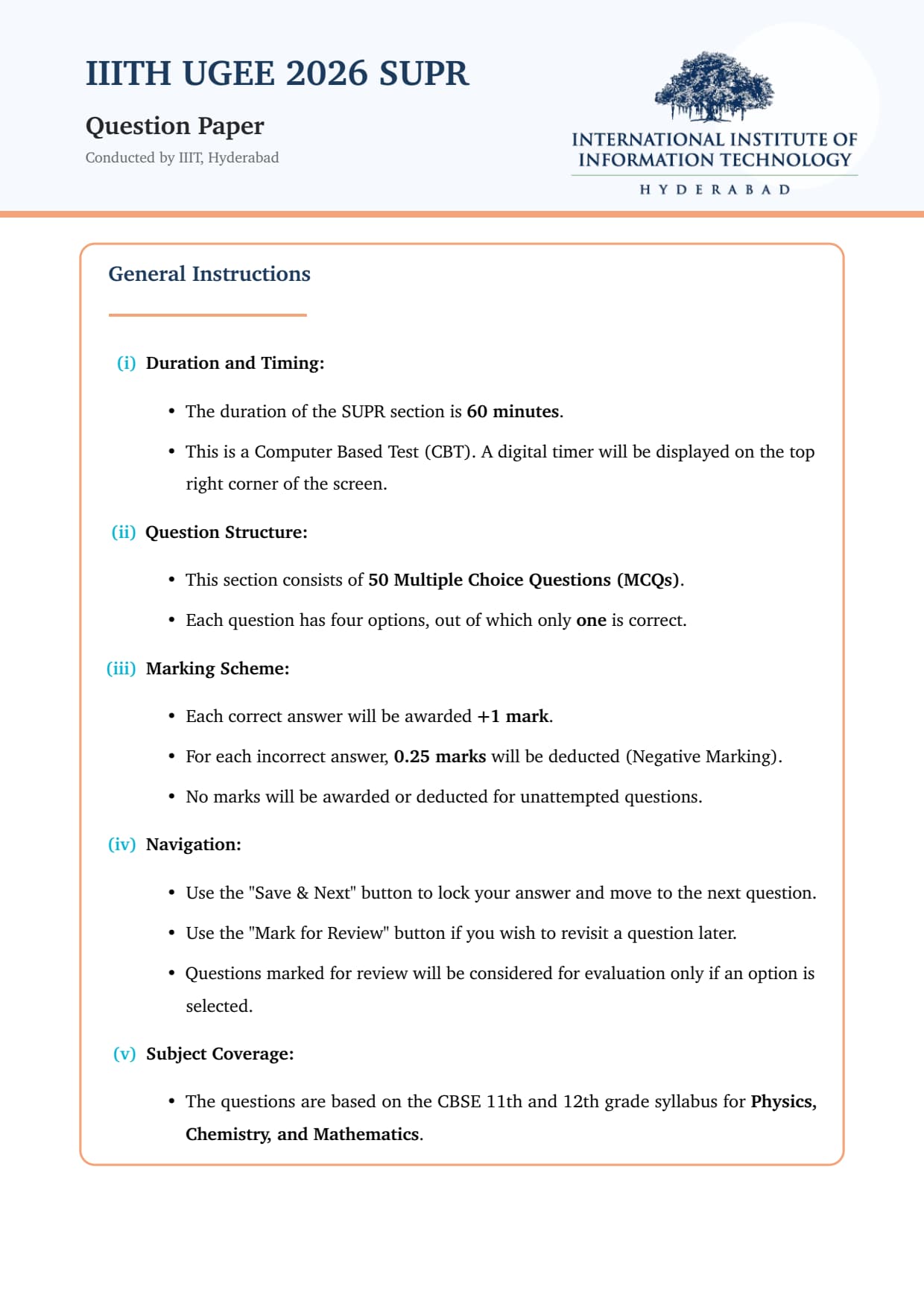
- IIITH UGEE question paper is divided into two sections: the Subject Proficiency Test (SUPR) and the Research Aptitude Test (REAP).
- The SUPR section is 60 minutes long, and the REAP section is 120 minutes.
Candidates can download IIITH UGEE 2026 Question Paper with Answer Key and Solution PDF from the links provided below
IIITH UGEE 2026 Question Paper with Solution PDF( Memory Based)
| IIITH UGEE 2026 SUPR Question Paper | Download PDF | Check Solution |
| IIITH UGEE 2026 REAP Question Paper | Download PDF | Check Solution |
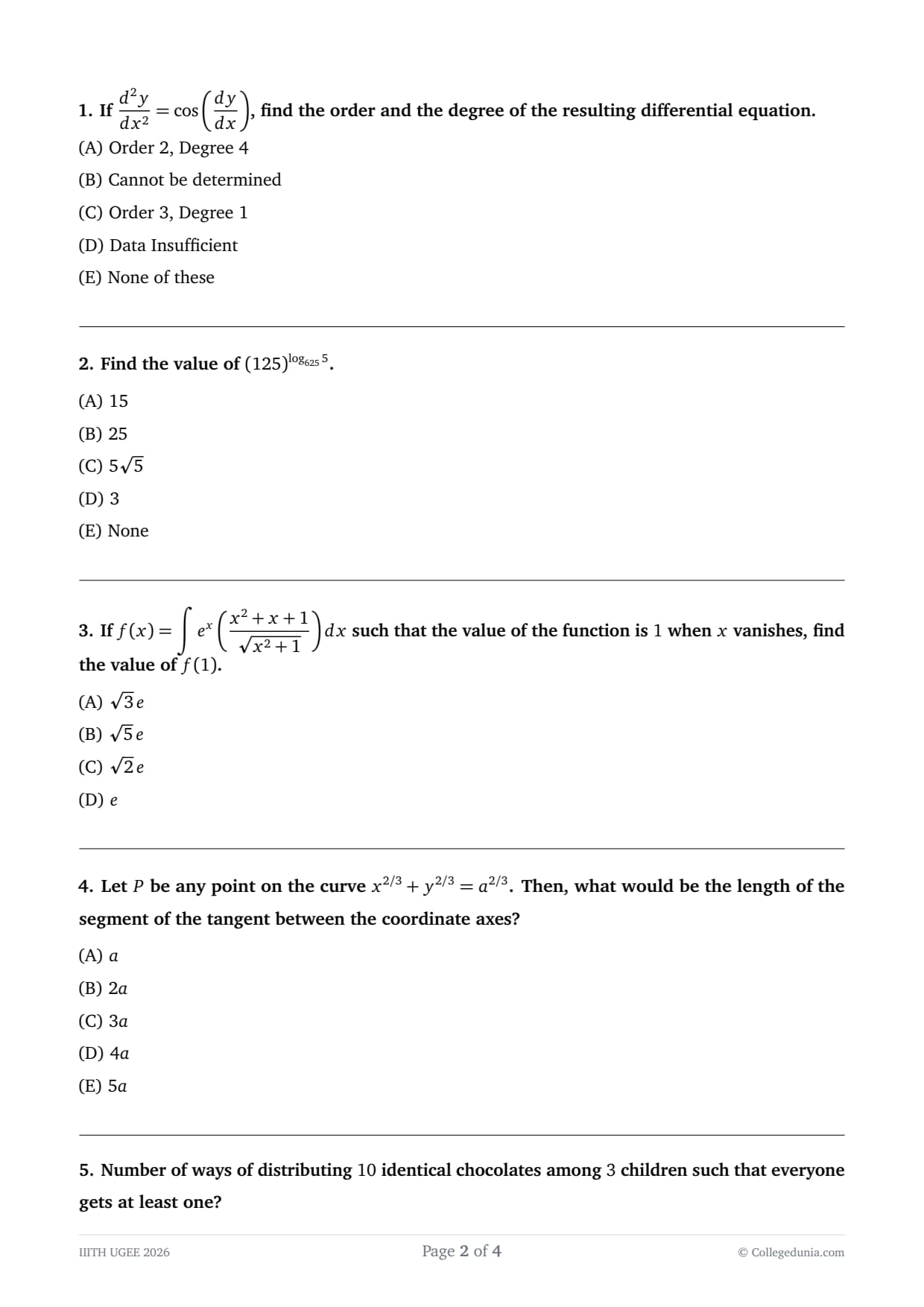
If \( \dfrac{d^2y}{dx^2} = \cos \left(\dfrac{dy}{dx}\right) \), find the order and the degree of the resulting differential equation.
Find the value of \( (125)^{\log_{625} 5} \).
If \( f(x) = \displaystyle \int e^x \left(\frac{x^2 + x + 1}{\sqrt{x^2 + 1}}\right) dx \) such that the value of the function is \(1\) when \(x\) vanishes, find the value of \(f(1)\).
Let \(P\) be any point on the curve \(x^{2/3}+y^{2/3}=a^{2/3}\). Then, what would be the length of the segment of the tangent between the coordinate axes?
Number of ways of distributing \(10\) identical chocolates among \(3\) children such that everyone gets at least one?
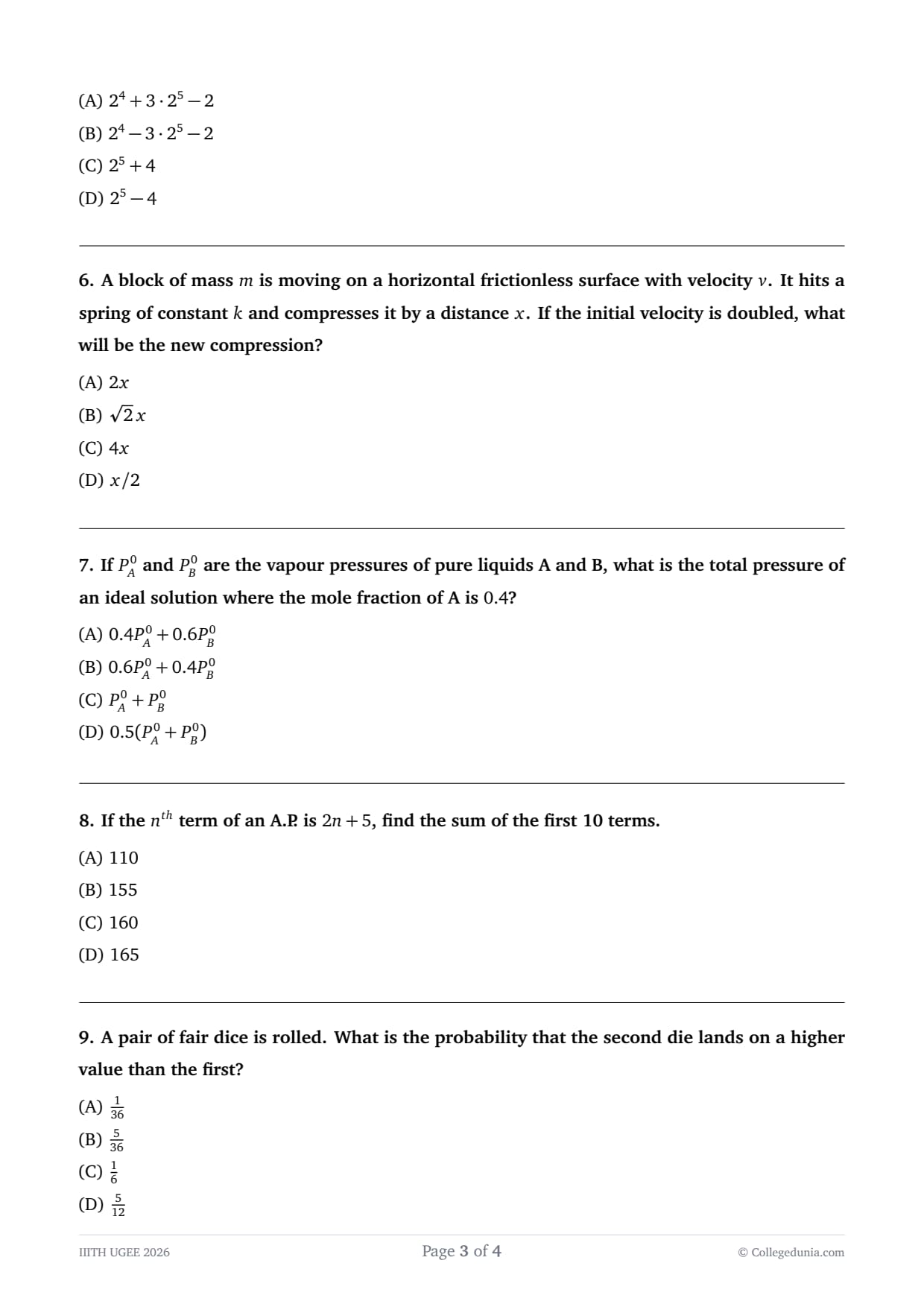
A block of mass \(m\) is moving on a horizontal frictionless surface with velocity \(v\). It hits a spring of constant \(k\) and compresses it by a distance \(x\). If the initial velocity is doubled, what will be the new compression?
If \(P_A^{0}\) and \(P_B^{0}\) are the vapour pressures of pure liquids A and B, what is the total pressure of an ideal solution where the mole fraction of A is \(0.4\)?
If the \(n^{th}\) term of an A.P. is \(2n + 5\), find the sum of the first 10 terms.
A pair of fair dice is rolled. What is the probability that the second die lands on a higher value than the first?
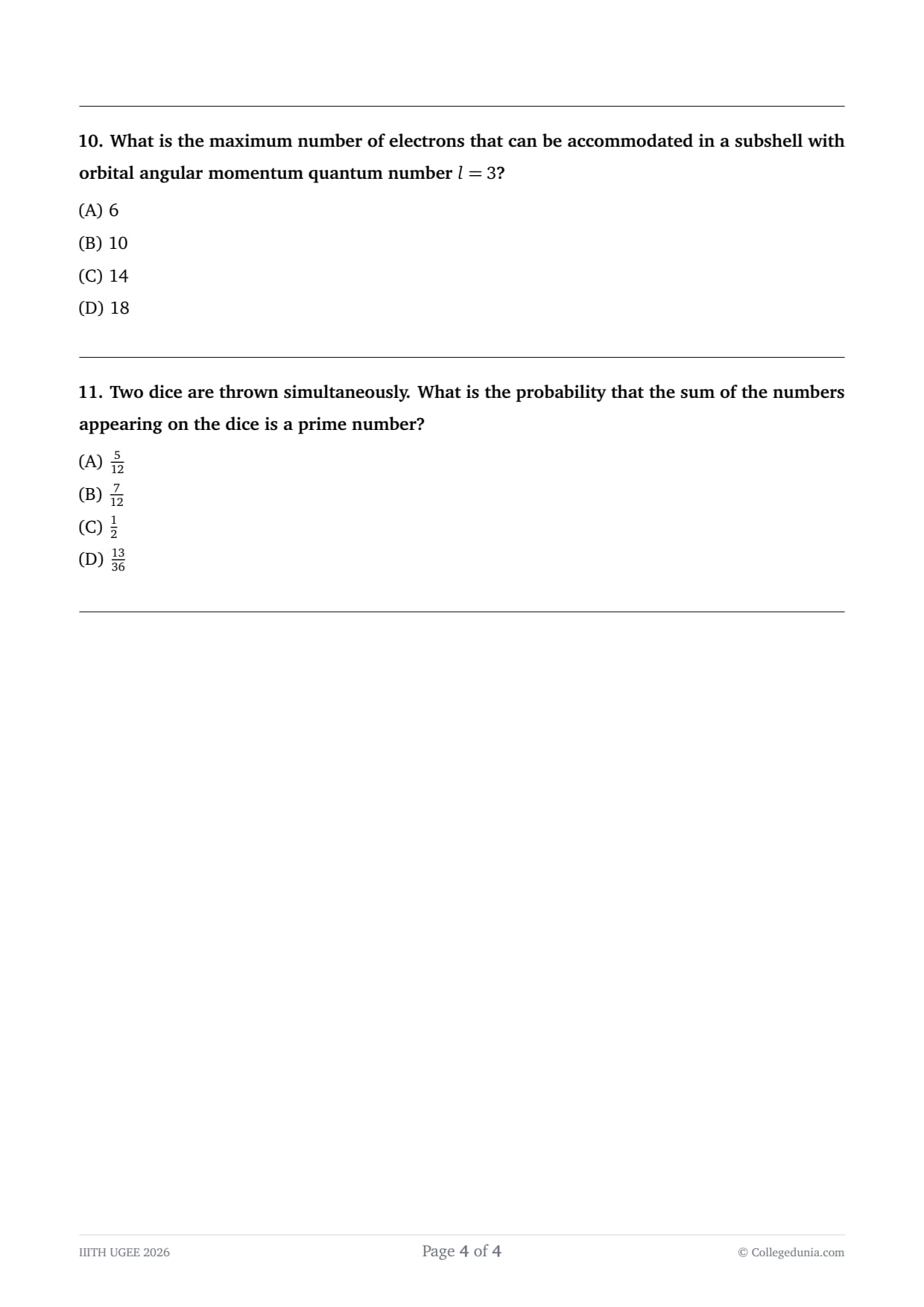
What is the maximum number of electrons that can be accommodated in a subshell with orbital angular momentum quantum number \(l = 3\)?
Two dice are thrown simultaneously. What is the probability that the sum of the numbers appearing on the dice is a prime number?
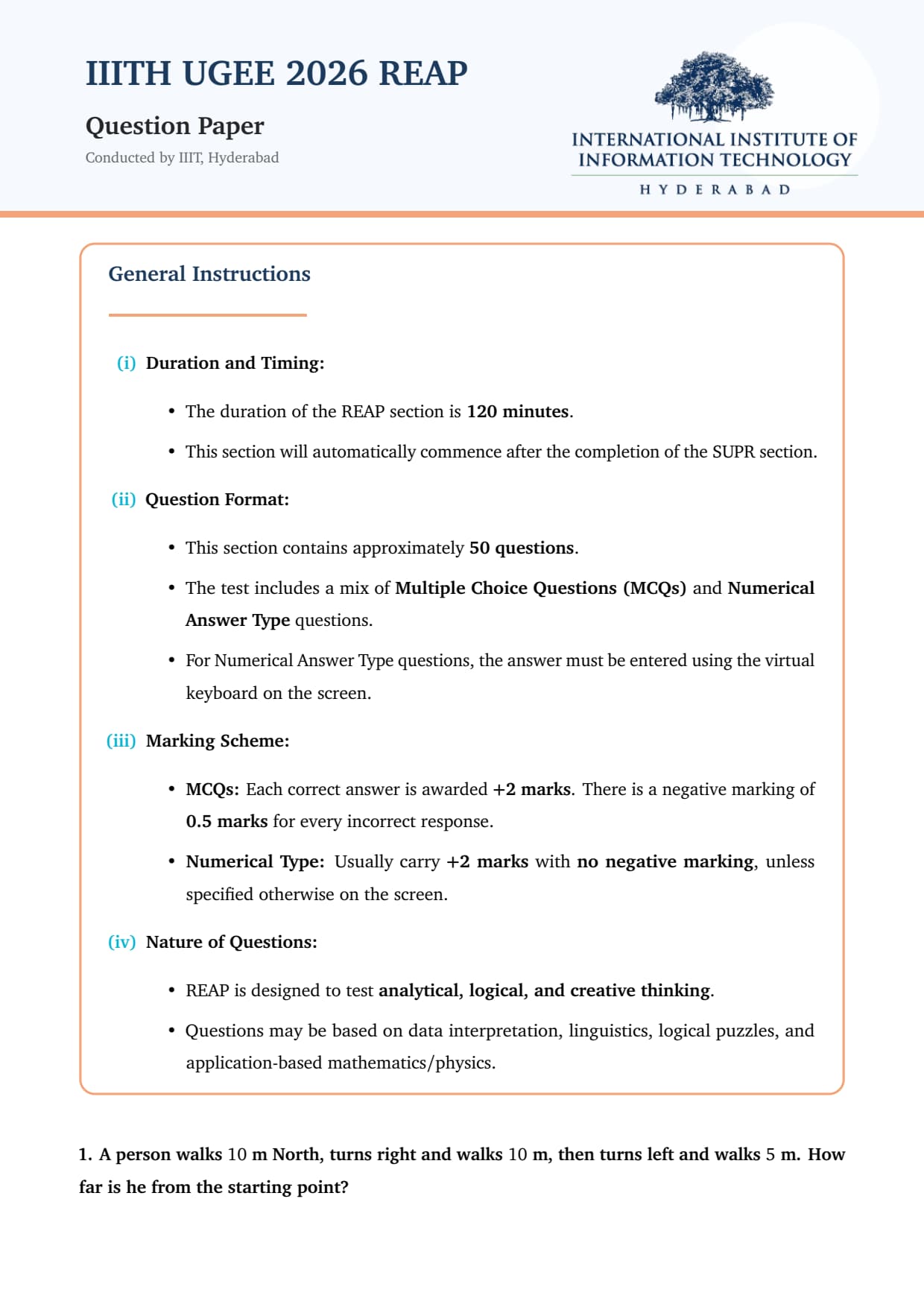
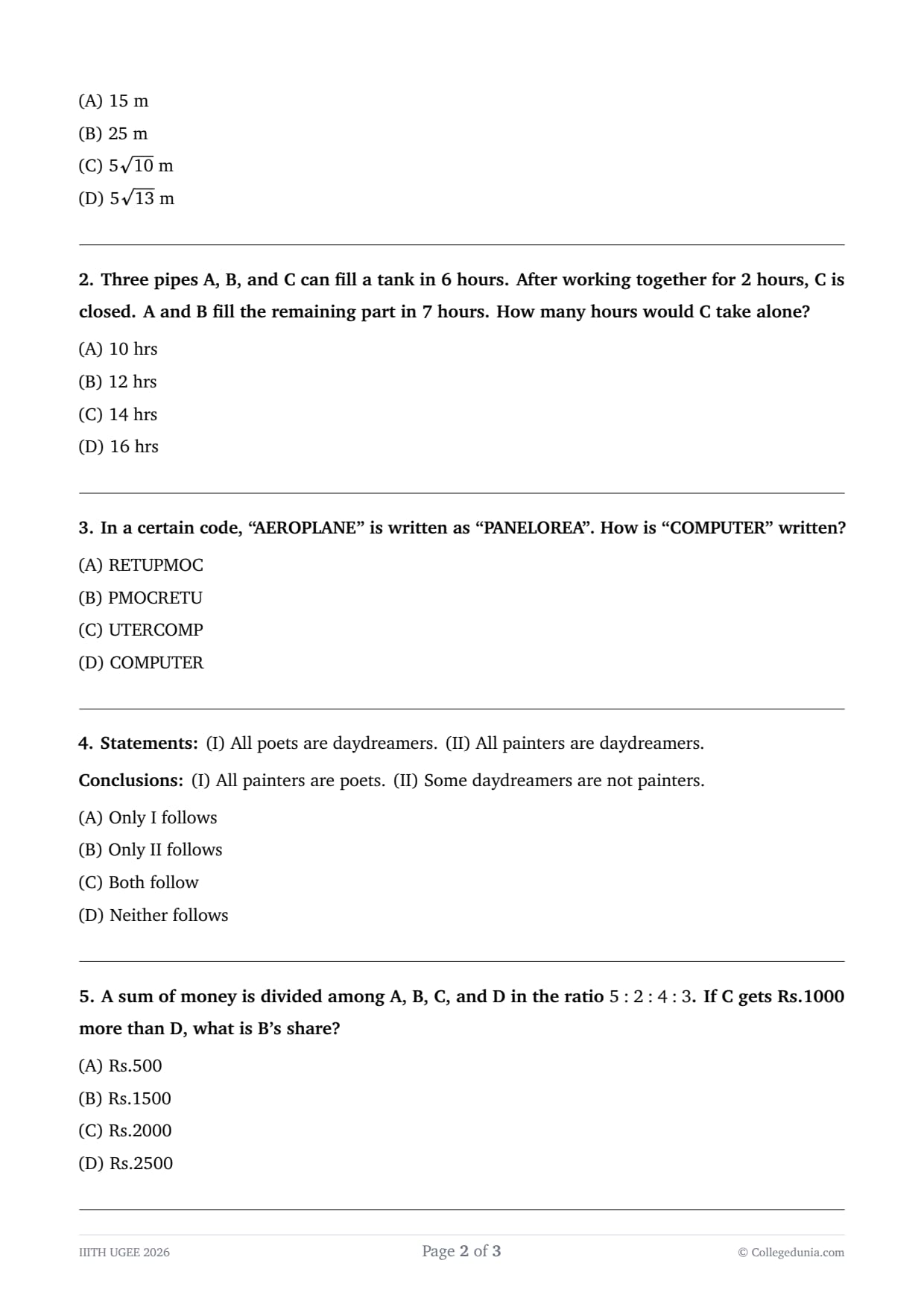
A person walks \(10\) m North, turns right and walks \(10\) m, then turns left and walks \(5\) m. How far is he from the starting point?
View Solution
Concept:
When movements occur in perpendicular directions, the shortest distance (displacement) between the starting point and final point is found using the Pythagoras theorem.
\[ Distance = \sqrt{(Total Horizontal Displacement)^2 + (Total Vertical Displacement)^2} \]
Step 1: Determine the vertical displacement.
The person walks:
\(10\) m North (initial movement)
\(5\) m North (after turning right to East, then left back to North)
Total vertical displacement: \[ 10 + 5 = 15 m \]
Step 2: Determine the horizontal displacement.
After walking \(10\) m North, the person turns right (East) and walks: \[ 10 m East \]
Total horizontal displacement: \[ 10 m \]
Step 3: Apply Pythagoras theorem.
\[ Distance = \sqrt{15^2 + 10^2} \]
\[ = \sqrt{225 + 100} = \sqrt{325} \]
Factoring out the perfect square: \[ \sqrt{25 \times 13} = 5\sqrt{13} m \] Quick Tip: In direction problems, map out the journey on a coordinate plane. Sum all North/South movements for the y-component and all East/West movements for the x-component before using \(\sqrt{x^2 + y^2}\).
Three pipes A, B, and C can fill a tank in 6 hours. After working together for 2 hours, C is closed. A and B fill the remaining part in 7 hours. How many hours would C take alone?
View Solution
Concept:
In pipe and cistern problems, work is measured as the fraction of the tank filled per unit of time.
\[ Work Rate = \frac{1}{Time} \]
The combined rate of multiple pipes is the sum of their individual rates.
Step 1: Find the work done by A + B + C together.
Since all three pipes fill the tank in \(6\) hours, their combined rate is: \[ Rate of (A+B+C) = \frac{1}{6} tank/hr \]
Work done in the first \(2\) hours: \[ 2 \times \frac{1}{6} = \frac{1}{3} of the tank \]
Step 2: Find the remaining work and the rate of A + B.
The remaining part of the tank is: \[ 1 - \frac{1}{3} = \frac{2}{3} \]
A and B fill this remaining \(\frac{2}{3}\) in \(7\) hours. Thus, their combined rate is: \[ Rate of (A+B) = \frac{2/3}{7} = \frac{2}{21} tank/hr \]
Step 3: Find the work rate of pipe C.
The individual rate of pipe C is found by subtracting the rate of (A+B) from the total rate: \[ Rate of C = Rate of (A+B+C) - Rate of (A+B) \] \[ = \frac{1}{6} - \frac{2}{21} \]
Taking the LCM of \(6\) and \(21\), which is \(42\): \[ = \frac{7}{42} - \frac{4}{42} = \frac{3}{42} = \frac{1}{14} \]
Thus, pipe C fills \(\frac{1}{14}\) of the tank per hour. The time taken by C alone is: \[ Time = \frac{1}{1/14} = 14 hours \] Quick Tip: To simplify fractions in time and work, use the "Total Units" method: Assume the tank capacity is the LCM of the given times (e.g., \(42\) units). Total rate \(= 7\) units/hr. In \(2\) hrs, \(14\) units are filled. Remaining \(28\) units filled by A+B in \(7\) hrs \(\rightarrow\) A+B rate \(= 4\) units/hr. Thus, C's rate \(= 7 - 4 = 3\) units/hr. Time for C \(= 42/3 = 14\) hrs.
In a certain code, ``AEROPLANE'' is written as ``PANELOREA''. How is ``COMPUTER'' written?
View Solution
Concept:
In coding–decoding questions, the pattern often involves rearranging letters, splitting words into segments, or reversing parts of the word.
Step 1: Analyze the given coding pattern.
The word is ``AEROPLANE''. Notice the middle letter 'P' acts as a pivot or the start of the second segment.
Split the word into the first four letters and the last five: \[ AERO \quad | \quad PLANE \]
Reverse each part: \[ AERO \rightarrow OREA \] \[ PLANE \rightarrow ENALP (or rearranged to PANEL) \]
In this specific pattern, the second half reversed (PANEL) is placed before the first half reversed (OREA): \[ PANEL + OREA = PANELOREA \]
Step 2: Apply the same logic to ``COMPUTER''.
Split the 8-letter word into two equal halves: \[ COMP \quad | \quad UTER \]
Reverse each half: \[ COMP \rightarrow PMOC \] \[ UTER \rightarrow RETU \]
Step 3: Combine the reversed parts.
Following the pattern (Second Reversed + First Reversed): \[ RETU + PMOC does not match options. \]
Checking the alternative pattern (First Reversed + Second Reversed): \[ PMOC + RETU = PMOCRETU \]
This matches option (B). Quick Tip: When the letter count differs between the example and the target word, focus on the symmetry. For an 8-letter word like COMPUTER, a 4-4 split is the most common logical starting point.
Statements:
(I) All poets are daydreamers.
(II) All painters are daydreamers.
Conclusions:
(I) All painters are poets.
(II) Some daydreamers are not painters.
View Solution
Concept:
In syllogism problems, relationships between groups are interpreted using set logic (Venn Diagrams). A conclusion follows only if it is always true based on the given premises.
Given statements:
All poets are daydreamers.
All painters are daydreamers.
This implies that the set of ``Poets'' and the set of ``Painters'' are both contained within the larger set of ``Daydreamers.''
Step 1: Analyze Conclusion I.
Conclusion I: All painters are poets.
The premises state that both groups are daydreamers, but they provide no information about the relationship between painters and poets themselves. They could be separate sets, overlapping sets, or one could be a subset of the other. Because it is not certain, this conclusion does not follow.
Step 2: Analyze Conclusion II.
Conclusion II: \textit{Some daydreamers are not painters.
We know all painters are daydreamers. However, in formal logic, this does not automatically mean the set of daydreamers is larger than the set of painters. It is possible that the set of painters and daydreamers are identical. Since we cannot prove that there \textit{must be daydreamers outside the painter circle, this conclusion does not necessarily follow.
Step 3: Final conclusion.
Since neither Conclusion I nor Conclusion II is guaranteed by the statements, the answer is neither follows. Quick Tip: To test a conclusion, try to draw a Venn Diagram that satisfies the statements but \textbf{contradicts the conclusion. If you can draw such a diagram, the conclusion does not follow.
A sum of money is divided among A, B, C, and D in the ratio \(5:2:4:3\). If C gets Rs.1000 more than D, what is B's share?
View Solution
Concept:
When a total amount is divided in a ratio, each share can be expressed as a multiple of a common factor \(x\).
If the ratio is \(a:b:c:d\), the individual shares are: \[ ax,\; bx,\; cx,\; dx \]
Step 1: Express the shares using a common factor.
Given the ratio \(A:B:C:D = 5:2:4:3\), we let: \[ A = 5x, \quad B = 2x, \quad C = 4x, \quad D = 3x \]
Step 2: Use the given difference between C and D.
The problem states that C gets Rs.1000 more than D: \[ C - D = 1000 \]
Substituting the values in terms of \(x\): \[ 4x - 3x = 1000 \] \[ x = 1000 \]
Step 3: Find B's share.
B's share is \(2x\): \[ B = 2(1000) = 2000 \]
Thus, B's share is \[ \boxed{Rs.2000} \] Quick Tip: To save time, look at the "parts" directly. The difference between C (4 parts) and D (3 parts) is 1 part. Since 1 part = Rs.1000, B's share (2 parts) is simply \(2 \times 1000 = Rs.2000\).
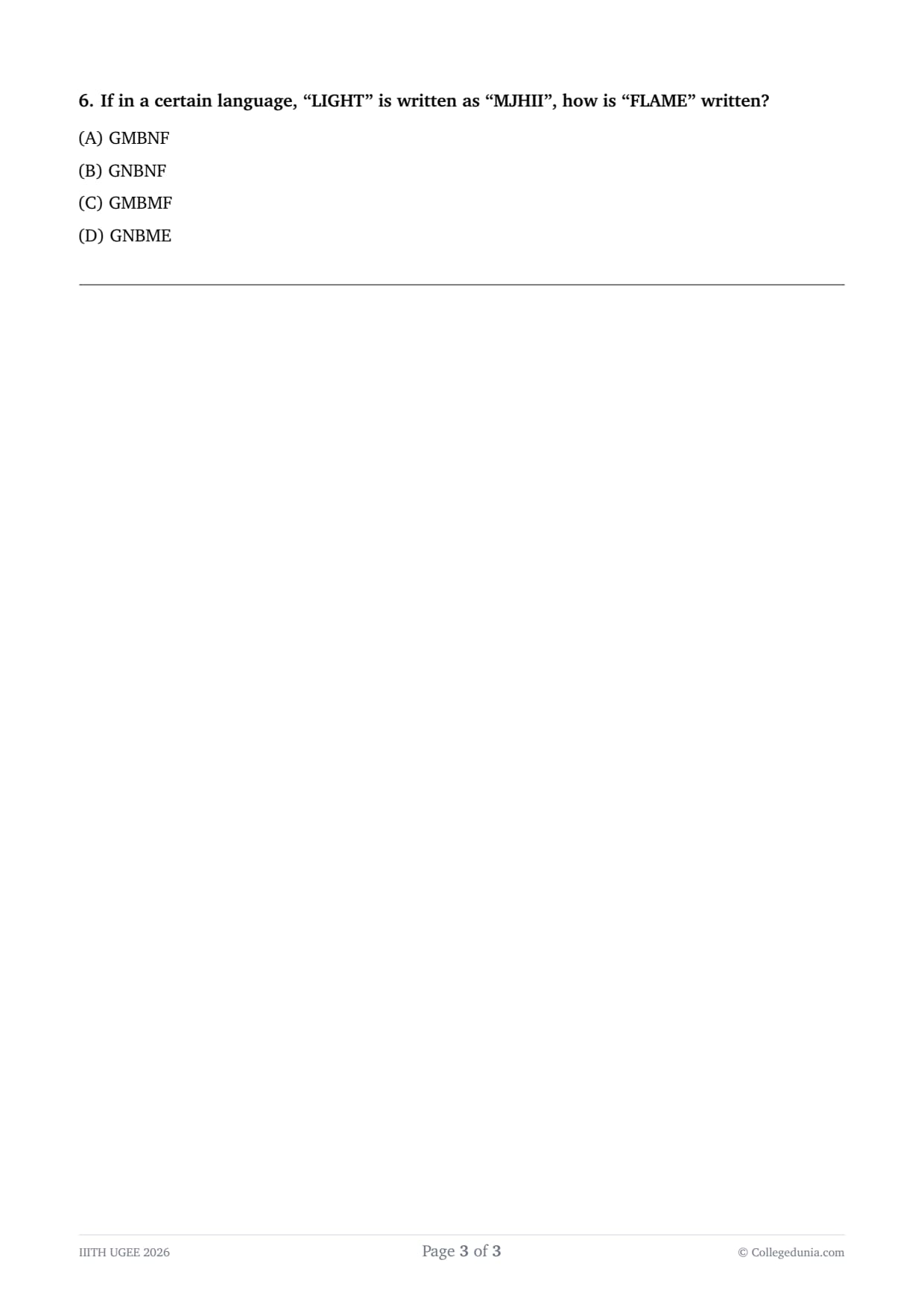
If in a certain language, ``LIGHT'' is written as ``MJHII'', how is ``FLAME'' written?
View Solution
Concept:
In coding–decoding problems, letters are often shifted forward or backward in the alphabet by a fixed number of positions (e.g., \(+1, -1, +2\)).
Step 1: Analyze the coding pattern.
Given: \[ LIGHT \rightarrow MJHII \]
Observe the positional shifts for the first four letters: \[ L + 1 \rightarrow M \] \[ I + 1 \rightarrow J \] \[ G + 1 \rightarrow H \] \[ H + 1 \rightarrow I \]
Although the final letter in the example (\(T \rightarrow I\)) suggests a typo in the prompt, the dominant pattern for the word is a one-step forward shift (\(+1\)).
Step 2: Apply the same rule to ``FLAME''.
Following the \(+1\) pattern: \[ F + 1 \rightarrow G \] \[ L + 1 \rightarrow M \] \[ A + 1 \rightarrow B \] \[ M + 1 \rightarrow N \] \[ E + 1 \rightarrow F \]
Step 3: Write the coded word.
\[ FLAME \rightarrow GMBNF \]
Matches option (A). Quick Tip: In alphabet coding, if most letters follow a clear arithmetic shift, assume that pattern is correct even if a single letter seems anomalous. Always check the options to see if they align with your identified rule.
IIITH UGEE 2026 Exam Pattern
| Section | Duration | Total Question | Marking Scheme |
|---|---|---|---|
| SUPR (Subject Proficiency Test) | 60 minutes | 50 MCQs | +1 for correct answer, -0.25 for incorrect answer |
| REAP (Research Aptitude Test) | 120 minutes | 50 MCQs | +2 for correct answer, -0.5 for incorrect answer |



Comments