




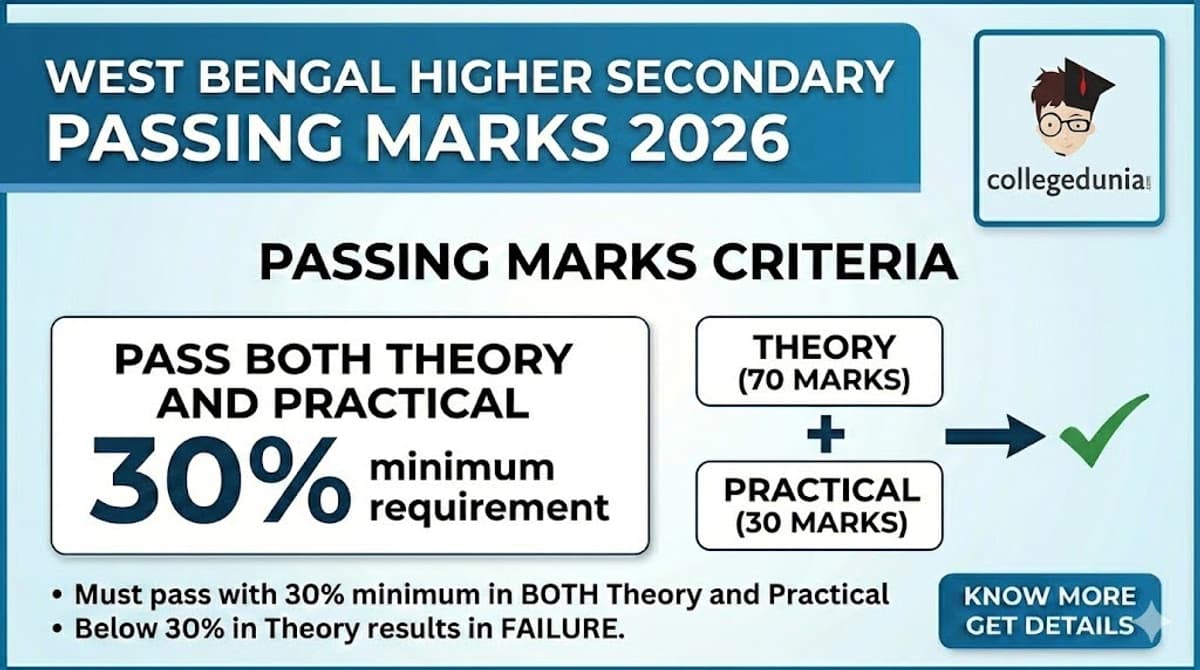
The Passing Marks for the West Bengal Higher Secondary Examination is 30% in each subject. A student should score 30 out of 100 in theoretical and practical (or project work) papers together to pass the exam.
- For subjects without practicals, a student should score 30 out of 100 in the written paper.
- For practical subjects, the theory paper is for 70 marks, and the remaining 30 is practical.
- A student must pass both practical/ project with a minimum of 30% in both and together.
- Scoring below the 30% in the theory paper will lead to failure.
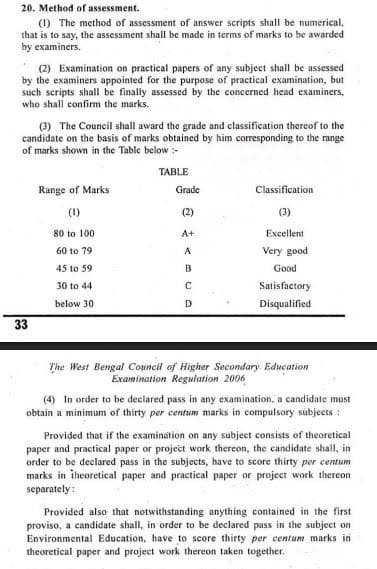
Source: West Bengal Council of Higher Secondary Education
Related Articles:
- West Bengal HS Result 2065- Check HS Result Link@wbresults.nic.in
- West Bengal Class 12 Question Paper 2026
Key Summary
- The minimum scoring mark is 30% for each subject.
- For 100 marks theory subjects, a student must score 30 out of 100 to pass the subjects.
- To pass the subjects with 70+30 evaluation pattern, the minimum passing mark is 21 out of 70 and 9 out of 30.
- A student must score a minimum of 24 marks for an 80 marks theory paper and 6 out of 20 for project work.
- Newly added subjects like Applied Artificial Intelligence and Cyber Security also follow a 70+30 pattern, and Science of Well-being follows an 80+20 pattern.
- Music and Visual Arts share 50-50 marks for theory and practical, with 15 as minimum marks required to pass.
- According to the WBCHSE Grading pattern, a student should secure at least a “C” grade to pass the subject.
Semester System in West Bengal Higher Secondary Board
The West Bengal Council for Higher Secondary Examination shifted to conducting the West Bengal Higher Secondary examination in a semester format.
- Where in, Class 11 will be divided into two semesters, that is first and second semesters.
- Class 12 will be split to the third semester and fourth semesters.
- The third semester will have an OMR-based examination with 30% weightage.
- The fourth semester will be conducted as a board-style theoretical exam.
WBCHSE Science Stream Minimum Passing Marks Breakdown 2026
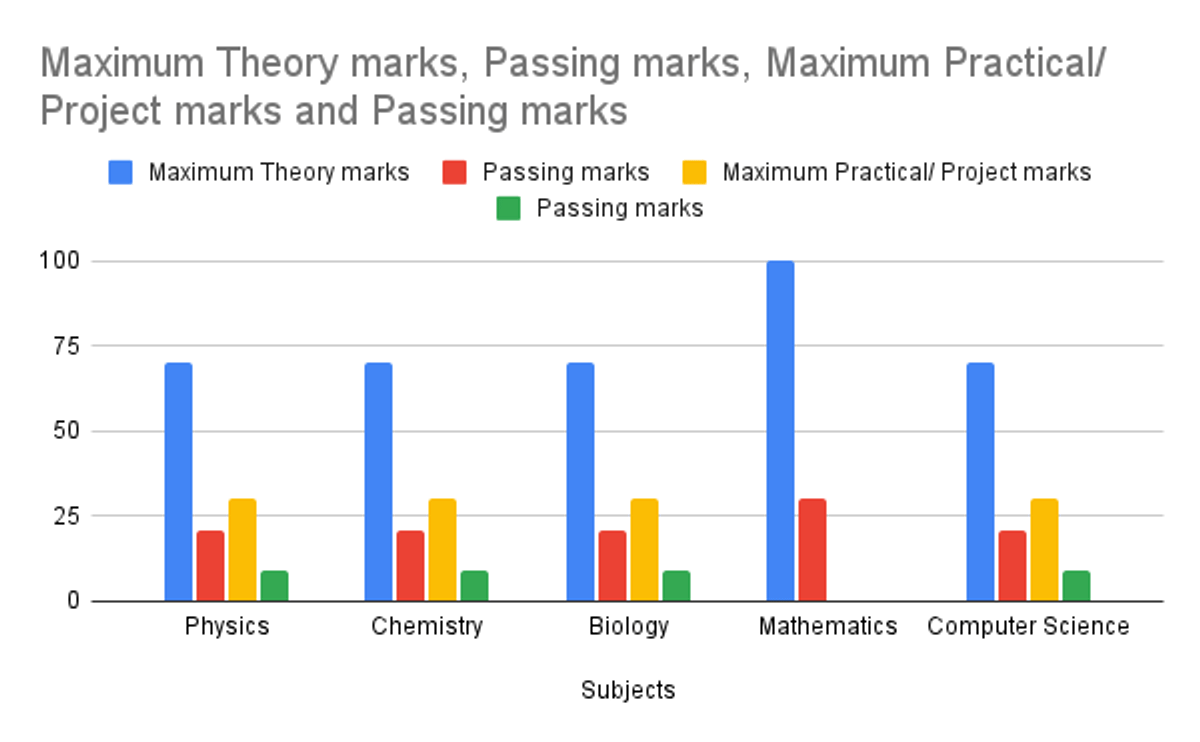
- For the science subjects like Physics, Chemistry, Biology, and Computer Science, the maximum theory marks is 70 and practicals is 30.
- Failing either theory or practical will lead to failing the subject.
- Mathematics has 100 marks for theory, with minimum marks of 30 to pass the exam.
| Subjects | Maximum Theory marks | Passing marks | Maximum Practical/ Project marks | Passing marks |
|---|---|---|---|---|
| Physics | 70 | 21 | 30 | 09 |
| Chemistry | 70 | 21 | 30 | 09 |
| Biology | 70 | 21 | 30 | 09 |
| Mathematics | 100 | 30 | - | - |
| Computer Science | 70 | 21 | 30 | 09 |
Ques. What is the passing mark for West Bengal Higher Secondary exam?
Ans. A minimum score of 30% in all the subjects, including practical and theory separately in the fourth semester of Higher Secondary is required to pass the exam.
Ques. What is the passing mark for science subjects?
Ans. For a theory paper out of 70 marks, which includes Physics, Chemistry, Biology, and Computer Science, a minimum of 21 marks is required, and 9 marks out of 30 in practicals to pass the subject.
Ques. What is the passing mark for Mathematics?
Ans. A minimum mark of 30 is required to pass Mathematics as it is a 100 mark theory exam. This is applicable to the Commerce stream Mathematics as well.
WBCHSE Commerce Stream Minimum Passing Marks Breakdown 2026
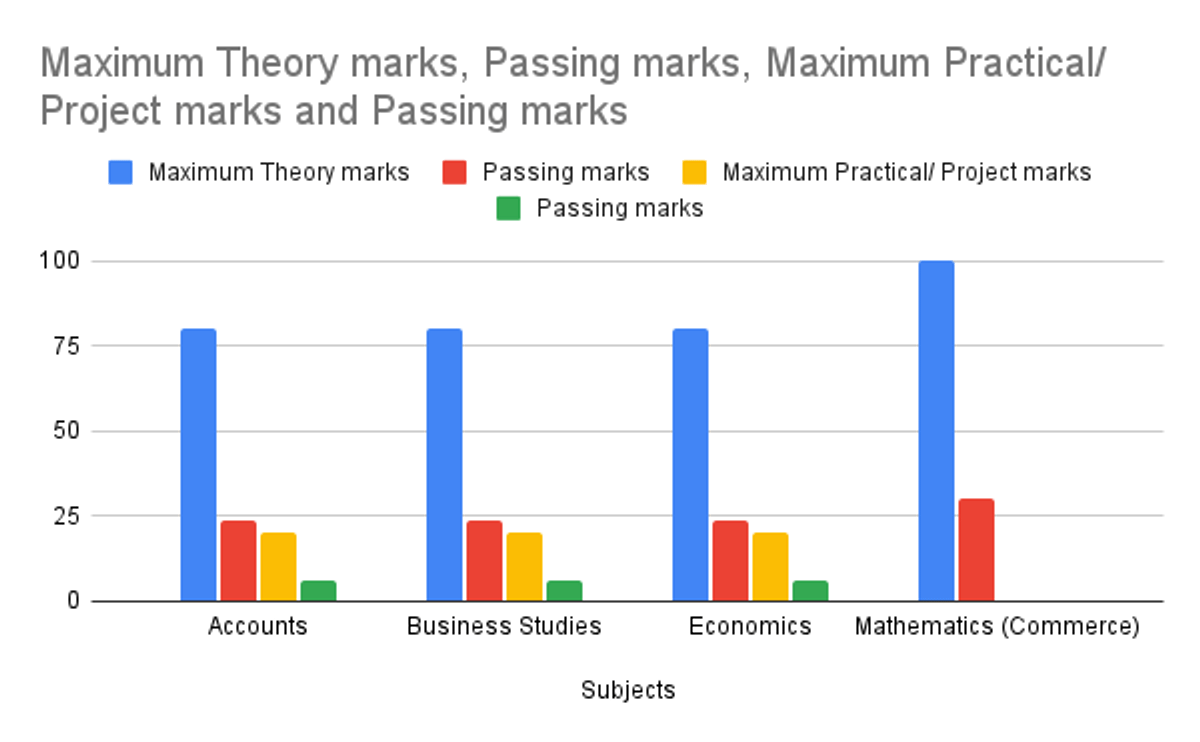
- The Commerce Stream subjects follow a pattern of 80% for theory with 20% for practical/ project marks, except for Mathematics.
- The passing marks for the 80% theory paper is 24.
- For the practical/ project work, a student must score 6 out of 20 to pass the subject.
| Subjects | Maximum Theory marks | Passing marks | Maximum Practical/ Project marks | Passing marks |
|---|---|---|---|---|
| Accounts | 80 | 24 | 20 | 06 |
| Business Studies | 80 | 24 | 20 | 06 |
| Economics | 80 | 24 | 20 | 06 |
| Mathematics (Commerce) | 100 | 30 | - | - |
Ques. Is 6 out of 20 pass marks?
Ans. Yes. In subjects like English, Bengali, Accounts, Business Studies, Economics, and Science of Well-being, following 80+20 patterns, 6 is the passing mark out of 20, for practicals/ project work.
Ques. Is 23 out of 80 pass?
Ans. No. You need to score at least 24 out of 80, for subjects like English, Bengali, Accounts, Business Studies, Economics, and Science of Well-being, to pass with 30%.
WBCHSE Arts Stream Minimum Passing Marks Breakdown 2026
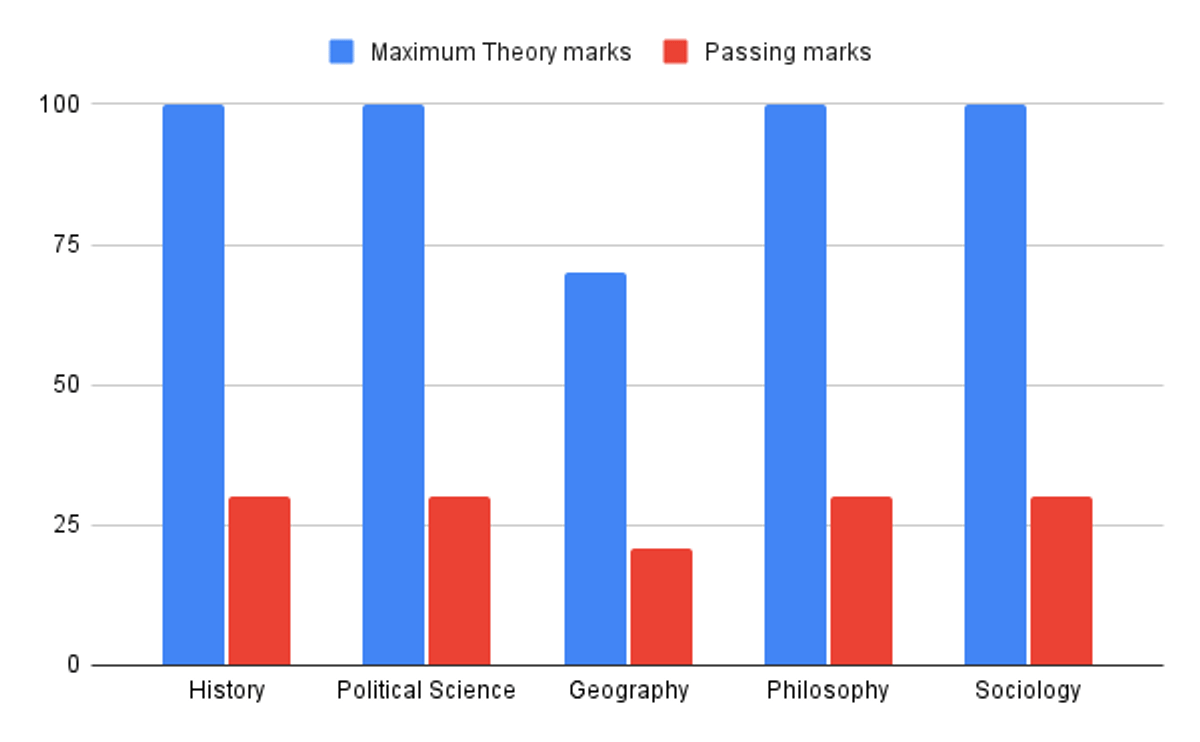
- Arts Stream subjects like History, Political Science, Philosophy, and Sociology are also evaluated only based on theory.
- Hence, the minimum passing marks required for the above subjects is 30 out of 100.
- Geography is the only arts subject that has 70 marks for theory and 30 marks for project work.
| Subjects | Maximum Theory marks | Passing marks | Maximum Practical/ Project marks | Passing marks |
|---|---|---|---|---|
| History | 100 | 30 | - | - |
| Political Science | 100 | 30 | - | - |
| Geography | 70 | 21 | 30 | 09 |
| Philosophy | 100 | 30 | - | - |
| Sociology | 100 | 30 | - | - |
Ques. What is the passing mark for Geography?
Ans. The maximum marks for passing theory in Geography is by scoring 21 or above out of 70, and 9 or above out of 30, for passing the project work.
Ques. What is the minimum mark required to pass the Arts subjects?
Ans. Since the Arts subjects like History, Political Science, Philosophy, and Sociology are 100 mark theory subjects, 30 out of 100 is required to pass these subjects.
WBCHSE Compulsory Language Subjects and Other Subjects Minimum Passing Marks Breakdown
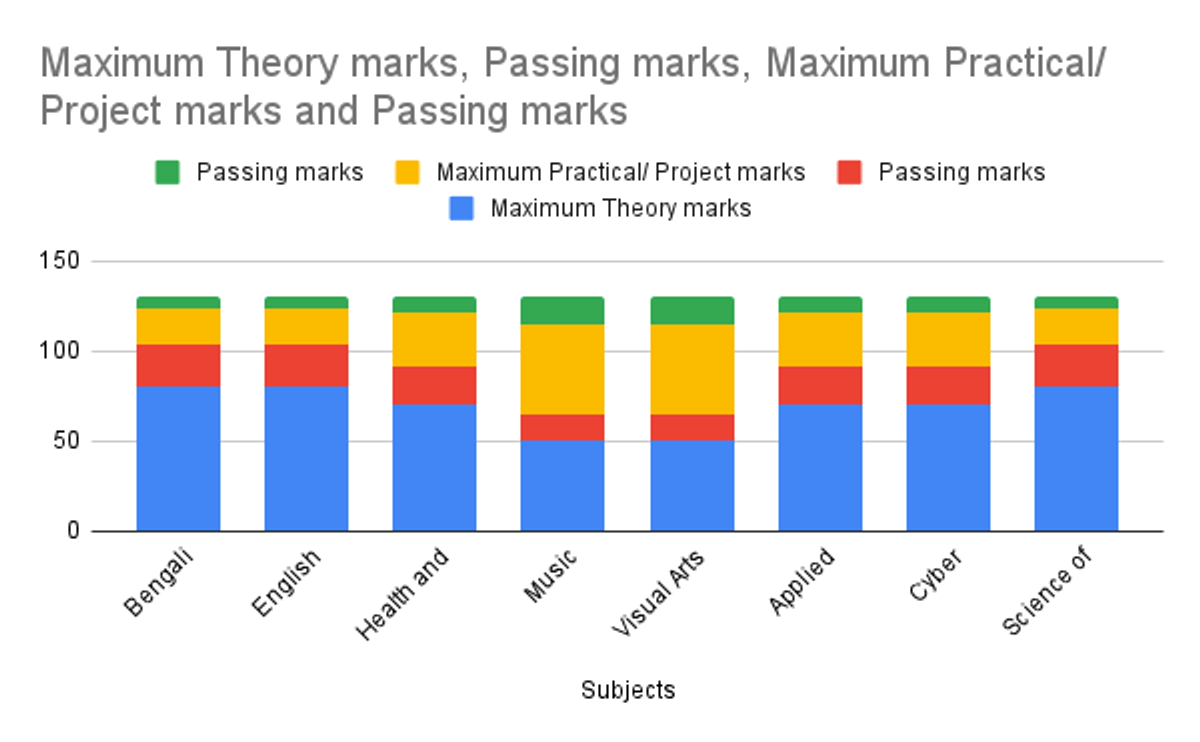
The Language subjects Bengali and English are Compulsory subjects and also have a similar evaluation pattern to that of the Commerce stream subjects, with 80% weightage for the theory and 20% of the marks from project work.
- Apart from Science subjects and Geography, Health and Physical Education, Cyber Security and Applied Artificial Intelligence also have 70 as maximum marks for theory, with practicals for 30.
- Science of Well Being has an 80+20 evaluation (theory+projectwork) pattern.
- Music and Visual Arts hold an equal weightage for both theory and practical, with 50 as the maximum marks for both.
| Subjects | Maximum Theory marks | Passing marks | Maximum Practical/ Project marks | Passing marks |
|---|---|---|---|---|
| Bengali | 80 | 24 | 20 | 6 |
| English | 80 | 24 | 20 | 6 |
| Health and Physical Education | 70 | 21 | 30 | 9 |
| Music | 50 | 15 | 50 | 15 |
| Visual Arts | 50 | 15 | 50 | 15 |
| Applied Artificial Intelligence | 70 | 21 | 30 | 9 |
| Cyber Security | 70 | 21 | 30 | 9 |
| Science of Well Being | 80 | 24 | 20 | 6 |
Ques. What are the passing marks for the Language subjects?
Ans. The language subjects English and Bengali are compulsory to attempt and it follows an 80+20 evaluation pattern, with 24 out of 80 and 6 out of 20, to pass these subjects.
Ques. What is the minimum mark required to pass Health and Physical Education/ Applied Artificial Intelligence/ Cyber Security?
Ans. Health and Physical Education, Applied Artificial Intelligence and Cyber Security follow a 70+30 pattern for evaluation, similar to the Science subjects, and students must score 21 out of 70 and 9 out of 30 to pass these subjects.
Ques. What is the passing score for Music and Visual Arts?
Ans. Music and Visual Arts have equal weightage for both theory and practical, and has 15 as the minimum passing mark.
WBCHSE Grading Point System 2026
The WBCHSE uses a 9 point grading scale to rank students based on their overall performance in the examination (Theory+Practical+Internal).
A student must acquire at least a “D” grade in every subject to pass the board examination.
| Marks Range | Grade | Classification |
|---|---|---|
| 80-100 | A+ | Excellent |
| 60-79 | A | Very Good |
| 45-59 | B | Good |
| 30-44 | C | Satisfactory |
| Below 30 | D | Disqualified |
Ques. What is the passing grade?
Ans. The passing grade, according to the WBCHSE is “C”, which qualifies as “Satisfactory” performance, with a mark range of 30-44.
Ques. Can any student fail the exam?
Ans. Yes. There can be chances where a student can fail the exam. But as the WBCHSE follows a semester-based assessment format, it can be easier for the students to pass the exam.
This is the first time the West Bengal Council of Higher Secondary Education has attempted to follow a semester-based format of assessment. The results will provide us with an overview of the impact of this change.



Comments