



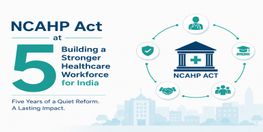
The National Commission for Allied and Healthcare Professions (NCAHP) Act turned five. It is one of the most consequential shifts in Indian healthcare that took place quietly.
For decades after Independence, Allied and Healthcare Professionals (AHP) – lab technicians, radiographers, OT technologists, physiotherapists, optometrists, who keep hospitals functioning – had no national regulatory framework. Training quality varied by geography. Curricula differed between institutions. There was no common standard for what an AHP graduate should know or be able to do. A profession central to patient care was, in policy terms, invisible.
The NCAHP Act 2021 began to change that.
Building the Foundation
The most important thing the Act did in its first five years was structural.
India now has a working regulatory framework for Allied and Healthcare Professions. In practical terms, that means:
- A national framework covering 10 recognised professional categories and more than 50 Allied & Healthcare professions
- Competency-based curricula, benchmarked to international healthcare education standards
- India's first national AHP registry and licensing mechanisms
- Mandatory clinical training embedded into every programme
None of this existed before 2021.
The data emphasises on the urgency of the situation. India currently has 20 healthcare workers per 10,000 people, against the WHO benchmark of 44.5. The estimated shortage for AHPs alone stands at 6.5 million. Existing institutions, at current capacity, serve roughly 4% of what the country needs.
The NCAHP Act built the foundation on which the gap can be reduced.
One Nation, One Curriculum
Perhaps the most consequential shift has been the move toward standardised healthcare education.
For years, the quality of AHP training depended heavily on where you studied and which institution you attended. Students entered the workforce with uneven clinical exposure and inconsistent skill readiness. Employers had no reliable understanding of what a graduate from one state could actually do, compared to one from another.
The competency-based curriculum framework, developed by the Ministry of Health & Family Welfare (MoHFW) in collaboration with NCAHP and launched in April 2025, addresses this directly. For the first time, students across the nation are being trained against the same nationally defined framework and competency benchmarks. Truly embodying the vision of “One Nation, One Curriculum”.
Why This Moment Matters
For most of this sector's history, India had neither the institutional capacity to train AHPs at scale, nor a nationally defined standard for what that training should produce.
For the first time, both critical levers are moving together.
The National Education Policy 2020 envisions 25 to 40 million additional students entering higher education by 2035. The Union Budget 2026-27 has allocated Rs. 1,000 crore to AHP education, the first dedicated budget line for this sector since Independence, with a target of one lakh trained AHP professionals across 10 disciplines over the next five years. The Budget validated the regulatory foundation the NCAHP Act spent five years building.
This marks a meaningful shift in posture from the state. AHP education is no longer an afterthought.
From Domestic Need to Global Opportunity
The significance of this extends beyond domestic healthcare.
The world is projected to face a shortage of millions of health workers by 2030, driven by ageing workforces, insufficient training pipelines, and rising care demands across developed economies.
The pressure is already visible in specific markets. Germany is grappling with a shortfall of over 1.5 million nurses, while the United Kingdom's NHS carries over 1,00,020 vacancies – positions increasingly being filled by professionals from India and other countries. While Japan requires over 2,50,000 additional healthcare workers primarily for elder care.
These are the demographic realities that will deepen over the next two decades.
India is positioned to respond to this demand at scale. What has been missing, until now, is the regulatory credibility to do so. An AHP trained under the NCAHP framework — with nationally standardized competency benchmarks aligned to international standards — is, for the first time, credibly comparable to an internationally trained peer. That comparability matters enormously for global employers, bilateral agreements, and the recognition of Indian credentials abroad.
The economic dimension is significant too. Indians working abroad sent home a record $135 billion in remittances in FY25, a 14% rise year on year. Healthcare professionals are a meaningful and growing part of that flow. A regulated, certified, internationally benchmarked AHP workforce serves India's national interest as a source of skilled talent the world needs, generating returns that flow back home.
The Work Ahead
At Virohan, we have spent nearly a decade building in the Allied and Healthcare education landscape in India – training over 13,000 candidates and alumni, some of whom are now working within the healthcare system.
The two halves of that decade look nothing alike.
The first half meant operating in a fragmented sector with no standard curriculum, no national competency benchmark, no regulatory signal to build toward. The second has been structurally different – cleaner, more directional, built on a foundation that finally exists.
Our experience led us to understand that the larger challenge now will be sustaining this momentum.
Faculty pipelines that can train at the required scale. Employer integration to absorb these skilled graduates. And student financing that keeps AHP careers within reach of the masses.
These are not sequential decisions. They have to move together because the foundation the NCAHP Act spent five years building deserves an ecosystem that rises to meet it.
By Nalin Saluja
Co-Founder & CTO, Virohan







Comments