



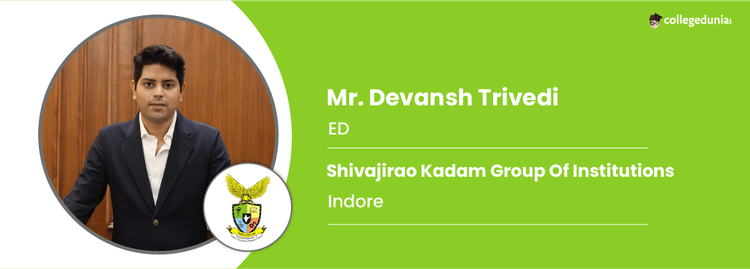
Mr. Devansh Trivedi is the Executive Director at Shivajirao Kadam Group of Institutions, Indore. He has international academic and professional experience in management and consulting. He completed his Bachelor of Commerce at NMIMS University, Mumbai, and a Master's in Management (Grande école) at ESCP Business School, Paris. Mr. Devansh Trivedi has worked with organizations like OnePoint, Paris, and 3Horizons Consulting, London. He specializes in marketing and has researched data-driven innovative business models under Prof. Boris Durisin. Mr. Devansh Trivedi is also the Founder Director of SKITECH LEAD Foundation, where he supports startups and young innovators.
What keeps you connected with the Education Sector and how has your experience been so far with the institute?
Ans: Education is not just a profession for me, it is a legacy. I belong to the fourth generation in academics, and institution building has been a part of my upbringing. This deep-rooted connection is what keeps me committed to the education sector — the belief that education has the power to shape individuals, industries, and society at large.
At Shivajirao Kadam Institute of Technology and Management (SKITM), this legacy translates into a strong commitment towards quality, discipline, and long-term impact. The experience has been extremely fulfilling, as we continue to strengthen the institution as a leader in career-focused, industry-aligned education in Central India, with a clear focus on academic excellence, employability, and innovation.
Being the Executive Director of SKITM, what is your philosophy of leadership? How would you describe your leadership style?
Ans: My philosophy of leadership is built around clarity of vision, strong execution, and continuous evolution. In today’s dynamic environment, institutions must not only maintain quality but also constantly adapt to changing industry and global trends.
I would describe my leadership style as strategic and systems-driven, with a strong focus on outcomes. At the same time, I believe in being accessible and connected with students and faculty, because meaningful growth happens when leadership understands ground realities. My focus is on building SKITM as a benchmark institution that consistently delivers quality education and strong career outcomes.
How do you strategize about key programs and plans for marketing and administration?
Ans: Our approach is structured and outcome oriented. On the academic and administrative front, we focus on building robust systems that ensure consistency in quality, curriculum relevance, and student outcomes, particularly in placements and skill development.
From a marketing perspective, we focus on credibility-led positioning. Instead of just promotion, we highlight our core strengths — NAAC ‘A’ accreditation, autonomous curriculum, strong placement performance, industry integration, and infrastructure. The idea is to build long-term trust among students and parents rather than short-term visibility.
What can a student gain from studying at your institute compared to global education systems?
Ans: Students at SKITM benefit from a globally aligned, industry-integrated education model.
While Indian education provides strong academic grounding, we complement it with practical exposure, project-based learning, and global collaborations. Our international MoUs and academic pathways provide exposure to global practices, while our curriculum integrates AI, Data Science, and applied technologies.
The outcome is a student who is not only academically sound but also deployment-ready, adaptable, and globally competitive.
How does the curriculum of SKITM ensure best industry practices?
Ans: Our biggest strength is our UGC autonomous status, which allows us to move faster than traditional institutions.
We continuously update our curriculum to integrate AI, Data Science, emerging technologies, certifications, and industry-led modules. Learning is structured around projects, real-world datasets, and applied problem-solving.
We also maintain continuous industry interaction through mentorship, expert sessions, and collaborative programs, ensuring that students are trained not just academically, but in a way that aligns with industry expectations from day one.
How is SKITM welcoming to students from diverse backgrounds?
Ans: Inclusivity is fundamental to our philosophy. We believe that talent is widely distributed, and institutions must create the right environment for it to flourish.
At SKITM, we focus on building a supportive, performance-driven ecosystem, where students from different socio-economic and cultural backgrounds can grow through structured training, mentorship, and exposure.
Our systems are designed to ensure that every student progresses toward skill development, confidence, and career readiness, regardless of their starting point.
What should be the institute’s top priority over the next 10 years?
Ans: The top priority should be to build a future-ready, globally competitive, and innovation-driven institution.
This includes developing AI-focused academic ecosystems, research capabilities, global collaborations, and industry-aligned centers of excellence. Institutions must also focus on creating students who are not just employable, but capable of innovation, entrepreneurship, and leadership in emerging domains.
What are the greatest strengths of SKITM?
Ans: SKITM’s strengths lie in a unique combination of:
- NAAC ‘A’ Grade and UGC Autonomous Status
- Top 100 national ranking and strong academic credibility
- Consistent 90%+ placements with strong recruiter base
- Deep focus on AI, Data Science, and technology-driven programs
- Industry-aligned curriculum and training systems
- Modern infrastructure and multidisciplinary programs
- Strong focus on innovation and student development
- Distinguished leadership with national and global academic experience
Together, these create a well-rounded academic ecosystem.
What are the biggest challenges in higher education today?
Ans: The biggest challenge is the gap between academic learning and industry requirements, especially in fast-evolving domains like AI and technology.
Institutions must move faster, update their curriculum, adopt new technologies, and focus on skill-based learning. Another challenge is building innovation ecosystems within campuses, rather than relying only on theoretical frameworks.
At SKITM, we address these through autonomy, industry integration, and an execution-driven academic model.
What are your plans for international affairs and global exposure?
Ans: We are actively expanding our global academic collaborations across the USA, UK, and Australia.
Our focus is on building structured opportunities such as international pathways, joint certifications, exchange programs, and collaborative academic models. The goal is to provide students with global exposure while maintaining strong local relevance.
.jpeg?h=132&w=263&mode=stretch)

.png?h=132&w=263&mode=stretch)

.png?h=132&w=263&mode=stretch)



Comments