


.png?h=18&w=18&mode=stretch)
Abhyudaya, DoCC, PG Lab and ADMAP are SPJIMR's four non-classroom modules. Every first-year PGDM participant has to complete all four. They run alongside the regular core courses in Year 1.
Each module has a different shape. Abhyudaya runs across a full academic year. DoCC is a social internship of one to five weeks. PG Lab is a four-day offsite at the programme's start.
ADMAP is a two-credit course built around institute committees. A fifth module, Science of Spirituality, is mandatory too. SPJIMR lists all of them on its immersive experiences page.
Check: SPJIMR Profile-Based MBA Shortlist
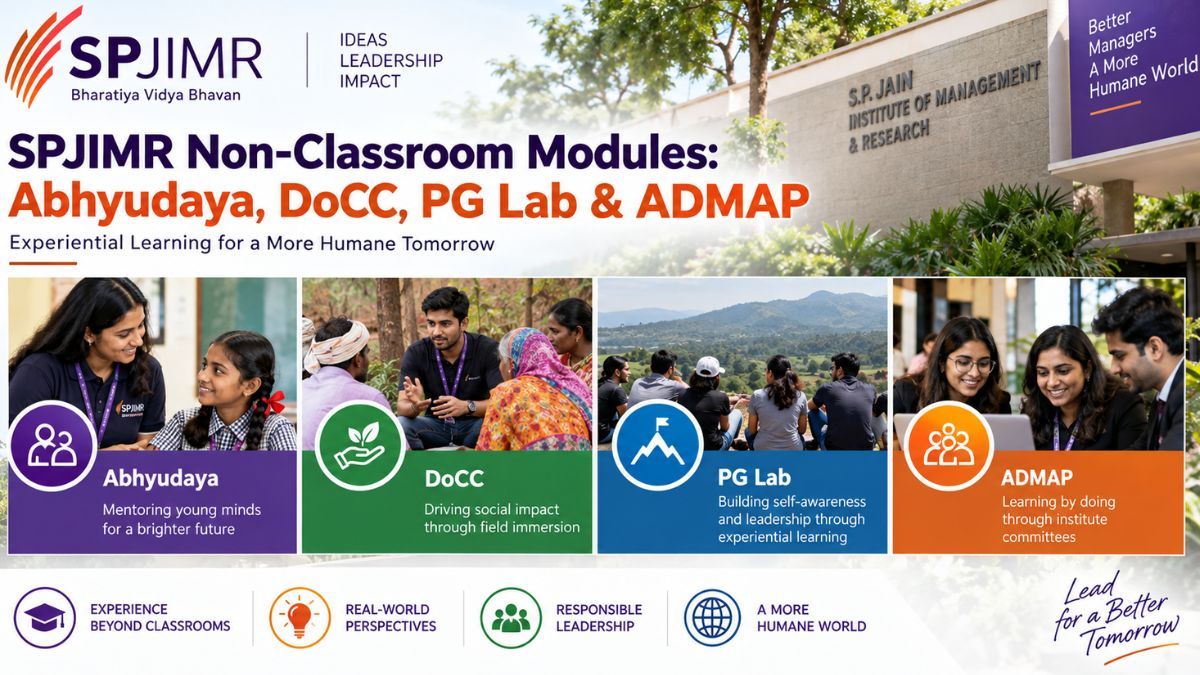
SPJIMR Non-Classroom Learning Modules at a Glance
SPJIMR was the first Indian management school to build in such modules. The institute says it did so more than 20 years ago. Here is what each module covers.
| Module | What It Covers | Format and Duration |
|---|---|---|
| Abhyudaya | Mentoring an underprivileged school child in Mumbai | One-to-one mentoring, one academic year |
| DoCC (Development of Corporate Citizenship) | Field internship with a social sector organisation | Social internship, one to five weeks |
| PG Lab (Personal Growth Lab) | Self-awareness and team skills through lab exercises | Residential offsite, four days |
| ADMAP | Running institute committees under a faculty-in-charge | Committee work, two-credit course |
| SoS (Science of Spirituality) | Values and self-mastery from eastern wisdom traditions | Reflective classroom and practice course |
Check: SSPJIMR Without CAT: The GMAT Route, Accepted Score Validity and Why XAT Isn't Accepted
Abhyudaya: Mentoring a Sitara Through Year 1
Abhyudaya pairs each first-year PGDM participant with one school child. The children are called Sitaras, meaning stars. They come from low-income neighbourhoods in Mumbai's K-West ward.
The initiative started in 2008 as a Bharatiya Vidya Bhavan project. It was set up under the late Dr. Manesh L. Shrikant, then Honorary Dean. About 4,046 PGDM participants have mentored a Sitara since then.
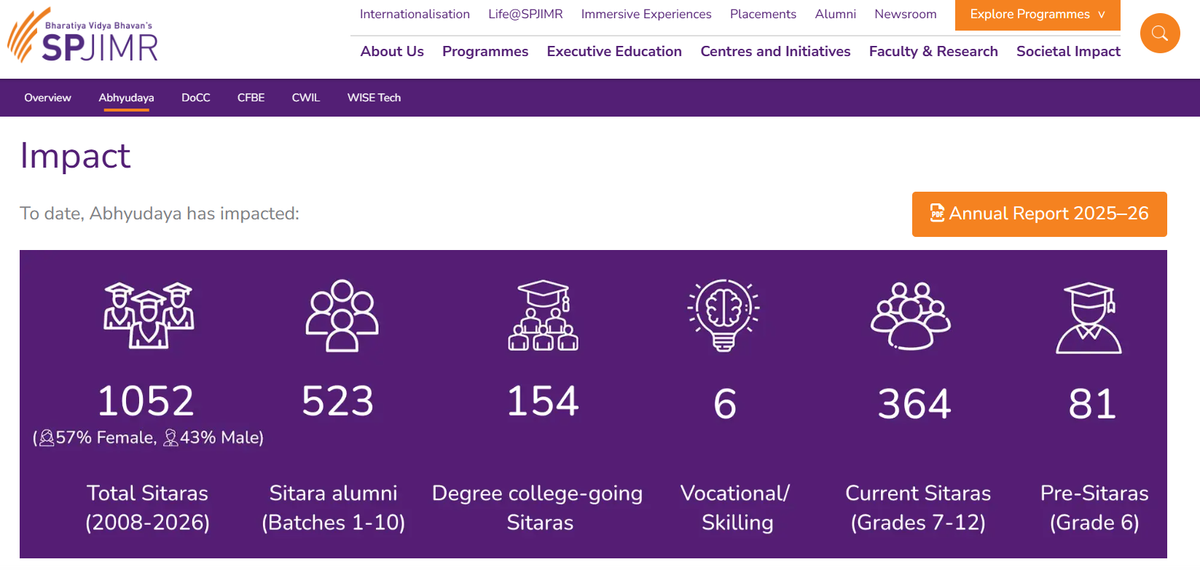
The current cohort has 364 Sitaras in grades 7 to 12. Abhyudaya counts 1,052 Sitaras in total between 2008 and 2026. Of these, 523 have graduated out across 10 batches.
How the Mentoring Year Works?
The mentoring is one-to-one and lasts the whole year. Mentors make seven home visits between October and March. Sitaras also come to the SPJIMR campus twice during the year.
Mentors build a plan for the child and then work it through. They write individual reflection diaries and sit in group reflection sessions. The module is tied to UN Sustainable Development Goals 4 and 17.
Example: a mentor visits a Sitara's home in K-West. The visit covers the parents and the study space. The plan is then reset around the family's routine.
Also Read: SPJIMR Interview Questions and Experience
DoCC: The Social Internship in Rural India
DoCC stands for Development of Corporate Citizenship. SPJIMR says it started the module more than 30 years ago. It sends participants into the social sector for a field internship.
Partner organisations host participants for one to five weeks. DoCC works with over 300 social sector organisations. These sit across 26 states in India. Partners also operate in Bangladesh and Nepal.
What a DoCC Project Covers?
Project themes are wide. They include water, sanitation, health, disability and ageing. Livelihood, agriculture, education, food security and women empowerment also feature.
Other projects run on financial inclusion, energy, disaster management and social entrepreneurship. Self-help group work and environment projects are on the list too. Participants usually go out in small teams.
Example: a four-member PGDM team spent a month in Kolkata. The host was the Durbar Mahila Samanwaya Committee. The work involved interviews, focus group discussions and field visits.
Another team worked with a disaster mitigation institute in Ahmedabad.
PG Lab: The Four-Day Offsite That Opens the Programme
PG Lab is short for Personal Growth Lab. It runs for four days at the start of the academic year. The venue is away from the Mumbai campus.
The module sits inside the organisational behaviour course. It mixes human relations laboratory exercises with scientific assessments. Outbound activities, conceptual inputs and structured reflection fill the rest.
The stated aim is self-awareness first, then team skills. SPJIMR describes it as a move from individual focus to team focus. Participants get a personal development roadmap out of it.
ADMAP: Running the Institute Through Committees
ADMAP is the module that puts participants inside the institute's own administration. The official expansion is Assessment and Development of Managerial and Administrative Potential. It is run as a two-credit course.
Participants join a committee and help run real institute work. That covers admissions, placements, industry engagement and campus events. The learning method is doing, observing, reflecting and recording.
Each committee has a faculty-in-charge attached to it. The faculty member helps the group pull management lessons from the work. Committees are the unit of assessment here, not individual assignments.
ADMAP Committees at SPJIMR
SPJIMR currently lists 15 ADMAP committees. The spread shows how much of the institute is run this way.
- Abhyudaya Committee
- Academic Committee
- ADMAP Committee
- Admissions Committee
- Alumni Committee
- Business School Competitions and International Exchange Committee
- Campus Living Committee
- Centre for Family Business and Entrepreneurship Committee
- WISE Tech Committee
- Communications Committee
- Centre for Wisdom in Leadership Committee
- DoCC and Sustainability Committee
- Placement Support Committee
- Programme Marketing Committee
- Community Involvement Project Committee
How the Modules Fit Into the PGDM Year 1 Calendar?
The four modules do not run at the same time. Two are short and fixed. Two stretch across the year.
| Module | When It Runs | Commitment Type |
|---|---|---|
| PG Lab | Start of Year 1 | Four-day block, offsite |
| Abhyudaya | Full academic year, home visits October to March | Recurring, one-to-one |
| ADMAP | Spread through Year 1 | Ongoing committee work |
| DoCC | Block internship during Year 1 | Field placement, one to five weeks |
The corporate internship is separate from all four. It runs in Year 2 and lasts about two months. The Year 2 calendar also carries a three-week international module.
What Students Say About the Non-Classroom Modules?
The First Year Is Heavily Loaded
Students consistently describe Year 1 at SPJIMR as packed. The four modules sit on top of core coursework. They do not replace it. Students report that time management becomes the real skill being tested.
Field Conditions Are Basic
DoCC postings are often in small towns and villages. Students describe living conditions on these internships as simple. Many also describe the posting as the year's most memorable part.
Home Visits Take Planning
Abhyudaya mentors report that the home visits need the most coordination. Travel into K-West and matching family timings take effort. Students describe the visits as where the module stops feeling academic.
Which SPJIMR Programmes These Modules Apply To?
The five immersive modules are mandatory for PGDM participants. They apply to the PGDM (BM) programme as well. Both are two-year full-time programmes at the Mumbai campus.
The one-year PGPM programme also carries DoCC. Its social internship is shorter, at around two weeks. That is the pattern as per previous batches.
The longer five-week format is the PGDM version.
Read More: SPJIMR Courses & Fees 2027
Student Experience of Abhyudaya at SPJIMR
A Quora user asked, “What is your experience of the Abhyudaya program at SPJIMR, Mumbai?”
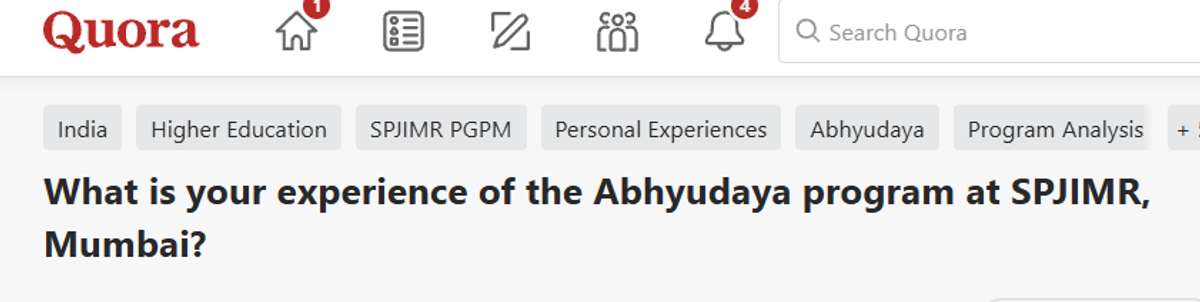
- In response, a personal experience shared by an SPJIMR PGDM graduate described Abhyudaya as a unique non-classroom learning experience within the PGDM curriculum.
- The experience highlights how each PGDM participant is paired with a school-going student from an underprivileged background, known as a Sitara, and mentors them in different aspects of life.
- The experience particularly highlights learning through time management, ethnography and reverse mentoring. It also describes Abhyudaya as an opportunity to build a meaningful relationship, take a break from the academic routine and contribute to society.
“It is a complete package of fun and value addition. No wonder they call it ‘Growing together.’”— Personal experience shared by an SPJIMR PGDM graduate on Quora
Takeaway: The account presents Abhyudaya not simply as an academic requirement, but as an experience combining mentoring, personal learning, social engagement and relationship-building.
Read the complete Abhyudaya experience on Quora for more insights.
SPJIMR Non-Classroom Modules FAQs
Ques. What is Abhyudaya mentoring at SPJIMR, and is it a paid work assignment for PGDM participants?
Ans. No. Abhyudaya mentoring is a mandatory component of the SPJIMR PGDM Year 1 curriculum. Each participant is assigned one Sitara (student) for the academic year.
Ques. Can SPJIMR PGDM participants skip DoCC and opt for a corporate internship instead?
Ans. No. The Development of Corporate Citizenship (DoCC) programme is a mandatory part of the PGDM curriculum. The corporate internship is a separate requirement conducted in Year 2.
Ques. Where is the SPJIMR PG Lab conducted?
Ans. The SPJIMR PG Lab is conducted away from the Mumbai campus. Past editions have been held in the Khandala and Lonavala region and follow a four-day residential offsite format.
Ques. How many ADMAP committees does SPJIMR have?
Ans. SPJIMR currently lists 15 ADMAP committees, with each committee having a designated faculty-in-charge.
Ques. What is the Abhyudaya enrichment programme at SPJIMR?
Ans. The SPJIMR Abhyudaya enrichment programme is an after-school programme that runs alongside the mentoring component. Sitaras from Grades 7 to 10 attend classes Monday to Friday, from 2:30 pm to 5:30 pm. The programme covers English, Mathematics, Science and Life Skills.
Ques. How are children selected as Sitaras for SPJIMR Abhyudaya?
Ans. Nominations are received from around 50 schools in the area. Shortlisted students take the Standard Progressive Matrices test, followed by family interviews and a summer camp before final selection.
Ques. Is Science of Spirituality a mandatory module in the SPJIMR PGDM programme?
Ans. Yes. Science of Spirituality is one of the five mandatory immersive experiences. The course draws on Eastern wisdom traditions, psychology and neuroscience.
Ques. Does the SPJIMR DoCC internship require participants to travel outside Maharashtra?
Ans. Usually, yes. DoCC partners operate across 26 states, and some placements are with organisations in Bangladesh and Nepal. Travel requirements may therefore vary depending on the participant's placement.



.png?h=132&w=263&mode=stretch)
![MBA/PGDM | admission | 2024 | Narsee Monjee Institute of Management Studies - [NMIMS Deemed to be University]](https://img.collegedunia.com/public/college_data/images/logos/1506323004Logo.jpg?h=72&w=72&mode=stretch)


![MBA/PGDM | admission | 2024 | Indian Institute of Management - [IIMC]](https://img.collegedunia.com/public/college_data/images/logos/1488950580d2.png?h=72&w=72&mode=stretch)



Comments