

.jpeg?h=300&w=1440&mode=stretch)



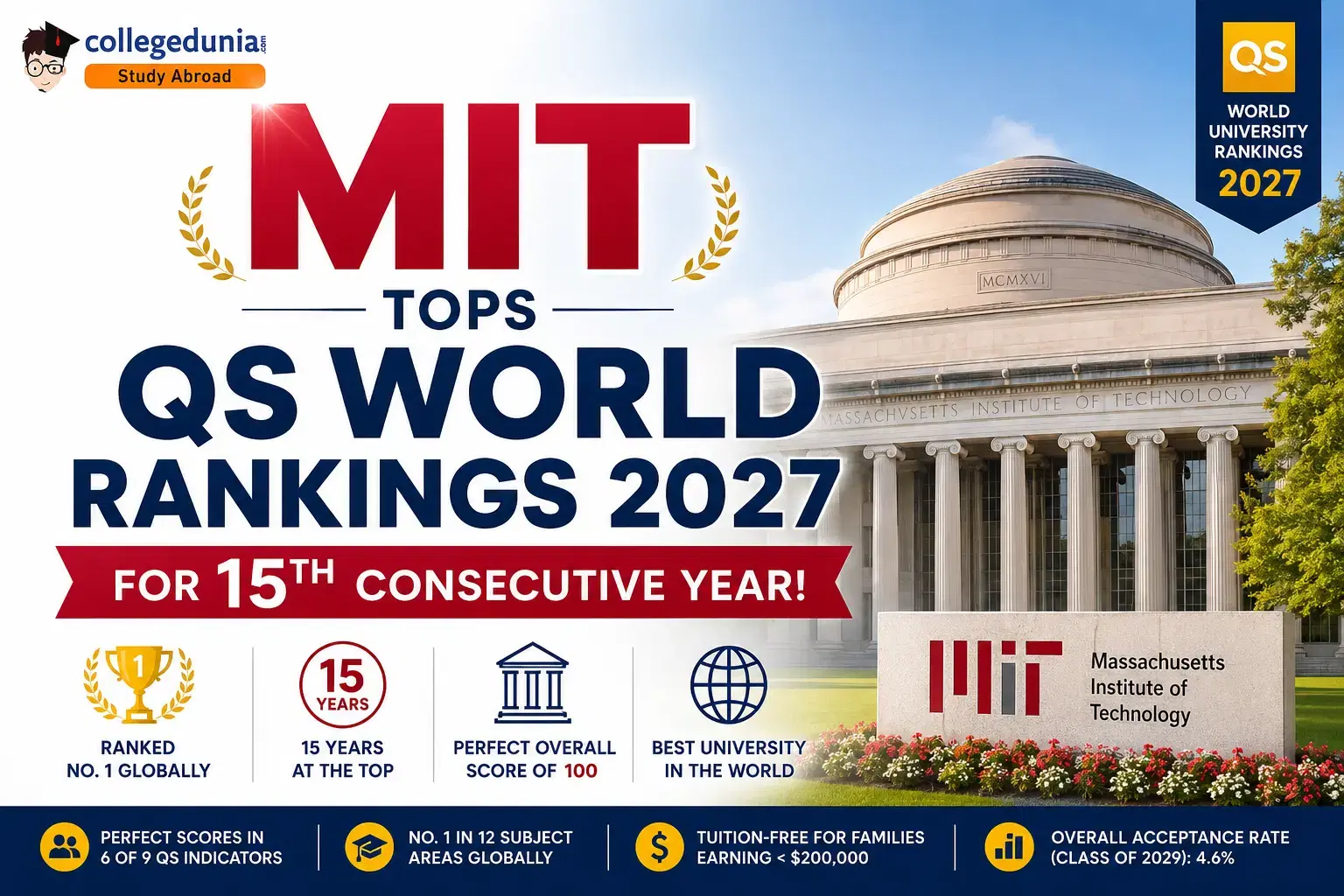
Massachusetts Institute of Technology (MIT) has retained the No. 1 spot in the QS World University Rankings 2027, marking its 15th consecutive year at the top. QS Quacquarelli Symonds released the rankings on June 18, 2026. MIT scored a perfect overall score of 100, the only institution in the list to achieve this.
QS World Rankings 2027: Top 10 Universities
The top 10 universities in the latest QS WUR 2027 are as follows:
| Rank | University | Country | Overall Score |
|---|---|---|---|
| 1 | Massachusetts Institute of Technology (MIT) | USA | 100 |
| =2 | Imperial College London | UK | 99.2 |
| =2 | Stanford University | USA | 99.2 |
| 4 | University of Oxford | UK | 98.6 |
| 5 | Harvard University | USA | 97.4 |
| 6 | University of Cambridge | UK | 97.1 |
| 7 | California Institute of Technology (Caltech) | USA | 96.6 |
| =8 | ETH Zurich | Switzerland | 96.3 |
| =8 | UCL | UK | 96.3 |
| 10 | National University of Singapore (NUS) | Singapore | 96.2 |
Insight: Imperial College London held its second position from the previous edition, while Stanford University moved up from third place to share the rank with Imperial. Caltech climbed from 10th to 7th. ETH Zurich is the highest-ranked university in continental Europe, and NUS is the highest-ranked university in Asia.
MIT's Indicator-Wise Scores, QS 2027
QS uses different indicators to rank universities. Here’s how MIT performs in each indicator:
| Indicator | MIT Score |
|---|---|
| Academic Reputation | 100 |
| Employer Reputation | 100 |
| Citations per Faculty | 100 |
| Faculty-Student Ratio | 100 |
| Employment Outcomes | 100 |
| International Faculty Ratio | 100 |
| International Research Network | 94.4 |
| Sustainability | 93.2 |
| International Student Ratio | 91.1 |
Indian student insight: MIT recorded perfect or near-perfect scores across six of the nine indicators QS uses to compile the overall rank, with International Student Ratio remaining its comparatively lower-scoring metric. However, 36 US universities face a sharp decline in the latest QS rankings.
MIT's Indicator Trend, Last 5 Editions
MIT has held the crown of the #1 global university for the last 15 years. Each year, MIT scored a near-perfect score in QS ranking indicators. Here’s a glimpse of the last 5 years:
| Edition Year | Academic Reputation | Employer Reputation | Citations/Faculty | Faculty-Student Ratio | Intl. Faculty Ratio | Intl. Student Ratio | Intl. Research Network | Sustainability |
|---|---|---|---|---|---|---|---|---|
| 2027 | 100 | 100 | 100 | 100 | 100 | 91.1 | 94.4 | 93.2 |
| 2026 | 100 | 100 | 100 | 100 | 100 | 91.6 | 94.1 | 93.8 |
| 2025 | 100 | 100 | 100 | 100 | 99.3 | 86.8 | 96.0 | 99.0 |
| 2024 | 100 | 100 | 100 | 100 | 100 | 88.2 | 94.3 | 95.2 |
| 2023 | 100 | 100 | 100 | 100 | 100 | 90.0 | 96.1 | — |
Student insight: MIT has held a perfect score in Academic Reputation, Employer Reputation, Citations per Faculty, and Faculty-Student Ratio across every QS edition in this five-year window. Some indicators were not part of the QS methodology in earlier editions, marked with a dash above. Check complete details of MIT admissions 2026-27 and secure your place at the earliest.
MIT's Subject Rankings 2027
MIT was ranked the world's No. 1 university in 12 individual subject areas, as announced by QS in March 2026:
- Chemical Engineering
- Civil and Structural Engineering
- Computer Science and Information Systems
- Data Science and Artificial Intelligence
- Electrical and Electronic Engineering
- Engineering and Technology
- Linguistics
- Materials Science
- Mechanical, Aeronautical, and Manufacturing Engineering
- Mathematics
- Physics and Astronomy
- Statistics and Operational Research
MIT also placed second globally in seven subject areas: Architecture/Built Environment, History of Art, Biological Sciences, Economics and Econometrics, Marketing, and Natural Sciences.
At the broader faculty-area level, QS also ranked MIT No. 1 in Engineering and Technology and No. 1 in Natural Sciences (Chemistry), with second-place finishes in Natural Sciences overall and Architecture and Built Environment, and top-3 finishes in Accounting and Finance and Business and Management Studies.
MIT additionally holds the No. 1 global rank for postgraduate programs in QS's broader institutional comparisons. Check MIT courses and fees for 2026-27.
How QS Ranks Universities?
Here are the ranking indicators of QS:
| Indicator | Weight |
|---|---|
| Academic Reputation | 30% |
| Citations per Faculty | 20% |
| Employer Reputation | 15% |
| Faculty/Student Ratio | 10% |
| International Faculty Ratio | 5% |
| International Student Ratio | 5% |
| Employment Outcomes | Variable |
| Sustainability | Variable |
| International Research Network | Variable |
Academic Reputation and Employer Reputation together accounts for nearly half the overall score, making QS one of the most reputation-weighted ranking systems globally.
Cost of Attendance at MIT, 2026-27
MIT stands as one of the most expensive private research universities in USA. For Indian students, the annual cost of attendance is undoubtedly on the higher side.
| Expense Head | Estimated Cost (USD) |
|---|---|
| Tuition | $66,720 |
| Student Life Fee | $420 |
| Housing | $14,090 |
| Food | $8,104 |
| Books, Course Materials, Supplies & Equipment | $930 |
| Personal Expenses | $2,496 |
| Total Annual Cost of Attendance | $92,760 |
At an exchange rate of approximately USD 1 = INR 94.51 (June 19, 2026), the total annual cost works out to roughly Rs 87.66 lakhs, making MIT one of the most expensive universities in the world by sticker price.
Financial Aid at MIT
MIT follows a need-blind, full-need financial aid policy for undergraduate admissions, meaning ability to pay is not considered during admissions and 100% of demonstrated financial need is met for four years.
- Students from families with an annual income under $200,000 (with typical assets) attend MIT tuition-free.
- Students from families with annual income under $100,000 are not expected to make any parental contribution toward the cost.
- The median annual price paid by an undergraduate receiving an MIT Scholarship was $10,268 in 2024-25.
- 88% of the Class of 2025 graduated debt-free; those who borrowed had a median debt of $20,288 at graduation, below the national average.
Read more: Scholarship opportunities for Indian students in MIT
Admission Selectivity at MIT
MIT's admissions remain among the most competitive globally. For the Class of 2029 (entering Fall 2025), MIT admitted 1,334 students out of 29,281 applicants, an overall acceptance rate of 4.6%.
| Applicant Pool | Acceptance Rate |
| Overall (Class of 2029) | 4.6% |
| Early Action (Class of 2029) | 5.98% |
| International | 1.96% |
MIT evaluates applicants on academic strength in mathematics and science, demonstrated research or project work, and evidence of problem-solving ability, alongside standardized test scores (SAT/ACT, required). Read more about the MIT acceptance rate.
Global Trends in the 2027 Edition
- The United States remains the most-represented country with 184 ranked universities, followed by the UK (93) and Mainland China (85).
- More than 1,500 universities across 106 higher education systems were assessed, including 98 new entrants.
- More than 330 institutions retained their previous rank, while over 400 improved.
- The "Big Four" study destinations — US, UK, Canada, and Australia — saw more institutions decline by 20+ positions than gain, linked to student caps, visa restrictions, and international fee levies.
- China saw 29 institutions rise by more than 20 places, the strongest gain of any country.
Key Takeaways
- MIT: No. 1 globally for the 15th year in a row, with a perfect overall score of 100.
- Imperial College London and Stanford University: tied at No. 2 (99.2).
- MIT ranked No. 1 in 12 individual subject areas and holds perfect scores in six of nine QS indicators.
- Total cost of attendance for 2026-27: $92,760 (approx. Rs 88 lakh); families earning under $200,000 a year attend tuition-free.
- Overall acceptance rate for the Class of 2029: 4.6%.
- Full results are available on the official QS portal, topuniversities.com.
Sources: QS World University Rankings 2027, Quacquarelli Symonds (released June 18, 2026); MIT News (June 17, 2026); MIT Student Financial Services and MIT Admissions (mitadmissions.org, sfs.mit.edu).

interested in this College ?
Follow & Share this college to get information about admission.



Comments