





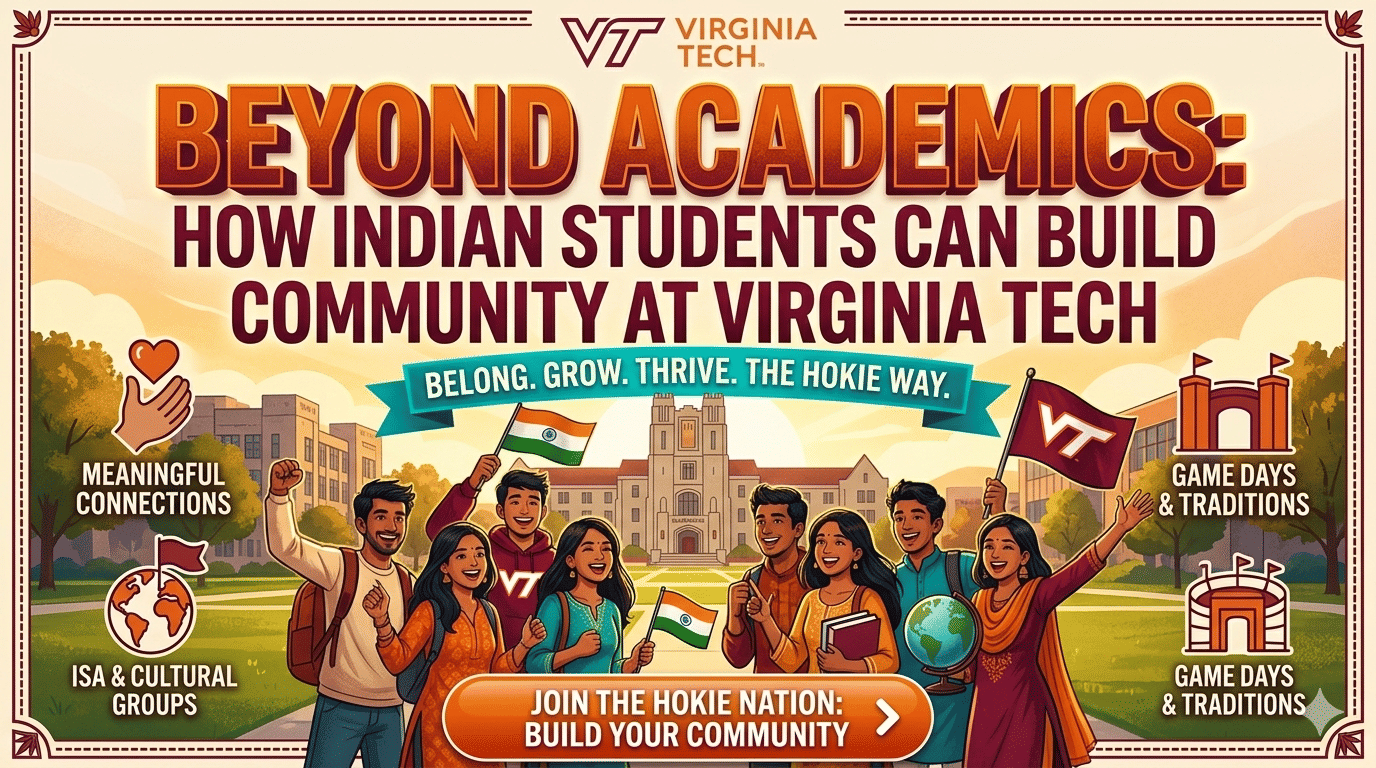
Community at Virginia Tech is built through multiple systems, student organizations, cultural groups, academic environments, and campus traditions like Virginia Tech Hokies football. Those repeated, shared experiences create something harder to quantify but directly relevant to students: access to people. For international students, especially those arriving from India, this matters because integration does not happen automatically.
With over 900 student organizations, living-learning communities, and department-led cohorts, the university creates multiple smaller networks where students interact regularly. Residence halls, academic programs, and student groups function as primary spaces for peer connection, particularly for international cohorts, including Indian students, who often rely on these structured environments during initial transition.
Learn about the Indian students' guide to studying in the US
- How Community Is Built at Virginia Tech: Student Organizations & Clubs
- Major Annual Events & Campus Traditions
- Residential Colleges & Living-Learning Communities
- Football as a Community Catalyst at Virginia Tech
- The Hokie Alumni Network: 70+ Chapters, One Shared Mascot
- How the Communities Help in Networking
- What Indian Students at Virginia Tech Actually Experience
- Where VT Graduates End Up: The Numbers
- The Bottom Line
- FAQs
How Community Is Built at Virginia Tech: Student Organizations & Clubs
At Virginia Tech, student organizations form the most direct and structured pathway to community. The university hosts approximately 800 student-run organizations, covering academic, cultural, religious, recreational, and professional interests.
These organizations operate as identity-based micro-communities. Students typically join groups aligned with their background (e.g., cultural associations), academic focus (department clubs), or interests (music, sports, entrepreneurship). This creates an environment where initial connections are based on shared context rather than chance.
The platform GobblerConnect functions as the central discovery system. It allows students to search for organizations, register for events, and track involvement. For international students, this reduces the friction of entry, community is searchable, not accidental.
Learn about the admission process at Virginia Tech University
Major Annual Events & Campus Traditions (Cross-Community Interaction)
Beyond structured groups, Virginia Tech relies on large-scale events and traditions to connect students across different communities.
Gobblerfest, held at the start of the fall semester, brings together hundreds of student organizations in a single space. For new students, it acts as a high-density discovery point where multiple communities are visible and accessible at once.
Similarly, The Big Event mobilizes thousands of students for community service across Blacksburg. Unlike club-based interaction, this event creates temporary but wide-reaching connections among students who may not otherwise interact.
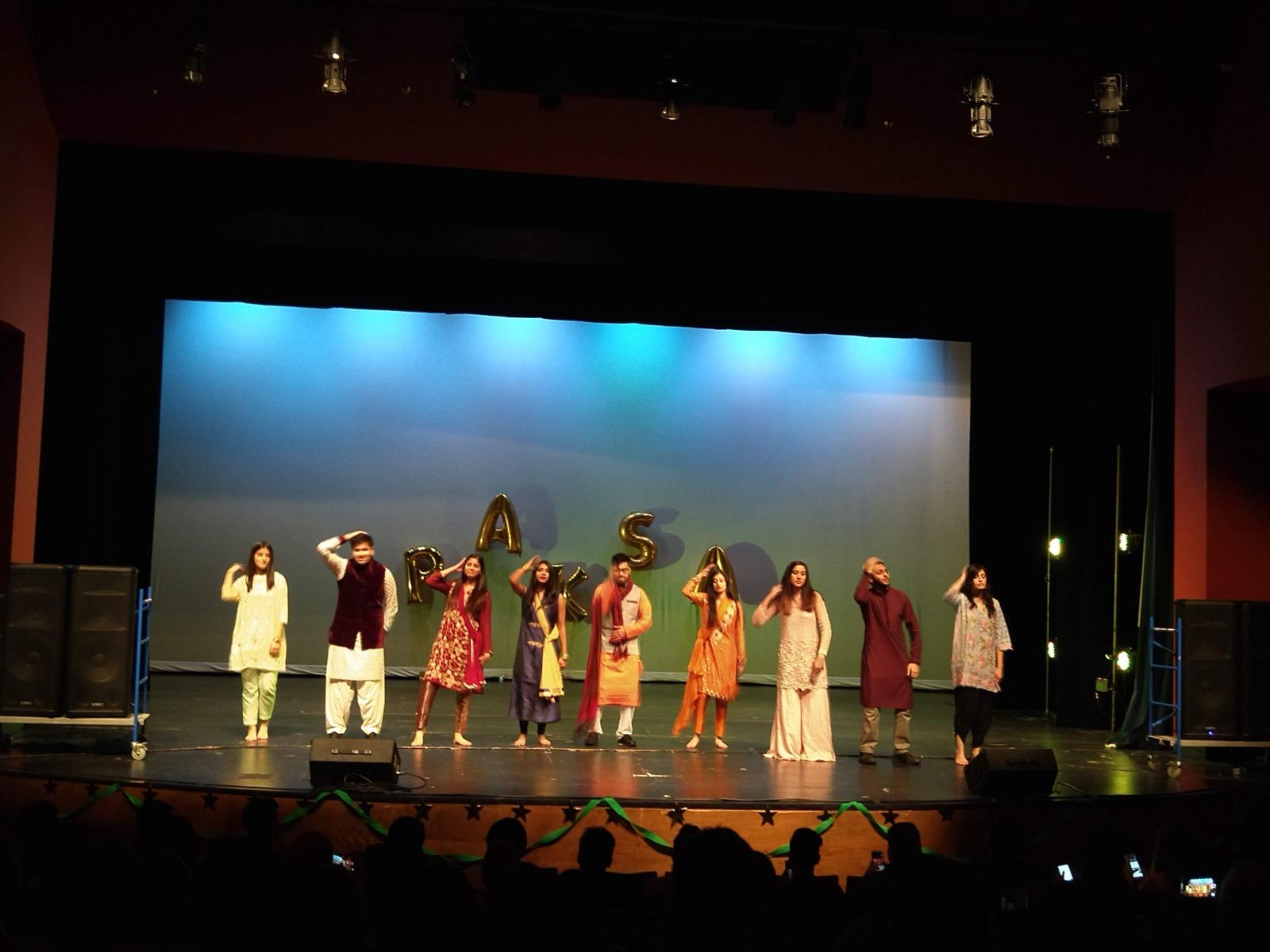
Other recurring formats, such as international café hours, cultural performances, and affinity group programming, create regular opportunities for cross-cultural engagement. Smaller traditions (like the Gargoyle scavenger hunt, therapy dog visits, or first-snow gatherings) contribute to a shared campus identity through informal, repeated participation.
Together, these events function as bridges between communities, rather than communities themselves.
Check out the US application deadline for international students
Residential Colleges & Living-Learning Communities (Built-In Early Networks)
For many first-year students, community formation begins with where they live. On-campus housing at Virginia Tech, particularly in spaces like West Ambler Johnston Hall, is designed to create immediate peer networks.
Living-Learning Communities (LLCs) group students around shared academic or thematic interests such as Honors, Leadership, or Innovation. These communities combine residential life with structured programming, including faculty interaction, workshops, and group events.
The result is a smaller, more consistent interaction environment. Unlike large campus events, these communities rely on frequency and proximity—students see the same peers regularly, which accelerates relationship-building.
For international students, this often becomes the first stable social layer before expanding into broader campus networks.
Football at Virginia Tech
Lane Stadium holds over 66,000 fans. In 2023, five home games sold out at that capacity (Virginia Tech Athletics, 2024). That is not just a sports statistic; it is a measure of how many people are in the same place, at the same time, with a shared reason to talk to each other.
The game day experience starts well before kickoff. Here is what the official gameday timeline looks like:
- 7:00 AM: Parking lots open
- 9:00 AM: Hokie Village opens (free admission, 3.5 hours before kickoff)
- 9:30 AM: Hokie Walk on Beamer Way
- 10:00 AM: Stadium gates open
- Noon: Kickoff (for a typical noon game)
Hokie Village is the pre-game gathering space located on the turf field directly across from the west side of Lane Stadium. It is free to attend and runs until 45 minutes before kickoff. It features live music, food trucks, cornhole, inflatables, and drink tents.
For a student who has just arrived in Blacksburg from Hyderabad or Pune, this is a low-barrier entry point into campus social life. You do not need to know anyone. You do not need to buy anything. You show up, and 66,000 people are already there.
The "Enter Sandman" entrance, where the team runs onto the field as Metallica plays and the entire stadium jumps, is one of the most recognized traditions in college football. Students who have been through it describe it as the moment Blacksburg stops feeling like a foreign town and starts feeling like home.
Learn about the part-time job options available in the US for Indian students
The Hokie Alumni Network: 70+ Chapters, One Shared Mascot
Virginia Tech has more than 70 alumni chapters across the United States and internationally, including chapters in Europe and China (Virginia Tech Alumni Association, 2026). Major US cities with active chapters include:
- Washington, D.C. (with nearly 60,000 VT alumni in the greater DC region alone)
- New York City
- Chicago
- Los Angeles and San Francisco
- Houston, Dallas, and Austin
- Atlanta and Charlotte
- Seattle
That DC figure, 60,000 alumni in one metro area, is significant for Indian students targeting careers in tech, consulting, government, or policy after graduation (Virginia Tech Strategic Affairs, cited 2026).
The undergraduate alumni giving rate has topped 20 percent for four consecutive years, which Virginia Tech describes as "consistently among the nation's best" (Virginia Tech News, 2025). A high giving rate signals an alumni base that stays engaged, and an engaged alumni base responds when a recent graduate reaches out on LinkedIn.
Some students on Reddit have noted that the "Hokies always find Hokies" culture, where VT alumni recognize each other by a cap or a sticker, is genuinely real. A Facebook post from the official Virginia Tech page noted that the VT Alumni Association reports over 2,000 Virginia Tech alumni in the greater San Francisco Bay Area alone. That kind of density in tech hubs matters when you are looking for your first job or OPT placement.
Check out the status of Public Transportation in the US for Indian students
How the Communities Help in Networking
For football games alone, dozens of students work at Lane Stadium. Students produce 60 percent of the content displayed on social media, televisions, and video scoreboards through HokieVision, the athletics video department. HokieVision employs:
- 8 undergraduate students on scholarship
- 5 graduate assistants
- Nearly 50 student production assistants
These students interact directly with ESPN employees, local news crews, conference executives, and marketing professionals during live game production (Virginia Tech News, 2018). One student quoted in an official VT article said: "I've been able to meet and work alongside those who work at major networks like ESPN, which will be very beneficial once I graduate."
Beyond HokieVision, the athletics department runs formal career development programs tied to the football program. The annual Beyond VT event, held inside Lane Stadium in April 2024, brought together current student-athletes and alumni professionals for speed networking, panel Q&As, and resource stations covering resume writing, LinkedIn best practices, elevator pitches, and professional headshots (Virginia Tech Athletics, 2024).
Clubs and professional organizations help students connect with seniors, alumni, and recruiters, while also offering resume workshops, mock interviews, and company info sessions. Leadership roles within these groups add strong value to resumes and SOPs, and many organizations actively facilitate internships and job opportunities by bringing companies to campus.
For Engineering students, societies like IEEE, ASME, AIAA, NSBE, and SWE are especially impactful, as they organise career fairs, industry visits, and hands-on projects such as hackathons and design competitions.
Check out the placement opportunities offered at Virginia Tech University
What Indian Students at Virginia Tech Actually Experience
Virginia Tech recorded 2,698 international students in its fall 2024 census, out of a total student population of 38,857. The 2024 first-year class came from 66 countries (Virginia Tech News, October 2024).
The Indian student community at VT is organized primarily through the Indian Students Association (ISA), which the university's official student organization platform GobblerConnect lists as "the largest international community on the Virginia Tech campus, with over 800 active members." The ISA's own website puts that number at over 1,000 members, including students and families.
ISA runs a full calendar of events, including:
- Bollywood Night (held at Owens Ballroom, ticketed event)
- Holi (held at Duckpond Field, free, 500+ attendees in 2026)
- Garba (Navratri celebration)
- Diwali celebrations
- Pre-arrival summer webinars (held in July, covering Blacksburg setup, health insurance, and fee payment — timed for incoming students still in India)
- Welcome Social at the start of each semester
The pre-arrival webinars are particularly relevant. ISA holds these sessions at 9:00 AM EST / 6:30 PM IST, specifically timed for students still in India. This means the community-building process starts before you land in Virginia.
Quora users who have studied at VT note that Virginia Tech has a large and active Indian student organization alongside a welcoming campus culture.
Where VT Graduates End Up: The Numbers
Virginia Tech's Career and Professional Development office publishes annual first-destination data. For the Class of 2024:
- Median starting salary: $68,000/year (≈ ₹64.70 Lakhs/year, approx.)
- Mean starting salary: $66,942/year (≈ ₹63.65 Lakhs/year, approx.)
- 52.75% employed full-time within 6 months of graduation
- 19.36% continuing education
Source: Virginia Tech Career and Professional Development, career.vt.edu/outcomes/
The Bottom Line
At Virginia Tech, community is not built through a single channel. It emerges from a combination of structured systems, student organizations, residential communities, academic environments, and campus-wide events. Each of these creates different types of connections: some small and consistent, others large and occasional.
Within this ecosystem, the culture around the Virginia Tech Hokies functions as a high-scale, low-barrier entry point. Football brings together large segments of the university population in shared spaces like Lane Stadium.
Check which alumni chapters exist in the city where you plan to work; the DC, NYC, and Bay Area chapters are active and professionally relevant. Start with the ISA pre-arrival webinars at isa-vt.org and the alumni chapter directory at alumni.vt.edu/chapters/chapter_list.html.
FAQs
Ques. Do I need to be interested in football to benefit from Virginia Tech's sports culture?
Ans. No. The benefits — alumni chapters, Hokie Club networking events, and game day social gatherings — are open to all students and graduates regardless of whether you follow the sport. Football is the occasion; the network is the actual value.
Ques. How many Indian students are at Virginia Tech?
Ans. Virginia Tech recorded 2,698 international students in fall 2024. The university does not publish a country-specific breakdown. The Indian Students Association lists over 1,000 members (including students and families), making it the largest international student organization on campus.
Ques. How does Virginia Tech's alumni network compare to other universities?
Ans. Virginia Tech has 70+ alumni chapters globally, with nearly 60,000 alumni in the Washington, D.C. metro area alone. The undergraduate alumni giving rate has exceeded 20% for four consecutive years, which the university describes as among the nation’s best. Direct comparisons with other universities are not available from official primary sources.
Ques. Can international students on F-1 visas participate in Hokie Club events and alumni networking?
Ans. Yes. Hokie Club membership and alumni chapter events are open to all Virginia Tech graduates and current students regardless of visa status. There are no citizenship or residency restrictions for participation.

%20-%20Sayantan%20Sarkar.jpeg)
%20-%20Sayantan%20Sarkar.jpeg)
%20-%20Sayantan%20Sarkar.jpeg)
%20-%20Sayantan%20Sarkar.jpeg)
%20-%20Sayantan%20Sarkar.jpeg)
%20-%20Sayantan%20Sarkar.jpeg)
interested in this College ?
Follow & Share this college to get information about admission.



Comments