

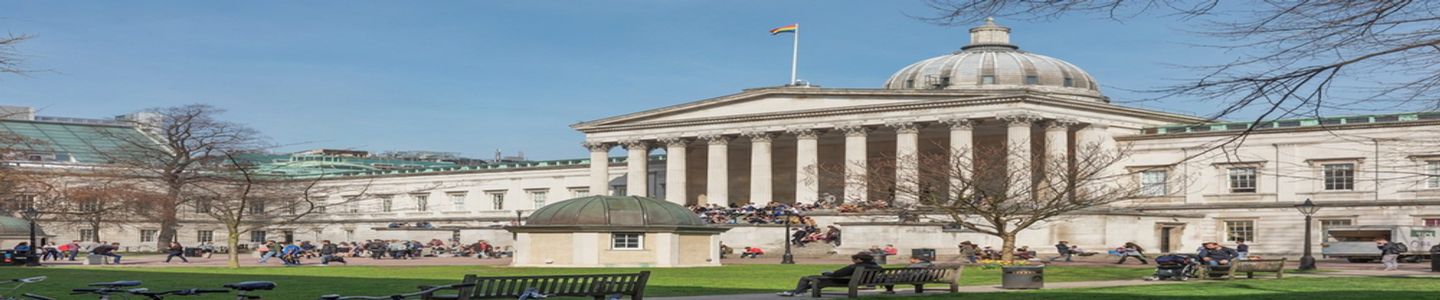



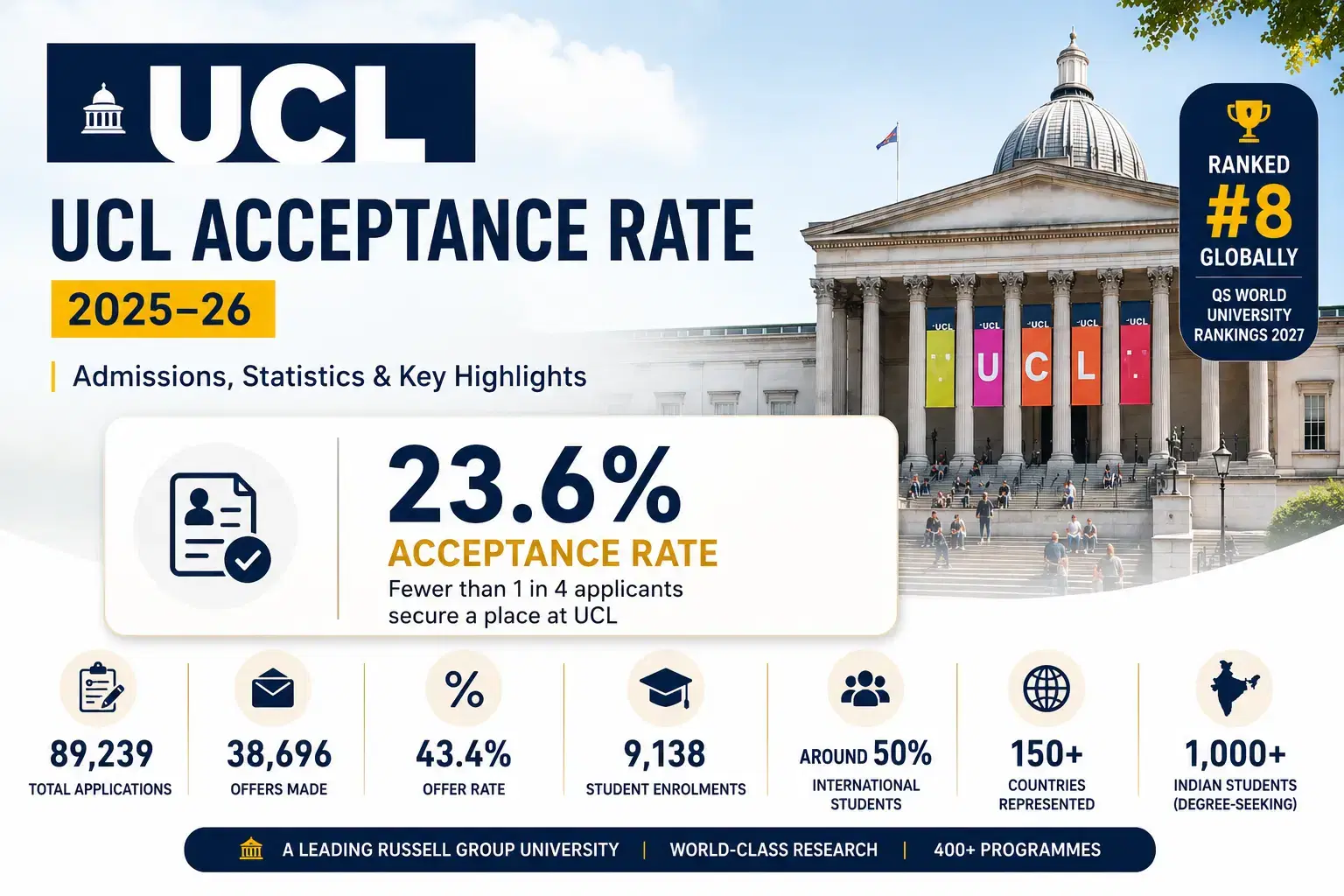
University College London (UCL) is one of the world's most prestigious universities and a member of the UK's Russell Group. Ranked #8 globally in the QS World University Rankings 2027, UCL attracts tens of thousands of applicants every year from across the world. As a result, admission to the university is highly competitive.
For the 2025-26 admission cycle, UCL received 89,239 undergraduate applications and made 38,696 offers, resulting in an offer rate of 43.4%. However, only 9,138 students eventually enrolled, bringing the overall UCL acceptance rate to approximately 23.6%. This means that fewer than one in four applicants successfully secure a place at the university.
UCL evaluates applicants holistically, considering academic performance, course-specific entry requirements, the UCAS personal statement, academic references, and supporting documents. The university currently enrolls more than 51,000 students from over 150 countries, with international students accounting for around half of the total student population. Its strong global reputation, research excellence, and wide range of academic programs continue to make UCL a top Russell Group choice for Indian and international students.
- QS World University Ranking 2027: #8 globally
- Total Undergraduate Applications: 89,239
- Total Offers Made: 38,696
- Offer Rate: 43.4%
- Total Student Enrolments: 9,138
- Overall Acceptance Rate: 23.6%
- Average Applications per Place: 9.8
- International Student Population: Around 50%
- Countries Represented: 150+
- Indian Student Community: 1,000+ degree-seeking students
Key Insight: UCL offered admission to around 43 out of every 100 applicants, but only around 24 students ultimately enrolled. This difference exists because many applicants receive multiple UCAS offers and choose other universities.
Also Check: UK Universities with Highest Acceptance Rate
|
Table of Contents |
UCL Acceptance Rate of Faculty of Arts and Humanities
The Faculty of Arts and Humanities at University College London (UCL) overall acceptance rate is 66%. This marks an increase from previous cycles, reflecting a balanced demand with an average of 7.0 applications per place. The faculty received a total of 9,000 applications, leading to 5,946 offers and 1,315 places.
| Program | Applications | Admission Offers | Acceptance Rate | Places |
|---|---|---|---|---|
| Arts and Sciences BASc | 1,354 | 1,096 | 80.8% | 217 |
| School of European Languages, Culture, and Society (SELCS) | 1,243 | 993 | 79.8% | 290 |
| English | 783 | 429 | 54.8% | 110 |
| Euro. Social and Pol. Stds BA | 681 | 415 | 42.30% | 107 |
| Slade School of Fine Art | 1,294 | 163 | 12.6% | 77 |
| Greek & Latin | 285 | 250 | 87.7% | 60 |
| Hebrew & Jewish Studies | 44 | 34 | 77.3% | 4 |
| Philosophy | 934 | 662 | 70.9% | 133 |
| Information Studies | 287 | 265 | 92.33% | 26 |
| School of Slavonic and East European Studies (SSEES) | 2,097 | 1,639 | 78.15% | 291 |
| Total | 9,002 | 5,946 | 66.05% | 1,315 |
UCL saw a slight increase in applications this year, but offer rates generally improved, reflecting a move toward more holistic assessment.
- The easiest programs to enter are Information Studies (92% offer rate) and Greek & Latin (87.7%), the latter being a low-competition gem with just 4.8 applications per place.
- Conversely, the Slade School of Fine Art remains the most selective at a mere 12.6%.
- In terms of sheer volume, SSEES saw the most applications (2,097) with a 78.15% offer rate.
UCL Acceptance Rate of Faculty of Brain Sciences
The Faculty of Brain Sciences at UCL has an acceptance rate of 37.71%. The faculty processed 3,025 applications, issuing 1,141 offers and 285 students accepted places. Check out the course-wise admission report of the Faculty of Brain Sciences in UCL:
| Program | Applications | Admission Offers | Acceptance Rate | Places |
|---|---|---|---|---|
| Ear Institute | 101 | 59 | 58.41% | 20 |
| Linguistics | 322 | 249 | 77.32% | 45 |
| Psychology | 1,918 | 436 | 22.73% | 139 |
| Psychology & Lang. Sciences BSc | 284 | 211 | 74.29% | 56 |
| Neurology | 400 | 186 | 46.5% | 25 |
| Total | 3,025 | 1,141 | 37.71% | 285 |
UCL Acceptance Rate of Faculty of the Built Environment
University College London has a selective acceptance rate of 32.27% in the Faculty of the Built Environment. The acceptance rate of various subjects in this faculty of University College London is as follows:
| Program | Applications | Admission Offers | Acceptance Rate | Places |
|---|---|---|---|---|
| Architecture | 3,233 | 539 | 16.67% | 256 |
| Planning | 624 | 336 | 53.84% | 79 |
| Environment, Energy and Resources | 376 | 304 | 80.85% | 50 |
| Sustainable Construction | 445 | 330 | 74.15% | 70 |
| Total | 4,678 | 1,509 | 32.27% | 455 |
UCL Acceptance Rate of Faculty of Engineering Sciences
The faculty of Engineering Sciences in University College London has an overall acceptance rate of 28.29%. The course-specific acceptance rates in this faculty are tabulated below:
| Program | Applications | Admission Offers | Acceptance Rate | Places |
|---|---|---|---|---|
| Biochemical Engineering | 723 | 526 | 72.75% | 93 |
| Chemical Engineering | 1,856 | 612 | 32.97% | 160 |
| Civil, Environmental & Geomatic Engineering | 923 | 585 | 63.38% | 100 |
| Computer Science | 4,006 | 805 | 20.09% | 228 |
| Electronic & Electrical Engineering | 2,200 | 454 | 20.63% | 139 |
| Integrated Foundation Years | 1,710 | 79 | 4.61% | 52 |
| UCL School of Management – International Management | 2,772 | 318 | 11.47% | 80 |
| UCL School of Management – Information Management for Business | 1,093 | 396 | 36.23% | 115 |
| UCL School of Management – Management Science | 807 | 341 | 42.25% | 90 |
| Mechanical Engineering | 4,457 | 943 | 21.15% | 235 |
| Medical Physics – Biomedical Engineering | 1,235 | 616 | 49.87% | 133 |
| Medical Physics – Medical Physics | 204 | 186 | 91.17% | 30 |
| Security and Crime Science | 333 | 238 | 71.47% | 75 |
| Science, Technology, Engineering and Public Policy | 258 | 198 | 76.74% | 25 |
| Total | 22,576 | 6,388 | 28.29% | 1,555 |
UCL Acceptance Rate of Institute of Education
The UCL Institute of Education has an overall acceptance rate of 69%. Education, Society and Culture program in this faculty has the highest acceptance rate of 88%. Following are the acceptance rates of various programs in UCL’s Institute of Education:
| Program | Applications | Admission Offers | Acceptance Rate | Places |
|---|---|---|---|---|
| Culture Communication & Media | 1,460 | 613 | 42% | 160 |
| Youth, Society and Sustainable Futures | 264 | 215 | 81.43% | 40 |
| Education, Society and Culture | 675 | 594 | 88% | 135 |
| Early Childhood Education | 387 | 278 | 72% | 60 |
| Psychology with Education | 699 | 536 | 76.68% | 90 |
| Social Research Institute | 1,344 | 1,076 | 80% | 176 |
| Total | 4,829 | 3,312 | 68.58% | 661 |
UCL Acceptance Rate of Faculty of Life Sciences
UCL Faculty of Life Sciences comprises 7 key divisions, with 4 subjects ranked among the top 10 in the world according to QS World University Rankings by Subject, 2025. The faculty has an overall acceptance rate of 41.21%. The course-wise acceptance rates of UCL Faculty of Life Sciences are as follows:
| Program | Applications | Admission Offers | Acceptance Rate | Places |
|---|---|---|---|---|
| Biochemistry and Biotechnology | 1,027 | 541 | 52.67% | 130 |
| Biological Sciences | 1,305 | 630 | 48.27% | 131 |
| Biomedical Sciences | 1,647 | 726 | 44.08% | 160 |
| Human Sciences | 251 | 206 | 82% | 50 |
| Neuroscience | 713 | 351 | 49.22% | 99 |
| Pharmacology | 588 | 202 | 34.35% | 50 |
| School of Pharmacy | 2,223 | 540 | 24.29% | 200 |
| Total | 7,754 | 3,196 | 41.21% | 820 |
UCL Acceptance Rate of Faculty of Mathematical and Physical Sciences
UCL Faculty of Mathematical and Physical Science has an overall acceptance rate of 47.62%. The faculty has the highest number of student acceptances in Mathematics program. The course-wise acceptance rates are as follows:
| Program | Applications | Admission Offers | Acceptance Rate | Places |
|---|---|---|---|---|
| Chemistry | 1,921 | 1,254 | 65.27% | 200 |
| Earth Sciences | 969 | 656 | 67.70% | 95 |
| Mathematics | 3,894 | 2,098 | 53.87% | 270 |
| Natural Sciences BSc/MSci | 1,002 | 733 | 73.15% | 130 |
| Physics & Astronomy | 2,250 | 1,144 | 50.84% | 226 |
| Risk & Disaster Reduction | 261 | 223 | 85.44% | 74 |
| Science & Technology Studies | 447 | 392 | 87.69% | 89 |
| Statistical Science | 4,683 | 847 | 18.10% | 165 |
| Total | 15,427 | 7,347 | 47.62% | 1,397 |
The acceptance rate of the other faculties in University College London are as follows:
| Faculty | Applications | Admission Offers | Acceptance Rate | Places |
|---|---|---|---|---|
| Faculty of Laws | 4,552 | 637 | 14% | 200 |
| Faculty of Medical Sciences | 4,036 | 2,117 | 52.45% | 624 |
| Faculty of Population Health Sciences | 1,692 | 1,293 | 76.41% | 277 |
| Faculty of Social and Historical Sciences | 11,668 | 5,810 | 49.80% | 1,549 |
UCL Entry Requirements for Indian Students
Official UCL entry requirements include the following:
| Qualification | Requirement |
|---|---|
| CBSE / CISCE Class XII | Usually 90%-98%, depending on course |
| IELTS Academic | 6.5-8.0 overall depending on program |
| Personal Statement | Required via UCAS |
| Academic Reference | Required |
| Additional Tests | Required for selected courses |
Note: UCL does not admit students solely based on grades. Admissions tutors evaluate academic performance, the UCAS application, references, and course-specific requirements. Read more about UCL admission requirements for Indian students.
The Most Competitive and Least Competitive Courses at UCL
As the per-place official data suggest, here are the most competitive and least competitive courses at UCL:
Most Competitive Courses at UCL
| Program | Applications per Place |
|---|---|
| Statistical Science | 28.4 |
| Computer Science | 17.6 |
| School of Management (International Management) | 34.7 |
| Architecture | 12.6 |
| Psychology | 13.8 |
Note: Computer Science, Statistical Science, Architecture and Management programs remain among the most competitive undergraduate courses at UCL.
Easiest Courses to Get Into at UCL
| Program | Offer Rate |
|---|---|
| Information Studies | 92.3% |
| Medical Physics | 91.2% |
| Education, Society and Culture | 88% |
| Greek and Latin | 87.7% |
| Science & Technology Studies | 87.7% |
Which UCL Faculty Is Hardest to Get Into?
| Faculty | Offer Rate |
|---|---|
| Laws | 14% |
| Engineering Sciences | 28.3% |
| Built Environment | 32.3% |
| Brain Sciences | 37.7% |
| Arts & Humanities | 66% |
Key Insight: Law, Computer Science, Architecture and Management programs remain significantly more competitive than humanities and education-related degrees.
International Students at UCL
Official UCL data shows:
- Students from over 150 countries
- Nearly 50% of the student population is international
- More than 51,000 total students
- One of the UK's largest international student communities
While the overall acceptance rate of University College London is moderate, getting entry into a few of the courses can be a tough nut to crack. In view of this, students must ensure that they adequately meet the course requirements and also make their application stand out.
FAQs
Ques. Is getting into UCL difficult?
Ans. Yes, UCL is one of the most competitive universities in the UK. For the 2025-26 admission cycle, the university received 89,239 undergraduate applications but enrolled only 9,138 students, resulting in an overall acceptance rate of around 23.6%. Admission decisions are based on academic performance, course-specific entry requirements, the UCAS personal statement, references, and supporting documents. Highly competitive courses such as Computer Science, Architecture, Law, and Medicine typically attract far more applicants than available places.
Ques. What is the acceptance rate of University College London?
Ans. The overall acceptance rate at UCL is approximately 23.6% for the 2025-26 admission cycle. The university received 89,239 applications, made 38,696 offers, and enrolled 9,138 students. Acceptance rates vary significantly by faculty and course. Among the major faculties listed, the Institute of Education recorded one of the highest offer rates at 68.6%, while the Faculty of Engineering Sciences was among the most competitive, with an overall offer rate of 28.3%. Individual programs such as Computer Science, Architecture, and Law are even more selective.
Ques. What GPA do you need to get into UCL?
Ans. UCL does not publish a single GPA requirement for all applicants. Admission standards vary by course and qualification type. For Indian students applying to undergraduate programs, most courses typically require high Class XII scores, often ranging from 90% to 98%, depending on the program. Competitive courses may require exceptionally strong grades in relevant subjects. Applicants should always check the specific entry requirements for their chosen course on the UCL website.
Ques. Why is UCL hard to get into?
Ans. UCL is consistently ranked among the world's leading universities and attracts a large number of applications from both UK and international students. For 2025-26, the university received nearly 90,000 undergraduate applications for just over 9,000 available places. Its global reputation, strong research profile, membership in the Russell Group, and wide range of highly ranked academic programs make competition for admission particularly intense.
Ques. Can I get accepted by UCL without IELTS?
Ans. Possibly. While many international applicants submit IELTS scores to demonstrate English-language proficiency, UCL also accepts several alternative qualifications and English-language tests. Depending on an applicant's educational background, other accepted qualifications may satisfy the university's English language requirements. Since requirements vary by course and applicant profile, students should refer to the specific English language requirements listed for their chosen program on the official UCL website.






interested in this College ?
Follow & Share this college to get information about admission.



Comments