



Education Journalist | Study Abroad Lead
Post-study work (PSW) pathways remain one of the biggest decision factors for Indian students choosing a study abroad destination in 2026. The key trend this year is that governments are tightening eligibility (language proof, age caps, timelines) while still keeping PSW routes open for graduates who plan early and meet compliance.
For example, the UK has formally set a shorter Graduate visa duration for applications made from 1 January 2027, while Canada has added mandatory language requirements for most PGWP applicants applying from November 2024 onward.
This guide breaks down 10 strong PSW destinations from an Indian-student lens—what the visa is called, how long you can stay, what it costs, what’s changing, and what to plan before you apply.
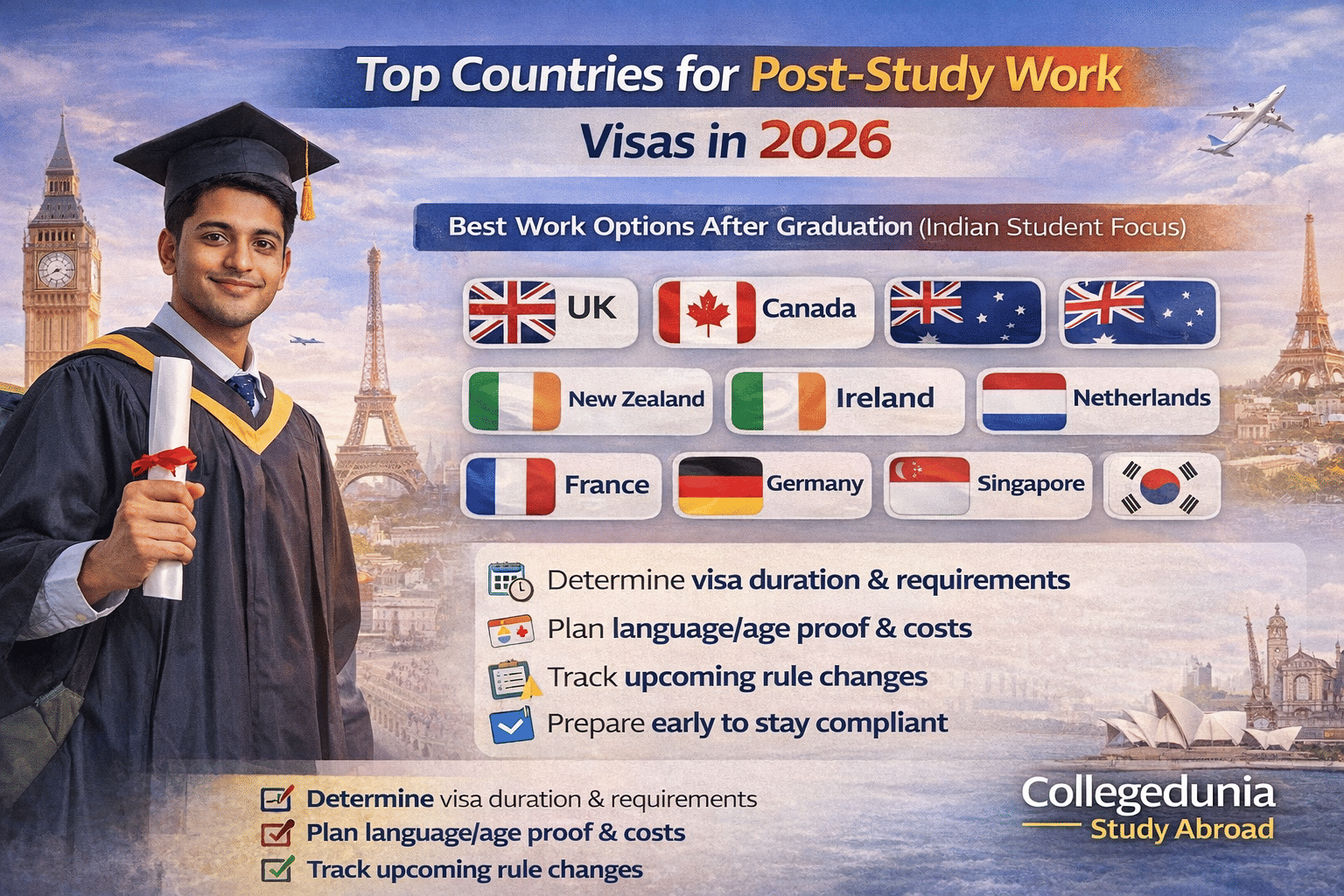
- Overview of Post-Study Work Options in 2026
- UK (Graduate visa)
- Canada (PGWP)
- Australia (Temporary Graduate visa subclass 485)
- New Zealand (Post Study Work Visa)
- Ireland (Stamp 1G)
- Netherlands (Orientation Year / zoekjaar)
- France (Job Search/Business Creation VLS-TS)
- Germany (job-seeking residence permit after graduation)
- Singapore (Employment Pass)
- South Korea (D-10-1 Job Seeker)
- How should Indian students choose the “best PSW country” in 2026
Quick Overview of Post-Study Work Options in 2026
| Country | PSW route name | Typical duration | Best for Indian students who want |
|---|---|---|---|
| UK | Graduate visa | 2 years (until 31 Dec 2026 applications), 18 months (from 1 Jan 2027 applications), PhD: 3 years | A clear “work-anywhere” graduate route + strong employer market |
| Canada | PGWP | Up to program-based length (commonly up to 3 years) | PR-oriented pathways + large Indian community; compliance is stricter now |
| Australia | Temporary Graduate (subclass 485) | Varies by qualification/stream | Strong graduate work rights; rules/streams have been reshaped since 2024 |
| New Zealand | Post Study Work Visa | Up to 3 years (depends on study) | Faster processing visibility + smaller market but clear rules |
| Ireland | Third Level Graduate Programme (Stamp 1G) | 12 months (Level 8), up to 24 months (Level 9+) | EU access + growing tech hiring, especially for Master’s grads |
| Netherlands | Orientation Year (zoekjaar) | 1 year | A job-search year with free work rights; helpful for EU entry |
| France | Job Search/Business Creation (VLS-TS) | Commonly 12 months | French/EU opportunities if you have a Master’s-level profile |
| Germany | Job-seeker residence permit after studies | 18 months | Engineering/tech roles + structured pathways into EU work permits |
| Singapore | Employment Pass (job-offer-based) | Pass duration varies | High salaries and Asia HQ roles—PSW isn’t automatic; job offer is key |
| South Korea | D-10-1 Job Seeker (job search/training) | Depends on case/issuance | Korea-market entry for specific profiles (language + employer fit matters |
UK (Graduate visa)
The UK Graduate visa allows eligible graduates to stay and work (or look for work) after completing a UK degree. What’s critical for 2026/2027 planners is that the duration depends on the application date:
- 2 years if you apply on or before 31 December 2026
- 18 months if you apply on or after 1 January 2027
- 3 years for PhD/doctoral qualification holders
Costs to plan for include the £880 application fee and the IHS (£1,035 per year).
Processing guidance for in-UK applications lists Graduate: 8 weeks as a standard processing time benchmark.
India-focused tip: If you’re graduating in late 2026, your PSW duration can be affected if you delay applying until January 2027—timing matters.
Canada (PGWP)
Canada’s Post-Graduation Work Permit (PGWP) remains one of the strongest long-term plays because it can connect to Canadian work experience and PR programs. However, in 2026, students must plan for newer compliance requirements:
- Language proof is mandatory for most PGWP applications submitted from November 2024, with minimum benchmarks that depend on the level of study. IRCC’s official PGWP language requirement pages outline how to map test scores to required levels.
- Fees for PGWP commonly include CAD 155 plus CAD 100 open work permit holder fee (total CAD 255).
- Applicants generally must apply within the allowed post-completion window (IRCC guidance for “apply within 180 days” is commonly referenced in official PGWP process pages).
India-focused tip: If you’re financing via education loans, plan the language test and documentation timeline early so you don’t lose working months due to avoidable refusals.
Australia (Temporary Graduate visa subclass 485)
Australia’s subclass 485 remains a core post-study pathway, but the program has been reshaped since 2024:
- The Department of Home Affairs page confirms the Post-Higher Education Work stream is for international graduates of Australian institutions and allows you to live, work, and study temporarily.
- Public guidance and summaries of changes note stream renaming and other eligibility updates effective 1 July 2024 (e.g., “Post-Study Work” renamed to “Post-Higher Education” in common references).
- StudyAustralia explains that the length of stay varies by qualification level, which is why course selection matters for Indian students.
- Home Affairs also publishes that global visa processing times are updated monthly on its processing-times page.
India-focused tip: Don’t treat Australia PSW as “set and forget.” Your eligibility can depend on age, stream rules, and documentation readiness—track the Home Affairs updates during your final semester.
New Zealand (Post Study Work Visa)
New Zealand’s PSW pathway is straightforward on paper:
- Stay and work up to 3 years, depending on what you studied
- Cost shown as from NZD 1,670
- Processing time indicator: 80% within 4 weeks
- You must show funds of at least NZD 5,000 for living expenses (as stated in visa requirements)
India-focused tip: NZ is often attractive when you want a transparent rulebook and predictable processing indicators, but the job market is smaller—course-to-occupation alignment matters.
Ireland (Stamp 1G)
Ireland’s Third Level Graduate Programme is clearly defined:
- Level 8 award holders: 12 months
- Level 9+ award holders: 12 months initially, renewable for another 12 months (up to 24 months) if you show appropriate job-search efforts
- Registration fee: €300
India-focused tip: Ireland can work well for Indian students in tech/data/finance, but hiring is role-specific—internships and work placements during study significantly improve outcomes.
Netherlands (Orientation Year / zoekjaar)
The Netherlands offers a structured “orientation year” permit:
- Valid for 1 year
- Application cost shown as €254
- During the orientation year, you may work freely (the employer doesn’t need a work permit)
India-focused tip: This route is powerful for students who want Schengen/EU mobility, but salaries, housing, and employer sponsorship norms should be researched early.
France (Job Search/Business Creation VLS-TS)
France’s France-Visas guidance notes that this route is for students with at least a Master’s-level qualification (or listed equivalent), returning to France to seek employment or set up a business (within a defined timeframe).
Campus France presents this as a post-study residence option and lists a €75 fee on the referenced page.
India-focused tip: France can be compelling if your program includes strong industry links and you can operate in French for many roles.
Germany (job-seeking residence permit after graduation)
Germany is widely chosen for engineering, data, automotive, and manufacturing ecosystems. Official guidance describes a post-graduation job-seeking period commonly referenced as up to 18 months for graduates to find work aligned with their qualification.
India-focused tip: Germany rewards planning: internships (“Werkstudent”), applied thesis collaborations, and German language skills can significantly affect how quickly you convert to a work permit.
Singapore (Employment Pass)
Singapore does not offer a universal “graduate route” like the UK. Instead, the practical post-study pathway is typically employer-driven (job offer → work pass). The Employment Pass (EP) system is governed by MOM rules:
- EP candidates must meet the qualifying salary and pass COMPASS, unless exempted.
- Minimum qualifying salary for new EP applications from 1 Jan 2025 (all sectors except financial services) is shown as SGD 5,600, increasing with age.
India-focused tip: For Singapore, brand-name internships, in-demand roles (tech, quant, product, finance), and strong employer networking matter more than the university’s “PSW promise.”
South Korea (D-10-1 Job Seeker)
Korea’s D-10-1 guidance (example shown by the Embassy of the Republic of Korea in Singapore) describes the D-10-1 as a job-seeking / training route in fields aligned to certain professional work visas (E categories). It also notes permitted activities may include job seeking and on-the-job training (including short-term paid internship), plus application/processing administration details.
India-focused tip: Korea can work for specific profiles (especially where language, industry fit, or prior Korea education applies). Always verify the exact requirements with the Korean mission handling applications for India.
Visa fees
| Destination | Key fee (officially stated) | Fee in INR (approx.) |
|---|---|---|
| UK | Graduate visa application fee: £880 | ₹111,217 |
| UK | Immigration Health Surcharge (IHS): £1,035 per year | ₹130,807 per year |
| Canada | PGWP fees: CAD 155 + CAD 100 (open work permit holder fee) = CAD 255 | ₹16,469 |
| New Zealand | Post Study Work Visa cost: NZD 1,670 | ₹92,187 |
| Netherlands | Orientation year application cost: €254 | ₹27,830 |
| Ireland | Registration fee: €300 | ₹32,870 |
| France | Long-stay visa fee shown: €75 | ₹8,217 |
| Singapore | EP minimum qualifying salary (all sectors except financial services, new applications from 1 Jan 2025): SGD 5,600/month | ₹4,04,303/month |
How should Indian students choose the “best PSW country” in 2026?
A PSW route only helps if you can realistically convert it into a job and then a longer-term work status. Prioritise:
- Course-to-job alignment: pick programs that map cleanly to shortage skills or employer demand.
- Timeline certainty: routes with strict deadlines (UK application-date rules; Canada language documentation) should be planned before final exams.
- Total cost of staying back: includes visa fees, health charges, and living costs (especially in the UK and major EU cities).
- Employer sponsorship reality: Some markets are PSW-friendly but still selective for sponsorship.
Indian Student Experiences (from Reddit)
As per Reddit insights, many students report that the “paper rules” are only half the story - processing time, documentation completeness, and timing can materially change outcomes:
- UK Graduate visa timing + processing: Students commonly share timelines ranging from a few weeks to the full guidance window; one user reported receiving the Graduate visa after just over 5 weeks during a peak period.
- Australia 485 outcomes can be fast when documents are perfect: A student shared a full self-managed checklist and reported a grant within days of submission once police checks, medicals, and test results were ready—reinforcing that “front-loading” documents matters.
- Canada PGWP language rules create confusion in edge cases: A thread discussion shows applicants asking whether language requirements apply to specific scenarios (e.g., extensions due to passport validity), reflecting that students should read IRCC updates carefully and keep proof ready even when they think they might be exempt.
If your priority is “time to find a job after graduating,” the UK, Australia, New Zealand, Ireland, and the Netherlands remain strong—provided you align the course, timing, and compliance. If your priority is “PR runway,” Canada can still be a top choice, but only if you treat language proof and documentation as non-negotiable.



Comments