



| Updated On - Jun 2, 2026
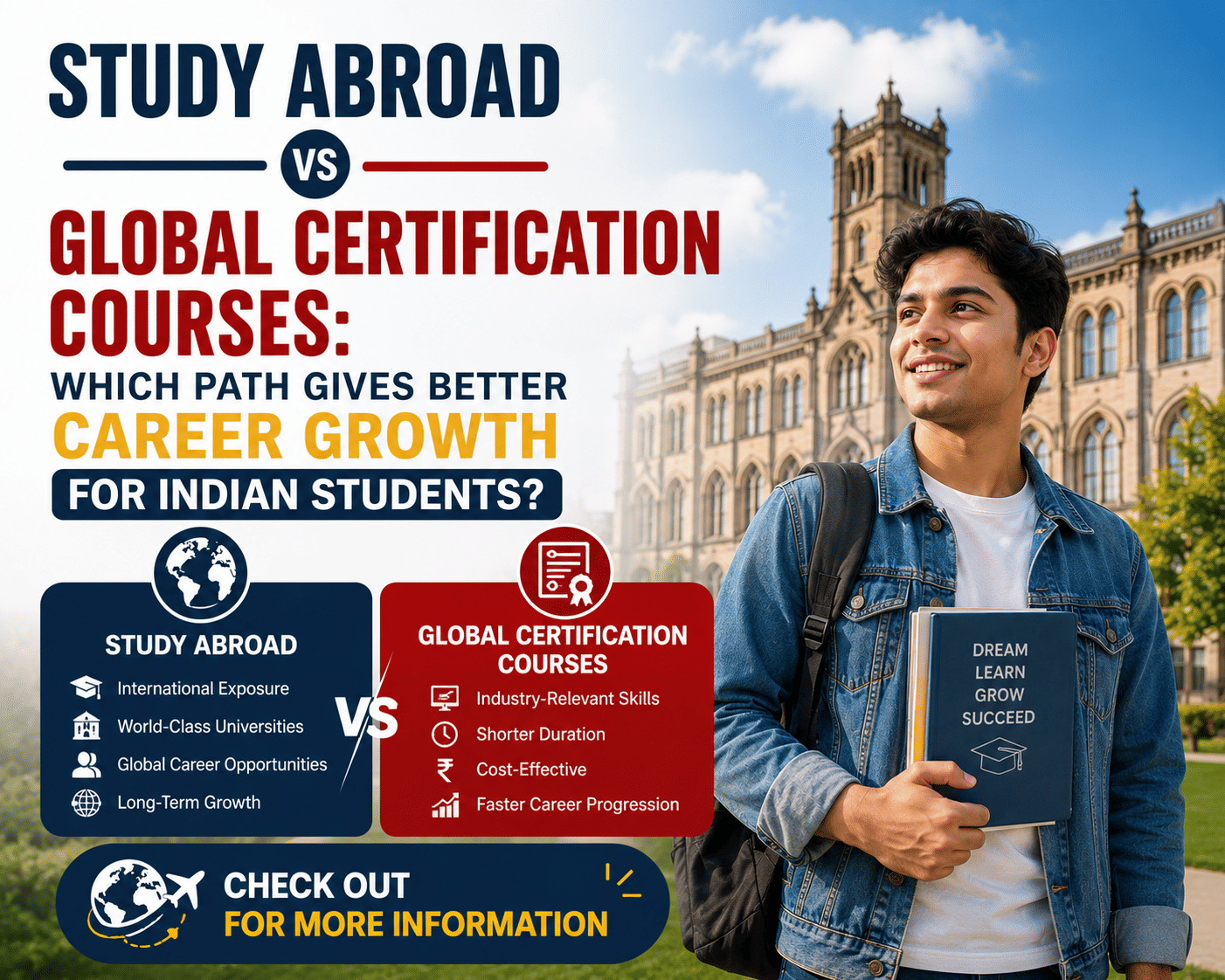
Indian students today have more educational options than ever before. Study abroad programs and global certification courses both offer legitimate pathways to career success, but they serve different goals and suit different profiles. Study abroad provides deep cultural immersion and long-term global exposure, while certification courses offer affordable, industry-focused learning that gets you into the job market faster. Understanding the differences helps you choose the right path for your career goals and financial situation.
Key Differences at a Glance:
- Study Abroad: Full-time degree programs lasting 2-4 years abroad
- Certification Courses: Short-term skill-based programs lasting 3-12 months
- Study Abroad Cost: ₹20-60 Lakhs per year, depending on the country
- Certification Cost: ₹50,000-5 Lakhs total for entire program
- Study Abroad ROI Timeline: 5-10 years to break even
- Certification ROI Timeline: 1-2 years to break even
Also check,
- Study Abroad: Colleges, Courses, Exams, and Fees
- Top Universities/Colleges to study abroad
- Study in the USA for Indian Students: Find Universities and Costs
- List of Top Courses in Abroad Colleges & Universities
Study Abroad: Long-Term Global Exposure
Study abroad remains the traditional choice for students seeking comprehensive international education. Countries like Canada, Germany, the United Kingdom, and Australia attract Indian students because of globally recognized universities and strong job markets. Students gain deep cultural exposure, access to advanced research facilities, and develop independence and global understanding.
Key Advantages of Study Abroad:
- Global networking: Build relationships with international peers and faculty
- Research opportunities: Access to advanced labs and research projects
- Internship experience: Real-world work experience in multinational companies
- Visa sponsorship: Many countries offer post-study work visas (Canada: 3 years, UK: 2 years, Germany: 18 months)
- Employer recognition: International degrees valued by multinational corporations
- Personal growth: Independence, adaptability, and cross-cultural communication skills
Challenges of Study Abroad:
- High costs: USA ($85,000-$110,000/year), UK (£20,000-£35,000/year), Canada (CAD 20,000-40,000/year)
- Long duration: 2-4 years away from home and family
- Visa complexity: Application process, documentation, and approval timelines
- Emotional adjustment: Cultural shock and homesickness
- Delayed job entry: Takes 2-4 years to complete a degree before earning
Study Abroad Salary Premium: According to research from the Forum on Education Abroad, graduates with study abroad experience earn on average $4,159 more (approximately ₹3.5 Lakhs) in their first job - a 6.3% salary premium compared to domestic graduates.
Also check,
- Top Universities in the USA for 2026: Rankings, Courses & Fees
- Top Universities in UK: Rankings 2026, Fees & Top Courses
- Study in Germany: Find Universities, Fees, and Visa Guide
- Study in Canada: Top Universities, Admissions, and Deadlines
Global Certification Courses: Affordable and Skill-Focused
Global certification courses are emerging as a practical alternative for students wanting international-level learning without leaving India. These programs are short-term, industry-designed, and increasingly recognized by employers. Popular platforms include Google Career Certificates, AWS Certifications, Coursera, and university-backed programs.
Key Advantages of Certification Courses:
- Affordability: ₹50,000-5 Lakhs vs ₹20-60 Lakhs per year for study abroad
- Speed to employment: Complete in 3-12 months and start earning immediately
- Skill-focused: Learn exactly what industry demands (AI, Data Science, Cloud Computing, Cybersecurity)
- Flexibility: Study while working or pursuing other goals
- Global recognition: Certificates from Google, AWS, and Microsoft are recognized worldwide
- No visa required: Study from India, no immigration hassles
- Employer partnerships: Direct job placement opportunities with partner companies
Popular Global Certification Programs in India (2026):
| Program | Duration | Cost (INR) | Entry-Level Salary |
|---|---|---|---|
| Google Data Analytics Certificate | 3-6 months | ₹50,000-1,50,000 | ₹4-6 Lakhs |
| AWS Cloud Practitioner | 2-3 months | ₹1,00,000-2,00,000 | ₹6-10 Lakhs |
| Microsoft Azure Fundamentals | 2-3 months | ₹80,000-1,50,000 | ₹5-8 Lakhs |
| Coursera Data Science Specialization | 4-6 months | ₹1,50,000-3,00,000 | ₹7-12 Lakhs |
| Digital Marketing Certification | 3-4 months | ₹50,000-1,00,000 | ₹3-5 Lakhs |
Challenges of Certification Courses:
- Limited scope: Focuses on specific skills, not broad education
- No degree credential: Doesn't replace a bachelor's or master's degree
- Employer variability: Some traditional companies still prefer degrees
- Career ceiling: May limit advancement to senior leadership roles
- No visa sponsorship: Cannot use certification for work visa abroad
Also check,
Cost Comparison: Investment and ROI
Cost is the biggest differentiator between study abroad and certification courses. Study abroad requires significant upfront investment, while certification courses offer faster returns on investment.
Total Cost Breakdown (2026):
| Expense Category | Study Abroad (2-Year Master's) | Certification Course |
|---|---|---|
| Tuition Fees | ₹20-40 Lakhs | ₹50,000-3 Lakhs |
| Living Expenses | ₹15-30 Lakhs (2 years) | ₹0 (study from India) |
| Travel & Visa | ₹2-5 Lakhs | ₹0 |
| Total Investment | ₹37-75 Lakhs | ₹50,000-3 Lakhs |
| Time to Break Even | 5-10 years | 1-2 years |
Real Example: A student investing ₹50 Lakhs in a 2-year Master's abroad, earning ₹25 Lakhs annually, needs 2 years just to recover the investment. A student investing ₹2 Lakhs in a certification earning ₹6 Lakhs annually breaks even in 4 months.
Which Path is Best for You?
The right choice depends on your goals, financial situation, and career timeline. Neither path is universally "better" — they serve different needs.
Choose Study Abroad If:
- You want to work abroad permanently (need visa sponsorship)
- You have financial resources (₹40+ Lakhs available)
- You seek leadership roles in multinational companies
- You want deep cultural immersion and a global perspective
- Your field requires advanced research or specialization (PhD, specialized Master's)
- You're willing to invest 5-10 years for long-term returns
Choose Certification If:
- You want to start earning quickly (within 1 year)
- You have a limited budget (₹1-3 Lakhs)
- You need specific technical skills (AI, Cloud, Data Science)
- You want to stay in India or work remotely
- You're already working and want to upskill
- You prefer flexibility and self-paced learning
Hybrid Approach (Best of Both):
Many successful professionals combine both paths: Complete a certification first (3-6 months, ₹1-2 Lakhs) to gain skills and start earning, then pursue study abroad after 2-3 years of work experience. This approach reduces financial burden, improves study abroad applications, and provides real-world context for advanced studies.
FAQs
Ques. Do employers prefer study abroad degrees over certifications?
Ans. It depends on the industry and role. Traditional sectors (finance, consulting, law) still prefer degrees. Tech and startup sectors increasingly value skills-based hiring — 85% of employers now use skills-based hiring. For leadership roles, degrees remain important. For technical roles, certifications are equally valued.
Ques. Can I get a work visa with just a certification course?
Ans. No, certification courses alone don't qualify for work visas in most countries. Study abroad degrees (Bachelor's or Master's) provide post-study work visas (Canada: 3 years, UK: 2 years, Germany: 18 months). However, certifications can help you get hired by companies that sponsor work visas.
Ques. What's the real ROI difference between study abroad and certification?
Ans. Certification ROI is faster: ₹2 Lakhs investment breaks even in 4 months. Study abroad ROI takes longer: ₹50 Lakhs investment breaks even in 2-3 years. However, study abroad offers higher lifetime earnings (₹40-60 Lakhs at 5 years vs ₹20-35 Lakhs for certification). Choose based on your timeline and financial capacity.
Ques. Can I do a certification course while working and then study abroad later?
Ans. Yes, this is an excellent strategy. Complete a certification (3-6 months), work for 2-3 years, build experience and savings, then apply for study abroad. This approach improves your study abroad applications, reduces financial burden, and gives you real-world context for advanced studies.



Comments