


| Updated On - Jun 24, 2026
If you're an 11th or 12th-grade student planning to pursue undergraduate studies abroad or in the USA, SAT scores can help you gain admission. The SAT exam is just 2 months away, scheduled in June 2026. Students need to utilize the 4-week time wisely to score well on the exam. Those who are preparing for JEE and IELTS have an upper hand on this as the syllabus overlaps. This reduces the stress and makes the June attempt easy to score.
Students primarily need to focus more on time management and covering the remaining syllabus in 4 weeks. Those who are actively preparing for it need to move strategically, as SAT scores are accepted globally by top universities such as Imperial College London and the University of Toronto. SAT scores can help you to get notable SAT scholarships like the National Buckeye Scholarship.
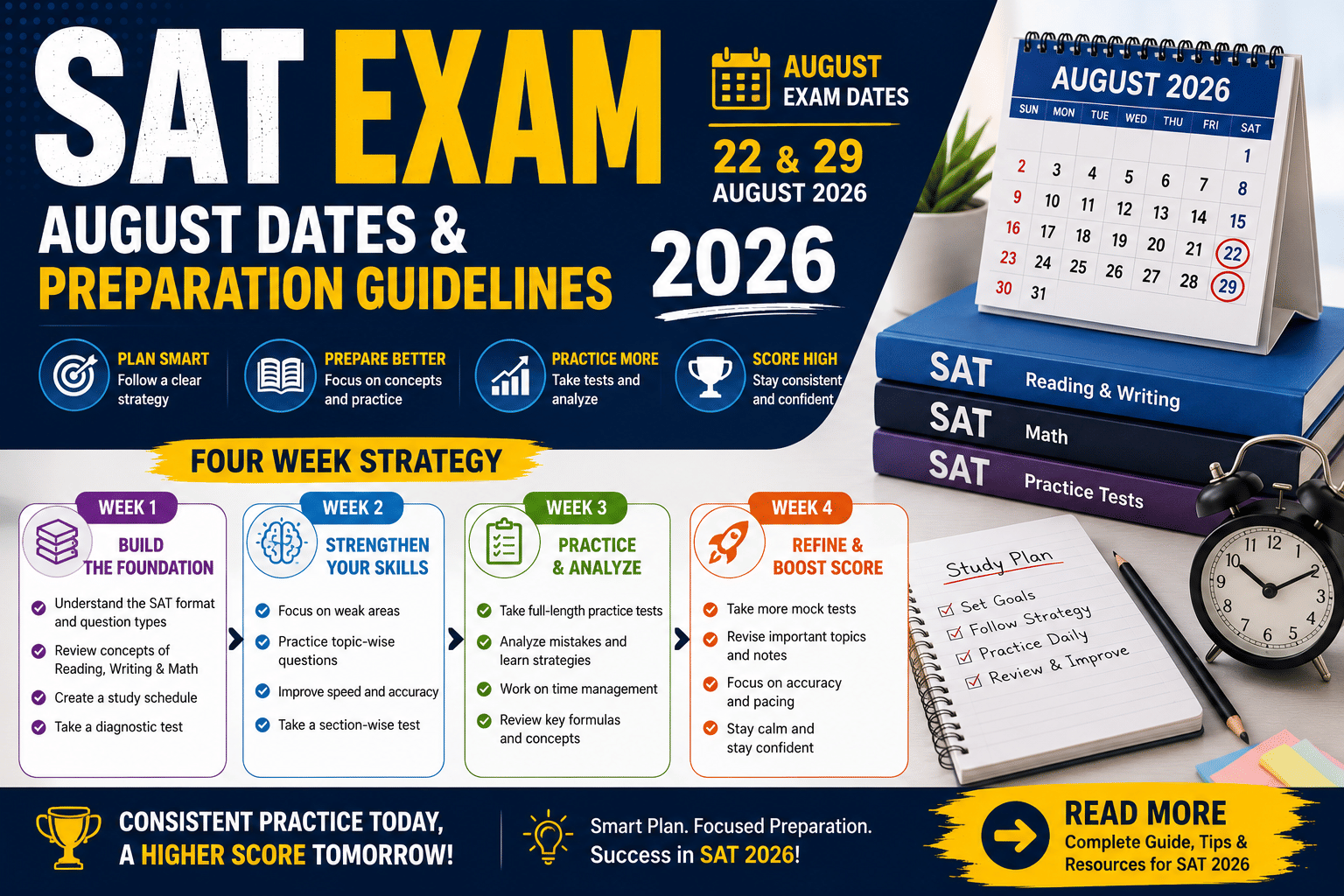
Important SAT test dates to remember:
- Last registration date - 7th August, 2026
- Late registration deadline - 11th August,2026
- Date of Examination - 22nd August, 2026
Also read: Why is the SAT Important for 2027 Early Action for US Universities?
- SAT Exam Pattern 2026
- FAQs
- 4-week Strategy for Indian Students to Crack the SAT
- JEE, IELTS, and SAT Syllabus Comparison
4.1 Similarities Between JEE and SAT Math
4.2 Similarities Between the IELTS and the SAT English
- Special Tips for Students to Crack the SAT
- Things to Avoid While Preparing for the SAT
6.1 FAQs
SAT Exam Pattern 2026
The SAT test pattern is adaptive, which means the questions’ difficulty depends on how you perform. It is divided into two main sections: Reading & Writing and Math. Each section contains two modules of equal length.
- The Reading & Writing section has 54 questions to be completed in 64 minutes, while
- The Math section has 44 questions with a total time of 70 minutes.
- The entire test lasts 2 hours and 14 minutes. SAT scores range from 400 to 1600, combining results from both sections, and there is no negative marking for incorrect answers.
| Sections | Modules | Time per module | Total no. of questions | Question type |
|---|---|---|---|---|
| Reading & writing | 2 | 32 minutes | 54 | Multiple-choice |
| Mathematics | 2 | 35 minutes | 44 | MCQs + Student-produced responses |
Note: 1 USD = 94.50 INR is used as the Currency conversion rate throughout the article as of 24th June, 2026.
Also read: SAT exam fees details.
FAQs
Ques. What are the registration fees for the SAT in August 2026?
Ans. Registration fees for the SAT exam in August 2026 are 131 USD (₹12,400). Students can visit the College Board website and fill out the form for June 2026. Students belonging to economically weaker sections can avail a 90% fee waiver. through the College Board India Scholars Program.
4-week Strategy for Indian Students to Crack the SAT
Students need to sit for weekly sessions and solve as many problems as they can each day. One needs to make a schedule, breaking down the syllabus into each week to focus on all the topics separately.
Strategy for week 1
During week 1, students should focus on weak domains like Algebra, Data Analysis, or Reading comprehension. This can help in identifying the major issues which need more attention. This can help in a strategic hold of the SAT syllabus.
| Area | Topics / Tasks | Frequency | Goal |
|---|---|---|---|
| Reading & Writing | Grammar basics (SVA, pronouns, verbs, modifiers, punctuation), short passages, main idea, tone, vocab-in-context | 5 days | Build core R&W foundation |
| Daily R&W Practice | 20-25 grammar Qs, 2-3 passages, learn question patterns | Daily | Improve accuracy |
| Math | Linear equations, systems, ratios, percentages, basic algebra, graphs, intro functions | 5 days | Build math basics |
| Daily Math Practice | 20-25 core problems, learn Desmos basics | Daily | Strengthen fundamentals |
| End-of-Week Task | Bluebook Practice Test 1 (untimed), analyse weak areas | 1 day | Diagnose strengths & weaknesses |
The student must build their base within this period and should focus on major topics and tasks that can help to tackle the syllabus in the following weeks.
Strategy for week 2
Focus intensively on your two weakest domains. For Math, JEE students should skip re-learning concepts and focus on SAT question formats, which are shorter, applied, and real-world contextualised.
| Area | Topics / Tasks | Frequency | Goal |
|---|---|---|---|
| Reading & Writing | Transitions, rhetorical skills, logical flow, and evidence questions | 5 days | Enhance reasoning skills |
| Daily R&W Practice | 3-4 passages, 20 grammar Qs, timed R&W module (32 min) | Daily | Start time-conditioning |
| Math | Quadratics, inequalities, exponential functions, word problems, geometry, statistics | 5 days | Cover medium-level topics |
| Daily Math Practice | 25-30 questions, timed Math Module 1 (35 min) | Daily | Build timed math accuracy |
| End-of-Week Task | Bluebook Practice Test 2 (timed), review mistakes | 1 day | Build test stamina |
Practice 30 - 40 SAT Math questions daily. For Reading and Writing, read one editorial or science article daily and annotate for main idea, tone, and evidence. Practise 20 grammar questions focusing on punctuation, sentence structure, and subject-verb agreement.
Strategy for week 3
Take two full-length timed digital SAT practice tests. Review every wrong answer. Do not just note it, understand the exact reasoning error. This is an efficient way to prepare for the SAT:-
| Area | Topics / Tasks | Frequency | Goal |
|---|---|---|---|
| Reading & Writing | Purpose questions, structure, synthesis, advanced grammar, humanities/science passages | 5 days | Master high-yield R&W topics |
| Daily R&W Practice | 1 full module (27 Qs), detailed error log | Daily | Improve adaptive performance |
| Math | Advanced algebra, functions, hard word problems, quadratics + systems, probability, stats | 5 days | Strengthen high-value math areas |
| Daily Math Practice | 30-35 mixed questions, Desmos speed techniques | Daily | Increase difficulty tolerance |
| End-of-Week Task | Bluebook Practice Test 3 (timed), check if you get hard Module 2 | 1 day | Track high-band scoring ability |
Revisit the Desmos graphing calculator (built into the Bluebook app) and learn to use it for quadratics and function graphs.
Also Read: Calculator vs Mental Math: What Actually Saves Time in the SAT?
Tip - This tool alone can save you 3 - 4 minutes on the Math section.
Strategy for week 4
Week 4 is the most crucial as it is the last week for preparation. Students need to be careful with this limited and last-minute time. This week needs a strategic focus for SAT.
| Area | Topics / Tasks | Frequency | Goal |
|---|---|---|---|
| Reading & Writing | Full-time modules, transitions, main idea, advanced rhetoric review | 6 days | Maximize R&W accuracy |
| Math | Full-time modules, medium/hard questions, formula revision | 6 days | Eliminate careless errors |
| Mocks | Mock Test 1 (Mon/Tue), detailed review (Wed/Thu); Mock Test 2 (Fri/Sat) | 2 full tests | Build real exam readiness |
| Final Days | Light review, formula sheet, grammar rules, light passages, rest | Last 2-3 days | Peak mental performance |
As these are the final days before the exam, students need to be more careful and focus more on solving questions and building accuracy.
JEE, IELTS, and SAT Syllabus Comparison
Anyone preparing for JEE Main or Advanced and IELTS can easily clear the SAT, as much of the SAT syllabus overlaps with JEE and IELTS. Students need to utilise their remaining 2 months carefully. They need to focus mainly on the untouched part in the first week. Later, they can aim for the other significant portion that needs revision. Here`s a complete breakdown of the syllabus:-
Similarities Between JEE and SAT Math
A dedicated JEE aspirant who scores 120 in a 300-mark maths practice paper can easily score 750-800 in SAT Math. The syllabus of the two exams overlap, so anyone who is a JEE aspirant should sit for the SAT exams as well. Here`s the complete breakdown:-
| Domain | Similarities in the JEE Syllabus | New Components to Cover in Sat |
|---|---|---|
| Algebra | Linear equations, inequalities, and systems of equations | Framing real-world equations |
| Advanced Math | Quadratic functions, polynomials, factoring, exponential growth/decay. | Real numbers, Parabolas |
| Problem-solving and data analysis | Basic probability, mean, median, mode, and range. | Scatterplots, two-way tables, and margin of error |
| Geometry & Trigonometry | Coordinate geometry (lines, circles, slopes), basic trig ratios | 2D geometry, circle theorems, and right-triangle trigonometry. |
Similarities Between the IELTS and the SAT English
While both exams assess academic English, the following comparison highlights how their testing formats and core objectives differ for students.
| Similarities Between IELTS & SAT | Dissimilarities Between IELTS & SAT |
|---|---|
| Academic Content: Both use passages from Science, History, Social Studies, and the Humanities. | IELTS has Speaking & Listening; the SAT is purely Reading & Writing. |
| Evidence-Based: Both require you to find answers only within the text (no outside opinions). | Format: IELTS uses long passages (900 words), SAT uses "micro-passages" (one per question). |
| Core Grammar: Both penalise errors in subject-verb agreement, tenses, and basic punctuation. | SAT uniquely tests how an author builds an argument or uses a specific "tone." |
| Vocabulary: Both require a strong grasp of academic English and context-based meanings. | SAT is Adaptive (Module 2 difficulty changes), IELTS is linear (constant difficulty). |
| Inference Skills: Both ask you to "read between the lines" to find the author's implied meaning. | IELTS asks you to write an essay, and the SAT asks you to fix sentences and transitions. |
Special Tips for Students to Crack the SAT
To crack the SAT, students need to plan their strategy and build speed. One needs to work smartly for the remaining 30 days. Students should primarily focus on practice papers on the official Bluebook app and Collegedunia SAT papers. Here are the tips one needs to follow:-
- Solving the sums with the timer on. This will help them to manage their time during the exam.
- Solving multiple practice papers given on the official Bluebook app and the practice paper set by Collegedunia.
- Use of elimination power is another effective way to solve problems and save time. The elimination technique is when students remove the most wrong answers to get the correct one.
- Module 1 performance decides if you get the harder Module 2. Aim for high accuracy in Module 1 to reach the top score range.
- Practice calculator tips, such as Desmos. Desmos is an advanced online graphing calculator and a suite of math tools. It allows users to plot equations, create tables, add sliders to animate graphs, and explore mathematical concepts visually.
- Patience and calmness increase the focus of the students.
- Weekly practice sessions can help clear the doubts and increase the problem-solving capabilities.
Note - Download Bluebook on your device 5-6 days before the exam date and log in with your credentials. Complete the ‘Exam setup’ to generate an admission ticket
Things to Avoid While Preparing for the SAT
Preparing for the SAT, students need to keep in mind that they shouldn't overuse the calculator in exams. They should have a weekly record of their drawbacks and the area which needs special attention. Here are some more things students should strictly avoid while preparing for the SAT:-
- Don`t focus on speed before accuracy. Accuracy needs more practice, which can result in excellent speed.
- Do not leave any question unanswered, as there is no negative marking.
- Don`t rely on school-level Math and English. The SAT pattern differs from the usual school pattern.
- Don`t waste time memorising vocabulary. SAT questions are more focused on in-context questions.
- Don`t study for long sessions, which makes you tired. Sit for smaller sessions spanning 1 hour to 1 hour 30 minutes.
- Don`t ignore your mistakes. They can help you to find out your drawbacks and weak areas.
For Indian students, the June 2026 SAT represents a high-stakes gateway to global education, where a score of 1300+ can unlock merit scholarships worth over ₹50 Lakhs through the College Board India Scholars Program. With 70% of the syllabus overlapping with JEE and IELTS, students can strategically leverage their existing foundation to master the 1600-point adaptive digital format.
By dedicating the final 4 weeks to high-yield domains like Advanced Math and skills, and utilizing tools like Desmos, aspirants can maximize their score. Students can take advantage of up to 90% fee waivers and domestic financial aid like the PM-Vidyalaxmi scheme.
FAQs
Ques. Can SAT scores help with educational loans?
Ans. A high SAT score of 1450+ can help the student to get student loans for higher education from banks such as SBI, Avanse, HDFC, and Credila. The banks approve non-collateral unsecured loans for students with high scores who are likely to get a decent job in the future.
High scores can help students get scholarships, which eventually reduces the principal of the loan with lower interest rates. Students can also get scholarships and loans from the PM Vidyalaxmi scheme if they plan to attend a premium institute within the country.
Ques. Can SAT score benefit if 12th-grade marks are low?
Ans. SAT scores can help Indian students to get a scholarship as well as to improve their grades to get admission. Anyone who has received low grades in the 12th standard can sit for the SAT exam and can plan to go abroad.
Ques. Can I use my Aadhaar Card as identification at the test center in India?
Ans. For 2026, the College Board accepts the original physical Aadhaar Card as a valid form of identification for Indian citizens testing within India.
Ques. How does Superscoring work if I take the SAT multiple times?
Ans. Most top universities (including Stanford, MIT, and Yale) follow a Superscore policy. This means if you take the SAT in June 2026 and again later, the university will take your highest Reading & Writing score from one date and combine it with your highest Math score from another to create your best possible total. You must send the full score reports for both dates; you cannot "mix and match" sections yourself.








Comments