



| KdTvCV - Jun 15, 2026
PTE Academic gives results in typically 48 hours, while IELTS on Paper takes up to 7 days. For Indian students applying close to university deadlines, this difference can decide whether an application goes through or not. PTE Academic is a 2-hour, computer-based test accepted by 4,000+ universities worldwide. IELTS on Computer gives results in 1-2 day. Both tests are valid for 2 years. This article breaks down result timelines, test formats, score sharing, and what matters most when time is short.
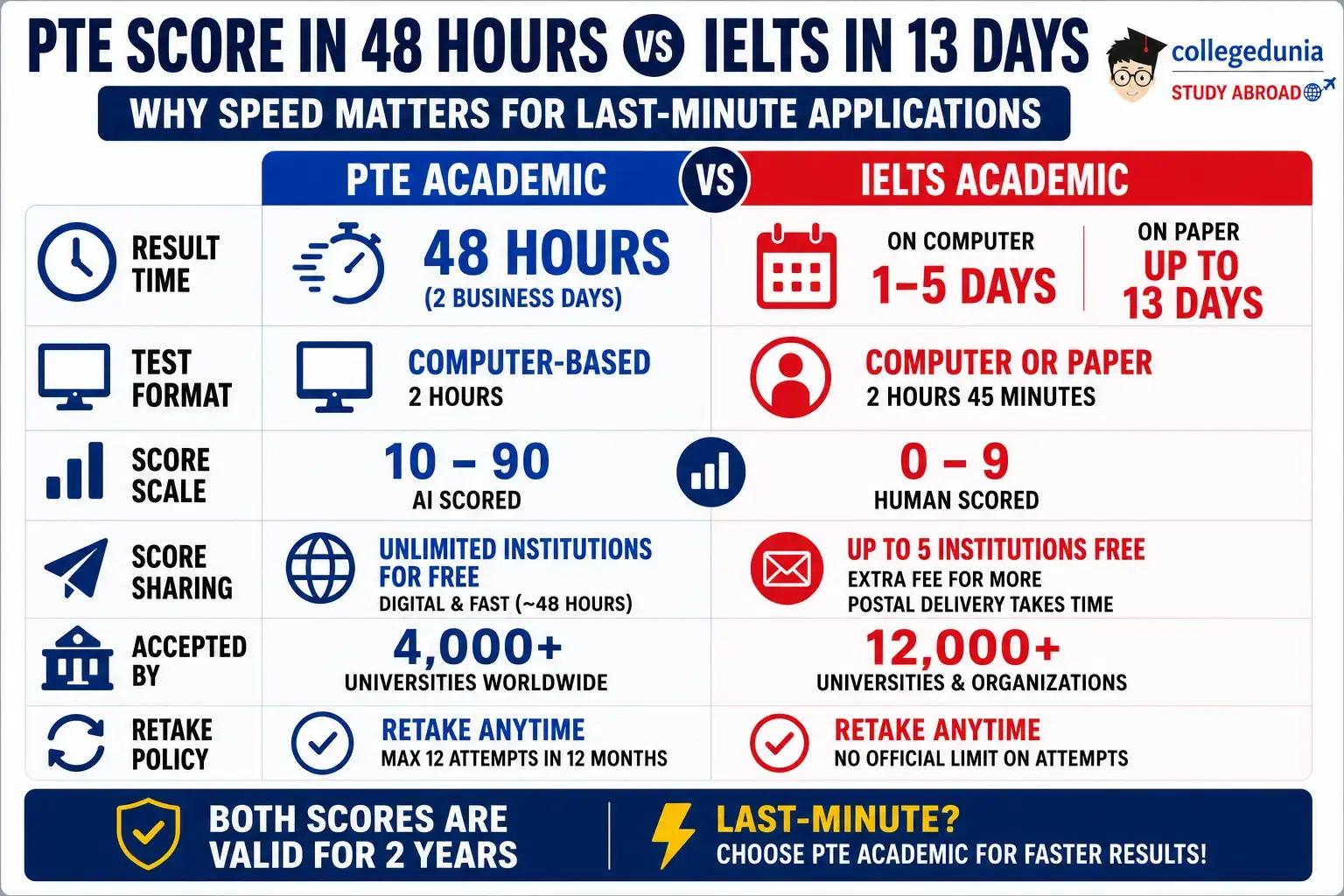
How Long Does It Take to Get Your Score?
This is the most important factor for students with tight deadlines. The result timeline varies a lot between PTE and IELTS — and even within IELTS itself.
PTE Academic:
- Results typically in 48 hours (2 business days).
- Can take up to 5 business days in some cases.
- You get an email when your score is ready.
- Access your score via your myPTE account.
IELTS (varies by test type):
- IELTS on Computer: 1-2 days
- IELTS on Paper: Up to 7 days
- IELTS for UKVI (for UK university applications, student visa, and work visa):
- 1-2 days for the Computer-based test
- Up to 13 days for the paper-based test.
- IELTS for UKVI Life Skills (for UK spouse visa, sportsperson visa, and citizenship): Up to 7 days
Key takeaway for Indian students: If you're applying last-minute, PTE Academic and IELTS on Computer are your fastest options. IELTS on Paper is the slowest.
Must Read: IELTS Paper-based Test to be Discontinued from Mid-2026 Onwards
What Is the Test Format?
Knowing the format helps you pick the right test quickly. Both tests assess the same 4 skills — but the format is different.
PTE Academic:
- Fully computer-based.
- Duration: 2 hours.
- Tests: Speaking, Writing, Reading, Listening.
- Scored by AI — no human examiner involved.
- Available at 500+ test centers worldwide.
- Cannot be taken at home.
IELTS Academic:
- Duration: 2 hours 45 minutes.
- Tests: Listening (~30 min), Reading (60 min), Writing (60 min), Speaking (11–14 min).
- The speaking section is done face-to-face with a human examiner.
- Available on paper and on computer.
- Over 1,600 test locations in 140 countries.
How Are Scores Calculated?
Understanding how each test scores you helps set the right expectations before you book.
PTE Academic:
- Scores on a scale of 10 to 90.
- AI scoring — reduces human bias.
- You get an overall score + individual scores for each skill.
- Also includes a Skills Profile (visible only to you).
- Typical score requirements:
- Foundation courses: 36–50
- Undergraduate: 51–60
- Postgraduate: 57–67
IELTS:
- Scores on a band scale of 0 to 9.
- Overall band = average of 4 sections, rounded to nearest half band.
- Writing and Speaking are marked by trained human examiners.
- The score is valid for 2 years (same as PTE).
PTE vs IELTS Score Comparison (Official Concordance):
| PTE Score | IELTS Band |
|---|---|
| 47 | 6.0 |
| 55 | 6.5 |
| 63 | 7.0 |
| 71 | 7.5 |
| 79 | 8.0 |
(Source: Latest Pearson PTE official concordance study)
How Do You Share Your Score With Universities?
Once you have your score, you need to send it to universities fast. Here's how each test handles this.
PTE Academic:
- Scores are digital only — no paper copy needed.
- Share with unlimited institutions for free.
- Done via your myPTE account.
- After you send, institutions can see your score in around 48 hours.
- Institutions cannot see your other attempts — only what you share.
IELTS:
- You receive a Test Report Form (TRF) — paper or digital (eTRF).
- You can share by postal mail (up to 5 organisations free) or e-delivery.
- Paper TRF delivery takes additional time due to postal delays.
For Indian students: PTE's digital score sharing is faster and free for unlimited institutions. IELTS charges an extra fee for more than 5 score reports.
Where Is Each Test Accepted?
Both PTE and IELTS are widely accepted, but there are some differences worth knowing.
PTE Academic is accepted by:
- 4,000+ universities and colleges worldwide.
- Virtually all universities in Australia, Canada, the UK, and New Zealand.
- Widely accepted across the US, including all Ivy League universities.
- Australian and New Zealand governments for migration visas.
IELTS is accepted by:
- More than 12,000 universities and organizations globally, per IDP, the conducting body.
- All 4 major immigration authorities — Australia, Canada, New Zealand, and the UK.
- Widely accepted for student visas, work visas, and PR applications.
Note: Always check the specific score requirement of your target university or visa program directly on their official website.
Can You Retake the Test Quickly?
If your score isn't enough, how fast can you retake?
PTE Academic:
- You can retake as soon as you receive your score.
- Maximum 12 attempts in a 12-month period.
- No mandatory waiting period between attempts.
IELTS:
- You can retake the test; no official limit on attempts.
- Check test date availability at your nearest test centre.
PTE Academic's 48-hour result timeline is a clear advantage for students with urgent deadlines, compared to IELTS on Paper's 13-day wait. IELTS on Computer (1–5 days) is a middle ground. Both tests are valid for 2 years and widely accepted. Your choice should depend on your deadline, preferred test format, and which test your target university or visa program accepts.
FAQs
Ques. Can I take PTE Academic from home?
Ans. No. PTE Academic must be taken at an authorised test centre. It cannot be taken at home. This ensures the test is secure and accepted by universities and governments.
Ques. Is PTE score sharing really free for all universities?
Ans. Yes. According to Pearson PTE's official website, you can send your PTE Academic score to unlimited institutions for free via your myPTE account.
Ques. How long is a PTE or IELTS score valid?
Ans. Both PTE Academic and IELTS scores are valid for 2 years from the test date. After 2 years, you will need to retake the test.
Ques. If I take IELTS on Computer, will I get a paper TRF or digital?
Ans. For IELTS on Computer, you typically receive a paper Test Report Form. In some countries, a digital eTRF is also being issued. Check with your local test centre for the latest update.
Ques. Can universities see all my PTE attempts?
Ans. No. Universities can only see the score you choose to send them. They cannot see your other attempts or whether your score is higher or lower than previous tests.


1787567517.png?tr=w-305,h-145,c-force?h=175&w=350&mode=stretch)



Comments