



| Updated On - Jul 8, 2026
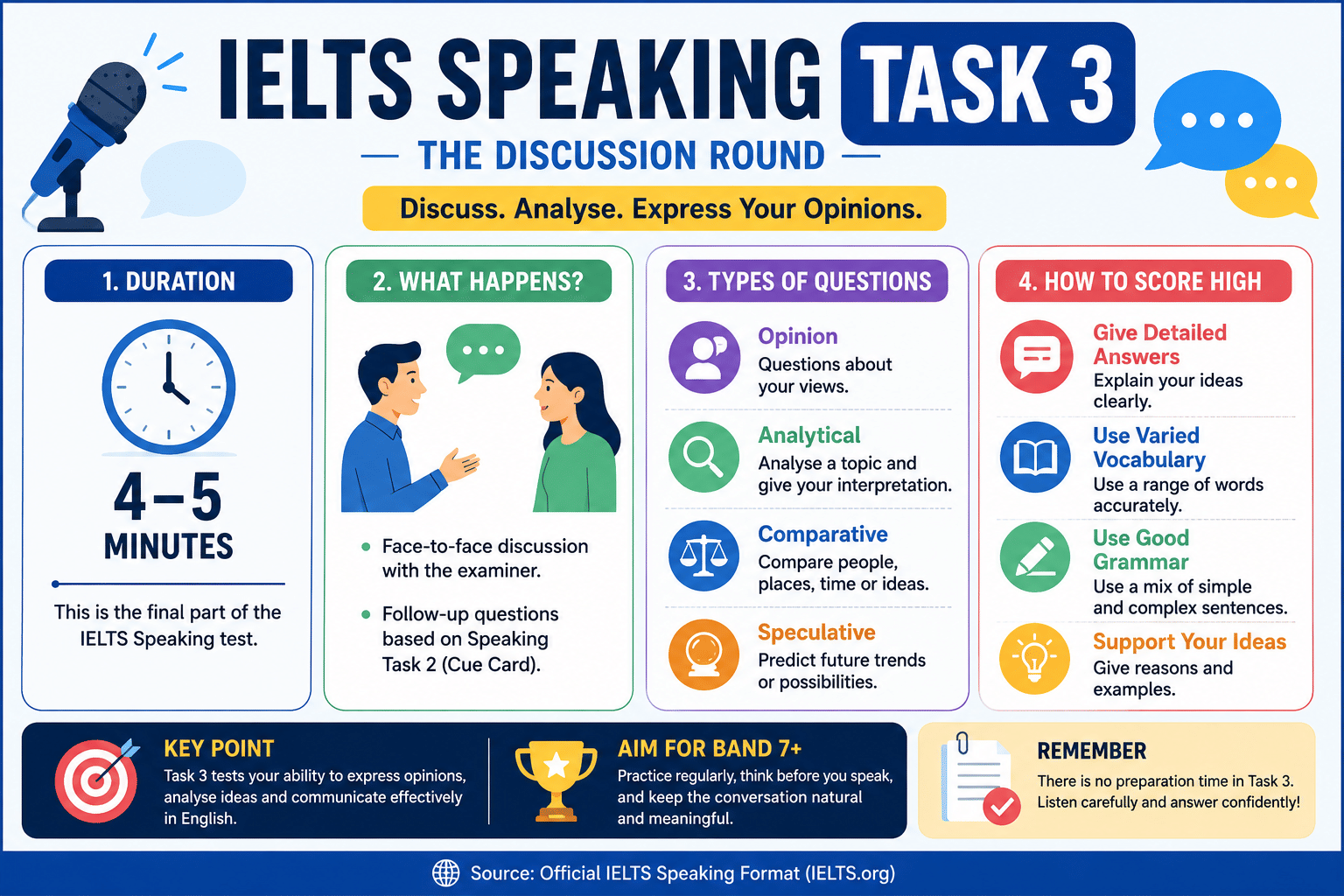
IELTS Speaking Task 3 is a 4-5 minutes long discussion round. The applicant is questioned by the examiner on some basic or general topics. The applicant needs to respond to the examiner's questions of the examiner. The IELTS Speaking test is mainly to test speaking skills of the applicant.
The IELTS Speaking Task 3 questions can be opinion-based or comparative. The examiner examines the applicant’s vocabulary and grammar proficiency throughout the IELTS test.
- What is IELTS Speaking Task 3?
- IELTS Speaking Task 3 Format 2026
- Types of Questions Asked in IELTS Speaking Task 3
- IELTS Speaking Task 3 Sample Questions with Answers 2026
- How IELTS Speaking Task 3 is Different from Task 2
- Common Mistakes to Avoid in IELTS Speaking Task 3
- Vocabulary for IELTS Speaking Task 3
- Grammar for IELTS Speaking Task 3
- Tips and Strategies to IELTS Score Band 7+ in Part 3
- FAQs
What is IELTS Speaking Task 3?
IELTS Speaking Task 3 is a discussion round. In this, the IELTS examiner is involved in a conversation with the applicant. Both discuss a general topic, and the examiner can ask the applicant some opinion-related questions.
The topic for the IELTS Speaking Task 3 is mainly general. The examiner can continue the same topic given in the IELTS Cue Card. You might have to answer some questions from the examiner about what you said in the Cue Card round.
IELTS Speaking Task 3 Format 2026
The IELTS Speaking Task 3 lasts 4-5 minutes. The IELTS Speaking Test lasts 11-14 minutes, in which Task 1 lasts for 3-4 minutes, Task 2 for 3-4 minutes, and Task 3, the discussion round, is 4-5 minutes.
The IELTS Speaking Task 3 is a face-to-face interview between the test taker and an examiner, and the test is recorded. The examiner moves directly from IELTS Speaking Part 2 into Part 3, asking follow-up questions connected to the Part 2 topic.
Types of Questions Asked in IELTS Speaking Task 3
The IELTS Speaking Task 3 primarily has questions in which applicants need to explain their opinions, analyse their views, and discuss their ideas. The Task 3 tests the applicants' ability to explain their opinions.
The IELTS Speaking Task 3 question types are:
- Opinion questions: In this type of question, the examiner can ask you your views on a certain general theme or topic.
- Analytical question: In this type of question, the examiner can ask you to analyse a given topic and give your interpretation.
- Comparative questions: The examiner can ask you to compare certain time phases, data, or something from the introductions and Cue Card round.
- Speculative questions: In such questions, the examiner can ask you to predict what the future of a certain given issue or topic will be, looking at its current state.
In IELTS Speaking Task 3, the examiner can ask questions like “What kind of things give status to people in your country?”, “Have things changed since your parents’ time?” These questions are simple and opinion-based. Applicant need to analyse and give their answer according to their observation.
IELTS Speaking Task 3 Sample Questions with Answers 2026
Question 1: What kind of things give status to people in your country?
Sample Answer
In my opinion, expensive cars, luxury homes, and branded clothing are some of the most common status symbols in my country. Many people believe that owning these things reflects financial success and a comfortable lifestyle. However, I think education and professional achievements are becoming equally important today. For example, people who work as doctors, engineers, or entrepreneurs are often respected regardless of the car they drive or the clothes they wear.
Question 2: Have things changed since your parents' time?
Sample Answer
Yes, I believe people's priorities have changed a lot over the years. In my parents' generation, owning a house or having a stable government job was considered a major achievement. Nowadays, younger people often value international travel, technology, and flexible careers more than traditional symbols of success. Social media has also influenced what people consider fashionable or prestigious.
Question 3: Do you think advertising influences what people buy?
Sample Answer
Yes, advertising has a significant influence on consumers because it introduces new products and creates awareness about different brands. Attractive advertisements can encourage people to try products they may not have considered before. However, many consumers also compare prices and read online reviews before making a final decision, especially when purchasing expensive items.
Question 4: Why do some people like buying expensive brands?
Sample Answer
Some people buy expensive brands because they believe these products offer better quality and last longer. Others may choose luxury brands to express their personal style or to create a positive impression in social or professional settings. At the same time, not everyone prefers branded products, as many people focus more on value for money than on brand names.
How IELTS Speaking Task 3 is Different from Task 2
In IELTS Speaking Task 3, applicants need to engage in a discussion round where they need to answer some questions from the IELTS examiner. On the other hand, in the IELTS Cue Card, applicants are given a topic on which they need to speak continuously for 2-3 minutes.
The major difference between the IELTS Task 2 and Task 3 is that for the IELTS Cue Card Task 2 applicants are given 1-2 minutes of time for preparation. But for IELTS Speaking Task 3, applicants are given no preparation time.
The difference between IELTS Speaking Task 2 and Task 3 is discussed in detail below:
| Feature | IELTS Speaking Cue Card (Task 2) | IELTS Speaking Task 3 (Discussion) |
|---|---|---|
| Nature | Individual long turn on a task-card topic | Two-way discussion with the examiner |
| Content | Personal experience, the applicant's own life | Abstract, general issues connected to the Part 2 topic |
| Duration | 3-4 minutes, including 1 minute preparation | 4-5 minutes, no preparation time |
| Skill tested | Speaking at length on a given topic, using appropriate language and organising ideas logically | Explaining opinions and analysing, discussing, and speculating about issues |
| Interaction | Largely uninterrupted monologue | Interactive back-and-forth with examiner follow-ups |
Common Mistakes to Avoid in IELTS Speaking Task 3
Applicants must be aware of the common mistakes committed in the IELTS Speaking Task 3, which affect their overall performance and IELTS Scores. Following are some of the common mistakes made by the applicants:
- Repeating the same linking words. Speakers use the same connecting words, like "and," "but," "so", again and again instead of varying them.
- Pausing too much to find basic words. Many test takers stop mid-sentence just to think of simple words or grammar they should already know well.
- Not trying to paraphrase. When test takers forget a word, they often give up instead of trying to explain it in a different way.
- Giving short, repetitive answers. Many test takers avoid longer sentence structures with words like "because," "which," or "although," so their answers stay short and start to sound repetitive, and this often comes with more grammar mistakes.
- Losing the thread when speaking under pressure. Some test takers lose track of what they are saying, repeat themselves, or keep correcting themselves, which breaks the flow of their answer.
Vocabulary for IELTS Speaking Task 3
Applicants should take care of their vocabulary while appearing for the IELTS Speaking test. The words used in the test are one of the most important factors for their scoring. To get good IELTS vocabulary accuracy, follow the given vocabulary areas in the table below:
| Vocabulary Area | Description |
|---|---|
| Opinion Expressions | Use phrases such as In my opinion, I believe, and From my perspective to introduce your viewpoint naturally. |
| Reason and Result Words | Connect ideas using expressions like because, therefore, as a result, and one reason is that. |
| Comparison Vocabulary | Use words such as similarly, however, in contrast, and on the other hand to compare different ideas. |
| Future Prediction Language | Express future possibilities using phrases like It is likely that, I expect, and There is a possibility that. |
| Example Expressions | Support your answers with phrases like For example, For instance, and Such as to make your ideas clearer. |
| Cause and Effect Vocabulary | Explain relationships using words such as lead to, result in, contribute to, and due to. |
| Topic-Specific Vocabulary | Learn commonly used words related to education, technology, environment, work, health, and society, as these themes frequently appear in Part 3 discussions. |
Grammar for IELTS Speaking Task 3
Indian students preparing for the IELTS Speaking test should know that grammar is one of the main testing areas of IELTS. Grammatical accuracy is a primary requirement of all the IELTS tests. Here are some grammar topics which you can prepare for IELTS Speaking Task 3 and for the overall test:
| Grammar Topic | Description |
|---|---|
| Present, Past, and Future Tenses | Use different tenses to discuss current situations, past experiences, and future predictions confidently. |
| Comparative and Superlative Forms | Compare people, places, or ideas using structures like more than, less than, and the most. |
| Conditional Sentences | Use first and second conditionals to discuss possible or hypothetical situations, which are common in Part 3 questions. |
| Modal Verbs | Words like should, could, may, and might help express opinions, advice, obligation, and possibility. |
| Complex Sentences | Combine ideas using conjunctions such as because, although, while, and since to give detailed answers. |
| Passive Voice | Use passive structures when focusing on an action rather than the person performing it, especially in formal discussions. |
| Relative Clauses | Add extra information using who, which, and that to make your responses more detailed and natural. |
Also read: IELTS Preparation 2026: Tips, Study Plan, & Books to Score 7+ Band
Tips and Strategies to IELTS Score Band 7+ in Part 3
Applicants appearing for the IELTS test should follow these tips and strategies to get a Band 7 score in IELTS Speaking Task 3:
- Keep going without visible effort. Band 7 requires being able to keep going and readily produce long turns without noticeable effort.
- For IELTS score band 7, hesitation, repetition, and self-correction may occur but should not affect overall coherence.
- Mix simple and complex sentences deliberately, as both simple and complex sentences should be used effectively, with frequent error-free sentences.
- Reach for less common vocabulary with awareness of style.
- Paraphrase instead of stopping, effective use of paraphrase is explicitly rewarded at Band 7 and above.
- Change tenses naturally when discussing the past, present, and future.
- Include comparative structures when comparing ideas.
- Use modal verbs to express opinions, advice, or possibility.
- Focus on grammatical accuracy rather than using overly complicated structures.
- Correct yourself naturally if you make a small mistake instead of stopping completely.
Also read: How to Get 9 Band Score in IELTS Speaking Test 2026
IELTS Speaking Task 3 is a 4-5 minute discussion round where you explain your opinions, analyse ideas, and answer follow-up questions related to the Cue Card topic. To score well, focus on giving detailed answers, using a range of vocabulary and grammar, and supporting your opinions with clear reasons and examples. Regular practice with different question types and natural communication can help you improve your confidence and achieve a Band 7+ in the IELTS Speaking test.
FAQs
Ques. How long is IELTS Speaking Task 3?
Ans. IELTS Speaking Task 3 lasts 4–5 minutes. It is the final part of the Speaking test and involves a discussion between the examiner and the candidate based on the topic introduced in Part 2 (Cue Card).
Ques. Is IELTS Speaking Task 3 the same for Academic and General Training?
Ans. Yes. The Speaking test format is identical for both IELTS Academic and IELTS General Training. Candidates take the same three-part Speaking test with the same assessment criteria.
Ques. Is there any preparation time before IELTS Speaking Task 3?
Ans. No. Unlike Part 2, there is no preparation time before Part 3. The examiner moves directly into the discussion after you finish your Cue Card response.
Ques. Can I ask the examiner to repeat a question in IELTS Speaking Task 3?
Ans. Yes. If you do not hear or understand a question, you may politely ask the examiner to repeat or clarify it before answering.
Ques. What skills are tested in IELTS Speaking Task 3?
Ans. Part 3 assesses your ability to discuss abstract topics, explain and justify opinions, analyse ideas, compare situations, and speculate about future developments while communicating fluently and accurately.


1787567517.png?tr=w-305,h-145,c-force?h=175&w=350&mode=stretch)



Comments