



| Updated On - Jun 9, 2026
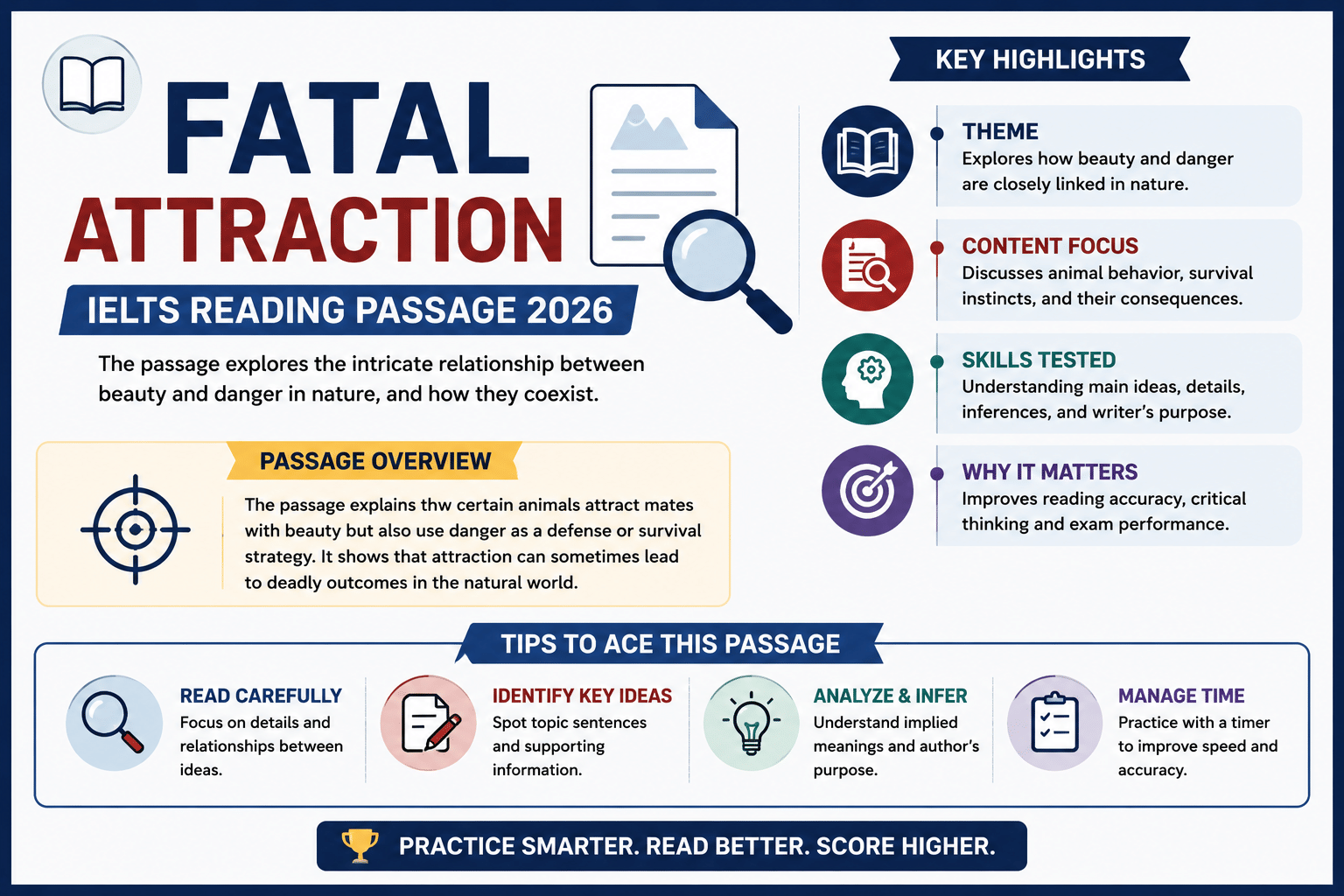
The IELTS Fatal Attraction is a reading passage-based question from the Official Cambridge Guide to IELTS. It is the 2nd reading passage question in the 7th test of IELTS Academic reading. There are a total of 13 questions to be answered by reading the passage in the IELTS test writing task.
The IELTS Fatal Attraction Reading passage discusses carnivorous plants like the Venus flytrap, their working, evolution, and other biological processes. The passages are scientific, solely focused on biology, adaptations, and environmental issues. These are from questions 14 to 26 in the IELTS Academic reading.
Also read: Types of Questions in IELTS Reading and Sample Questions 2026
Disclaimer: "Fatal Attraction" is the title of a reading passage published in The Official Cambridge Guide to IELTS by Cambridge Assessment English. All rights to the original passage and questions belong to Cambridge Assessment English. The practice passage and questions provided below, titled "Nature's Ingenious Predators", have been independently written by the Collegedunia IELTS team and are inspired by the theme of carnivorous plants covered in the original. They are not reproductions of the Cambridge passage or questions. This content is shared solely for educational and exam-preparation purposes. For the original passage, please refer to the official Cambridge publication.
Practice Passage Based on the Official IELTS Fatal Attraction Reading Passage
The candidates need to read the passage thoroughly and then answer 13 questions based on their interpretation of the passage. Here's an example of the passage and question pattern:
Reading Passage
You should spend about 20 minutes on Questions 14-26, which are based on Reading Passage 2 below.
Nature's Ingenious Predators
Paragraph A
Most people associate hunting with animals, yet several hundred plant species have developed the ability to capture and digest living prey. These carnivorous plants are typically found in environments where nutrients such as nitrogen and phosphorus are scarce. Rather than relying solely on the soil, they supplement their diet by trapping insects and other small organisms. Although these plants vary enormously in appearance, they all face the same challenge: how to obtain nutrients from prey while remaining rooted to a single location
Paragraph B
For many years, botanists assumed that all carnivorous plants evolved from a common ancestor. Recent genetic studies, however, suggest a more complex story. Evidence indicates that carnivory arose independently in several unrelated plant families. In other words, different groups of plants appear to have arrived at similar solutions to the problem of nutrient deficiency. This phenomenon, known as convergent evolution, demonstrates how environmental pressures can shape the development of remarkably similar adaptations in species that are only distantly related.
Paragraph C
One of the simplest trapping mechanisms is employed by sundews. Their leaves are covered with tiny glandular hairs that produce droplets of sticky fluid. To an insect, these droplets resemble nectar or morning dew. Once an insect lands on the leaf, it becomes trapped in the adhesive substance. Struggling only worsens the situation, as nearby hairs gradually bend toward the victim. The process is relatively slow, but it is highly effective for small insects that lack the strength to escape.
Paragraph D
The Venus flytrap, perhaps the most famous carnivorous plant, uses a far more sophisticated strategy. Each trap consists of two hinged lobes lined with sensitive trigger hairs. When an insect touches these hairs twice within a short period, an electrical signal is generated. This mechanism helps prevent accidental closure caused by rain or debris. The trap can snap shut in less than a second, making it one of the fastest movements in the plant kingdom. Nevertheless, the system is not perfect. If the prey is too small, it may slip through the gaps between the lobes before digestion begins.
Paragraph E
Another remarkable approach can be observed in pitcher plants. Their modified leaves form deep containers filled with digestive fluid. Bright colours, nectar, and distinctive scents attract insects to the rim of the pitcher. The inner walls are often extremely slippery, causing victims to lose their footing and fall into the liquid below. Some tropical species are capable of capturing not only insects but also small frogs, reptiles, and mammals. Researchers have even documented rare cases in which larger animals contribute nutrients to the plant without being consumed directly.
Paragraph F
Among the most unusual carnivorous plants are the bladderworts, which live primarily in aquatic environments. Their traps consist of tiny bladder-like structures maintained under negative pressure. When a small aquatic organism brushes against trigger hairs near the trap entrance, a door opens inward. Water and prey are sucked inside almost instantaneously, after which the door closes again. High-speed photography has revealed that the entire sequence may take less than a millisecond, making it one of the fastest biological actions ever recorded.
Paragraph G
The digestive process is equally fascinating. Once prey has been captured, enzymes begin breaking down soft tissues into absorbable nutrients. In some species, however, digestion is assisted by microorganisms living within the traps. These bacteria and other microscopic organisms help decompose prey, forming a miniature ecosystem. The relationship benefits both parties: the microorganisms gain access to food, while the plant receives nutrients that would otherwise remain unavailable.
Paragraph H
Carnivorous plants have attracted considerable scientific interest because they challenge traditional ideas about plant behaviour. Experiments have shown that some species can distinguish between living prey and non-living objects. Others appear capable of adjusting digestive enzyme production according to the size of captured prey. Although these responses do not constitute intelligence in the animal sense, they reveal a level of biological complexity that was once thought impossible in plants.
Paragraph I
Despite their extraordinary adaptations, many carnivorous plants face an uncertain future. Wetland drainage, agricultural expansion, pollution, and climate change have reduced suitable habitats in numerous regions. Conservation organisations are working to protect remaining populations through habitat restoration and controlled cultivation programmes. Scientists also hope that increased public awareness will reduce illegal collection from the wild, which continues to threaten several rare species.
Questions 14-18
Complete the notes below.
Choose NO MORE THAN TWO WORDS from the passage for each answer.
Evolution and Trapping Methods
- Carnivorous plants often grow in areas lacking essential 14 __________.
- Studies suggest that carnivory developed through 15 __________ in several plant families.
- Sundews trap insects using an adhesive 16 __________.
- The Venus flytrap produces an 17 __________ before the trap closes.
- Bladderwort traps operate using 18 __________.
Questions 19-22
Look at the following statements (Questions 19-22) and the list of plants below.
Match each statement with the correct plant, A-D.
Write the correct letter, A-D, in boxes 19-22 on your answer sheet.
List of Plants
A. Sundew
B. Venus flytrap
C. Pitcher plant
D. Bladderwort
Statements
- It may fail to retain very small prey.
- It attracts prey with visual and chemical signals.
- It uses a sticky substance to immobilise prey.
- It captures prey through rapid suction.
Questions 23-26
Reading Passage 2 has nine paragraphs, A-I.
Which paragraph contains the following information?
Write the correct letter, A-I, in boxes 23-26 on your answer sheet.
- A description of cooperation between carnivorous plants and microorganisms.
- Evidence that different plant groups developed similar adaptations independently.
- An example of research changing scientists' previous assumptions.
- Information about measures intended to protect carnivorous plants.
Answer Key
- nutrients
- convergent evolution
- sticky fluid
- electrical signal
- negative pressure
- B
- C
- A
- D
- G
- B
- B
- I
Check for More IELTS Fatal Attractions Reading Passage Practice Questions
Why is the Fatal Attraction IELTS Reading Passage Important?
The Fatal Attraction IELTS reading passage is important because it tests the technical word accuracy of the candidates.
- It is important for IELTS because it examines typical scientific and informative texts with technical vocabulary such as enzymes, photosynthesis, and adaptations.
- It examines complex sentence structures and a mix of question types that test skimming, scanning, detail comprehension, and inference.
- One of the primary aspects of this test is candidate needs to be completely accurate with the scientific terms, as no other substitute or synonym can be used in place of a scientific term.
Common Mistakes in Fatal Attraction IELTS Reading Test 2026
Indian students often experience struggle with scientific passages due to less time, pressure and vocabulary. Here are some common mistakes students make:
- Over-reading details: Trying to understand every word instead of skimming or scanning for keywords.
- Synonyms or paraphrasing errors: While using any synonym or paraphrasing any topic, applicants should not change the meaning of the concept and process.
- Word limit violations: Students write more than two words in notes, which violates the guidelines of the questions.
- Matching mismatches: Getting confused between similar terms which sound or look similar but are different, such as sticky plants and slippery plants.
- Time management: Spending more than 20 mins on this passage is a major mistake that candidates make. This affects the timing of the third passage.
- False assumptions: Using outside biology knowledge instead of sticking to the given text.
Tips to Solve Scientific Passages IELTS Reading Test 2026
Indian students appearing for the IELTS test should follow these tips to solve the scientific passages well in time:
- Time management: Applicants should start practising the questions well in advance with a timer on. This will help them to know their weak areas and work effectively to improve them. The time limit should not exceed 20 minutes.
- Read questions and instructions carefully: Identify keywords and question types before deep reading. This guides the scanning of the passage according to the question. Avoid getting lost in every detail.
- Techniques: Focus on the given keywords and synonyms given in the passage. Applicants should carefully read the cause-effect and processes given in the passages as they hold specific keywords and information.
- Note the key themes from each passage: While reading, applicants can note the key themes and words discussed in each section. This saves time and revisiting the passage again and again.
- Double-check the answer sheet: After finishing, spend 1 minute copying answers neatly. Make sure spelling is exact, and hasn't crossed the word limit. Small mistakes in scientific terms or numbers can cost easy marks.
- Devoting time to practice: Practising it helps build skills for handling real test passages on biology and science topics, improves time management, and exposes learners to common traps like paraphrasing.
Also read: IELTS Reading Tips and Tricks to Score Well in the IELTS Test 2026
The Fatal Attraction IELTS Reading Passage consists of 13 questions based on an 800 to 1000-word scientific text divided into 9 sections (A-I). It primarily tests candidates’ ability to understand technical vocabulary, identify key details, and answer note-completion, matching, and paragraph-location questions within about 20 minutes. Success in this passage depends on accurate reading, effective skimming and scanning, and careful attention to scientific terms, word limits, and question instructions.
FAQs
Ques. Is “Fatal Attraction” from an actual IELTS test or only a practice test?
Ans. It is a practice passage from the official Cambridge preparation book, not a live test. Official live tests are not published.
Ques. Does the IELTS Reading test always have scientific passages?
Ans. Academic Reading often includes texts from scientific or academic topics, but the content varies. No specialist knowledge is needed, as everything is in the passage.
Ques. Is “Fatal Attraction” considered a difficult passage?
Ans. Scientific passages like this can feel challenging due to technical vocabulary for adaptations, electric charge, and photosynthesis. Applicant does not require specialist knowledge, as all answers are in the text.
Ques. How is the Reading score calculated for this passage?
Ans. Each correct answer gives 1 mark. The full Reading test has 40 questions across 3 passages. Your raw score is converted to a band score. 30 correct answers are equivalent to a band 7 in Academic Reading.
Ques. Are there any diagrams or images in the Fatal Attraction passage?
Ans. The passage is primarily text-based with no diagrams or labelled figures in the standard version. The primary focus is on descriptive biology and processes.



Comments