


| Updated On - Jun 26, 2026
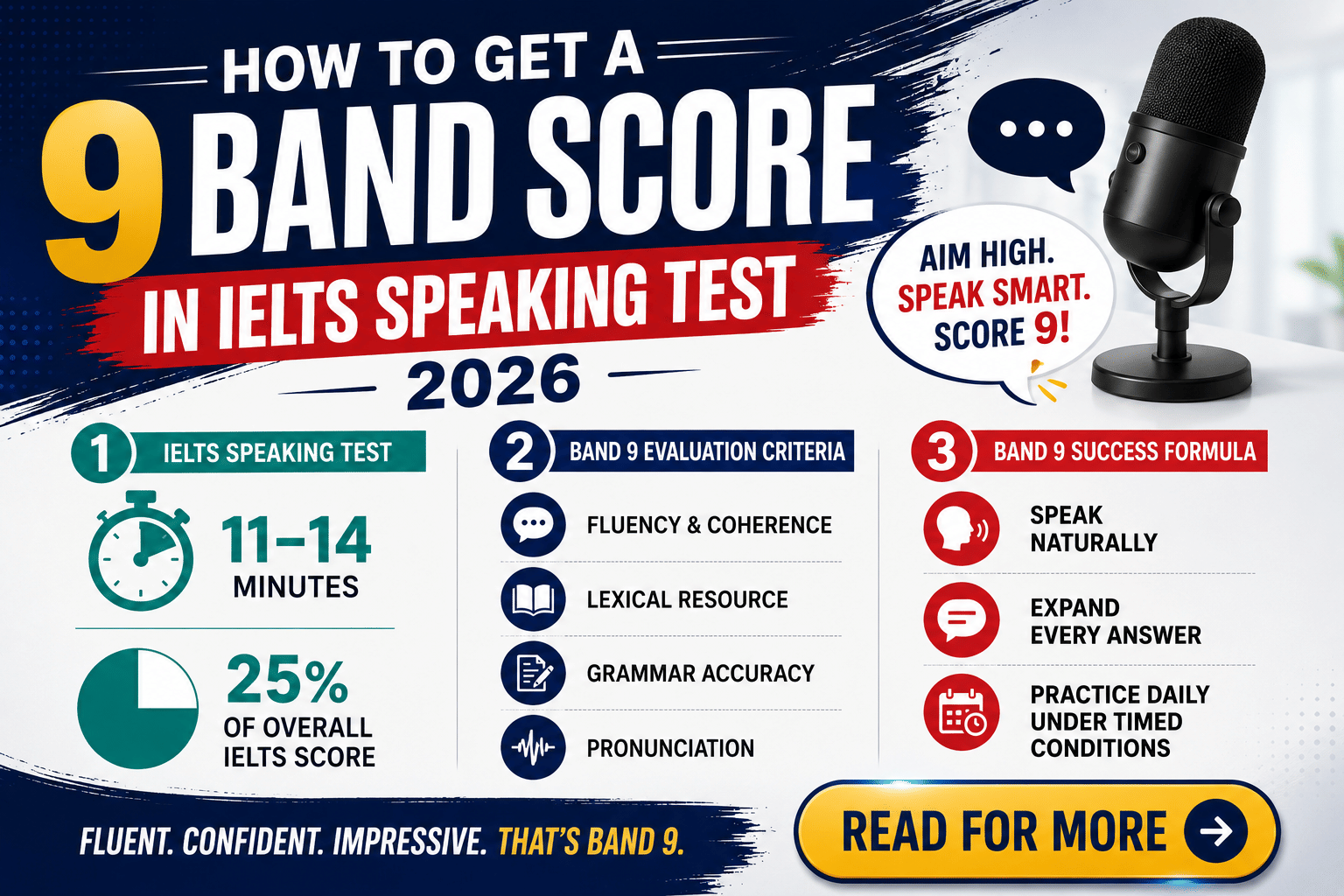
Achieving IELTS Band 9 means expert-level English with natural, accurate, and effortless communication throughout the 11-14 minute interview. In the IELTS test, the Speaking section carries 25% weightage of your overall IELTS score.
The IELTS Speaking test is evaluated on 4 criteria that are:
- Fluency and Coherence
- Lexical Resource
- Grammatical Range
- Accuracy and Pronunciation
Also read: IELTS Study Apps That Help You Ace the Test in 2026
- How to Get a Band 9 in IELTS Speaking?
- IELTS Speaking Evaluation Criteria 2026
- Common Mistakes That Prevent Candidates from Getting Band 9
- IELTS Speaking Vocabulary for a Band 9 Score
- Band 9 Pronunciation Tips for IELTS Speaking
- Grammar Tips to Score Band 9 in IELTS Speaking
- Daily Study Plan to Achieve Band 9 in IELTS Speaking
- FAQs
How to Get a Band 9 in IELTS Speaking?
To get a 9-band score in IELTS Speaking, applicants need to give an expert-level performance across all 4 speaking criteria. Applicants must speak fluently with a natural flow for 11-14 minutes.
To get an IELTS band 9 in IELTS Speaking, focus on natural and fluent conversation, expanding answers fully while staying on-topic. Official guidance emphasizes real conversation over memorization. A real and original conversation is full of topic development and effortless communication.
IELTS Speaking band 9 strategies can be as follows:
- Speak at length naturally on a wide range of topics.
- Use a full range of language features flexibly and precisely.
- Maintain coherence, accuracy, and clear pronunciation throughout.
- Practice under timed conditions and record yourself for self-assessment.
- Familiarize yourself thoroughly with the test format. All the 3 parts of IELTS Speaking is important and needs fluent conversation.
The 3 parts of IELTS Speaking are:
| Part | Duration | Description | Skills Tested |
|---|---|---|---|
| Paer 1: Introduction | 4-5 minutes | Applicants need to introduce themselves, followed by some general questions answered. | Ability to give opinions and information on everyday topics and common experiences. |
| Part 2: IELTS Cue Card | 3-4 minutes (including preparation time) | Applicants are given a generalised topic on which they need to speak for 2-3 minutes | Ability to speak at length on a given topic, using appropriate language and organising your ideas logically. |
| Part 3: Discussion | 4-5 minutes | The examiner discusses the topic on which the applicant speaks in part 2. | Ability to explain your opinions and to analyse or discuss related issues. |
Also read: IELTS Mock Tests 2026: Download Free IELTS Practice Test PDF
IELTS Speaking Evaluation Criteria 2026
IELTS Speaking is evaluated mainly on fluency and original ideas shared in the conversation. Applicants who memorise words are easily traced as they are unable to talk on vast topics. Whereas those who focus on sharing real conversation talk fluently.
Here’s a full description of the testing criteria of IELTS Speaking:
| Criterion | Band 9 Description |
|---|---|
| Fluency and Coherence | Fluent with only very occasional repetition or self-correction. Hesitation is used only to prepare the next content, not to search for words or grammar. Speech that is situationally appropriate with cohesive features is fully acceptable. Topic development is fully coherent and appropriately extended. |
| Lexical Resource | Total flexibility and precise use in all contexts. Sustained use of accurate and idiomatic language. |
| Grammatical Range and Accuracy | Structures are precise and accurate at all times, apart from occasional ‘mistakes’ characteristic of native speaker speech. |
| Pronunciation | Uses a full range of phonological features to convey precise/subtle meaning. Flexible, sustained use of connected speech features. Effortlessly understood throughout; accent does not affect intelligibility. |
Also read: Check IELTS Speaking Topics and Example 2026
Common Mistakes That Prevent Candidates from Getting Band 9
Applicants should avoid memorising just 1-2 phrases and repeating words. To score a 9 band in IELTS Speaking, you should avoid making these common mistakes that prevent Indians from scoring well in the IELTS Speaking test.
- Giving short, one-word, or minimal responses without expansion or development in your answer.
- Memorizing prepared answers is easily detected by the examiners, and this may change questions, leading to unnatural delivery.
- Excessive hesitation, repetition, or self-correction while searching for language. You should instead focus more on content preparation than language.
- Going off-topic or failing to maintain coherence.
- Overusing basic vocabulary or lacking the use of phrases and idioms.
- Poor time management in Part 2. Too short or rushed answers lead to low IELTS scores.
- Frequent basic grammar errors or a limited range of structures.
- Pronunciation issues affecting intelligibility, such as inconsistent rhythm, intonation, or connected speech.
Also read: IELTS Speaking Tips, Strategies, Practice Topics & Preparation Guide 2026
IELTS Speaking Vocabulary for a Band 9 Score
To get a 9-band score in IELTS Speaking, applicants must focus on building a strong vocabulary. IELTS Band 9 requires total flexibility and proficiency across all topics and contexts. Follow these tips to build a good vocabulary:
- Build vocabulary through extensive exposure, like reading and listening, rather than memorising lists.
- Use words and phrases that convey precise meaning naturally.
- Demonstrate awareness of connotation and appropriate register.
- Paraphrase effectively when needed.
- Use idioms in your language naturally and not force it.
Band 9 Pronunciation Tips for IELTS Speaking
Indian applicants often fail to adapt accurate pronunciation proficiency due to vast differences in English and regional accents. To build a good, proficient pronunciation for an IELTS Speaking 9 band score, follow these tips:
- Use a wide range of phonological features, such as word or sentence stress, intonation, and rhythm, to convey subtle meanings.
- Try to produce individual sounds and word endings clearly.
- Ensure the accent does not impede understanding in any way.
- Practice expressive intonation and natural rhythm through shadowing native speech and recording self-review.
Also read: Check Why Indian Students Lose Marks in IELTS Speaking Test 2026
Grammar Tips to Score Band 9 in IELTS Speaking
Grammar is one of the major areas that needs close attention and thorough revision. Grammar rules should be adopted proficiently with a natural flow. Follow these tips to get an IELTS 9 band score in grammar expertise:
- Use a wide range of complex and simple structures flexibly and naturally.
- Maintain high accuracy, errors should be rare and non-systematic.
- Mix sentence types effectively without forcing complexity that leads to mistakes.
- Focus on natural production: subject-verb agreement, tenses, articles, prepositions, etc.
- Try to have control even in longer, extended turns of conversation.
Daily Study Plan to Achieve Band 9 in IELTS Speaking
To have fluent English proficiency, follow these weekly study and practice tips to achieve IELTS band 9 scores in IELTS Speaking:
- Daily (30-60 minutes): Speak English aloud every day. Record responses to IELTS Speaking practice questions. Listen back to your recorded voice and note improvements in fluency, vocabulary, grammar, and pronunciation.
- Fluency Practice: Listen to audio from official materials or podcasts and practice timed Part 2 IELTS Cue card talks for 1-2 minutes continuously.
- Vocabulary or Grammar: Learn new phrases and idioms, and use them in context. This will help in getting grammar expertise through paraphrase practice.
- Pronunciation: Focus on one feature daily. Try to improve your weak domains through recording.
- Weekly: Full mock test of all 3 parts, with a partner or self-recording. Review against Band 9 descriptors. Listen to native speakers and discuss abstract topics for Part 3.
Also read: IELTS Preparation Tips for Vocabulary 2026
Scoring a Band 9 in IELTS Speaking requires consistent performance across all four assessment criteria, that is, Fluency and Coherence, Lexical Resource, Grammatical Range and Accuracy, and Pronunciation. Since each criterion carries equal weight, even minor weaknesses can affect your final band score. Regular speaking practice, original responses, and familiarity with the three test parts are the key factors that help candidates achieve the highest possible score.
FAQs
Ques. Can memorised answers help me score Band 9?
Ans. No. IELTS examiners are trained to identify memorised responses. If your answers sound rehearsed or irrelevant to the question, the examiner may ask different follow-up questions. Natural, spontaneous communication is rewarded over memorisation.
Ques. Does having an Indian accent reduce my IELTS Speaking score?
Ans. No. Your accent does not affect your score as long as your speech is clear and easy to understand. The assessment focuses on intelligibility, pronunciation features, stress, rhythm, and intonation rather than a native English accent.
Ques. Do I need to use difficult vocabulary to get Band 9?
Ans. No. Examiners assess how accurately and naturally you use vocabulary. Using precise words appropriately is more important than using uncommon or complex words incorrectly.
Ques. Is IELTS Speaking the same for Academic and General Training?
Ans. Yes. The IELTS Speaking test is identical for both Academic and General Training candidates. The format, duration, assessment criteria, and scoring system remain the same.
Ques. Can I correct myself during the Speaking test?
Ans. Yes. Occasional self-correction is considered a normal part of natural communication. However, frequent corrections, repetition, or long pauses may affect your Fluency and Coherence score.








Comments