



The IELTS exam 2026 has undergone significant changes in its exam format and question types. Though these changes are not yet official, the differences are cited in the Cambridge IELTS Volume 20 practice tests. Therefore, students need to be aware of the changes.
IELTS changes 2026 are mostly happening in the Listening, Reading, and Writing sections. The questions in the Listening section will be less predictable now, and the map-type questions will have a “You Are Here” mark to help you navigate with ease.
The IELTS Reading section has a question type called “Matching Heading”, which students find difficult. These question types will be appearing less now. Instead, you will see more of the Matching Paragraphs and Matching Sentence Endings type of questions.
The IELTS Writing has also undergone some changes. This includes mixed charts in Task 1 of the Academic test. A mixed chart may include a combination of data representations, such as a pie chart with a table.
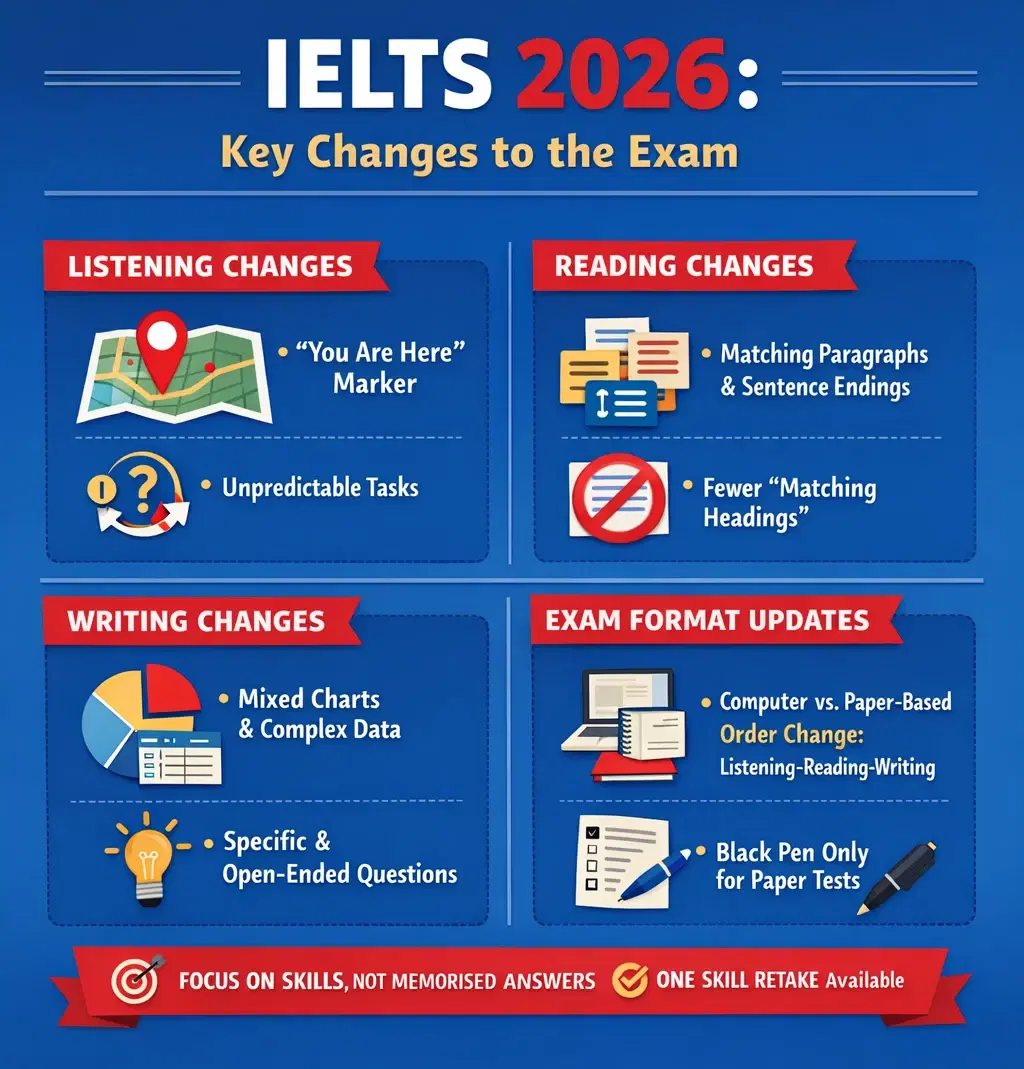
In this article, we will discuss in detail all the IELTS changes that are coming out in 2026.
- IELTS 2026 Changes
- What are the Changes to the IELTS Exam in 2026?
2.1 IELTS Listening Pattern 2026: Maps & Tasks
2.2 IELTS Writing Task 1: Handling Complex Data
2.3 IELTS Writing Task 2: Critical Thinking Required
- IELTS Exam Updated Order 2026
- IELTS Computer-based vs Paper-based
- How to Prepare for the IELTS 2026?
- FAQs
IELTS 2026 Changes
The table below gives an overview of the major changes happening to the IELTS syllabus 2026:
| Test section | Changes Made | Description |
|---|---|---|
| Listening | “You Are Here” Marker | In map questions, you will see a clear mark showing where you are standing to help you navigate easily. |
| Listening | Unpredictable structure | You might get 2 "Matching" tasks, or none at all. The order of question types is less fixed now. |
| Reading | Fewer “Matching Headings” | This difficult task is appearing less often in recent exams. |
| Reading | More "Matching Paragraphs" | You will see more questions asking "Which paragraph contains this information?" |
| Reading | More “Match Sentence Endings” | The task that asks you to match the beginning of a sentence with the correct ending is becoming very common. |
| Writing (Task 1) | Complex data | You might be given several tables or a mix of charts in one question (like a pie chart with a table and a graph). Don’t describe everything; focus only on the main trends. |
| Writing (Task 2) | Open-ended questions | Prompts are more open-ended. Instead of asking for a set list like “advantages and disadvantages,” they ask questions like “What is the value of X?” so you have to come up with your own ideas. |
| Writing (Task 2) | High specificity | Questions are very specific. You need to answer exactly what they ask for (for example, only the environmental benefits), not a broad or general response. |
| General rules | Black pen only | Applicable for the paper-based test |
What are the Changes to the IELTS Exam in 2026?
The following changes to the IELTS exam in 2026 are cited from the Cambridge practice books. Official confirmation is awaited from IDP.
IELTS Listening Pattern 2026: Maps & Tasks
The IELTS Listening section is less predictable now, so you can’t depend on old templates. In 2026, map-labelling questions will include a “You Are Here” marker to help you get oriented before the audio starts, but the order of tasks is changing. You may get 2 matching tasks, or none at all.
Be prepared for shorter tasks with fewer questions that change quickly.
IELTS Writing Task 1: Handling Complex Data
IELTS Writing Task 1 is becoming more challenging. You may see more complex visuals, such as multiple tables or a combination of charts and graphs in one question. The key is not to describe every detail, but to group and explain the main trends clearly.
IELTS Writing Task 2: Critical Thinking Required
IELTS Writing Task 2 questions are becoming more specific and open-ended. Instead of basic “agree or disagree” topics, you may be asked to discuss the importance or value of something. Read the question carefully. If it mentions “school holidays,” focus on that topic, not education in general.
IELTS Exam Updated Order 2026
The order of sections in the different types of the IELTS exam is as follows:
- Computer-based: Listening, followed by Reading, and then Writing.
- Paper-based: Writing, followed by Reading, and then Listening.
IELTS Computer-based vs Paper-based
Check out the differences between the IELTS computer-based and paper-based formats:
| Feature | Computer-Based IELTS | Paper-Based IELTS |
|---|---|---|
| Writing Tool | Keyboard (Typing) | Black Pen Only (No pencil) |
| Result Time | 1-5 days | 13 days |
| One Skill Retake | Available | Not Available |
| Handwriting | Does not matter | Must be clear and neat |
| Test Order | Listening comes first | Writing comes first |
| Headphones | Personal headphones | Sometimes speakers in the room |
How to Prepare for the IELTS 2026?
The IELTS exam is becoming more skill-focused. It now tests real English ability, not memorized answers.
- Avoid using prepared essays and read the question keywords carefully.
- If you take the paper-based test, practise writing with a black pen.
- If you worry about one weak skill, consider the computer-delivered test so you can use the One Skill Retake option.
- Pay special attention to sentence-ending questions in Reading and mixed charts in Writing Task 1.
- Use recent materials such as Cambridge IELTS 19 and 20, and avoid books older than Cambridge 15.
The IELTS exam in 2026 is placing more emphasis on accuracy, clarity, and real language skills. Changes across Listening, Reading, and Writing show a move toward less predictable tasks and more specific questions. Test takers need to adapt their preparation strategies and use the latest practice materials. Staying updated and practicing with a focus on key trends will be essential for success.
FAQs
Ques. Is IELTS changing in 2026?
Ans. While there is no official announcement from IDP, changes to the number of questions and question difficulty have been cited in the Cambridge prep books and recent exams.
Ques. What is the One Skill Retake, and will it be available in 2026?
Ans. One Skill Retake is a very useful feature of the IELTS exam. It allows you to take any one section of the test if you are not satisfied with your score. This saves you a lot of time and money by not making you take the entire test. OSR is available in 2026.


1787567517.png?tr=w-305,h-145,c-force?h=175&w=350&mode=stretch)



Comments