



| Updated On - Jul 19, 2026
IELTS is an English proficiency test, where applicants’ proficiency and fluency are scored on a scale of 0-6. Using phrases and idioms can enhance applicants' fluency and scores. Using idioms can help applicants to express themselves better.
- Best idioms for IELTS Speaking Band 7
- IELTS Speaking Band 8 vocabulary and idioms
- IELTS Speaking idioms with meanings and examples
- Common idioms for IELTS Speaking Part 2
- How to use idioms in IELTS Speaking
5.1 Things to Avoid While Preparing Idioms for IELTS
- Tips to remember idioms easily for IELTS Speaking
- Which topics require idioms the most?
- FAQs
Best idioms for IELTS Speaking Band 7
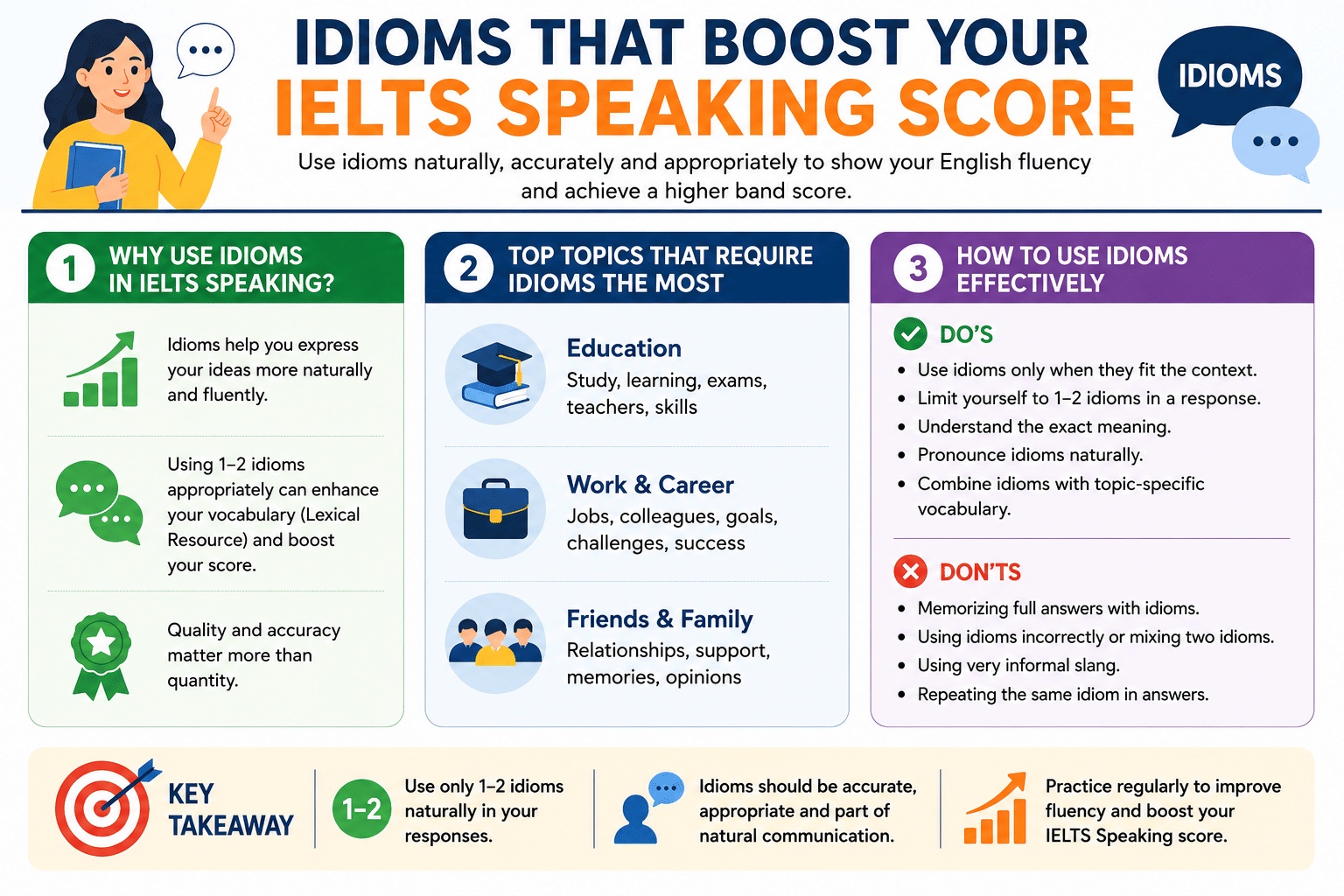
IELTS examiners don’t expect candidates to use idioms specifically to express themselves. But using 1 or 2 idioms demonstrates their fluency, which helps them earn good scores. Using 1 or 2 idioms naturally is much better than filling every answer with memorized expressions.
Here are some idioms you can use to get a 7 band score in the IELTS exam:
| Idiom | Meaning | Example |
|---|---|---|
| Piece of cake | Very easy | "Learning to ride a bicycle wasn't a piece of cake for me." |
| Hit the books | Study hard | "I usually hit the books before my exams." |
| Once in a blue moon | Very rarely | "I eat fast food once in a blue moon." |
| Under the weather | Feeling sick | "I stayed home because I was under the weather." |
| Break the ice | Make people feel comfortable | "Playing games helped us break the ice." |
| Cost an arm and a leg | Very expensive | "Studying abroad can cost an arm and a leg." |
| On the same page | Agree with someone | "My parents and I are on the same page about my career." |
| Get the hang of | Learn how to do something | "It took me a few weeks to get the hang of driving." |
| In hot water | In trouble | "I got in hot water for missing a deadline." |
| Call it a day | Stop working | "After finishing my assignment, I called it a day." |
Sample Answer
"During my final exams, I had to burn the midnight oil because I wanted to achieve excellent grades. Although it was stressful, all my hard work eventually paid off."
IELTS Speaking Band 8 vocabulary and idioms
To get band 8, candidates should use idioms flexibly without forcing them. They can also combine idioms with advanced vocabulary to prove their proficiency. The table below shows what vocabulary and idioms can be used together to get good IELTS scores.
| Situation | Vocabulary | Idiom |
|---|---|---|
| Success | Accomplishment, achievement | Go the extra mile |
| Failure | Setback, obstacle | Back to square one |
| Work | Productive, efficient | Burn the midnight oil |
| Relationships | Supportive, trustworthy | See eye to eye |
| Travel | Adventurous, spontaneous | Off the beaten track |
| Health | Balanced, nutritious | Fit as a fiddle |
| Money | Financially stable | Make ends meet |
| Education | Knowledgeable, dedicated | Hit the books |
IELTS Speaking idioms with meanings and examples
Applicants can use these examples and meanings to learn and remember the idioms. They are advised to use them in day-to-day life, which becomes a part of their vocabulary. This will help them not only to build proficiency, but also to score well.
| Idiom | Meaning | IELTS Example |
|---|---|---|
| Burn the midnight oil | Study or work late | "I burned the midnight oil before my TOEFL exam." |
| Go the extra mile | Make extra effort | "Teachers who go the extra mile inspire students." |
| A blessing in disguise | Something good that seemed bad initially | "Failing that interview was a blessing in disguise." |
| On cloud nine | Extremely happy | "I was on cloud nine after receiving my admission letter." |
| The best of both worlds | Enjoy two advantages | "Online learning gives me the best of both worlds." |
| Keep an open mind | Be willing to consider new ideas | "Students should keep an open mind while studying abroad." |
| Learn the ropes | Learn the basics | "It took me a month to learn the ropes at my internship." |
| Through thick and thin | In good and bad times | "My best friend has supported me through thick and thin." |
| Bite off more than you can chew | Take on too much | "Many students bite off more than they can chew." |
| Miss the boat | Miss an opportunity | "I almost missed the boat by applying late." |
Common idioms for IELTS Speaking Part 2
Some of the common idioms, which can be used in day-to-day life, can impact the scores on a larger scale. This helps the candidate to express simple topics in IELTS Cue Card with better knowledge of idioms and English fluency.
| Cue Card Topic | Suitable Idiom |
|---|---|
| Describe a teacher | Go the extra mile |
| Describe a journey | Off the beaten track |
| Describe a challenge | Burn the midnight oil |
| Describe a happy event | On cloud nine |
| Describe a mistake | Blessing in disguise |
| Describe a friend | Through thick and thin |
| Describe a goal | Keep my fingers crossed |
| Describe a job | Learn the ropes |
| Describe a memorable day | The icing on the cake |
| Describe a skill | Get the hang of |
How to use idioms in IELTS Speaking
Examiners reward natural, accurate, and appropriate use of idiomatic language, not the number of idioms you use. Follow these tips to use idioms differently and proficiently in the IELTS Speaking test.
- Use idioms only when they fit the context.
- Limit yourself to 1-2 idioms in a cue card response.
- Make sure you understand the exact meaning.
- Pronounce the idiom naturally without emphasizing it.
- Combine idioms with topic-specific vocabulary.
Things to Avoid While Preparing Idioms for IELTS
- Memorizing full answers with idioms.
- Using idioms incorrectly.
- Mixing two idioms.
- Using very informal slang.
- Repeating the same idiom in multiple answers.
Tips to remember idioms easily for IELTS Speaking
To get a 7 or 8 IELTS score, follow these tips below to learn idioms easily for the Speaking test:
- Learn by topic, as group idioms under education, work, travel, health, technology, and relationships.
- Learn only 3-5 idioms each week. Quality matters more than quantity.
- Make your own examples. Instead of memorizing.
- Use the flashcard technique, keep one side with the idiom and the other with the meaning and an IELTS example.
- Watch English interviews. Notice how native speakers naturally use expressions rather than memorizing lists.
- Practice speaking idioms and use newly learned idioms during mock interviews or with a speaking partner.
- Revise regularly and review older idioms every week to improve long-term retention.
Also read: How to get 9 Band Score in IELTS Speaking Test 2026
Which topics require idioms the most?
The general topics such as career, education, and personal relations can be well expressed with 1-2 idioms. This gives the examiner a good impression of your vocabulary and idioms.
| IELTS Topic | Recommended Idioms |
|---|---|
| Education | Hit the books, Burn the midnight oil, Pass with flying colours |
| Work & Career | Learn the ropes, Go the extra mile, Climb the career ladder |
| Friends & Family | Through thick and thin, See eye to eye |
| Travel | Hit the road, Off the beaten track, Catch the travel bug |
| Hobbies | Kill time, Get the hang of |
| Success & Achievement | On cloud nine, Hard work paid off |
| Challenges | Back to square one, Blessing in disguise |
| Health | Under the weather, Fit as a fiddle |
| Technology | Keep up with the times, Ahead of the curve |
| Environment | Go green, Carbon footprint |
Also read: Check IELTS Speaking Tips and Strategies 2026
Using idioms naturally can strengthen your IELTS Speaking performance, but quality matters more than quantity. This article covers 40+ commonly used idioms across 10 high-frequency IELTS topics and recommends using only 1-2 relevant idioms in a cue card response. Regular practice, learning 3-5 idioms each week, and using them in everyday conversations can help improve fluency and boost your IELTS Speaking band score.
FAQs
Ques. Does using idioms improve my IELTS Speaking band score?
Ans. Using idioms alone does not increase your IELTS Speaking score. Examiners assess whether you use idiomatic language naturally, accurately, and appropriately as part of the Lexical Resource criterion. Overusing or forcing idioms can negatively affect your performance.
Ques. How do IELTS examiners assess idiomatic language in the Speaking test?
Ans. Examiners assess Speaking using four criteria: Fluency and Coherence, Lexical Resource, Grammatical Range and Accuracy, and Pronunciation. Idiomatic language is evaluated under Lexical Resource, along with vocabulary range and the ability to paraphrase.
Ques. Can I use idioms in all three parts of the IELTS Speaking test?
Ans. Yes. You may use idiomatic language in Part 1, Part 2, and Part 3, provided it fits the context naturally. IELTS examiners value appropriate communication rather than memorized expressions.
Ques. What happens if I use idioms incorrectly in IELTS Speaking?
Ans. Using idioms incorrectly or unnaturally may reduce your Lexical Resource score because examiners assess the accuracy and appropriateness of vocabulary, not just the number of idioms used.
Ques. Are memorized answers with idioms recommended in IELTS Speaking?
Ans. No. IELTS assesses your ability to communicate naturally. Memorized responses or rehearsed answers may prevent you from demonstrating your true speaking ability and can affect your performance.









Comments