




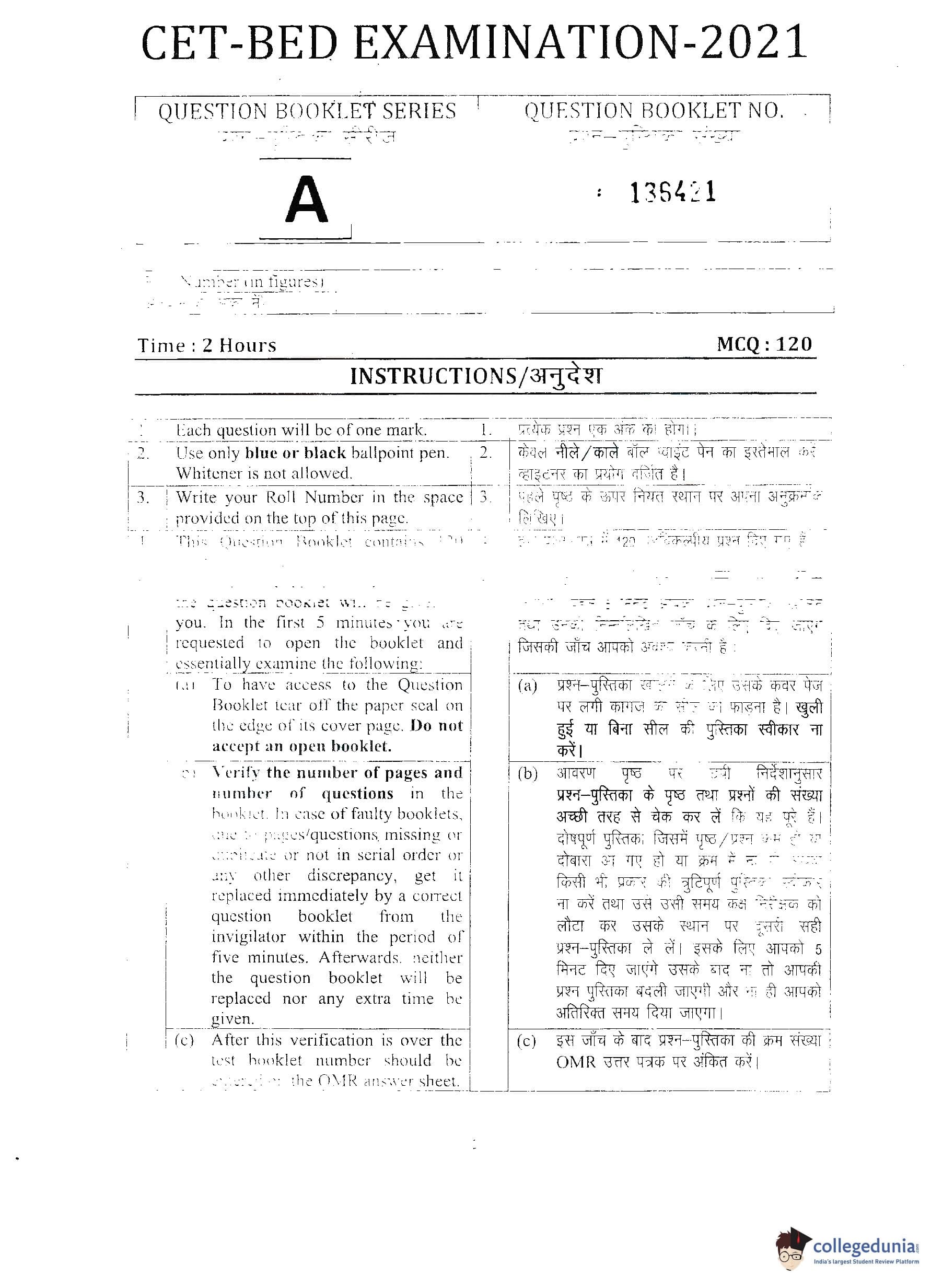
Bihar BEd CET 2021 Question Paper with Answer Key pdf is available for download. The exam was conducted by Lalit Narayan Mithila University (LNMU) on August 11, 2021. The question paper comprised a total of 120 questions.
Bihar BEd CET 2021 Question Paper with Answer Key PDF
| Bihar BEd 2021 Question Paper with Answer Key | Download PDF | Check Solution |
Question 1:
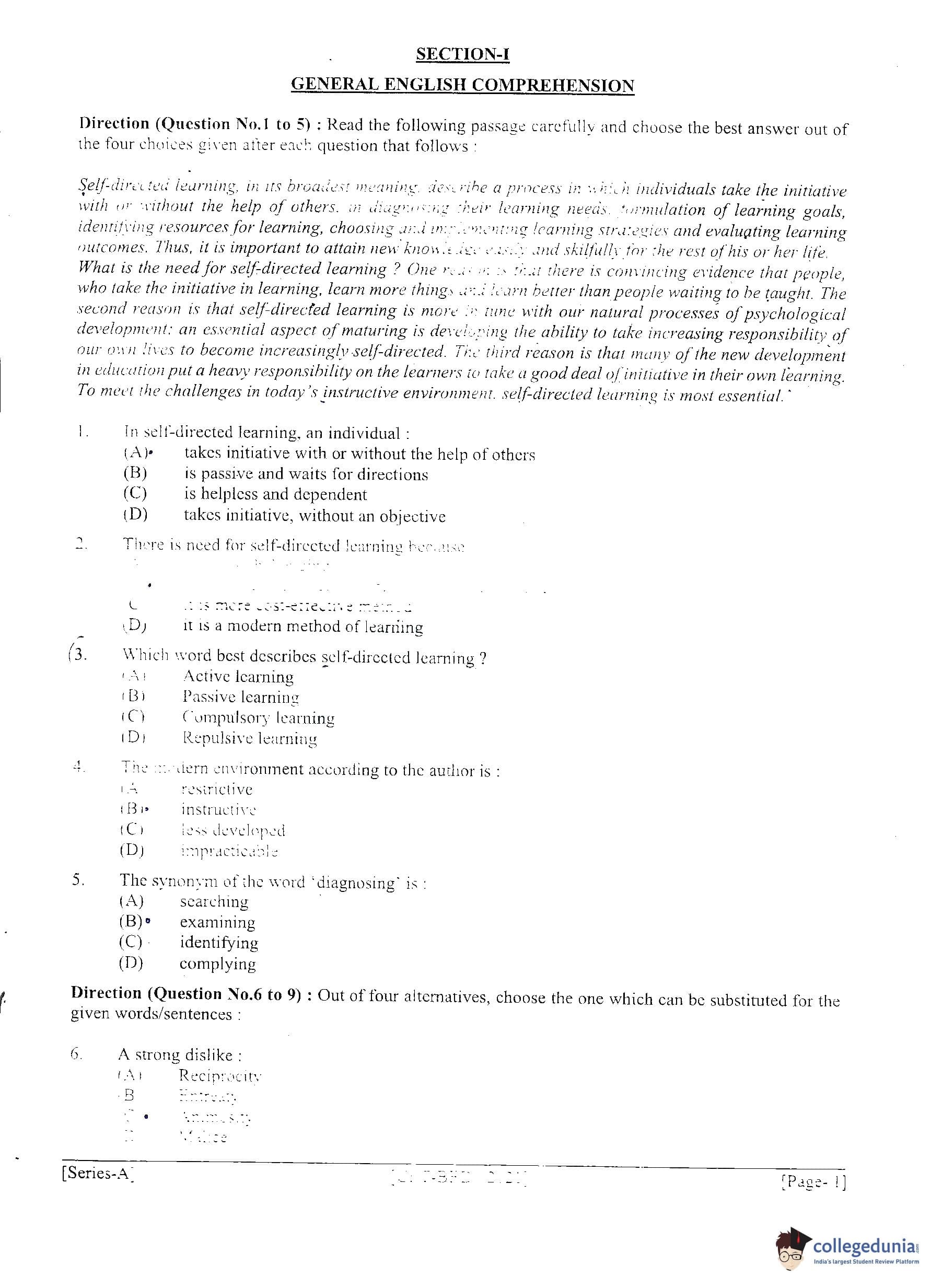
In self-directed learning, an individual:
View Solution
In self-directed learning, individuals take the initiative in their learning process, regardless of whether they are assisted by others. The process involves identifying learning needs, setting goals, seeking resources, and evaluating outcomes. Thus, the correct answer is "takes initiative with or without the help of others".
Quick Tip: Self-directed learning is a vital skill, particularly in today's education system, where learners are increasingly expected to take responsibility for their own learning.
There is a need for self-directed learning because:
View Solution
Self-directed learning is often considered more effective because it allows individuals to take control of their learning process, thereby making it more personalized and efficient. This approach fosters greater responsibility and engagement, leading to better learning outcomes.
Quick Tip: Self-directed learning improves critical thinking and problem-solving skills, as it requires active engagement from the learner.
Which word best describes self-directed learning?
View Solution
Self-directed learning involves active participation by the learner. This form of learning requires individuals to take responsibility for setting their goals, choosing their methods, and evaluating their progress. Therefore, it is best described as "active learning".
Quick Tip: Active learning engages the learner, leading to better retention and understanding of the material.
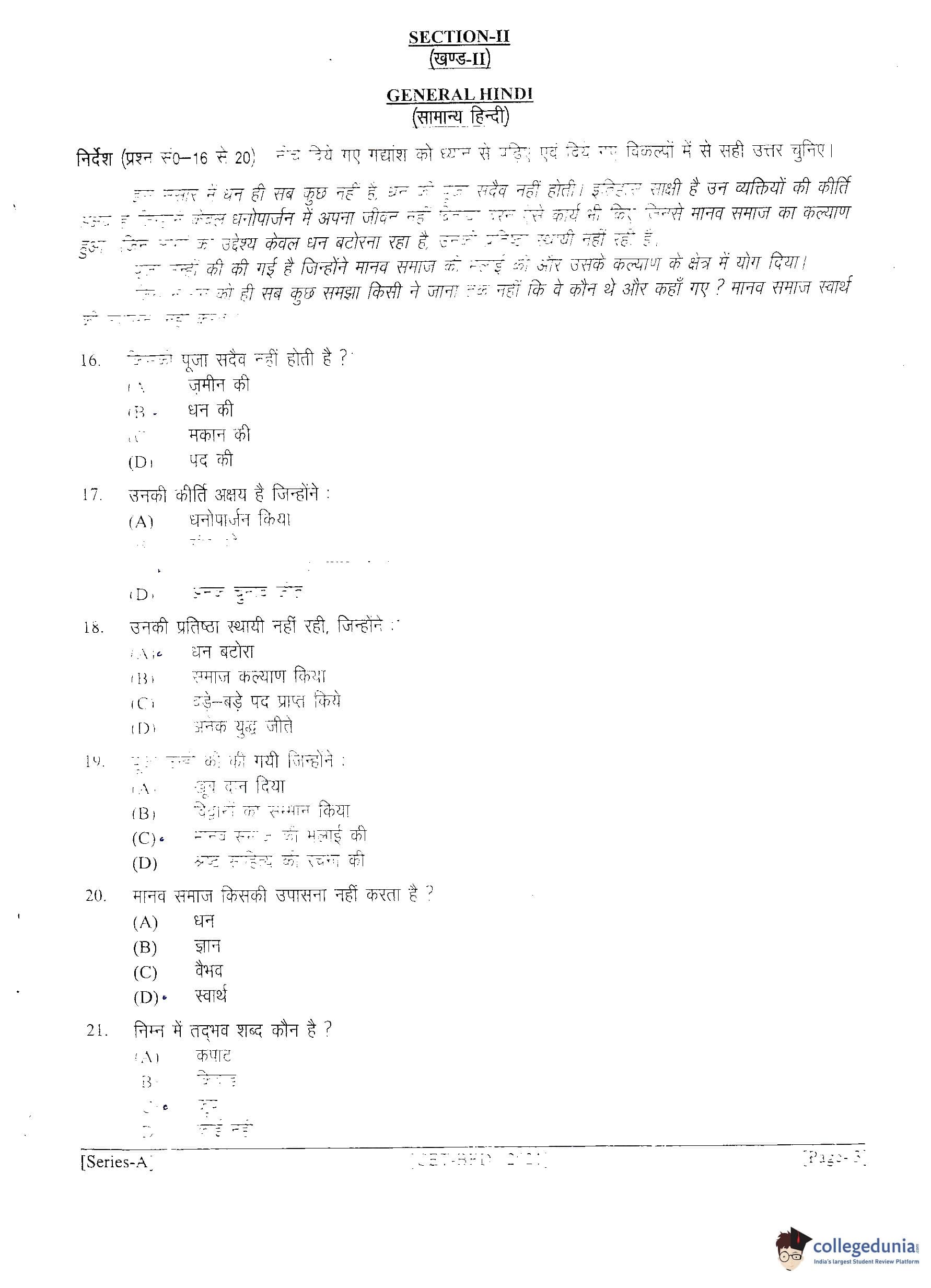
The modern environment according to the author is:
View Solution
According to the author, the modern environment is not fully developed in terms of supporting self-directed learning. The correct description is "less developed" as it suggests there is room for improvement in the current state of the environment to support this learning style.
Quick Tip: Modern environments require more facilitative structures for self-directed learning to thrive.
The synonym of the word "diagnosing" is:
View Solution
"Diagnosing" refers to the process of examining something, particularly in the context of identifying problems or conditions. It closely aligns with the meaning of "examining" in this case. Therefore, the correct synonym is "examining".
Quick Tip: When finding synonyms, focus on words with similar contexts in specific subject areas like medicine or problem-solving.
A strong dislike:
View Solution
A strong dislike is commonly referred to as "aversion," which means a strong feeling of dislike or repugnance. The other options do not correctly describe a strong dislike.
Quick Tip: When looking for synonyms, consider both the emotional context and the intensity of the feeling expressed by the word.
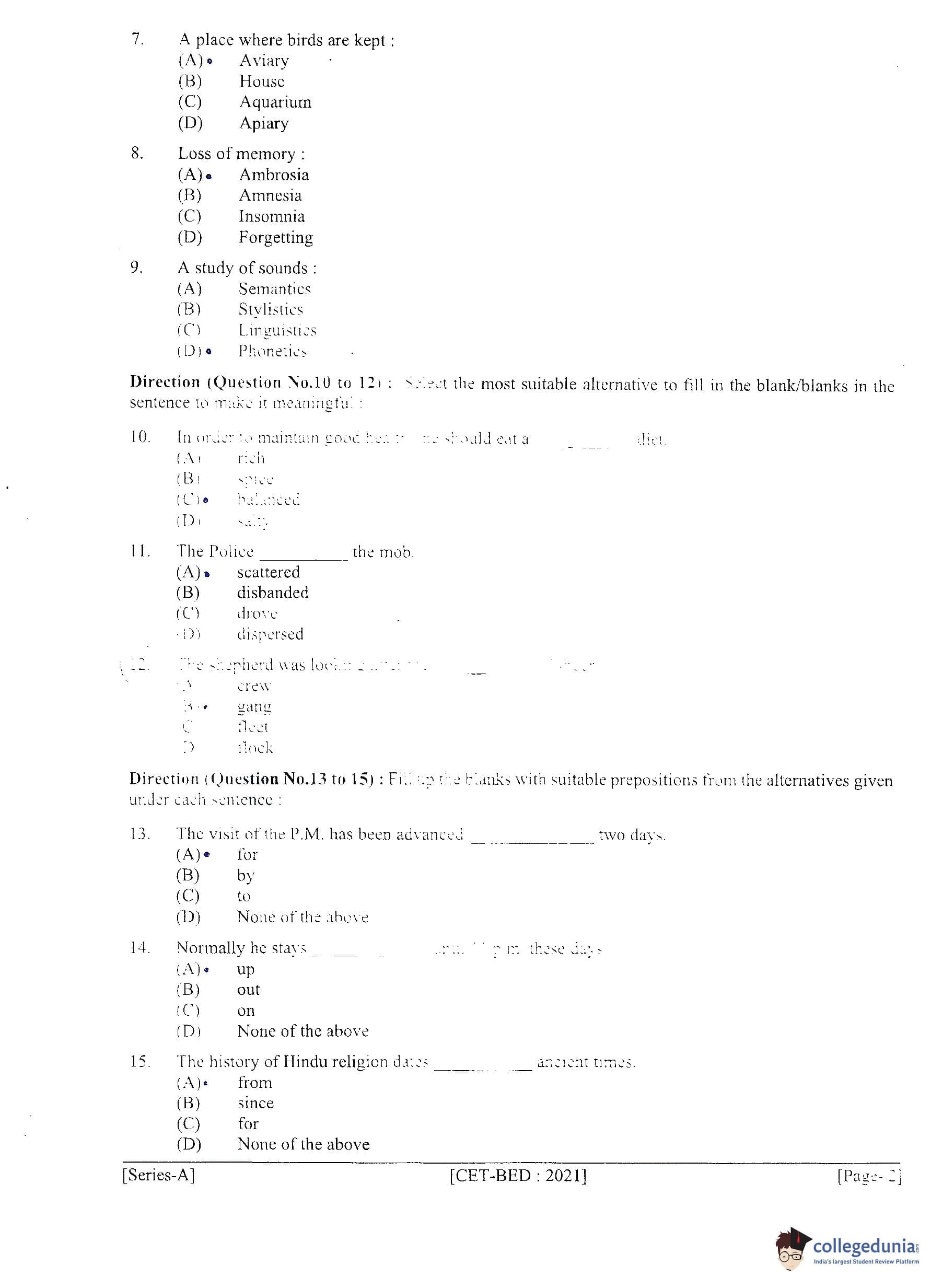
A place where birds are kept:
View Solution
An aviary is a large enclosure for confining birds, typically larger than a birdcage. The other options refer to places for different types of animals or insects. Therefore, the correct answer is "Aviary".
Quick Tip: When trying to identify places related to specific animals, remember that terms like "aviary" are often specific to birds.
Loss of memory:
View Solution
"Amnesia" refers to the condition of memory loss, either partial or complete. The other options do not specifically relate to memory loss. "Ambrosia" refers to the food of the gods in Greek mythology, "insomnia" refers to sleep issues, and "forgetting" is the action but not the condition.
Quick Tip: When studying medical terms, focus on the prefixes and suffixes to identify meanings. "A" often denotes a condition, as in "amnesia".
A study of sounds:
View Solution
Phonetics is the study of sounds in human speech, including their production, transmission, and perception. The other options focus on different aspects of language or its structure.
Quick Tip: Phonetics is the foundation of linguistics, which covers the structure, meaning, and use of language.
In order to maintain good health, we should eat a .......... diet:
View Solution
A "balanced" diet is one that includes a variety of foods in the right proportions to maintain good health. The other options do not represent an ideal or healthy dietary choice.
Quick Tip: For optimal health, aim for a balanced diet that includes a variety of food types such as proteins, carbohydrates, fats, vitamins, and minerals.
The Police .......... the mob:
View Solution
The verb "dispersed" means to scatter or spread something over a wide area. In this context, it means the police caused the mob to scatter or break up. "Scattered" could also be a possible choice, but "dispersed" is more commonly used in this context.
Quick Tip: When describing groups breaking up, "dispersed" is often used to indicate the spreading out of people or objects.
The suspect was located in a ..........:
View Solution
A "gang" typically refers to a group of people, often involved in illegal or suspicious activity, and is the most appropriate term for locating a suspect. The other options do not fit as well in this context.
Quick Tip: The term "gang" is commonly associated with a group of individuals engaged in unlawful activities.
The visit of the P.M. has been advanced .............. two days:
View Solution
The phrase "advanced by two days" indicates that the visit of the P.M. has been moved forward in time by this amount. "By" is the correct preposition in this context.
Quick Tip: In time-related phrases, "by" often indicates a change or movement in time.
Normally he stays ........... these days:
View Solution
The sentence "Normally he stays ..... these days" does not fit with the provided options. The correct structure would be "Normally he stays at home these days" or "Normally he stays in these days," so "None of the above" is the correct choice.
Quick Tip: When in doubt, check if the phrase sounds natural. If not, "None of the above" could be the answer.
The history of Hindu religion dates ........ ancient times:
View Solution
The phrase "dates from ancient times" is the correct usage. "From" is the correct preposition to indicate the starting point in time.
Quick Tip: When referring to the starting point of an event or period, use "from" to indicate the origin of time.
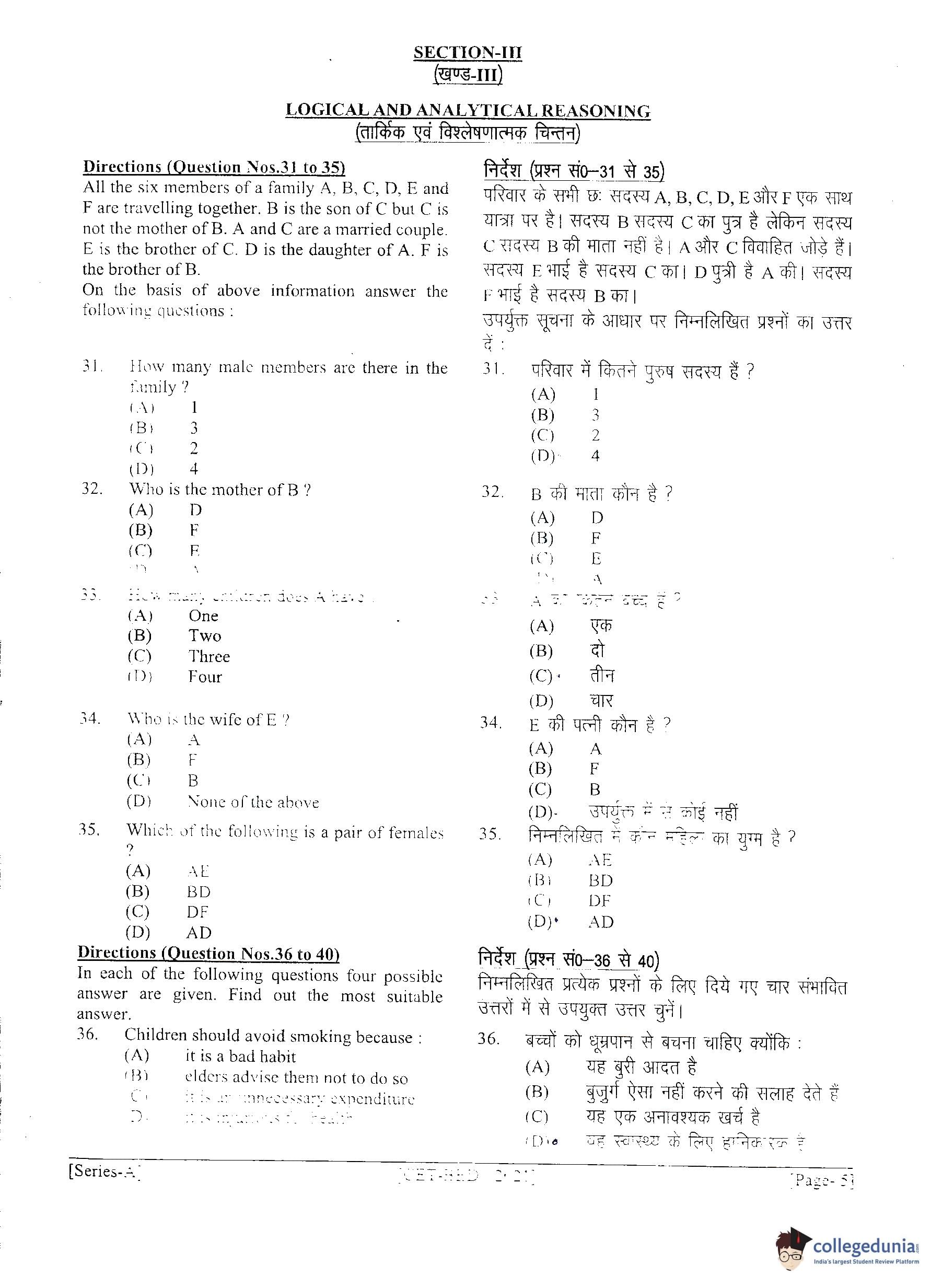
How many male members are there in the family?
View Solution
To determine how many male members are in the family, we need to carefully analyze the family structure and identify the male members. Based on the provided context, the correct answer is "3".
Quick Tip: When analyzing family-related questions, carefully consider the relationships and genders of the individuals mentioned.
Who is the mother of B?
View Solution
From the provided family relationships, the correct answer is "F" who is the mother of B.
Quick Tip: When figuring out relationships in a family tree, follow the direct references to family members carefully.
How many children does A have?
View Solution
Based on the given family structure, A has two children, making the correct answer "Two".
Quick Tip: In family-related questions, pay attention to the number of offspring and family structure for accurate answers.
Who is the wife of E?
View Solution
From the family structure, F is identified as the wife of E. The other options do not match the family relationships.
Quick Tip: In family-related questions, track relationships carefully to identify the correct answers.
Which of the following is a pair of females?
View Solution
The correct answer is "DF," as both D and F are females in the family structure. The other pairs include at least one male member.
Quick Tip: When identifying pairs, focus on the gender of the individuals involved in the relationship.
Children should avoid smoking because:
View Solution
The most compelling reason for children to avoid smoking is that it is injurious to health. Smoking can lead to serious health problems like lung disease, cancer, and heart disease. Therefore, "it is injurious to health" is the correct answer.
Quick Tip: Focus on the long-term effects of smoking when considering why it should be avoided.
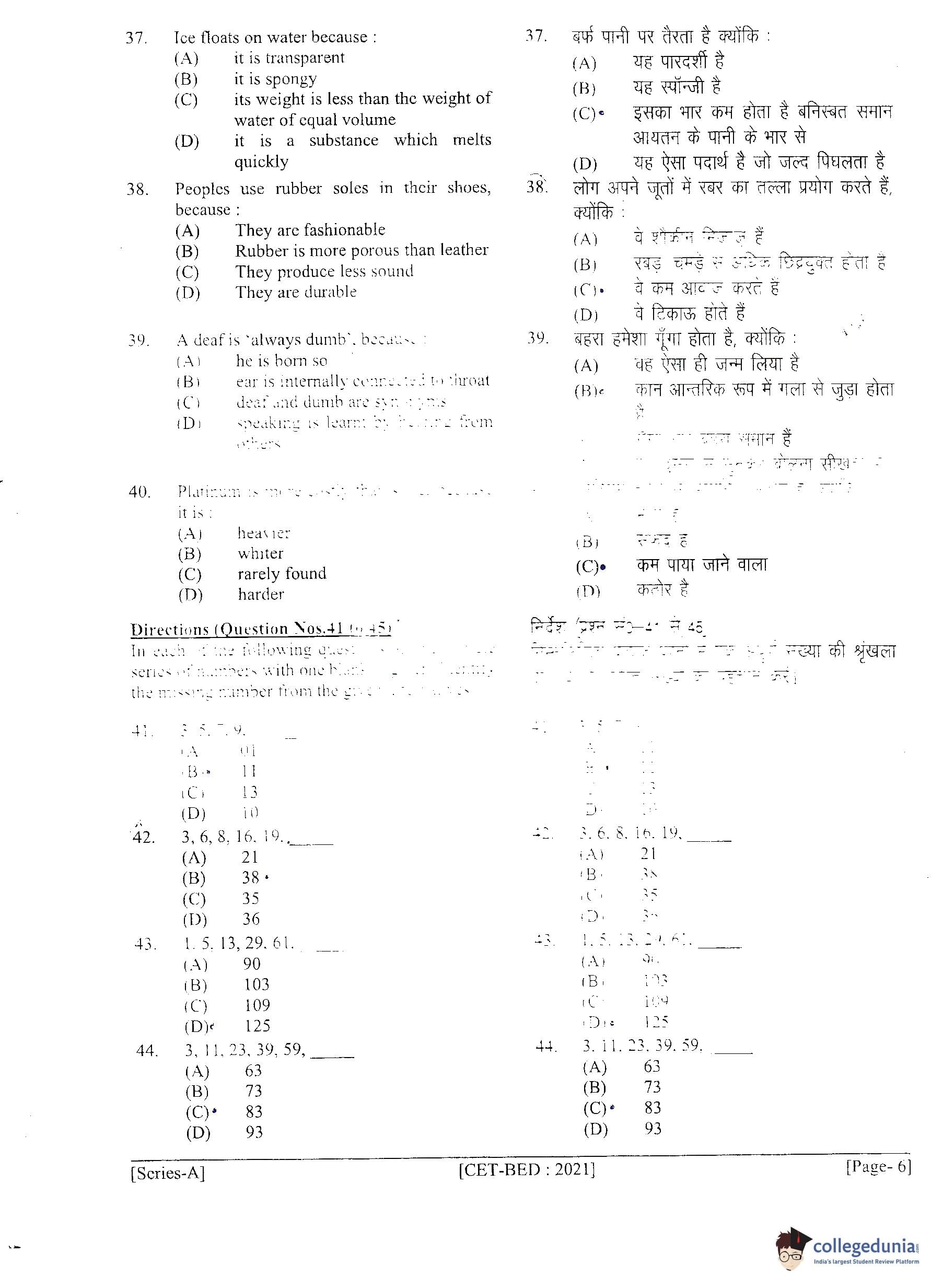
Ice floats on water because:
View Solution
Ice floats on water because its density is less than that of water. This means that the weight of an equal volume of ice is less than the weight of an equal volume of water. This is why ice floats.
Quick Tip: Objects float when their density is lower than the fluid they are in.
People use rubber soles in their shoes because:
View Solution
Rubber soles are commonly used in shoes because they are durable, providing long-lasting wear and comfort. Additionally, rubber is resistant to wear and tear, which makes it ideal for shoes.
Quick Tip: When selecting footwear, durability is an important factor to consider for long-term use.
A deaf is "always dumb" because:
View Solution
A deaf person is often unable to speak clearly because speaking is typically learned by hearing the sounds and speech patterns of others. The absence of hearing inhibits the ability to learn to speak effectively.
Quick Tip: Speech and language development often rely on auditory feedback, making hearing an essential part of verbal communication.
Platinum is more costly than gold because it is:
View Solution
Platinum is more costly than gold primarily because it is much rarer in nature. Although platinum is also denser and harder, its rarity contributes most significantly to its higher cost.
Quick Tip: The rarity of a metal plays a major role in its value.
What comes next in the series: 1, 3, 6, 9, ...?
View Solution
The series increases by 3 with each successive number. The next number in the series after 9 is 12. Thus, the correct answer is "12".
Quick Tip: To solve number series questions, look for the common difference or pattern between the terms.
What comes next in the series: 3, 6, 8, 16, 19, ...?
View Solution
In this series, the first term is multiplied by 2 (3 * 2 = 6), then 2 is added (6 + 2 = 8), then it is multiplied by 2 (8 * 2 = 16), and then 3 is added (16 + 3 = 19). Continuing this pattern, 19 is multiplied by 2 (19 * 2 = 38). Thus, the next term is "38".
Quick Tip: Observe the alternating pattern of multiplication and addition to solve such series.
1, 5, 13, 29, 61, ...
View Solution
The pattern in the series is increasing by multiplying the previous term by 2 and adding 1:
1 * 2 + 3 = 5
5 * 2 + 3 = 13
13 * 2 + 3 = 29
29 * 2 + 3 = 61
61 * 2 + 3 = 103.
Thus, the next number in the series is "103".
Quick Tip: When solving series problems, try identifying any arithmetic patterns (multiplication or addition) between terms.
3, 11, 23, 39, 59, ...
View Solution
The pattern in this series involves adding successive odd numbers:
3 + 8 = 11
11 + 12 = 23
23 + 16 = 39
39 + 20 = 59
59 + 24 = 83.
Thus, the next number in the series is "83".
Quick Tip: Look for arithmetic patterns in differences between terms, such as adding consecutive even or odd numbers.
4, 16, 36, 64, ...
View Solution
The pattern in the series involves the squares of the numbers:
2^2 = 4
4^2 = 16
6^2 = 36
8^2 = 64
The next number should be 10^2 = 100. Thus, the correct answer is "100".
Quick Tip: Look for patterns involving squares, cubes, or other common mathematical operations when solving number series.
Statements:
I. All boys are beautiful.
II. All beautiful are lovely.
Conclusions:
View Solution
From the statements:
- "All boys are beautiful" means all boys are included in the group of beautiful individuals.
- "All beautiful are lovely" means everyone in the group of beautiful individuals is also lovely.
Therefore, it follows that all boys are lovely. Hence, the correct conclusion is "All boys are lovely."
Quick Tip: When solving logical reasoning problems, always try to connect the given statements and conclusions logically.
Statements:
I. Manish is a player.
Conclusions:
View Solution
The statement that "Manish is a player" does not give information about his height. Therefore, we cannot conclude that Manish is tall from the given statement. "Manish is not tall" is the only option that is logically valid because there is no direct statement indicating his height.
Quick Tip: In logical reasoning, make sure conclusions only derive directly from the given statements without adding assumptions.
Statements:
I. Some people are wise.
II. Some people are rich.
Conclusions:
View Solution
From the given statements, we know that some people are wise and some are rich. The conclusion that "Some wise people are rich" is a possible outcome, given that there is no contradiction between the two statements. Therefore, the correct conclusion is "Some wise people are rich".
Quick Tip: When handling logical reasoning, make sure the conclusions are supported by the given statements without assuming additional information.
Statements:
I. Some cats are good.
II. Some cats are black.
Conclusions:
View Solution
The statements tell us that some cats are good and some are black, but there is no direct relationship between being good and being black. The conclusion that "Some black are good" is the most plausible, as it directly relates the categories "black" and "good" without contradicting the given statements.
Quick Tip: In logical reasoning, when no direct relationship is provided, focus on the possible overlap between the categories mentioned.
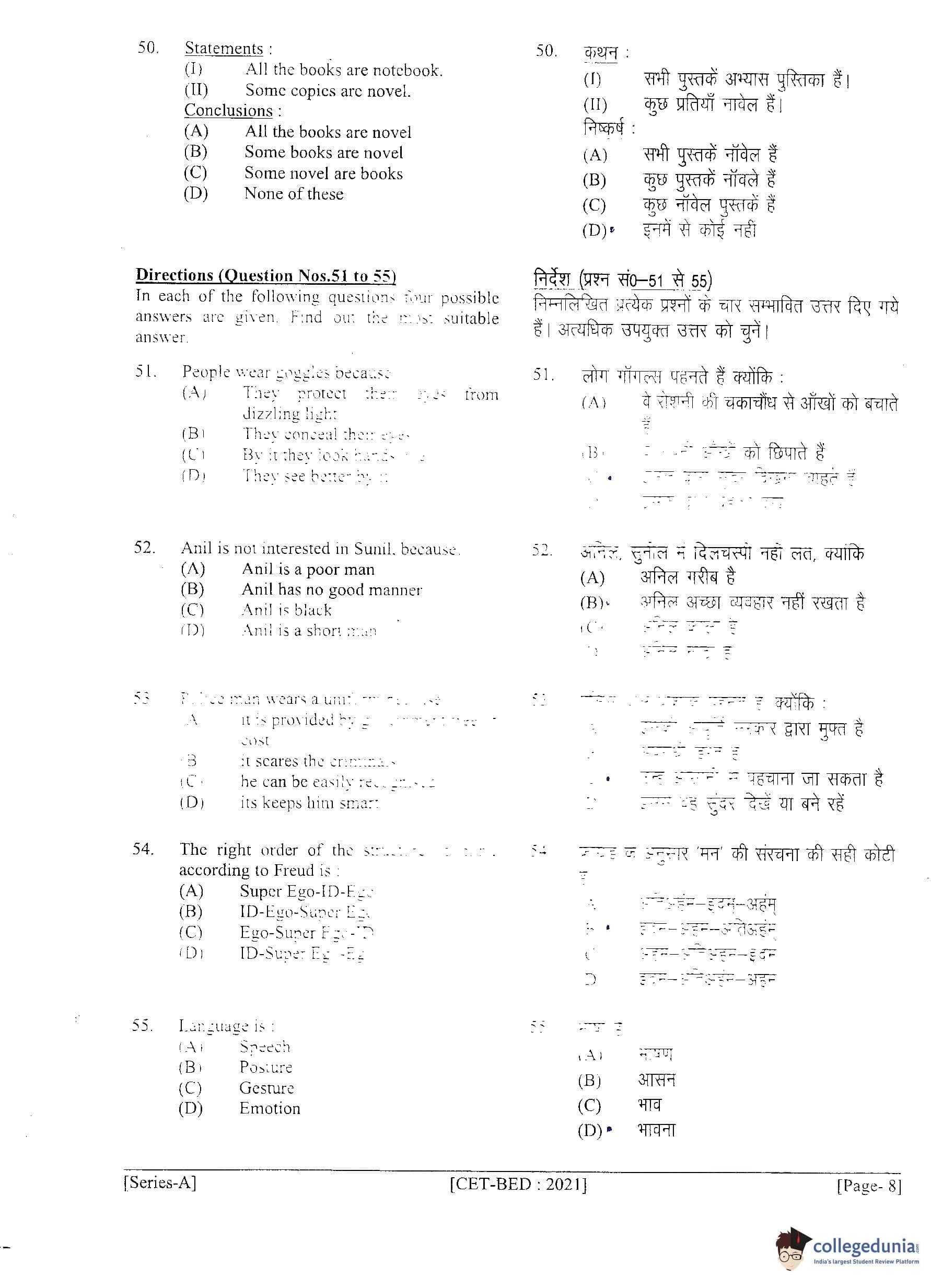
Statements:
I. All the books are not books.
II. Some copies are novels.
Conclusions:
View Solution
The first statement is logically inconsistent ("All the books are not books"). Based on the given statements, none of the conclusions directly follow from the given premises. Therefore, the correct answer is "None of these".
Quick Tip: In logical reasoning, always analyze the consistency of the statements and check if the conclusions are directly supported.
People wear goggles because:
View Solution
People wear goggles primarily to protect their eyes from intense or dazzling light, such as sunlight, or when engaging in certain activities like skiing or swimming. The other options don't fully justify the common use of goggles.
Quick Tip: When analyzing why people use an object, focus on its primary function or purpose.
Anil is not interested in Sunil because:
View Solution
The reasoning behind Anil's disinterest in Sunil is based on the fact that Anil is short, which may be a reason Sunil doesn't have an interest in him. The other options do not provide sufficient context for disinterest.
Quick Tip: When dealing with "why" questions in logical reasoning, look for traits or facts that are directly mentioned in the statements.
A policeman wears a uniform because:
View Solution
A policeman wears a uniform mainly so that he can be easily recognized by others, especially in situations requiring identification. The other options are not primary reasons for wearing a uniform.
Quick Tip: Uniforms are used to establish recognition and authority in various professions, particularly in law enforcement.
The right order of the senses according to Freud is:
View Solution
According to Freud's theory of personality, the correct order is: ID, Ego, and Super Ego. The ID is the primal part of personality, followed by the Ego (which deals with reality), and lastly, the Super Ego (which represents the moral conscience).
Quick Tip: Freud's model of personality is central to psychoanalytic theory, focusing on the balance between instinctual drives, reality, and morality.
Language is:
View Solution
Language, in its most fundamental form, is speech. While gestures, posture, and emotions can all be part of non-verbal communication, speech is the most direct form of language.
Quick Tip: Language encompasses both verbal and non-verbal forms of communication, with speech being the primary method.
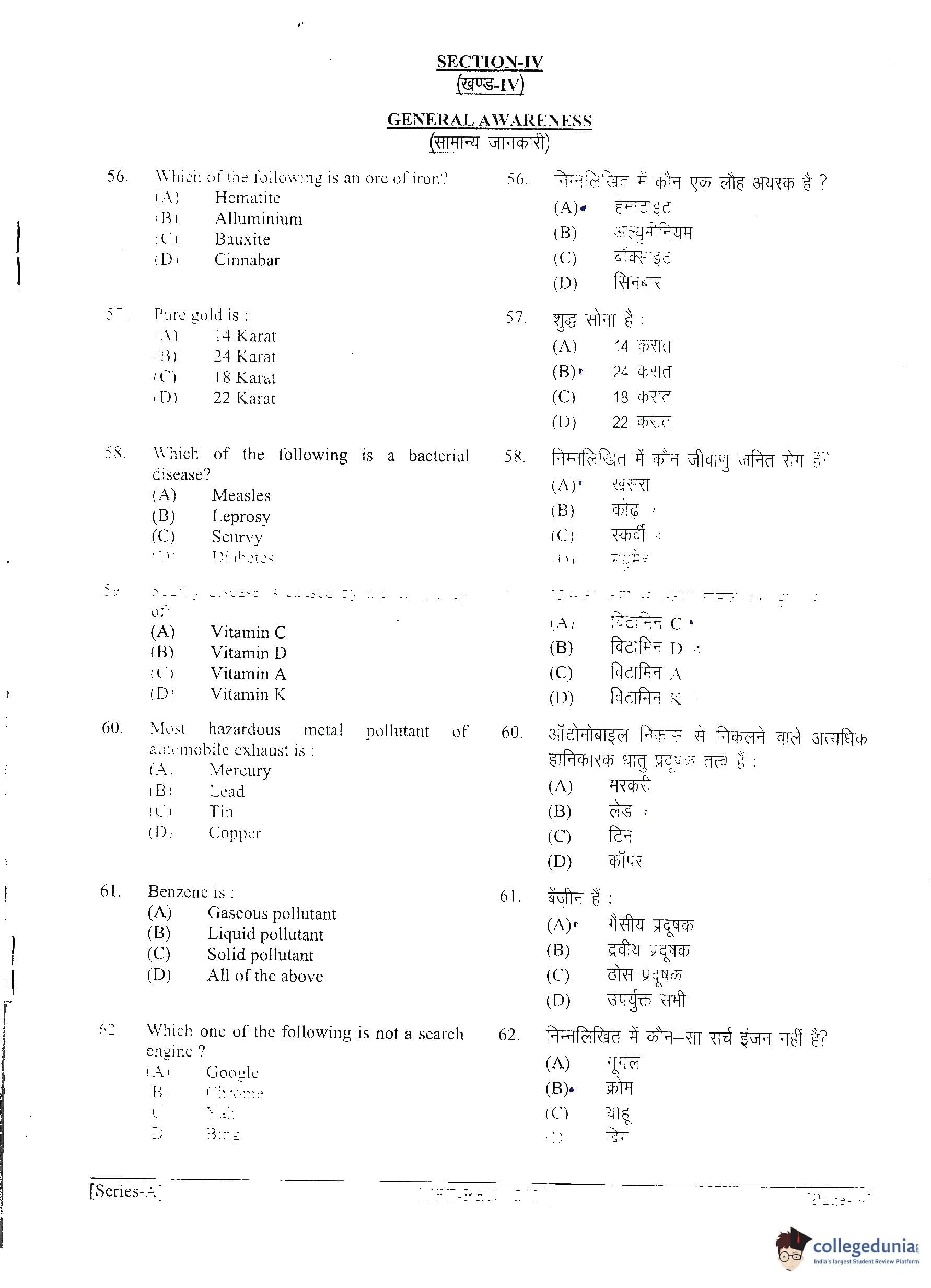
Which of the following is an ore of iron?
View Solution
Hematite is the most common ore of iron. Bauxite is an ore of aluminium, cinnabar is an ore of mercury, and aluminium is not an ore.
Quick Tip: When identifying ores, focus on the metals or elements they are primarily used to extract.
Pure gold is:
View Solution
Pure gold is 24 Karat. The Karat scale measures the purity of gold, with 24 Karat representing 100% pure gold.
Quick Tip: When buying or evaluating gold, check the Karat to determine its purity. 24 Karat is the highest.
Which of the following is a bacterial disease?
View Solution
Leprosy is a bacterial disease caused by the bacteria *Mycobacterium leprae*. Measles is a viral disease, scurvy is caused by vitamin C deficiency, and diabetes is a metabolic disorder.
Quick Tip: Identify diseases by their causes—bacterial, viral, or other factors—when answering questions about them.
Which of the following vitamins is produced by the action of sunlight on the skin?
View Solution
Vitamin D is produced by the action of sunlight on the skin. When the skin is exposed to UV radiation from the sun, it synthesizes Vitamin D, which is essential for calcium absorption and bone health.
Quick Tip: Make sure to spend some time in sunlight for adequate Vitamin D production, but always protect your skin from overexposure.
Most hazardous metal pollutant of automobile exhaust is:
View Solution
Lead is the most hazardous metal pollutant found in automobile exhaust, especially from leaded petrol. It can cause serious environmental and health issues.
Quick Tip: Lead is a toxic metal and its use in gasoline has been phased out in most countries due to its harmful effects.
Benzene is:
View Solution
Benzene is a gaseous pollutant, commonly found in industrial emissions, vehicle exhaust, and tobacco smoke. It is harmful to human health and can cause cancer.
Quick Tip: Benzene is a volatile organic compound (VOC) and a major air pollutant.
Which one of the following is not a search engine?
View Solution
Google, Yahoo, and Bing are search engines, whereas Chrome is a web browser. Chrome is used to access search engines but is not one itself.
Quick Tip: A search engine helps you find information on the web, whereas a web browser is used to access the internet.
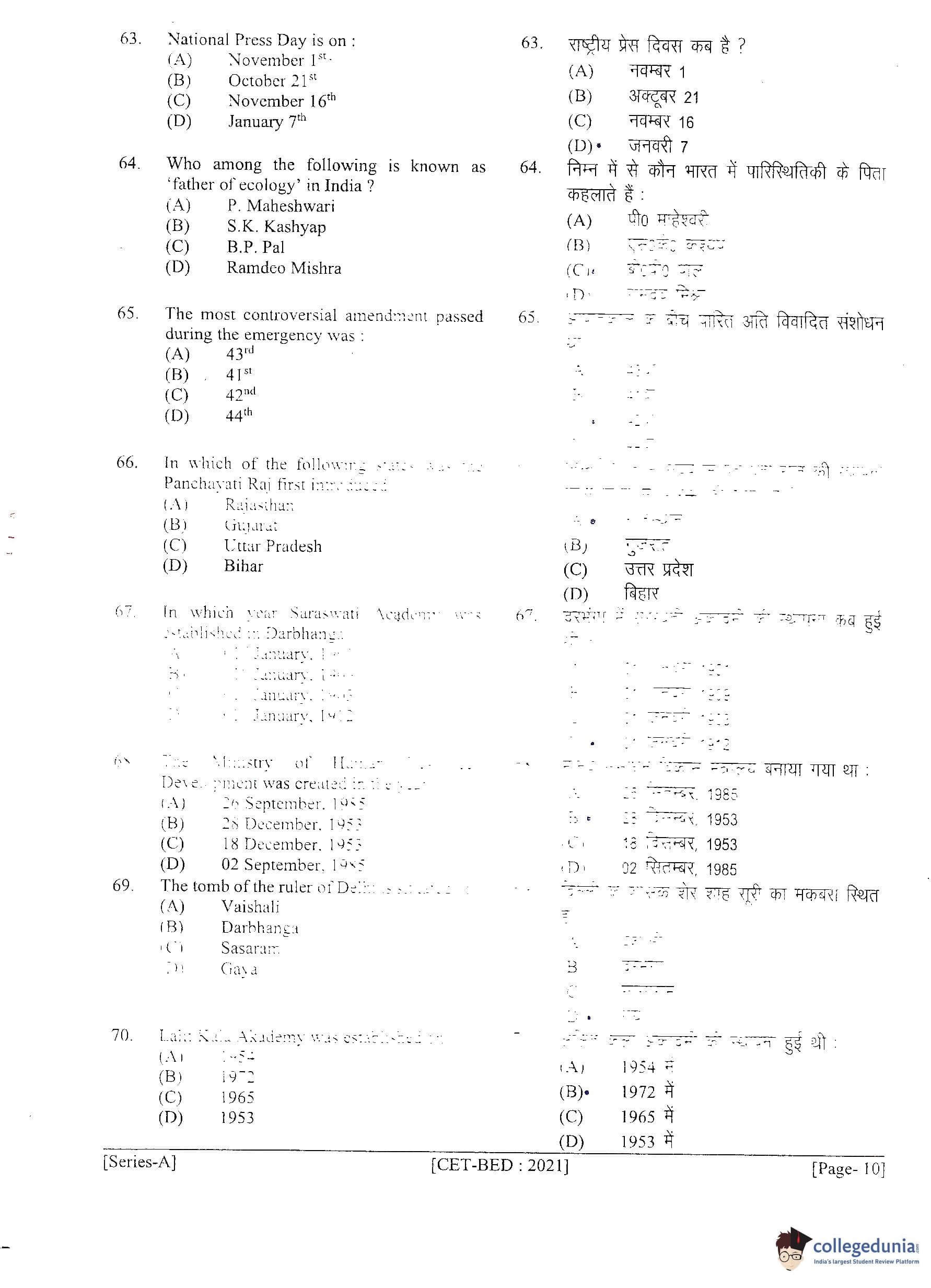
National Press Day is on:
View Solution
National Press Day is celebrated on November 16th every year in India to honor the press and recognize the role of media in the country.
Quick Tip: National Press Day highlights the importance of press freedom and the role of media in democracy.
Who among the following is known as the 'father of ecology' in India?
View Solution
Ramdeo Mishra is known as the 'father of ecology' in India for his contributions to the field of environmental science and ecology.
Quick Tip: Familiarize yourself with key figures in scientific fields to help answer questions about influential personalities.
The most controversial amendment passed during the emergency was:
View Solution
The 42nd Amendment, passed during the Emergency period (1975-1977), is one of the most controversial amendments in India's history. It altered several provisions of the Constitution and gave more power to the executive.
Quick Tip: The 42nd Amendment is also known as the "Constitutional Mini-Revolution" because of the sweeping changes it introduced.
In which of the following states was the Panchayati Raj first introduced?
View Solution
Rajasthan was the first state in India to implement the Panchayati Raj system in 1959, following the recommendations of the Balwant Rai Mehta Committee.
Quick Tip: The Panchayati Raj system was introduced to promote decentralization and empower local self-government.
In which year was Saraswati Academy established in Darbhanga?
View Solution
Saraswati Academy, a renowned educational institution, was established in Darbhanga in the year 1954.
Quick Tip: When answering historical or factual questions, verify the key events, especially the dates of establishment of significant institutions.
The Ministry of Human Resource Development was created in:
View Solution
The Ministry of Human Resource Development (MHRD) was created on 26th September 1985 with the objective of managing and improving the educational system in India.
Quick Tip: The MHRD was established to promote educational and cultural development in India.
The tomb of the ruler of Delhi Sultanate is in:
View Solution
The tomb of Sher Shah Suri, the ruler of the Delhi Sultanate, is located in Sasaram, Bihar. It is a significant historical monument.
Quick Tip: When studying historical monuments, note the location and historical significance of the monuments.
Lalit Kala Academy was established in:
View Solution
The Lalit Kala Academy, India's National Academy of Fine Arts, was established in 1965 to promote and support the visual arts in the country.
Quick Tip: The Lalit Kala Academy promotes the development of fine arts, including painting, sculpture, and graphic arts in India.
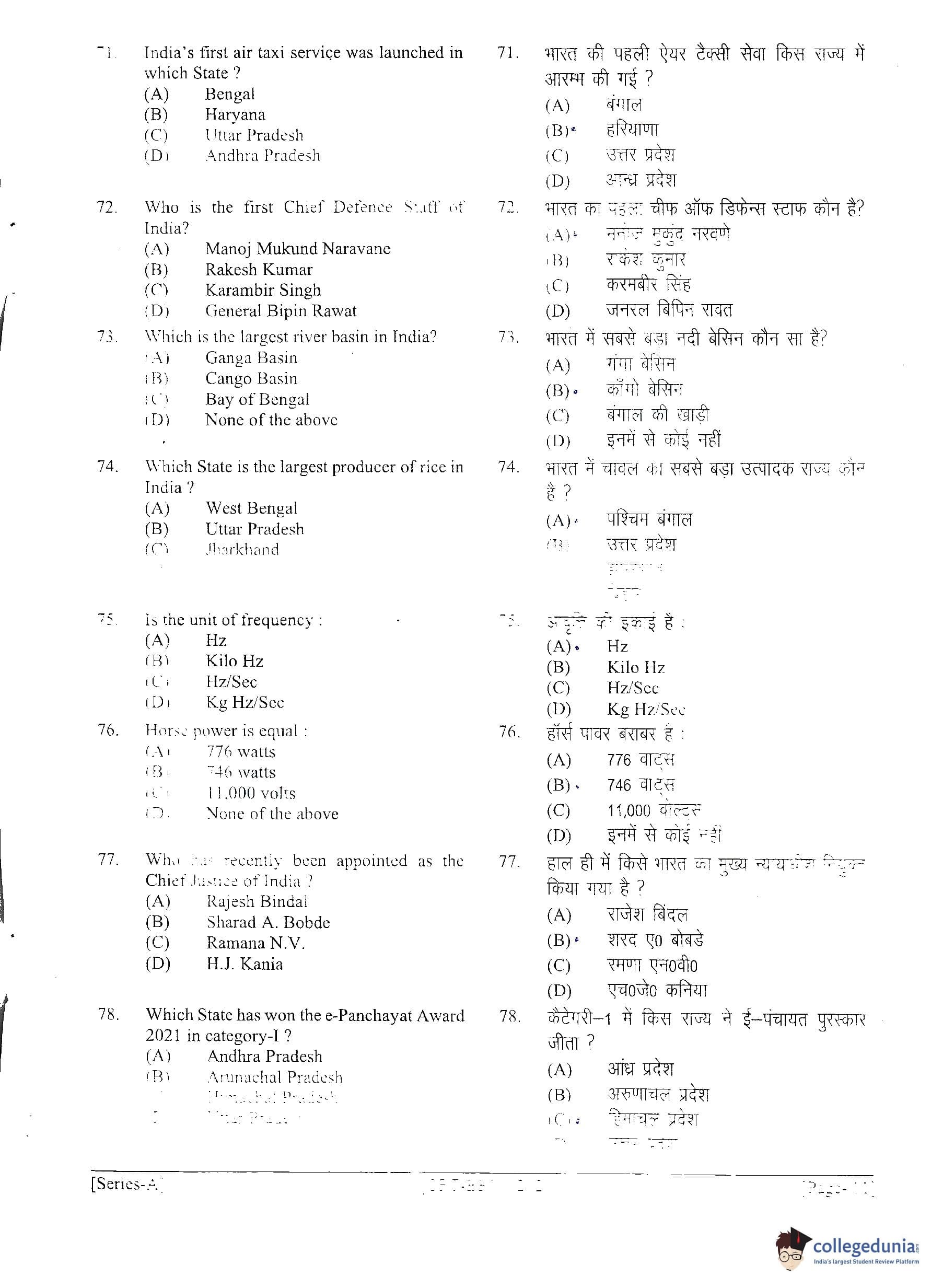
India’s first air taxi service was launched in which State?
View Solution
India's first air taxi service was launched in Uttar Pradesh, providing convenient air transportation for passengers.
Quick Tip: Air taxi services provide a faster alternative to traditional road transport, especially in congested areas.
Who is the first Chief Defence Staff of India?
View Solution
General Bipin Rawat was appointed as the first Chief of Defence Staff (CDS) of India in January 2020. The CDS is the top military officer in India, overseeing all three branches of the military.
Quick Tip: The Chief of Defence Staff plays a crucial role in India's military strategy and defense coordination.
Which is the largest river basin in India?
View Solution
The Ganga Basin is the largest river basin in India, covering a large part of Northern India. It is one of the most important river systems in the country, providing water for agriculture, industry, and human consumption.
Quick Tip: The Ganga Basin is crucial for India's economy, supporting millions of people in agriculture and industry.
Which State is the largest producer of rice in India?
View Solution
West Bengal is the largest producer of rice in India. The state's favorable climate and fertile soil conditions contribute to its large rice production.
Quick Tip: Rice is a staple crop in India, and several states play a major role in its production, with West Bengal being the leader.
The unit of frequency is:
View Solution
The unit of frequency is Hertz (Hz), which measures the number of cycles per second. Kilo Hertz (KHz) is a multiple of Hz, used for higher frequencies.
Quick Tip: Hertz is the standard unit for measuring frequency, where 1 Hz equals one cycle per second.
Horse power is equal to:
View Solution
One horsepower is equivalent to 746 watts. This is a standard unit of power used in mechanical and electrical systems.
Quick Tip: Horsepower is a common unit of power, especially in engines, and it is defined as 746 watts.
Who has recently been appointed as the Chief Justice of India?
View Solution
N.V. Ramana was appointed as the 48th Chief Justice of India in April 2021. He took office after the retirement of Sharad A. Bobde.
Quick Tip: The Chief Justice of India plays a crucial role in the judicial system of the country, overseeing the Supreme Court's functions.
Which State has won the e-Panchayat Award 2021 in category-I?
View Solution
Andhra Pradesh won the e-Panchayat Award 2021 in category-I for its outstanding initiatives in using digital technology for improving governance at the grassroots level.
Quick Tip: e-Panchayat awards recognize states for their efforts in utilizing technology to improve rural governance.
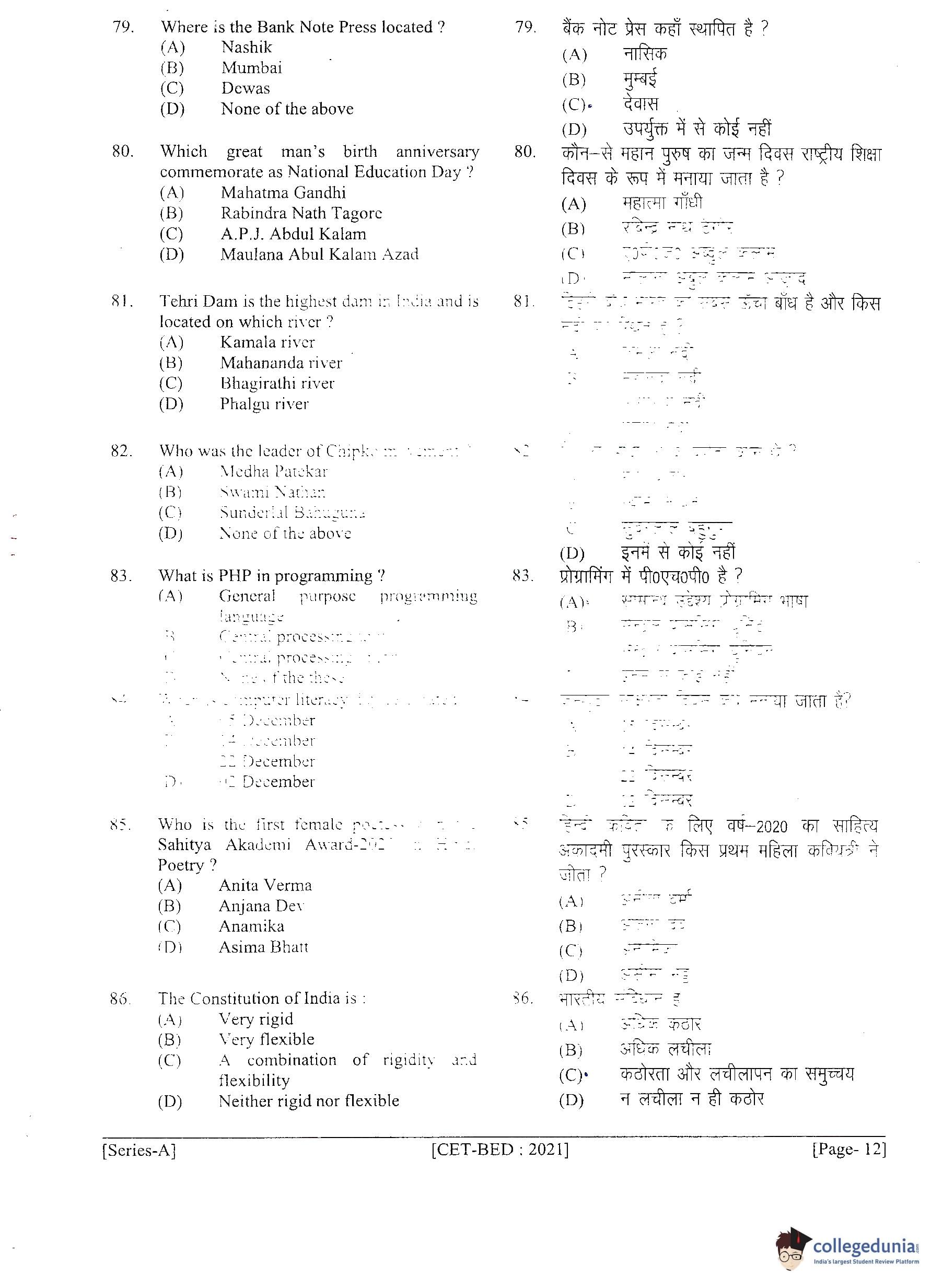
Where is the Bank Note Press located?
View Solution
The Bank Note Press is located in Dewas, Madhya Pradesh. It is responsible for printing currency notes for the Reserve Bank of India.
Quick Tip: The Bank Note Press is an essential institution in India's monetary system, responsible for currency printing.
Which great man's birth anniversary is commemorated as National Education Day?
View Solution
National Education Day is celebrated on November 11th every year in honor of Maulana Abul Kalam Azad, India's first Minister of Education, who played a key role in shaping India's education system.
Quick Tip: National Education Day is observed to commemorate the contributions of Maulana Abul Kalam Azad towards the educational development of India.
Tehri Dam is the highest dam in India and is located on which river?
View Solution
Tehri Dam is located on the Bhagirathi River in Uttarakhand. It is the highest dam in India and is an important hydroelectric project.
Quick Tip: Tehri Dam is vital for water supply, irrigation, and power generation in the region.
Who was the leader of Chipko movement?
View Solution
Sunderlal Bahuguna was the prominent leader of the Chipko movement, a non-violent protest against deforestation in the 1970s in India. He is widely recognized for his role in environmental conservation.
Quick Tip: The Chipko movement is known for its peaceful approach, where people hugged trees to prevent them from being cut down.
What is PHP in programming?
View Solution
PHP (Hypertext Preprocessor) is a general-purpose programming language primarily used for web development, but it can also be used for general-purpose scripting. It is widely used for server-side processing in websites.
Quick Tip: PHP is popular in web development for dynamic content generation and is often used in combination with MySQL for database management.
Which is the International Literacy Day?
View Solution
International Literacy Day is celebrated every year on 8th September, highlighting the importance of literacy to individuals and societies. (There seems to be an error in the question regarding the date.)
Quick Tip: International Literacy Day is an opportunity to raise awareness about the importance of literacy for individuals and communities worldwide.
Who is the first female recipient of the Sahitya Akademi Award for Poetry?
View Solution
Anamika was the first female poet to receive the Sahitya Akademi Award for Poetry. Her work is celebrated for its emotional depth and cultural reflection.
Quick Tip: The Sahitya Akademi Award is one of the highest literary honors in India, recognizing excellence in literature.
The Constitution of India is:
View Solution
The Constitution of India is a blend of rigidity and flexibility. While certain provisions are rigid (e.g., the amendment process for federal features), others are flexible to accommodate changes over time.
Quick Tip: The Constitution of India allows for amendments to meet the evolving needs of the country, making it a living document.
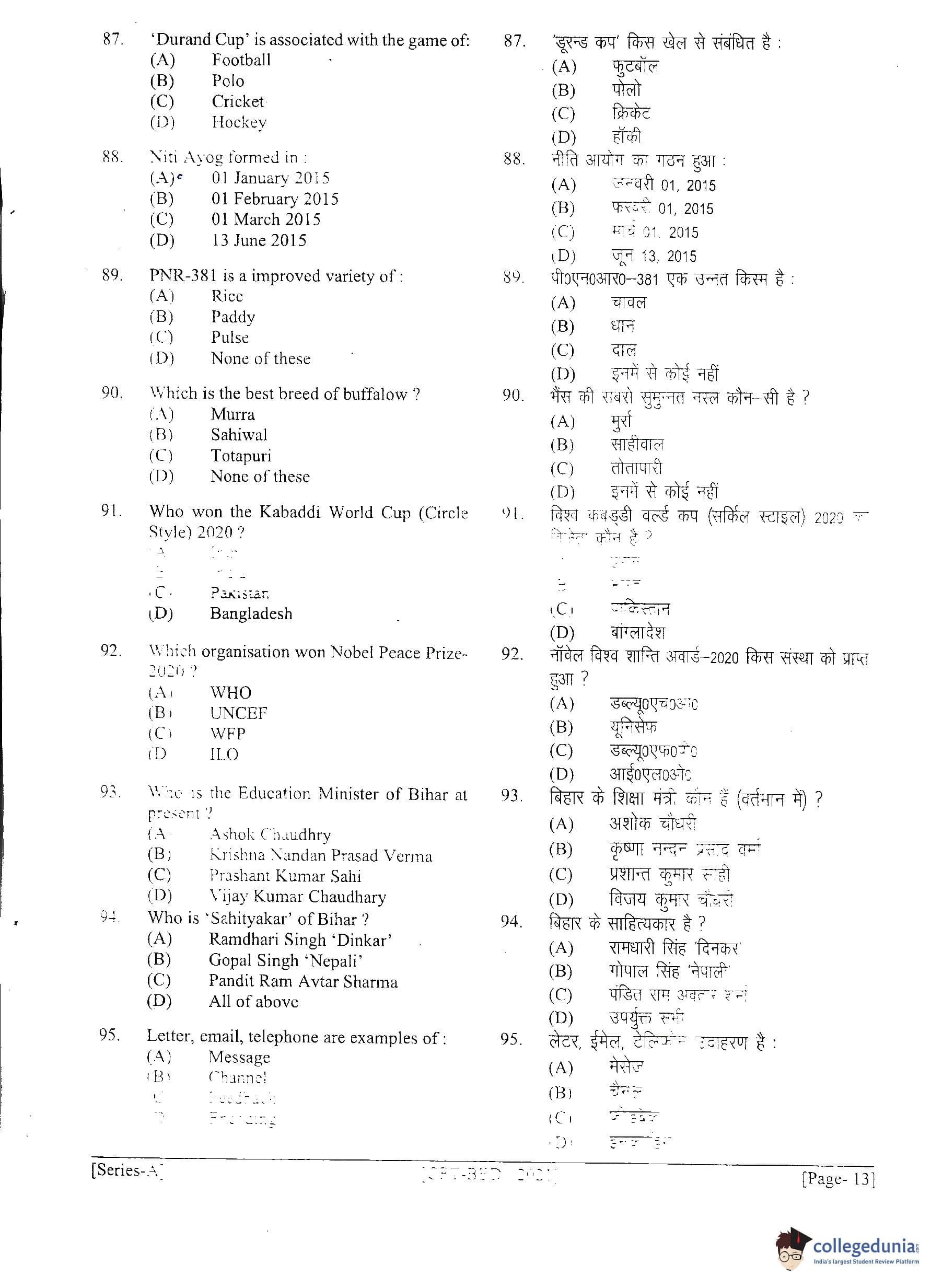
'Durand Cup' is associated with the game of:
View Solution
The Durand Cup is one of the oldest and most prestigious football tournaments in India, originally founded in 1888.
Quick Tip: The Durand Cup is traditionally played by top football teams from India and abroad.
Niti Aayog was formed in:
View Solution
Niti Aayog (National Institution for Transforming India) was established on 1st January 2015, replacing the Planning Commission of India, with the aim of fostering cooperative federalism.
Quick Tip: Niti Aayog plays a key role in India's development agenda and serves as a think tank for the central government.
PNR-381 is an improved variety of:
View Solution
PNR-381 is an improved variety of paddy (rice) developed for higher yield, disease resistance, and better adaptability to varied climates.
Quick Tip: Improved varieties of crops, like PNR-381, contribute significantly to food security and agricultural productivity.
Which is the best breed of buffalo?
View Solution
Murra is considered one of the best breeds of buffalo, primarily known for its high milk yield, strength, and good quality milk in India.
Quick Tip: When studying livestock breeds, focus on characteristics like milk yield and adaptability to local climates.
Who won the Kabaddi World Cup (Circle Style) 2020?
View Solution
India won the 2020 Kabaddi World Cup (Circle Style). The tournament was held in Lahore, Pakistan, and India secured the title.
Quick Tip: The Kabaddi World Cup is one of the most prestigious tournaments for the sport, especially in countries like India and Iran.
Which organisation won the Nobel Peace Prize 2020?
View Solution
The World Food Programme (WFP) won the Nobel Peace Prize in 2020 for its efforts to combat hunger, for its contribution to bettering conditions for peace in conflict-affected areas, and for its efforts to prevent the use of hunger as a weapon of war.
Quick Tip: The Nobel Peace Prize is awarded to organizations and individuals that make significant contributions to the promotion of peace and security worldwide.
Who is the Education Minister of Bihar at present?
View Solution
Vijay Kumar Chaudhary is currently serving as the Education Minister of Bihar. He is responsible for overseeing the education system in the state.
Quick Tip: When discussing government positions, always verify the current officeholder by checking official sources for the most up-to-date information.
Who is 'Sahityakar' of Bihar?
View Solution
All three personalities—Ramdhari Singh 'Dinkar', Gopal Singh 'Nepali', and Pandit Ram Avtar Sharma—are celebrated literary figures and known as 'Sahityakar' (literary figures) of Bihar. They contributed greatly to Hindi literature and poetry.
Quick Tip: When exploring literary figures, study their works and the social and historical contexts in which they wrote.
Letter, email, telephone are examples of:
View Solution
Letter, email, and telephone are forms of communication channels or mediums through which messages are transmitted. They serve as conduits for information exchange.
Quick Tip: When discussing communication, remember that the medium refers to the method used to convey information, such as speech, writing, or electronic methods.
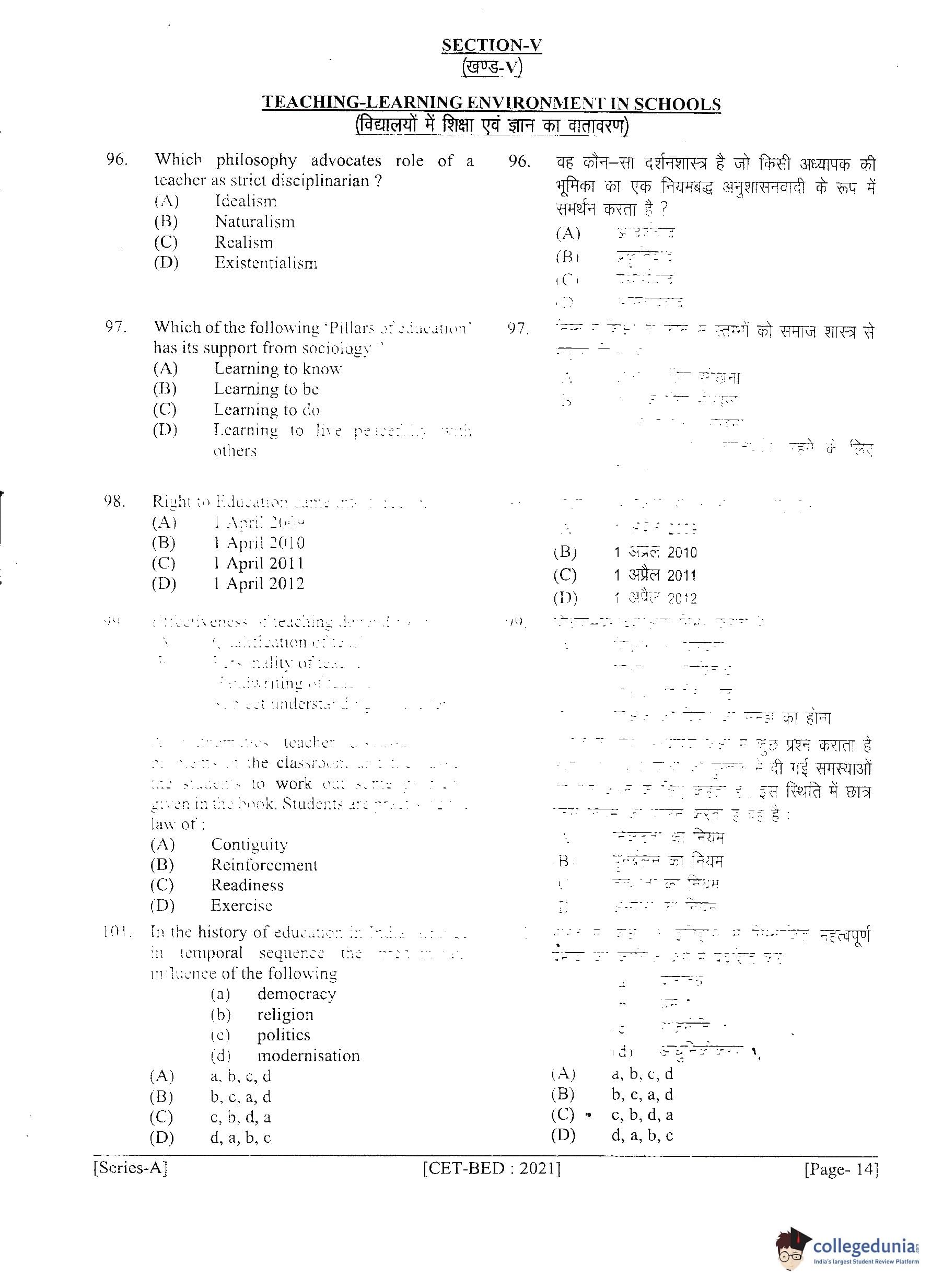
Which philosophy advocates the role of a teacher as a strict disciplinarian?
View Solution
Idealism advocates the role of the teacher as a strict disciplinarian. In this philosophy, the teacher is seen as a guide to moral development, emphasizing discipline and control in the learning process.
Quick Tip: In educational philosophies, the teacher's role varies significantly, ranging from a strict disciplinarian to a facilitator of independent learning.
Which of the following 'Pillars of Education' has its support from sociology?
View Solution
The pillar 'Learning to live together with others' is most supported by sociology. This pillar emphasizes social harmony, cooperation, and respect for diversity, which are core elements in the field of sociology.
Quick Tip: Sociology focuses on the study of society and human interactions, making the pillar of 'learning to live together' a central theme.
Right to Education came into effect on:
View Solution
The Right to Education Act (RTE) came into effect on 1st April 2010, providing free and compulsory education to children aged 6 to 14 years. However, its formal implementation was delayed by a year in certain regions.
Quick Tip: The Right to Education Act ensures that every child in India has access to free and quality education.
The teacher in the classroom applies the law of:
View Solution
In the classroom, the law of Exercise, as per educational psychology, implies that regular practice and repetition help in reinforcing learning and retention. This principle suggests that the more a student practices, the more they retain.
Quick Tip: The law of Exercise is a fundamental concept in education, emphasizing the importance of continuous practice for better learning outcomes.
In the history of education in India, in temporal sequence, the most influential factors are:
View Solution
In the history of education in India, the most influential factors, in temporal sequence, have been: democracy (a), religion (b), politics (c), and modernisation (d). These elements have shaped the educational landscape in India, with religion and politics being significant in the past and democracy and modernisation playing key roles in the current era.
Quick Tip: The development of education is deeply intertwined with historical, social, and political changes.
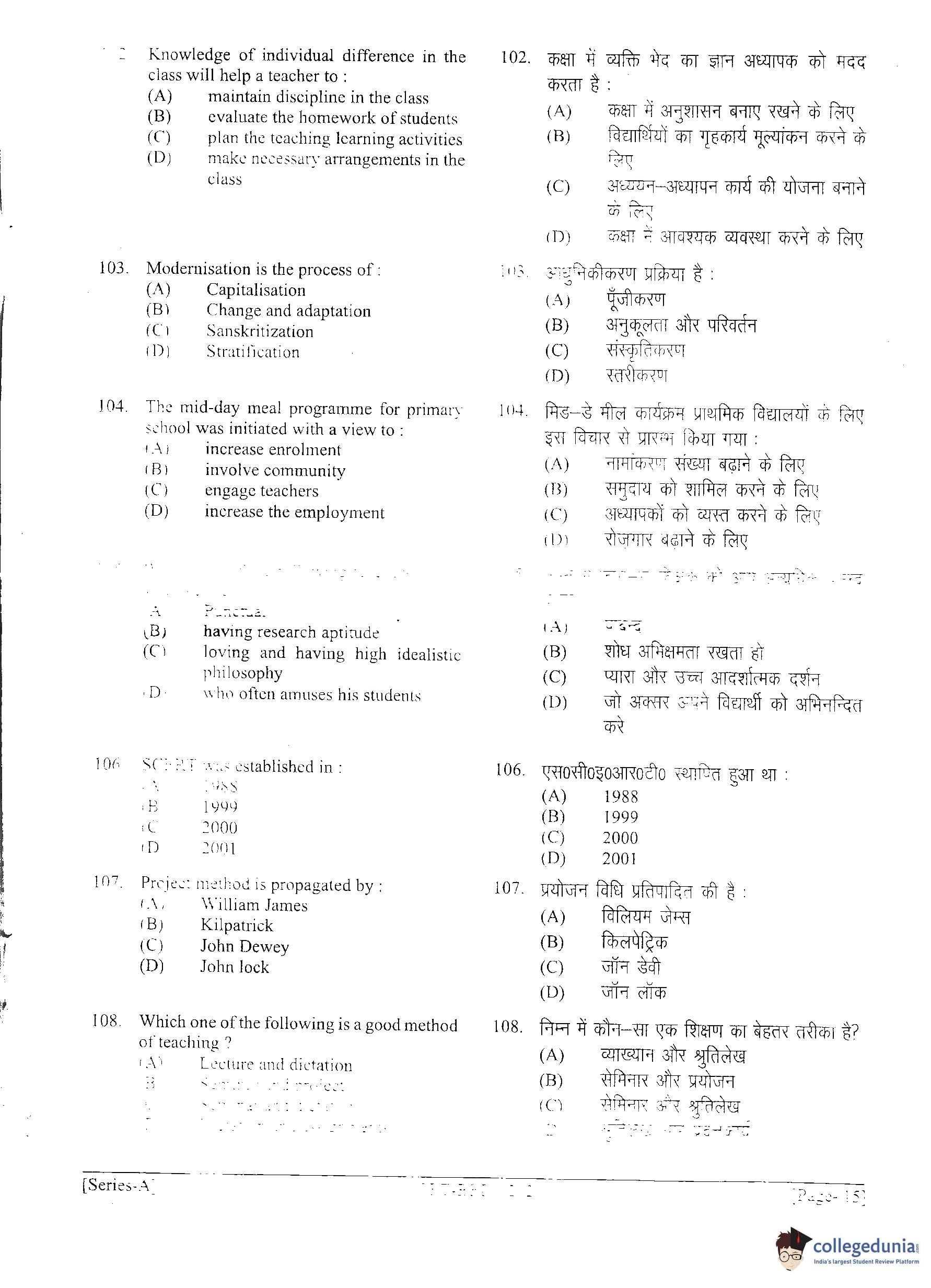
Knowledge of individual differences in the class will help a teacher to:
View Solution
Knowing the individual differences in the class allows the teacher to plan activities that cater to the diverse needs of students. It helps in creating an effective and inclusive learning environment.
Quick Tip: By understanding individual differences, teachers can provide tailored learning experiences, improving overall engagement and outcomes.
Modernisation is the process of:
View Solution
Modernisation refers to the process of change and adaptation, where societies adopt new technologies, ideas, and practices in order to progress socially and economically. It often involves shifts in values, education, and lifestyle.
Quick Tip: Modernisation is about embracing changes that improve living standards, while preserving core cultural values.
The mid-day meal programme for primary school was initiated with a view to:
View Solution
The mid-day meal programme was introduced to encourage enrollment in primary schools, particularly in underprivileged areas, by providing children with a nutritional meal. This initiative aimed to improve school attendance and learning outcomes.
Quick Tip: The mid-day meal programme not only helps with nutrition but also acts as an incentive for children to attend school regularly.
A teacher with a personality characterized as:
View Solution
A teacher who is loving and possesses a high idealistic philosophy tends to inspire and motivate students. Their approach goes beyond academic teachings, fostering emotional and moral development.
Quick Tip: A teacher’s philosophy and attitude towards students can significantly impact their learning experience and personal growth.
SCERT was established in:
View Solution
The State Council of Educational Research and Training (SCERT) was established in 1988 to oversee the academic, curricular, and instructional development in the education sector at the state level.
Quick Tip: SCERT plays a critical role in improving the quality of education at the state level by developing curriculum, textbooks, and teaching methods.
Project method is propagated by:
View Solution
The project method, which emphasizes active student participation and learning by doing, was popularized by William H. Kilpatrick. It allows students to engage with real-world problems through projects.
Quick Tip: The project method encourages creativity, critical thinking, and collaborative learning among students.
Which one of the following is a good method of teaching?
View Solution
The discussion method is considered one of the most effective teaching methods because it encourages student participation, critical thinking, and allows for deeper exploration of topics.
Quick Tip: The discussion method helps in developing communication skills and allows students to express their opinions and ideas.
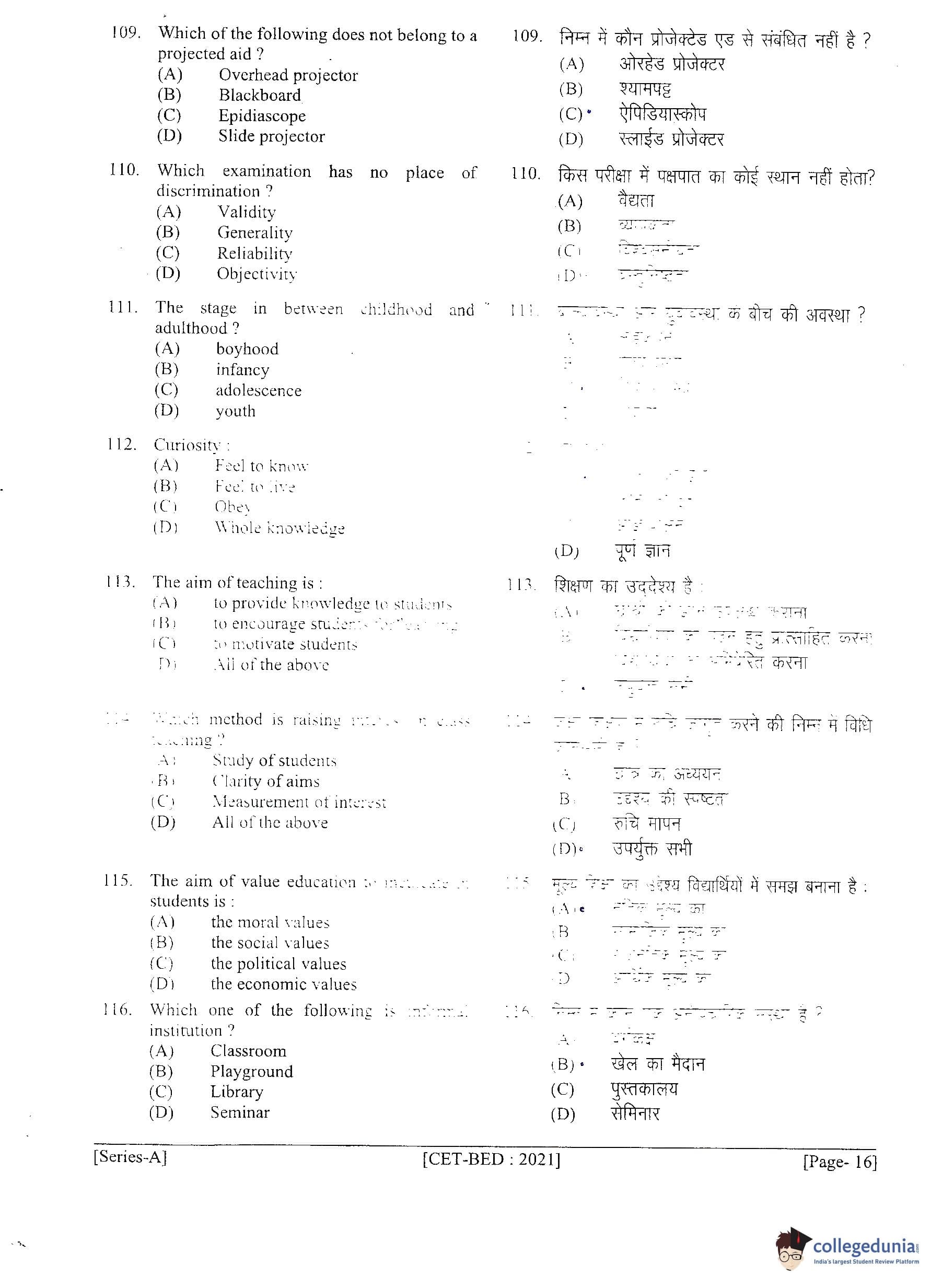
Which of the following does not belong to a projected aid?
View Solution
A blackboard does not belong to projected aids, as it is not used to project images or information onto a screen. The overhead projector, epidiascope, and slide projector are all types of projected aids used in classrooms.
Quick Tip: When discussing teaching aids, focus on whether the tool projects information onto a screen or not to distinguish between projected and non-projected aids.
Which examination has no place of discrimination?
View Solution
Objectivity in examinations ensures that all students are evaluated based on the same criteria, without bias or discrimination. It eliminates subjective judgment and ensures fairness.
Quick Tip: In exams, objectivity refers to the consistent and unbiased assessment of student responses, which is crucial for fairness.
The stage in between childhood and adulthood is:
View Solution
Adolescence is the stage between childhood and adulthood. It is characterized by physical, emotional, and psychological development, marking the transition into adulthood.
Quick Tip: Adolescence is a critical period for personal growth and development, where individuals undergo significant changes.
Curiosity:
View Solution
Curiosity is the feeling of wanting to know or learn something. It is a natural inclination to seek understanding, which drives individuals to ask questions and explore new information.
Quick Tip: Curiosity is the key to learning, as it encourages questioning and exploration, essential for knowledge acquisition.
The aim of teaching is:
View Solution
The aim of teaching encompasses providing knowledge, encouraging creativity, and motivating students. Teaching aims to nurture well-rounded individuals, fostering not only academic growth but also personal development.
Quick Tip: Effective teaching is about balancing the dissemination of knowledge with nurturing critical thinking and motivating students to engage actively.
Which method is raising interest in the class for learning?
View Solution
Raising interest in the class for learning involves understanding the students' needs (study of students), ensuring clear learning objectives (clarity of aims), and actively measuring and addressing students' interests. All of these factors contribute to effective engagement and learning.
Quick Tip: To maintain student engagement, consider addressing their interests, ensuring clarity in learning goals, and actively assessing their needs.
The aim of value education to students is:
View Solution
The primary aim of value education is to instill moral values in students, helping them grow into responsible, ethical, and compassionate individuals. Moral education shapes their attitudes and behaviors, which is essential for personal and societal growth.
Quick Tip: Value education focuses on teaching students to make ethical decisions and contribute positively to society.
Which one of the following is an educational institution?
View Solution
A classroom is a formal educational institution where students learn from teachers. It provides the necessary environment for instruction, interaction, and academic growth. Other options, like playgrounds, libraries, and seminars, support learning but are not formal institutions in the same sense.
Quick Tip: A classroom is the primary space for structured learning, where the foundation of academic knowledge is laid.
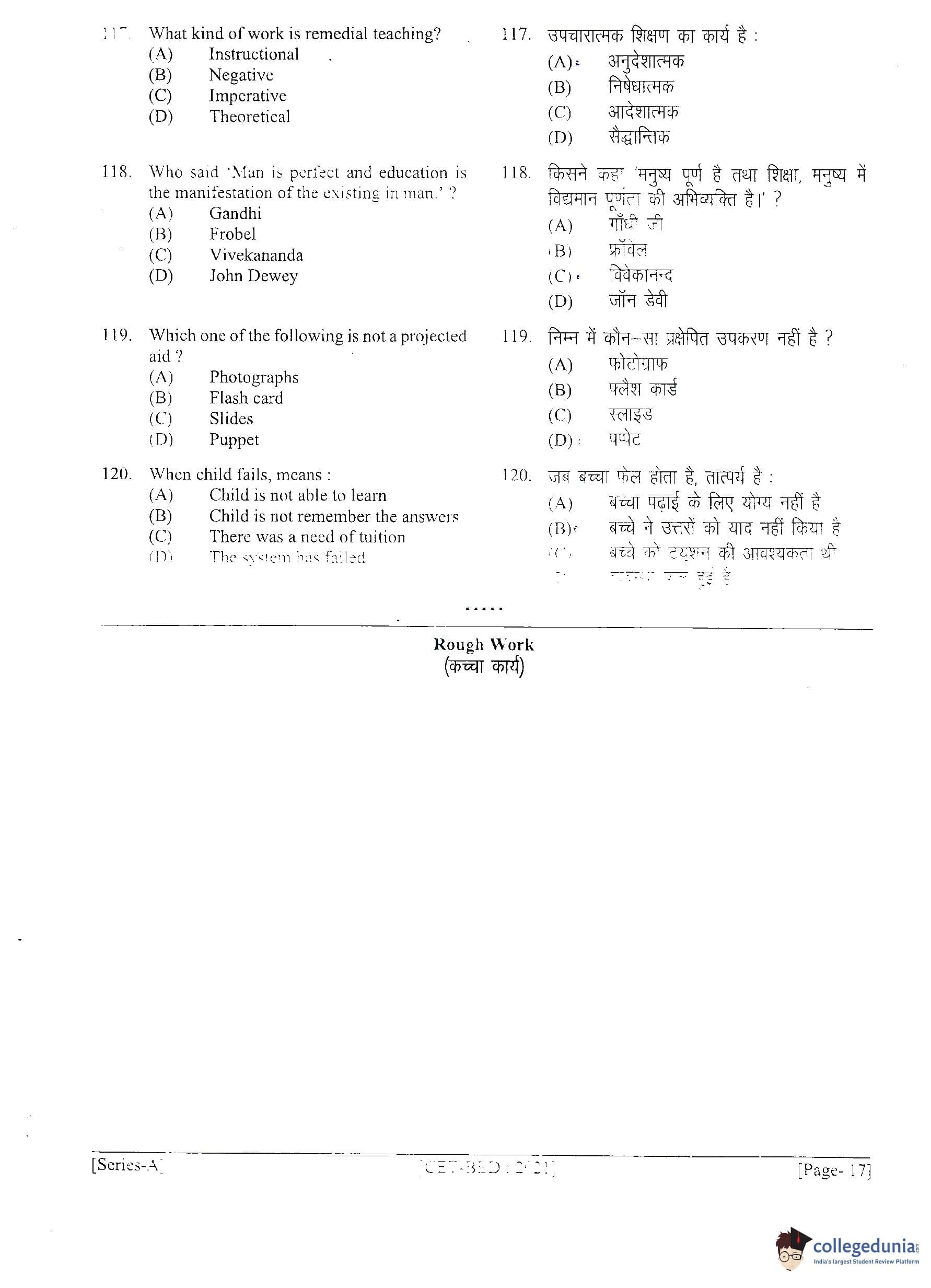
What kind of work is remedial teaching?
View Solution
Remedial teaching is instructional in nature. It is aimed at helping students overcome their learning difficulties, providing tailored support to meet their individual needs. It is designed to help students catch up to the required academic level.
Quick Tip: Remedial teaching focuses on identifying and addressing specific learning challenges, improving comprehension and skills.
Who said “Man is perfect and education is the manifestation of the existing in man”?
View Solution
This statement was made by Swami Vivekananda. He believed that education should help manifest the innate potential and perfection within every human being, empowering individuals to realize their full potential.
Quick Tip: Swami Vivekananda's educational philosophy emphasized holistic development and the realization of inner potential.
Which one of the following is not a projected aid?
View Solution
Puppets are not considered a projected aid because they do not project images or information onto a screen. Projected aids like photographs, flash cards, and slides involve projecting content for visual aid during teaching.
Quick Tip: To differentiate between teaching aids, check if the tool projects visual content onto a screen (projected aids) or is used directly in the physical space (non-projected aids).
When a child fails, it means:
View Solution
When a child fails, it often indicates that the educational system, teaching methods, or learning environment may not have met the child's needs. A child’s failure can be seen as a reflection of gaps in the system rather than the child's inability to learn.
Quick Tip: Failure in education should prompt a review of teaching strategies, learning resources, and system structures to better support the child’s learning needs.






Comments