




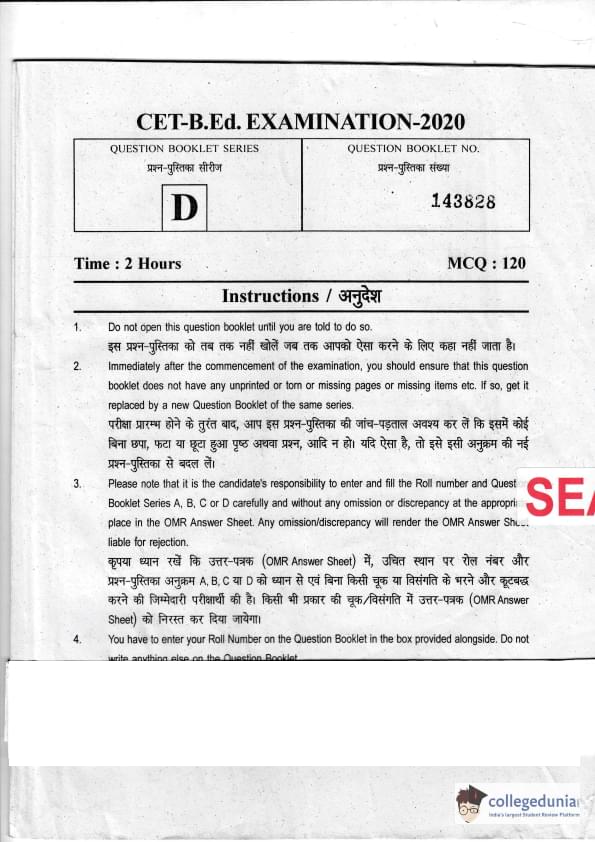
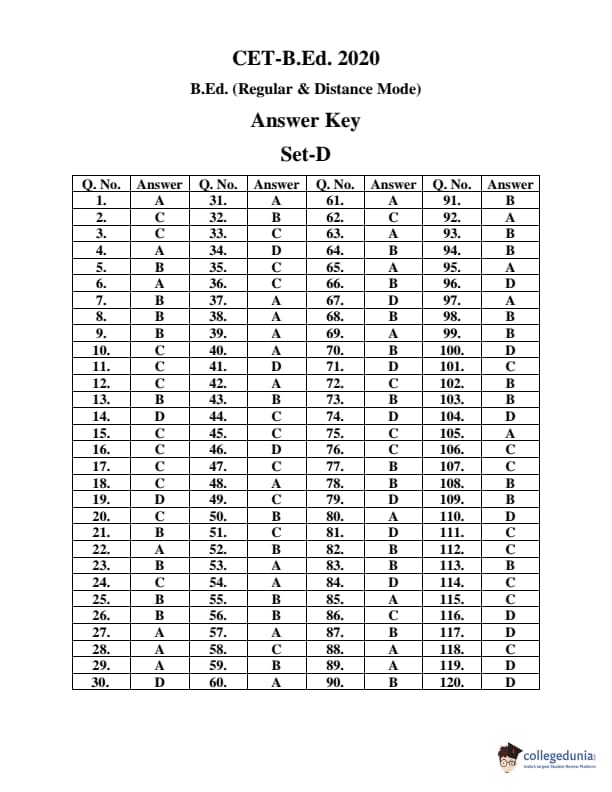
Bihar BEd CET 2020 Set D Question paper with answer key pdf is available here for download.Bihar BEd CET 2020 exam was conducted on September 22, 2020 . The exam was successfully organized by Lalit Narayan Mithila University. The question paper comprised a total of 120 questions.
Bihar BEd CET 2020 Set D Question Paper with Answer Key PDFs
| Bihar BEd CET 2020 Set D Question Paper With Answer Key | Download PDF | Check Solutions |
Question 1:
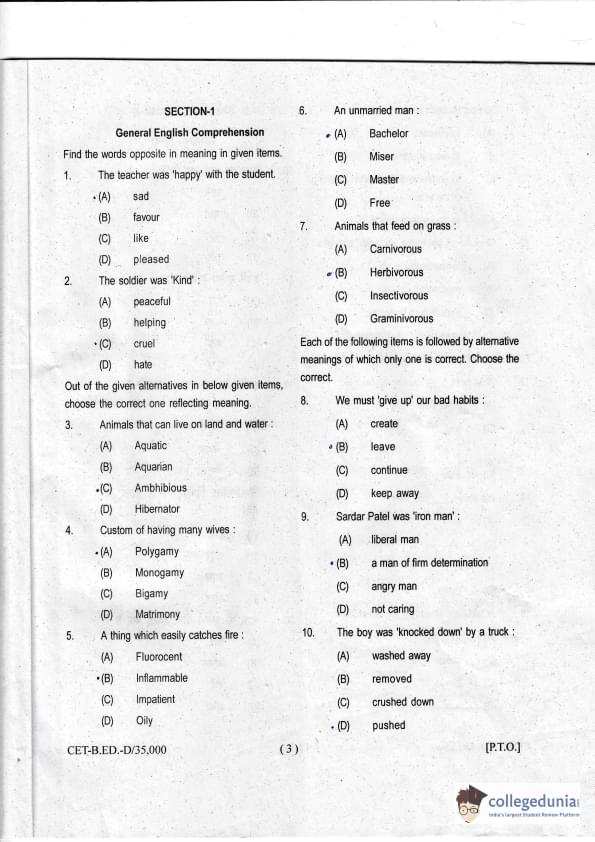
The teacher was 'happy' with the student.
View Solution
The word "happy" refers to a positive emotional state, and the opposite of being happy is being pleased, as this reflects contentment or satisfaction.
Quick Tip: When identifying opposites, focus on the emotional or descriptive context of the words.
The soldier was 'Kind'.
View Solution
The word "kind" means being considerate and generous, while the opposite is "cruel," meaning unkind or harsh.
Quick Tip: Remember that opposites typically reflect a complete contrast in behavior or attitude.
Animals that can live on land and water:
View Solution
"Amphibious" refers to animals that can live both on land and in water. Aquatic refers to animals that live only in water.
Quick Tip: Think of amphibians like frogs, which thrive both in water and on land.
Custom of having many wives:
View Solution
Polygamy refers to the practice of having more than one wife at the same time. Bigamy is the illegal act of marrying someone while already being married to another.
Quick Tip: Be sure to differentiate between terms related to marriage customs based on the number of partners involved.
A thing which easily catches fire:
View Solution
"Inflammable" refers to something that easily catches fire, while "flammable" is the more commonly used term. Fluorescent refers to the emission of light.
Quick Tip: Remember that both "inflammable" and "flammable" mean the same thing, referring to something that can catch fire easily.
An unmarried man:
View Solution
A bachelor is an unmarried man, while "miser" refers to someone who is excessively frugal, and "master" is not related to marital status.
Quick Tip: The term "bachelor" specifically refers to an unmarried man in common English usage.
Animals that feed on grass:
View Solution
Herbivorous animals feed on plants and grasses, while carnivorous animals eat meat, insectivorous animals eat insects, and granivorous animals eat seeds.
Quick Tip: Think of herbivores like cows or deer, which primarily eat plants and grasses.
We must 'give up' our bad habits:
View Solution
To "give up" something means to stop or leave it behind, especially when referring to bad habits.
Quick Tip: When someone says to "give up" a habit, it means to stop doing it or abandon it entirely.
Sardar Patel was 'iron man':
View Solution
Sardar Patel was known as the "iron man" due to his firm determination and leadership qualities.
Quick Tip: Think of the phrase "iron man" as symbolizing strength and determination.
The boy was 'knocked down' by a truck:
View Solution
"Knocked down" refers to being hit forcefully, often causing injury, which fits with being crushed down.
Quick Tip: When you hear "knocked down," think of something being struck or toppled forcefully.
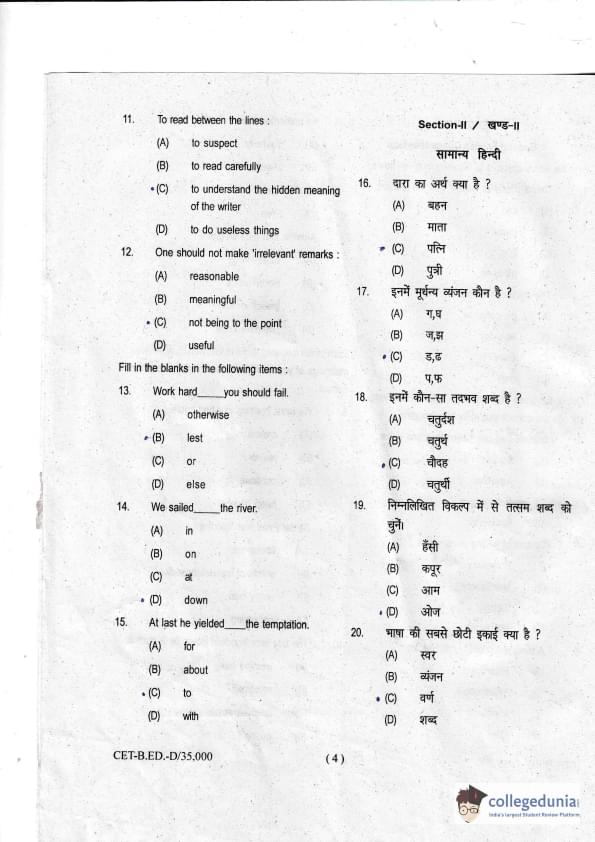
To read between the lines:
View Solution
"To read between the lines" means to perceive or understand a meaning that is not directly stated but implied. It refers to grasping the hidden or underlying meaning of something, especially in writing or speech.
Quick Tip: Always consider context clues and subtle hints in a passage to "read between the lines."
One should not make 'irrelevant' remarks:
View Solution
"Irrelevant" means something that is not related or not applicable to the main subject. The opposite of relevant is not being to the point.
Quick Tip: Focus on the connection of remarks to the main topic when identifying relevance.
Work hard ___\ you should fail:
View Solution
"Lest" is used to express the idea of preventing something from happening. It fits the context of the sentence, meaning that if you do not work hard, you might fail.
Quick Tip: "Lest" is often used to express fear or prevention of something undesirable.
We sailed ___\ the river:
View Solution
The correct preposition here is "down," as it indicates movement along the flow of the river.
Quick Tip: Use "down" for directions or movement along a natural path like a river.
At last he yielded ___\ the temptation:
View Solution
"Yielded to" is a common phrase meaning to give in or surrender to something, such as a temptation.
Quick Tip: Use "yielded to" when someone gives in to something, especially an urge or temptation.
दारा का अर्थ क्या है?
View Solution
"दारा" का अर्थ पति होता है, जो एक पुरुष को उसकी पत्नी के संदर्भ में कहा जाता है।
Quick Tip: जब किसी शब्द के अर्थ को समझना हो, तो उसका संदर्भ और उपयोग देखें।
इनमें से मुख्य व्यंजन कौन है?
View Solution
व्यंजन "ड" और "ढ" मुख्य व्यंजन होते हैं, जो विशेष रूप से हिंदी भाषा में प्रयुक्त होते हैं।
Quick Tip: हिंदी व्यंजन की पहचान उनके उच्चारण से की जाती है।
इनमें कौन-सा तद्भव शब्द है?
View Solution
"चौदह" एक तद्भव शब्द है, जो संस्कृत से हिंदी में आया है।
Quick Tip: तद्भव शब्द वे होते हैं जो संस्कृत से हिंदी में आकर विकृत हो गए होते हैं।
निर्मलिखित विकल्प में से तद्भव शब्द चुनो।
View Solution
"हंसी" एक तद्भव शब्द है, जो संस्कृत शब्द "हंसी" से हिंदी में आया है।
Quick Tip: तद्भव शब्दों के बारे में जानने के लिए उनके उत्पत्ति स्रोत पर ध्यान दें।
भाषा की सबसे छोटी इकाई क्या है?
View Solution
भाषा की सबसे छोटी इकाई वर्ण होती है, जो ध्वनि का रूप होती है और शब्दों का निर्माण करती है।
Quick Tip: वर्ण के बारे में समझते समय, इसे ध्वनियों की सबसे छोटी इकाई के रूप में पहचानें।
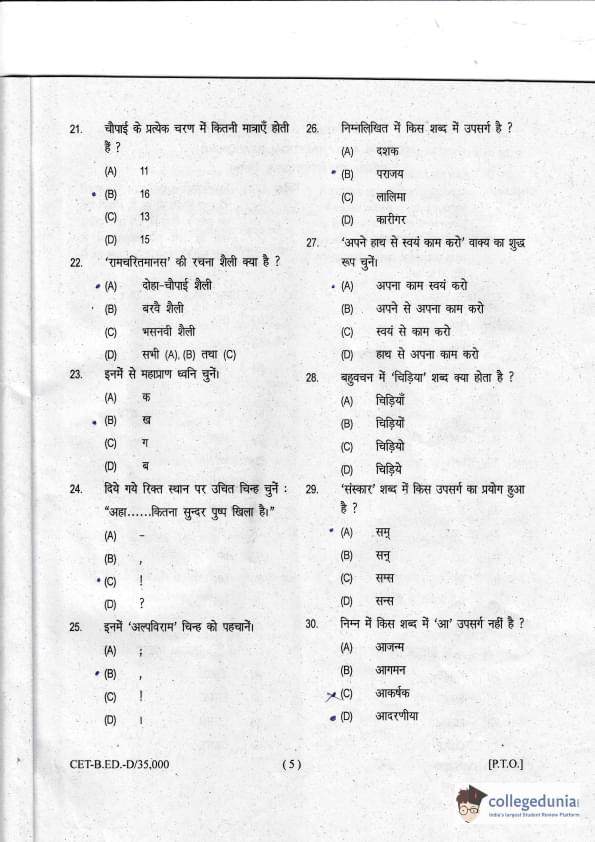
चौपाई के प्रथम चरण में कितनी मात्राएँ होती हैं?
View Solution
चौपाई में चार चरण होते हैं और प्रत्येक चरण में 16 मात्राएँ होती हैं।
Quick Tip: चौपाई के चरण और मात्राओं की संख्या को याद करने के लिए कविता का अभ्यास करें।
'रामचरितमानस' की रचना शैली क्या है?
View Solution
रामचरितमानस में दोहा-चौपाई, बरेह और भक्तिनवीन शैली का मिश्रण किया गया है।
Quick Tip: रामचरितमानस की रचना शैली को समझने के लिए अलग-अलग प्रकार के छंदों पर ध्यान दें।
इनमें से महाप्राण ध्वनि चुनें।
View Solution
"महाप्राण" ध्वनियाँ वो होती हैं जो उच्चारण के दौरान अधिक शक्ति लगती हैं, जैसे ख।
Quick Tip: महाप्राण ध्वनियाँ अधिक जोर से बोली जाती हैं और श्वास की अधिक आवश्यकता होती है।
दिये गए रिक्त स्थान पर उचित चित्र चुनें: "अहा.....कितना सुंदर पुष्प खिला है।"
View Solution
"अहा" एक विस्मयादिबोधक शब्द है, और इसके साथ विस्मय चिह्न (!) का प्रयोग किया जाता है।
Quick Tip: विस्मयादिबोधक शब्द के साथ हमेशा विस्मय चिह्न का प्रयोग करें।
इनमें 'अद्वितीय' शब्द को पहचानो।
View Solution
'अद्वितीय' का अर्थ होता है जो कोई अन्य समान न हो, यानी 'अद्भुत'।
Quick Tip: 'अद्वितीय' शब्द का प्रयोग तब होता है जब कोई वस्तु या व्यक्ति अन्य सभी से अलग हो।
निर्मलिखित में किस शब्द में उपसर्ग है?
View Solution
'परंपरागत' शब्द में 'परि' उपसर्ग है जो किसी चीज़ के चारों ओर होने का बोध देता है।
Quick Tip: उपसर्ग वह होता है जो मूल शब्द के पहले जुड़कर उसका अर्थ बदलता है।
'अपने हाथ से स्वयं काम करो' वाक्य का शुद्ध रूप चुनें।
View Solution
यह वाक्य में 'स्वयं' का प्रयोग स्वचालित रूप से किया जाता है, और सही रूप 'अपना काम स्वयं करो' है।
Quick Tip: स्वयं का प्रयोग किसी व्यक्ति की आत्मनिर्भरता को दर्शाने के लिए किया जाता है।
बहुवचन में 'विडिया' शब्द क्या होता है?
View Solution
'विडिया' का बहुवचन 'विद्यियाँ' होता है।
Quick Tip: संज्ञाओं का बहुवचन बनाने में 'याँ' जोड़ते हैं, जैसे विद्यियाँ।
'संस्कार' शब्द में किस उपसर्ग का प्रयोग हुआ है?
View Solution
'संस्कार' में 'सं' उपसर्ग है, जो एक सकारात्मक प्रक्रिया को दर्शाता है।
Quick Tip: उपसर्गों के साथ शब्दों के अर्थ को बदलने पर ध्यान दें।
निम्न में किस शब्द में 'आ' उपसर्ग नहीं है?
View Solution
'आ' उपसर्ग 'आसक्ति' में नहीं होता है, जबकि अन्य शब्दों में यह उपसर्ग है।
Quick Tip: 'आ' उपसर्ग किसी शब्द के अर्थ में वृद्धि करने के लिए उपयोग होता है।
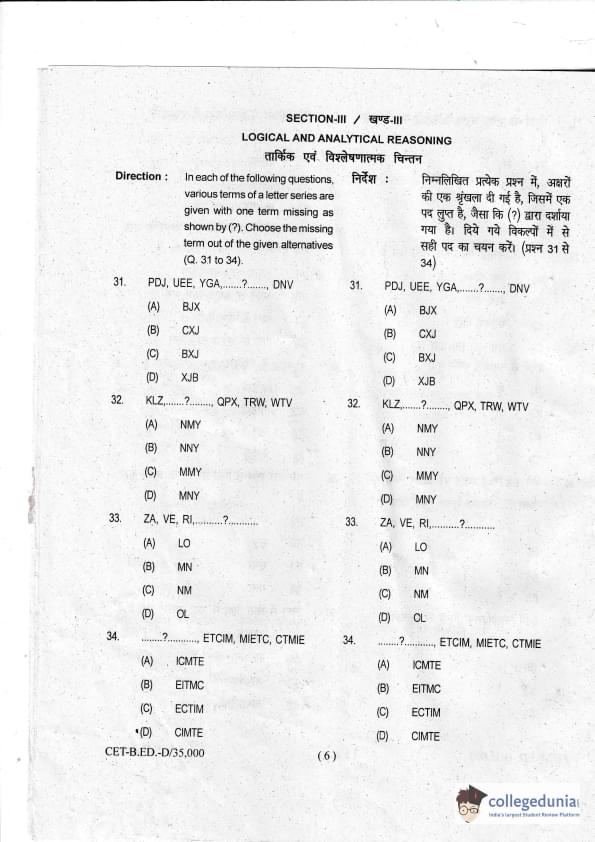
PDJ, UEE, YGA, ....?.., DNV
View Solution
The pattern in the letter series follows a shift of one letter forward in the first term, then one backward in the second term, etc. The missing term should fit this pattern.
Quick Tip: Look for patterns in the shift of letters to identify the missing term.
KLZ, ......, QPX, TRW, WTV
View Solution
The series shows a pattern of incremental shifts in the letters. The missing term fits the pattern of progression seen in the terms before and after it.
Quick Tip: Focus on the sequence and look for a consistent shift across the series.
ZA, VE, RI, ......
View Solution
The letters follow a pattern of alternating letters in the alphabet. The missing term completes the pattern by filling the gap in the sequence.
Quick Tip: Analyze the alphabetical order and identify the missing term based on the established pattern.
......, ETCIM, MIETC, CTMIE
View Solution
The terms in this series show a rearrangement of the same letters. The missing term fits this pattern and completes the sequence.
Quick Tip: Pay attention to the rearrangement of letters and find the sequence that follows logically.
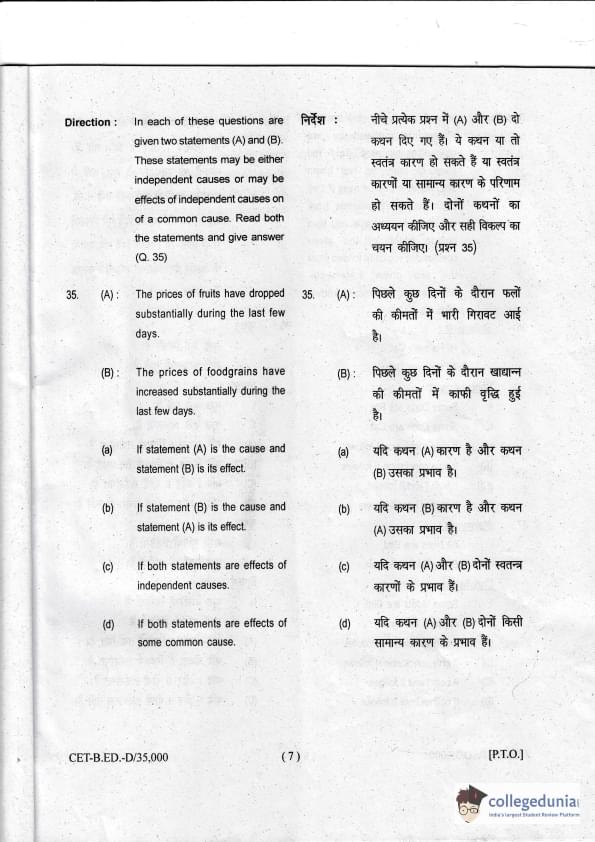
(A): The prices of fruits have dropped substantially during the last few days.
(B): The prices of foodgrains have increased substantially during the last few days.
View Solution
The price fluctuations of fruits and foodgrains are likely influenced by a common external factor, such as weather conditions or market policies, which would explain both the increase in foodgrains prices and the decrease in fruit prices.
Quick Tip: Look for external factors that could influence multiple effects in logical reasoning questions like this one.
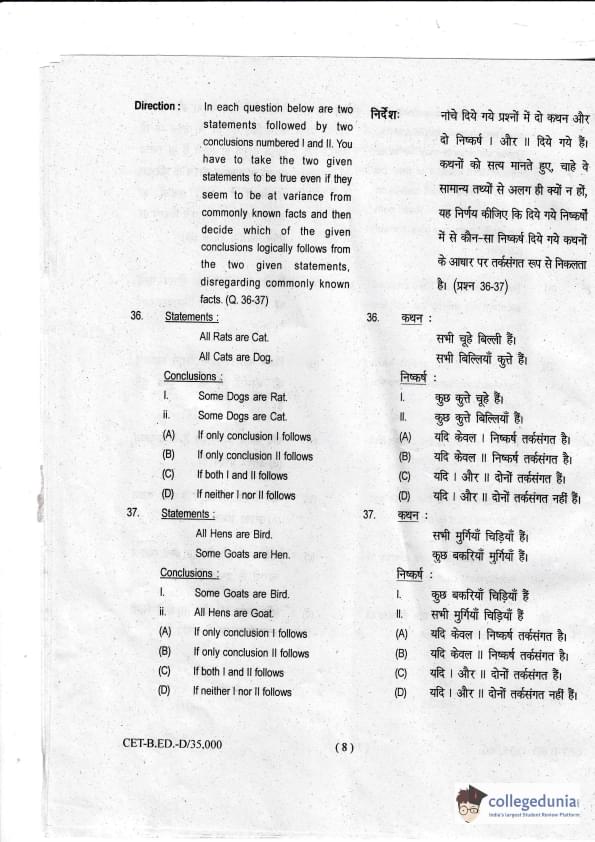
Statements:
All Rats are Cat.
All Cats are Dog.
Conclusions:
I. Some Dogs are Rat.
II. Some Dogs are Cat.
View Solution
Given the statements, if all rats are cats and all cats are dogs, we cannot conclusively state that some dogs are rats or some dogs are cats. Therefore, neither conclusion follows.
Quick Tip: In logical reasoning, always evaluate the relationships between statements and conclusions based on the given conditions.
Statements:
All Hens are Bird.
Some Goats are Hen.
Conclusions:
I. Some Goats are Bird.
II. All Hens are Goat.
View Solution
Since all hens are birds and some goats are hens, it follows that some goats are birds. However, we cannot conclude that all hens are goats, as not all hens are necessarily goats. Therefore, only conclusion I follows.
Quick Tip: When analyzing conclusions, ensure that they are logically supported by the statements provided, and rule out those that do not follow.
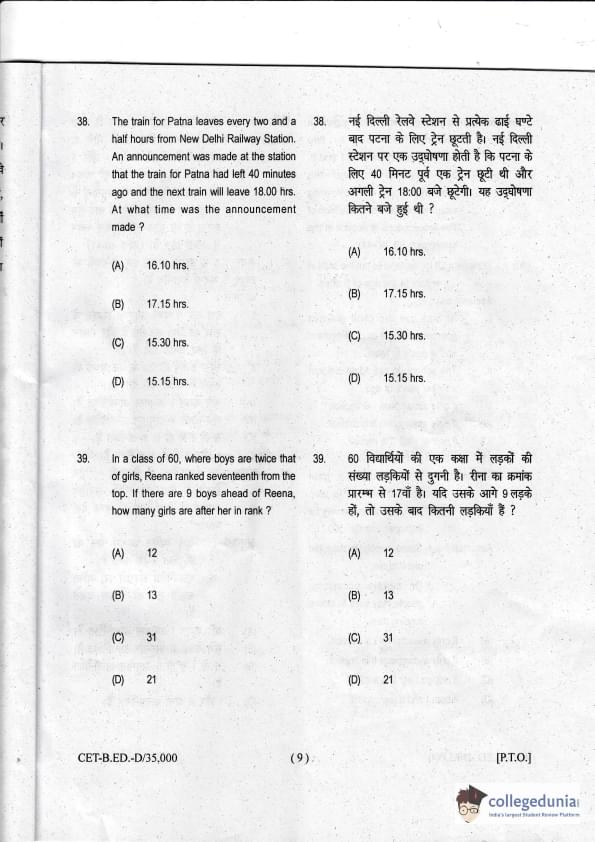
The train for Patna leaves every two and a half hours from New Delhi Railway Station. An announcement was made at the station that the train for Patna had left 40 minutes ago and the next train will leave at 18.00 hrs. At what time was the announcement made?
View Solution
The train for Patna leaves every 2.5 hours. If the next train will leave at 18:00 hrs and the announcement was made 40 minutes after the train left, the announcement must have been made at 17:15 hrs.
Quick Tip: To solve time-related problems, work backwards by calculating the interval from the given event.
In a class of 60, where boys are twice that of girls, Reena ranked seventeenth from the top. If there are 9 boys ahead of Reena, how many girls are after her in rank?
View Solution
Since there are 60 students and the number of boys is twice that of girls, we have 40 boys and 20 girls. Reena ranks 17th, and there are 9 boys ahead of her, so 8 girls are ahead of her. Hence, there are 13 girls after Reena in rank.
Quick Tip: Break down the total number of students into smaller groups to simplify counting and ranking problems.
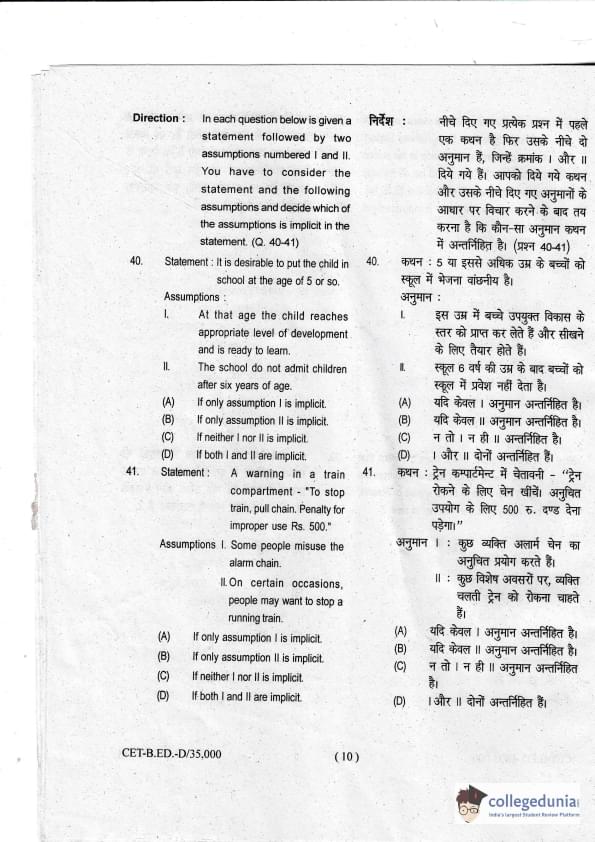
Statement: It is desirable to put the child in school at the age of 5 or so.
% Assumptions
Assumptions:
I. At that age the child reaches an appropriate level of development and is ready to learn.
II. The school does not admit children after six years of age.
View Solution
The statement implies that a child should be in school at the age of 5 or so, based on the child's developmental readiness to learn. The second assumption about the age limit of six years is not directly implied by the statement.
Quick Tip: Look for assumptions that directly support or are suggested by the statement itself.
Statement: A warning in a train compartment - "To stop train, pull chain. Penalty for improper use Rs. 500."
% Assumptions
Assumptions:
I. Some people misuse the alarm chain.
II. On certain occasions, people may want to stop a running train.
View Solution
The statement about pulling the chain implies that some people might misuse the chain, and the warning acknowledges that there are occasions when people may need to stop the train. Thus, both assumptions are implicit.
Quick Tip: Consider all possible implications of the statement when evaluating assumptions.
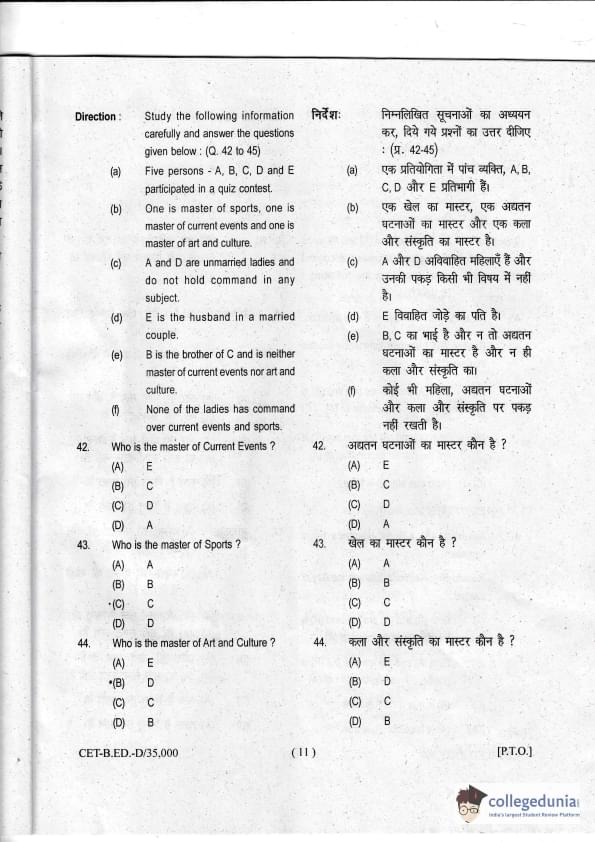
Who is the master of Current Events?
View Solution
Given that none of the ladies holds command over current events, and B is not a master of current events or art and culture, C must be the master of current events.
Quick Tip: Eliminate the impossible options based on the provided conditions.
Who is the master of Sports?
View Solution
Since A and D are unmarried ladies and do not hold command in any subject, A must be the master of sports as no other option fits the criteria.
Quick Tip: Review the exclusions in the problem to narrow down the possibilities.
Who is the master of Art and Culture?
View Solution
Since B is neither the master of current events nor art and culture, and the remaining options fit the description of the given scenario, B must be the master of art and culture.
Quick Tip: Ensure that the remaining options logically fit based on the constraints given in the problem.
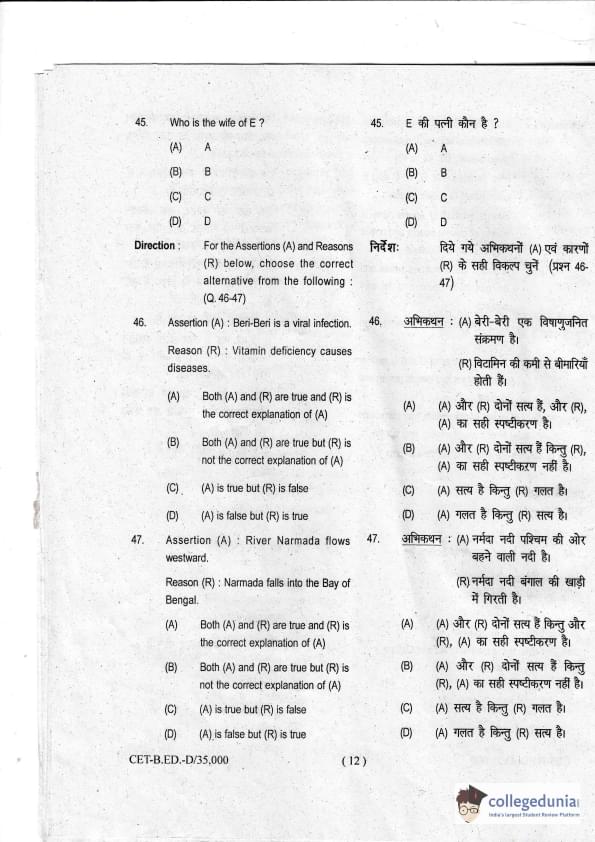
Who is the wife of E?
View Solution
The question provides details about marital relationships. Based on the provided clues, the answer is B.
Quick Tip: Carefully consider the information provided in the directions to solve relationship-based questions.
Assertion (A): Beri-Beri is a viral infection.
Reason (R): Vitamin deficiency causes diseases.
View Solution
While Beri-Beri is related to vitamin deficiency, it is not caused by a viral infection, hence (A) is true but (R) is false.
Quick Tip: When analyzing assertions and reasons, make sure both the factual accuracy and logical relationship are considered.
Assertion (A): River Narmada flows westward.
Reason (R): Narmada falls into the Bay of Bengal.
View Solution
While it is true that the Narmada river flows westward, it does not flow into the Bay of Bengal. Instead, it empties into the Arabian Sea. Therefore, (A) is true but (R) is false.
Quick Tip: Always check the accuracy of both assertions and reasons before concluding the answer.
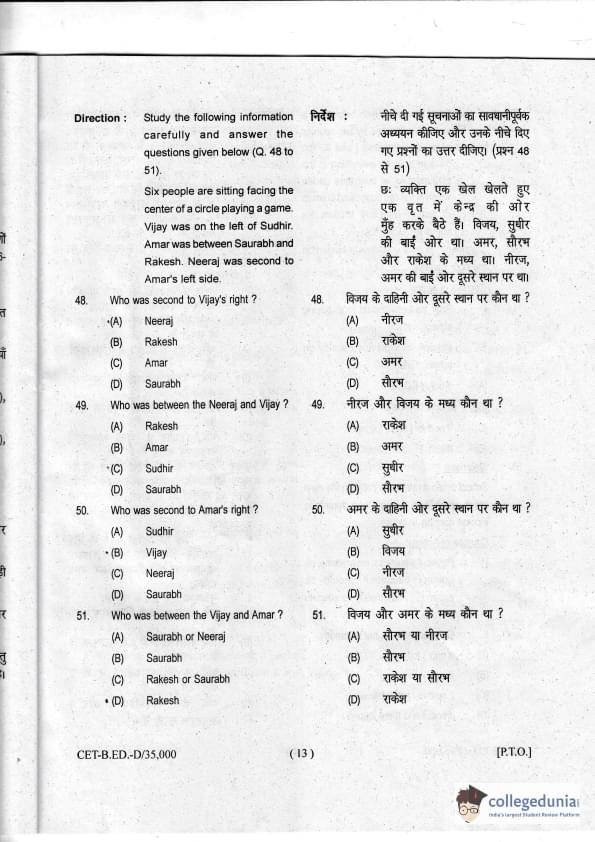
Who was second to Vijay's right?
View Solution
Based on the seating arrangement, Neeraj is second to Vijay's right.
Quick Tip: Pay attention to the seating arrangement and relationships between people when answering such seating problems.
Who was between Neeraj and Vijay?
View Solution
Amar is seated between Neeraj and Vijay in the arrangement.
Quick Tip: When given relationships between people, use elimination to figure out who is seated between the others.
Who was second to Amar's right?
View Solution
Saurabh is seated second to Amar's right.
Quick Tip: Visualizing the seating arrangement can help you easily identify positions and relationships.
Who was between Vijay and Amar?
View Solution
Rakesh or Saurabh could be seated between Vijay and Amar, based on the seating arrangement provided.
Quick Tip: Always check the seating order and process the information systematically when solving these problems.
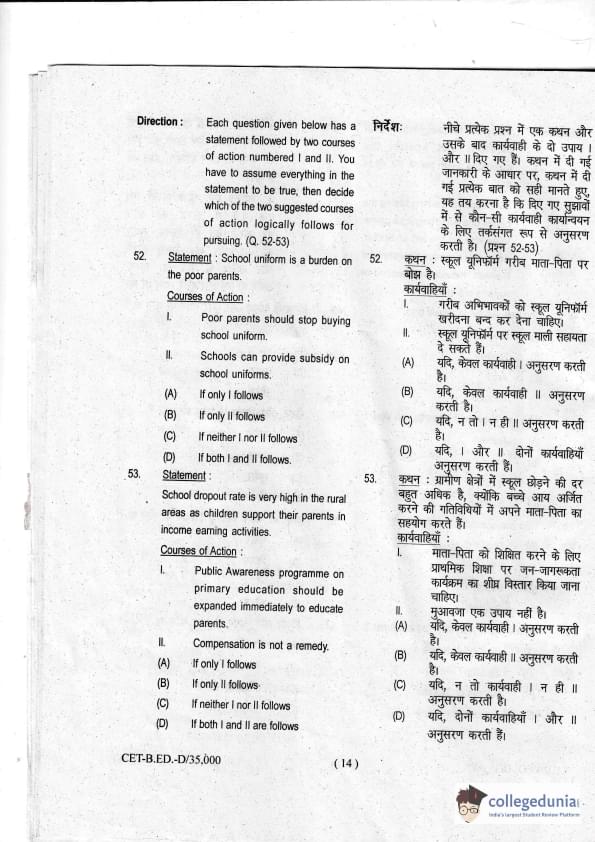
Statement: School uniform is a burden on the poor parents.
Courses of Action:
I. Poor parents should stop buying school uniforms.
II. Schools can provide subsidy on school uniforms.
View Solution
Since school uniforms are a burden for poor parents, a subsidy on uniforms is a feasible solution to support them. Therefore, course of action II is the most logical.
Quick Tip: When faced with financial burdens, look for supportive actions like subsidies or aids rather than stopping essential activities.
Statement: School dropout rate is very high in the rural areas as children support their parents in income earning activities.
Courses of Action:
I. Public Awareness programme on primary education should be expanded immediately to educate parents.
II. Compensation is not a remedy.
View Solution
To address the high dropout rates, it is crucial to educate parents about the importance of education. Therefore, course of action I, which focuses on public awareness, follows logically.
Quick Tip: Focus on educating the community to solve larger societal issues, like school dropouts.
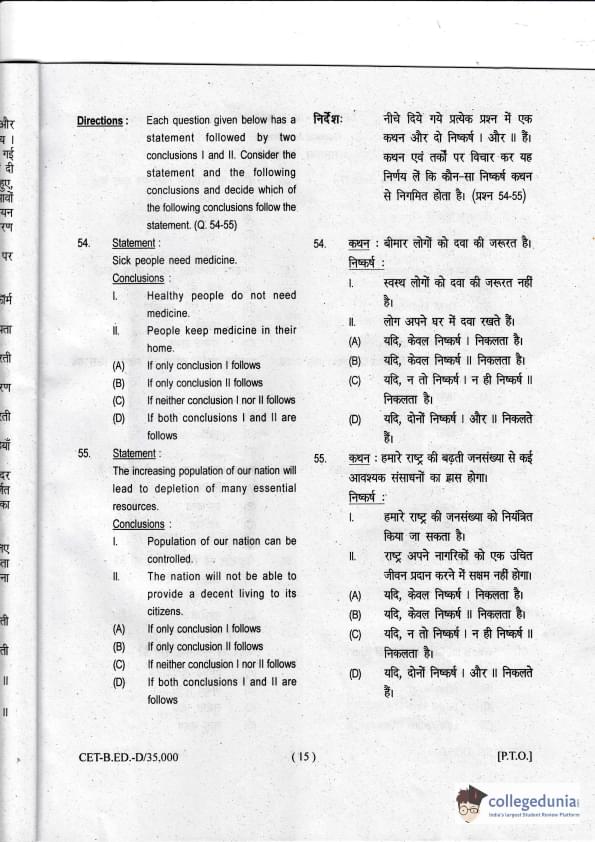
Statement: Sick people need medicine.
Conclusions:
I. Healthy people do not need medicine.
II. People keep medicine in their home.
View Solution
The statement does not suggest that healthy people do not need medicine, nor does it imply that people keep medicine in their homes. Therefore, neither conclusion I nor II follows.
Quick Tip: In logical reasoning, always check if the conclusions are directly supported by the statement.
Statement: The increasing population of our nation will lead to depletion of many essential resources.
Conclusions:
I. Population of our nation can be controlled.
II. The nation will not be able to provide a decent living to its citizens.
View Solution
The statement indicates that the increasing population could cause depletion of resources, which implies that controlling the population could be a possible solution, and that the nation may struggle to provide a decent living if resources deplete. Therefore, both conclusions I and II logically follow.
Quick Tip: When dealing with such questions, consider the broader implications of the statement and how the conclusions connect to those implications.
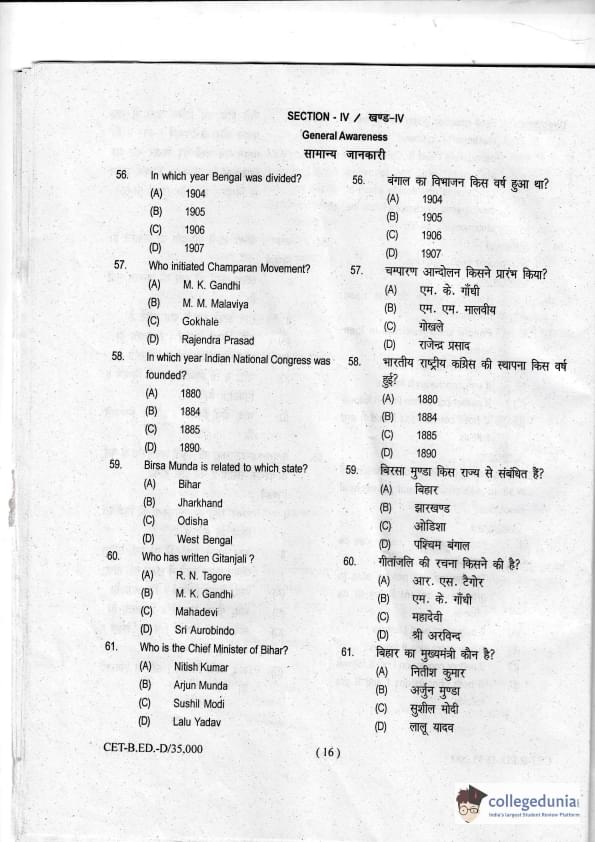
In which year Bengal was divided?
View Solution
Bengal was divided in 1905 during the British rule, as part of the strategy to divide and rule India.
Quick Tip: Remember the key events that led to the partition of Bengal, as they are critical to understanding India's colonial history.
Who initiated Champaran Movement?
View Solution
The Champaran movement was initiated by Mahatma Gandhi in 1917 to address the plight of indigo farmers in Bihar. It marked the beginning of his mass movements in India.
Quick Tip: The Champaran Satyagraha was an important milestone in India's freedom struggle, showing the power of non-violent resistance.
In which year Indian National Congress was founded?
View Solution
The Indian National Congress was founded in 1885, marking the formal beginning of political resistance to British rule in India.
Quick Tip: The formation of the Indian National Congress was a turning point in Indian politics, uniting various regions against British rule.
Birsa Munda is related to which state?
View Solution
Birsa Munda was an Indian freedom fighter and tribal leader, who is mainly associated with the state of Jharkhand, where he led a movement against British rule.
Quick Tip: Remember the contributions of tribal leaders like Birsa Munda in the fight for Indian independence.
Who has written Gitanjali?
View Solution
Rabindranath Tagore wrote "Gitanjali" (Song Offerings), which earned him the Nobel Prize in Literature in 1913. It is a collection of poems reflecting spiritual themes.
Quick Tip: "Gitanjali" is an important work in Indian literature, showcasing Tagore's philosophy of unity and spirituality.
Who is the Chief Minister of Bihar?
View Solution
Nitish Kumar is the current Chief Minister of Bihar. He has served multiple terms and is known for his work in improving the state's infrastructure and governance.
Quick Tip: Stay updated on current political leaderships as they often play a crucial role in the development of the state.
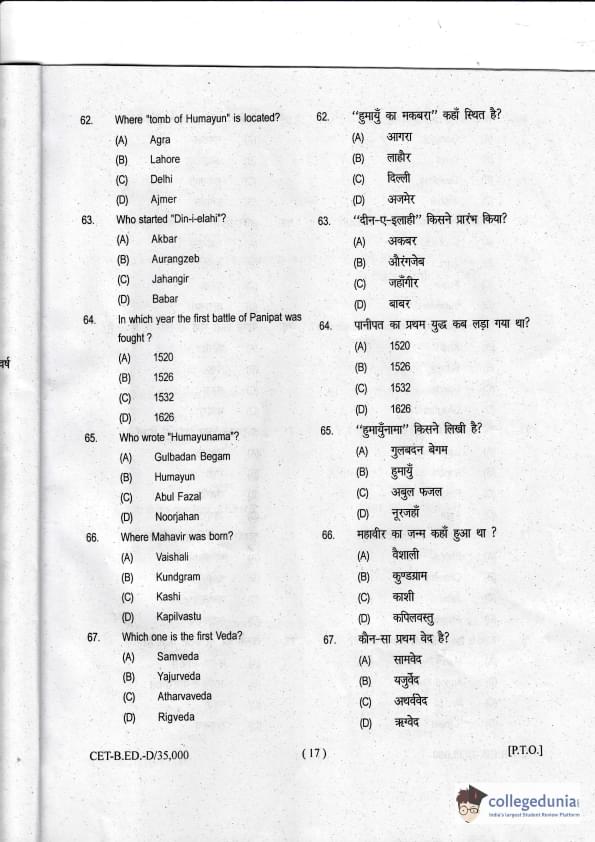
Where "tomb of Humayun" is located?
View Solution
The tomb of Humayun, a UNESCO World Heritage site, is located in Delhi, India.
Quick Tip: When studying historical monuments, pay attention to their locations as they are often crucial in understanding their historical significance.
Who started "Din-i-elahi"?
View Solution
Din-i-elahi, or the "Divine Faith," was introduced by Mughal Emperor Akbar as an attempt to combine the best elements of different religions.
Quick Tip: Remember that Akbar's policies were aimed at religious tolerance and promoting unity among his diverse subjects.
In which year the first battle of Panipat was fought?
View Solution
The first battle of Panipat was fought in 1526 between the Mughal emperor Babur and the Sultan of Delhi, Ibrahim Lodi. This battle marked the beginning of Mughal rule in India.
Quick Tip: Remember that the first battle of Panipat is one of the most significant battles in Indian history, leading to the establishment of the Mughal Empire.
Who wrote "Humayunama"?
View Solution
"Humayunama" was written by Gulbadan Begam, Humayun's sister, and it is an important historical account of the Mughal emperor Humayun's life.
Quick Tip: Keep in mind that family members of historical figures often played crucial roles in documenting history.
Where Mahavir was born?
View Solution
Mahavir, the 24th Tirthankara of Jainism, was born in Vaishali, which is in present-day Bihar.
Quick Tip: When studying the life of spiritual leaders, pay attention to their birthplace as it often has significant religious or historical importance.
Which one is the first Veda?
View Solution
The Rigveda is considered the oldest of the four Vedas and is the foundational text of Hinduism, dating back to around 1500 BCE.
Quick Tip: The Vedas are key to understanding early Hinduism; remember that the Rigveda is the oldest.
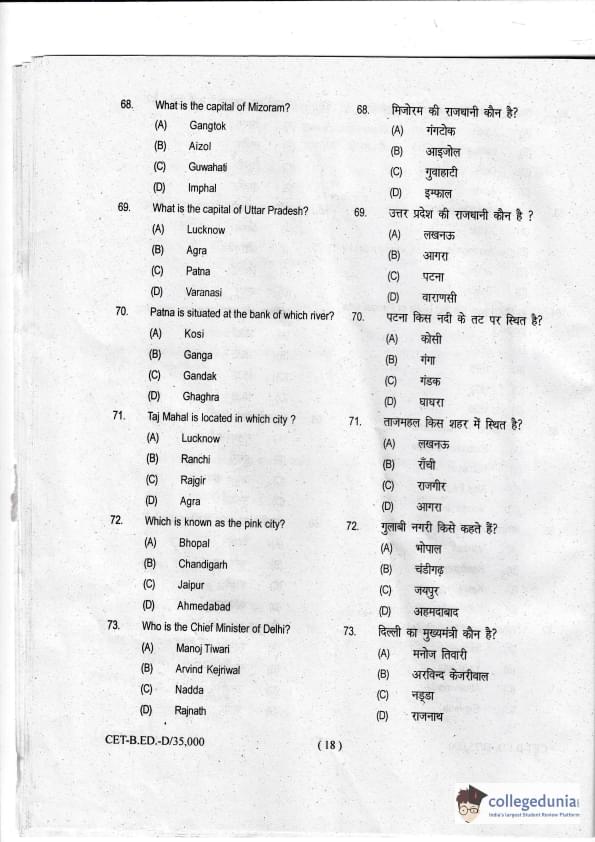
What is the capital of Mizoram?
View Solution
Aizol is the capital city of Mizoram, a state in northeastern India.
Quick Tip: When learning about Indian states, focus on their capitals and major cities as they are often linked to historical and political events.
What is the capital of Uttar Pradesh?
View Solution
Lucknow is the capital city of Uttar Pradesh, one of the largest and most populous states in India.
Quick Tip: Always remember the capitals of major Indian states as they are key to understanding their political landscape.
Patna is situated at the bank of which river?
View Solution
Patna, the capital of Bihar, is situated on the banks of the Ganga River, which holds great religious and cultural significance in India.
Quick Tip: Rivers like the Ganga are central to many Indian cities; knowing their location can help understand their cultural significance.
Taj Mahal is located in which city?
View Solution
The Taj Mahal, one of the Seven Wonders of the World, is located in Agra, Uttar Pradesh, India.
Quick Tip: The Taj Mahal is an iconic monument; its location in Agra makes it a must-know for Indian geography.
Which is known as the pink city?
View Solution
Jaipur, the capital of Rajasthan, is famously known as the "Pink City" because of its distinctive pink-colored architecture.
Quick Tip: Jaipur’s iconic color and architecture make it one of India’s most recognizable cities.
Who is the Chief Minister of Delhi?
View Solution
Arvind Kejriwal is the current Chief Minister of Delhi, having served multiple terms.
Quick Tip: Stay updated on the political leadership of major Indian cities, especially capitals like Delhi.
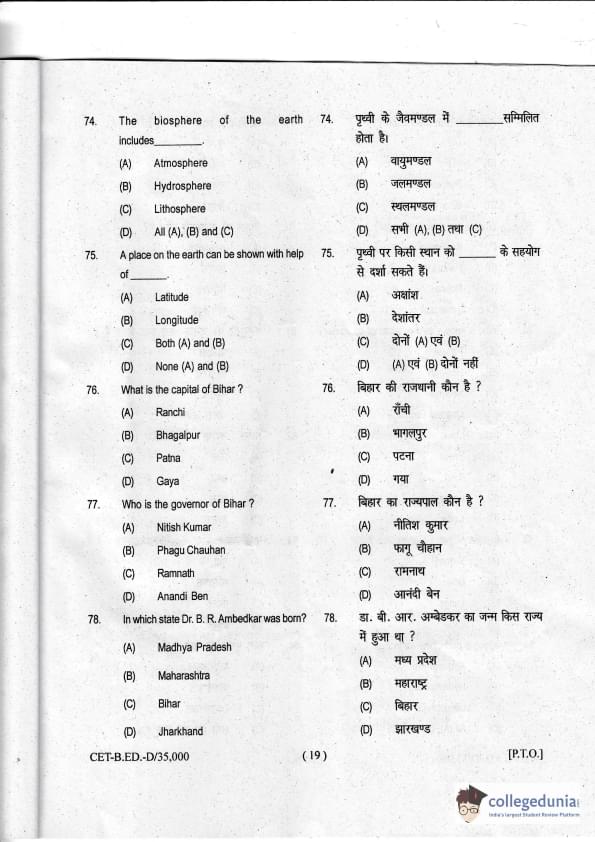
The biosphere of the earth includes ____\ .
View Solution
The biosphere of Earth includes the atmosphere, hydrosphere, and lithosphere, as all these layers are essential for sustaining life.
Quick Tip: Remember that the biosphere is the sum of all ecosystems, including the atmosphere, hydrosphere, and lithosphere.
A place on the earth can be shown with help of ____\ .
View Solution
A place on Earth is located using latitude and longitude coordinates, which are geographic coordinates used to define locations.
Quick Tip: Latitude and longitude are essential in geography to pinpoint exact locations on Earth.
What is the capital of Bihar?
View Solution
Patna is the capital of Bihar and is one of the oldest continuously inhabited places in the world.
Quick Tip: Patna is a historically significant city; remember that it is the capital of Bihar and is located on the banks of the Ganga River.
Who is the governor of Bihar?
View Solution
Phagu Chauhan is the current governor of Bihar, serving as the ceremonial head of the state.
Quick Tip: Keep track of political figures such as governors, as they play a crucial role in state governance.
In which state Dr. B. R. Ambedkar was born?
View Solution
Dr. B. R. Ambedkar, the chief architect of the Indian Constitution, was born in Mhow, which is now part of Madhya Pradesh.
Quick Tip: Dr. B. R. Ambedkar's contributions to the Indian Constitution are vital; remember that he was born in Maharashtra.
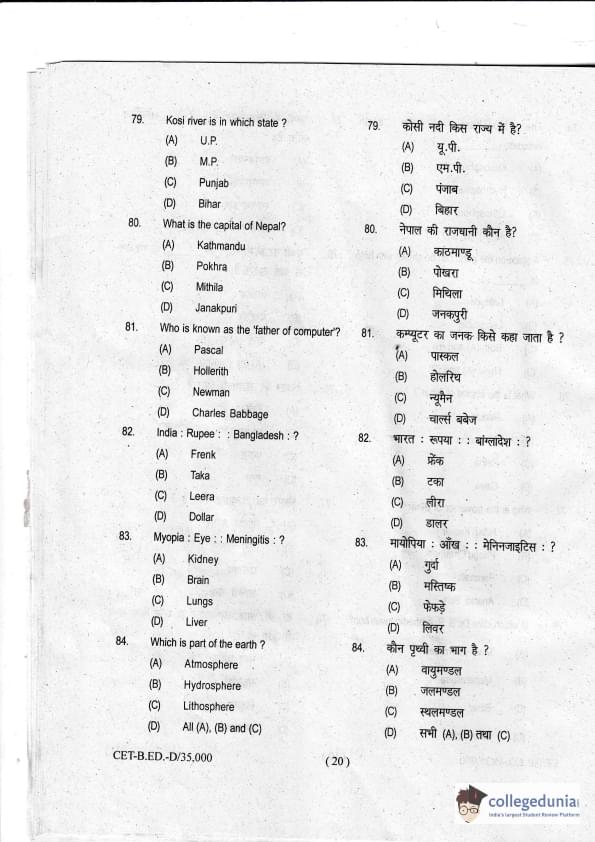
Kosi river is in which state?
View Solution
Kosi river flows through Bihar, and it is one of the major rivers of the state.
Quick Tip: The Kosi river is often called the 'Sorrow of Bihar' due to its tendency to cause floods.
What is the capital of Nepal?
View Solution
Kathmandu is the capital and largest city of Nepal. It is also the cultural and economic hub of the country.
Quick Tip: Kathmandu, the capital of Nepal, is known for its historic temples and cultural significance.
Who is known as the 'father of computer'?
View Solution
Charles Babbage is known as the 'father of computer' for his invention of the Analytical Engine, a precursor to modern computers.
Quick Tip: Remember that Charles Babbage’s work laid the foundation for the development of computers as we know them today.
India : Rupee : : Bangladesh : ?
View Solution
Just as India uses the Rupee as its currency, Bangladesh uses the Taka as its currency.
Quick Tip: Currency names are often specific to each country; remember the currency of neighboring countries.
Myopia : Eye : : Meningitis : ?
View Solution
Myopia affects the eye, and meningitis affects the brain. This is a relationship of the organ that is impacted by the condition.
Quick Tip: Understanding the relationship between medical conditions and affected organs helps with memorization and application.
Which is part of the earth?
View Solution
The Earth is composed of three main layers: the atmosphere, hydrosphere, and lithosphere, all of which are essential for sustaining life.
Quick Tip: The Earth’s structure is divided into the atmosphere (air), hydrosphere (water), and lithosphere (land).
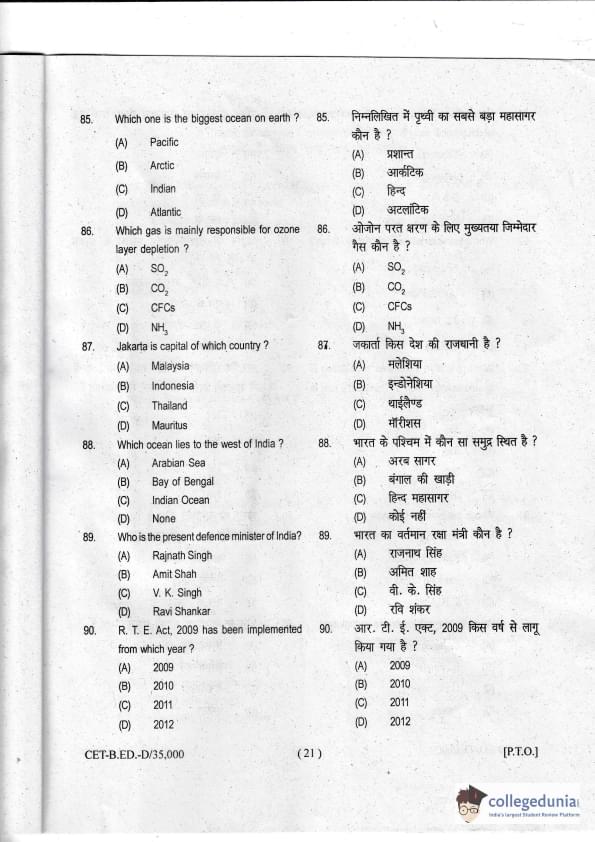
Which one is the biggest ocean on earth?
View Solution
The Pacific Ocean is the largest and deepest ocean on Earth. It covers more than a third of the Earth's surface.
Quick Tip: Remember that the Pacific Ocean is the largest of the Earth's five oceans and is located between Asia and the Americas.
Which gas is mainly responsible for ozone layer depletion?
View Solution
CFCs (chlorofluorocarbons) are the primary chemicals responsible for the depletion of the ozone layer, causing it to thin and allowing more ultraviolet radiation to reach the Earth.
Quick Tip: CFCs are banned in many countries due to their harmful effects on the ozone layer.
Jakarta is the capital of which country?
View Solution
Jakarta is the capital and largest city of Indonesia, located on the island of Java.
Quick Tip: When studying capitals, focus on their geographical and cultural importance. Jakarta is a major hub for business and culture in Southeast Asia.
Which ocean lies to the west of India?
View Solution
The Arabian Sea lies to the west of India, forming a major part of the Indian Ocean. It borders the western coast of India.
Quick Tip: Remember that the Arabian Sea is located to the west of India, while the Bay of Bengal is to the east.
Who is the present defense minister of India?
View Solution
Rajnath Singh is the current defense minister of India, serving in the second tenure of Prime Minister Narendra Modi's government.
Quick Tip: Stay updated on India's political leadership, especially in critical areas like defense, which is vital for national security.
R. T. E. Act, 2009 has been implemented from which year?
View Solution
The Right of Children to Free and Compulsory Education (RTE) Act was passed by the Government of India in 2009 to provide free and compulsory education to children aged 6 to 14 years.
Quick Tip: The RTE Act is a significant step towards ensuring that education is accessible to all children in India, irrespective of their socio-economic background.
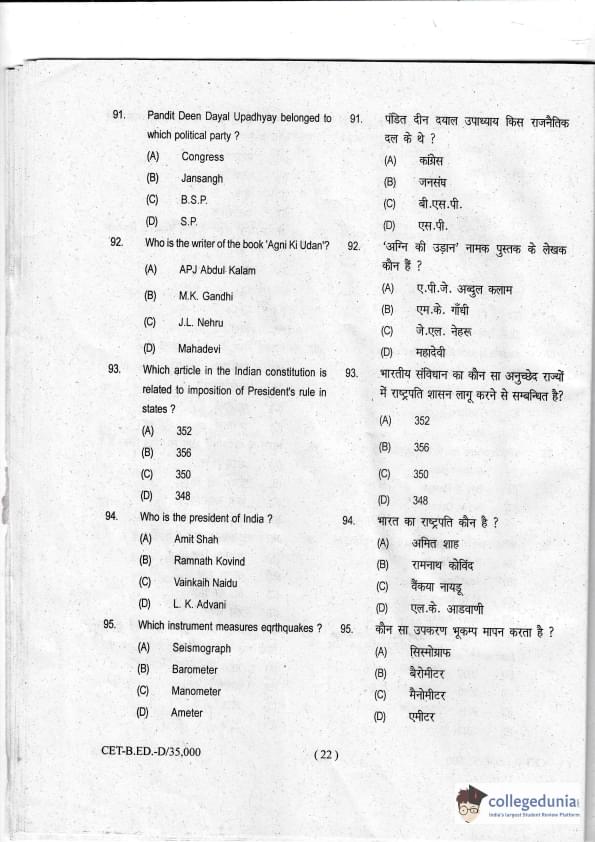
Pandit Deen Dayal Upadhyay belonged to which political party?
View Solution
Pandit Deen Dayal Upadhyay was associated with the Bharatiya Jana Sangh, the precursor to the Bharatiya Janata Party (BJP).
Quick Tip: Deen Dayal Upadhyay's legacy is important in understanding the roots of the BJP and its development.
Who is the writer of the book 'Agni Ki Udan'?
View Solution
'Agni Ki Udan' is an autobiography written by Dr. APJ Abdul Kalam, the former President of India and a well-known figure in the field of science and technology.
Quick Tip: APJ Abdul Kalam's contributions to India's space and defense programs are crucial for understanding India's development in these fields.
Which article in the Indian constitution is related to the imposition of President's rule in states?
View Solution
Article 356 of the Indian Constitution deals with the imposition of President's Rule in a state if the President believes that the governance in a state cannot be carried out in accordance with the provisions of the Constitution.
Quick Tip: Article 356 is a critical part of the Indian Constitution, particularly in the context of federal governance and emergency provisions.
Who is the president of India?
View Solution
Ramnath Kovind is the current President of India, having assumed office in 2017. He is the 14th President of India.
Quick Tip: The President of India is the ceremonial head of state, while executive powers are vested in the Prime Minister and Council of Ministers.
Which instrument measures earthquakes?
View Solution
A seismograph is an instrument used to measure the intensity and duration of seismic waves caused by earthquakes.
Quick Tip: Seismographs are crucial in earthquake research and help in understanding the magnitude and effects of earthquakes.
Which of the following is the major cause of decreasing ethical standards in society?
View Solution
The major cause of decreasing ethical standards in society is the failure of educational policies, which directly impact the moral and ethical upbringing of children and society at large.
Quick Tip: Focus on the educational system and its role in shaping values and ethics in the society.
Which is not part of the 3R’s (Reading, Writing, Arithmetic)?
View Solution
The 3R’s refer to Reading, Writing, and Arithmetic. Speaking is not considered one of the core 3Rs, as they primarily focus on basic academic skills.
Quick Tip: The 3R’s form the foundation of basic education and are essential for academic learning.
Which is related to the education of the deaf and dumb?
View Solution
All of the above are related to the education of the deaf and dumb. Braille is used for the blind, while sign language and Brailler are used to help the hearing-impaired.
Quick Tip: Understanding alternative methods of communication is essential for inclusive education.
Which new term has been coined for students who are deaf and dumb, blind, or lack some abilities?
View Solution
The term 'Divyang' has been coined to refer to people with disabilities, including those who are deaf, dumb, blind, or have other physical or mental impairments.
Quick Tip: The term 'Divyang' emphasizes respect and dignity towards differently-abled individuals.
Which one should be followed by a good teacher in a class?
View Solution
A good teacher should aim to address the needs of all students, including fast learners, mediocre learners, and slow learners, in order to provide an inclusive learning environment.
Quick Tip: A well-rounded teaching approach ensures that all students, regardless of their learning speed, are engaged and supported.
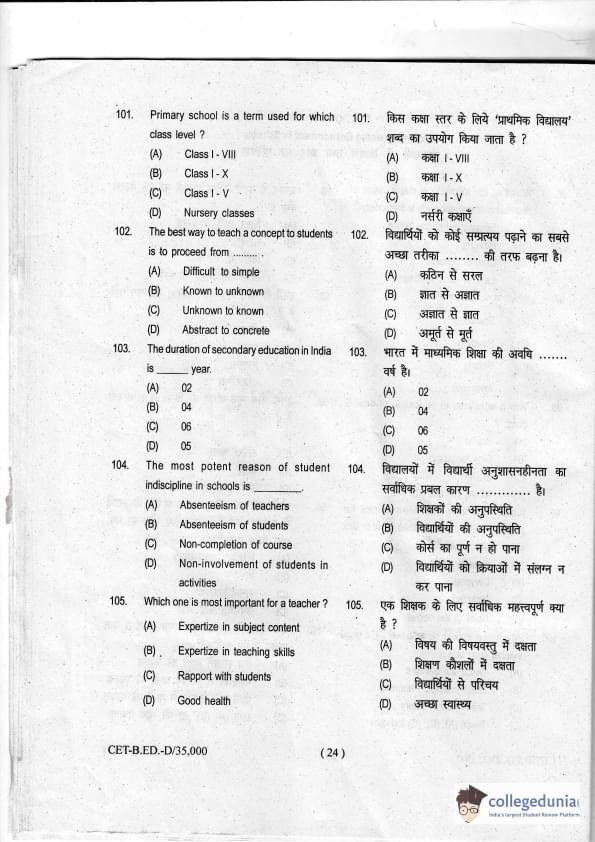
Primary school is a term used for which class level?
View Solution
Primary school generally refers to education from Class I to Class V, where basic education and foundation are laid out for the students.
Quick Tip: The primary school is a crucial phase in a child's educational journey, focusing on foundational subjects.
The best way to teach a concept to students is to proceed from _____.
View Solution
The best approach for teaching concepts to students is to start with something they already know and gradually introduce more complex or unfamiliar information. This helps in better comprehension.
Quick Tip: Starting from the known to the unknown helps in solidifying students' understanding and ensures smoother learning.
The duration of secondary education in India is _____ year.
View Solution
In India, secondary education typically lasts for 4 years, covering classes from 9th to 12th.
Quick Tip: Secondary education is crucial for preparing students for further academic pursuits or vocational training.
The most potent reason for student indiscipline in schools is _____.
View Solution
When students are not engaged in activities, they may develop disruptive behavior. Active participation in activities helps students focus and learn discipline.
Quick Tip: Keeping students engaged in activities can significantly reduce indiscipline in schools.
Which one is most important for a teacher?
View Solution
Building a good rapport with students is crucial as it helps in creating a positive and effective learning environment, fostering trust and communication.
Quick Tip: A teacher's relationship with students can have a lasting impact on their learning and personal development.
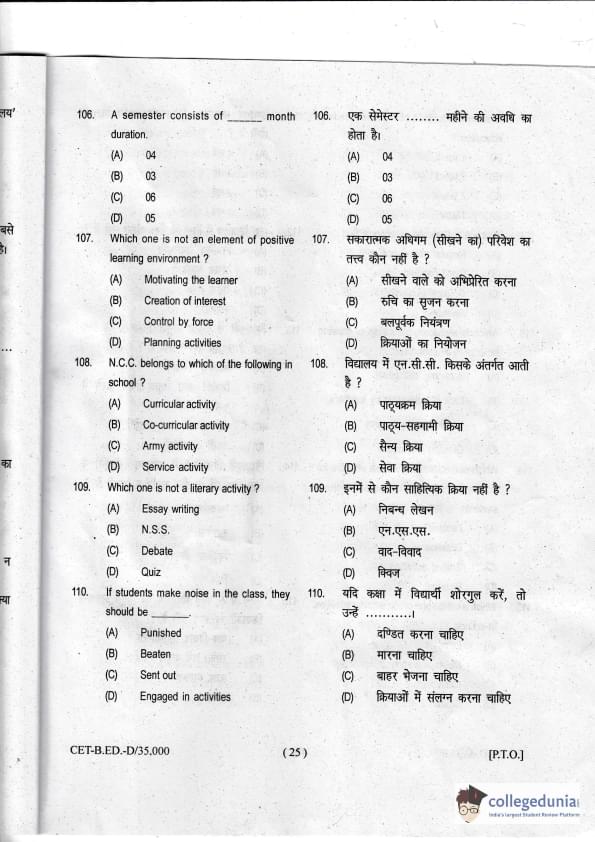
A semester consists of ____ month duration.
View Solution
A semester typically lasts for 6 months in most educational systems.
Quick Tip: Understand the typical duration of educational semesters to plan your schedule accordingly.
Which one is not an element of a positive learning environment?
View Solution
A positive learning environment encourages motivation, interest, and well-planned activities, whereas control by force is a negative factor that hinders student growth.
Quick Tip: A positive learning environment is one that is motivating and encouraging, not forceful.
N.C.C. belongs to which of the following in school?
View Solution
The National Cadet Corps (NCC) is a co-curricular activity that helps in developing leadership, discipline, and social service in students.
Quick Tip: Co-curricular activities like NCC complement the academic curriculum and contribute to overall personality development.
Which one is not a literary activity?
View Solution
N.S.S. (National Service Scheme) is a social service activity, not a literary activity, which includes writing essays or participating in debates.
Quick Tip: Literary activities include writing, reading, and debating, while service activities like N.S.S. are not categorized under literary.
If students make noise in the class, they should be ____ .
View Solution
Engaging students in productive activities is a better way to manage classroom behavior rather than punishing or beating them.
Quick Tip: Engaging students in tasks helps to keep them focused and reduces disruptive behavior.
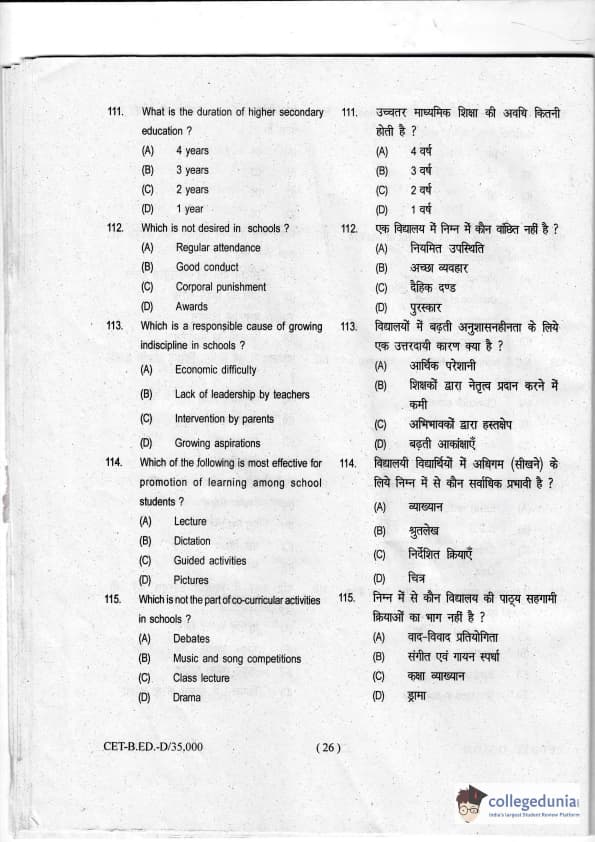
What is the duration of higher secondary education?
View Solution
Higher secondary education in most systems lasts for 2 years, typically covering classes 11th and 12th.
Quick Tip: Understanding the structure of higher secondary education helps in planning for future educational goals.
Which is not desired in schools?
View Solution
Corporal punishment is not desired in schools as it is an outdated and harmful practice. Encouraging positive behavior and discipline is essential.
Quick Tip: Schools focus on promoting positive reinforcement over physical punishment for better behavior management.
Which is a responsible cause of growing indiscipline in schools?
View Solution
Lack of strong leadership from teachers often leads to indiscipline, as students need guidance and role models to stay focused and disciplined.
Quick Tip: Strong leadership from teachers helps in maintaining discipline and guiding students toward positive behavior.
Which of the following is most effective for promotion of learning among school students?
View Solution
Guided activities engage students more effectively and enhance their learning experience by providing practical application of knowledge.
Quick Tip: Incorporate guided activities in lessons to make learning more interactive and effective for students.
Which is not part of co-curricular activities in schools?
View Solution
Class lectures are part of the academic curriculum, whereas co-curricular activities include debates, music, and drama, which complement academic learning.
Quick Tip: Co-curricular activities enhance students' overall development, offering opportunities to explore their talents.
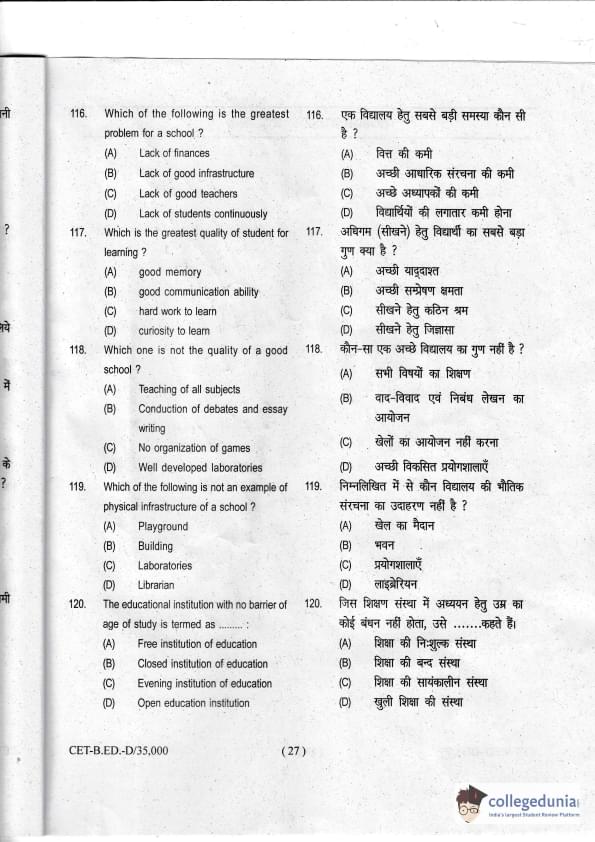
Which of the following is the greatest problem for a school?
View Solution
A lack of good teachers is a primary issue faced by schools, as quality teaching plays a critical role in student success.
Quick Tip: Focus on professional development and teacher retention to address the shortage of good teachers.
Which is the greatest quality of a student for learning?
View Solution
Curiosity is a powerful motivator for learning. It drives students to explore new concepts and persist in solving problems.
Quick Tip: Foster curiosity in students by encouraging open-ended questions and exploration.
Which one is not the quality of a good school?
View Solution
A good school organizes games and extracurricular activities to support physical, emotional, and social development.
Quick Tip: Encourage physical activities and sports in school to promote overall well-being and teamwork.
Which of the following is not an example of physical infrastructure of a school?
View Solution
A librarian is a staff member and not part of the physical infrastructure of a school. The physical infrastructure includes the playground, building, and laboratories.
Quick Tip: Understand the difference between staff and physical infrastructure when planning school resources.
The educational institution with no barrier of age of study is termed as ____ :
View Solution
An open education institution allows students of all ages to learn, without restrictions based on age or time of study.
Quick Tip: Explore open education options that provide flexible learning environments for students of all ages.




Comments