




JAC Board has successfully conducted the Class 12 English Core Board Exam 2026 on February 18, 2026. Class 12 English Core Question Paper with Solution PDF is available here for download.
The question paper of JAC Board Class 12 English Core Board Exam 2026 is provided below. Students can download the official paper in PDF format for reference.
JAC Board Class 12 2026 English Core Question Paper with Solution PDF
| JAC Board Class 12, 2026 English Core Question Paper |  Download Download |
Check Solutions |

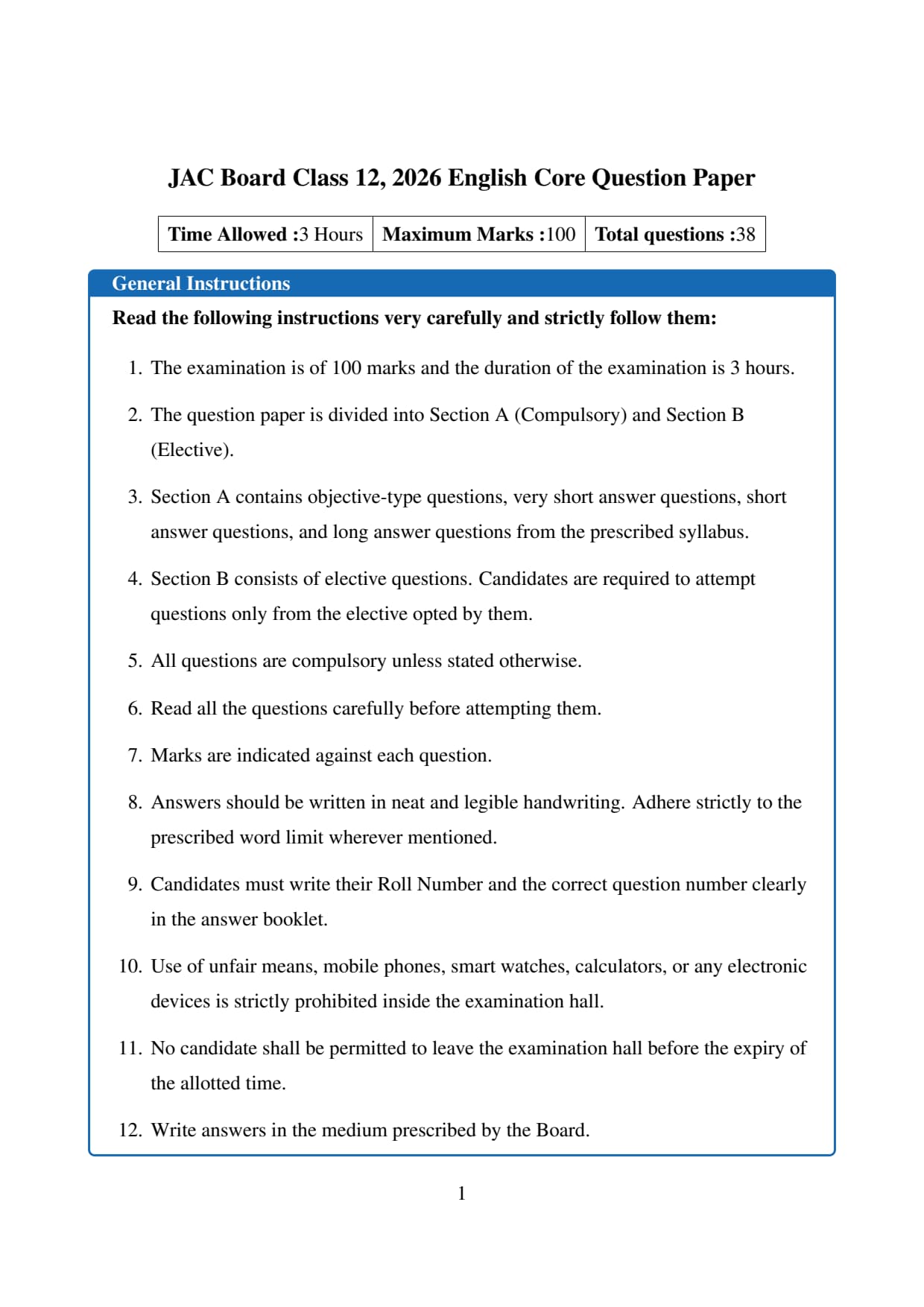
Notice does not consist of:
View Solution
A notice is a formal written communication used to inform a specific group of people about an event, meeting, or important information. It follows a fixed format.
Step 1: Understand the format of a notice.
A notice generally includes the name of the institution, the word “NOTICE” as the title, the date, the subject or heading, the body of the notice, and the signature with designation.
Step 2: Analyze the options.
(A) Date: A notice always includes the date on which it is issued.
(B) Name of the institution: This is written at the top of the notice.
(C) Salutation: A notice does not include salutations like “Dear Sir/Madam” because it is not a personal letter.
(D) Title: The word “NOTICE” acts as the title and is an essential part of the format.
Step 3: Conclusion.
Since a notice does not contain a salutation, the correct answer is (C).
Final Answer: \[ \boxed{(C) \, Salutation} \] Quick Tip: A notice is a formal announcement and does not include personal elements like salutation or complimentary closing.
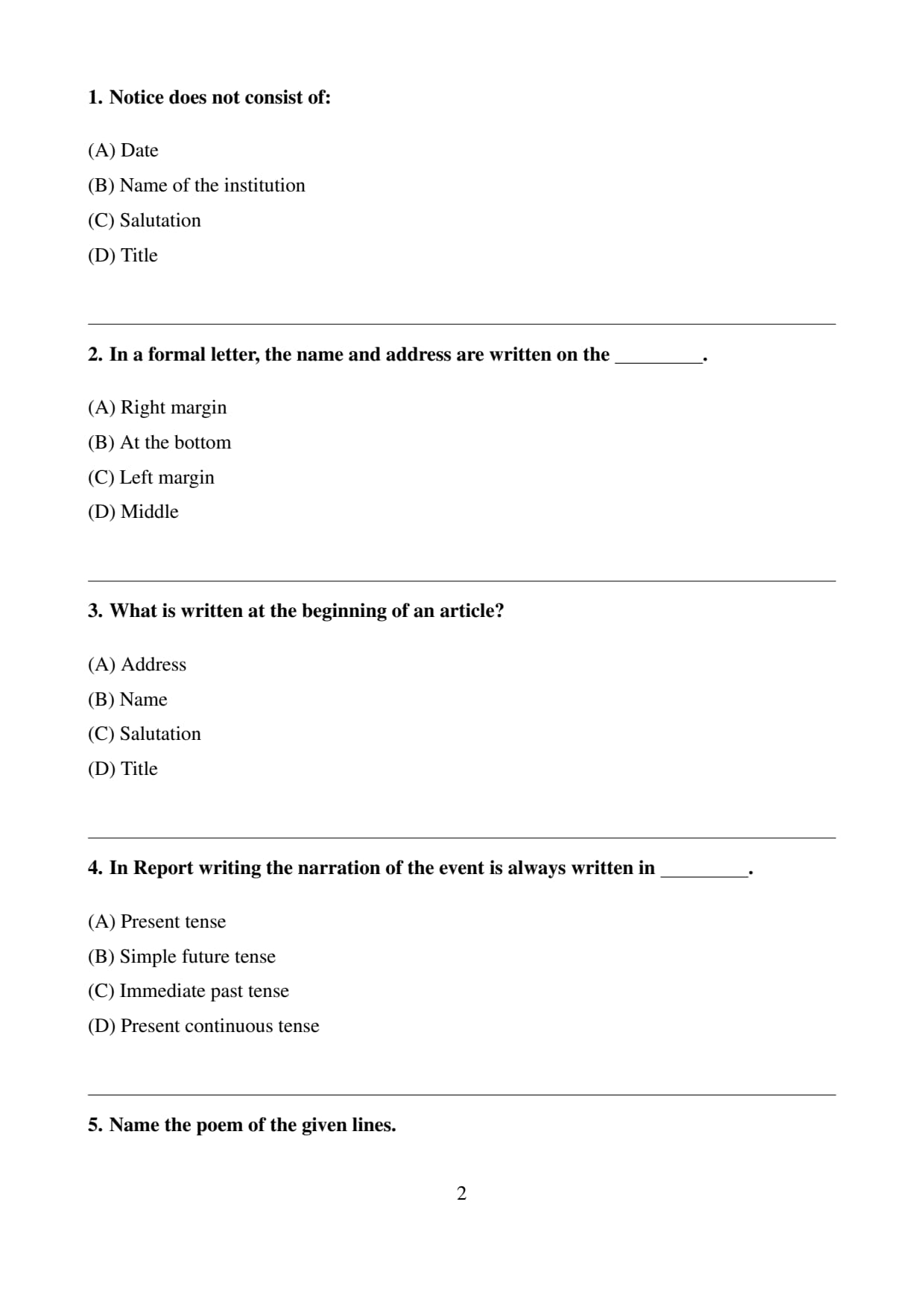
In a formal letter, the name and address are written on the ______ .
View Solution
A formal letter follows a specific format and alignment style. The name and address of the sender and receiver are written according to standard letter-writing conventions.
Step 1: Understand the format of a formal letter.
In a formal letter, all parts such as the sender’s address, date, receiver’s address, subject, salutation, and body are generally aligned to the left side of the page.
Step 2: Analyze the options.
(A) Right margin: Formal letters are not written aligned to the right side.
(B) At the bottom: The name and address are not placed at the bottom of the letter.
(C) Left margin: This is correct, as formal letters follow left alignment format.
(D) Middle: The address is not written in the middle of the page.
Step 3: Conclusion.
Since formal letters follow left alignment, the correct answer is (C).
Final Answer: \[ \boxed{(C) \, Left margin} \] Quick Tip: Formal letters follow left alignment format, where addresses and other elements are written along the left margin.
What is written at the beginning of an article?
View Solution
An article is a piece of writing that presents information, opinions, or ideas on a particular topic. It follows a structured format.
Step 1: Understand the format of an article.
At the beginning of an article, the Title is written. The title gives a clear idea about the topic and attracts the reader’s attention.
Step 2: Analyze the options.
(A) Address: An address is written in letters, not in articles.
(B) Name: The writer’s name may appear, but it is not the first and most essential element.
(C) Salutation: Salutation is used in letters, not in articles.
(D) Title: This is correct because every article begins with a suitable title.
Step 3: Conclusion.
Since an article always starts with a title, the correct answer is (D).
Final Answer: \[ \boxed{(D) \, Title} \] Quick Tip: An article always begins with a catchy and relevant title to introduce the topic to the reader.
In Report writing the narration of the event is always written in ______ .
View Solution
Report writing describes events that have already taken place. Therefore, the narration is written in the past form.
Step 1: Understand the purpose of report writing.
A report provides factual information about an event that has already happened. Since it is a description of a completed event, it must be written in the past tense.
Step 2: Analyze the options.
(A) Present tense: This is used for general facts, not for reporting completed events.
(B) Simple future tense: This is used for events that will happen in the future.
(C) Immediate past tense: This is correct because reports describe events that have already occurred.
(D) Present continuous tense: This is used for actions happening right now, not for past events.
Step 3: Conclusion.
Since report writing narrates events that have already occurred, it is written in the immediate past tense. Hence, the correct answer is (C).
Final Answer: \[ \boxed{(C) \, Immediate past tense} \] Quick Tip: Report writing generally uses past tense because it describes events that have already taken place.
Name the poem of the given lines.
View Solution
The poem referred to in the given lines belongs to the poem “My Mother at Sixty-Six” written by Kamala Das.
Step 1: Identify the theme.
The poem deals with the poet’s feelings about her ageing mother and the fear of losing her. It reflects emotions of love, pain, and separation.
Step 2: Analyze the options.
(A) My Mother at Sixty-Six: This poem focuses on the poet’s concern for her ageing mother, making it the correct answer.
(B) A Thing of Beauty: This poem by John Keats talks about the everlasting beauty of nature.
(C) Keeping Quiet: This poem by Pablo Neruda emphasizes silence and introspection.
(D) Aunt Jennifer's Tigers: This poem by Adrienne Rich highlights the oppression of women through symbolic imagery.
Step 3: Conclusion.
Since the theme of the given lines relates to the ageing mother and emotional attachment, the correct answer is (A).
Final Answer: \[ \boxed{(A) \, My Mother at Sixty-Six} \] Quick Tip: “My Mother at Sixty-Six” by Kamala Das expresses the poet’s emotional pain and fear of losing her ageing mother.
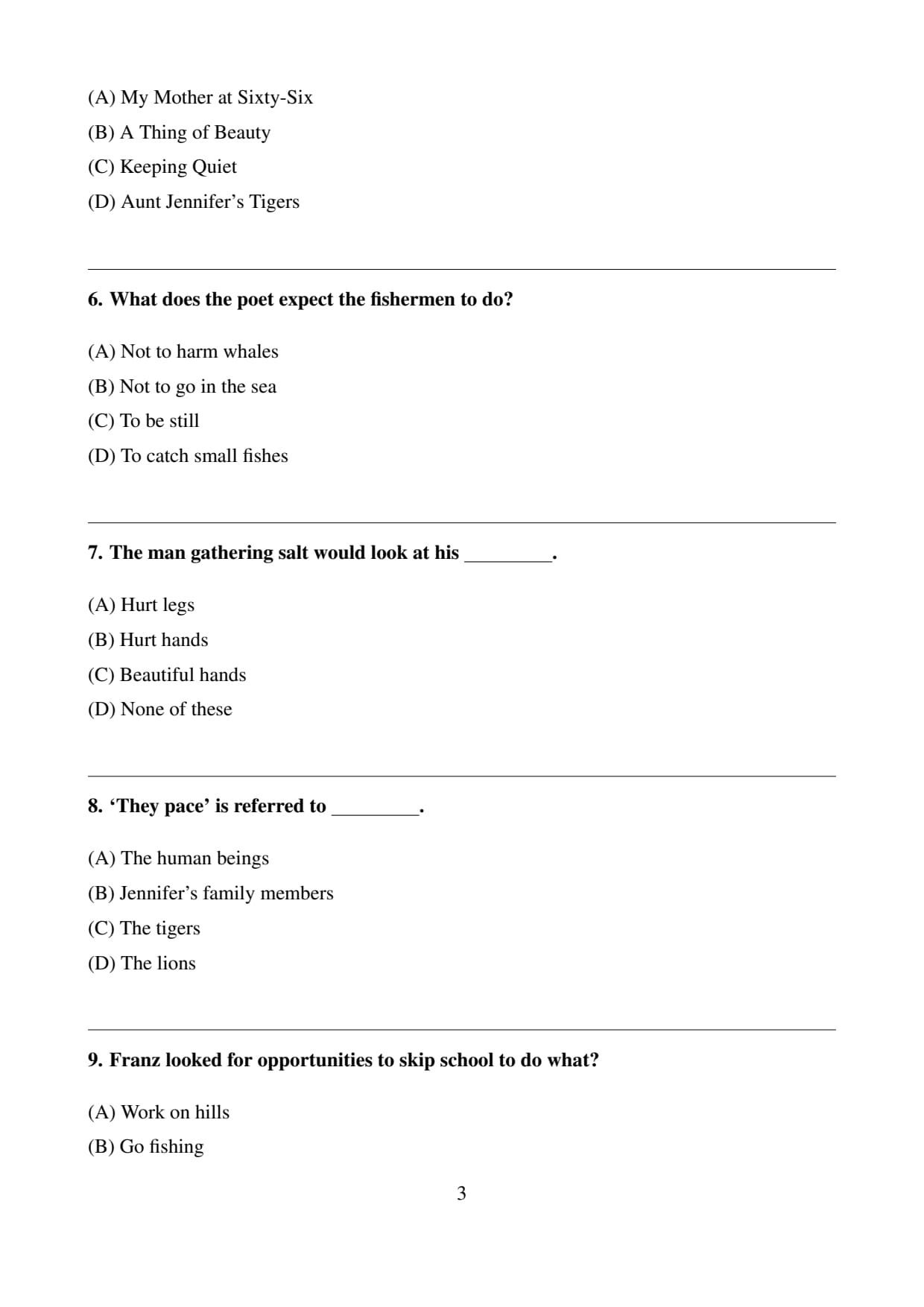
What does the poet expect the fishermen to do?
View Solution
This question is related to the poem “Keeping Quiet” by Pablo Neruda. In the poem, the poet appeals to everyone, including fishermen, to stop all activities for a moment and maintain silence.
Step 1: Understand the theme of the poem.
The poem emphasizes the importance of silence, introspection, and universal brotherhood. The poet urges people to pause their busy lives and reflect peacefully.
Step 2: Analyze the options.
(A) Not to harm whales: Although the poem suggests avoiding violence, this specific instruction is not directly stated.
(B) Not to go in the sea: The poet does not forbid fishermen from going to the sea permanently.
(C) To be still: This is correct because the poet asks everyone, including fishermen, to remain silent and still for a moment.
(D) To catch small fishes: This is unrelated to the theme of the poem.
Step 3: Conclusion.
Since the poet requests fishermen to pause and remain still, the correct answer is (C).
Final Answer: \[ \boxed{(C) \, To be still} \] Quick Tip: In “Keeping Quiet,” the poet urges everyone to stop their activities for a moment to promote peace and self-reflection.
The man gathering salt would look at his ______ .
View Solution
This question is based on the poem “Keeping Quiet” by Pablo Neruda. In the poem, the poet imagines a moment of complete silence where even the man gathering salt would stop working and reflect.
Step 1: Understand the context.
The poet says that the man gathering salt would look at his hurt hands. This image highlights the hardship and pain faced by laborers due to their continuous work.
Step 2: Analyze the options.
(A) Hurt legs: The poem specifically mentions hands, not legs.
(B) Hurt hands: This is correct because the salt gatherer’s hands are affected by the harsh conditions of his work.
(C) Beautiful hands: This does not match the suffering described in the poem.
(D) None of these: Since option (B) is correct, this option is incorrect.
Step 3: Conclusion.
The correct answer is (B) Hurt hands, as mentioned in the poem.
Final Answer: \[ \boxed{(B) \, Hurt hands} \] Quick Tip: In “Keeping Quiet,” Pablo Neruda uses the image of the salt gatherer’s hurt hands to symbolize human suffering and the need for rest and reflection.
‘They pace’ is referred to ______ .
View Solution
This question is based on the poem “Aunt Jennifer’s Tigers” by Adrienne Rich. The phrase “They pace” refers to the tigers that Aunt Jennifer has embroidered on the panel.
Step 1: Understand the context.
In the poem, the embroidered tigers are described as fearless and confident. The line “They pace in sleek chivalric certainty” clearly indicates that the tigers are moving proudly and confidently.
Step 2: Analyze the options.
(A) The human beings: The poem does not describe humans pacing in this context.
(B) Jennifer's family members: There is no mention of family members pacing.
(C) The tigers: This is correct because the phrase directly describes the embroidered tigers.
(D) The lions: The poem mentions tigers, not lions.
Step 3: Conclusion.
Since the phrase “They pace” refers to the embroidered tigers, the correct answer is (C).
Final Answer: \[ \boxed{(C) \, The tigers} \] Quick Tip: In “Aunt Jennifer’s Tigers,” the tigers symbolize courage and freedom, contrasting with Aunt Jennifer’s oppressed life.
Franz looked for opportunities to skip school to do what?
View Solution
This question is based on the story “The Last Lesson” by Alphonse Daudet. Franz, the narrator, often looked for excuses to avoid going to school.
Step 1: Understand the context of the story.
Franz was not very interested in his studies and preferred outdoor activities. He frequently thought of skipping school to enjoy himself instead of attending classes.
Step 2: Analyze the options.
(A) Work on hills: This is not mentioned in the story.
(B) Go fishing: Although children enjoy fishing, this is not specifically mentioned as Franz’s reason.
(C) Water the plants: This is unrelated to the story.
(D) Collect bird's eggs: This is correct because Franz mentions that he was tempted to skip school to collect bird’s eggs and enjoy the pleasant weather.
Step 3: Conclusion.
Since Franz wanted to collect bird’s eggs instead of attending school, the correct answer is (D).
Final Answer: \[ \boxed{(D) \, Collect bird's eggs} \] Quick Tip: In “The Last Lesson,” Franz regrets skipping school earlier, especially when he realizes it is his last French lesson.
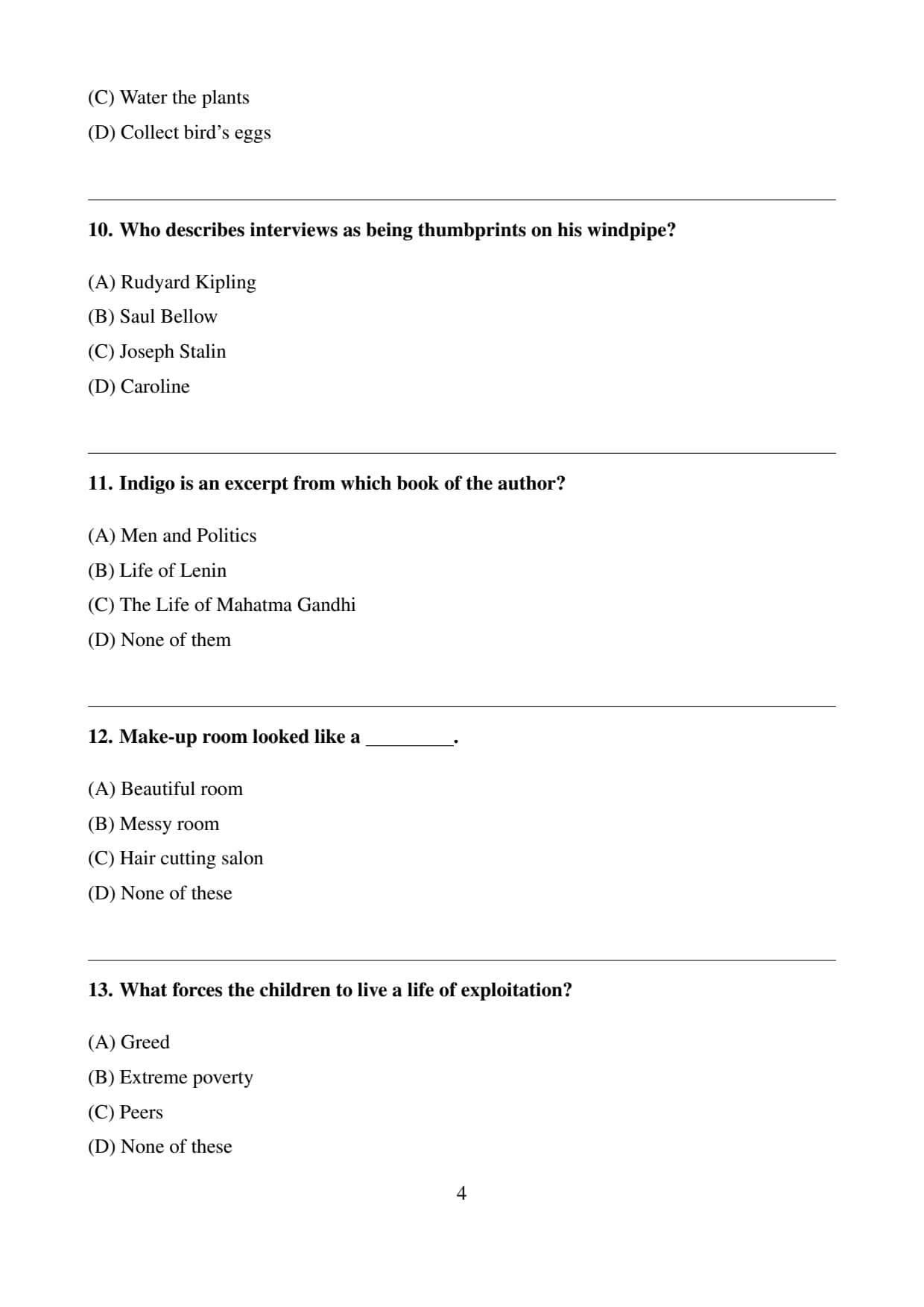
Who describes interviews as being thumbprints on his windpipe?
View Solution
This question is based on the chapter “The Interview” by Christopher Silvester. In the chapter, different writers express their opinions about interviews.
Step 1: Understand the context.
Rudyard Kipling strongly disliked interviews. He described interviews as “thumbprints on his windpipe,” expressing his discomfort and resentment toward the process.
Step 2: Analyze the options.
(A) Rudyard Kipling: This is correct because he used the metaphor “thumbprints on his windpipe” to show how oppressive interviews felt to him.
(B) Saul Bellow: Although he had opinions about interviews, he did not use this particular expression.
(C) Joseph Stalin: He is mentioned in discussions about interviews but did not use this phrase.
(D) Caroline: This option is unrelated to the statement.
Step 3: Conclusion.
Since Rudyard Kipling described interviews in this way, the correct answer is (A).
Final Answer: \[ \boxed{(A) \, Rudyard Kipling} \] Quick Tip: In “The Interview,” Rudyard Kipling expresses strong dislike for interviews, comparing them to “thumbprints on his windpipe” to show his discomfort.
Indigo is an excerpt from which book of the author?
View Solution
The chapter “Indigo” is written by Louis Fischer and describes Mahatma Gandhi’s struggle for justice in Champaran.
Step 1: Understand the background.
The lesson “Indigo” is taken from Louis Fischer’s book “Men and Politics.” It highlights Gandhi’s leadership and his fight against the exploitation of farmers by British landlords.
Step 2: Analyze the options.
(A) Men and Politics: This is correct because “Indigo” is an excerpt from this book written by Louis Fischer.
(B) Life of Lenin: This book is not related to Gandhi or the Champaran movement.
(C) The Life of Mahatma Gandhi: Although related to Gandhi, this is not the source of the chapter.
(D) None of them: Since option (A) is correct, this option is incorrect.
Step 3: Conclusion.
Therefore, the correct answer is (A) Men and Politics.
Final Answer: \[ \boxed{(A) \, Men and Politics} \] Quick Tip: “Indigo” by Louis Fischer is taken from his book “Men and Politics” and describes Gandhi’s first successful civil disobedience movement in Champaran.
Make-up room looked like a _______ .
View Solution
This question is based on the chapter “Poets and Pancakes” by Asokamitran. In the story, the author describes the make-up room of Gemini Studios.
Step 1: Understand the description.
The make-up room is described as having bright lights, mirrors, and people constantly engaged in grooming and applying make-up. The atmosphere resembled that of a busy salon.
Step 2: Analyze the options.
(A) Beautiful room: The description focuses more on activity and appearance rather than beauty.
(B) Messy room: The room is active and crowded, but it is not specifically described as messy.
(C) Hair cutting salon: This is correct because the make-up room with mirrors and grooming activities resembled a salon.
(D) None of these: Since option (C) matches the description, this option is incorrect.
Step 3: Conclusion.
Therefore, the make-up room looked like a hair cutting salon. The correct answer is (C).
Final Answer: \[ \boxed{(C) \, Hair cutting salon} \] Quick Tip: In “Poets and Pancakes,” the make-up room of Gemini Studios is compared to a hair cutting salon due to its bright lights, mirrors, and constant grooming activities.
What forces the children to live a life of exploitation?
View Solution
This question is based on the chapter “Lost Spring” by Anees Jung. The chapter highlights the miserable conditions of poor children who are forced into child labour.
Step 1: Understand the context.
The children described in the chapter belong to very poor families. Due to the lack of basic needs such as food, shelter, and education, they are compelled to work at a young age.
Step 2: Analyze the options.
(A) Greed: The children are not greedy; they are victims of circumstances.
(B) Extreme poverty: This is correct because poverty forces them into labour and exploitation.
(C) Peers: Peer influence is not the reason for their exploitation.
(D) None of these: Since option (B) is correct, this option is incorrect.
Step 3: Conclusion.
Extreme poverty is the main reason that forces children to live a life of exploitation. Hence, the correct answer is (B).
Final Answer: \[ \boxed{(B) \, Extreme poverty} \] Quick Tip: In “Lost Spring,” poverty and lack of opportunities trap children in a cycle of exploitation and child labour.
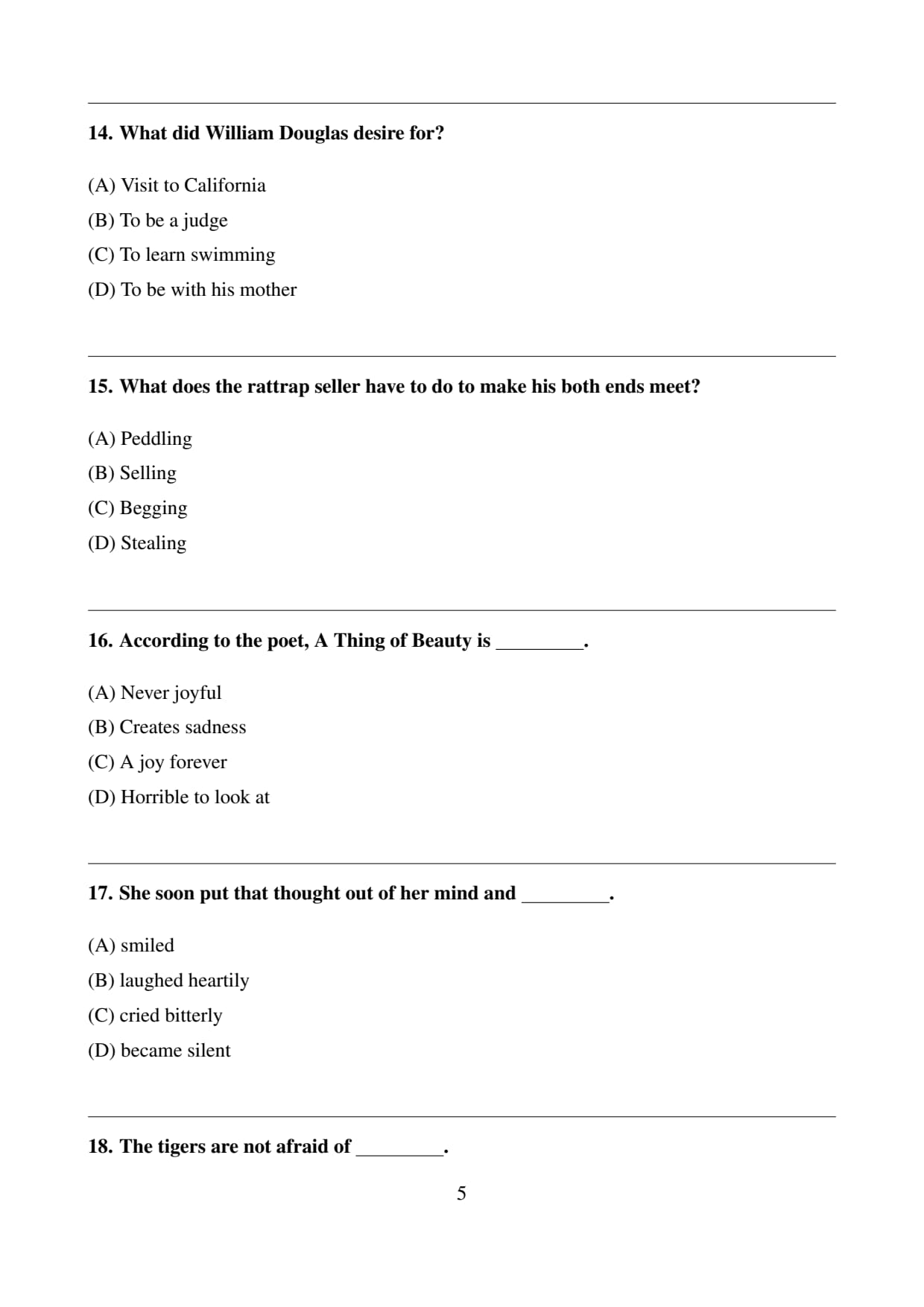
What did William Douglas desire for?
View Solution
This question is based on the chapter “Deep Water” by William Douglas. In the story, Douglas shares his childhood fear of water and his strong determination to overcome it.
Step 1: Understand the context.
William Douglas had a deep fear of water after a traumatic experience. However, instead of avoiding it, he developed a strong desire to conquer his fear.
Step 2: Analyze the options.
(A) Visit to California: This is not related to the theme of the lesson.
(B) To be a judge: Although William Douglas later became a judge, this is not the focus of the chapter.
(C) To learn swimming: This is correct because he desired to learn swimming to overcome his fear of water.
(D) To be with his mother: This is not mentioned as his desire in the story.
Step 3: Conclusion.
Since William Douglas wanted to overcome his fear and master swimming, the correct answer is (C).
Final Answer: \[ \boxed{(C) \, To learn swimming} \] Quick Tip: In “Deep Water,” William Douglas shows courage by learning swimming to conquer his childhood fear of water.
What does the rattrap seller have to do to make his both ends meet?
View Solution
This question is based on the story “The Rattrap” by Selma Lagerlöf. The rattrap seller was a poor man who earned his livelihood by selling small wire rattraps.
Step 1: Understand the character.
The rattrap seller wandered from place to place with his rattraps, trying to sell them to villagers. His earnings were very small, and he struggled to survive.
Step 2: Analyze the options.
(A) Peddling: This is correct because he made a living by peddling (selling door to door) his handmade rattraps.
(B) Selling: Although he sold rattraps, the specific method described in the story is peddling.
(C) Begging: He did not primarily depend on begging for survival.
(D) Stealing: He committed theft once, but it was not his regular means of livelihood.
Step 3: Conclusion.
Since the rattrap seller earned his living by peddling rattraps, the correct answer is (A).
Final Answer: \[ \boxed{(A) \, Peddling} \] Quick Tip: In “The Rattrap,” the peddler survives by selling wire rattraps door to door, symbolizing how life itself can trap people.
According to the poet, A Thing of Beauty is ________ .
View Solution
This question is based on the poem “A Thing of Beauty” by John Keats. The opening line of the poem states, “A thing of beauty is a joy forever.”
Step 1: Understand the meaning of the line.
The poet believes that beautiful things bring everlasting happiness and never lose their charm. Beauty gives comfort, peace, and pleasure to the human mind.
Step 2: Analyze the options.
(A) Never joyful: This contradicts the poet’s statement.
(B) Creates sadness: The poem emphasizes joy, not sadness.
(C) A joy forever: This is correct as it directly reflects the poet’s words.
(D) Horrible to look at: This is opposite to the idea of beauty.
Step 3: Conclusion.
According to John Keats, a thing of beauty is a joy forever. Hence, the correct answer is (C).
Final Answer: \[ \boxed{(C) \, A joy forever} \] Quick Tip: John Keats believed that beauty has a lasting impact and provides eternal joy and comfort.
She soon put that thought out of her mind and _______ .
View Solution
This question is based on the poem “My Mother at Sixty-Six” by Kamala Das. The poet observes her ageing mother and feels a deep fear of losing her.
Step 1: Understand the context.
The poet feels sadness when she sees her mother’s pale and ageing face. However, she tries to suppress her fear and sadness.
Step 2: Analyze the options.
(A) smiled: This is correct because the poet hides her pain and smiles to reassure her mother.
(B) laughed heartily: This is not mentioned in the poem.
(C) cried bitterly: The poet does not openly cry in front of her mother.
(D) became silent: Though she is emotionally affected, she finally chooses to smile.
Step 3: Conclusion.
Since the poet hides her emotions and smiles, the correct answer is (A).
Final Answer: \[ \boxed{(A) \, smiled} \] Quick Tip: In “My Mother at Sixty-Six,” the poet smiles to hide her fear and reassure her ageing mother.
The tigers are not afraid of ______ .
View Solution
This question is based on the poem “Aunt Jennifer’s Tigers” by Adrienne Rich. The tigers embroidered by Aunt Jennifer are described as bold and fearless.
Step 1: Understand the context.
In the poem, the poet writes that the tigers “do not fear the men beneath the tree.” This shows that the tigers are brave and confident.
Step 2: Analyze the options.
(A) the hunters: This is correct because the tigers are described as fearless and not afraid of men (hunters).
(B) the elephants: There is no mention of elephants in the poem.
(C) the lions: The poem talks about tigers, not lions.
(D) the villagers: This is not mentioned in the poem.
Step 3: Conclusion.
Since the tigers are fearless and not afraid of men or hunters, the correct answer is (A).
Final Answer: \[ \boxed{(A) \, the hunters} \] Quick Tip: In “Aunt Jennifer’s Tigers,” the tigers symbolize strength and fearlessness, unlike Aunt Jennifer who feels oppressed.
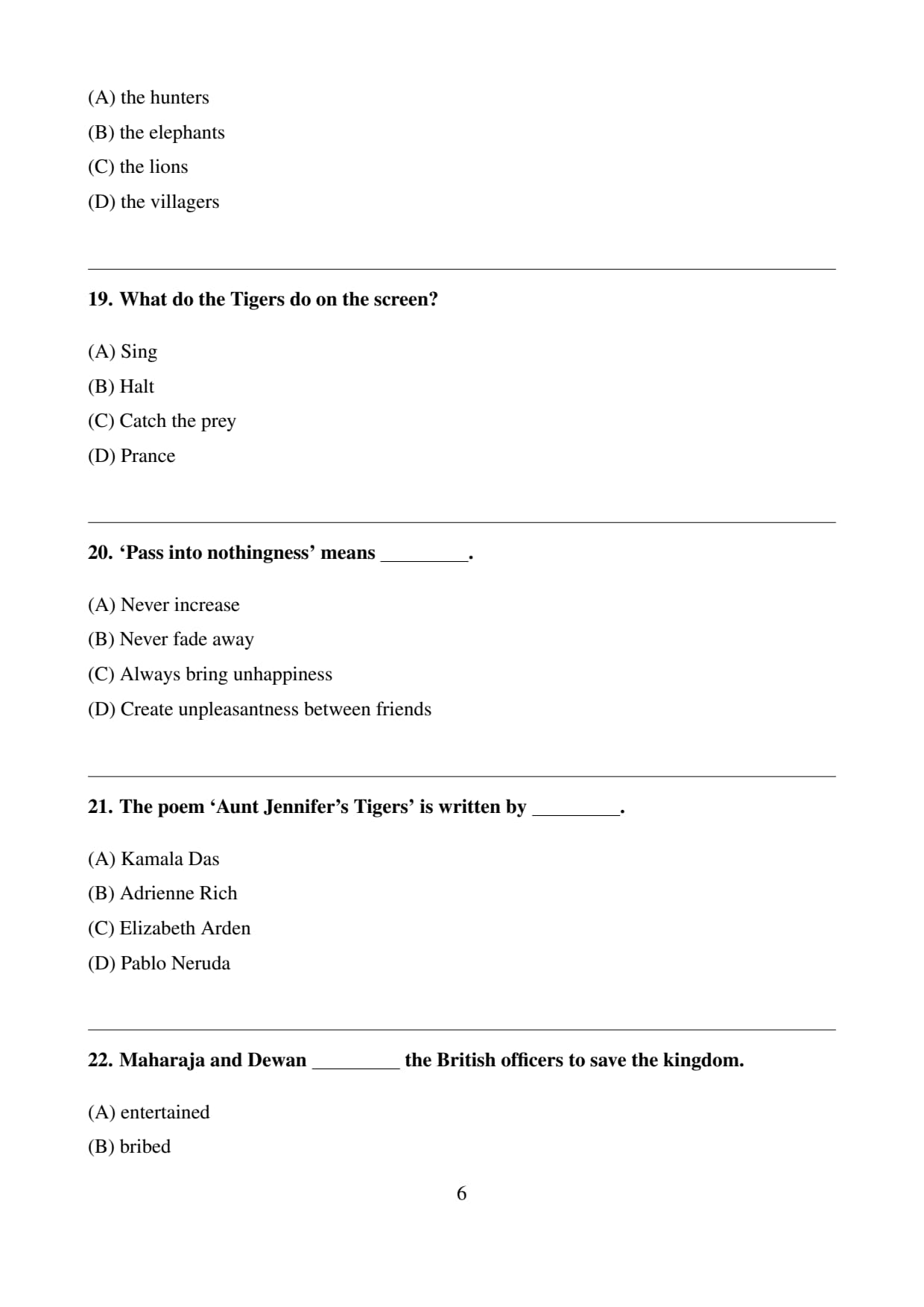
What do the Tigers do on the screen?
View Solution
This question is based on the poem “Aunt Jennifer’s Tigers” by Adrienne Rich. In the poem, the tigers embroidered on the screen are described as fearless and confident.
Step 1: Recall the exact line.
The poet writes that the tigers “prance in sleek chivalric certainty.” This clearly shows that they move proudly and confidently across the screen.
Step 2: Analyze the options.
(A) Sing: The poem does not mention the tigers singing.
(B) Halt: The tigers are described as moving, not stopping.
(C) Catch the prey: There is no mention of them hunting or catching prey.
(D) Prance: This is correct because the poem explicitly states that the tigers prance confidently.
Step 3: Conclusion.
Since the poet clearly mentions that the tigers prance, the correct answer is (D).
Final Answer: \[ \boxed{(D) \, Prance} \] Quick Tip: In “Aunt Jennifer’s Tigers,” the word “prance” highlights the tigers’ confidence and fearless nature.
‘Pass into nothingness’ means _______ .
View Solution
This phrase is taken from the poem “A Thing of Beauty” by John Keats. The poet says that a thing of beauty never “passes into nothingness.”
Step 1: Understand the meaning of the phrase.
“Pass into nothingness” means to disappear completely or fade away. The poet explains that beautiful things do not lose their charm or vanish from our memory.
Step 2: Analyze the options.
(A) Never increase: This does not relate to the meaning of the phrase.
(B) Never fade away: This is correct because the poet says that beauty does not pass into nothingness, meaning it never fades away.
(C) Always bring unhappiness: This contradicts the idea of beauty giving joy.
(D) Create unpleasantness between friends: This is unrelated to the context of the poem.
Step 3: Conclusion.
Since “pass into nothingness” means to fade away or disappear, and the poet says beauty does not do so, the correct answer is (B).
Final Answer: \[ \boxed{(B) \, Never fade away} \] Quick Tip: In “A Thing of Beauty,” John Keats emphasizes that beauty is everlasting and never fades from memory.
The poem ‘Aunt Jennifer's Tigers’ is written by ______ .
View Solution
This question is based on the poem “Aunt Jennifer's Tigers.” The poem explores themes of oppression, fear, and the contrast between strength and helplessness.
Step 1: Identify the poet.
The poem was written by Adrienne Rich, a well-known American poet known for her feminist writings and themes of women’s struggles.
Step 2: Analyze the options.
(A) Kamala Das: She wrote “My Mother at Sixty-Six,” not this poem.
(B) Adrienne Rich: This is correct as she is the author of “Aunt Jennifer's Tigers.”
(C) Elizabeth Arden: She was a businesswoman, not the poet of this work.
(D) Pablo Neruda: He wrote “Keeping Quiet,” not this poem.
Step 3: Conclusion.
Since “Aunt Jennifer's Tigers” was written by Adrienne Rich, the correct answer is (B).
Final Answer: \[ \boxed{(B) \, Adrienne Rich} \] Quick Tip: Adrienne Rich’s “Aunt Jennifer's Tigers” highlights women’s oppression and contrasts it with the fearless tigers she embroiders.
Maharaja and Dewan _______ the British officers to save the kingdom.
View Solution
This question is based on the story “The Tiger King” by Kalki. In the story, the Maharaja was determined to kill one hundred tigers due to an astrologer’s prediction.
Step 1: Understand the context.
When the British officers wanted to hunt tigers in the Maharaja’s kingdom, he refused because he wanted to kill all the tigers himself to prove the astrologer wrong. However, to avoid conflict with the British government, the Maharaja and his Dewan chose a diplomatic solution.
Step 2: Analyze the options.
(A) entertained: They did not simply entertain the officers.
(B) bribed: This is correct because they bribed the British officers with expensive gifts to prevent them from hunting tigers in the kingdom.
(C) confronted: They avoided direct confrontation.
(D) ignored: Ignoring the officers would have caused political trouble.
Step 3: Conclusion.
To save the kingdom from British anger and to protect his plan, the Maharaja and the Dewan bribed the British officers. Hence, the correct answer is (B).
Final Answer: \[ \boxed{(B) \, bribed} \] Quick Tip: In “The Tiger King,” the Maharaja uses bribes to avoid conflict with British officers and continue his tiger-hunting mission.
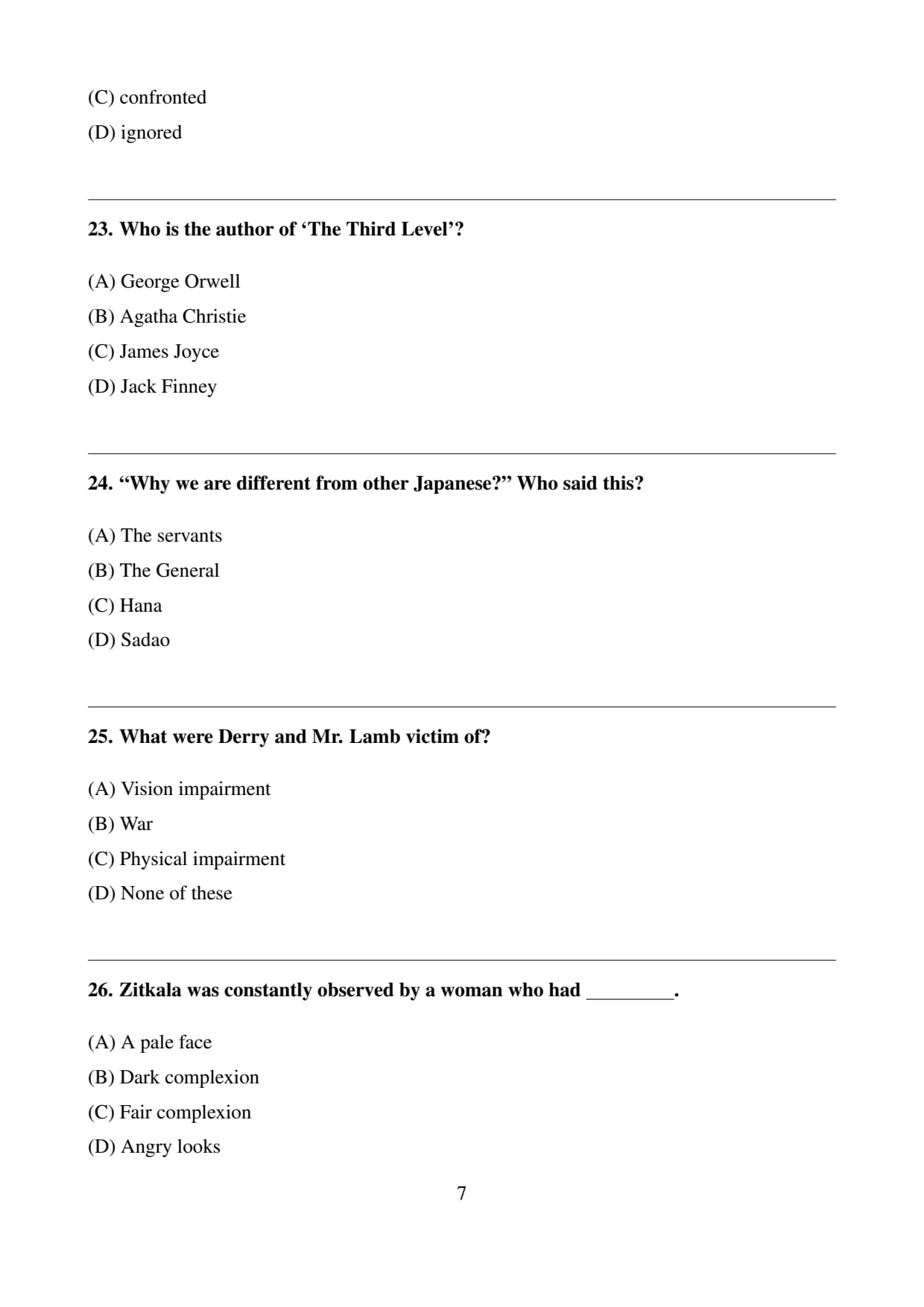
Who is the author of ‘The Third Level’?
View Solution
This question is based on the short story “The Third Level.” The story blends fantasy and reality and explores themes of escapism and psychological stress.
Step 1: Identify the author.
“The Third Level” was written by Jack Finney, an American author known for his science fiction and fantasy works.
Step 2: Analyze the options.
(A) George Orwell: Known for “Animal Farm” and “1984,” not this story.
(B) Agatha Christie: Famous for detective novels, not this story.
(C) James Joyce: Known for modernist works like “Ulysses,” not this story.
(D) Jack Finney: This is correct as he wrote “The Third Level.”
Step 3: Conclusion.
Since Jack Finney is the author of “The Third Level,” the correct answer is (D).
Final Answer: \[ \boxed{(D) \, Jack Finney} \] Quick Tip: Jack Finney’s “The Third Level” explores escapism through a mysterious third level at Grand Central Station.
“Why we are different from other Japanese?” Who said this?
View Solution
This question is based on the chapter “The Enemy” by Pearl S. Buck. The story revolves around Dr. Sadao, a Japanese doctor, who faces a moral dilemma when he saves the life of an American prisoner during wartime.
Step 1: Understand the context.
Sadao questions why he and his wife feel compassion and humanity toward the wounded American soldier, unlike other Japanese who considered him an enemy.
Step 2: Analyze the options.
(A) The servants: They were afraid and did not express such thoughts.
(B) The General: He was concerned with political and military matters, not moral reflection.
(C) Hana: Although she showed sympathy, this particular line reflects Sadao’s inner conflict.
(D) Sadao: This is correct because he expresses the thought about being different from other Japanese.
Step 3: Conclusion.
The line reflects Sadao’s moral struggle and humanity. Therefore, the correct answer is (D).
Final Answer: \[ \boxed{(D) \, Sadao} \] Quick Tip: In “The Enemy,” Dr. Sadao’s compassion and professional duty make him question national hatred during wartime.
What were Derry and Mr. Lamb victim of?
View Solution
This question is based on the play “On the Face of It” by Susan Hill. The play highlights the emotional and psychological struggles of two physically challenged characters.
Step 1: Understand the characters.
Derry has a burnt face due to an accident with acid, which makes him self-conscious and isolated. Mr. Lamb has lost one of his legs in the war and walks with the help of a tin leg.
Step 2: Analyze the options.
(A) Vision impairment: Neither of them suffers from vision problems.
(B) War: Although Mr. Lamb lost his leg in war, both characters are primarily victims of physical disability.
(C) Physical impairment: This is correct because both Derry and Mr. Lamb suffer from physical disabilities.
(D) None of these: Since option (C) is correct, this option is incorrect.
Step 3: Conclusion.
Both Derry and Mr. Lamb are victims of physical impairment, which affects their lives and attitudes. Hence, the correct answer is (C).
Final Answer: \[ \boxed{(C) \, Physical impairment} \] Quick Tip: “On the Face of It” teaches that physical impairment should not limit one’s outlook towards life.
Zitkala was constantly observed by a woman who had ______ .
View Solution
This question is based on the chapter “Memories of Childhood” by Zitkala-Sa. In the story, she describes her experiences at a boarding school where Native American children were treated harshly.
Step 1: Understand the context.
Zitkala-Sa mentions that she was closely watched by a woman with a pale face, representing the white authorities in the school who tried to impose their culture on Native American children.
Step 2: Analyze the options.
(A) A pale face: This is correct as the woman observing her is described as having a pale face.
(B) Dark complexion: This does not match the description in the text.
(C) Fair complexion: The text specifically mentions a pale face.
(D) Angry looks: While the authorities were strict, the identifying feature mentioned was the pale face.
Step 3: Conclusion.
Since Zitkala-Sa was constantly observed by a woman with a pale face, the correct answer is (A).
Final Answer: \[ \boxed{(A) \, A pale face} \] Quick Tip: In “Memories of Childhood,” the pale-faced woman symbolizes the authority and cultural oppression faced by Native American children.
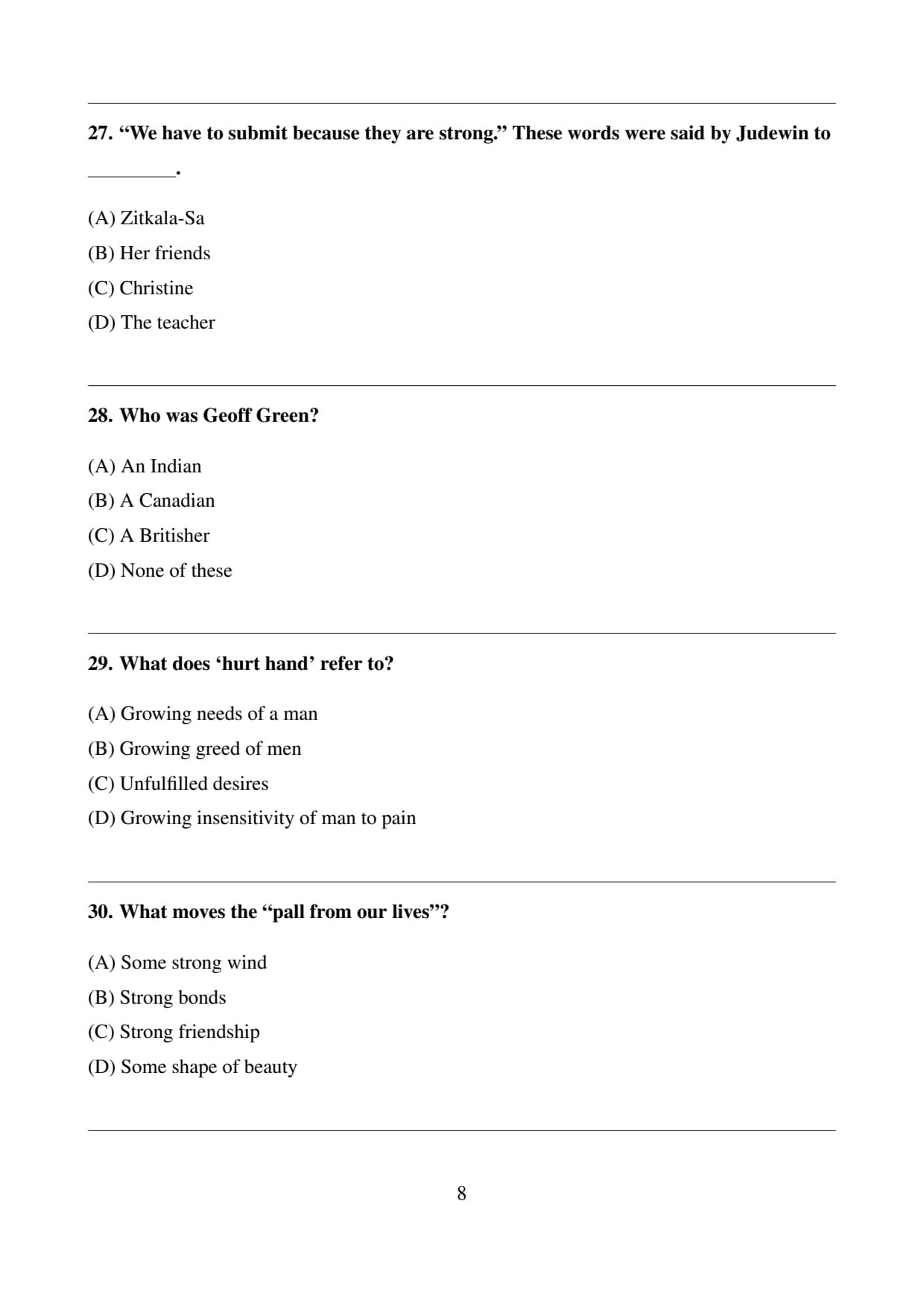
“We have to submit because they are strong.” These words were said by Judewin to _______ .
View Solution
This question is based on the chapter “Memories of Childhood” by Zitkala-Sa. The story describes the cultural oppression faced by Native American children in a boarding school.
Step 1: Understand the context.
When Zitkala-Sa resisted the cutting of her hair, her friend Judewin warned her that the authorities were powerful and strict. She told her that they had to submit because the authorities were strong.
Step 2: Analyze the options.
(A) Zitkala-Sa: This is correct because Judewin spoke these words to Zitkala-Sa.
(B) Her friends: The words were not addressed to a group of friends.
(C) Christine: Christine is mentioned in the chapter, but these words were not spoken to her.
(D) The teacher: Judewin did not say this to a teacher.
Step 3: Conclusion.
Since Judewin said these words to Zitkala-Sa, the correct answer is (A).
Final Answer: \[ \boxed{(A) \, Zitkala-Sa} \] Quick Tip: In “Memories of Childhood,” Judewin represents the fear and helplessness felt by Native American children under strict authority.
Who was Geoff Green?
View Solution
This question is based on the chapter “Journey to the End of the Earth” by Tishani Doshi. The chapter describes a student expedition to Antarctica.
Step 1: Identify the character.
Geoff Green was the founder of the organization “Students on Ice,” which aimed to take students on educational expeditions to Antarctica to create awareness about environmental issues.
Step 2: Analyze the options.
(A) An Indian: Geoff Green was not Indian.
(B) A Canadian: This is correct because Geoff Green was a Canadian environmentalist and expedition leader.
(C) A Britisher: He was not from Britain.
(D) None of these: Since option (B) is correct, this option is incorrect.
Step 3: Conclusion.
Geoff Green was a Canadian who organized Antarctic expeditions for students. Hence, the correct answer is (B).
Final Answer: \[ \boxed{(B) \, A Canadian} \] Quick Tip: Geoff Green founded “Students on Ice” to educate young people about climate change and environmental conservation.
What does ‘hurt hand’ refer to?
View Solution
This question is related to the poem “Keeping Quiet” by Pablo Neruda. The phrase “hurt hands” is used symbolically in the poem.
Step 1: Understand the symbolism.
The “hurt hands” of the salt gatherer represent the suffering caused by continuous labour and human exploitation. It also suggests the impact of human greed and material pursuits.
Step 2: Analyze the options.
(A) Growing needs of a man: The poem does not directly emphasize needs.
(B) Growing greed of men: This is correct because the poem criticizes human greed and exploitation that lead to suffering.
(C) Unfulfilled desires: This is not the direct meaning in the context.
(D) Growing insensitivity of man to pain: Although related, the main idea reflects greed-driven exploitation.
Step 3: Conclusion.
The phrase “hurt hands” symbolically points toward the growing greed of men that causes suffering. Hence, the correct answer is (B).
Final Answer: \[ \boxed{(B) \, Growing greed of men} \] Quick Tip: In “Keeping Quiet,” Neruda uses simple images like “hurt hands” to symbolize human suffering caused by greed and exploitation.
What moves the “pall from our lives”?
View Solution
This question is based on the poem “A Thing of Beauty” by John Keats. The poet explains how beauty removes sadness and negativity from our lives.
Step 1: Understand the phrase.
The poet writes that some shape of beauty removes the pall (a feeling of sadness or gloom) from our dark spirits. This means beauty has the power to uplift our mood.
Step 2: Analyze the options.
(A) Some strong wind: This is not mentioned in the poem.
(B) Strong bonds: The poem focuses on beauty, not relationships.
(C) Strong friendship: Friendship is not directly referred to in this context.
(D) Some shape of beauty: This is correct because the poet clearly states that beauty removes the pall from our lives.
Step 3: Conclusion.
According to John Keats, some shape of beauty moves the pall from our lives. Hence, the correct answer is (D).
Final Answer: \[ \boxed{(D) \, Some shape of beauty} \] Quick Tip: In “A Thing of Beauty,” John Keats emphasizes that beauty removes sadness and fills life with hope and joy.



Comments