AP PGLCET 2024 LLM Question Paper with solution PDF is available for download here. Acharya Nagarjuna University, Guntur on behalf of APSCHE conducted AP PGLCET 2024 exam on June 9, 2024. AP PGLCET question paper 2024 comprises a total of 120 questions divided into 2 sections.
Check AP PGLCET Question Paper 2025 with Solution PDF
AP PGLCET 2024 LLM Question Paper with Answer Key PDF
![]()
AP PGLCET 2024 Questions with Solutions
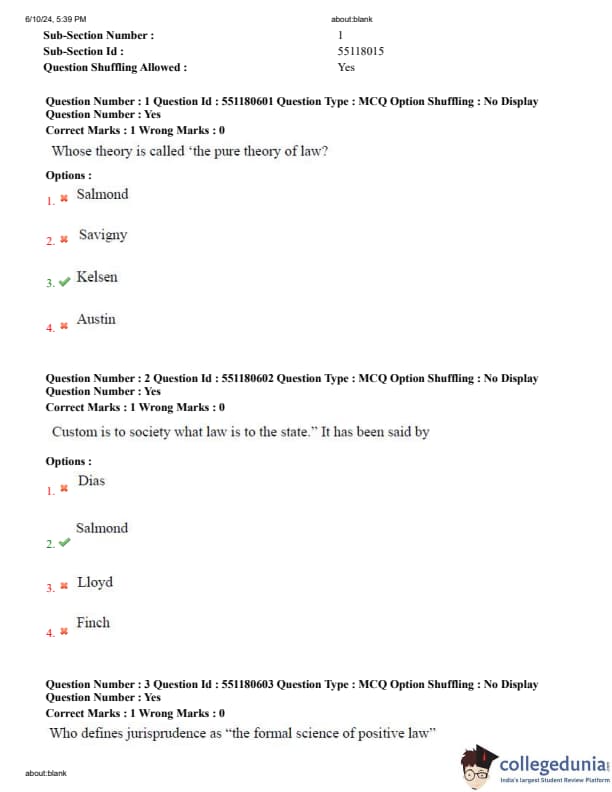
Question 1:
Whose theory is called 'the pure theory of law'?
- (A) Salmond
- (B) Savigny
- (C) Kelsen
- (D) Austin
Question 2:
Custom is to society what law is to the state. It has been said by
- (A) Dias
- (B) Salmond
- (C) Lloyd
- (D) Finch
Question 3:
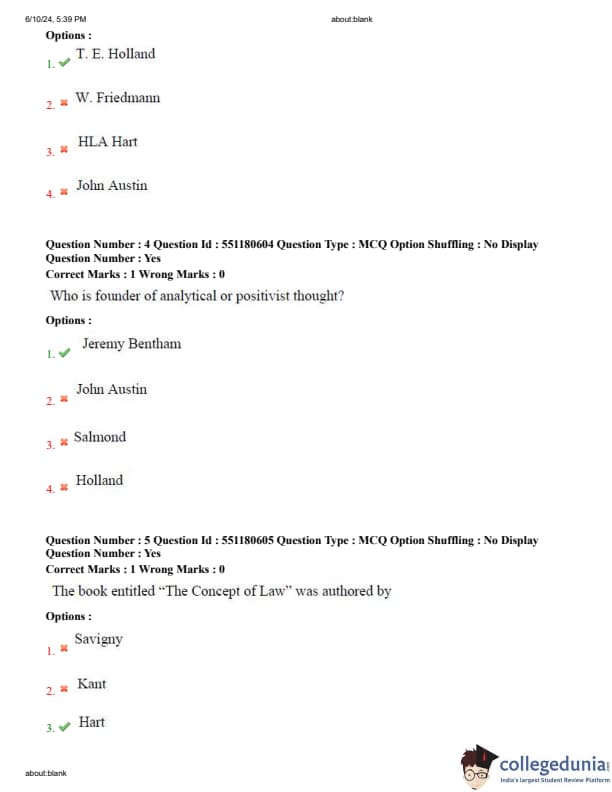
Who defines jurisprudence as "the formal science of positive law"?
- (A) T. E. Holland
- (B) W. Friedmann
- (C) HLA Hart
- (D) John Austin
Question 4:
Who is founder of analytical or positivist thought?
- (A) Jeremy Bentham
- (B) John Austin
- (C) Salmond
- (D) Holland
Question 5:
The book entitled "The Concept of Law" was authored by
- (A) Savigny
- (B) Kant
- (C) Hart
- (D) Kelsen
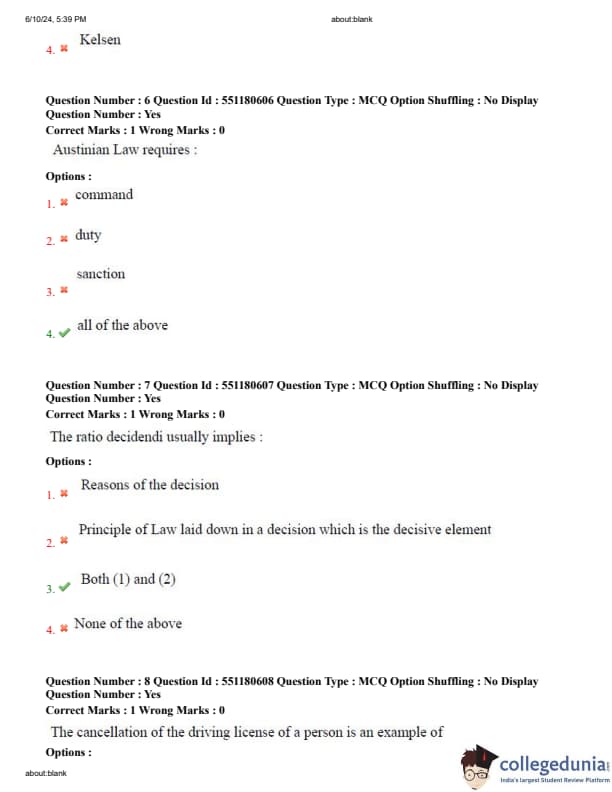
Question 6:
Austinian Law requires:
- (A) command
- (B) duty
- (C) sanction
- (D) all of the above
Question 7:
The ratio decidendi usually implies:
- (A) Reasons of the decision
- (B) Principle of Law laid down in a decision which is the decisive element
- (C) Both (1) and (2)
- (D) None of the above
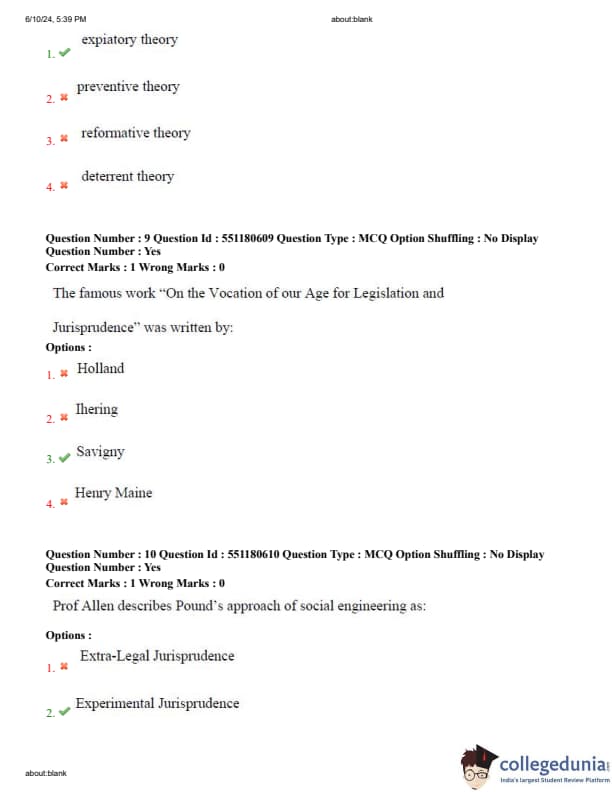
Question 8:
The cancellation of the driving license of a person is an example of
- (A) expiatory theory
- (B) preventive theory
- (C) reformative theory
- (D) deterrent theory
Question 9:
The famous work "On the Vocation of our Age for Legislation and Jurisprudence" was written by:
- (A) Holland
- (B) Ihering
- (C) Savigny
- (D) Henry Maine
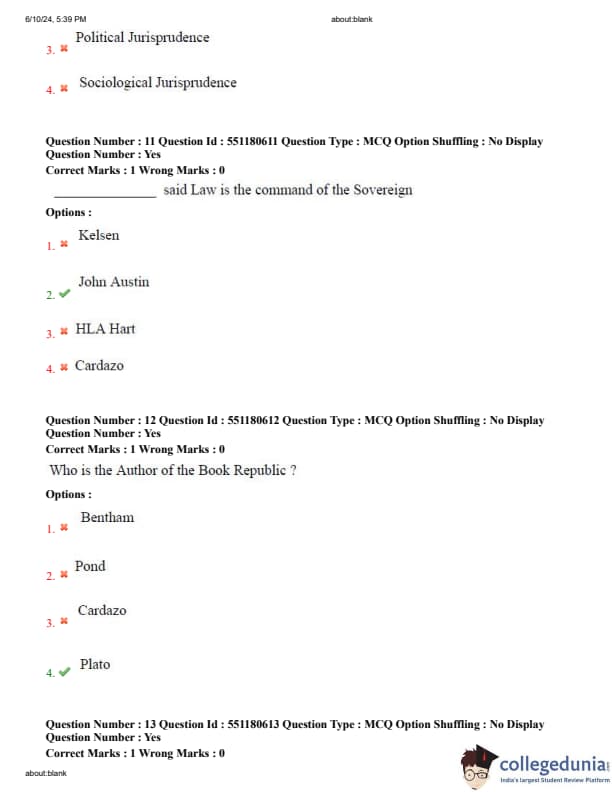
Question 10:
Prof Allen describes Pound's approach of social engineering as:
- (A) Extra-Legal Jurisprudence
- (B) Experimental Jurisprudence
- (C) Political Jurisprudence
- (D) Sociological Jurisprudence
Question 11:
Said Law is the command of the Sovereign
- (A) Kelsen
- (B) John Austin
- (C) HLA Hart
- (D) Cardazo
Question 12:
Who is the Author of the Book Republic?
- (A) Bentham
- (B) Pond
- (C) Cardazo
- (D) Plato
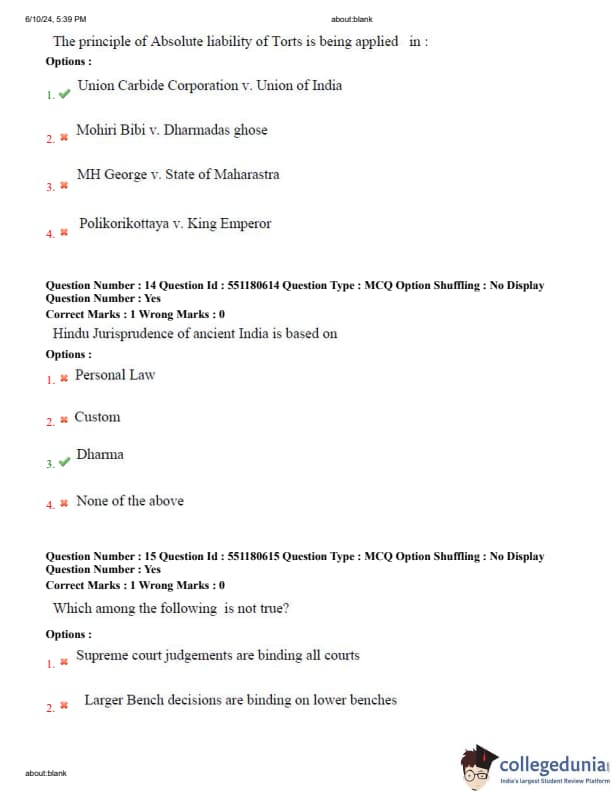
Question 13:
The principle of Absolute liability of Torts is being applied in:
- (A) Union Carbide Corporation v. Union of India
- (B) Mohiri Bibi v. Dharmadas Ghose
- (C) MH George v. State of Maharastra
- (D) Polikorikottaya v. King Emperor
Question 14:
Hindu Jurisprudence of ancient India is based on
- (A) Personal Law
- (B) Custom
- (C) Dharma
- (D) None of the above
Question 15:
Which among the following is not true?
- (A) Supreme court judgements are binding all courts
- (B) Larger Bench decisions are binding on lower benches
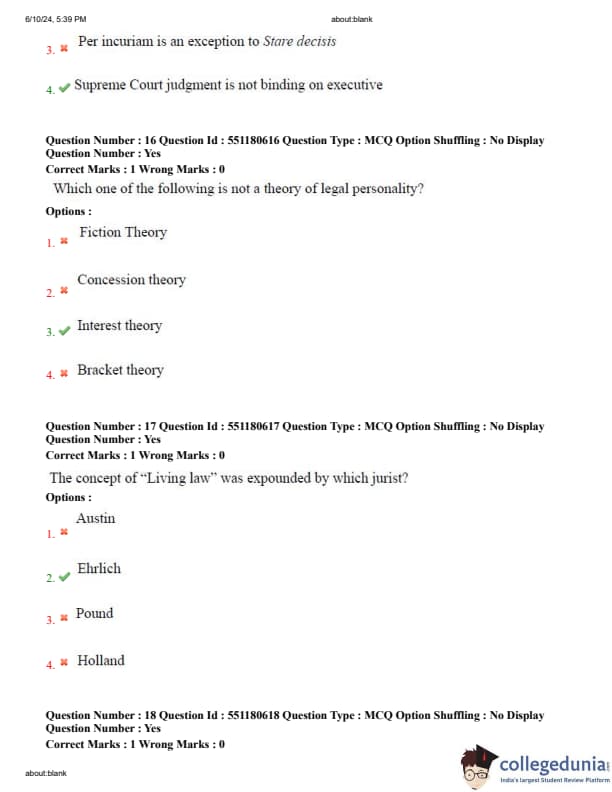
- (C) Per incuriam is an exception to Stare decisis
- (D) Supreme Court judgment is not binding on executive
Question 16:
Which one of the following is not a theory of legal personality?
- (A) Fiction Theory
- (B) Concession Theory
- (C) Interest Theory
- (D) Bracket Theory
Question 17:
The concept of "Living law" was expounded by which jurist?
- (A) Austin
- (B) Ehrlich
- (C) Pound
- (D) Holland
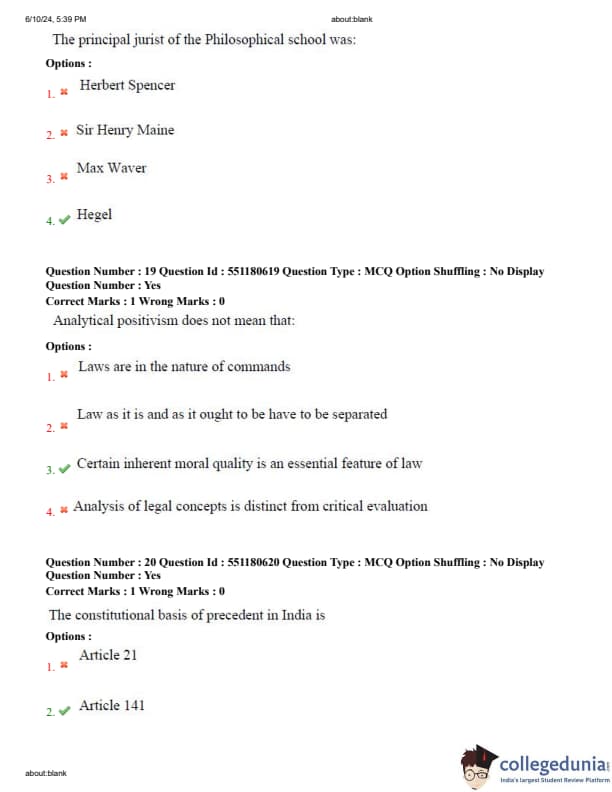
Question 18:
The principal jurist of the Philosophical school was:
- (A) Herbert Spencer
- (B) Sir Henry Maine
- (C) Max Weber
- (D) Hegel
Question 19:
Analytical positivism does not mean that:
- (A) Laws are in the nature of commands
- (B) Law as it is and as it ought to be have to be separated
- (C) Certain inherent moral quality is an essential feature of law
- (D) Analysis of legal concepts is distinct from critical evaluation
Question 20:
The constitutional basis of precedent in India is
- (A) Article 21
- (B) Article 141
- (C) Article 136
- (D) Article 14
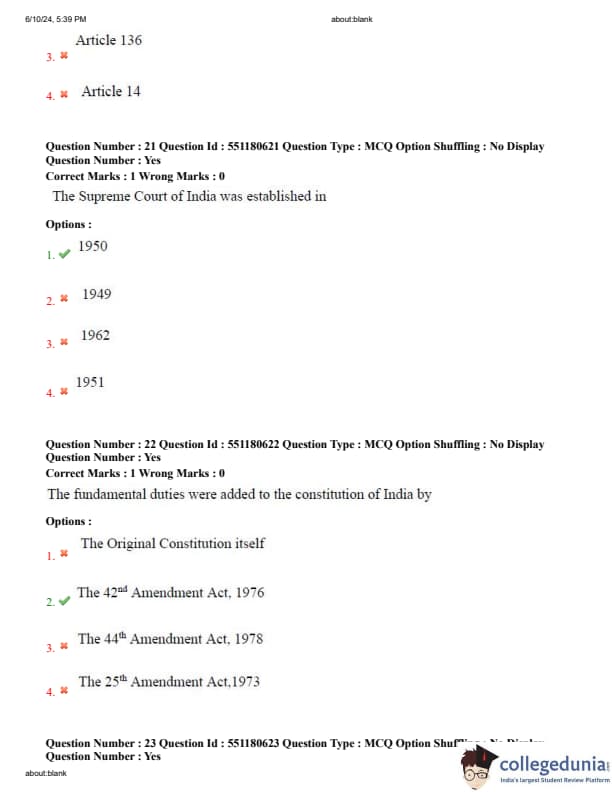
Question 21:
The Supreme Court of India was established in
- (A) 1950
- (B) 1949
- (C) 1962
- (D) 1951
Question 22:
The fundamental duties were added to the constitution of India by
- (A) The Original Constitution itself
- (B) The 42nd Amendment Act, 1976
- (C) The 44th Amendment Act, 1978
- (D) The 25th Amendment Act, 1973
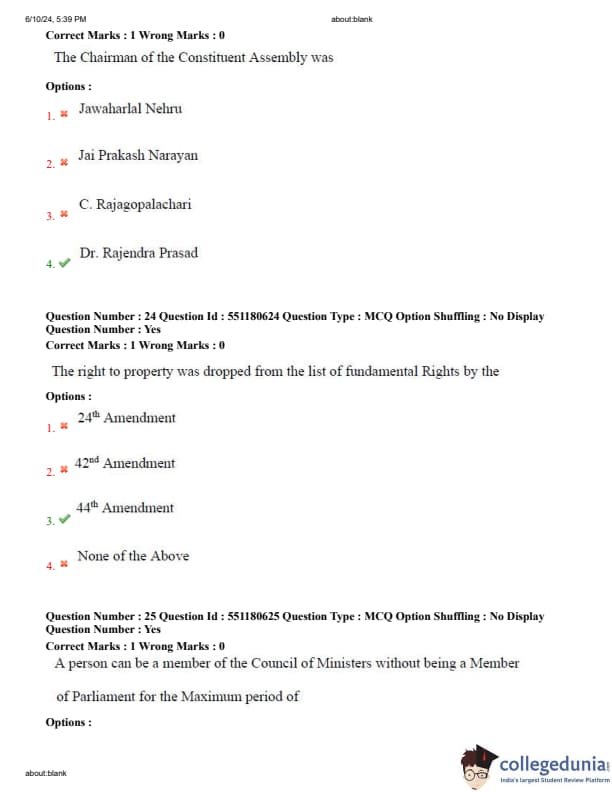
Question 23:
The Chairman of the Constituent Assembly was
- (A) Jawaharlal Nehru
- (B) Jai Prakash Narayan
- (C) C. Rajagopalachari
- (D) Dr. Rajendra Prasad
Question 24:
The right to property was dropped from the list of fundamental Rights by the
- (A) 24th Amendment
- (B) 42nd Amendment
- (C) 44th Amendment
- (D) None of the Above
Question 25:
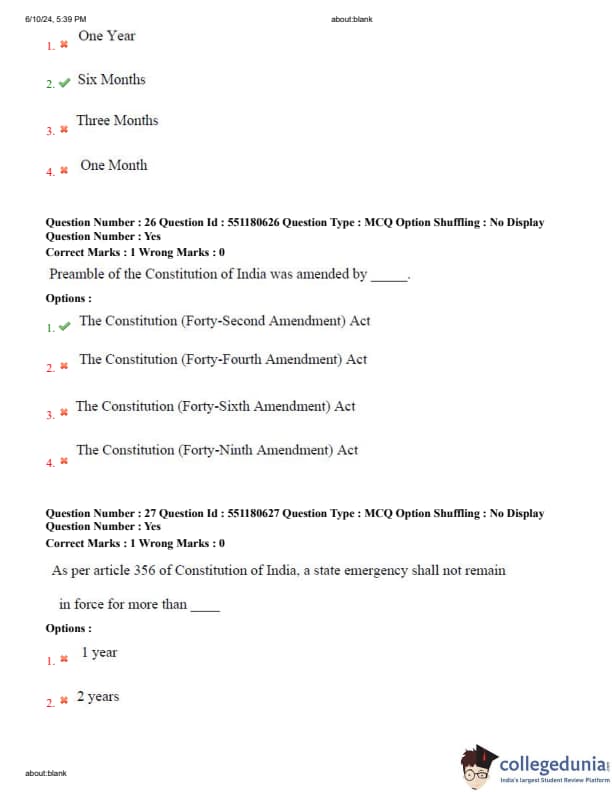
A person can be a member of the Council of Ministers without being a Member of Parliament for the Maximum period of
- (A) One Year
- (B) Six Months
- (C) Three Months
- (D) One Month
Question 26:
Preamble of the Constitution of India was amended by
- (A) The Constitution (Forty-Second Amendment) Act
- (B) The Constitution (Forty-Fourth Amendment) Act
- (C) The Constitution (Forty-Sixth Amendment) Act
- (D) The Constitution (Forty-Ninth Amendment) Act
Question 27:
As per article 356 of Constitution of India, a state emergency shall not remain in force for more than
- (A) 1 year
- (B) 2 years
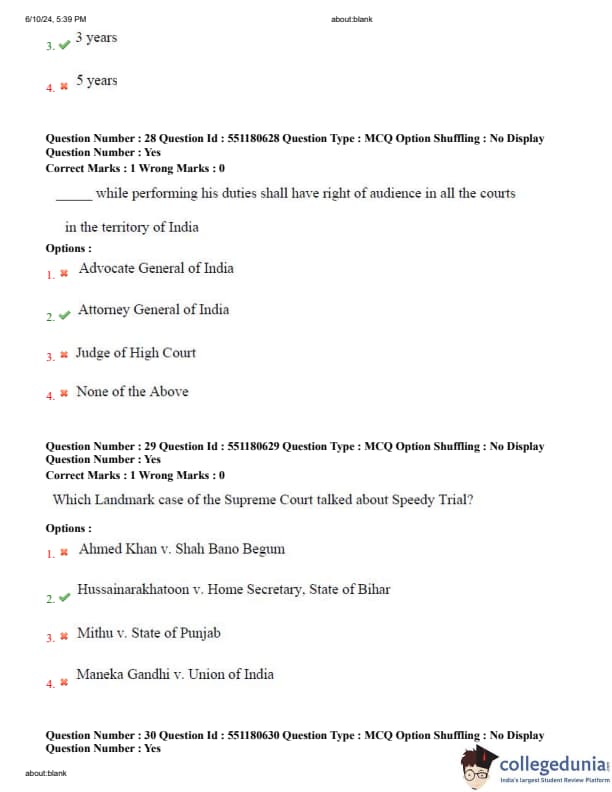
- (C) 3 years
- (D) 5 years
Question 28:
While performing his duties shall have right of audience in all the courts in the territory of India
- (A) Advocate General of India
- (B) Attorney General of India
- (C) Judge of High Court
- (D) None of the Above
Question 29:
Which Landmark case of the Supreme Court talked about Speedy Trial?
- (A) Ahmed Khan v. Shah Bano Begum
- (B) Hussainara Khatoon v. Home Secretary, State of Bihar
- (C) Mithu v. State of Punjab
- (D) Maneka Gandhi v. Union of India
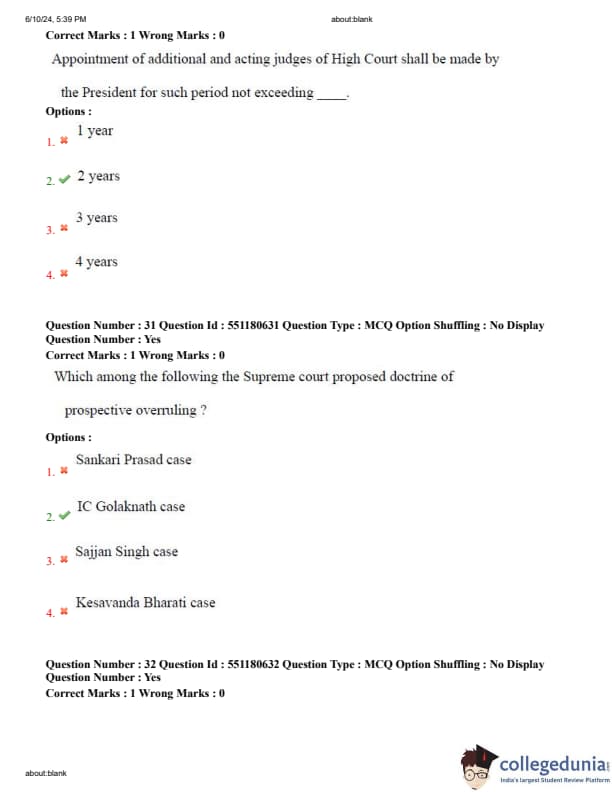
Question 30:
Appointment of additional and acting judges of High Court shall be made by the President for such period not exceeding
- (A) 1 year
- (B) 2 years
- (C) 3 years
- (D) 4 years
Question 31:
Which among the following the Supreme court proposed doctrine of prospective overruling?
- (A) Sankari Prasad case
- (B) IC Golaknath case
- (C) Sajjan Singh case
- (D) Kesavananda Bharati case
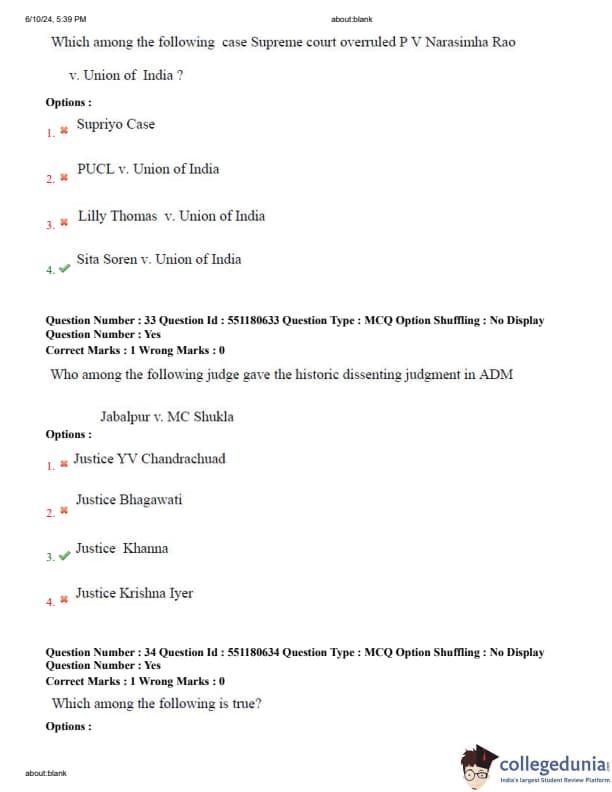
Question 32:
Which among the following case Supreme court overruled P V Narasimha Rao v. Union of India?
- (A) Supriyo Case
- (B) PUCL v. Union of India
- (C) Lilly Thomas v. Union of India
- (D) Sita Soren v. Union of India
Question 33:
Who among the following judge gave the historic dissenting judgment in ADM Jabalpur v. MC Shukla
- (A) Justice YV Chandrachud
- (B) Justice Bhagawati
- (C) Justice Khanna
- (D) Justice Krishna Iyer
Question 34:
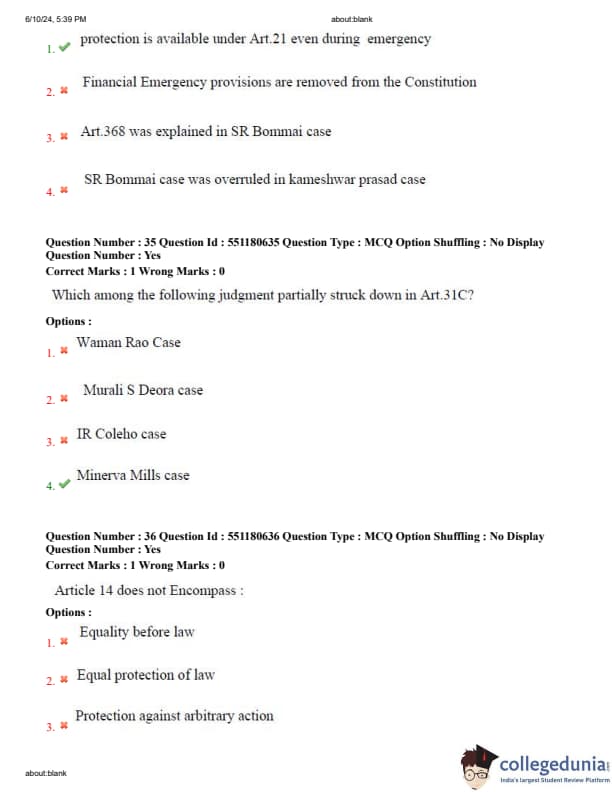
Which among the following is true?
- (A) Protection is available under Art. 21 even during emergency
- (B) Financial Emergency provisions are removed from the Constitution
- (C) Art. 368 was explained in SR Bommai case
- (D) SR Bommai case was overruled in Kameshwar Prasad case
Question 35:
Which among the following judgment partially struck down in Art.31C?
- (A) Waman Rao Case
- (B) Minerva Mills Case
- (C) Kesavananda Bharati Case
- (D) Golak Nath Case
Question 36:
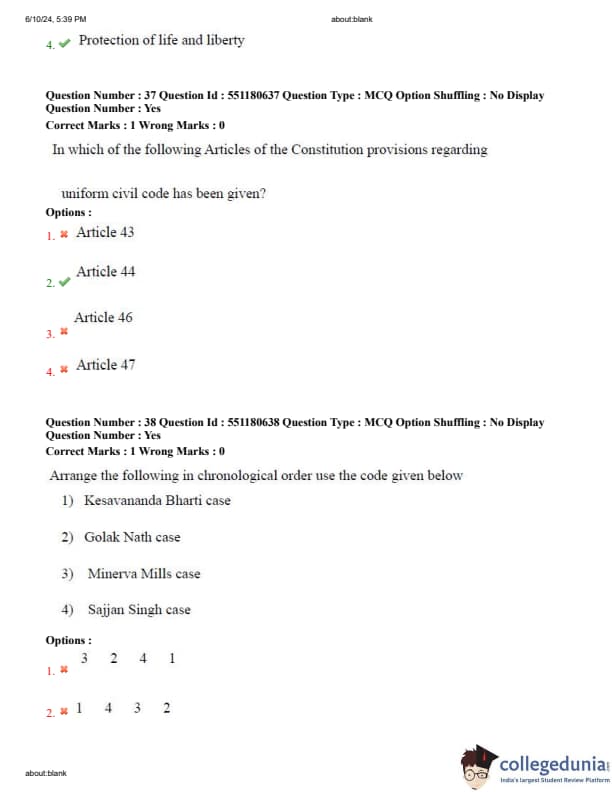
In which of the following Articles of the Constitution provisions regarding uniform civil code has been given?
- (A) Article 43
- (B) Article 44
- (C) Article 46
- (D) Article 47
Question 37:
Arrange the following in chronological order use the code given below
1) Kesavananda Bharati case
2) Golak Nath case
3) Minerva Mills case
4) Sajjan Singh case
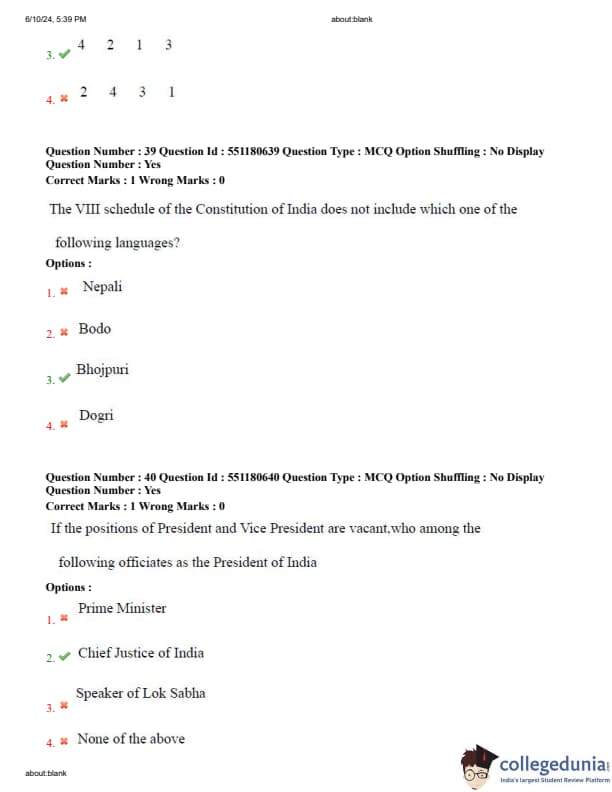
- (A) 1, 2, 3, 4
- (B) 4, 2, 1, 3
- (C) 2, 4, 1, 3
- (D) 4, 1, 2, 3
Question 38:
The VIII schedule of the Constitution of India does not include which one of the following languages?
- (A) Nepali
- (B) Bodo
- (C) Bhojpuri
- (D) Dogri
Question 39:
If the positions of President and Vice President are vacant, who among the following officiates as the President of India
- (A) Prime Minister
- (B) Chief Justice of India
- (C) Speaker of Lok Sabha
- (D) None of the above
Question 40:
Protection of life and liberty
- (A) Article 21
- (B) Article 19
- (C) Article 14
- (D) Article 20
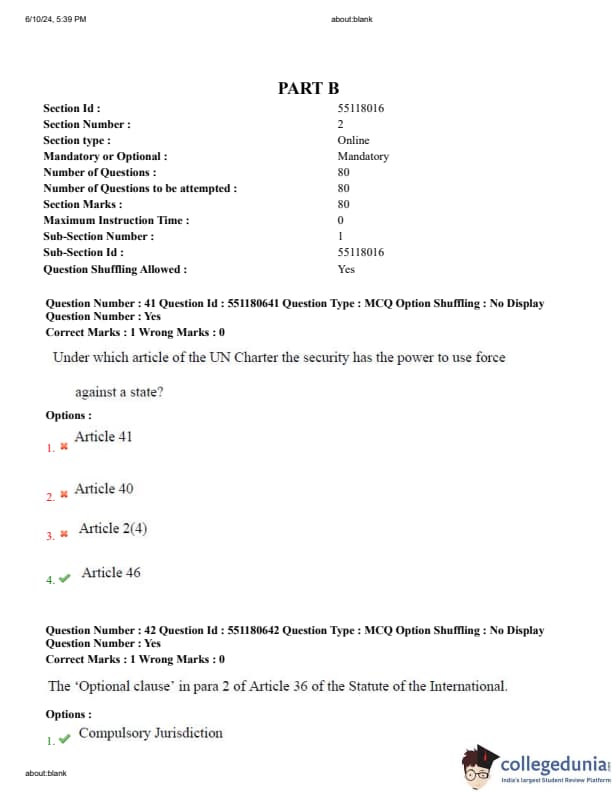
Question 41:
Under which article of the UN Charter the security has the power to use force against a state?
- (A) Article 41
- (B) Article 40
- (C) Article 2(4)
- (D) Article 46
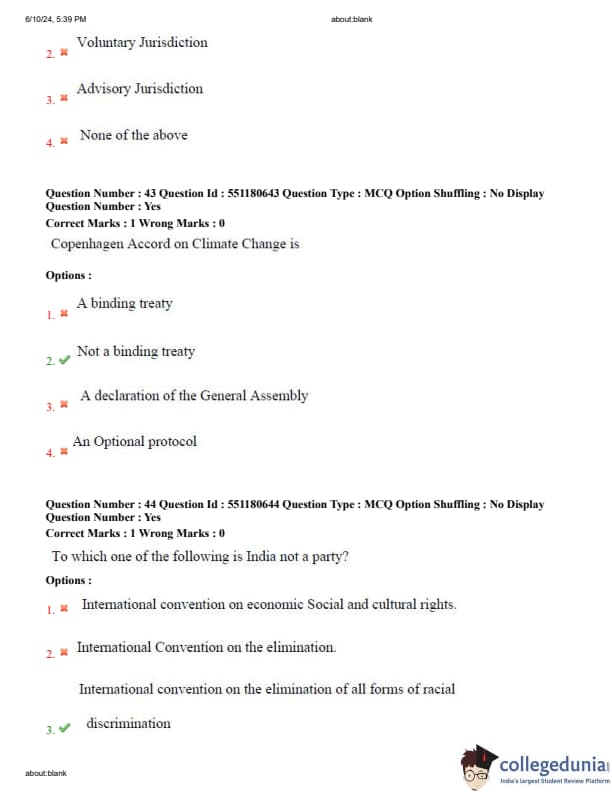
Question 42:
The 'Optional clause' in para 2 of Article 36 of the Statute of the International Court of Justice refers to:
- (A) Compulsory Jurisdiction
- (B) Voluntary Jurisdiction
- (C) Advisory Jurisdiction
- (D) None of the above
Question 43:
Copenhagen Accord on Climate Change is:
- (A) A binding treaty
- (B) Not a binding treaty
- (C) A declaration of the General Assembly
- (D) An Optional protocol
Question 44:
To which one of the following is India not a party?
- (A) International Convention on Economic, Social and Cultural Rights
- (B) International Convention on the Elimination of All Forms of Racial Discrimination
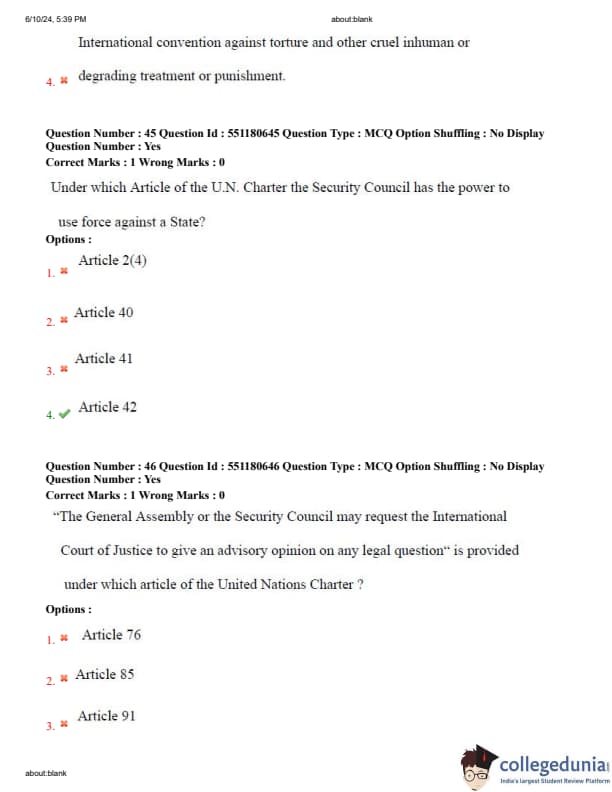
- (C) International Convention Against Torture and Other Cruel, Inhuman or Degrading Treatment or Punishment
- (D) None of the above
Question 45:
Under which Article of the U.N. Charter the Security Council has the power to use force against a State?
- (A) Article 2(4)
- (B) Article 40
- (C) Article 41
- (D) Article 42
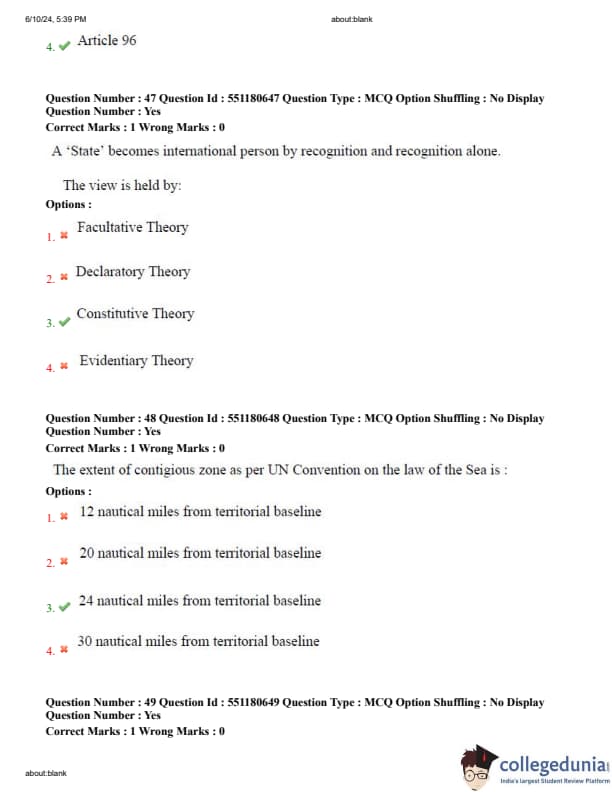
Question 46:
"The General Assembly or the Security Council may request the International Court of Justice to give an advisory opinion on any legal question" is provided under which article of the United Nations Charter?
- (A) Article 76
- (B) Article 85
- (C) Article 91
- (D) Article 96
Question 47:
A 'State' becomes international person by recognition and recognition alone. The view is held by:
- (A) Facultative Theory
- (B) Declaratory Theory
- (C) Constitutive Theory
- (D) Evidentiary Theory
Question 48:
The extent of contiguous zone as per UN Convention on the Law of the Sea is:
- (A) 12 nautical miles from territorial baseline
- (B) 20 nautical miles from territorial baseline
- (C) 24 nautical miles from territorial baseline
- (D) 30 nautical miles from territorial baseline
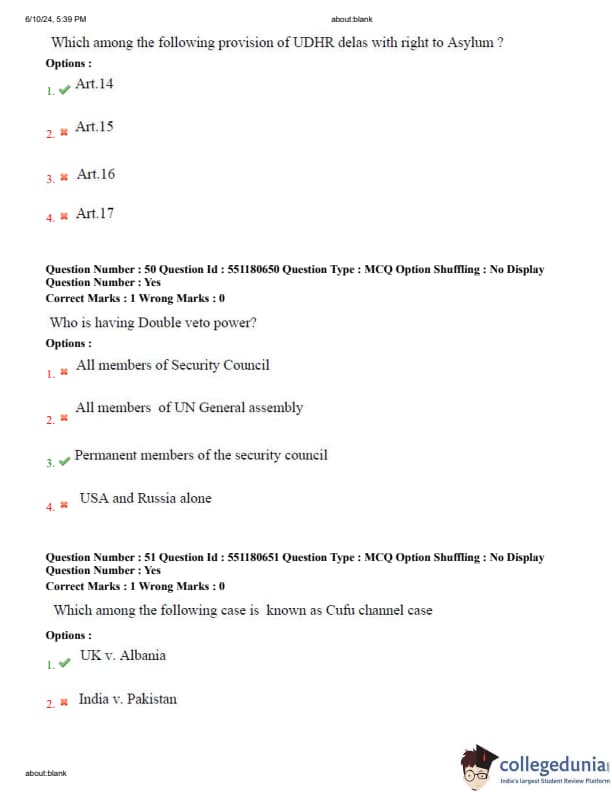
Question 49:
Which among the following provision of UDHR deals with right to Asylum?
- (A) Art. 14
- (B) Art. 15
- (C) Art. 16
- (D) Art. 17
Question 50:
Who is having Double veto power?
- (A) All members of Security Council
- (B) All members of UN General Assembly
- (C) Permanent members of the Security Council
- (D) USA and Russia alone
Question 51:
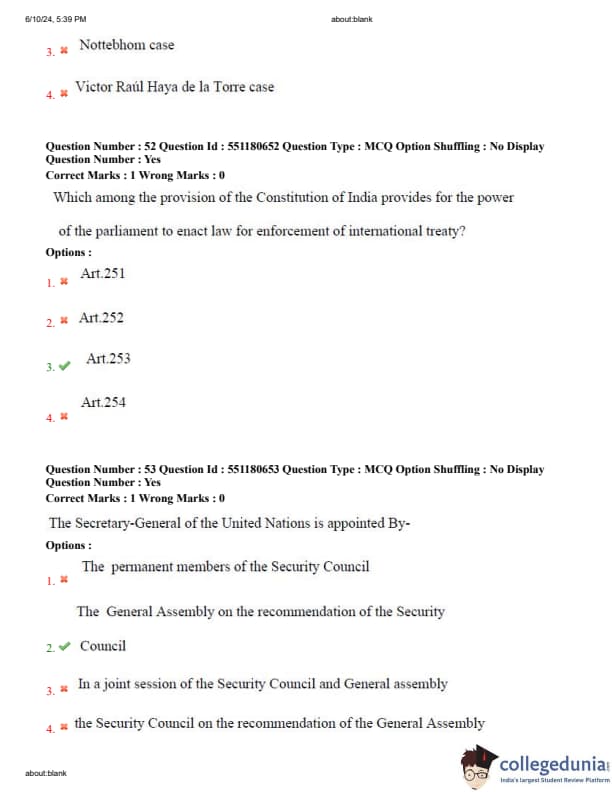
Which among the following case is known as Corfu Channel case?
- (A) UK v. Albania
- (B) India v. Pakistan
- (C) Nottebohm case
- (D) Victor Raúl Haya de la Torre case
Question 52:
Which among the provision of the Constitution of India provides for the power of the parliament to enact law for enforcement of international treaty?
- (A) Art. 251
- (B) Art. 252
- (C) Art. 253
- (D) Art. 254
Question 53:
The Secretary-General of the United Nations is appointed By-
- (A) The permanent members of the Security Council
- (B) The General Assembly on the recommendation of the Security Council
- (C) In a joint session of the Security Council and General Assembly
- (D) The Security Council on the recommendation of the General Assembly
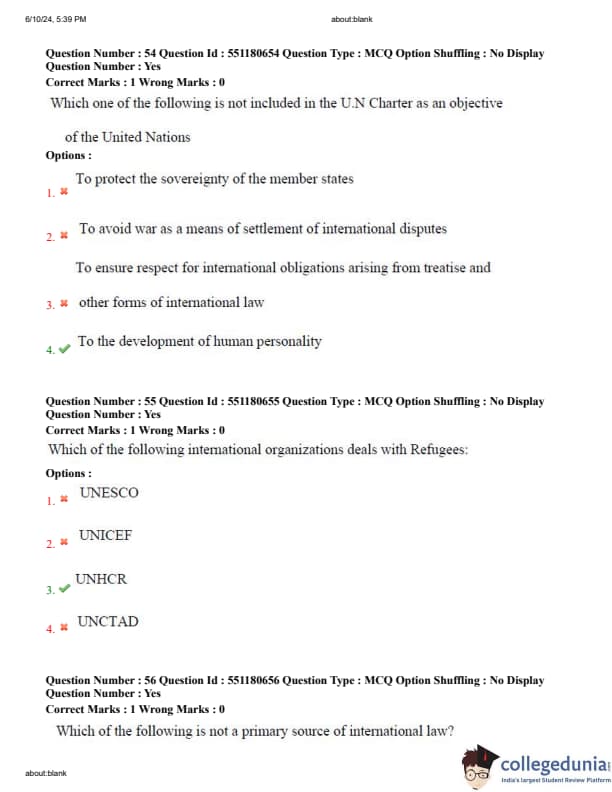
Question 54:
Which one of the following is not included in the U.N Charter as an objective of the United Nations?
- (A) To protect the sovereignty of the member states
- (B) To avoid war as a means of settlement of international disputes
- (C) To ensure respect for international obligations arising from treaties and other forms of international law
- (D) To the development of human personality
Question 55:
Which of the following international organizations deals with Refugees?
- (A) UNESCO
- (B) UNICEF
- (C) UNHCR
- (D) UNCTAD
Question 56:
Which of the following is not a primary source of international law?
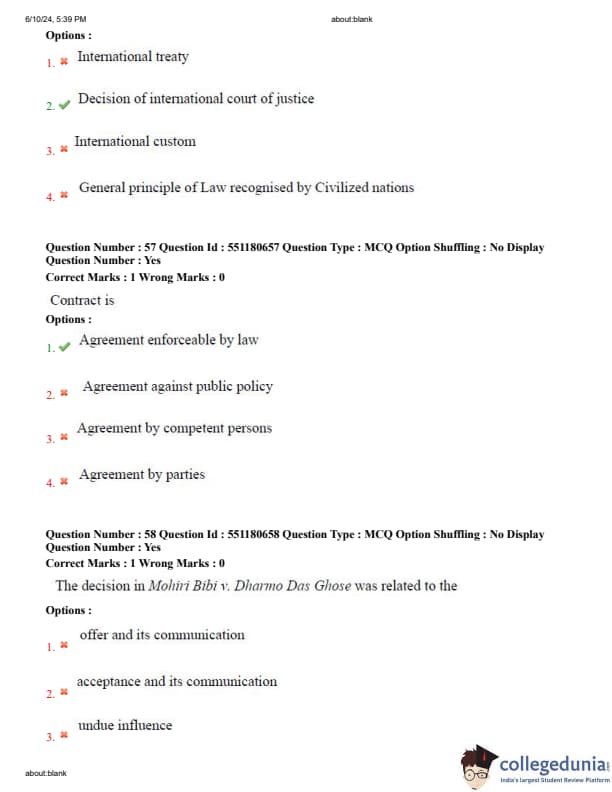
- (A) International treaty
- (B) Decision of International Court of Justice
- (C) International custom
- (D) General principle of Law recognised by Civilized nations
Question 57:
Contract is
- (A) Agreement enforceable by law
- (B) Agreement against public policy
- (C) Agreement by competent persons
- (D) Agreement by parties
Question 58:
The decision in Mohiri Bibi v. Dharmo Das Ghose was related to the
- (A) Offer and its communication
- (B) Acceptance and its communication
- (C) Undue influence
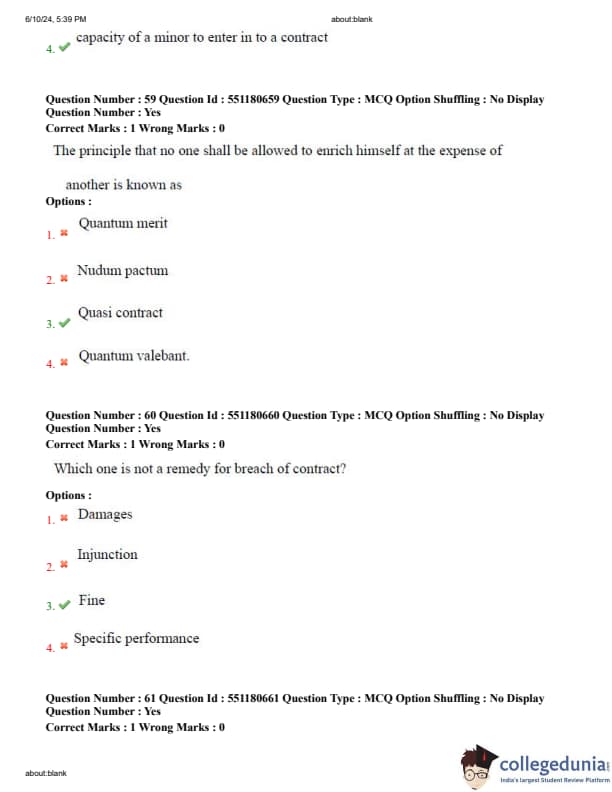
- (D) Capacity of a minor to enter into a contract
Question 59:
The principle that no one shall be allowed to enrich himself at the expense of another is known as
- (A) Quantum meruit
- (B) Nudum pactum
- (C) Quasi contract
- (D) Quantum valebant
Question 60:
Which one is not a remedy for breach of contract?
- (A) Damages
- (B) Injunction
- (C) Fine
- (D) Specific performance
Question 61:
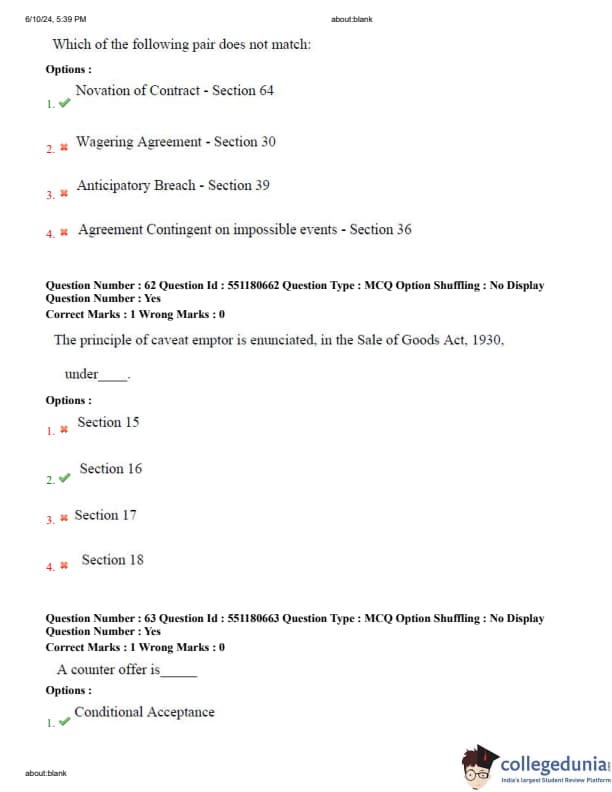
Which of the following pair does not match:
- (A) Novation of Contract - Section 64
- (B) Wagering Agreement - Section 30
- (C) Anticipatory Breach - Section 39
- (D) Agreement Contingent on impossible events - Section 36
Question 62:
The principle of caveat emptor is enunciated, in the Sale of Goods Act, 1930, under
- (A) Section 15
- (B) Section 16
- (C) Section 17
- (D) Section 18
Question 63:
A counter offer is
- (A) Conditional Acceptance
- (B) Invitation to offer
- (C) Rejection to offer
- (D) Revocation of offer
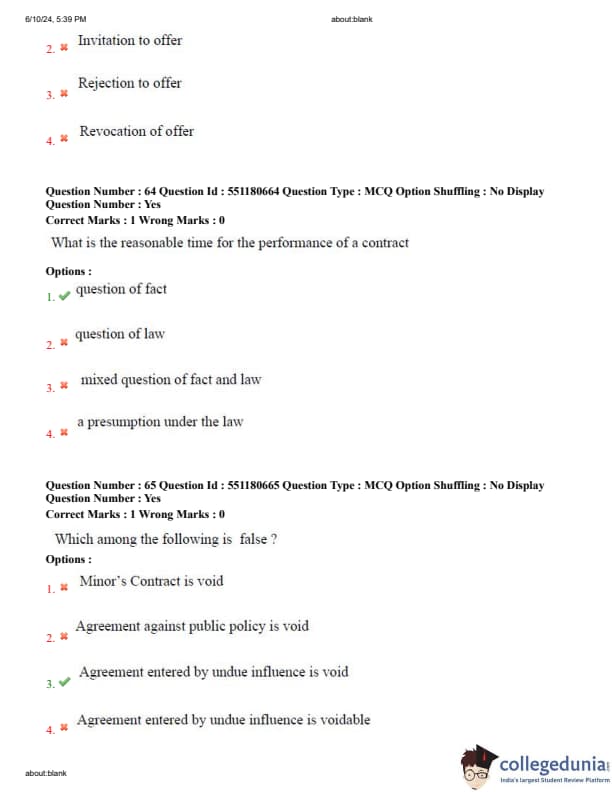
Question 64:
What is the reasonable time for the performance of a contract
- (A) Question of fact
- (B) Question of law
- (C) Mixed question of fact and law
- (D) A presumption under the law
Question 65:
Which among the following is false?
- (A) Minor’s Contract is void
- (B) Agreement against public policy is void
- (C) Agreement entered by undue influence is void
- (D) Agreement entered by undue influence is voidable
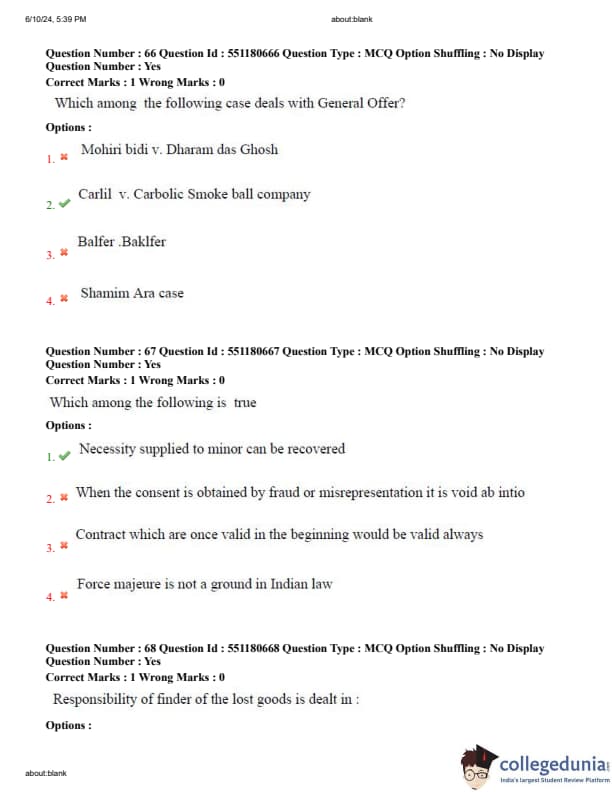
Question 66:
Which among the following case deals with General Offer?
- (A) Mohiri Bibi v. Dharmo Das Ghosh
- (B) Carlill v. Carbolic Smoke Ball Company
- (C) Balfour v. Balfour
- (D) Shamim Ara case
Question 67:
Which among the following is true?
- (A) Necessity supplied to minor can be recovered
- (B) When the consent is obtained by fraud or misrepresentation it is void ab initio
- (C) Contract which are once valid in the beginning would be valid always
- (D) Force majeure is not a ground in Indian law
Question 68:
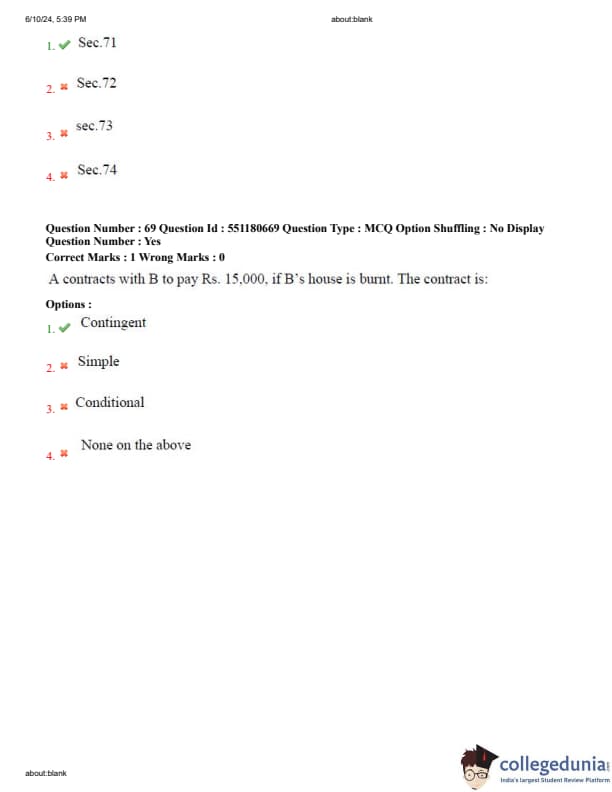
Responsibility of finder of the lost goods is dealt in:
- (A) Sec. 71
- (B) Sec. 72
- (C) Sec. 73
- (D) Sec. 74
Question 69:
A contracts with B to pay Rs. 15,000, if B’s house is burnt. The contract is:
- (A) Contingent
- (B) Simple
- (C) Conditional
- (D) None of the above
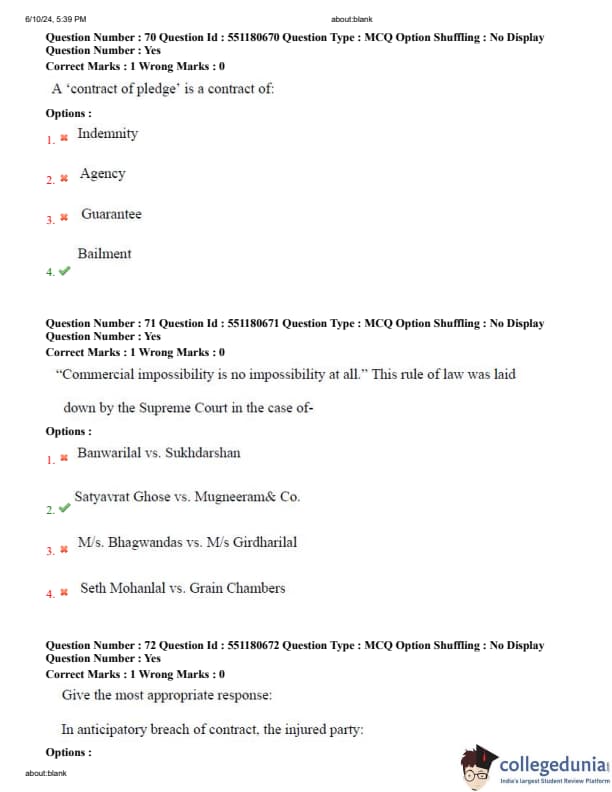
Question 70:
A ‘contract of pledge’ is a contract of:
- (A) Indemnity
- (B) Agency
- (C) Guarantee
- (D) Bailment
Question 71:
“Commercial impossibility is no impossibility at all.” This rule of law was laid down by the Supreme Court in the case of-
- (A) Banwarilal vs. Sukhdarshan
- (B) Satyavrat Ghose vs. Mugneeram & Co.
- (C) M/s. Bhagwandas vs. M/s Girdharilal
- (D) Seth Mohanlal vs. Grain Chambers
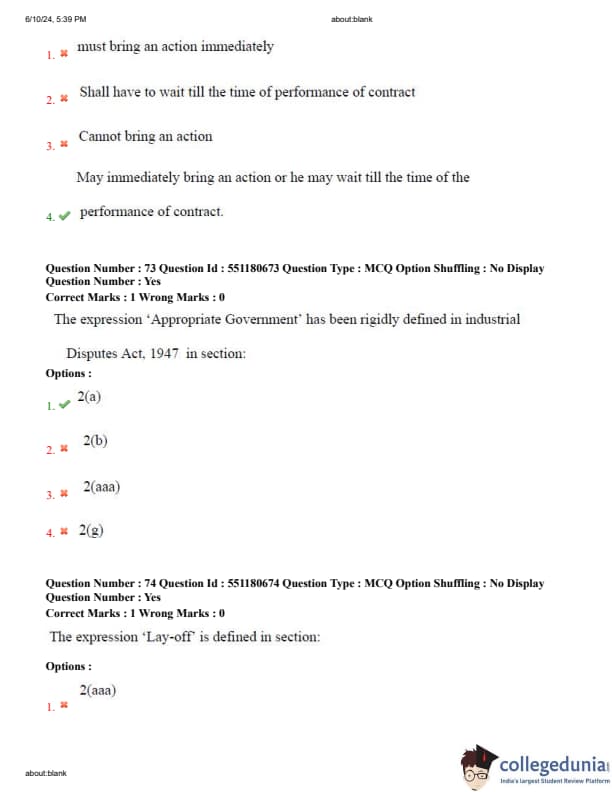
Question 72:
In anticipatory breach of contract, the injured party:
- (A) Must bring an action immediately
- (B) Shall have to wait till the time of performance of contract
- (C) Cannot bring an action
- (D) May immediately bring an action or he may wait till the time of the performance of contract
Question 73:
The expression ‘Appropriate Government’ has been rigidly defined in Industrial Disputes Act, 1947 in section:
- (A) 2(a)
- (B) 2(b)
- (C) 2(aaa)
- (D) 2(g)
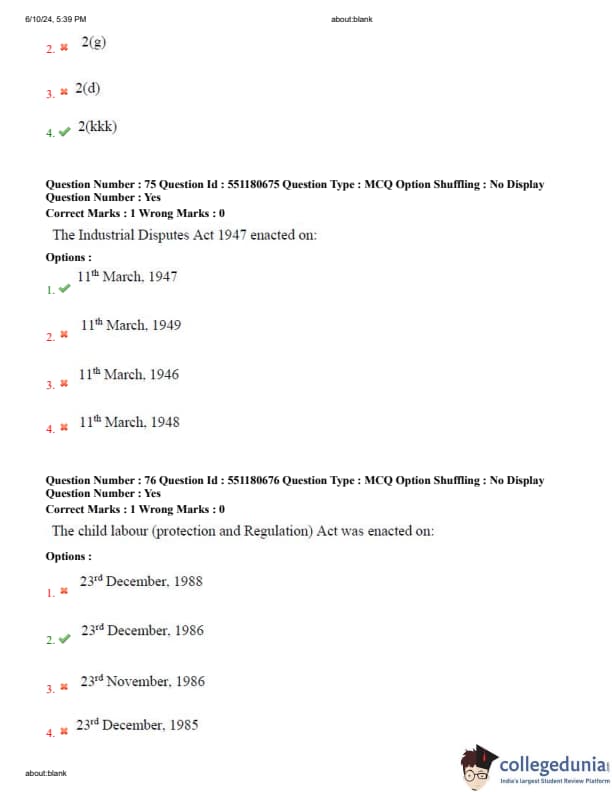
Question 74:
The expression ‘Lay-off’ is defined in section:
- (A) 2(aaa)
- (B) 2(z)
- (C) 2(d)
- (D) 2(kk)
Question 75:
The Industrial Disputes Act 1947 enacted on:
- (A) 11th March, 1947
- (B) 11th March, 1949
- (C) 11th March, 1946
- (D) 11th March, 1948
Question 76:
The Child Labour (Protection and Regulation) Act was enacted on:
- (A) 23rd December, 1988
- (B) 23rd December, 1986
- (C) 23rd November, 1986
- (D) 23rd December, 1985
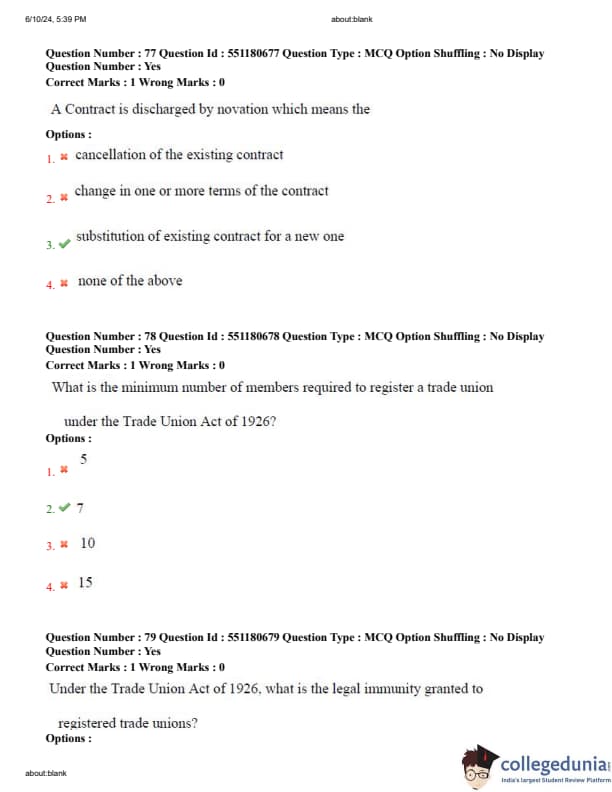
Question 77:
A Contract is discharged by novation which means the
- (A) Cancellation of the existing contract
- (B) Change in one or more terms of the contract
- (C) Substitution of existing contract for a new one
- (D) None of the above
Question 78:
What is the minimum number of members required to register a trade union under the Trade Union Act of 1926?
- (A) 5
- (B) 7
- (C) 10
- (D) 15
Question 79:
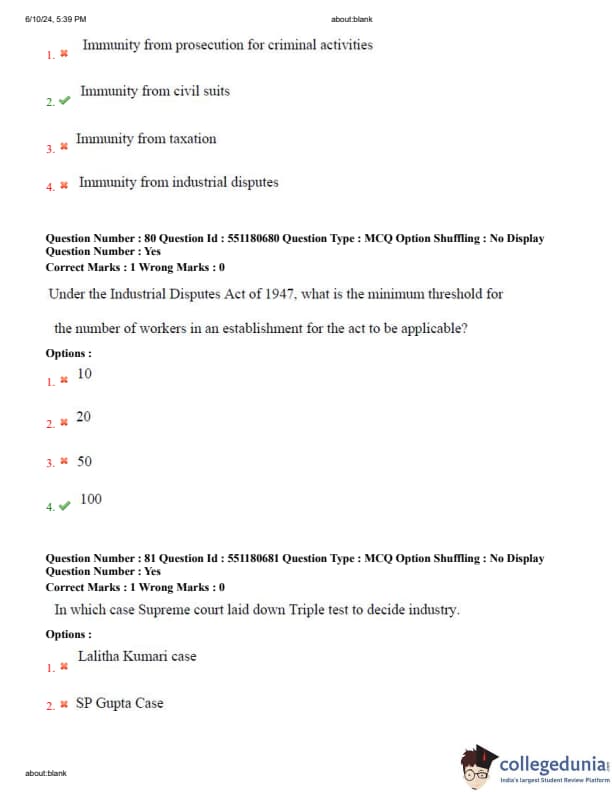
Under the Trade Union Act of 1926, what is the legal immunity granted to registered trade unions?
- (A) Immunity from prosecution for criminal activities
- (B) Immunity from civil suits
- (C) Immunity from taxation
- (D) Immunity from industrial disputes
Question 80:
Under the Industrial Disputes Act of 1947, what is the minimum threshold for the number of workers in an establishment for the act to be applicable?
- (A) 10
- (B) 20
- (C) 50
- (D) 100
Question 81:
In which case Supreme Court laid down Triple Test to decide industry?
- (A) Lalitha Kumari case
- (B) SP Gupta Case
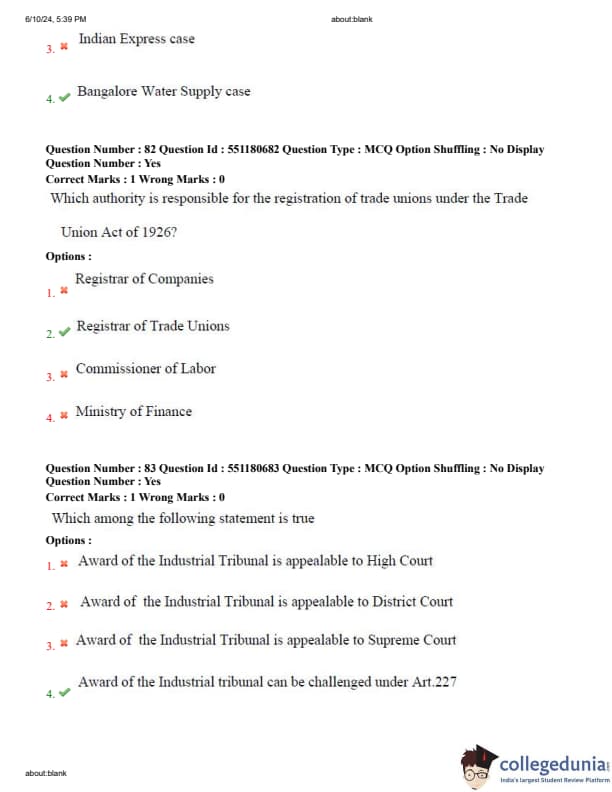
- (C) Bangalore Water Supply case
- (D) Maneka Gandhi Case
Question 82:
Which authority is responsible for the registration of trade unions under the Trade Union Act of 1926?
- (A) Registrar of Companies
- (B) Registrar of Trade Unions
- (C) Commissioner of Labor
- (D) Ministry of Finance
Question 83:
Which among the following statement is true?
- (A) Award of the Industrial Tribunal is appealable to High Court
- (B) Award of the Industrial Tribunal is appealable to District Court
- (C) Award of the Industrial Tribunal is appealable to Supreme Court
- (D) Award of the Industrial Tribunal is not appealable
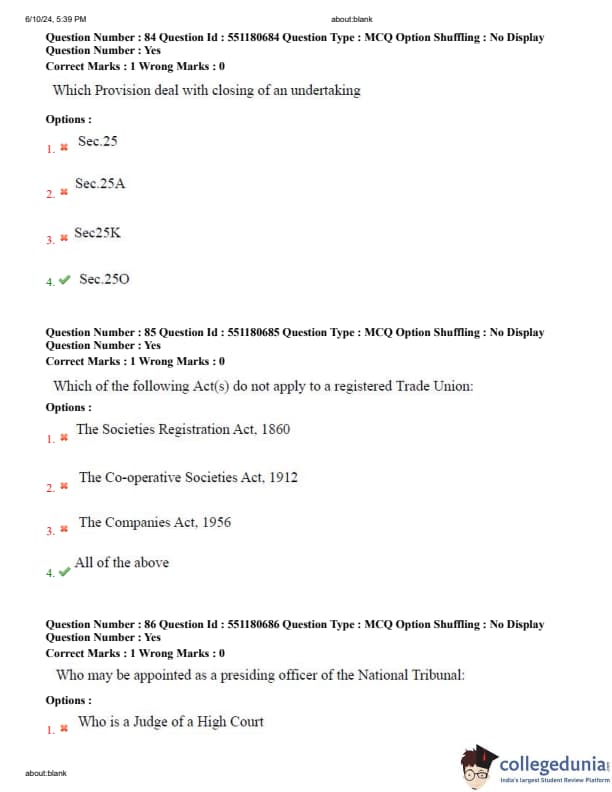
Question 84:
Which Provision deals with closing of an undertaking?
- (A) Sec. 25
- (B) Sec. 25A
- (C) Sec. 25K
- (D) Sec. 25O
Question 85:
Which of the following Act(s) do not apply to a registered Trade Union?
- (A) The Societies Registration Act, 1860
- (B) The Co-operative Societies Act, 1912
- (C) The Companies Act, 1956
- (D) All of the above
Question 86:
Who may be appointed as a presiding officer of the National Tribunal?
- (A) Who is a Judge of a High Court
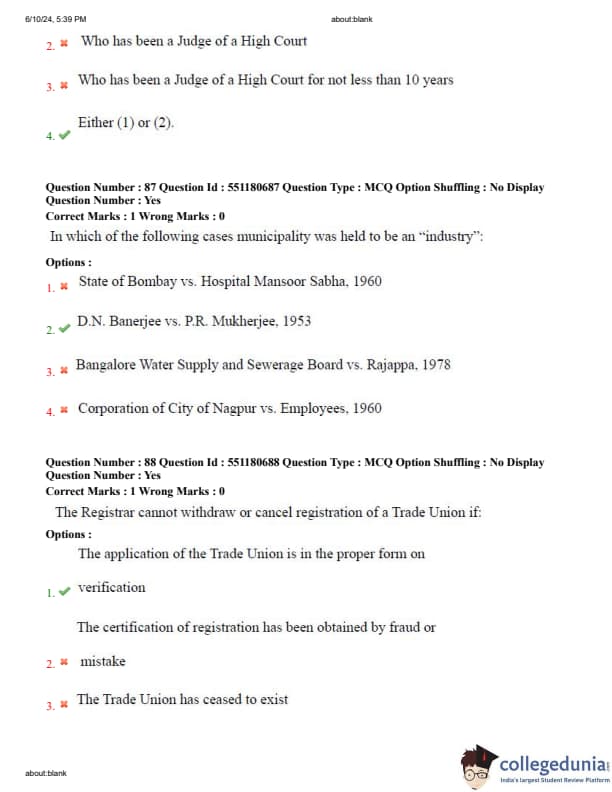
- (B) Who has been a Judge of a High Court
- (C) Who has been a Judge of a High Court for not less than 10 years
- (D) Either (1) or (2)
Question 87:
In which of the following cases municipality was held to be an “industry”?
- (A) State of Bombay vs. Hospital Mazdoor Sabha, 1960
- (B) D.N. Banerjee vs. P.R. Mukherjee, 1953
- (C) Bangalore Water Supply and Sewerage Board vs. Rajappa, 1978
- (D) Corporation of City of Nagpur vs. Employees, 1960
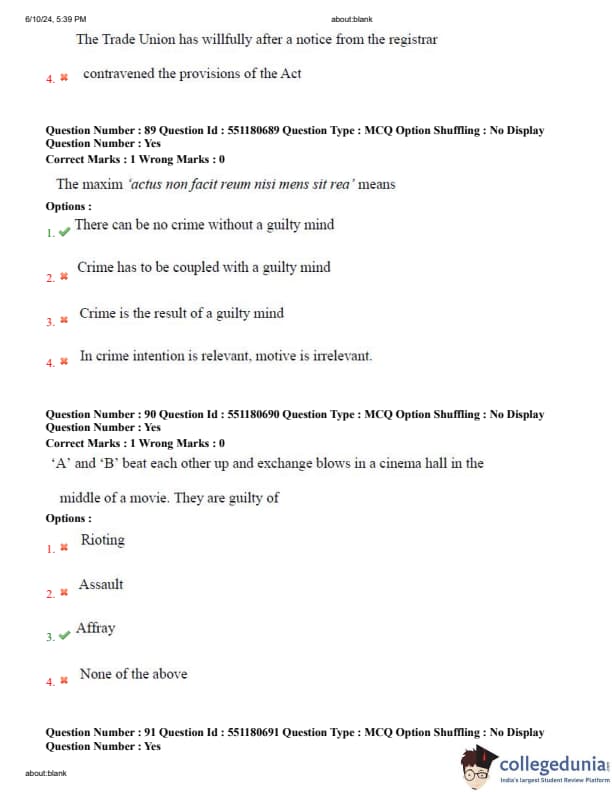
Question 88:
The Registrar cannot withdraw or cancel registration of a Trade Union if:
- (A) The application of the Trade Union is in the proper form on verification
- (B) The certification of registration has been obtained by fraud or mistake
- (C) The Trade Union has ceased to exist
- (D) The Trade Union has willfully after a notice from the registrar contravened the provisions of the Act
Question 89:
The maxim ‘actus non facit reum nisi mens sit rea’ means
- (A) There can be no crime without a guilty mind
- (B) Crime has to be coupled with a guilty mind
- (C) Crime is the result of a guilty mind
- (D) In crime intention is relevant, motive is irrelevant
Question 90:
‘A’ and ‘B’ beat each other up and exchange blows in a cinema hall in the middle of a movie. They are guilty of
- (A) Rioting
- (B) Assault
- (C) Affray
- (D) None of the above
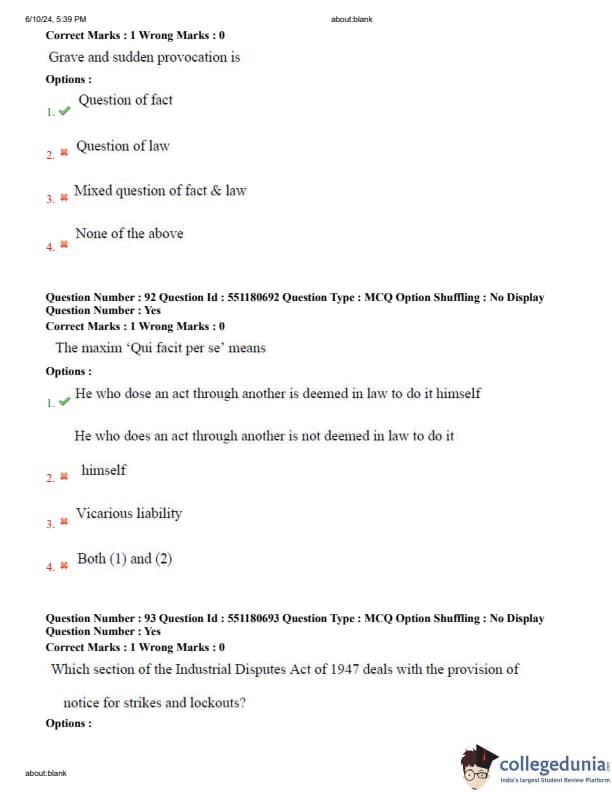
Question 91:
Grave and sudden provocation is
- (A) Question of fact
- (B) Question of law
- (C) Mixed question of fact \& law
- (D) None of the above
Question 92:
The maxim ‘Qui facit per se’ means
- (A) He who does an act through another is deemed in law to do it himself
- (B) He who does an act through another is not deemed in law to do it himself
- (C) Vicarious liability
- (D) Both (1) and (2)
Question 93:
Which section of the Industrial Disputes Act of 1947 deals with the provision of notice for strikes and lockouts?
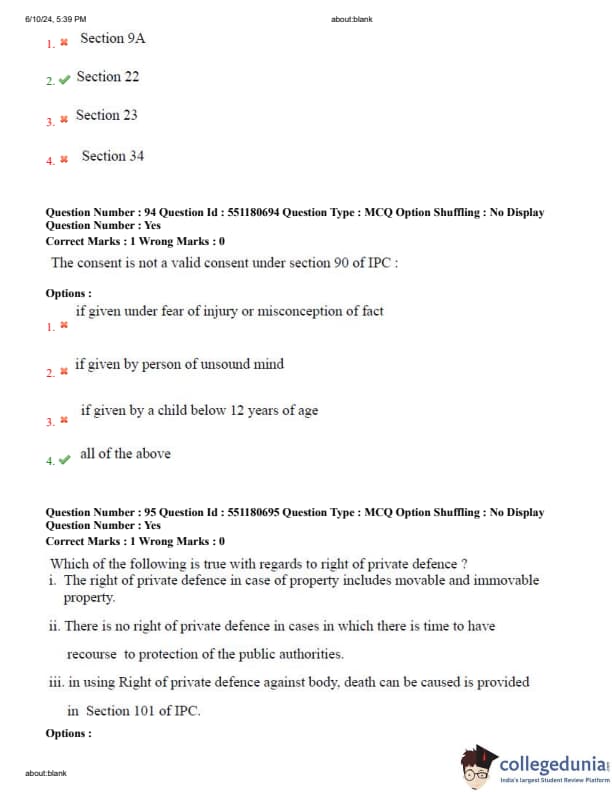
- (A) Section 9A
- (B) Section 22
- (C) Section 23
- (D) Section 34
Question 94:
The consent is not a valid consent under section 90 of IPC:
- (A) If given under fear of injury or misconception of fact
- (B) If given by person of unsound mind
- (C) If given by a child below 12 years of age
- (D) All of the above
Question 95:
Which of the following is true with regards to right of private defence?
- (A) Only i
- (B) i and ii
- (C) i and iii
- (D) Only iii
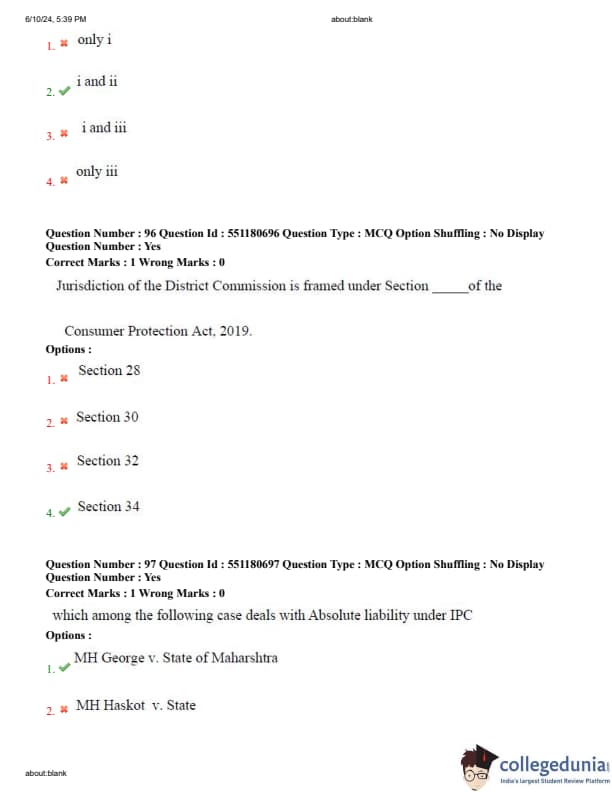
Question 96:
Jurisdiction of the District Commission is framed under Section of the Consumer Protection Act, 2019.
- (A) Section 28
- (B) Section 30
- (C) Section 32
- (D) Section 34
Question 97:
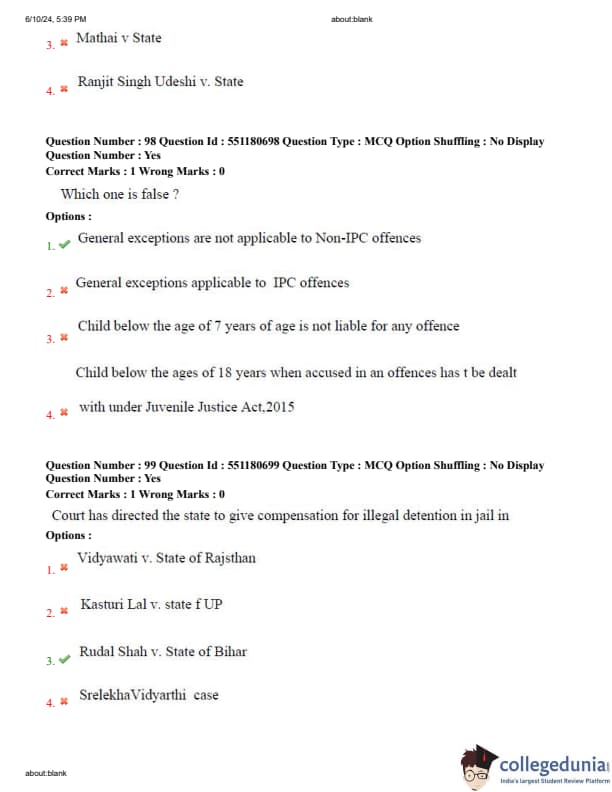
Which among the following case deals with Absolute liability under IPC?
- (A) MH George v. State of Maharashtra
- (B) MH Haskot v. State
- (C) Mathai v. State
- (D) Ranjit Singh Udeshi v. State
Question 98:
Which one is false?
- (A) General exceptions are not applicable to Non-IPC offences
- (B) General exceptions applicable to IPC offences
- (C) Child below the age of 7 years of age is not liable for any offence
- (D) Child below the ages of 18 years when accused in an offence has to be dealt with under Juvenile Justice Act, 2015
Question 99:
Court has directed the state to give compensation for illegal detention in jail in
- (A) Vidyawati v. State of Rajasthan
- (B) Kasturi Lal v. State of UP
- (C) Rudal Shah v. State of Bihar
- (D) Srelekha Vidyarthi case
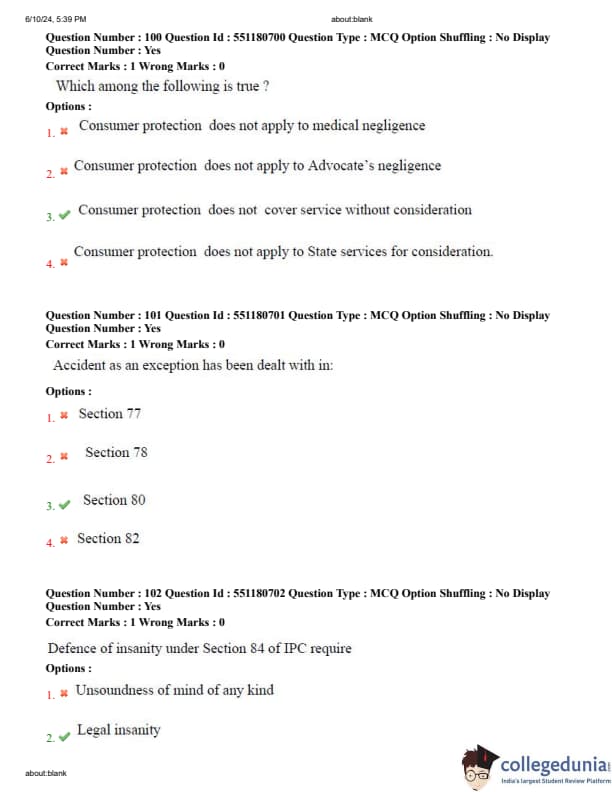
Question 100:
Which among the following is true?
- (A) Consumer protection does not apply to medical negligence
- (B) Consumer protection does not apply to Advocate’s negligence
- (C) Consumer protection does not apply to State services for consideration
- (D) None of the above
Question 101:
Accident as an exception has been dealt with in:
- (A) Section 77
- (B) Section 78
- (C) Section 80
- (D) Section 82
Question 102:
Defence of insanity under Section 84 of IPC requires
- (A) Unsoundness of mind of any kind
- (B) Legal insanity
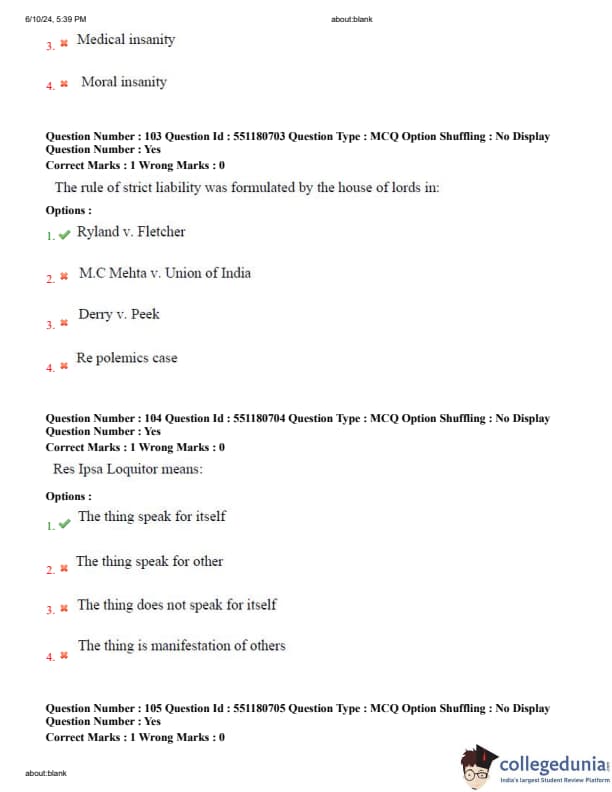
- (C) Medical insanity
- (D) Moral insanity
Question 103:
The rule of strict liability was formulated by the House of Lords in:
- (A) Rylands v. Fletcher
- (B) M.C. Mehta v. Union of India
- (C) Derry v. Peek
- (D) Re Polemis case
Question 104:
Res Ipsa Loquitur means:
- (A) The thing speaks for itself
- (B) The thing speaks for other
- (C) The thing does not speak for itself
- (D) The thing is manifestation of others
Question 105:
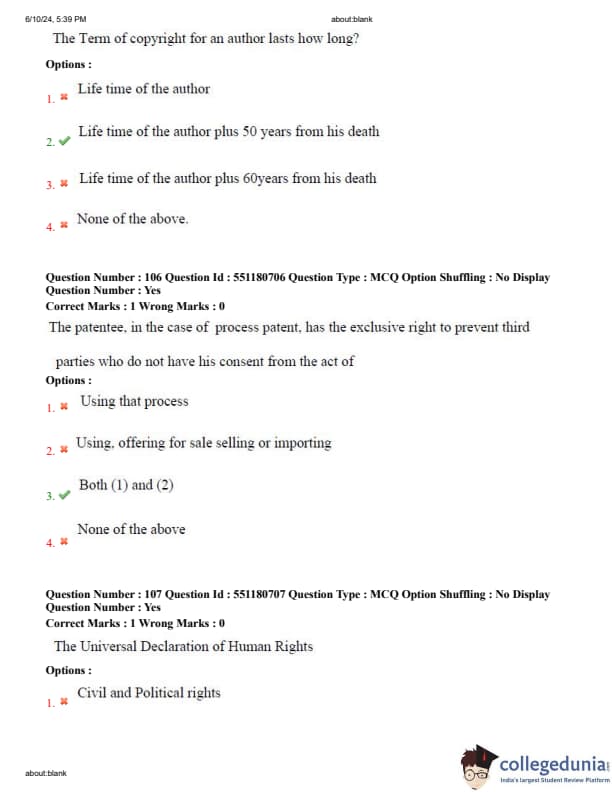
The Term of copyright for an author lasts how long?
- (A) Lifetime of the author
- (B) Lifetime of the author plus 50 years from his death
- (C) Lifetime of the author plus 60 years from his death
- (D) None of the above
Question 106:
The patentee, in the case of process patent, has the exclusive right to prevent third parties who do not have his consent from the act of
- (A) Using that process
- (B) Using, offering for sale, selling or importing
- (C) Both (1) and (2)
- (D) None of the above
Question 107:
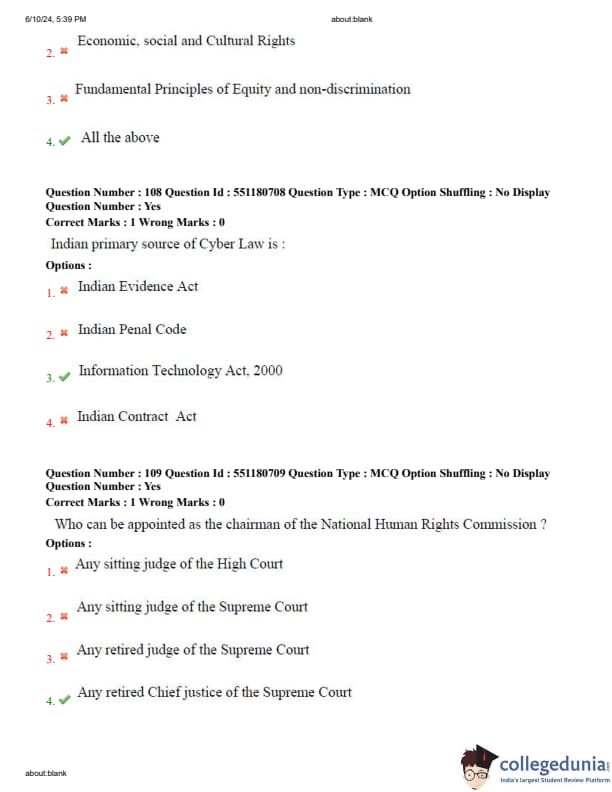
The Universal Declaration of Human Rights
- (A) Civil and Political rights
- (B) Economic, social and Cultural Rights
- (C) Fundamental Principles of Equity and non-discrimination
- (D) All the above
Question 108:
Indian primary source of Cyber Law is:
- (A) Indian Evidence Act
- (B) Indian Penal Code
- (C) Information Technology Act, 2000
- (D) Indian Contract Act
Question 109:
Who can be appointed as the chairman of the National Human Rights Commission?
- (A) Any sitting judge of the High Court
- (B) Any sitting judge of the Supreme Court
- (C) Any retired judge of the Supreme Court
- (D) Any retired Chief Justice of the Supreme Court
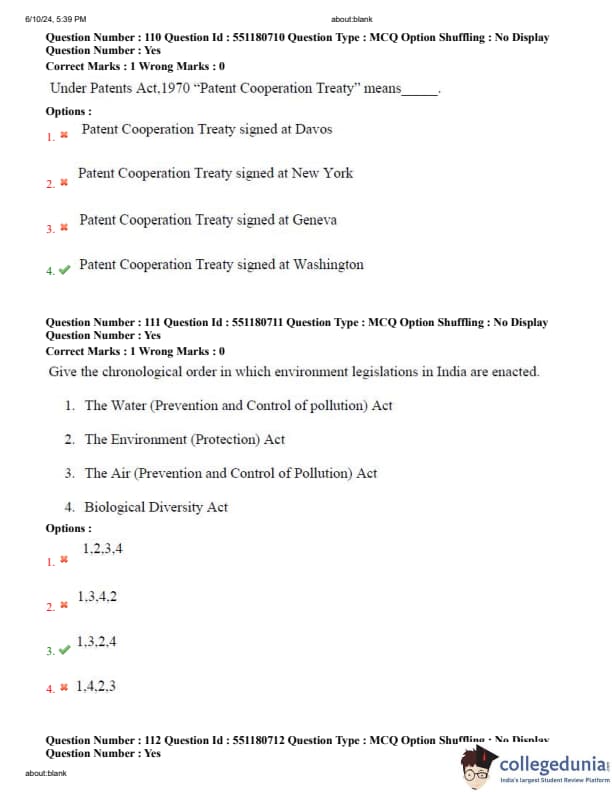
Question 110:
Under Patents Act, 1970 “Patent Cooperation Treaty” means
- (A) Patent Cooperation Treaty signed at Davos
- (B) Patent Cooperation Treaty signed at New York
- (C) Patent Cooperation Treaty signed at Geneva
- (D) Patent Cooperation Treaty signed at Washington
Question 111:
Give the chronological order in which environment legislations in India are enacted.
- (A) 2, 3, 4
- (B) 1, 3, 4, 2
- (C) 1, 3, 2, 4
- (D) 1, 4, 2, 3
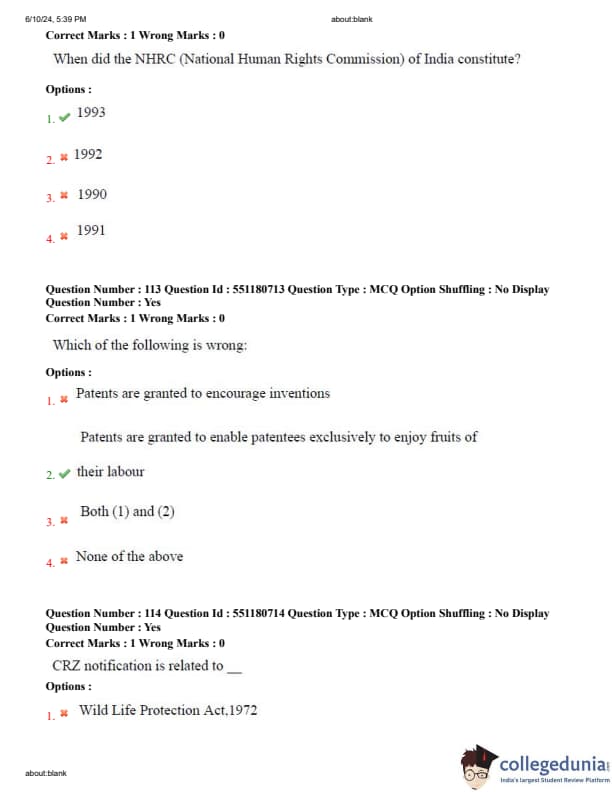
Question 112:
When did the NHRC (National Human Rights Commission) of India constitute?
- (A) 1993
- (B) 1992
- (C) 1990
- (D) 1991
Question 113:
Which of the following is wrong:
- (A) Patents are granted to encourage inventions
- (B) Patents are granted to enable patentees exclusively to enjoy fruits of their labour
- (C) Both (1) and (2)
- (D) None of the above
Question 114:
CRZ notification is related to
- (A) Wild Life Protection Act, 1972
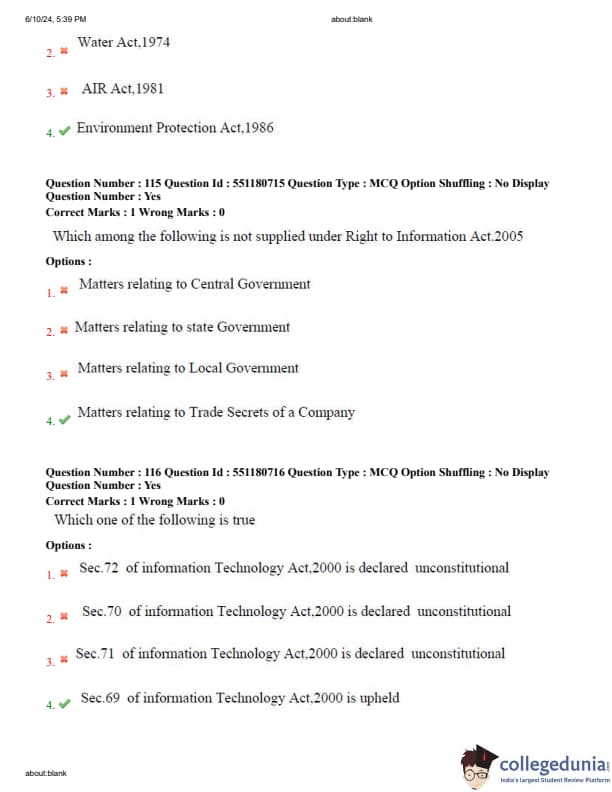
- (B) Water Act, 1974
- (C) Air Act, 1981
- (D) Environment Protection Act, 1986
Question 115:
Which among the following is not supplied under Right to Information Act, 2005
- (A) Matters relating to Central Government
- (B) Matters relating to State Government
- (C) Matters relating to Local Government
- (D) Matters relating to Trade Secrets of a Company
Question 116:
Which one of the following is true
- (A) Sec. 72 of Information Technology Act, 2000 is declared unconstitutional
- (B) Sec. 70 of Information Technology Act, 2000 is declared unconstitutional
- (C) Sec. 71 of Information Technology Act, 2000 is declared unconstitutional
- (D) Sec. 69 of Information Technology Act, 2000 is upheld
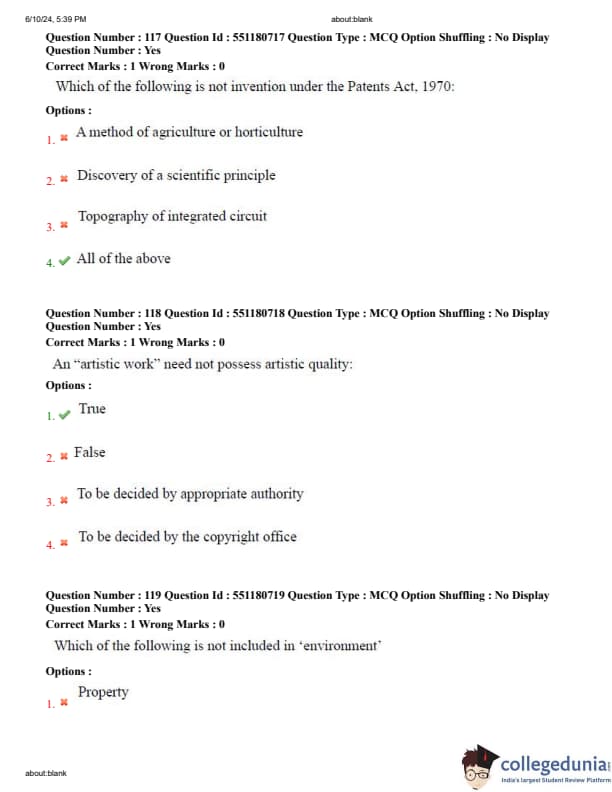
Question 117:
Which of the following is not invention under the Patents Act, 1970:
- (A) A method of agriculture or horticulture
- (B) Discovery of a scientific principle
- (C) Topography of integrated circuit
- (D) All of the above
Question 118:
An “artistic work” need not possess artistic quality:
- (A) True
- (B) False
- (C) To be decided by appropriate authority
- (D) To be decided by the copyright office
Question 119:
Which of the following is not included in ‘environment’
- (A) Property
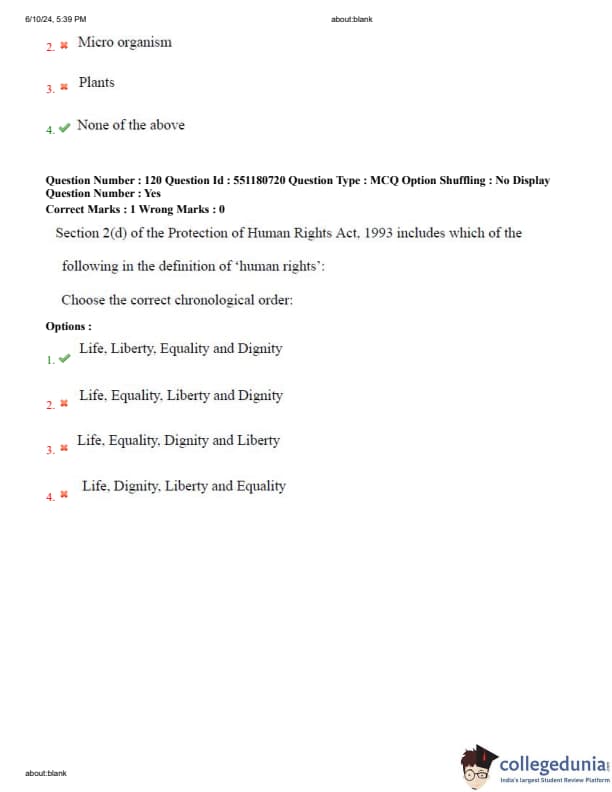
- (B) Micro organism
- (C) Plants
- (D) None of the above
Question 120:
Section 2(d) of the Protection of Human Rights Act, 1993 includes which of the following in the definition of ‘human rights’:
- (A) Life, Liberty, Equality and Dignity
- (B) Life, Equality, Liberty and Dignity
- (C) Life, Equality, Dignity and Liberty
- (D) Life, Dignity, Liberty and Equality
AP PGLCET Previous Year Question Paper with Answer Key PDFs
Similar Law Exam Question Papers:









Comments