




TISSNET, was an entrance exam conducted by Tata Institute of Social Sciences (TISS) at the all-India level for admission to its various postgraduate programs. However, from the 2023-24 academic session, TISS has adopted the CUET-PG for Postgraduate programs and CAT scores for a few courses, where the TISSNET exam is no more applicable.
TISSNET (HUQP22 - Sociology, Peace and Conflict Studies and Management) Question Paper With Solution PDF is available here.
TISSNET Sociology, Peace and Conflict Studies and Management Question Paper 2024 PDF Download
| TISSNET Sociology Question Paper 2024 with Answer Key |  Download Download |
Check Solutions |
TISSNET Sociology 2024 Questions with Solutions
Question 1:
C. W. Mills coined the term _______
View Solution
Step 1: C. W. Mills, a prominent sociologist, coined the term "Sociological Imagination." This term became a central concept in sociology, referring to the ability to understand the intricate relationship between individual experiences and the broader societal forces that shape those experiences.
Step 2: Mills introduced the term in his influential 1959 book titled The Sociological Imagination. According to Mills, the sociological imagination allows individuals to see beyond their personal circumstances and recognize the connection between individual lives and the larger societal context.
Step 3: The term is essential in sociological theory because it encourages individuals to think critically about how society influences personal choices, behaviors, and experiences. Mills emphasized that by developing this perspective, individuals can better understand the social forces that shape their lives, such as class, culture, and politics.
Step 4: It is not to be confused with "Sociology" (which is the broader field of study) or other concepts like "Social Structure" or "Empathy," which have different meanings in sociological discourse. Quick Tip: The Sociological Imagination helps individuals understand how personal problems are often tied to larger societal issues. It's a powerful tool for analyzing the interplay between individual lives and the societal structures they inhabit.
According to Auguste Comte, the three stages of society's development are:
View Solution
Step 1: Auguste Comte, often regarded as the father of sociology, proposed a theory of the development of human societies through three stages. These stages represent the evolution of human thought and society's understanding of the world:
Theological Stage: This is the first stage in Comte’s model. People in this stage explain phenomena through religious beliefs and divine intervention. Society is organized around religious authority, and individuals interpret the world in terms of supernatural forces or gods controlling events.
Metaphysical Stage: In this stage, people start to shift away from supernatural explanations and begin relying on abstract philosophical concepts. Here, abstract ideas such as "nature," "essence," or "cause" are invoked to explain natural phenomena, but without the rigorous scientific methods that would come later.
Positive Stage: The final stage in Comte's theory is characterized by the application of scientific methods. In this stage, society moves away from religious and philosophical explanations and instead adopts empirical reasoning and scientific observation to understand the world. It emphasizes facts and evidence over belief or philosophy.
Step 2: The correct answer is option (2) Theological, Metaphysical, Positive, as these are the three stages that Comte outlined in his work. The other options do not correspond to Comte’s theory of social evolution. Quick Tip: Comte’s theory of the three stages emphasizes how human thought evolves from a religious and metaphysical understanding of the world to a more scientific and empirical approach.
G. H. Mead belonged to which school of thought?
View Solution
Step 1: George Herbert Mead was an influential American sociologist best known for his development of the theory of Symbolic Interactionism. This theory focuses on the micro-level of social interactions and emphasizes the role of symbols and language in shaping human behavior.
Step 2: Symbolic Interactionism asserts that individuals develop and rely upon social symbols, such as gestures, words, and language, to create meaning and engage with others. Mead's work contributed significantly to understanding how individuals interpret and respond to social cues in society.
Step 3: Mead’s ideas contrast with those in Conflict Theory (which focuses on power struggles and inequalities in society), Functionalism (which examines the stability and functioning of society as a whole), and Critical Theory (which critiques societal structures from a Marxist perspective). Mead’s work is firmly within the Symbolic Interactionism school of thought, which focuses on the roles of social interaction and symbols in society. Quick Tip: Symbolic Interactionism emphasizes the importance of symbols and face-to-face interactions in shaping individual identities and societal norms. It's central to understanding how social meanings are created and transmitted.
World Cup Cricket matches are watched by millions of viewers across the world at the same time. This is an example of:
View Solution
Step 1: The phenomenon of millions of viewers from different parts of the world watching a World Cup Cricket match simultaneously is an example of Globalisation.
Globalisation refers to the process through which people, cultures, goods, and ideas spread across the globe, creating interconnectedness. This involves the increasing interdependence of countries and the integration of markets, cultures, and communication systems worldwide.
Step 2: Globalisation enables events like World Cup Cricket matches to reach a global audience, regardless of geographical boundaries. The spread of media and communication technologies (like television, the internet, and social media) is a key aspect of globalisation, making it possible for people around the world to connect over common events.
Step 3: The other options are not correct because:
Urbanisation refers to the growth of cities and the movement of people from rural to urban areas.
Sanskritisation is a process of social change where lower castes adopt the practices of higher castes to improve their social status.
Socialisation is the process through which individuals learn and internalize the values and norms of society.
Quick Tip: Globalisation is a key driver of cultural exchange and global connectivity, often enhanced by advancements in communication and technology.
Who among the following developed the concept "Culture of Poverty"?
View Solution
Step 1: The concept of the "Culture of Poverty" was developed by Oscar Lewis, an American anthropologist and sociologist.
Step 2: Lewis introduced the concept in his works, particularly in his 1961 study of poor urban families. He argued that poverty is not just an economic condition but also a cultural one. According to Lewis, people living in poverty often develop a unique set of values, beliefs, and behaviors that perpetuate their disadvantaged status across generations.
Step 3: The other options do not apply to the development of the "Culture of Poverty" concept:
Emile Durkheim is known for his work on social solidarity and functionalism, not the culture of poverty.
Levi-Strauss was a structuralist anthropologist known for his work on mythology and kinship systems.
William Julius Wilson is known for his work on race and urban poverty, but he did not develop the concept of the "Culture of Poverty."
Quick Tip: Oscar Lewis’s "Culture of Poverty" concept focuses on the idea that poverty is perpetuated through cultural norms and behaviors that are passed down through generations, making it difficult to escape the cycle of poverty.
Social stratification based on ascription is:
View Solution
Step 1: Social stratification based on ascription refers to a system where an individual's social status is assigned at birth, rather than achieved through personal effort or merit. This is characteristic of the Caste system in India.
Step 2: The caste system is a form of stratification where social positions are assigned based on ascribed characteristics, such as birth, family, or hereditary traits. A person’s caste status is usually predetermined and remains fixed throughout their life.
Step 3: The other options do not apply because:
Meritocracy is a system where social status is achieved through individual effort, skills, and merit.
Class stratification is often based on economic factors such as wealth or occupation, not ascription.
Status refers to the prestige or respect associated with a particular social position, but it doesn’t directly define a system based on ascription.
Quick Tip: Caste is a prime example of a social system where status is largely ascribed, meaning individuals are born into a particular caste and typically remain within it throughout their lives.
Which Indian sociologist coined the term "Sanskritisation"?
View Solution
Step 1: The concept of Sanskritisation was coined by M. N. Srinivas, a prominent Indian sociologist. It refers to the process by which lower castes or tribes adopt the practices, rituals, and beliefs of higher castes, particularly the Brahmins, in an attempt to improve their social status.
Step 2: In his research, Srinivas observed that many lower castes in India sought to emulate the cultural practices and rituals of the dominant castes, hoping to gain social and economic benefits. Sanskritisation is seen as a means of upward social mobility, often achieved by adopting vegetarianism, Hindu rituals, and other upper-caste customs.
Step 3: The other options are not correct because:
G. S. Ghurye is known for his contributions to Indian sociology but did not coin the term Sanskritisation.
Andre Beteille is known for his work on caste and social stratification but not for Sanskritisation.
Yogendra Singh is another Indian sociologist who worked on caste and social change but did not coin this term. Quick Tip: Sanskritisation is a significant concept in understanding social mobility and caste dynamics in India, highlighting how lower castes try to improve their status by adopting higher caste cultural norms.
Who coined the terms "Little Tradition" and "Great Tradition"?
View Solution
Step 1: The terms "Little Tradition" and "Great Tradition" were coined by Robert Redfield, a renowned American anthropologist.
Step 2: Redfield used these terms to distinguish between two levels of culture in society.
Great Tradition refers to the elite or formal traditions, often associated with educated or ruling classes, including religious practices, philosophical ideas, and scholarly traditions.
Little Tradition refers to the local, informal, and folk traditions that exist within specific communities, typically practiced by the common people.
Step 3: The other options are not correct because:
Herbert Spencer is known for his work on social evolution but did not coin these terms.
Radcliffe-Brown and Malinowski are both prominent anthropologists known for their work on structural-functionalism and fieldwork methods, respectively, but they did not coin these terms. Quick Tip: Redfield's concept of "Little Tradition" and "Great Tradition" highlights the distinction between formal, elite cultural practices and informal, everyday cultural traditions in society.
Worshiping of Goddess Laxmi during Diwali is a widespread practice in India. This is an example of:
View Solution
Step 1: The worship of Goddess Laxmi during Diwali is a widespread practice in India and reflects the concept of Universalisation in sociological terms.
Step 2: Universalisation refers to the process through which a particular practice or belief, initially specific to a particular culture or society, becomes adopted more widely across different societies or regions. In this case, the worship of Goddess Laxmi during Diwali, which started as a specific cultural practice, has become a universal tradition across various parts of India and even in some regions outside India, among Indian diaspora communities.
Step 3: The other options are not correct because:
Parochialisation refers to a narrowing or restricting of cultural practices to a particular region or group.
Westernisation refers to the adoption of Western culture and practices, which is not relevant to the worship of Goddess Laxmi.
Modernisation refers to the transformation of society through the adoption of modern technologies, systems, and practices, but it doesn’t specifically apply to religious traditions.
Quick Tip: Universalisation involves the spread and acceptance of cultural practices, making them widespread across different societies, as seen in the global practice of worshiping Goddess Laxmi during Diwali.
In order to study the political attitude of Indian population, a researcher uses sampling techniques. Which among these is not feasible in sampling?
View Solution
Step 1: Sampling is a technique used to select a subset of individuals from a population for study. The goal is to draw conclusions about the entire population based on the sample.
Step 2: The correct option is (2) Study the responses from each and every individual of the population, as this is not feasible in sampling. Sampling is about studying a smaller, representative portion of the population, not every individual.
Step 3: The other options are feasible and true for sampling:
- Sampling must be representative (Option 1): The sample must accurately reflect the population in order to make valid inferences.
- Every individual of the population has the same probability of being selected (Option 3): This is the principle of random sampling.
- Generalisation can be drawn based on small proportion of the population (Option 4): This is the fundamental principle behind sampling — generalising results from the sample to the broader population. Quick Tip: Sampling techniques are used to reduce costs and time when studying large populations. The key is ensuring the sample is representative of the population.
Which among these is a disadvantage of the survey method?
View Solution
Step 1: Analyzing the options.
Option 1: The ability to quantify and analyze data is an \textit{advantage, not a disadvantage.
Option 2: The fact that surveys, especially large-scale ones, require significant time and resources is a major \textit{disadvantage.
Option 3: The ability to study a large number of respondents is a key \textit{advantage of surveys.
Option 4: While surveys can be designed based on the scientific method, this is generally considered a \textit{strength or at least not a disadvantage in itself. It doesn't inherently create a problem. Quick Tip: Think about the practical challenges of conducting surveys. Consider factors like design, distribution, collection, and analysis of responses.
Which method is an attempt to test a hypothesis under highly controlled conditions established by the researcher?
View Solution
The Experiment Method is designed to test hypotheses under highly controlled conditions. In experimental research, the researcher manipulates one or more independent variables to observe the effect on a dependent variable, while controlling for other variables to eliminate bias or external influence. This method is commonly used to determine cause-and-effect relationships between variables.
Steps involved in the experimental method:
1. Formulate a Hypothesis: Based on prior research or observations, a researcher proposes a hypothesis that predicts a relationship between variables.
2. Design the Experiment: The researcher designs the experiment, carefully selecting the independent variable(s) to manipulate and ensuring all other variables are controlled. This can include selecting participants, establishing control groups, and determining the environment in which the experiment takes place.
3. Conduct the Experiment: The independent variable is manipulated, and the dependent variable is observed and measured. Control groups or randomized trials are often used to avoid confounding variables.
4. Analyze Data: After collecting data, statistical analysis is used to determine whether the results support the hypothesis.
5. Draw Conclusions: Based on the findings, the researcher draws conclusions about the relationship between variables. This may lead to further research or modifications to the hypothesis.
The controlled conditions ensure that any observed changes in the dependent variable are directly attributable to the manipulation of the independent variable, rather than to extraneous factors.
In contrast, the other methods listed (Survey, Life Histories, and Ethnographic) involve less control over external factors and do not focus on testing causal relationships under controlled conditions. Quick Tip: Experimental research is powerful because it allows for causal inferences, but it requires rigorous control to avoid biases. Random assignment to groups is one way to achieve control.
Which among these are features of a globalised economy?
(A). Global commodity chains
(B). Transnational capital
(C). Global financial markets
(D). Subsistence economy
Choose the correct answer from the options given below:
View Solution
A globalised economy refers to an interconnected global system where economies, markets, and industries are linked across national borders. The following features are characteristic of such an economy:
1. Global Commodity Chains: This refers to the networks of production and trade in goods and services that span the globe. Products are often made in different countries, with each country specializing in a specific part of the production process, from raw materials to manufacturing and distribution.
2. Transnational Capital: Refers to capital (e.g., money, investments) that flows across national borders to take advantage of opportunities in other countries. This includes multinational corporations operating in several countries, often driving foreign direct investment (FDI).
3. Global Financial Markets: These are interconnected financial systems that allow the flow of capital across countries. This includes stock markets, currency markets, and international banking systems that operate globally, facilitating investment, trade, and economic activities.
However, a subsistence economy (Option D) is not a feature of a globalised economy. It refers to an economy where people primarily produce goods for their own use rather than for trade or profit, which is largely non-globalized.
Thus, the correct features of a globalized economy are (A), (B), and (C), making option (2) the correct answer. Quick Tip: Globalization leads to the integration of markets, which results in economic interdependence between countries. This makes national economies more sensitive to global economic fluctuations.
Choose the concepts associated with development of 'self' as conceived by Mead:
(A). Preparatory stage
(B). Super-Ego
(C). Play stage
(D). Game stage
Choose the correct answer from the options given below:
View Solution
The development of the 'self' as conceived by George Herbert Mead involves several stages of socialization where individuals learn to understand themselves in relation to others. Mead proposed that the self develops through interaction with others and is influenced by role-taking in various stages of life. The key stages are:
1. Preparatory Stage: This is the earliest stage of development where children mimic the behavior of others around them. During this stage, they do not fully understand the roles they are imitating but begin to learn the basic symbols of social interaction.
2. Play Stage: In this stage, children start to take on the roles of significant others (such as family members or friends) and act out behaviors associated with those roles. They engage in role-playing, but they may not yet understand the complex nature of these roles.
3. Game Stage: In this stage, children begin to understand the complexity of societal roles. They learn to take on multiple roles at once and understand how their actions interact with others' roles in a social context, such as in team games.
Note: The Super-Ego is a concept developed by Sigmund Freud, not Mead, and is thus not part of Mead's theory of self-development. Quick Tip: Mead’s concept of the 'self' emphasizes the social nature of identity formation. The development of self requires both interaction and the ability to see oneself from the perspective of others.
Which among these is NOT a characteristic of modernity?
View Solution
Modernity is typically characterized by various social, cultural, and economic transformations that lead to the development of advanced, industrialized, and urbanized societies. These include:
1. Increasing role of science and technology: Modern societies are marked by advancements in science and technology, which drive economic growth, innovation, and a more complex social structure.
2. Urbanisation: The process of moving from rural areas to cities is a key feature of modernity, as it reflects the development of infrastructure, industry, and trade.
3. Industrialisation: The rise of industry, factories, and mechanization is central to modernity, which enables mass production and economic growth.
Bonded labour, on the other hand, is a practice often associated with pre-modern or underdeveloped societies and is considered a violation of human rights. It does not characterize modernity, as modern societies aim to eliminate such practices through legal frameworks and human rights reforms. Quick Tip: Modernity is often associated with the Enlightenment period and the rise of rational thought, which led to the development of democratic institutions and economic systems based on free markets.
In statistical techniques, _______ is the figure that occurs most frequently in a given set of data?
View Solution
The Mode is the statistical measure that represents the value that occurs most frequently in a data set. Unlike the mean (average) or median (middle value), the mode is specifically concerned with frequency. It can be used for both numerical and categorical data.
Mean: The average of all data points, but it is not necessarily the most frequent value.
Median: The middle value when the data is arranged in ascending or descending order, but it is not concerned with frequency.
Mode: The most frequently occurring value in the data set, making it the correct answer.
Quick Tip: If there are multiple values that appear with the same highest frequency, the dataset is considered multimodal.
According to Durkheim, which is the closest alternative to the experimental method?
View Solution
Durkheim, in his sociological research, emphasized the use of methods that could be as objective and systematic as the experimental method used in natural sciences. The Comparative method involves comparing different societies or social phenomena to identify general patterns and relationships. This method is seen as the closest alternative to the experimental method, as it allows researchers to draw conclusions about social facts across different contexts without directly manipulating variables.
Comparative method: Involves systematic comparison of different societies or phenomena, suitable for sociological research.
Historical method: Focuses on studying past events to understand current social phenomena but is not as directly comparable to the experimental method.
Verstehen: A concept developed by Max Weber, referring to understanding social action by putting oneself in the actor's shoes, which is more interpretive than experimental.
Case study method: Focuses on in-depth study of a single case, which doesn't directly mimic the controlled nature of an experiment. Quick Tip: The comparative method is useful in sociology because it helps identify common patterns across different social contexts, providing insights into the nature of social phenomena.
The discipline concerned with the study of the social aspect of ageing is:
View Solution
Social Gerontology is the discipline that focuses on the social aspects of aging, examining how aging affects individuals and societies. It looks at the experiences of older adults, their roles in society, and the social issues they face, such as healthcare, retirement, and elder care.
Social Gerontology: The study of aging from a sociological perspective, focusing on the challenges and social roles of older people.
Social Morphology: The study of the structure of social groups, not specifically focused on aging.
Social Anthropology: A broader discipline that examines human cultures and societies, not limited to aging.
Social Psychology: Focuses on individual behavior within social contexts, but does not specifically study aging. Quick Tip: Social gerontology often explores topics like ageism, the impact of aging on social relationships, and the policies affecting older populations.
Which among these are formal agencies of socialisation?
(A). Family
(B). School
(C). State
(D). Prison
Choose the correct answer from the options given below:
View Solution
Formal agencies of socialization refer to institutions that formally and systematically transmit social norms and values. These agencies play an active role in shaping an individual's behavior and societal roles.
School: A formal agency that educates individuals, teaching them academic knowledge as well as social skills like cooperation and discipline.
State: The state imposes laws and regulations that shape the behaviors and norms in society.
Prison: A formal institution that socializes individuals through punishment and rehabilitation, enforcing legal and societal norms.
While the Family is an essential agency of socialization, it is considered informal compared to the other more structured institutions. Quick Tip: Informal agencies of socialization include family, peers, and mass media, which influence social norms but without formal rules or regulations.
Who coined the term "Generalized Other"?
View Solution
The term "Generalized Other" was coined by George Herbert Mead, a key figure in the development of symbolic interactionism. It refers to the attitudes, viewpoints, and expectations of society as a whole that an individual uses to guide their behavior. The Generalized Other represents the collective norms and values that a person internalizes through socialization, helping them function as a member of society.
Cooley: Known for his concept of the Looking-Glass Self, which focuses on self-concept development through others' perceptions.
Goffman: Known for his work on the dramaturgical model of social interaction.
Blumer: Contributed to the development of symbolic interactionism, focusing on the role of symbols in social interaction. Quick Tip: The Generalized Other is part of Mead's stages of self-development, where individuals learn to take the perspective of society in general.
Tonnies's concept of Gemeinschaft is characterised by what kind of relationship?
View Solution
Gemeinschaft is a concept introduced by Ferdinand Tönnies to describe a type of social relationship found in traditional, close-knit communities. In such relationships, individuals are bound by personal ties, emotional bonds, and a sense of shared values and duties. These relationships are typically found in rural settings or small communities where people know each other personally.
Gemeinschaft contrasts with Gesellschaft, which refers to more impersonal, contractual relationships found in modern, urban societies where relationships are often based on individual goals and self-interest. Quick Tip: In Gemeinschaft, people are connected through a sense of common purpose and mutual understanding, often tied to family, tradition, or religion.
When a man marries more than one woman at the same time it is called:
View Solution
Polygyny is the term used when a man marries more than one woman at the same time. This is a form of polygamy, which involves having multiple spouses, but specifically refers to a man having multiple wives.
Polyandry refers to a woman having multiple husbands, the opposite of polygyny.
Monogamy is the practice of having only one spouse at a time, either in marriage or relationships.
Patriarchy refers to a social system in which men hold primary power and dominance, not related to marital practices. Quick Tip: Polygyny is more common in certain cultures and historical contexts, whereas polyandry is much rarer and often found in specific societies like those in Tibet.
Which among these is NOT a characteristic feature of scientific observation?
View Solution
Scientific observation is characterized by rigorous standards that ensure reliability, validity, and the production of knowledge that is universal and verifiable. The main characteristics of scientific observation include:
1. Objective: Scientific observation is impartial and free from personal bias.
2. Systematic: Observations are organized in a structured manner to ensure consistency and replicability.
3. Based on verifiable evidence: Scientific observations are grounded in data that can be verified through replication and peer review.
Common sense knowledge, however, is based on subjective experience and may vary from person to person. It is not systematically gathered or scientifically validated. Quick Tip: Scientific observation aims to eliminate personal biases and assumptions, unlike common sense knowledge, which is influenced by cultural norms and individual experiences.
When a man marries more than one woman at the same time it is called:
View Solution
Polygyny is the term used when a man marries more than one woman at the same time. This is a form of polygamy, which involves having multiple spouses, but specifically refers to a man having multiple wives.
- Polyandry refers to a woman having multiple husbands, the opposite of polygyny.
- Monogamy is the practice of having only one spouse at a time, either in marriage or relationships.
- Patriarchy refers to a social system in which men hold primary power and dominance, not related to marital practices. Quick Tip: Polygyny is more common in certain cultures and historical contexts, whereas polyandry is much rarer and often found in specific societies like those in Tibet.
Which among these is NOT a characteristic feature of scientific observation?
View Solution
Scientific observation is characterized by rigorous standards that ensure reliability, validity, and the production of knowledge that is universal and verifiable. The main characteristics of scientific observation include:
1. Objective: Scientific observation is impartial and free from personal bias.
2. Systematic: Observations are organized in a structured manner to ensure consistency and replicability.
3. Based on verifiable evidence: Scientific observations are grounded in data that can be verified through replication and peer review.
Common sense knowledge, however, is based on subjective experience and may vary from person to person. It is not systematically gathered or scientifically validated. Quick Tip: Scientific observation aims to eliminate personal biases and assumptions, unlike common sense knowledge, which is influenced by cultural norms and individual experiences.
Cultural pattern which is widespread among society's population is called:
View Solution
Popular culture refers to cultural patterns, practices, and products that are widespread and commonly embraced by society at large. It is the culture that is consumed by the masses, often influenced by media, entertainment, fashion, and mass production.
High culture refers to cultural practices associated with the elite or upper classes, often distinguished by sophistication, refinement, and intellectual pursuits.
Subculture refers to a group within a larger society that shares distinct cultural norms, values, and behaviors that differ from the mainstream.
Folk culture involves traditions, customs, and practices that are often rooted in rural communities and passed down through generations.
Quick Tip: Popular culture is highly dynamic, often changing with technological advancements, trends, and media influence.
Which among these is NOT a characteristic of a secondary group?
View Solution
Secondary groups are larger, more impersonal groups that are typically goal-oriented, with relationships being more formal and less emotionally involved compared to primary groups. These groups focus on achieving specific objectives or tasks rather than on the development of deep personal relationships.
Large in size or membership: Secondary groups tend to be large, such as professional organizations or work teams.
Social contacts are formal, segmental: In secondary groups, interactions are typically task-based and less personal.
Goal oriented: Secondary groups often have specific goals or tasks, such as achieving business objectives or completing academic coursework.
On the other hand, relationship-oriented is characteristic of primary groups, which are smaller, personal, and focused on close, emotional ties. Quick Tip: Secondary groups tend to have more instrumental relationships focused on achieving specific outcomes, whereas primary groups are more expressive and emotionally fulfilling.
Which among these is NOT a function of schooling?
View Solution
Schooling serves several functions in society, primarily contributing to the socialization of individuals, preparing them for adulthood, and integrating them into the broader societal structure. These functions include:
1. Socialisation: Schools teach students the norms, values, and behaviors expected in society, helping them understand how to function as members of the community.
2. Social placement: Schools serve as a mechanism for identifying and placing individuals in appropriate social or professional roles based on their abilities and achievements.
3. Social integration: Schools contribute to social cohesion by bringing together individuals from different backgrounds and teaching them to work together in a shared environment.
However, perpetuating social hierarchy and inequality is often considered a critique of the educational system. Critics argue that schools may reinforce existing social inequalities, particularly through differences in access to resources, curriculum, and opportunities based on socio-economic status. Quick Tip: While schools aim to provide equal opportunities for all, social stratification can still influence educational outcomes, reflecting broader societal inequalities.
Name the religion that believes that wind, mountains, and oceans are spiritual forces:
View Solution
Animism is a religious belief that attributes spiritual qualities to elements of the natural world, such as wind, mountains, and oceans. Adherents believe that not only animals and plants but also inanimate objects and natural phenomena possess a spiritual essence.
Buddhism: Focuses on spiritual development and the attainment of a deep insight into the true nature of life, but does not typically attribute spiritual forces to natural objects in the way animism does.
Judaism and Christianity: These monotheistic religions believe in a single God and do not typically view natural objects as having spiritual forces of their own, unlike animistic beliefs.
Quick Tip: Animism is considered one of the oldest beliefs, prevalent in many indigenous cultures around the world, reflecting a deeply ecological worldview.
Which among these are characteristics of ethnographic methods of data collection?
(A). Participant observation
(B). Adapted to meet the requirements of researchers with various viewpoints on the nature of social reality
(C). Generates in-depth information on the subjects under study
(D). Specific variables controlled by the researcher
Choose the correct answer from the options given below:
View Solution
Ethnographic methods of data collection are characterized by their qualitative approach to understanding cultural and social aspects by immersing in the community being studied. The key characteristics include:
Participant observation: Researchers become part of the community they study to observe and engage in their daily lives.
Adapted to meet the requirements of researchers with various viewpoints on the nature of social reality: Ethnography is flexible and can be adapted to suit different theoretical perspectives.
Generates in-depth information on the subjects under study: This method provides comprehensive insights into the behaviors, beliefs, and interactions within a community.
Controlling specific variables (Option D) is not typical of ethnographic methods, which are more about observing natural behaviors rather than controlling conditions or variables. Quick Tip: Ethnography often results in rich, detailed descriptions that can offer profound insights into a society's functions, rituals, and everyday life.
Who has written "The City"?
View Solution
Robert Park is one of the authors of "The City," a seminal work in the field of urban sociology, which was published as part of a collaborative effort with Ernest Burgess and Roderick McKenzie. The work details the social and environmental effects of urbanization and outlines a methodological approach to studying cities.
Quick Tip: "The City" is influential in defining the concept of urban ecology, an important part of how sociologists understand and analyze urban social structures.
A young woman, for assessing her salary, uses her co-workers of about the same age and experience as points of comparison. This group is called:
View Solution
A Reference group is a group that individuals use as a standard for evaluating themselves and their own behavior. This group influences a person's behavior and attitudes, regardless of whether an individual is a member of the group. In this case, the woman uses her co-workers as a reference group to assess her salary, comparing her earnings to those in similar positions and circumstances.
Quick Tip: Reference groups are essential for understanding social comparison processes, which influence many aspects of behavior, including job satisfaction and aspirations.
A small group of intimates which has strong in-group sentiments and interests is called:
View Solution
A Clique is a small, exclusive group of people known for its tight-knit, intimate relationships and strong in-group sentiments. Cliques are characterized by their selectivity in membership and strong internal solidarity, which distinguishes them from broader social groups.
Out-group: A group toward which an individual feels opposition or rivalry.
Reference group: Groups that individuals use as a standard for evaluating their own behavior.
Self-Help group: A group formed by individuals seeking to address personal or mutual concerns. Quick Tip: Cliques can significantly influence the social dynamics within larger groups, affecting patterns of communication and social interaction.
Which among these is NOT a characteristic of 'civil religion'?
View Solution
Civil religion refers to the set of religious beliefs, symbols, and rituals that are deeply integrated into a society's culture and that provide a sacred justification for its institutions and practices. Characteristics include:
Widely held beliefs throughout society: Represents common values that bind citizens.
Upheld by mainstream religious organisations: Often supported by existing religious structures as part of the social fabric.
Sustaining moral conduct in a democratic state: Encourages behaviors that align with democratic ideals.
The idea that it is practised among a minority population is incorrect as civil religion typically involves beliefs and practices that are widespread and generally accepted across the entire society, not just among a minority. Quick Tip: Civil religion plays a crucial role in national events and public rituals, often blending secular state affairs with religious overtones.
Arrange the stages of development of society as perceived by Karl Marx:
(A). Feudalism
(B). Primitive Commune
(C). Slave Society
(D). Capitalism
Choose the correct answer from the options given below:
View Solution
Karl Marx outlined a progressive series of stages in the development of economic systems that societies evolve through, which reflects changes in class structures and modes of production:
1. Primitive Commune: The initial stage characterized by communal ownership and absence of class distinctions.
2. Slave Society: A development where slavery becomes a central element of production.
3. Feudalism: A stage where landownership and serfdom define the economic system.
4. Capitalism: The final stage discussed by Marx, marked by private ownership and the class struggle between capitalists and workers.
This sequence, (B), (C), (A), (D), reflects Marx’s view of historical materialism, where the forces and relations of production shape societal structures. Quick Tip: Understanding Marx’s stages of societal development helps to frame the historical contexts of economic and social changes in terms of class struggles and the ownership of production means.
Who viewed religion as the "Opiate of the People"?
View Solution
Karl Marx famously described religion as the "opiate of the masses," suggesting that religion serves as a form of pain relief for the working class, dulling the pain of oppression under capitalism by promising a better life after death. Marx argued that religion is a tool used by the ruling classes to maintain control by providing false hope, which in turn discourages the proletariat from seeking social change. Quick Tip: Marx’s critique of religion was part of his broader analysis of capitalist society, where he believed economic forces played a central role in shaping human behavior and societal structures.
Which theory views that deviance and conformity result not so much from what people do as from how others respond to those actions?
View Solution
Labeling theory posits that deviance and conformity are not inherent in an act; rather, the definitions are imposed by others. This sociological perspective argues that individuals become deviant as a result of the labels that are imposed on them by society. According to this theory, people's reactions and interactions define certain behaviors as deviant or normal. Quick Tip: Labeling theory is particularly influential in understanding the societal reaction approach to deviance, emphasizing the role of social control agencies in creating deviants through labeling.
Who wrote 'Grundrisse'?
View Solution
Karl Marx is the author of 'Grundrisse', a collection of writings that outline his theories of the capitalist system, the dynamics of economic development, and the class relations that define such structures. 'Grundrisse', written between 1857 and 1858, is considered by many to be the groundwork for his later economic works, including 'Das Kapital'. Quick Tip: 'Grundrisse' is less well-known than 'Das Kapital' but provides a deeper insight into Marx’s philosophy and detailed critique of political economy, showing his workings and thoughts in process.
Strong ideas of right and wrong which require certain actions and forbid others is:
View Solution
Mores refer to the set of moral norms that are held in high esteem by a particular society. These norms are considered so vital to societal welfare and to the maintenance of order that they are often codified into law or are strongly supported by social consensus. The violation of mores is seen as particularly serious and can result in strong social sanctions.
Detailed characteristics of mores include:
Moral significance: Mores carry strong moral implications for what is deemed right or wrong within a society. They influence core ethical decisions and behaviors.
Social enforcement: Because they are so closely tied to the core values of a society, mores are often enforced through social mechanisms such as ostracism, shaming, or even legal penalties.
Cultural dependency: While all cultures have mores, the specific actions categorized as mores can vary widely from one culture to another. For example, issues related to marriage, fidelity, and honesty often involve widely accepted mores, but the specifics can differ across cultural boundaries.
Comparison with other options:
- Folkways are less stringent norms that dictate everyday behavior, such as dress codes or table manners. Unlike mores, folkways do not carry a moral component and their violation usually results in mild social reactions.
- Culture is a broader term that encompasses mores, folkways, values, customs, and material artifacts that together form a people's way of life.
- Values are abstract ideals that guide people’s behavior and choices, such as freedom, respect, and honesty. While values inform mores, they are less specific and not necessarily enforced by societal sanctions.
Quick Tip: Understanding mores within a cultural context is crucial for anyone looking to interact effectively across different societies, as what may be considered a minor infraction in one culture can be a major transgression in another.
Match List I with List II:
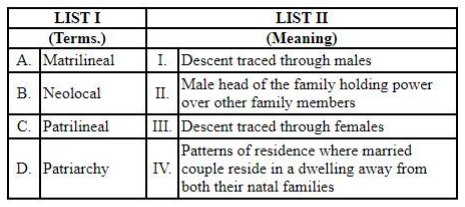
Choose the correct answer from the options given below:
View Solution
Matrilineal (A): Refers to a system where descent is traced through females. Correct match: (III) Descent traced through females.
Neolocal (B): Describes a residence pattern in which a newly married couple sets up its own home, away from both their families. Correct match: (IV) Patterns of residence where married couple reside in a dwelling away from both their natal families.
Patrilineal (C): Refers to a system where descent is traced through males. Correct match: (I) Descent traced through males.
Patriarchy (D): A social system in which males hold primary power, typically with authority over women and children. Correct match: (II) Male head of the family holding power over other family members. Quick Tip: Understanding these terms is crucial for comprehending different family structures and societal organization, which vary widely across cultures.
Integrating special students into the overall educational program is called:
View Solution
Mainstreaming is the practice of placing students with special education needs in regular education classrooms during specific time periods based on their skills. This approach aims to integrate them socially and academically into the general school environment, providing the same educational opportunities as for other students. Quick Tip: Mainstreaming promotes inclusivity and interaction among all students, which can benefit social skills and reduce stigmatization of special needs students.
Theda Skocpol developed a theory on the origin and nature of revolution where she studied three different revolutions under different historical contexts. Which two research methods would be suitable for such research?
(A). Experiment Method
(B). Comparative Method
(C). Historical Analysis
(D). Ethnographic Method
Choose the correct answer from the options given below:
View Solution
Theda Skocpol's research into the origins and nature of social revolutions employs a method that fits well with both Comparative Method and Historical Analysis:
- Comparative Method (B): Suitable for comparing different revolutions to identify common factors and varying outcomes across different historical settings.
- Historical Analysis (C): Essential for understanding the specific historical and social contexts of each revolution. Quick Tip: Using these methods allows researchers to grasp the complexity of revolutions, factoring in both broad patterns and unique historical contexts.
Which among these represents Ivan Illich's understanding of education and schooling?
(A). He developed a functionalist and liberal view on education
(B). He wrote Deschooling Society
(C). He considered schools having "Hidden Curriculum"
(D). He saw schools as repressive institutions
Choose the correct answer from the options given below:
View Solution
Ivan Illich's critiques of modern educational systems are well captured in:
- He wrote Deschooling Society (B): A seminal work where he argued for the deinstitutionalization of education.
- He considered schools having "Hidden Curriculum" (C): Where schools impart norms and values beyond the explicit teachings of the classroom.
- He saw schools as repressive institutions (D): Illich believed that schools reinforce a societal structure that is oppressive and manipulative. Quick Tip: Illich’s radical views on education challenge us to think about the real purposes of education and how it should be structured to truly benefit society.
Match List I with List II:
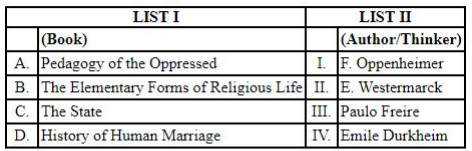
Choose the correct answer from the options given below:
View Solution
Pedagogy of the Oppressed (A): Written by Paulo Freire. This work discusses the concept of critical pedagogy, which empowers individuals to question the status quo and change their circumstances.
The Elementary Forms of Religious Life (B): Authored by Emile Durkheim. This is a fundamental sociological study of religion, examining how social aspects influence the development of religion.
The State (C): Authored by F. Oppenheimer. This work explores the roles and origins of the state in society.
History of Human Marriage (D): Written by E.
Westermarck, this book details the evolution and sociology behind the institution of marriage. Quick Tip: Understanding the authors and their key works can provide profound insights into various aspects of sociology and education, illustrating different perspectives and theories in social sciences.
Criminal act against a person or his/her property by an offender motivated by racial or other bias is called:
View Solution
A Hate crime is a criminal act committed against individuals, groups, or property motivated by the offender's bias against a race, religion, ethnic/national origin, gender, age, disability, or sexual orientation. This type of crime is driven by prejudice and can include violence, threats, property damage, and other illegal activities. Quick Tip: Understanding and addressing hate crimes is crucial for maintaining social harmony and protecting the rights and dignity of all community members.
A powerfully negative label that greatly changes a person's self-concept and social identity is called:
View Solution
A Stigma is a powerful negative social label that radically changes a person's self-concept and social identity. Stigma involves a deep discrediting attribute that reduces an individual from a whole and usual person to a tainted, discounted one. It significantly alters the way individuals view themselves and are viewed by others. Quick Tip: The impact of stigma can be profound, influencing individuals' mental health and limiting their opportunities for social interaction and economic advancement.
19th century philosophers who influenced the development of modern sociology:
(A). Hegel
(B). Marx
(C). Durkheim
(D). Saint Simon
Choose the correct answer from the options given below:
View Solution
Karl Marx (B) and Émile Durkheim (C) were two prominent 19th century philosophers whose theories and research have significantly shaped modern sociology. Marx focused on the issues of class conflict and the economic factors driving human behavior and social structures. Durkheim, on the other hand, emphasized social cohesion and the functions of societal institutions. Quick Tip: Understanding the contributions of Marx and Durkheim is essential for any comprehensive study of sociology, as their theories continue to influence sociological thought and research methodologies.
Which among these is NOT a religious organisation?
View Solution
A Trade Union is an organization primarily focused on representing the interests of employees and workers in various industries, advocating for their rights, wages, and working conditions through collective bargaining and negotiations. It is fundamentally a labor organization, not affiliated with religious activities or beliefs.
Sects and Cults are groups that break away from larger religious movements to form their own new doctrines, often following a charismatic leader.
Churches are established religious bodies with formalized practices and doctrines, typically associated with Christian denominations. Quick Tip: Understanding the difference between religious and non-religious organizations is crucial for sociological and cultural studies, especially in contexts involving rights and societal structures.
Method of understanding a culture by its own standards is called:
View Solution
Cultural relativism is a concept in anthropology and sociology that advocates understanding and evaluating a culture from within its own context, respecting its norms, values, customs, and conventions. This approach prevents the imposition of external standards that might not be relevant or appropriate, and helps avoid ethnocentric biases which can lead to misunderstanding and conflict.
This approach involves:
Empathy and suspension of one’s cultural biases: To truly understand another culture by its own standards, an observer must set aside their own cultural references and prejudices.
Detailed study and interaction: Engaging directly with the cultural practices, rituals, and people to gain a deeper understanding of their perspectives.
Recognition of cultural diversity: Acknowledging that what is considered moral, normal, or rational in one culture may not be so in another.
Xenocentrism is the preference for the products, styles, or ideas of another culture, often seeing them as superior to one's own.
Cultural integration involves the merging of cultural aspects from different groups into a unified social framework.
Ethnocentrism is the act of judging another culture based solely on the values and standards of one's own culture, often accompanied by a sense of superiority.
Quick Tip: Applying cultural relativism can be challenging but is essential in global interactions, helping to promote understanding and cooperation between different cultural groups.
Process by which in modern society religious ideas and organisations tend to lose influence when faced with science and other forms of modern knowledge is called:
View Solution
Secularisation refers to the process by which religious institutions, practices, and beliefs lose their social significance. This trend is typically observed in modern societies where science and rational forms of knowledge challenge and often diminish the influence of religious organizations and doctrines. Secularisation involves a societal shift from religious values and institutions toward nonreligious (secular) beliefs and rational-legal institutions.
Modernisation generally refers to the process of social change whereby societies transform from traditional agricultural economies to industrialized, urban centers driven by technological innovation.
Globalisation describes the increasing interconnectedness of societies, which can involve the spreading of religious ideas but does not specifically denote the loss of religious influence.
Westernisation refers to the adoption of Western culture and ideas, including technology, politics, and values, and is not specifically about the decline in religious influence. Quick Tip: Secularisation is often accompanied by debates and tensions as traditional religious communities adjust to increasingly secular norms and practices.
"Relative Normlessness" is associated with:
View Solution
Anomic suicide is directly related to the state of anomie, a term coined by sociologist Emile Durkheim to describe a situation where social norms are confused, unclear, or not present. Anomie occurs during periods of significant social, economic, or moral upheaval, when the lack of norms leads to societal instability. Durkheim argued that this type of environment results in a higher rate of anomic suicide, as individuals feel disconnected from the collective conscience or social regulation. This disconnection creates a state of despair and meaninglessness, pushing individuals toward suicide due to a lack of perceived social support or guidance.
Altruistic suicide is seen in societies where individuals are overly integrated into social norms to the extent that their own identities are sacrificed for group identity, leading to self-sacrifice.
Fatalistic suicide arises from situations where a person is excessively regulated, where their futures are oppressively blocked, and escape seems impossible.
Egoistic suicide occurs in settings where individuals feel detached from the broader community or society due to weak social ties and lack of integration. Quick Tip: Durkheim’s study of suicide highlights the complex interaction between individual actions and broader social forces, emphasizing the importance of stable social regulation and integration in preventing suicide.
Which among these is NOT a cause of female infanticide in India:
View Solution
While increasing child labour is a significant social and economic issue in India, it does not directly cause female infanticide. Female infanticide—the deliberate killing of newborn female children—is driven by cultural, economic, and social factors deeply rooted in parts of Indian society:
Poverty: Economic hardship can drive the preference for male children, who are often seen as economic supporters of their parents in old age.
Dowry System: The financial burden of dowries, which can be substantial, often leads families to prefer male children to avoid the financial strain of raising a girl.
Preference for Male Child: Deeply ingrained cultural norms and the importance of males for lineage and inheritance continue to influence the practice of female infanticide.
The misconception linking child labor and female infanticide likely arises from the general pattern of gender discrimination and economic exploitation that affects children in various forms, including labor and differential treatment based on gender. Quick Tip: Efforts to combat female infanticide in India include legal action, economic incentives for families with daughters, and widespread educational campaigns to shift cultural perceptions about the value of girls.
American survey in 1953-54 showed that sociological researches took place in two predominant areas:
(A). Urban and community studies
(B). Marriage and family
(C). Human mind
(D). Child development
Choose the correct answer from the options given below:
View Solution
The American sociological survey of 1953-54 highlighted two primary areas of sociological research that were particularly prominent during this period:
- Urban and community studies (A): This area focuses on understanding social structures, relationships, and issues within urban environments and communities.
- Marriage and family (B): This field studies the dynamics within family structures, including marital relationships, parenting, and household roles.
These areas have been fundamental in shaping sociological inquiry and understanding societal functions and individual roles within different societal frameworks. Quick Tip: Exploring historical trends in sociological research can provide insights into how societal concerns and academic interests evolve over time.
'Self' which is discovered through the reactions of others has been termed as "Looking Glass Self". This term was developed by
View Solution
Charles Horton Cooley coined the term "Looking Glass Self". This sociological concept describes how an individual’s self grows out of society’s interpersonal interactions and the perceptions of others. Cooley theorized that individuals base their sense of self on how they believe others view them. According to this theory, we form our self-image as reflections of the response and evaluations of others in our environment. Quick Tip: Understanding the "Looking Glass Self" is essential for comprehending the social nature of self-concept development and the importance of social interactions in shaping our identities.
A complete and detailed account of an event, situation or development is which method of research?
View Solution
A Case study is a research method that involves an up-close, in-depth, and detailed examination of a subject of study, as well as its related contextual conditions.
Case studies can involve a comprehensive and detailed account of an event, situation, or development.
This method is particularly useful in obtaining a deep understanding of a complex issue or object and can extend experience or add strength to what is already known through previous research. Quick Tip: Case studies are particularly valuable in the preliminary stages of research, allowing researchers to gather as much information as possible about a particular problem or condition.
Sigmund Freud divided the 'self' into three parts. Find the one which is NOT Freud's classification.
View Solution
Sigmund Freud's model of the psyche is divided into three parts: the Id, Ego, and Super ego. These elements interact to form complex human behaviors:
Id: Represents the instinctual drives of the psyche and operates based on the pleasure principle.
Ego: Functions as the realistic part that mediates between the desires of the Id and the Super ego.
Super ego: Aims for perfection, acting as a moral conscience.
The Game Stage is not part of Freud's division of the self; it is a concept from George Herbert Mead's theory of social behaviorism, describing a stage in child social development where the child starts to understand the generalized other. Quick Tip: Understanding Freud's structure of the mind helps in analyzing various psychological behaviors and treatment modalities in psychoanalysis.
Intangible world of ideas created by members of the society is called:
View Solution
Non-Material culture refers to the intangible aspects created by a society that include the values, beliefs, norms, and practices that govern the way of life. Non-material culture is crucial in shaping how individuals think and behave but is not physically tangible. Examples include religion, language, laws, and moral values.
Material culture, on the other hand, includes physical objects or belongings created by a group of people.
Counter culture represents cultural patterns that strongly oppose those widely accepted within a society.
Popular culture involves the widespread cultural elements in any given society that are perpetuated through the media and consumer demand. Quick Tip: Exploring both material and non-material culture provides a comprehensive understanding of a society’s overall culture.
Unequal distribution of wealth, power, and prestige among people at different stages of life course is called:
View Solution
Age stratification refers to the hierarchical ranking of people into age groups within a society. This stratification system can influence individuals’ access to resources, power, and privilege at different stages of their life. Factors like employment opportunities, social roles, and political power can vary significantly with age.
Gender stratification concerns the inequality distributed between genders.
Social stratification involves a broader system of social standing that includes class.
Economic stratification pertains specifically to economic inequalities among various groups. Quick Tip: Age stratification has significant implications for social policy, especially in terms of retirement, healthcare, and employment.
That view of things in which one's own group is the center of everything and all others are scaled and rated with reference to it is called:
View Solution
Ethnocentrism is the practice of viewing the world from the perspective of one's own culture, often leading to the perception that one's own culture is superior to others. This viewpoint can affect interactions between cultures and influence social policies and international relations.
Cultural relativism is the opposite, where one tries to understand other cultures on their own terms.
Cultural adjustments involve changes that groups may make when they come into contact with another culture.
Xenocentrism is the preference for the products, styles, or ideas of another culture over one's own. Quick Tip: Being aware of ethnocentric biases is important when studying or interacting with different cultures to foster understanding and respect.
Which among these islands was NOT part of Margaret Mead's study?
View Solution
Margaret Mead, a prominent cultural anthropologist, is famous for her studies on the roles of culture in personality development, primarily focusing on the South Pacific regions. Among the given options, Mead conducted detailed ethnographic work among the Arapesh, Mundugumor, and Tchambuli peoples. Each of these groups demonstrated distinct cultural norms and gender roles, which Mead used to argue for the cultural basis of personality and behavior.
The Trobriand Islands, however, were famously studied by Bronisław Malinowski, another key figure in anthropology, known especially for his work on the kula ring and his theories on the function of culture. Although both anthropologists studied in the broader region of Papua New Guinea, the Trobriand Islands were not part of Mead's research focus. Quick Tip: Understanding the contributions of early anthropologists like Mead and Malinowski is crucial for appreciating the depth and diversity of cultural anthropology and its impact on how we perceive cultural differences today.
Match List I with List II:
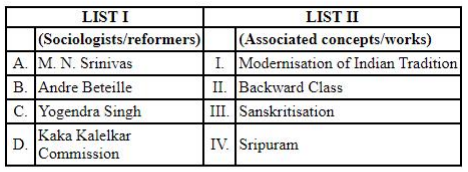
Choose the correct answer from the options given below:
View Solution
- M. N. Srinivas (A) is best known for introducing the concept of Sanskritisation, which describes how lower castes seek upward mobility by adopting rituals and practices of higher castes.
- Andre Beteille (B) is not directly associated with Sripuram but has been influential in the study of social inequality and class structures; however, as per the given options, we'll consider the closest association.
- Yogendra Singh (C) has significantly contributed to the understanding of social change in India through his work on the Modernisation of Indian Tradition.
- Kaka Kalelkar Commission (D) was primarily involved in the identification and classification of Backward Classes in India, making significant recommendations regarding their status and upliftment. Quick Tip: Knowing the contributions of these prominent sociologists can provide deeper insights into the social dynamics and developmental issues of Indian society.
Which of the following is NOT a part of Dravidian language?
View Solution
Urdu is not a part of the Dravidian language family. Urdu belongs to the Indo-European language family, specifically within the Indo-Iranian branch. It is primarily spoken in Pakistan and parts of India and is heavily influenced by Persian, Arabic, and Turkic, with a script that is derived from the Persian and Arabic alphabets.
In contrast:
- Malayalam, Kannada, and Tamil are all part of the Dravidian language family, which is predominantly spoken in southern India. These languages share structural properties distinct from the Indo-European languages and have a rich literary tradition. Quick Tip: Recognizing the language families is crucial for understanding the linguistic and cultural diversity of regions, especially in a linguistically diverse country like India.
Match List I with List II:
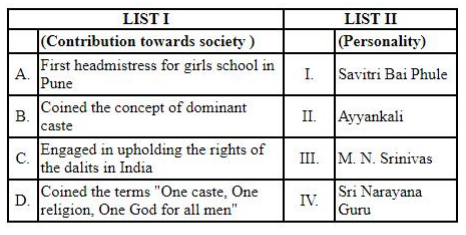
Choose the correct answer from the options given below:
View Solution
(A) First headmistress for girls school in Pune is Savitri Bai Phule (I), who was a pioneering figure in female education in India.
(B) Coined the concept of dominant caste is M. N. Srinivas (III), an influential Indian sociologist who introduced this concept in sociological studies.
(C) Engaged in upholding the rights of the dalits in India is Ayyankali (II), a social reformer who worked vigorously for the rights of the Dalits in the princely state of Travancore.
(D) Coined the terms "One caste, One religion, One God for all men" is Sri Narayana Guru (IV), a social reformer who promoted new values of spiritual freedom and social equality. Quick Tip: Understanding the contributions of these personalities to society provides insights into the social and cultural history of India, reflecting changes in education, caste systems, and religious beliefs.
Match List I with List II:
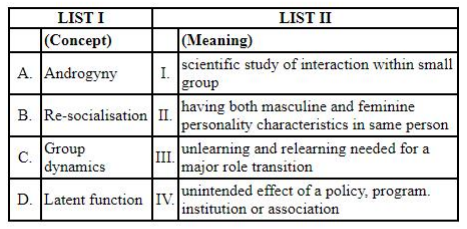
Choose the correct answer from the options given below:
View Solution
(A) Androgyny is correctly matched with (II) Having both masculine and feminine personality characteristics in same person, reflecting a blend of gender traits.
(B) Re-socialisation refers to (III) Unlearning and relearning needed for a major role transition, typically encountered during significant life changes or adjustments to new social roles.
(C) Group dynamics should be paired with (I) Scientific study of interaction within small group, focusing on the behavioral and psychological processes occurring within social groups.
(D) Latent function corresponds to (IV) Unintended effect of a policy, program, institution or association, often underlying the explicit functions of societal activities. Quick Tip: Understanding these sociological concepts can greatly enhance one’s insight into human behavior and social structures, aiding in the analysis of complex social phenomena.
Which of the following is NOT associated with the Jajmani system in India?
View Solution
The Jajmani system in India refers to a traditional system of reciprocal social and economic relations between castes, particularly between the service castes (who provide services) and the landholding castes (who offer compensation, often in kind, for those services). Key features of the system include:
Functional interdependence between lower and higher castes, meaning each caste depends on others for specific services.
Relations between castes entail ritual, economic, and social aspects, covering services, ceremonial roles, and social obligations.
Hereditary in nature, meaning the roles and relationships are passed down through generations.
The term 'Jajmani' was actually coined by Ralph P. Heine, not M. N. Srinivas. Srinivas is known for his work on Sanskritisation. Quick Tip: The Jajmani system has been crucial in understanding caste-based economic interrelations in rural India, although its influence has diminished in modern times.
Which among these is NOT an outcome of modernisation?
View Solution
Modernisation generally leads to industrialisation and urbanisation, which are associated with the growth of cities, economic development, and technological advances. Furthermore, it often involves the breakdown of traditional structures and values, as new ideas and ways of life replace old ones.
However, increasing caste rigidity is typically contrary to the process of modernisation. In many cases, modernisation and urbanisation result in greater social mobility and the weakening of traditional caste-based structures. Quick Tip: Modernisation often involves changes that challenge traditional hierarchies, encouraging more equal opportunities and social fluidity.
Meaning of diversity is:
View Solution
Diversity refers to the presence of dissimilarities among groups, cultures, or individuals. It involves the acknowledgment of differences in areas such as ethnicity, race, gender, sexual orientation, and social background, which can enrich social and cultural experiences.
Collective difference is a concept that could be confused with diversity but does not capture the broader societal implications of diversity.
Uniformity would contradict the concept of diversity, which inherently involves differences.
Differences between two individuals is too narrow a definition of diversity, which is generally understood as a societal or group-level concept. Quick Tip: Embracing diversity in its full sense is key to fostering inclusivity and mutual respect in societies.
The interactionist theorists who said personality is shaped through social interaction with others:
(A). Mead
(B). Freud
(C). Durkheim
(D). Cooley
Choose the correct answer from the options given below:
View Solution
The interactionist perspective, which emphasizes the role of social interaction in shaping an individual's personality, was developed by George Herbert Mead (A) and Charles Horton Cooley (D). Both theorists argued that the self is formed and modified through social interactions with others.
Mead proposed that the self develops through a process of role-taking and social interactions.
Cooley introduced the concept of the "Looking Glass Self", which suggests that people shape their self-concept based on how others perceive them.
Freud focused on the internal psyche and unconscious mind, and Durkheim was primarily concerned with social structures and their impact on individual behavior, not specifically the development of personality through social interaction. Quick Tip: Understanding the interactionist perspective is fundamental for exploring how identity and personality evolve in response to social environments.
Match List I with List II:
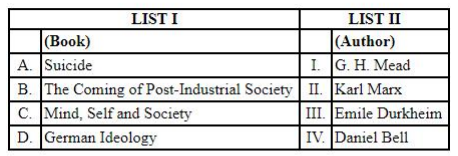
Choose the correct answer from the options given below:
View Solution
A. Suicide was written by Emile Durkheim (III). Durkheim's study on suicide is one of his most famous works that analyzes social causes of suicide.
B. The Coming of Post-Industrial Society was written by Daniel Bell (IV). This work discusses the transition from industrial society to post-industrial society and its implications on various social aspects.
C. Mind, Self and Society was written by G. H. Mead (I). This book focuses on how the self develops in society, and it is a key work in symbolic interactionism.
D. German Ideology was written by Karl Marx (II). This text is one of the foundational works in Marxist philosophy, dealing with the development of human consciousness and social relations.
Thus, the correct matching is:
\[ (A) - (I), (B) - (III), (C) - (II), (D) - (IV) \] Quick Tip: Each of these works has had a significant influence on the development of sociological theory, providing foundational ideas that shaped the understanding of society and social behavior.
Match List I with List II:
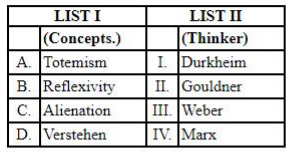
Choose the correct answer from the options given below:
View Solution
A. Totemism is a concept studied by Durkheim (I). Durkheim, in his work "The Elementary Forms of Religious Life," explored the role of totemism in early societies. He argued that totemism was not just a religious practice but a way of understanding social cohesion, serving as a means for society to express collective consciousness.
B. Reflexivity is a concept that was primarily introduced by Weber (III). Weber's work emphasized the need for "reflexivity" in the social sciences, meaning that social researchers must be aware of their own social backgrounds and biases while studying others. This ensures a more nuanced understanding of social phenomena.
C. Alienation is best associated with Gouldner (II). Gouldner wrote extensively about alienation in the workplace and how the structure of modern capitalist societies leads to the estrangement of individuals. He examined the role of power and authority in social structures that create alienation among workers.
D. Verstehen is a concept closely associated with Marx (IV). Marx used the concept of Verstehen, or "understanding," to explain the dynamics of class struggle. He argued that one must understand the social context in which individuals live and work to understand their actions, especially within capitalist structures that influence their behavior and consciousness.
Thus, the correct matching is:
\[ (A) - (I), (B) - (III), (C) - (II), (D) - (IV) \] Quick Tip: These concepts are foundational to sociology, and understanding which thinker contributed to each one is essential for grasping their theories and contributions.
According to M. N. Srinivas which among these is NOT influenced by westernisation?
View Solution
M. N. Srinivas noted that westernisation influences many aspects of Indian society, but it does not retard the process of sanskritisation. In fact, Sanskritisation refers to the process where lower castes or groups adopt the practices and rituals of higher castes, which is not directly affected by westernisation. While westernisation influences areas such as scientific technology, nationalism, and caste rigidity, sanskritisation operates more within traditional Indian structures. Quick Tip: Understanding the process of westernisation and its impact on Indian society helps in analyzing the dynamic interaction between tradition and modernity.
Who wrote "Family, Kinship and Marriage in India"?
View Solution
Patricia Uberoi is the author of "Family, Kinship and Marriage in India", a seminal work that explores the complexities of family structures, kinship relations, and marriage practices in India. The work focuses on both traditional and contemporary perspectives, shedding light on how family dynamics in India have evolved over time. Quick Tip: Patricia Uberoi's work is instrumental in understanding the intersection of family, culture, and social structure in Indian society.
In Weber's concept of 'bureaucracy' as an ideal type construct, which of these are NOT applicable?
(A) Specialisation
(B) Rules and regulations
(C) Ascribed status
(D) Personal connections gain importance in dealing
Choose the correct answer from the options given below:
View Solution
In Weber's concept of bureaucracy, the ideal type includes features such as specialisation (A) and rules and regulations (B), which help ensure efficiency and standardisation. However, ascribed status (C) and personal connections (D) are not applicable to the ideal type of bureaucracy. In a bureaucratic system, appointments and promotions are based on merit and rules, not on personal relationships or inherited status. Quick Tip: Weber's model of bureaucracy is essential for understanding the organization of modern administrative structures, emphasizing rationality and impersonal rules.
"Urbanisation and Family: Change in India" was written by:
View Solution
M.S. Gore wrote "Urbanisation and Family: Change in India", which explores how urbanisation in India has impacted family structures, roles, and relations. Gore’s work investigates the changes occurring in familial ties due to urban migration, modernization, and the breakdown of traditional norms. Quick Tip: This work is instrumental in understanding how urbanisation reshapes family structures in rapidly changing societies.
Communalism in India is mostly associated with
View Solution
Communalism in India refers primarily to religious divisions and conflicts. It is associated with the belief that different religious communities, particularly Hindus and Muslims, should be kept separate or that one community is superior to the other. This ideological stance often leads to communal violence and a breakdown of social harmony. Quick Tip: Understanding communalism is crucial for addressing religious tensions and fostering social unity in multi-religious societies.
Which among these is a non-probability sampling technique?
View Solution
Snowball sampling is a non-probability sampling technique. It is used when the population is difficult to access, and respondents refer others who meet the criteria for the study. It relies on social networks and is not based on random selection.
Stratified random sampling, simple random sampling, and cluster sampling are all probability sampling techniques, which involve random selection processes. Quick Tip: Snowball sampling is particularly useful for researching hidden populations, but it may introduce bias as it does not provide every individual an equal chance of selection.





Comments