




TISSNET, was an entrance exam conducted by Tata Institute of Social Sciences (TISS) at the all-India level for admission to its various postgraduate programs. However, from the 2023-24 academic session, TISS has adopted the CUET-PG for Postgraduate programs and CAT scores for a few courses, where the TISSNET exam is no more applicable.
TISSNET (HUQP06 - Development and Labour Studies) Question Paper With Solution PDF is available here.
TISSNET Development and Labour Studies Question Paper 2024 PDF Download
| TISSNET Development and Labour Studies Question Paper 2024 with Answer Key |  Download Download |
Check Solutions |
TISSNET Development and Labour Studies 2024 Questions with Solutions
Question 1:
Rate of Unemployment is calculated by using the formula
View Solution
The rate of unemployment is a key indicator used in economics to measure the percentage of the labour force that is unemployed but actively seeking work. It is calculated by dividing the number of unemployed people by the size of the labour force (which includes both employed and unemployed individuals in the workforce), and then multiplying by 100 to convert it into a percentage.
\[ Unemployment Rate = \left( \frac{Number of Unemployed People}{Size of Labour Force} \right) \times 100 \]
The Labour Force includes all people who are either employed or actively seeking work.
The Number of Unemployed People refers to individuals who are actively looking for a job but are currently without work.
Other options are not correct representations of the unemployment rate:
Option (2) does not use the correct division of the unemployed people and the labour force. It incorrectly uses the "total work force" and subtracts the unemployed people, which is not how the unemployment rate is calculated.
Option (3) and (4) are incorrect as they relate total populations or workforces without considering the number of unemployed people within the labour force specifically. Quick Tip: The unemployment rate is a crucial indicator for assessing the health of an economy. A high rate of unemployment suggests economic inefficiency and underutilisation of the workforce.
Which one of the following activities is not covered in primary sectors?
View Solution
The primary sector of the economy involves the extraction and harvesting of natural resources. This includes activities such as agriculture, mining, and quarrying, which involve directly obtaining raw materials from the earth.
However, transport and storage is part of the tertiary sector, which involves services rather than the direct extraction or harvesting of resources. The tertiary sector is concerned with providing services like transportation, storage, distribution, and retail. Quick Tip: Understanding the three economic sectors—primary, secondary, and tertiary—helps in differentiating between activities that extract, manufacture, and provide services.
______ is the apex body which coordinates the functioning of different financial institutions working for the expansion of rural credit in India
View Solution
NABARD (National Bank for Agriculture and Rural Development) is the apex body responsible for coordinating the functioning of various financial institutions involved in providing rural credit in India. NABARD works towards the expansion of rural credit, facilitating institutional credit to farmers, rural development programs, and promoting various agricultural initiatives.
Regional Rural Banks are part of the rural credit system but are not the apex body.
Co-operative Banks and Commercial Banks also provide rural credit but operate under the coordination of NABARD. Quick Tip: NABARD plays a central role in promoting rural development and agricultural finance, working with a variety of institutions to support the rural economy.
Which of the following is not an institutional source of agricultural credit?
View Solution
Rich landlords are not considered an institutional source of agricultural credit. While landlords may provide informal credit in some cases, institutional sources of agricultural credit include:
Co-operative credit, which refers to loans provided by agricultural co-operatives.
Commercial bank credit, which refers to loans provided by commercial banks.
Regional rural banks, which were established to cater to the credit needs of rural areas.
These institutional sources are formalized and regulated, unlike the informal lending that may occur with landlords. Quick Tip: Institutional credit sources are essential for providing structured and reliable credit to the agricultural sector, promoting rural economic development.
Which of the following states is considered as a successful example in the efficient implementation of milk co-operatives?
View Solution
Gujarat is widely regarded as a successful example in the efficient implementation of milk co-operatives. The Amul cooperative in Gujarat has played a significant role in transforming the dairy industry, providing a model for cooperative dairy farming in India. Gujarat's success in milk co-operatives is based on a strong foundation of cooperative networks, which ensure fair prices for both producers and consumers.
While other states like Maharashtra and Andhra Pradesh have also implemented milk co-operatives, Gujarat's success with Amul is often highlighted as a model for the entire country. Quick Tip: Milk co-operatives, like Amul, have empowered rural farmers by providing them with better prices, creating employment, and ensuring a steady supply of dairy products.
HDI measures the average achievement in three basic dimensions of human development. Which one of the following measure is not a part of HDI?
View Solution
The Human Development Index (HDI) measures the average achievements in three basic dimensions of human development:
Health, measured by life expectancy at birth.
Knowledge, measured by adult literacy rates (with two-thirds weight) and the combined gross enrolment ratio for primary, secondary, and tertiary education (with one-third weight).
Standard of living, measured by GDP per capita.
A sufficient bank balance measured as savings is not a part of HDI. While economic factors like GDP per capita are considered in HDI, personal savings or bank balances are not included. Quick Tip: HDI is a widely used measure of human development, which takes into account broader well-being factors, such as health, education, and standard of living, rather than just economic wealth.
Which of the following society is based on the concept of Matrilineal in India?
View Solution
The Khasi society, a prominent tribe in Meghalaya, follows a matrilineal system. In a matrilineal society, lineage and inheritance are traced through the mother's side of the family. This means that children inherit family names, property, and status from their mother, and it is typically the mother's brothers who take on key responsibilities for children.
Gonds, Bodos, and Minas are not matrilineal; they follow patrilineal systems, where lineage is traced through the father’s side. Quick Tip: Matrilineal societies like the Khasi offer a unique perspective on kinship, inheritance, and family structures that are different from the more common patrilineal systems.
The term matrilocal refers to—
View Solution
Matrilocal refers to a residence pattern in which the married couple lives with or near the wife's family, particularly her mother. This system is common in matrilineal societies, where lineage is traced through the mother's side, and it is the mother's family that plays a central role in the family structure.
Patrilocal refers to a system where the married couple resides with or near the husband's family, which is a more commonly known pattern. Quick Tip: Understanding different residence patterns like matrilocal and patrilocal can help in exploring how family roles and responsibilities are distributed in various societies.
The policy of apartheid is related to—
View Solution
The policy of apartheid was a system of racial segregation and discrimination that was officially implemented in South Africa from 1948 until the early 1990s. Under apartheid, the government classified people into racial groups, with white people enjoying superior rights and privileges, while other racial groups, particularly black South Africans, faced severe discrimination.
Caste is a social stratification system found primarily in India, unrelated to the concept of apartheid.
Religion and culture are not the defining aspects of apartheid, which was fundamentally based on race.
Quick Tip: Apartheid is a historical example of systemic racial discrimination, and it provides insights into how legal and political systems can enforce social inequality.
In which year the Trade Unions Act was passed?
View Solution
The Trade Unions Act was passed in 1926 in India to regulate the functioning of trade unions and provide a legal framework for their operation. The Act recognized trade unions as legal entities, allowed them to register, and gave them the right to collective bargaining. It laid the foundation for organized labor movements in India.
The Act was a significant step in ensuring the rights of workers and improving their working conditions, especially during the colonial period when labor laws were limited. Quick Tip: The Trade Unions Act of 1926 is a critical piece of labor legislation in India that helped formalize the recognition of workers' rights and facilitated collective labor actions.
Who has given the Law of three stages of Society?
View Solution
The Law of Three Stages was proposed by August Comte, a French sociologist, as a way of understanding the evolution of human societies. According to Comte, societies progress through three stages:
1. Theological Stage: where phenomena are explained by divine or religious causes.
2. Metaphysical Stage: where abstract concepts and philosophical ideas are used to explain phenomena.
3. Positive Stage: where scientific methods and empirical evidence are used to understand and explain societal phenomena.
This framework was central to Comte's positivism, which emphasized the use of scientific methods to study society. Quick Tip: Comte's Law of Three Stages is an important theory in sociology that highlights how human understanding and societies evolve from religious to scientific explanations.
Gross National Income is a
View Solution
Gross National Income (GNI) is the total market value of all the goods and services produced by the residents of a country within a given period, typically a year. It includes the income generated by residents both domestically and abroad, as well as the income generated from their property. It is a broad measure of a country’s economic health.
GNI is often used as an indicator of the overall economic performance and development of a country.
Option (2), (3), and (4) describe other economic measures but do not accurately define GNI. Quick Tip: Gross National Income (GNI) is different from Gross Domestic Product (GDP) in that GNI includes net income from abroad, such as wages, rents, and profits.
Which of the following books is not written by Alfred Marshall?
View Solution
Alfred Marshall was a renowned economist, and he authored several influential works, but "The Political Economy of Hunger" was not written by him. The correct books by Alfred Marshall include:
- Principles of Economics, which laid the foundation for microeconomic theory.
- The Economics of Industry, co-written with his wife Mary Paley Marshall, focuses on industrial economics.
- The Present Position of Economics provides an overview of economic thought during his time.
"The Political Economy of Hunger" is a work by another economist, not Marshall. Quick Tip: Alfred Marshall is best known for his work in microeconomics, particularly the theory of supply and demand, elasticity, and the concept of consumer surplus.
Motor development is concerned with
View Solution
Motor development refers to the progression and coordination of physical movements, including the use of the hands, legs, fingers, and other body parts. It is a crucial aspect of physical development, especially in children, and is related to the acquisition of skills such as walking, running, grasping objects, and more complex movements.
It is distinct from language development, moral development, and social aspects such as getting along with people, which are covered under different developmental areas. Quick Tip: Motor development is essential for children's physical growth and independence, and it plays a significant role in their overall well-being and coordination.
How can we develop human and moral values in a child?
View Solution
The development of human and moral values in a child is primarily influenced by proper socialisation. Socialisation refers to the process by which children learn and internalize the values, norms, and behaviors of their society. This process occurs through interactions with family, peers, teachers, and other social agents. Proper socialisation helps children understand moral principles such as empathy, fairness, and respect for others.
Assembly of children and Union of children are not sufficient by themselves to promote moral values, as they don't specifically address the need for appropriate guidance and social norms.
Unlearning of values is counterproductive, as moral values are meant to be learned, not unlearned.
Quick Tip: Socialisation plays a key role in a child's development, shaping their moral compass and understanding of right and wrong. Positive role models and appropriate guidance are crucial in this process.
Which of the following is not a characteristic of economic development?
View Solution
Economic development is characterized by several factors aimed at improving the standard of living and quality of life in a country. These characteristics include:
Sustainable development, which ensures that economic growth meets the needs of the present without compromising the ability of future generations to meet their own needs.
Diversification of the economy, which refers to the expansion of an economy into a wider range of industries and sectors to reduce dependency on a single industry or resource.
Improved infrastructure, which supports economic activity by providing necessary services such as transportation, communication, and utilities.
However, high inflation is generally not considered a characteristic of economic development. In fact, high inflation can be detrimental to economic stability and growth, as it erodes purchasing power and creates uncertainty in the market. Quick Tip: Economic development aims for long-term growth, stability, and sustainability. High inflation undermines this by causing instability and reducing the real value of income and savings.
Neoliberalism emerged in the pushing an agenda of free trade and removal of import substitution industrialization policies:
View Solution
Neoliberalism emerged in the 1980s as a response to the perceived inefficiencies of the state-led import substitution industrialization (ISI) policies. Neoliberalism advocated for free trade, deregulation of industries, privatization, and a reduction in government intervention in the economy. This shift was strongly supported by leaders such as Ronald Reagan in the United States and Margaret Thatcher in the United Kingdom, who promoted market-based policies that focused on global competitiveness and reducing state involvement.
The 1950s, 1960s, and 1970s saw more emphasis on state-led economic models, including ISI, rather than the neoliberal approach that began in the 1980s. Quick Tip: Neoliberalism focuses on maximizing market efficiency and reducing the role of the government in economic affairs. It became particularly influential in the 1980s and reshaped global economic policies.
Who among the following is not associated with the theories of personality?
View Solution
Max Weber is not typically associated with theories of personality. Instead, Weber was a sociologist who focused on social theory, bureaucracy, and the study of religion, economics, and society.
On the other hand:
Sigmund Freud developed the Psychoanalytic Theory, which emphasizes the unconscious mind and its impact on behavior and personality.
Carl Rogers is known for Humanistic Theory, particularly focusing on self-concept and personal growth.
Abraham Maslow is famous for his Hierarchy of Needs, which emphasizes the importance of fulfilling basic needs for self-actualization. Quick Tip: While Weber made important contributions to sociology and social theory, his work was more focused on social structure and authority than on individual personality development.
How many stages of development identified by Robert Havinghurst?
View Solution
Robert Havinghurst identified 6 stages of development, each with specific tasks that individuals must complete at various points in their lives. These stages include childhood, adolescence, early adulthood, middle age, and late adulthood, and are centered on the idea that individuals face developmental challenges at each stage of life that are key to achieving personal growth and social adaptation.
Havinghurst's stages are widely used in developmental psychology, particularly for understanding how individuals grow and change over time in relation to societal expectations. Quick Tip: Havinghurst's concept of developmental stages provides a framework for understanding the challenges people face throughout life, focusing on tasks related to social roles and individual growth.
Which one of the following is not a dimension index of Human development index?
View Solution
The Human Development Index (HDI) is calculated based on three dimensions:
1. Life Expectancy Index: Measures health and life expectancy at birth.
2. Educational Index: Combines adult literacy rate and gross enrolment ratio for primary, secondary, and tertiary education.
3. GNI Index: Measures the Gross National Income per capita.
The Empowerment Index is not part of HDI. While it is a key factor in some development measures, it is not included in the HDI calculation. HDI focuses on health, education, and economic dimensions. Quick Tip: HDI is a comprehensive measure of development that emphasizes the well-being of individuals in terms of health, education, and standard of living, but it does not include direct measures of empowerment.
Under which Ministry does National Sample Survey Organization (NSSO) come under?
View Solution
The National Sample Survey Organization (NSSO) comes under the Ministry of Statistics and Program Implementation (MOSPI) in India. NSSO is responsible for conducting large-scale sample surveys to collect data on various socio-economic indicators, which is critical for policy-making and planning.
The Ministry of Commerce and Industry, the Ministry of Electronics and Information Technology, and the Ministry of Finance do not handle NSSO. Quick Tip: NSSO plays an essential role in gathering reliable data for the government, which is crucial for economic planning, policy formulation, and monitoring development progress.
Which state in India receives the highest number of immigrants?
View Solution
Maharashtra is the state that receives the highest number of immigrants in India. This is primarily due to its economic opportunities, particularly in Mumbai, which is India's financial capital. People from various parts of India, especially from poorer states, migrate to Maharashtra in search of better job prospects and a higher standard of living.
West Bengal and Uttar Pradesh also see significant migration, but Maharashtra leads due to its economic prominence.
Bihar has a large number of out-migrants, rather than immigrants.
Quick Tip: Urban migration, particularly to states with high economic opportunities, is a key feature of India's internal migration patterns, with Maharashtra as a major destination for job seekers.
The first official census in India was done in the year ______\ under Lord Ripon
View Solution
The first official census of India was conducted in 1881 during the British colonial period under the administration of Lord Ripon. This census marked the beginning of the systematic recording of population data in India.
Prior to 1881, there were some population estimates, but they were not official censuses. The census of 1881 was the first comprehensive and systematic enumeration. Quick Tip: Census data provides essential information for policy-making, resource allocation, and understanding demographic trends. India's census is one of the largest in the world today.
Who among the following was the Finance Minister of India during the introduction of the New Economic Policy, 1991?
View Solution
Dr. Manmohan Singh was the Finance Minister of India when the New Economic Policy (NEP) was introduced in 1991. Under his leadership, India implemented a series of economic reforms, including liberalization, privatization, and globalization, which were aimed at opening up the economy and promoting growth. These reforms were pivotal in transforming India’s economy and integrating it with global markets.
P. Chidambaram and Madhu Dandavate held other significant positions, but they were not Finance Ministers at the time of the NEP.
S. B. Chavan was also a notable political figure, but not in the role of Finance Minister during the 1991 reforms.
Quick Tip: Dr. Manmohan Singh's tenure as Finance Minister in 1991 is often seen as a turning point in India’s economic history, helping to transition the country from a closed, regulated economy to a more open and market-driven one.
According to the Human Development Report (2021-22), what is India's rank in terms of Human Development Index out of 191 countries?
View Solution
According to the Human Development Report (2021-22), India ranked 136th out of 191 countries in terms of Human Development Index (HDI). This ranking reflects the country's progress in key areas such as health, education, and standard of living, but it also highlights challenges in improving these dimensions for the overall population.
HDI is a composite measure that looks at life expectancy, education level, and per capita income to assess the overall human development of a country.
India’s rank has seen gradual improvements over the years, but it still faces significant challenges in achieving higher human development outcomes, especially in areas like income inequality and access to quality healthcare and education. Quick Tip: The HDI ranking is an important indicator for understanding a country's overall development, but it doesn't capture all aspects, such as income inequality, which may require additional indices.
Which of the following is not a key characteristic of the Mahatma Gandhi National Rural Employment Guarantee Act?
View Solution
The Mahatma Gandhi National Rural Employment Guarantee Act (MGNREGA) is a social security scheme aimed at enhancing livelihood security in rural areas by providing employment to adult members of rural households who are willing to work. Its key features include:
Employment for rural households, with one member from each household provided with employment for up to 150 days per year.
Free registration and a job guarantee within 15 days of application.
At least one-third of employees must be women, ensuring gender equality in employment.
However, the act does not specify weekly payments or a fixed minimum wage. Instead, wages are determined according to the state’s schedule of rates, which are subject to revision. Quick Tip: MGNREGA is a key component of India's rural development strategy, aiming to enhance livelihood security, particularly for marginalized rural communities.
Occupation structure refers to
View Solution
Occupation structure refers to the distribution of the working population across different sectors of the economy, namely the primary, secondary, and tertiary sectors. This classification helps in understanding the economic focus of a country and the nature of employment:
Primary sector includes agriculture, mining, and other natural resource extraction industries.
Secondary sector includes manufacturing and industrial activities.
Tertiary sector involves services like healthcare, education, finance, and trade.
The size of the labour force, the number of people in a country, and the nature of occupations are related concepts but do not directly define occupation structure. Quick Tip: The occupation structure helps in understanding the economic development of a country and the transition from an agricultural economy to an industrial and service-based economy.
Who of the following is not a member of the National Human Rights Commission (NHRC)?
View Solution
The National Human Rights Commission (NHRC) is an independent statutory body responsible for the protection and promotion of human rights in India. The members of NHRC include:
Chairperson of the National Commission for Women.
Chairperson of the National Commission for Scheduled Castes.
Chairperson of the National Commission for Scheduled Tribes.
However, the National Commission for Minority Educational Institutions is not represented on the NHRC, making its chairperson not a member of NHRC. Quick Tip: The NHRC plays a crucial role in ensuring the protection of fundamental rights in India, working alongside other national commissions to address issues related to marginalized communities.
_____ is defined as a fixed image or set of characteristics representing an individual or group, but which may or may not be true in reality.
View Solution
Stereotyping refers to the process of forming fixed, generalized images or assumptions about a group of people or individuals. These images are often oversimplified and may not be accurate, but they are widely held due to cultural, social, or historical factors. Stereotypes can be based on race, gender, ethnicity, or other characteristics and can lead to biased judgments and unfair treatment.
Marginalisation, discrimination, and mistreated are related concepts, but they do not specifically refer to the generalization of characteristics about individuals or groups. Quick Tip: Stereotyping can have harmful effects, as it often leads to unfair treatment and discrimination against certain groups based on preconceived notions.
_____ is the highest authority for interpretation of the constitution
View Solution
The Supreme Court of India is the highest judicial authority and has the power to interpret the Constitution of India. It is the final authority in matters related to constitutional interpretation, and its judgments are binding on all other courts. The Court has the power of judicial review, meaning it can review laws and government actions to ensure they comply with the Constitution.
Parliament enacts laws but does not interpret the Constitution.
The President and Prime Minister hold executive roles but are not responsible for interpreting constitutional law.
Quick Tip: The Supreme Court’s power of judicial review allows it to examine the constitutionality of laws and government actions, ensuring that they align with constitutional principles.
Who is the author of the book titled 'The Wealth of Nations'?
View Solution
Adam Smith is the author of "The Wealth of Nations", first published in 1776. It is considered the founding work of modern economics. In this book, Smith discusses the division of labor, the function of markets, and the concept of the "invisible hand," which suggests that individuals pursuing their own interests unintentionally contribute to the economic prosperity of society.
Irwin Fisher, J. M. Kegres, and JR Hicles were economists, but they did not write "The Wealth of Nations." Quick Tip: Adam Smith’s work laid the groundwork for classical economics and is still influential in the study of economics today.
Which among the following is not included under the Jan Dan Yojana Scheme?
View Solution
Pradhan Mantri Ujjwala Yojana (PMUY) is not included under the Jan Dan Yojana Scheme. The Jan Dan Yojana is a financial inclusion initiative launched by the government to provide access to banking facilities, insurance, and pension for the poor. The schemes that fall under Jan Dan Yojana include:
PMJJBY (Pradhan Mantri Jeevan Jyoti Bima Yojana) - Life insurance.
PMSBY (Pradhan Mantri Sukanya Bima Yojana) - Insurance for the girl child.
APY (Atal Pension Yojana) - Pension scheme for the unorganized sector.
PMUY, on the other hand, is a separate scheme focused on providing LPG connections to women from Below Poverty Line (BPL) households. Quick Tip: The Jan Dan Yojana aims to ensure access to financial products like insurance and pensions for underprivileged sections of society.
In which year National Rural Livelihood Mission was renamed as Deendyal Upadhyaya Yojana- National Rural Livelihood Mission (DUY-NRLM)?
View Solution
The National Rural Livelihood Mission (NRLM) was renamed as Deendyal Upadhyaya Yojana- National Rural Livelihood Mission (DUY-NRLM) in 2015. This was done in honor of Deendyal Upadhyaya, an Indian thinker and political activist, and to provide further momentum to the mission's goal of improving the living standards of rural households by enhancing their livelihoods.
The NRLM was launched in 2011 with a focus on poverty alleviation through the promotion of self-help groups and income-generating activities in rural areas. Quick Tip: The renaming of NRLM to DUY-NRLM is a step towards strengthening rural development efforts and improving livelihoods in India's rural areas.
Which committee was constituted in August 1991, which suggested reforms in tax structure?
View Solution
The R. Chelliah Committee was constituted in August 1991 to suggest reforms in the tax structure of India. The committee was tasked with reviewing the existing tax system and recommending measures to simplify and make it more efficient. The committee's report was a significant contribution to India's economic reforms during the early 1990s, which included the introduction of liberalization and tax reforms.
Abid Husain Committee is known for its work on economic reforms but was not focused on tax structure.
Dutta Committee and K L Rekhi Committee are also important but not directly related to tax structure reforms. Quick Tip: Tax reforms introduced after the Chelliah Committee's recommendations helped streamline India's tax system and promoted higher compliance and revenue generation.
When was Mahatma Gandhi National Rural Employment Guarantee Act (MGNREGA) officially launched in India?
View Solution
Mahatma Gandhi National Rural Employment Guarantee Act (MGNREGA) was officially launched in 2005 with the goal of enhancing livelihood security in rural areas by providing employment to rural households. It guarantees 100 days of wage employment to one adult member of every rural household who is willing to do unskilled manual labor. This scheme has had a profound impact on reducing rural poverty and improving infrastructure.
2003, 2004, and 2007 were important years for other government schemes but not for the launch of MGNREGA. Quick Tip: MGNREGA is one of India’s largest social security schemes, aiming to provide sustainable livelihoods to rural families through public works.
Who has authored the book 'Planned economy for India’ in 1934?
View Solution
The book 'Planned Economy for India' was authored by M. Visvesvaraya in 1934. In this book, Visvesvaraya, a prominent Indian engineer, statesman, and scholar, advocated for planned economic development in India. He proposed the idea of a planned economy, focusing on industrialization, infrastructure development, and economic self-sufficiency as key aspects for India’s progress.
Ashwani Mahajan, Marshall, and A. R. Rodon are not the authors of this work. Quick Tip: M. Visvesvaraya's ideas on planned economic development influenced India’s policy framework in the post-independence period, especially during the initial years of economic planning.
Which of the following are the important features of the social democratic mixed economy model of development?
(A). Co-existence of public and private sector enterprises and nationalization of key industries
(B). National planning by state authorities for industrial development
(C). Allocation of resources and jobs are done through bureaucratized political control
(D). Care is taken for the redistribution of wealth through progressive taxation
(E). The state implements welfare state policies like minimum wage, social insurance, pension, full employment
Choose the correct answer from the options given below:
View Solution
The social democratic mixed economy model includes several key features aimed at balancing market-driven growth with social welfare policies. The important features of this model include:
Co-existence of public and private sector enterprises (A), where both sectors play crucial roles in economic development, and nationalization of key industries to ensure public control over essential services.
National planning by state authorities (B) for industrial development, ensuring the government’s role in steering economic priorities.
Redistribution of wealth (D) through progressive taxation to reduce inequality.
Welfare state policies (E), such as minimum wage, social insurance, pensions, and full employment to ensure economic stability and social justice.
Option (C), which suggests bureaucratized political control for allocation of resources and jobs, is not an essential feature of the social democratic mixed economy. Quick Tip: A social democratic mixed economy seeks to combine the best of both market and planned economies, ensuring a fair distribution of wealth while fostering economic growth.
Which of the following are the capitalist models of development?
(A). The agrarian capitalist model
(B). Mercantile capitalist model
(C). The Industrial capitalist model
(D). The post-globalization neoliberal model
(E). Social democratic mixed economy model of development
Choose the correct answer from the options given below:
View Solution
The capitalist model of development emphasizes the role of private ownership, market-driven economies, and profit maximization. The following are capitalist models of development:
- The agrarian capitalist model (A), where the focus is on agricultural production under capitalist structures.
- The industrial capitalist model (C), which refers to industrialization as the driving force for economic growth under capitalism.
- The post-globalization neoliberal model (D), which emphasizes free-market policies, deregulation, and globalization.
However, the Social democratic mixed economy model of development (E) is not strictly a capitalist model, as it involves significant state intervention and a balance between public and private sectors. Hence, it is typically classified under mixed economy models. Quick Tip: Capitalist models focus on private ownership and market-driven growth, while mixed economies, like social democracy, combine market mechanisms with significant government intervention.
Which of the following statements correctly represents actions undertaken by the Government towards liberalization?
(A). Levying high tariffs to discourage imports and encouraging the consumption of domestic goods and services.
(B). Devaluation of the rupees to promote inflow of foreign exchange.
(C). Allowing private banks to take decisions independent of the RBI restrictions.
(D). Fixing prices of certain industrial goods in order to support increased consumption of these goods to boost the manufacturing industry.
Choose the correct answer from the options given below:
View Solution
During the liberalization phase in India, several measures were implemented to open up the economy, attract foreign investment, and promote market efficiency. The correct actions undertaken by the government included:
Devaluation of the rupee (B) to promote the inflow of foreign exchange by making exports cheaper and more attractive on the global market.
Allowing private banks to take decisions independent of the RBI restrictions (C), which was part of financial liberalization to enhance the efficiency and competitiveness of the banking sector.
Levying high tariffs (A) is contrary to liberalization policies, which aim to reduce trade barriers and encourage free trade.
Fixing prices of industrial goods (D) is also not aligned with liberalization principles, as it involves government intervention rather than market-driven pricing. Quick Tip: Liberalization policies in India focused on reducing state control and increasing market-driven economic activity, especially in trade, finance, and industries.
Which one of the following is not an important trade and investment policy reform?
(A). Removal of quantitative restrictions on imports and exports
(B). Removal of Export duties
(C). Reduction in Import duties
(D). Relaxation in import licensing system
(E). Devaluation of Rupee
Choose the correct answer from the options given below:
View Solution
Devaluation of Rupee (E) is not typically considered a trade and investment policy reform. It is a monetary policy tool used to adjust the value of the currency. While devaluation can affect trade by making exports cheaper, it is not classified as part of trade and investment policy reforms, which focus more on measures like:
Removal of quantitative restrictions (A), which allows more free trade.
Removal of export duties (B) to encourage exports.
Reduction in import duties (C) to make imports more affordable and competitive.
Relaxation in the import licensing system (D) to ease trade restrictions.
Quick Tip: Trade and investment policy reforms aim to reduce barriers to trade, improve market access, and promote economic growth. Devaluation of currency is typically used for macroeconomic stabilization, not as a reform of trade policy.
Which of the following represent the part of the Group of Eight (G-8) countries?
(A). India
(B). Canada
(C). Japan
(D). Germany
(E). USA
Choose the correct answer from the options given below:
View Solution
The Group of Eight (G-8) is an intergovernmental organization of advanced economies. The member countries of the G-8 are:
Canada (B)
Japan (C)
Germany (D)
USA (E)
India (A) is not part of the G-8 group, although it plays a significant role in global economic and political affairs.
The G-8 members discuss and coordinate on issues like global economics, security, and international cooperation.
Quick Tip: The G-8 countries have played a significant role in shaping global economic policies, though the group has evolved into the G-7 since Russia’s suspension in 2014.
Sigmund Freud had proposed a five-stage of personality development, arrange the following in proper order.
(A). Oral stage
(B). Phallic
(C). Genital
(D). Anal
(E). Latency
Choose the correct answer from the options given below:
View Solution
Sigmund Freud's theory of personality development involves five stages, each of which corresponds to a focus on different areas of pleasure. The stages are in the following order:
1. Oral stage (A) - The first stage, from birth to about 1 year, where pleasure is centered around the mouth.
2. Phallic stage (B) - From about 3 to 6 years, where pleasure is centered around the genital area, and children develop identification with their same-sex parent.
3. Latency stage (E) - From about 6 years to puberty, where sexual feelings are dormant and energy is focused on other activities like school.
4. Genital stage (C) - From puberty onwards, where sexual interests reawaken, and individuals focus on developing mature relationships.
5. Anal stage (D) - Between 1 and 3 years, where pleasure is derived from controlling bowel movements.
This progression of stages is fundamental to Freud's psychosexual theory of development. Quick Tip: Freud's stages emphasize the role of early childhood experiences in shaping personality and behavior. Each stage focuses on a different source of pleasure and conflict.
Most commonly used techniques for assessing personality are
(A). Behavioral analysis
(B). Projective Techniques
(C). Self report measures
(D). Psychometric test
(E). Creative visualization technique
Choose the correct answer from the options given below:
View Solution
The most commonly used techniques for assessing personality include:
1. Psychometric tests (D), which involve standardized tests designed to measure personality traits objectively.
2. Self-report measures (C), where individuals rate themselves on various personality traits, such as through questionnaires like the Big Five Inventory.
3. Projective techniques (B), such as the Rorschach Inkblot Test, where individuals project their thoughts, feelings, and motives onto ambiguous stimuli.
4. Behavioral analysis (A), which involves observing an individual’s behavior in various situations to draw inferences about their personality.
Creative visualization technique (E) is not a commonly used technique in psychological assessments of personality, as it does not provide a standardized measure of personality traits. Quick Tip: Psychometric tests and self-report measures are some of the most reliable and widely used methods in personality assessment. Projective techniques provide insight into unconscious aspects of personality, but they are less standardized.
Which of the following are defense mechanisms?
(A). Projection
(B). Denial
(C). Reaction formation
(D). Rationalisation
(E). Libido
Choose the correct answer from the options given below:
View Solution
Defense mechanisms are unconscious psychological strategies used by individuals to cope with anxiety, stress, and internal conflicts. The following are considered defense mechanisms:
Projection (A): Attributing one’s own undesirable thoughts or feelings to others.
Denial (B): Refusing to accept reality or facts, thus blocking external events from awareness.
Reaction formation (C): Expressing an emotion or behavior that is the opposite of the anxiety-provoking feeling.
Rationalization (D): Offering reasonable explanations to justify or excuse behaviors that are actually driven by unconscious motives.
However, Libido (E) is not a defense mechanism. It refers to the sexual drive or energy in Freud’s theory of psychoanalysis and is not considered a defense mechanism. Quick Tip: Defense mechanisms are vital for protecting the psyche from stress and anxiety, but over-reliance on them can lead to maladaptive behaviors.
Which of the following constitutional articles safeguard the political rights of Scheduled Tribes?
(A). Article 331
(B). Article 243
(C). Article 350
(D). Article 332
(E). Article 361
Choose the correct answer from the options given below:
View Solution
The constitutional articles that specifically safeguard the political rights of Scheduled Tribes in India are:
Article 331 (A): This article empowers the President to nominate members to the House of the People (Lok Sabha) to represent the Anglo-Indian community, and similarly, it has been extended to include other communities such as the Scheduled Tribes for ensuring political representation at the national level. This article indirectly supports political rights by enhancing representation for marginalized communities.
Article 243 (B): This article deals with the establishment of Panchayats in rural areas. It ensures that Scheduled Tribes have reserved seats in local governance bodies such as Panchayats to promote their political participation and empowerment in rural administration. It is a vital provision for ensuring grassroots political rights.
Article 332 (D): This article guarantees the representation of Scheduled Tribes in the Legislative Assemblies of states and Union Territories. It mandates reserved seats for Scheduled Tribes in the Legislative Assemblies to ensure their participation in state-level decision-making processes.
The following articles do not specifically deal with the political rights of Scheduled Tribes:
Article 350 (C): This article relates to language rights, particularly the right to use one’s language and the provision of facilities for minorities to preserve their culture and language, but it does not directly relate to political rights.
Article 361 (E): This article deals with the protection of the President and Governors from legal action, ensuring they are not subject to lawsuits or prosecution in the discharge of their duties. It does not concern political rights or representation of Scheduled Tribes.
Thus, the correct answer is (A), (B), (D). Quick Tip: Articles 331, 243, and 332 play a significant role in ensuring the political representation of marginalized groups, such as Scheduled Tribes, in India’s governance structures.
Match List-I with List-II
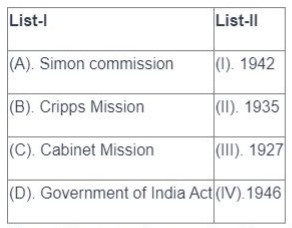
Choose the correct answer from the options given below:
View Solution
A. Simon Commission was set up in 1927 (III). The Simon Commission was a British commission set up to review the working of the Government of India Act of 1919. It was notable for its lack of Indian representation, leading to widespread protests.
B. Cripps Mission occurred in 1942 (I). The Cripps Mission, led by Sir Stafford Cripps, visited India during World War II to seek Indian support for the British war effort. The mission proposed the creation of a constitution for an independent India, but it was rejected by Indian leaders.
C. Cabinet Mission came in 1946 (IV). The Cabinet Mission was a British mission aimed at discussing the transfer of power and the future of British India. It proposed a federal structure for India, but its recommendations were not fully accepted, leading to the partition of India in 1947.
D. Government of India Act was passed in 1935 (II). The Government of India Act 1935 was an important piece of legislation that marked a significant step towards constitutional reform in British India. It proposed the establishment of a federal structure and gave greater autonomy to Indian provinces.
Thus, the correct matching is:
\[ (A) - (III), (B) - (II), (C) - (IV), (D) - (I) \] Quick Tip: The Simon Commission, Cripps Mission, and Cabinet Mission were all major steps in India's path towards independence, each with a specific purpose related to constitutional and political reforms.
Match List-I with List-II
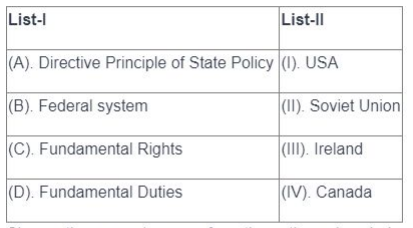
Choose the correct answer from the options given below:
View Solution
The matching between the provisions in the Constitution of India and the countries is as follows:
Directive Principle of State Policy (A) in India is inspired by the Soviet Union (II). The Soviet Union emphasized state intervention for the welfare of the people, which influenced India's Directive Principles for guiding social and economic policy.
Federal system (B) is taken from Canada (IV). Canada's federal system divides power between the central government and provinces, similar to India's federal structure.
Fundamental Rights (C) are influenced by the Constitution of Ireland (III), which guarantees civil liberties and freedoms to its citizens, just like India's Fundamental Rights.
Fundamental Duties (D) are inspired by the USA (I), where the focus is on the rights and responsibilities of citizens towards the state, influencing India's approach to the civic duties of its citizens.
Thus, the correct matching is:
(A) - (II), (B) - (IV), (C) - (III), (D) - (I) Quick Tip: India’s Constitution borrowed elements from multiple countries, including the Soviet Union for social welfare policies, Canada for the federal structure, Ireland for civil liberties, and the USA for citizen duties.
Match List-I with List-II
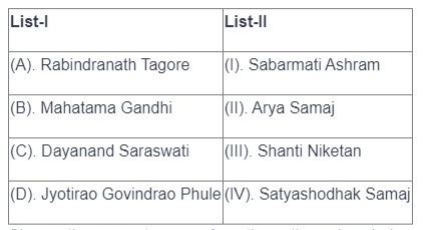
Choose the correct answer from the options given below:
View Solution
A. Rabindranath Tagore: Rabindranath Tagore, one of India's most iconic figures in literature and education, founded Shanti Niketan (III) in 1901. This was a school in Bengal dedicated to providing quality education, promoting creative arts, and fostering a spirit of peaceful coexistence, a place which would become a symbol of India's cultural renaissance.
B. Mahatma Gandhi: Mahatma Gandhi established the Sabarmati Ashram (I) in 1915 in Gujarat. It was here that Gandhi initiated the crucial steps for India's independence, including the Salt March and non-violent protests. The ashram was both a place of refuge for Gandhi and an epicenter for the Indian independence movement.
C. Dayanand Saraswati: Dayanand Saraswati, a renowned social reformer, founded the Arya Samaj (II) in 1875. Arya Samaj played a key role in promoting educational reforms, the revival of Vedic practices, and a campaign against caste-based discrimination, child marriage, and the promotion of widow remarriage.
D. Jyotirao Govindrao Phule: Jyotirao Phule, a key figure in the social reform movement in India, established the Satyashodhak Samaj (IV) in 1873. The society's aim was to promote social equality, oppose the caste system, and improve the status of women and the lower castes in Indian society.
Thus, the correct matching is:
\[ (A) - (III), (B) - (I), (C) - (II), (D) - (IV) \] Quick Tip: The work of these reformers, like Tagore’s educational ideals, Gandhi’s movement for independence, Saraswati’s Vedic reformation, and Phule’s fight against caste discrimination, has had a profound impact on India’s social structure and governance.
Match List-I with List-II
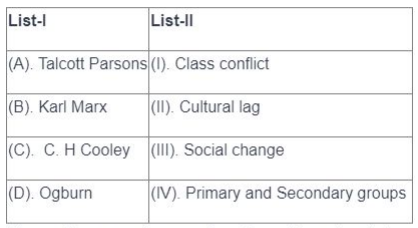
Choose the correct answer from the options given below:
View Solution
A. Talcott Parsons is associated with the concept of Cultural lag (II), which explains the delay between technological advancements and societal adaptation.
B. Karl Marx is known for his concept of Class conflict (I), focusing on the struggles between different social classes.
C. C.H. Cooley is linked with the concept of Primary and Secondary groups (IV), which distinguishes between intimate, small groups and larger, impersonal groups.
D. Ogburn is associated with Social change (III), particularly the impact of technological advancements on society.
Thus, the correct matching is:
\[ (A) - (II), (B) - (I), (C) - (IV), (D) - (III) \] Quick Tip: Understanding the contributions of these sociologists is crucial for comprehending the foundational theories of social structure, change, and conflict in sociology.
Match List-I with List-II
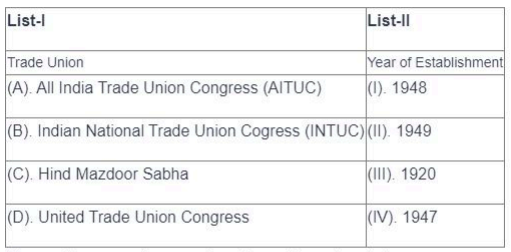
Choose the correct answer from the options given below:
View Solution
The matching between the trade unions and their respective years of establishment is as follows:
All India Trade Union Congress (AITUC) (A) was established in 1920 (III). It was the first major trade union in India, founded by Lala Lajpat Rai and others.
Indian National Trade Union Congress (INTUC) (B) was established in 1947 (IV). INTUC was formed by the Congress Party under the leadership of Jawaharlal Nehru to represent workers' interests.
Hind Mazdoor Sabha (C) was established in 1948 (I). It is one of India's prominent national labor organizations, established after the independence movement.
United Trade Union Congress (D) was established in 1949 (II). This trade union was formed with the aim of unifying workers and representing their rights more effectively across different industries.
Thus, the correct matching is:
- (A)-(I), (B)-(II), (C)-(III), (D)-(IV). Quick Tip: The history of labor unions in India reflects the struggles of workers for better wages, working conditions, and rights, especially post-independence.
Match List-I with List-II

Choose the correct answer from the options given below:
View Solution
Step 1:
The first session of the International Labour Conference (I.L.C.) was held from 29 Oct - 29 Nov 1919. Thus, (A) corresponds to (II).
Step 2:
The Trade Union Act was passed in 1881, which corresponds to (B) being matched with (IV).
Step 3:
The Child Labour Prohibition and Regulation Act was passed in 1986, so (C) corresponds to (III).
Step 4:
The First Factories Act passed in India was in 1926, so (D) corresponds to (I). Quick Tip: The passage of these landmark labor laws in India represents crucial steps towards improving working conditions, protecting vulnerable groups, and ensuring social justice for workers and children.
Match List-I with List-II
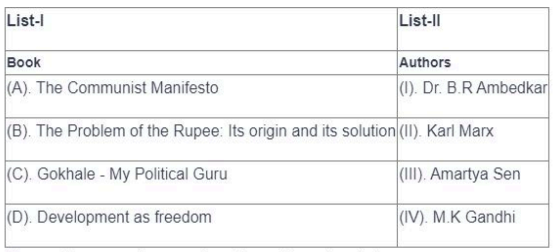
Choose the correct answer from the options given below:
View Solution
Step 1:
The Communist Manifesto is a political pamphlet written by Karl Marx and Friedrich Engels. This manifesto was first published in 1848. Hence, (A) matches with (II), as Karl Marx is the author of this book.
Step 2:
The Problem of the Rupee: Its origin and its solution is a famous work by Dr. B.R Ambedkar. Dr. Ambedkar was a well-known economist and social reformer, and this work primarily addresses the economic challenges and solutions regarding the Indian currency during British rule. Hence, (B) matches with (I).
Step 3:
Gokhale - My Political Guru is a biography written by M.K Gandhi, in which Gandhi recalls his association with Gopal Krishna Gokhale. Gokhale was an important political mentor to Gandhi, and this book reflects their relationship. Hence, (C) matches with (IV).
Step 4:
Development as Freedom is a significant work by Amartya Sen, which argues that development is best understood as freedom, focusing on human capabilities and freedom as the foundation of development. Hence, (D) matches with (III). Quick Tip: Understanding these books is essential for grasping the diverse perspectives on social, economic, and political issues that shaped modern Indian thought and policy.
Match List-I with List-II
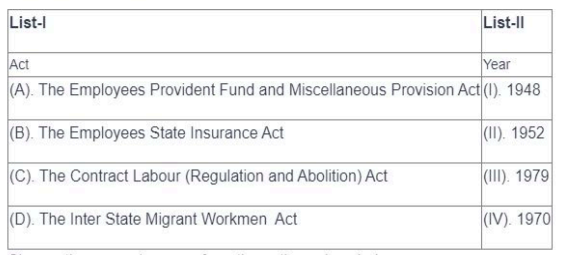
Choose the correct answer from the options given below:
View Solution
The correct matching between the acts and their years of establishment is as follows:
The Employees Provident Fund and Miscellaneous Provision Act (A) was passed in 1948 (II). This Act provides for the institution of provident funds for employees, offering financial security and support.
The Employees State Insurance Act (B) was passed in 1952 (I). This act provides social security benefits to workers in case of sickness, maternity, and employment injury.
The Contract Labour (Regulation and Abolition) Act (C) was passed in 1979 (III). This act aims to regulate the employment of contract labor and, where necessary, abolish it to improve working conditions.
The Inter State Migrant Workmen Act (D) was passed in 1970 (IV). This act provides for the welfare of inter-state migrant workers, regulating their conditions of employment and ensuring their rights.
Thus, the correct matching is:
- (A) - (II), (B) - (I), (C) - (III), (D) - (IV). Quick Tip: These labor welfare laws play an essential role in improving the conditions of workers, ensuring their social security, and regulating the industries for better treatment of employees.
Match List-I with List-II
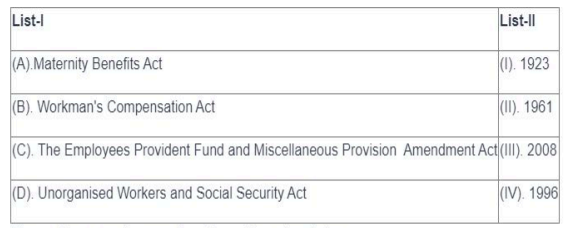
Choose the correct answer from the options given below:
View Solution
The correct matching between the acts and their years of establishment is as follows:
Maternity Benefits Act (A) was passed in 1923 (I). This Act ensures maternity benefits for female employees, including paid leave and other maternity-related support.
Workman's Compensation Act (B) was passed in 1961 (II). This Act provides compensation to workers who are injured or disabled during the course of employment.
The Employees Provident Fund and Miscellaneous Provision Amendment Act (C) was passed in 2008 (III). This amendment made significant changes in the regulation of the provident fund and related benefits for employees.
Unorganised Workers and Social Security Act (D) was passed in 1996 (IV). This Act aims to provide social security benefits for workers in the unorganised sector, ensuring health, insurance, and retirement benefits.
Thus, the correct matching is:
(A) - (I), (B) - (II), (C) - (III), (D) - (IV). Quick Tip: These Acts are crucial in ensuring the welfare of workers in India, providing essential benefits and social security, particularly for female workers and those in the unorganised sector.
Match List-I with List-II
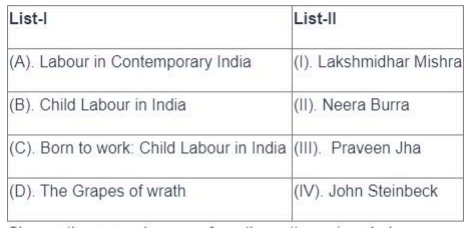
Choose the correct answer from the options given below:
View Solution
The correct matching between the books and their respective authors is as follows:
- Labour in Contemporary India (A) was written by Lakshmidhar Mishra (I). This book discusses the contemporary labor issues in India, focusing on the various challenges faced by workers in the modern economic landscape.
- Child Labour in India (B) was written by Neera Burra (II). This work critically examines the issue of child labor in India, offering insights into its causes, implications, and possible solutions.
- Born to Work: Child Labour in India (C) was written by Praveen Jha (III). This book focuses on the socio-economic factors contributing to child labor in India and its impact on education and childhood development.
- The Grapes of Wrath (D) was written by John Steinbeck (IV). This novel is a classic in American literature that tells the story of a family struggling with poverty and social injustice during the Great Depression.
Thus, the correct matching is:
- (A) - (I), (B) - (II), (C) - (III), (D) - (IV). Quick Tip: Books related to labor and child labor provide valuable insights into the socio-economic conditions and challenges faced by marginalized groups, both in India and globally.
Match List-I with List-II
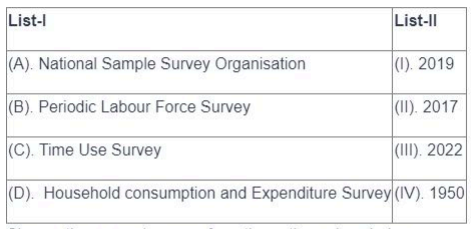
Choose the correct answer from the options given below:
View Solution
The correct matching between the surveys and their respective years is as follows:
National Sample Survey Organisation (A) was established in 1950 (IV). This organization conducts large-scale surveys on a wide range of socio-economic topics in India.
Periodic Labour Force Survey (B) was first initiated in 2017 (II). This survey aims to provide detailed information about labor force participation, employment, and unemployment trends in India.
Time Use Survey (C) was conducted in 2022 (III). This survey gathers data on how individuals allocate their time across various activities, providing valuable insights into labor, leisure, and household activities.
Household Consumption and Expenditure Survey (D) was carried out in 2019 (I). This survey collects data on the consumption and expenditure patterns of households, helping to estimate the consumption expenditure and its distribution.
Thus, the correct matching is:
- (A) - (IV), (B) - (II), (C) - (III), (D) - (I). Quick Tip: Surveys conducted by the National Sample Survey Organisation provide critical data that supports policymaking and research in social, economic, and labor areas.
Match List-I with List-II
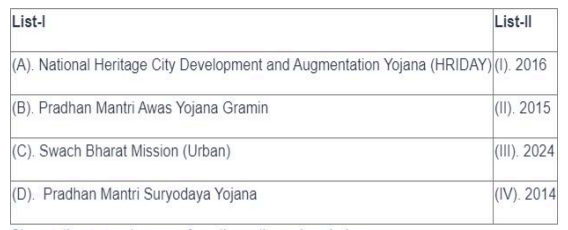
Choose the correct answer from the options given below:
View Solution
The correct matching between the schemes and their respective years is as follows:
National Heritage City Development and Augmentation Yojana (HRIDAY) (A) was launched in 2014 (IV). The HRIDAY scheme focuses on the development of heritage cities in India with a focus on heritage preservation and tourism development.
Pradhan Mantri Awas Yojana Gramin (B) was launched in 2016 (I). This is a rural housing scheme that aims to provide affordable housing to rural people, ensuring housing for all by 2022.
Swach Bharat Mission (Urban) (C) was launched in 2014 (III). This is an initiative aimed at cleaning up streets, roads, and infrastructure of cities, while promoting sanitation practices across urban areas in India.
Pradhan Mantri Suryodaya Yojana (D) was launched in 2024 (II). This scheme aims at promoting the development and use of solar energy to provide electricity to rural and remote areas.
Thus, the correct matching is:
- (A) - (IV), (B) - (I), (C) - (III), (D) - (II). Quick Tip: These schemes are crucial steps toward improving the infrastructure, sanitation, and housing in India, especially in rural and underdeveloped areas.
Match List-I with List-II
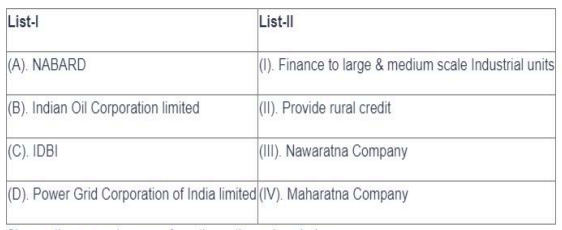
Choose the correct answer from the options given below:
View Solution
The correct matching between the institutions and their respective activities is as follows:
NABARD (A): National Bank for Agriculture and Rural Development (NABARD) is responsible for providing rural credit (II). It focuses on the development of rural India by providing financial and other support to agriculture and rural projects.
Indian Oil Corporation Limited (B): Indian Oil is a Nawaratna Company (IV). It is one of the largest public-sector oil companies in India, and the term "Nawaratna" is used for large companies with strategic importance to the Indian economy.
IDBI (C): Industrial Development Bank of India (IDBI) provides finance to large \& medium scale industrial units (I). It plays a key role in providing credit to industries for their development.
Power Grid Corporation of India Limited (D): Power Grid is classified as a Maharatna Company (III). It is a government-owned corporation that operates in the power transmission sector and is considered one of India's most valuable state-owned companies.
Thus, the correct matching is:
- (A) - (II), (B) - (IV), (C) - (I), (D) - (III). Quick Tip: Understanding the classifications of Maharatna, Navratna, and Miniratna companies is important to grasp their significance and their role in India's public sector economy.
Match List-I with List-II
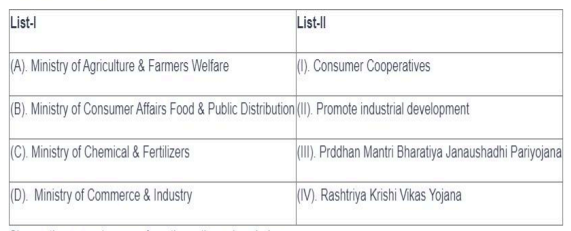
Choose the correct answer from the options given below:
View Solution
The correct matching between the ministries and their respective projects or schemes is as follows:
Ministry of Agriculture \& Farmers Welfare (A): This ministry is associated with the Rashtriya Krishi Vikas Yojana (IV). The scheme aims to promote agricultural development by providing financial assistance and fostering sustainable farming.
Ministry of Consumer Affairs, Food \& Public Distribution (B): This ministry focuses on Consumer Cooperatives (I). It works on ensuring consumer protection, facilitating food security, and promoting cooperatives that serve the needs of consumers.
Ministry of Chemical \& Fertilizers (C): This ministry oversees the Pradhan Mantri Bharatiya Janaushadhi Pariyojana (III). This scheme aims to provide quality medicines at affordable prices to the masses through designated Janaushadhi Kendras.
Ministry of Commerce \& Industry (D): This ministry is concerned with promoting industrial development (II). It is involved in policy formulation to boost industrial growth, exports, and overall economic development.
Thus, the correct matching is:
- (A) - (IV), (B) - (I), (C) - (III), (D) - (II). Quick Tip: Understanding the role of different ministries in implementing key government schemes is crucial for grasping their impact on India's economic development and social welfare.
Match List-I with List-II
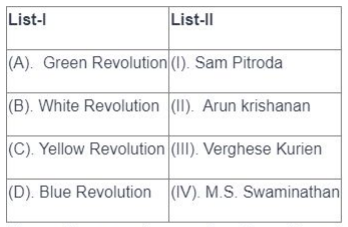
Choose the correct answer from the options given below:
View Solution
The correct matching between the revolutions and their respective pioneers is as follows:
Green Revolution (A) is associated with M.S. Swaminathan (IV). The Green Revolution in India, led by M.S. Swaminathan, revolutionized agricultural productivity, especially in wheat and rice production, transforming India into a self-sufficient nation in food grains.
White Revolution (B) is associated with Verghese Kurien (III). The White Revolution, also known as Operation Flood, is credited to Dr. Verghese Kurien, which transformed India into the world's largest producer of milk and dairy products.
Yellow Revolution (C) is associated with Arun Krishnan (II). The Yellow Revolution, which focused on the production of oilseeds like mustard and sunflower, is credited to Arun Krishnan's contributions to increasing oilseed production in India.
Blue Revolution (D) is associated with Sam Pitroda (I). The Blue Revolution focuses on the expansion and growth of the fisheries sector in India, where Sam Pitroda's efforts were crucial in the development and implementation of new technology and policy to enhance fisheries.
Thus, the correct matching is:
- (A) - (IV), (B) - (I), (C) - (II), (D) - (III). Quick Tip: Each revolution focused on a specific aspect of India's agricultural or economic growth. Understanding the contributions of key individuals behind these revolutions helps grasp their significant impact on India's development.
Match List-I with List-II
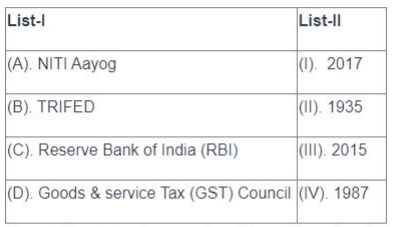
Choose the correct answer from the options given below:
View Solution
The correct matching between the institutions and their respective years of establishment is as follows:
NITI Aayog (A): The National Institution for Transforming India, known as NITI Aayog, was established in 2015 (III). It replaced the Planning Commission and focuses on long-term strategic planning for India’s development.
TRIFED (B): The Tribal Cooperative Marketing Development Federation of India (TRIFED) was established in 1987 (IV). It works for the socio-economic development of tribals and promotes their art and craft.
Reserve Bank of India (RBI) (C): The Reserve Bank of India, the central bank of India, was established in 1935 (II). It is responsible for monetary policy, issuing currency, and managing the economic stability of India.
Goods \& Service Tax (GST) Council (D): The Goods \& Service Tax Council, which governs the implementation of the Goods and Service Tax in India, was constituted in 2017 (I). It is a key institution for GST-related decisions.
Thus, the correct matching is:
- (A) - (III), (B) - (I), (C) - (II), (D) - (IV). Quick Tip: NITI Aayog, RBI, TRIFED, and the GST Council are integral parts of India’s economic and developmental structure. Understanding their role and establishment dates is crucial for comprehending India's administrative framework.
Match List-I with List-II
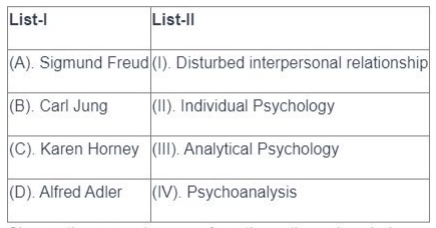
Choose the correct answer from the options given below:
View Solution
The correct matching between the psychologists and their theories is as follows:
Sigmund Freud (A) is associated with Psychoanalysis (IV). Freud is considered the father of psychoanalysis, which focuses on the unconscious mind and its influence on human behavior.
Carl Jung (B) is associated with Analytical Psychology (III). Jung developed analytical psychology, which emphasizes the exploration of the unconscious and the concept of archetypes, as well as the integration of the conscious and unconscious mind.
Karen Horney (C) is associated with Disturbed interpersonal relationships (I). Horney focused on neurosis and stressed the importance of disturbed interpersonal relationships and cultural factors in personality development.
Alfred Adler (D) is associated with Individual Psychology (II). Adler developed individual psychology, which emphasizes the uniqueness of each person and the importance of social interest in healthy development.
Thus, the correct matching is:
- (A) - (IV), (B) - (III), (C) - (I), (D) - (II). Quick Tip: These prominent figures in psychology have significantly contributed to the understanding of human behavior and personality. Psychoanalysis, analytical psychology, and individual psychology provide diverse perspectives on mental health and personal development.
The main features of globalisation are
(A). Integration of markets around the world
(B). Tolerance for one another among nation states
(C). Getting connected to the global economy
(D). Mediation by United Nations to settle disputes between nations
(E). Increase in movement of commodities, money, information and people
Choose the correct answer from the options given below:
View Solution
The main features of globalisation are as follows:
Integration of markets around the world (A) is a key feature of globalisation as it leads to a seamless connection of economic markets across countries.
Getting connected to the global economy (C) is another core feature, as it enables nations to be a part of the global economic system.
Increase in the movement of commodities, money, information, and people (E) is an essential feature, as globalisation facilitates the flow of goods, capital, data, and labor across borders.
Thus, the correct features of globalisation are:
- (A), (C), (E) only. Quick Tip: Globalisation is primarily driven by trade, technological advancements, and policies that promote interdependence among nations, fostering economic growth and interconnectedness.
Social stratification is based on the principles of
(A). Social equality
(B). Social inequality
(C). Social justice
(D). Social injustice
(E). Social hierarchy
Choose the correct answer from the options given below:
View Solution
Social stratification is based on the principles of:
Social inequality (B), which is the foundation of social stratification, as it describes the unequal distribution of resources, opportunities, and status in society.
Social justice (C), which seeks to address and correct social inequalities and promote fairness across different layers of society.
Social injustice (D), which occurs when there is a lack of fairness and equity in the distribution of power, wealth, and rights in society.
Thus, the correct principles are:
- (B), (C), (D) only. Quick Tip: Social stratification refers to the hierarchical arrangement of individuals in society based on factors like wealth, status, and power. It often leads to inequality and can result in social conflicts if not managed properly.
Which of the following statements are correct?
(A). Death rates have declined due to advancement in public health and better nutrition
(B). Poverty and starvation are caused by population growth rather than unequal distribution of resources
(C). Population growth rates are high because both the death rate and the birth rate are high
(D). Unjust social order allows privileged minority to live in luxury while majority are forced to live in poverty
(E). Population growth rates are high as birth rates have declined and epidemic diseases are being controlled
Choose the correct answer from the options given below:
View Solution
(A): Death rates have indeed declined due to advancements in public health and better nutrition, which is widely recognized in demographic studies.
(B): This statement is not true as poverty and starvation are more linked to the unequal distribution of resources rather than merely population growth.
(C): Population growth rates are generally high because the birth rate remains high even when death rates have declined.
(D): The statement is true, as an unjust social order often leads to wealth disparities, where a privileged minority lives in luxury while the majority live in poverty.
(E): This statement is not entirely accurate as population growth rates are still high despite declining birth rates in some regions, and the control of epidemics does not necessarily correlate with high growth rates.
Thus, the correct answer is: (A), (D) only. Quick Tip: Population dynamics are influenced by various factors such as healthcare, nutrition, and social systems. While growth rates may seem controlled by health improvements, socio-economic factors play a significant role.
The Child Protection Acts in India are:
(A). The Immoral Traffic (Prevention) Act, 1987
(B). Child Labour (Prohibition and Regulation) Act, 1986
(C). Protection of Children from Sexual Offences Act, 2012
(D). The Hindu Marriage Act, 1955
(E). Prohibition of Child Marriage Act, 2006 \
Choose the correct answer from the options given below:
View Solution
(A): The Immoral Traffic (Prevention) Act, 1987, deals with trafficking of women and children, aiming to prevent exploitation.
(B): The Child Labour (Prohibition and Regulation) Act, 1986, prohibits the employment of children in hazardous work environments.
(C): The Protection of Children from Sexual Offences Act, 2012, provides legal protection against sexual abuse for children.
(E): The Prohibition of Child Marriage Act, 2006, aims to prevent child marriages by setting legal age limits.
Thus, the correct answer is: (A), (B), (C), and (E) only. Quick Tip: India has a series of legal frameworks aimed at protecting children from exploitation and abuse, and these acts are critical in ensuring the rights of children are safeguarded.
Social Stratification refers to:
(A). People in a society are hierarchically ranked
(B). Unequal distribution of resources
(C). Natural difference between people
(D). Social position of a person is ascribed
(E). Free movement of people and goods
Choose the correct answer from the options given below:
View Solution
(A): Social stratification indeed involves hierarchical ranking of individuals based on their socio-economic status.
(B): Unequal distribution of resources is one of the core features of social stratification.
(D): In social stratification, the social position of a person is often ascribed, meaning it is assigned at birth or involuntarily (e.g., caste, gender).
(C): Natural differences between people are not considered a basis for social stratification; rather, it is based on social and economic factors.
(E): Free movement of people and goods is not related to social stratification.
Thus, the correct answer is: (A), (B), and (D) only. Quick Tip: Social stratification is a system by which society ranks categories of people in a hierarchy. It impacts people's access to resources and opportunities, often leading to inequalities.
The characteristics of caste system are
(A). Practice of exogamy
(B). Practice of Endogamy
(C). Social exclusion
(D). Principle of purity and pollution
(E). Social inclusion
Choose the correct answer from the options given below:
View Solution
(B): The caste system is characterized by the practice of Endogamy, where individuals marry within their own caste.
(C): Social exclusion is a key feature, as lower castes are often excluded from certain social privileges and opportunities.
(D): The caste system is governed by the principle of purity and pollution, where higher castes are considered pure, and lower castes are seen as impure.
(A): The caste system generally practices Endogamy rather than exogamy, where marriage is restricted within the caste.
(E): Social inclusion is not a characteristic of the caste system, as it promotes social exclusion.
Thus, the correct answer is: (B), (C), and (D) only. Quick Tip: The caste system has deep historical roots in India and continues to shape the social structure, impacting individuals' access to resources, opportunities, and social mobility.
Which of the following are the fundamental duties of every citizen of India
(A). To protect and improve the natural environment
(B). To safeguard public property
(C). To value the sovereignty of neighbouring nations
(D). To develop the scientific temper and spirit of inquiry
(E). To provide opportunities for education to their child or ward
Choose the correct answer from the options given below:
View Solution
The Fundamental Duties listed in the Indian Constitution include the following:
(A): To protect and improve the natural environment is a fundamental duty.
(B): To safeguard public property is also a fundamental duty of Indian citizens.
(D): Developing scientific temper and the spirit of inquiry is mentioned as a fundamental duty.
(E): To provide opportunities for education to their child or ward is included in the Fundamental Duties.
Thus, the correct answer is: (A), (B), (D), (E) only. Quick Tip: The Fundamental Duties in the Indian Constitution are guidelines for the citizens, which ensure their responsibilities towards the nation, society, and environment.
The Ministry of Corporate Affairs (MCA) administers the following Acts/codes
(A). The Companies Act, 2013
(B). The Indian Partnership Act, 1932
(C). Insolvency and Bankruptcy Code, 2016
(D). The Competition Act, 2002
(E). Wildlife (Protection Act), 1972 )
Choose the correct answer from the options given below:
View Solution
The Ministry of Corporate Affairs (MCA) is responsible for the following major Acts and codes:
(A) The Companies Act, 2013 is a fundamental law governing the incorporation, regulation, and dissolution of companies in India.
(B) The Indian Partnership Act, 1932 governs partnerships in India.
(C) The Insolvency and Bankruptcy Code, 2016 regulates the process of insolvency and bankruptcy for individuals and companies.
(D) The Competition Act, 2002 promotes and sustains competition in the market.
The Wildlife (Protection Act), 1972 (E) is not administered by the MCA, as it is under the Ministry of Environment, Forest and Climate Change.
Thus, the correct answer is: (A), (B), (C), (D) only. Quick Tip: The Ministry of Corporate Affairs plays a crucial role in regulating the corporate sector, facilitating ease of doing business, and ensuring legal compliance.
The Pradhan Mantri Rojgar Protsahan Yojana (PMRPY) was launched in 2016 aims at
(A). To incentivise employers for creation of new employment
(B). To incentivise for employees to upskill themselves
(C). To incentivise for employees to help them find more raw materials
(D). To incentivise for employers for increased goods sold
(E). To incentivise for employers for increased market demand
Choose the correct answer from the options given below:
View Solution
The Pradhan Mantri Rojgar Protsahan Yojana (PMRPY) aims to incentivize employers for creation of new employment (A) by reimbursing the employers' contribution to the Employees' Provident Fund (EPF) for new employees.
(A): The scheme focuses on incentivizing employers to create new jobs, which is a primary goal of PMRPY.
(B): While upskilling employees is important for overall employment growth, it is not the primary focus of PMRPY.
(C), (D), and (E): These do not align with the objectives of the PMRPY scheme.
Thus, the correct answer is: (A) only. Quick Tip: PMRPY is aimed at promoting employment generation by incentivizing employers to hire new workers, especially from vulnerable and marginalized sections.
Name one of the first organizations to deal with the labor issues
(A). Collective labour law
(B). Treaty of Versailles
(C). International Labour Organisation (ILO)
(D). International Federation of Trade Union (IFTU)
(E). Indian Union of Labour (IUL)
Choose the correct answer from the options given below:
View Solution
The International Labour Organisation (ILO) (C) was one of the first organizations to address labor issues, focusing on setting international labor standards and improving working conditions worldwide.
(A): Collective labor law is a legal concept, not an organization.
(B): The Treaty of Versailles primarily dealt with peace terms after World War I and is not directly concerned with labor issues.
(D): The International Federation of Trade Unions (IFTU) is a significant entity but was not the first to deal with labor issues.
(E): The Indian Union of Labour (IUL) is a national body and does not have the historical precedence or global influence of the ILO.
Thus, the correct answer is: (C) only. Quick Tip: The International Labour Organisation (ILO) has been at the forefront of advocating for workers' rights and has developed numerous international labor standards to protect workers globally.
The Ministry has developed a Unified web portal ‘Shram Suvidha Portal’
(A). To provide transparency and accountability on employment of labor as per the skills
(B). To provide transparency and accountability in enforcement of labor laws and facilitate complexity of compliance
(C). To provide transparency and accountability on gender-specific labor laws
(D). To provide transparency and accountability on training, employment, skill development
(E). To provide transparency and accountability on trends of employment in different sectors
Choose the correct answer from the options given below:
View Solution
The Shram Suvidha Portal was developed by the Ministry to promote transparency and ease of compliance in labor regulations. It serves the following functions:
(A): The portal provides transparency on employment based on skills.
(B): It helps in the enforcement of labor laws, facilitating the complexity of compliance.
(D): The portal supports training, employment, and skill development, aiming to improve workforce readiness.
(C) and (E): While important, these aspects are not primary features of the portal, which focuses on compliance, transparency, and skill development rather than gender-specific laws or sector trends.
Thus, the correct answer is: (A), (B), and (D) only. Quick Tip: The Shram Suvidha Portal aims to streamline labor law compliance and improve transparency in the labor market, benefiting both employers and employees.
The main objectives of Make in India are
(A). To Promote Integrated value chain
(B). To Promote India as an important investment destination
(C). To Promote India as a global hub for manufacturing, design, and innovation
(D). To boost export of telecom
(E). To uplift urban poor households by enhancing sustainable livelihood opportunities
Choose the correct answer from the options given below:
View Solution
The Make in India initiative focuses on turning India into a global manufacturing hub. Its main objectives include:
(B): Promoting India as an important investment destination is a primary goal of the initiative, aiming to attract foreign direct investment (FDI) into the manufacturing sector.
(C): Promoting India as a global hub for manufacturing, design, and innovation is another key objective of Make in India, focusing on boosting India's global competitiveness.
(A): Although integrated value chains are important for industrial development, they are not specifically emphasized in the options provided.
(D) and (E): While boosting exports and improving livelihoods are important, these are not core objectives specifically highlighted by the Make in India initiative.
Thus, the correct answer is: (B) and (C) only. Quick Tip: Make in India aims to increase domestic manufacturing and innovation, fostering economic growth by enhancing India's position as a global manufacturing hub.
Match List-I with List-II

Choose the correct answer from the options given below:
View Solution
The correct matching between the types of taxes and their respective categories is as follows:
(A) Direct Tax: Direct taxes are taxes imposed on individuals and organizations directly, like Property Tax (II), which is imposed on the ownership of property.
(B) Indirect Tax: Indirect taxes are levied on goods and services, such as Excise Duty (I), which is a tax on the production or sale of goods within a country.
(C) Taxes imposed by the Central Government: Taxes imposed by the central government include taxes like Wealth Tax (IV), which is levied on the wealth of individuals.
(D) Taxes imposed by the State Government: State governments impose taxes like Motor Vehicle Tax (III), which is charged on vehicles in a state.
Thus, the correct matching is:
- (A) - (II), (B) - (I), (C) - (IV), (D) - (III). Quick Tip: Direct taxes are levied directly on individuals and organizations, while indirect taxes are passed on to the consumer through the price of goods and services. Understanding their distinctions is key in grasping tax structures.





Comments