



The UK Board 2026 Class 12 Geology Question Paper with Solution PDF is now available for download. The Uttarakhand Board of School Education (UBSE) conducted the Intermediate Geology exam on March 12, 2026.
The UK Board Class 12 Geology paper covered key topics from minerals, rocks, geological processes, and earth structures. The MCQ section tested basic understanding of geological concepts, while the descriptive questions required detailed explanations, analysis of geological formations, and practical applications. Students should focus on understanding geological processes, rock formations, and interpreting geological data to score well.
UK Board Class 12 2026 Geology Question Paper with Solution PDF
| UK Board Class 12 2026 Geology Question Paper with Solution PDF | Download PDF | Check Solution |
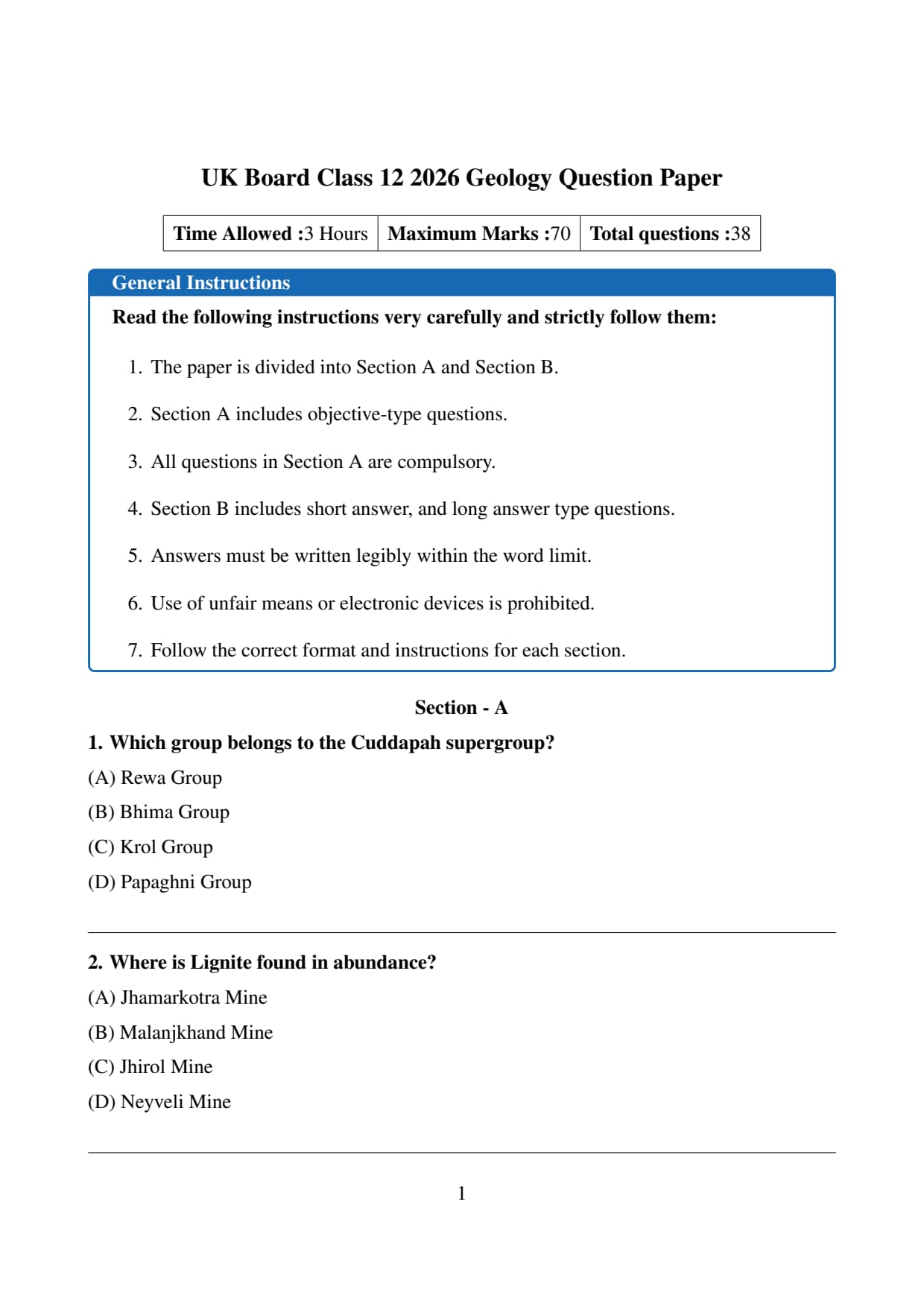
Which group belongs to the Cuddapah supergroup?
View Solution
Step 1: Understanding Cuddapah Supergroup.
The Cuddapah supergroup is a geological formation in India, and it consists of several subgroups. The Bhima Group is one of the subgroups that belongs to the Cuddapah supergroup.
Step 2: Identifying the correct group.
The correct group related to the Cuddapah supergroup is the Bhima Group. The other options such as Rewa, Krol, and Papaghni groups belong to different geological formations.
Step 3: Comparison with other options.
(A) Rewa Group: Incorrect. The Rewa group is not part of the Cuddapah supergroup.
(B) Bhima Group: Correct. This group is part of the Cuddapah supergroup.
(C) Krol Group: Incorrect. The Krol Group is a part of the Lesser Himalayas, not the Cuddapah supergroup.
(D) Papaghni Group: Incorrect. The Papaghni Group is another separate geological formation.
Step 4: Conclusion.
Thus, the Bhima Group is the one that belongs to the Cuddapah supergroup.
Final Answer: (B) Bhima Group.
Quick Tip: The Cuddapah supergroup consists of multiple groups, with the Bhima Group being one of its prominent subgroups.
Where is Lignite found in abundance?
View Solution
Step 1: Understanding Lignite.
Lignite is a type of coal that is considered the lowest rank due to its relatively low carbon content. It is mainly used for power generation due to its high moisture content and low energy output.
Step 2: Identifying the location of Lignite mines.
The Neyveli Mine, located in Tamil Nadu, India, is one of the largest lignite reserves in the country. It is known for its vast deposits of lignite, used for electricity generation.
Step 3: Comparison with other options.
(A) Jhamarkotra Mine: Incorrect. This mine is known for its gypsum deposits, not lignite.
(B) Malanjkhand Mine: Incorrect. This mine is famous for copper mining, not lignite.
(C) Jhirol Mine: Incorrect. Jhirol Mine is not known for lignite extraction.
(D) Neyveli Mine: Correct. Neyveli is one of the largest sources of lignite in India.
Step 4: Conclusion.
The Neyveli Mine is the correct answer, as it is the largest lignite reserve in India.
Final Answer: (D) Neyveli Mine.
Quick Tip: Neyveli Mine is the largest lignite mining area in India, with significant contributions to power generation through lignite-based thermal plants.
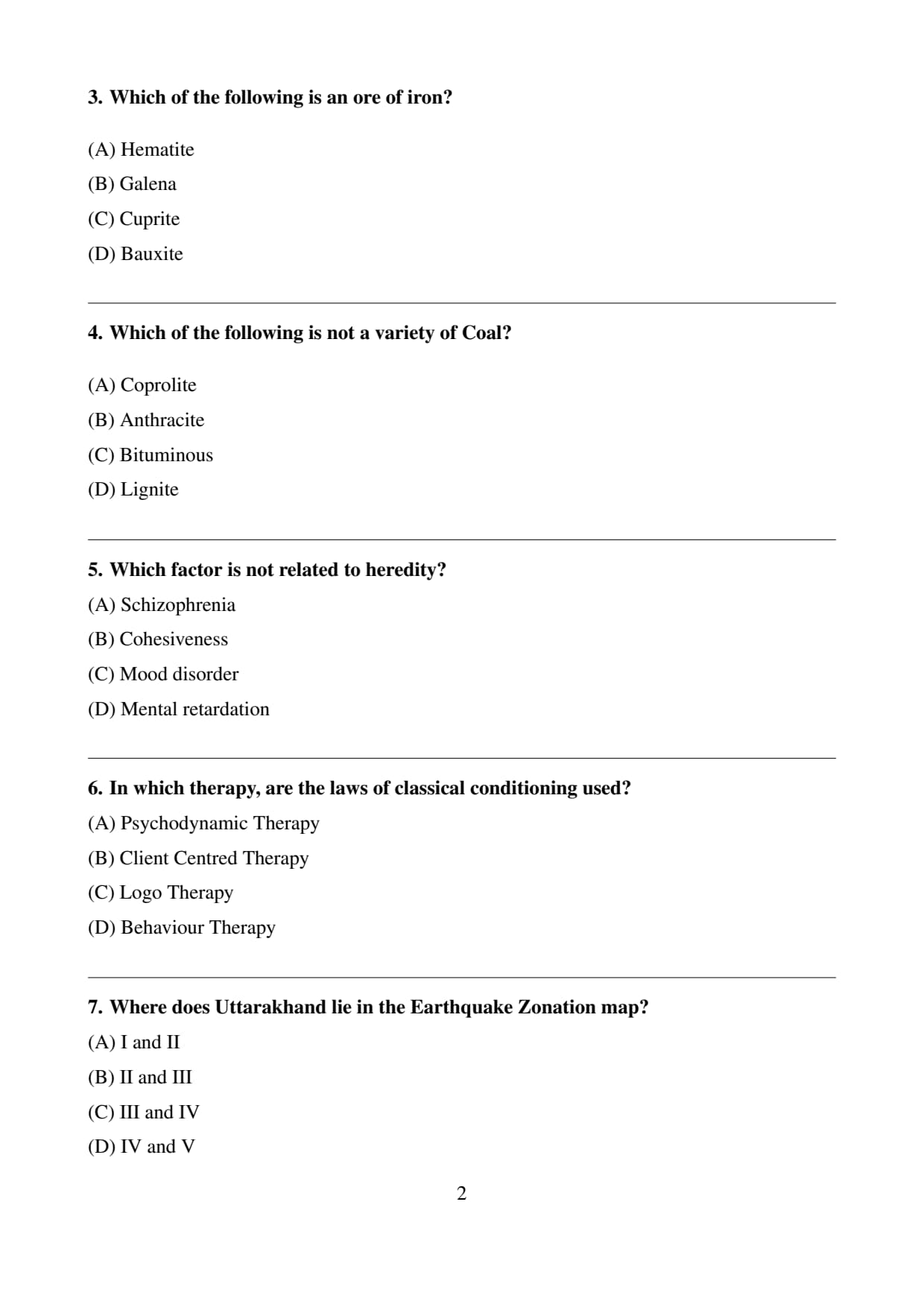
Which of the following is an ore of iron?
View Solution
Step 1: Understanding ores of iron.
Iron ores are naturally occurring minerals from which iron can be extracted. Common ores of iron include Hematite, Magnetite, and Siderite.
Step 2: Analyzing the options.
(A) Hematite: Correct. Hematite is an important iron ore. It is the most commonly mined ore and contains iron oxide (Fe2O3).
(B) Galena: Incorrect. Galena is the primary ore of lead, not iron.
(C) Cuprite: Incorrect. Cuprite is the ore of copper, not iron.
(D) Bauxite: Incorrect. Bauxite is the ore of aluminum, not iron.
Step 3: Conclusion.
Hematite is a well-known ore of iron. Therefore, the correct answer is (A) Hematite.
Final Answer: Hematite. Quick Tip: Remember, ores of iron include Hematite, Magnetite, and Siderite, while other materials like Galena and Bauxite are ores of lead and aluminum, respectively.
Which of the following is not a variety of Coal?
View Solution
Step 1: Understanding types of coal.
Coal is classified into several types based on carbon content and its use in industrial processes. The main varieties are Anthracite, Bituminous, and Lignite.
Step 2: Analyzing the options.
(A) Coprolite: Correct. Coprolite is not a type of coal. It refers to fossilized excrement.
(B) Anthracite: Incorrect. Anthracite is a high-carbon, high-energy coal.
(C) Bituminous: Incorrect. Bituminous coal is a type of coal used in energy production and steel manufacturing.
(D) Lignite: Incorrect. Lignite, also known as brown coal, is a low-rank coal.
Step 3: Conclusion.
Coprolite is not a type of coal. Therefore, the correct answer is (A) Coprolite.
Final Answer: Coprolite. Quick Tip: Coal varieties are primarily classified as Anthracite, Bituminous, and Lignite. Coprolite, however, is fossilized excrement and not related to coal.
Which factor is not related to heredity?
View Solution
Step 1: Understanding heredity and psychological factors.
Heredity refers to the genetic inheritance of traits from parents to offspring. Certain psychological and mental health conditions are known to be influenced by genetics, such as schizophrenia and mood disorders.
Step 2: Evaluating the options.
(A) Schizophrenia: Incorrect. Schizophrenia is a mental health disorder strongly linked to genetic factors.
(B) Cohesiveness: Correct. Cohesiveness refers to social or group dynamics, which are not directly related to heredity.
(C) Mood disorder: Incorrect. Mood disorders, such as depression and bipolar disorder, have a hereditary component.
(D) Mental retardation: Incorrect. Some forms of mental retardation (intellectual disability) can be inherited.
Step 3: Conclusion.
Therefore, cohesiveness is the factor that is not related to heredity.
Final Answer: (B) Cohesiveness.
Quick Tip: Heredity plays a role in various mental health conditions, but social factors like cohesiveness are not directly related to genetic inheritance.
In which therapy, are the laws of classical conditioning used?
View Solution
Step 1: Understanding classical conditioning.
Classical conditioning is a type of learning in which a neutral stimulus becomes associated with a meaningful stimulus to produce a response. This form of learning is used in therapies that aim to modify behavior.
Step 2: Evaluating the therapy types.
(A) Psychodynamic Therapy: Incorrect. Psychodynamic therapy is based on Freudian concepts, focusing on unconscious processes and early childhood experiences.
(B) Client Centred Therapy: Incorrect. Client-centred therapy, developed by Carl Rogers, focuses on the individual's self-actualization and personal growth, not classical conditioning.
(C) Logo Therapy: Incorrect. Logo therapy, developed by Viktor Frankl, is focused on finding meaning in life, not based on classical conditioning.
(D) Behaviour Therapy: Correct. Behaviour therapy uses the principles of classical conditioning to modify unwanted behaviors.
Step 3: Conclusion.
Behavior therapy is the correct answer, as it explicitly incorporates classical conditioning in its methods.
Final Answer: (D) Behaviour Therapy.
Quick Tip: Classical conditioning is a cornerstone of behaviour therapy, often used to help modify or eliminate undesirable behaviors.
Where does Uttarakhand lie in the Earthquake Zonation map?
View Solution
Step 1: Understanding Earthquake Zonation.
The Earthquake Zonation map classifies different regions of a country based on their susceptibility to seismic activities. These zones are categorized from I (low seismic risk) to V (high seismic risk).
Step 2: Evaluating the seismic zones of Uttarakhand.
Uttarakhand lies in a region that is categorized under high seismic risk zones, primarily in Zone II and Zone III on the Earthquake Zonation map.
Step 3: Comparison with other options.
(A) I and II: Incorrect. Uttarakhand is not categorized under Zone I, which is low risk.
(B) II and III: Correct. Uttarakhand is located in Zones II and III, where there is moderate seismic risk.
(C) III and IV: Incorrect. While Zone III is correct, Uttarakhand does not lie in Zone IV.
(D) IV and V: Incorrect. Uttarakhand does not fall under Zones IV and V, which are for regions with the highest seismic risk.
Step 4: Conclusion.
Based on the seismic risk assessment, Uttarakhand lies in Zones II and III.
Final Answer: (B) II and III.
Quick Tip: Uttarakhand is situated in seismic risk Zones II and III, which have moderate earthquake risk.
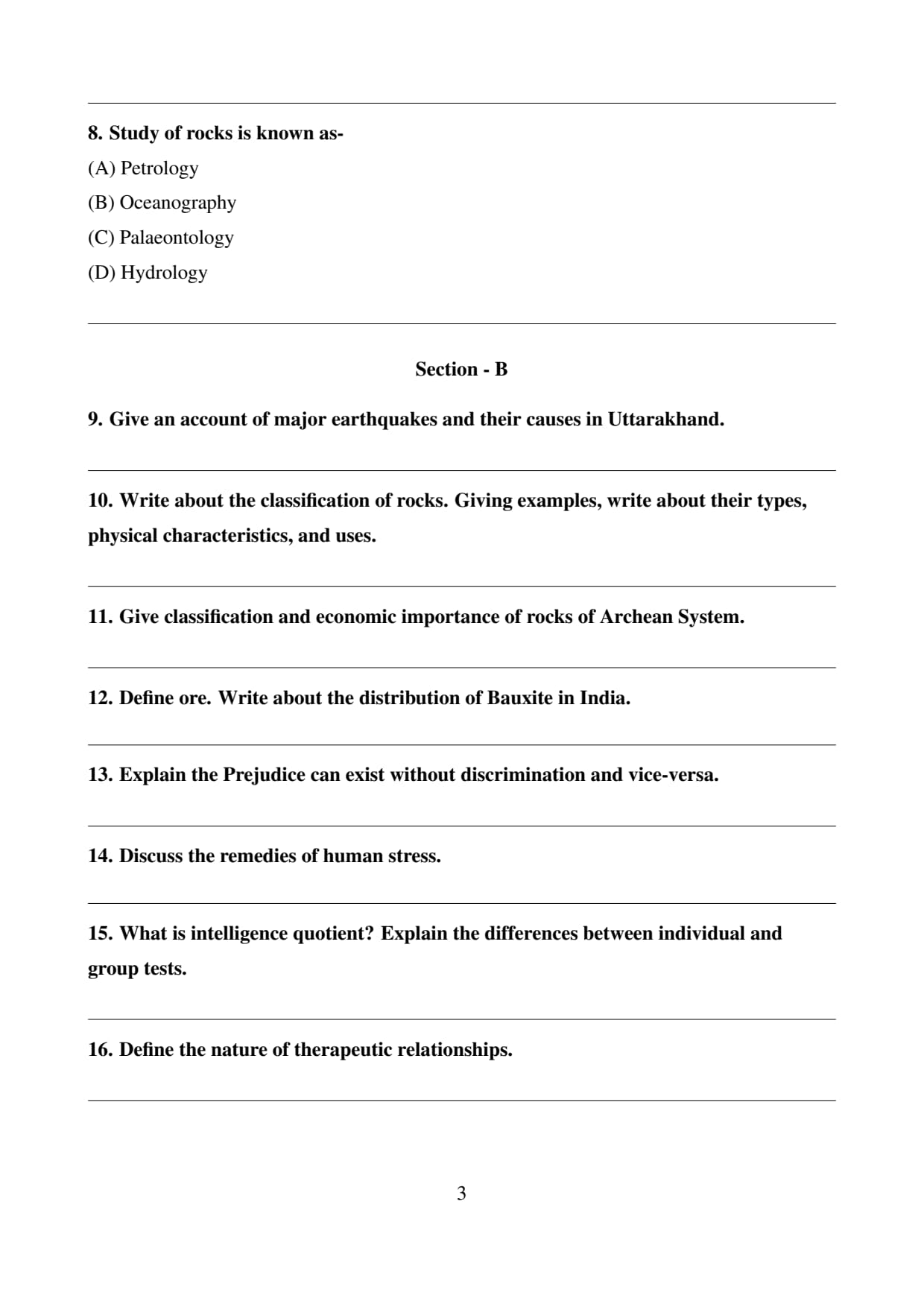
Study of rocks is known as-
View Solution
Step 1: Understanding the term "Petrology".
Petrology is the branch of geology that studies rocks, their origin, composition, and structure. It is concerned with understanding how rocks form, their mineral composition, and their role in the Earth's processes.
Step 2: Evaluating the options.
(A) Petrology: Correct. Petrology is the study of rocks and their properties.
(B) Oceanography: Incorrect. Oceanography is the study of the Earth's oceans and seas, including their physical properties and biological aspects.
(C) Palaeontology: Incorrect. Palaeontology is the study of fossils and ancient life forms, not rocks.
(D) Hydrology: Incorrect. Hydrology is the study of water on Earth, its distribution, and its movement.
Step 3: Conclusion.
Petrology is the correct field of study when it comes to rocks.
Final Answer: (A) Petrology.
Quick Tip: Petrology helps us understand the Earth’s composition and the processes that form and alter rocks.
Give an account of major earthquakes and their causes in Uttarakhand.
View Solution
Step 1: Overview of Earthquakes in Uttarakhand.
Uttarakhand, located in the northern part of India, is a seismically active region due to its position in the Himalayan belt, which is prone to tectonic activity.
Step 2: Causes of Earthquakes in Uttarakhand.
The primary cause of earthquakes in Uttarakhand is the collision of the Indian Plate with the Eurasian Plate. This leads to the formation of the Himalayan mountain range, and the tectonic movement causes seismic activity in the region.
Step 3: Faults and Seismic Zones.
Uttarakhand is located in seismic zones IV and V, which are highly prone to strong earthquakes. The movement along major faults such as the Main Boundary Thrust (MBT) and the Main Central Thrust (MCT) further triggers earthquakes. Quick Tip: Remember: The major cause of earthquakes in Uttarakhand is the tectonic plate collision in the Himalayan region, especially along the major faults like MBT and MCT.
Write about the classification of rocks. Giving examples, write about their types, physical characteristics, and uses.
View Solution
Step 1: Introduction to Rock Classification.
Rocks are classified into three major types based on their formation process: igneous, sedimentary, and metamorphic rocks.
Step 2: Igneous Rocks.
Igneous rocks form from the cooling and solidification of molten magma. Examples include granite and basalt. They are generally hard, durable, and are used in construction.
Step 3: Sedimentary Rocks.
Sedimentary rocks form from the accumulation of sediments. Examples include sandstone and limestone. These rocks are often layered and are used in construction, and for making cement and glass.
Step 4: Metamorphic Rocks.
Metamorphic rocks form when existing rocks are subjected to heat and pressure. Examples include marble and slate. These rocks are known for their durability and are often used in sculptures and construction.
Step 5: Physical Characteristics and Uses.
The physical characteristics of rocks, such as hardness, texture, and composition, influence their uses in various industries, from construction to manufacturing of goods. Quick Tip: Remember: The classification of rocks is based on their formation: igneous (from magma), sedimentary (from sediments), and metamorphic (from heat and pressure).
Give classification and economic importance of rocks of Archean System.
View Solution
Step 1: Classify the rocks of Archean System.
The rocks of the Archean System can be classified into two primary categories: Granitic and Basaltic. Granitic rocks are primarily light-colored, rich in silica, and generally consist of minerals such as quartz, feldspar, and mica. These are typically found in the Earth's crust and form the foundation of many continental landmasses. Basaltic rocks, on the other hand, are dark-colored, rich in iron and magnesium, and are typically found in oceanic crusts. These rocks are also fundamental in the formation of the Earth's early surface and contribute to geological activity like plate tectonics.
Step 2: Economic Importance of Archean Rocks.
Archean rocks have significant economic importance due to the presence of several valuable minerals. The main economic contributions of Archean rocks include:
- Gold Deposits: Archean rocks, especially the greenstone belts, are rich in gold deposits, which have been a major source of gold mining, particularly in countries like South Africa and Australia.
- Iron Ore: The iron-rich banded iron formations (BIFs) found within Archean rocks are essential for the production of iron and steel.
- Bauxite: Certain Archean rocks also contain significant deposits of bauxite, the primary ore of aluminum, which is crucial for the aerospace and transportation industries.
- Other Minerals: Other important minerals, such as copper, zinc, and uranium, are also found in Archean rocks, contributing to the mining industry.
These economic resources, primarily mined from Archean rocks, have been critical for the development of infrastructure, industrialization, and modern technologies.
Quick Tip: Remember: The Archean system is a key source of valuable minerals, and understanding their classification helps in the identification of economic resources.
Define ore. Write about the distribution of Bauxite in India.
View Solution
Step 1: Define Ore.
An ore is a naturally occurring material from which a metal or valuable mineral can be extracted profitably. Ores are formed through geological processes over millions of years. They are typically composed of minerals that contain high concentrations of metals, and these metals are extracted using various mining techniques like smelting, flotation, or chemical processes. The profitability of extracting the metal from the ore depends on the concentration of the metal, its accessibility, and the extraction process used. Common examples of ores include iron ore (hematite, magnetite), copper ore (chalcopyrite), and bauxite (aluminum ore).
Step 2: Distribution of Bauxite in India.
Bauxite is the principal ore of aluminum, and its availability is crucial for industries that manufacture aluminum products. India is one of the world's largest producers of bauxite, with substantial deposits scattered across the country.
- Odisha: Odisha has the largest reserves of bauxite in India, especially in the Kalahandi, Koraput, and Rayagada districts. These areas are known for their rich bauxite deposits, which contribute significantly to the aluminum industry.
- Gujarat: Gujarat has sizable bauxite deposits, particularly in the Panchmahal and Kheda districts. These deposits are essential for the aluminum production in the region.
- Maharashtra: The districts of Kolhapur and Satara in Maharashtra are known for their bauxite deposits, which play a key role in the state's mining sector.
- Jharkhand: Jharkhand is another significant contributor to India's bauxite reserves, particularly in the West Singhbhum district, which holds substantial amounts of bauxite.
- Andhra Pradesh: Andhra Pradesh also has important bauxite reserves, especially in areas like Visakhapatnam, where bauxite is extracted for industrial purposes.
The widespread distribution of bauxite in India ensures a steady supply for the domestic aluminum industry, making India one of the key players in the global aluminum market.
Quick Tip: Remember: Bauxite is a crucial ore for aluminum extraction, and India has significant deposits in states like Odisha and Gujarat.
Explain the Prejudice can exist without discrimination and vice-versa.
View Solution
Step 1: Define Prejudice.
Prejudice refers to preconceived opinions or judgments about individuals or groups based on characteristics such as race, gender, or social status. These judgments are often formed without sufficient knowledge or understanding.
Step 2: Explain Discrimination.
Discrimination, on the other hand, is the actual behavior or action that results from prejudice. It involves unfair treatment of individuals or groups based on prejudiced beliefs. Discrimination occurs when someone is treated differently or unjustly because of their characteristics.
Step 3: Can Prejudice exist without Discrimination?
Yes, prejudice can exist without discrimination. A person may hold prejudiced beliefs about a group but may not act on those beliefs, refraining from discriminatory actions.
Step 4: Can Discrimination exist without Prejudice?
Discrimination can also exist without prejudice. For example, a person might engage in discriminatory practices due to societal or institutional pressures, without personally holding prejudiced beliefs. This shows that while prejudice leads to discrimination, discrimination can sometimes occur due to external factors. Quick Tip: Remember: Prejudice is a belief, while discrimination is an action. Prejudice can exist without resulting in discriminatory behavior, and vice-versa.
Discuss the remedies of human stress.
View Solution
Step 1: Introduction to Stress.
Stress is the body's response to challenges or demands. It can be physical, emotional, or psychological. Prolonged stress can lead to serious health issues like heart disease, anxiety, and depression.
Step 2: Remedies for Human Stress.
There are several remedies to manage and reduce stress:
- Physical Exercise: Regular physical activity, such as walking, jogging, yoga, or swimming, can significantly reduce stress by releasing endorphins, the body's natural mood enhancers.
- Relaxation Techniques: Techniques like deep breathing, meditation, and mindfulness can help in relaxing the mind and reducing the effects of stress.
- Time Management: Organizing tasks and prioritizing them can help prevent overwhelming situations. Time management reduces stress by preventing procrastination and ensuring better control over one's workload.
- Adequate Sleep: Proper rest and sleep are essential for physical and mental recovery. Lack of sleep can exacerbate stress, so it is important to maintain a healthy sleep schedule.
- Social Support: Talking to friends, family, or a therapist can help in relieving stress. Having a strong support network provides emotional stability and a sense of security.
Step 3: Conclusion.
By implementing these remedies, individuals can effectively manage their stress levels and maintain both physical and mental well-being. Quick Tip: Remember: Managing stress is essential for health. Incorporate exercise, relaxation techniques, and proper sleep into your routine to reduce stress levels.
What is intelligence quotient? Explain the differences between individual and group tests.
View Solution
Step 1: Definition of Intelligence Quotient (IQ).
Intelligence Quotient (IQ) is a measure of a person's intellectual abilities in relation to others. It is usually determined through standardized tests that assess various cognitive abilities.
Step 2: Individual Tests.
Individual IQ tests are administered to one person at a time, usually in a controlled environment. The test taker receives personalized attention from the examiner. These tests are often more accurate in measuring an individual's cognitive abilities. Examples include the Stanford-Binet IQ test.
Step 3: Group Tests.
Group IQ tests are designed to assess the intelligence of a group of individuals simultaneously. These tests are typically less time-consuming and may not provide as detailed results for each person, but they are efficient for testing large groups. An example is the Army Alpha Test.
Step 4: Key Differences.
The main difference between individual and group tests lies in the administration and the level of personalized attention. Individual tests are more accurate and detailed, whereas group tests are quicker and more practical for large-scale assessments. Quick Tip: Remember: Individual tests are more detailed and accurate, while group tests are quicker and suitable for large-scale assessments.
Define the nature of therapeutic relationships.
View Solution
Step 1: Introduction to Therapeutic Relationships.
Therapeutic relationships are professional relationships between a therapist and a client that are centered around the healing process. These relationships are built on trust, respect, and understanding.
Step 2: Characteristics of Therapeutic Relationships.
The therapeutic relationship is collaborative, with both the therapist and client actively participating in the treatment process. It is also confidential, ensuring that the client feels safe to express themselves without fear of judgment.
Step 3: Boundaries and Professionalism.
In therapeutic relationships, clear boundaries are maintained to ensure that the therapist remains objective and focused on the client's well-being. This helps to prevent emotional dependency and maintains professionalism.
Step 4: Goals of the Therapeutic Relationship.
The primary goal of a therapeutic relationship is to help the client achieve emotional healing, develop coping strategies, and improve their mental health. This is achieved through empathy, active listening, and appropriate therapeutic interventions. Quick Tip: Remember: A therapeutic relationship is based on trust, professionalism, and clear boundaries. Its goal is to help the client heal and improve their mental health.



Comments