




Maharashtra Board Class 12 Physics Question Paper 2022 with Answer Key is available for download. The exam was conducted by the Maharashtra State Board of Secondary & Higher Secondary Education (MSBSHSE) on March 10, 2022 in the Morning Session 10:30 AM to 2 PM. The medium of paper was English. In terms of difficulty level, Maharashtra Board Class 12 Physics paper was of Easy to Moderate level. The question paper comprised a total of 31 questions divided among 4 sections.
Maharashtra Board Class 12 Physics Question Paper 2022 with Answer Key (March 10)
| Maharashtra Board Class 12 Physics Question Paper | Maharashtra Board Class 12 Physics Answer Key + Solutions |
|---|---|
| Download PDF | Download PDF |
The first law of thermodynamics is concerned with the conservation of ______.
View Solution
The first law of thermodynamics states that the total energy of an isolated system is constant; energy can be transformed but not created or destroyed. It is expressed as \( \Delta U = Q - W \), where \( U \) is internal energy, \( Q \) is heat added, and \( W \) is work done by the system.
Answer: energy.
Quick Tip: The first law of thermodynamics is essentially the law of energy conservation.
The average value of alternating current over a full cycle is always ______.
View Solution
Alternating current (AC) is sinusoidal, typically \( I = I_0 \sin(\omega t) \). Over one full cycle, the positive and negative halves cancel out, resulting in an average value of zero.
\[ Average = \frac{1}{T} \int_0^T I_0 \sin(\omega t) \, dt = 0. \]
Answer: zero.
Quick Tip: For AC, the average value over a full cycle is zero due to symmetry; use RMS for effective value.
The angle at which maximum torque is exerted by the external uniform electric field on the electric dipole is ______.
View Solution
Torque on an electric dipole in a uniform electric field is \( \tau = pE \sin \theta \), where \( p \) is the dipole moment, \( E \) is the electric field strength, and \( \theta \) is the angle between the dipole and the field. Maximum torque occurs when \( \sin \theta = 1 \), i.e., \( \theta = 90^\circ \).
Answer: \( 90^\circ \).
Quick Tip: Torque is maximum when the dipole is perpendicular to the electric field (\( \sin 90^\circ = 1 \)).
The property of light which does not change, when it travels from one medium to another is ______.
View Solution
When light travels from one medium to another, its speed and wavelength change due to the refractive index (\( v = \frac{c}{n} \), \( \lambda = \frac{\lambda_0}{n} \)). Frequency remains constant as it depends on the source, not the medium (\( v = f \lambda \)).
Answer: frequency.
Quick Tip: Frequency of light is source-dependent and remains constant across media; speed and wavelength adjust.
The root mean square speed of the molecules of a gas is proportional to ______. [T = Absolute temperature of gas]
View Solution
The RMS speed of gas molecules is given by: \[ v_{rms} = \sqrt{\frac{3RT}{M}}, \]
where \( R \) is the gas constant, \( T \) is absolute temperature, and \( M \) is molar mass. Thus, \( v_{rms} \propto \sqrt{T} \).
Answer: \( \sqrt{T} \).
Quick Tip: RMS speed depends on \( \sqrt{T} \); use the kinetic theory formula \( v_{rms} = \sqrt{\frac{3RT}{M}} \).
The unit Wbm\(^2\) is equal to ______.
View Solution
The unit of magnetic flux is the weber (Wb). Magnetic flux density \( B \) is flux per unit area: \[ B = \frac{Wb}{m^2} \quad \Rightarrow \quad Wb/m^2 = tesla. \]
Thus, Wbm\(^2\) is a typo for Wb/m\(^2\), which is tesla.
Answer: tesla.
Quick Tip: Magnetic flux density is measured in tesla, equivalent to Wb/m\(^2\).
When the bob performs a vertical circular motion and the string rotates in a vertical plane, the difference in the tension in the string at horizontal position and uppermost position is ______.
View Solution
At the uppermost position (top), tension \( T_{top} \) and weight \( mg \) provide centripetal force: \[ T_{top} + mg = \frac{mv^2}{r}. \]
At the horizontal position, tension \( T_{horizontal} \) provides centripetal force: \[ T_{horizontal} = \frac{mv^2}{r}. \]
Assuming constant speed (minimum speed at top), let’s find minimum speed at top: \( v^2 = rg \) (just enough to keep string taut).
\[ T_{top} = \frac{m \cdot rg}{r} - mg = 0. \]
At bottom (not horizontal, assuming typo for bottom as common in such problems):
\[ T_{bottom} = \frac{mv^2}{r} + mg. \]
Using energy conservation from top to bottom:
\[ \frac{1}{2}mv_{top}^2 + mgh = \frac{1}{2}mv_{bottom}^2, \quad h = 2r, \quad v_{top}^2 = rg. \] \[ \frac{1}{2}m(rg) + mg(2r) = \frac{1}{2}mv_{bottom}^2 \quad \Rightarrow \quad \frac{rg}{2} + 2rg = \frac{v_{bottom}^2}{2} \quad \Rightarrow \quad v_{bottom}^2 = 5rg. \] \[ T_{bottom} = \frac{m \cdot 5rg}{r} + mg = 5mg + mg = 6mg. \]
Difference: \( T_{bottom} - T_{top} = 6mg - 0 = 6mg \).
Answer: 6mg.
Quick Tip: For vertical circular motion, use centripetal force and energy conservation; tension is highest at the bottom.
A liquid rises in glass capillary tube up to a height of 2.5 cm at room temperature. If another glass capillary tube having radius half that of the earlier tube is immersed in the same liquid, the rise of liquid in it will be ______.
View Solution
Capillary rise formula: \( h = \frac{2T \cos \theta}{\rho g r} \), where \( T \) is surface tension, \( \theta \) is contact angle, \( \rho \) is density, \( g \) is gravity, and \( r \) is radius.
Height is inversely proportional to radius: \( h \propto \frac{1}{r} \).
If radius is halved (\( r' = \frac{r}{2} \)):
\[ h' = \frac{h \cdot r}{r/2} = 2h = 2 \cdot 2.5 = 5 \, cm. \]
Answer: 5 cm.
Quick Tip: Capillary rise is inversely proportional to tube radius; use \( h = \frac{2T \cos \theta}{\rho g r} \).
In Young's double slit experiment the two coherent sources have different amplitudes. If the ratio of maximum intensity to minimum intensity is 16 : 1, then the ratio of amplitudes of the two sources will be ______.
View Solution
In Young's double slit experiment, for amplitudes \( a_1 \) and \( a_2 \), intensity \( I \propto a^2 \).
\[ I_{max} = (a_1 + a_2)^2, \quad I_{min} = (a_1 - a_2)^2. \] \[ \frac{I_{max}}{I_{min}} = \frac{(a_1 + a_2)^2}{(a_1 - a_2)^2} = 16 \quad \Rightarrow \quad \frac{a_1 + a_2}{a_1 - a_2} = 4. \]
Let \( r = \frac{a_1}{a_2} \). Then: \[ \frac{a_1 + a_2}{a_1 - a_2} = \frac{r + 1}{r - 1} = 4. \] \[ r + 1 = 4(r - 1) \quad \Rightarrow \quad r + 1 = 4r - 4 \quad \Rightarrow \quad 5 = 3r \quad \Rightarrow \quad r = \frac{5}{3}. \]
Answer: 5 : 3.
Quick Tip: For interference, use \( \frac{I_{max}}{I_{min}} = \left( \frac{a_1 + a_2}{a_1 - a_2} \right)^2 \) to find amplitude ratios.
The equation of a simple harmonic progressive wave travelling on a string is \( y = 8 \sin (0.02 x - 4 t) \) cm. The speed of the wave is ______.
View Solution
Wave equation: \( y = 8 \sin (0.02 x - 4 t) \).
Standard form: \( y = A \sin (kx - \omega t) \).
\[ k = 0.02 \, cm^{-1}, \quad \omega = 4 \, s^{-1}. \]
Wave speed: \( v = \frac{\omega}{k} = \frac{4}{0.02} = \frac{4 \cdot 100}{2} = 200 \, cm/s.\)
Answer: 200 cm/s.
Quick Tip: Wave speed is \( v = \frac{\omega}{k} \); compare wave equation to \( y = A \sin (kx - \omega t) \).
Define potential gradient of the potentiometer wire.
View Solution
The potential gradient of a potentiometer wire is the rate of change of potential difference per unit length along the wire. It is denoted by \( K \) and is given by \( K = \frac{V}{L} \), where \( V \) is the potential difference across the wire and \( L \) is the length of the wire. The unit is volts per meter (V/m).
Answer: The potential gradient is the potential difference per unit length of the potentiometer wire, expressed as \( K = \frac{V}{L} \) (unit: V/m).
Quick Tip: The potential gradient depends on the current through the wire and its resistance; ensure uniform wire properties for accurate measurements.
State the formula for critical velocity in terms of Reynold's number for a flow of a fluid.
View Solution
The critical velocity \( v_c \) for fluid flow in a tube, where the flow transitions from laminar to turbulent, is related to Reynold's number \( Re \). The formula is: \[ v_c = \frac{Re \eta}{\rho d}, \]
where \( \eta \) is the coefficient of viscosity, \( \rho \) is the fluid density, and \( d \) is the diameter of the tube.
Answer: \( v_c = \frac{Re \eta}{\rho d} \).
Quick Tip: Reynold's number determines flow type; critical \( Re \) varies by system, typically around 2000 for pipes.
Is it always necessary to use red light to get photoelectric emission?
View Solution
Photoelectric emission occurs when the frequency of incident light exceeds the threshold frequency \( \nu_0 \) of the metal, where \( h\nu \geq \phi \) (\( \phi \) is the work function). Red light has the lowest frequency in the visible spectrum (\( \approx 4 \times 10^{14} \, Hz \)). If the metal’s threshold frequency is higher than that of red light, emission will not occur. Higher frequency light (e.g., blue, violet, or ultraviolet) is often required.
Answer: No, red light is not always necessary; light with frequency above the metal’s threshold frequency is needed.
Quick Tip: Check the metal’s work function; use \( \nu > \frac{\phi}{h} \) to ensure photoelectric emission.
Write the Boolean expression for Exclusive-OR (XOR) gate.
View Solution
The Exclusive-OR (XOR) gate outputs true when exactly one input is true. For inputs \( A \) and \( B \), the Boolean expression is: \[ Y = A \oplus B = \overline{A}B + A\overline{B}. \]
This can be derived from the truth table: \( Y = 1 \) when \( A = 1, B = 0 \) or \( A = 0, B = 1 \).
Answer: \( Y = \overline{A}B + A\overline{B} \).
Quick Tip: XOR output is true for odd number of true inputs; use \( \overline{A}B + A\overline{B} \) for two inputs.
Write the differential equation for angular S.H.M.
View Solution
Angular simple harmonic motion (SHM) occurs when the restoring torque is proportional to the angular displacement \( \theta \). The torque is \( \tau = -k\theta \), and using Newton’s second law for rotation, \( \tau = I \frac{d^2 \theta}{dt^2} \), where \( I \) is the moment of inertia. Thus: \[ I \frac{d^2 \theta}{dt^2} = -k \theta \quad \Rightarrow \quad \frac{d^2 \theta}{dt^2} = -\frac{k}{I} \theta = -\omega^2 \theta, \]
where \( \omega = \sqrt{\frac{k}{I}} \) is the angular frequency.
Answer: \( \frac{d^2 \theta}{dt^2} + \omega^2 \theta = 0 \).
Quick Tip: Angular SHM follows the same form as linear SHM; replace linear quantities with angular ones.
What is the mathematical formula for third postulate of Bohr's atomic model?
View Solution
Bohr’s third postulate states that the angular momentum of an electron in a stable orbit is quantized. The angular momentum \( L = mvr \) (where \( m \) is electron mass, \( v \) is velocity, \( r \) is orbit radius) is an integer multiple of \( \frac{h}{2\pi} \): \[ mvr = n \frac{h}{2\pi}, \]
where \( n \) is the principal quantum number and \( h \) is Planck’s constant.
Answer: \( mvr = \frac{n h}{2\pi} \).
Quick Tip: Bohr’s quantization applies to angular momentum; use \( \frac{h}{2\pi} \) for reduced Planck’s constant.
Two inductor coils with inductance 10 mH and 20 mH are connected in series. What is the resultant inductance of the combination of the two coils?
View Solution
For inductors in series, the total inductance \( L_{total} \) is the sum of individual inductances: \[ L_{total} = L_1 + L_2. \]
Given: \( L_1 = 10 \, mH \), \( L_2 = 20 \, mH \).
\[ L_{total} = 10 + 20 = 30 \, mH. \]
Answer: 30 mH.
Quick Tip: In series, inductances add directly; in parallel, use \( \frac{1}{L_{total}} = \frac{1}{L_1} + \frac{1}{L_2} \).
Calculate the moment of inertia of a uniform disc of mass 10 kg and radius 60 cm about an axis perpendicular to its length and passing through its centre.
View Solution
For a uniform disc, the moment of inertia about an axis perpendicular to its plane through the center is: \[ I = \frac{1}{2} M R^2. \]
Given: \( M = 10 \, kg \), \( R = 60 \, cm = 0.6 \, m \).
\[ I = \frac{1}{2} \cdot 10 \cdot (0.6)^2 = 5 \cdot 0.36 = 1.8 \, kg \cdot m^2. \]
Answer: 1.8 kg m\(^2\).
Quick Tip: Use \( I = \frac{1}{2} M R^2 \) for a disc’s moment of inertia about its central perpendicular axis; convert units to SI.
Define moment of inertia of a rotating rigid body. State its SI unit and dimensions.
View Solution
The moment of inertia (\( I \)) of a rotating rigid body is defined as the mass property that quantifies its resistance to angular acceleration about a given axis. It is the sum of the products of the mass of each particle in the body and the square of its distance from the axis of rotation: \( I = \sum m_i r_i^2 \), where \( m_i \) is the mass of the \( i \)-th particle and \( r_i \) is its perpendicular distance from the axis.
SI Unit: kilogram meter squared (\( kg \cdot m^2 \)).
Dimensions: Using \( [M] \) for mass, \( [L] \) for length: \[ [I] = [M][L]^2 = M L^2. \]
Answer: Moment of inertia is the mass property resisting angular acceleration, \( I = \sum m_i r_i^2 \). SI unit: \( kg \cdot m^2 \), dimensions: \( M L^2 \).
Quick Tip: Moment of inertia depends on mass distribution and axis; use standard formulas for common shapes (e.g., \( \frac{1}{2}MR^2 \) for a disc).
What are polar dielectrics and non-polar dielectrics?
View Solution
Polar Dielectrics: These are materials with molecules that have a permanent electric dipole moment due to an asymmetric charge distribution (e.g., water, HCl). In the absence of an electric field, dipoles are randomly oriented, but they align partially in an external field, enhancing polarization.
Non-Polar Dielectrics: These are materials with molecules that have no permanent dipole moment, as charges are symmetrically distributed (e.g., O\(_2\), benzene). Polarization occurs only in an external electric field due to induced dipoles from charge displacement.
Answer: Polar dielectrics have permanent dipole moments; non-polar dielectrics have no permanent dipoles but can be polarized by an external field.
Quick Tip: Polar dielectrics align naturally in fields; non-polar ones rely on induced dipoles.
What is a thermodynamic process? Give any two types of it.
View Solution
A thermodynamic process is a change in the state of a system characterized by its thermodynamic variables (e.g., pressure, volume, temperature). It describes how a system transitions from one equilibrium state to another.
Two Types:
1. **Isothermal Process:** Temperature remains constant (\( \Delta T = 0 \)).
2. **Adiabatic Process:** No heat is exchanged with the surroundings (\( Q = 0 \)).
Answer: A thermodynamic process is a change in a system’s state. Types: isothermal, adiabatic.
Quick Tip: Identify process type by constraints (e.g., constant temperature for isothermal, no heat transfer for adiabatic).
Derive an expression for the radius of the \( n \)-th Bohr orbit of the electron in hydrogen atom.
View Solution
For a hydrogen atom, the electron revolves in a circular orbit. The centripetal force is provided by the electrostatic force between the proton and electron.
Step 1: Electrostatic force: \[ F = \frac{1}{4\pi \epsilon_0} \frac{e^2}{r^2}, \]
where \( e \) is the electron charge, \( r \) is the radius, and \( \epsilon_0 \) is the permittivity of free space.
Centripetal force: \[ \frac{m v^2}{r} = \frac{1}{4\pi \epsilon_0} \frac{e^2}{r^2} \quad \Rightarrow \quad m v^2 = \frac{e^2}{4\pi \epsilon_0 r}, \quad \cdots (1) \]
where \( m \) is the electron mass, \( v \) is velocity.
Step 2: Bohr’s quantization (third postulate): \[ m v r = \frac{n h}{2\pi}, \quad \Rightarrow \quad v = \frac{n h}{2\pi m r}, \quad \cdots (2) \]
where \( n \) is the principal quantum number, \( h \) is Planck’s constant.
Step 3: Substitute \( v \) into (1): \[ m \left( \frac{n h}{2\pi m r} \right)^2 = \frac{e^2}{4\pi \epsilon_0 r}. \] \[ \frac{n^2 h^2}{4\pi^2 m r^2} = \frac{e^2}{4\pi \epsilon_0 r} \quad \Rightarrow \quad n^2 h^2 = 4\pi^2 m r \cdot \frac{e^2}{4\pi \epsilon_0} \quad \Rightarrow \quad r = \frac{n^2 h^2 4\pi \epsilon_0}{4\pi^2 m e^2}. \] \[ r = \frac{n^2 h^2 \epsilon_0}{\pi m e^2}. \]
Answer: \( r_n = \frac{n^2 h^2 \epsilon_0}{\pi m e^2} \).
Quick Tip: Balance centripetal and electrostatic forces, then apply Bohr’s quantization to find orbit radius.
What are harmonics and overtones (Two points)?
View Solution
Harmonics:
1. Harmonics are integral multiples of the fundamental frequency of a vibrating system (e.g., \( f, 2f, 3f, \ldots \)).
2. They represent the natural modes of vibration in systems like strings or air columns.
Overtone:
1. Overtones are frequencies higher than the fundamental frequency, numbered sequentially (first overtone is \( 2f \), second is \( 3f \), etc.).
2. They may or may not be integral multiples, depending on the system (e.g., non-harmonic in some cases).
Answer: Harmonics are integral multiples of fundamental frequency; overtones are higher frequencies, numbered sequentially.
Quick Tip: Harmonics are always integral multiples; overtones depend on the system and may not be harmonic.
Distinguish between potentiometer and voltmeter.
View Solution
Potentiometer:
1. Measures potential difference without drawing current from the circuit, using a null point method.
2. Provides high accuracy as it balances the unknown voltage against a known voltage gradient.
Voltmeter:
1. Measures potential difference by drawing a small current, as it is connected in parallel.
2. Less accurate due to its finite resistance, which affects the circuit.
Answer: Potentiometer measures voltage at null point without current draw, offering higher accuracy; voltmeter draws current and is less accurate.
Quick Tip: Use a potentiometer for precise voltage measurements; voltmeters are simpler but less accurate due to loading effects.
What are mechanical equilibrium and thermal equilibrium?
View Solution
Mechanical Equilibrium: A system is in mechanical equilibrium when the net force and net torque on it are zero, resulting in no acceleration or rotation (e.g., a book at rest on a table).
Thermal Equilibrium: A system is in thermal equilibrium when there is no net heat flow between its parts or with its surroundings, implying all parts are at the same temperature (e.g., two objects in contact reaching the same temperature).
Answer: Mechanical equilibrium: zero net force and torque; thermal equilibrium: no net heat flow, uniform temperature.
Quick Tip: Mechanical equilibrium involves forces and torques; thermal equilibrium involves temperature uniformity.
An electron in an atom is revolving round the nucleus in a circular orbit of radius 5.3 × 10\(^{-11}\) m with a speed of 3 × 10\(^6\) m/s. Find the angular momentum of electron.
View Solution
Angular momentum \( L = m v r \), where \( m \) is the electron mass (\( 9.11 \times 10^{-31} \, kg \)), \( v = 3 \times 10^6 \, m/s \), \( r = 5.3 \times 10^{-11} \, m \).
\[ L = (9.11 \times 10^{-31}) \times (3 \times 10^6) \times (5.3 \times 10^{-11}). \] \[ = 9.11 \times 3 \times 5.3 \times 10^{-31 + 6 - 11} = 144.729 \times 10^{-36} = 1.44729 \times 10^{-34} \, kg \cdot m^2/s. \]
Answer: \( 1.45 \times 10^{-34} \, kg \cdot m^2/s \) (to 3 significant figures).
Quick Tip: Angular momentum is \( L = m v r \); ensure consistent SI units for mass, velocity, and radius.
Plane wavefront of light of wavelength 6000 Å is incident on two slits on a screen perpendicular to the direction of light rays. If the total separation of 10 bright fringes on a screen 2 m away is 2 cm, find the distance between the slits.
View Solution
Wavelength \( \lambda = 6000 \, Å = 6 \times 10^{-7} \, m \).
Fringe width \( \beta = \frac{\lambda D}{d} \), where \( D = 2 \, m \) (screen distance), \( d \) is slit separation.
Total separation of 10 bright fringes = \( 10 \beta = 2 \, cm = 0.02 \, m \).
\[ \beta = \frac{0.02}{10} = 0.002 \, m. \] \[ \beta = \frac{\lambda D}{d} \quad \Rightarrow \quad 0.002 = \frac{(6 \times 10^{-7}) \times 2}{d}. \] \[ d = \frac{12 \times 10^{-7}}{0.002} = 6 \times 10^{-4} \, m = 0.6 \, mm. \]
Answer: 0.6 mm.
Quick Tip: Fringe width in Young’s experiment is \( \beta = \frac{\lambda D}{d} \); total width of \( n \) fringes is \( n \beta \).
Eight droplets of water each of radius 0.2 mm coalesce into a single drop. Find the decrease in the surface area.
View Solution
Volume conservation: 8 droplets of radius \( r = 0.2 \, mm = 0.0002 \, m \) form one drop of radius \( R \).
\[ 8 \cdot \frac{4}{3} \pi r^3 = \frac{4}{3} \pi R^3 \quad \Rightarrow \quad 8 r^3 = R^3 \quad \Rightarrow \quad R = 2^{1/3} r. \] \[ R = 2^{1/3} \times 0.0002 \approx 1.2599 \times 0.0002 \approx 0.000252 \, m. \]
Surface area of one droplet: \( 4 \pi r^2 \).
Total initial surface area (8 droplets): \[ 8 \cdot 4 \pi (0.0002)^2 = 32 \pi \times 4 \times 10^{-8} = 1.28 \pi \times 10^{-6} \, m^2. \]
Surface area of final drop: \[ 4 \pi R^2 = 4 \pi (2^{1/3} \times 0.0002)^2 = 4 \pi \cdot 2^{2/3} \times 4 \times 10^{-8} \approx 4 \pi \times 1.5874 \times 4 \times 10^{-8} \approx 7.9577 \times 10^{-7} \, m^2. \]
Decrease in surface area: \[ 1.28 \pi \times 10^{-6} - 7.9577 \times 10^{-7} \approx 4.016 \times 10^{-6} - 7.9577 \times 10^{-7} \approx 3.2203 \times 10^{-6} \, m^2 \approx 0.00322 \, cm^2. \]
Answer: \( 0.00322 \, cm^2 \).
Quick Tip: For coalescing droplets, use volume conservation to find the new radius; surface area decreases due to \( 4 \pi r^2 \).
A 0.1 H inductor, a 25 × 10\(^{-6}\) F capacitor, and a 15 Ω resistor are connected in series to a 120 V, 50 Hz AC source. Calculate the resonant frequency.
View Solution
Resonant frequency of an LCR series circuit: \[ f_0 = \frac{1}{2\pi \sqrt{L C}}, \]
where \( L = 0.1 \, H \), \( C = 25 \times 10^{-6} \, F \).
\[ L C = 0.1 \times 25 \times 10^{-6} = 2.5 \times 10^{-6}. \] \[ \sqrt{L C} = \sqrt{2.5 \times 10^{-6}} = \sqrt{2.5} \times 10^{-3} \approx 1.5811 \times 10^{-3}. \] \[ f_0 = \frac{1}{2 \pi \times 1.5811 \times 10^{-3}} \approx \frac{1}{9.935 \times 10^{-3}} \approx 100.65 \, Hz. \]
Answer: \( 100.65 \, Hz \).
Quick Tip: Resonant frequency depends only on \( L \) and \( C \); use \( f_0 = \frac{1}{2\pi \sqrt{L C}} \).
The difference between the two molar specific heats of a gas is 9000 J/kg K. If the ratio of the two specific heats is 1.5, calculate the two molar specific heats.
View Solution
The difference between molar specific heats at constant pressure (\( C_p \)) and constant volume (\( C_v \)) is: \[ C_p - C_v = R. \]
Given: \( C_p - C_v = 9000 \, J/kg K \), and \( \frac{C_p}{C_v} = 1.5 \).
Note: The unit J/kg K suggests specific heats per unit mass, but “molar” implies per mole. Assuming a typo and interpreting as J/mol K (common in such problems).
\[ C_p - C_v = 9000 \, J/mol K, \quad \frac{C_p}{C_v} = 1.5. \]
Let \( C_v = x \). Then \( C_p = 1.5x \).
\[ 1.5x - x = 9000 \quad \Rightarrow \quad 0.5x = 9000 \quad \Rightarrow \quad x = 18000. \] \[ C_v = 18000 \, J/mol K, \quad C_p = 1.5 \times 18000 = 27000 \, J/mol K. \]
Answer: \( C_p = 27000 \, J/mol K \), \( C_v = 18000 \, J/mol K \).
Quick Tip: Use \( C_p - C_v = R \) and the ratio \( \gamma = \frac{C_p}{C_v} \) to solve for molar specific heats.
With the help of a neat diagram, explain the reflection of light on a plane reflecting surface.
View Solution
Reflection of light on a plane reflecting surface follows the laws of reflection:
1. The incident ray, the reflected ray, and the normal to the surface at the point of incidence all lie in the same plane.
2. The angle of incidence (\( i \)) is equal to the angle of reflection (\( r \)).
When a ray of light strikes a plane mirror, it bounces back with \( i = r \), maintaining the direction in the same plane.
Diagram:
The diagram shows the incident ray, normal, and reflected ray with \( i = r \).
Answer: Reflection follows two laws; incident and reflected rays are symmetric about the normal.
Quick Tip: Laws of reflection apply to plane surfaces; angle equality ensures image formation in mirrors.
What is magnetization, magnetic intensity, and magnetic susceptibility?
View Solution
Magnetization (\( M \)): The magnetic moment per unit volume of a material, induced by an external magnetic field. \( M = \frac{m}{V} \), unit: A/m.
Magnetic Intensity (\( H \)): The magnetizing force or magnetic field strength that induces magnetization in a material. \( H = \frac{B}{\mu_0} - M \) in vacuum, unit: A/m.
Magnetic Susceptibility (\( \chi \)): A measure of how a material becomes magnetized in an external magnetic field. \( \chi = \frac{M}{H} \), dimensionless.
Answer: Magnetization is magnetic moment per volume; magnetic intensity is magnetizing force; susceptibility is response to field.
Quick Tip: Magnetization relates to induced moments; susceptibility indicates diamagnetic (\( \chi < 0 \)) or paramagnetic (\( \chi > 0 \)) materials.
Prove that the frequency of beats is equal to the difference between the frequencies of the two sound notes giving rise to beats.
View Solution
Beats occur when two sound waves of slightly different frequencies interfere. Let the frequencies be \( f_1 \) and \( f_2 \) (with \( f_1 > f_2 \)). The combined wave is: \[ y = A \sin (2\pi f_1 t) + A \sin (2\pi f_2 t) = 2A \cos \left( 2\pi \frac{f_1 - f_2}{2} t \right) \sin \left( 2\pi \frac{f_1 + f_2}{2} t \right). \]
The amplitude modulates with frequency \( \frac{f_1 - f_2}{2} \), but the perceived beat frequency is the number of amplitude maxima per second, which is \( f_1 - f_2 \).
Proof: The time between consecutive beats is the period of the cosine envelope, but since each cycle of cosine gives two beats (max and min), the beat frequency is \( f_1 - f_2 \).
Answer: Beat frequency = \( |f_1 - f_2| \).
Quick Tip: Beats result from interference; frequency difference determines beat rate, useful for tuning instruments.
Define:
(a) Inductive reactance
(b) Capacitive reactance
(c) Impedance
View Solution
a. Inductive Reactance (\( X_L \)): The opposition offered by an inductor to alternating current, given by \( X_L = \omega L = 2\pi f L \), where \( L \) is inductance and \( f \) is frequency. Unit: ohm.
b. Capacitive Reactance (\( X_C \)): The opposition offered by a capacitor to alternating current, given by \( X_C = \frac{1}{\omega C} = \frac{1}{2\pi f C} \), where \( C \) is capacitance. Unit: ohm.
c. Impedance (\( Z \)): The total opposition to alternating current in a circuit with resistance, inductance, and capacitance, given by \( Z = \sqrt{R^2 + (X_L - X_C)^2} \). Unit: ohm.
Answer: Inductive reactance opposes current in inductors; capacitive in capacitors; impedance is total AC opposition.
Quick Tip: Reactance is frequency-dependent; impedance combines resistance and reactance in AC circuits.
Derive an expression for the kinetic energy of a body rotating with uniform angular speed.
View Solution
For a rigid body with moment of inertia \( I \) rotating with angular speed \( \omega \), kinetic energy (KE) is the sum of linear KE of all particles.
For a particle of mass \( m_i \) at distance \( r_i \) from the axis: \[ v_i = r_i \omega, \quad KE_i = \frac{1}{2} m_i v_i^2 = \frac{1}{2} m_i r_i^2 \omega^2. \]
Total KE: \[ KE = \sum \frac{1}{2} m_i r_i^2 \omega^2 = \frac{1}{2} \left( \sum m_i r_i^2 \right) \omega^2 = \frac{1}{2} I \omega^2, \]
where \( I = \sum m_i r_i^2 \).
Answer: \( KE = \frac{1}{2} I \omega^2 \).
Quick Tip: Rotational KE uses \( I \omega^2 / 2 \), analogous to linear \( m v^2 / 2 \).
Derive an expression for emf (\( e \)) generated in a conductor of length (\( l \)) moving in uniform magnetic field (\( B \)) with uniform velocity (\( v \)) along x-axis.
View Solution
A conductor of length \( l \) moving with velocity \( v \) perpendicular to a uniform magnetic field \( B \) induces an emf due to motional electromotive force.
Assume conductor along y-axis, magnetic field along z-axis, velocity along x-axis.
The induced emf is: \[ e = B l v, \]
derived from Lorentz force on charges: \( F = q (\vec{v} \times \vec{B}) \).
For perpendicular motion, the effective force separates charges, creating a potential difference \( e = B l v \).
Answer: \( e = B l v \).
Quick Tip: Motional emf is \( B l v \sin \theta \); maximum when perpendicular (\( \sin 90^\circ = 1 \)).
Derive an expression for terminal velocity of a spherical object falling under gravity through a viscous medium.
View Solution
When a spherical object falls through a viscous medium, three forces act:
1. Gravitational force: \( mg = \frac{4}{3} \pi r^3 \rho g \), where \( \rho \) is the density of the object, \( r \) is radius, \( g \) is gravitational acceleration.
2. Buoyant force: \( \frac{4}{3} \pi r^3 \sigma g \), where \( \sigma \) is the density of the medium.
3. Viscous drag (Stokes’ law): \( F_d = 6 \pi \eta r v \), where \( \eta \) is the viscosity, \( v \) is velocity.
At terminal velocity \( v_t \), net force is zero:
\[ \frac{4}{3} \pi r^3 \rho g = \frac{4}{3} \pi r^3 \sigma g + 6 \pi \eta r v_t. \]
Simplify:
\[ \frac{4}{3} \pi r^3 g (\rho - \sigma) = 6 \pi \eta r v_t. \] \[ v_t = \frac{2 r^2 g (\rho - \sigma)}{9 \eta}. \]
Answer: \( v_t = \frac{2 r^2 g (\rho - \sigma)}{9 \eta} \).
Quick Tip: Terminal velocity balances gravity, buoyancy, and Stokes’ drag; valid for laminar flow conditions.
Determine the shortest wavelengths of Balmer and Paschen series. Given the limit for Lyman series is 912 Å.
View Solution
The shortest wavelength (series limit) occurs when the electron falls from \( n_2 = \infty \) to the lowest level of the series. Given Lyman series limit (\( n_2 = \infty \) to \( n_1 = 1 \)) is 912 Å.
Rydberg formula: \( \frac{1}{\lambda} = R \left( \frac{1}{n_1^2} - \frac{1}{n_2^2} \right) \), where \( R \) is Rydberg constant.
For Lyman limit:
\[ \frac{1}{912} = R \left( 1 - 0 \right) \quad \Rightarrow \quad R = \frac{1}{912} \, Å^{-1}. \]
Balmer Series (\( n_1 = 2 \), \( n_2 = \infty \)):
\[ \frac{1}{\lambda_B} = R \left( \frac{1}{2^2} - 0 \right) = \frac{R}{4} = \frac{1}{912 \times 4} \quad \Rightarrow \quad \lambda_B = 4 \times 912 = 3648 \, Å. \]
Paschen Series (\( n_1 = 3 \), \( n_2 = \infty \)):
\[ \frac{1}{\lambda_P} = R \left( \frac{1}{3^2} - 0 \right) = \frac{R}{9} = \frac{1}{912 \times 9} \quad \Rightarrow \quad \lambda_P = 9 \times 912 = 8208 \, Å. \]
Answer: Balmer: 3648 Å, Paschen: 8208 Å.
Quick Tip: Shortest wavelength corresponds to maximum energy transition (\( n_2 = \infty \)); use Rydberg formula.
Calculate the value of magnetic field at a distance of 3 cm from a very long, straight wire carrying a current of 6A.
View Solution
Magnetic field due to a long straight wire:
\[ B = \frac{\mu_0 I}{2 \pi r}, \]
where \( \mu_0 = 4 \pi \times 10^{-7} \, T m/A \), \( I = 6 \, A \), \( r = 3 \, cm = 0.03 \, m \).
\[ B = \frac{4 \pi \times 10^{-7} \times 6}{2 \pi \times 0.03} = \frac{24 \pi \times 10^{-7}}{0.06 \pi} = \frac{24 \times 10^{-7}}{0.06} = 4 \times 10^{-5} \, T. \]
Answer: \( 4 \times 10^{-5} \, T \).
Quick Tip: Magnetic field decreases inversely with distance from a wire; use Ampère’s law for straight conductors.
A parallel plate capacitor filled with air has an area of 6 cm² and plate separation of 3 mm. Calculate its capacitance.
View Solution
Capacitance of a parallel plate capacitor:
\[ C = \epsilon_0 \frac{A}{d}, \]
where \( \epsilon_0 = 8.85 \times 10^{-12} \, F/m \), \( A = 6 \, cm^2 = 6 \times 10^{-4} \, m^2 \), \( d = 3 \, mm = 0.003 \, m \).
\[ C = 8.85 \times 10^{-12} \times \frac{6 \times 10^{-4}}{0.003} = 8.85 \times 10^{-12} \times 0.2 = 1.77 \times 10^{-12} \, F = 1.77 \, pF. \]
Answer: 1.77 pF.
Quick Tip: Capacitance increases with area and decreases with separation; use SI units for consistency.
An emf of 91 mV is induced in the windings of a coil, when the current in a nearby coil is increasing at the rate of 1.3 A/s, what is the mutual inductance (M) of the two coils in mH?
View Solution
Induced emf due to mutual inductance:
\[ \epsilon = M \frac{dI}{dt}. \]
Given: \( \epsilon = 91 \, mV = 0.091 \, V \), \( \frac{dI}{dt} = 1.3 \, A/s \).
\[ M = \frac{\epsilon}{\frac{dI}{dt}} = \frac{0.091}{1.3} \approx 0.07 \, H = 70 \, mH. \]
Answer: 70 mH.
Quick Tip: Mutual inductance relates induced emf to rate of current change; \( M = \frac{\epsilon}{\frac{dI}{dt}} \).
Two cells of emf 4V and 2V having respective internal resistance of 1 Ω and 2 Ω are connected in parallel, so as to send current in the same direction through an external resistance of 5 Ω. Find the current through the external resistance.
View Solution
For parallel cells with emf \( E_1 = 4 \, V \), \( r_1 = 1 \, \Omega \), \( E_2 = 2 \, V \), \( r_2 = 2 \, \Omega \), equivalent emf:
\[ E_{eq} = \frac{E_1 r_2 + E_2 r_1}{r_1 + r_2} = \frac{4 \times 2 + 2 \times 1}{1 + 2} = \frac{8 + 2}{3} = \frac{10}{3} \, V. \]
Equivalent internal resistance:
\[ \frac{1}{r_{eq}} = \frac{1}{r_1} + \frac{1}{r_2} = \frac{1}{1} + \frac{1}{2} = \frac{3}{2} \quad \Rightarrow \quad r_{eq} = \frac{2}{3} \, \Omega. \]
Total resistance: \( r_{eq} + R = \frac{2}{3} + 5 = \frac{17}{3} \, \Omega \).
Current through external resistance:
\[ I = \frac{E_{eq}}{r_{eq} + R} = \frac{\frac{10}{3}}{\frac{17}{3}} = \frac{10}{17} \, A \approx 0.588 \, A. \]
Answer: \( \frac{10}{17} \, A \).
Quick Tip: For parallel cells, use equivalent emf and resistance; ensure same direction for current flow.
Derive an expression for a pressure exerted by a gas on the basis of kinetic theory of gases.
View Solution
The kinetic theory assumes gas molecules are in random motion, colliding elastically with container walls.
Step 1: Consider a cubic container of side length \( L \) with \( N \) molecules, each of mass \( m \). Assume 1/3 molecules move along each axis.
Step 2: For a molecule moving with velocity \( v_x \) along x-axis, change in momentum upon collision with wall: \( 2 m v_x \). Time between collisions: \( \frac{2L}{v_x} \).
Force per molecule: \( \frac{2 m v_x}{\frac{2L}{v_x}} = \frac{m v_x^2}{L} \).
Total force on wall: \( \frac{N}{3} \cdot \frac{m \langle v_x^2 \rangle}{L} \).
Pressure \( P = \frac{force}{area} = \frac{N m \langle v_x^2 \rangle}{3 L^3} = \frac{N m \langle v_x^2 \rangle}{3 V} \).
Step 3: Since \( v_{rms}^2 = \langle v^2 \rangle = 3 \langle v_x^2 \rangle \), \( \langle v_x^2 \rangle = \frac{v_{rms}^2}{3} \).
\[ P = \frac{1}{3} \frac{N m v_{rms}^2}{V}. \]
Answer: \( P = \frac{1}{3} \rho v_{rms}^2 \), where \( \rho = \frac{N m}{V} \).
Quick Tip: Kinetic theory links macroscopic pressure to microscopic molecular motion; use \( P = \frac{1}{3} \rho v_{rms}^2 \).
What is a rectifier? With the help of a neat circuit diagram, explain the working of a half wave rectifier.
View Solution
A rectifier is a device that converts alternating current (AC) to direct current (DC) by allowing current to flow in one direction.
Half-Wave Rectifier: Uses a single diode to pass only one half of the AC cycle.
Diagram:
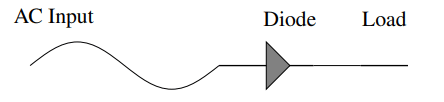
Working:
During positive half-cycle, diode is forward-biased, allowing current through the load. During negative half-cycle, diode is reverse-biased, blocking current. Output is pulsating DC with only positive halves.
Answer: Rectifier converts AC to DC; half-wave rectifier uses diode to pass one AC half-cycle.
Quick Tip: Half-wave rectifier is simple but inefficient; full-wave uses both cycles for smoother DC.
Draw a neat, labelled diagram of a suspended coil type moving coil galvanometer. The initial pressure and volume of a gas enclosed in a cylinder are 2 × 10^5 N/m² and 6 × 10⁻³ m³ respectively. If the work done in compressing the gas at constant pressure is 150 J, find the final volume of the gas.
View Solution
i. Diagram:
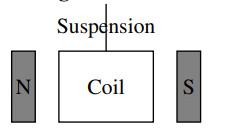
Labelled parts: Coil, N-pole, S-pole, Suspension.
ii. Final Volume:
Constant pressure compression: Work done \( W = P \Delta V \), where \( \Delta V = V_i - V_f \) (since compression, \( W > 0 \)).
Given: \( P = 2 \times 10^5 \, N/m^2 \), \( V_i = 6 \times 10^{-3} \, m^3 \), \( W = 150 \, J = 150 \, N·m \).
For compression at constant P: \( W = P (V_i - V_f) \).
\[ 150 = 2 \times 10^5 \times (6 \times 10^{-3} - V_f) \quad \Rightarrow \quad 6 \times 10^{-3} - V_f = \frac{150}{2 \times 10^5} = 7.5 \times 10^{-4}. \] \[ V_f = 6 \times 10^{-3} - 7.5 \times 10^{-4} = 5.25 \times 10^{-3} \, m^3. \]
Answer: Final volume = 5.25 × 10⁻³ m³.
Quick Tip: Galvanometer detects current via torque on coil in magnetic field; work at constant P is PΔV.
Define second's pendulum. Derive a formula for the length of second's pendulum. A particle performing linear S.H.M. has maximum velocity 25 cm/s and maximum acceleration 100 cm/s². Find period of oscillations.
View Solution
Definition: A second's pendulum is a simple pendulum with a period of exactly 2 seconds for one complete oscillation, so one swing (to and fro) takes 1 second.
Derivation: Period of simple pendulum: \( T = 2\pi \sqrt{\frac{L}{g}} \), where \( L \) is length, \( g \) is gravitational acceleration.
For T = 2 s:
\[ 2 = 2\pi \sqrt{\frac{L}{g}} \quad \Rightarrow \quad 1 = \pi \sqrt{\frac{L}{g}} \quad \Rightarrow \quad L = \frac{g}{\pi^2}. \]
Period of SHM: Maximum velocity \( v_{\max} = A \omega = 25 \) cm/s, maximum acceleration \( a_{\max} = A \omega^2 = 100 \) cm/s².
\[ \omega = \frac{a_{\max}}{v_{\max}} = \frac{100}{25} = 4 \, rad/s. \] \[ T = \frac{2\pi}{\omega} = \frac{2\pi}{4} = \frac{\pi}{2} \, s. \]
Answer: Second's pendulum has T = 2 s; \( L = \frac{g}{\pi^2} \); period = \( \frac{\pi}{2} \) s.
Quick Tip: Second's pendulum length is approximately 1 m; for SHM, \( \omega = \frac{v_{\max}}{A} = \frac{a_{\max}}{v_{\max}} \).
Explain de Broglie wavelength. Obtain an expression for de Broglie wavelength of wave associated with material particles. The photoelectric work function for a metal is 4.2 eV. Find the threshold wavelength.
View Solution
Explanation: de Broglie wavelength (\( \lambda \)) is the wavelength associated with a material particle, proposing that matter has wave-like properties. It is given by \( \lambda = \frac{h}{p} \), where \( h \) is Planck’s constant and \( p \) is momentum.
Derivation: For photons, \( E = h \nu = pc \), where \( \lambda = \frac{c}{\nu} \Rightarrow p = \frac{h}{\lambda} \Rightarrow \lambda = \frac{h}{p} \).
de Broglie extended this to particles: \( \lambda = \frac{h}{p} = \frac{h}{m v} \), where \( m \) is mass, \( v \) is velocity.
Threshold Wavelength: Threshold frequency \( \nu_0 = \frac{\phi}{h} \), where \( \phi = 4.2 \, eV = 4.2 \times 1.6 \times 10^{-19} \, J = 6.72 \times 10^{-19} \, J \).
\( h = 6.626 \times 10^{-34} \, J s \).
\[ \nu_0 = \frac{6.72 \times 10^{-19}}{6.626 \times 10^{-34}} \approx 1.014 \times 10^{15} \, Hz. \] \[ \lambda_0 = \frac{c}{\nu_0} = \frac{3 \times 10^8}{1.014 \times 10^{15}} \approx 2.96 \times 10^{-7} \, m = 2960 \, Å. \]
Answer: de Broglie wavelength \( \lambda = \frac{h}{p} \); threshold wavelength = 2960 Å.
Quick Tip: de Broglie hypothesis unifies wave-particle duality; threshold wavelength \( \lambda_0 = \frac{h c}{\phi} \).



Comments