




Maharashtra Board Class 12 English Question Paper 2022 with Answer Key is available for download. The exam was conducted by the Maharashtra State Board of Secondary & Higher Secondary Education (MSBSHSE) on March 4, 2022 in the Morning Session 10:30 AM to 2 PM. The medium of paper was English. In terms of difficulty level, Maharashtra Board Class 12 English paper was of Moderate to Tough level. The question paper comprised a total of 5 questions divided among 4 sections.
Maharashtra Board Class 12 English Question Paper 2022 with Answer Key (March 4)
| Maharashtra Board Class 12 English Question Paper | Maharashtra Board Class 12 English Answer Key + Solution |
|---|---|
| Download PDF | Download PDF |
Read the extract and complete the activities given below:
At a corner of Sixth Avenue electric lights and cunningly displayed wares behind plate-glass made a shop window attractive. Soapy took a stone and dashed it through the glass. People came running, round the corner, a policeman in the lead. Soapy stood still with his hands in his pockets, and smiled at the sight of brass buttons.
"Where’s the man that done that?" inquired the officer agitatedly.
"Don’t you think that I might have had something to do with it?" said Soapy, with a friendly voice, as one greets good fortune.
The policeman refused to accept Soapy even as a clue. Men who smash windows do not remain to chat with the police. They take to their heels. The policeman saw a man half-way down the block running to catch a car. With drawn club he joined in the pursuit. Soapy, with disgust in his heart, drifted along, twice unsuccessful.
On the opposite side of the street was a restaurant of no great pretensions. It catered to large appetites and modest purses. Its crockery and atmosphere were thick; its soup and napery thin. Into this place Soapy betook himself without challenge. At a table he sat and consumed beefsteak, flapjacks, doughnuts and pie. And then he told the waiter the fact that the minutest coin and himself were total strangers.
"Now, get busy and call a cop," said Soapy. "And don’t keep a gentleman waiting."
"No cop for you," said the waiter, with a voice like butter cakes and an eye like the cherry in the Manhattan cocktail. "Hey, Con!"
Neatly upon his left ear on the callous pavement two waiters pitched Soapy. He arose, joint by joint, as a carpenter's rule opens, and dusted his clothes. Arrest seemed now but an elusive dream. The island seemed very far away. A policeman who stood before a drugstore two doors away laughed and walked down the street.
A1. True / False:
Read the following sentences and state whether they are true or false. Correct the false statements and rewrite them.
A2. Rearrange:
Rearrange the following statements in order of their occurrence in the extract.
A3. Guess:
Read the following sentences and write down what it means.
A4. Personal response:
Suppose you are a manager of a hotel, a poor boy has taken a meal in the hotel and is not able to pay the bill. Describe how you will react in the situation.
A5. Language study:
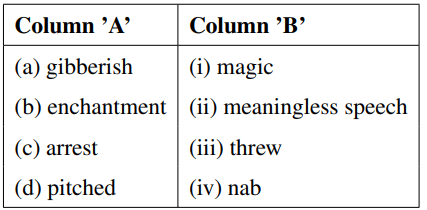
A6. Vocabulary: Match the words in column 'A' with their meanings in column 'B'.
A2. (b), (a), (d), (c).
A3. (a) Soapy hints he broke the window; (b) Soapy admits he has no money.
A4. Personal response varies (example provided).
A5. (A) Was there not a restaurant of no great pretensions on the opposite side of the street? (B) Men smashing windows do not stay to talk with police.
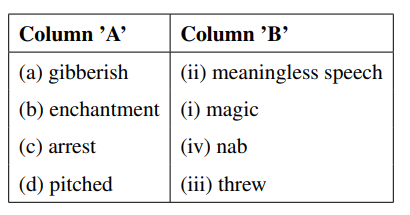
A6. (a)-(ii), (b)-(i), (c)-(iv), (d)-(iii).
View Solution
A1. True / False:
(a) True: Soapy broke the glass, as stated: "Soapy took a stone and dashed it through the glass."
(b) False: The statement is incorrect because "People came running, round the corner" after the glass broke. Corrected: People heard the breaking of the glass window and came running.
(c) False: The policeman chased another man running to catch a car, not Soapy. Corrected: The policeman did not chase Soapy but pursued another man.
(d) True: Soapy "stood still with his hands in his pockets" after breaking the window.
A2. Rearrange:
The correct order of occurrence:
(b) Soapy took a stone and dashed it through the glass (first action).
(a) The policeman refused to accept Soapy even as a clue (after questioning Soapy).
(d) Soapy, with disgust in his heart, drifted along twice unsuccessful (after the failed shop incident, before the restaurant).
(c) "Now, get busy and call a cop," said Soapy (in the restaurant, after eating).
A3. Guess:
(a) "Don't you think that I might have had something to do with it?" means Soapy is subtly admitting or hinting to the policeman that he was responsible for breaking the window, hoping to be arrested.
(b) "He told the waiter the fact that the minutest coin and himself were total strangers" means Soapy admitted to the waiter that he had no money at all to pay for the meal, implying he was penniless.
A4. Personal response:
As a hotel manager, if a poor boy ate a meal and couldn’t pay, I would approach the situation with empathy. I’d first confirm his inability to pay and inquire about his circumstances. To avoid embarrassment, I’d discreetly offer the meal for free as a gesture of goodwill, possibly asking him to help with a small task (e.g., cleaning tables) to maintain dignity. If he’s in genuine distress, I’d connect him with local support services. This balances compassion with business considerations, fostering a positive reputation for the hotel.
A5. Language study:
(A) Rhetorical question: Was there not a restaurant of no great pretensions on the opposite side of the street?
(B) Simple sentence: Men smashing windows do not stay to talk with police.
A6. Vocabulary:
Quick Tip: Analyzing literature extracts requires careful reading to identify sequence, intent, and language nuances; vocabulary context aids interpretation.
Grammar / Language Study (Non-Textual Grammar) – Do as directed:
(B) No sooner had I entered the post office than the Post Master presented me with a telegram.
(C) Does the mother not look after her child?
View Solution
(A) The original sentence uses "can," indicating ability or possibility. To show compulsion, the modal auxiliary "must" is used, implying obligation.
Rewritten: We must accept our life gracefully.
(B) To begin with "No sooner," invert the subject and auxiliary verb (past perfect "had" for past tense), and replace "as" with "than" to form the correlative structure.
Rewritten: No sooner had I entered the post office than the Post Master presented me with a telegram.
(C) A rhetorical question implies an obvious answer for effect. Transform the declarative sentence by adding "Does...not" to emphasize the mother’s role.
Rewritten: Does the mother not look after her child? Quick Tip: Modal auxiliaries like "must" indicate obligation, while "No sooner...than" structures require verb inversion and past perfect for past events.
Spot the error in the given sentence and rewrite the correct sentence:
Summers in Delhi are extreme hot.
View Solution
Error: The word "extreme" is an adjective, incorrectly modifying the adjective "hot." The correct form is the adverb "extremely," which modifies adjectives.
Corrected Sentence: Summers in Delhi are extremely hot. Quick Tip: Use adverbs (e.g., extremely) to modify adjectives, not other adjectives (e.g., extreme).
Read the extract and complete the activities given below:
"I don't believe in taking the right decisions. I take decisions, I take decisions and then make them right." One of them make them right. One of the right decisions taken by Ratan Tata. His inspiring words made me dream beyond shadows. I felt fortunate that I discovered him in the early stage of my life and now I am using his teachings to mould my future the way I want.
Even though Ratan Tata was born in a very posh family of India, he never took money and power for granted. He graduated from Riverdale country from New York, Ratan Tata returned to India in search of change that he could bring to India. He started as a fellow on the shop floor at Tata Steel. After working for almost 10 years he was appointed as the director-in-charge of the National Radio and Electronics Company Limited (NELCO) in order to help its struggling finances. He worked hard building a better consumer electronics division but the economic recession and union strikes prevented him from achieving success and this struck the Tata Group of companies. He started with a very basic job in his father's company and today he owns a billion dollar company.
The tag of greatness does not come without making any sacrifices and this tag on Ratan Tata suits to its best.
Tata group launched its passenger car Tata Indica in the year 1998 but Tata Indica was a failure in its first year and the experiment seemed to be failing. Many people started advising Ratan Tata that he should sell the passenger car business. Ratan Tata also agreed to sell his car business and approached Ford. They went to Detroit to discuss the sale. They treated him humiliatingly. The company is not doing well. So, Ford's representative arrogantly said that they were doing a favour by buying their business.
Ratan Tata decided to move back home. While travelling he was very tense as the feeling of being insulted was on his mind. After earlier failures, Tata Motors did very well with its business of passenger cars but in the same period, Ford did very bad. In 2008 when Ford was on its way of bankruptcy, Tata Group offered Ford to buy its luxury car brand Jaguar-Land Rover. Ford arrived in Mumbai for the meeting. In the meeting, Bill Ford said to Ratan Tata, "You are doing a big favour for us by buying Jaguar-Land Rover". Jaguar-Land Rover is now owned by Tata Group and is currently making profits.
A1. Rewrite the following sentences as per their occurrence in the extract:
A2. Explain:
The writer says, "...I don't believe in taking right decisions I take decisions, I take decisions and then make them right.'
A3. Give reasons:
Ratan Tata decided to sell his passenger car business.
A4. Personal Response:
Right decision at the right time is important for success. Express your opinion.
A5. Grammar:
Do as directed:
A6. Vocabulary:
Give antonyms.
A2. Ratan Tata believes in taking decisions and working to make them successful.
A3. Failure of Tata Indica and advice from others.
A4. Personal response varies (example provided).
A5. (A) He worked hard to build a better consumer electronics division. (B) The passenger car Tata Indica was launched by the Tata Group.
A6. (A) Loss; (B) Allow.
View Solution
A1. Rewrite as per occurrence:
The correct chronological order:
(d) He graduated from Riverdale country from New York (early life event).
(a) He was appointed as the director-in-charge of the National Radio and Electronics Company Limited (after working at Tata Steel).
(b) Tata Group launched its passenger car Tata Indica in the year 1998 (later business venture).
(c) Bill Ford said to Ratan Tata, "You are doing a big favour for us by buying Jaguar-Land Rover" (in 2008, final event).
A2. Explain:
The statement "...I don't believe in taking the right decisions. I take decisions, I take decisions and then make them right" means Ratan Tata does not wait for a guaranteed "right" decision. Instead, he makes decisions confidently and then works diligently to ensure their success through effort and adaptability. It reflects his proactive and resilient approach to leadership, as seen in his turnaround of Tata Motors and the acquisition of Jaguar-Land Rover.
A3. Give reasons:
Ratan Tata decided to sell his passenger car business because:
1. Failure of Tata Indica: The Tata Indica, launched in 1998, failed in its first year, and the experiment seemed unsuccessful.
2. External advice: Many people advised him to sell the passenger car business due to its poor performance.
A4. Personal response:
I agree that making the right decision at the right time is crucial for success. Timely decisions capitalize on opportunities and mitigate risks. For example, Ratan Tata’s decision to acquire Jaguar-Land Rover in 2008, when Ford was struggling, was well-timed and led to profits. Delaying or rushing decisions can lead to missed opportunities or failures, as seen in the initial Tata Indica setback. Strategic timing, backed by effort, ensures success in business and life.
A5. Grammar:
(A) Infinitive form: The gerund "building" is replaced with the infinitive "to build" for grammatical accuracy.
Rewritten: He worked hard to build a better consumer electronics division.
(B) Rewrite with new beginning: The sentence is restructured to start with the object and use passive voice.
Rewritten: The passenger car Tata Indica was launched by the Tata Group.
A6. Vocabulary:
Antonyms based on context:
(A) Profit: Loss (opposite of financial gain).
(B) Prevent: Allow (opposite of stopping an action). Quick Tip: When analyzing extracts, trace the timeline of events for rearrangement and use context to interpret quotes and vocabulary.
Summary:
Write a summary of the above extract with a suitable title with the help of the given points/hints:
Ratan Tata's early career * early setback in passenger car business * his meeting with Bill Ford * his success in passenger car business * purchase of Jaguar and Ford’s Land Rover.
Title: Ratan Tata’s Journey from Setback to Success
Summary: Ratan Tata, born into a prominent Indian family, began his career humbly at Tata Steel and later became director-in-charge of NELCO, facing challenges due to economic recession and union strikes. In 1998, Tata Group launched Tata Indica, which initially failed, prompting Ratan Tata to consider selling the passenger car business. During a humiliating meeting with Ford in Detroit, they belittled his venture. Motivated by this, Tata persevered, and Tata Motors eventually succeeded in the passenger car market. In 2008, when Ford faced bankruptcy, Tata Group acquired Jaguar-Land Rover. In a Mumbai meeting, Bill Ford acknowledged Tata’s favor in buying the luxury brand, which now thrives under Tata’s ownership, showcasing his resilience and strategic vision.
View Solution
The summary encapsulates Ratan Tata’s journey using the provided points:
- Early career: Started at Tata Steel, later managed NELCO despite setbacks.
- Early setback: Tata Indica’s failure in 1998 led to advice to sell the car business.
- Meeting with Bill Ford: Ford’s humiliating remarks in Detroit motivated Tata to persevere.
- Success in passenger car business: Tata Motors overcame initial failures to thrive.
- Purchase of Jaguar-Land Rover: Acquired Ford’s luxury brand in 2008, turning it profitable.
The title reflects his transformation of challenges into triumphs through decisive action. Quick Tip: A summary should concisely cover key points in the order of significance, with a title that captures the essence of the narrative.
Mind Mapping:
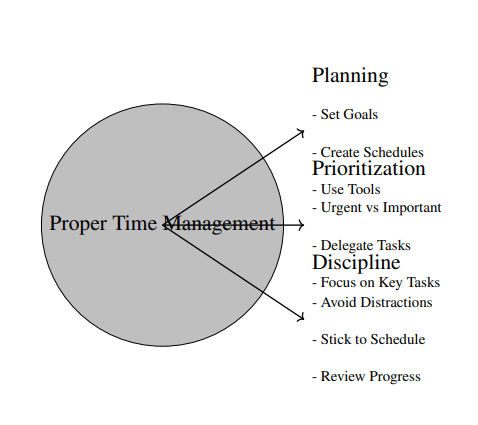
Develop a Mind-Mapping using your ideas and concepts to develop the topic 'Proper Time Management.'
Mind map diagram and explanation provided below.
View Solution
Mind Map: Proper Time Management
The mind map centers on "Proper Time Management" with three main branches: Planning, Prioritization, and Discipline, each with sub-branches detailing specific strategies.
Explanation:
- Planning: Involves setting clear goals (e.g., daily/weekly targets), creating schedules (e.g., timetables), and using tools like calendars or apps (e.g., Google Calendar).
- Prioritization: Focuses on distinguishing urgent vs. important tasks (e.g., Eisenhower Matrix), delegating non-essential tasks, and concentrating on high-impact activities.
- Discipline: Requires avoiding distractions (e.g., limiting social media), adhering to schedules, and regularly reviewing progress to stay on track.
This structure visually organizes strategies for effective time management, emphasizing proactive and disciplined approaches. Quick Tip: Mind maps visually connect ideas; use clear branches and concise labels to represent relationships and hierarchies effectively.
Read the extract and complete the activities given below:
A foot and light-hearted I take to the open road, Healthy, free, the world before me, The long brown path before me leading wherever I choose.
Henceforth I ask not good-fortune, I myself am good-fortune, Henceforth I whimper no more, postpone no more, need nothing, Done with indoor complaints, libraries, querulous criticisms, Strong and content I travel the open road.
The earth, that is sufficient, I do not want the constellations any nearer, I know they are very well where they are, I know they suffice for those who belong to them.
(Still here I carry my old delicious burdens, I carry them, men and women, I carry them with me wherever I go, I swear it is impossible for me to get rid of them, I am fill'd with them, and I will fill them in return.)
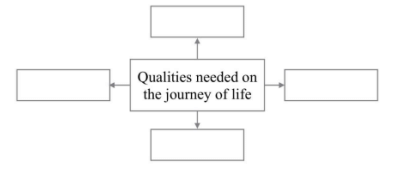
A1. Complete the web diagram about the qualities needed on the journey of life:
A2. Analyze:
The line- I asked not good fortune, I myself am good fortune.
A3. Personal response:
Explain the importance of 'long road / path' in man's life.
A4. Poetic Device:
Identify and explain the figure of speech in the following line. Still here I carry old delicious burdens.
A5. Poetic creativity:
Complete the given lines using your imagination.
There is no way leading back.
I move forward ..................
A2. The speaker believes they create their own luck through confidence and action.
A3. The long road symbolizes life’s journey, full of choices and challenges.
A4. Oxymoron; "delicious burdens" combines opposing ideas of pleasure and weight.
A5. There is no way leading back. I move forward with courage and hope.
View Solution
A1. Complete the web diagram:
The extract highlights qualities needed for life’s journey, derived from the speaker’s attitude and actions.
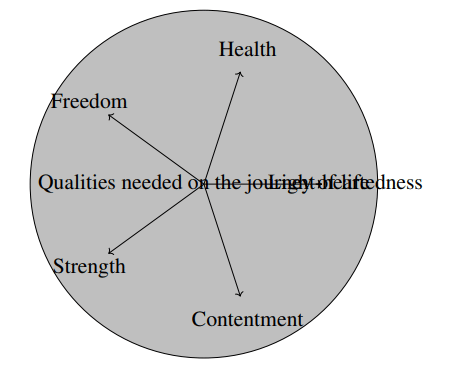
- Light-heartedness: "A foot and light-hearted" suggests a cheerful, optimistic approach.
- Health: "Healthy, free" indicates physical vitality for the journey.
- Freedom: "The world before me, leading wherever I choose" reflects autonomy.
- Strength: "Strong and content" implies resilience.
- Contentment: "The earth, that is sufficient" shows satisfaction with simplicity.
A2. Analyze:
The line "I asked not good fortune, I myself am good fortune" means the speaker rejects dependence on external luck. Instead, they believe their confidence, decisions, and proactive attitude create their own success and opportunities. It reflects self-reliance and an empowered mindset, as the speaker takes control of their destiny on the "open road" of life.
A3. Personal response:
The 'long road / path' in man’s life symbolizes the journey of existence, filled with opportunities, challenges, and choices. It represents personal growth, as individuals navigate through experiences, learning and evolving. The "long brown path leading wherever I choose" suggests freedom to shape one’s future, but it also implies perseverance, as the road is unending and requires strength to continue. For example, choosing a career path or overcoming hardships mirrors this journey, emphasizing the importance of resilience and direction.
A4. Poetic Device:
The line "Still here I carry my old delicious burdens" uses an oxymoron. The words "delicious" (pleasant, enjoyable) and "burdens" (heavy, troublesome) are contradictory, creating a striking effect. The speaker suggests that responsibilities (e.g., relationships with "men and women") are both challenging and cherished, highlighting the complex joy of human connections.
A5. Poetic creativity:
There is no way leading back.
I move forward with courage and hope.
This continuation maintains the poem’s theme of progress and optimism, reflecting the speaker’s determination to embrace the future despite past burdens. Quick Tip: Poetry analysis requires identifying themes (e.g., freedom, resilience) and devices (e.g., oxymoron) while connecting personal insights to the text.
Appreciation:
Read the given extract and write an appreciation of the poem using the following points.
Is anybody happier because you passed his way?
Does anyone remember that you spoke to him today?
This day is almost over, and its toiling time is through; Is there anyone to utter now a kindly word of you?
Did you give a cheerful greeting to the friend who came along?
Or a churlish sort of "Howdy" and then vanish in the throng?
Were you selfish pure and simple as you rushed along the way, Or is someone mighty grateful for a deed you did today?
Can you say tonight, in parting with the days that's slipping fast, That you helped a single brother of the many that you passed?
Is a single heart rejoicing over what you did or said; Does a man whose hopes were fading now with courage look ahead?
Points:
Title and Poet: "The House by the Side of the Road" by Sam Walter Foss
Theme: Impact of kindness and empathy in daily interactions
Poetic Devices, Language: Rhetorical questions, simple language, alliteration, imagery
Values: Kindness, empathy, selflessness
Opinion: Inspirational and thought-provoking, encouraging positive human connections
View Solution
(A) Title of the poem, name of the poet:
The poem is "The House by the Side of the Road" by Sam Walter Foss. The extract reflects the poem’s core idea of living a life that positively impacts others through small acts of kindness.
(B) Theme:
The central theme is the importance of kindness and empathy in daily human interactions. The poem urges readers to reflect on whether their actions—greetings, deeds, or words—bring happiness, hope, or courage to others, emphasizing the value of selflessness over selfishness in life’s fleeting moments.
(C) Poetic devices, language:
The poem employs:
- Rhetorical questions: Lines like "Is anybody happier because you passed his way?" provoke introspection without expecting answers.
- Alliteration: Phrases like "toiling time" and "cheerful greeting" enhance rhythm.
- Imagery: "Slipping fast" and "vanish in the throng" create vivid mental pictures of time and crowds.
- Simple language: Clear, conversational words (e.g., "Howdy," "brother") make the poem relatable and direct, amplifying its emotional impact.
(D) Values:
The poem promotes values of kindness, empathy, and selflessness. It encourages helping others ("helped a single brother"), offering cheerful interactions, and inspiring hope ("man whose hopes were fading now with courage look ahead"), urging readers to prioritize positive contributions to society over personal gain.
(E) Your opinion about the poem:
The poem is inspirational and thought-provoking, reminding us of the power of small acts of kindness in transforming lives. Its simple yet profound questions encourage self-reflection, making it relevant to all ages. The rhythmic flow and relatable language make it engaging, while its message of empathy resonates deeply, motivating me to be more mindful in daily interactions. Quick Tip: Poem appreciation involves analyzing theme, devices, and values while connecting personally to its message for a holistic response.
Complete the activities as per the instructions given below:
(1) You are Gopal, a receptionist, in the office of a company manufacturing garments. A sales manager Mr. Deshmukh visited and handed over the sales report to be submitted to the general manager who was busy attending a meeting.Mr. Deshmukh: Hellow! I am here to submit the available sales report to the General Manager.
Gopal: I am sorry but the General Manager is in the meeting. Can you leave a message for him along with the reports?
Mr. Deshmukh: Sorry, I have to leave immediately to collect the other reports. Please inform the General Manager, that I had to leave immediately and I will see him in the evening at 5:30 P. M. with other reports. Thank you.
As a receptionist draft a virtual message for the General Manager.
You are so much interested in fashion designing. You have also participated in the various competitions and have shown your talent. Your friend is assisting you to make the career in fashion designing.
Draft a statement of purpose that will help you to get admission for the course in fashion designing at M. Rajeshwar College Arts, Hubli, Karnataka.
(3) Group Discussion
You along with your friends Sujit, Rohit and Kishor discussing their likes and dislikes. But all are fascinated with the reading habit. Write a short group discussion in the form of dialogue telling the importance of reading for enhancing knowledge
View Solution
(1) Virtual Message:
Subject: Message from Mr. Deshmukh Regarding Sales Report
Dear General Manager,
Mr. Deshmukh, Sales Manager, visited the office today to submit the available sales report. As you were attending a meeting, he could not meet you. He left the report with me and mentioned that he had to leave immediately to collect other reports. He will meet you today at 5:30 PM with additional reports.
Regards,
Gopal
Receptionist
October 12, 2025 Quick Tip: A virtual message should be concise, include key details (who, what, when), and maintain a professional tone.
Attempt 'Any One' of the following activities:
E-mail writing:
Report writing:
(2) You are a representative of the N. S. S. unit of your college. Write a brief report of the camp in which various social activities including cleanliness have been conducted by all the participant
Interview Questions:
(3) Imagine that you have met with the topper in M.P.S.C. Examination. You wish to interview of him/her to know his/her journey of success. Prepare a set of 8 to 10 questions to be asked.
View Solution
(1) Email Writing:
Subject: Apology for Delay in Delivery of Gift Articles
Dear [Customer's Name],
I sincerely apologize for the delay in delivering your order of gift articles placed with us. Due to an unexpected shortage of stock caused by supply chain disruptions, we are unable to deliver on the promised date. We are working diligently to restock and ensure your order is dispatched by [specific date, e.g., October 20, 2025]. As a gesture of goodwill, we will include a complimentary gift with your order. Thank you for your understanding and patience. Please contact me at [your email/phone] for any queries.
Best regards,
[Your Name]
Shopkeeper, [Shop Name]
October 12, 2025 Quick Tip: An apology email should acknowledge the issue, explain the reason briefly, offer a solution, and maintain a courteous tone.
Attempt 'Any One' of the following activities:
Speech Writing:
(2) Compering:
On the occasion of the inaugural function of 'Sports Day' you have been the responsibility to compere:
Draft a script of the same. Use the following points.
- Brief introduction
- Lighting the lamp/Inauguration
- Welcome the guests
- Chief guest's address
- Vote of thanks
(3) Expansion of Idea:
Expand the following idea by using the points -
'Time and tide wait for none'.
- Meaning of the proverb
- Importance of time
- Proper time management
- Add your own points
View Solution
(1) Speech Writing: Mask for Safety
Good morning, respected judges, teachers, and friends!
Today, I speak on a topic vital to our well-being: "Mask for Safety." In recent years, masks have become more than just a piece of cloth—they are a shield, a symbol of responsibility, and a tool for survival. Wearing a mask protects us from airborne diseases, such as viruses that spread through droplets, ensuring our health and that of those around us. For instance, during pandemics, masks reduced transmission rates significantly, saving countless lives. Beyond health, masks reflect our care for society, showing we value others’ safety. They are simple yet powerful, affordable yet effective. However, we must use them correctly—covering nose and mouth, using clean masks, and disposing of them responsibly. Let’s embrace masks not as a burden but as a badge of safety and unity. Wear a mask, stay safe, and protect lives!
Thank you. Quick Tip: A speech should have a clear structure (greeting, introduction, body, conclusion), use persuasive language, and include relevant examples.
Attempt 'Any One' of the following activities:
Film Review:
- Story/Theme
- Producer / Director
- Special features of direction
- Characters: Conflict
- Music/ Dance / Songs / Photography etc.
- Your opinion
Blog Writing:
(2) Write a blog in appropriate format on "Necessity of Social awareness" regarding cleanliness / Hygiene in about 100 to 150 words.
Appeal:
(3) Prepare an appeal to inculcate the habit:
- Slogans
- Use persuasive appeal
- Its necessity for development
View Solution
(2) Blog Writing: Necessity of Social Awareness Regarding Cleanliness / Hygiene
Title: Clean Today, Thriving Tomorrow: The Need for Social Awareness
Date: October 12, 2025
Author: [Your Name]
Cleanliness and hygiene are the cornerstones of a healthy society, yet their importance is often overlooked. Social awareness about maintaining clean surroundings and personal hygiene can transform communities. Dirty streets, littered public spaces, and poor sanitation breed diseases like cholera and dengue, affecting millions annually. Awareness campaigns, such as India’s Swachh Bharat Mission, have shown that collective action—proper waste disposal, regular handwashing, and clean water access—reduces health risks significantly. Schools, media, and local leaders must educate people on segregating waste, using public bins, and practicing hygiene habits. By fostering a culture of cleanliness, we ensure safer environments, reduce healthcare costs, and enhance quality of life. Let’s pledge to stay aware, act responsibly, and inspire others for a cleaner, healthier tomorrow.
Comments: Share your thoughts on promoting hygiene in your community! Quick Tip: A blog should have a catchy title, clear structure (title, date, author, content), and a call to action to engage readers.
Complete the activities given below as per the instructions:
(A) Match the following items from column-A with those from the column-B: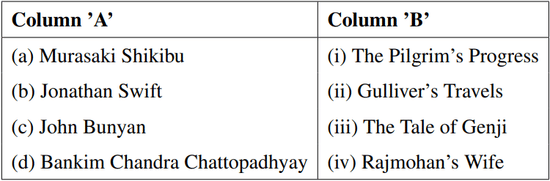
(B) Pick the odd word out:
(B) (a) Henry Fielding; (b) novella; (c) epistolary; (d) picaresque
View Solution
(A) Match:
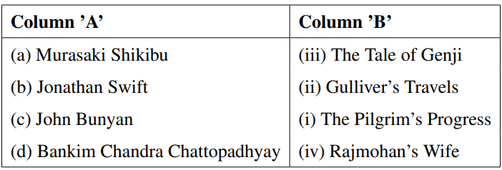
- Murasaki Shikibu wrote The Tale of Genji, a classic Japanese novel.
- Jonathan Swift authored Gulliver's Travels, a satirical adventure.
- John Bunyan wrote The Pilgrim's Progress, an allegorical Christian work.
- Bankim Chandra Chattopadhyay wrote Rajmohan's Wife, an early Indian English novel.
(B) Odd word out:
(a) Henry Fielding: Amit Ghosh, Vikram Seth, and Anita Desai are Indian authors; Henry Fielding is British.
(b) novella: Plot, setting, and theme are narrative elements; novella is a form of fiction.
(c) epistolary: Place, time, and climate are setting components; epistolary is a narrative style (letter-based).
(d) picaresque: Horror, mystery, and thriller are modern genres; picaresque is a historical narrative style about a rogue’s adventures. Quick Tip: For matching and odd word tasks, identify common characteristics (e.g., nationality, category) to find connections or differences.
Answer the following:
(A) Through respect, engagement, and practical teaching methods.
(B) Through discussions, outings, and real-world exposure.
View Solution
(A) Change in students’ behaviour:
In To Sir, With Love, Ricky Braithwaite, a black teacher in a tough London school, transforms his students’ behaviour by:
- Building respect: He insists on being addressed as "Sir" and treats students as adults, using respectful titles (e.g., "Miss" or "Mr."), fostering mutual respect.
- Engaging teaching: He abandons rigid curricula, teaching practical life skills like budgeting and relationships, making lessons relevant.
- Addressing prejudice: Facing racial hostility, he remains calm and professional, earning trust by showing empathy and fairness (e.g., handling Denham’s boxing challenge).
Example: His approach turns rebellious students like Pamela Dare into cooperative learners, improving classroom discipline.
(B) Cultural exposure:
Braithwaite enhances cultural exposure by:
- Discussions: He introduces debates on social issues (e.g., race, gender), broadening students’ perspectives.
- Outings: He organizes trips to museums and theaters, exposing students to art and history outside their East End environment.
- Real-world connections: He invites guest speakers and relates lessons to current events, encouraging critical thinking.
Example: A museum visit helps students appreciate cultural heritage, enriching their worldview. Quick Tip: For character-based questions, focus on specific actions and their impact, using examples from the text to support your answer.
Answer the following:
(A) Respectful, evolving into love, marked by mutual care.
(B) Through deduction, linking pearls to Sholto’s guilt and the Agra treasure.
View Solution
(A) Mr. Fogg and Aouda’s relationship:
In Around the World in Eighty Days by Jules Verne, Phileas Fogg and Aouda share a relationship that evolves from duty to love:
- Initial rescue: Fogg saves Aouda from sati in India, showing his principled nature but maintaining emotional reserve.
- Mutual respect: Aouda admires Fogg’s calm determination, while he values her courage and gratitude, treating her with courtesy.
- Growing affection: During their global journey, Aouda’s care for Fogg (e.g., tending to him after attacks) fosters closeness. By the end, their bond deepens, leading to marriage.
Example: Aouda’s proposal to Fogg in London reflects their mutual devotion.
(B) Sherlock Holmes and the pearls:
In The Sign of Four by Arthur Conan Doyle, Holmes discovers the connection between Miss Morstan’s pearls and Major Sholto through:
- Observation: Miss Morstan receives a pearl annually since her father’s disappearance, suggesting a link to a hidden motive.
- Deduction: Holmes learns Major Sholto was Captain Morstan’s friend, involved with the Agra treasure. Sholto’s deathbed guilt implies he sent pearls to Morstan’s daughter as atonement for withholding her share.
- Evidence: Holmes connects the pearls’ timing to Sholto’s wealth and death, confirming his involvement.
Example: The pearls’ anonymous delivery is traced to Sholto’s attempt to ease his conscience. Quick Tip: For plot-based questions, summarize key events and character motivations clearly, referencing specific moments from the text.
Answer the following:
(A) Through clues linking Bartholomew’s murder to the Agra treasure and Small.
(B) Using deduction, physical evidence, and pursuit tactics.
View Solution
(A) Mystery of Bartholomew’s murder:
In The Sign of Four, the murder of Bartholomew Sholto leads Holmes to Jonathan Small:
- Crime scene analysis: Holmes finds a poisoned dart and a footprint with a wooden leg mark at Bartholomew’s murder scene, indicating an accomplice and a specific killer.
- Agra treasure link: The theft of the treasure from Bartholomew’s home connects to Major Sholto’s past, implicating Small, a convict tied to the treasure.
- Motive: Holmes deduces Small’s desire to reclaim the treasure, stolen by Sholto, drove the murder, leading him to pursue Small.
Example: The wooden leg footprint points to Small’s accomplice, Tonga, guiding Holmes to Small.
(B) Tracking down Small:
Holmes tracks Jonathan Small by:
- Deduction: Using the footprint and dart, Holmes identifies Small’s accomplice, Tonga, and links Small to the Agra treasure.
- Investigation: He interviews witnesses (e.g., Mrs. Smith) to trace Small’s boat, the *Aurora*.
- Pursuit: Holmes and Watson chase the *Aurora* on the Thames with police, capturing Small after a dramatic boat chase.
Example: Holmes uses a dog to track Small’s scent to the river, confirming his escape route. Quick Tip: For detective novel questions, focus on Holmes’ logical steps: observation, deduction, and action, with specific textual references.



Comments