




Maharashtra Board is conducting the Class 12 Chemistry Board Exam 2026 on February 18, 2026. Class 12 Chemistry Question Paper with Solution PDF is available here for download.
The official question paper of Maharashtra Board Class 12 Chemistry Board Exam 2026 is provided below. Students can download the official paper in PDF format for reference.
Maharashtra Board Class 12 2026 Chemistry Question Paper with Solution PDF
| Maharashtra Board Class 12 2026 Chemistry Question Paper with Solution PDF | Download PDF | Check Solutions |
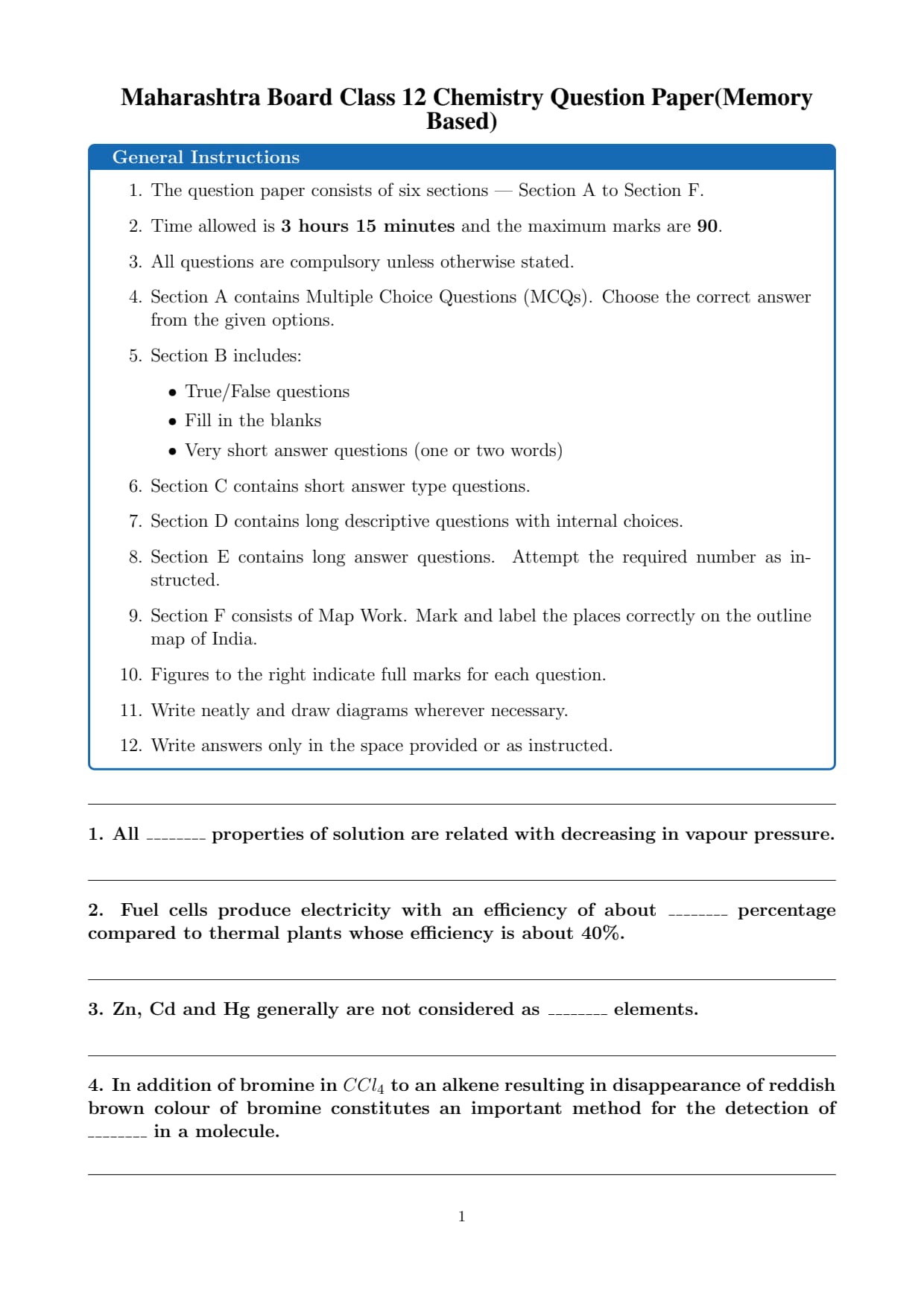
All ________ properties of solution are related with decreasing in vapour pressure.
View Solution
Concept:
When a non-volatile solute is added to a solvent, the vapour pressure of the solution decreases. This lowering of vapour pressure leads to several related properties known as colligative properties.
Colligative Properties:
Colligative properties are those properties of solutions that depend only on the number of solute particles present, not on their nature.
Examples of Colligative Properties:
Lowering of vapour pressure
Elevation of boiling point
Depression of freezing point
Osmotic pressure
All these properties arise due to the decrease in vapour pressure when solute is added.
\[ \boxed{Answer: Colligative} \] Quick Tip: Colligative properties depend on quantity of solute particles, not their chemical identity.
Fuel cells produce electricity with an efficiency of about ________ percentage compared to thermal plants whose efficiency is about 40%.
View Solution
Concept:
Fuel cells convert chemical energy directly into electrical energy through electrochemical reactions. Unlike thermal power plants, they do not rely on combustion, which increases their efficiency.
Explanation:
Thermal power plants operate at about \(40%\) efficiency due to energy losses as heat.
Fuel cells can achieve efficiencies of about \(60% - 70%\).
When waste heat is utilized (combined heat and power systems), overall efficiency may exceed \(80%\).
\[ \boxed{Efficiency of fuel cells \approx 70%} \] Quick Tip: Fuel cells are more efficient because they directly convert chemical energy into electrical energy without intermediate heat conversion.
Zn, Cd and Hg generally are not considered as ________ elements.
View Solution
Concept:
Transition elements are defined as elements that have partially filled d-orbitals in their atoms or in at least one of their common oxidation states.
Explanation:
Zinc (Zn), Cadmium (Cd), and Mercury (Hg) belong to Group 12 of the periodic table.
Their electronic configurations have completely filled d-subshells.
\[ Zn: [Ar]\,3d^{10}4s^2 \] \[ Cd: [Kr]\,4d^{10}5s^2 \] \[ Hg: [Xe]\,4f^{14}5d^{10}6s^2 \]
Even in their common ions (e.g., \( Zn^{2+} \)), the d-orbitals remain fully filled.
Conclusion:
Since they do not have partially filled d-orbitals, Zn, Cd, and Hg are not considered true transition elements.
\[ \boxed{Answer: Transition elements} \] Quick Tip: Group 12 elements are called d-block elements but not true transition elements due to fully filled d-orbitals.
In addition of bromine in \(CCl_4\) to an alkene resulting in disappearance of reddish brown colour of bromine constitutes an important method for the detection of ________ in a molecule.
View Solution
Concept:
Bromine test is a common qualitative test used in organic chemistry to detect unsaturation in hydrocarbons.
Explanation:
Bromine in carbon tetrachloride (\(CCl_4\)) has a reddish-brown colour.
When an alkene is added, bromine undergoes an addition reaction across the double bond.
This reaction removes the colour of bromine solution.
Reaction:
\[ R{-}CH=CH{-}R + Br_2 \rightarrow R{-}CHBr{-}CHBr{-}R \]
Conclusion:
Disappearance of bromine colour indicates the presence of a double bond or unsaturation in the molecule.
\[ \boxed{Answer: Unsaturation} \] Quick Tip: Decolourisation of bromine in \(CCl_4\) is a quick test for alkenes and alkynes (unsaturated compounds).
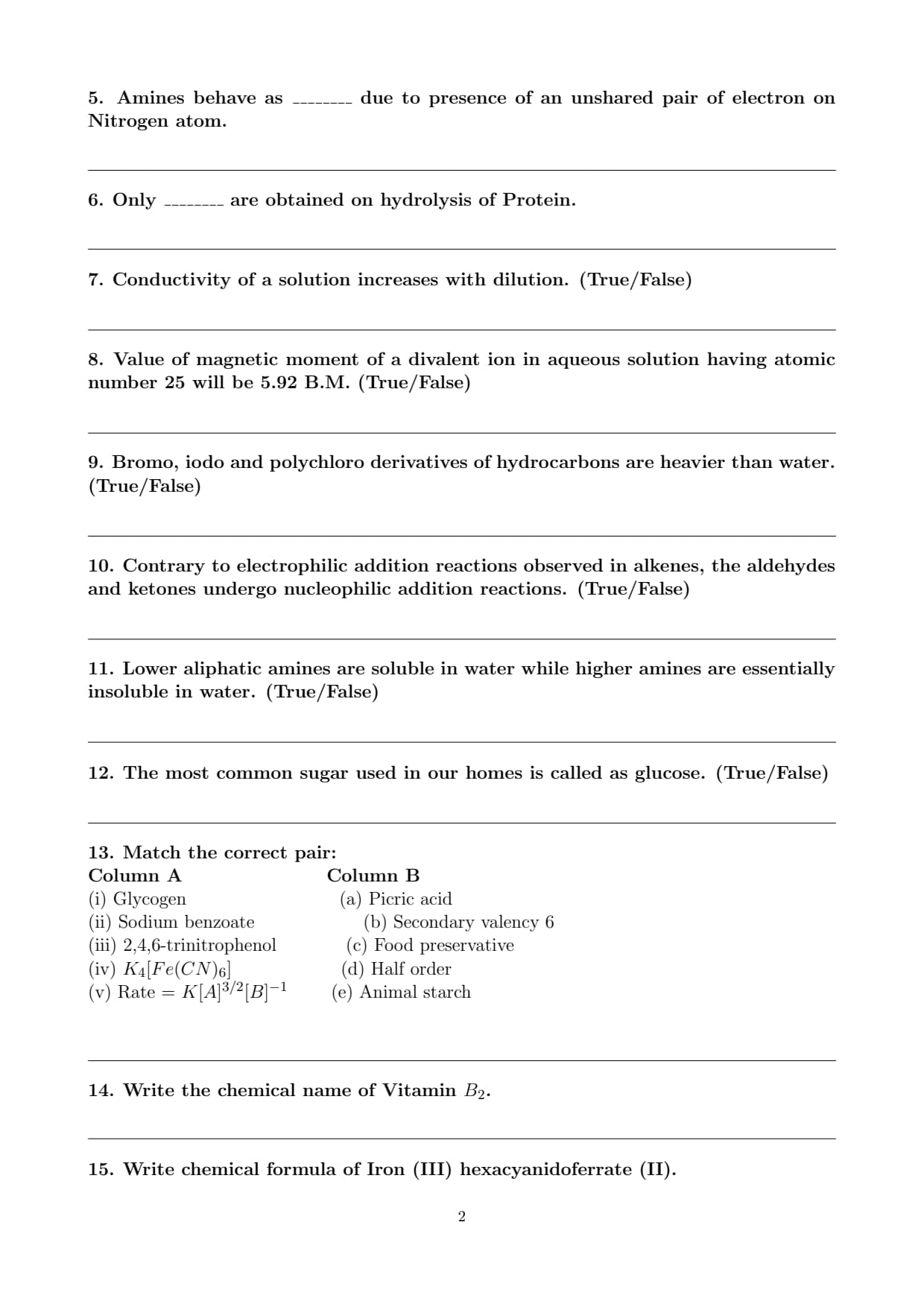
Amines behave as ________ due to presence of an unshared pair of electron on Nitrogen atom.
View Solution
Concept:
Amines are organic derivatives of ammonia (\(NH_3\)) in which one or more hydrogen atoms are replaced by alkyl or aryl groups. The nitrogen atom in amines contains a lone pair of electrons.
Explanation:
Nitrogen atom in amines has an unshared (lone) pair of electrons.
This lone pair can accept a proton (\(H^+\)).
Hence, amines behave as Lewis bases or Brønsted bases.
Example Reaction:
\[ RNH_2 + H^+ \rightarrow RNH_3^+ \]
This shows proton acceptance, confirming basic nature.
Conclusion:
Due to the presence of a lone pair on nitrogen, amines exhibit basic properties.
\[ \boxed{Answer: Bases} \] Quick Tip: More availability of lone pair on nitrogen increases basic strength of amines.
Only ________ are obtained on hydrolysis of Protein.
View Solution
Concept:
Proteins are complex biomolecules made up of long chains of amino acids linked by peptide bonds. When proteins are broken down chemically, these peptide bonds are cleaved.
Explanation:
Hydrolysis involves breaking bonds using water (acidic, basic, or enzymatic conditions).
During hydrolysis, peptide bonds in proteins are broken.
This releases individual amino acid units.
Reaction Representation:
\[ Protein + H_2O \xrightarrow{Hydrolysis} Amino acids \]
Conclusion:
Since proteins are polymers of amino acids, their complete hydrolysis yields amino acids.
\[ \boxed{Answer: Amino acids} \] Quick Tip: Proteins = polymers; Amino acids = monomers released after hydrolysis.
Conductivity of a solution increases with dilution. (True/False)
View Solution
Concept:
There are two types of conductivity in electrolytic solutions:
Specific conductivity (\( \kappa \))
Molar conductivity (\( \Lambda_m \))
Explanation:
On dilution, the number of ions per unit volume decreases.
Therefore, specific conductivity decreases.
However, molar conductivity increases due to increased ion mobility and dissociation.
Since the statement says conductivity (generally referring to specific conductivity), it is incorrect.
\[ \boxed{False} \] Quick Tip: Dilution ↓ specific conductivity but ↑ molar conductivity.
Value of magnetic moment of a divalent ion in aqueous solution having atomic number 25 will be 5.92 B.M. (True/False)
View Solution
Concept:
Magnetic moment of transition metal ions depends on the number of unpaired electrons and is calculated using the spin-only formula:
\[ \mu = \sqrt{n(n+2)} B.M. \]
where \( n \) = number of unpaired electrons.
Step 1: Identify the Element
Atomic number 25 → Manganese (Mn)
\[ Mn: [Ar]\,3d^5 4s^2 \]
Step 2: Divalent Ion Formation
\[ Mn^{2+}: [Ar]\,3d^5 \]
All five d-electrons remain unpaired.
\[ n = 5 \]
Step 3: Calculate Magnetic Moment
\[ \mu = \sqrt{5(5+2)} = \sqrt{35} = 5.92 B.M. \]
Conclusion:
The given statement is correct.
\[ \boxed{True} \] Quick Tip: Maximum spin-only magnetic moment occurs for \(d^5\) configuration due to five unpaired electrons.
Bromo, iodo and polychloro derivatives of hydrocarbons are heavier than water. (True/False)
View Solution
Concept:
The density of organic compounds depends on the atoms present in the molecule. Halogen atoms like chlorine, bromine, and iodine have higher atomic masses compared to hydrogen.
Explanation:
Hydrocarbons contain mainly carbon and hydrogen, so they are usually lighter than water.
When halogens (Cl, Br, I) replace hydrogen atoms, molecular mass increases significantly.
Bromo and iodo compounds especially have high densities due to heavy halogen atoms.
Polychloro derivatives (e.g., chloroform, carbon tetrachloride) are also denser than water.
Examples:
Chloroform (\(CHCl_3\)) – denser than water
Carbon tetrachloride (\(CCl_4\)) – sinks in water
Bromoform (\(CHBr_3\)) – very dense liquid
Conclusion:
Hence, the statement is correct.
\[ \boxed{True} \] Quick Tip: Heavier halogens increase density — more halogens, heavier the compound.
Contrary to electrophilic addition reactions observed in alkenes, the aldehydes and ketones undergo nucleophilic addition reactions. (True/False)
View Solution
Concept:
Different functional groups undergo different types of reactions depending on electron distribution and bond polarity.
Explanation:
Alkenes contain a carbon–carbon double bond (\(C=C\)) rich in electron density.
Therefore, they attract electrophiles and undergo electrophilic addition reactions.
Aldehydes and Ketones:
They contain a polar carbonyl group (\(C=O\)).
Oxygen is more electronegative, making the carbonyl carbon partially positive.
This electrophilic carbon is attacked by nucleophiles.
Hence, aldehydes and ketones undergo nucleophilic addition reactions.
Example:
\[ RCHO + HCN \rightarrow RCH(OH)CN \]
(HCN adds via nucleophilic addition)
Conclusion:
The given statement is correct.
\[ \boxed{True} \] Quick Tip: Alkenes → electrophilic addition; Carbonyl compounds → nucleophilic addition.
Lower aliphatic amines are soluble in water while higher amines are essentially insoluble in water. (True/False)
View Solution
Concept:
Solubility of organic compounds in water depends on their ability to form hydrogen bonds and the size of the hydrophobic hydrocarbon chain.
Explanation:
Amines contain a nitrogen atom with a lone pair of electrons.
This allows formation of hydrogen bonds with water molecules.
Lower aliphatic amines (e.g., methylamine, ethylamine) have small alkyl groups, so hydrogen bonding dominates → high solubility.
Higher Amines:
As the alkyl chain length increases, the non-polar hydrocarbon portion increases.
Hydrophobic effect reduces interaction with water.
Thus, higher amines become less soluble or insoluble.
Conclusion:
The statement is correct.
\[ \boxed{True} \] Quick Tip: Increasing carbon chain length decreases solubility in water due to higher hydrophobic character.
The most common sugar used in our homes is called as glucose. (True/False)
View Solution
Concept:
Different sugars are used in daily life, and their chemical identities vary.
Explanation:
The sugar commonly used in homes is table sugar.
Table sugar is chemically known as sucrose (\(C_{12}H_{22}O_{11}\)).
It is a disaccharide made of glucose and fructose units.
About Glucose:
Glucose is a monosaccharide (\(C_6H_{12}O_6\)).
It is found in fruits, honey, and blood sugar.
It is not the common household sugar.
Conclusion:
Since household sugar is sucrose and not glucose, the statement is incorrect.
\[ \boxed{False} \] Quick Tip: Table sugar = sucrose; blood sugar = glucose.
Match the correct pair:
Column A \hspace{3cm Column B
(i) Glycogen \hspace{3.2cm (a) Picric acid
(ii) Sodium benzoate \hspace{2.2cm (b) Secondary valency 6
(iii) 2,4,6-trinitrophenol \hspace{1.3cm (c) Food preservative
(iv) \(K_4[Fe(CN)_6]\) \hspace{2.2cm (d) Half order
(v) Rate = \(K[A]^{3/2}[B]^{-1}\) \hspace{0.7cm (e) Animal starch
View Solution
Explanation of Each Pair:
Glycogen → Animal starch (e)
Glycogen is a polysaccharide that stores energy in animals, hence called animal starch.
Sodium benzoate → Food preservative (c)
Widely used to preserve food and beverages due to antimicrobial properties.
2,4,6-trinitrophenol → Picric acid (a)
The chemical name of picric acid is 2,4,6-trinitrophenol.
\(K_4[Fe(CN)_6]\) → Secondary valency 6 (b)
In coordination compounds, iron has coordination number (secondary valency) 6.
Rate = \(K[A]^{3/2}[B]^{-1}\) → Half order (d)
Fractional powers indicate fractional order reactions; here overall order is fractional (includes half-order behavior).
Final Matching:
\[ \boxed{(i)-(e),\ (ii)-(c),\ (iii)-(a),\ (iv)-(b),\ (v)-(d)} \] Quick Tip: Remember: Glycogen = animal starch, Sodium benzoate = preservative, Picric acid = trinitrophenol.
Write the chemical name of Vitamin \(B_2\).
View Solution
Concept:
Vitamins are essential organic compounds required in small amounts for normal body metabolism. Each vitamin has a common name and a chemical name.
Vitamin \(B_2\):
Chemical name: Riboflavin
Water-soluble vitamin
Belongs to the Vitamin B-complex group
Functions:
Helps in energy production
Important for skin and eye health
Plays a role in cellular respiration
Sources:
Milk and dairy products
Eggs
Green vegetables
Whole grains
\[ \boxed{Vitamin B_2 = Riboflavin} \] Quick Tip: Vitamin B\(_1\) = Thiamine, B\(_2\) = Riboflavin, B\(_3\) = Niacin.
Write chemical formula of Iron (III) hexacyanidoferrate (II).
View Solution
Concept:
Coordination compounds consist of a central metal ion surrounded by ligands. The name indicates oxidation states of metals and nature of ligands.
Given Name Breakdown:
Iron (III) → \(Fe^{3+}\)
Hexacyanidoferrate (II) → \([Fe(CN)_6]^{4-}\)
Charge Balance:
To form a neutral compound:
\msg{LCM of charges = 12
4 ions of \(Fe^{3+}\) → \(+12\)
3 ions of \([Fe(CN)_6]^{4-}\) → \(-12\)
Final Formula:
\[ Fe_4[Fe(CN)_6]_3 \]
This compound is commonly known as Prussian blue.
\[ \boxed{Fe_4[Fe(CN)_6]_3} \] Quick Tip: Balance charges between metal ions and complex ions to write formulas of coordination compounds.
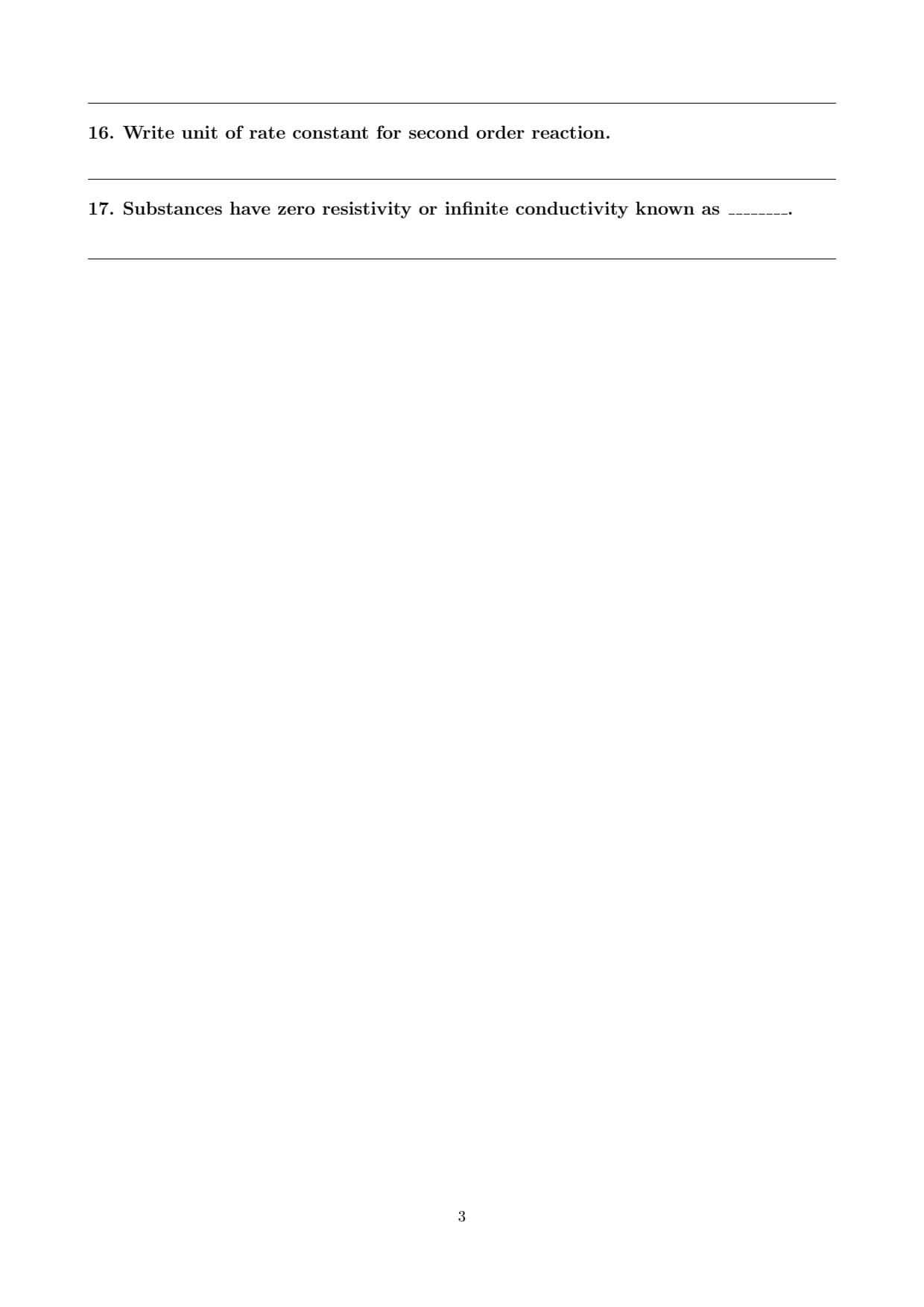
Write unit of rate constant for second order reaction.
View Solution
Concept:
The unit of rate constant depends on the order of the reaction.
Rate law: \[ Rate = k[A]^n \]
Units of rate are: \[ mol\,L^{-1}s^{-1} \]
Second Order Reaction:
For a second order reaction: \[ Rate = k[A]^2 \]
Unit Calculation:
\[ k = \frac{Rate}{[A]^2} \]
Substitute units:
\[ k = \frac{mol\,L^{-1}s^{-1}}{(mol\,L^{-1})^2} \]
\[ = L\,mol^{-1}s^{-1} \]
Alternative Form:
\[ M^{-1}s^{-1} \]
(where \(M = mol\,L^{-1}\))
\[ \boxed{L\,mol^{-1}\,s^{-1}} \] Quick Tip: Order ↑ → Power of concentration in denominator ↑ → More complex unit of \(k\).
Substances have zero resistivity or infinite conductivity known as ________.
View Solution
Concept:
Electrical resistivity measures how strongly a material opposes the flow of electric current. Some materials exhibit special behavior at very low temperatures.
Explanation:
Certain materials, when cooled below a critical temperature, lose all electrical resistance.
Their resistivity becomes zero and conductivity becomes infinite.
This phenomenon is called superconductivity.
Definition:
Materials that exhibit zero resistivity and infinite conductivity are called superconductors.
Examples:
Mercury (below 4.2 K)
Lead
Niobium alloys
\[ \boxed{Answer: Superconductors} \] Quick Tip: Superconductivity occurs below a critical temperature where electrical resistance drops to zero.



Comments