




Maharashtra Board Class 12 Chemistry Question Paper 2022 with Answer Key is available for download. The exam was conducted by the Maharashtra State Board of Secondary & Higher Secondary Education (MSBSHSE) on March 12, 2022 in the Morning Session 10:30 AM to 2 PM. The medium of paper was English. In terms of difficulty level, Maharashtra Board Class 12 Chemistry paper was of Moderate level. The question paper comprised a total of 31 questions divided among 4 sections.
Maharashtra Board Class 12 Chemistry 2022 Question Paper with Answer Key
| Maharashtra Board Class 12 Chemistry Question Paper 2022 with Answer Key |  Download Download |
Check Solution |
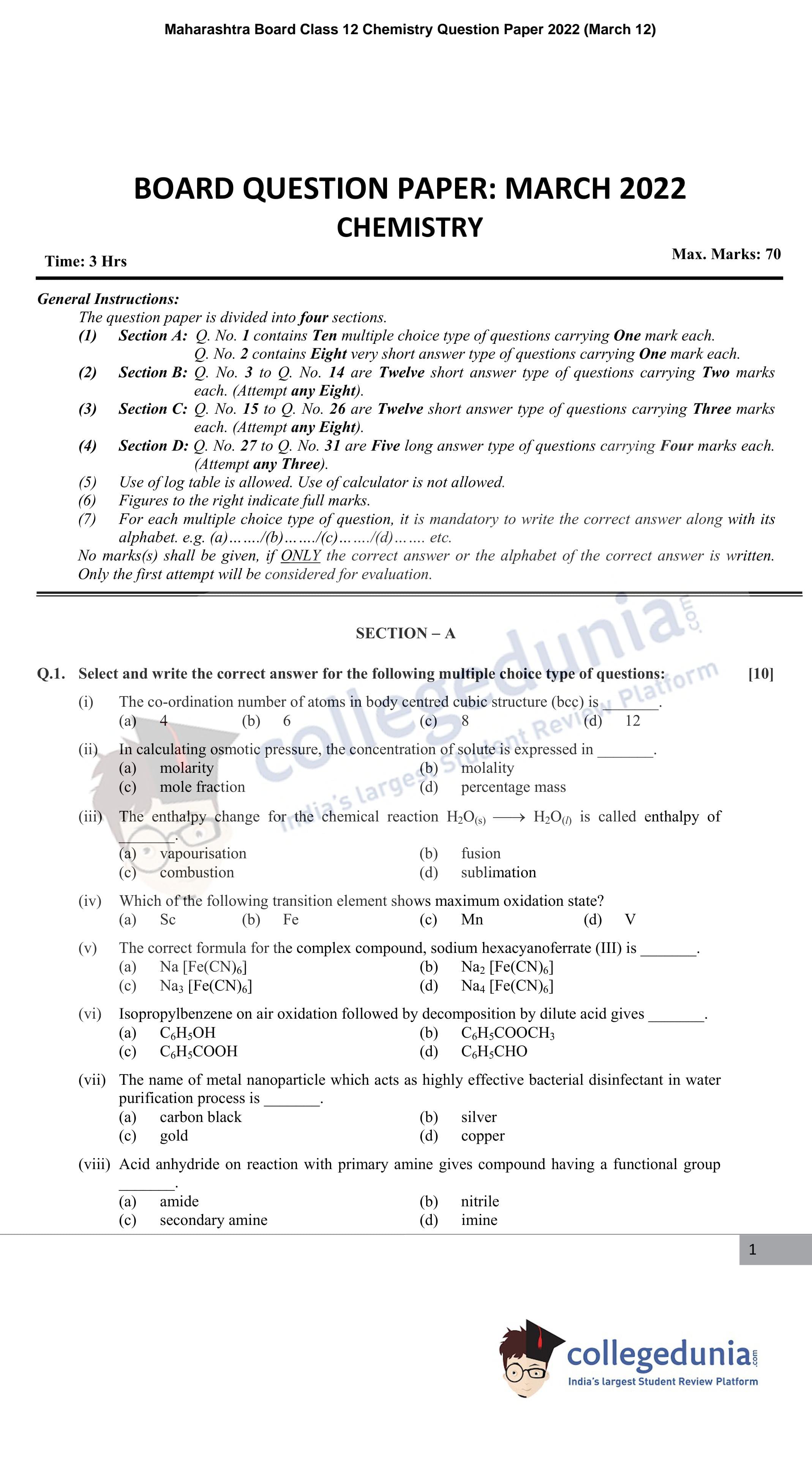
The co-ordination number of the following crystal structure (bcc) is
In calculating osmotic pressure, the concentration of solution is expressed in
The enthalpy change for the chemical reaction \( H_2 (g) \to H_2 O(l) \) is called enthalpy of
Which of the following transition element shows maximum oxidation state?
The correct formula for the complex compound, Na\(_2\) [Fe(CN)\(_4\)](III) is
Isopropylbenzene on air oxidation followed by dilute acid gives
The name of metal nanoparticle which acts as highly effective bacterial disinfectant in water purification process is ________________.
Acid anhydride on reaction with primary amine gives compound having a functional group
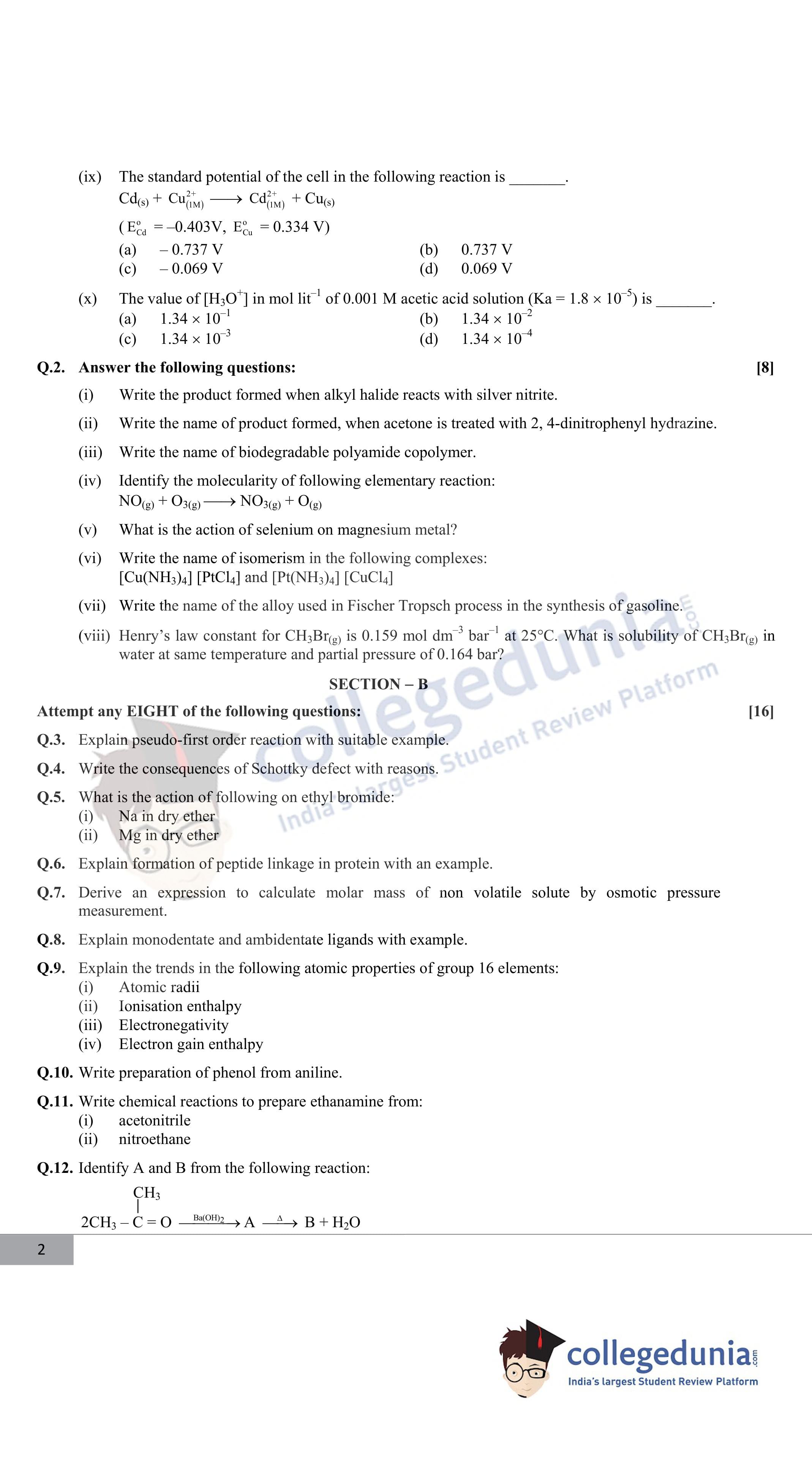
The standard potential of the cell in the following reaction is ______________.
Cd(s) + Cu\(^{2+}\) (aq) \to Cd\(^{2+}\) (aq) + Cu(s)
(E\(^\circ\)_Cd = -0.403 V, E\(^\circ\)_Cu = 0.334 V)
The value of [H\(_3\)O\(^+\)] in mol lit\(^{-1}\) of 0.001 M acetic acid solution (\( K_a = 1.8 \times 10^{-5} \)) is _________.
Write the product when alkyl halide reacts with silver nitrite.
Write the name of biodegradable polyamide copolymer.
Identify the molecularity of following elementary reaction: NO(g) + O\(_3\)(g) \to NO\(_3\)(g) + O(g)
What is the action of selenium on magnesium metal?
Write the name of [Cu(NH\(_3\))\(_4\)]Cl and [Pt(NH\(_3\))\(_4\)]Cl\(_2\) complexes.
Write the name of the process in Fischer Tropsch process in the synthesis of gasoline.
Henry’s law constant for CH\(_3\)Br(g) is 0.159 mol dm\(^{-3}\) bar\(^{-1}\) at 25°C. What is solubility of CH\(_3\)Br(g) in water at same temperature and partial pressure of 0.164 bar?
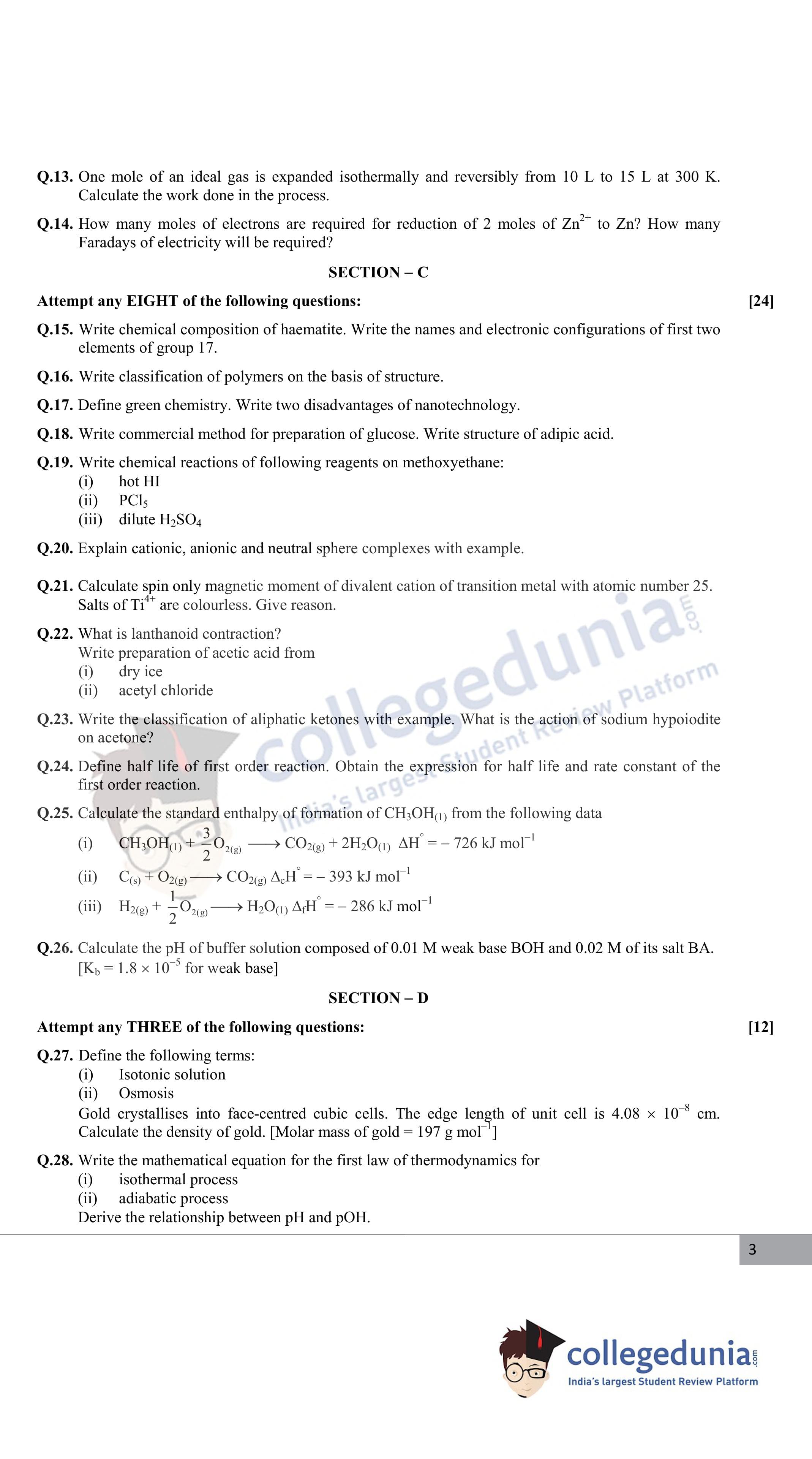
Salts of Ti\(^{2+}\) are coloured. Give reason. Divalent cation of transition metal with atomic number 25.
What is lanthanoid contraction? Write preparation of acetic acid from dry ice and ethyl chloride.
Write the classification of aliphatic ketones with example. What is the action of sodium hypoiodite on acetone?
Define half life of first order reaction. Obtain the expression for half life and rate constant of the first order reaction.
Calculate the standard enthalpy of formation of CH\(_{3}\)OH(l) from the following data: \[ CH_{3}OH(l) + \frac{3}{2} O_{2} (g) \rightarrow CO_{2} (g) + 2H_{2}O(l), \quad \Delta H = -726 \, kJ mol^{-1}, \] \[ C(graphite) + O_{2} (g) \rightarrow CO_{2} (g), \quad \Delta H = -393 \, kJ mol^{-1}, \] \[ H_{2} (g) + \frac{1}{2} O_{2} \rightarrow H_{2}O(l), \quad \Delta H = -286 \, kJ mol^{-1}. \]
Calculate pH of buffer solution composed of 0.1 M weak base BOH and 0.2 M of its salt BA. (\( K_b = 1.8 \times 10^{-5} \) for weak base).
Define the following terms: Isotonic solution, Osmosis. Gold crystallises into face-centred cubic cells. The edge length of unit cell is \( 4.08 \times 10^{-8} \) cm. Calculate the density of gold. [Molar mass of gold = 197 g mol\(^{-1}\)]
Write the mathematical equation for the first law of thermodynamics for Isothermal process, Adiabatic process. Derive the relationship between pH and pOH.
Define reference electrode. Write functions of salt bridge. Draw neat, labelled diagram of standard hydrogen electrode (SHE).
Explain metal deficiency. Write uses of sulphur. Write chemical equation for preparation of sulphur dioxide from sulphur.
Write chemical reactions for the following conversions: Ethyl bromide to ethyl methyl ether, Ethyl bromide to ethene, Bromobenzene to toluene, Chlorobenzene to biphenyl.



Comments