



Education Journalist | Study Abroad Lead | Updated On - Mar 20, 2026
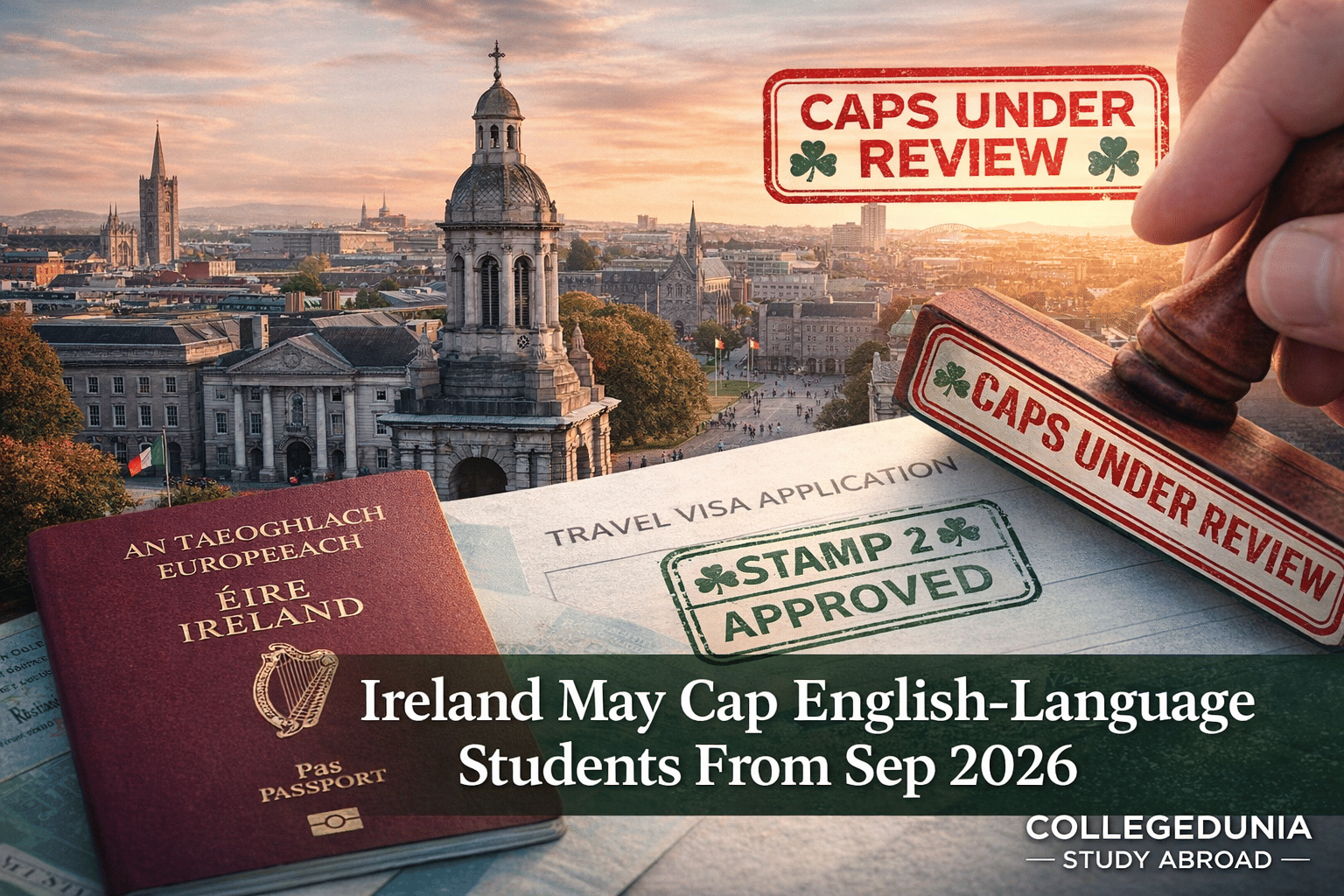
Ireland has quietly become one of the most sought-after study destinations for Indian students, with enrolments surging 30% in 2024–25 to reach a record 13,000. But just as the country cements its status as a top alternative to the US, UK, and Canada, the Irish government is drawing up plans to cap English-language student numbers and tighten visa rules — with changes potentially taking effect from the September 2026 intake.
For Indian students currently weighing Ireland as their next step, the timing matters. The country still offers strong post-study work rights, EU-wide career access, and a booming tech sector. But the policy environment is shifting, and applicants planning for September 2026 need to understand what is changing, what is not, and what to do right now.
Check: Study in Ireland Guide for Indian Students
Why Indian Students Are Choosing Ireland in Record Numbers?
Ireland's rise as a study destination for Indian students is not accidental. As the US tightened F1 visa scrutiny, Canada capped study permits, and the UK shortened its Graduate Route, Ireland emerged as an English-speaking, EU-based alternative with a stable visa framework and strong employment outcomes.
- According to Ireland's Higher Education Authority (HEA), total international student enrolment in Ireland reached 44,535 in 2024–25 — up more than 10% for the fourth consecutive year.
- Indian students now account for over 20% of all international enrolments, with approximately 13,000 enrolled across universities and colleges.
- The 30% year-on-year growth in Indian enrolments is the highest of any major source country.
Popular programmes among Indian applicants include business administration, ICT, natural sciences, law, and STEM-related fields. Ireland's technology sector — home to the European headquarters of Google, Meta, Apple, and Microsoft — creates direct employment pathways for graduates in these disciplines. The Stamp 1G post-study work visa allows Master's and PhD graduates to remain in Ireland for up to 24 months after course completion with no job offer required, while Bachelor's (Level 8) graduates receive up to 12 months of full open work rights.
Check out the top universities in Ireland
What the Irish Government Is Planning to Change
The Irish Cabinet Committee on Migration discussed the issue in February 2026. Briefing papers confirmed that a cross-departmental group is "developing options to reduce the numbers" of international students attending private English-language schools, after officials warned that some applicants are using study visas as a "back door" into the Irish labour market.
Policy options under active review:
| Option | Detail |
|---|---|
| National enrolment quota | Cap linked to accommodation capacity |
| Shorter permission periods | Reduce duration of Stamp 2 study permissions |
| Raised financial proof | Higher funds requirement for visa applicants |
| Reduced work rights | Potential cut to 20-hour weekly work limit |
| New accreditation scheme | ~50–60 of Ireland's ~100 language schools expected to qualify |
Minister for Higher Education James Lawless confirmed a new accreditation scheme for English-language schools will include immigration spot checks. Schools that fail accreditation will lose their ability to enrol international students. A formal proposal is expected to reach Cabinet before summer 2026, with changes potentially applying from the September 2026 intake.
Critically, these changes target English-language schools (Stamp 2 route), not degree-level university programmes.
Who Is Affected — and Who Is Not?
Directly affected:
- Indian students planning to enrol in private English-language schools on a Stamp 2 visa
- Students using language school enrolment primarily as a route to work
Not directly affected at this stage:
- Indian students applying to recognised Irish universities and institutes of technology for degree programmes
- Students already enrolled in degree programmes
- Students on the Stamp 1G post-study work visa
However, the broader signal matters. Ireland issued 60,000 study permissions in 2025 — double the 2019 figure. The government has explicitly identified population growth as a concern, and future tightening could extend to degree-level intake caps, as happened in Canada and Australia.
Ireland vs. Other Destinations in 2026
| Destination | Post-Study Work | Duration | Indian Visa Difficulty | Cap Risk |
|---|---|---|---|---|
| Ireland | Stamp 1G | 12–24 months | Low–Medium | Emerging |
| UK | Graduate Route | 18 months (from Jan 2027) | Medium | High |
| Canada | PGWP | Up to 3 years | Very High | Active cap |
| Australia | Subclass 485 | Up to 2 years | High | Fee doubled |
| USA | OPT | 12–36 months | High | Integrity fee added |
At €1 ≈ ₹107 (ECB rate, March 19, 2026), annual postgraduate tuition in Ireland typically ranges from €10,000–€18,000 (approx. ₹10.7–19.3 lakh). Living costs in Dublin average €12,000–€15,000 per year (approx. ₹12.8–16 lakh). The minimum financial proof required for an Irish student visa is €10,000 (approx. ₹10.7 lakh).
What Indian Students Should Do Now?
- Apply to ILEP-listed degree institutions — universities and institutes of technology on Ireland's official Internationalisation Register are not the target of current cap proposals. Avoid private language schools if your goal is a degree qualification.
- Apply early for September 2026 — Irish student visa processing takes 8–12 weeks. Submit by June 2026 at the latest.
- Prepare €10,000+ in financial proof — the minimum required; a stronger balance improves your application.
- Confirm your programme is ILEP-listed — check the Irish Naturalisation and Immigration Service (INIS) register before paying any deposit.
- Monitor the Cabinet announcement — a formal policy proposal is expected before summer 2026. Track updates at the Irish Department of Justice and Department of Higher Education websites.
- Understand your Stamp 1G eligibility — Master's and PhD applicants should confirm their course qualifies for the 24-month post-study work permission under the Third Level Graduate Programme.



Comments