



Education Journalist | Study Abroad Lead
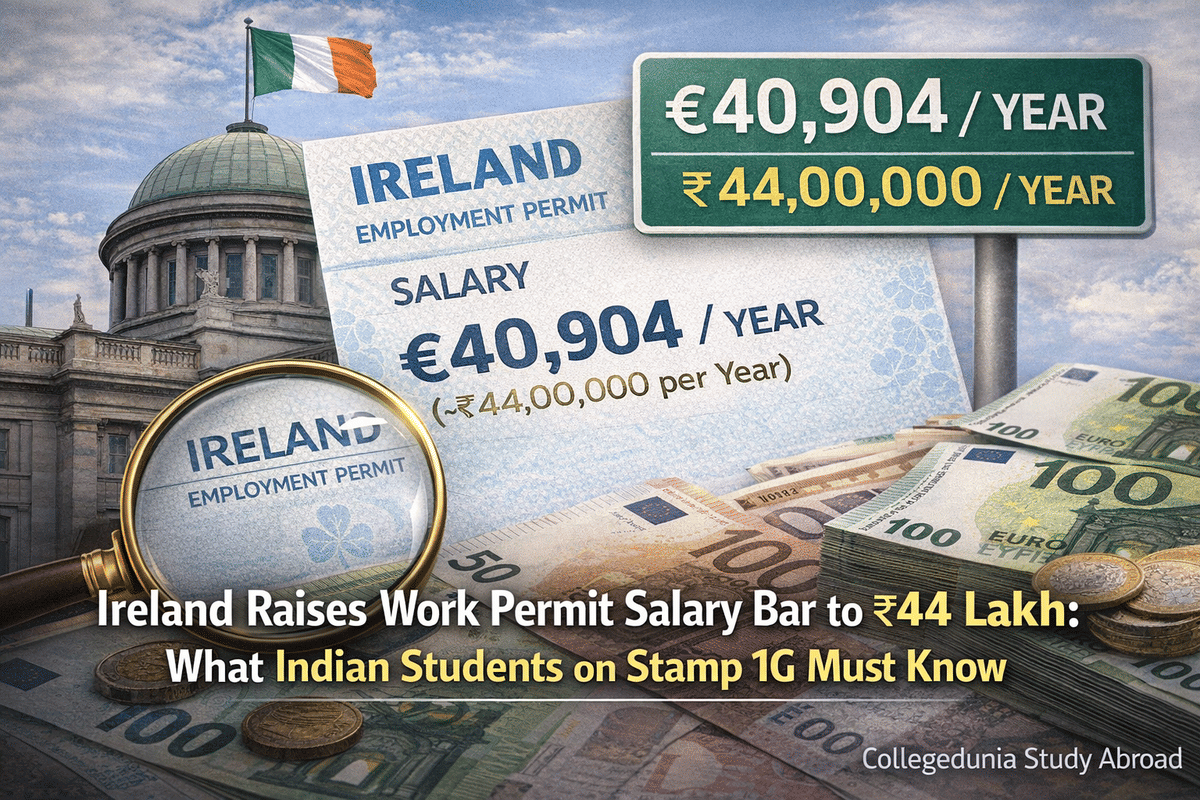
Ireland quietly raised the salary floor for its Critical Skills Employment Permit (CSEP) from €38,000 to €40,904 (approximately ₹44.18 lakh per year) effective March 1, 2026 — a change that directly affects Indian graduates trying to convert their post-study Stamp 1G visa into a long-term work permit. The increase, announced by Ireland's Department of Enterprise, Tourism and Employment (DETE) on December 2, 2025, is the first step in a phased salary roadmap running through 2030.
For India's 13,000 students currently enrolled in Irish universities — a record high, up 30% in 2024–25 — this is not an abstract policy update. It raises the minimum job offer an Indian graduate needs to stay in Ireland beyond the two-year Stamp 1G window.
What Changed From March 1, 2026
Ireland's DETE has revised minimum annual remuneration (MAR) thresholds across all employment permit categories. The increases apply to all new applications and renewals submitted from March 1, 2026 onwards.
| Permit Type | Previous Threshold | New Threshold (Mar 2026) | In INR (approx.) |
|---|---|---|---|
| Critical Skills Employment Permit (CSEP) | €38,000 | €40,904 | ₹44.18 lakh/yr |
| General Employment Permit (GEP) | €34,000 | €36,605 | ₹39.53 lakh/yr |
| CSEP — Recent Graduate (new category) | Not applicable | €36,848 | ₹39.80 lakh/yr |
| Intra-Company Transfer | ~€46,000 | >€49,500 | ₹53.46 lakh/yr |
Exchange rate: €1 = ₹108. Previous thresholds were in place since January 2024.
The 7.66% increase is smaller than the 15.8% originally planned under the 2023 roadmap — a concession to employer concerns about rising business costs. However, for Indian graduates job-hunting in Ireland, the bar has still moved up meaningfully.
Why This Matters for Indian Students?
The Critical Skills Employment Permit is the primary route through which Indian graduates on Stamp 1G convert to a long-term work permit in Ireland.
- Stamp 1G allows graduates to stay and work in Ireland for up to two years after completing their degree — but it is not a permanent solution.
- To remain in Ireland beyond that window, most Indian graduates need a sponsored job offer that meets the CSEP or GEP salary threshold.
- At €40,904 per year, that translates to roughly ₹3.68 lakh per month — a figure that many entry-level roles in Ireland, particularly outside core tech and pharma, do not reach.
- For Indian students who took education loans averaging ₹20–40 lakh to study in Ireland, failing to secure a qualifying job offer within the Stamp 1G period means returning home without the income to repay that debt.
Who Is Affected?
Most at risk:
- Indian MSc graduates in non-critical-skills fields (business analytics, marketing, HR, general management) where entry-level salaries often fall below €36,605
- Students graduating in 2025–26 who are currently on Stamp 1G and planning to apply for a CSEP or GEP before their visa expires
- Students who enrolled in Ireland specifically for post-study work rights, without verifying whether their target role qualifies for a CSEP
Less affected:
- Indian graduates in ICT (software development, cybersecurity, data engineering), engineering, nursing, and pharma — roles that typically meet or exceed the new CSEP threshold
- PhD graduates, who receive three years of post-study stay under Stamp 1G, giving more time to secure a qualifying offer
- Students applying for the new Recent Graduate CSEP category (see below)
The Recent Graduate Exemption: A Relief Valve Worth Knowing
One significant — and underreported — element of the March 2026 update is the introduction of a lower CSEP threshold specifically for recent graduates: €36,848 (approximately ₹39.80 lakh/year).
This applies to graduates of any recognised third-level institution (Level 8 or above) who apply for a CSEP within 12 months of graduation, provided their qualification is relevant to the occupation. This is approximately €4,056 lower than the standard CSEP threshold — a meaningful difference for graduates negotiating their first job offer.
Key conditions:
- Must apply within 12 months of graduation date
- Degree must be Level 8 or above (honours bachelor's, master's, or PhD)
- Qualification must be relevant to the job role applied for
- Job must still appear on DETE's Critical Skills Occupations List (ICT, engineering, science, healthcare, finance)
Indian students who are currently on Stamp 1G and approaching the 12-month mark from their graduation date should prioritise applying under this category before the window closes.
What Indian Students Should Do Now?
- Check your graduation date. If you graduated within the last 12 months, you may qualify for the lower Recent Graduate CSEP threshold of €36,848. Act before the 12-month window closes.
- Verify your target role is on the Critical Skills Occupations List. DETE publishes this list at enterprise.gov.ie. Roles in ICT, engineering, pharma, nursing, and select finance positions qualify. Generic business or marketing roles typically do not.
- Negotiate your salary with the new threshold in mind. If your employer is offering below €40,904 for a CSEP role, ask whether they can meet the threshold — many Irish tech and pharma employers are aware of the requirement and budget for it.
- Do not let your Stamp 1G expire without a plan. Once Stamp 1G expires, you cannot switch to a work permit from within Ireland without leaving and re-entering. Start the CSEP or GEP application process at least 3–4 months before your Stamp 1G end date.
- Consider the General Employment Permit if your role is not on the Critical Skills list. The GEP threshold is now €36,605 — lower than the CSEP — but the GEP has a longer processing time and fewer long-term benefits (CSEP holders can apply for permanent residency after two years; GEP holders must wait five years).
- Track the roadmap. DETE has confirmed further increases through 2030. If you are planning to study in Ireland for a September 2026 or January 2027 intake, factor in that salary thresholds will be higher by the time you graduate.
- The salary threshold changes were officially announced by Minister Peter Burke and Minister of State Alan Dillon on December 2, 2025, and took effect March 1, 2026. Full details are available on the DETE website at enterprise.gov.ie.
Ireland's employment permit system is designed to prioritise EEA workers first; non-EEA nationals (including Indian graduates) require a sponsored permit to work beyond the Stamp 1G period. The CSEP is the fastest route to permanent residency — eligible after just two years, compared to five years under the GEP.






Comments