


What Students Say
Likes
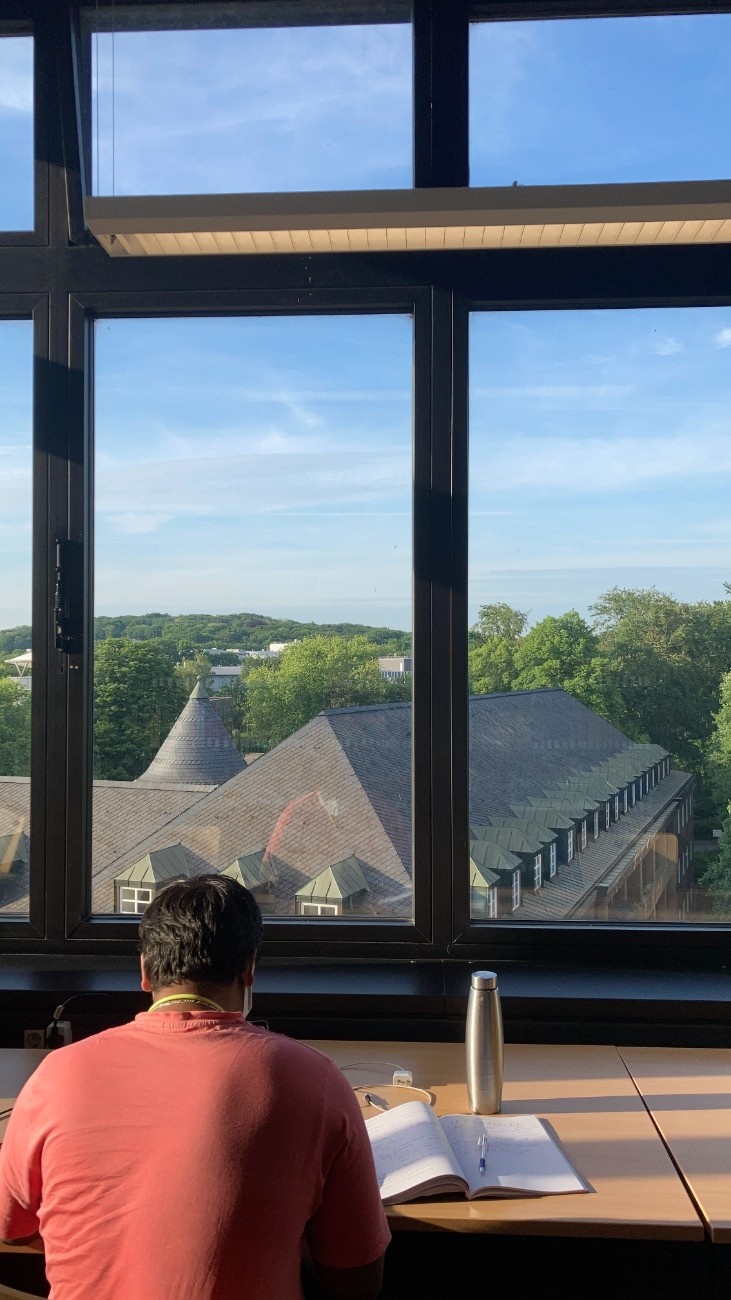
- The university library is the best place to study.
- The classrooms are very good and quiet.
- The teachers always help you, even apart from your syllabus.
Dislikes
- Less interaction with other students.
- Less attendance to the lectures.
- Less clarity in the content of some courses.
Course Curriculum
10
- The difficulty level is a little bit high compared to India; the course is a mixture of both theory and practical. This is a public university, so the research site is also explored in the public university. In applied science universities, more practical courses are designed.
- The course is very well structured, and the outline is defined so that students get an idea of a topic and are helped to clear the exams. Some courses are very difficult, and you have to give the exam in the German language. The course at the university I taught in both languages, so some compulsory subjects are only in the German language.
- Average students in the course will be better, because in the university you have to choose your subjects by yourself from given options. So students from other branches can also study some of your subjects.
- So average students for any subject may be 100-120, based on exams given by students.
- And in the University of Duisburg-Essen, the number of Indian students is very high. Among the 120 students, 50-60 may be Indian students.
Admission Experience
-
I applied to the following universities:
- RWTH Aachen University – Rejected (The requirement of GRE with more than 180 marks in quant section)
- Karlsruhe Institute of Technology – Rejected Requirement of higher grade in B.E.)
- Technische Universität Darmstadt – rejected (Requirement of higher grade in B.E.)
- University of Duisburg-Essen – Admitted
- University of Kaiserslautern – Rejected (German certificate least B1)
- Esslingen university of applied sciences ( Requirement of higher grade in B.E.)
- The technical logistics course at the University of Duisburg-Essen is very structured. I had a chat with one of my friends who was already enrolled in this course.
- Also, the city of Duisburg has one of the most important ports in Europe, so the opportunities in logistics are very high in this area.
- I applied from the official university website. The process is simple. First, you need to create an account and fill in all the information about yourself, your previous education and your work experiences.
- The main documents that need to be uploaded are a CV, university transcripts, SOP (statement of purpose), letter of recommendation, IELTS certificate and German language certificate. Then after applying to the course online on the official university portal, print out the application form and send all the relevant documents via post to the university. They will review them and provide you with a response in 3-4 weeks.
- The admission requirement of the University of Duisburg-Essen is IELTS at least 5.5 and a German certificate of at least B2 (the German language certificate must be from a renowned institute, e.g., Goethe or telc). Also, some relevant subjects in your bachelor's and relevant work experience are considered a plus point.
- Also, you can come to Germany from India as a language student. e.g., I applied with a B1 certificate in India, and then I came to Germany as a language student and then cleared my B2 exam from a language school in Duisburg, and then I got admitted to the course. But to get the visa, the university will provide you with a provisional admit card by which you can come to Germany.
- I didn't have too many challenges. The application process was easy, and the visa process was easy, so I made it to Germany easily without any support from the consultant agencies.
- The course is available both in summer and in wintertime. Summer semester starts in April, and winter in October.
- I started in the summer semester of 2022.
- I submitted the application in September 2021. I got the admit card in November 2021, and then the loan and visa process took a long time till February 2022, and then I reached Germany in March 2022, and even though the semester had started, I completed my German course in 2 months and got admitted to the course in May 2022.
- So the admission process is very fast and online. If you have all the necessary documents, you can pay the fees, and within 1 week you will receive your student certificate.
- This admission process is very easy; you just have to send the mail to the international office with your offer letter for the course and the health insurance document with the fees paid bill to the university. Then they will enrol you as a student and provide you with your student certificate, matriculation number and the transportation ticket.
Faculty
10
- The Faculty of Engineering Sciences, in which approximately 27 professors instruct around 3,500 students under the Department of Mechanical and Process Engineering. This establishes a medium-sized ratio that provides effective interaction and one-on-one guidance between teachers and students
- The instructional approach used by the faculty is based on theoretical lectures along with practical exercises, project work, and research-based learning. The teaching style ensures students have firsthand experience and knowledge related to present-day industry requirements, thereby equipping them for logistics and supply chain engineering careers.
- Educational staff actively help students get part-time and full-time employment utilising their professional networks in the industrial and logistics sectors. They organise internships and connect students with business partners through university partnerships, like career day at university, which is organised regularly.
- Professor Bernd Noche is widely respected for his expertise, research commitment to sustainable logistics, and extremely good support of students. Both academia-topic and industry-practically experienced faculty members, with accessibility, tend to impress, inspiring students and helping with their success on both academic and professional fronts.
Campus Life
8
- The University of Duisburg-Essen has two campuses: the Duisburg Campus at Forsthausweg 2, 47057 Duisburg, and the Essen Campus at Universitätsstraße 2, 45141 Essen. The university has many other campuses all over the city, not so far but within a radius of 1-2 km in the cities of Duisburg and Essen.
- Some on-campus facilities include a university library with various branches of specialised libraries, conference rooms, sports fields, cafeterias, and medical centres with an access link to the university hospital at Essen. Both campuses also have student counselling, career counselling, computer labs, and study rooms.
- Large campus activities are cultural festivals, club events, and academic symposia. Student organisations like sports clubs, cultural groups, and technical student organisations sponsoring events and competitions are student favourites.
- Extracurricular activities are spread across fields like sport (football, basketball, swimming), cultural activities (music, drama, international student meet-ups), and engaging student groups with a focus on sustainability, technology, and social activism to foster vibrant campus life.
Part Time Jobs
- Part-time work for students at University of Duisburg-Essen varies from Teaching Assistant (TA), Research Assistant (RA), and Departmental Assistant (DA) work to work in university services like catering, accommodation administration, and administration.
- Typically, a small group of students achieve TA/RA/DA positions based on faculty needs and student qualifications. Salary for these roles generally ranges between €11 and €15 an hour.
- Other on-campus jobs include cafeteria, library, and student support services work with hourly pay of around €10 to €12.
- A maximum of 20 hours of work per week in semester time is allowed for students. On-campus working is competitive but is generally achievable through positive job seeking and networking between departments.
- Off-campus part-time employment in neighbouring cities, such as retailing or hotel work, also exists but may require a bit more time and effort to find. Part-time employment with the University of Duisburg-Essen includes Teaching Assistant (TA), Research Assistant (RA), and Departmental Assistant (DA) posts, mainly in faculties. A number of students receive such appointments for each semester, typically based on availability and appropriateness. Compensation ranges from around €11 to €15 per hour. Other on-campus jobs are found in libraries, cafeteria staff, and administration offices, with average hourly rates between €10 and €12. Students can work up to 20 hours a week during semester periods. On-campus jobs are competitive, with department relationships and early application making taking jobs possible. Off-campus part-time jobs in restaurants or hotels are also common but require active seeking.
- The basic part-time salary in Germany is currently 12 euros. The part-time jobs are delivery, warehouse, cafeteria, cook and picker at the warehouse. These jobs are not included in the university on roll, so they can pay you a minimum of 12 euros to 15 euros, depending on the individual. I worked in DHL as an external, so they paid me around 13.5, and the university paid me around 14.5. actively looking for jobs at official websites of the companies. But the best way is to get a recommendation from a person working at that place or who worked at that place. This will take less time and give you a high chance to get the job based on your skills and knowledge. The usual process is you need a CV to mention your professional and educational background. then a valid tax ID and insurance certificate. Remember at university you won't get the job directly; you have to show them your student status and valid tax ID number and insurance certificate.
Placement
8
- Approximately 75-80% of the University of Duisburg-Essen's graduating class secure employment within six months of graduation. The salary for the Technical Logistics graduates typically ranges from $55,000 to $65,000 annually, depending on the sector and nature of employment.
- Students usually find jobs through a mix of campus recruitment drives, internships, interaction with the faculty and industry professionals, and web-based job portals. Internships while in the programme are significant in culminating in job offers upon graduation.
- Batchmates report placements at large firms, especially in sectors like automotive, logistics, and engineering. Some of the prominent recruiters include Siemens, ThyssenKrupp, DHL, Bosch, and Deutsche Bahn, with roles in supply chain management, logistics planning, and process engineering.
- This strong industry connection enables smooth career starts for most graduates in the programme.
Accommodation
Off Campus
8
- University of Duisburg-Essen student housing is generally acquired through online communities, the university's resident service in Studierendenwerk, and sometimes the student communities on Facebook and WhatsApp. Apply early, as it is in high demand.
- Monthly rent in student dorms ranges from approximately €340 to €470, typically including utilities, internet, furnished space, and shared kitchen and laundry facilities.
- Flat rents are higher, between €400 and €750.
- Limited supply of dorms, language, and competition for rentals are a challenge. These are mitigated by starting the search early and using official university resources. Finding accommodation in this region is always a big problem.
- Prospective students are urged to apply in advance, explore shared apartments, use university housing services, and visit student social groups for information and listings. Keep posting on Facebook groups and WhatsApp groups that I am looking for accommodation in this region. Also, like Duisburg, every city has groups for Indian students and newcomers, and they also post about the available applications. Beware of frauds, please. Many people try to make you a fool. Never pay them advance rent; always pay them after 15 days of the following month.
- Most of the accommodations range from 5 to 15 minutes from campus via public transportation. Indian students typically live in the Neudorf and Duissern (Duisburg) or Nordviertel and Stadtkern (Essen) areas due to convenience and local presence.
Exams
- IELTS – at least 5.5 (the language of medium certificate is also accepted, which should be provided by your university and certified by the college or university you are studying at)
- Most important is your CV describing your previous education and work experience (if you have it), SOP (statement of purpose), at least 2 letters of recommendation (from your college professor or your manager you were working with), university transcripts (describing your previous courses and subjects), IELTS certificate or medium of instruction certificate, and German language certificate.
- No interview is taken in this university; the admit card is provided depending on your application documents.
- Be honest about your previous education and work. The statement of purpose should be an honest intention to study at the university. The more you design your statement of purpose, the more it will look fake. Do not only mention your achievements and success stories; also mention failure and learning experiences in a positive way.
Fees
- Total university fees are different every semester; they vary between 300 and 350 euros per semester.
- So this is only for 6 months of university fees.
- In this fee, the university provides us free transportation in the North Rhine-Westphalia state. With this ticket we can take any regional train within the state.
- Currently, because of the Deutschland ticket, with which we can travel within the whole of Germany, the University of Duisburg-Essen includes the Deutschland ticket in its semester fees only. There is no need to buy any other tickets for transportation; it includes regional trains, buses, trams and U-Bahns.
- The rent usually is between 320 and 380 euros in the city centre, even in student dormitories. outside the city it will be between 250-320 euros for 13-15m square room.
- Private rentals may be between 300 and 400 for one single room of around 15 square metres.
- In this city, monthly groceries will cost around 150-200 euros, and if you eat regularly in the university canteen and outside, then it will go up to 300 euros monthly.
- No other expenses are required. Personal shopping may cost you 100-150 euros, depending on the individual.
- If you visit places nearby, the transportation is free, but you have to pay the ticket price to see the historical places, museums, etc. With a student card, the ticket price will be lower than normal.
Scholarship
- No, as this is a public university, the chances of scholarships are very low. They do have some scholarships, but the usual criteria is higher grades in each semester. But mostly due to lower fees and no other costs, public universities have fewer scholarship offers.
- The data about the students who get the scholarships are not disclosed, but among my friends Not a single person received any scholarships for the current course.
- The PhD candidates may receive the scholarships but have no experience or any idea how it can be done.


