



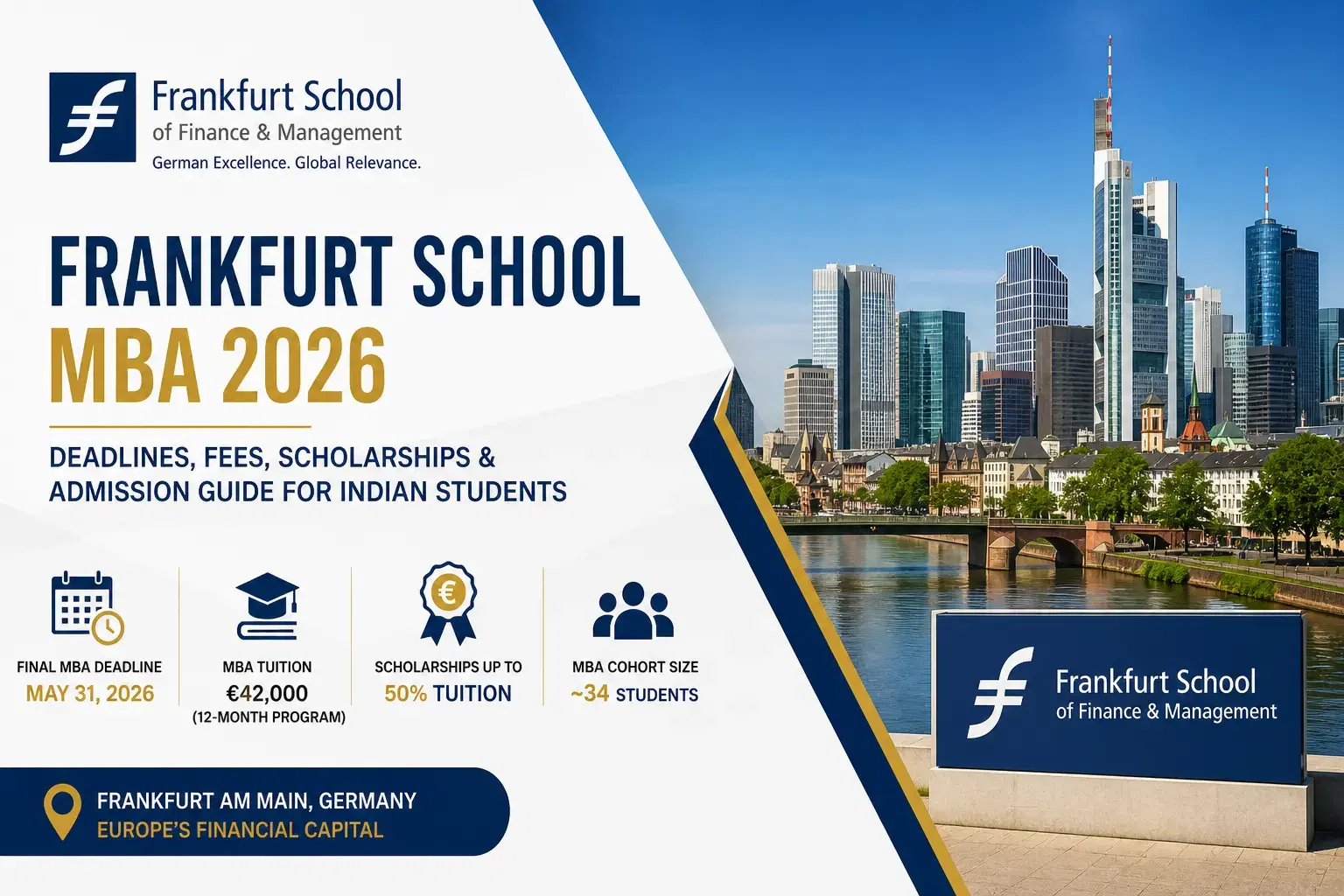
Frankfurt School of Finance & Management (FSFM) admissions for the September 2026 Full-Time MBA intake have a final deadline of May 31, 2026, with the Master in Management (MIM) closing on June 30, 2026. The FSFM MBA cohort is the smallest among top German business schools at ~34 admits per cycle. The MBA tuition is €42,000 (₹46.78 Lakhs) for the 12-month program.
- Final MBA deadline for September 2026 intake: May 31, 2026
- MIM Sep 2026 deadline (rolling, final): June 30, 2026
- FSFM Full-Time MBA tuition: €42,000 (₹46.78 Lakhs) for 12-month program
- FSFM MIM tuition: €17,750 per year (₹19.78 Lakhs/year); total ~€35,500 over 2 years
- Application fee: €100 (~₹11,142) for MBA, non-refundable
- MBA cohort size: ~34 students; significantly smaller than WHU (~70) or ESMT (~60)
- Triple-crown accredited: AACSB, AMBA, EQUIS
FSFM is located in Frankfurt am Main, Germany's financial capital and home to the European Central Bank, Deutsche Bank, Commerzbank, and DZ Bank. The school's finance specialisation makes it the natural choice for Indian applicants targeting banking, asset management, or corporate finance careers. FSFM ranks #92 globally for MBA and #62 globally for MIM in the Financial Times 2025/26.
Also Check: Top MBA Universities in Europe for Indian Students
(Exchange rate used: €1 = ₹111.42 as of 5 May 2026. Source: BookMyForex / Xe.)
FSFM MBA Application Deadlines 2026-27
FSFM operates a single-intake MBA calendar with the September program start. Applications are reviewed on a rolling basis from October until the final deadline in late May. The MIM and MSc programs follow separate calendars with rolling admissions until June 30, 2026.
The Frankfurt School application deadlines for the 2026-27 cycle are listed below. Past deadlines are struck through. Indian applicants targeting the September 2026 MBA intake must submit by May 31, 2026 — this leaves only 12 to 14 weeks for visa processing and APS Certificate verification.
| Program / Round | Application Deadline | Decision Date | Status |
|---|---|---|---|
| MBA Sep 2026 R1 | Closed | Closed | |
| MBA Sep 2026 R2 | Closed | Closed | |
| MBA Sep 2026 R3 | Closed | Closed | |
| MBA Sep 2026 R4 | Closed | Closed | |
| MBA Sep 2026 Final | May 31, 2026 | ~3 to 4 weeks rolling | Active (urgent) |
| MIM Sep 2026 (rolling) | June 30, 2026 (final) | ~4 weeks rolling | Active |
| MSc Finance Sep 2026 (rolling) | June 30, 2026 (final) | ~4 weeks rolling | Active |
| MSc AI & Data Science Sep 2026 | June 30, 2026 (final) | ~4 weeks rolling | Active |
| Executive MBA Apr 2027 | December 15, 2026 | ~4 weeks rolling | Upcoming |
FSFM application deadlines close at 23:59 Central European Time. IST is 4 hours and 30 minutes ahead, so a CET deadline corresponds to 04:29 IST the following morning. For more information, visit the application deadlines for German universities.
Note:
- The May 31, 2026 final MBA deadline leaves 12 to 14 weeks for German Visa Type D processing — tight given the APS Certificate requirement
- FSFM strongly recommends submitting by April end to allow comfortable visa timing for international applicants
- The MBA cohort cap of ~34 students means later-round applicants face structural seat-availability constraints; prior rounds may have already filled capacity
- MIM applications continue rolling reviews through June 30, with final selection in mid-July
Tip: The 34-student MBA cohort cap is the binding constraint at FSFM, not the deadline. Round 4 (April 30) is the practical final round for Indian applicants targeting the September 2026 intake. Applicants submitting in May face a high probability of waitlist or deferral to September 2027 because the cohort may already be at or near capacity. Indian applicants with strong profiles should target Round 3 (February 28) or earlier.
Read More: Germany Student Visa for Indian Students Guide
FSFM MBA Acceptance Rate and Class Profile
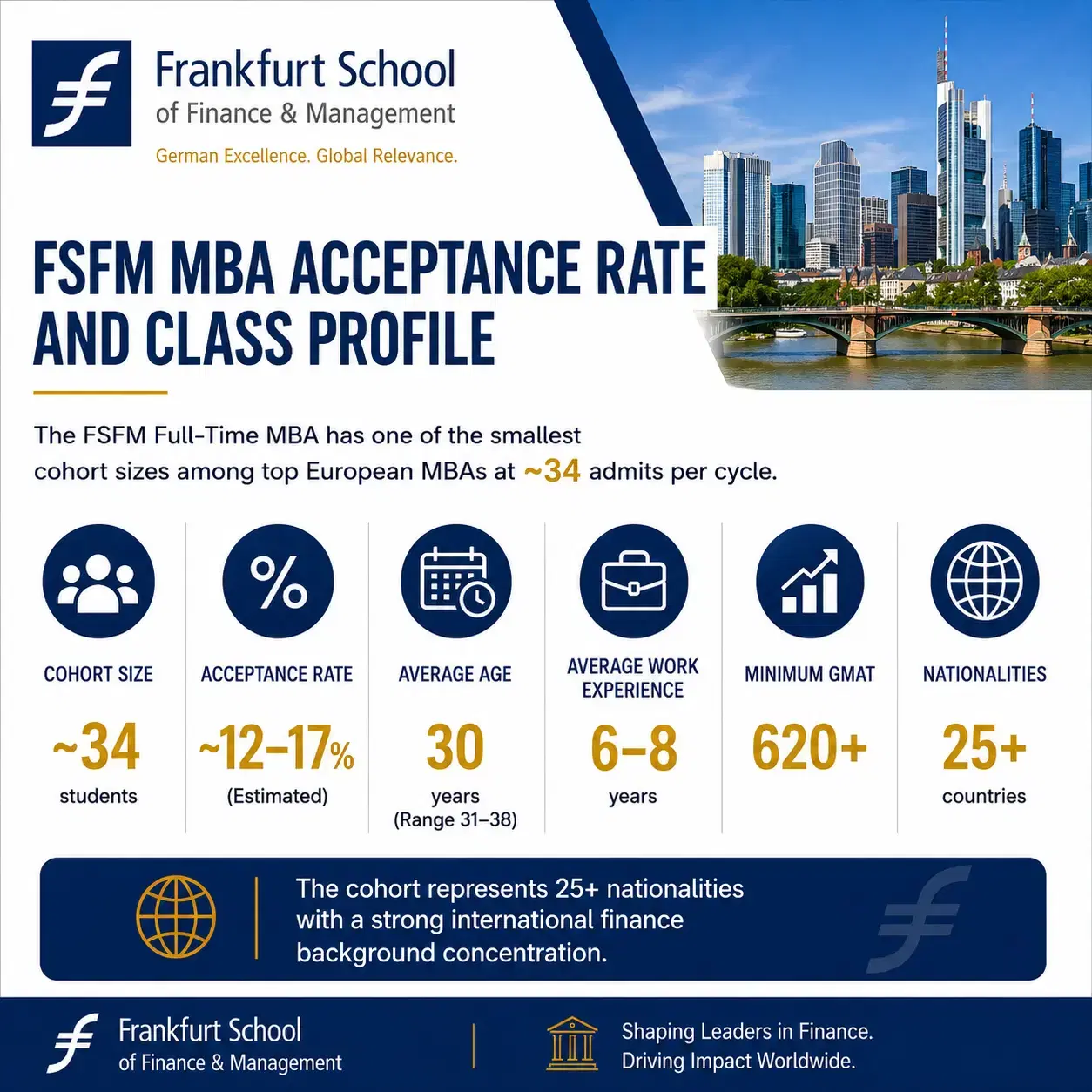
The FSFM Full-Time MBA has one of the smallest cohort sizes among top European MBAs at ~34 admits per cycle. The Class of 2025 averaged age 30 (range 31 to 38), with an average of 6 to 8 years of work experience and a minimum GMAT of 620. The cohort represents 25+ nationalities with a strong international finance background concentration.
Indian Admit Profile Snapshot at FSFM
FSFM MBA admits approximately 4 to 6 Indian students per cohort, representing 12 to 18% of the class. The smaller absolute number reflects the 34-student cap; competition within the Indian applicant pool is intense, given the limited seats.
Successful Indian admits to FSFM typically present:
- Bachelor's GPA 3.2+ on a 4.0 scale (CBSE 75%+ for STEM, 70%+ for non-STEM)
- GMAT 620 to 700 or GRE 312+
- 5 to 8 years of postgraduate work experience (3+ years required)
- Finance, banking, or quantitative work background strongly preferred
- IELTS 7.0+, TOEFL 90+, or English-medium bachelor's degree with MOI letter
- CFA Level 1 or higher significantly improves competitiveness
Post-MBA Outcomes for FSFM Indian Graduates
FSFM Class of 2025 reports 81% MBA placement within 3 months of graduation. The MIF Class of 2024 reports 91% placement with an average salary of €77,000 (~₹85.79 Lakhs). Top recruiters include Deutsche Bank, ECB, KfW, Commerzbank (banking); Allianz, Munich Re (insurance); McKinsey, BCG, Bain (consulting); and EY, KPMG, PwC (Big 4). The finance-heavy placement profile is unique among German MBAs.
Note: The 81% MBA placement at FSFM is lower than ESMT (92%) or WHU (95%) and partially reflects the finance specialisation; finance roles take longer to secure than consulting roles. Indian admits targeting consulting should weigh ESMT or WHU for higher placement rates; Indian admits targeting banking or asset management benefit from FSFM's Frankfurt location and ECB proximity over peer schools.
Also read: Jobs after MBA in Germany for Indian students
FSFM 34-Student MBA Cohort and Faculty Access
Frankfurt School maintains the smallest Full-Time MBA cohort among top German business schools, capping admits at approximately 34 students per cycle. This cohort scale shapes the program experience, faculty interaction quality, and recruiter access in ways that differentiate FSFM from larger MBA programs.
Implications of the 34-student MBA Cohort
The structural advantages of the small cohort manifest in three areas:
- Faculty-to-student ratio: 1 faculty member per 1 to 2 MBA students; classroom interactions are seminar-style rather than lecture-format
- Cohort tightness: 34 students means every admit knows every other admit by name; the cohort functions like a tight team rather than a large class
- Recruiter access: top finance recruiters at Frankfurt institutions can see all MBA admits during a single campus visit; competitive intensity for top placements is higher per individual admit
Comparison of MBA Cohort Sizes Across German Batch
| School | Full-Time MBA cohort | Cohort character | Indian seats per cycle |
|---|---|---|---|
| Frankfurt School | ~34 students | Tight finance cohort | 4 to 6 |
| ESMT Berlin | ~60 students | Multi-sector international | 8 to 12 |
| Mannheim Business School | ~50 students | Diversified international | 6 to 10 |
| WHU Otto Beisheim | ~70 students | Consulting-heavy | 8 to 12 |
Indian applicants prioritising tight cohort relationships and direct faculty access should weigh FSFM's structure favourably. Indian applicants prioritising peer network density and recruiter breadth typically benefit from ESMT or WHU's larger cohorts.
Key Insight: The 34-student cohort means every Indian admit becomes structurally visible to every recruiter who visits FSFM. This is a double-edged dynamic: strong profiles benefit from increased visibility, but average profiles cannot hide within a larger pool of competing classmates. Indian applicants with credentials at the lower end of the FSFM admit range (GMAT 620, 3 years experience) should consider this when comparing offers from FSFM, ESMT, and WHU.
FSFM Application Process and Requirements
The FSFM MBA application has eight components plus an admissions interview.
FSFM MBA Application Components
- Online application form on the FSFM admissions portal
- Updated CV in English (one to two pages) with finance/business work experience emphasis
- GMAT, GRE, or Executive Assessment score; minimum GMAT 620 expected
- Two professional reference letters
- Motivation essay (500 words) covering career goals and FSFM fit
- Letter of motivation specific to finance industry interest if applicable
- English Proficiency: TOEFL 90+, IELTS 7.0+, or English-medium bachelor's degree with MOI letter
- Application fee of €100 (~₹11,142)
- APS Certificate (mandatory for Indian applicants since November 2022)
- Online admissions interview (45 to 60 minutes) if shortlisted
- Admission decision within 4 weeks of interview
- Tuition deposit on admission to confirm seat
The FSFM Admissions Interview Emphasis
The FSFM interview emphasises finance industry awareness alongside standard MBA-fit questions. Indian applicants should prepare specific responses on:
- Current ECB monetary policy implications for European banking
- Frankfurt's role as Eurozone financial center and post-Brexit beneficiary
- Specific career path within finance: banking, asset management, treasury, fintech, or corporate finance
- Reasons for choosing FSFM over WHU, ESMT, or international alternatives like INSEAD
The interview committee includes faculty with active research in finance and adjunct professors from Deutsche Bank, ECB, and KfW. Indian applicants without finance background but targeting general management roles must articulate finance-adjacent rationale clearly.
FSFM Eligibility Criteria for Indian Students
FSFM eligibility criteria for Indian students vary across the Full-Time MBA, MIM, MSc programs, Bachelor in Business Administration, and Executive MBA. Each program targets distinct career stages with specific work experience and quantitative requirements.
Eligibility Requirements by Program (Indian applicants)
| Program | Bachelor's Required | Work Experience | GMAT / GRE | English Proficiency | Other |
|---|---|---|---|---|---|
| Full-Time MBA | 3 or 4-year, any discipline | 3+ years (avg 6 to 8) | GMAT 620+ or GRE 312+ | IELTS 7.0 / TOEFL 90 / waiver | Finance background preferred, APS, interview |
| Master in Management | 3 or 4-year, any discipline | None to 1 year | GMAT or GRE accepted | IELTS 7.0 / TOEFL 90 / waiver | APS, motivation essay, interview |
| MSc International Finance | 4-year, finance/economics/quant | None to 2 years | GMAT 600+ or GRE 310+ | IELTS 7.0 / TOEFL 90 / waiver | CFA Level 1 strongly preferred |
| MSc AI & Data Science | 4-year, math/CS/engineering | None to 2 years | GMAT/GRE strong Quant | IELTS 7.0 / TOEFL 90 / waiver | Programming/analytics background |
| Executive MBA | 3 or 4-year, any discipline | 10+ years in senior management | EA preferred; GMAT optional | Fluency assessed via interview | 18-month modular delivery |
| BBA | High school diploma / Class 12 | None | SAT or FSFM test | IELTS 6.5 / TOEFL 87 | 3.5-year program with 1-2 semesters abroad |
IELTS Waiver for Indian Students Applying to FSFM
FSFM waives IELTS, TOEFL, and Cambridge English for applicants who completed their bachelor's degree in English. Submit a medium-of-instruction (MOI) letter from the university registrar on official letterhead. Most Indian engineering and business school graduates qualify: IIT, NIT, BITS Pilani, IIM, ISB, SRCC, St. Stephen's, FMS, MDI, XLRI.
FSFM additionally assesses English fluency during the admissions interview. Applicants with three or more years of work experience in English-language professional environments can also qualify with employer-confirmed work history.
FSFM MBA Fees, Scholarships and Cost of Attendance
The FSFM Full-Time MBA fees for the September 2026 intake are €42,000 (₹46.78 Lakhs) for the 12-month program. The MIM is significantly more cost-efficient at €35,500 over 2 years. The MSc programs sit between, ranging €29,000 to €49,500 depending on specialisation.
Total Cost of Attendance for FSFM Full-Time MBA
| Cost component | EUR | INR |
|---|---|---|
| Full-Time MBA tuition (12-month) | €42,000 | ₹46.78 Lakhs |
| Application fee | €100 | ~₹11,142 |
| Health insurance (annual) | €1,200 to €1,500 | ₹1.34 to ₹1.67 Lakhs |
| Living costs Frankfurt (12 months) | €14,400 to €19,800 | ₹16.04 to ₹22.06 Lakhs |
| APS certificate processing | ~€135 | ~₹15,000 |
| Books, materials, social activities | €1,500 to €2,500 | ₹1.67 to ₹2.79 Lakhs |
| Total all-in (Frankfurt) | ~€59,335 to €65,935 | ~₹66.10 to ₹73.46 Lakhs |
Frankfurt's living costs are the highest among the German batch — Indian students should budget €1,200 to €1,650 monthly for shared accommodation, transport, and food. Frankfurt's central location and high cost of living are direct trade-offs for finance career access. For more information, visit the FSFM fees for Indian students.
FSFM Scholarships for Indian Students 2026
FSFM offers merit-based scholarships covering up to 50% of tuition for outstanding admits. The scholarship application requires a 500-word motivation letter submitted alongside the regular application:
- FSFM Excellence Scholarship: merit-based; up to 50% tuition coverage (~€21,000)
- FSFM Diversity Scholarship: targets women and applicants from underrepresented backgrounds
- FSFM Need-Based Aid: requires CA-certified income proof; covers a portion of tuition
- DAAD Scholarships: German government scholarships available via separate application
- European Investment Bank Scholarship: targets candidates with finance career plans in EU institutions
FSFM's 50% tuition merit scholarship is the most generous among the German batch, but is highly competitive given the small cohort. Approximately 5 to 8 admits per cycle receive this top-tier award. Indian applicants should target Round 1 to Round 3 submissions for maximum scholarship visibility.
Read More: Fully Funded MBA Scholarships for Indian Students Abroad
FSFM Master in Management and Specialised MSc Programs
FSFM offers a 2-year Master's in Management plus several Specialised Master's programs. The MIM is ranked #62 globally by FT 2025; the MSc International Finance is among the top finance-specialised European master's programs.
FSFM Master's in Management for Indian Students
The FSFM MIM is a 2-year English-taught program with one annual September intake. Tuition is €17,750 per year, summing to ~€35,500 over both years.
- Application fee: €100 (~₹11,142)
- Acceptance rate: not officially published; estimated 25 to 30% based on cohort size
- Cohort: ~80 to 100 students per intake
- Average GMAT: 620 to 660 for admitted Indian applicants
- 91% placement within 3 months (Class of 2024)
- Average post-MIM salary: €77,000 (~₹85.79 Lakhs) for Class of 2024
- FT 2025 ranking: #62 globally
FSFM MSc Programs for Indian Students
| Program | Duration | Tuition | Indian admit profile |
|---|---|---|---|
| MSc International Finance | 2 years | ~€38,000 (₹42.34 Lakhs) | CFA Level 1+, finance background |
| MSc AI & Data Science | 2 years | ~€35,500 (₹39.55 Lakhs) | STEM background, programming skills |
| MSc Applied Data Science | 2 years | ~€18,710 first year | Quantitative undergrad, analytics interest |
The MSc International Finance places strongly into ECB-adjacent roles, Deutsche Bank, KfW, and Big 4 financial advisory. The MSc AI & Data Science targets fintech, banking technology, and data analytics roles within Frankfurt's financial ecosystem.
Frankfurt Financial Center Proximity for FSFM Students
FSFM's central Frankfurt location places students within a 10 to 15-minute walk of every major German financial institution. The campus is in the same district as the European Central Bank (ECB), Deutsche Bundesbank, Deutsche Bank Towers, Commerzbank Tower, and DZ Bank. This proximity translates to direct recruiter access and informal networking opportunities unique among German MBAs.
Frankfurt's Financial Ecosystem for FSFM Students
Frankfurt hosts approximately 200 banks, including 100+ international banks, the European Central Bank (Eurozone monetary policy), Deutsche Bundesbank (German central bank), and the Frankfurt Stock Exchange (Europe's third-largest by market cap). Post-Brexit, Frankfurt has expanded as the European banking hub, with Goldman Sachs, JP Morgan, Morgan Stanley, Citigroup, and Bank of America establishing major Frankfurt operations.
| Institution | Walk distance from FSFM | FSFM career relevance |
|---|---|---|
| European Central Bank (ECB) | ~15 minutes | Monetary policy, regulatory affairs roles |
| Deutsche Bank Towers | ~10 minutes | Investment banking, M&A, asset management |
| Commerzbank Tower | ~10 minutes | Corporate banking, trade finance |
| Deutsche Bundesbank | ~20 minutes (subway) | Central banking, financial stability |
| Frankfurt Stock Exchange (Deutsche Börse) | ~10 minutes | Trading, exchange operations |
| KfW Banking Group | ~15 minutes | Development finance, ESG investing |
Frankfurt Living for Indian FSFM Students
Frankfurt has an established Indian community of approximately 35,000 residents, with multiple Indian temples, restaurants, grocery stores, and the largest Indian community center in Germany. Indian students at FSFM have stronger community access compared to Vallendar (WHU) or even Mannheim, making Frankfurt structurally easier for Indian admits with families.
- Shared apartment rent (Bornheim/Sachsenhausen): €700 to €1,100 monthly
- Frankfurt has direct flights to most major Indian cities via Lufthansa, Emirates, and Air India
- Cost of living is approximately 20% higher than Berlin and 35% higher than Vallendar
FSFM Admission Tips for Indian Students
- Submit by Round 3 (February 28) for cohort seat security. The 34-student MBA cohort fills early; Round 4 and Round 5 admits face waitlist or deferral risk. Indian applicants with strong profiles should target Round 2 or Round 3 to secure seats before capacity constraints bind.
- CFA Level 1 significantly improves competitiveness. The FSFM admissions committee weighs CFA Level 1 as evidence of finance commitment and quantitative discipline. Indian applicants without prior finance work experience can compensate by completing CFA Level 1 before applying. CFA Level 2 or 3 strengthens the application substantially.
- Reference specific Frankfurt institutions in essays. The "Why FSFM" essay should reference specific Frankfurt employers (ECB, Deutsche Bank, KfW) by role and team rather than generic "European banking" narratives. The committee specifically scores depth of finance industry awareness.
- Prepare ECB monetary policy talking points for the interview. The FSFM interview frequently covers current ECB policy, Eurozone inflation, and German banking dynamics. Indian applicants from non-finance backgrounds should prepare 2 to 3 specific ECB policy positions and their business implications before the interview.
- Apply for the FSFM 50% Excellence Scholarship via the 500-word motivation letter. The scholarship application is a separate motivation letter alongside the regular application. The letter should articulate financial need or specific finance career intent that aligns with FSFM's positioning. Approximately 5 to 8 admits per cycle receive this award.
- Initiate APS Certificate processing 2 to 3 months before application submission. The APS verification at the German Embassy takes 2 to 6 weeks. Indian applicants targeting Round 3 (February 28) should start APS in November 2025; Round 4 (April 30) applicants should start APS by January 2026.
- Plan Frankfurt living budget at €1,200 to €1,650 monthly. Frankfurt is the most expensive German city among the German batch. Shared apartments in Bornheim or Sachsenhausen are the practical Indian-student choice; central Bahnhofsviertel is cheaper but less safe at night.
- Combine FSFM application with Mannheim Business School. Both schools have similar finance-adjacent positioning and Round 3-Round 4 deadlines align. Indian applicants applying to multiple German MBAs can use largely identical application materials with different "Why X" essays.
- Use Brain Capital's Generation Contract or Prodigy Finance for Indian applicants. Brain Capital is a German-specific student loan provider offering income-share-agreement structures; Prodigy Finance offers cosigner-free loans without Indian co-borrowers. Both are accessible to Indian FSFM admits.
- Address career path post-MBA explicitly: banking vs consulting vs corporate finance. FSFM admissions favours specific career narratives over generic ones. Indian applicants should articulate their target role 2 years post-graduation (e.g., "ECB monetary policy economist" vs "European banking generally") for differentiated essays.
Check Out: Cost of Living in Europe for Indian Students
Indian applicants targeting the FSFM September 2026 MBA intake should treat the May 31, 2026 final deadline as the absolute fallback — Round 4 (April 30) was the practical final round given cohort capacity. Initiate APS Certificate processing immediately and prepare ECB monetary policy talking points for the interview. Visit the official FSFM admissions page or contact mba@fs.de for application portal updates and scholarship-specific guidance.
Frequently Asked Questions
Ques. What is the FSFM MBA acceptance rate for Indian students?
Ans. FSFM does not publish an official MBA acceptance rate, but the cohort cap of approximately 34 admits per cycle from 200 to 300 applications implies an effective acceptance rate of 12 to 17%. Indian admits represent 12 to 18% of the class, equivalent to 4 to 6 students per intake. The small absolute number reflects the cohort cap; competition within the Indian applicant pool is intense.
Ques. What is the FSFM application fee for Indian students?
Ans. The FSFM MBA application fee is €100 (~₹11,142). The MIM and Specialised MSc programs charge €100 to €130 depending on the program. The Executive MBA charges a separate fee structure. There are no fee waivers specifically for Indian applicants.
Ques. Is IELTS required for FSFM if I studied in English-medium in India?
Ans. No, FSFM waives IELTS, TOEFL, and Cambridge English for applicants who completed their bachelor's degree in English. Submit a medium-of-instruction letter from your university registrar on official letterhead. Most Indian engineering and business school graduates qualify: IIT, NIT, BITS Pilani, IIM, ISB, SRCC, St. Stephen's, FMS, MDI, XLRI. English fluency is also assessed during the admissions interview.
Ques. What GMAT score do I need for FSFM MBA admission?
Ans. FSFM requires a minimum GMAT score of 620 for MBA admission, with Indian admits typically clustering between 620 and 700. The MIM accepts GMAT 600+ or GRE equivalent. FSFM also accepts the Executive Assessment for the EMBA. Indian applicants from finance backgrounds with CFA Level 1 or 2 can sometimes succeed with GMAT 600 to 620 if other profile elements are strong.
Ques. Why is the FSFM MBA cohort so small?
Ans. FSFM intentionally caps the Full-Time MBA cohort at approximately 34 students to maintain a high faculty-to-student ratio (1 faculty per 1 to 2 MBA students) and seminar-style classroom interactions. The small cohort enables direct faculty access and tight cohort relationships but creates structural seat-availability constraints; later-round applicants may face waitlist or deferral. Indian admits prioritising tight cohort networks benefit from this structure.
Ques. How does Frankfurt's financial center proximity benefit FSFM students?
Ans. FSFM's central Frankfurt location places students within 10 to 15 minutes' walk of the European Central Bank, Deutsche Bank, Commerzbank, and Deutsche Bundesbank. Post-Brexit, Frankfurt has expanded as Europe's banking hub with Goldman Sachs, JP Morgan, Morgan Stanley, and Citigroup expanding Frankfurt operations. FSFM students have direct recruiter access and informal networking opportunities unique among German MBAs.
Ques. Is the APS Certificate mandatory for Indian applicants to FSFM?
Ans. Yes, the APS (Akademische Prüfstelle) Certificate is mandatory for all Indian applicants to German universities since November 2022. FSFM requires APS verification before German visa appointment. Process the APS at the German Embassy in New Delhi or consulates in Mumbai, Bengaluru, Chennai, or Kolkata. Processing takes 2 to 6 weeks and costs approximately ₹15,000.
Ques. What scholarships does FSFM offer to Indian students?
Ans. FSFM offers merit-based scholarships covering up to 50% of MBA tuition (~€21,000) for outstanding admits. The scholarship application is a 500-word motivation letter submitted alongside the regular application. Approximately 5 to 8 admits per cycle receive this top-tier award. Other awards include FSFM Diversity Scholarship for women, need-based aid, DAAD German government scholarship, and the European Investment Bank Scholarship for finance-focused candidates.
Ques. What is the difference between FSFM MBA and Master in Finance for Indian applicants?
Ans. The FSFM MBA is a 12-month general management program for applicants with 3+ years work experience, costing €42,000 with cohort cap of ~34 students. The MSc International Finance is a 2-year specialised program for finance-track applicants, costing ~€38,000 with cohort of ~80 to 100 students. The MIF places stronger into specialised banking and asset management roles; the MBA places stronger into general management and consulting roles. Indian engineers without finance background typically choose MBA; Indian finance professionals or CFA candidates typically choose MIF.
Ques. What is the post-MBA salary for FSFM Indian graduates?
Ans. FSFM does not publish granular MBA salary data; the MIF Class of 2024 reports average €77,000 (~₹85.79 Lakhs). MBA graduates targeting Frankfurt-based banking roles typically secure salaries in the €75,000 to €100,000 range; consulting roles average €80,000 to €110,000. The Frankfurt premium of 10 to 15% over peer German cities reflects financial sector compensation norms.
Ques. Can Indian students with 3-year bachelor's degrees apply to FSFM?
Ans. Yes, FSFM accepts 3-year Indian bachelor's degrees from UGC-recognised universities for both MBA and MIM admissions. Three-year B.Com, BBA, BSc, and BA degrees qualify without requiring an additional master's degree. The APS certificate verification process additionally validates the academic equivalency of Indian degrees to German Bachelor's standards.
Ques. Can I work in Germany after the FSFM MBA?
Ans. Yes, Germany offers an 18-month post-study work visa to international graduates from German universities. Indian FSFM graduates can extend the German National Visa Type D into a Job-Seeker Residence Permit upon graduation, allowing 18 months to secure employment. Frankfurt's financial sector concentration creates higher placement rates for finance-track roles than peer German cities; Indian graduates targeting ECB or banking careers benefit from FSFM's Frankfurt location.
College Student Profiles

Frankfurt School of Finance & Management Program Fees & Deadlines
| Program | Important Dates | Fees | Eligibility | Financial Aid |
|---|---|---|---|---|
M.B.A 1 year | Application Deadline For 2026 Intake (31st May 2026) | INR 46.7 L/Yr EUR 42,000 /Yr | TOEFL- 90 | IELTS- 7.0 |
Do you think the Dates are wrong ? Report Here
Important Alerts
| Events | Dates |
|---|---|
| Master of Business Administration [MBA] Application Deadline For 2026 Intake | Closing in 16 days |
Course Finder - Search from 50K+ courses
Popular Streams:
Reviews
4 Reviews Found
Likes
- Great networking opportunities, good syllabus, good people.
Likes
- Courses go beyond theory, integrating real world applications, and financial modelling, ensuring strong industry readiness.
- Studying in Frankfurt provides direct exposure to top financial institutions, networking events, and internship opportunities, enhancing career prospects.
- Strong ties with global financial firms, CFA partnerships and career support services, help students secure internships and jobs and top finance roles.
Dislikes
- While the curriculum is strong, more flexibility in choosing electives across different finance, specialisations could enhance personalise learning experiences.
- The campus is modern and well equipped, but expanding student spaces, such as study areas and social lounges, could improve the overall student experience.
- Many industry events are valuable, but some are scheduled during peak academic periods, making it challenging to balance coursework and networking opportunities.
Likes
- This college is ranked high for the program i choose and it is located in the central part of the city which has access to other services
- The university provides an environment that encourages me to push my boundaries and unleash my full potential. Moreover, the infrastructure is top-notch, providing modern facilities and resources that enhance the overall learning experience. The well-structured courses offer a comprehensive curriculum tailored to meet the demands of today's industries, ensuring that i am well-prepared for the professional world.
Dislikes
- While my college excels in many areas, one aspect that could be improved is the student dorm accommodation. Currently undergoing construction, the dorms may not meet the immediate needs of students seeking on-campus housing. However, beyond this temporary inconvenience, I find little to dislike about my college, as it offers an overall enriching and supportive academic environment.
Overview
My experience at my college ( till now) has been exceptionally and fulfilling. The institution has provided me with a wealth of knowledge and practical skills, particularly in the field of management.
Overview
I chose this university because of the flexibility to work part-time in a corporate/start-up along with studies.
Scholarship
Yes, I got a 25% scholarship from my University for a good academic record and GMAT score.



interested in this College ?
Follow & Share this college to get information about admission.



Comments