




WBJEE JENPAS UG is a state-level common entrance examination conducted by the West Bengal Joint Entrance Examinations Board (WBJEEB). It is used for admission into undergraduate programs in Nursing, Paramedical, and Allied Sciences.
WBJEE JENPAS UG has 2 Papers. Paper I is for B.Sc. Nursing and paramedical/allied courses, while Paper II is exclusively for Bachelor of Hospital Administration. Both papers are conducted in offline OMR-based mode, with 100 MCQs carrying 115 marks in each paper.
- Each paper is of 90 minutes, with Paper I scheduled from 11:00 AM to 12:30 PM and Paper II from 2:00 PM to 3:30 PM.
- Paper I includes Biology, Physics, Chemistry, Basic English, and Logical Reasoning, with each science subject carrying 25 marks.
- Paper II covers Physical Science, Mathematics, General Knowledge, Basic English, and Logical Reasoning, with 25 marks each for the first three subjects.
- The JENPAS UG 2027 exam is tentatively expected around June 6, 2027, although WBJEEB is yet to officially confirm the date.
- WBJEE JENPAS Registration is expected to begin in late March 2027 and continue until mid-April 2027.
- General/EWS candidates need 45% aggregate in PCB, while SC/ST/OBC-A/OBC-B/PwD candidates need 40% according to the provided criteria.
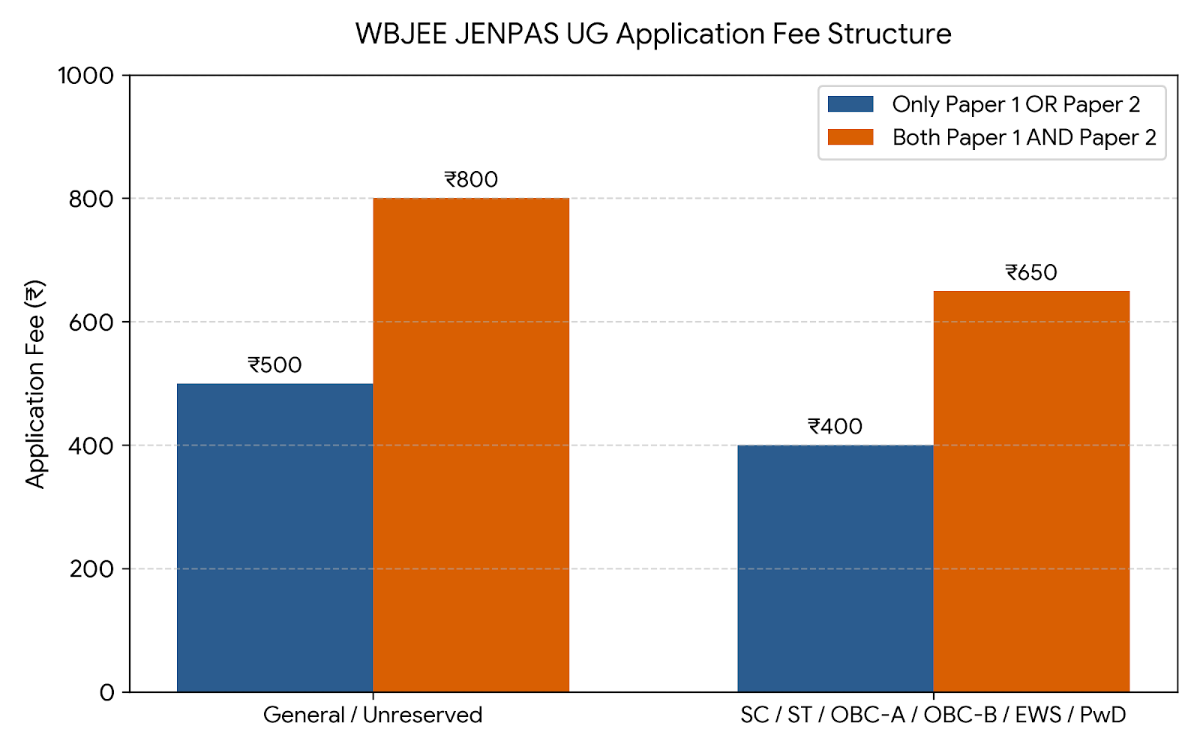
- The expected fee is ₹500 for General candidates and ₹400 for reserved/EWS/PwD candidates for one paper. For both papers, the expected fees are ₹800 and ₹650, respectively.
- The JENPAS UG result is expected in late July 2027. Paper I candidates receive a General Merit Rank (GMR), while Paper II candidates receive a Paper II Merit Rank (PMR) for BHA admissions.
Related Links:
- WBJEE JENPAS UG Previous Years Question Paper: Download Question Paper and Answer Key PDFs
- JENPAS UG 2027: Is 100 Marks Safe for BSc Nursing Admission
Key Summary
- WBJEE JENPAS UG grants admission to Nursing, Paramedical, Allied Health, and Hospital Administration undergraduate courses through two separate papers.
- The WBJEE exam date for JENPAS UG 2027 is tentatively expected on the first or second Sunday of June 2027, around June 6, 2027.
- WBJEE registration for JENPAS UG 2027 is expected to open in late March 2027 and close by mid-April 2027, entirely through the WBJEE official website.
- The JENPAS UG total marks are 115 per paper, out of 100 MCQs, with results expected in late July 2027, followed by centralized counselling.
What is WBJEE JENPAS UG Exam?
WBJEE JENPAS full form is Joint Entrance Test for Nursing, Paramedical, and Allied Sciences Undergraduate Courses. West Bengal Joint Entrance Examinations Board, WBJEEB, conducts this exam to shortlist candidates for a wide variety of healthcare fields.
The JENPAS UG courses span several fields:
- Nursing: B.Sc. Nursing.
- Paramedical & Allied Health:
- B.P.T. (Physiotherapy),
- B.O.T. (Occupational Therapy),
- B.M.L.S. (Medical Laboratory Technology),
- B.Sc. O.T.T. (Operation Theatre Technology),
- B.Sc. P.T. (Perfusion Technology),
- B.Sc. P.A. (Physician Assistant),
- B.Sc. E.M.T. (Emergency Medical Technology), and
- B.Optom. (Optometry).
- Hospital Administration: B.H.A. (Bachelor of Hospital Administration).
The offline test is divided into two papers depending on your career goals:
- Paper I: Compulsory for Nursing and all Paramedical courses. It evaluates Physics, Chemistry, Biology, Basic English, and Logical Reasoning.
- Paper II: Exclusively for candidates targeting the Bachelor of Hospital Administration (BHA) program. It tests Physical Science, Mathematics, General Knowledge, English, and Logical Reasoning.
| Parameter | Particular |
|---|---|
| Conducting Body | West Bengal Joint Entrance Examinations Board (WBJEEB) |
| Exam Name | Joint Entrance Test for Nursing, Paramedical, and Allied Sciences Undergraduate Courses (JENPAS UG) |
| Subjects Covered |
|
| Exam Level | State-Level (West Bengal) |
| Exam Mode | Offline (Pen-and-Paper on OMR sheets) |
| Total Questions | 100 MCQs per paper |
| Total Marks | 115 Marks per paper |
| Marking Scheme |
|
| Passing Criteria |
|
| Basic Eligibility |
|
| Age Limit |
|
| Application Mode | Online Only |
| Official Website | wbjeeb.nic.in/jenpas-ug |
As per the students on Reddit, below is an overview of the WBJEE JENPAS UG exam:
- The PCB (Physics, Chemistry, Biology) syllabus is based on board patterns similar to NEET, carrying 75 marks total (25 marks each), while Basic English and the newly introduced Health Aptitude subject carry 20 marks each.
- According to the post, the exam is simpler than NEET, making standard NEET preparation sufficient; buying a dedicated preparation book and watching YouTube lectures (available in Bengali) for Health Aptitude is recommended.
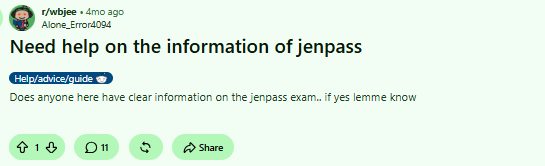
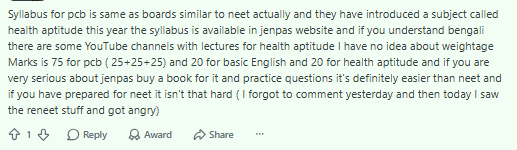
Source: Reddit
Ques. Is WBJEE JENPAS UG the same as WBJEE GNM?
Ans. No. WBJEE JENPAS UG covers degree-level B.Sc. Nursing, Paramedical, and Hospital Administration courses, while WBJEE GNM refers to a separate diploma-level General Nursing and Midwifery admission process handled independently of JENPAS UG.
What's New in WBJEE JENPAS UG Exam 2027?
The WBJEE JENPAS UG exam is expected to remain the same in structure and syllabus content as in previous years:
- OMR-Based Exam: JENPAS UG 2027 is expected to continue with the offline pen-and-paper OMR format.
- Two Question Categories: Category 1 has one correct option with negative marking, while Category 2 allows multiple correct options with no negative marking.
- More Allied Courses: Courses such as Medical Microbiology, Respiratory Technology, and Central Sterilization & Infection Control continue alongside B.Sc. Nursing and BPT.
In 2026, the WBJEE JENPAS UG Paper 1 syllabus was updated, and the logical reasoning section was completely replaced with another section called Health Aptitude.
- It remains a permanent core subject for the 2027 exam as well.
- This section falls under Category-1. Unlike the core science subjects, this specific section historically carries no negative marks for wrong choices, making it a critical rank-boosting area for students.
| Feature | Older Format (Pre-Evolution) | Current & 2027 Expected Structure |
|---|---|---|
| Sectional Changes | Logical Reasoning Section as a part of category I exam in Paper 1 | Logical Reasoning section is replaced with Health Aptitude section from 2026 cycle. |
| Exam Mode | Offline OMR | Offline OMR (Retained for logistical security) |
| Papers Offered | General combined test | Two distinct Papers: Paper I (Nursing/Paramedical) & Paper II (BHA) |
| Question Blueprint | 50 Questions per paper | 100 Questions per paper (Distributed into 5 unique sections) |
| Total Marks | Variable weightage (100–200 marks) | 115 Marks per paper |
| Question Breakdown | Uniform evaluation | Category 1: 1 Mark (+1, -0.25 penalty); Category 2: 2 Marks (Multiple choice correct, 0 negative marks) |
| Syllabus Breadth | Limited to Physics, Chemistry, Biology | Evaluates Core Sciences + Basic English + Logical Reasoning |
WBJEE JENPAS UG Exam: Important Dates 2027 (Tentative)
The official important dates for the WBJEE JENPAS UG 2027 exam have not been released yet by the West Bengal Joint Entrance Examinations Board (WBJEEB). However, based on the historical timelines established during previous examination cycles, the board consistently follows a specific pattern:
| Event | Expected Timeline / Date |
|---|---|
| Official Notification & Brochure Release | Late February to March 2027 |
| Online Application & Registration (JENPAS Form Fill Up) | Late March to mid-April 2027 |
| Application Form Correction Window | Mid-April 2027; usually 2–3 days |
| Admit Card Release | Late May 2027; approximately 7–10 days before the exam |
| JENPAS UG 2027 Exam (WBJEE Exam Date) | First or second Sunday of June 2027; tentatively June 6, 2027 |
| Paper I (Nursing & Paramedical) | 11:00 AM to 12:30 PM |
| Paper II (Hospital Administration) | 2:00 PM to 3:30 PM |
| Provisional Answer Key & OMR Response Sheet | Late June to early July 2027 |
| Final Result & Rank Card (JENPAS UG Result Date) | Late July 2027 |
| Centralized Counselling (JENPAS UG Counselling) | August to September 2027 |
Ques. When is the WBJEE exam date for JENPAS UG 2027?
Ans. The JENPAS UG 2027 exam is tentatively expected on the first or second Sunday of June 2027, around June 6, 2027, though the official date will be confirmed by WBJEEB closer to the notification.
Ques. When is the JENPAS UG form fill-up date expected?
Ans. Online registration and the JENPAS form fill-up window is expected to open in late March 2027 and close by mid-April 2027, through the WBJEE official website.
WBJEE JENPAS UG Exam Eligibility Criteria 2027
Candidates must fulfill the following requirements to be eligible to apply for the WBJEE JENPAS UG exam:
- Candidates must satisfy the nationality and West Bengal domicile requirements, particularly for admission to government college seats.
- The minimum age is 17 years, while the maximum age varies according to the course.
- For most science-based courses, candidates need Physics, Chemistry, Biology, and English at the Class 12 level.
- The minimum PCB aggregate is 45% for General/EWS candidates and 40% for SC/ST/OBC-A/OBC-B/PwD candidates.
- Gender eligibility differs by course and institution, with government B.Sc. Nursing is restricted to female candidates according to the provided criteria.
| Broad Eligibility Criteria | Details |
|---|---|
| Nationality & Domicile |
|
| Age Limit |
|
| Course-wise Age Limit |
|
| Educational Qualification |
|
| Required Subjects |
|
| Minimum Marks |
|
| Gender Eligibility |
|
WBJEE JENPAS UG Registration Process 2027
WBJEE registration for JENPAS UG 2027 will be conducted completely online through the WBJEE official website at wbjeeb.nic.in. The registration window is expected to open between March and April 2027.
- One Application Rule: A candidate can submit only one application form. Multiple applications will result in direct cancellation.
- Correction Window: If you make an error, WBJEEB will open a brief 2 to 3-day correction window in mid-April 2027. However, you cannot change your name, father's name, mother's name, gender, domicile, and date of birth during this period.
| Step | Details |
|---|---|
| Step 1: Online Registration |
|
| Step 2: Fill Application Form |
|
| Step 3: Upload Documents |
|
| Step 4: Pay Application Fee |
|
| Step 5: Download Confirmation Page |
|
Ques. Where do I complete the JENPAS form fill up for 2027?
Ans. The JENPAS form fill up must be completed entirely online through the WBJEE official website, wbjeeb.nic.in/jenpas-ug; no offline application mode is accepted.
WBJEE JENPAS UG Exam Application Fee 2027
The official application fee structure for the WBJEE JENPAS UG 2027 exam will be confirmed upon the release of the formal 2027 Information Bulletin. However, WBJEEB standardizes its registration charges strictly based on the number of papers chosen and your social category.
The application fee is ₹500 for a single paper for the general category and ₹400 for SC / ST / OBC-A / OBC-B / EWS / PwD categories.
- The registration payment is 100% non-refundable under any circumstances once processed.
- Transactions must be executed exclusively via online channels, including Net Banking, Debit Card, Credit Card, UPI, or QR Code. No cash, demand drafts, or offline challans are permitted.
| Candidate Category | Amount (For Only Paper 1 OR Only Paper 2) | Amount (For Both Paper 1 AND Paper 2) |
|---|---|---|
| General / Unreserved | ₹500 | ₹800 |
| SC / ST / OBC-A / OBC-B / EWS / PwD | ₹400 | ₹650 |
Check Out:
Documents Required for WBJEE JENPAS UG 2027
Documents Needed for Online Application (Scanned Copies)
During the registration window (expected March–April 2027), you will only need to upload your photograph and signature. However, you must keep your marksheets nearby to manually enter accurate data.
- Recent Passport Photograph: Color photo against a light/white background (10 KB to 200 KB, JPG/JPEG format).
- Signature: Signed clearly on white paper with a black or blue pen (4 KB to 30 KB, JPG/JPEG format).
- Academic Identity: Class 10 Admit Card/Certificate (for birthdate proof) and Class 12 Marksheet (if already passed).
- Valid ID Proof: Aadhaar Card, Passport, Voter ID, or School ID card number.
WBJEE JENPAS Registration Trends (2024 - 2026)
| Exam Year | Registration Window | Total Registered Candidates | Total Appeared Candidates |
|---|---|---|---|
| 2027 (Expected) | March – April 2027 | ~1,62,000 | ~1,03,000 |
| 2026 | 24 March – 18 April 2026 | ~1,55,000 | ~98,000 |
| 2025 | March – April 2025 | ~1,48,000 | ~93,000 |
| 2024 | March – April 2024 | ~1,35,000 | ~85,000 |
Check Out:
WBJEE JENPAS UG Exam Pattern 2027
The official WBJEE JENPAS UG 2027 exam pattern is organized by WBJEEB into an offline, OMR-based test.
- The structure divides the exam into two separate papers based on the courses you intend to pursue, and the JENPAS UG total marks work out to 115 per paper.
| Exam Pattern | Details |
|---|---|
| Mode of Examination | Offline, Pen-and-Paper Based Test on OMR sheets |
| Medium of Examination | English and Bengali |
| Duration | 90 minutes per paper |
| Questions per Paper | 100 MCQs |
| Marks per Paper | 115 marks |
| Category 1 Questions | 85 questions; one correct option; +1 mark for a correct answer and -0.25 mark for an incorrect answer |
| Category 2 Questions | 15 questions; one or more options may be correct; +2 marks if all correct options are selected |
| Partial Marking | Awarded in Category 2 when some correct options are selected and no incorrect option is chosen |
| Negative Marking in Category 2 | No negative marking for incorrect answers |
WBJEE JENPAS UG: Subject-Wise Marks Distribution
Paper I evaluates five core domains based on the Class 11 & 12 Science syllabus alongside basic language and logic tracks. Paper II focuses on general aptitude, basic sciences, and logical framework.
Paper I: For B.Sc. Nursing and All Paramedical Courses
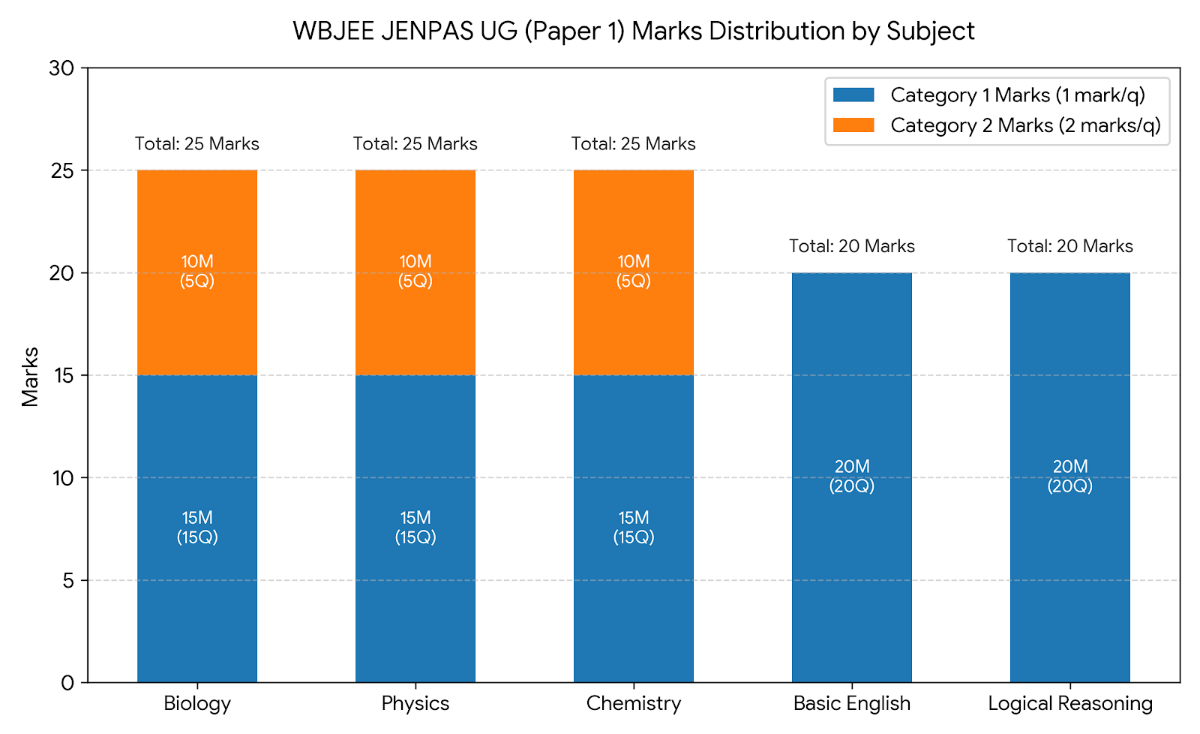
- Science subjects carry the highest weightage. Biology, Physics, and Chemistry each contribute 25 marks, including 5 Category 2 questions.
- Basic English and Logical Reasoning each have 20 questions for 20 marks, with no Category 2 questions.
- Paper I contains 100 questions for 115 marks, with 85 Category 1 and 15 Category 2 questions.
| Subject | Category 1 (1 Mark Each) | Category 2 (2 Marks Each) | Total Questions | Total Marks |
|---|---|---|---|---|
| Biology | 15 | 5 | 20 | 25 |
| Physics | 15 | 5 | 20 | 25 |
| Chemistry | 15 | 5 | 20 | 25 |
| Basic English | 20 | 0 | 20 | 20 |
| Health Aptitude | 20 | 0 | 20 | 20 |
| Total | 85 | 15 | 100 | 115 |
Paper II: Exclusively for Bachelor of Hospital Administration (BHA)
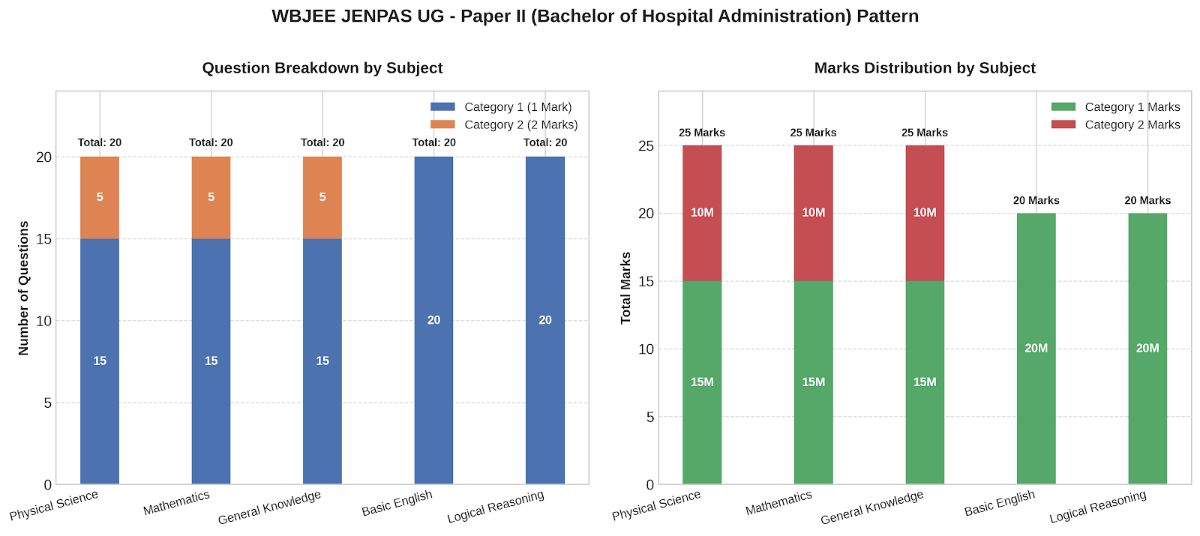
| Subject | Category 1 (1 Mark Each) | Category 2 (2 Marks Each) | Total Questions | Total Marks |
|---|---|---|---|---|
| Physical Science | 15 | 5 | 20 | 25 |
| Mathematics | 15 | 5 | 20 | 25 |
| General Knowledge | 15 | 5 | 20 | 25 |
| Basic English | 20 | 0 | 20 | 20 |
| Logical Reasoning | 20 | 0 | 20 | 20 |
| Total | 85 | 15 | 100 | 115 |
Ques. What are the JENPAS UG total marks per paper?
Ans. Each paper of WBJEE JENPAS UG carries a maximum of 115 marks across 100 MCQs, split between 85 Category 1 questions and 15 Category 2 questions.
Check Out:
WBJEE JENPAS UG Exam Syllabus 2027
The JENPAS UG syllabus follows the standard Class 11 and Class 12 curriculum recognized by the West Bengal Council of Higher Secondary Education (WBCHSE) and CBSE/ICSE boards.
Based on historical trends and analysis of past questions from WBJEEB, certain chapters consistently carry more weight than others within the JENPAS syllabus:
- Paper I-High-Weightage Science Topics: Prioritize Human Physiology, Genetics, Ecology, Modern Physics, Optics, Electrostatics, Organic Chemistry, Solutions, Coordination Compounds, and Chemical Bonding.
- Paper II & Common Sections: For BHA, focus on Class 9–10 Mathematics, Physical Science, and GK, while English and Logical Reasoning should be prepared for both papers.
The exact chapters you need to prepare depend directly on whether you are appearing for Paper I (Nursing and Paramedical) or Paper II (Hospital Administration).
| Paper / Subject | Syllabus / Topics Covered |
|---|---|
| Paper I – Biology |
|
| Paper I – Physics |
|
| Paper I – Chemistry |
|
| Paper I – Basic English | Tenses, Articles, Prepositions, Subject-Verb Agreement, Synonyms, Antonyms, Idioms & Phrases, Sentence Correction, Spotting Errors, Voice Change, Direct & Indirect Speech |
| Paper I – Health Aptitude |
|
| Paper II – Physical Science | Class 9–10 level Physics and Chemistry, including Force, Sound, Light, Structure of Atom and Chemical Reactions |
| Paper II – Mathematics | Class 9–10 level Arithmetic, Basic Algebra, Geometry and Mensuration; Profit & Loss, Time & Work, Percentages, Simple Interest and Compound Interest |
| Paper II – General Knowledge | Current Affairs, Basic Indian History and Geography, General Science Achievements, Awards and Sports |
| Paper II – Basic English & Logical Reasoning | Same English and Logical Reasoning topics prescribed for Paper I |
Ques. Where can I find the complete JENPAS syllabus for 2027?
Ans. The complete JENPAS UG syllabus for both Paper I and Paper II is based on the WBCHSE/CBSE/ICSE Class 11 and 12 curriculum, and is detailed subject-wise in the table above.
Check Out:
- WBJEE JENPAS UG 2021 PHYSICS & CHEMISTRY Question Paper with Answer Key PDFs (July 31)
- WBJEE JENPAS UG 2019 BIOLOGICAL SCIENCES Question Paper with Answer Key PDFs (June 30)
- WBJEE JENPAS UG 2016 PHYSICS Question Paper with Answer Key PDFs (July 16 - Afternoon Session)
YouTube video to add
This video discusses the Health Aptitude syllabus that has been officially introduced by WBJEE Board. It highlights a detailed explanation of Health Aptitude for JENPAS UG 2026, topic-wise discussion with easy understanding, and important areas to focus on for the exam.
WBJEE JENPAS UG Exam Preparation Tips 2027
Preparing for WBJEE JENPAS UG 2027 requires a strategic balance between core sciences and the general aptitude sections. Because Paper I and Paper II include an unconventional marking scheme (Category 1 and Category 2), your strategy needs to adapt accordingly.
- Concept Building: Complete the Class 11 & 12 syllabus chapter-wise and practice 30–40 topic-wise MCQs daily.
- Revision & Consolidation: Solve combined chapter tests, analyze your performance, and focus on improving weak topics.
- Mock Test Practice: Attempt at least 10 full-length PYQs from 2021–2026 and take mocks during the actual Paper I exam timing (11:00 AM–12:30 PM) to build exam-day focus.
| Preparation Area | Key Preparation Tips |
|---|---|
| Marking Strategy |
|
| Biology |
|
| Physics & Chemistry |
|
| English & Logical Reasoning |
|
JENPAS UG Question Papers of Previous Years:
The links to the previous years' question papers of the JENPAS UG exam are provided below:
JENPAS UG Question Paper 2024
| Subject | Question Paper Link |
|---|---|
| Paper 1 | Download PDF |
| Paper 2 | To be updated |
JENPAS UG Question Paper 2023
| Subject | Question Paper Link | Solution PDF |
|---|---|---|
| Paper 1 | Check Here | Download PDF |
| Paper 2 | Check Here | Check Here |
JENPAS UG Question Paper 2022
| Subject | Question Paper Link |
|---|---|
| Paper 1 | Check Here |
| Paper 2 | Check Here |
JENPAS UG Question Paper 2021
| Subject | Question Paper Link |
|---|---|
| Physics & Chemistry | Check Here |
| Biology | Check Here |
Is WBJEE JENPAS UG Exam Considered Difficult?
The WBJEE JENPAS UG exam is generally considered to be of moderate difficulty. It is less difficult than national-level medical entrance exams like NEET UG, but it is more competitive than standard board examinations.
- Physics: This is universally considered the most challenging section by applicants. It features conceptual questions and formula-based numerical problems from Class 11 and 12.
- Chemistry: This section is highly balanced. Physical Chemistry requires formula application, while Organic and Inorganic Chemistry rely heavily on direct facts from NCERT/WBCHSE textbooks.
- Biology: This is typically the most scoring and straightforward section. Most questions are direct, memory-based, or diagram-centric.
- Basic English & Logical Reasoning: These sections are designed to be high-yielding score boosters, covering elementary grammar and basic pattern recognition.
Check Out:
JENPAS UG 2026 June 7 Paper Analysis: Difficulty Level, Good Attempts and Expected Cutoff
WBJEE JENPAS UG Exam Admit Card 2027
The WBJEE JENPAS UG 2027 Admit Card will be released online by WBJEEB tentatively in late May 2027, approximately 7 to 10 days before the exam date. It will contain:
- Candidate Details: Full Name, Roll Number, Photograph, and Digital Signature.
- Exam Logistics: Allocated Exam Center Name, Full Address, and Center Code.
- Schedule: Exact date of the exam along with shift timings for Paper I (11:00 AM – 12:30 PM) and Paper II (2:00 PM – 3:30 PM).
- Exam Guidelines: Core instructions regarding permissible items and OMR-shading rules.
WBJEE JENPAS UG 2027 Exam Day Guidelines
Mandatory Documents to Carry
- A printed physical copy of your JENPAS UG 2027 Admit Card
- A valid original Photo ID Proof (Aadhaar Card, Voter ID, Passport, or Class 10 Admit Card)
- The identical colored passport photograph uploaded during registration.
- Prohibited Items: Mobile phones, calculators, digital watches, log tables, or loose pieces of paper are strictly forbidden inside the test center.
WBJEE JENPAS UG Exam Result and Scorecard 2027
The official WBJEE JENPAS UG 2027 Results are expected to be declared tentatively in late July 2027, roughly 4 to 5 weeks after the completion of the offline exam. WBJEEB publishes the JENPAS result through its official web portal at wbjeeb.nic.in.
Depending on the papers you sit for, WBJEEB will issue distinct ranks:
- GMR (General Merit Rank): The most crucial rank for Paper I takers. Admissions to B.Sc. Nursing and all Paramedical courses are conducted strictly based on your GMR position, not your raw marks.
- PMR (Paper II Merit Rank): Calculated exclusively for candidates who appeared in Paper II, used for admissions into the BHA programme.
- Category Ranks: SC, ST, OBC-A, OBC-B, EWS, or PwD candidates will see a separate category rank, used for counselling sequence awareness alongside the GMR/PMR structure.
WBJEE JENPAS UG Tie-Breaking Rules
- First Tie-Breaker: Candidate with fewer negative marks gets preference.
- Second Tie-Breaker: If still tied, higher Biology marks are considered.
- Third & Fourth Tie-Breakers: Chemistry marks, followed by Physics marks, are compared.
- Final Tie-Breaker: If the tie persists, the older candidate by date of birth gets preference.
Ques. When is the JENPAS UG result date expected for 2027?
Ans. The JENPAS UG result is expected to be declared in late July 2027, roughly 4 to 5 weeks after the exam, on the official WBJEEB website.
Check Out:
WBJEE JENPAS UG Exam Cutoff 2027
The official WBJEE JENPAS UG 2027 Cutoff marks and ranks will be determined and published by WBJEEB after the evaluation of results in July 2027.
The cutoff system functions across two levels:
- A baseline Qualifying Percentile (needed to participate in counselling) and
- Actual competitive Safe Scores/Closing Ranks required to secure a seat at top government colleges.
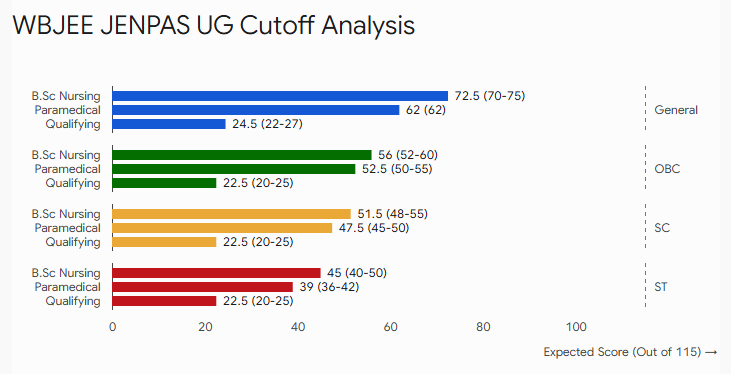
Expected Minimum Qualifying Percentile 2027 (out of 115 marks):
| Category | Qualifying Percentile Requirement | Approximate Marks Needed(Out of 115) |
|---|---|---|
| General / UR / EWS | 50th Percentile | 22 – 27 Marks |
| General-PwD | 45th Percentile | 21 – 26 Marks |
| SC / ST / OBC-A / OBC-B | 40th Percentile | 20 – 25 Marks |
Expected Safe Cutoff Scores for Government Colleges (Out of 115):
| Category | B.Sc. Nursing (Govt. Seats) | Paramedical & Allied Health (Govt. Seats) |
|---|---|---|
| General (UR) | 70+ Marks (75+ for top tier) | 62+ Marks |
| OBC-A / OBC-B | 52 – 60 Marks | 50 – 55 Marks |
| SC | 48 – 55 Marks | 45 – 50 Marks |
| ST | 40 – 50 Marks | 36 – 42 Marks |
Check Out:
WBJEE JENPAS UG 2027: Rank vs Marks
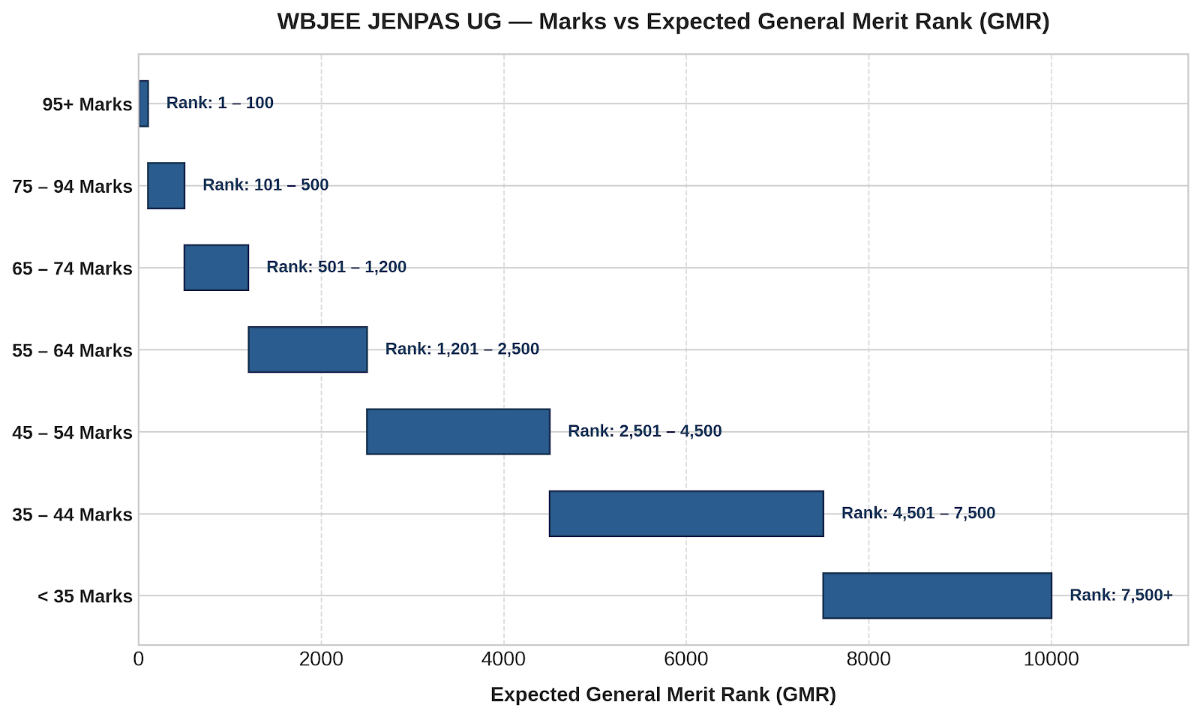
In WBJEE JENPAS UG, your General Merit Rank (GMR) is compiled strictly based on your total raw score obtained in Paper I (out of 115 marks).
Due to a steady rise in competition, the score required to bag a top-tier rank has incrementally increased.
| Raw Score Range (Out of 115) | Expected General Merit Rank (GMR) | Government Seat Eligibility Status |
|---|---|---|
| 95+ Marks | Rank 1 – 100 | Guaranteed top-tier seats at IPGMER & SSKM or Medical College Kolkata |
| 75 – 94 Marks | Rank 101 – 500 | Confirmed B.Sc. Nursing or premier Paramedical track in prominent Govt. colleges |
| 65 – 74 Marks | Rank 501 – 1,200 | Highly safe for B.Sc. Nursing / BPT / BMLT in standard Government medical sectors |
| 55 – 64 Marks | Rank 1,201 – 2,500 | Threshold line for General category Government seats; fully safe for SC/OBC categories |
| 45 – 54 Marks | Rank 2,501 – 4,500 | Government options mostly open to ST/SC/OBC; General category candidates match into private or aided colleges |
| 35 – 44 Marks | Rank 4,501 – 7,500 | Safe primarily for reserved structures (ST/EWS) or premium private institutional openings |
| Below 35 Marks | Rank 7,500+ | Private institution enrollment tracks through open counselling parameters |
WBJEE JENPAS UG 2027: Counselling and Admission
The WBJEE JENPAS UG 2027 Counselling and Admission process will be managed completely online by WBJEEB immediately after the results are declared in July 2027.
Admissions to all government and private colleges in West Bengal are handled strictly through a centralized e-counselling portal, with seats allocated based on your GMR or PMR.
Documents Required for Counselling & Physical Verification
Once you clear the exam and meet the cutoff, you must bring the original documents along with self-attested photocopies to your allotted college:
- JENPAS UG Rank Card and Provisional Allotment Letter
- Class 10 Admit Card / Birth Certificate
- Class 12 Marksheet
- West Bengal Domicile Certificate (Proforma A1, A2, or B, as applicable)
- Category Certificate (SC/ST/OBC-A/OBC-B), EWS Certificate, and PwD Certificate, if applicable
- Medical Fitness Certificate, where required
| Counselling Step | Details |
|---|---|
| Step 1: Registration & Fee Payment |
|
| Step 2: Choice Filling & Locking |
|
| Step 3: Round-Wise Seat Allotment |
|
| Step 4: Seat Acceptance & Allotment Letter |
|
| Step 5: Document Verification & Admission |
|
Ques. When does JENPAS UG counselling begin for 2027?
Ans. JENPAS UG counselling is expected to begin in August 2027, immediately after results are declared, and continues through multiple rounds into September 2027.
Check Out:
Top Universities Accepting WBJEE JENPAS UG Exam Score
The West Bengal University of Health Sciences (WBUHS) is the overarching apex university to which almost all nursing and paramedical colleges accepting WBJEE JENPAS UG scores are affiliated. Based on historical trends, here is the direct score breakdown required to secure a seat at top participating institutes under Paper I:
- Top Government Colleges: Expected safe scores range from 78+ to 44+ marks, with IPGMER & SSKM, Medical College Kolkata, and NRS Medical College requiring relatively higher scores.
- Other & Private Colleges: College of Allied Health Sciences may require around 62+/52+/42+ marks, while private colleges such as Apollo College of Nursing and IQ City Institute of Nursing have expected safe scores of 48+ and 42+ marks, respectively.
| Institute Name | Location | Expected Safe Score (Out of 115) |
|---|---|---|
| IPGMER & SSKM Hospital | Kolkata | 78+ / 65+ / 55+ Marks |
| Medical College, Kolkata | Kolkata | 74+ / 62+ / 52+ Marks |
| Nil Ratan Sircar (NRS) Medical College | Kolkata | 71+ / 60+ / 50+ Marks |
| R.G. Kar Medical College | Kolkata | 69+ / 58+ / 48+ Marks |
| Burdwan Medical College | Burdwan | 65+ / 54+ / 44+ Marks |
| College of Allied Health Sciences (WBUHS) | Kalyani | 62+ / 52+ / 42+ Marks |
| Apollo College of Nursing (Private) | Kolkata | 48+ Marks |
| IQ City Institute of Nursing (Private) | Durgapur | 42+ Marks |
WBJEE JENPAS UG FAQs
Ques. What is JENPAS UG and who conducts it?
Ans. JENPAS UG (Joint Entrance Test for Nursing, Paramedical, and Allied Sciences Undergraduate Courses) is conducted by WBJEEB, the same board that oversees WBJEE JENPAS UG admissions across Nursing, Paramedical, Allied Health, and Hospital Administration courses in West Bengal.
Ques. What is the WBJEE full form and how is it related to JENPAS UG?
Ans. WBJEE stands for West Bengal Joint Entrance Examinations. WBJEE JENPAS UG is a distinct examination under the same board (WBJEEB), specifically for healthcare-related undergraduate admissions, separate from the WBJEE exam for engineering and pharmacy.
Ques. Where is the WBJEE official website for JENPAS UG registration and updates?
Ans. The WBJEE official website for JENPAS UG is wbjeeb.nic.in/jenpas-ug, where registration, admit card, result, and counselling updates are all published.
Ques. What are the JENPAS UG courses available through this exam?
Ans. The jenpas ug courses include B.Sc. Nursing, B.P.T., B.O.T., B.M.L.S., B.Sc. O.T.T., B.Sc. P.T., B.Sc. P.A., B.Sc. E.M.T., B.Optom., and B.H.A. (Bachelor of Hospital Administration).
Ques. How can I check the JENPAS UG result once declared?
Ans. The JENPAS UG result can be checked on the official WBJEEB website using your application number and other login credentials once WBJEEB declares it, expected in late July 2027.
Ques. Is there a separate JENPAS UG syllabus for Paper I and Paper II?
Ans. Yes. The JENPAS UG syllabus for Paper I covers Physics, Chemistry, Biology, Basic English, and Logical Reasoning, while Paper II covers Physical Science, Mathematics, General Knowledge, Basic English, and Logical Reasoning.




Comments
Found 5 Comments
You must fulfil the following qualifying requirements in order to take the WBJEE JENPAS UG exam and get into a government college in West Bengal:
Follow these steps to apply for WBJEE JENPAS UG
The Joint Entrance Test for Nursing, Paramedical, and Allied Sciences Undergraduate Exam (JENPAS UG) will take place on June 30, 2024, according to a statement released by the West Bengal Joint Entrance Examinations Board (WBJEE). A decent score on the JENPAS UG exam is 400 or more, which is regarded as an average. 28 colleges in West Bengal accepts the WBJEE JENPAS UG.
To register for WBJEE JENPAS UG 2023, students must use the application for this exam available on the official website of WBJEE. However, the last date to register for JENPAS UG 2023 was January 31, 2023.
The documents required to be uploaded during the WBJEE JENPAS UG 2023 application process are mentioned below.
The docuemnts must be submitted in one go and the size of the documents should be between 50 to 300kB and must be in PDF format.
The application process for WBJEE JENPAS UG 2023 started on January 11, 2023. The application process has been closed recently on January 31, 2023.