



Content Curator
Number theory is a branch of mathematics, whose main focus is the study of integers and arithmetic functions.
- It is also known as arithmetic or higher arithmetic.
- It helps to study the relationship between various types of numbers such as rational numbers, prime numbers, and algebraic integers.
- Number theory helps in the study of the set of positive whole numbers, such as 1, 2, 3, 4, 5, 6,….
- These numbers are commonly known as the set of natural numbers.
| Table of Content |
Key Terms: Number theory, Odd numbers, Even numbers, Natural numbers and Whole numbers, Square numbers, Integers, Rational numbers, Composite numbers, Cube numbers
Number Theory
[Click Here for Sample Questions]
In the field of pure mathematics, number theory is the study of natural numbers and integers.
- It is the study of the set of natural numbers, which consists of all positive whole numbers.
- This is a theoretical and experimental theory.
- The experimental number theory leads to questions and suggests different ways to answer them.
- The theoretical number theory tries to provide a definite answer by solving it.
- In theory, there are several categories of numbers, including whole numbers, complex numbers, natural numbers, and so on.
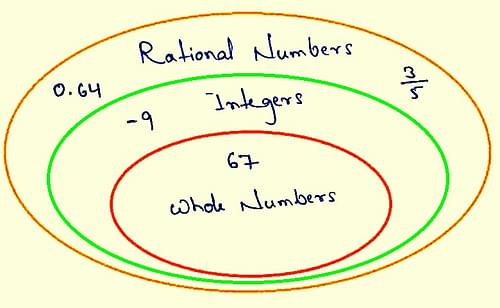
- The relation between whole numbers, integers, and rational numbers is shown in the following image.
Also Read:
| Related Articles | ||
|---|---|---|
| Arithmetic progression | Number System | Octal number system |
| Important Formulas and Examples | Binary & Decimal Number System | Number System MCQs |
Number Theory Topics
[Click Here for Sample Questions]
The following are the subcategories of the natural number:
Even Numbers
Even numbers are integers that can be divided exactly by two.
Examples of Even Numbers: 2, 4, 6, 8, 10, 12, 14, 16, 18, 20, 22, 24, 26, 28 . . .
Odd Numbers
Any number that is not divisible by two is an odd number. On the number line, 1 is the first positive odd number.
Examples of Odd Numbers: 1, 3, 5, 7, 9, 11, 13, 15, 17, 19, 21, 23, 25. . .
Square Numbers
When a number is multiplied by itself, the result is known as a 'Square Number.' Square numbers are also called perfect square numbers.
- The square of 2 is 4, i.e. 2 x 2 = 4.
- The square of 3 is 9, i.e. 3 x 3 = 9
- The square of 4 is 16, i.e. 4 x 4 = 16
Examples of Square Numbers: 4, 9, 16, 25, 36, 49, 64, 81,100 . . .
Cube Numbers
A cube number is the result of three times multiplying a whole number.
- The cube of 2 is 8, i.e. 2 x 2 x 2 = 8.
- The cube of 3 is 27, i.e. 3 x 3 x 3 = 27
- The cube of 4 is 64, i.e. 4 x 4 x 4 = 64
Examples of Cube Numbers: 8, 27, 64, 125, 216, 343, 512 . . .
Prime Numbers
Prime numbers are positive integers with only two factors: 1 and the integer itself.
- Factors of 8, for example, are 1,2,4, and 8, for a total of four factors.
- However, there are only two factors of 5: one and five. As a result, 5 is a prime number.
- It is important to remember that 1 is neither composite nor prime.
Examples of Prime Numbers: 2, 3, 5, 7, 11, 13, 17, 19, . . .
Composite Numbers
Composite numbers are those that have more than two factors, as opposed to prime numbers, which have only two factors.
- The numbers are referred to as composite numbers.
- All natural numbers that are not prime numbers are composite since they can be divided by more than two numbers.
- For example, the number 6 is a composite since it can be divided by 1, 2, 3, and 6.
Examples of Composite Numbers: 4, 6, 8, 9, 10, 12, 14, 15, 16,18, 20, 21, 22, 24 . . .
Triangular Numbers
When a certain number of pebbles can be placed in a triangle with one pebble at the top, two pebbles in the next row, three pebbles in the next row, and so on, it is said to be a triangular number.
Examples of Triangular Numbers: 3, 6, 10, 15, 21, 28, 36, 45,..
Modulo 4 Numbers
A number is said to be 1 (modulo 4) if it divides by 4 and leaves a remainder of 1.
Similarly, When a number is divided by 4, it leaves a 3 as a remainder. This is referred to as a 3 (modulo 4) number.
Examples of 1 (modulo 4) Numbers: 1, 5, 9, 13, 17, 21, 25, . .
Fibonacci Numbers
The Fibonacci number is a number series in which a number is the sum of the previous two numbers, starting with 0 and going up to infinity.
Xn = Xn-1 + Xn-2
Examples of Fibonacci Numbers: 0, 1, 1, 2, 3, 5, 8, 13, 21, 34, 55…
Applications of Number Theory
[Click Here for Sample Questions]
Some of the important divisibility tests, such as determining if a given integer m divides the integer n, can be obtained by using number theory. Several mathematical and practical applications of number theory are available, including
- In Barcodes.
- Creation of modular designs.
- Method of Memory Management.
- Device authentication.
- Security system in banking securities.
- Websites for E-commerce.
- Theory of Coding.
Additionally, it is defined in terms of pseudorandom numbers, hash functions, linear congruences, and fast arithmetic operations.
Things to Remember
- Number theory is the study of natural numbers and integers.
- It is also called higher arithmetic.
- Different types of numbers are whole numbers, complex numbers, natural numbers, etc.
- The number which is divisible by 2 is known as an even number.
- The number that is divisible by 3 is known as an odd number.
- Prime numbers are positive integers with only two factors: 1 and the integer itself.
- Number theory is used in a variety of industries, including barcodes, coding, and security.
Also Read:
Sample Questions
Ques. What is the basic of number theory? (2 Marks)
Ans. Number theory is a branch of mathematics, whose main focus is the study of integers and arithmetic functions. It is also known as arithmetic or higher arithmetic.
Ques. What are natural numbers? (1 Mark)
Ans. Natural numbers are a subset of real numbers that are used for counting. 1,2,3,4,5 are the first five natural numbers.
Ques. Why do we use number theory? (2 Marks)
Ans. The simple technique of counting numbers from one to infinity makes number theory important. Number theory is a useful tool for identifying and verifying intriguing relationships between various numbers.
Ques. The last digit of (2004)5 is (3 Marks)
Ans. (2004)5 mod 10 = (4)5 mod 10
4x has a cyclicity of 2 i.e.
If power is even, 4x is 6
If power is odd, 4x is 4
Hence 45 mod 10 = 4
Ques. The digit in the unit place of the number 1! + 2! + 3! + ...................+ 99! Is (3 Marks)
Ans. 1! = 1
2! = 2
3! = 6
4! = 24
1 + 2 + 6 + (2)4 = 13
After that, the unit place will be zero
5! = 120
6! = 720
1! + 2! + 3! + ...................+ 99! is 3
Ques. The largest integer n for which n + 5 divides n5 + 5 is (3 Marks)
Ans. n5 + 5/ n+5 = Integer I1 --------------- (1)
You must know that an +bn is divisible by a+b if n is odd
Add and subtract 55 in (1)
[(n5 + 55)/ (n+5)] + (5-55)/ (n+5) = I1
I2 + (5 - 3125)/ (n+5) = I1
I2 - 3120/ n+5 = I1
n+5 is a factor of 3120
if n is the maximum then (n+5) is also the maximum
n+5= 3120
n = 3120 -5
n = 3115
Ques. The square root of [(0.75)2 / 1- (0.75)] + ( 0.75 + 0.752 + 1) is (3 Marks)
Ans. 0.75 = a
(a3 / 1-a) + (a + a2 + 1)
Take LCM
[a3 + (1-a) (1 + a + a2)]/1-a
= (a3 + 1 – a3) / 1 – a
= 1/1 – a
= 1/1 – 0.75
= 4
= Square root of 4 is 2
Ques. The number of digits in the decimal expansion of 165 516 is (3 Marks)
Ans. 165. 516 = (24)5. 516
= 220. 516
= 24 (2 x 5)16 ------------- 2.5 = 10 ( 2 × 5 =10)
= 16 x 1016
So it will be 18 digits, The answer is 18
Ques. Determine all non-negative integral solutions (n1, n2, .................n14) if any, apart from permutations of the Diophantine equation (n1)4 + (n2)2 + ----------------------------------- + (n1)14 = 1599 (3 Marks)
Ans. (n1)4 + (n2)2 + ----------------------------------- + (n1)14 = 1599 ------------ (1)
n4 – 0,1, 16, 81, 296, 625, 1296, ----------------
n4 – 0,1 (mod 16)
n= 2k (2k)4 = 0 (mod 16)
n = 2k+1 ;
(2k+1)2 = 1 (mod 8) = 8k+1
(2k+1)4 = (8k+1)2 = 64k2 + 16k + 1 = 16λ +1
From (1)
RHS = 15 (mod16)
LHSmax =14 (mod 16)
This has no solution
Ques. Find GCD (2100 -1 , 2120 – 1) (3 Marks)
Ans. (2100 -1 , 2120 – 1)
= [2100 -1, 2100 (220 – 1)] ------------------- 2120 – 1 – (2100 – 1) = 2100 (220 – 1)
= (2100 -1, 220 -1 )
= (220(280 -1) , 220 -1 )
= ( 280-1, 220 -1)
= 220 - 1
For Latest Updates on Upcoming Board Exams, Click Here: https://t.me/class_10_12_board_updates
Check-Out:



Comments