




The Michigan English Test pattern is divided into 4 sections: Speaking, Reading, Writing, and Listening. The total number of questions is 107, and the duration of the test is 155 minutes (2 hours 35 minutes).
The MET writing tasks measure your writing at the sentence, paragraph, and essay levels. The listening section assesses your comprehension of speech in educational, public, professional, and personal contexts. The reading section assesses both reading comprehension and grammar, and the speaking section assesses real-world communication skills.
The MET score ranges from 0 to 80. The total score is the average of the section scores, which also range from 0 to 80. There is no pass or fail; universities and organisations have their own rules about the English level and the scores you need.
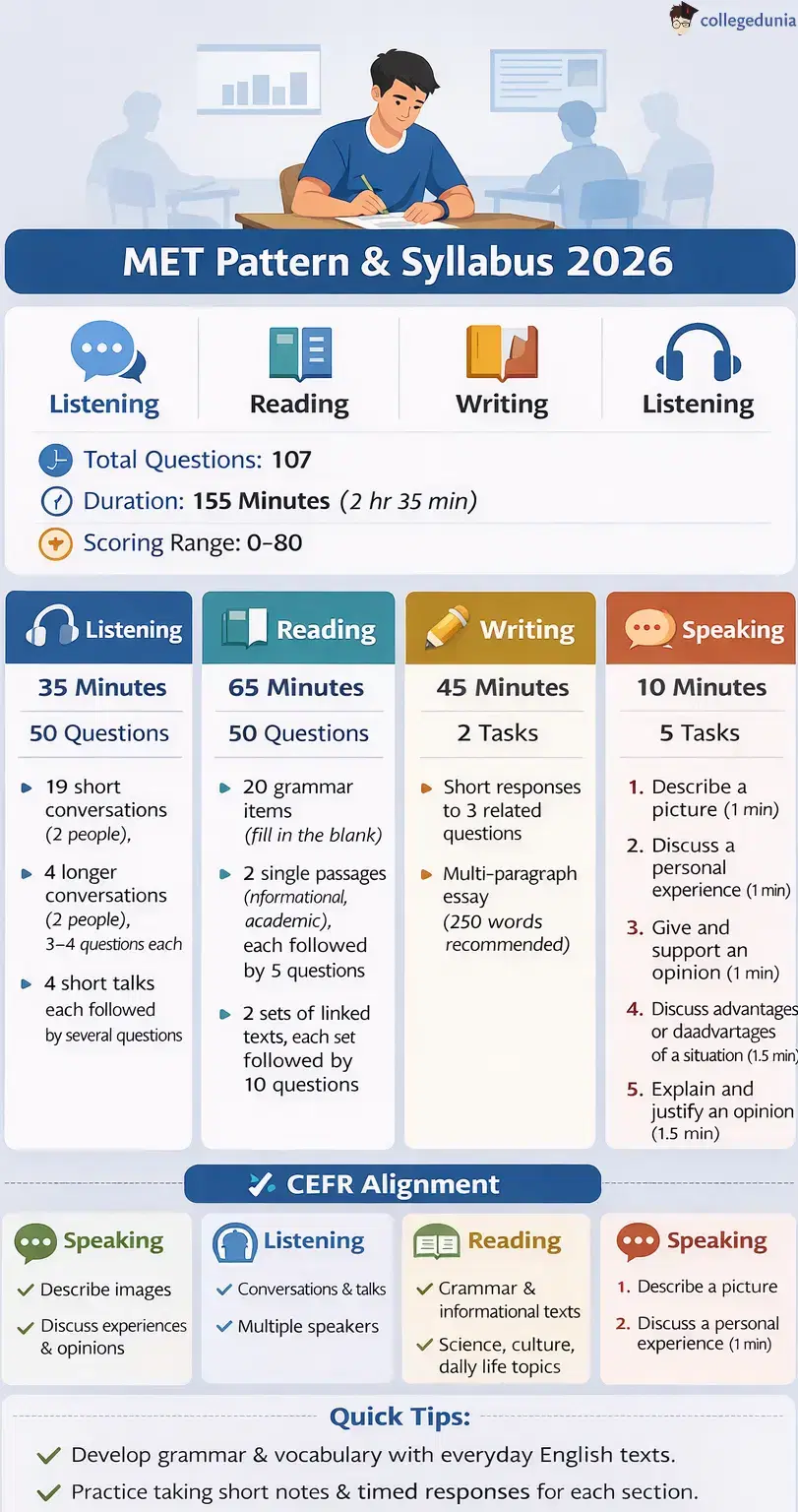
MET Pattern 2026
The MET exam pattern is explained in the table below:
| Section | Duration | Number of questions | Question types |
|---|---|---|---|
| Listening | 35 minutes | 50 MCQs | Part 1: 19 short conversations (2 people), each followed by 1 question. Part 2: 4 longer conversations (2 people), each followed by 3-4 questions (total 14). Part 3: 4 short talks (1 speaker), each followed by several questions (total 17). |
| Reading | 65 minutes | 50 MCQs | Part 1: 20 grammar items (single sentences with a missing word or phrase; choose the best completion). Part 2: 2 single-text passages (informational or academic), each followed by 5 questions (total 10). Part 3: 2 sets of 3 related texts, each set followed by 10 questions (total 20). |
| Writing | 45 minutes | 2 tasks | Task 1: Short responses to 3 related questions (e.g., personal experiences). Task 2: Essay (typically 250 words), providing reasons, explanations, and supporting ideas. |
| Speaking | 10 minutes | 5 tasks | Task 1: Describe a picture (60 seconds). Task 2: Discuss a personal experience (60 seconds). Task 3: Give and support an opinion (60 seconds). Task 4: Discuss the advantages or disadvantages of a situation (90 seconds). Task 5: Explain and justify an opinion to an authority figure (90 seconds). |
The speaking section is recorded via a microphone and involves on-screen prompts. All responses are structured to simulate natural communication.
Is there negative marking in the MET exam?
No, there is no negative marking in the MET. You should answer every question, even if you are unsure.
MET Syllabus 2026
The MET syllabus emphasises practical, everyday English, focusing on communicative ability. No prior knowledge of specific subjects is needed; content draws from general interest areas like personal life, work, education, travel, health, environment, and current events. Here's a section-wise breakdown of the content and skills covered:
MET Writing Syllabus 2026
The MET Writing section focuses on expressive writing. It has the following parts:
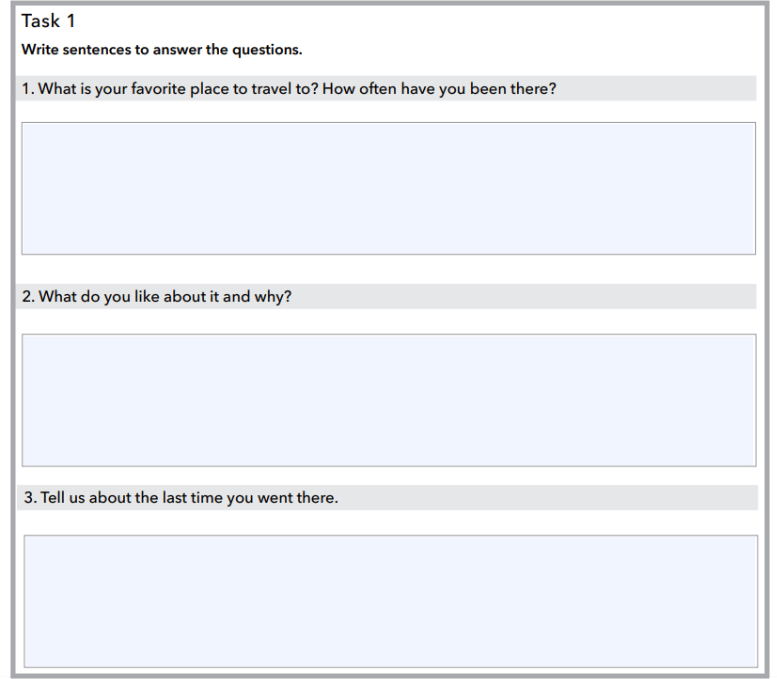
- Task 1: Short-form responses to 3 related questions.
Sample Question:
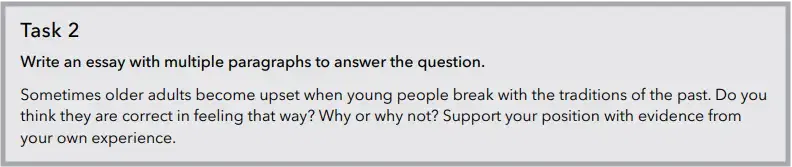
- Task 2: Essay writing, such as arguing for or against a topic.
Key areas of this section include vocabulary range, grammatical accuracy (tenses, conditionals, connectors), coherence (logical flow, transitions), and idea development with examples. Expect topics on personal opinions, societal issues, or hypothetical scenarios.
MET Listening Syllabus 2026
The MET Listening section covers audio in various accents.
- Content includes casual conversations (e.g., about projects or plans), extended dialogues (e.g., discussions on events), and monologues (e.g., talks on festivals or news).
- Skills include understanding gist, specific details, implications, attitudes, and functions (e.g., agreeing, suggesting).
- Topics are everyday: social interactions, workplace scenarios, public announcements, or informational lectures.
Sample Question:

MET Reading Syllabus 2026
The MET Reading section emphasises informational and academic-style texts.
- Part 1 tests grammar in isolation. For example, verb forms, prepositions, articles, etc.
Sample Question:
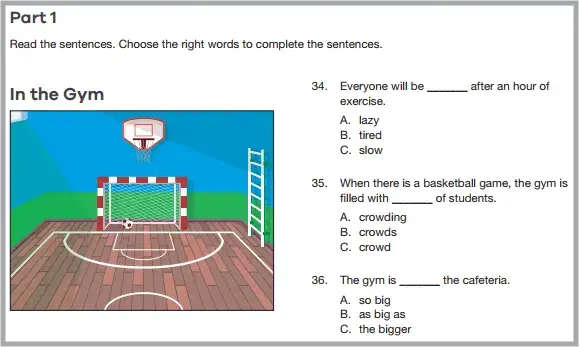
- Parts 2 and 3 involve passages on general topics like science, culture, technology, or daily life.
Sample Question:
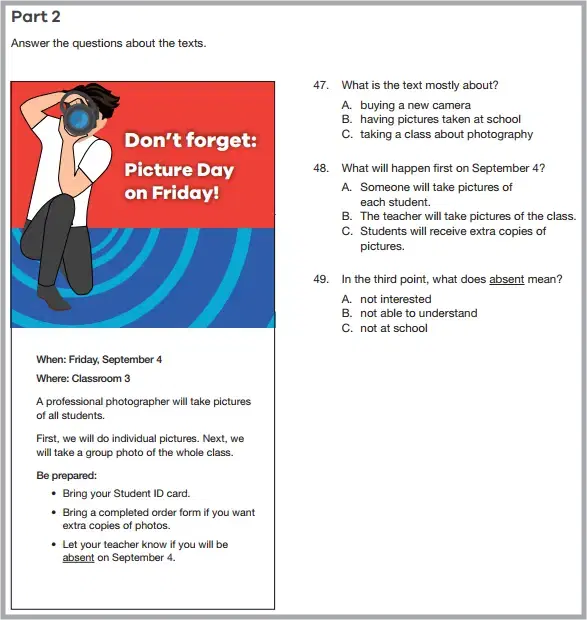
- Skills include vocabulary inference, identifying main ideas or supporting details, understanding relationships between texts, and drawing conclusions.
- Texts are 200-500 words each, with questions on comprehension, synonyms, pronouns, and logical connections.
MET Speaking Syllabus 2026
The MET Speaking section focuses on oral production. Below is the detailed syllabus:
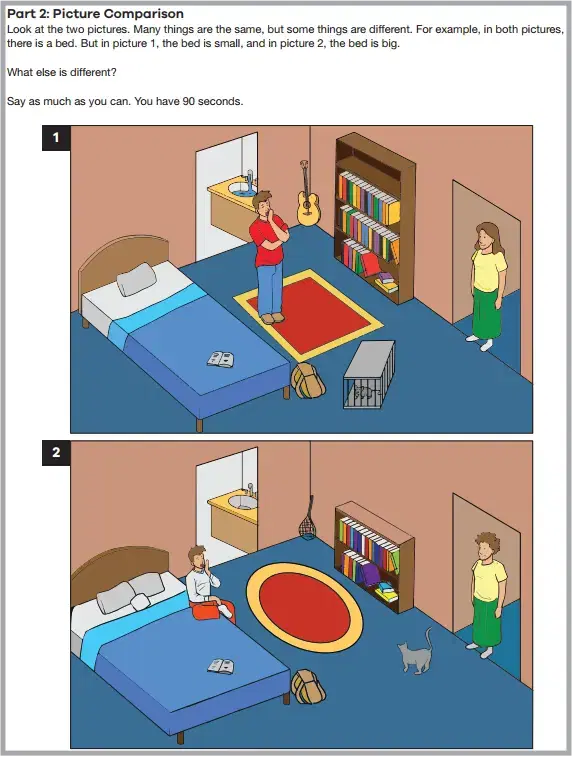
- Tasks build from descriptive (e.g., pictures of scenes) to opinion-based (e.g., "Should students have part-time jobs?").
- Content covers personal experiences, pros and cons debates, and persuasive speeches.
- Key areas: pronunciation and clarity, fluency (minimal hesitation), vocabulary variety, grammatical structures (complex sentences), and discourse management (organising thoughts).
Sample Question:
MET Scoring 2026
MET scores are reported on a 0-80 scale per section, with an overall score as the average. Listening and reading are auto-scored; writing and speaking are rated by certified experts based on criteria like accuracy, range, and effectiveness. The scores are mapped to CEFR levels as follows:
| CEFR Level | Description | MET Score Range (per section) |
|---|---|---|
| A2 | Basic User | 31-40 |
| B1 | Independent User | 41-52 |
| B2 | Upper Independent User | 53-63 |
| C1 | Proficient User | 64-80 |
If a score falls below 31, no CEFR level is assigned for that section. This indicates that the test taker’s skills are below the minimum level measured by the test.
Can uneven section scores affect the final result?
Yes, since the total score is an average, a very low score in one section can reduce the overall MET score.
MET Syllabus Preparation Tips 2026
Here are some section-wise MET preparation strategies that can help you prepare for the exam well:
1. Writing
- Practice organising ideas quickly: Use a simple structure (introduction, body paragraphs with examples, conclusion).
- Build vocabulary for common topics (education, technology, environment, health, travel, work).
- Focus on coherence: Use connectors (however, moreover, for example), varied sentence structures, and accurate grammar (tenses, conditionals).
- Write one essay daily on opinion topics, like "Should social media be restricted for teenagers?" Time yourself (25-30 min for the essay). Self-edit for errors or get feedback from teachers/peers.
- Aim for 250+ words in the main essay; support opinions with reasons and examples.
2. Listening
- Improve by exposing yourself to American English accents (podcasts, YouTube, news).
- Practice note-taking for main ideas, details, inferences, and speaker attitudes.
- Do timed practice tests daily. Focus on idioms and phrasal verbs (common in conversations). Replay audios to identify why the wrong answers are incorrect.
- Don't panic if you miss one; questions get progressively harder.
3. Reading
- Strengthen grammar in context (verb forms, prepositions, articles, pronouns).
- Practice skimming for main ideas and scanning for details; infer vocabulary from context.
- Read informational articles daily (200-500 words). Do grammar drills, then full passages with questions. Time yourself to finish comfortably.
- For linked texts, focus on how ideas connect across multiple short pieces.
4. Speaking
- Fluency first, then accuracy (pronunciation, vocabulary range, complex structures).
- Record responses on your phone (60-90 seconds per task). Listen back to reduce fillers ("um," "like"), improve pacing, and self-rate.
- Practice common topics: Hobbies, travel, education, work, and opinions on current issues.
- Watch TED Talks or opinion videos, note vocabulary and organisation, and imitate. Practice timed responses daily.
The MET 2026 tests practical English skills across speaking, listening, reading, and writing in real-life contexts. Understanding the exam pattern, syllabus, and scoring system helps you plan your preparation effectively. With regular practice and focus on all four skills, candidates can steadily improve their performance. Using the right strategies and official resources increases the chances of achieving the required MET score.
FAQs
Ques. Can I take the MET online from home?
Ans. No, the MET is conducted at authorised test centers. At-home testing is currently unavailable in India.
Ques. Are spelling and punctuation important in the MET Writing section?
Ans. Yes, spelling and punctuation are part of grammatical accuracy and can affect your writing score, especially in the essay task.
Ques. Can I go back and change answers in Listening and Reading?
Ans. In Listening, you usually cannot go back once the audio moves forward. In Reading, you can review and change answers within the time limit.
Ques. Is grammar tested separately in the MET?
Ans. Grammar is tested within the Reading section through sentence-based questions and is also evaluated in Writing and Speaking.



Comments