



Content Curator
Latus rectum of the hyperbola is a line segment perpendicular to the transverse axis and passes through any of the foci with end points lying on the hyperbola.
The topic ‘Latus Rectum of Hyperbola’ falls under Chapter 11 Conic Sections of CBSE Class 11 Mathematics Syllabus. Conic Sections with other chapters of Unit-3 i.e Coordinate Geometry carries a combined weightage of 10 Marks in the CBSE Class 11 Mathematics Examination.
| Table of Content |
Also read: Calculus Formula
Hyperbola
[Click Here for Sample Questions]
A hyperbola is the locus of all the points in a plane in such a way that the difference in their distances from the fixed points in the plane is a constant.
The figure shows the basic shape of the hyperbola with its parts. We have four-point P1, P2, P3, and P4 at certain distances from the focus F1 and F2.

Discover about the Chapter video:
Conic Sections Detailed Video Explanation:
Latus Rectum
[Click Here for Sample Questions]

In a Conic Section, the latus rectum is the chord that passes through the focus, and is parallel to the directrix. The word latus rectum is derived from the Latin word- latus which means side and the rectum mean straight.
Also read: Definite Integral Formula
Latus Rectum of Conic Sections
[Click Here for Sample Questions]
The latus rectum of the conic sections is the chord that passes through the focus and is perpendicular to the main axis. Both the starting point and the ending points of the latus rectum are on the curve.
The length of the latus rectum different for all the conic sections:
- The Latus rectum is forever equivalent to the length of the diameter in a circle.
- The length of the latus rectum in the hyperbola is square of the length of the transverse axis separated by the length of the conjugate axis.
- The length of the latus rectum in a parabola is four-times to its focal length.
- The length of the latus rectum in an ellipse is square to the length of the conjugate axis divided by the length of the transverse axis.
| Conic Section | Ends of the Latus Rectum | Length of the Latus Rectum |
|---|---|---|
| y2 = 4ax | L = (a, 2a), L’ = (a, -2a) | 4a |
| (x2/a2) + (y2/b2) =1 | L = (ae, b2/a), L = (ae, – b2/a) | If a>b; 2b2/a |
| (x2/a2) + (y2/b2) =1 | L = (ae, b2/a), L = (ae, – b2/a) | If b>a; 2a2/b |
| (x2/a2) – (y2/b2) =1 | L = (ae, b2/a), L = (ae, – b2/a) | 2b2/a |
Latus Rectum of Hyperbola
[Click Here for Sample Questions]
The line segments perpendicular to the transverse axis through any of the foci such that their endpoints lie on the hyperbola are defined as the latus rectum of a hyperbola.
The length of the latus rectum of Hyperbola is 2b2/a.
Also read: Determinant Formula
Length of Latus Rectum of Hyperbola

In the above figure,
LSL' and TS'T' are the latus rectum and LS is the semi latus rectum.
The coordinates of L are (ae, SL)
Since, L lies on the hyperbola.
(x2/a2) - (y2/b2) = 1
The coordinate will satisfy the equation of the hyperbola
((ae)2/a2) - ((SL)2/b2) = 1
(a2e2/a2) - ((SL)2/b2) = 1
e2 - 1 = ((SL)2/b2)
(SL)2 = b2(e2 - 1) ….(1)
b2 = a2 (e2 - 1)
(e2 - 1) = b2/a2
On putting the values of (e2 - 1) in (1), we get
(SL)2 = b2(b2/a2)
(SL)2 = b4/a2
SL = b2/a (length of semi latus rectum)
SL + SL' = 2b2/a
LSL' = 2b2/a
Hence it proves that the length of Latus Rectum of Hyperbola is 2b2/a
Also read: Trapezoid Formula
Sample Questions Based on Latus rectum of Hyperbola
Ques.1: Find the length of the latus rectum of the hyperbola x2 − 4y2= 4. (3 Marks)
Answer: Given Equation of Hyperbola:
x2 − 4y2 = 4
⇒x2/22 − y2/1 = 1
⇒a = 2, b = 1
Thus length of the latus rectum is
2b2/a = 1
Ques.2: Find the equation of the hyperbola whose foci are (0,+-12,) and Latus Rectum is 36. (4 Marks)
Answer: Let the eccentricity of Hyperbola be e.

Ques.3: Determine the equation of the hyperbola which satisfies the given conditions: Foci (0, ±13), the conjugate axis is of length 24. (5 Marks)
Answer:

Ques.4: Find the coordinates of the foci and the vertices, the eccentricity and the length of the latus rectum of the hyperbolas. \(\frac{y^2}{9} - \frac{x^2}{27} = 1\) (5 Marks)
Answer:


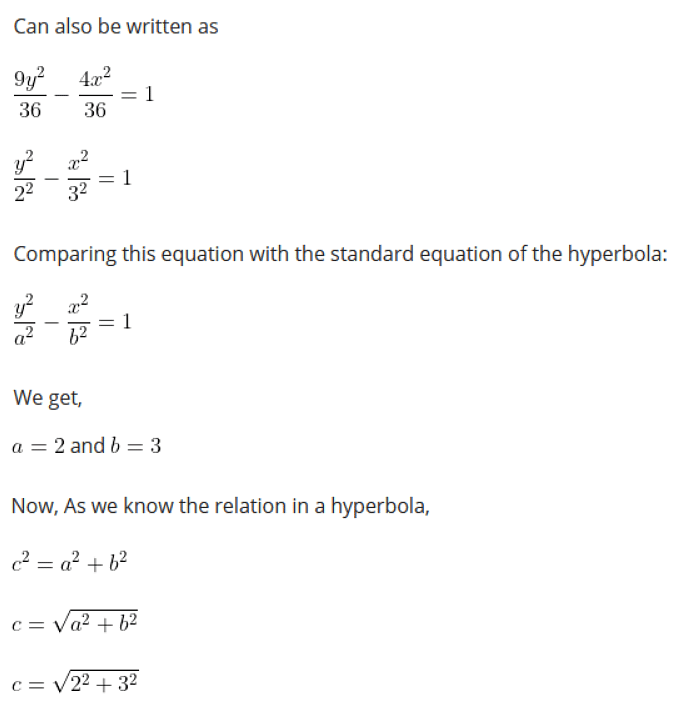
Ques.5: Find the coordinates of the foci and the vertices, the eccentricity and the length of the latus rectum of the hyperbolas. 9y2 – 4x2 = 36 (5 Marks)
Answer: Given a Hyperbola equation,
9y2 – 4x2 = 36

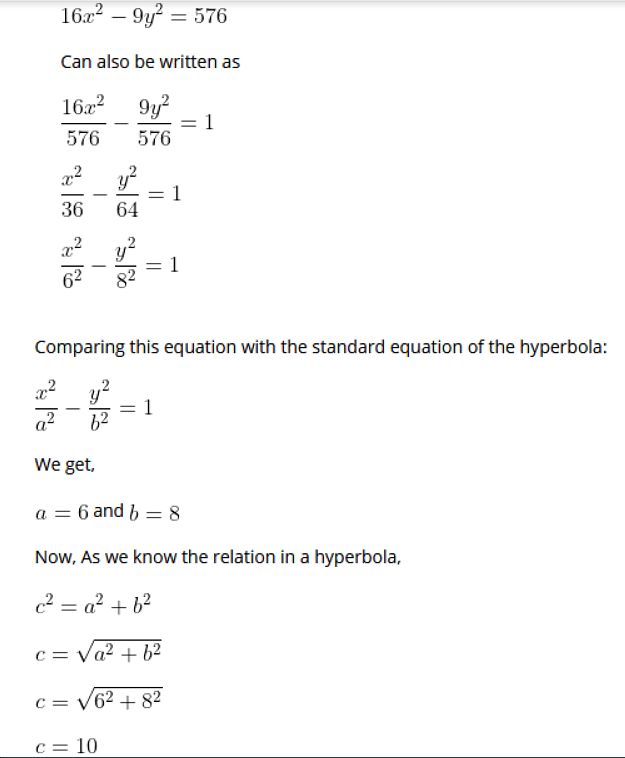
Ques.6: Find the coordinates of the foci and the vertices, the eccentricity and the length of the latus rectum of the hyperbolas. 16x2 – 9y2 = 576 (5 Marks)
Answer:Given a Hyperbola equation,

Also Read:



Comments